














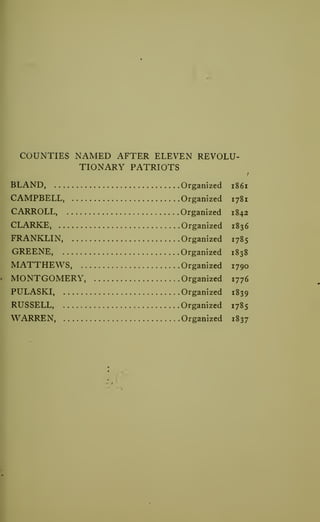

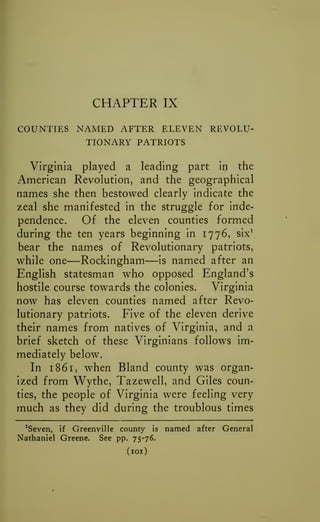













VIRGINIA COUNTY NAMES
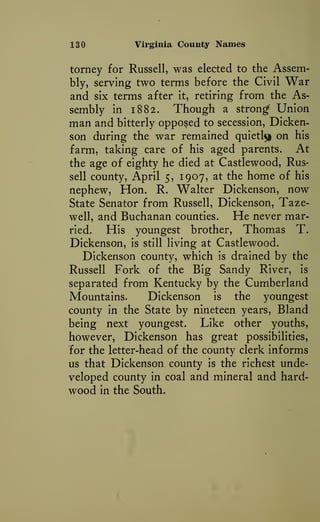
Two Hundred and Seventy
Years of Virginia History
By
CHARLES M. LONG, M.A., Ph.D.
A Native of Virginia and an Alumnus
of her University
New York and Washington
THE NEALE PUBLISHING COMPANY
1908
r
LIBRARY of C(.N6niESS|
Two Gooie-.! Hixiirtved
die 11 
Copyright, 1908, by
Charles M. Long
To 7ny wife, Elizabeth H. Long
CONTENTS
PART I
Introduction
CHAPTER PAGE
I Introduction 17
PART II
Names from Royal English Families
II House of Stuart 27
III The Nine Stuart Counties . . 31
IV The Three Orange Counties . 41
V The Fourteen Hanover Coun-
ties 47
PART III
Other Names from England
VI Thirteen Counties Named After
Prominent Englishmen ... 63
VII Twelve Counties Named After
English Shires 85
VIII A County Named After an Eng-
lish Island 95
PART IV
American Warriors and Statesmen
IX Counties Named After Eleven
Revolutionary Patriots . . loi
10 Virginia County Names
X Counties Named After Seven
Virginians 121
PART V
Virginia Governors and United States
Presidents
CHAPTER PAGE
XI Counties Named After Thir-
teen Virginia Governors . . 135
XII Counties Named After Three
Presidents . 155
PART VI
Indian Names and Natural Features
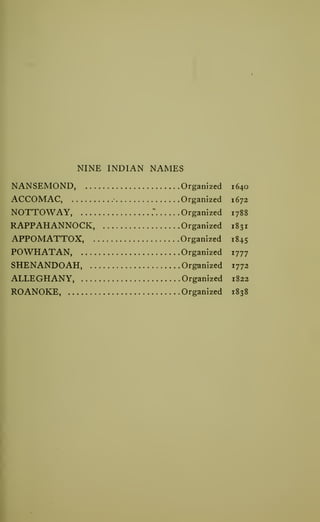
XIII Nine Indian County Names . . 161
XIV Four Names for Natural Feat-
ures ... 173
PART VII
The Jamestown Exposition and Virginia
County Names—Conclusion
XV The Jamestown Exposition and
Virginia County Names . . . 179
XVI Conclusion 187
Appendix 191
I >
_- -33—SS~5Se3
bf
1 1
i
PREFACE
•This books alms to tell how the Virginia
counties got their names, and in telling the
story it endeavors to show that the thoughts
and feelings of the Virginians are reflected in
the names the counties bear.
In the unfolding of this story I have been
impressed, first, by the amount of history sug-
gested by the names; and, second, by the fact
that the naming of the Virginia counties fur-
nishes more material for colonial history than
the county-naming of any other State in the
Union. Of course the history suggested in
this way falls far short of being a history of
Virginia, but it is not too much to claim that
these county-namings are interesting and help-
ful in presenting some parts of the history of
the Old Dominion from a new point of view.
The names are the magnet; the facts of Vir-
ginia history are the iron filings : it has been
my part to put the magnet among the filings.
I have been at much pains in my efforts
to verify the facts herein presented, and when
in doubt I have endeavored to attach to my
statements the exact measure of doubt that
I myself entertained.
12 Virginia County Names
To include all the facts that have a bear-
ing on Virginia county names I have gone
back in Scotch history to 1370; and I have
brought my work up to date by showing that
among the exhibits of the Jamestown Exposi-
tion of 1907 were many honoring men after
whom Virginia counties had been named.
The second part of the title of the book,
"Two hundred and seventy years of Virginia
History," is given because of the fact that,
with reference to Virginia history, I begin
with 1607 and end, as far as the naming of
the counties is concerned, with 1880, when the
youngest county of the State was organized.
The contents indicates the general plan of
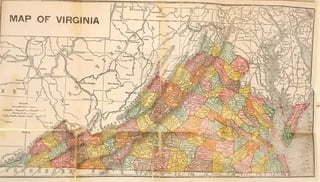
the work. The map of Virginia will be
found useful for reference. The Appendix
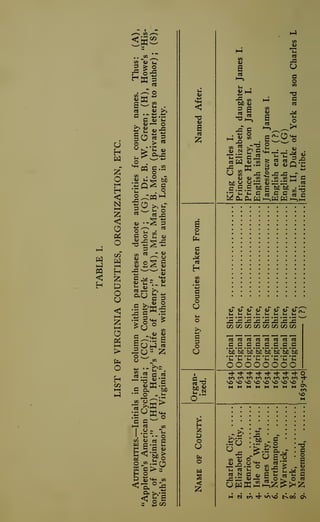
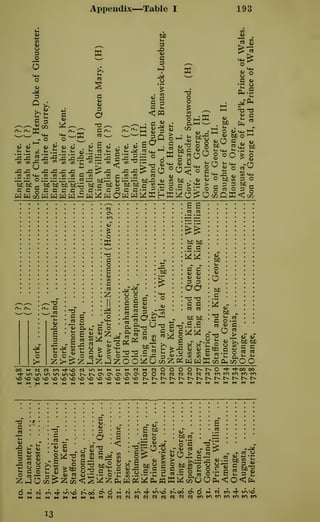
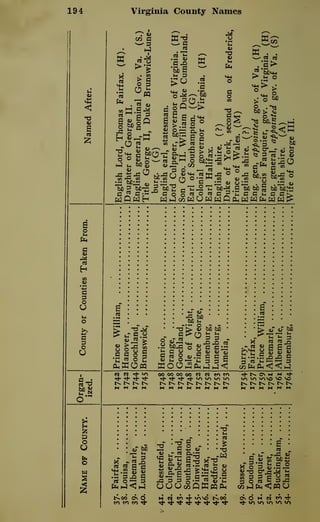
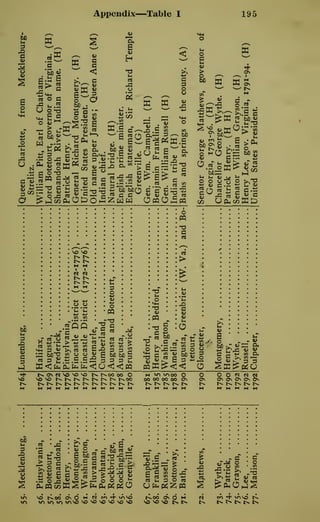
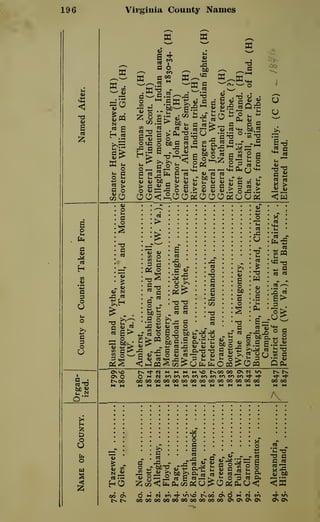
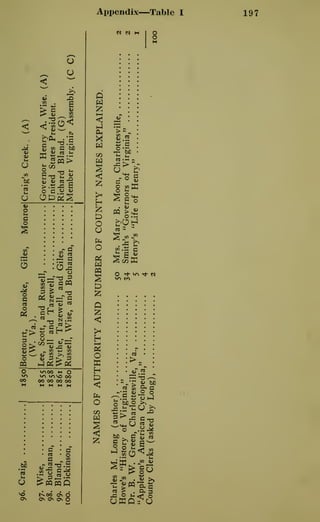
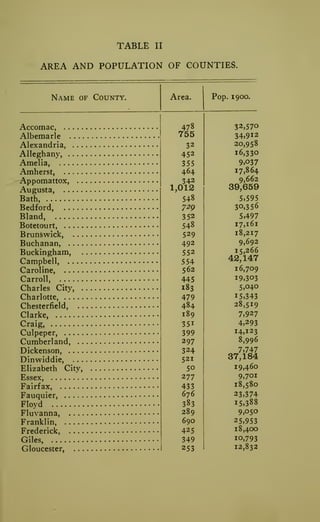
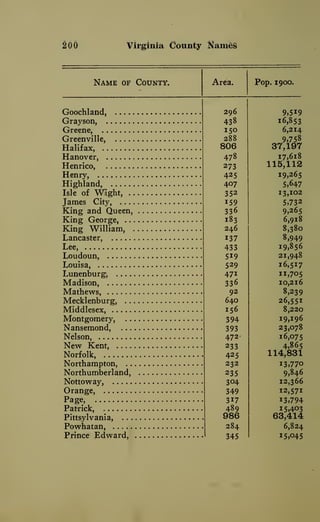
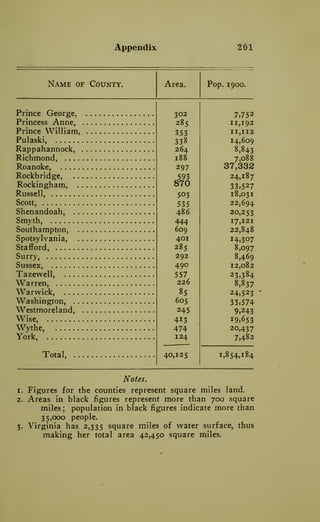
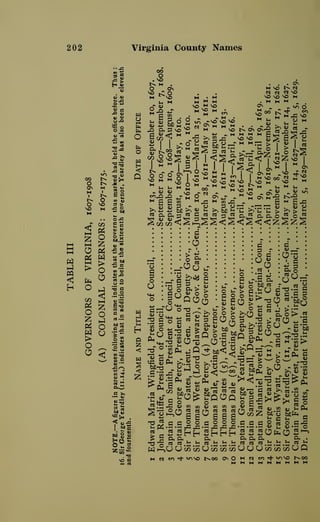
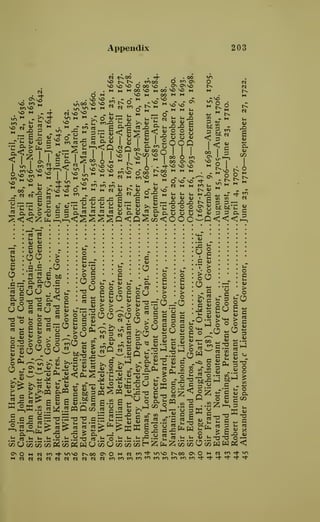
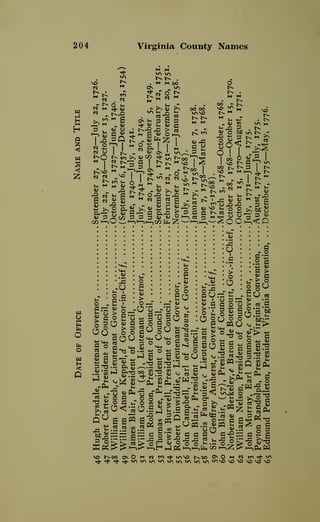
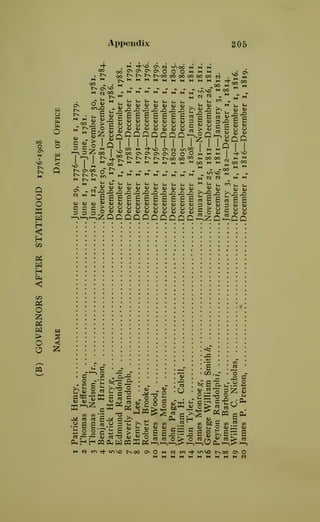
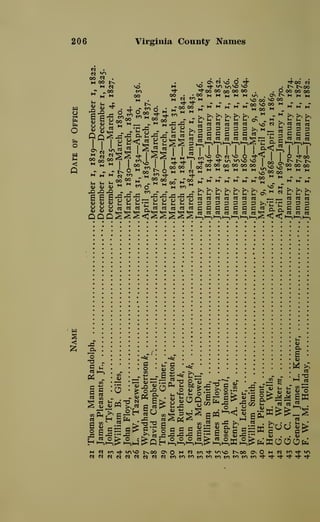
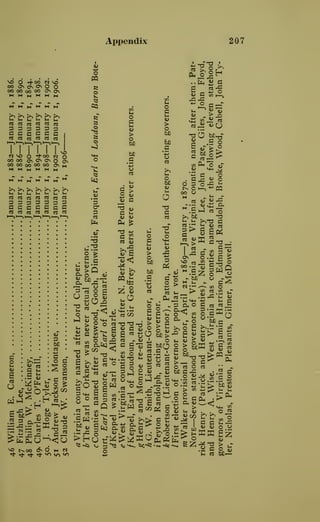
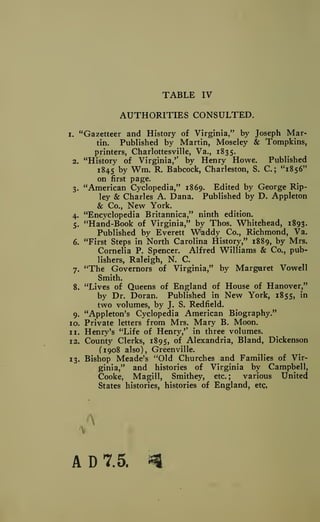
gives four tables : i . A list of Virginia coun-
ties, arranged according to the date of forma-
tion, and giving source of each county name
and the county or counties from which each
county was formed. 2. A list of Virginia
governors, 1 607-1908. 3. Area and popu-
lation of each county, census 1900. 4. List
of authorities consulted in compiling the work.
I acknowledge especial indebtedness to
my wife, who rendered material aid in the
mechanical preparation of the work; to
Preface 13
Dr. B. W. Green, of Charlottesville, Va.,
who, after reading over the manuscript, made
many helpful suggestions; to Mrs. Mary B.
Moon, of Charlottesville, Va.; and to Dr.
Charles W. Kent, of the University of Vir-
ginia, who has encouraged me in presenting
this work to the public.
Charles M. Long.
RUSSELLVILLE, Ky.
PART I
INTRODUCTION
CHAPTER I
INTRODUCTION
The full significance of geographical names
does not appear to the casual thinker; but
to one who asks why and how the names were
given, interesting answers often suggest them-
selves. From the contemplation of the place
that bears his name, we begin to consider
the character and actions of the man from
whom the name may have been derived, and
our thoughts flow easily and swiftly from the
man to his nationality, and from the nation
to the circumstances that gave to the nation
the possession of the place.
Thus, the name St. Petersburg calls up to
most students of geography the Idea of a
great and mighty city, but there the Idea gen-
erally ends. Further Inquiry would have
shown that a Russian sovereign, desirous of
founding a capital worthy of his vast empire,
had struggled against almost Insurmountable
difficulties and had builded the city which. In
Its name, reminds us of the ambition and
power of Peter the Great. Pennsylvania, by
2 (17)
18 Virginia County Names
the name it bears, recalls the worth and in-
tegrity of honest William Penn^ while Vir-
ginia tells us that an English nobleman dis-
covered new and strange lands over the seas;
and that Queen Elizabeth, pleased with the
discovery of her subject, named these lands in
commemoration of her own virgin state.
A name, apart from the circumstances that
give it significance, is but a barren mingling
of letters and sounds. Why, then, should
we prize so dearly the names of objects about
us? Why should we be so unwilling to
change the name of the rose ? It is because the
name has become associated with that which
it represents. The qualities that belong to the
object are reproduced in memory as we name
that object. Valueless in itself, the name
becomes invaluable from the thoughts and
associations that cluster around it.
The value and influence of a name are due
to what the name suggests, as when, for in-
stance, the warrior, in his fierce battle-cry,
clamors for vengeance upon the slayers of
his fallen comrades. "Remember the
Alamo !"^ shouted the enraged Texans as they
^It gets Its name, however, from Penn's father, Admiral
Penn.
^Pronounced Al-amo, and meaning cottonwood tree.
Introduction 1
9
rushed upon the superior numbers of the op-
posing Mexicans. The valor inspired by
their thirst for vengeance was irresistible;
and the cruel slaughter at the Alamo was
avenged by the brilliant victory of San Ja-
cinto, which expelled the hated Mexicans
from Texas soil.
Virginia names can justly claim for them-
selves an unusual degree of interest. In Vir-
ginia was made the first permanent English
settlement in America, and during all the
colonial days Virginia ranked among the
colonies first in territory, in population, and
in political importance. This priority of rank
continued throughout the Revolution, and in
1810 Virginia was still the most populous
State in the Union.
The naming of Virginia counties, combined
with the circumstances that attended the nam-
ing, serves to recall many historical facts, and
so numerous and important are these facts
that the county names form, as it were, a
framework on which hangs much of English
history and more of the history of Virginia.
Furthermore, this framework presents the
facts in a new aspect, and, indeed, probably
brings to light not a few facts that are wholly
new.
20 Virginia County Names
The progress of events in England was
carefully watched by Virginia, and the nam-
ing of a county in a particular year often
serves to record some event of unusual in-
terest to the mother country and to the
colony. Births and marriages in the royal
family of England are thus recorded; re-
corded in this way, too, is the accession of
a new sovereign to the throne, the ministry
then in power, or the success of an English
general or statesman. So, also, after Vir-
ginia became a State, matters and men of
State or national interest furnish to a new
county a name that indicates in itself the trend
of popular sentiment.
The date of the settlement of any particular
locality is often indicated by the name given
to that locality; so, too, the political views
of the residents are exhibited in the character
of the names about them.
In Tidewater Virginia nearly all the coun-
ties bear names taken from places or persons
in England, while in the western part of the
State the vast majority of county names are
of American origin, the names thus showing
that the eastern portion of Virginia was
settled earlier than the western portion. In
the times of the struggle between the Round-
Introduction 2
1
heads and Royalists In England, Virginia
earned for herself the title of ''Old Do-
minion" by her loyalty to the fugitive Prince
Charles.
The story of the county-naming is pre-
eminently a story of colonial Virginia, for
fifty-eight of Virginia's one hundred counties
were named during the colonial era. Fur-
thermore, no State In the Union can begin to
suggest. In the naming of her counties, the
wealth of colonial history thus suggested by
Virginia.
Virginia was the oldest of the colonies, and
Virginia has a larger number of counties that
were named during the colonial times than
any other State. The six New England
States have, taken together, only sixty-seven
counties In all; Pennsylvania has sixty-seven,
and New York has sixty-one. Georgia, de-
cidedly exceeding Virginia In the number of
her counties, and North Carolina, nearly
equaling her, have, both put together, not as
many colonial county names as Virginia. The
remaining four of the original thirteen colo-
nies. New Jersey, Delaware, Maryland, and
South Carolina, have now, In the aggregate,
only eighty-nine counties.
As has been suggested, the long and close
22 Virginia County Names
connection between England and Virginia Is
shown by the large number of county names
taken from the mother country. Twenty-six
of the hundred counties are named in honor
of various royal families of England; per-
haps a dozen are named after English shires f
six are named after colonial governors; and
other names are taken from English generals
and statesmen. Altogether England fur-
nishes fifty-seven per cent, of Virginia county
names.
Nine counties have Indian names, several
are named from their natural features, and
about twenty-five are named In honor of men
that attained prominence on American soil.
^A division of England corresponding to our county.
PART II
NAMES FROM ROYAL ENGLISH
FAMILIES
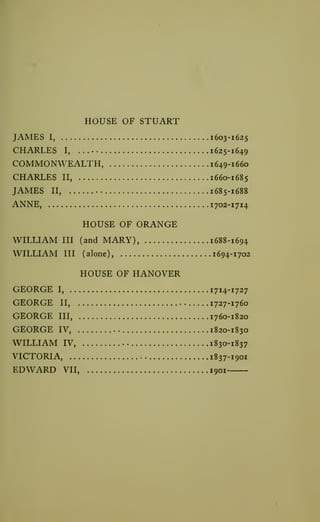
HOUSE OF STUART
JAMES I, 1603-1625
CHARLES I, 1625-1649
COMMONWEALTH, 1649-1660
CHARLES n, 1660-1685
JAMES n, 1685-1688
ANNE, 1702-1714
HOUSE OF ORANGE
WILLIAM III (and MARY), 1688-1694
WILLIAM III (alone), 1694-1702
HOUSE OF HANOVER
GEORGE I, 1714-1727
GEORGE II, 1727-1760
GEORGE III, 1760-1820
GEORGE IV, 1820-1830
WILLIAM IV, 1830-1837
VICTORIA, 1837-1901
EDWARD VII, 1901
CHAPTER II
HOUSE OF STUART
When Jamestown was settled in 1607 by
the English, James Stuart, son of the beauti-
ful but unfortunate Mary Queen of Scots,
sat upon the throne of England. England
and Scotland had just been peacefully united
into one kingdom under him, for he was heir
to the throne of both countries.
The rule of the Stuarts began in Scotland
in 1370 under Robert, the steward of that
country, who then succeeded to the kingdom
with the title of Robert II. The office of
steward, which was hereditary, had long been
held by Robert's ancestors; and from the
office came their family name of "Stuart."
Robert II of Scotland was grandson to Robert
Bruce, who inflicted such a terrible defeat
upon the English at the battle of Bannock-
burn. The House of Stuart had reigned in
Scotland for 233 years, when, in 1603, James
VI of Scotland became also James I of Eng-
land.
The settlers who came to Virginia from
(27)
28 Virginia County Names
England were loyal in their attachment to
the mother country, and they manifested their
devotion by the character of the names they
bestowed on the lands and waters of their
new home. Jamestown itself was so called
in honor of King James I of England. The
river^ that flows by the town was called James
in honor of the same sovereign, while Cape
Charles and Cape Henry bear the names of
two of his sons.
^Its Indian name was Powhatan, in honor of the great
Indian chief.
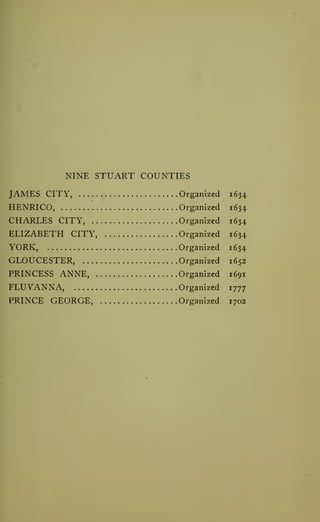
NINE STUART COUNTIES
JAMES CITY, Organized 1634
HENRICO, Organized 1634
CHARLES CITY, Organized 1634
ELIZABETH CITY, Organized 1634
YORK, Organized 1634
GLOUCESTER, Organized 1652
PRINCESS ANNE, Organized 1691
FLUVANNA, Organized 1777
PRINCE GEORGE, Organized 1703
CHAPTER III
THE NINE STUART COUNTIES
In 1634, when Charles I, son of James I,
held the throne of his father, the colony of
Virginia was divided into counties, or shires,
as they were then called. Eight shires were
formed, and five of them bear the names of
various members of the royal family of
England.
James City county was named after James
Clty,^ as Jamtstown was called In 16 19 and
for many years afterward. As has been In-
dicated, the town bore the name of King
James I of England—the king who had the
common or "King James" version of the
English Bible prepared.
Like James City, Henrico county was
named after a town within Its limits. In
161 1 Sir Thomas Dale, with the permission of
acting Governor Thomas Gates, made a set-
tlement of 350 chosen men upon a neck of
land on James River. The place, which was
nearly surrounded by water, he called Hen-
^See p. 198, Martin's "Virginia Gazetteer."
(31)
32 Virginia County Names
rico, in honor of Prince Henry, son of King
James. A county formed twenty-three years
later received the name of the town, and thus
indirectly Prince Henry's name. The Prince
died in 1612, before he had reached his
eighteenth birthday. He was a youth of
great promise, and was heir apparent to the
throne at the time of his death.
In the list^ of towns, plantations, and hun-
dreds for 1 6 19 is Charles City. The place
was almost certainly named after Prince
Charles, afterwards King Charles I of Eng-
land, who was beheaded in 1649 after
a reign of nearly twenty-five years. The
town could not have been named in honor
of Charles II, for he was not born until 1630.
Though I have no data to support me, I as-
sume that Charles City county derives its
name from that of the town, thus receiving,
though indirectly, the name of the king that
reigned at the time the county was formed
—
In 1634.
The naming of Elizabeth City county is
a matter of greater doubt, for, so far as I
can learn, there is no town from which the
county might have been named. It is highly
probable that the county is named, directly
'See J. E. Cooke's "Virginia," p. 115.
Nine Stuart Counties 33
or indirectly, from Princess Elizabeth, daugh-
ter of James I.
In 1 6 13 the princess married Frederick
V, Elector^ Palatine. Frederick was chosen
king of Bohemia in 16 19, but was utterly de-
feated the next year by the army of the
Catholic League, and had to give up both his
electorate and his kingdom.
Elizabeth had thirteen children, several of
whom are of considerable historical impor-
tance : Charles Louis, who was restored to the
electorate at the close of the Thirty Years'
War in 1648; Rupert, the "mad cavalier,"
and Maurice fought for their uncle, Charles
I of England, in the civil war so disastrous
to the royal cause. Sophia married Ernest
Augustus of the House of Brunswick, who
afterwards became Elector of Hanover.
Parliament agreed that Sophia should suc-
ceed Anne as Queen of England, but Sophia
died before Anne. Sophia's son, however,
—
Elizabeth's grandson,—became king of Eng-
land after Anne's death, with the title of
George L
Elizabeth possessed an admirable charac-
^Electors were princes or churchmen who had the power
of electing the emperor of Germany. Electors first met
at Frankfort in 1152. There were seven electors, and
their right to elect was hereditary.
34 Virginia County Names
ten strong and true in adversity, charming
and vivacious in prosperity. She died in her
native England in 1662 at the age of sixty-
five.
The name of Elizabeth City county could
not have come from Princess Elizabeth,
daughter of Charles I, for she was not born
until 1635, one year after the county was
formed and named.
York and Gloucester counties are almost
certainly named after the titles of two of
King Charles Vs sons. York was one of the
original shires, and was formed when James,
Duke of York, was only one year old. Though
the title was not formally bestowed on young
James until 1643, he was, from the first,
called the Duke of York. For a brief period
of its existence York county was known as
Charles River county.
Prince James succeeded his brother Charles
as king of England in 1685, but reigned only
three years. He died an exile in France in
1701.
The first time that the name of Gloucester
county,* which was formed from York, oc-
curs is 1652. King Charles's son, Henry,
*Dr. B. W. Green, quoting Henning's "Statues at Large
for Virginia," Vol. i, p. 371.
Nine Stuart Counties 35
the Duke of Gloucester, was then eleven years
old. Henry died of small-pox at the early
age of twenty; his brother, Charles II, had
shortly before become king.
York and Gloucester counties may possibly
be named after English shires, though It is
most probable that they were named, as in-
dicated, In honor of the dukes of York and
Gloucester. The time of their naming, and
the naming of other counties after members
of the same royal family, heighten this proba-
bility.
Princess Anne and Fluvanna counties are
named after Anne, second daughter of
James II.
This princess was born In 1664, when her
father was the Duke of York. At the ac-
cession of William and Mary to the throne
in 1688, she did not follow her father Into
exile, but adhered to the dominant Pro-
testant party, and remained at the English
court, where her oldest sister was queen.
With the exception of the king and queen,
Anne was probably the most prominent char-
acter at court.
It Is therefore not surprising that, when
King and Queen county was named In honor
of William and Mary In 1691, Princess Anne
36 Virginia County Names
county should have been named after Anne at
the same time.
When nineteen years of age Anne married
Prince George, son of Christian V, of Den-
mark. She had seventeen children, though
only one of them survived infancy, and he
died at the age of eleven. After receiving
due honors in the reign of William and Mary,
she succeeded to the English throne at Wil-
liam's death in 1702, Mary having died be-
fore her husband. Anne's older brother
James, by right of birth, had a prior claim
to the crown, but because he was a Catholic
he was set aside in favor of the Protestant
Anne.
The Virginians testified their loyalty to
Queen Anne by naming Prince George county
after her husband the same year in which she
became queen. The Danish prince was never
given kingly power in England; Anne, like
Victoria, ruled alone.
Anne was twelve years queen. Though
not brilliant, she seems to have won the affec-
tion of her subjects, and was known as the
"Good Queen Anne." She died in 1714 at
the age of fifty.
The James River above where the Rivanna
enters it was formerly called Fluvanna, in
Nine Stuart Counties 37
honor of Queen Anne. The Latin word
fluvius means river; the English name
"Anna" was added to fiuv, the stem of the
Latin word; and thus fliiv-anna, River Anna,
>vas formed. Riv-anna was also named after
Queen Anne; the name is merely a shorter
way of saying River Anna. In 1777 the pres-
ent county of Fluvanna was organized, and
received the name by which the upper James
had been called, thus indirectly receiving
Queen Anne's name. The some time Fluv-
anna River was thenceforth called the James.
The North Anna, South Anna, and Rapidan
rivers are also named after Anne. And in
her honor the capital city of Maryland had
its name changed, in 1691, from Providence
to Annapolis.
Of the nine Stuart-named counties, all ex-
cept York, Gloucester and Princess Anne lie
directly on the James. Elizabeth City, with
an area of fifty square miles, is the smallest
county in the State except Alexandria. It
lies on the north side of Hampton Roads, and
in it is the noted Fort Monroe. James City
county lies between the York and the James,
and is separated from Charles City by the
Chickahominy River. Charles City and
Henrico occupy the peninsula formed by the
38 Virginia County Names
James and Chlckahominy rivers. York
county lies along the south bank of the York
River and adjoins the Chesapeake Bay on the
east. Gloucester's southern boundary is on
the York River; Mobjack Bay bounds it on
the southeast, and the Piankatank River
separates it on the north from Middlesex.
Chesapeake Bay and its tidewater tribu-
taries afford excellent transportation, and the
immense supply of fish and oysters is a source
of great wealth to the counties drained by
these waters.
Princess Anne county lies south of the
Chesapeake Bay on the Atlantic coast; it is
bounded on the south by North Carolina, and
North River, its chief stream, flows into the
North Carolinian Currituck Sound.
Prince George county lies along the south
bank of the James, just across from Charles
City. The Appomattox, Blackwater, and
Nottoway rivers, together with the James,
receive the county's drainage.
Fluvanna is situated between Goochland
and Albemarle on the north bank of the
James, and is nearly bisected by the Rivanna
River.
THREE ORANGE COUNTIES
KING AND QUEEN, Organized 1691
KING WILLIAM, Organized 1701
ORANGE, Organized 1734
CHAPTER IV
THE THREE ORANGE COUNTIES
Three counties of Virginia are named in
honor of the House of Orange, a prominent
royal family of Holland that became con-
nected with England by treaty and by mar-
riage.
King and Queen county is so called in honor
of King William III of England, who was
the Prince of Orange, and of Queen Mary,
who ruled England jointly with her husband/
In 1 70 1, seven years after Mary's death.
King William county was named after Wil-
liam,- who was sole ruler of England during
the eight years in which he survived his wife.
Although William was a prince of Holland,
he was grandson of Charles I of England
through his mother Mary, who was the oldest
daughter of that king. His wife Mary was
his first cousin, for she also was a grandchild
^William and Mary College, chartered in 1692, takes
its name from these sovereigns.
'Williamsburg was named in honor of King William,
and the streets were to have been laid out in the shape
of a W, but this plan was only partly carried out.
(41)
42 Virginia County Names
of Charles I. Thus in William and Mary the
line of Stuarts was indirectly represented on
the English throne.
There is hardly a doubt that the naming
of Orange county in 1734 was a graceful way
of extending congratulations to Prince Wil-
liam of Orange, who married Anne, the oldest
daughter of George II of England, in that
year.
The above explanation of Orange county's
name is original with me, and I adopted it
even before I knew that a county in North
Carolina was named in honor of the House
of Orange. The historian John Fiske, as
I learned in 1900, says without qualification,
that Orange county is named after the House
of Orange.
Two historians of Virginia give a different
explanation of how the county got its name.
Martin's "Gazetteer of Virginia"^ states that
Orange county derived its name from the
color of the soil in the mountainous portion
of the county. Howe's "History of Vir-
ginia,"* which bought the copyright to Mar-
tin's book, follows Martin in saying that the
county was named from the color of the soil.
A number of considerations, besides the au-
'P. 353. *P. 417-
Three Orange Counties 4 3
thority of Mr. Fiske, strengthen my belief
that Orange county was named in comphment
to Prince William of Orange.
The connection between England and the
House of Orange had been long and close.
The family influence of George II determined
several Virginia county names, both before
and after Orange county was named. In
1727 Caroline county was named after
George's wife, Queen Caroline; in 1730
Prince William county received the name of
his son William; in 1738 Frederick and Au-
gusta counties were named after the Prince
of Wales and his wife; in 1742 Louisa
county received the name of a daughter of
George 11. Of the seven counties besides
Orange that were formed during the sixteen
years ending in 1742, five were named after
members of George IPs family. Counties
had been named after both of his sons, after
one son's wife, and also after two of his
five daughters. As there was already a
Princess Anne county, George's oldest daugh-
ter, Anne, had not yet been honored by a
Virginia county name, There was then no
opportunity for bestowing such a distinction,
but in 1734 the occasion offered to honor her
by naming a county after her husband's
44 Virginia County Names
family. It Is hard to believe that Virginia
failed to seize the opportunity.
King and Queen county is south of Essex
and Middlesex, and is separated from King
William on the south by the Mattapony
River. The county Is drained chiefly by the
Mattapony River, partly by the Plankatank.
King William county Is enclosed on all
except its northwest side by the Mattapony
and Pamunkey rivers; Caroline county
bounds it on the northwest.
Orange county, in north-central Virginia,
Is watered by the Rapldan and North Anna
rivers ; its western surface Is broken by moun-
tains. Although its present area is only 349
square miles, Orange county, at its formation
one hundred and seventy-four years ago, com-
prised all of Virginia west of the Blue Ridge.
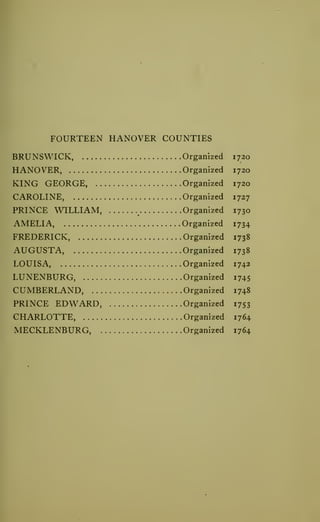
FOURTEEN HANOVER COUNTIES
BRUNSWICK, Organized 1720
HANOVER, Organized 1720
KING GEORGE, Organized 1720
CAROLINE, Organized 1727
PRINCE WILLIAM, ^ Organized 1730
AMELIA, Organized 1734
FREDERICK, Organized 1738
AUGUSTA, Organized 1738
LOUISA, Organized 1743
LUNENBURG, Organized 1745
CUMBERLAND, Organized 1748
PRINCE EDWARD, Organized 1753
CHARLOTTE, Organized 1764
MECKLENBURG, Organized 1764
CHAPTER V
THE FOURTEEN HANOVER COUNTIES
At Queen Anne's death, in 17 14, the
House of Hanover came Into peaceful posses-
sion of the English throne. This line of
sovereigns was so called because the Ger-
man province of Hanover, with its various
duchies, became subject to the English crown
when George, the Elector of Hanover, be-
came also ruler of England. Hanover re-
mained a part of the British kingdom until
1837, when Victoria became queen of the
English. It then became independent of
England, for, by the German law of succes-
sion, no female could reign in Hanover.
Fourteen Virginia counties bear names per-
taining to the family of Hanover, and, as
might be expected from early settled coun-
ties, most of them are in the eastern part of
the State. They were all named within a
period of forty-five years, beginning in 1720
and ending in 1764. After the latter date
names associated with American independence
begin to be prominent among the Virginia
counties.
(47)
48 Virginia County Names
Brunswick, Hanover, and King George
counties, all three named in 1720, bear em-
phatic evidence of Virginia's loyalty to the
home government in England. Hanover
and Brunswick are named in honor of the
House of Hanover and the House of Bruns-
wick respectively, though of course the
families derived their names in the first case
from the German province of Hanover, and
in the second case from the duchy of Bruns-
wick, which formed a part of Hanover. King
George county bears the name of the king
himself, George I, who ruled over England
and Hanover from 1714 to 1727.
In 1727 George II succeeded his father as
king, and during the thirty-three years of his
reign nine Virginia counties were named in
honor of various members of the royal family.
The king's wife, two sons, two daughters, a
grandson, a son-in-law, and a daughter-in-
law were thus complimented. Moreover, an-
other county, Lunenburg, was named in honor
of the king himself, for one of the king's titles
was duke of Brunswick-Lunebiirg, Lune-
biirg being the German form of Lunenburg.
Caroline county was formed in 1727, the
first year of George II's reign, and derived its
name from the new sovereign's wife. Queen
Fourteen Hanover Counties 49
Caroline. Caroline was a woman of char-
acter and ability, and exercised considerable
influence on English politics during the ten
years that she lived after becoming queen.
Two counties are named in honor of
Prince William Augustus, Duke of Cumber-
land and favorite—though not the oldest
—
son of George II. When the prince was
only nine years old Prince William county
received his name, in 1730. Eighteen years
later, when William was commander-in-chief
of the British army,^ Cumberland county was
named in honor of the duke, in this instance,
however, taking his title for that purpose.
The duke had won great popularity by his
decisive victory over the *'Young Pretender"
at Culloden in 1746, and a triumphal demon-
stration was made at Norfolk, Va., in honor
of the victory. England rewarded Prince
William with an annual pension of £40,000,
or about $200,000, in gratitude to him for
^Dr. B. W. Green, an authority on matters of Virginia
history, supports me in this explanation of the name of
Cumberland county in Virginia. Spencer's "North Caro-
lina History" says that a North Carolina county was
named after the duke in 1754. The "American Cyclo-
pedia" says that Cumberland county, Pennsylvania, was,
in 1750, named after the shire of that name in the north-
west of England.
50 Virginia County Names
destroying forever the hopes the Stuarts may
have entertained of gaining the Enghsh
crown. The duke's subsequent military
career, however, was quite unsuccessful. On
his return from an unfortunate war in Han-
over he resigned from the army, and was not
again given office. He died in 1765.
The county of Amelia was organized in
1734, and takes its name from Amelia Sophia,
second daughter of George II. The county
of Orange was named in the same year to
honor King George's son-in-law, the Prince
of Orange, who had just married Anne, the
king's oldest daughter. The accomplished
and imperious Amelia never married. The
princess was addicted to the habit of taking
snuff, and on her snuff-box was inscribed,
*^Noli me tangere^^ (Don't touch me). An
old army officer once disregarded the injunc-
tion and helped himself to some snuff from
Amelia's snuff-box, whereupon the indignant
Amelia had the remainder of the contents of
the box cast into the fire. She was born in
171 1, and lived through the entire reigns of
her grandfather and father, and her nephew,
George III, had been twenty-six years king
when she died—in 1786.
Louisa county was named in 1742 in com-
Fourteen Hanover Counties 51
pliment to Princess Louisa, the fifth and
youngest daughter of George II, and was
then a graceful, talented and amiable young
lady of eighteen. She married Frederick V
of Denmark the next year, and died in 175 1,
at the age of twenty-seven.
Frederick and Augusta counties were
named in 1738 in honor of the Prince of
Wales and his wife, who had just become the
happy parents of a son. Twenty-two years
later this son succeeded his grandfather as
king of England, with the title of George III.
Frederick himself died in 175 1, during his
father's reign, and so never became king.
The city of Fredericksburg in Spotsylvania
county was founded in 1727 and named after
Prince Frederick, when the prince was twenty-
one years old.
Frederick's character was full of contra-
dictions, and his faults were neither few nor
small; but he was a friend to authors, and
he encouraged painting. He even attempted
poetry himself, and most of his verse, which
was wretched, was written in praise of his
wife. Augusta's intelligence, her kindness,
and her virtue, at a time when license and
immorality abounded, deserved the efforts of
a better poet.
52 Virginia County Names
Augusta was only seventeen when the royal
yacht, JVilliam and Mary, carried her from
her home in Saxe-Gotha to become the bride
of Frederick, Prince of Wales, in 1736. As
has been said, Augusta herself never became
queen of England, but from her have de-
scended all the sovereigns of England since
her day. Victoria was her great-grand-
daughter, and thus Edward VII is her great-
great-grandson. Augusta lived to see Eng-
land attain a greater tide of power than she
had ever before reached, and she died before
the ebb set in: immense possessions had just
been wrenched from France in North
America, and the foundations of Britain's
power had been securely laid in India. It
was in 1772, just before the tyranny of
George III had lost to England the greater
part of her North American possessions, that
Augusta died.
Edward Augustus, second son of Frederick,
Prince of Wales, was fourteen years old when
Prince Edward county was named after him
in 1753. During the splendid and elaborate
marriage of King George III to Queen Char-
lotte in 1 76 1, Edward proved very helpful
to his royal brother by his kindly tact. The
prince, who seems to have been of a witty and
Fourteen Hanover Counties 53
sunshiny disposition, was created Duke of
York. He never married, and died in 1761,
at the age of twenty-eight.
When the Virginians formed a new county
from Brunswick in 1746, they realized that,
although the reigning king's wife and various
members of the royal household had been
honored in naming Virginia counties, no such
honor had been paid directly to the king him-
self.
The name King George had already been
given in honor of George I, and Prince
George was not suitable for a king, besides,
there was already a Prince George county.
But the supply of titles by which George II
could be called was not yet exhausted, and
accordingly the new county received the name
of Lunenburg, the English rendering of the
German Liineburg, for George II, as well as
his father, George I, was Duke of Bruns-
wick-Liineburg. This name seems especially
appropriate when we consider that Lunenburg
county was taken directly from Brunswick.
Liineburg and Brunswick were at one time
separate duchies, but In George II's time they
constituted a single duchy, Brunswick-Liine-
burg, and were a part of the kingdom of
Hanover.
54 Virginia County Names
The State of Georgia bears the name of
George II.
Three Virginia counties were named to
honor George I, ten to honor George II, and
two to honor George III, and both of the
last were namecl in comphment to Queen
Charlotte, wife of George III. Both coun-
ties were taken from Lunenburg, and both
were formed in 1764. Charlotte county
takes its name directly from Queen Charlotte.
Mecklenburg also is named in honor of the
queen, but indirectly so, for its gets its name
from the German duchy, or rather grand-
duchy, of Mecklenburg^-Strelitz, from which
Charlotte came, and of which her brother was
the duke. Charlottesville, Va., was founded
soon after Charlotte became queen, and was
named in her honor.
Charlotte Sophia, sister of the Duke of
Mecklenburg-Strelitz, married young King
George III in 1761, and was fifty-seven years
queen of England. Fifteen children sprang
from this marriage, and all but two grew up.
There were nine sons and six daughters; the
aggregate age of the sons was 494 years; of
"The German duchy of Mecklenburg is divided into
the two grandduchies of Mecklenburg-Strelitz and Meck-
linburg-Schwerin.
Fourteen Hanover Counties 55
the daughters, 371 years. The average age
of the fifteen children was ^6 years and 8
months; twelve attained the age of 50 years,
ten of these reached 60 years, eight attained
70 years, and two lived to be 80. The aver-
age age of George III and 'Queen Charlotte
was over 75 years.
Brunswick, Mecklenburg, Lunenburg, and
Charlotte counties are situated together in
southern Virginia, just east of the center, and
are watered by North Carolina streams.
Prince Edward lies north of Charlotte and
Lunenburg, and is drained chiefly by Appo-
mattox waters. Amelia and Cumberland, to
the northeast of Prince Edward, are sepa-
rated from each other by the Appomattox
River; Willis River drains a large part of
Cumberland county. Hanover separates
Louisa county from Caroline. The North
Anna and South Anna rivers drain Louisa,
flow southeast, and, together with the Pa-
munkey and Chickahominy, also drain Hen-
rico. Caroline is watered by the Rappahan-
nock, Mattapony, and North Anna rivers.
King George lies on the opposite side of
the Rappahannock from Caroline, and has
the Potomac on its northern boundary.' Prince
William, also adjacent to the Potomac, has
56 Virginia County Names
the now famous stream of Bull Run on a part
of its northern border, while the village of
Manassas is within its territory.
Frederick, in the Shenandoah Valley, is
the most northern county in the State; while
Augusta, also in the Valley, is the largest
county in Virginia.
Mecklenburg county is justly famed for its
wonderful mineral springs.
The nine counties named after the Stuarts,
though small in area, are rich in historical as-
sociations. James City county contains
Jamestown, which was the colonial capital
until it was burned in Bacon's Rebellion in
1676; and it also contains Williamsburg,
which became the capital in 1699, and so con-
tinued until it was succeeded by Richmond, in
1779. Henrico owes much of its historical
interest to its chief city, Richmond, the capi-
tal of the State and also of the Confederacy
during most of the Civil War of 1861-65.
President Tyler died in Richmond, and Presi-
dent Monroe is buried there, in the beautiful
Hollywood cemetery. It seems rather strange
that Charles City county, which contains only
183 square miles, should have been the birth-
place of William Henry Harrison and of
John Tyler, who became President and Vice-
Fourteen Hanover Counties 57
President respectively of the United States In
1 841. Tyler became President a month later,
at Harrison's death.
Orange Is probably the most Interesting
historically of the three counties named after
the House of Orange. In Orange President
Madison died, and there President Taylor
was born.
Among the Hanover counties, Hanover
Itself gave birth to Patrick Henry and to
Henry Clay. King George was the birth-
place of President Madison. Prince William
county makes the old Confederate soldier
thrill with pride as he remembers the two bril-
liant victories of First and Second Manassas.
PART III
OTHER NAMES FROM
ENGLAND
THIRTEEN COUNTIES NAMED AFTER PROMI-
NENT ENGLISHMEN
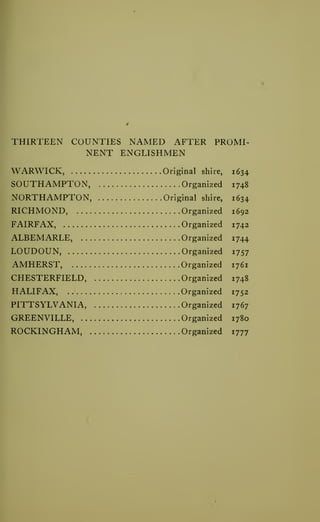
WARWICK, Original shire, 1634
SOUTHAMPTON, Organized 1748
NORTHAMPTON Original shire, 1634
RICHMOND, Organized 1692
FAIRFAX, Organized 1742
ALBEMARLE, Organized 1744
LOUDOUN, Organized 1757
AMHERST, Organized 1761
CHESTERFIELD, Organized 1748
HALIFAX, Organized 1752
PITTSYLVANIA, Organized 1767
GREENVILLE, Organized 1780
ROCKINGHAM, Organized 1777
CHAPTER VI
THIRTEEN COUNTIES NAMED AFTER PROMI-
NENT ENGLISHMEN
Eleven Virginia counties, and more prob-
ably thirteen, are named in honor of various
prominent Englishmen that lived during the
days when Virginia was a colony. With re-
gard to the naming of Richmond and Green-
ville counties, there attaches considerable
doubt; hence I have adopted the explanation
that seems to me most probable.
Assuming that all thirteen of the counties
were named as I suppose, the explanations
will be as follows : two counties, Warwick and
Southampton, were named after two English
earls, members of the London Company for
Virginia; Northampton is named after an
English earl killed in fighting for King
Charles I ; Richmond county takes the name
of an English duke; Fairfax is named in
honor of an Englishman who owned extensive
tracts of land in Virginia; Albemarle, Lou-
doun, and Amherst counties are named after
English generals; and Chesterfield, Halifax,
(63)
64 Virginia County Names
Pittsylvania, Greenville, and Rockingham re-
produce the names of English statesmen.
Warwick county, one of the original shires
and at first called Warwick River county, is
named after Robert Rich,^ the second Earl
of Warwick, who was a prominent member
of the London Company for Virginia. Rich
obtained celebrity in the Civil War, was ad-
miral for the Long Parliament, and enjoyed
the confidence of Cromwell. He died in
1659, the year before the monarchy was re-
stored.
Southampton county derives its name indi-
rectly from Henry Wriothesley, third Earl
of Southampton;^ for the "hundred" of
Southampton, a division of the colony smaller
than the county, was named in the earl's
honor while he was treasurer for the London
Company. The county itself did not receive
the earl's name until 124 years after his
death.
Wriothesley is said to have been especially
active in procuring for Virginia the first char-
ter of the London Company; and the second
^Dr, B. W. Green is authority for this, though I had
already thought it probably the origin of the county name.
^Dr. Green says the county is named after the earl ; so
also Bishop Meade. I had already learned that the "hun-
dred" took the earl's name,
Thirteen Named After Englishmen 65
charter of the company made him treasurer,
which then virtually meant governor, for the
company. He held this office until the com-
pany was dissolved in 1624. A few months
later he died of a fever that was contracted
while he was engaged in an expedition
against the Dutch. The Earl of Southamp-
ton, to whom Shakespeare dedicated "Venus
and Adonis" and the "Rape of Lucrece," is
the only man from whom Shakespeare ac-
knowledeges having received a benefit. A
son of Shakespeare's friend became the fourth
Earl of Southampton, and was Treasurer of
England during the first seven years of
Charles IPs reign.
Northampton county was one of the eight
original shires into which Virginia was di-
vided in 1634. Its name until 1642-43 was
"Accawmacke," called from the name of an
Indian tribe that lived on the "Eastern
Shore," which is that part of Virginia lying
between the Chesapeake Bay and the Atlantic
Ocean, and containing the counties of Acco-
mac and Northampton. The county name of
Accomac was revived in 1672, when North-
ampton county was divided, and the northern
part called Accomac.
The Eastern Shore county of "Accaw-
66 Virginia County Names
macke" doubtless had its name changed in
1643 'to honor the memory of a brave Roy-
alist, Spencer Compton, second Earl of
Northampton, who that year gave his life in
the cause of King Charles I. This explana-
tion of the name is original with me, but the
enthusiastic loyalty of the Virginians to the
royal cause and the fact that the name was
changed at a time when the colonists would
be wanting to show their loyalty, make it al-
most certain that the death of the earl and
the naming of the county in the same year
stand in the relation of cause and effect.
Spencer Compton,^ second Earl of North-
ampton, born in May, 1601, a partisan of
Charles in his struggle with Parliament, served
actively in the royal army, and, while com-
manding the royal troops, was killed at the
battle of Hopton Heath, March 19, 1643.
It is interesting to note that the North
Carolina* county of Northampton was named
in 1 74 1 in honor of George, probably the
fourth Earl of Northampton. Spencer
Compton, third son of the third Earl of
Northampton, was created Viscount Pevensy
and Earl of Wilmington in 1730—^whence
^"Century Cyclopdia of Names."
*Spencer's N. C. History, appendix.
Thirteen Named After Englishmen 67
probably the name of the city of Wilmington,
North Carolina.
Of course the county of Northampton in
Virginia could have been named after the
English shire of the same name, and a writer
In the Virginia Magazine of History and
Biography^ gives this origin of the name.
He states that the name is said to have been
changed from Accomac in honor of Colonel
Obedience Robins, who was from Long-
buckie, in Northampton, England.
As has been said, the origin of Richmond
county's name is very doubtful. There is no
English shire after which it could have been
named. The beautiful city of Richmond^ on
the Thames gave the name to the present cap-
ital of Virginia, but there is no reason to be-
lieve that the Virginia county got is name
from the English city. There remains the
possibility that the county may take the name
of some English Earl or Duke of Richmond,
living, or in public remembrance, at the time
the county was named.
Such a nobleman was Charles Lennox, first
Duke of Richmond and a natural son of King
^Vol. ix., No, I, p. 94; reference through Dr. B. W.
Green.
^Howe's "Virginia," p. 305.
68 Virginia County Names
Charles II. The duke was born in 1672,
and was therefore twenty years old when, In
1692, the old county of Rappahannock was
divided into the two new counties of Rich-
mond and Essex, and itself ceased to exist.
The present county of Rappahannock has no
relation to the former one, except that it bears
the same name.
Macaulay, in his "History of England,"
relates that King Charles on his death-bed
parted with peculiar tenderness from the
Duke of Richmond. At the Revolution of
1688 Richmond went to Paris in the service
of the fugitive James, but later, changing
both his politics and his religion, he became
reconciled to King William and entered the
Church of England. William's wife was a
daughter of James, and Anne, another daugh-
ter, was, with the exception of the king and
queen, probably the most prominent charac-
ter at court. In 1691 a county had been
named after the king and queen jointly and
another county had received Princess Anne's
name.. It seems, therefore, not unlikely that
the county of Richmond, formed in 1692, re-
ceived the name of the Duke of Richmond,
who was so closely connected with the royal
family of England, and whose reconciliation
Thirteen Named After Englishmen 69
with the king doubtless attracted the attention
of the colonists in Virginia. I do not, un-
fortunately, know the date of the reconcilia-
tion, but, as the duke was "an unprincipled
adventurer,"" he most likely had gone over
to William before 1692. Richmond died in
England in 1723.
In connection with the Virginia county, it is
interesting to note that the North Carolina
county of Richmond, formed In 1779, was
named after Charles Lennox, third Duke of
Richmond (and probably a grandson of the
first Duke of Richmond), who was a friend
of the colonies In the English Parliament.
A descendant of the first Duke of Richmond
was Governor-General of Canada for some
years during the latter part of the nineteenth
century.
Thomas, the sixth Baron of Fairfax, was
born In England in 1691, and died In 1782
at his large country mansion, "Greenway
Court," twelve miles from Winchester, Va.
He came to Virginia in 1739, but soon re-
turned to England. In 1742, during his ab-
sence from Virginia, a part of his estates was
organized Into a county and named Fairfax
In his honor. In 1745 Lord Fairfax settled
^"Century Cyclopedia of Names," under Charles Lennox.
70 Virginia County Names
permanently on his Virginia lands. Sixteen
of the present counties of the State^—Lan-
caster, Northumberland, Richmond, West-
moreland, Stafford, King George, Prince Wil-
liam, Fairfax, Loudoun, Fauquier, Culpeper,
Clarke, Madison, Page, Shenandoah, and
Frederick—and the seven West Virginia
counties of Hampshire, Hardy, Morgan, Ber-
keley, Jefferson, Grant, and Mineral, be-
longed to the cultivated and hospitable old
bachelor.
Lord Fairfax employed young Washing-
ton to make surveys on his vast domain, and
the two men formed a strong and lifelong
friendship for each other. Sir Thomas's
home was often the resort of guests, and
his friendliness and generosity made him uni-
versally esteemed. During the Revolution
he remained loyal to George III, but neither
American nor Briton would harm the prop-
erty of the genial old gentleman.
Albemarle county, organized in 1744, was
named after William Anne Keppel, second
Earl of Albemarle, who had been appointed
Governor-in-chief of Virginia seven years be-
fore. The earl never occupied the govem-
^Footnote, p. 236, Howe's "Virginia History." Grant
and Mineral counties in West Virginia have been organ-
ized from Hampshire and Hardy since Howe wrote.
Thirteen Named After Engllsliinen 71
or's chair, and Virginia was under deputy
governors during the seventeen years that he
was nominally her chief executive.
Keppel was born in England in 1702; at
fifteen years of age was made captain in the
English army, and was successively promoted
for meritorious conduct until 1743, when he
became Lieutenant-General. His excellent
military record doubtless led to his being
made governor of Virginia.
The Earl of Loudoun and General Am-
herst, prominent officers of the French and
Indian War, were his successors in the guber-
natorial office, though, like Keppel, neither of
them actually performed the functions of that
office. Lord Albemarle had a fine figure and
courtly manners, but his habits were so ex-
travagant that he was kept heavily in debt.
He died in Paris at the age of fifty-two.
Keppel must not be confused with General
George Monk, Duke of Albemarle, who re-
stored the Stuarts to the throne in 1660. The
duke was one of the eight original grantees of
Carolina, and his name still lives in the North
Carolina Albemarle Sound.
In 1757, when Loudoun county® was
formed, Lord Loudoun was commander of
*There is a Loudon county, Tennessee, and the Vir-
ginia county is sometimes incorrectly spelled without the u.
72 Virginia County Names
the British troops in America, and hence his
name is given to one of the fairest of Vir-
ginia counties. Loudoun had been appointed
governor of Virginia in the same year, but his
military duties in the North prevented him
from assuming the office. He proved, how-
ever, an utterly incompetent general. After
he had left northern New York almost de-
fenseless in order to increase the army he was
leading against the strong French fortress at
Louisburg, the enemy gained important suc-
cesses on the unprotected frontier. Loudoun's
efforts resulted in no advantage to the Brit-
ish, for he did not deem his forces strong
enough to carry on the siege, and so the
English retired from Louisburg without ac-
complishing anything.
Very different was the military career of
General Amherst, whom Pitt, the new Eng-
lish Prime Minister, appointed in Loudoun's
place in 1758. Louisburg was soon taken,
and the English arms were nearly every-
where successful. The fall of Quebec in
1760 virtually ended the war, and, by the
terms of the treaty of peace made in 1763,
the French yielded to the English all their
territory in North America except several
small islands near Newfoundland. Am-
Thirteen Named After Englishmen 73
herst county's name, which was given in 1761,
fairly indicates the joyful pride that Virginia
felt in the successful general. Amherst was
appointed governor of Virginia in 1763, but
he did not assume the office, and hence Fau-
quier continued to serve.
In 1748, when the Earl of Chesterfield had
just ended his brilliant public career in Great
Britain, the Virginia county was named in his
honor. The earl had been many years both
in the House of Commons and in the House
of Lords, but his greatest political success
was his able administration as Lord-Lieuten-
ant of Ireland. His courtly grace and pol-
ished dignity made "Chesterfield manners"
proverbial; and to say that one is a "regular
Lord Chesterfield" is merely an emphatic
way of affirming a complete fulfilment of the
laws of etiquette. Chesterfield lived twenty-
five years after his retirement to private life,
and spent much of his time in correspondence.
His letters, ^^ like his manners, are models of
style.
In 1749 the English Earl of Halifax
founded in Nova Scotia the famous seaport
'"Chesterfield's letters are valuable also as original
sources of history. They give an inner picture of court
life and of the royal family.
74 Virginia County Names
city that bears his name. The county that
contains the city is also called Halifax, in
honor of the earl. Three years later Vir-
ginia followed Nova Scotia's example by or-
ganizing a Halifax county also. In 1758
North Carolina, too, named a county after
the Earl of Halifax.
William Pitt, Earl of Chatham, was hardly
surpassed in popularity or influence by any
English statesman of the eighteenth century,
though William Gladstone held nearly the
same place in English hearts in the nineteenth
century that William Pitt did 140 years ago.
Nearly half of Pitt's seventy years of life was
spent in public service, and the successful
termination of the war in Canada in 1763
was due to his sound judgment in the choice
of generals. Pitt's part in securing the repeal
of the odious Stamp Act of 1766 was so well
known that the General Assemblies of Massa-
chusetts and Virginia gave him a vote of
thanks for his efforts in their behalf. The
grateful Virginians named Pittsylvania
county after him the next year, and its county
seat is called Chatham, from the earl's title.
The city of Pittsburg in Pennsylvania is also
named after William Pitt.
Greenville (sometimes spelled Green-es-
Thirteen Named After Englishmeii 75
vllle) county was formed in the latter part of
1780. I am divided between two explana-
tions of the name, as it may come either from
Sir Richard Temple Grenville, sometimes
spelled Greenville, a brother-in-law of Wil-
liam Pitt, or from General Nathaniel Greene,
of Revolutionary fame. Both explanations
have much to recommend them, and while I
credit the name to the English nobleman, I
regard it equally as probable that it should be
credited to the Revolutionary patriot.
A sketch of General Greene is given else-
where," and a few words must suffice here.
After ably fulfilling the duties of quarter-
master-general of the Revolutionary army for
two years, Greene was transferred to the com-
mand of the army in the South in the autumn
of 1780. In October of that year he had
presided over the tribunal that convicted the
brave but unfortunate Andre. At the time
that Greenville county was formed, the name
of General Greene was already loved and
honored in the South, and his movements
were eagerly and anxiously watched by the
patriotic Virginians. What Greene did or
failed to do was going to mean much to the
South and to Virginia, much to the very ex-
Pp. 113-114.
76 Virginia County Names
istence of the nation. What man could Vir-
ginia at that time more fittingly honor in the
naming of a new county ?^^
Sir Richard Temple Grenville was born in
171 1, and after an active life in politics, dur-
ing which he showed himself to be a friend
to liberty, he died in 1779, one year before
the Virginia county of Greenville was formed.
He was a brother-in-law of William Pitt,
who had died in 1778, and was a patron of
John Wilkes, the English politician and po-
litical agitator who became a popular hero by
his fearless attacks on the English ministry
and King George III. Wilkes, after being
several times elected to Parliament and kept
from taking his seat on the ground that he
was ineligible, was elected and seated in 1774,
and continued in Parliament until 1790. In
1777 Wilkes county. North Carolina, was
named after the English friend of liberty.
In addition to his connection, private and po-
litical, with William Pitt, so highly esteemed
in the colonies, and his friendship for John
Wilkes, Grenville was supposed by many to
have been the author of the "Letters of Ju-
nius," that were such masterly attacks on the
^^The county clerk of Greenville, 1895, unhesitatingly
said that the county was named after General Greene.
Thirteen Named After Englishmen 77
English government at a time when the col-
onies were feeling the weight of English op-
pression.
The probability that the Virginia county
was named after Sir Richard Grenville is
heightened by the fact that North Carolina,
in 1777, named three counties, Burke, Cam-
den, and Wilkes, after English friends to the
colonies, and in 1779 named Richmond
county after another English friend.
The chief objection to the theory that
Greenville county is named after General
Greene is that the county is named Greenville,
and not Greene. A further objection is the
fact that in 1838 Virginia named Greene
county in honor of the Revolutionary patriot,
which she would hardly have done if one Vir-
ginia county were already named after
Greene. It is, of course, possible that the
older county was named in honor of the gen-
eral, and that this fact was forgotten or over-
looked when the new county was named.
The Marquis of Rockingham, after whom
the Virginia county was named in 1777, was
far inferior to William Pitt in ability; yet,
as the leader of the liberal party among the
aristocrats in England, he proved himself to
be the true friend of America. He was
78 Virginia County Names
Prime Minister of England in 1765-66, and,
from that time, headed the opposition to the
war ministry of Lord North. In 1782, when
the party in favor of making peace with
America came into power, Rockingham be-
came Prime Minister again, but died a few
months after assuming the office.
These thirteen counties are pretty widely
scattered throughout the State. Loudoun
and Fairfax are the most northern of them,
and are watered by Potomac streams. Fair-
fax is rendered more attractive when it is re-
membered that Mount Ve'rnon, the home and
burial place of Washington, is within its bor-
ders. At Oak Hill in Loudoun county is the
home where President Monroe resided for
part of the time after his retirement from the
Presidency.
Rockingham Is a large county that lies be-
tween the Blue Ridge and Great North moun-
tains In the Shenandoah Valley, and it Is
drained by waters that enter the beautiful
Shenandoah River.
Albemarle, In north-central Virginia, has
beautiful mountain and river scenery. In this
county Is Charlottesville, which contains the
University of Virginia. This institution,
which was founded by Thomas Jefferson, has
Thiileen Named After Englislimen 79
long held the first place among Southern unir
versitles. Jefferson was bom In Albemarle,!
and also died there; and near Charlottesville

Is Montlcello, his home and burial place. Al-
bemarle produces excellent grapes, and the
"Albemarle pippin" Is probably more widely
and favorably known than any other apple.
In 1842, when Mr. Andrew Stevenson, a
citizen of Albemarle county, represented the
United States at the English court, he caused
several barrels of Albemarle pippins to be
presented to Queen Victoria. ^^ From that
time until her death the pippin was the apple
eaten at the Court of St. James' ; and It may
be that King Edward keeps up the custom
of his mother. At any rate, the pippin has
a wonderful popularity In England now.
Mr. C. E. Sydnor, the Richmond fruit ex-
pert, received, In the summer of 1907, an or-
der from a wholesale fruit merchant of Eng-
land for 20,000 barrels of pippins. This
order, at $6.50 a barrel In London, would
represent about $130,000. Sydnor also re-
ceived an order from Copenhas^en, Denmark,
for 5000 barrels of pippins. Some years ago
a university student sent as a Christmas pres-
"Charlottesville Daily Progress, July 9, 1907.
80 Virginia County Names
ent a barrel of choice pippins from Char-
lottesville to his sweetheart in Louisiana. He
took the writer with him to help select the
apples, and the two sampled the fruit before
it was shipped. Well, if those apples didn't
win that girl, she must be proof against all the
wiles of crafty lovers
!
Amherst county has the Blue Ridge on its
northwestern border, while the James River
adjoins it on the south for a distance of fifty
miles.
^*
Pittsylvania and Halifax counties lie to-
gether on the North Carolina border, and are
watered by the Staunton and the Dan rivers.
Both are unusually large counties, and Pittsyl-
vania is exceeded in population by Henrico
and Norfolk only.
Chesterfield is southeast of the State's
center, and is surrounded on all except its
northwest side by the James and Appomattox
rivers. Matoaca, a town of seven hundred in-
habitants on the north bank of the Appomat-
tox not far from Petersburg, bears a private
name of Pocahontas,^^ the Indian princess.
Matoaca was the early home of John Ran-
^^Whitehead's "Virginia Handbook," p. 203,
^^Howe's "Virginia," p. 229.
Thirteen Named After Englishmen 81
dolph of Roanoke. Numerous Indian relics
have been found there, and the place seems to
have been a favorite resort with the Indians.
Indeed, we assume that Pocohontas herself
must have loved the neighborhood, for not far
from Matoaca is a small place, not a post of-
fice, but a station on the Seaboard Air Line
Railroad, called Pocahontas; and in Amelia
county is Mattoax, which is simply another
rendering of the Indian girl's name.
Warwick and Southampton counties are in
southern Virginia, with the Isle of Wight
county between them. Warwick county is in
the southeastern part of the peninsula formed
by the James and York rivers. Its original
name was Warwick River county,^^ though
the "River" was dropped before 1672. The
county has greatly increased in population
since Newport News began its growth.
Southampton county is drained by the
Meherrin, Nottoway, and Blackwater rivers.
In Southampton occurred a slave insurrection
under Nat Turner in 1 83 1 . Fifty-nine whites
were murdered in cold blood, most of them
women and children. The rising was
promptly suppressed and Turner and about a
^^Martin's "Virginia Gazeteer," p. 288.
82 Virginia County Names
dozen of his followers were hanged. The
negro leader claimed to have received revela-
tions from heaven directing him to the step.
The outbreak was not caused by cruelty of
the whites to their slaves, for Turner con-
fessed that his master treated him kindly.
As has been said, Northampton county is
the southern part of the "Eastern Shore" of
Virginia, Accomac comprising the northern
part. Sulgrave, the ancestral home of the
Washingtons, is in Northampton.
Richmond, In the "Northern Neck," the
peninsula formed by the Potomac and Rappa-
hannock rivers, is hemmed in by the Rappa-
hannock River and by Westmoreland, North-
umberland, and Lancaster counties.
Greenville county, on the North Carolina
line, separates Brunswick from Sussex and
Southampton, and Is watered by the Meherrin
and Nottoway rivers.
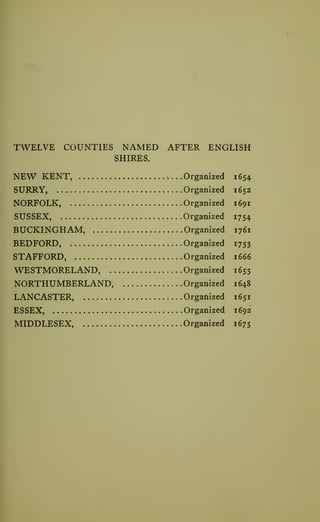
TWELVE COUNTIES NAMED AFTER ENGLISH
SHIRES.
NEW KENT, -....Organized 1654
SURRY, Organized 1652
NORFOLK, Organized 1691
SUSSEX, Organized 1754
BUCKINGHAM, Organized 1761
BEDFORD, Organized 1753
STAFFORD, Organized 1666
WESTMORELAND, Organized 1653
NORTHUMBERLAND, Organized 1 648
LANCASTER, Organized 1651
ESSEX, Organized 1692
MIDDLESEX, Organized 1675
CHAPTER VII
TWELVE COUNTIES NAMED AFTER ENGLISH
SHIRES
Seventeen Virginia counties have names
that correspond to those of shires in England.
Five of these names, however, are probably
derived from titles of nobility with which
prominent Englishmen were honored. Glou-
cester and York were nearly certainly named
after two^ of King Charles I's sons, Henry,
Duke of Gloucester, and James, Duke of
York. Cumberland county is named after
Prince William, Duke of Cumberland and son
of George II, King of England; Warwick
county- takes its name from the Earl of War-
wick, a prominent member of the London
Company for Virginia, and Northampton
county^ is nearly certainly named after Spen-
cer Compton, Earl of Northampton, who fell
fighting for King Charles in the civil war
of 1642-49. Bedford county, too, may possi-
'See antea, pp. 34-35. ^See antea, p. 64. 'See aniea, p. 66,
(85)
86 Virginia County Names
bly be named after an English duke, though
it is classed among the counties named after
the English shires.
Of the remaining twelve counties given in
the list above, the names of two, New Kent
and Surry, can be traced with certainty.
New Kent is so named from the shire of
Kent in England, and is a small tidewater
county north of Henrico and Charles City.
There are five Kent counties in the United
States: in Rhode Island, Delaware, Mary-
land, Michigan, and Texas; and it is almost
safe to assume that the first three names are
taken directly from the English shire, for
these are old colonial counties and named
when the States were loyal to England.
In New Kent county, on the banks of the
Pamunkey River, is the mansion called the
"White House," which occupies the site of
the one in which Washington was married.
About ^Yt miles from the mouth of Ware
Creek, a tributary of the York River, and
twenty-two miles from Jamestown, stand the
ruins of the "The Old Stone House."^ This
building, though not completed, was strongly
made and well suited for defense. Captain
^Campbell's "History of Virginia," p. 74.
Twelve Named After English Shires 87
John Smith describes just such a fort that was
partly built in 1608-09, but never finished, be-
cause the workmen had to stop building in
order to provide a food supply/ If this
be Captain Smith's fort, it is probably the
oldest building erected by the English in
America.
Surry county takes its name from the shire
of Surrey, spelled with an e in England*^
The only other Surry county in the United
States is in North Carolina, which State fol-
lows Virginia in leaving out the original e.
The North Carolina county is named after
the English shire/ Surry is on the south
bank of the James River, between Isle of
Wight on the east and Prince George on the
west. The Blackwater River receives the
drainage of the county on the southwest.
Nearly all of the twelve counties that we
may assume to have been named after the
shires of England are tidewater counties, and
ten of them were named before 1700. Buck-
ingham and Bedford are the only ones con-
^Howe's "Virginia History," pp. 390-392; Smith's "Vir-
ginia," Vol. iii. p. 227.
•^Dr. B. W. Green supports me in this view.
'J. C. D. in Appendix Mrs. Cornelia P. Spencer's North
Carolina History.
88 Virginia County Names
taining mountains. Five of the thirteen
—
Norfolk, Sussex, Buckingham, Bedford, and
Surry—lie south of the James. Surry has al-
ready been discussed.
Norfolk and Sussex are flat counties of
southeastern Virginia.
Norfolk, bordering on North Carolina,
contains the cities of Norfolk and Ports-
mouth, which are opposite each other on the
Elizabeth River, and are noted for their ex-
cellent harbors. The great Jamestown Expo-
sition of 1907, held in Norfolk from lack of
accommodations at Jamestown, but which
commemorated the three hundredth anniver-
sary of the landing of the English at James-
town, has done much to make this part of Vir-
ginia famous.
Norfolk was the second county^ of the State
in population in 1900, but is now undoubtedly
first. The farmers there are unsurpassed for
industry and thrift, and agriculture is fol-
lowed in a highly scientific manner. The
market for vegetables is the earliest in the
State, and the "trucking" trade is a source of
^Henrico, with Richmond in it, was first in 1900, but
Norfolk county gained on Henrico 3,500 population a year
between 1890 and 1900, and in 1900 was only a8i be-
hind.
Twelve Named After English Shires 89
great wealth. Fish and oysters of excellent
quality are abundant, and a large trade in
them is carried on.
Norfolk and Nansemond (to the west of
Norfolk) counties contain the northern part
of the Dismal Swamp; and Lake Drum-
mond, so noted for the purity of its water, is
about equally divided between the two
counties.
Sussex county, a southwest extension of
Surry county, from which it was formed, is
watered by the Nottoway and Blackwater
rivers. Peanuts and cotton are raised, and
the yellow pine furnishes valuable lumber.
Buckingham county is centrally located,
and the James River forms its northern
border. The soil of the river "low-grounds"
is very rich, and the scenery, viewed from the
bluffs on the James, is beautiful. Gold is
mined here, though not extensively.
Bedford, with the James on its northeast
border, and with tributaries of the Staunton
River furnishing an abundant water supply
elsewhere, is hardly surpassed in beauty of
scenery by any Virginia county. The Peaks
of Otter, with their extended view, are ob-
jects of great interest to the tourist. The
hotel on the summit of Sharp Top, which is
90 Virginia County Names
the peak commanding the best view, is gener-
ally open from May i to October 15. The
number of guests that visit the hotel is large,
and seems to be steadily increasing. The
mountain air is peculiarly invigorating, and
produces a keen appetite.
As has been intimated,^ Bedford county
may have been named after an English duke,
John Russell, fourth Duke of Bedford. The
duke was born in 17 10, and at the time Bed-
ford county was formed, 1753, was well
known in the public life of England. He had
been for three years Secretary of State, 1748-
175 1, and it is quite possible that the Virgin-
ians named Bedford county in his honor two
years after he retired from his high position.
All four of the Virginia counties named in
the three years 1752-3-4 have names of Eng-
lish origin: Halifax, in 1752, after an Eng-
lish earl; Prince Edward, in 1753, after a
son of the Prince of Wales; Bedford, in
1753, after the English shire or after the
English duke; Sussex, in 1754, after an
English shire. The Duke of Bedford was
Lord-Lieutenant of Ireland, 1756-61, and
died in 1771, after holding several other high
positions.
'•P. 86.
Twelve Named After English Shires 91
Of the six other counties named after Eng-
lish shires, three—Stafford, Westmoreland,
and Northumberland—are separated from
Maryland by the Potomac; three—Lancas-
ter, Essex, and Middlesex—lie along the
banks of the Rappahannock.
With regard to fivQ of these counties, there
is hardly any doubt that they take their names
from the shires in England; but Stafford
county may have been named in another way,
though in my classification I place it among
the counties named after shires.
Stafford county was formed in 1666 while
William Howard, Viscount Stafford, was
prominent at the English court; and it may
have been named after the English viscount
instead of after the English shire. Howard
was brought up a Roman Catholic, and was
a Royalist during the civil war, though he
was often in opposition after the monarchy
was restored. He was executed for treason in
1680, on testimony gathered by Titus Oates.
He protested his innocence to the last, and
there is good reason to believe his protests.
Stafford, in northern Virginia, is watered
by the Potomac and Rappahannock. Like
the other counties bordering on tidewater
Potomac, Stafford has an abundance of fish.
92 Virginia County Names
Westmoreland is between King George and
Northumberland on the Potomac, and the
Rappahannock is a part of its southwest bor-
der. Westmoreland is famous as the birth-
place of great men. Here were born Wash-
ington and Monroe, each of whom served
eight years as President of the United States.
In this county is Stratford, the capacious man-
sion built for Thomas Lee,^^ the first native-
born American that became governor of Vir-
ginia. In Stratford were born Richard Henry
Lee and Francis Lightfoot Lee, distinguished
signers of the Declaration of Independence.
The great Confederate chieftain, Robert Ed-
ward Lee, was also born in this house. Gen-
eral Henry Lee, the father of Robert E. Lee,
was also a native of Westmoreland.
Northumberland and Lancaster counties
adjoin the Chesapeake Bay, and carry on a
vigorous trucking trade by means of the ves-
sels that ply the bay and the Potomac and
Rappahannock rivers.
Essex and Middlesex are two small tide-
water counties on the south bank of the Rap-
pahannock; the two counties together have
an area of only 433 square miles, about the
average area of a single county.
A COUNTY NAMED AFTER AN ENGLISH
ISLAND
ISLE OF WIGHT, Organized 1634
CHAPTER VIII
A COUNTY NAMED AFTER AN ENGLISH
ISLAND
The shire of Hants, sometimes called
Hampshire, furnished the names for two Vir-
ginia counties. In 1754 Virginia had a
county organized and called Hampshire, after
the English shire itself. This county, now
greatly reduced in size, is the oldest county
within the limits of the present State of West
Virginia. One of the New England States
also is named after the English shire.
The Isle of Wight, near the mainland of
England, is a part of Hants, a shire in the
southern part of England. The county in
southeastern Virginia probably received its
name from this Isle of Wight.^ The present
name of the county was adopted in 1637, but
for the first three years of its existence the
county was called Warrosquyoake ;^ also
spelled Warrasqueake. Warrosquyoake is
the name of an Indian tribe whose king
^My theory supported by Dr. B. W. Green.
^Cooke's "Virginia," pp. 50-51.
(95)
96 Virginia County Names
warned Captain Smith that Powhatan was
not to be trusted too much, even if appear-
ances should indicate that no harm was medi-
tated. Smith was just then going to visit
Powhatan in order to procure corn. Pow-
hatan tried hard to get Captain Smith into his
power, but the Englishman was too good a
strategist to be deceived by the pretensions of
the Indian. Smithfield, the principal town of
the county, was established in 1752, and takes
its name from Arthur Smith, the original
owner of the land.^ Near Smithfield is an
old church, which is said to have been built
by Sir Joseph Bridger in 1632. The church
was originally a splendid structure, and for
many years it stood in ruins, but has lately
been repaired, and is used by the Methodist
Episcopal Church South.
Among other industries, Smithfield con-
tains the largest establishment in the State de-
voted to the peanut trade.
^Whitehead's "Virginia Handbook," p. 266.
PART IV
AMERICAN WARRIORS AND
STATESMEN
COUNTIES NAMED AFTER ELEVEN REVOLU-
TIONARY PATRIOTS
BLAND, Organized i86i
CAMPBELL, Organized 1781
CARROLL, Organized 1842
CLARKE, Organized 1836
FRANKLIN, Organized 1785
GREENE, Organized 1838
MATTHEWS, Organized 1790
MONTGOMERY, Organized 1776
PULASKI, Organized 1839
RUSSELL, Organized 1785
WARREN, Organized 1837
CHAPTER IX
COUNTIES NAMED AFTER ELEVEN REVOLU-
TIONARY PATRIOTS
Virginia played a leading part in the
American Revolution, and the geographical
names she then bestowed clearly indicate the
zeal she manifested in the struggle for inde-
pendence. Of the eleven counties formed
during the ten years beginning in 1776, six^
bear the names of Revolutionary patriots,
while one—Rockingham—is named after an
English statesman who opposed England's
hostile course towards the colonies. Virginia
now has eleven counties named after Revo-
lutionary patriots. Five of the eleven derive
their names from natives of Virginia, and a
brief sketch of these Virginians follows im-
mediately below.
In 1 86 1, when Bland county was organ-
ized from Wythe, Tazewell, and Giles coun-
ties, the people of Virginia were feeling very
much as they did during the troublous times
^Seven, if Greenville county is named after General
Nathaniel Greene. See pp. 75-76.
(loi)
102 Virginia County Names
at the beginning of the Revolution. In the
days preceding the Revolution the colony of
Virginia was suffering under the oppressive
measures of a mother government that was
disregarding the rights of her individual
daughter colonies. In the days preceding the
struggle of 1861-65 the State of Virginia was
smarting under the helplessness of a central
government that could not protect her indi-
vidual rights as a State.^ In the days be-
fore Lexington, Virginia was fearing an
armed invasion from the soldiers of England;
in the days before Sumter,^ Virginia was fear-
ing an armed invasion from the soldiers of
the United States.
Wythe, Tazewell, and Giles counties were
all named after American patriots that had
signally emphasized their love for independ-
ence and for freedom from external interfer-
ence in matters pertaining to local self-gov-
ernment. The county that was being taken
^Many Northern States had passed laws, in opposition
to the United States law, that prevented Virginia and
other Southern States from recovering runaway slaves.
If the central government could not protect the individual
States of the South in one domestic institution,—slavery,
—
was it not natural for the South to suppose that other
States' rights were also in danger?
^Bland was organized March 26, Sumter was attacked
April 13.
After Eleven Patriots 103
from these three counties must also, In its
name, emphasize Virginia's love for inde-
pendence and for State sovereignty. Thus
it came about that Virginia, in the troublous,
soul-stirring times of 1861, named Bland
county* after the patriotic Virginian and
American, Richard Bland.
Richard Bland, of Jordan's Point, Prince
George county, was one of the most eminent
statesmen of the Revolutionary period. He
was of the same lineage as Giles Bland,^ who
had perished as a martyr to liberty after
Bacon's Rebellion of 1676 had been crushed;
and in his veins flowed the blood of the kingly
Powhatan. Bland's services to his State^ and
his country were neither few nor unimportant.
He was long a member of the House of Bur-
gesses, he belonged to the Committee of Cor-
respondence in 1773, was one of the seven
delegates'^ from Virginia to the General Con-
gress that met in Philadelphia September 5,
*The county clerk of Bland, 1895, suggested that the
county was named after a Mr, Bland who was instru-
mental in having the county organized.
^Bancroft's History of the United States, Vol. v. p. 43.
*Then a colony.
'The other delegates were Peyton Randolph, Richard
Henry Lee, George Washington, Patrick Henry, Benja-
min Harrison, and Edmund Pendleton.
104 Virginia County Nam^§
1774, and was on the Committee of Safety
in 1775-76. Only the infirmities of old age
prevented his serving as a delegate to a Gen-
eral Congress in 1775. John Esten Cooke^
thus describes the old patriot : "Richard Bland,
an old man nearly blind and wearing a band-
age over his eyes, the author of the 'Enquiry
into the Rights of the American Colonies,'
and called the Virginia Antiquary . .
."
Bland early and vigorously expressed his be-
lief that the American Assemblies had the ex-
clusive right to tax the colonies, and he
heartily opposed Great Britain in her policy
of taxing the colonies without giving them
representation. At the age of sixty-six, and in
the year of the Declaration of Independence,^
Richard Bland yielded up his spirit to his
country's God, the Author of liberty.
The comparatively insignificant battle of
King's Mountain possibly determined the
names of two Virginia counties. Campbell
and Russell counties are named after Gen-
erals William Campbell and William Russell,
respectively, who especially distinguished
themselves at King's Mountain. This battle
^Cooke's "Virginia," p. 406.
^October 29, 1776.
After Eleven Patriots 105
was fought October 7, 1780, under circum-
stances that would naturally have given the
victory to the unfatigued British troops.
Campbell, with a regiment of 910 cavalrymen
and 50 riflemen, marched fifty miles in
eighteen hours, much of the time through
rain, mud, and darkness. Without pausing
for rest, he at once made a fierce attack on the
British Colonel Ferguson, who commanded a
force of 1 105 men. Though the fighting was
obstinate, Ferguson himself was slain, and all
of his men either killed, wounded, or cap-
tured. Campbell's conduct at the battle caused
him to be promoted from colonel to general,
and to receive the thanks of the Legislature
and of Congress. Though his military ser-
vices elsewhere were decidedly meritorious,
Campbell is known in history as the "hero of
King's Mountain." He died of sickness in
the fall of 178 1, at the age of thirty-six.
General William Russell, born in Culpeper
county, was twenty-seven years old when the
large county in southwestern Virginia re-
ceived his name in 1785. At the age of fifteen
Russell began his military career by joining
Daniel Boone's expedition against the Indians,
and had already become a veteran soldier, by
fighting against these redskins, when he
106 Virginia County Names
fought under Campbell at King's Mountain.
Russell was the first American to reach the
summit of the mountain and to receive a
sword from the enemy. His gallantry at the
mountain earned him a promotion to the rank
of captain. He fought the next March at
Guilford Court House, and served afterwards
in many campaigns against the Indians. Rus-
sell is more intimately connected with the his-
tory of Kentucky than of Virginia, for he re-
moved to Kentucky after the Revolution, was
a member of the Virginia legislature that sep-
arated Kentucky from the Old Dominion,
and was, for many years, a legislator in the
new State. In 1811 he succeeded General
William Henry Harrison as commander of
the frontier forces in Indiana, Illinois, and
Missouri. Kentucky, as well as Virginia, has
a county named after General Russell.
Matthews (also spelled Mathews) county
was named in honor of General George Mat-
thews, a distinguished officer of the Revolu-
tion. Matthews took a prominent part in the
battle of Point Pleasant,^" which was fought
just before the Revolutionary War. The
contest occurred at the junction of the Kana-
^"See Howe, p. 305, for a good description of the battle.
After Eleven Patriots 101
wha with the Ohio, and was the bloodiest
ever fought on Vlrginia^^ soil against the
Indians. The battle raged stubbornly from
sunrise till dark, but resulted at last in favor
of the whites. Matthews afterwards fought
at Brandywine and Germantown, and his regi-
ment did much to save the American army
from destiniction at the latter place. He took
no further part in the Revolution, for he was
captured at Germantown and was not re-
leased until the close of the war. He subse-
quently removed to Georgia, where he was
elected to Congress. He was governor of his
adopted State during 1793-96.
Clarke county, which really should be
spelled without the e, Is so named In honor of
General George Rogers Clark, ^^ a famous
pioneer and Indian fighter. Although Clark
"Including West Virginia, for Point Pleasant is in
West Virginia.
^Clark spelled his name without an e, as may be seen
from many of his letters, which are in the State Library
in Richmond. The Virginia county, strange to say, though
named in his honor, is generally spelled Clark<?. Ohio
and Indiana have Clarke counties, both probably named
after General Clark, and Illinois has a Clark county,
also probably named after the same man. Missouri has
a Clark county, so called ("American Cyclopedia'') in
honor of George's brother, William Clark, Some of the
States, then, are inaccurate in spelling county names
Clarke while intending for them to honor George Rogers
Clark by the county name.
168 Virginia County Names
was born in Albemarle county, Virginia, most
of his notable exploits were done in Kentucky,
Ohio, Indiana, and Illinois. It was largely
by his bravery and skill that Kentucky was
freed from the ravages of hostile Indians.
Through him, also, the territory north of the
Ohio River was secured to the United States
when Great Britain made peace with us in
1783. This was because Clark had obtained
possession of posts that gave him control over
that country. Through his influence Ken-
tucky was organized as a Virginia county in
1776, and after it became a State an east-
central county was named Clark in his honor.
Louisville, Kentucky, was founded by General
Clark. George was one of six brothers,
^^
four of whom attained prominence in the
Revolution. His younger brother William
was joint commander with Captain Lewis on
an exploring tour to the Pacific in 1804. On
this tour Clark was of great service in nego-
tiations with the Indians. Clarke's Fork and
Lewis's Fork of the Columbia River are
named after these explorers.
Bland and Russell counties, in southwest
Virginia, between the Blue Ridge and Alle-
^^"American Enclycopedia." George was born 1742),
died 1808 or 1817; William was born 1770, died 1838.
After Eleven Patriots 109
ghany mountains, have their surfaces broken
by towering peaks and swift streams. Bland is
between Giles and Tazewell on the West Vir-
ginia border, and is drained by New River
waters. Russell county, to the west of the
Clinch Mountains, is drained chiefly by the
Clinch River.
Campbell county is in Piedmont Virginia,
and is drained by the Staunton and the James.
This county contains Lynchburg,^* which,
next to Roanoke, is the largest city west of
Richmond in the State.
Clarke county, taken from Frederick in
1836, when Wlliam Clark, brother to George
Rogers Clark, was Superintendent of Indian
Affairs, has West Virginia on its northern
border. It is hemmed in on the east by the
Shenandoah Mountains, and the Shenandoah
River flows through it.
Matthews, one of the few tidewater coun-
ties with a name distinctively American, is
nearly surrounded by the Chesapeake Bay
and its arms.
Montgomery, Pulaski, and Warren coun-
ties are named in honor of men that fought
and fell in the cause of American freedom.
"Until the census of 1900 Lynchburg was larger than
Roanoke.
110 Virginia County Names ^*'
All three are mountainous counties in the ele-
vated portion of Virginia lying between the
Blue Ridge and Alleghany mountains. Mont-
gomery and Pulaski, in southwestern Virginia,
are separated from each other by the New
River, whose waters drain all of Pulaski and
a considerable part of Montgomery. War-
ren lies between the Blue Ridge and Massa-
nutten mountains in northern Virginia, and is
traversed by the Shenandoah River.
General Richard Montgomery, born in
Ireland in 1736, had a short but brilliant
career in the cause of the struggling colonies.
He was put in command of an expedition
sent against Canada, and soon obtained pos-
session of Montreal and other important
points. After a month's siege a desperate at-
tempt was made, December 31, 1775, to cap-
ture Quebec by assault. Montgomery was
killed while cheering on his men, and they, in
dismay at his death, at once retreated. In
grateful recognition of his services Congress
erected a monument to his memory in St.
Paul's churchyard. New York city. Under
this monument lies the dust of the fallen hero.
Virginia is but one of many States to have
a county named after General Montgomery.
Count Pulaski, of Poland, who had already
After Eleven Patriots 111
become a veteran soldier by service in Europe,
was induced by Benjamin Franklin to join the
American army in 1777. The Polish count
and the French Marquis de Lafayette were
together in their first battle for the colonies at
Brandywine. After two years of fighting in
our behalf, Pulaski fell mortally wounded in
an ill-timed attack on Savannah, October 9,
1779. The responsibility for making the at-
tack does not belong to Pulaski; he was
simply obeying the orders of his commander.
Exactly forty-six years after his death his
friend Lafayette laid the corner stone of
the statue of Liberty that was erected in
Savannah in joint honor of the Polish noble-
man and of General Nathaniel Greene. It
may be of interest to note that the capital of
Arkansas is in Pulaski county, and that
Georgia and other States have counties named
in honor of the brave foreigner.
Virginia named a county after the illus-
trious French marquis, but Fayette is now
a county of the State of West Virginia.
Among those who gave their lives for
American independence, none was more gen-
erally beloved than the talented Massachu-
setts physician. General Joseph Warren.
From 1766 he was energetic in the cause of
112 Virginia County Names
the colonies against the oppressive measures
of Great Britain. In 1774 he was the virtual
head of Massachusetts, for he was president
of the State Congress and chairman of the
Committee of Public Safety. It was by War-
ren's orders that Dawes and Paul Revere set
out on their famous midnight ride for Lex-
ington. Longfellow's stirring poem tells how
these horsemen warned the Americans in time
to meet the hostile British. Warren fought
at Lexington, and two months later fell at
Bunker Hill. The British General Howe de-
clared his death to be an off-set to the loss of
five hundred British soldiers. At Bunker Hill
stands a monument erected to his memory.
It was unveiled June 17, 1857, the eighty-
second anniversary of his death.
Five of the six Virginia counties named
during the seven years ending in 1842 were
named after American patriots of Revolu-
tionary fame: Clarke in 1836, Warren in
1837, Greene in 1838, Pulaski in 1839, and
Carroll in 1842. Moreover, all four of the
counties formed during that time within the
limits of the present State of West Virginia
—
Braxton In 1836, Mercer In 1837, and
Marion and Wayne In 1842—take their
names from Revolutionary patriots. Roan-
After Eleven Patriots 113
oke, formed In 1838 and having an Indian
name, Is the only one of ten Virginia-West
Virginia counties formed within that period
of seven years and not named In honor of
Revolutionary heroes.
When Greene county, then, was formed In
1838, the Virginians seemed to be especially
desirous of remembering the heroes of '76 In
their county names. If, as has been sug-
gested,^^ Greenville county had been named
In honor of General Nathaniel Greene In the
latter part of 1780, the fact had been over-
looked or disregarded In after years, for,
fifty-eight years later. In 1838, Greene county
received the name of the patriot from Rhpde
Island. If both Greene and Greenville coun-
ties are named after General Greene, he Is
the only American besides Patrick Henry^® to
be honored In the naming of more than one
Virginia county.
General Nathaniel Greene,^^ of Rhode
Island, served with distinction during the en-
tire Revolution. His services in that war
probably rank second to Washington's only In
value. He took a prominent part in many of
the leading battles of the north, and, by his
successful stand at the battle of Brandywine,
"P. 75. • "P. 144. "See Pp. 75-76 also.
114 Virginia County Names
saved the American army from destruction.
In the autumn of 1780, after he had been
transferred to the command of the army of
the South, by a skillful campaign of hard-
fought battles he in ten months' time recov-
ered all of the Carolinas and Georgia except
the three seaports of Charleston, Wilmington,
and Savannah. The scene of the hotly con-
tested battle of Guilford Court House is now
called Greensboro, in honor of General
Greene. The Carolinas and Georgia granted
him valuable property, and Congress gave
him a medal in recognition of his services.
After the war he visited his native State, but
settled in Georgia in 1785 on lands that had
been given to him by that State. He lived
less than a year in his new home, for he died
of sunstroke June 19, 1786, at the age of
forty-four.
Greene, which is decidedly smaller than the
average Virginia county, is just east of the
Blue Ridge and Is watered by the Rivanna
and Rapldan rivers.
Charles Carroll, of Maryland, and Benja-
min Franklin, of Massachusetts, are each
honored with a county name in southwest Vir-
ginia.
Carroll county contains some of the most
After Eleven Patriots 115
elevated land in the State, and is enclosed on
two sides by ranges of the Blue Ridge Moun-
tains. It is drained by New River waters.
Franklin is separated from Carroll by Floyd,
and has the main Blue Ridge range on its
western border. The county contains 445
square miles, and is drained by the Staunton
and Dan rivers.
For over two hundred years the name of
Carroll has been especially prominent in the
State of Maryland. Though many of his
name are held in high esteem, Charles Car-
roll, of Carrollton, is easily first of them all in
the love and respect of his countrymen. His
naturally strong business capacity was ren-
dered stronger by the opportunities afforded
by a college education and by travel in
Europe. At the outbreak of the Revolution
he was considered the richest man in the
colonies, and was probably worth two million
dollars. During the Revolution Carroll served
in the legislative halls of State and nation,
and was one of the framers of Maryland's
State constitution. The Maryland delegates to
the General Congress of 1776 had been in-
structed by the legislature to disavow any
claim of independence, but Carroll had these
instructions removed and was himself one of
116 Virginia County Names
the first to sign the Declaration of Independ-
ence. Until 1 80 1 he was busily engaged in
public affairs, but he then retired to a well-
earned repose at his magnificent country es-
tate near Baltimore. Many friends used to
visit him there to enjoy the society of their
cultured and generous host. At the death of
Thomas Jefferson and John Adams, on July
4, 1826, Carroll was left as the sole survivor
of the signers of the Declaration of Inde-
pendence. Exactly two years later he made
has last public appearance, when he laid the
corner stone of the Baltimore and Ohio Rail-
road. He died in 1832 at the age of ninety-
five. Ten years later the Virginia county was
named In honor of the venerable Maryland
patriot.
Three of Carroll's granddaughters mar-
ried English noblemen, and were distin-
guished at the court of George IV as "The
American Graces"—a title fairly earned by
their attractive manners and great beauty.
In 1876 Governor John Carroll of Mary-
land, a great-grandson of the Illustrious
Charles, took a prominent part In the Phila-
delphia Centennial of American Independ-
ence.
Virginia Is but one of many States to name
After Eleven Patriots 117
a county after the patriotic Ben Franklin.
When Franklin county was formed in 1785
the fame of Dr. Benjamin Franklin was well
established both in Europe and America. As
the founder of the University of Pennsyl-
vania, as inventor of the lightning rod, as op-
poser of the Stamp Act, and as signer of the
Declaration of Independence, the great Bos-
tonian proved his love for learning, science,
and native land.
COUNTIES NAMED AFTER SEVEN VIRGINIANS
WYTHE, Organized 1789
GRAYSON, Organized 1792
TAZEWELL, Organized 1799
SCOTT, Organized 1814
SMYTH, Organized 1831
ALEXANDRIA, Organized 1847
DICKENSON, Organized 1880
CHAPTER X
COUNTIES NAMED AFTER SEVEN VIRGINIANS
Wythe county, and Wytheville, its county
seat, are named after George Wythe, another
signer of the paper that declared the United
States free and independent. Wythe was
probably the most eminent Virginia jurist of
the eighteenth century. During the Revolu-
tion he was an ardent and active patriot.^
He helped George Mason and Richard
Henry Lee to frame Virginia's State consti-
tution in 1776,^ and soon afterwards aided
Thomas Jefferson and Edmund Pendleton in
the revision of the State laws. For more than
twenty years Wythe was sole chancellor^ of
Virginia, and he is generally known as Chan-
cellor Wythe. Wythe ranked high among
scholars, and by Jefferson was regarded as the
best Greek and Latin scholar of Virginia.
^See Wythe in American Supplement to "Enclycopedia
Britannica."
'Wythe, **Appleton's American Biography."
^An office corresponding to the presidency of the Court
of Appeals; it was abolished at Wythe's death.
(121)
122 Virginia County Names
From 1779 to 1789 Wythe was Professor of
Law at William and Mary College, and many
of his pupils afterwards attained great emi-
nence : Jefferson*—to whom he bequeathed his
great library—and Madison subsequently be-
came Presidents of the United States; Giles
held the leadership of the Democratic-Repub-
lican party in the national Senate for seven
years, and was governor of Virginia for three
years; John Marshall was Chief Justice of the
United States for thirty-five years, and gained
a reputation in law that has certainly not
been surpassed, and probably has not been
equaled, within the United States.
Jefferson, Madison, Giles, and Marshall
were each honored by Virginia in the name of
a county, though Jefferson and Marshall be-
came a part of West Virginia when that State
was formed.
Chancellor Wythe's residence in Williams-
burg is still standing.
Grayson and Tazewell counties were named
in honor of two United States Senators from
Virginia, who died shortly before the counties
were organized.
The Virginia legislature of 1782-83 was
*Jefferson took law under Wythe by private instruc-
tion about 1760.
After Seven Virginians 123
remarkable for the entrance into State coun-
cils of several men who afterwards became
quite distinguished. Among others were John
Marshall, the future Chief Justice, and Wil-
liam Grayson,^ after whom Grayson county is
named. Together with Patrick Henry and
others, Grayson vigorously opposed the rati-
fication by Virginia of the United States Con-
stitution. In 1788 Grayson and Richard
Henry Lee were elected as the first two United
States Senators from Virginia under the Con-
stitution, over Madison, who was then the
Federal leader in the State. Senator Gray-
son only lived to serve two years of the term
to which he had been elected.
Tazewell county was formed in 1799 and
named in honor of Senator Henry Tazewell,
of Virginia, who died in that year. In 1775,
at the age of twenty-two, Tazewell became a
member of the Virginia legislature, and
served until 1785- He was one of the com-
mittee^ of 1776 that drew up the Declaration
of Rights and adopted the State constitution,
and from 1785 till 1794 he held honorable
^Not to be confounded with William J. Grayson, after
whom a Kentucky county is named.
*See Vol. i. p. 409, Henry's "Life of Henry," for a list
of the thirty-two men that composed this committee.
124 Virginia County Names
positions in the Virginia judiciary. In the
latter year he was chosen to the United States
Senate, and held the office till his death.
Even more distinguished than Henry Taze-
well was his son, Littleton Waller Tazewell,
who was a member of the State legislature, a
United States Senator, and governor of Vir-
ginia for the two years ending April 30,
1836.
Wythe county, situated among the moun-
tains of southwest Virginia, is separated from
West Virginia by Bland county, and from
North Carolina by Grayson. Like its eastern
neighbors, Pulaski and Carroll, Wythe county
is drained entirely by New River waters.
Grayson county is included with Floyd and
Carroll between two forks of the Blue Ridge
Mountains, and the three are known as the
Blue Ridge counties. These counties are
among the most elevated in the State; and
Mount Balsam in Grayson county, with an
elevation of 5700 feet above sea level, is said
to be the highest peak in Virginia.
Tazewell county, which adjoins West Vir-
ginia, is famous for its timber, minerals, and
beautiful scenery. The county is drained
chiefly by Clinch River waters, which flow
southwest, and by tributaries of the New
After Seven Virginians 125
River, which flows northeast; "Burke's Gar-
den" is a beautiful and fertile valley of about
thirty thousand acres in the eastern part of
the county. It is surrounded on all except its
north side by lofty , mountains; from that
side flow the headwaters of Wolf Creek, a
large tributary of the New River.
Scott and Smyth counties are named in
honor of two Virginia generals, Winfield Scott
and Alexander Smyth.
General Winfield Scott was born in Peters-
burg, Va., June 13, 1786, and lived to see the
end of the great Civil War of 1861-65. Scott
took an active and honorable part in the War
of 1 8 12 against Great Britain, and won still
greater fame by his victories in the Mexican
War; the infirmities of old age prevented him
from being anything more than an interested
spectator in the war between the States.
He entered the army at the age of twenty-
two. Early in 18 14 he began a vigorous and
systematic training of the troops, and in a few
months' time he had a well-drilled army with
which to attack the British in Canada. On
July 5 of that year he obtained an important
victory in Canada, at the Battle of Chippewa,
and twenty days afterwards he fought the
memorable drawn battle of Lundy's Lane,
126 Virginia County Names
This engagement, sometimes called Bridge-
water, began at five o'clock in the afternoon
and raged until midnight. One man out of
every five engaged was either killed or
wounded. The scene of the encounter was
made more impressive because the din of con-
flict was mingled with the sullen roar of
Niagara Falls. These two battles greatly-
encouraged the Americans, and established
the fame of the brave American commander,
who was soon offered the position of Secre-
tary of War by President Madison, Scott,
however, declining the President's offer.
The naming of Scott county in 1814 was
a well-deserved tribute to the gallant Vir-
ginian at the hands of his native State.
His signal victories in the Mexican War
earned him the Whig nomination for the
Presidency in 1852, but he was defeated by
Franklin Pierce, the Democratic nominee.
Scott held the chief command of the Ameri-
can army for twenty years, but was forced to
resign his position in 1861 on account of fall-
ing health.
Like Grayson and Tazewell, Smyth county
was named In honor of a prominent Virginia
statesman whose career had been recently
?nded by death. General Alexander Smyth
After Seven Virginians 127
was of Irish birth, but he early removed to
Virginia, where he entered upon the practice
of law. For many years he was a member of
the State legislature, and in 1808 Jefferson
appointed him a colonel of a United States
regiment in the Southwest. He was after-
wards made general, was sent against Canada
in 18 12, but failed and was removed from the
army. He seems, however, to have retained
public esteem, for, after serving again as a
State legislator, he was elected to Congress in
1 8 17, where he served almost continuously
until his death, in 1830. Smyth county was
named in the following year for the citizen,
soldier, and statesman who had so long identi-
fied himself with the interests of his adopted
State.
Scott county contains a wonderful natural
tunnel that extends for 150 yards through one
of the spurs of Powell's Mountain.'^ In
height and width the tunnel varies greatly,
100 feet being probably the maximum height,
and 150 feet the greatest width. The Vir-
ginia and Southwestern Railroad runs trains
through the tunnel, while outside, overhead, a
^Whitehead's "Virginia Handbook," p. 53, quoting the
Bristol News, calls the tunnel 300 yards long; but see
"Martin's Virginia Gazetteer," pp. 442-444.
128 , Virginia County Names
wagon road crosses it. Stock Creek, a tribu-
tary of the Clinch River, flows through the
tunnel. Scott county lies between the counties
of Lee and Washington, on the Tennessee
line and is watered by the Clinch and Holston
rivers.
Smyth is situated north of Washington and
Grayson, and is divided by Holston River
waters and the mountain into three distinct
sections, which differ greatly in natural feat-
ures and products.
Alexandria county doubtless derives Its
name from its chief city. The city itself
was originally known as Belhaven, but the
name was changed to Alexandria in honor of
the Alexander family, of whom the oldest
was John Alexander, a citizen of the place.
John's son, William Thornton Alexander, was
a prominent business man of a hundred years
ago. The city was incorporated in 1779.
The present county was for many years a
part of the District of Columbia, but was
(ff^-^ re-ceded to Virginia in 1847. Alexandria Is
the smallest of Virginia counties, having a
land surface of only thirty-two square miles.
It is surrounded on all except its north side
by Fairfax county, where the Potomac River
forms its boundary.
After Seven Virginians 129
Dickenson county is named in honor of Wil-
liam J. Dickenson, a delegate from Russell
to the Virginia Assembly at the time of Dick-
enson's formation in 1880. After the Assem-
bly had voted that the name of the new county
should be Dickenson, the Senate substituted
Stonewall for Dickenson—a tribute to Gen-
eral "Stonewall" Jackson. Virginia had
already named a county Jackson,^ after Presi-
dent Andrew Jackson, hence the name "Stone-
wall" would be more unmistakably a tribute
to Thomas J. Jackson than the name Jackson
itself. The Assembly, however, rejected the
Senate's amendment, and the name Dickenson
was adopted.
The Dickenson family has always been at
the front in public affairs in that narrow strip
of Virginia lying south of West Virginia and
e^st of Kentucky. William J. Dickenson's
grandfather, Henry Dickenson, located in
that section in 1770, and in 1785 helped to
organize Russell county, serving as Russell's
first county clerk. William's father. Major
James Dickenson, was several times sheriff of
Russell and for two terms served In the Vir-
ginia Assembly. William J. Dickenson him-
self, after studying law and while County At-
'^Now a part of West Virginia.
130 Virginia County Names
torney for Russell, was elected to the Assem-
bly, serving two terms before the Civil War
and six terms after it, retiring from the As-
sembly in 1882. Though a strong' Union
man and bitterly opposed to secession, Dicken-
son during the war remained quietl^i on his
farm, taking care of his aged parents. At
the age of eighty he died at Castlewood, Rus-
sell county, April 5, 1907, at the home of his
nephew, Hon. R. Walter Dickenson, now
State Senator from Russell, Dickenson, Taze-
well, and Buchanan counties. He never mar-
ried. His youngest brother, Thomas T.
Dickenson, is still living at Castlewood.
Dickenson county, which is drained by the
Russell Fork of the Big Sandy River, is
separated from Kentucky by the Cumberland
Mountains. Dickenson is the youngest
county in the State by nineteen years. Bland
being next youngest. Like other youths,
however, Dickenson has great possibilities,
for the letter-head of the county clerk informs
us that Dickenson county is the richest unde-
veloped county in coal and mineral and hard-
wood in the South.
PART V
VIRGINIA GOVERNORS AND
UNITED STATES PRESIDENTS
COUNTIES NAMED AFTER THIRTEEN VIRGINIA
GOVERNORS
CULPEPER, Organized 1748
SPOTSYLVANIA, Organized 1720
GOOCHLAND Organized 1727
DINWIDDIE, Organized 1752
FAUQUIER, Organized 1759
BOTETOURT, Organized 1769
HENRY, Organized 1776
PATRICK, Organized 1790
NELSON, Organized 1807
LEE, Organized 1792
PAGE, Organized 1831
GILES, Organized 1806
FLOYD Organized 1831
V^ISE, Organized 1855
CHAPTER XI
COUNTIES NAMED AFTER THIRTEEN VIRGINIA
GOVERNORS^
In fourteen of her counties Virginia re-
produces the names of her governors. Bote-
tourt^ Culpeper, Dinwiddle, Fauquier, Gooch-
land, and Spotsylvania recall colonial times;
while Floyd, Giles, Patrick and Henry,
Lee, Nelson, Page, and Wise date after the
Declaration of Independence.
With the exception of Botetourt, these
colonial counties He east of Virginia's center.
Fauquier and Culpeper are In th^ north near
the headwaters of the Rappahannock. Spot-
sylvania, to the southeast of these two counties,
contains the sources of the Mat, the Ta, the
Po and the Ny rivers, which unite In Caroline
county to form the Mattapony River. Din-
widdle Is In southeastern Virginia, and Is
drained by the Nottoway and Appomattox
rivers. Goochland Is on the north bank of
the James between Fluvanna and Henrico.
^Fourteen counties, as two are named aft€r Patrick
Henry.
(135)
136 Virginia County Names
Botetourt lies on both sides of the James,
wedged in between the Alleghany and Blue
Ridge Mountains.
Lord Culpeper, who served from 1680 to
1683 ^s the governor of Virginia, is chiefly
notable for the immense tracts of land he
owned. In 1673 Charles II of England
granted Virginia for a period of thirty-one
years to Culpeper and the Earl of Arlington.
Two years afterward Culpeper bought the
rights to the lands lying between the Potomac
and Rappahannock rivers, and was appointed
governor of Virginia for life. He did not
come to Virginia to assume his office until
1680. Though a shrewd and capable gov-
ernor, Culpeper was convicted of bribery at
the end of three years, and was thereupon
deposed from office. Culpeper county was
named after Governor Culpeper in 1748, a
few years after his grandson. Lord Fairfax,^
had made his home on the vast estate inherited
from his grandfather.
Of the six colonial governors who gave
their names to Virginia counties, Alexander
Spotswood,^ with his spacious and hospitable
country home, is probably the most interesting
^Pp. 69-70 for Fairfax.
^Spelled with one /, and so the county should be spelled.
After Thirteen Virginia Governors 137
character. While governor he made an explor-
ing tour through the country from Williams-
burg across the mountains to the Shenandoah
River. The party had a jolly time, and were
gone six weeks. On their return each tourist
received a golden horseshoe as a souvenir of
the trip, and thus was instituted the order of
the "Knights of the Horse-Shoe." A horse-
shoe was chosen as the badge of knighthood
because the horses, which at home needed no
shoes, had to be shod in order to be able to
travel over the rocky regions of the moun-
tains. In 1724 Governor Spotswood had
above the falls on the Rappahannock River
an iron furnace, considered by himself as the
first regular iron furnace in the United States.
"^
Sir William Gooch had already won fame
as a soldier in Europe when he was chosen
governor of the Old Dominion in 1727. Two
counties were established that year, and one
of them was named Goochland in honor of
the new governor. Gooch greatly endeared
himself to the people by his wise administra-
tion as governor, and the Virginians bade him
^But there was a furnace for smelting iron ore at Fall-
ing Creek, in Chesterfield county, in 1619. It was de-
stroyed and the people killed in the Indian massacre of
March 22, 1622. There is a pig of the iron with the
the furnace mark in the State Library in Richmond.
138 Virginia County Names
a tearful farewell when he sailed for his
English home after twenty years of service in
the colony. The flourishing city of Staunton
in Augusta county is named after Lady Staun-
ton, the beloved wife of Governor Gooch.
Robert Dinwiddie became governor of Vir-
ginia in 1752, and a county was named after
him the same year. Dinwiddie's term lasted
six years. Though neither a good nor a
popular executive, Dinwiddie showed discern-
ment by appointing young Washington to im-
portant commands. The latter's trip beyond
Fort Duquesne was undertaken at Dinwid-
die's instigation.
The Virginians again complimented their
chief executive in 1759 when they named
Fauquier county in honor of Francis Fauquier,
who had lately become governor. Fauquier
was a broad-minded scholar of culture and
ability, and his society was greatly enjoyed
by the youthful but appreciative Jefferson.
Though Fauquier was watchful of the in-
terest of the home government in England,
he had also the welfare of the colonists at
heart. His term was ended by death in 1768.
Lord Norberne Berkeley, Baron of Bote-
tourt, became governor of Virginia in 1768,
and held the office until his death in October,
After Thirteen Virginia Governors 139
1770. Though the opposition between the
Virginians and the mother country caused Bo-
tetourt to use strongly repressive measures to-
wards Virginia, the baron was a true friend
to the colony. He was much mourned at his
death and the legislature honored his memory
with a marble statue, which is still standing
at William and Mary College. The beauti-
ful county in western Virginia received his
name the year before his death. Fincastle,
the county seat of Botetourt, takes its name
from Lord Botetourt's estate in England.
Fincastle county was formed in 1772, but
ceased to exist four years later, when It was
divided Into Washington, Montgomery, and
Kentucky counties—the last named after-
wards became Kentucky State.
Berkeley county, now of West Virginia,
was organized as a Virginia county in 1772.
The name was nearly certainly derived from
the late Governor Botetourt, Lord Norberne
Berkeley, though I have no authority to cite
in support of this theory. On the other hand,
"Appleton's American Cyclopedia" says that
the county was named after "Governor Berke-
ley." This must mean Sir William Berkeley,
governor of Virginia for twenty years or
more In the seventeenth century. William
140 Virginia County Names
Berkeley is the only person that was generally
known as Governor Berkeley; Norberne
Berkeley is known in history as Governor
Botetourt.
Several considerations seem to throw doubt
on the cyclopedia's statement. The latter
part of Berkeley's administration was marked
by great cruelty to the followers of Nathaniel
Bacon, and Berkeley was recalled to England
at the request of the Virginians. While the
governor had been very popular before
Bacon's rebellion, was it likely that Virginia
should wait ninety-five years after Berkeley's
death and then give a county name for a
governor that had been hateful to many in
the colony for his acts of tyranny ?
In the Virginians' attitude towards Lord
Botetourt it seems more probable that Berke-
ley county should have been named after the
baron's ordinary name, Norberne Berkeley.
Fincastle county was named after his English
estate the same year Berkeley county was or-
ganized, and Botetourt county had been
named after the baron himself only three
years before—thus proving the affection of
Virginians for him. But, even if Berkeley
county is named after Sir William Berkeley,
the naming was probably done to reflect honor
After Thirteen Vii'ginia Governors 141
on Lord Norberne Berkeley, for Norberne
was a direct descendant of John, elder brother
of William.
Culpeper, Orange, and Fauquier organized
a famous regiment of "Minute Men"^ at the
beginning of the Revolution. The Culpeper
corps carried an aggressive-looking flag, which
had depicted on It a rattlesnake with twelve
rattles—the head for Virginia, a rattle for
each of the other colonies. On the flag were
the words: "The Culpeper Minute Men.
Liberty or Death. Don't Tread on
Me.'' The Culpeper men wore green hunt-
ing shirts and were otherwise attired so as to
present a savage and formidable appearance.
Fauquier contains some of the best farm-
ing lands In the State. Botetourt Is rich in
minerals and well adapted to stock raising.
Dinwiddle contains Petersburg, the third city
of the State In size.
The eight counties that Virginia has named
after her governors since she cast off alle-
giance to England are west of the State's
center, and all of them are more or less moun-
tainous. Patrick and Henry are on the North
Carolina border, and are watered by Carolina
^Howe's "Virginia," pp. 237-8.
142 Virginia County Names
streams. Lee, the most western county of the
State, separates Kentucky from Tennessee,
and is drained by Russell's River, whose
waters reach the Tennessee. Wise is north
of Lee, and also borders on Kentucky; it is
drained by Kentucky streams and by Clinch
River waters. Giles, bordering on West
Virginia, is bisected by the New River.
Floyd is watered chiefly by the Little River,
a tributary of the New, and lies northwest of
Patrick county. Nelson, with its west-central
position, is beautified on the northwest by the
Blue Ridge Mountains, on the southwest by
the historic James. Page, in the Shenandoah
Valley, is noted for the wonderful Luray
Caverns.
Of Virginia's governors none deserve a
higher rank than Patrick Henry. His long
life almost coincides with that of Washing-
ton—he was born four years after, and died
six months before, the President. Both were
Virginia born, and both spent their last days
in their native State.
It would be hard to overestimate the value
of Henry's services to his State and his coun-
try. Before the Revolution his eloquence
did much to secure the repeal of the odious
Stamp Act, and when the war was on hand
After Thirteen Virginia Governors 143
he kindled a fiery zeal for independence in
the hearts of his countrymen. Henry was
instrumental in getting the Virginia delegates
to propose independence in the national Con-
gress of 1776,® and he helped to secure the
guarantee of religious freedom in the State^
and the natlonaP constitutions.
After perfecting for Virginia the first writ-
ten State constitution in America, the Wil-
liamsburg State convention ended its work of
June 29, 1776, by electing Patrick Henry
the first governor of the new State,^ and the
legislature of that year honored Henry by
giving his name to the large county that had
just been formed from Pittsylvania. After
Henry had retired from the Virginia legis-
lature of 1790, a new county was formed
from a part of Henry county, and the ex-
legislator was again honored in Patrick
county's name. Henry was unanimously re-
elected governor four times, and in 1796, six
years after his retirement to private life, was
again chosen chief executive of Virginia, but
"See Henry's "Henry," Vol. i. pp. 332-34.
^Ibid., Vol. i. pp. 431-32.
^Ibid., Vol. ii. pp. 338-89.
^Virginia was a colony, subject to Great Britain, before
she declared her independence,
144 Virginia County Names
declined to serve on account of the infirmities
of age. The Virginia governors were then
elected by the State legislature for a term of
one year, and were not eligible for more than
three successive terms. No other governor
of Virginia has served as many terms as
Henry/*^ nor does any other governor of the
State have more than one county named in
his honor. Henry was twice offered a United
States senatorship, and also important of-
fices under President Washington, but he de-
clined them all.
Nelson county was formed in 1807, and
was named after General Thomas Nelson,
who was Virginia's third governor after she
had become a State. While Nelson was of
greater service as a legislator than as a soldier,
he took honorable rank in both capacities.
As a member of the Virginia legislature he
helped to frame the State constitution, and
afterwards signed the Declaration of Inde-
pendence. In 1776 he was Henry's chief
competitor for the governorship, and in June,
178 1, he succeeded Jefferson in that office.
At the siege of Yorktown, where he com-
manded the Virginia militia, Governor Nel-
son manifested a noble example of unselfish
^"Unless it was Governor Botetourt; see pp. 139-1^1.1.
After Thirteen Virginia Governors 145
patriotism. His house was the largest and best
In Yorktown, and thinking, therefore, that
General Cornwallls probably had his head-
quarters there, Nelson had the building bom-
barded,^^ offering a reward to the cannoneer
who should put the first ball through it.
Nelson's term of governorship lasted not
quite six months, as falling health forced him
to resign, and the remaining eight years of
his life were spent in retirement. He died in
York, the county that had given him birth
fifty-one years before. The statues of six
honored sons of Virginia stand around the
lifelike equestrian statue of Washington in
the capitol square of Richmond. These
statues commemorate the lives and services of
General Andrew Lewis, so distinguished In
Indian warfare; George Mason; Chief Jus-
tice Marshall; Patrick Henry; President
Jefferson, and Governor Thomas Nelson.
Lee county received its name in 1792, from
General Henry Lee, of Westmoreland, who
had just become governor of Virginia. Vir-
ginia had special reason at that time to honor
the name of Lee, as Richard Henry Lee had
just retired to private life after thirty-six
"The Governor's house was struck by the shot, but is
still standing and has people living in it.
xo
146 Virginia County Names
years of arduous public service, while Francis
Lightfoot Lee and Arthur Lee, brothers of
Richard Henry Lee, had also endeared them-
selves to the State by careers of usefulness
and honor.
General Henry Lee, second cousin to Rich-
ard Henry, rendered valuable service in the
Revolution by his brave and well-trained
"legion" of cavalry. Lee's "Memoirs of
'76" tells of Revolutionary scenes. Lee was
a member of the congress that adopted the
Constitution of the United States, and he
urged its ratification by Virginia in 1788.
He became governor of the State December
I, 1 79 1, and held the office three years.
Three Lees have been Virginia's chief ex-
ecutive: Thomas Lee,^^ President of the
Colonial Council, was governor from Septem-
ber, 1749, to February, 1751; General
Henry Lee, December i, 1791, to December
I, 1794; and General Fitzhugh Lee,
nephew of General R. E. Lee and grandson
of Governor Henry Lee, was governor for
the four years ending December 31, 1889.
At the death of Washington Congress ap-
pointed Henry Lee to prepare a eulogy on
the great American. Lee's speech contained
"See p. 92 for Thomas Lee,
After Thirteen Vii'ginia Governors 147
the now famous words, *'First In war, first in
peace, and first in the hearts of his country-
men."
Page county was named in 1831 in honor
of Governor John Page, whose term of office
expired twenty-six years before the county
was organized.
John Page, of Gloucester county, Virginia,
attended William and Mary College with
Thomas Jefferson, and the two students
formed there a lasting friendship for each
other. During the Revolution Page proved
of great service to the State as lieutenant-gov-
ernor and as a member of the committee of
public safety. He was in Congress during
Washington's entire Presidency, and was
governor of Virginia for the three years end-
ing In 1805. When Page retired from the
governorship, his old friend, President Jef-
ferson, appointed him to a public office, which
he held until his death In 1808.
Those who have read the delightful stories
of Thomas Nelson Page will, perhaps, take
a greater Interest In Governor John Page
when they learn that he was the great-grand-
father of the author of "Marse Chan" and
^'Meh Lady."
William Branch Giles had been for twQ
148 Virginia County Names
years the leader of the Democratic party in
the United States Senate when Giles county
was named after him in 1 806. In 1 79 1 he was
elected to Congress to fill the vacancy caused
by the death of Colonel Theodoric Bland,
and served continuously in that body for eight
years. He resigned from Congress in 1798
and became a member of the Virginia legis-
lature, where he helped Madison to pass the
celebrated ''Resolutions of '98." These
Resolutions strongly emphasized the rights of
the individual States, and indicated the
dangerous tendencies that lurk in a govern-
ment that has too great power over the parts
composing that government. Giles was
chosen United States senator in 1804, and at
once became the leader of the Democratic
party in the Senate. After holding the lead-
ership seven years, he lost it because of his
opposition to war with Great Britain. He
retired from the Senate to private life in
18 15, but entered politics again in 1826 as
a member of the Virginia legislature. The
next year he was made governor of Virginia,
and served until 1830.
Floyd county takes its name from John
Floyd, who succeeded Mr. Giles as governor
of Virginia. Floyd was a member of Con-
After Thirteen Virginia Governors 149
gress from Virginia from 1830 to 1834 He
enjoyed the personal friendship of Presidents
Jefferson, Madison, and Jackson, but opposed
Jackson's election for a second term because
of the repressive measures the President used
against South Carolina. South Carolina
seems to have appreciated Floyd's pronounced
States' rights views, for she gave him her
vote for President In 1832.
It Is rather unusual for father and son to
become governors of the same State, but John
Buchanan Floyd, son of Governor John
Floyd, was governor of Virginia from 1849
to 1852. When James Buchanan became
President In 1857 he appointed young Floyd
Secretary of War.
Henry Alexander Wise, of Accomac county,
Virginia, who had served eleven years In
Congress, and for three years as minister to
Brazil, was nominated by the Democrats In
1855 for governor of Virginia. He began
the campaign under heavy disadvantages, but
his vigorous and skillful canvass, during
which he traveled over three thousand mlles^^
and made more than fifty speeches, resulted
'^It must be remembered that the facilities for travel
are much better in 1908 than they were in 1855. Rail-
roads were scarce then.
150 Virginia County Names
in his election by ten thousand majority.
Wise county was named that year in honor of
the energetic governor-elect. He held the of-
fice four years, and, like young Floyd, entered
the Confederate army. Neither man was
specially fortunate in his military career: in
their case the laurels earned in peace were
greater than those won in war.
Giles, Nelson, and Page counties are re-
markable for natural objects of great interest.
In Giles, about a thousand feet above the
base of Salt Pond Mountain, and three thou-
sand feet above sea-level, is a wonderful sheet
of water known as Mountain Lake.^* The
lake is three-fourths of a mile long, half a
mile wide, and from fifty to sixty feet deep.
The water is so transparent that the bottom
can be seen in every part.
In the southwestern corner of Nelson
county is probably the highest waterfall east
of the Mississippi River. Crab Tree Falls
starts from the top of Pinnacle Peak and
descends three thousand feet in going a hori-
zontal distance of two thousand feet. The
^^Well described in Howe's "Virginia History" and
Martin's "Virginia Gazetteer." Whitehead's "Virginia
Handbook" describes Mountain Lake (formerly called
Salt Pond), Crab Tree Falls, and Luray Caves,
After Tliirteen Virginia Governors 151
highest cataract, the "Grand Cataract,"
makes a fall of five hundred feet; the lowest
falls Is about fifty feet high. Crab Tree
Creek, on which the falls is located, flows into
Tye River a few miles from the cataract.
The approach to the falls is very difficult, but
the numerous visitors are well repaid for their
trouble by the magnificent view obtained.
In Page county are the Luray Caverns,
whose "wonders surpass those of any other
caverns known to man." The most remark-
able of these curious examples of nature's
handiwork were not discovered until 1878.
They are now fitted up with electric lights,
that their wonderful formation may be fully
appreciated by the numerous sight-seers who
visit them.
COUNTIES NAMED AFTER THREE PRESIDENTS
WASHINGTON, Organized 1776
MADISON, Organized 1792
BUCHANAN Organized 1858
CHAPTER XII
COUNTIES NAMED AFTER THREE PRESIDENTS
Buchanan, Madison, and Washington
counties bear the names of United States
Presidents, though neither Madison nor
Washington had attained to that office when
the counties were named in their honor.
Buchanan forms a sharp point of the State
that borders on Kentucky and West Virginia,
and is drained by the Big Sandy River.
Madison, a small county in north-central Vir-
ginia, is bounded on the west by the Blue
Ridge, which separates it from Page. Rapi-
dan waters drain most of this mountainous
county. Washington, in the southwest, is
beautified by the attractive river and moun-
tain scenery of the Holston River valley.
Buchanan county was organized and
named in 1858, the year after James
Buchanan of Pensylvania was inaugurated
President. It was the last Virginia county
to receive a President's name.
Madison county was named in 1792, when
James Madison of Virginia was the acknowl-
edged leader of the Democrats in Congress,
(155)
156 Virginia County Names
his previous public career gaining for him this
leadership. He helped to secure religious
freedom for Virginia, and strongly supported^
the Constitution, both when it was adopted by
Congress and on its ratification by Virginia.
In addition to the other high honors accorded
him, Madison was afterwards twice Presi-
dent. He lived to the ripe old age of eighty-
five, and died in Virginia, the State that had
given him birth.
The universal esteem in which our first
President is held is well proven by the great
number of places that bear the name of Wash-
ington. Virginia, though the first,^ is but one
of thirty-one States to have a Washington
county. Seven of the original thirteen States
thus honor the illustrious Virginian, while
South Dakota, Idaho, and Oregon, in a simi-
lar way, also revere his name. Post offices in
twenty-eight different States and Territories,
the capital city of our great Republic, and a
large State on the Pacific Ocean also bear the
name of the one, who seems, in very truth, to
be the "Father of His Country.''
^Madison afterwards opposed the Constitution, and
helped to secure a number of amendments that more fully
guaranteed States' rights.
^The Legislature established the county in October, 1776;
the first county court was held January 28, 1777.
PART VI
INDIAN NAMES AND NATURAL
FEATURES
NINE INDIAN NAMES
NANSEMOND, Organized 1640
ACCOMAC, Organized 1672
NOTTOWAY, ; Organized 1788
RAPPAHANNOCK, Organized 1831
APPOMATTOX, Organized 1845
POWHATAN, Organized 1777
SHENANDOAH, Organized 1772
ALLEGHANY, Organized 1822
ROANOKE, Organized 1838
CHAPTER XIII
NINE INDIAN COUNTY NAMES
When Captain John Smith first came to
Jamestown, in 1607, about fifty Indian tribes
lived between the sea and the mountains of
Virginia. Most of the tribes belonged to the
one or the other of two great confederacies.
Thirty tribes under the chieftain Powhatan
lived south of the Potomac, between the sea
and the falls of the rivers. Against Pow-
hatan's tribes were opposed two smaller con-
federacies—the Mannahoacks and the Mana-
kins. The Mannahoacks consisted of eight
tribes scattered between the Rappahannock
and York rivers, while the Manakins were a
union of five tribes who lived above the falls
between the York and the James. Besides
the confederated Indians, there were the
Nottoways, the Meherricks, the Tuteloes, and
several other independent tribes.
Although the Indians inhabited a great
part of Virginia east of the Blue Ridge, the
population was so scattered that It probably
II (161)
162 Virginia County Names
did not exceed twenty thousand/ Pow-
hatan's great domain contained but eight
thousand souls, yet the chief was able to hold
his own against all his Indian foes. The Yir- i
ginia Indians east of the mountains wiiere ^
probably numerically superior to the whites
until after 1650,^ though the latter had al-
ready been victorious in several wars between
the races. During the war following
Opechankanough's great massacre of 1622,
the white population was reduced from four
thousand to twenty-five hundred. In 1644
Opechankanough was the leader in another
great massacre, in which five hundred whites
perished. This second massacre was swiftly
and severely avenged, and the Indians were
forced to keep the peace. They were again
reduced to peace about thirty years later by
Nathaniel Bacon, the leader of the noted re-
bellion against the tyrannical Governor
Berkeley. Bacon's victory so crushed the
Indians that they were never again formid-
able in eastern Virginia.
^
Beverly's "History of Virginia," published
In London in 1722, gives a list of such towns
^Howe, p. 136.
- ^A writer of ^649 gives the population of that time
as fifteen thousand whites and three hundred negroes.
Nine Indian County Names 163
or bodies of Indians east of the Blue Ridge
as in 1700 retained their names. All of them
combined could not muster five hundred fight-
ing men, and they lived miserably and much
in fear of the neighboring Indian tribes. Each
town, by the articles of peace, 1677, paid an
annual tribute of three Indian arrows and
twenty beaver skins, for protection.
Beverly mentions twenty towns, distributed
as follows: in Accomac there were Matom-
kin, Gingotoque, Pungoteaque, Kiequotank,
Matchopungo, Occahannock, Oanancock,
Chiconessex, Nanduye ; in Northampton, Gan-
gascoe, almost as numerous as all the preced-
ing put together; in Prince George, Wyan-
oke, extinct; in Charles City, Appamattox,
extinct; in Surry, Nottaway; in Nansemond,
Menheering and Nansamond; in King WiU
liani, Pamunkie and Chickahominie; In Es-
sex, Rappahannock, extinct; In Richmond,
Port Tobago, extinct; in Northumberland,
Wiccomoco. The spelling of the tribal
names just given j/ Beverly's. There was no
way to determine the spelling except by the.
sound of the words, hence the same name is
often spelled In several ways.
Pungoteque was governed by a queen ; and
Nanduye was "a seat of the empress," who
(^N
164 Virginia County Names
had "all the nations of the shore under
tribute."
From many of these Indian names come
names for counties, white towns, bays, inlets,
and islands of Virginia. The Potomac River
is named after an Indian tribe; Chesapeake
Bay, the "Mother of Waters,"^ is an Indian
name; and the James River once bore the
name Powhatan, in honor of the Indian chief.
Nansemond, Accomac, Nottoway, Rappa-
hannock, and Appomattox counties are named
after Indian tribes.
Nansemond is in southeast Virginia on the
North Carolina border. It is drained by the
Nansemond and Blackwater rivers and by
Lake Drummond. This county, the ninth
oldest in the State, was in existence as early
as 1640, for an act was then passed defining
its boundaries. It was first called Upper
Norfolk, but six years later it took the name
"Nansimun." Captain John Smith spelled
the name "Nansamund"; Beverly says
"Nansamond"; and now it is Nansemond.
Beverly says of the Indian tribe after whom
the county and Nansemond River were
named: "Nansamond; about thirty bow-
men; they have increased much of late."
^See Howe, p. 23.
Nine Indian County Names 165
Accomac county comprises nearly two-
thirds of that part of Virginia which hes be-
tween the Chesapeake Bay and the Atlantic
Ocean. The name "Accawmacke" was given
to all the "Eastern Shore" of Virginia when
it became one of the original shires in 1634/
Nine years later the name was changed to
Northampton, but the term "Accomac" was
was revived in 1672 in the name of the county
that was fhen formed from a part of North-
ampton. The Accomacs were a tribe of
Indians that once inhabited the Eastern
Shore.
Accomac and Northampton counties
abound in Indian names. Chincoteague inlet,
Matomkin island and inlet, Onancock and
Pangoteague towns pertaining to Accomac;
while the Great Machipongo Inlet is off the
Northampton coast. Pocomoke sound and
river and Assateague bay and island are
probably Indian names also.
Nottoway is a small county in southeastern
Virginia, and is drained by Nottoway and
Appomattox waters. Burkeville, at the junc-
tion of the two railroads that traverse the
county, is becoming well known for its min-
eral waters.
*P. 65.
166 Virginia County Names
The tribe of Indians after whom Notto-
way county and river were named is now ex-
tince. Beverly, about 1700, says that the
"Nottoways" had about a hundred bowmen,
and that they were increasing. Jefferson, in
writing "Virginia Notes," about 1780, says
that only a few squaws then remained of the
Nottoways.
Rappahannock county is situated in north-
ern Virginia between Fauquier and Madison
counties, and takes its name from the river
whose headwaters it contains. The river,
however, is named from an Indian tribe that
once lived along its banks in Essex county.
The tribe became extinct before 1700. Rich-
mond and Essex^ counties were known as
Rappahannock county before 1692, but the
old county was absorbed that year by the two
new ones that were formed out of its terri-
tory. The new Rappahannock county was
not formed until 1831, or one hundrded and
thirty-nine years after the old county ceased
to exist.
Appomattox county, on the south bank of
the Ja-mes, is almost equally distant from the
eastern and western extremities of the State.
It doubtless takes its name from the river that
'p. 68.
Nine Indian County Names 167
rises within its borders. The river has the
name of an Indian tribe that once lived in
Charles City county, but, like the Rappa-
hannocks, the tribe had already become ex-
tinct when Beverly wrote his Virginia history.
Powhatan county is named after the noted
Indian chief. It lies along the south bank of
the James River, which separates it from
Goochland. Powhatan county was formerly
inhabited by the Manakins, a powerful and
warlike Indian tribe; but none remained
there in the latter part of the seventeenth
century. The seat of their town on James
River is still called Manakin Town Ferry.
Powhatan was the most notable of the
Indian chiefs whom the early Virginia settlers
encountered. Physically, he was remarkably
strong and vigorous. Moreover, he was
shrewd and courageous; not disheartened by
defeat, nor unduly elated by victory. He
lived as became a king, and commanded the
respect of his subjects. A bodyguard of forty
warriors attended him, and a sentry kept
watch over his palace by night. One of his
homes was on the James, where the city of
Richmond now stands. He died in Virginia,
April, 1618, at the age of nearly seventy.
His daughter, Pocahontas, after whom a
l^S Virginia County Names
West Virginia county was named, had died in
England the previous year.
Shenandoah county, in northern Virginia,
is separated from West Virginia by the Shen-
andoah Mountains. It is watered by the
North Fork of the Shenandoah River, and
has the Massanutten Mountains on its east-
em border.
Shenandoah county was organized in
1772, and was named Dunmore in honor of
the last colonial governor of Virginia. But
Lord Dunmore proved so hateful to the Vir-
ginians that they were unwilling that the
county should retain his name. In 1777,
therefore, the name was changed, and the
county was called Shenandoah, after the
stream that traverses it. The Indians called
the river "Shenandoah," thus signifying that
it was the "Beautiful daughter of the stars."^
Alleghany county takes the name of the
great chain of mountains that forms its west-
ern border. The name Alleghany was given
to the mountains by the English settlers of
the north, who had received it from the
Indians. "Appleton's American Cyclopedia'*
says that Alleghany means "Endless."^ Mar-
^"Hlstory of Augusta County," by J. Lewis Peyton, p. i.
'P. 31.
Nine Indian County Names l69
tin's "Gazetteer of Virginia," however, gives
the meaning "Endless" to the Indian name of
Kaatin Chunk, which was what the red men
called the Kittatinny or Great North Moun-
tains. Both the Alleghany and Kaatin Chunk
mountains might well appear "endless" to ob-
servers viewing the two ranges from the val-
ley between them. Very possibly, both names
mean endless. The mountains might have
been named by different tribes, or the words
may have been synonyms in the one Indian
language; and thus the one English transla-
tion might be correct in either case. Alle-
ghany county is watered by the Jackson and
Cowpasture rivers, which unite to form the
James a few miles east of the county's border.
Roanoke county lies south of Botetourt
and Craig and west of the Blue Ridge Moun-
tains. It doubtless takes its name from the
Roanoke River, which receives most of the
county's drainage. Roanoke, Roenoke, or
Rawrenoke, in the Indian tongue, signified
"shell money.'" East of the Blue Ridge the
Roanoke River Is known as the Staunton until
It and the Dan unite In Mecklenburg county
to form the larger Roanoke.
^Howe's "Virginia," p. 447.
FOUR NAMES FROM NATURAL FEATURES
ROCKBRIDGE, Organized 1778
BATH, Organized 1790
HIGHLAND, Organized 1847
CRAIG, Organized 1850
CHAPTER XIV
FOUR NAMES FOR NATURAL FEATURES
Rockbridge, Bath, Highland, and Cralg^
counties are named from their natural feat-
ures. Rockbridge is south of Augusta be-
tween the Blue Ridge and Great North Moun-
tains,^ and is drained by the James and North
Rivers. Bath is on the West Virginia border,
and is separated from Rockbridge by the
Great North Mountains. The Jackson and
Cowpasture rivers, which unite to form the
James in Botetourt, traverse the county and
receive most of its drainage. Highland, just
north of Bath, makes a sharp projection into
West Virginia. The Alleghany Mountains
form the western border of both counties.
Highland county is intersected by numer-
ous streams and mountains, and is the water-
shed that separates the headwaters of the
James from some of the sources of the Poto-
mac. In the northwestern part of the county
^Craig hardly belongs under this head, but it is classed
here for convenience. See p. 176.
'Also called the Shenandoah Mountain.
(173)
174 Virginia County Names
the North Fork of the South Branch of the
Potomac rises within about ten miles of the
sources of Back Creek, a tributary of Jack-
son's River, and thus, indirectly, a tributary
of the James also.
Craig county lies between Giles and Alle-
ghany on the West Virginia line, and, with
the exception of a part drained by Sinking
Creek, which flows into the New River, is
drained by Craig Creek waters.
Rockbridge takes its name from the cele-
brated Natural Bridge over Cedar Creek in
the southern part of the county. The height
of the bridge from the water to its upper sur-
face is 215 feet, average width 80 feet, length
,j93 feet, thickness 55 feet.^ The original
bridge tract was granted to Thomas Jefferson
in 1774 by King George III. After Jeffer-
son was President, he visited the place and
made a survey and map of it.* The bridge
has long been a place of interest to travelers.
Besides Jefferson, Presidents Monroe, Jack-
son, and Van Buren have visited there.
Chief Justice Marshall called it "God's great-
^Whitehead's "Virginia Handbook," p. 51.
^Washington, when a surveyor for Lord Fairfax, visited
the bridge and carved his name there. See W^hitehead,
p. 50.
Four For Natural Features 175
est miracle in stone." Henry Clay wrote of
"the bridge not made with hands, that spans
a river, carries a highway, and makes two
mountains one."
Bath county takes its name from its numer-
ous and remarkable springs and baths. The
most celebrated springs are the Warm Sul-
phur, whose waters have been famed for
nearly a century, the Healing, and the Hot.
The Warm Sulphur springs are located at
Warm Springs, the county seat.
The tradition^ respecting the discovery of
the (warm) springs is, that a party of
Indians hunting, spent the night in the val-
ley. One of their number discovering the
spring, bathed in it, and, being much fatigued,
he was induced, by the delicious sensation and
warmth imparted by it, to remain all night.
The next morning he was enabled to scale the
mountain before his companions. As the
country became settled, the fame of the waters
gradually extended.
Highland county derives its name from
its great elevation, which varies from 1500
to 4500 feet above the sea level. The surface
is greatly broken by streams and mountains.
Craig county is named after its chief
"Howe, p. 185.
176 Virginia County Names
Stream, Craig's Creek,^ which merits the
name of river, for it drains about four hun-
dred square miles of territory. The stream
probably got its name from some hunter or
early settler in that region. Craig's Creek
rises in Montgomery near Blacksburg, flows
through Craig, and empties into the James in
the western part of Botetourt county.
^"Appleton's American Cyclopedia."
PART VII
THE JAMESTOWN EXPOSITION
AND VIRGINIA COUNTY
NAMES—CONCLUSION
12
CHAPTER XV
THE JAMESTOWN EXPOSITION AND VIRGINIA
COUNTY NAMES
It Is no part of my task to give an account
of the Jamestown Exposition of 1907; but
some of the interesting facts and exhibits con-
nected with the Exposition have a direct bear-
ing on persons or places referred to in this
work. Of these facts and exhibits, therefore,
some mention Is not inappropriate.
Of course Norfolk county Itself, rich In
historic associations, takes pride In the fact
that the Exposition was held within her bor-
ders; nor does James City county, within
which are the ruins of old Jamestown, feel
jealous that the better location of her sister
county made Norfolk and not James City the
seat of the Tercentennial Celebration of the
first permanent settlement of the English In
America.
Princess Anne county contains Cape
Henry, at which are two lighthouses and a
wireless telegraphy station. At the foot of
the old lighthouse, which dates from 1690,
(179)
t
1
180 Virginia County Names
a stone tablet now replaces the old wooden
cross raised by the first settlers to mark the
spot of their first landing on American soil,
April 26, 1907—seventeen days before the
settlement oT Jamestown. The old lighthouse
is not now in use, being replaced by the some-
what taller one of recent date that stands
about 200 yards distant and looks down upon
her older sister from a height of 1 60 feet.
The Exposition grounds, about four hun-
dred acres in extent, were located at SewalPs
Point, which borders on Hampton Roads at
the mouth of the James, Elizabeth, and
Nansemond rivers, and is six miles north of
Norfolk. About two miles west of the
Qfrounds occurred the Merrimac-Monitor
fight in Hampton Roads.
The architecture of the Tercentennial was
entirely colonial, and the names of many of
the places about the grounds commemorated
colonial days. At the north of the grounds
were the Government Twin-piers—200 feet
wide and 800 feet in length,—^which, hung
with electric lights on every part, presented a
most beautiful spectacle at ni^ht. These
piers and the landing between them were
named Susan Constant Pier f on the west)
,
Discovery Landing, and Godspeed Pier (on
$
The Jaiiicstovvn Exposition 181
the east) , thus commemorating the names of
the three EngHsh vessels that brought the
hrst settlers to Jamestown. Ihe harbor
within the piers was Smith Harbor.
Prominent among the streets of the Expo-
sition grounds were Powhatan, Pocahontas,
and Gilbert,^ running east and west, while
Bacon Street ran north and south. Just south
of the government piers was Raleigh Square,
and on the eastern part of the grounds were
"circles"—really only semi-circles—named
after the Colonial governors, Bennet and
Spotswood. "Lee's Parade," a thirty-acre
field north of the main entrance to the
ground, was used for military maneuvers, and
in its name honored the Southern military
chieftain.
In the southeastern part of the grounds
near Spotswood Circle was the Exposition
Hospital, Pocahontas Hospital, in front of
Pocahontas Spring, noted in history as the
spring used by the Indian princess. Just east
of Spotswood Circle, between where the Tex-
tile Building and the Silver and Copper Build-
ing stood, is the Powhatan Oak, a monster
^Named after Sir Humphrey Gilbert, who was drowned
in 1583 in an unsuccessful attempt to establish an English
settlement in North America.
182 Virginia County Names
live oak that was a large tree when the first
settlers landed there three hundred years ago.
Full of interest to lovers of history were
the contents of some of the State buildings,
and especially interesting was the interior of
the History Building, where, as the guide-
book told us, "there is shown the greatest col-
lection of rare relics and heirlooms of colonial
history ever brought together in this coun-
try."
Within the Missouri Building there were
on the walls two portraits, oil paintings, that
were especially interesting to me : on the left,
as you enter the building, was the portrait of
"Meriwether Lewis, First Governor Mis-
souri Territory, 1 807-1 809"; on the right
was a portrait inscribed, "General WilHam
Clark, Governor Missouri Territory, 1809-
1821."
The Maryland Building was on the out-
side a reproduction of the house on the Har-
wood estate, built in 1802 for his son by
Charles Carroll of Carrollton. Within the
building was shown a large and handsome
harpsichord formerly owned by Carroll, and
in a frame with pictures of nine other Mary-
land men was Carroll's picture also. Large
portraits of Charles I and of his queen
The Jamestown Exposition 183
adorned the walls of the building, and the
Pocahontas Memorial Association exhibited
two separate portraits of Pocohontas, a
picture of her marriage to Rolfe, and a fac-
simile of Rolfe's request to the Governor of
Virginia that he be allowed to marry her.
The Pennsylvania Building was a duplicate
of Independence Hall, Philadelphia, and it
was most fitting that the portraits of the sign-
ers of the Declaration of Independence should
hang on the walls of one of the rooms. These
portraits, only forty-seven in number, because
the portraits of some of the signers were lack-
ing, were taken from Philadelphia. There
were excellent portraits of all the signers after
whom Virginia named counties—Franklin,
Carroll, Wythe, and Thomas Nelson, Jr., for
counties within Virginia; and Carter Brax-
ton, Hancock, Jefferson, and Benjamin Har-
rison for counties within the present State of
West Virginia.
Just west of the Auditorium and between
Pocahontas and Gilbert streets was the His-
tory Building, a permanent colonial structure
of 124x129 feet. Many States contributed
to make the historic exhibit both interesting
and instructive, but Virginia's exhibit was
probably the most attractive of them all. To
154 Virginia County Names
this success the Virginia State Library con-
tributed much by the loan of valuable papers
and documents.
The letters and papers were neatly ar-
ranged, with printed descriptive labels, in
glass cases. Several cases were devoted to
letters, etc, of Patrick Henry; in one case
were autograph letters of the Virginia gov-
ernors beginning with Berkeley and going
through Dunmore; another case contained
letters from all the Virginia signers of
the Declaration of Independence—Richard
Henry Lee, Francis Lightfoot Lee, Thomas
Nelson, Jr., Carter Braxton, Benjamin Har-
rison, Thomas Jefferson, and George Wythe.
From George Rogers Clark—spelled without
a final e—was a letter of October 22, 1782,
to the governor of Virginia, and also a letter
to the governor from Daniel Boone, August
30, 1782. From Richard Bland there was
a letter of August i, 177 1, to Thomas Adams
in England.
In one case there was an old newspaper
giving a list of ''toasts" offered by the House
of Burgesses on May 16, 1769. Among
those "toasted" were Governor Botetourt and
the Duke of Richmond. A second case con-
tained a portrait of the "Right Honorable
The Jamestown Exposition 185
Norberne Berkeley, Baron de Botetourt, late
Governor of Virginia"; and in another case
were three portraits—Sir Thomas Smith,
Treasurer of the Colony, 1 606-1 6 19; Sir
Edwin Sandys ; and Henry Wriothesley, Earl
of Southampton. "These three men," said
the printed description by the Virginia His-
torical Society, "more than any other were
influential in the settlement of Virginia."
West Virginia contributed to the History
Building a painting of the Battle of Point
Pleasant by Captain Joseph Faris.
Near the West Virginia State Building was
an exhibit, unique and characteristic of the
push and energy of what was until 1863 the
western part of the Old Dominion
—"an obe-
lisk of West Virginia coal, 40x40 feet at the
base and 160 feet high. It is laid in obelisk
form, a stratum for each county of the State,
and illuminated by electric lights, forming an
exhibit visible far out at sea."
The Jamestown Exposition is now a thing
of the past, and visitors to the grounds would
probably find It hard to recognize the place.
But the Exposition has not been In vain; It
has, we believe, done much for Virginia's one
hundred counties, much for the State at large,
much for the nation.
CHAPTER XVI
CONCLUSION
I have traced the naming of Virginia
counties from 1634, when the eight original
shires were organized, through the naming
of Dickenson county in 1880—from eight
counties to one hundred counties.
The names, as they were given, singly or
sometimes in groups, make a record for the
historian almost as suggestive as the early
Chronicles of the Anglo-Saxons in England.
Viewed in the light of the circumstances at-
tending the naming, the names give a picture
of thoughts and feelings of the Virginians—
a
moving picture that begins with colonial Vir-
ginia in her loyalty to King James I of Eng-
land, that continues with Revolutionary Vir-
ginian in her devotion to the Father of his
Country, and that ends with modern Virginia
honoring one of her own sons in the naming
of her youngest county.^
^James City county, organized 1634; Washington county,
organized 1776; Dickinson county, organized 1880.
(187)
188 . Virginia County Names
The story of Virginia is the story of the
oldest English colony, and in that story we
seek and we find a richer heritage of names
taken from England than in the story of any
other colony. For one hundred and sixty-
nine years Virginia was a colony, and during
that period fifty-eight of her one hundred
counties were organized and named.
Fifty-six of these fifty-eight counties took
their names, directly or indirectly, from Eng-
land. Royal English families contributed
twenty-six names, English shires gave twelve,
one came from an English island, six were
from governors imported into the colony, and
ten were from Englishmen of prominence,
some of whom never set foot on Virginia
soil. One of the fifty-eight names, Dunmore,
was afterwards, in 1777, changed to Shenan-
doah, thus reducing the colonial names of
English origin to fifty-five. The other three
names were Nansemond, Accomac, and Shen-
andoah, all Indian. The fifty-five English
names were, during the Revolution, increased
to fifty-six—fifty-seven, if Greenville county
be named after Sir Richard Temple Gren-
ville. It is more than a coincidence that
Virginia should have fifty-eight counties
named during the colonial period, and that
Conclusion 189
fifty-seven county names should come from
England.
The characteristics of the two States, Vir-
ginia and West Virginia, mother and daugh-
ter, are shown In their county names. Vir-
ginia, old and conservative, looked to Eng-
land for the majority of her county names;
West Virginia, young and Independent, has,
with few exceptions, names of American
origin.^ Virginia clings to the spirit of the
English cavaliers, and honors the memory of
their high-born descendants, men of lofty
Ideals and noble lives. West Virginia,
strong and sturdy. Is building a common-
wealth rich In material resources and strong
In the spirit of self-made men.
Virginia's age Is shown bv her fifty-seven
counties with names from England; West
Virginia's youth Is shown by the fact that
only three counties out of fifty-five—Berkeley,
Hampshire, and Raleigh—are taken from
England. West Virginia Is distinctively
American In her county names, Virginia is
largely colonial.
Now, while It is true In general that Vir-
ginia has had a spirit of deliberation and con-
^Most of the West Virginia counties were named before
the new State was formed, however.
190 Virginia County Names
servatism, a spirit at times antagonistic to
progress, that spirit is, we believe, gradually
giving way to one more practical and pro-
gressive, a spirit fired by renewed youth and
refined by three hundred years of struggle.
Virginia Is awaking. Nor does West Vir-
ginia exhibit solely the marks of rude and
pushing youth. Education is beginning to
keep pace with oil, and culture is strenuously
contending with coal.
Virginia's past is glorious, a precious heri-
tage to all sons of the Old Dominion. Vir-
ginia's future, now rosy with promise, lies,
under God, in the hands of her sons.
APPENDIX
/
.-3
<
u
h
oI—
I
<
N
o
o
wI—
I
H
o
o
C/5
^S'
03 V Ui
. ^ o
^
— u
a -a.
^2i "'f'.
'w §
<n
0^ Ih' *2 faB
2 I- MG O " (U
^ -^ '^ -G
Cm '^-'
< i^«^
o
6-S»
u en
'S c^ </3
l-l
. « -- o
CO QJ rt C
M i^ C qj
HO
s
H
o
U
fa
o
bJD V
Of
U
c
oCO
13
S
OJ N
Ucn
u
c.S
o
^O
l> (» S
A P.
V CO
•S ^ g»-i G rt
M bX)
w w I—,^q
!5 *-G !S 1g '^ IS IS IS
s .s .s.s.s.s .s.s
*3D"So"5il'hb*bJ0*hb"bi)'5jD
00000000
o
{J Ml
.S o
-G
N G _^ £
G y
•"I
CJ '-' G
_, O h^ O P5
M N CO ^ VIVO t>.00 0^
Appendix—Table I 193
n.. re.
JU
.- .In <«
CO W3 J-3
•pi: :jn o
M M -
c c S
4)
9
O
o
e 3
X
a
(U JJ (U
tn tfi tri
c c c
www
l-i 4>
en u,
c/3 C
-in «
W^
o
C r>-.
rt —
tH « t- «i
bO
a
9
«J G
9 =*
ffi
-c:z: x:
bC c bXl lu
C •" C 3
w:^ wo
. • cOoj a> C ^^
I-H ^ « ^_
-o
C
un "-i^
bcxi
be M c 2
C G •- =3
w Wt^ffi
X X»3 (I « m
G
o
o
O
CO ' ~
O »-H Mh
P o
o y.
V (L)
50
o C
<u
01 to
.ti o
HE
bJD
O
o "
C 0)
^^
U C
wI—(
"-I
. ~
l_( O V Mh •"*
<u bo o'-'
*-i Mh *-
W)
G ^rs ^
D O
3
fv, c
o
On
<u a, Ih" G O
2 I ^ ^ ^ J^'
t^
W 01 O
o
G
G
w
a,
a«
OOkTOcoIUoO —
g C
cj G
P< **
bC
-3 G
X!
bO
>i^2
b -3 G -a'
CO W N/ o
s s
bC bC
C G
G G
V u
V u
3 3
oo
"3 TJ
G C
bC b£
G G
bD
O
bD
G
W ->
bC
>! H X C
«j « cCO CO
J3
bb^ucoZP^wwffi
-3
G o
rt u
o-3
* G
rt
w
c« CU
c
>, bC bX)
«3 G c
o f^ **
c^OO
oo M c* N rn rJ-^O NiommmmNmrl-u-)i/-»nvnv«-i^O r^t^ON<3NOvOsOvO
tJ-oo oo
t^ t^ t^
^^z^<St^z&.w«liiPMmffi^ c« u O Pu <: o < fo
N to t4- u^VO t^oO OS O w M «<^ ^ vno t^oo On O •H N CO rj- vr>VO
(.^MMMMiHM'-'NMNMNNWNNNcototocneototo
13
194 Virginia County Names
-a
s
CO c
I
CO o
(X4
I—i c ^vm4 ••-< m2 ^
*» S Q
^ •«
W
«
.O
o
(u
G
O•i-i
a,
S
o
CO
fe >-.2
-a
u
-T3
Co
Mis
ex,
3 d
U
o rt
«5 ^H «
o
^-H CQ
.211!
«-i G '-'
rr !:i
o S w o w
£co
>-^ w cs
.'g>
?» »-i o
o . •>
- o-- TO »-l «
" G ^ C "
G
• "^^ =^
.i3 « 3 «
-G
^ 4) o
G^tHGGi^GGt>
bJO W) rt bbli^^
S
ou
CO
G
3
O
G
G
O
U
bo K
T3^' GO4) CO
G o
CO o
C^WOpq
u c o
?? CO g (U
4-1 (U
b£ u
bJD M oT iT bJO
3 3 «
-Q J2 CO
G g:-
U 1) u
G G g
2 2 -Q
>;^ u s a gu^u G « il S»H •-< •« -Q -O G
P CO in -"2 '-; 3
CO fc, pL, < <; ^j
Tf- '^h rt- T*-
t^ t^ t^ !>.
oooooooo W N eoto t}- t^ O M M "tl-
!>. t^ t>. l^ t^ bs
Eh
!?
O
o
(z)
IS
»» CO o
,7 X)
CO CO G rj
•in 3X> G
CO C-J 3
CO
^ G ii 4> • •
73
« wi: g2 x'"^
2 OiG'S •^'S^^ G
js's 3 §-S3'S*c
UUUcoQWm&4
S
S (u ^ boii
J. 3 •« ui G oP< O 3 u .3 I—
I
1> T3 cr'_r! J^ t^
Jg 3 3 -e « 52
3 O CO _5 3;^
1^00 ON O
CO «0 CO ^ 5-^ 4 -^l- •«*•'* * 0 O M « CO Tj-
rj- »o in xn »o «ii
Appendix—Table I 195
bO
X3 > ^
G
.2^
^ c
b0 4j
B
2
rt O C
-« I. 2
Mh
> -
9i i: o 1-
ao
M .t:p<
rt +-: 3
^ .•a OJ3
u , eu tJ 5N Si o
a o-o
.2 «
^"0 a
c
9
71 r« vh V
ffi
4>
c
c
»-'
O« j£
6C<
o
bfi .
ij *^
tJ-l CO
tj '-' !ri
n ?« -ti
rt ¥ C
a
h
2
ffi X
c
s
o
0)
J3
ffi!s
Cl<<-t-i
s ^
2 G
go
-^ ^ r- G
I- ."^ .2 *^
« c c ^
Z w W
ex—
^'e^
3^x bfl
rt « ="
3
G
u
C
3
^ .i<I
X rt o
m (/>
M-l 3 u
M'O
rj 3
ffi< fa
M IH
I I
.2QQ
G
rt « aj
CO y a
Ph fa fa
T3
a> G
u
P3
6 J3
n e
3
<:u
o
pq
-d
G
'=-' -w sen en ^3 3 2
b£ bD S
3 3d
T3
O
C *-'
(L)
o
o
Gu
V
>
o
bC
W
OS
ffi ffi s
o •-•
(J i;;
u C '
^2Sffi
bxi::^
J-i »_i lU k^
0*0
o
M
0.2 .
1 >^2 o
^ MS
S ? S
^ i> G
-o ^ G - 2 "J^ 55
'-'
t*.*- .2 « 3 Ho cP-c:= 3 o o
•4H 3 CO 4> hfi ir; 3
1^ v/^ r i^/^ r r o r^ fss ai #v>
s
5 a> kT" 3 3
VO
t^ On MVO VO t^
t^ l^ t^
VO VO VO
t^ rs. t-s
t^ t^ r^
oo 00 O
t^ tN. t>.
M u-i vnoo O
00 oo oo oo o
t>. t^ l^ t«» b*
O O N N «0 9 0 Cfs 0
t^ t^ t^ l^ t^
W)
(U
^
be
>;!=?
c I? .-H "m"
— - .2 « „
cj is 9^ ? c e
S tl^Ma3ffi^t>fapMrtpjjO
O C e *;
bC*3 5 '^
- In > -r ^ ^ y,
« p !> '
5 c-
g g Ss-5
rt vh 3 O rt
UfaP<ZM
«i QJ
•^ o
•4-1
^^ ^ Ui '*' "»
h:^. " , k. a ^-t
VO t^OO 0 O "H N f*^ '^ voMD
»r» to »0 »ovo VO ^ VO VO VO VO
t^OO Ov O "H
VO VO VO t> tN t^ t^ l^ tx t^
196 Virginia County Names
X
X
N
o
O ii
ffi
6 *
« I
G O
m
fl oo
K
ffi.
.K
ffi
c^O
^8
o ^^
;-! t4
t> C
o <u
oo
rt
-a
.S > fcJO V, c
3 O C ^
C - O <L> ^
o —>::;; B
^ ^ S 5 -
b£ ^ <u S ^,
<v^ooS
G
73
G
P^.^X,
X) l-H
G
g
G (U
13
G
PS QkH ;-! t—
<
;h
(-J o M
CJ
^ V
G G
hfl
l-l
u
-G
C-T3
C4 £
o *o5
G
^-G 1—
1
^ — hH
<2
O1—1 7U
s
o
C3
3
o
s
2
(U 'rt 13
M-c 1^ U Mh
;h
c w :h
O c
(U
G > 3 >
pij u u p^
s
o
4«!
G
G
O
U
G
3
O
U
H
o
U
o
u
2
u
Q (U CS
_ o
<b -M ;>
(U (U
ai oCO 5_i
bC
.S
'a
C3 o
^ M
-G ^ XI
s rt
< JM
a 4>
•rjX!
>2^
73 73
G G
^^ G
<U rt o
s <=>
bfl G
o
bC
73
G
On O OWNoo oo oo
G G to a,-d
'^Xlb>- G ^H t^j-i 0[>-K G
SoDl>UfafaO03t^Offl
s
«r ^ G bD
^ "^i G
y='73
^-. G
IS C8
p .
Oh -W -t-l
rt
*
is
"5
CJ M G^ . -H 4,
W H VO t^OO OO o N »o
OOOOOOOOOOOOOOOOOOOOOO OO OO
N Ji
G
G' -G -
CO ti <u >>
tJ "^ r-'
o
o
G
G
^-G 5_M
Ca> a;
HO Zc»<fo^C«f^U^0psJpMO<
^ 1> ~
i> G rt
.'::? Q G
G rt
bfi
<ffi
oo o O w N to "^ vo^o I>»oo ON O w N to
oooooooooooooooooooo 0 ^ 0 Os On on
Appendix—Table I 197
^ u
.£5
B
< < ^o<
^
u
bC
U
E -M " "
o c
o
0)
o
c
rt
o
u
o
t_i ^—
.
o
CQ
CO «.
3 ^
^ N
—I «
C
CQ
^ G
cpq
~ a
S^
U-lOO HI oXT) VTlVO OO
OO OO 00 oo
w
NO
5 • c
S "^
>. 3^.«
t>.0O On d0^ Ov On O
M N M O
O
P
W
1—1
<
&^
w
(X)
w
<
>^
h
o
u
o
e^
w
D
iz;
P
<:
I—
(
o
H
o
en
W
<
w
f"ffi
o rS
n -
i3 g «
O •* w^ ^ W
«
qj" W
bC .
g"
oJ ™
Ui
o
uffip^u
TABLE II
AREA AND POPULATION OF COUNTIES.
Name of County. Pop. 1900.
Accomac,
Albemarle ...
Alexandria, . .
.
Alleghany, . . .
.
Amelia,
Amherst,
Appomattox, .
.
Augusta,
Bath
Bedford,
Bland
Botetourt
Brunswick, . . .
Buchanan, . . .
.
Buckingham,
Campbell, . . .
.
Caroline,
Carroll,
Charles City, .
Charlotte,
Chesterfield, .
.
Clarke,
Craig,
Culpeper,
Cumberland, . .
Dickenson, . . .
.
Dinwiddie, . . .
Elizabeth City,
Essex,
Fairfax,
Fauquier,
Floyd
Fluvanna, . . .
.
Franklin,
Frederick, . . .
.
Giles,
Gloucester, . .
.
478
755
32
452
355
464
342
1,012
548
729
352
548
529
492
552
554
563
445
183
479
484
189
351
399
297
324
521
50
277
433
676
383
289
690
425
349
253
32,570
34.912
20,958
16,330
9>o37
17,864
9,662
39,659
5,595
30,356
5,497
17,161
18,217
9,692
15,266
42,147
16,709
19,303
5,040
15,343
28,519
7,927
4,293
14,123
8,996
7,747
37,184
19,460
9,701
18,580
23,374
15,388
9,050
25,953
18,400
10,793
12,832
200 Virginia County MamfeS
Name of County. Pop. 1900.
Goochland,
Grayson,
Greene,
Greenville,
Halifax,
Hanover,
Henrico,
Henry,
Highland,
Isle of Wiight, .
.
James City, . . .
.
King and Queen,
King George, . .
.
King William, .
Lancaster,
Lee,
Loudoun,
Louisa,
Lunenburg,
Madison,
Mathews,
Mecklenburg, . .
.
Middlesex,
Montgomery, . .
,
Nansemond,
Nelson,
New Kent,
Norfolk,
Northampton, .
.
Northumberland,
Nottoway,
Orange,
Page,
Patrick,
Pittsylvania, . .
.
Powhatan,
Prince Edward,
396 9,519
438 16,853
150 6,214
288 9,758
806 37,197
478 17,618
273 115,112
435 19,265
407 5,647
352 13,102
159 5,732
336 9,265
183 6,918
246 8,380
137 8,949
433 19,856
519 21,948
529 16,517
471 11,705
336 10,216
92 8,239
640 26,551
156 8,220
394 19,196
393 23,078
472 16,075
233 4,865
425 114,831
232 13,770
235 9,846
304 12,366
349 12,571
317 13,794
489 15,403
986 63,414
284 6,824
345 15,045
Appendix 201
Name of County. Pop. 1900.
Prince George,
Princess Anne,
Prince William,
Pulaski,
Rappahannock,
Richmond, . . .
.
Roanoke,
Rockbridge,
Rockingham, .
Russell,
Scott,
Shenandoah, .
.
Smyth,
Southampton, .
Spotsylvania,
Stafford,
Surry,
Sussex,
Tazewell, . . .
.
Warren,
Warwick, ....
Washington, .
.
Westmoreland,
Wise,
Wythe,
York,
Total, .. 40,125
302 7,752
285 11,192
353 11,112
338 14,609
264 8,843
1S8 7,088
297 37,332
593 24,187
870 33,527
503 18,031
535 22,694
486 20,253
444 17,121
609 22,848
401 14,307
285 8,097
292 8,469
490 12,082
557 23,384
226 8,837
85 24,523
605 33,574
245 9,243
413 19,653
474 20,437
124 7,482
1,854,184
Notes.
1. Figures for the counties represent square miles Ijmd.
2. Areas in black figures represent more than 700 square
miles ;
population in black figures indicate more than
35,000 people.
3. Virginia has 2,335 square miles of water surface, thus
making her total area 42,450 square miles.
202 Virginia County Names
(-1
pq
<
O t^
OS M
O vo
VO M
>
o
o
<I—
I
o
o
o
C/D
P^
o
:^
p^ _
w u
o
O
9 13
4} U
O 01
2-a
E c
=
•«
« ts
.si
I"
•© «•
en '.^
o —
c •*
« I-;
*-< ._!
S5
c >>
S^
< «•£
*• CO
M
O»—
I
O
o
H
Q
H
Q
!z;
«:
•<
oo
OVO
1^
O OVO tc: O
U M
^ S B, d 2
^ a P VO ^
o o o ^VO M w O
"H i^ M „
" s s I
"
>-. 55 ii bC >i
2 C« C/D ^H 2 t
. . . o^
M VO t^ O
N (M W VO
VO VO VO M
VO M VO ON
M
VO
M M
~VO VO VO
OS M M >-l
M VO
^ —
T
^ ^-^ rT isT' P vS M I
I
I
VO " v
O M ^
t^ OV ON
M M
VO VO
M M
rt u *
-, "^ O
H I
VO
»^5
ov
M VO 00 W M ^
OO
VO M «>«
H VO "^
CO ^
= 43
^j5
a, .oD- *2 Cu i-i, w 1^ u w^o rt
o
o
U
-O C
•35 3
V o
SI
W I—;
O
^•^OO
u O) o
r ^ "^-i
gna fl ^
"""
/^
.tj Ph »r
,-^ (U ea <u
^ <u cn Ki
O fh CJ «
^^ s g
a, a, , ,
«j nj ii
*-<
,U U "c/) 'c^
G
3 r
o c
rt 1
« G
lU .
0-D'. G
U
o o
so
«^ ;> 01
G ^
r
.
_ w
^^ (U c.G P
^ -M C '. . • »H ^
^ > « O *. G
00 o vJ ^ C5
o
o o
a, >>
Z i^Qs"lU
I
G
rt
QO
*-| rt o rh -^ Is
Q g-^
O 2 2 g O Jd :z^ bc'G
coo
Oh
U CZ) C/3
s.s.s
rt nl
Qj ;- Ph
O C-G
1) .rt o
, 5 O fo o ^
Oh Ph O4 Oh .
"c^ U U U CO 'c« 'c^ U Q
M M CO rh vriVO I>00 0> O W f^ co rh »OVO l>00
Appendix 203
to 00
oo >o
NO «0 „
" . I-' Ui "
o .•:'
M IH M oo VO W 00
ir^OO vo
m H M «
l^ o
O M
t^ H
O M
to-Q b
:t: e
11^ IT
O ^-
00
U iH > s
D. a o -33
• w
(L>
c
Sol
<ss
U
9v2D 00
— o
Sex «o u
flJ 00
Q
. . 00
O to ON
O CJNVO
VO NO IH
- - On
VO NO
M M U
O)
;-i :-i ^V V C
-^-^ So o '^
ii ii o
O <J lU
OOP
o
3 -u.
,t>C/3 NO
u
tONO o 00 't^OO
00
ON ON
NO NO NO
NO
S
Tow
" « H. ^NO " ^
O
M to
M H W
;-c )-> :-! ;-<
rt CTj W CS
"1^ r;:;
==,<SS SSq<qSc^<
O ^ NO
N HI M
NO
M ^ l-l Sh
U U V
X( J3 J2
000
V CX U WOO
000
^-^ ON
to v<
^B
»^ M •-(
sag
P<<<
00
O • rt
.a.s
o
c
D
O
UU
-o
c
cs
u
o
c
>
o
O
a,
U
-o
c
o
a
>
o
o
o
o
^ • 5
C w _-
O "t3
S> .-: 3o > 2
Ocsa
o
G ^
1^ —
I
o i
c 4-.
P3 G
a* u, :::; T3
> o o
o a c
3 ^. 3 '-'
sO
ui i_c <u ;-!
o ^ -
C
N
- CJN
'^srH
X
c
A.
o O
M <u u
ti '-' i-l
n Q^ u
Pi
^ C ^ to
>,.— en ti s^
^ o Si «2 «
>
c G
> ^ >
,^
ON
1
>, ^ C3VO
W G
^ ex
20
^ C a •-
o
01 - <U
J:*!
£X
y ^ HH
G -— rQ
C^ CO P<
,2 pq Q c/D^rt
*co p< W U CO
o >-< "^
2 g *.'
O rt '-'
G.2 u
"o .i; .i2
O 00 CO
« § G
-go
ijQ
t. o
a, ^
G <« SS "
CO H Z &H
G
G o
iJ G
G
oCO O
•
1)
; IS ^
'
' u•
G V
yr >
k! O
:0^
> c
•
>, w .
•
G « 2
:-g 3 S
J:; (D <u
-0"t >
h-l o
u
13*^ 2ffi
Hi G
C
^
i-i T3
few
c
C <u
b£-G )—
1
O i^ 4J"
o 2
MH > g
V V
O CO O
•o^
Pftu ^
O ^
"coW
Si S ^.
^.iJ o
C .^
•G I- O
£ G^
T3 '^ -T3
G *^ G
3 ii rt
^-° «T3 O ^Wpsi<
^OtHMtOT^-vriNOt^OOCvOwNto^w^NOt^OOONOHNto^w pj N pj N p< r^ c< p) pj N tototototocototototorhri-rt-n'n-
204 Virginia County Names
OI—
<
O
O
M
H
<
'<4-
to
w
tCvo
u <->
v
CO —
5
o »-.
- s
.3Q
M „l
CO Ul
H V
J3
On ^ u-i
m l-i o ^-1
ON vh 3 e p
T^ <U ^-( flj G
•^ S r"" £ '—
>
°& I
I
-
^ ^
" o'
00 oo
b^ to
UJ
_5 •"
3 flj <L) O
I—,c« feZ
t^OO
3 C C
O
l>
t^ .
M M
00 " t-^
^ u ^^ (U CO
<u O bC
§o<
O
I vo f^
oo !>, t^
.
VO „ 11
vo
t^ CO
oo ^
o ^
3 T3
• ^ CO
> „
o -^
O ^ 0-o_-
c
> 5+j o o
O) ^ o
a
-T3 C3
(U
o c
o C tT
rt CJ M
''^ Vh (M »H
O
2 o
SO
O o
U -g "^ --r
en »H C
VO ^H o O
o
o
2 r^ —r -^^
I' fi c o o
c
3 I
t>-
I
^"
" M Vh
2 6
>! M u
« 3 w
.2 a
c ;>
« c
V a a
Quo
o 2 U o -P
o
_( s_i "* ku CO ":
O o ,-
O CO 9
S O CO
rtP< 2
vj rt w
111":
3 << »oJ^ O
3 >^ ^'«
!> rt S
°'g M
ar|> +j
'1 G
O 4-> u
P G-a
3 OJ "H
3-^ S
« Pli
rt j; ^H '"I
fe ttS *c3 4>
O — G
3 o
il^
:=; G
CO u
« G G
Poo
OO":: g^
U O
G^ G-e
i^.S o
^H
l-^
G
rt ~ O
^ G «
°,PhW
o l>.oo ON O HI W «o rh vovo i^oo On O M N CO Tj- vn
•^'^'+Tl-"^»'^»/^»Ou-ivrivnuiu-) lOVO vo vo NO NO ^
Api)eiidix 205
o
Q
O
O
h
CO
<
CO
p<
O
IS
P<
W
>
o
o
m
MM ^
M Tj-^o ON N vn
o o^ o o o Ot^ t^ t^ t^OO 00
oo M M M
O M M M
00 OO OO OO N
o
o
o
u
M
OO
r^
M
M
vo
00
M
M
M
M
M
M
M
M
M
M
M
M
M
M
M
M
M
M
M
M M
N
M
oo
M
M
00
M
M
OO
M
M
OO
M
t-T
^
o"
M Ui <-l ;-> 1-1 U u t-l u to ^
OS *-(
V (U v u OJ (LI OJ ki a> M Ui hi
t^ CO
6
^
s
XI _Q X) X) ^ XI J3 b U X) b V v
M M (L)
e 6 6 E e s eU U U V V U V 3
X
E E
3 XI
X)
E
X3
E
M
(U
C
3
OO
«^
M
oT
C
s
>
o
Z
>
o
z
1
M
g
o
(U
Q1
Q
1
u o y o (J cj ua; V u u v a; V
GQQQOQQ
1 1 1 1 1 1 1
oo M TJ-VO 0 (M u-i
C
T00
>
o
1
M
C
TM
E
o
"-1 3 oo ^o 00 Ov OS ON ON o o O M M M 1
•+ vo
1 V 1
l^
4oo
oo
M
t-^ !>. t>- l^ t^oo oo oo M oo 00 1
N
M
M M
1
so 1
1 M M M M M M M M M OO M M OO OO
M
ONOO
t^ M
M M M M M M M M M M
M
M
OO
M
M
M M
M l-c
sS U U Ul U U U U Ui Ui M u tH CO ^ .
<>
M M (-!
<U V V V u u
J3 J3 ^ XI ^^ U U (U v
X X X X
V
X >, X Xi
<u V V
fa fa
a;
E E E E E C3
3
E S
C a
3
c
3 o c o C u
v IL>
>—> ZQQQQQDQQQD rt
>—
1
ZQ 1
—
.
QQ
Z
batti
V V
ffi
1—1
en
^ RJ
o E
•4-1
o
x;
Om H
,z
c
tn
'^
a P
^ oS «J ^5 ^ _
*Jo/ «5 « ?='
-o .
'-'
O 3 u. >,
n S3 4^ is •"
12 C > C Xcj T3 (U »i O
PL, tLl pq !l^ (^
X)
03
C/D.
t< E a- tT
<u «?'7; 3
hJPQ
^ CO
'
E eJ^^ E 8&E
•—.1—5»—»^ t—,1—^L** pLi
> O M P» tn Ti- xriVO t->
u
^ E 8&E^ S
M P) CO rf vo^O t^OO On O M PI tn Ti- xri NO t->00 On O
MMMMMMHMMMP)
206 Virginia County Names
oh-t
(^
O
in
o
t-i
<
Q
w ^oo c) . ..... . .
HOOt^ . . ..OsWvoO':*" rhoo MMr* NO *•* 0 ^ r, vnVO vo . t^ t^oo
^ -OO «o "!i" •^oo OOooOOOO . .Ooooooo
"m>-< oo oo.«oomihi_,wmui.o»^mihm
M. '-•5i!2*-' vooo^oo
S ^! 4: . "^ • .^^f? - w" hT bT m" ih"oo ^ °° " w" m" 1-"
1-24:3 o|;o<2 ^5-^" .^bb>^bb -"j-'^bb^
o'^'-'m'-'—' -•^M-C-C'-'SrtrtcjcscJ voc*>^rtrtrt
Q|l,-fllf^l |i||i||l=l III
.Uillt^|i!!li?|OT!iitpl
M- hT M-^
^ S, " «2 - ^ " " ^ " " " "
. "^ 'S 'S . .
S S S-g'5 o— OO u o o rt «i rt rt rt rt rt —. ^ w cs pj
............... .......^~.
.£3 ' *
I . '
! . ! ! '. . ' ! . I ; ; . ! I .
"^ !
^ • • •
:
*
.,-' • •
• • •••••&•
^ ::.:"*;: '-*r :'::::::::::. g
•
c ^" :•::§: fe"" § • ^"^ ''•:::::::• W ^
^^f^iE^.^^ s§^^^ i^^'^rl^ i*^^^^-^
S ^^^ ^^- ^ p H K2,^^»i2,^ Ah° ffi H° ^ fo ffi O O O fo
M M to rl- voVO l>.00 O O W N tr) ^ lOVO t^OO ON O H Pi en rf- U-|
Appendix 207
VO O tJ-OO n vo
oo o ov ^ O oOO OO OO 00 OS OS
M M M M M M
CQ cQ cj c^ c^ c^
3 3 3 3 3 3
G c c a a a
w c^ c^ cd c^ ctS
M ^O o ^oo N OOO 00 OS OS ON O OS
OO OO OO OO OO OS M
b b ^ b b ^ b»-i Ui Uh t< M Ui Si
C^ Cd CQ C^ CTj C3 c^
3 3 3 3 3 3 3
C G G C C C C
Ctf CT) CT3 C^ CTj c4 ^
C
o
s
U
o
pq
<3
3
cr
3
c 2
=>
« § su
o
c
u
>
o
bB
C
S >
S w
u G
C >->
PL. ^
S " C
^1 I
w '-'
.5
in *-M
.0 ..
Z< k^
C bJC^ <«
^o t^oo <5n d M PJ
^ * ^ -^ "^ vn *^
3
bD
«
G ~
O G
G
K -"?
. G-2
4-1 S
13
1°
r^ O 'S
G
Ji acr>
o
G
>
o
G
O
b£
o «
..fe « C
,. f- *2 O
-oO bC—
-
^ .So
c ^^>
'S C o
a ^ <u o
'
^ c '^ ^
•T3
G
^ i^
>^"t3 G
2 'C i: « «J
§> g B^
•—> > ^ ^ —
I ^ G s 2OS O .« G
0 w« C3 -1-1 _»r
".Sz gw
g HI t. .. a ^
S
(U
^
4
">
D, O
rt 13 "t3 "rt >^
S 2i '='
«^.*S
S S « tjO
c c ^
3m-, S
O O rt
W G
< "= 3"? s
mh .iJ 13 '-'
SO -M 3 -w
G 5 "> -
O V
bfi >
o
bCO
G T
o ^
u
>, o
X) c;h
o >
c o
3 •-: h-i .-^
O G l-H ,^1-i
"•a G ^
o
e
c
3
«« « ^
.S W 'S >
O
Oh (-> rv I-
J>
CI- ?? S =
<u «-•
a; « J
c« 2G
G^^
p^ §
O O)
PLhP<
a>
> ^
c o §cffi £ g gI- bC^ _- t> CQ -Z
>^ O G "^ ^
o « o ea " .
M G^ fl;.2 C3
O ii-i^ ^ G O
0.2 2'n>*blc
> CO z; ^ fc-
Go « 'T Qui
O in G eU J ^
>
OJ U( 0)
EE
^ S Z -^ T3
• SrJ C b £
o w
£z
TABLE IV
AUTHORITIES CONSULTED.
I. "Gazetteer and History of Virginia," by Joseph Mar-
tin. Published by Martin, Moseley & Tompkins,
printers, Charlottesville, Va., 1835.
3. "History of Virginia,'' by Henry Howe. Published
1845 by Wm. R. Babcock, Charleston, S. C. ;
''1856"
on first page.
3. "American Cyclopedia," 1869. Edited by George Rip-
ley & Charles A. Dana. Published by D. Appleton
& Co., New York.
4. "Encyclopedia Britannica," ninth edition.
5. "Hand-Book of Virginia," by Thos. Whitehead, 1893.
Published by Everett Waddy Co., Richmond, Va.
6. "First Steps in North Carolina History," 1889, by Mrs.
Cornelia P. Spencer. Alfred Williams & Co., pub-
lishers, Raleigh, N. C.
7. "The Governors of Virginia," by Margaret Vowell
Smith.
8. "Lives of Queens of England of House of Hanover,"
by Dr. Doran. Published in New York, 1855, in
two volumes, by J. S. Redfield.
9. "Appleton's Cyclopedia American Biography."
10. Private letters from Mrs. Mary B. Moon.
II. Henry's "Life of Henry,'' in three volumes.
12. County Clerks, 1895, of Alexandria, Bland, Dickenson
(1908 also), Greenville.
13. Bishop Meade's "Old Churches and Families of Vir-
ginia," and histories of Virginia by Campbell,
Cooke, Magill, Smithey, etc. ; various United
States histories, histories of England, etc,
A
A D 7.5.

Virginia County Names - A History

  • 1.
    VIRGINIA COUNTY NAMES TwoHundred and Seventy Years of Virginia History By CHARLES M. LONG, M.A., Ph.D. A Native of Virginia and an Alumnus of her University New York and Washington THE NEALE PUBLISHING COMPANY 1908
  • 2.
    r LIBRARY of C(.N6niESS| TwoGooie-.! Hixiirtved die 11 Copyright, 1908, by Charles M. Long
  • 3.
    To 7ny wife,Elizabeth H. Long
  • 5.
    CONTENTS PART I Introduction CHAPTER PAGE IIntroduction 17 PART II Names from Royal English Families II House of Stuart 27 III The Nine Stuart Counties . . 31 IV The Three Orange Counties . 41 V The Fourteen Hanover Coun- ties 47 PART III Other Names from England VI Thirteen Counties Named After Prominent Englishmen ... 63 VII Twelve Counties Named After English Shires 85 VIII A County Named After an Eng- lish Island 95 PART IV American Warriors and Statesmen IX Counties Named After Eleven Revolutionary Patriots . . loi
  • 6.
    10 Virginia CountyNames X Counties Named After Seven Virginians 121 PART V Virginia Governors and United States Presidents CHAPTER PAGE XI Counties Named After Thir- teen Virginia Governors . . 135 XII Counties Named After Three Presidents . 155 PART VI Indian Names and Natural Features XIII Nine Indian County Names . . 161 XIV Four Names for Natural Feat- ures ... 173 PART VII The Jamestown Exposition and Virginia County Names—Conclusion XV The Jamestown Exposition and Virginia County Names . . . 179 XVI Conclusion 187 Appendix 191
  • 7.
  • 9.
  • 11.
    PREFACE •This books almsto tell how the Virginia counties got their names, and in telling the story it endeavors to show that the thoughts and feelings of the Virginians are reflected in the names the counties bear. In the unfolding of this story I have been impressed, first, by the amount of history sug- gested by the names; and, second, by the fact that the naming of the Virginia counties fur- nishes more material for colonial history than the county-naming of any other State in the Union. Of course the history suggested in this way falls far short of being a history of Virginia, but it is not too much to claim that these county-namings are interesting and help- ful in presenting some parts of the history of the Old Dominion from a new point of view. The names are the magnet; the facts of Vir- ginia history are the iron filings : it has been my part to put the magnet among the filings. I have been at much pains in my efforts to verify the facts herein presented, and when in doubt I have endeavored to attach to my statements the exact measure of doubt that I myself entertained.
  • 12.
    12 Virginia CountyNames To include all the facts that have a bear- ing on Virginia county names I have gone back in Scotch history to 1370; and I have brought my work up to date by showing that among the exhibits of the Jamestown Exposi- tion of 1907 were many honoring men after whom Virginia counties had been named. The second part of the title of the book, "Two hundred and seventy years of Virginia History," is given because of the fact that, with reference to Virginia history, I begin with 1607 and end, as far as the naming of the counties is concerned, with 1880, when the youngest county of the State was organized. The contents indicates the general plan of the work. The map of Virginia will be found useful for reference. The Appendix gives four tables : i . A list of Virginia coun- ties, arranged according to the date of forma- tion, and giving source of each county name and the county or counties from which each county was formed. 2. A list of Virginia governors, 1 607-1908. 3. Area and popu- lation of each county, census 1900. 4. List of authorities consulted in compiling the work. I acknowledge especial indebtedness to my wife, who rendered material aid in the mechanical preparation of the work; to
  • 13.
    Preface 13 Dr. B.W. Green, of Charlottesville, Va., who, after reading over the manuscript, made many helpful suggestions; to Mrs. Mary B. Moon, of Charlottesville, Va.; and to Dr. Charles W. Kent, of the University of Vir- ginia, who has encouraged me in presenting this work to the public. Charles M. Long. RUSSELLVILLE, Ky.
  • 15.
  • 17.
    CHAPTER I INTRODUCTION The fullsignificance of geographical names does not appear to the casual thinker; but to one who asks why and how the names were given, interesting answers often suggest them- selves. From the contemplation of the place that bears his name, we begin to consider the character and actions of the man from whom the name may have been derived, and our thoughts flow easily and swiftly from the man to his nationality, and from the nation to the circumstances that gave to the nation the possession of the place. Thus, the name St. Petersburg calls up to most students of geography the Idea of a great and mighty city, but there the Idea gen- erally ends. Further Inquiry would have shown that a Russian sovereign, desirous of founding a capital worthy of his vast empire, had struggled against almost Insurmountable difficulties and had builded the city which. In Its name, reminds us of the ambition and power of Peter the Great. Pennsylvania, by 2 (17)
  • 18.
    18 Virginia CountyNames the name it bears, recalls the worth and in- tegrity of honest William Penn^ while Vir- ginia tells us that an English nobleman dis- covered new and strange lands over the seas; and that Queen Elizabeth, pleased with the discovery of her subject, named these lands in commemoration of her own virgin state. A name, apart from the circumstances that give it significance, is but a barren mingling of letters and sounds. Why, then, should we prize so dearly the names of objects about us? Why should we be so unwilling to change the name of the rose ? It is because the name has become associated with that which it represents. The qualities that belong to the object are reproduced in memory as we name that object. Valueless in itself, the name becomes invaluable from the thoughts and associations that cluster around it. The value and influence of a name are due to what the name suggests, as when, for in- stance, the warrior, in his fierce battle-cry, clamors for vengeance upon the slayers of his fallen comrades. "Remember the Alamo !"^ shouted the enraged Texans as they ^It gets Its name, however, from Penn's father, Admiral Penn. ^Pronounced Al-amo, and meaning cottonwood tree.
  • 19.
    Introduction 1 9 rushed uponthe superior numbers of the op- posing Mexicans. The valor inspired by their thirst for vengeance was irresistible; and the cruel slaughter at the Alamo was avenged by the brilliant victory of San Ja- cinto, which expelled the hated Mexicans from Texas soil. Virginia names can justly claim for them- selves an unusual degree of interest. In Vir- ginia was made the first permanent English settlement in America, and during all the colonial days Virginia ranked among the colonies first in territory, in population, and in political importance. This priority of rank continued throughout the Revolution, and in 1810 Virginia was still the most populous State in the Union. The naming of Virginia counties, combined with the circumstances that attended the nam- ing, serves to recall many historical facts, and so numerous and important are these facts that the county names form, as it were, a framework on which hangs much of English history and more of the history of Virginia. Furthermore, this framework presents the facts in a new aspect, and, indeed, probably brings to light not a few facts that are wholly new.
  • 20.
    20 Virginia CountyNames The progress of events in England was carefully watched by Virginia, and the nam- ing of a county in a particular year often serves to record some event of unusual in- terest to the mother country and to the colony. Births and marriages in the royal family of England are thus recorded; re- corded in this way, too, is the accession of a new sovereign to the throne, the ministry then in power, or the success of an English general or statesman. So, also, after Vir- ginia became a State, matters and men of State or national interest furnish to a new county a name that indicates in itself the trend of popular sentiment. The date of the settlement of any particular locality is often indicated by the name given to that locality; so, too, the political views of the residents are exhibited in the character of the names about them. In Tidewater Virginia nearly all the coun- ties bear names taken from places or persons in England, while in the western part of the State the vast majority of county names are of American origin, the names thus showing that the eastern portion of Virginia was settled earlier than the western portion. In the times of the struggle between the Round-
  • 21.
    Introduction 2 1 heads andRoyalists In England, Virginia earned for herself the title of ''Old Do- minion" by her loyalty to the fugitive Prince Charles. The story of the county-naming is pre- eminently a story of colonial Virginia, for fifty-eight of Virginia's one hundred counties were named during the colonial era. Fur- thermore, no State In the Union can begin to suggest. In the naming of her counties, the wealth of colonial history thus suggested by Virginia. Virginia was the oldest of the colonies, and Virginia has a larger number of counties that were named during the colonial times than any other State. The six New England States have, taken together, only sixty-seven counties In all; Pennsylvania has sixty-seven, and New York has sixty-one. Georgia, de- cidedly exceeding Virginia In the number of her counties, and North Carolina, nearly equaling her, have, both put together, not as many colonial county names as Virginia. The remaining four of the original thirteen colo- nies. New Jersey, Delaware, Maryland, and South Carolina, have now, In the aggregate, only eighty-nine counties. As has been suggested, the long and close
  • 22.
    22 Virginia CountyNames connection between England and Virginia Is shown by the large number of county names taken from the mother country. Twenty-six of the hundred counties are named in honor of various royal families of England; per- haps a dozen are named after English shires f six are named after colonial governors; and other names are taken from English generals and statesmen. Altogether England fur- nishes fifty-seven per cent, of Virginia county names. Nine counties have Indian names, several are named from their natural features, and about twenty-five are named In honor of men that attained prominence on American soil. ^A division of England corresponding to our county.
  • 23.
    PART II NAMES FROMROYAL ENGLISH FAMILIES
  • 25.
    HOUSE OF STUART JAMESI, 1603-1625 CHARLES I, 1625-1649 COMMONWEALTH, 1649-1660 CHARLES n, 1660-1685 JAMES n, 1685-1688 ANNE, 1702-1714 HOUSE OF ORANGE WILLIAM III (and MARY), 1688-1694 WILLIAM III (alone), 1694-1702 HOUSE OF HANOVER GEORGE I, 1714-1727 GEORGE II, 1727-1760 GEORGE III, 1760-1820 GEORGE IV, 1820-1830 WILLIAM IV, 1830-1837 VICTORIA, 1837-1901 EDWARD VII, 1901
  • 27.
    CHAPTER II HOUSE OFSTUART When Jamestown was settled in 1607 by the English, James Stuart, son of the beauti- ful but unfortunate Mary Queen of Scots, sat upon the throne of England. England and Scotland had just been peacefully united into one kingdom under him, for he was heir to the throne of both countries. The rule of the Stuarts began in Scotland in 1370 under Robert, the steward of that country, who then succeeded to the kingdom with the title of Robert II. The office of steward, which was hereditary, had long been held by Robert's ancestors; and from the office came their family name of "Stuart." Robert II of Scotland was grandson to Robert Bruce, who inflicted such a terrible defeat upon the English at the battle of Bannock- burn. The House of Stuart had reigned in Scotland for 233 years, when, in 1603, James VI of Scotland became also James I of Eng- land. The settlers who came to Virginia from (27)
  • 28.
    28 Virginia CountyNames England were loyal in their attachment to the mother country, and they manifested their devotion by the character of the names they bestowed on the lands and waters of their new home. Jamestown itself was so called in honor of King James I of England. The river^ that flows by the town was called James in honor of the same sovereign, while Cape Charles and Cape Henry bear the names of two of his sons. ^Its Indian name was Powhatan, in honor of the great Indian chief.
  • 29.
    NINE STUART COUNTIES JAMESCITY, Organized 1634 HENRICO, Organized 1634 CHARLES CITY, Organized 1634 ELIZABETH CITY, Organized 1634 YORK, Organized 1634 GLOUCESTER, Organized 1652 PRINCESS ANNE, Organized 1691 FLUVANNA, Organized 1777 PRINCE GEORGE, Organized 1703
  • 31.
    CHAPTER III THE NINESTUART COUNTIES In 1634, when Charles I, son of James I, held the throne of his father, the colony of Virginia was divided into counties, or shires, as they were then called. Eight shires were formed, and five of them bear the names of various members of the royal family of England. James City county was named after James Clty,^ as Jamtstown was called In 16 19 and for many years afterward. As has been In- dicated, the town bore the name of King James I of England—the king who had the common or "King James" version of the English Bible prepared. Like James City, Henrico county was named after a town within Its limits. In 161 1 Sir Thomas Dale, with the permission of acting Governor Thomas Gates, made a set- tlement of 350 chosen men upon a neck of land on James River. The place, which was nearly surrounded by water, he called Hen- ^See p. 198, Martin's "Virginia Gazetteer." (31)
  • 32.
    32 Virginia CountyNames rico, in honor of Prince Henry, son of King James. A county formed twenty-three years later received the name of the town, and thus indirectly Prince Henry's name. The Prince died in 1612, before he had reached his eighteenth birthday. He was a youth of great promise, and was heir apparent to the throne at the time of his death. In the list^ of towns, plantations, and hun- dreds for 1 6 19 is Charles City. The place was almost certainly named after Prince Charles, afterwards King Charles I of Eng- land, who was beheaded in 1649 after a reign of nearly twenty-five years. The town could not have been named in honor of Charles II, for he was not born until 1630. Though I have no data to support me, I as- sume that Charles City county derives its name from that of the town, thus receiving, though indirectly, the name of the king that reigned at the time the county was formed — In 1634. The naming of Elizabeth City county is a matter of greater doubt, for, so far as I can learn, there is no town from which the county might have been named. It is highly probable that the county is named, directly 'See J. E. Cooke's "Virginia," p. 115.
  • 33.
    Nine Stuart Counties33 or indirectly, from Princess Elizabeth, daugh- ter of James I. In 1 6 13 the princess married Frederick V, Elector^ Palatine. Frederick was chosen king of Bohemia in 16 19, but was utterly de- feated the next year by the army of the Catholic League, and had to give up both his electorate and his kingdom. Elizabeth had thirteen children, several of whom are of considerable historical impor- tance : Charles Louis, who was restored to the electorate at the close of the Thirty Years' War in 1648; Rupert, the "mad cavalier," and Maurice fought for their uncle, Charles I of England, in the civil war so disastrous to the royal cause. Sophia married Ernest Augustus of the House of Brunswick, who afterwards became Elector of Hanover. Parliament agreed that Sophia should suc- ceed Anne as Queen of England, but Sophia died before Anne. Sophia's son, however, — Elizabeth's grandson,—became king of Eng- land after Anne's death, with the title of George L Elizabeth possessed an admirable charac- ^Electors were princes or churchmen who had the power of electing the emperor of Germany. Electors first met at Frankfort in 1152. There were seven electors, and their right to elect was hereditary.
  • 34.
    34 Virginia CountyNames ten strong and true in adversity, charming and vivacious in prosperity. She died in her native England in 1662 at the age of sixty- five. The name of Elizabeth City county could not have come from Princess Elizabeth, daughter of Charles I, for she was not born until 1635, one year after the county was formed and named. York and Gloucester counties are almost certainly named after the titles of two of King Charles Vs sons. York was one of the original shires, and was formed when James, Duke of York, was only one year old. Though the title was not formally bestowed on young James until 1643, he was, from the first, called the Duke of York. For a brief period of its existence York county was known as Charles River county. Prince James succeeded his brother Charles as king of England in 1685, but reigned only three years. He died an exile in France in 1701. The first time that the name of Gloucester county,* which was formed from York, oc- curs is 1652. King Charles's son, Henry, *Dr. B. W. Green, quoting Henning's "Statues at Large for Virginia," Vol. i, p. 371.
  • 35.
    Nine Stuart Counties35 the Duke of Gloucester, was then eleven years old. Henry died of small-pox at the early age of twenty; his brother, Charles II, had shortly before become king. York and Gloucester counties may possibly be named after English shires, though It is most probable that they were named, as in- dicated, In honor of the dukes of York and Gloucester. The time of their naming, and the naming of other counties after members of the same royal family, heighten this proba- bility. Princess Anne and Fluvanna counties are named after Anne, second daughter of James II. This princess was born In 1664, when her father was the Duke of York. At the ac- cession of William and Mary to the throne in 1688, she did not follow her father Into exile, but adhered to the dominant Pro- testant party, and remained at the English court, where her oldest sister was queen. With the exception of the king and queen, Anne was probably the most prominent char- acter at court. It Is therefore not surprising that, when King and Queen county was named In honor of William and Mary In 1691, Princess Anne
  • 36.
    36 Virginia CountyNames county should have been named after Anne at the same time. When nineteen years of age Anne married Prince George, son of Christian V, of Den- mark. She had seventeen children, though only one of them survived infancy, and he died at the age of eleven. After receiving due honors in the reign of William and Mary, she succeeded to the English throne at Wil- liam's death in 1702, Mary having died be- fore her husband. Anne's older brother James, by right of birth, had a prior claim to the crown, but because he was a Catholic he was set aside in favor of the Protestant Anne. The Virginians testified their loyalty to Queen Anne by naming Prince George county after her husband the same year in which she became queen. The Danish prince was never given kingly power in England; Anne, like Victoria, ruled alone. Anne was twelve years queen. Though not brilliant, she seems to have won the affec- tion of her subjects, and was known as the "Good Queen Anne." She died in 1714 at the age of fifty. The James River above where the Rivanna enters it was formerly called Fluvanna, in
  • 37.
    Nine Stuart Counties37 honor of Queen Anne. The Latin word fluvius means river; the English name "Anna" was added to fiuv, the stem of the Latin word; and thus fliiv-anna, River Anna, >vas formed. Riv-anna was also named after Queen Anne; the name is merely a shorter way of saying River Anna. In 1777 the pres- ent county of Fluvanna was organized, and received the name by which the upper James had been called, thus indirectly receiving Queen Anne's name. The some time Fluv- anna River was thenceforth called the James. The North Anna, South Anna, and Rapidan rivers are also named after Anne. And in her honor the capital city of Maryland had its name changed, in 1691, from Providence to Annapolis. Of the nine Stuart-named counties, all ex- cept York, Gloucester and Princess Anne lie directly on the James. Elizabeth City, with an area of fifty square miles, is the smallest county in the State except Alexandria. It lies on the north side of Hampton Roads, and in it is the noted Fort Monroe. James City county lies between the York and the James, and is separated from Charles City by the Chickahominy River. Charles City and Henrico occupy the peninsula formed by the
  • 38.
    38 Virginia CountyNames James and Chlckahominy rivers. York county lies along the south bank of the York River and adjoins the Chesapeake Bay on the east. Gloucester's southern boundary is on the York River; Mobjack Bay bounds it on the southeast, and the Piankatank River separates it on the north from Middlesex. Chesapeake Bay and its tidewater tribu- taries afford excellent transportation, and the immense supply of fish and oysters is a source of great wealth to the counties drained by these waters. Princess Anne county lies south of the Chesapeake Bay on the Atlantic coast; it is bounded on the south by North Carolina, and North River, its chief stream, flows into the North Carolinian Currituck Sound. Prince George county lies along the south bank of the James, just across from Charles City. The Appomattox, Blackwater, and Nottoway rivers, together with the James, receive the county's drainage. Fluvanna is situated between Goochland and Albemarle on the north bank of the James, and is nearly bisected by the Rivanna River.
  • 39.
    THREE ORANGE COUNTIES KINGAND QUEEN, Organized 1691 KING WILLIAM, Organized 1701 ORANGE, Organized 1734
  • 41.
    CHAPTER IV THE THREEORANGE COUNTIES Three counties of Virginia are named in honor of the House of Orange, a prominent royal family of Holland that became con- nected with England by treaty and by mar- riage. King and Queen county is so called in honor of King William III of England, who was the Prince of Orange, and of Queen Mary, who ruled England jointly with her husband/ In 1 70 1, seven years after Mary's death. King William county was named after Wil- liam,- who was sole ruler of England during the eight years in which he survived his wife. Although William was a prince of Holland, he was grandson of Charles I of England through his mother Mary, who was the oldest daughter of that king. His wife Mary was his first cousin, for she also was a grandchild ^William and Mary College, chartered in 1692, takes its name from these sovereigns. 'Williamsburg was named in honor of King William, and the streets were to have been laid out in the shape of a W, but this plan was only partly carried out. (41)
  • 42.
    42 Virginia CountyNames of Charles I. Thus in William and Mary the line of Stuarts was indirectly represented on the English throne. There is hardly a doubt that the naming of Orange county in 1734 was a graceful way of extending congratulations to Prince Wil- liam of Orange, who married Anne, the oldest daughter of George II of England, in that year. The above explanation of Orange county's name is original with me, and I adopted it even before I knew that a county in North Carolina was named in honor of the House of Orange. The historian John Fiske, as I learned in 1900, says without qualification, that Orange county is named after the House of Orange. Two historians of Virginia give a different explanation of how the county got its name. Martin's "Gazetteer of Virginia"^ states that Orange county derived its name from the color of the soil in the mountainous portion of the county. Howe's "History of Vir- ginia,"* which bought the copyright to Mar- tin's book, follows Martin in saying that the county was named from the color of the soil. A number of considerations, besides the au- 'P. 353. *P. 417-
  • 43.
    Three Orange Counties4 3 thority of Mr. Fiske, strengthen my belief that Orange county was named in comphment to Prince William of Orange. The connection between England and the House of Orange had been long and close. The family influence of George II determined several Virginia county names, both before and after Orange county was named. In 1727 Caroline county was named after George's wife, Queen Caroline; in 1730 Prince William county received the name of his son William; in 1738 Frederick and Au- gusta counties were named after the Prince of Wales and his wife; in 1742 Louisa county received the name of a daughter of George 11. Of the seven counties besides Orange that were formed during the sixteen years ending in 1742, five were named after members of George IPs family. Counties had been named after both of his sons, after one son's wife, and also after two of his five daughters. As there was already a Princess Anne county, George's oldest daugh- ter, Anne, had not yet been honored by a Virginia county name, There was then no opportunity for bestowing such a distinction, but in 1734 the occasion offered to honor her by naming a county after her husband's
  • 44.
    44 Virginia CountyNames family. It Is hard to believe that Virginia failed to seize the opportunity. King and Queen county is south of Essex and Middlesex, and is separated from King William on the south by the Mattapony River. The county Is drained chiefly by the Mattapony River, partly by the Plankatank. King William county Is enclosed on all except its northwest side by the Mattapony and Pamunkey rivers; Caroline county bounds it on the northwest. Orange county, in north-central Virginia, Is watered by the Rapldan and North Anna rivers ; its western surface Is broken by moun- tains. Although its present area is only 349 square miles, Orange county, at its formation one hundred and seventy-four years ago, com- prised all of Virginia west of the Blue Ridge.
  • 45.
    FOURTEEN HANOVER COUNTIES BRUNSWICK,Organized 1720 HANOVER, Organized 1720 KING GEORGE, Organized 1720 CAROLINE, Organized 1727 PRINCE WILLIAM, ^ Organized 1730 AMELIA, Organized 1734 FREDERICK, Organized 1738 AUGUSTA, Organized 1738 LOUISA, Organized 1743 LUNENBURG, Organized 1745 CUMBERLAND, Organized 1748 PRINCE EDWARD, Organized 1753 CHARLOTTE, Organized 1764 MECKLENBURG, Organized 1764
  • 47.
    CHAPTER V THE FOURTEENHANOVER COUNTIES At Queen Anne's death, in 17 14, the House of Hanover came Into peaceful posses- sion of the English throne. This line of sovereigns was so called because the Ger- man province of Hanover, with its various duchies, became subject to the English crown when George, the Elector of Hanover, be- came also ruler of England. Hanover re- mained a part of the British kingdom until 1837, when Victoria became queen of the English. It then became independent of England, for, by the German law of succes- sion, no female could reign in Hanover. Fourteen Virginia counties bear names per- taining to the family of Hanover, and, as might be expected from early settled coun- ties, most of them are in the eastern part of the State. They were all named within a period of forty-five years, beginning in 1720 and ending in 1764. After the latter date names associated with American independence begin to be prominent among the Virginia counties. (47)
  • 48.
    48 Virginia CountyNames Brunswick, Hanover, and King George counties, all three named in 1720, bear em- phatic evidence of Virginia's loyalty to the home government in England. Hanover and Brunswick are named in honor of the House of Hanover and the House of Bruns- wick respectively, though of course the families derived their names in the first case from the German province of Hanover, and in the second case from the duchy of Bruns- wick, which formed a part of Hanover. King George county bears the name of the king himself, George I, who ruled over England and Hanover from 1714 to 1727. In 1727 George II succeeded his father as king, and during the thirty-three years of his reign nine Virginia counties were named in honor of various members of the royal family. The king's wife, two sons, two daughters, a grandson, a son-in-law, and a daughter-in- law were thus complimented. Moreover, an- other county, Lunenburg, was named in honor of the king himself, for one of the king's titles was duke of Brunswick-Lunebiirg, Lune- biirg being the German form of Lunenburg. Caroline county was formed in 1727, the first year of George II's reign, and derived its name from the new sovereign's wife. Queen
  • 49.
    Fourteen Hanover Counties49 Caroline. Caroline was a woman of char- acter and ability, and exercised considerable influence on English politics during the ten years that she lived after becoming queen. Two counties are named in honor of Prince William Augustus, Duke of Cumber- land and favorite—though not the oldest — son of George II. When the prince was only nine years old Prince William county received his name, in 1730. Eighteen years later, when William was commander-in-chief of the British army,^ Cumberland county was named in honor of the duke, in this instance, however, taking his title for that purpose. The duke had won great popularity by his decisive victory over the *'Young Pretender" at Culloden in 1746, and a triumphal demon- stration was made at Norfolk, Va., in honor of the victory. England rewarded Prince William with an annual pension of £40,000, or about $200,000, in gratitude to him for ^Dr. B. W. Green, an authority on matters of Virginia history, supports me in this explanation of the name of Cumberland county in Virginia. Spencer's "North Caro- lina History" says that a North Carolina county was named after the duke in 1754. The "American Cyclo- pedia" says that Cumberland county, Pennsylvania, was, in 1750, named after the shire of that name in the north- west of England.
  • 50.
    50 Virginia CountyNames destroying forever the hopes the Stuarts may have entertained of gaining the Enghsh crown. The duke's subsequent military career, however, was quite unsuccessful. On his return from an unfortunate war in Han- over he resigned from the army, and was not again given office. He died in 1765. The county of Amelia was organized in 1734, and takes its name from Amelia Sophia, second daughter of George II. The county of Orange was named in the same year to honor King George's son-in-law, the Prince of Orange, who had just married Anne, the king's oldest daughter. The accomplished and imperious Amelia never married. The princess was addicted to the habit of taking snuff, and on her snuff-box was inscribed, *^Noli me tangere^^ (Don't touch me). An old army officer once disregarded the injunc- tion and helped himself to some snuff from Amelia's snuff-box, whereupon the indignant Amelia had the remainder of the contents of the box cast into the fire. She was born in 171 1, and lived through the entire reigns of her grandfather and father, and her nephew, George III, had been twenty-six years king when she died—in 1786. Louisa county was named in 1742 in com-
  • 51.
    Fourteen Hanover Counties51 pliment to Princess Louisa, the fifth and youngest daughter of George II, and was then a graceful, talented and amiable young lady of eighteen. She married Frederick V of Denmark the next year, and died in 175 1, at the age of twenty-seven. Frederick and Augusta counties were named in 1738 in honor of the Prince of Wales and his wife, who had just become the happy parents of a son. Twenty-two years later this son succeeded his grandfather as king of England, with the title of George III. Frederick himself died in 175 1, during his father's reign, and so never became king. The city of Fredericksburg in Spotsylvania county was founded in 1727 and named after Prince Frederick, when the prince was twenty- one years old. Frederick's character was full of contra- dictions, and his faults were neither few nor small; but he was a friend to authors, and he encouraged painting. He even attempted poetry himself, and most of his verse, which was wretched, was written in praise of his wife. Augusta's intelligence, her kindness, and her virtue, at a time when license and immorality abounded, deserved the efforts of a better poet.
  • 52.
    52 Virginia CountyNames Augusta was only seventeen when the royal yacht, JVilliam and Mary, carried her from her home in Saxe-Gotha to become the bride of Frederick, Prince of Wales, in 1736. As has been said, Augusta herself never became queen of England, but from her have de- scended all the sovereigns of England since her day. Victoria was her great-grand- daughter, and thus Edward VII is her great- great-grandson. Augusta lived to see Eng- land attain a greater tide of power than she had ever before reached, and she died before the ebb set in: immense possessions had just been wrenched from France in North America, and the foundations of Britain's power had been securely laid in India. It was in 1772, just before the tyranny of George III had lost to England the greater part of her North American possessions, that Augusta died. Edward Augustus, second son of Frederick, Prince of Wales, was fourteen years old when Prince Edward county was named after him in 1753. During the splendid and elaborate marriage of King George III to Queen Char- lotte in 1 76 1, Edward proved very helpful to his royal brother by his kindly tact. The prince, who seems to have been of a witty and
  • 53.
    Fourteen Hanover Counties53 sunshiny disposition, was created Duke of York. He never married, and died in 1761, at the age of twenty-eight. When the Virginians formed a new county from Brunswick in 1746, they realized that, although the reigning king's wife and various members of the royal household had been honored in naming Virginia counties, no such honor had been paid directly to the king him- self. The name King George had already been given in honor of George I, and Prince George was not suitable for a king, besides, there was already a Prince George county. But the supply of titles by which George II could be called was not yet exhausted, and accordingly the new county received the name of Lunenburg, the English rendering of the German Liineburg, for George II, as well as his father, George I, was Duke of Bruns- wick-Liineburg. This name seems especially appropriate when we consider that Lunenburg county was taken directly from Brunswick. Liineburg and Brunswick were at one time separate duchies, but In George II's time they constituted a single duchy, Brunswick-Liine- burg, and were a part of the kingdom of Hanover.
  • 54.
    54 Virginia CountyNames The State of Georgia bears the name of George II. Three Virginia counties were named to honor George I, ten to honor George II, and two to honor George III, and both of the last were namecl in comphment to Queen Charlotte, wife of George III. Both coun- ties were taken from Lunenburg, and both were formed in 1764. Charlotte county takes its name directly from Queen Charlotte. Mecklenburg also is named in honor of the queen, but indirectly so, for its gets its name from the German duchy, or rather grand- duchy, of Mecklenburg^-Strelitz, from which Charlotte came, and of which her brother was the duke. Charlottesville, Va., was founded soon after Charlotte became queen, and was named in her honor. Charlotte Sophia, sister of the Duke of Mecklenburg-Strelitz, married young King George III in 1761, and was fifty-seven years queen of England. Fifteen children sprang from this marriage, and all but two grew up. There were nine sons and six daughters; the aggregate age of the sons was 494 years; of "The German duchy of Mecklenburg is divided into the two grandduchies of Mecklenburg-Strelitz and Meck- linburg-Schwerin.
  • 55.
    Fourteen Hanover Counties55 the daughters, 371 years. The average age of the fifteen children was ^6 years and 8 months; twelve attained the age of 50 years, ten of these reached 60 years, eight attained 70 years, and two lived to be 80. The aver- age age of George III and 'Queen Charlotte was over 75 years. Brunswick, Mecklenburg, Lunenburg, and Charlotte counties are situated together in southern Virginia, just east of the center, and are watered by North Carolina streams. Prince Edward lies north of Charlotte and Lunenburg, and is drained chiefly by Appo- mattox waters. Amelia and Cumberland, to the northeast of Prince Edward, are sepa- rated from each other by the Appomattox River; Willis River drains a large part of Cumberland county. Hanover separates Louisa county from Caroline. The North Anna and South Anna rivers drain Louisa, flow southeast, and, together with the Pa- munkey and Chickahominy, also drain Hen- rico. Caroline is watered by the Rappahan- nock, Mattapony, and North Anna rivers. King George lies on the opposite side of the Rappahannock from Caroline, and has the Potomac on its northern boundary.' Prince William, also adjacent to the Potomac, has
  • 56.
    56 Virginia CountyNames the now famous stream of Bull Run on a part of its northern border, while the village of Manassas is within its territory. Frederick, in the Shenandoah Valley, is the most northern county in the State; while Augusta, also in the Valley, is the largest county in Virginia. Mecklenburg county is justly famed for its wonderful mineral springs. The nine counties named after the Stuarts, though small in area, are rich in historical as- sociations. James City county contains Jamestown, which was the colonial capital until it was burned in Bacon's Rebellion in 1676; and it also contains Williamsburg, which became the capital in 1699, and so con- tinued until it was succeeded by Richmond, in 1779. Henrico owes much of its historical interest to its chief city, Richmond, the capi- tal of the State and also of the Confederacy during most of the Civil War of 1861-65. President Tyler died in Richmond, and Presi- dent Monroe is buried there, in the beautiful Hollywood cemetery. It seems rather strange that Charles City county, which contains only 183 square miles, should have been the birth- place of William Henry Harrison and of John Tyler, who became President and Vice-
  • 57.
    Fourteen Hanover Counties57 President respectively of the United States In 1 841. Tyler became President a month later, at Harrison's death. Orange Is probably the most Interesting historically of the three counties named after the House of Orange. In Orange President Madison died, and there President Taylor was born. Among the Hanover counties, Hanover Itself gave birth to Patrick Henry and to Henry Clay. King George was the birth- place of President Madison. Prince William county makes the old Confederate soldier thrill with pride as he remembers the two bril- liant victories of First and Second Manassas.
  • 59.
  • 61.
    THIRTEEN COUNTIES NAMEDAFTER PROMI- NENT ENGLISHMEN WARWICK, Original shire, 1634 SOUTHAMPTON, Organized 1748 NORTHAMPTON Original shire, 1634 RICHMOND, Organized 1692 FAIRFAX, Organized 1742 ALBEMARLE, Organized 1744 LOUDOUN, Organized 1757 AMHERST, Organized 1761 CHESTERFIELD, Organized 1748 HALIFAX, Organized 1752 PITTSYLVANIA, Organized 1767 GREENVILLE, Organized 1780 ROCKINGHAM, Organized 1777
  • 63.
    CHAPTER VI THIRTEEN COUNTIESNAMED AFTER PROMI- NENT ENGLISHMEN Eleven Virginia counties, and more prob- ably thirteen, are named in honor of various prominent Englishmen that lived during the days when Virginia was a colony. With re- gard to the naming of Richmond and Green- ville counties, there attaches considerable doubt; hence I have adopted the explanation that seems to me most probable. Assuming that all thirteen of the counties were named as I suppose, the explanations will be as follows : two counties, Warwick and Southampton, were named after two English earls, members of the London Company for Virginia; Northampton is named after an English earl killed in fighting for King Charles I ; Richmond county takes the name of an English duke; Fairfax is named in honor of an Englishman who owned extensive tracts of land in Virginia; Albemarle, Lou- doun, and Amherst counties are named after English generals; and Chesterfield, Halifax, (63)
  • 64.
    64 Virginia CountyNames Pittsylvania, Greenville, and Rockingham re- produce the names of English statesmen. Warwick county, one of the original shires and at first called Warwick River county, is named after Robert Rich,^ the second Earl of Warwick, who was a prominent member of the London Company for Virginia. Rich obtained celebrity in the Civil War, was ad- miral for the Long Parliament, and enjoyed the confidence of Cromwell. He died in 1659, the year before the monarchy was re- stored. Southampton county derives its name indi- rectly from Henry Wriothesley, third Earl of Southampton;^ for the "hundred" of Southampton, a division of the colony smaller than the county, was named in the earl's honor while he was treasurer for the London Company. The county itself did not receive the earl's name until 124 years after his death. Wriothesley is said to have been especially active in procuring for Virginia the first char- ter of the London Company; and the second ^Dr, B. W. Green is authority for this, though I had already thought it probably the origin of the county name. ^Dr. Green says the county is named after the earl ; so also Bishop Meade. I had already learned that the "hun- dred" took the earl's name,
  • 65.
    Thirteen Named AfterEnglishmen 65 charter of the company made him treasurer, which then virtually meant governor, for the company. He held this office until the com- pany was dissolved in 1624. A few months later he died of a fever that was contracted while he was engaged in an expedition against the Dutch. The Earl of Southamp- ton, to whom Shakespeare dedicated "Venus and Adonis" and the "Rape of Lucrece," is the only man from whom Shakespeare ac- knowledeges having received a benefit. A son of Shakespeare's friend became the fourth Earl of Southampton, and was Treasurer of England during the first seven years of Charles IPs reign. Northampton county was one of the eight original shires into which Virginia was di- vided in 1634. Its name until 1642-43 was "Accawmacke," called from the name of an Indian tribe that lived on the "Eastern Shore," which is that part of Virginia lying between the Chesapeake Bay and the Atlantic Ocean, and containing the counties of Acco- mac and Northampton. The county name of Accomac was revived in 1672, when North- ampton county was divided, and the northern part called Accomac. The Eastern Shore county of "Accaw-
  • 66.
    66 Virginia CountyNames macke" doubtless had its name changed in 1643 'to honor the memory of a brave Roy- alist, Spencer Compton, second Earl of Northampton, who that year gave his life in the cause of King Charles I. This explana- tion of the name is original with me, but the enthusiastic loyalty of the Virginians to the royal cause and the fact that the name was changed at a time when the colonists would be wanting to show their loyalty, make it al- most certain that the death of the earl and the naming of the county in the same year stand in the relation of cause and effect. Spencer Compton,^ second Earl of North- ampton, born in May, 1601, a partisan of Charles in his struggle with Parliament, served actively in the royal army, and, while com- manding the royal troops, was killed at the battle of Hopton Heath, March 19, 1643. It is interesting to note that the North Carolina* county of Northampton was named in 1 74 1 in honor of George, probably the fourth Earl of Northampton. Spencer Compton, third son of the third Earl of Northampton, was created Viscount Pevensy and Earl of Wilmington in 1730—^whence ^"Century Cyclopdia of Names." *Spencer's N. C. History, appendix.
  • 67.
    Thirteen Named AfterEnglishmen 67 probably the name of the city of Wilmington, North Carolina. Of course the county of Northampton in Virginia could have been named after the English shire of the same name, and a writer In the Virginia Magazine of History and Biography^ gives this origin of the name. He states that the name is said to have been changed from Accomac in honor of Colonel Obedience Robins, who was from Long- buckie, in Northampton, England. As has been said, the origin of Richmond county's name is very doubtful. There is no English shire after which it could have been named. The beautiful city of Richmond^ on the Thames gave the name to the present cap- ital of Virginia, but there is no reason to be- lieve that the Virginia county got is name from the English city. There remains the possibility that the county may take the name of some English Earl or Duke of Richmond, living, or in public remembrance, at the time the county was named. Such a nobleman was Charles Lennox, first Duke of Richmond and a natural son of King ^Vol. ix., No, I, p. 94; reference through Dr. B. W. Green. ^Howe's "Virginia," p. 305.
  • 68.
    68 Virginia CountyNames Charles II. The duke was born in 1672, and was therefore twenty years old when, In 1692, the old county of Rappahannock was divided into the two new counties of Rich- mond and Essex, and itself ceased to exist. The present county of Rappahannock has no relation to the former one, except that it bears the same name. Macaulay, in his "History of England," relates that King Charles on his death-bed parted with peculiar tenderness from the Duke of Richmond. At the Revolution of 1688 Richmond went to Paris in the service of the fugitive James, but later, changing both his politics and his religion, he became reconciled to King William and entered the Church of England. William's wife was a daughter of James, and Anne, another daugh- ter, was, with the exception of the king and queen, probably the most prominent charac- ter at court. In 1691 a county had been named after the king and queen jointly and another county had received Princess Anne's name.. It seems, therefore, not unlikely that the county of Richmond, formed in 1692, re- ceived the name of the Duke of Richmond, who was so closely connected with the royal family of England, and whose reconciliation
  • 69.
    Thirteen Named AfterEnglishmen 69 with the king doubtless attracted the attention of the colonists in Virginia. I do not, un- fortunately, know the date of the reconcilia- tion, but, as the duke was "an unprincipled adventurer,"" he most likely had gone over to William before 1692. Richmond died in England in 1723. In connection with the Virginia county, it is interesting to note that the North Carolina county of Richmond, formed In 1779, was named after Charles Lennox, third Duke of Richmond (and probably a grandson of the first Duke of Richmond), who was a friend of the colonies In the English Parliament. A descendant of the first Duke of Richmond was Governor-General of Canada for some years during the latter part of the nineteenth century. Thomas, the sixth Baron of Fairfax, was born In England in 1691, and died In 1782 at his large country mansion, "Greenway Court," twelve miles from Winchester, Va. He came to Virginia in 1739, but soon re- turned to England. In 1742, during his ab- sence from Virginia, a part of his estates was organized Into a county and named Fairfax In his honor. In 1745 Lord Fairfax settled ^"Century Cyclopedia of Names," under Charles Lennox.
  • 70.
    70 Virginia CountyNames permanently on his Virginia lands. Sixteen of the present counties of the State^—Lan- caster, Northumberland, Richmond, West- moreland, Stafford, King George, Prince Wil- liam, Fairfax, Loudoun, Fauquier, Culpeper, Clarke, Madison, Page, Shenandoah, and Frederick—and the seven West Virginia counties of Hampshire, Hardy, Morgan, Ber- keley, Jefferson, Grant, and Mineral, be- longed to the cultivated and hospitable old bachelor. Lord Fairfax employed young Washing- ton to make surveys on his vast domain, and the two men formed a strong and lifelong friendship for each other. Sir Thomas's home was often the resort of guests, and his friendliness and generosity made him uni- versally esteemed. During the Revolution he remained loyal to George III, but neither American nor Briton would harm the prop- erty of the genial old gentleman. Albemarle county, organized in 1744, was named after William Anne Keppel, second Earl of Albemarle, who had been appointed Governor-in-chief of Virginia seven years be- fore. The earl never occupied the govem- ^Footnote, p. 236, Howe's "Virginia History." Grant and Mineral counties in West Virginia have been organ- ized from Hampshire and Hardy since Howe wrote.
  • 71.
    Thirteen Named AfterEngllsliinen 71 or's chair, and Virginia was under deputy governors during the seventeen years that he was nominally her chief executive. Keppel was born in England in 1702; at fifteen years of age was made captain in the English army, and was successively promoted for meritorious conduct until 1743, when he became Lieutenant-General. His excellent military record doubtless led to his being made governor of Virginia. The Earl of Loudoun and General Am- herst, prominent officers of the French and Indian War, were his successors in the guber- natorial office, though, like Keppel, neither of them actually performed the functions of that office. Lord Albemarle had a fine figure and courtly manners, but his habits were so ex- travagant that he was kept heavily in debt. He died in Paris at the age of fifty-two. Keppel must not be confused with General George Monk, Duke of Albemarle, who re- stored the Stuarts to the throne in 1660. The duke was one of the eight original grantees of Carolina, and his name still lives in the North Carolina Albemarle Sound. In 1757, when Loudoun county® was formed, Lord Loudoun was commander of *There is a Loudon county, Tennessee, and the Vir- ginia county is sometimes incorrectly spelled without the u.
  • 72.
    72 Virginia CountyNames the British troops in America, and hence his name is given to one of the fairest of Vir- ginia counties. Loudoun had been appointed governor of Virginia in the same year, but his military duties in the North prevented him from assuming the office. He proved, how- ever, an utterly incompetent general. After he had left northern New York almost de- fenseless in order to increase the army he was leading against the strong French fortress at Louisburg, the enemy gained important suc- cesses on the unprotected frontier. Loudoun's efforts resulted in no advantage to the Brit- ish, for he did not deem his forces strong enough to carry on the siege, and so the English retired from Louisburg without ac- complishing anything. Very different was the military career of General Amherst, whom Pitt, the new Eng- lish Prime Minister, appointed in Loudoun's place in 1758. Louisburg was soon taken, and the English arms were nearly every- where successful. The fall of Quebec in 1760 virtually ended the war, and, by the terms of the treaty of peace made in 1763, the French yielded to the English all their territory in North America except several small islands near Newfoundland. Am-
  • 73.
    Thirteen Named AfterEnglishmen 73 herst county's name, which was given in 1761, fairly indicates the joyful pride that Virginia felt in the successful general. Amherst was appointed governor of Virginia in 1763, but he did not assume the office, and hence Fau- quier continued to serve. In 1748, when the Earl of Chesterfield had just ended his brilliant public career in Great Britain, the Virginia county was named in his honor. The earl had been many years both in the House of Commons and in the House of Lords, but his greatest political success was his able administration as Lord-Lieuten- ant of Ireland. His courtly grace and pol- ished dignity made "Chesterfield manners" proverbial; and to say that one is a "regular Lord Chesterfield" is merely an emphatic way of affirming a complete fulfilment of the laws of etiquette. Chesterfield lived twenty- five years after his retirement to private life, and spent much of his time in correspondence. His letters, ^^ like his manners, are models of style. In 1749 the English Earl of Halifax founded in Nova Scotia the famous seaport '"Chesterfield's letters are valuable also as original sources of history. They give an inner picture of court life and of the royal family.
  • 74.
    74 Virginia CountyNames city that bears his name. The county that contains the city is also called Halifax, in honor of the earl. Three years later Vir- ginia followed Nova Scotia's example by or- ganizing a Halifax county also. In 1758 North Carolina, too, named a county after the Earl of Halifax. William Pitt, Earl of Chatham, was hardly surpassed in popularity or influence by any English statesman of the eighteenth century, though William Gladstone held nearly the same place in English hearts in the nineteenth century that William Pitt did 140 years ago. Nearly half of Pitt's seventy years of life was spent in public service, and the successful termination of the war in Canada in 1763 was due to his sound judgment in the choice of generals. Pitt's part in securing the repeal of the odious Stamp Act of 1766 was so well known that the General Assemblies of Massa- chusetts and Virginia gave him a vote of thanks for his efforts in their behalf. The grateful Virginians named Pittsylvania county after him the next year, and its county seat is called Chatham, from the earl's title. The city of Pittsburg in Pennsylvania is also named after William Pitt. Greenville (sometimes spelled Green-es-
  • 75.
    Thirteen Named AfterEnglishmeii 75 vllle) county was formed in the latter part of 1780. I am divided between two explana- tions of the name, as it may come either from Sir Richard Temple Grenville, sometimes spelled Greenville, a brother-in-law of Wil- liam Pitt, or from General Nathaniel Greene, of Revolutionary fame. Both explanations have much to recommend them, and while I credit the name to the English nobleman, I regard it equally as probable that it should be credited to the Revolutionary patriot. A sketch of General Greene is given else- where," and a few words must suffice here. After ably fulfilling the duties of quarter- master-general of the Revolutionary army for two years, Greene was transferred to the com- mand of the army in the South in the autumn of 1780. In October of that year he had presided over the tribunal that convicted the brave but unfortunate Andre. At the time that Greenville county was formed, the name of General Greene was already loved and honored in the South, and his movements were eagerly and anxiously watched by the patriotic Virginians. What Greene did or failed to do was going to mean much to the South and to Virginia, much to the very ex- Pp. 113-114.
  • 76.
    76 Virginia CountyNames istence of the nation. What man could Vir- ginia at that time more fittingly honor in the naming of a new county ?^^ Sir Richard Temple Grenville was born in 171 1, and after an active life in politics, dur- ing which he showed himself to be a friend to liberty, he died in 1779, one year before the Virginia county of Greenville was formed. He was a brother-in-law of William Pitt, who had died in 1778, and was a patron of John Wilkes, the English politician and po- litical agitator who became a popular hero by his fearless attacks on the English ministry and King George III. Wilkes, after being several times elected to Parliament and kept from taking his seat on the ground that he was ineligible, was elected and seated in 1774, and continued in Parliament until 1790. In 1777 Wilkes county. North Carolina, was named after the English friend of liberty. In addition to his connection, private and po- litical, with William Pitt, so highly esteemed in the colonies, and his friendship for John Wilkes, Grenville was supposed by many to have been the author of the "Letters of Ju- nius," that were such masterly attacks on the ^^The county clerk of Greenville, 1895, unhesitatingly said that the county was named after General Greene.
  • 77.
    Thirteen Named AfterEnglishmen 77 English government at a time when the col- onies were feeling the weight of English op- pression. The probability that the Virginia county was named after Sir Richard Grenville is heightened by the fact that North Carolina, in 1777, named three counties, Burke, Cam- den, and Wilkes, after English friends to the colonies, and in 1779 named Richmond county after another English friend. The chief objection to the theory that Greenville county is named after General Greene is that the county is named Greenville, and not Greene. A further objection is the fact that in 1838 Virginia named Greene county in honor of the Revolutionary patriot, which she would hardly have done if one Vir- ginia county were already named after Greene. It is, of course, possible that the older county was named in honor of the gen- eral, and that this fact was forgotten or over- looked when the new county was named. The Marquis of Rockingham, after whom the Virginia county was named in 1777, was far inferior to William Pitt in ability; yet, as the leader of the liberal party among the aristocrats in England, he proved himself to be the true friend of America. He was
  • 78.
    78 Virginia CountyNames Prime Minister of England in 1765-66, and, from that time, headed the opposition to the war ministry of Lord North. In 1782, when the party in favor of making peace with America came into power, Rockingham be- came Prime Minister again, but died a few months after assuming the office. These thirteen counties are pretty widely scattered throughout the State. Loudoun and Fairfax are the most northern of them, and are watered by Potomac streams. Fair- fax is rendered more attractive when it is re- membered that Mount Ve'rnon, the home and burial place of Washington, is within its bor- ders. At Oak Hill in Loudoun county is the home where President Monroe resided for part of the time after his retirement from the Presidency. Rockingham Is a large county that lies be- tween the Blue Ridge and Great North moun- tains In the Shenandoah Valley, and it Is drained by waters that enter the beautiful Shenandoah River. Albemarle, In north-central Virginia, has beautiful mountain and river scenery. In this county Is Charlottesville, which contains the University of Virginia. This institution, which was founded by Thomas Jefferson, has
  • 79.
    Thiileen Named AfterEnglislimen 79 long held the first place among Southern unir versitles. Jefferson was bom In Albemarle,! and also died there; and near Charlottesville Is Montlcello, his home and burial place. Al- bemarle produces excellent grapes, and the "Albemarle pippin" Is probably more widely and favorably known than any other apple. In 1842, when Mr. Andrew Stevenson, a citizen of Albemarle county, represented the United States at the English court, he caused several barrels of Albemarle pippins to be presented to Queen Victoria. ^^ From that time until her death the pippin was the apple eaten at the Court of St. James' ; and It may be that King Edward keeps up the custom of his mother. At any rate, the pippin has a wonderful popularity In England now. Mr. C. E. Sydnor, the Richmond fruit ex- pert, received, In the summer of 1907, an or- der from a wholesale fruit merchant of Eng- land for 20,000 barrels of pippins. This order, at $6.50 a barrel In London, would represent about $130,000. Sydnor also re- ceived an order from Copenhas^en, Denmark, for 5000 barrels of pippins. Some years ago a university student sent as a Christmas pres- "Charlottesville Daily Progress, July 9, 1907.
  • 80.
    80 Virginia CountyNames ent a barrel of choice pippins from Char- lottesville to his sweetheart in Louisiana. He took the writer with him to help select the apples, and the two sampled the fruit before it was shipped. Well, if those apples didn't win that girl, she must be proof against all the wiles of crafty lovers ! Amherst county has the Blue Ridge on its northwestern border, while the James River adjoins it on the south for a distance of fifty miles. ^* Pittsylvania and Halifax counties lie to- gether on the North Carolina border, and are watered by the Staunton and the Dan rivers. Both are unusually large counties, and Pittsyl- vania is exceeded in population by Henrico and Norfolk only. Chesterfield is southeast of the State's center, and is surrounded on all except its northwest side by the James and Appomattox rivers. Matoaca, a town of seven hundred in- habitants on the north bank of the Appomat- tox not far from Petersburg, bears a private name of Pocahontas,^^ the Indian princess. Matoaca was the early home of John Ran- ^^Whitehead's "Virginia Handbook," p. 203, ^^Howe's "Virginia," p. 229.
  • 81.
    Thirteen Named AfterEnglishmen 81 dolph of Roanoke. Numerous Indian relics have been found there, and the place seems to have been a favorite resort with the Indians. Indeed, we assume that Pocohontas herself must have loved the neighborhood, for not far from Matoaca is a small place, not a post of- fice, but a station on the Seaboard Air Line Railroad, called Pocahontas; and in Amelia county is Mattoax, which is simply another rendering of the Indian girl's name. Warwick and Southampton counties are in southern Virginia, with the Isle of Wight county between them. Warwick county is in the southeastern part of the peninsula formed by the James and York rivers. Its original name was Warwick River county,^^ though the "River" was dropped before 1672. The county has greatly increased in population since Newport News began its growth. Southampton county is drained by the Meherrin, Nottoway, and Blackwater rivers. In Southampton occurred a slave insurrection under Nat Turner in 1 83 1 . Fifty-nine whites were murdered in cold blood, most of them women and children. The rising was promptly suppressed and Turner and about a ^^Martin's "Virginia Gazeteer," p. 288.
  • 82.
    82 Virginia CountyNames dozen of his followers were hanged. The negro leader claimed to have received revela- tions from heaven directing him to the step. The outbreak was not caused by cruelty of the whites to their slaves, for Turner con- fessed that his master treated him kindly. As has been said, Northampton county is the southern part of the "Eastern Shore" of Virginia, Accomac comprising the northern part. Sulgrave, the ancestral home of the Washingtons, is in Northampton. Richmond, In the "Northern Neck," the peninsula formed by the Potomac and Rappa- hannock rivers, is hemmed in by the Rappa- hannock River and by Westmoreland, North- umberland, and Lancaster counties. Greenville county, on the North Carolina line, separates Brunswick from Sussex and Southampton, and Is watered by the Meherrin and Nottoway rivers.
  • 83.
    TWELVE COUNTIES NAMEDAFTER ENGLISH SHIRES. NEW KENT, -....Organized 1654 SURRY, Organized 1652 NORFOLK, Organized 1691 SUSSEX, Organized 1754 BUCKINGHAM, Organized 1761 BEDFORD, Organized 1753 STAFFORD, Organized 1666 WESTMORELAND, Organized 1653 NORTHUMBERLAND, Organized 1 648 LANCASTER, Organized 1651 ESSEX, Organized 1692 MIDDLESEX, Organized 1675
  • 85.
    CHAPTER VII TWELVE COUNTIESNAMED AFTER ENGLISH SHIRES Seventeen Virginia counties have names that correspond to those of shires in England. Five of these names, however, are probably derived from titles of nobility with which prominent Englishmen were honored. Glou- cester and York were nearly certainly named after two^ of King Charles I's sons, Henry, Duke of Gloucester, and James, Duke of York. Cumberland county is named after Prince William, Duke of Cumberland and son of George II, King of England; Warwick county- takes its name from the Earl of War- wick, a prominent member of the London Company for Virginia, and Northampton county^ is nearly certainly named after Spen- cer Compton, Earl of Northampton, who fell fighting for King Charles in the civil war of 1642-49. Bedford county, too, may possi- 'See antea, pp. 34-35. ^See antea, p. 64. 'See aniea, p. 66, (85)
  • 86.
    86 Virginia CountyNames bly be named after an English duke, though it is classed among the counties named after the English shires. Of the remaining twelve counties given in the list above, the names of two, New Kent and Surry, can be traced with certainty. New Kent is so named from the shire of Kent in England, and is a small tidewater county north of Henrico and Charles City. There are five Kent counties in the United States: in Rhode Island, Delaware, Mary- land, Michigan, and Texas; and it is almost safe to assume that the first three names are taken directly from the English shire, for these are old colonial counties and named when the States were loyal to England. In New Kent county, on the banks of the Pamunkey River, is the mansion called the "White House," which occupies the site of the one in which Washington was married. About ^Yt miles from the mouth of Ware Creek, a tributary of the York River, and twenty-two miles from Jamestown, stand the ruins of the "The Old Stone House."^ This building, though not completed, was strongly made and well suited for defense. Captain ^Campbell's "History of Virginia," p. 74.
  • 87.
    Twelve Named AfterEnglish Shires 87 John Smith describes just such a fort that was partly built in 1608-09, but never finished, be- cause the workmen had to stop building in order to provide a food supply/ If this be Captain Smith's fort, it is probably the oldest building erected by the English in America. Surry county takes its name from the shire of Surrey, spelled with an e in England*^ The only other Surry county in the United States is in North Carolina, which State fol- lows Virginia in leaving out the original e. The North Carolina county is named after the English shire/ Surry is on the south bank of the James River, between Isle of Wight on the east and Prince George on the west. The Blackwater River receives the drainage of the county on the southwest. Nearly all of the twelve counties that we may assume to have been named after the shires of England are tidewater counties, and ten of them were named before 1700. Buck- ingham and Bedford are the only ones con- ^Howe's "Virginia History," pp. 390-392; Smith's "Vir- ginia," Vol. iii. p. 227. •^Dr. B. W. Green supports me in this view. 'J. C. D. in Appendix Mrs. Cornelia P. Spencer's North Carolina History.
  • 88.
    88 Virginia CountyNames taining mountains. Five of the thirteen — Norfolk, Sussex, Buckingham, Bedford, and Surry—lie south of the James. Surry has al- ready been discussed. Norfolk and Sussex are flat counties of southeastern Virginia. Norfolk, bordering on North Carolina, contains the cities of Norfolk and Ports- mouth, which are opposite each other on the Elizabeth River, and are noted for their ex- cellent harbors. The great Jamestown Expo- sition of 1907, held in Norfolk from lack of accommodations at Jamestown, but which commemorated the three hundredth anniver- sary of the landing of the English at James- town, has done much to make this part of Vir- ginia famous. Norfolk was the second county^ of the State in population in 1900, but is now undoubtedly first. The farmers there are unsurpassed for industry and thrift, and agriculture is fol- lowed in a highly scientific manner. The market for vegetables is the earliest in the State, and the "trucking" trade is a source of ^Henrico, with Richmond in it, was first in 1900, but Norfolk county gained on Henrico 3,500 population a year between 1890 and 1900, and in 1900 was only a8i be- hind.
  • 89.
    Twelve Named AfterEnglish Shires 89 great wealth. Fish and oysters of excellent quality are abundant, and a large trade in them is carried on. Norfolk and Nansemond (to the west of Norfolk) counties contain the northern part of the Dismal Swamp; and Lake Drum- mond, so noted for the purity of its water, is about equally divided between the two counties. Sussex county, a southwest extension of Surry county, from which it was formed, is watered by the Nottoway and Blackwater rivers. Peanuts and cotton are raised, and the yellow pine furnishes valuable lumber. Buckingham county is centrally located, and the James River forms its northern border. The soil of the river "low-grounds" is very rich, and the scenery, viewed from the bluffs on the James, is beautiful. Gold is mined here, though not extensively. Bedford, with the James on its northeast border, and with tributaries of the Staunton River furnishing an abundant water supply elsewhere, is hardly surpassed in beauty of scenery by any Virginia county. The Peaks of Otter, with their extended view, are ob- jects of great interest to the tourist. The hotel on the summit of Sharp Top, which is
  • 90.
    90 Virginia CountyNames the peak commanding the best view, is gener- ally open from May i to October 15. The number of guests that visit the hotel is large, and seems to be steadily increasing. The mountain air is peculiarly invigorating, and produces a keen appetite. As has been intimated,^ Bedford county may have been named after an English duke, John Russell, fourth Duke of Bedford. The duke was born in 17 10, and at the time Bed- ford county was formed, 1753, was well known in the public life of England. He had been for three years Secretary of State, 1748- 175 1, and it is quite possible that the Virgin- ians named Bedford county in his honor two years after he retired from his high position. All four of the Virginia counties named in the three years 1752-3-4 have names of Eng- lish origin: Halifax, in 1752, after an Eng- lish earl; Prince Edward, in 1753, after a son of the Prince of Wales; Bedford, in 1753, after the English shire or after the English duke; Sussex, in 1754, after an English shire. The Duke of Bedford was Lord-Lieutenant of Ireland, 1756-61, and died in 1771, after holding several other high positions. '•P. 86.
  • 91.
    Twelve Named AfterEnglish Shires 91 Of the six other counties named after Eng- lish shires, three—Stafford, Westmoreland, and Northumberland—are separated from Maryland by the Potomac; three—Lancas- ter, Essex, and Middlesex—lie along the banks of the Rappahannock. With regard to fivQ of these counties, there is hardly any doubt that they take their names from the shires in England; but Stafford county may have been named in another way, though in my classification I place it among the counties named after shires. Stafford county was formed in 1666 while William Howard, Viscount Stafford, was prominent at the English court; and it may have been named after the English viscount instead of after the English shire. Howard was brought up a Roman Catholic, and was a Royalist during the civil war, though he was often in opposition after the monarchy was restored. He was executed for treason in 1680, on testimony gathered by Titus Oates. He protested his innocence to the last, and there is good reason to believe his protests. Stafford, in northern Virginia, is watered by the Potomac and Rappahannock. Like the other counties bordering on tidewater Potomac, Stafford has an abundance of fish.
  • 92.
    92 Virginia CountyNames Westmoreland is between King George and Northumberland on the Potomac, and the Rappahannock is a part of its southwest bor- der. Westmoreland is famous as the birth- place of great men. Here were born Wash- ington and Monroe, each of whom served eight years as President of the United States. In this county is Stratford, the capacious man- sion built for Thomas Lee,^^ the first native- born American that became governor of Vir- ginia. In Stratford were born Richard Henry Lee and Francis Lightfoot Lee, distinguished signers of the Declaration of Independence. The great Confederate chieftain, Robert Ed- ward Lee, was also born in this house. Gen- eral Henry Lee, the father of Robert E. Lee, was also a native of Westmoreland. Northumberland and Lancaster counties adjoin the Chesapeake Bay, and carry on a vigorous trucking trade by means of the ves- sels that ply the bay and the Potomac and Rappahannock rivers. Essex and Middlesex are two small tide- water counties on the south bank of the Rap- pahannock; the two counties together have an area of only 433 square miles, about the average area of a single county.
  • 93.
    A COUNTY NAMEDAFTER AN ENGLISH ISLAND ISLE OF WIGHT, Organized 1634
  • 95.
    CHAPTER VIII A COUNTYNAMED AFTER AN ENGLISH ISLAND The shire of Hants, sometimes called Hampshire, furnished the names for two Vir- ginia counties. In 1754 Virginia had a county organized and called Hampshire, after the English shire itself. This county, now greatly reduced in size, is the oldest county within the limits of the present State of West Virginia. One of the New England States also is named after the English shire. The Isle of Wight, near the mainland of England, is a part of Hants, a shire in the southern part of England. The county in southeastern Virginia probably received its name from this Isle of Wight.^ The present name of the county was adopted in 1637, but for the first three years of its existence the county was called Warrosquyoake ;^ also spelled Warrasqueake. Warrosquyoake is the name of an Indian tribe whose king ^My theory supported by Dr. B. W. Green. ^Cooke's "Virginia," pp. 50-51. (95)
  • 96.
    96 Virginia CountyNames warned Captain Smith that Powhatan was not to be trusted too much, even if appear- ances should indicate that no harm was medi- tated. Smith was just then going to visit Powhatan in order to procure corn. Pow- hatan tried hard to get Captain Smith into his power, but the Englishman was too good a strategist to be deceived by the pretensions of the Indian. Smithfield, the principal town of the county, was established in 1752, and takes its name from Arthur Smith, the original owner of the land.^ Near Smithfield is an old church, which is said to have been built by Sir Joseph Bridger in 1632. The church was originally a splendid structure, and for many years it stood in ruins, but has lately been repaired, and is used by the Methodist Episcopal Church South. Among other industries, Smithfield con- tains the largest establishment in the State de- voted to the peanut trade. ^Whitehead's "Virginia Handbook," p. 266.
  • 97.
  • 99.
    COUNTIES NAMED AFTERELEVEN REVOLU- TIONARY PATRIOTS BLAND, Organized i86i CAMPBELL, Organized 1781 CARROLL, Organized 1842 CLARKE, Organized 1836 FRANKLIN, Organized 1785 GREENE, Organized 1838 MATTHEWS, Organized 1790 MONTGOMERY, Organized 1776 PULASKI, Organized 1839 RUSSELL, Organized 1785 WARREN, Organized 1837
  • 101.
    CHAPTER IX COUNTIES NAMEDAFTER ELEVEN REVOLU- TIONARY PATRIOTS Virginia played a leading part in the American Revolution, and the geographical names she then bestowed clearly indicate the zeal she manifested in the struggle for inde- pendence. Of the eleven counties formed during the ten years beginning in 1776, six^ bear the names of Revolutionary patriots, while one—Rockingham—is named after an English statesman who opposed England's hostile course towards the colonies. Virginia now has eleven counties named after Revo- lutionary patriots. Five of the eleven derive their names from natives of Virginia, and a brief sketch of these Virginians follows im- mediately below. In 1 86 1, when Bland county was organ- ized from Wythe, Tazewell, and Giles coun- ties, the people of Virginia were feeling very much as they did during the troublous times ^Seven, if Greenville county is named after General Nathaniel Greene. See pp. 75-76. (loi)
  • 102.
    102 Virginia CountyNames at the beginning of the Revolution. In the days preceding the Revolution the colony of Virginia was suffering under the oppressive measures of a mother government that was disregarding the rights of her individual daughter colonies. In the days preceding the struggle of 1861-65 the State of Virginia was smarting under the helplessness of a central government that could not protect her indi- vidual rights as a State.^ In the days be- fore Lexington, Virginia was fearing an armed invasion from the soldiers of England; in the days before Sumter,^ Virginia was fear- ing an armed invasion from the soldiers of the United States. Wythe, Tazewell, and Giles counties were all named after American patriots that had signally emphasized their love for independ- ence and for freedom from external interfer- ence in matters pertaining to local self-gov- ernment. The county that was being taken ^Many Northern States had passed laws, in opposition to the United States law, that prevented Virginia and other Southern States from recovering runaway slaves. If the central government could not protect the individual States of the South in one domestic institution,—slavery, — was it not natural for the South to suppose that other States' rights were also in danger? ^Bland was organized March 26, Sumter was attacked April 13.
  • 103.
    After Eleven Patriots103 from these three counties must also, In its name, emphasize Virginia's love for inde- pendence and for State sovereignty. Thus it came about that Virginia, in the troublous, soul-stirring times of 1861, named Bland county* after the patriotic Virginian and American, Richard Bland. Richard Bland, of Jordan's Point, Prince George county, was one of the most eminent statesmen of the Revolutionary period. He was of the same lineage as Giles Bland,^ who had perished as a martyr to liberty after Bacon's Rebellion of 1676 had been crushed; and in his veins flowed the blood of the kingly Powhatan. Bland's services to his State^ and his country were neither few nor unimportant. He was long a member of the House of Bur- gesses, he belonged to the Committee of Cor- respondence in 1773, was one of the seven delegates'^ from Virginia to the General Con- gress that met in Philadelphia September 5, *The county clerk of Bland, 1895, suggested that the county was named after a Mr, Bland who was instru- mental in having the county organized. ^Bancroft's History of the United States, Vol. v. p. 43. *Then a colony. 'The other delegates were Peyton Randolph, Richard Henry Lee, George Washington, Patrick Henry, Benja- min Harrison, and Edmund Pendleton.
  • 104.
    104 Virginia CountyNam^§ 1774, and was on the Committee of Safety in 1775-76. Only the infirmities of old age prevented his serving as a delegate to a Gen- eral Congress in 1775. John Esten Cooke^ thus describes the old patriot : "Richard Bland, an old man nearly blind and wearing a band- age over his eyes, the author of the 'Enquiry into the Rights of the American Colonies,' and called the Virginia Antiquary . . ." Bland early and vigorously expressed his be- lief that the American Assemblies had the ex- clusive right to tax the colonies, and he heartily opposed Great Britain in her policy of taxing the colonies without giving them representation. At the age of sixty-six, and in the year of the Declaration of Independence,^ Richard Bland yielded up his spirit to his country's God, the Author of liberty. The comparatively insignificant battle of King's Mountain possibly determined the names of two Virginia counties. Campbell and Russell counties are named after Gen- erals William Campbell and William Russell, respectively, who especially distinguished themselves at King's Mountain. This battle ^Cooke's "Virginia," p. 406. ^October 29, 1776.
  • 105.
    After Eleven Patriots105 was fought October 7, 1780, under circum- stances that would naturally have given the victory to the unfatigued British troops. Campbell, with a regiment of 910 cavalrymen and 50 riflemen, marched fifty miles in eighteen hours, much of the time through rain, mud, and darkness. Without pausing for rest, he at once made a fierce attack on the British Colonel Ferguson, who commanded a force of 1 105 men. Though the fighting was obstinate, Ferguson himself was slain, and all of his men either killed, wounded, or cap- tured. Campbell's conduct at the battle caused him to be promoted from colonel to general, and to receive the thanks of the Legislature and of Congress. Though his military ser- vices elsewhere were decidedly meritorious, Campbell is known in history as the "hero of King's Mountain." He died of sickness in the fall of 178 1, at the age of thirty-six. General William Russell, born in Culpeper county, was twenty-seven years old when the large county in southwestern Virginia re- ceived his name in 1785. At the age of fifteen Russell began his military career by joining Daniel Boone's expedition against the Indians, and had already become a veteran soldier, by fighting against these redskins, when he
  • 106.
    106 Virginia CountyNames fought under Campbell at King's Mountain. Russell was the first American to reach the summit of the mountain and to receive a sword from the enemy. His gallantry at the mountain earned him a promotion to the rank of captain. He fought the next March at Guilford Court House, and served afterwards in many campaigns against the Indians. Rus- sell is more intimately connected with the his- tory of Kentucky than of Virginia, for he re- moved to Kentucky after the Revolution, was a member of the Virginia legislature that sep- arated Kentucky from the Old Dominion, and was, for many years, a legislator in the new State. In 1811 he succeeded General William Henry Harrison as commander of the frontier forces in Indiana, Illinois, and Missouri. Kentucky, as well as Virginia, has a county named after General Russell. Matthews (also spelled Mathews) county was named in honor of General George Mat- thews, a distinguished officer of the Revolu- tion. Matthews took a prominent part in the battle of Point Pleasant,^" which was fought just before the Revolutionary War. The contest occurred at the junction of the Kana- ^"See Howe, p. 305, for a good description of the battle.
  • 107.
    After Eleven Patriots101 wha with the Ohio, and was the bloodiest ever fought on Vlrginia^^ soil against the Indians. The battle raged stubbornly from sunrise till dark, but resulted at last in favor of the whites. Matthews afterwards fought at Brandywine and Germantown, and his regi- ment did much to save the American army from destiniction at the latter place. He took no further part in the Revolution, for he was captured at Germantown and was not re- leased until the close of the war. He subse- quently removed to Georgia, where he was elected to Congress. He was governor of his adopted State during 1793-96. Clarke county, which really should be spelled without the e, Is so named In honor of General George Rogers Clark, ^^ a famous pioneer and Indian fighter. Although Clark "Including West Virginia, for Point Pleasant is in West Virginia. ^Clark spelled his name without an e, as may be seen from many of his letters, which are in the State Library in Richmond. The Virginia county, strange to say, though named in his honor, is generally spelled Clark<?. Ohio and Indiana have Clarke counties, both probably named after General Clark, and Illinois has a Clark county, also probably named after the same man. Missouri has a Clark county, so called ("American Cyclopedia'') in honor of George's brother, William Clark, Some of the States, then, are inaccurate in spelling county names Clarke while intending for them to honor George Rogers Clark by the county name.
  • 108.
    168 Virginia CountyNames was born in Albemarle county, Virginia, most of his notable exploits were done in Kentucky, Ohio, Indiana, and Illinois. It was largely by his bravery and skill that Kentucky was freed from the ravages of hostile Indians. Through him, also, the territory north of the Ohio River was secured to the United States when Great Britain made peace with us in 1783. This was because Clark had obtained possession of posts that gave him control over that country. Through his influence Ken- tucky was organized as a Virginia county in 1776, and after it became a State an east- central county was named Clark in his honor. Louisville, Kentucky, was founded by General Clark. George was one of six brothers, ^^ four of whom attained prominence in the Revolution. His younger brother William was joint commander with Captain Lewis on an exploring tour to the Pacific in 1804. On this tour Clark was of great service in nego- tiations with the Indians. Clarke's Fork and Lewis's Fork of the Columbia River are named after these explorers. Bland and Russell counties, in southwest Virginia, between the Blue Ridge and Alle- ^^"American Enclycopedia." George was born 1742), died 1808 or 1817; William was born 1770, died 1838.
  • 109.
    After Eleven Patriots109 ghany mountains, have their surfaces broken by towering peaks and swift streams. Bland is between Giles and Tazewell on the West Vir- ginia border, and is drained by New River waters. Russell county, to the west of the Clinch Mountains, is drained chiefly by the Clinch River. Campbell county is in Piedmont Virginia, and is drained by the Staunton and the James. This county contains Lynchburg,^* which, next to Roanoke, is the largest city west of Richmond in the State. Clarke county, taken from Frederick in 1836, when Wlliam Clark, brother to George Rogers Clark, was Superintendent of Indian Affairs, has West Virginia on its northern border. It is hemmed in on the east by the Shenandoah Mountains, and the Shenandoah River flows through it. Matthews, one of the few tidewater coun- ties with a name distinctively American, is nearly surrounded by the Chesapeake Bay and its arms. Montgomery, Pulaski, and Warren coun- ties are named in honor of men that fought and fell in the cause of American freedom. "Until the census of 1900 Lynchburg was larger than Roanoke.
  • 110.
    110 Virginia CountyNames ^*' All three are mountainous counties in the ele- vated portion of Virginia lying between the Blue Ridge and Alleghany mountains. Mont- gomery and Pulaski, in southwestern Virginia, are separated from each other by the New River, whose waters drain all of Pulaski and a considerable part of Montgomery. War- ren lies between the Blue Ridge and Massa- nutten mountains in northern Virginia, and is traversed by the Shenandoah River. General Richard Montgomery, born in Ireland in 1736, had a short but brilliant career in the cause of the struggling colonies. He was put in command of an expedition sent against Canada, and soon obtained pos- session of Montreal and other important points. After a month's siege a desperate at- tempt was made, December 31, 1775, to cap- ture Quebec by assault. Montgomery was killed while cheering on his men, and they, in dismay at his death, at once retreated. In grateful recognition of his services Congress erected a monument to his memory in St. Paul's churchyard. New York city. Under this monument lies the dust of the fallen hero. Virginia is but one of many States to have a county named after General Montgomery. Count Pulaski, of Poland, who had already
  • 111.
    After Eleven Patriots111 become a veteran soldier by service in Europe, was induced by Benjamin Franklin to join the American army in 1777. The Polish count and the French Marquis de Lafayette were together in their first battle for the colonies at Brandywine. After two years of fighting in our behalf, Pulaski fell mortally wounded in an ill-timed attack on Savannah, October 9, 1779. The responsibility for making the at- tack does not belong to Pulaski; he was simply obeying the orders of his commander. Exactly forty-six years after his death his friend Lafayette laid the corner stone of the statue of Liberty that was erected in Savannah in joint honor of the Polish noble- man and of General Nathaniel Greene. It may be of interest to note that the capital of Arkansas is in Pulaski county, and that Georgia and other States have counties named in honor of the brave foreigner. Virginia named a county after the illus- trious French marquis, but Fayette is now a county of the State of West Virginia. Among those who gave their lives for American independence, none was more gen- erally beloved than the talented Massachu- setts physician. General Joseph Warren. From 1766 he was energetic in the cause of
  • 112.
    112 Virginia CountyNames the colonies against the oppressive measures of Great Britain. In 1774 he was the virtual head of Massachusetts, for he was president of the State Congress and chairman of the Committee of Public Safety. It was by War- ren's orders that Dawes and Paul Revere set out on their famous midnight ride for Lex- ington. Longfellow's stirring poem tells how these horsemen warned the Americans in time to meet the hostile British. Warren fought at Lexington, and two months later fell at Bunker Hill. The British General Howe de- clared his death to be an off-set to the loss of five hundred British soldiers. At Bunker Hill stands a monument erected to his memory. It was unveiled June 17, 1857, the eighty- second anniversary of his death. Five of the six Virginia counties named during the seven years ending in 1842 were named after American patriots of Revolu- tionary fame: Clarke in 1836, Warren in 1837, Greene in 1838, Pulaski in 1839, and Carroll in 1842. Moreover, all four of the counties formed during that time within the limits of the present State of West Virginia — Braxton In 1836, Mercer In 1837, and Marion and Wayne In 1842—take their names from Revolutionary patriots. Roan-
  • 113.
    After Eleven Patriots113 oke, formed In 1838 and having an Indian name, Is the only one of ten Virginia-West Virginia counties formed within that period of seven years and not named In honor of Revolutionary heroes. When Greene county, then, was formed In 1838, the Virginians seemed to be especially desirous of remembering the heroes of '76 In their county names. If, as has been sug- gested,^^ Greenville county had been named In honor of General Nathaniel Greene In the latter part of 1780, the fact had been over- looked or disregarded In after years, for, fifty-eight years later. In 1838, Greene county received the name of the patriot from Rhpde Island. If both Greene and Greenville coun- ties are named after General Greene, he Is the only American besides Patrick Henry^® to be honored In the naming of more than one Virginia county. General Nathaniel Greene,^^ of Rhode Island, served with distinction during the en- tire Revolution. His services in that war probably rank second to Washington's only In value. He took a prominent part in many of the leading battles of the north, and, by his successful stand at the battle of Brandywine, "P. 75. • "P. 144. "See Pp. 75-76 also.
  • 114.
    114 Virginia CountyNames saved the American army from destruction. In the autumn of 1780, after he had been transferred to the command of the army of the South, by a skillful campaign of hard- fought battles he in ten months' time recov- ered all of the Carolinas and Georgia except the three seaports of Charleston, Wilmington, and Savannah. The scene of the hotly con- tested battle of Guilford Court House is now called Greensboro, in honor of General Greene. The Carolinas and Georgia granted him valuable property, and Congress gave him a medal in recognition of his services. After the war he visited his native State, but settled in Georgia in 1785 on lands that had been given to him by that State. He lived less than a year in his new home, for he died of sunstroke June 19, 1786, at the age of forty-four. Greene, which is decidedly smaller than the average Virginia county, is just east of the Blue Ridge and Is watered by the Rivanna and Rapldan rivers. Charles Carroll, of Maryland, and Benja- min Franklin, of Massachusetts, are each honored with a county name in southwest Vir- ginia. Carroll county contains some of the most
  • 115.
    After Eleven Patriots115 elevated land in the State, and is enclosed on two sides by ranges of the Blue Ridge Moun- tains. It is drained by New River waters. Franklin is separated from Carroll by Floyd, and has the main Blue Ridge range on its western border. The county contains 445 square miles, and is drained by the Staunton and Dan rivers. For over two hundred years the name of Carroll has been especially prominent in the State of Maryland. Though many of his name are held in high esteem, Charles Car- roll, of Carrollton, is easily first of them all in the love and respect of his countrymen. His naturally strong business capacity was ren- dered stronger by the opportunities afforded by a college education and by travel in Europe. At the outbreak of the Revolution he was considered the richest man in the colonies, and was probably worth two million dollars. During the Revolution Carroll served in the legislative halls of State and nation, and was one of the framers of Maryland's State constitution. The Maryland delegates to the General Congress of 1776 had been in- structed by the legislature to disavow any claim of independence, but Carroll had these instructions removed and was himself one of
  • 116.
    116 Virginia CountyNames the first to sign the Declaration of Independ- ence. Until 1 80 1 he was busily engaged in public affairs, but he then retired to a well- earned repose at his magnificent country es- tate near Baltimore. Many friends used to visit him there to enjoy the society of their cultured and generous host. At the death of Thomas Jefferson and John Adams, on July 4, 1826, Carroll was left as the sole survivor of the signers of the Declaration of Inde- pendence. Exactly two years later he made has last public appearance, when he laid the corner stone of the Baltimore and Ohio Rail- road. He died in 1832 at the age of ninety- five. Ten years later the Virginia county was named In honor of the venerable Maryland patriot. Three of Carroll's granddaughters mar- ried English noblemen, and were distin- guished at the court of George IV as "The American Graces"—a title fairly earned by their attractive manners and great beauty. In 1876 Governor John Carroll of Mary- land, a great-grandson of the Illustrious Charles, took a prominent part In the Phila- delphia Centennial of American Independ- ence. Virginia Is but one of many States to name
  • 117.
    After Eleven Patriots117 a county after the patriotic Ben Franklin. When Franklin county was formed in 1785 the fame of Dr. Benjamin Franklin was well established both in Europe and America. As the founder of the University of Pennsyl- vania, as inventor of the lightning rod, as op- poser of the Stamp Act, and as signer of the Declaration of Independence, the great Bos- tonian proved his love for learning, science, and native land.
  • 119.
    COUNTIES NAMED AFTERSEVEN VIRGINIANS WYTHE, Organized 1789 GRAYSON, Organized 1792 TAZEWELL, Organized 1799 SCOTT, Organized 1814 SMYTH, Organized 1831 ALEXANDRIA, Organized 1847 DICKENSON, Organized 1880
  • 121.
    CHAPTER X COUNTIES NAMEDAFTER SEVEN VIRGINIANS Wythe county, and Wytheville, its county seat, are named after George Wythe, another signer of the paper that declared the United States free and independent. Wythe was probably the most eminent Virginia jurist of the eighteenth century. During the Revolu- tion he was an ardent and active patriot.^ He helped George Mason and Richard Henry Lee to frame Virginia's State consti- tution in 1776,^ and soon afterwards aided Thomas Jefferson and Edmund Pendleton in the revision of the State laws. For more than twenty years Wythe was sole chancellor^ of Virginia, and he is generally known as Chan- cellor Wythe. Wythe ranked high among scholars, and by Jefferson was regarded as the best Greek and Latin scholar of Virginia. ^See Wythe in American Supplement to "Enclycopedia Britannica." 'Wythe, **Appleton's American Biography." ^An office corresponding to the presidency of the Court of Appeals; it was abolished at Wythe's death. (121)
  • 122.
    122 Virginia CountyNames From 1779 to 1789 Wythe was Professor of Law at William and Mary College, and many of his pupils afterwards attained great emi- nence : Jefferson*—to whom he bequeathed his great library—and Madison subsequently be- came Presidents of the United States; Giles held the leadership of the Democratic-Repub- lican party in the national Senate for seven years, and was governor of Virginia for three years; John Marshall was Chief Justice of the United States for thirty-five years, and gained a reputation in law that has certainly not been surpassed, and probably has not been equaled, within the United States. Jefferson, Madison, Giles, and Marshall were each honored by Virginia in the name of a county, though Jefferson and Marshall be- came a part of West Virginia when that State was formed. Chancellor Wythe's residence in Williams- burg is still standing. Grayson and Tazewell counties were named in honor of two United States Senators from Virginia, who died shortly before the counties were organized. The Virginia legislature of 1782-83 was *Jefferson took law under Wythe by private instruc- tion about 1760.
  • 123.
    After Seven Virginians123 remarkable for the entrance into State coun- cils of several men who afterwards became quite distinguished. Among others were John Marshall, the future Chief Justice, and Wil- liam Grayson,^ after whom Grayson county is named. Together with Patrick Henry and others, Grayson vigorously opposed the rati- fication by Virginia of the United States Con- stitution. In 1788 Grayson and Richard Henry Lee were elected as the first two United States Senators from Virginia under the Con- stitution, over Madison, who was then the Federal leader in the State. Senator Gray- son only lived to serve two years of the term to which he had been elected. Tazewell county was formed in 1799 and named in honor of Senator Henry Tazewell, of Virginia, who died in that year. In 1775, at the age of twenty-two, Tazewell became a member of the Virginia legislature, and served until 1785- He was one of the com- mittee^ of 1776 that drew up the Declaration of Rights and adopted the State constitution, and from 1785 till 1794 he held honorable ^Not to be confounded with William J. Grayson, after whom a Kentucky county is named. *See Vol. i. p. 409, Henry's "Life of Henry," for a list of the thirty-two men that composed this committee.
  • 124.
    124 Virginia CountyNames positions in the Virginia judiciary. In the latter year he was chosen to the United States Senate, and held the office till his death. Even more distinguished than Henry Taze- well was his son, Littleton Waller Tazewell, who was a member of the State legislature, a United States Senator, and governor of Vir- ginia for the two years ending April 30, 1836. Wythe county, situated among the moun- tains of southwest Virginia, is separated from West Virginia by Bland county, and from North Carolina by Grayson. Like its eastern neighbors, Pulaski and Carroll, Wythe county is drained entirely by New River waters. Grayson county is included with Floyd and Carroll between two forks of the Blue Ridge Mountains, and the three are known as the Blue Ridge counties. These counties are among the most elevated in the State; and Mount Balsam in Grayson county, with an elevation of 5700 feet above sea level, is said to be the highest peak in Virginia. Tazewell county, which adjoins West Vir- ginia, is famous for its timber, minerals, and beautiful scenery. The county is drained chiefly by Clinch River waters, which flow southwest, and by tributaries of the New
  • 125.
    After Seven Virginians125 River, which flows northeast; "Burke's Gar- den" is a beautiful and fertile valley of about thirty thousand acres in the eastern part of the county. It is surrounded on all except its north side by lofty , mountains; from that side flow the headwaters of Wolf Creek, a large tributary of the New River. Scott and Smyth counties are named in honor of two Virginia generals, Winfield Scott and Alexander Smyth. General Winfield Scott was born in Peters- burg, Va., June 13, 1786, and lived to see the end of the great Civil War of 1861-65. Scott took an active and honorable part in the War of 1 8 12 against Great Britain, and won still greater fame by his victories in the Mexican War; the infirmities of old age prevented him from being anything more than an interested spectator in the war between the States. He entered the army at the age of twenty- two. Early in 18 14 he began a vigorous and systematic training of the troops, and in a few months' time he had a well-drilled army with which to attack the British in Canada. On July 5 of that year he obtained an important victory in Canada, at the Battle of Chippewa, and twenty days afterwards he fought the memorable drawn battle of Lundy's Lane,
  • 126.
    126 Virginia CountyNames This engagement, sometimes called Bridge- water, began at five o'clock in the afternoon and raged until midnight. One man out of every five engaged was either killed or wounded. The scene of the encounter was made more impressive because the din of con- flict was mingled with the sullen roar of Niagara Falls. These two battles greatly- encouraged the Americans, and established the fame of the brave American commander, who was soon offered the position of Secre- tary of War by President Madison, Scott, however, declining the President's offer. The naming of Scott county in 1814 was a well-deserved tribute to the gallant Vir- ginian at the hands of his native State. His signal victories in the Mexican War earned him the Whig nomination for the Presidency in 1852, but he was defeated by Franklin Pierce, the Democratic nominee. Scott held the chief command of the Ameri- can army for twenty years, but was forced to resign his position in 1861 on account of fall- ing health. Like Grayson and Tazewell, Smyth county was named In honor of a prominent Virginia statesman whose career had been recently ?nded by death. General Alexander Smyth
  • 127.
    After Seven Virginians127 was of Irish birth, but he early removed to Virginia, where he entered upon the practice of law. For many years he was a member of the State legislature, and in 1808 Jefferson appointed him a colonel of a United States regiment in the Southwest. He was after- wards made general, was sent against Canada in 18 12, but failed and was removed from the army. He seems, however, to have retained public esteem, for, after serving again as a State legislator, he was elected to Congress in 1 8 17, where he served almost continuously until his death, in 1830. Smyth county was named in the following year for the citizen, soldier, and statesman who had so long identi- fied himself with the interests of his adopted State. Scott county contains a wonderful natural tunnel that extends for 150 yards through one of the spurs of Powell's Mountain.'^ In height and width the tunnel varies greatly, 100 feet being probably the maximum height, and 150 feet the greatest width. The Vir- ginia and Southwestern Railroad runs trains through the tunnel, while outside, overhead, a ^Whitehead's "Virginia Handbook," p. 53, quoting the Bristol News, calls the tunnel 300 yards long; but see "Martin's Virginia Gazetteer," pp. 442-444.
  • 128.
    128 , VirginiaCounty Names wagon road crosses it. Stock Creek, a tribu- tary of the Clinch River, flows through the tunnel. Scott county lies between the counties of Lee and Washington, on the Tennessee line and is watered by the Clinch and Holston rivers. Smyth is situated north of Washington and Grayson, and is divided by Holston River waters and the mountain into three distinct sections, which differ greatly in natural feat- ures and products. Alexandria county doubtless derives Its name from its chief city. The city itself was originally known as Belhaven, but the name was changed to Alexandria in honor of the Alexander family, of whom the oldest was John Alexander, a citizen of the place. John's son, William Thornton Alexander, was a prominent business man of a hundred years ago. The city was incorporated in 1779. The present county was for many years a part of the District of Columbia, but was (ff^-^ re-ceded to Virginia in 1847. Alexandria Is the smallest of Virginia counties, having a land surface of only thirty-two square miles. It is surrounded on all except its north side by Fairfax county, where the Potomac River forms its boundary.
  • 129.
    After Seven Virginians129 Dickenson county is named in honor of Wil- liam J. Dickenson, a delegate from Russell to the Virginia Assembly at the time of Dick- enson's formation in 1880. After the Assem- bly had voted that the name of the new county should be Dickenson, the Senate substituted Stonewall for Dickenson—a tribute to Gen- eral "Stonewall" Jackson. Virginia had already named a county Jackson,^ after Presi- dent Andrew Jackson, hence the name "Stone- wall" would be more unmistakably a tribute to Thomas J. Jackson than the name Jackson itself. The Assembly, however, rejected the Senate's amendment, and the name Dickenson was adopted. The Dickenson family has always been at the front in public affairs in that narrow strip of Virginia lying south of West Virginia and e^st of Kentucky. William J. Dickenson's grandfather, Henry Dickenson, located in that section in 1770, and in 1785 helped to organize Russell county, serving as Russell's first county clerk. William's father. Major James Dickenson, was several times sheriff of Russell and for two terms served In the Vir- ginia Assembly. William J. Dickenson him- self, after studying law and while County At- '^Now a part of West Virginia.
  • 130.
    130 Virginia CountyNames torney for Russell, was elected to the Assem- bly, serving two terms before the Civil War and six terms after it, retiring from the As- sembly in 1882. Though a strong' Union man and bitterly opposed to secession, Dicken- son during the war remained quietl^i on his farm, taking care of his aged parents. At the age of eighty he died at Castlewood, Rus- sell county, April 5, 1907, at the home of his nephew, Hon. R. Walter Dickenson, now State Senator from Russell, Dickenson, Taze- well, and Buchanan counties. He never mar- ried. His youngest brother, Thomas T. Dickenson, is still living at Castlewood. Dickenson county, which is drained by the Russell Fork of the Big Sandy River, is separated from Kentucky by the Cumberland Mountains. Dickenson is the youngest county in the State by nineteen years. Bland being next youngest. Like other youths, however, Dickenson has great possibilities, for the letter-head of the county clerk informs us that Dickenson county is the richest unde- veloped county in coal and mineral and hard- wood in the South.
  • 131.
    PART V VIRGINIA GOVERNORSAND UNITED STATES PRESIDENTS
  • 133.
    COUNTIES NAMED AFTERTHIRTEEN VIRGINIA GOVERNORS CULPEPER, Organized 1748 SPOTSYLVANIA, Organized 1720 GOOCHLAND Organized 1727 DINWIDDIE, Organized 1752 FAUQUIER, Organized 1759 BOTETOURT, Organized 1769 HENRY, Organized 1776 PATRICK, Organized 1790 NELSON, Organized 1807 LEE, Organized 1792 PAGE, Organized 1831 GILES, Organized 1806 FLOYD Organized 1831 V^ISE, Organized 1855
  • 135.
    CHAPTER XI COUNTIES NAMEDAFTER THIRTEEN VIRGINIA GOVERNORS^ In fourteen of her counties Virginia re- produces the names of her governors. Bote- tourt^ Culpeper, Dinwiddle, Fauquier, Gooch- land, and Spotsylvania recall colonial times; while Floyd, Giles, Patrick and Henry, Lee, Nelson, Page, and Wise date after the Declaration of Independence. With the exception of Botetourt, these colonial counties He east of Virginia's center. Fauquier and Culpeper are In th^ north near the headwaters of the Rappahannock. Spot- sylvania, to the southeast of these two counties, contains the sources of the Mat, the Ta, the Po and the Ny rivers, which unite In Caroline county to form the Mattapony River. Din- widdle Is In southeastern Virginia, and Is drained by the Nottoway and Appomattox rivers. Goochland Is on the north bank of the James between Fluvanna and Henrico. ^Fourteen counties, as two are named aft€r Patrick Henry. (135)
  • 136.
    136 Virginia CountyNames Botetourt lies on both sides of the James, wedged in between the Alleghany and Blue Ridge Mountains. Lord Culpeper, who served from 1680 to 1683 ^s the governor of Virginia, is chiefly notable for the immense tracts of land he owned. In 1673 Charles II of England granted Virginia for a period of thirty-one years to Culpeper and the Earl of Arlington. Two years afterward Culpeper bought the rights to the lands lying between the Potomac and Rappahannock rivers, and was appointed governor of Virginia for life. He did not come to Virginia to assume his office until 1680. Though a shrewd and capable gov- ernor, Culpeper was convicted of bribery at the end of three years, and was thereupon deposed from office. Culpeper county was named after Governor Culpeper in 1748, a few years after his grandson. Lord Fairfax,^ had made his home on the vast estate inherited from his grandfather. Of the six colonial governors who gave their names to Virginia counties, Alexander Spotswood,^ with his spacious and hospitable country home, is probably the most interesting ^Pp. 69-70 for Fairfax. ^Spelled with one /, and so the county should be spelled.
  • 137.
    After Thirteen VirginiaGovernors 137 character. While governor he made an explor- ing tour through the country from Williams- burg across the mountains to the Shenandoah River. The party had a jolly time, and were gone six weeks. On their return each tourist received a golden horseshoe as a souvenir of the trip, and thus was instituted the order of the "Knights of the Horse-Shoe." A horse- shoe was chosen as the badge of knighthood because the horses, which at home needed no shoes, had to be shod in order to be able to travel over the rocky regions of the moun- tains. In 1724 Governor Spotswood had above the falls on the Rappahannock River an iron furnace, considered by himself as the first regular iron furnace in the United States. "^ Sir William Gooch had already won fame as a soldier in Europe when he was chosen governor of the Old Dominion in 1727. Two counties were established that year, and one of them was named Goochland in honor of the new governor. Gooch greatly endeared himself to the people by his wise administra- tion as governor, and the Virginians bade him ^But there was a furnace for smelting iron ore at Fall- ing Creek, in Chesterfield county, in 1619. It was de- stroyed and the people killed in the Indian massacre of March 22, 1622. There is a pig of the iron with the the furnace mark in the State Library in Richmond.
  • 138.
    138 Virginia CountyNames a tearful farewell when he sailed for his English home after twenty years of service in the colony. The flourishing city of Staunton in Augusta county is named after Lady Staun- ton, the beloved wife of Governor Gooch. Robert Dinwiddie became governor of Vir- ginia in 1752, and a county was named after him the same year. Dinwiddie's term lasted six years. Though neither a good nor a popular executive, Dinwiddie showed discern- ment by appointing young Washington to im- portant commands. The latter's trip beyond Fort Duquesne was undertaken at Dinwid- die's instigation. The Virginians again complimented their chief executive in 1759 when they named Fauquier county in honor of Francis Fauquier, who had lately become governor. Fauquier was a broad-minded scholar of culture and ability, and his society was greatly enjoyed by the youthful but appreciative Jefferson. Though Fauquier was watchful of the in- terest of the home government in England, he had also the welfare of the colonists at heart. His term was ended by death in 1768. Lord Norberne Berkeley, Baron of Bote- tourt, became governor of Virginia in 1768, and held the office until his death in October,
  • 139.
    After Thirteen VirginiaGovernors 139 1770. Though the opposition between the Virginians and the mother country caused Bo- tetourt to use strongly repressive measures to- wards Virginia, the baron was a true friend to the colony. He was much mourned at his death and the legislature honored his memory with a marble statue, which is still standing at William and Mary College. The beauti- ful county in western Virginia received his name the year before his death. Fincastle, the county seat of Botetourt, takes its name from Lord Botetourt's estate in England. Fincastle county was formed in 1772, but ceased to exist four years later, when It was divided Into Washington, Montgomery, and Kentucky counties—the last named after- wards became Kentucky State. Berkeley county, now of West Virginia, was organized as a Virginia county in 1772. The name was nearly certainly derived from the late Governor Botetourt, Lord Norberne Berkeley, though I have no authority to cite in support of this theory. On the other hand, "Appleton's American Cyclopedia" says that the county was named after "Governor Berke- ley." This must mean Sir William Berkeley, governor of Virginia for twenty years or more In the seventeenth century. William
  • 140.
    140 Virginia CountyNames Berkeley is the only person that was generally known as Governor Berkeley; Norberne Berkeley is known in history as Governor Botetourt. Several considerations seem to throw doubt on the cyclopedia's statement. The latter part of Berkeley's administration was marked by great cruelty to the followers of Nathaniel Bacon, and Berkeley was recalled to England at the request of the Virginians. While the governor had been very popular before Bacon's rebellion, was it likely that Virginia should wait ninety-five years after Berkeley's death and then give a county name for a governor that had been hateful to many in the colony for his acts of tyranny ? In the Virginians' attitude towards Lord Botetourt it seems more probable that Berke- ley county should have been named after the baron's ordinary name, Norberne Berkeley. Fincastle county was named after his English estate the same year Berkeley county was or- ganized, and Botetourt county had been named after the baron himself only three years before—thus proving the affection of Virginians for him. But, even if Berkeley county is named after Sir William Berkeley, the naming was probably done to reflect honor
  • 141.
    After Thirteen Vii'giniaGovernors 141 on Lord Norberne Berkeley, for Norberne was a direct descendant of John, elder brother of William. Culpeper, Orange, and Fauquier organized a famous regiment of "Minute Men"^ at the beginning of the Revolution. The Culpeper corps carried an aggressive-looking flag, which had depicted on It a rattlesnake with twelve rattles—the head for Virginia, a rattle for each of the other colonies. On the flag were the words: "The Culpeper Minute Men. Liberty or Death. Don't Tread on Me.'' The Culpeper men wore green hunt- ing shirts and were otherwise attired so as to present a savage and formidable appearance. Fauquier contains some of the best farm- ing lands In the State. Botetourt Is rich in minerals and well adapted to stock raising. Dinwiddle contains Petersburg, the third city of the State In size. The eight counties that Virginia has named after her governors since she cast off alle- giance to England are west of the State's center, and all of them are more or less moun- tainous. Patrick and Henry are on the North Carolina border, and are watered by Carolina ^Howe's "Virginia," pp. 237-8.
  • 142.
    142 Virginia CountyNames streams. Lee, the most western county of the State, separates Kentucky from Tennessee, and is drained by Russell's River, whose waters reach the Tennessee. Wise is north of Lee, and also borders on Kentucky; it is drained by Kentucky streams and by Clinch River waters. Giles, bordering on West Virginia, is bisected by the New River. Floyd is watered chiefly by the Little River, a tributary of the New, and lies northwest of Patrick county. Nelson, with its west-central position, is beautified on the northwest by the Blue Ridge Mountains, on the southwest by the historic James. Page, in the Shenandoah Valley, is noted for the wonderful Luray Caverns. Of Virginia's governors none deserve a higher rank than Patrick Henry. His long life almost coincides with that of Washing- ton—he was born four years after, and died six months before, the President. Both were Virginia born, and both spent their last days in their native State. It would be hard to overestimate the value of Henry's services to his State and his coun- try. Before the Revolution his eloquence did much to secure the repeal of the odious Stamp Act, and when the war was on hand
  • 143.
    After Thirteen VirginiaGovernors 143 he kindled a fiery zeal for independence in the hearts of his countrymen. Henry was instrumental in getting the Virginia delegates to propose independence in the national Con- gress of 1776,® and he helped to secure the guarantee of religious freedom in the State^ and the natlonaP constitutions. After perfecting for Virginia the first writ- ten State constitution in America, the Wil- liamsburg State convention ended its work of June 29, 1776, by electing Patrick Henry the first governor of the new State,^ and the legislature of that year honored Henry by giving his name to the large county that had just been formed from Pittsylvania. After Henry had retired from the Virginia legis- lature of 1790, a new county was formed from a part of Henry county, and the ex- legislator was again honored in Patrick county's name. Henry was unanimously re- elected governor four times, and in 1796, six years after his retirement to private life, was again chosen chief executive of Virginia, but "See Henry's "Henry," Vol. i. pp. 332-34. ^Ibid., Vol. i. pp. 431-32. ^Ibid., Vol. ii. pp. 338-89. ^Virginia was a colony, subject to Great Britain, before she declared her independence,
  • 144.
    144 Virginia CountyNames declined to serve on account of the infirmities of age. The Virginia governors were then elected by the State legislature for a term of one year, and were not eligible for more than three successive terms. No other governor of Virginia has served as many terms as Henry/*^ nor does any other governor of the State have more than one county named in his honor. Henry was twice offered a United States senatorship, and also important of- fices under President Washington, but he de- clined them all. Nelson county was formed in 1807, and was named after General Thomas Nelson, who was Virginia's third governor after she had become a State. While Nelson was of greater service as a legislator than as a soldier, he took honorable rank in both capacities. As a member of the Virginia legislature he helped to frame the State constitution, and afterwards signed the Declaration of Inde- pendence. In 1776 he was Henry's chief competitor for the governorship, and in June, 178 1, he succeeded Jefferson in that office. At the siege of Yorktown, where he com- manded the Virginia militia, Governor Nel- son manifested a noble example of unselfish ^"Unless it was Governor Botetourt; see pp. 139-1^1.1.
  • 145.
    After Thirteen VirginiaGovernors 145 patriotism. His house was the largest and best In Yorktown, and thinking, therefore, that General Cornwallls probably had his head- quarters there, Nelson had the building bom- barded,^^ offering a reward to the cannoneer who should put the first ball through it. Nelson's term of governorship lasted not quite six months, as falling health forced him to resign, and the remaining eight years of his life were spent in retirement. He died in York, the county that had given him birth fifty-one years before. The statues of six honored sons of Virginia stand around the lifelike equestrian statue of Washington in the capitol square of Richmond. These statues commemorate the lives and services of General Andrew Lewis, so distinguished In Indian warfare; George Mason; Chief Jus- tice Marshall; Patrick Henry; President Jefferson, and Governor Thomas Nelson. Lee county received its name in 1792, from General Henry Lee, of Westmoreland, who had just become governor of Virginia. Vir- ginia had special reason at that time to honor the name of Lee, as Richard Henry Lee had just retired to private life after thirty-six "The Governor's house was struck by the shot, but is still standing and has people living in it. xo
  • 146.
    146 Virginia CountyNames years of arduous public service, while Francis Lightfoot Lee and Arthur Lee, brothers of Richard Henry Lee, had also endeared them- selves to the State by careers of usefulness and honor. General Henry Lee, second cousin to Rich- ard Henry, rendered valuable service in the Revolution by his brave and well-trained "legion" of cavalry. Lee's "Memoirs of '76" tells of Revolutionary scenes. Lee was a member of the congress that adopted the Constitution of the United States, and he urged its ratification by Virginia in 1788. He became governor of the State December I, 1 79 1, and held the office three years. Three Lees have been Virginia's chief ex- ecutive: Thomas Lee,^^ President of the Colonial Council, was governor from Septem- ber, 1749, to February, 1751; General Henry Lee, December i, 1791, to December I, 1794; and General Fitzhugh Lee, nephew of General R. E. Lee and grandson of Governor Henry Lee, was governor for the four years ending December 31, 1889. At the death of Washington Congress ap- pointed Henry Lee to prepare a eulogy on the great American. Lee's speech contained "See p. 92 for Thomas Lee,
  • 147.
    After Thirteen Vii'giniaGovernors 147 the now famous words, *'First In war, first in peace, and first in the hearts of his country- men." Page county was named in 1831 in honor of Governor John Page, whose term of office expired twenty-six years before the county was organized. John Page, of Gloucester county, Virginia, attended William and Mary College with Thomas Jefferson, and the two students formed there a lasting friendship for each other. During the Revolution Page proved of great service to the State as lieutenant-gov- ernor and as a member of the committee of public safety. He was in Congress during Washington's entire Presidency, and was governor of Virginia for the three years end- ing In 1805. When Page retired from the governorship, his old friend, President Jef- ferson, appointed him to a public office, which he held until his death In 1808. Those who have read the delightful stories of Thomas Nelson Page will, perhaps, take a greater Interest In Governor John Page when they learn that he was the great-grand- father of the author of "Marse Chan" and ^'Meh Lady." William Branch Giles had been for twQ
  • 148.
    148 Virginia CountyNames years the leader of the Democratic party in the United States Senate when Giles county was named after him in 1 806. In 1 79 1 he was elected to Congress to fill the vacancy caused by the death of Colonel Theodoric Bland, and served continuously in that body for eight years. He resigned from Congress in 1798 and became a member of the Virginia legis- lature, where he helped Madison to pass the celebrated ''Resolutions of '98." These Resolutions strongly emphasized the rights of the individual States, and indicated the dangerous tendencies that lurk in a govern- ment that has too great power over the parts composing that government. Giles was chosen United States senator in 1804, and at once became the leader of the Democratic party in the Senate. After holding the lead- ership seven years, he lost it because of his opposition to war with Great Britain. He retired from the Senate to private life in 18 15, but entered politics again in 1826 as a member of the Virginia legislature. The next year he was made governor of Virginia, and served until 1830. Floyd county takes its name from John Floyd, who succeeded Mr. Giles as governor of Virginia. Floyd was a member of Con-
  • 149.
    After Thirteen VirginiaGovernors 149 gress from Virginia from 1830 to 1834 He enjoyed the personal friendship of Presidents Jefferson, Madison, and Jackson, but opposed Jackson's election for a second term because of the repressive measures the President used against South Carolina. South Carolina seems to have appreciated Floyd's pronounced States' rights views, for she gave him her vote for President In 1832. It Is rather unusual for father and son to become governors of the same State, but John Buchanan Floyd, son of Governor John Floyd, was governor of Virginia from 1849 to 1852. When James Buchanan became President In 1857 he appointed young Floyd Secretary of War. Henry Alexander Wise, of Accomac county, Virginia, who had served eleven years In Congress, and for three years as minister to Brazil, was nominated by the Democrats In 1855 for governor of Virginia. He began the campaign under heavy disadvantages, but his vigorous and skillful canvass, during which he traveled over three thousand mlles^^ and made more than fifty speeches, resulted '^It must be remembered that the facilities for travel are much better in 1908 than they were in 1855. Rail- roads were scarce then.
  • 150.
    150 Virginia CountyNames in his election by ten thousand majority. Wise county was named that year in honor of the energetic governor-elect. He held the of- fice four years, and, like young Floyd, entered the Confederate army. Neither man was specially fortunate in his military career: in their case the laurels earned in peace were greater than those won in war. Giles, Nelson, and Page counties are re- markable for natural objects of great interest. In Giles, about a thousand feet above the base of Salt Pond Mountain, and three thou- sand feet above sea-level, is a wonderful sheet of water known as Mountain Lake.^* The lake is three-fourths of a mile long, half a mile wide, and from fifty to sixty feet deep. The water is so transparent that the bottom can be seen in every part. In the southwestern corner of Nelson county is probably the highest waterfall east of the Mississippi River. Crab Tree Falls starts from the top of Pinnacle Peak and descends three thousand feet in going a hori- zontal distance of two thousand feet. The ^^Well described in Howe's "Virginia History" and Martin's "Virginia Gazetteer." Whitehead's "Virginia Handbook" describes Mountain Lake (formerly called Salt Pond), Crab Tree Falls, and Luray Caves,
  • 151.
    After Tliirteen VirginiaGovernors 151 highest cataract, the "Grand Cataract," makes a fall of five hundred feet; the lowest falls Is about fifty feet high. Crab Tree Creek, on which the falls is located, flows into Tye River a few miles from the cataract. The approach to the falls is very difficult, but the numerous visitors are well repaid for their trouble by the magnificent view obtained. In Page county are the Luray Caverns, whose "wonders surpass those of any other caverns known to man." The most remark- able of these curious examples of nature's handiwork were not discovered until 1878. They are now fitted up with electric lights, that their wonderful formation may be fully appreciated by the numerous sight-seers who visit them.
  • 153.
    COUNTIES NAMED AFTERTHREE PRESIDENTS WASHINGTON, Organized 1776 MADISON, Organized 1792 BUCHANAN Organized 1858
  • 155.
    CHAPTER XII COUNTIES NAMEDAFTER THREE PRESIDENTS Buchanan, Madison, and Washington counties bear the names of United States Presidents, though neither Madison nor Washington had attained to that office when the counties were named in their honor. Buchanan forms a sharp point of the State that borders on Kentucky and West Virginia, and is drained by the Big Sandy River. Madison, a small county in north-central Vir- ginia, is bounded on the west by the Blue Ridge, which separates it from Page. Rapi- dan waters drain most of this mountainous county. Washington, in the southwest, is beautified by the attractive river and moun- tain scenery of the Holston River valley. Buchanan county was organized and named in 1858, the year after James Buchanan of Pensylvania was inaugurated President. It was the last Virginia county to receive a President's name. Madison county was named in 1792, when James Madison of Virginia was the acknowl- edged leader of the Democrats in Congress, (155)
  • 156.
    156 Virginia CountyNames his previous public career gaining for him this leadership. He helped to secure religious freedom for Virginia, and strongly supported^ the Constitution, both when it was adopted by Congress and on its ratification by Virginia. In addition to the other high honors accorded him, Madison was afterwards twice Presi- dent. He lived to the ripe old age of eighty- five, and died in Virginia, the State that had given him birth. The universal esteem in which our first President is held is well proven by the great number of places that bear the name of Wash- ington. Virginia, though the first,^ is but one of thirty-one States to have a Washington county. Seven of the original thirteen States thus honor the illustrious Virginian, while South Dakota, Idaho, and Oregon, in a simi- lar way, also revere his name. Post offices in twenty-eight different States and Territories, the capital city of our great Republic, and a large State on the Pacific Ocean also bear the name of the one, who seems, in very truth, to be the "Father of His Country.'' ^Madison afterwards opposed the Constitution, and helped to secure a number of amendments that more fully guaranteed States' rights. ^The Legislature established the county in October, 1776; the first county court was held January 28, 1777.
  • 157.
    PART VI INDIAN NAMESAND NATURAL FEATURES
  • 159.
    NINE INDIAN NAMES NANSEMOND,Organized 1640 ACCOMAC, Organized 1672 NOTTOWAY, ; Organized 1788 RAPPAHANNOCK, Organized 1831 APPOMATTOX, Organized 1845 POWHATAN, Organized 1777 SHENANDOAH, Organized 1772 ALLEGHANY, Organized 1822 ROANOKE, Organized 1838
  • 161.
    CHAPTER XIII NINE INDIANCOUNTY NAMES When Captain John Smith first came to Jamestown, in 1607, about fifty Indian tribes lived between the sea and the mountains of Virginia. Most of the tribes belonged to the one or the other of two great confederacies. Thirty tribes under the chieftain Powhatan lived south of the Potomac, between the sea and the falls of the rivers. Against Pow- hatan's tribes were opposed two smaller con- federacies—the Mannahoacks and the Mana- kins. The Mannahoacks consisted of eight tribes scattered between the Rappahannock and York rivers, while the Manakins were a union of five tribes who lived above the falls between the York and the James. Besides the confederated Indians, there were the Nottoways, the Meherricks, the Tuteloes, and several other independent tribes. Although the Indians inhabited a great part of Virginia east of the Blue Ridge, the population was so scattered that It probably II (161)
  • 162.
    162 Virginia CountyNames did not exceed twenty thousand/ Pow- hatan's great domain contained but eight thousand souls, yet the chief was able to hold his own against all his Indian foes. The Yir- i ginia Indians east of the mountains wiiere ^ probably numerically superior to the whites until after 1650,^ though the latter had al- ready been victorious in several wars between the races. During the war following Opechankanough's great massacre of 1622, the white population was reduced from four thousand to twenty-five hundred. In 1644 Opechankanough was the leader in another great massacre, in which five hundred whites perished. This second massacre was swiftly and severely avenged, and the Indians were forced to keep the peace. They were again reduced to peace about thirty years later by Nathaniel Bacon, the leader of the noted re- bellion against the tyrannical Governor Berkeley. Bacon's victory so crushed the Indians that they were never again formid- able in eastern Virginia. ^ Beverly's "History of Virginia," published In London in 1722, gives a list of such towns ^Howe, p. 136. - ^A writer of ^649 gives the population of that time as fifteen thousand whites and three hundred negroes.
  • 163.
    Nine Indian CountyNames 163 or bodies of Indians east of the Blue Ridge as in 1700 retained their names. All of them combined could not muster five hundred fight- ing men, and they lived miserably and much in fear of the neighboring Indian tribes. Each town, by the articles of peace, 1677, paid an annual tribute of three Indian arrows and twenty beaver skins, for protection. Beverly mentions twenty towns, distributed as follows: in Accomac there were Matom- kin, Gingotoque, Pungoteaque, Kiequotank, Matchopungo, Occahannock, Oanancock, Chiconessex, Nanduye ; in Northampton, Gan- gascoe, almost as numerous as all the preced- ing put together; in Prince George, Wyan- oke, extinct; in Charles City, Appamattox, extinct; in Surry, Nottaway; in Nansemond, Menheering and Nansamond; in King WiU liani, Pamunkie and Chickahominie; In Es- sex, Rappahannock, extinct; In Richmond, Port Tobago, extinct; in Northumberland, Wiccomoco. The spelling of the tribal names just given j/ Beverly's. There was no way to determine the spelling except by the. sound of the words, hence the same name is often spelled In several ways. Pungoteque was governed by a queen ; and Nanduye was "a seat of the empress," who (^N
  • 164.
    164 Virginia CountyNames had "all the nations of the shore under tribute." From many of these Indian names come names for counties, white towns, bays, inlets, and islands of Virginia. The Potomac River is named after an Indian tribe; Chesapeake Bay, the "Mother of Waters,"^ is an Indian name; and the James River once bore the name Powhatan, in honor of the Indian chief. Nansemond, Accomac, Nottoway, Rappa- hannock, and Appomattox counties are named after Indian tribes. Nansemond is in southeast Virginia on the North Carolina border. It is drained by the Nansemond and Blackwater rivers and by Lake Drummond. This county, the ninth oldest in the State, was in existence as early as 1640, for an act was then passed defining its boundaries. It was first called Upper Norfolk, but six years later it took the name "Nansimun." Captain John Smith spelled the name "Nansamund"; Beverly says "Nansamond"; and now it is Nansemond. Beverly says of the Indian tribe after whom the county and Nansemond River were named: "Nansamond; about thirty bow- men; they have increased much of late." ^See Howe, p. 23.
  • 165.
    Nine Indian CountyNames 165 Accomac county comprises nearly two- thirds of that part of Virginia which hes be- tween the Chesapeake Bay and the Atlantic Ocean. The name "Accawmacke" was given to all the "Eastern Shore" of Virginia when it became one of the original shires in 1634/ Nine years later the name was changed to Northampton, but the term "Accomac" was was revived in 1672 in the name of the county that was fhen formed from a part of North- ampton. The Accomacs were a tribe of Indians that once inhabited the Eastern Shore. Accomac and Northampton counties abound in Indian names. Chincoteague inlet, Matomkin island and inlet, Onancock and Pangoteague towns pertaining to Accomac; while the Great Machipongo Inlet is off the Northampton coast. Pocomoke sound and river and Assateague bay and island are probably Indian names also. Nottoway is a small county in southeastern Virginia, and is drained by Nottoway and Appomattox waters. Burkeville, at the junc- tion of the two railroads that traverse the county, is becoming well known for its min- eral waters. *P. 65.
  • 166.
    166 Virginia CountyNames The tribe of Indians after whom Notto- way county and river were named is now ex- tince. Beverly, about 1700, says that the "Nottoways" had about a hundred bowmen, and that they were increasing. Jefferson, in writing "Virginia Notes," about 1780, says that only a few squaws then remained of the Nottoways. Rappahannock county is situated in north- ern Virginia between Fauquier and Madison counties, and takes its name from the river whose headwaters it contains. The river, however, is named from an Indian tribe that once lived along its banks in Essex county. The tribe became extinct before 1700. Rich- mond and Essex^ counties were known as Rappahannock county before 1692, but the old county was absorbed that year by the two new ones that were formed out of its terri- tory. The new Rappahannock county was not formed until 1831, or one hundrded and thirty-nine years after the old county ceased to exist. Appomattox county, on the south bank of the Ja-mes, is almost equally distant from the eastern and western extremities of the State. It doubtless takes its name from the river that 'p. 68.
  • 167.
    Nine Indian CountyNames 167 rises within its borders. The river has the name of an Indian tribe that once lived in Charles City county, but, like the Rappa- hannocks, the tribe had already become ex- tinct when Beverly wrote his Virginia history. Powhatan county is named after the noted Indian chief. It lies along the south bank of the James River, which separates it from Goochland. Powhatan county was formerly inhabited by the Manakins, a powerful and warlike Indian tribe; but none remained there in the latter part of the seventeenth century. The seat of their town on James River is still called Manakin Town Ferry. Powhatan was the most notable of the Indian chiefs whom the early Virginia settlers encountered. Physically, he was remarkably strong and vigorous. Moreover, he was shrewd and courageous; not disheartened by defeat, nor unduly elated by victory. He lived as became a king, and commanded the respect of his subjects. A bodyguard of forty warriors attended him, and a sentry kept watch over his palace by night. One of his homes was on the James, where the city of Richmond now stands. He died in Virginia, April, 1618, at the age of nearly seventy. His daughter, Pocahontas, after whom a
  • 168.
    l^S Virginia CountyNames West Virginia county was named, had died in England the previous year. Shenandoah county, in northern Virginia, is separated from West Virginia by the Shen- andoah Mountains. It is watered by the North Fork of the Shenandoah River, and has the Massanutten Mountains on its east- em border. Shenandoah county was organized in 1772, and was named Dunmore in honor of the last colonial governor of Virginia. But Lord Dunmore proved so hateful to the Vir- ginians that they were unwilling that the county should retain his name. In 1777, therefore, the name was changed, and the county was called Shenandoah, after the stream that traverses it. The Indians called the river "Shenandoah," thus signifying that it was the "Beautiful daughter of the stars."^ Alleghany county takes the name of the great chain of mountains that forms its west- ern border. The name Alleghany was given to the mountains by the English settlers of the north, who had received it from the Indians. "Appleton's American Cyclopedia'* says that Alleghany means "Endless."^ Mar- ^"Hlstory of Augusta County," by J. Lewis Peyton, p. i. 'P. 31.
  • 169.
    Nine Indian CountyNames l69 tin's "Gazetteer of Virginia," however, gives the meaning "Endless" to the Indian name of Kaatin Chunk, which was what the red men called the Kittatinny or Great North Moun- tains. Both the Alleghany and Kaatin Chunk mountains might well appear "endless" to ob- servers viewing the two ranges from the val- ley between them. Very possibly, both names mean endless. The mountains might have been named by different tribes, or the words may have been synonyms in the one Indian language; and thus the one English transla- tion might be correct in either case. Alle- ghany county is watered by the Jackson and Cowpasture rivers, which unite to form the James a few miles east of the county's border. Roanoke county lies south of Botetourt and Craig and west of the Blue Ridge Moun- tains. It doubtless takes its name from the Roanoke River, which receives most of the county's drainage. Roanoke, Roenoke, or Rawrenoke, in the Indian tongue, signified "shell money.'" East of the Blue Ridge the Roanoke River Is known as the Staunton until It and the Dan unite In Mecklenburg county to form the larger Roanoke. ^Howe's "Virginia," p. 447.
  • 171.
    FOUR NAMES FROMNATURAL FEATURES ROCKBRIDGE, Organized 1778 BATH, Organized 1790 HIGHLAND, Organized 1847 CRAIG, Organized 1850
  • 173.
    CHAPTER XIV FOUR NAMESFOR NATURAL FEATURES Rockbridge, Bath, Highland, and Cralg^ counties are named from their natural feat- ures. Rockbridge is south of Augusta be- tween the Blue Ridge and Great North Moun- tains,^ and is drained by the James and North Rivers. Bath is on the West Virginia border, and is separated from Rockbridge by the Great North Mountains. The Jackson and Cowpasture rivers, which unite to form the James in Botetourt, traverse the county and receive most of its drainage. Highland, just north of Bath, makes a sharp projection into West Virginia. The Alleghany Mountains form the western border of both counties. Highland county is intersected by numer- ous streams and mountains, and is the water- shed that separates the headwaters of the James from some of the sources of the Poto- mac. In the northwestern part of the county ^Craig hardly belongs under this head, but it is classed here for convenience. See p. 176. 'Also called the Shenandoah Mountain. (173)
  • 174.
    174 Virginia CountyNames the North Fork of the South Branch of the Potomac rises within about ten miles of the sources of Back Creek, a tributary of Jack- son's River, and thus, indirectly, a tributary of the James also. Craig county lies between Giles and Alle- ghany on the West Virginia line, and, with the exception of a part drained by Sinking Creek, which flows into the New River, is drained by Craig Creek waters. Rockbridge takes its name from the cele- brated Natural Bridge over Cedar Creek in the southern part of the county. The height of the bridge from the water to its upper sur- face is 215 feet, average width 80 feet, length ,j93 feet, thickness 55 feet.^ The original bridge tract was granted to Thomas Jefferson in 1774 by King George III. After Jeffer- son was President, he visited the place and made a survey and map of it.* The bridge has long been a place of interest to travelers. Besides Jefferson, Presidents Monroe, Jack- son, and Van Buren have visited there. Chief Justice Marshall called it "God's great- ^Whitehead's "Virginia Handbook," p. 51. ^Washington, when a surveyor for Lord Fairfax, visited the bridge and carved his name there. See W^hitehead, p. 50.
  • 175.
    Four For NaturalFeatures 175 est miracle in stone." Henry Clay wrote of "the bridge not made with hands, that spans a river, carries a highway, and makes two mountains one." Bath county takes its name from its numer- ous and remarkable springs and baths. The most celebrated springs are the Warm Sul- phur, whose waters have been famed for nearly a century, the Healing, and the Hot. The Warm Sulphur springs are located at Warm Springs, the county seat. The tradition^ respecting the discovery of the (warm) springs is, that a party of Indians hunting, spent the night in the val- ley. One of their number discovering the spring, bathed in it, and, being much fatigued, he was induced, by the delicious sensation and warmth imparted by it, to remain all night. The next morning he was enabled to scale the mountain before his companions. As the country became settled, the fame of the waters gradually extended. Highland county derives its name from its great elevation, which varies from 1500 to 4500 feet above the sea level. The surface is greatly broken by streams and mountains. Craig county is named after its chief "Howe, p. 185.
  • 176.
    176 Virginia CountyNames Stream, Craig's Creek,^ which merits the name of river, for it drains about four hun- dred square miles of territory. The stream probably got its name from some hunter or early settler in that region. Craig's Creek rises in Montgomery near Blacksburg, flows through Craig, and empties into the James in the western part of Botetourt county. ^"Appleton's American Cyclopedia."
  • 177.
    PART VII THE JAMESTOWNEXPOSITION AND VIRGINIA COUNTY NAMES—CONCLUSION 12
  • 179.
    CHAPTER XV THE JAMESTOWNEXPOSITION AND VIRGINIA COUNTY NAMES It Is no part of my task to give an account of the Jamestown Exposition of 1907; but some of the interesting facts and exhibits con- nected with the Exposition have a direct bear- ing on persons or places referred to in this work. Of these facts and exhibits, therefore, some mention Is not inappropriate. Of course Norfolk county Itself, rich In historic associations, takes pride In the fact that the Exposition was held within her bor- ders; nor does James City county, within which are the ruins of old Jamestown, feel jealous that the better location of her sister county made Norfolk and not James City the seat of the Tercentennial Celebration of the first permanent settlement of the English In America. Princess Anne county contains Cape Henry, at which are two lighthouses and a wireless telegraphy station. At the foot of the old lighthouse, which dates from 1690, (179)
  • 180.
    t 1 180 Virginia CountyNames a stone tablet now replaces the old wooden cross raised by the first settlers to mark the spot of their first landing on American soil, April 26, 1907—seventeen days before the settlement oT Jamestown. The old lighthouse is not now in use, being replaced by the some- what taller one of recent date that stands about 200 yards distant and looks down upon her older sister from a height of 1 60 feet. The Exposition grounds, about four hun- dred acres in extent, were located at SewalPs Point, which borders on Hampton Roads at the mouth of the James, Elizabeth, and Nansemond rivers, and is six miles north of Norfolk. About two miles west of the Qfrounds occurred the Merrimac-Monitor fight in Hampton Roads. The architecture of the Tercentennial was entirely colonial, and the names of many of the places about the grounds commemorated colonial days. At the north of the grounds were the Government Twin-piers—200 feet wide and 800 feet in length,—^which, hung with electric lights on every part, presented a most beautiful spectacle at ni^ht. These piers and the landing between them were named Susan Constant Pier f on the west) , Discovery Landing, and Godspeed Pier (on
  • 181.
    $ The Jaiiicstovvn Exposition181 the east) , thus commemorating the names of the three EngHsh vessels that brought the hrst settlers to Jamestown. Ihe harbor within the piers was Smith Harbor. Prominent among the streets of the Expo- sition grounds were Powhatan, Pocahontas, and Gilbert,^ running east and west, while Bacon Street ran north and south. Just south of the government piers was Raleigh Square, and on the eastern part of the grounds were "circles"—really only semi-circles—named after the Colonial governors, Bennet and Spotswood. "Lee's Parade," a thirty-acre field north of the main entrance to the ground, was used for military maneuvers, and in its name honored the Southern military chieftain. In the southeastern part of the grounds near Spotswood Circle was the Exposition Hospital, Pocahontas Hospital, in front of Pocahontas Spring, noted in history as the spring used by the Indian princess. Just east of Spotswood Circle, between where the Tex- tile Building and the Silver and Copper Build- ing stood, is the Powhatan Oak, a monster ^Named after Sir Humphrey Gilbert, who was drowned in 1583 in an unsuccessful attempt to establish an English settlement in North America.
  • 182.
    182 Virginia CountyNames live oak that was a large tree when the first settlers landed there three hundred years ago. Full of interest to lovers of history were the contents of some of the State buildings, and especially interesting was the interior of the History Building, where, as the guide- book told us, "there is shown the greatest col- lection of rare relics and heirlooms of colonial history ever brought together in this coun- try." Within the Missouri Building there were on the walls two portraits, oil paintings, that were especially interesting to me : on the left, as you enter the building, was the portrait of "Meriwether Lewis, First Governor Mis- souri Territory, 1 807-1 809"; on the right was a portrait inscribed, "General WilHam Clark, Governor Missouri Territory, 1809- 1821." The Maryland Building was on the out- side a reproduction of the house on the Har- wood estate, built in 1802 for his son by Charles Carroll of Carrollton. Within the building was shown a large and handsome harpsichord formerly owned by Carroll, and in a frame with pictures of nine other Mary- land men was Carroll's picture also. Large portraits of Charles I and of his queen
  • 183.
    The Jamestown Exposition183 adorned the walls of the building, and the Pocahontas Memorial Association exhibited two separate portraits of Pocohontas, a picture of her marriage to Rolfe, and a fac- simile of Rolfe's request to the Governor of Virginia that he be allowed to marry her. The Pennsylvania Building was a duplicate of Independence Hall, Philadelphia, and it was most fitting that the portraits of the sign- ers of the Declaration of Independence should hang on the walls of one of the rooms. These portraits, only forty-seven in number, because the portraits of some of the signers were lack- ing, were taken from Philadelphia. There were excellent portraits of all the signers after whom Virginia named counties—Franklin, Carroll, Wythe, and Thomas Nelson, Jr., for counties within Virginia; and Carter Brax- ton, Hancock, Jefferson, and Benjamin Har- rison for counties within the present State of West Virginia. Just west of the Auditorium and between Pocahontas and Gilbert streets was the His- tory Building, a permanent colonial structure of 124x129 feet. Many States contributed to make the historic exhibit both interesting and instructive, but Virginia's exhibit was probably the most attractive of them all. To
  • 184.
    154 Virginia CountyNames this success the Virginia State Library con- tributed much by the loan of valuable papers and documents. The letters and papers were neatly ar- ranged, with printed descriptive labels, in glass cases. Several cases were devoted to letters, etc, of Patrick Henry; in one case were autograph letters of the Virginia gov- ernors beginning with Berkeley and going through Dunmore; another case contained letters from all the Virginia signers of the Declaration of Independence—Richard Henry Lee, Francis Lightfoot Lee, Thomas Nelson, Jr., Carter Braxton, Benjamin Har- rison, Thomas Jefferson, and George Wythe. From George Rogers Clark—spelled without a final e—was a letter of October 22, 1782, to the governor of Virginia, and also a letter to the governor from Daniel Boone, August 30, 1782. From Richard Bland there was a letter of August i, 177 1, to Thomas Adams in England. In one case there was an old newspaper giving a list of ''toasts" offered by the House of Burgesses on May 16, 1769. Among those "toasted" were Governor Botetourt and the Duke of Richmond. A second case con- tained a portrait of the "Right Honorable
  • 185.
    The Jamestown Exposition185 Norberne Berkeley, Baron de Botetourt, late Governor of Virginia"; and in another case were three portraits—Sir Thomas Smith, Treasurer of the Colony, 1 606-1 6 19; Sir Edwin Sandys ; and Henry Wriothesley, Earl of Southampton. "These three men," said the printed description by the Virginia His- torical Society, "more than any other were influential in the settlement of Virginia." West Virginia contributed to the History Building a painting of the Battle of Point Pleasant by Captain Joseph Faris. Near the West Virginia State Building was an exhibit, unique and characteristic of the push and energy of what was until 1863 the western part of the Old Dominion —"an obe- lisk of West Virginia coal, 40x40 feet at the base and 160 feet high. It is laid in obelisk form, a stratum for each county of the State, and illuminated by electric lights, forming an exhibit visible far out at sea." The Jamestown Exposition is now a thing of the past, and visitors to the grounds would probably find It hard to recognize the place. But the Exposition has not been In vain; It has, we believe, done much for Virginia's one hundred counties, much for the State at large, much for the nation.
  • 187.
    CHAPTER XVI CONCLUSION I havetraced the naming of Virginia counties from 1634, when the eight original shires were organized, through the naming of Dickenson county in 1880—from eight counties to one hundred counties. The names, as they were given, singly or sometimes in groups, make a record for the historian almost as suggestive as the early Chronicles of the Anglo-Saxons in England. Viewed in the light of the circumstances at- tending the naming, the names give a picture of thoughts and feelings of the Virginians— a moving picture that begins with colonial Vir- ginia in her loyalty to King James I of Eng- land, that continues with Revolutionary Vir- ginian in her devotion to the Father of his Country, and that ends with modern Virginia honoring one of her own sons in the naming of her youngest county.^ ^James City county, organized 1634; Washington county, organized 1776; Dickinson county, organized 1880. (187)
  • 188.
    188 . VirginiaCounty Names The story of Virginia is the story of the oldest English colony, and in that story we seek and we find a richer heritage of names taken from England than in the story of any other colony. For one hundred and sixty- nine years Virginia was a colony, and during that period fifty-eight of her one hundred counties were organized and named. Fifty-six of these fifty-eight counties took their names, directly or indirectly, from Eng- land. Royal English families contributed twenty-six names, English shires gave twelve, one came from an English island, six were from governors imported into the colony, and ten were from Englishmen of prominence, some of whom never set foot on Virginia soil. One of the fifty-eight names, Dunmore, was afterwards, in 1777, changed to Shenan- doah, thus reducing the colonial names of English origin to fifty-five. The other three names were Nansemond, Accomac, and Shen- andoah, all Indian. The fifty-five English names were, during the Revolution, increased to fifty-six—fifty-seven, if Greenville county be named after Sir Richard Temple Gren- ville. It is more than a coincidence that Virginia should have fifty-eight counties named during the colonial period, and that
  • 189.
    Conclusion 189 fifty-seven countynames should come from England. The characteristics of the two States, Vir- ginia and West Virginia, mother and daugh- ter, are shown In their county names. Vir- ginia, old and conservative, looked to Eng- land for the majority of her county names; West Virginia, young and Independent, has, with few exceptions, names of American origin.^ Virginia clings to the spirit of the English cavaliers, and honors the memory of their high-born descendants, men of lofty Ideals and noble lives. West Virginia, strong and sturdy. Is building a common- wealth rich In material resources and strong In the spirit of self-made men. Virginia's age Is shown bv her fifty-seven counties with names from England; West Virginia's youth Is shown by the fact that only three counties out of fifty-five—Berkeley, Hampshire, and Raleigh—are taken from England. West Virginia Is distinctively American In her county names, Virginia is largely colonial. Now, while It is true In general that Vir- ginia has had a spirit of deliberation and con- ^Most of the West Virginia counties were named before the new State was formed, however.
  • 190.
    190 Virginia CountyNames servatism, a spirit at times antagonistic to progress, that spirit is, we believe, gradually giving way to one more practical and pro- gressive, a spirit fired by renewed youth and refined by three hundred years of struggle. Virginia Is awaking. Nor does West Vir- ginia exhibit solely the marks of rude and pushing youth. Education is beginning to keep pace with oil, and culture is strenuously contending with coal. Virginia's past is glorious, a precious heri- tage to all sons of the Old Dominion. Vir- ginia's future, now rosy with promise, lies, under God, in the hands of her sons.
  • 191.
  • 192.
    .-3 < u h oI— I < N o o wI— I H o o C/5 ^S' 03 V Ui .^ o ^ — u a -a. ^2i "'f'. 'w § <n 0^ Ih' *2 faB 2 I- MG O " (U ^ -^ '^ -G Cm '^-' < i^«^ o 6-S» u en 'S c^ </3 l-l . « -- o CO QJ rt C M i^ C qj HO s H o U fa o bJD V Of U c oCO 13 S OJ N Ucn u c.S o ^O l> (» S A P. V CO •S ^ g»-i G rt M bX) w w I—,^q !5 *-G !S 1g '^ IS IS IS s .s .s.s.s.s .s.s *3D"So"5il'hb*bJ0*hb"bi)'5jD 00000000 o {J Ml .S o -G N G _^ £ G y •"I CJ '-' G _, O h^ O P5 M N CO ^ VIVO t>.00 0^
  • 193.
    Appendix—Table I 193 n..re. JU .- .In <« CO W3 J-3 •pi: :jn o M M - c c S 4) 9 O o e 3 X a (U JJ (U tn tfi tri c c c www l-i 4> en u, c/3 C -in « W^ o C r>-. rt — tH « t- «i bO a 9 «J G 9 =* ffi -c:z: x: bC c bXl lu C •" C 3 w:^ wo . • cOoj a> C ^^ I-H ^ « ^_ -o C un "-i^ bcxi be M c 2 C G •- =3 w Wt^ffi X X»3 (I « m G o o O CO ' ~ O »-H Mh P o o y. V (L) 50 o C <u 01 to .ti o HE bJD O o " C 0) ^^ U C wI—( "-I . ~ l_( O V Mh •"* <u bo o'-' *-i Mh *- W) G ^rs ^ D O 3 fv, c o On <u a, Ih" G O 2 I ^ ^ ^ J^' t^ W 01 O o G G w a, a« OOkTOcoIUoO — g C cj G P< ** bC -3 G X! bO >i^2 b -3 G -a' CO W N/ o s s bC bC C G G G V u V u 3 3 oo "3 TJ G C bC b£ G G bD O bD G W -> bC >! H X C «j « cCO CO J3 bb^ucoZP^wwffi -3 G o rt u o-3 * G rt w c« CU c >, bC bX) «3 G c o f^ ** c^OO oo M c* N rn rJ-^O NiommmmNmrl-u-)i/-»nvnv«-i^O r^t^ON<3NOvOsOvO tJ-oo oo t^ t^ t^ ^^z^<St^z&.w«liiPMmffi^ c« u O Pu <: o < fo N to t4- u^VO t^oO OS O w M «<^ ^ vno t^oo On O •H N CO rj- vr>VO (.^MMMMiHM'-'NMNMNNWNNNcototocneototo 13
  • 194.
    194 Virginia CountyNames -a s CO c I CO o (X4 I—i c ^vm4 ••-< m2 ^ *» S Q ^ •« W « .O o (u G O•i-i a, S o CO fe >-.2 -a u -T3 Co Mis ex, 3 d U o rt «5 ^H « o ^-H CQ .211! «-i G '-' rr !:i o S w o w £co >-^ w cs .'g> ?» »-i o o . •> - o-- TO »-l « " G ^ C " G • "^^ =^ .i3 « 3 « -G ^ 4) o G^tHGGi^GGt> bJO W) rt bbli^^ S ou CO G 3 O G G O U bo K T3^' GO4) CO G o CO o C^WOpq u c o ?? CO g (U 4-1 (U b£ u bJD M oT iT bJO 3 3 « -Q J2 CO G g:- U 1) u G G g 2 2 -Q >;^ u s a gu^u G « il S»H •-< •« -Q -O G P CO in -"2 '-; 3 CO fc, pL, < <; ^j Tf- '^h rt- T*- t^ t^ t^ !>. oooooooo W N eoto t}- t^ O M M "tl- !>. t^ t>. l^ t^ bs Eh !? O o (z) IS »» CO o ,7 X) CO CO G rj •in 3X> G CO C-J 3 CO ^ G ii 4> • • 73 « wi: g2 x'"^ 2 OiG'S •^'S^^ G js's 3 §-S3'S*c UUUcoQWm&4 S S (u ^ boii J. 3 •« ui G oP< O 3 u .3 I— I 1> T3 cr'_r! J^ t^ Jg 3 3 -e « 52 3 O CO _5 3;^ 1^00 ON O CO «0 CO ^ 5-^ 4 -^l- •«*•'* * 0 O M « CO Tj- rj- »o in xn »o «ii
  • 195.
    Appendix—Table I 195 bO X3> ^ G .2^ ^ c b0 4j B 2 rt O C -« I. 2 Mh > - 9i i: o 1- ao M .t:p< rt +-: 3 ^ .•a OJ3 u , eu tJ 5N Si o a o-o .2 « ^"0 a c 9 71 r« vh V ffi 4> c c »-' O« j£ 6C< o bfi . ij *^ tJ-l CO tj '-' !ri n ?« -ti rt ¥ C a h 2 ffi X c s o 0) J3 ffi!s Cl<<-t-i s ^ 2 G go -^ ^ r- G I- ."^ .2 *^ « c c ^ Z w W ex— ^'e^ 3^x bfl rt « =" 3 G u C 3 ^ .i<I X rt o m (/> M-l 3 u M'O rj 3 ffi< fa M IH I I .2QQ G rt « aj CO y a Ph fa fa T3 a> G u P3 6 J3 n e 3 <:u o pq -d G '=-' -w sen en ^3 3 2 b£ bD S 3 3d T3 O C *-' (L) o o Gu V > o bC W OS ffi ffi s o •-• (J i;; u C ' ^2Sffi bxi::^ J-i »_i lU k^ 0*0 o M 0.2 . 1 >^2 o ^ MS S ? S ^ i> G -o ^ G - 2 "J^ 55 '-' t*.*- .2 « 3 Ho cP-c:= 3 o o •4H 3 CO 4> hfi ir; 3 1^ v/^ r i^/^ r r o r^ fss ai #v> s 5 a> kT" 3 3 VO t^ On MVO VO t^ t^ l^ t^ VO VO VO t^ rs. t-s t^ t^ r^ oo 00 O t^ tN. t>. M u-i vnoo O 00 oo oo oo o t>. t^ l^ t«» b* O O N N «0 9 0 Cfs 0 t^ t^ t^ l^ t^ W) (U ^ be >;!=? c I? .-H "m" — - .2 « „ cj is 9^ ? c e S tl^Ma3ffi^t>fapMrtpjjO O C e *; bC*3 5 '^ - In > -r ^ ^ y, « p !> ' 5 c- g g Ss-5 rt vh 3 O rt UfaP<ZM «i QJ •^ o •4-1 ^^ ^ Ui '*' "» h:^. " , k. a ^-t VO t^OO 0 O "H N f*^ '^ voMD »r» to »0 »ovo VO ^ VO VO VO VO t^OO Ov O "H VO VO VO t> tN t^ t^ l^ tx t^
  • 196.
    196 Virginia CountyNames X X N o O ii ffi 6 * « I G O m fl oo K ffi. .K ffi c^O ^8 o ^^ ;-! t4 t> C o <u oo rt -a .S > fcJO V, c 3 O C ^ C - O <L> ^ o —>::;; B ^ ^ S 5 - b£ ^ <u S ^, <v^ooS G 73 G P^.^X, X) l-H G g G (U 13 G PS QkH ;-! t— < ;h (-J o M CJ ^ V G G hfl l-l u -G C-T3 C4 £ o *o5 G ^-G 1— 1 ^ — hH <2 O1—1 7U s o C3 3 o s 2 (U 'rt 13 M-c 1^ U Mh ;h c w :h O c (U G > 3 > pij u u p^ s o 4«! G G O U G 3 O U H o U o u 2 u Q (U CS _ o <b -M ;> (U (U ai oCO 5_i bC .S 'a C3 o ^ M -G ^ XI s rt < JM a 4> •rjX! >2^ 73 73 G G ^^ G <U rt o s <=> bfl G o bC 73 G On O OWNoo oo oo G G to a,-d '^Xlb>- G ^H t^j-i 0[>-K G SoDl>UfafaO03t^Offl s «r ^ G bD ^ "^i G y='73 ^-. G IS C8 p . Oh -W -t-l rt * is "5 CJ M G^ . -H 4, W H VO t^OO OO o N »o OOOOOOOOOOOOOOOOOOOOOO OO OO N Ji G G' -G - CO ti <u >> tJ "^ r-' o o G G ^-G 5_M Ca> a; HO Zc»<fo^C«f^U^0psJpMO< ^ 1> ~ i> G rt .'::? Q G G rt bfi <ffi oo o O w N to "^ vo^o I>»oo ON O w N to oooooooooooooooooooo 0 ^ 0 Os On on
  • 197.
    Appendix—Table I 197 ^u .£5 B < < ^o< ^ u bC U E -M " " o c o 0) o c rt o u o t_i ^— . o CQ CO «. 3 ^ ^ N —I « C CQ ^ G cpq ~ a S^ U-lOO HI oXT) VTlVO OO OO OO 00 oo w NO 5 • c S "^ >. 3^.« t>.0O On d0^ Ov On O M N M O O P W 1—1 < &^ w (X) w < >^ h o u o e^ w D iz; P <: I— ( o H o en W < w f"ffi o rS n - i3 g « O •* w^ ^ W « qj" W bC . g" oJ ™ Ui o uffip^u
  • 199.
    TABLE II AREA ANDPOPULATION OF COUNTIES. Name of County. Pop. 1900. Accomac, Albemarle ... Alexandria, . . . Alleghany, . . . . Amelia, Amherst, Appomattox, . . Augusta, Bath Bedford, Bland Botetourt Brunswick, . . . Buchanan, . . . . Buckingham, Campbell, . . . . Caroline, Carroll, Charles City, . Charlotte, Chesterfield, . . Clarke, Craig, Culpeper, Cumberland, . . Dickenson, . . . . Dinwiddie, . . . Elizabeth City, Essex, Fairfax, Fauquier, Floyd Fluvanna, . . . . Franklin, Frederick, . . . . Giles, Gloucester, . . . 478 755 32 452 355 464 342 1,012 548 729 352 548 529 492 552 554 563 445 183 479 484 189 351 399 297 324 521 50 277 433 676 383 289 690 425 349 253 32,570 34.912 20,958 16,330 9>o37 17,864 9,662 39,659 5,595 30,356 5,497 17,161 18,217 9,692 15,266 42,147 16,709 19,303 5,040 15,343 28,519 7,927 4,293 14,123 8,996 7,747 37,184 19,460 9,701 18,580 23,374 15,388 9,050 25,953 18,400 10,793 12,832
  • 200.
    200 Virginia CountyMamfeS Name of County. Pop. 1900. Goochland, Grayson, Greene, Greenville, Halifax, Hanover, Henrico, Henry, Highland, Isle of Wiight, . . James City, . . . . King and Queen, King George, . . . King William, . Lancaster, Lee, Loudoun, Louisa, Lunenburg, Madison, Mathews, Mecklenburg, . . . Middlesex, Montgomery, . . , Nansemond, Nelson, New Kent, Norfolk, Northampton, . . Northumberland, Nottoway, Orange, Page, Patrick, Pittsylvania, . . . Powhatan, Prince Edward, 396 9,519 438 16,853 150 6,214 288 9,758 806 37,197 478 17,618 273 115,112 435 19,265 407 5,647 352 13,102 159 5,732 336 9,265 183 6,918 246 8,380 137 8,949 433 19,856 519 21,948 529 16,517 471 11,705 336 10,216 92 8,239 640 26,551 156 8,220 394 19,196 393 23,078 472 16,075 233 4,865 425 114,831 232 13,770 235 9,846 304 12,366 349 12,571 317 13,794 489 15,403 986 63,414 284 6,824 345 15,045
  • 201.
    Appendix 201 Name ofCounty. Pop. 1900. Prince George, Princess Anne, Prince William, Pulaski, Rappahannock, Richmond, . . . . Roanoke, Rockbridge, Rockingham, . Russell, Scott, Shenandoah, . . Smyth, Southampton, . Spotsylvania, Stafford, Surry, Sussex, Tazewell, . . . . Warren, Warwick, .... Washington, . . Westmoreland, Wise, Wythe, York, Total, .. 40,125 302 7,752 285 11,192 353 11,112 338 14,609 264 8,843 1S8 7,088 297 37,332 593 24,187 870 33,527 503 18,031 535 22,694 486 20,253 444 17,121 609 22,848 401 14,307 285 8,097 292 8,469 490 12,082 557 23,384 226 8,837 85 24,523 605 33,574 245 9,243 413 19,653 474 20,437 124 7,482 1,854,184 Notes. 1. Figures for the counties represent square miles Ijmd. 2. Areas in black figures represent more than 700 square miles ; population in black figures indicate more than 35,000 people. 3. Virginia has 2,335 square miles of water surface, thus making her total area 42,450 square miles.
  • 202.
    202 Virginia CountyNames (-1 pq < O t^ OS M O vo VO M > o o <I— I o o o C/D P^ o :^ p^ _ w u o O 9 13 4} U O 01 2-a E c = •« « ts .si I" •© «• en '.^ o — c •* « I-; *-< ._! S5 c >> S^ < «•£ *• CO M O»— I O o H Q H Q !z; «: •< oo OVO 1^ O OVO tc: O U M ^ S B, d 2 ^ a P VO ^ o o o ^VO M w O "H i^ M „ " s s I " >-. 55 ii bC >i 2 C« C/D ^H 2 t . . . o^ M VO t^ O N (M W VO VO VO VO M VO M VO ON M VO M M ~VO VO VO OS M M >-l M VO ^ — T ^ ^-^ rT isT' P vS M I I I VO " v O M ^ t^ OV ON M M VO VO M M rt u * -, "^ O H I VO »^5 ov M VO 00 W M ^ OO VO M «>« H VO "^ CO ^ = 43 ^j5 a, .oD- *2 Cu i-i, w 1^ u w^o rt o o U -O C •35 3 V o SI W I—; O ^•^OO u O) o r ^ "^-i gna fl ^ """ /^ .tj Ph »r ,-^ (U ea <u ^ <u cn Ki O fh CJ « ^^ s g a, a, , , «j nj ii *-< ,U U "c/) 'c^ G 3 r o c rt 1 « G lU . 0-D'. G U o o so «^ ;> 01 G ^ r . _ w ^^ (U c.G P ^ -M C '. . • »H ^ ^ > « O *. G 00 o vJ ^ C5 o o o a, >> Z i^Qs"lU I G rt QO *-| rt o rh -^ Is Q g-^ O 2 2 g O Jd :z^ bc'G coo Oh U CZ) C/3 s.s.s rt nl Qj ;- Ph O C-G 1) .rt o , 5 O fo o ^ Oh Ph O4 Oh . "c^ U U U CO 'c« 'c^ U Q M M CO rh vriVO I>00 0> O W f^ co rh »OVO l>00
  • 203.
    Appendix 203 to 00 oo>o NO «0 „ " . I-' Ui " o .•:' M IH M oo VO W 00 ir^OO vo m H M « l^ o O M t^ H O M to-Q b :t: e 11^ IT O ^- 00 U iH > s D. a o -33 • w (L> c Sol <ss U 9v2D 00 — o Sex «o u flJ 00 Q . . 00 O to ON O CJNVO VO NO IH - - On VO NO M M U O) ;-i :-i ^V V C -^-^ So o '^ ii ii o O <J lU OOP o 3 -u. ,t>C/3 NO u tONO o 00 't^OO 00 ON ON NO NO NO NO S Tow " « H. ^NO " ^ O M to M H W ;-c )-> :-! ;-< rt CTj W CS "1^ r;:; ==,<SS SSq<qSc^< O ^ NO N HI M NO M ^ l-l Sh U U V X( J3 J2 000 V CX U WOO 000 ^-^ ON to v< ^B »^ M •-( sag P<<< 00 O • rt .a.s o c D O UU -o c cs u o c > o O a, U -o c o a > o o o o ^ • 5 C w _- O "t3 S> .-: 3o > 2 Ocsa o G ^ 1^ — I o i c 4-. P3 G a* u, :::; T3 > o o o a c 3 ^. 3 '-' sO ui i_c <u ;-! o ^ - C N - CJN '^srH X c A. o O M <u u ti '-' i-l n Q^ u Pi ^ C ^ to >,.— en ti s^ ^ o Si «2 « > c G > ^ > ,^ ON 1 >, ^ C3VO W G ^ ex 20 ^ C a •- o 01 - <U J:*! £X y ^ HH G -— rQ C^ CO P< ,2 pq Q c/D^rt *co p< W U CO o >-< "^ 2 g *.' O rt '-' G.2 u "o .i; .i2 O 00 CO « § G -go ijQ t. o a, ^ G <« SS " CO H Z &H G G o iJ G G oCO O • 1) ; IS ^ ' ' u• G V yr > k! O :0^ > c • >, w . • G « 2 :-g 3 S J:; (D <u -0"t > h-l o u 13*^ 2ffi Hi G C ^ i-i T3 few c C <u b£-G )— 1 O i^ 4J" o 2 MH > g V V O CO O •o^ Pftu ^ O ^ "coW Si S ^. ^.iJ o C .^ •G I- O £ G^ T3 '^ -T3 G *^ G 3 ii rt ^-° «T3 O ^Wpsi< ^OtHMtOT^-vriNOt^OOCvOwNto^w^NOt^OOONOHNto^w pj N pj N p< r^ c< p) pj N tototototocototototorhri-rt-n'n-
  • 204.
    204 Virginia CountyNames OI— < O O M H < '<4- to w tCvo u <-> v CO — 5 o »-. - s .3Q M „l CO Ul H V J3 On ^ u-i m l-i o ^-1 ON vh 3 e p T^ <U ^-( flj G •^ S r"" £ '— > °& I I - ^ ^ " o' 00 oo b^ to UJ _5 •" 3 flj <L) O I—,c« feZ t^OO 3 C C O l> t^ . M M 00 " t-^ ^ u ^^ (U CO <u O bC §o< O I vo f^ oo !>, t^ . VO „ 11 vo t^ CO oo ^ o ^ 3 T3 • ^ CO > „ o -^ O ^ 0-o_- c > 5+j o o O) ^ o a -T3 C3 (U o c o C tT rt CJ M ''^ Vh (M »H O 2 o SO O o U -g "^ --r en »H C VO ^H o O o o 2 r^ —r -^^ I' fi c o o c 3 I t>- I ^" " M Vh 2 6 >! M u « 3 w .2 a c ;> « c V a a Quo o 2 U o -P o _( s_i "* ku CO ": O o ,- O CO 9 S O CO rtP< 2 vj rt w 111": 3 << »oJ^ O 3 >^ ^'« !> rt S °'g M ar|> +j '1 G O 4-> u P G-a 3 OJ "H 3-^ S « Pli rt j; ^H '"I fe ttS *c3 4> O — G 3 o il^ :=; G CO u « G G Poo OO":: g^ U O G^ G-e i^.S o ^H l-^ G rt ~ O ^ G « °,PhW o l>.oo ON O HI W «o rh vovo i^oo On O M N CO Tj- vn •^'^'+Tl-"^»'^»/^»Ou-ivrivnuiu-) lOVO vo vo NO NO ^
  • 205.
    Api)eiidix 205 o Q O O h CO < CO p< O IS P< W > o o m MM ^ MTj-^o ON N vn o o^ o o o Ot^ t^ t^ t^OO 00 oo M M M O M M M 00 OO OO OO N o o o u M OO r^ M M vo 00 M M M M M M M M M M M M M M M M M M M M M N M oo M M 00 M M OO M M OO M t-T ^ o" M Ui <-l ;-> 1-1 U u t-l u to ^ OS *-( V (U v u OJ (LI OJ ki a> M Ui hi t^ CO 6 ^ s XI _Q X) X) ^ XI J3 b U X) b V v M M (L) e 6 6 E e s eU U U V V U V 3 X E E 3 XI X) E X3 E M (U C 3 OO «^ M oT C s > o Z > o z 1 M g o (U Q1 Q 1 u o y o (J cj ua; V u u v a; V GQQQOQQ 1 1 1 1 1 1 1 oo M TJ-VO 0 (M u-i C T00 > o 1 M C TM E o "-1 3 oo ^o 00 Ov OS ON ON o o O M M M 1 •+ vo 1 V 1 l^ 4oo oo M t-^ !>. t>- l^ t^oo oo oo M oo 00 1 N M M M 1 so 1 1 M M M M M M M M M OO M M OO OO M ONOO t^ M M M M M M M M M M M M M OO M M M M M l-c sS U U Ul U U U U Ui Ui M u tH CO ^ . <> M M (-! <U V V V u u J3 J3 ^ XI ^^ U U (U v X X X X V X >, X Xi <u V V fa fa a; E E E E E C3 3 E S C a 3 c 3 o c o C u v IL> >—> ZQQQQQDQQQD rt >— 1 ZQ 1 — . QQ Z batti V V ffi 1—1 en ^ RJ o E •4-1 o x; Om H ,z c tn '^ a P ^ oS «J ^5 ^ _ *Jo/ «5 « ?=' -o . '-' O 3 u. >, n S3 4^ is •" 12 C > C Xcj T3 (U »i O PL, tLl pq !l^ (^ X) 03 C/D. t< E a- tT <u «?'7; 3 hJPQ ^ CO ' E eJ^^ E 8&E •—.1—5»—»^ t—,1—^L** pLi > O M P» tn Ti- xriVO t-> u ^ E 8&E^ S M P) CO rf vo^O t^OO On O M PI tn Ti- xri NO t->00 On O MMMMMMHMMMP)
  • 206.
    206 Virginia CountyNames oh-t (^ O in o t-i < Q w ^oo c) . ..... . . HOOt^ . . ..OsWvoO':*" rhoo MMr* NO *•* 0 ^ r, vnVO vo . t^ t^oo ^ -OO «o "!i" •^oo OOooOOOO . .Ooooooo "m>-< oo oo.«oomihi_,wmui.o»^mihm M. '-•5i!2*-' vooo^oo S ^! 4: . "^ • .^^f? - w" hT bT m" ih"oo ^ °° " w" m" 1-" 1-24:3 o|;o<2 ^5-^" .^bb>^bb -"j-'^bb^ o'^'-'m'-'—' -•^M-C-C'-'SrtrtcjcscJ voc*>^rtrtrt Q|l,-fllf^l |i||i||l=l III .Uillt^|i!!li?|OT!iitpl M- hT M-^ ^ S, " «2 - ^ " " ^ " " " " . "^ 'S 'S . . S S S-g'5 o— OO u o o rt «i rt rt rt rt rt —. ^ w cs pj ............... .......^~. .£3 ' * I . ' ! . ! ! '. . ' ! . I ; ; . ! I . "^ ! ^ • • • : * .,-' • • • • •••••&• ^ ::.:"*;: '-*r :'::::::::::. g • c ^" :•::§: fe"" § • ^"^ ''•:::::::• W ^ ^^f^iE^.^^ s§^^^ i^^'^rl^ i*^^^^-^ S ^^^ ^^- ^ p H K2,^^»i2,^ Ah° ffi H° ^ fo ffi O O O fo M M to rl- voVO l>.00 O O W N tr) ^ lOVO t^OO ON O H Pi en rf- U-|
  • 207.
    Appendix 207 VO OtJ-OO n vo oo o ov ^ O oOO OO OO 00 OS OS M M M M M M CQ cQ cj c^ c^ c^ 3 3 3 3 3 3 G c c a a a w c^ c^ cd c^ ctS M ^O o ^oo N OOO 00 OS OS ON O OS OO OO OO OO OO OS M b b ^ b b ^ b»-i Ui Uh t< M Ui Si C^ Cd CQ C^ CTj C3 c^ 3 3 3 3 3 3 3 C G G C C C C Ctf CT) CT3 C^ CTj c4 ^ C o s U o pq <3 3 cr 3 c 2 => « § su o c u > o bB C S > S w u G C >-> PL. ^ S " C ^1 I w '-' .5 in *-M .0 .. Z< k^ C bJC^ <« ^o t^oo <5n d M PJ ^ * ^ -^ "^ vn *^ 3 bD « G ~ O G G K -"? . G-2 4-1 S 13 1° r^ O 'S G Ji acr> o G > o G O b£ o « ..fe « C ,. f- *2 O -oO bC— - ^ .So c ^^> 'S C o a ^ <u o ' ^ c '^ ^ •T3 G ^ i^ >^"t3 G 2 'C i: « «J §> g B^ •—> > ^ ^ — I ^ G s 2OS O .« G 0 w« C3 -1-1 _»r ".Sz gw g HI t. .. a ^ S (U ^ 4 "> D, O rt 13 "t3 "rt >^ S 2i '=' «^.*S S S « tjO c c ^ 3m-, S O O rt W G < "= 3"? s mh .iJ 13 '-' SO -M 3 -w G 5 "> - O V bfi > o bCO G T o ^ u >, o X) c;h o > c o 3 •-: h-i .-^ O G l-H ,^1-i "•a G ^ o e c 3 «« « ^ .S W 'S > O Oh (-> rv I- J> CI- ?? S = <u «-• a; « J c« 2G G^^ p^ § O O) PLhP< a> > ^ c o §cffi £ g gI- bC^ _- t> CQ -Z >^ O G "^ ^ o « o ea " . M G^ fl;.2 C3 O ii-i^ ^ G O 0.2 2'n>*blc > CO z; ^ fc- Go « 'T Qui O in G eU J ^ > OJ U( 0) EE ^ S Z -^ T3 • SrJ C b £ o w £z
  • 208.
    TABLE IV AUTHORITIES CONSULTED. I."Gazetteer and History of Virginia," by Joseph Mar- tin. Published by Martin, Moseley & Tompkins, printers, Charlottesville, Va., 1835. 3. "History of Virginia,'' by Henry Howe. Published 1845 by Wm. R. Babcock, Charleston, S. C. ; ''1856" on first page. 3. "American Cyclopedia," 1869. Edited by George Rip- ley & Charles A. Dana. Published by D. Appleton & Co., New York. 4. "Encyclopedia Britannica," ninth edition. 5. "Hand-Book of Virginia," by Thos. Whitehead, 1893. Published by Everett Waddy Co., Richmond, Va. 6. "First Steps in North Carolina History," 1889, by Mrs. Cornelia P. Spencer. Alfred Williams & Co., pub- lishers, Raleigh, N. C. 7. "The Governors of Virginia," by Margaret Vowell Smith. 8. "Lives of Queens of England of House of Hanover," by Dr. Doran. Published in New York, 1855, in two volumes, by J. S. Redfield. 9. "Appleton's Cyclopedia American Biography." 10. Private letters from Mrs. Mary B. Moon. II. Henry's "Life of Henry,'' in three volumes. 12. County Clerks, 1895, of Alexandria, Bland, Dickenson (1908 also), Greenville. 13. Bishop Meade's "Old Churches and Families of Vir- ginia," and histories of Virginia by Campbell, Cooke, Magill, Smithey, etc. ; various United States histories, histories of England, etc, A A D 7.5.