Agile Capacity Management
Dale Feiste, Principal Consultant
Abstract
Waterfall and agile processes have been applied to software development for many years.
However, the same concepts can be applied to many other areas of business operation,
including general IT activities such as capacity management. Terms such as lean, scrum, sprint,
velocity, stories, etc. are used in agile development, and can be carried over into other areas
as well, where they fit. Where agile concepts do not fit well, a more conventional or hybrid
approach can be used. Underlying principles to improve efficiency is what should determine
the methods used.
Agile software development was formulated in 2001 by a group of developers who created
a manifesto based on their experience with software development. The manifesto contained
guiding principles the developers came to value in creating software. Mapping these concepts
over to other areas of business operation, where efficiency could be improved, was a natural
evolution. Primary factors for agile processes is that it be customer centric and fast. This paper
covers the idea of applying agile processes to the function of capacity management and real
experiences carrying out capacity management in a company that has embraced Scaled Agile
methodologies.
2Syncsort Confidential and Proprietary - do not copy or distribute
Contents
Agile processes from the beginning
Capacity management requirements
Mapping agile processes and executing them
Lessons learned
Future ideas
3Syncsort Confidential and Proprietary - do not copy or distribute
Agile processes from the beginning
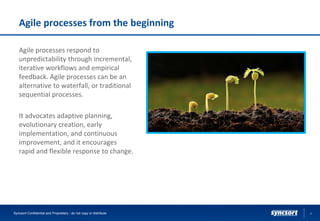
Agile processes respond to
unpredictability through incremental,
iterative workflows and empirical
feedback. Agile processes can be an
alternative to waterfall, or traditional
sequential processes.
It advocates adaptive planning,
evolutionary creation, early
implementation, and continuous
improvement, and it encourages
rapid and flexible response to change.
4Syncsort Confidential and Proprietary - do not copy or distribute
Agile processes from the beginning
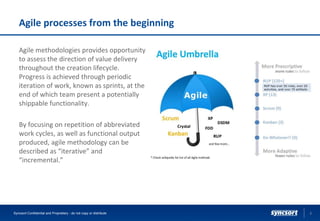
Agile methodologies provides opportunity
to assess the direction of value delivery
throughout the creation lifecycle.
Progress is achieved through periodic
iteration of work, known as sprints, at the
end of which team present a potentially
shippable functionality.
By focusing on repetition of abbreviated
work cycles, as well as functional output
produced, agile methodology can be
described as “iterative” and
“incremental.”
5Syncsort Confidential and Proprietary - do not copy or distribute
Agile processes from the beginning
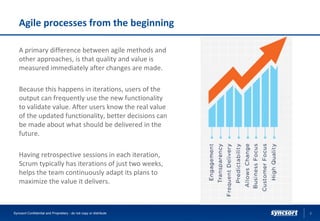
A primary difference between agile methods and
other approaches, is that quality and value is
measured immediately after changes are made.
Because this happens in iterations, users of the
output can frequently use the new functionality
to validate value. After users know the real value
of the updated functionality, better decisions can
be made about what should be delivered in the
future.
Having retrospective sessions in each iteration,
Scrum typically has iterations of just two weeks,
helps the team continuously adapt its plans to
maximize the value it delivers.
6Syncsort Confidential and Proprietary - do not copy or distribute
Capacity management requirements
Mission
Ensuring the best use of the appropriate IT infrastructure to cost-
effectively meet the business needs both now and in the future
Understanding how IT services will be used and matching resources
to deliver services at agreed levels (SLAs) now and in the future
Syncsort Confidential and Proprietary - do not copy or distribute 7
Capacity management requirements
Key Task
Ensuring adequate capacity
Performance Monitoring
Tuning
Forecasting resource demands and service levels
Producing the Capacity Plan
8Syncsort Confidential and Proprietary - do not copy or distribute
Capacity management requirements
Objects
Ensure the right level of ITI investment
Identify and resolve bottlenecks
Evaluate tuning strategies
Improve and report/publish performance
“Right-size” or “consolidate”
Ensure accurate and timely procurements
Ensure effective service level management
Plan for workload growth, new apps / sites
Avoid performance disasters
9Syncsort Confidential and Proprietary - do not copy or distribute
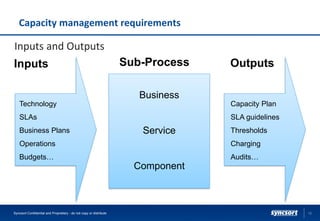
Inputs OutputsSub-Process
Business
Service
Component
Technology
SLAs
Business Plans
Operations
Budgets…
Capacity Plan
SLA guidelines
Thresholds
Charging
Audits…
Inputs and Outputs
Capacity management requirements
10Syncsort Confidential and Proprietary - do not copy or distribute
Capacity management requirements
Inputs
Technology
SLAs, SLRs, and Service Catalogue
IT Plans and Strategy
Business Requirements and
Volumes
Operational Schedules
Deployment and Development
Plans
Forward Schedule of Changes
(Change Management)
11Syncsort Confidential and Proprietary - do not copy or distribute
Incidents and Problems
(Incident Management
and Change Management)
Service Reviews
SLA Breaches
Financial Plans
Budgets
Capacity management requirements
Outputs
Capacity Plan
Capacity Management Information System (CMIS)
Baselines and Profiles
Thresholds and Alarms
Capacity Reports (regular, ad-hoc, exception)
SLA and SLR recommendations
Costing and charging recommendations
Proactive changes and service improvements
Revised operational schedule
Effectiveness reviews
Audits
12Syncsort Confidential and Proprietary - do not copy or distribute
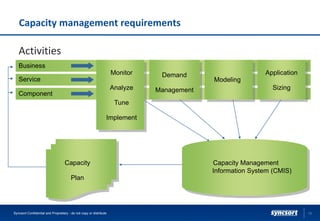
Activities
Business
Service
Component
Capacity
Plan
Capacity Management
Information System (CMIS)
Demand
Management
Modeling
Application
Sizing
Monitor
Analyze
Tune
Implement
Capacity management requirements
13Syncsort Confidential and Proprietary - do not copy or distribute
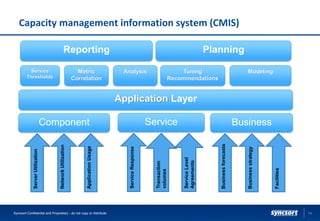
Service BusinessComponent
ServerUtilization
NetworkUtilization
ApplicationUsage
ServiceResponse
Transaction
volumes
ServiceLevel
Agreements
Businessforecasts
Businessstrategy
Facilities
Application Layer
Reporting
Service
Thresholds
Metric
Correlation
Analysis Tuning
Recommendations
Modeling
Planning
Capacity management information system (CMIS)
14Syncsort Confidential and Proprietary - do not copy or distribute
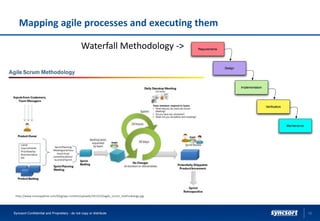
Waterfall Methodology ->
http://www.innovapptive.com/blog/wp-content/uploads/2013/10/agile_scrum_methodology.jpg
Mapping agile processes and executing them
15Syncsort Confidential and Proprietary - do not copy or distribute
Mapping agile processes and executing them
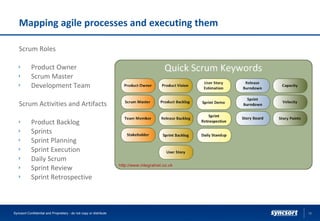
Scrum Roles
Product Owner
Scrum Master
Development Team
Scrum Activities and Artifacts
Product Backlog
Sprints
Sprint Planning
Sprint Execution
Daily Scrum
Sprint Review
Sprint Retrospective
16Syncsort Confidential and Proprietary - do not copy or distribute
 Scrum Storyboard
Scrum Burndown Chart 
Mapping agile processes and executing them
17Syncsort Confidential and Proprietary - do not copy or distribute
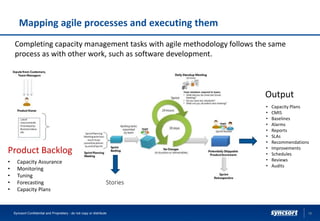
• Capacity Assurance
• Monitoring
• Tuning
• Forecasting
• Capacity Plans
Completing capacity management tasks with agile methodology follows the same
process as with other work, such as software development.
Product Backlog
Stories
• Capacity Plans
• CMIS
• Baselines
• Alarms
• Reports
• SLAs
• Recommendations
• Improvements
• Schedules
• Reviews
• Audits
Output
Mapping agile processes and executing them
18Syncsort Confidential and Proprietary - do not copy or distribute
http://www.scaledagileframework.com
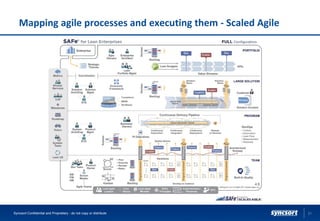
Mapping agile processes and executing them - Scaled Agile
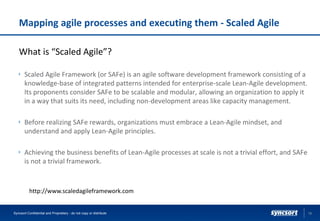
What is “Scaled Agile”?
Scaled Agile Framework (or SAFe) is an agile software development framework consisting of a
knowledge-base of integrated patterns intended for enterprise-scale Lean-Agile development.
Its proponents consider SAFe to be scalable and modular, allowing an organization to apply it
in a way that suits its need, including non-development areas like capacity management.
Before realizing SAFe rewards, organizations must embrace a Lean-Agile mindset, and
understand and apply Lean-Agile principles.
Achieving the business benefits of Lean-Agile processes at scale is not a trivial effort, and SAFe
is not a trivial framework.
19Syncsort Confidential and Proprietary - do not copy or distribute
Mapping agile processes and executing them - Scaled Agile
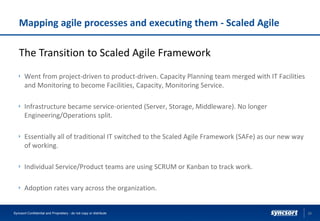
The Transition to Scaled Agile Framework
Went from project-driven to product-driven. Capacity Planning team merged with IT Facilities
and Monitoring to become Facilities, Capacity, Monitoring Service.
Infrastructure became service-oriented (Server, Storage, Middleware). No longer
Engineering/Operations split.
Essentially all of traditional IT switched to the Scaled Agile Framework (SAFe) as our new way
of working.
Individual Service/Product teams are using SCRUM or Kanban to track work.
Adoption rates vary across the organization.
20Syncsort Confidential and Proprietary - do not copy or distribute
Mapping agile processes and executing them - Scaled Agile
21Syncsort Confidential and Proprietary - do not copy or distribute
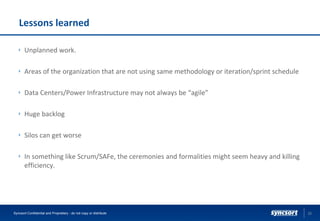
Lessons learned
Unplanned work.
Areas of the organization that are not using same methodology or iteration/sprint schedule
Data Centers/Power Infrastructure may not always be “agile”
Huge backlog
Silos can get worse
In something like Scrum/SAFe, the ceremonies and formalities might seem heavy and killing
efficiency.
22Syncsort Confidential and Proprietary - do not copy or distribute
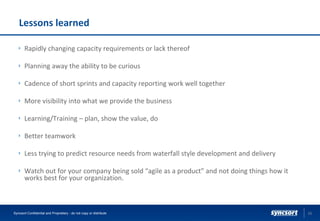
Lessons learned
Rapidly changing capacity requirements or lack thereof
Planning away the ability to be curious
Cadence of short sprints and capacity reporting work well together
More visibility into what we provide the business
Learning/Training – plan, show the value, do
Better teamwork
Less trying to predict resource needs from waterfall style development and delivery
Watch out for your company being sold “agile as a product” and not doing things how it
works best for your organization.
23Syncsort Confidential and Proprietary - do not copy or distribute
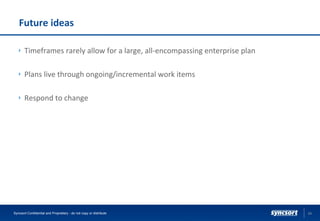
Future ideas
Timeframes rarely allow for a large, all-encompassing enterprise plan
Plans live through ongoing/incremental work items
Respond to change
24Syncsort Confidential and Proprietary - do not copy or distribute
Future ideas
Still need long-term data; unless you don’t
The plan and results achieved are much more visible
Any formal plans need to be kept much more simple, as things are changing much
more rapidly
25Syncsort Confidential and Proprietary - do not copy or distribute
Thank you for attending
Agile Capacity Management
Questions or comments?

Agile Capacity Management

  • 1.
    Agile Capacity Management DaleFeiste, Principal Consultant
  • 2.
    Abstract Waterfall and agileprocesses have been applied to software development for many years. However, the same concepts can be applied to many other areas of business operation, including general IT activities such as capacity management. Terms such as lean, scrum, sprint, velocity, stories, etc. are used in agile development, and can be carried over into other areas as well, where they fit. Where agile concepts do not fit well, a more conventional or hybrid approach can be used. Underlying principles to improve efficiency is what should determine the methods used. Agile software development was formulated in 2001 by a group of developers who created a manifesto based on their experience with software development. The manifesto contained guiding principles the developers came to value in creating software. Mapping these concepts over to other areas of business operation, where efficiency could be improved, was a natural evolution. Primary factors for agile processes is that it be customer centric and fast. This paper covers the idea of applying agile processes to the function of capacity management and real experiences carrying out capacity management in a company that has embraced Scaled Agile methodologies. 2Syncsort Confidential and Proprietary - do not copy or distribute
  • 3.
    Contents Agile processes fromthe beginning Capacity management requirements Mapping agile processes and executing them Lessons learned Future ideas 3Syncsort Confidential and Proprietary - do not copy or distribute
  • 4.
    Agile processes fromthe beginning Agile processes respond to unpredictability through incremental, iterative workflows and empirical feedback. Agile processes can be an alternative to waterfall, or traditional sequential processes. It advocates adaptive planning, evolutionary creation, early implementation, and continuous improvement, and it encourages rapid and flexible response to change. 4Syncsort Confidential and Proprietary - do not copy or distribute
  • 5.
    Agile processes fromthe beginning Agile methodologies provides opportunity to assess the direction of value delivery throughout the creation lifecycle. Progress is achieved through periodic iteration of work, known as sprints, at the end of which team present a potentially shippable functionality. By focusing on repetition of abbreviated work cycles, as well as functional output produced, agile methodology can be described as “iterative” and “incremental.” 5Syncsort Confidential and Proprietary - do not copy or distribute
  • 6.
    Agile processes fromthe beginning A primary difference between agile methods and other approaches, is that quality and value is measured immediately after changes are made. Because this happens in iterations, users of the output can frequently use the new functionality to validate value. After users know the real value of the updated functionality, better decisions can be made about what should be delivered in the future. Having retrospective sessions in each iteration, Scrum typically has iterations of just two weeks, helps the team continuously adapt its plans to maximize the value it delivers. 6Syncsort Confidential and Proprietary - do not copy or distribute
  • 7.
    Capacity management requirements Mission Ensuringthe best use of the appropriate IT infrastructure to cost- effectively meet the business needs both now and in the future Understanding how IT services will be used and matching resources to deliver services at agreed levels (SLAs) now and in the future Syncsort Confidential and Proprietary - do not copy or distribute 7
  • 8.
    Capacity management requirements KeyTask Ensuring adequate capacity Performance Monitoring Tuning Forecasting resource demands and service levels Producing the Capacity Plan 8Syncsort Confidential and Proprietary - do not copy or distribute
  • 9.
    Capacity management requirements Objects Ensurethe right level of ITI investment Identify and resolve bottlenecks Evaluate tuning strategies Improve and report/publish performance “Right-size” or “consolidate” Ensure accurate and timely procurements Ensure effective service level management Plan for workload growth, new apps / sites Avoid performance disasters 9Syncsort Confidential and Proprietary - do not copy or distribute
  • 10.
    Inputs OutputsSub-Process Business Service Component Technology SLAs Business Plans Operations Budgets… CapacityPlan SLA guidelines Thresholds Charging Audits… Inputs and Outputs Capacity management requirements 10Syncsort Confidential and Proprietary - do not copy or distribute
  • 11.
    Capacity management requirements Inputs Technology SLAs,SLRs, and Service Catalogue IT Plans and Strategy Business Requirements and Volumes Operational Schedules Deployment and Development Plans Forward Schedule of Changes (Change Management) 11Syncsort Confidential and Proprietary - do not copy or distribute Incidents and Problems (Incident Management and Change Management) Service Reviews SLA Breaches Financial Plans Budgets
  • 12.
    Capacity management requirements Outputs CapacityPlan Capacity Management Information System (CMIS) Baselines and Profiles Thresholds and Alarms Capacity Reports (regular, ad-hoc, exception) SLA and SLR recommendations Costing and charging recommendations Proactive changes and service improvements Revised operational schedule Effectiveness reviews Audits 12Syncsort Confidential and Proprietary - do not copy or distribute
  • 13.
    Activities Business Service Component Capacity Plan Capacity Management Information System(CMIS) Demand Management Modeling Application Sizing Monitor Analyze Tune Implement Capacity management requirements 13Syncsort Confidential and Proprietary - do not copy or distribute
  • 14.
  • 15.
    Waterfall Methodology -> http://www.innovapptive.com/blog/wp-content/uploads/2013/10/agile_scrum_methodology.jpg Mappingagile processes and executing them 15Syncsort Confidential and Proprietary - do not copy or distribute
  • 16.
    Mapping agile processesand executing them Scrum Roles Product Owner Scrum Master Development Team Scrum Activities and Artifacts Product Backlog Sprints Sprint Planning Sprint Execution Daily Scrum Sprint Review Sprint Retrospective 16Syncsort Confidential and Proprietary - do not copy or distribute
  • 17.
     Scrum Storyboard ScrumBurndown Chart  Mapping agile processes and executing them 17Syncsort Confidential and Proprietary - do not copy or distribute
  • 18.
    • Capacity Assurance •Monitoring • Tuning • Forecasting • Capacity Plans Completing capacity management tasks with agile methodology follows the same process as with other work, such as software development. Product Backlog Stories • Capacity Plans • CMIS • Baselines • Alarms • Reports • SLAs • Recommendations • Improvements • Schedules • Reviews • Audits Output Mapping agile processes and executing them 18Syncsort Confidential and Proprietary - do not copy or distribute
  • 19.
    http://www.scaledagileframework.com Mapping agile processesand executing them - Scaled Agile What is “Scaled Agile”? Scaled Agile Framework (or SAFe) is an agile software development framework consisting of a knowledge-base of integrated patterns intended for enterprise-scale Lean-Agile development. Its proponents consider SAFe to be scalable and modular, allowing an organization to apply it in a way that suits its need, including non-development areas like capacity management. Before realizing SAFe rewards, organizations must embrace a Lean-Agile mindset, and understand and apply Lean-Agile principles. Achieving the business benefits of Lean-Agile processes at scale is not a trivial effort, and SAFe is not a trivial framework. 19Syncsort Confidential and Proprietary - do not copy or distribute
  • 20.
    Mapping agile processesand executing them - Scaled Agile The Transition to Scaled Agile Framework Went from project-driven to product-driven. Capacity Planning team merged with IT Facilities and Monitoring to become Facilities, Capacity, Monitoring Service. Infrastructure became service-oriented (Server, Storage, Middleware). No longer Engineering/Operations split. Essentially all of traditional IT switched to the Scaled Agile Framework (SAFe) as our new way of working. Individual Service/Product teams are using SCRUM or Kanban to track work. Adoption rates vary across the organization. 20Syncsort Confidential and Proprietary - do not copy or distribute
  • 21.
    Mapping agile processesand executing them - Scaled Agile 21Syncsort Confidential and Proprietary - do not copy or distribute
  • 22.
    Lessons learned Unplanned work. Areasof the organization that are not using same methodology or iteration/sprint schedule Data Centers/Power Infrastructure may not always be “agile” Huge backlog Silos can get worse In something like Scrum/SAFe, the ceremonies and formalities might seem heavy and killing efficiency. 22Syncsort Confidential and Proprietary - do not copy or distribute
  • 23.
    Lessons learned Rapidly changingcapacity requirements or lack thereof Planning away the ability to be curious Cadence of short sprints and capacity reporting work well together More visibility into what we provide the business Learning/Training – plan, show the value, do Better teamwork Less trying to predict resource needs from waterfall style development and delivery Watch out for your company being sold “agile as a product” and not doing things how it works best for your organization. 23Syncsort Confidential and Proprietary - do not copy or distribute
  • 24.
    Future ideas Timeframes rarelyallow for a large, all-encompassing enterprise plan Plans live through ongoing/incremental work items Respond to change 24Syncsort Confidential and Proprietary - do not copy or distribute
  • 25.
    Future ideas Still needlong-term data; unless you don’t The plan and results achieved are much more visible Any formal plans need to be kept much more simple, as things are changing much more rapidly 25Syncsort Confidential and Proprietary - do not copy or distribute
  • 26.
    Thank you forattending Agile Capacity Management Questions or comments?