Rent sharing across
Production network
Emmanuel Dhyne, Global Forum on Productivity, Sydney
20/07 – 21/07 2019
◆ Firm level data from 1995
onwards.
◆ Various datasets connected by
unique firm level identifier :
VAT number
◆ Administrative and fiscal data
sources
◆ Network data only available
from 2002
◆ Allows a full description of the
domestic and foreign sales of
Belgian firms
◆ FDI and domestic
participations are covered to
identify (inter)national groups
2
Source(s):
1 Footnote
2 Footnote
The NBB datawarehouse
Firms regiter
Annual
account
register
VAT
declarations
International
trade
Social security
declarations
Balance of
paiement
survey
VAT domestic
customer
declarations
◆ 2 sources :
◇ National Statistical Institute :
- multiple cross-section, structure of earning survey (used f.i. by Rycx and co-authors for various projects).
- Small sample of firms and employees
◇ Cross-road bank of Social Security
- Centralize administrative datasets from Social security institutions from 1997 for main social security
agencies, from 2003 for administrative data sources
- Covers all the population of firms / individuals
- Allows to follow the situation of individuals over time (change in status, change of employers, wages) and
some characteristics (limited number - gender, age, location, citizenship, work experience, education)
3
Source(s):
1 Footnote
2 Footnote
Matched employer-employee data in Belgium
◆ Used to analyse several policy relevant issues
◇ At the Bank : Du Caju, Fuss, Wintr (2009) : wage rigidity in Belgium (part of the ESCB Wage dynamic
network) using 1/3 of the Belgian labor force
◇ Outside the Bank : evaluation of specific labor market policies by Belgian academics (see CBSS website for a
list of research projects based on their data)
4
Source(s):
1 Footnote
2 Footnote
Cross-road bank of Social Security
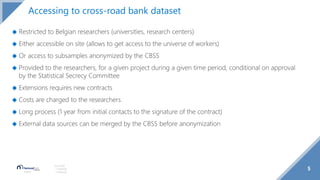
◆ Restricted to Belgian researchers (universities, research centers)
◆ Either accessible on site (allows to get access to the universe of workers)
◆ Or access to subsamples anonymized by the CBSS
◆ Provided to the researchers, for a given project during a given time period, conditional on approval
by the Statistical Secrecy Committee
◆ Extensions requires new contracts
◆ Costs are charged to the researchers
◆ Long process (1 year from initial contacts to the signature of the contract)
◆ External data sources can be merged by the CBSS before anonymization
5
Source(s):
1 Footnote
2 Footnote
Accessing to cross-road bank dataset
6
Source(s):
1 Footnote
2 Footnote
The NBB production network + CBSS data
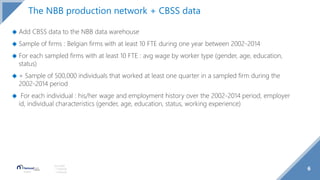
◆ Add CBSS data to the NBB data warehouse
◆ Sample of firms : Belgian firms with at least 10 FTE during one year between 2002-2014
◆ For each sampled firms with at least 10 FTE : avg wage by worker type (gender, age, education,
status)
◆ + Sample of 500,000 individuals that worked at least one quarter in a sampled firm during the
2002-2014 period
◆ For each individual : his/her wage and employment history over the 2002-2014 period, employer
id, individual characteristics (gender, age, education, status, working experience)
7
Source(s):
1 Footnote
2 Footnote
Pass-through within and across the boundaries of firms
(ongoing, very preliminary)
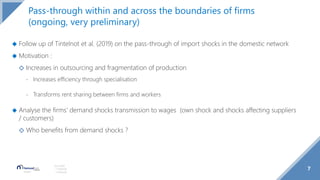
◆ Follow up of Tintelnot et al. (2019) on the pass-through of import shocks in the domestic network
◆ Motivation :
◇ Increases in outsourcing and fragmentation of production
- Increases efficiency through specialisation
- Transforms rent sharing between firms and workers
◆ Analyse the firms’ demand shocks transmission to wages (own shock and shocks affecting suppliers
/ customers)
◇ Who benefits from demand shocks ?
8
Source(s):
1 Footnote
2 Footnote
The NBB production network + CBSS data
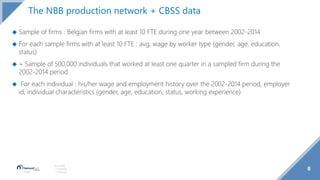
◆ Sample of firms : Belgian firms with at least 10 FTE during one year between 2002-2014
◆ For each sample firms with at least 10 FTE : avg, wage by worker type (gender, age, education,
status)
◆ + Sample of 500,000 individuals that worked at least one quarter in a sampled firm during the
2002-2014 period
◆ For each individual : his/her wage and employment history over the 2002-2014 period, employer
id, individual characteristics (gender, age, education, status, working experience)
9
Source(s):
1 Footnote
2 Footnote
Empirical strategy
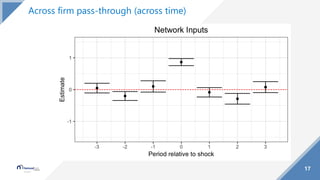
◆ Estimate individual firm responses in labor costs, avg. wage, employment to changes in sales
(instrumented by foreign demand shocks affecting firm i and all his direct and indirect customers).
◆ Estimate suppliers responses in terms of deliveries to Belgian firms and imports to changes in sales
10
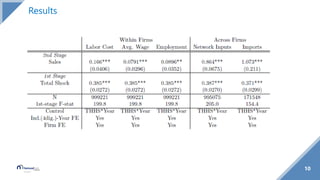
Results
11
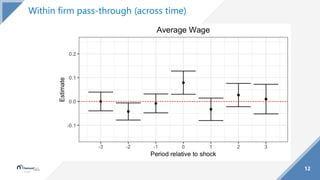
Within firm pass-through (across time)
12
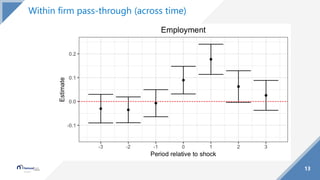
Within firm pass-through (across time)
13
Within firm pass-through (across time)
14
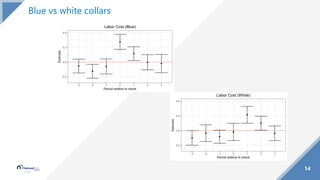
Blue vs white collars
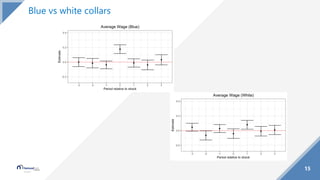
15
Blue vs white collars
16
Blue vs white collars
17
Across firm pass-through (across time)
18
Across firm pass-through (across time)
19
Heterogeneous pass-through across sectors
20
Heterogeneous pass-through across sectors
21

Rent sharing across Production network

  • 1.
    Rent sharing across Productionnetwork Emmanuel Dhyne, Global Forum on Productivity, Sydney 20/07 – 21/07 2019
  • 2.
    ◆ Firm leveldata from 1995 onwards. ◆ Various datasets connected by unique firm level identifier : VAT number ◆ Administrative and fiscal data sources ◆ Network data only available from 2002 ◆ Allows a full description of the domestic and foreign sales of Belgian firms ◆ FDI and domestic participations are covered to identify (inter)national groups 2 Source(s): 1 Footnote 2 Footnote The NBB datawarehouse Firms regiter Annual account register VAT declarations International trade Social security declarations Balance of paiement survey VAT domestic customer declarations
  • 3.
    ◆ 2 sources: ◇ National Statistical Institute : - multiple cross-section, structure of earning survey (used f.i. by Rycx and co-authors for various projects). - Small sample of firms and employees ◇ Cross-road bank of Social Security - Centralize administrative datasets from Social security institutions from 1997 for main social security agencies, from 2003 for administrative data sources - Covers all the population of firms / individuals - Allows to follow the situation of individuals over time (change in status, change of employers, wages) and some characteristics (limited number - gender, age, location, citizenship, work experience, education) 3 Source(s): 1 Footnote 2 Footnote Matched employer-employee data in Belgium
  • 4.
    ◆ Used toanalyse several policy relevant issues ◇ At the Bank : Du Caju, Fuss, Wintr (2009) : wage rigidity in Belgium (part of the ESCB Wage dynamic network) using 1/3 of the Belgian labor force ◇ Outside the Bank : evaluation of specific labor market policies by Belgian academics (see CBSS website for a list of research projects based on their data) 4 Source(s): 1 Footnote 2 Footnote Cross-road bank of Social Security
  • 5.
    ◆ Restricted toBelgian researchers (universities, research centers) ◆ Either accessible on site (allows to get access to the universe of workers) ◆ Or access to subsamples anonymized by the CBSS ◆ Provided to the researchers, for a given project during a given time period, conditional on approval by the Statistical Secrecy Committee ◆ Extensions requires new contracts ◆ Costs are charged to the researchers ◆ Long process (1 year from initial contacts to the signature of the contract) ◆ External data sources can be merged by the CBSS before anonymization 5 Source(s): 1 Footnote 2 Footnote Accessing to cross-road bank dataset
  • 6.
    6 Source(s): 1 Footnote 2 Footnote TheNBB production network + CBSS data ◆ Add CBSS data to the NBB data warehouse ◆ Sample of firms : Belgian firms with at least 10 FTE during one year between 2002-2014 ◆ For each sampled firms with at least 10 FTE : avg wage by worker type (gender, age, education, status) ◆ + Sample of 500,000 individuals that worked at least one quarter in a sampled firm during the 2002-2014 period ◆ For each individual : his/her wage and employment history over the 2002-2014 period, employer id, individual characteristics (gender, age, education, status, working experience)
  • 7.
    7 Source(s): 1 Footnote 2 Footnote Pass-throughwithin and across the boundaries of firms (ongoing, very preliminary) ◆ Follow up of Tintelnot et al. (2019) on the pass-through of import shocks in the domestic network ◆ Motivation : ◇ Increases in outsourcing and fragmentation of production - Increases efficiency through specialisation - Transforms rent sharing between firms and workers ◆ Analyse the firms’ demand shocks transmission to wages (own shock and shocks affecting suppliers / customers) ◇ Who benefits from demand shocks ?
  • 8.
    8 Source(s): 1 Footnote 2 Footnote TheNBB production network + CBSS data ◆ Sample of firms : Belgian firms with at least 10 FTE during one year between 2002-2014 ◆ For each sample firms with at least 10 FTE : avg, wage by worker type (gender, age, education, status) ◆ + Sample of 500,000 individuals that worked at least one quarter in a sampled firm during the 2002-2014 period ◆ For each individual : his/her wage and employment history over the 2002-2014 period, employer id, individual characteristics (gender, age, education, status, working experience)
  • 9.
    9 Source(s): 1 Footnote 2 Footnote Empiricalstrategy ◆ Estimate individual firm responses in labor costs, avg. wage, employment to changes in sales (instrumented by foreign demand shocks affecting firm i and all his direct and indirect customers). ◆ Estimate suppliers responses in terms of deliveries to Belgian firms and imports to changes in sales
  • 10.
  • 11.
  • 12.
  • 13.
  • 14.
  • 15.
  • 16.
  • 17.
  • 18.
  • 19.
  • 20.
  • 21.