
Andy Stirling, SPRU – Science and Technology Policy Research Annual STEPS Symposium, Brighton 24 th  September 2009 Democratising Innovation:  towards more accountable institutions
The Missing Politics of Direction all technology is good… all innovation is good… “ For the objectives of the Lisbon Strategy …  pro-innovation  action [is] a priority.” - European Parliament “ [we need] more  `pro-innovation’  policies …” - José Manuel Borroso determined simply by science…   “ [there is] an  anti-technology  culture  … a pro- technology culture must be created…”   -  Council for Science and Technology “…  this government's approach is to make decisions … on the basis of  sound science     - Tony Blair
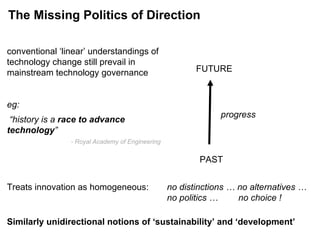
progress PAST FUTURE conventional ‘linear’ understandings of technology change still prevail in mainstream technology governance eg:  “history is a  race to advance technology ”   - Royal Academy of Engineering Treats innovation as homogeneous:  no distinctions … no alternatives …  no politics …    no choice ! Similarly unidirectional notions of ‘sustainability’ and ‘development’ The Missing Politics of Direction
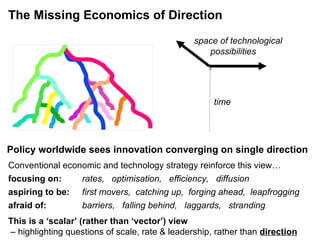
space of technological possibilities time Policy worldwide sees innovation  converging on single direction This is a ‘scalar’ (rather than ‘vector’) view  –  highlighting questions of scale, rate & leadership, rather than  direction Conventional economic and technology strategy reinforce this view… focusing on:   rates,  optimisation,  efficiency,  diffusion aspiring to be:    first movers,  catching up,  forging ahead,  leapfrogging  afraid of:    barriers,  falling behind,  laggards,  stranding The Missing Economics of Direction
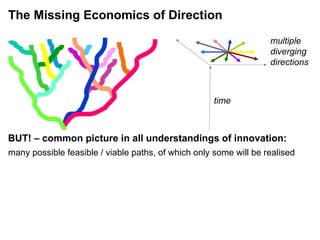
time BUT! – common picture in all understandings of innovation:  multiple diverging directions many possible feasible / viable paths, of which only some will be realised The Missing Economics of Direction
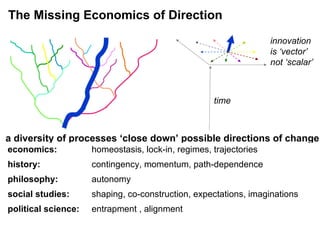
time a diversity of processes ‘close down’ possible directions of change economics: homeostasis, lock-in, regimes, trajectories  history: contingency, momentum, path-dependence  philosophy: autonomy social studies: shaping, co-construction, expectations, imaginations political science: entrapment , alignment  innovation  is ‘vector’  not ‘scalar’ The Missing Economics of Direction
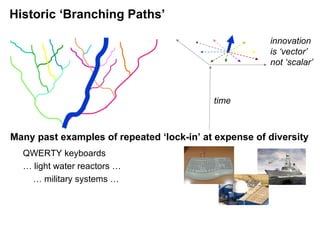
QWERTY keyboards …  light water reactors … …  military systems … Historic ‘Branching Paths’ Many past examples of repeated ‘lock-in’ at expense of diversity time innovation  is ‘vector’  not ‘scalar’
Many past examples of repeated ‘lock-in’ at expense of diversity Narrow Gauge Railways …  urban transport … …  internal combustion engine … time innovation  is ‘vector’  not ‘scalar’ Historic ‘Branching Paths’
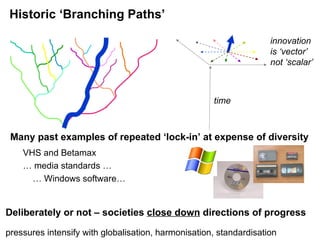
Many past examples of repeated ‘lock-in’ at expense of diversity VHS and Betamax …  media standards … …  Windows software… Deliberately or not – societies  close down  directions of progress pressures   intensify with globalisation, harmonisation, standardisation time innovation  is ‘vector’  not ‘scalar’ Historic ‘Branching Paths’
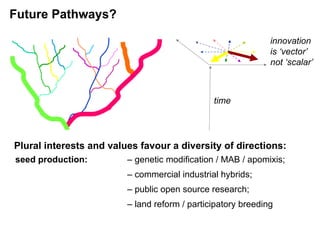
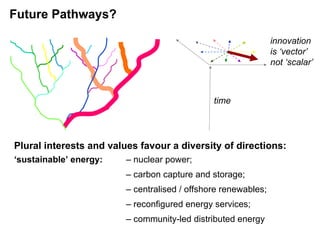
Future Pathways? Plural interests and values favour a diversity of directions: seed production:   –  genetic modification / MAB / apomixis;  –  commercial industrial hybrids;  –  public open source research; –  land reform / participatory  breeding time innovation  is ‘vector’  not ‘scalar’
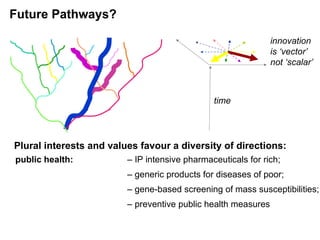
Future Pathways? Plural interests and values favour a diversity of directions: public health:   – IP intensive pharmaceuticals for rich ;  –  generic products for diseases of poor; –  gene-based screening of mass susceptibilities;  – preventive  public health measures time innovation  is ‘vector’  not ‘scalar’
‘ sustainable’ energy: – nuclear power; –  carbon capture and storage; –  centralised / offshore renewables; – reconfigured energy services; –  community-led distributed energy time innovation  is ‘vector’  not ‘scalar’ Plural interests and values favour a diversity of directions: Future Pathways?
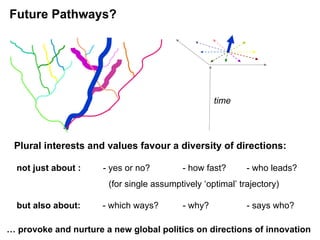
not just about :  - yes or no?  - how fast?  - who leads?   (for single assumptively ‘optimal’ trajectory) but also about:   - which ways? - why?  - says who? …  provoke and nurture a new global politics on directions of innovation time Plural interests and values favour a diversity of directions: Future Pathways?
New practices and institutions help provoke and nurture a new politics Catalysing a New Politics of Innovation inform  mainstream  policy -making about orientations of innovation extend  diversity of  perspectives  on directions for innovation build  new modes of  accountability  in pubic and private sectors enable  more distributed and  diverse  forms of innovation activity address  global  structures in international innovation  systems enhance  high-level political  debate  over priorities, values, interests
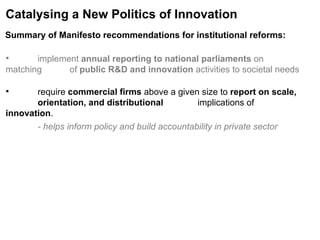
Summary of Manifesto recommendations for institutional reforms:   Catalysing a New Politics of Innovation implement  annual reporting to national parliaments  on matching  of  public R&D and innovation  activities to societal needs - helps inform policy and build accountability in public sector
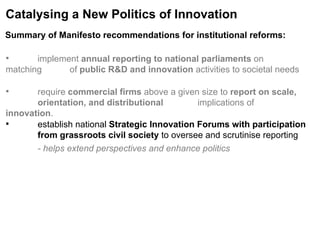
Catalysing a New Politics of Innovation implement  annual reporting to national parliaments  on matching  of  public R&D and innovation  activities to societal needs require  commercial firms  above a given size to  report on scale,  orientation, and distributional  implications of  innovation . - helps inform policy and build accountability in private sector Summary of Manifesto recommendations for institutional reforms:
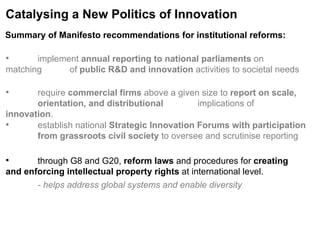
Catalysing a New Politics of Innovation implement  annual reporting to national parliaments  on matching  of  public R&D and innovation  activities to societal needs require  commercial firms  above a given size to  report on scale,  orientation, and distributional  implications of  innovation . establish national  Strategic Innovation Forums with participation  from grassroots civil society  to oversee and scrutinise reporting - helps extend perspectives and enhance politics Summary of Manifesto recommendations for institutional reforms:
Catalysing a New Politics of Innovation implement  annual reporting to national parliaments  on matching  of  public R&D and innovation  activities to societal needs require  commercial firms  above a given size to  report on scale,  orientation, and distributional  implications of  innovation . establish national  Strategic Innovation Forums with participation  from grassroots civil society  to oversee and scrutinise reporting through G8 and G20,  reform laws  and procedures for  creating  and enforcing intellectual property rights  at international level. - helps address global systems and enable diversity  Summary of Manifesto recommendations for institutional reforms:
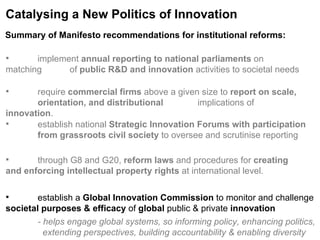
Catalysing a New Politics of Innovation implement  annual reporting to national parliaments  on matching  of  public R&D and innovation  activities to societal needs require  commercial firms  above a given size to  report on scale,  orientation, and distributional  implications of  innovation . establish national  Strategic Innovation Forums with participation  from grassroots civil society  to oversee and scrutinise reporting through G8 and G20,  reform laws  and procedures for  creating  and enforcing intellectual property rights  at international level. establish a  Global Innovation Commission  to monitor and challenge  societal purposes & efficacy  of  global  public & private  innovation - helps engage global systems, so informing policy, enhancing politics,      extending perspectives, building accountability & enabling diversity  Summary of Manifesto recommendations for institutional reforms:
Catalysing a New Politics of Innovation? implement  annual reporting to national parliaments  on matching  of  public R&D and innovation  activities to societal needs require  commercial firms  above a given size to  report on scale,  orientation, and distributional  implications of  innovation . establish national  Strategic Innovation Forums with participation  from grassroots civil society  to oversee and scrutinise reporting through G8 and G20,  reform laws  and procedures for  creating  and enforcing intellectual property rights  at international level. establish a  Global Innovation Commission  to monitor and challenge  societal purposes & efficacy  of  global  public & private  innovation Summary of Manifesto recommendations for institutional reforms:
 
ANNEX:  summary of recommendations for institutional reforms The institutions responsible for shaping innovation and the distribution of its benefits and  risks should be made more accountable to their stated beneficiaries.  C-1:  Annual reports  to document the overall prioritisation of all public sector R&D  and innovation activities C-2:  Each state should establish a  'Strategic Innovation Forum'  including  grassroots national civil society organisations C-3:  Programme for  progressively increasing  proportions of public sector  research and innovation  accountable to users and grassroots  civil society C-4:  Private sector organisations  should  report  on scale, orientation, and  distribution of innovation  to  national  Strategic Innovation Forum C-5:  The G8 and G20 should  reform laws  and procedures for the creation and  enforcement of  intellectual property C-6  Promote  alternative models for incentivising innovation  for poverty alleviation  and environmental sustainability C-7:   Constitute a  Global Innovation Commission  to monitor and challenge the  societal purposes and efficacy of global innovation activities
The institutions responsible for shaping innovation and the distribution of its benefits and  risks should be made more accountable to their stated beneficiaries.  ANNEX:  specific recommendations for institutional reforms – national:   C-1:  Annual reports  to the national legislature should  document the overall  prioritisation of all public sector R&D and innovation activities  thus  facilitating open transparent political debate about the aggregate resource  allocations in relation to societal needs and distributional consequences.  C-2:  Each state should establish  a body to fulfil the function of  a 'Strategic  Innovation Forum' including  representation from a full range of  grassroots  national civil society organisations  to oversee and deliberate on the reporting  process, and match relevant R&D and innovation activities to societal needs.  C-3:  An  explicit programme  should be established to make  progressively  increasing proportions of public sector research and innovation  activities –  both in competitive evaluation and in project governance –  accountable to users  and grassroots  civil society organisations.  C-4:  It should be a statutory requirement of  private sector organisations  above a  specified audited turnover, that the scale, orientation, and distributional  implications of R&D and innovation activities be a matter for  transparent  regular reporting  in the country of legal incorporation, subject to formal regular  comment from the national Strategic Innovation Forum.
ANNEX:  institutional recommendations (continued) – international:   C-5:  The  G8 should work with the G20  to open an honest dialogue with the wider  international community, including the’ least developed countries’ to  reform the  laws and procedures for the creation and enforcement of intellectual property  rights at national and international levels. C-6  Civil society and commercial organisations should promote alternative  models to incentivising innovation for poverty alleviation and environmental  sustainability  goals, and continue to experiment with, stretch and extend the  flexibilities provided under the WTO TRIPS agreement.  C-7:  A  Global Innovation Commission should be  established to promote the  emerging 3D agenda for innovation, sustainability and development and  provide  co-ordination and oversight at an international level. Comprising a  broad diversity of actors (especially from the global South), this should be  constituted  in association  with  (but independent from) the  existing  institutional frameworks of the UN  and others concerned with international  development and world trade regulation, under a governance structure to  include representation from civil society organisations participating in  national level Strategic Innovation Fora . The remit of the GIC is  to monitor  and challenge the societal purposes and efficacy of global  public and  private sector  innovation  activities, thus facilitating more democratic  political debate and so help improve the diversity, direction, and distributional  consequences of intergovernmental, national & commercial innovative activity.
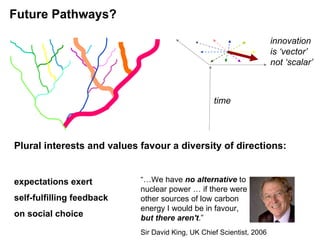
time innovation  is ‘vector’  not ‘scalar’ “… We have  no alternative   to   nuclear power … if there were    other sources of low carbon  energy I would be in favour,  but there aren't .”   Sir David King, UK Chief Scientist, 2006 ‘ sustainable’ energy: expectations exert self-fulfilling feedback on social choice Plural interests and values favour a diversity of directions: Future Pathways?

Manifesto: Andy Stirling - Democratising Innovation - towards more accountable institutions

  • 1.
    Andy Stirling, SPRU– Science and Technology Policy Research Annual STEPS Symposium, Brighton 24 th September 2009 Democratising Innovation: towards more accountable institutions
  • 2.
    The Missing Politicsof Direction all technology is good… all innovation is good… “ For the objectives of the Lisbon Strategy … pro-innovation action [is] a priority.” - European Parliament “ [we need] more `pro-innovation’ policies …” - José Manuel Borroso determined simply by science… “ [there is] an anti-technology culture … a pro- technology culture must be created…” - Council for Science and Technology “… this government's approach is to make decisions … on the basis of sound science - Tony Blair
  • 3.
    progress PAST FUTUREconventional ‘linear’ understandings of technology change still prevail in mainstream technology governance eg: “history is a race to advance technology ” - Royal Academy of Engineering Treats innovation as homogeneous: no distinctions … no alternatives … no politics … no choice ! Similarly unidirectional notions of ‘sustainability’ and ‘development’ The Missing Politics of Direction
  • 4.
    space of technologicalpossibilities time Policy worldwide sees innovation converging on single direction This is a ‘scalar’ (rather than ‘vector’) view – highlighting questions of scale, rate & leadership, rather than direction Conventional economic and technology strategy reinforce this view… focusing on: rates, optimisation, efficiency, diffusion aspiring to be: first movers, catching up, forging ahead, leapfrogging afraid of: barriers, falling behind, laggards, stranding The Missing Economics of Direction
  • 5.
    time BUT! –common picture in all understandings of innovation: multiple diverging directions many possible feasible / viable paths, of which only some will be realised The Missing Economics of Direction
  • 6.
    time a diversityof processes ‘close down’ possible directions of change economics: homeostasis, lock-in, regimes, trajectories history: contingency, momentum, path-dependence philosophy: autonomy social studies: shaping, co-construction, expectations, imaginations political science: entrapment , alignment innovation is ‘vector’ not ‘scalar’ The Missing Economics of Direction
  • 7.
    QWERTY keyboards … light water reactors … … military systems … Historic ‘Branching Paths’ Many past examples of repeated ‘lock-in’ at expense of diversity time innovation is ‘vector’ not ‘scalar’
  • 8.
    Many past examplesof repeated ‘lock-in’ at expense of diversity Narrow Gauge Railways … urban transport … … internal combustion engine … time innovation is ‘vector’ not ‘scalar’ Historic ‘Branching Paths’
  • 9.
    Many past examplesof repeated ‘lock-in’ at expense of diversity VHS and Betamax … media standards … … Windows software… Deliberately or not – societies close down directions of progress pressures intensify with globalisation, harmonisation, standardisation time innovation is ‘vector’ not ‘scalar’ Historic ‘Branching Paths’
  • 10.
    Future Pathways? Pluralinterests and values favour a diversity of directions: seed production: – genetic modification / MAB / apomixis; – commercial industrial hybrids; – public open source research; – land reform / participatory breeding time innovation is ‘vector’ not ‘scalar’
  • 11.
    Future Pathways? Pluralinterests and values favour a diversity of directions: public health: – IP intensive pharmaceuticals for rich ; – generic products for diseases of poor; – gene-based screening of mass susceptibilities; – preventive public health measures time innovation is ‘vector’ not ‘scalar’
  • 12.
    ‘ sustainable’ energy:– nuclear power; – carbon capture and storage; – centralised / offshore renewables; – reconfigured energy services; – community-led distributed energy time innovation is ‘vector’ not ‘scalar’ Plural interests and values favour a diversity of directions: Future Pathways?
  • 13.
    not just about: - yes or no? - how fast? - who leads? (for single assumptively ‘optimal’ trajectory) but also about: - which ways? - why? - says who? … provoke and nurture a new global politics on directions of innovation time Plural interests and values favour a diversity of directions: Future Pathways?
  • 14.
    New practices andinstitutions help provoke and nurture a new politics Catalysing a New Politics of Innovation inform mainstream policy -making about orientations of innovation extend diversity of perspectives on directions for innovation build new modes of accountability in pubic and private sectors enable more distributed and diverse forms of innovation activity address global structures in international innovation systems enhance high-level political debate over priorities, values, interests
  • 15.
    Summary of Manifestorecommendations for institutional reforms: Catalysing a New Politics of Innovation implement annual reporting to national parliaments on matching of public R&D and innovation activities to societal needs - helps inform policy and build accountability in public sector
  • 16.
    Catalysing a NewPolitics of Innovation implement annual reporting to national parliaments on matching of public R&D and innovation activities to societal needs require commercial firms above a given size to report on scale, orientation, and distributional implications of innovation . - helps inform policy and build accountability in private sector Summary of Manifesto recommendations for institutional reforms:
  • 17.
    Catalysing a NewPolitics of Innovation implement annual reporting to national parliaments on matching of public R&D and innovation activities to societal needs require commercial firms above a given size to report on scale, orientation, and distributional implications of innovation . establish national Strategic Innovation Forums with participation from grassroots civil society to oversee and scrutinise reporting - helps extend perspectives and enhance politics Summary of Manifesto recommendations for institutional reforms:
  • 18.
    Catalysing a NewPolitics of Innovation implement annual reporting to national parliaments on matching of public R&D and innovation activities to societal needs require commercial firms above a given size to report on scale, orientation, and distributional implications of innovation . establish national Strategic Innovation Forums with participation from grassroots civil society to oversee and scrutinise reporting through G8 and G20, reform laws and procedures for creating and enforcing intellectual property rights at international level. - helps address global systems and enable diversity Summary of Manifesto recommendations for institutional reforms:
  • 19.
    Catalysing a NewPolitics of Innovation implement annual reporting to national parliaments on matching of public R&D and innovation activities to societal needs require commercial firms above a given size to report on scale, orientation, and distributional implications of innovation . establish national Strategic Innovation Forums with participation from grassroots civil society to oversee and scrutinise reporting through G8 and G20, reform laws and procedures for creating and enforcing intellectual property rights at international level. establish a Global Innovation Commission to monitor and challenge societal purposes & efficacy of global public & private innovation - helps engage global systems, so informing policy, enhancing politics, extending perspectives, building accountability & enabling diversity Summary of Manifesto recommendations for institutional reforms:
  • 20.
    Catalysing a NewPolitics of Innovation? implement annual reporting to national parliaments on matching of public R&D and innovation activities to societal needs require commercial firms above a given size to report on scale, orientation, and distributional implications of innovation . establish national Strategic Innovation Forums with participation from grassroots civil society to oversee and scrutinise reporting through G8 and G20, reform laws and procedures for creating and enforcing intellectual property rights at international level. establish a Global Innovation Commission to monitor and challenge societal purposes & efficacy of global public & private innovation Summary of Manifesto recommendations for institutional reforms:
  • 21.
  • 22.
    ANNEX: summaryof recommendations for institutional reforms The institutions responsible for shaping innovation and the distribution of its benefits and risks should be made more accountable to their stated beneficiaries. C-1: Annual reports to document the overall prioritisation of all public sector R&D and innovation activities C-2: Each state should establish a 'Strategic Innovation Forum' including grassroots national civil society organisations C-3: Programme for progressively increasing proportions of public sector research and innovation accountable to users and grassroots civil society C-4: Private sector organisations should report on scale, orientation, and distribution of innovation to national Strategic Innovation Forum C-5: The G8 and G20 should reform laws and procedures for the creation and enforcement of intellectual property C-6 Promote alternative models for incentivising innovation for poverty alleviation and environmental sustainability C-7: Constitute a Global Innovation Commission to monitor and challenge the societal purposes and efficacy of global innovation activities
  • 23.
    The institutions responsiblefor shaping innovation and the distribution of its benefits and risks should be made more accountable to their stated beneficiaries. ANNEX: specific recommendations for institutional reforms – national: C-1: Annual reports to the national legislature should document the overall prioritisation of all public sector R&D and innovation activities thus facilitating open transparent political debate about the aggregate resource allocations in relation to societal needs and distributional consequences. C-2: Each state should establish a body to fulfil the function of a 'Strategic Innovation Forum' including representation from a full range of grassroots national civil society organisations to oversee and deliberate on the reporting process, and match relevant R&D and innovation activities to societal needs. C-3: An explicit programme should be established to make progressively increasing proportions of public sector research and innovation activities – both in competitive evaluation and in project governance – accountable to users and grassroots civil society organisations. C-4: It should be a statutory requirement of private sector organisations above a specified audited turnover, that the scale, orientation, and distributional implications of R&D and innovation activities be a matter for transparent regular reporting in the country of legal incorporation, subject to formal regular comment from the national Strategic Innovation Forum.
  • 24.
    ANNEX: institutionalrecommendations (continued) – international: C-5: The G8 should work with the G20 to open an honest dialogue with the wider international community, including the’ least developed countries’ to reform the laws and procedures for the creation and enforcement of intellectual property rights at national and international levels. C-6 Civil society and commercial organisations should promote alternative models to incentivising innovation for poverty alleviation and environmental sustainability goals, and continue to experiment with, stretch and extend the flexibilities provided under the WTO TRIPS agreement. C-7: A Global Innovation Commission should be established to promote the emerging 3D agenda for innovation, sustainability and development and provide co-ordination and oversight at an international level. Comprising a broad diversity of actors (especially from the global South), this should be constituted in association with (but independent from) the existing institutional frameworks of the UN and others concerned with international development and world trade regulation, under a governance structure to include representation from civil society organisations participating in national level Strategic Innovation Fora . The remit of the GIC is to monitor and challenge the societal purposes and efficacy of global public and private sector innovation activities, thus facilitating more democratic political debate and so help improve the diversity, direction, and distributional consequences of intergovernmental, national & commercial innovative activity.
  • 25.
    time innovation is ‘vector’ not ‘scalar’ “… We have no alternative to nuclear power … if there were other sources of low carbon energy I would be in favour, but there aren't .” Sir David King, UK Chief Scientist, 2006 ‘ sustainable’ energy: expectations exert self-fulfilling feedback on social choice Plural interests and values favour a diversity of directions: Future Pathways?