Principles Of Various Neurological Approaches And Its
Application
• Content
• Introduction
• Types of Neurological Approaches
• Principles and Its Application
• Recent Advances
INTRODUCTION
• Neurotherapeutic Approaches plays an important role in managing neurological disorders, delays as well as
diseases.
• These interventional approaches are aligned with motor learning, developmental patterns and neuroplasticity
theory which leads to train non-affected part of the brain to functionally compensate for affected area of the
brain.
• Patients with neurological symptoms, approached with a step wise manner, which consists of :
1. Identifying the anatomic location of lesion causing symptoms
2. Identifying the pathology involved
3. Generating differential diagnosis
4. Selecting appropriate tests and intervention
Types of Neurological Approaches
• Proprioceptive Neuromuscular Facilitatory Approach – Knott and Voss
• Roods - Sensory-motor Approach
• Bruunstorm – Movement therapy Approach
• Neurodevelopmental Approach
• Bobath
• Sensory Integration Approach
• Vojta Approach
• Muscle Re-education Approach/ Motor Re-learning Approach - Carr
Shepherd Approach
• Neural Tissue Mobilization
• Constrained Induced Movement Therapy
• Temple Fay Approach
• Doman Delecto Approach
• Peto Conductive Therapy Approach
• Saebo Approach
• Affolter Approach
• Contemporary Task Oriented Approach
PROPRIOCEPTIVE NEUROMUSCULAR FACILITATORY APPROACH
Principles : Utilize combination of these principles to obtain maximal response from the patient.
• Resistance
• Irradiation and reinforcement
• Manual contact
• Body position and body mechanics
• Verbal
• Vision
• Traction or approximation
• Stretch
• Timing
• Patterns
Application: Neck, Face, Tongue, Respiratory, Trunk, Scapula-Pelvis, Upper Extremity and Lower
Extremity
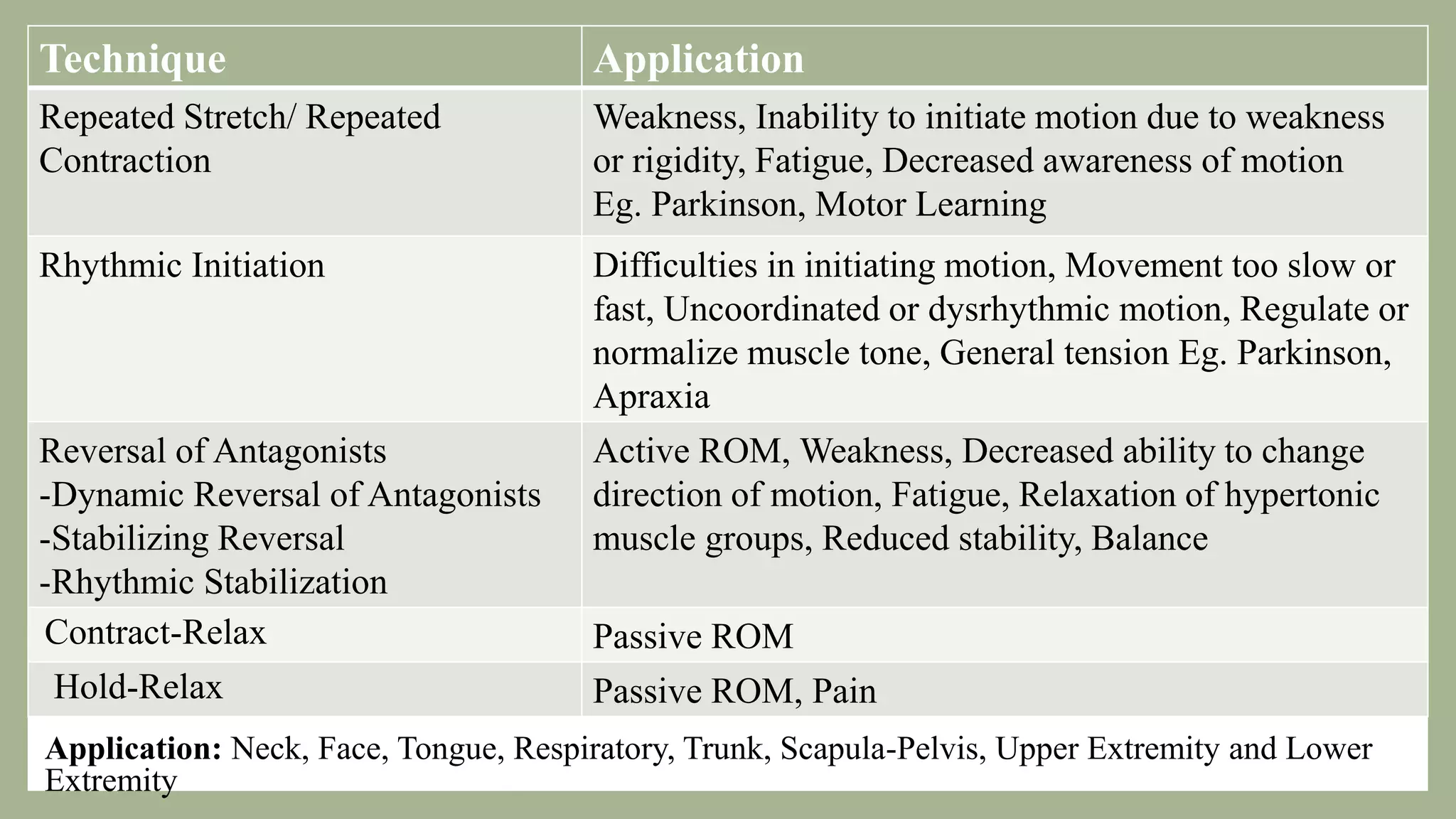
Technique Application
Repeated Stretch/ Repeated
Contraction
Weakness, Inability to initiate motion due to weakness
or rigidity, Fatigue, Decreased awareness of motion
Eg. Parkinson, Motor Learning
Rhythmic Initiation Difficulties in initiating motion, Movement too slow or
fast, Uncoordinated or dysrhythmic motion, Regulate or
normalize muscle tone, General tension Eg. Parkinson,
Apraxia
Reversal of Antagonists
-Dynamic Reversal of Antagonists
-Stabilizing Reversal
-Rhythmic Stabilization
Active ROM, Weakness, Decreased ability to change
direction of motion, Fatigue, Relaxation of hypertonic
muscle groups, Reduced stability, Balance
Contract-Relax Passive ROM
Hold-Relax Passive ROM, Pain
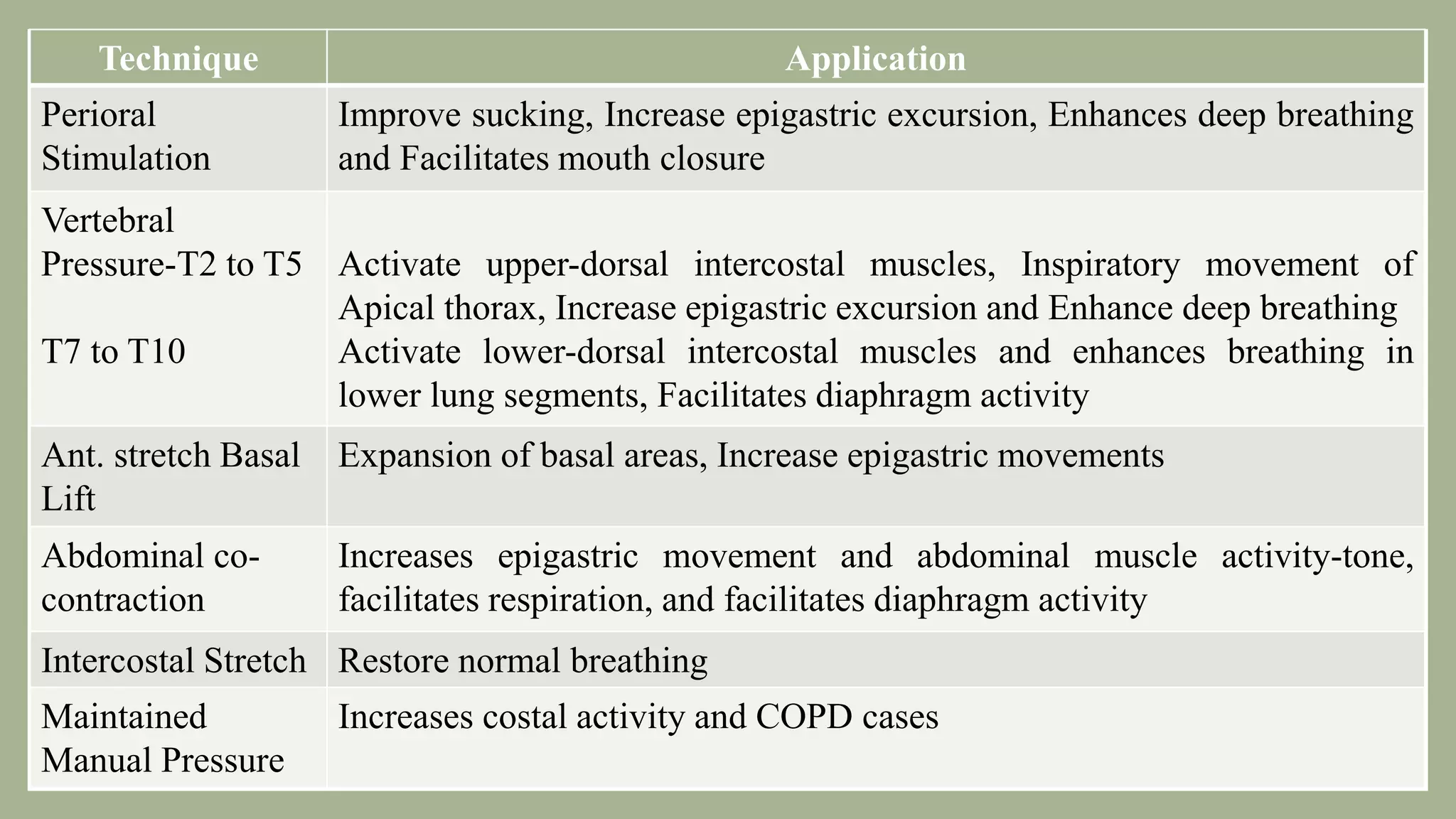
Technique Application
Perioral
Stimulation
Improve sucking, Increase epigastric excursion, Enhances deep breathing
and Facilitates mouth closure
Vertebral
Pressure-T2 to T5
T7 to T10
Activate upper-dorsal intercostal muscles, Inspiratory movement of
Apical thorax, Increase epigastric excursion and Enhance deep breathing
Activate lower-dorsal intercostal muscles and enhances breathing in
lower lung segments, Facilitates diaphragm activity
Ant. stretch Basal
Lift
Expansion of basal areas, Increase epigastric movements
Abdominal co-
contraction
Increases epigastric movement and abdominal muscle activity-tone,
facilitates respiration, and facilitates diaphragm activity
Intercostal Stretch Restore normal breathing
Maintained
Manual Pressure
Increases costal activity and COPD cases
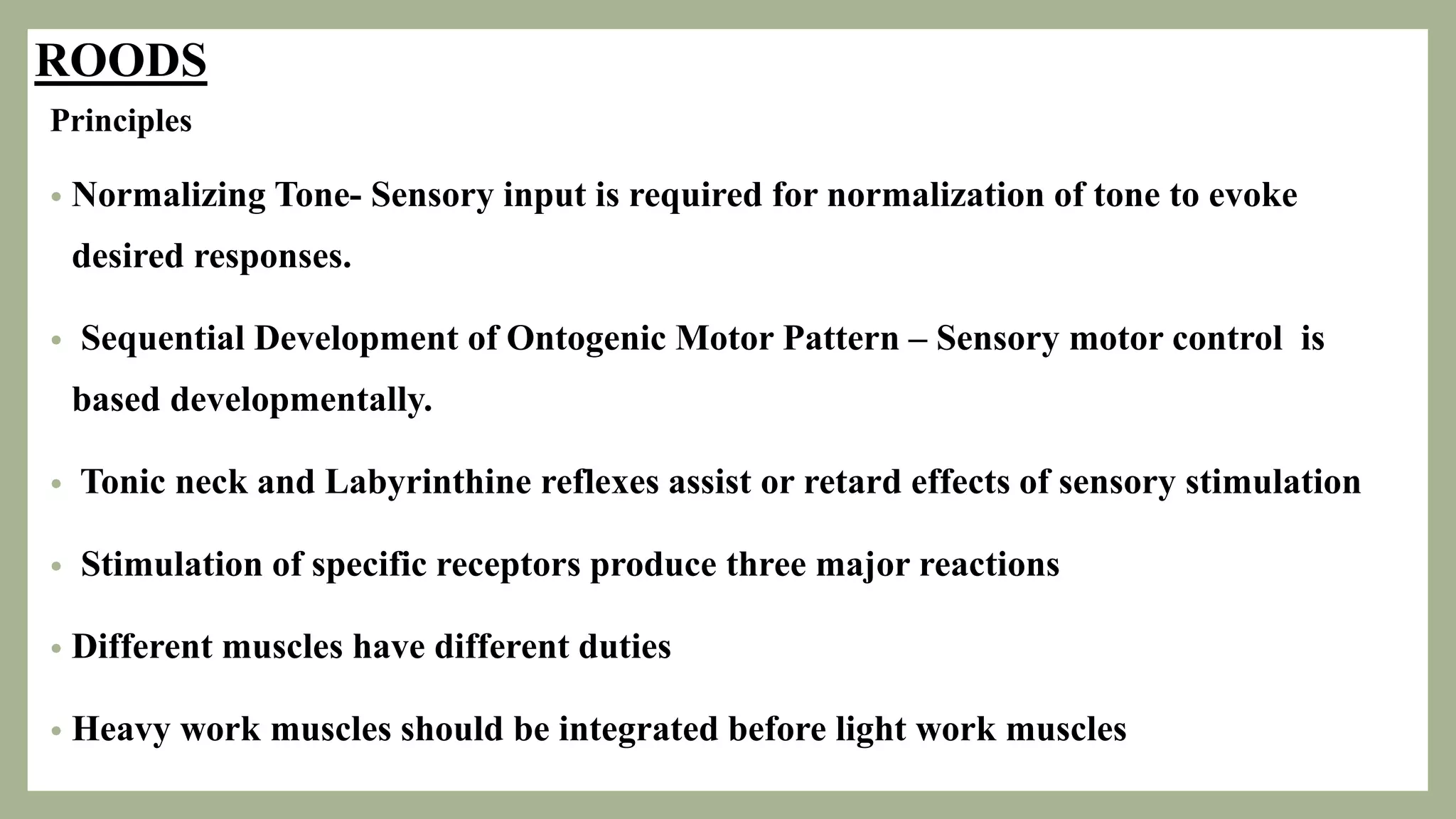
ROODS
Principles
• Normalizing Tone- Sensory input is required for normalization of tone to evoke
desired responses.
• Sequential Development of Ontogenic Motor Pattern – Sensory motor control is
based developmentally.
• Tonic neck and Labyrinthine reflexes assist or retard effects of sensory stimulation
• Stimulation of specific receptors produce three major reactions
• Different muscles have different duties
• Heavy work muscles should be integrated before light work muscles
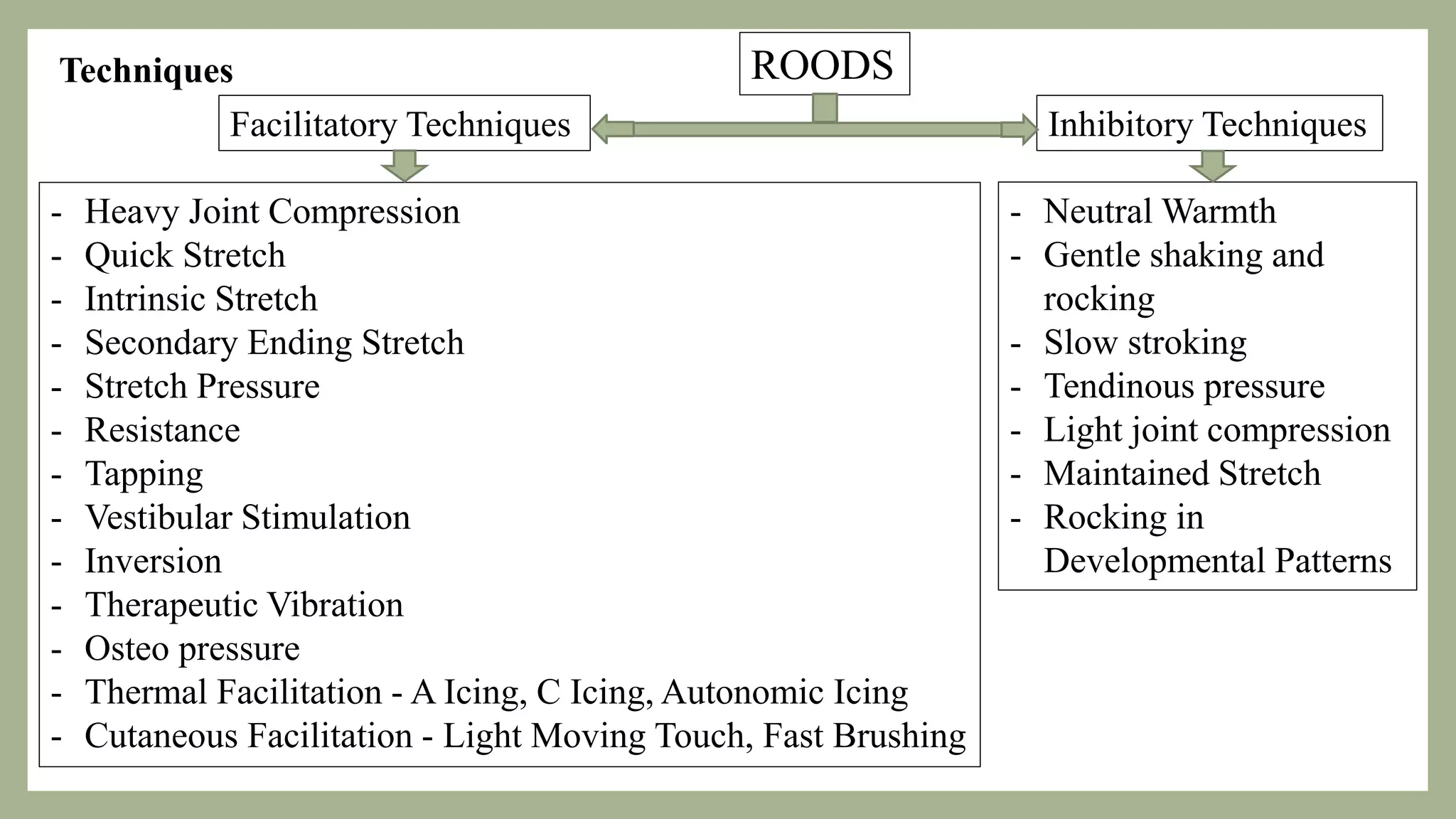
Techniques ROODS
Facilitatory Techniques Inhibitory Techniques
- Heavy Joint Compression
- Quick Stretch
- Intrinsic Stretch
- Secondary Ending Stretch
- Stretch Pressure
- Resistance
- Tapping
- Vestibular Stimulation
- Inversion
- Therapeutic Vibration
- Osteo pressure
- Thermal Facilitation - A Icing, C Icing, Autonomic Icing
- Cutaneous Facilitation - Light Moving Touch, Fast Brushing
- Neutral Warmth
- Gentle shaking and
rocking
- Slow stroking
- Tendinous pressure
- Light joint compression
- Maintained Stretch
- Rocking in
Developmental Patterns
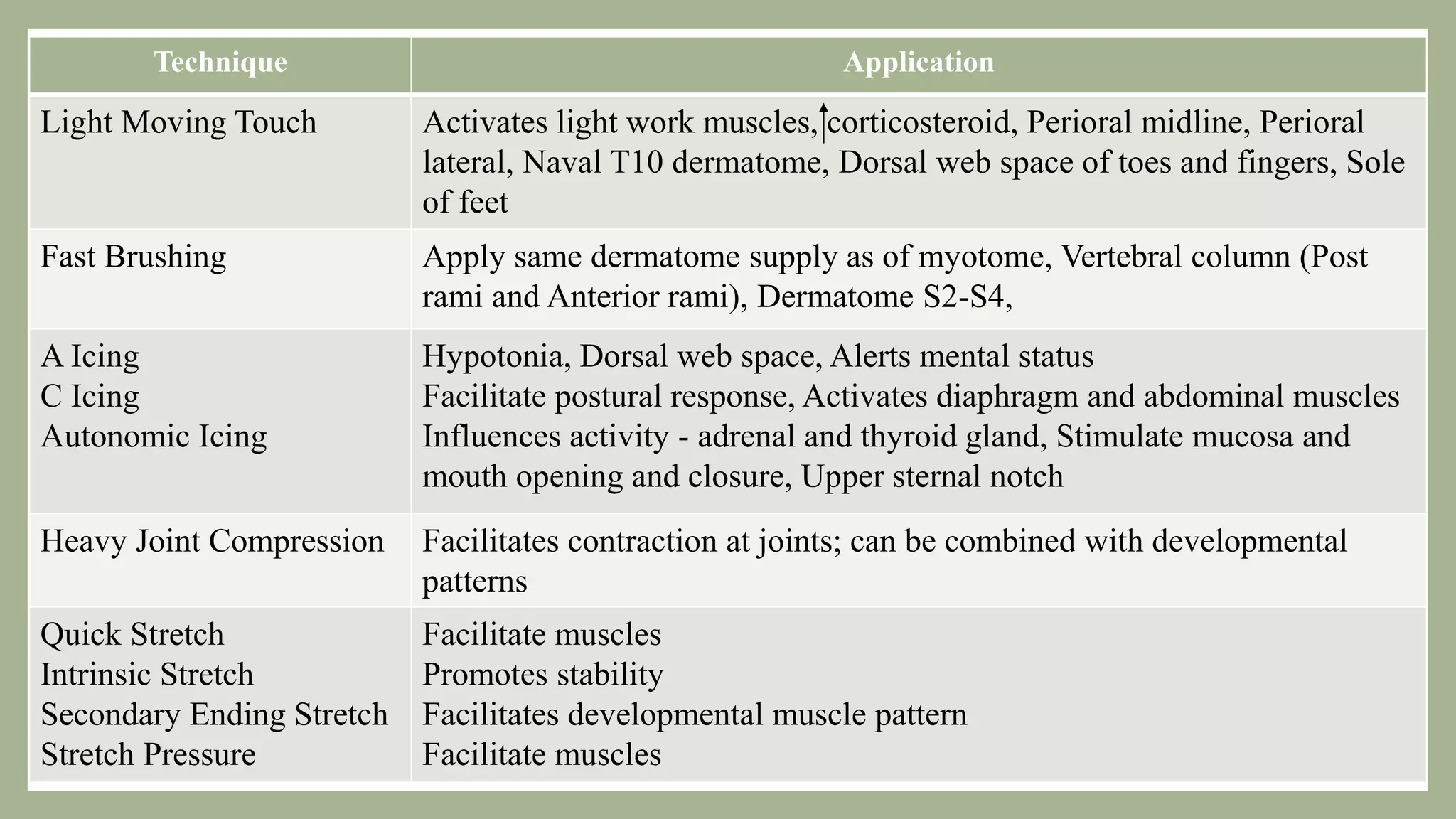
Technique Application
Light Moving Touch Activates light work muscles, corticosteroid, Perioral midline, Perioral
lateral, Naval T10 dermatome, Dorsal web space of toes and fingers, Sole
of feet
Fast Brushing Apply same dermatome supply as of myotome, Vertebral column (Post
rami and Anterior rami), Dermatome S2-S4,
A Icing
C Icing
Autonomic Icing
Hypotonia, Dorsal web space, Alerts mental status
Facilitate postural response, Activates diaphragm and abdominal muscles
Influences activity - adrenal and thyroid gland, Stimulate mucosa and
mouth opening and closure, Upper sternal notch
Heavy Joint Compression Facilitates contraction at joints; can be combined with developmental
patterns
Quick Stretch
Intrinsic Stretch
Secondary Ending Stretch
Stretch Pressure
Facilitate muscles
Promotes stability
Facilitates developmental muscle pattern
Facilitate muscles
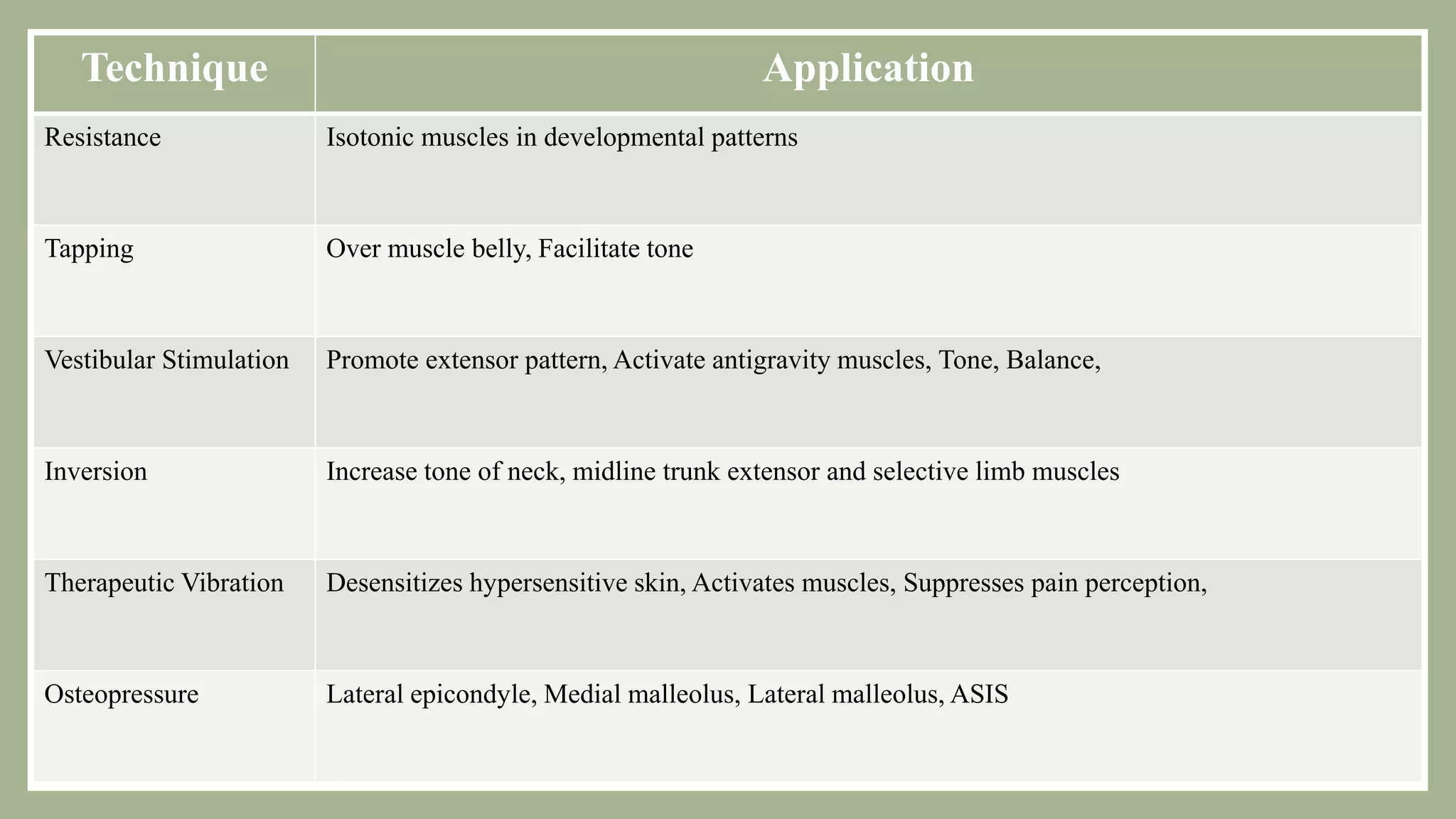
Technique Application
Resistance Isotonic muscles in developmental patterns
Tapping Over muscle belly, Facilitate tone
Vestibular Stimulation Promote extensor pattern, Activate antigravity muscles, Tone, Balance,
Inversion Increase tone of neck, midline trunk extensor and selective limb muscles
Therapeutic Vibration Desensitizes hypersensitive skin, Activates muscles, Suppresses pain perception,
Osteopressure Lateral epicondyle, Medial malleolus, Lateral malleolus, ASIS
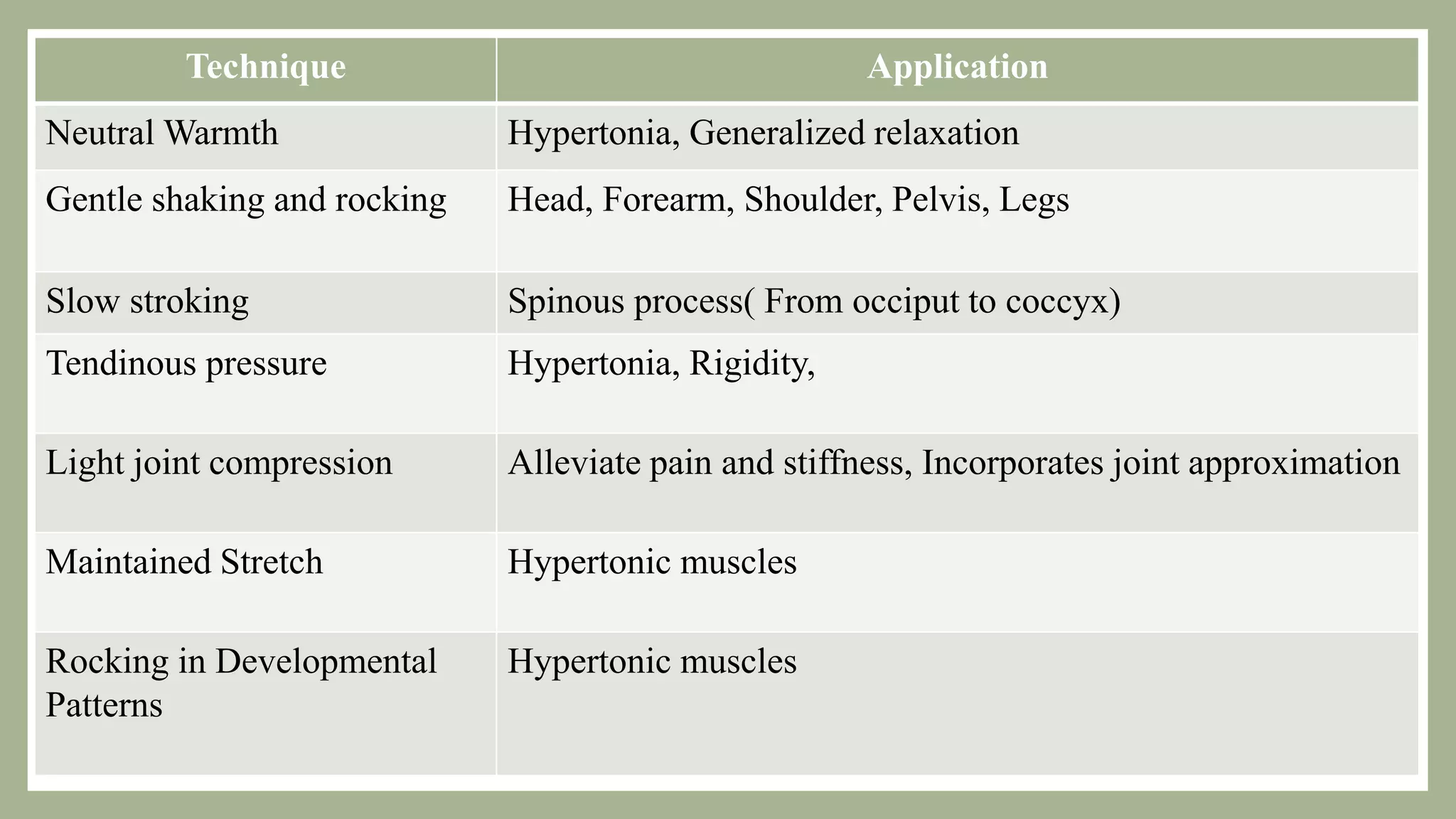
Technique Application
Neutral Warmth Hypertonia, Generalized relaxation
Gentle shaking and rocking Head, Forearm, Shoulder, Pelvis, Legs
Slow stroking Spinous process( From occiput to coccyx)
Tendinous pressure Hypertonia, Rigidity,
Light joint compression Alleviate pain and stiffness, Incorporates joint approximation
Maintained Stretch Hypertonic muscles
Rocking in Developmental
Patterns
Hypertonic muscles
NEURODEVELOPMENTAL THERAPY
Principles
• Therapy Works
• Treat The Individual As A Whole
• The Purpose Of Therapy Is To Increase The Individual’s Participation And Activity
• Build On The Individual’s Strength While Addressing The Impairments
• Individualize Intervention
• Treat In Past, Present And Future
• Team Work Is Critical For Best Care
• Typical Development Provides An Important Framework For Examination And Intervention
• Active Carryover Throughout Daily Life Is Important For Best Care
• NDT Reflects A Hands-on Intervention Process To Enhance Outcomes
• The Living Concept: The Integration Of Classic NDT Tenets With Current Scientific Findings
And Principles Of Neuroplasticity, Motor Control, Motor Development and Motor Learning
BOBATH
Principles
• Treat the individual as whole
• Basis for intervention is normal movement and their inter-relation
• Treatment includes facilitation and inhibition using key points of body control
• Encouragement of normal movement patterns and Discouragement of compensatory
movement
• Focusing on the quality of movement.
• Abnormal tone is always inhibited and normal response once elicited are always repeated
• Improvement of maximal functional recovery to promote the QoL
Stages
1. Initial flaccid stage
2. Stage Spasticity
3. Stage of Relative recovery
Application
E.g. Donning the shirt
- Position the shirt across knees with armhole visible
and sleeve between knees
- Bend forward placing affected extremity inside sleeve
- Bring collar to neck
- Sit upright dress the non-hemiplegic sleeve
- Button shirt from bottom to top
BRUNNSTORM
Principles
• Postural and attitudinal reflexes used as a means to alter tone in specific muscle
• Associated reactions used to initiate or alter synergy in early stage of recovery
• Stimulating skin over a muscle produces contraction of that muscle and facilitation of that
synergy to which that muscle belongs.
• Muscles are facilitated when are placed in their lengthened position and quick stretch
facilitates that muscle to contract and inhibits its antagonists
• Resistance facilitates the contraction of the muscle resisted
• Visual stimulation of self movement of part facilitates motion; and auditory stimuli assists to
perform desired movement.
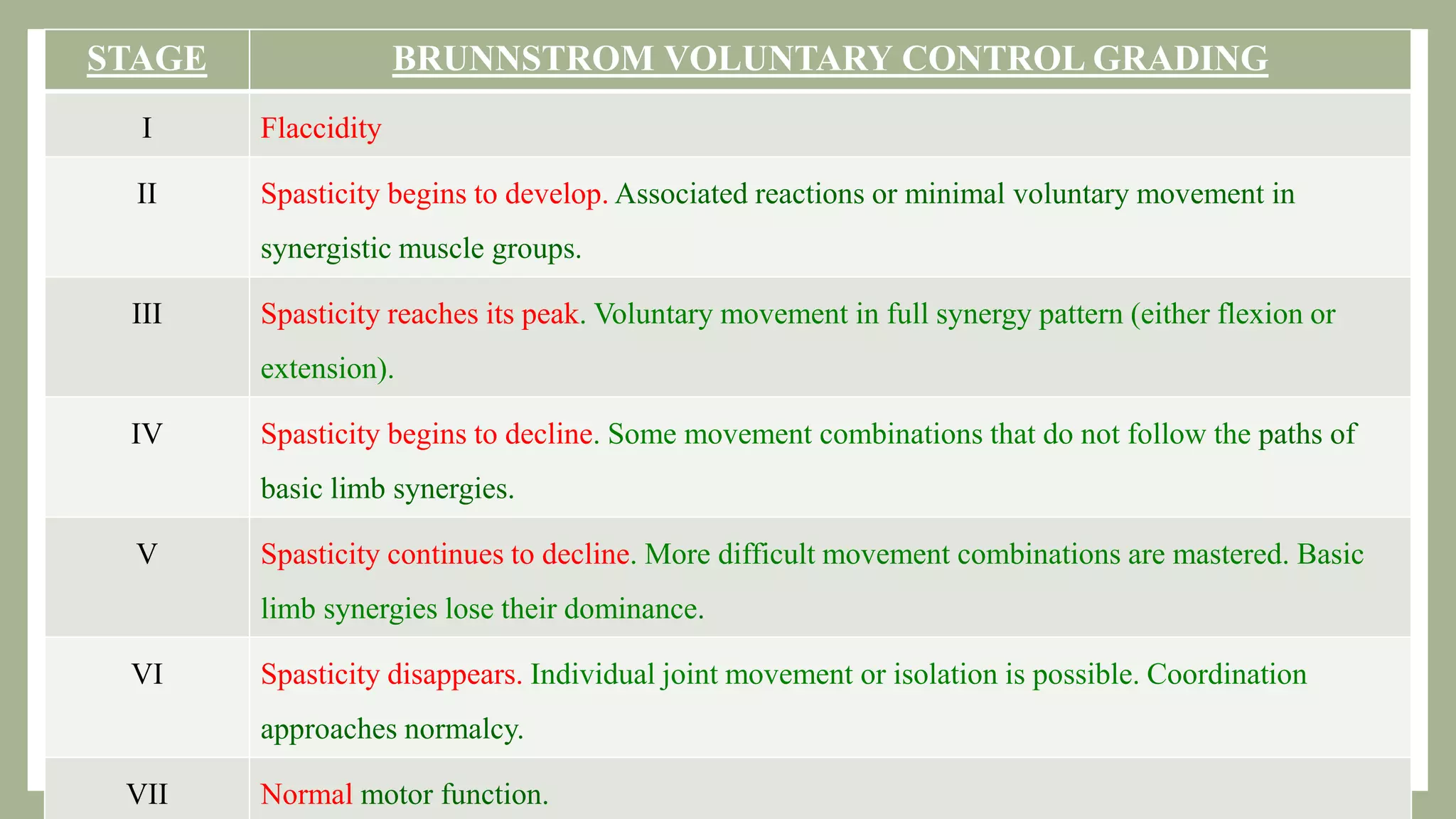
STAGE BRUNNSTROM VOLUNTARY CONTROL GRADING
I Flaccidity
II Spasticity begins to develop. Associated reactions or minimal voluntary movement in
synergistic muscle groups.
III Spasticity reaches its peak. Voluntary movement in full synergy pattern (either flexion or
extension).
IV Spasticity begins to decline. Some movement combinations that do not follow the paths of
basic limb synergies.
V Spasticity continues to decline. More difficult movement combinations are mastered. Basic
limb synergies lose their dominance.
VI Spasticity disappears. Individual joint movement or isolation is possible. Coordination
approaches normalcy.
VII Normal motor function.
STAGE BRUNNSTROM VOLUNTARY CONTROL GRADING
I Flaccidity. Muscles are flaccid on involved side
II Spasticity begins to develop. Minimal spasticity and little or no active finger flexion
III Spasticity reaches its peak. Patient able to hold but unable to release through voluntary finger
flexion
IV Spasticity begins to decline. Patient able to release by lateral thumb movement with minimal
finger extension or through normal functional synergy
V Spasticity continues to decline. Voluntary mass extension of digits possible. Patient able to
hold onto cylindrical and spherical grasp with limited functional use
VI Spasticity disappears. Voluntary finger extension of fingers, lateral palmar grasp, three point
prehension and individual finger movement possible
VII Normal motor function.
Joint Flexor Synergy Pattern UL Extensor Synergy Pattern UL
Scapula Retraction and/elevation Protraction and/ depression
Shoulder Abduction & external rotation Adduction & internal rotation
Elbow Flexion Extension
Forearm Supination Pronation
Fingers Flexion Extension or flexion
Joint Flexor Synergy Pattern LL Extensor Synergy Pattern LL
Hip Flexion, abduction & external
rotation
Extension, Adduction & Internal rotation
Knee Flexion Extension
Ankle and
subtalar
Dorsiflexion and inversion Plantar flexion and inversion
Toes Extension Flexion
Name Associated Reaction
Homolateral limb
synkinesis
Mutual dependency exists between synergies of upper and lower limbs.
E.g. LL flexion on affected side evokes flexion of UL on the same side.
Imitation
synkinesis
Mirroring of movements occur in the affected side when movements are attempted or
performed on the unaffected side.
E.g. Flexion of the unaffected side will evoke flexion of the affected side.
Raimiste’s
phenomena
Associated movement produced during resisted abduction or adduction movements.
E.g. Abduction phenomenon - Resisted hip abduction of unaffected side will evoke hip
abduction on the affected side
Instinctive Grasp
Reaction
Closure of hand in response to contact of stationary object with palm of the hand
Instinctive
Avoiding Reaction
Stroking over palmar surface of hand in distal direction causes hyperextension of fingers
Souques’s finger
phenomenon
Elevation of the affected arm causes the paralyzed fingers to extend automatically
Proprioceptive
traction response
Stretch of any of the flexor muscles in upper limb evokes contraction of flexor muscles of
all other joints of pattern of UL
SENSORY INTEGRATION
Principles
• Adaptive Responses
• Just the right Challenge
• Active engagement
• Child Direction
Astronaut
Video
B] Sensory stimulation Techniques
- Sensory diet
- Swinging
- Floor time
- Snoezelen room intervention(Controlled
multisensory ENV)
- Animal assisted therapy
- Sensory garden
- Play skills
- Sensory based Intervention – Single
Sensory or Multisensory
A] Sensory stimulation Protocols :
- Wilbarger Protocol
- Astronaut Program
- Brain gym activities
- Miller method
- Reciprocal imitation training
VOJTA
Principles
• Ontogenic Development
• Postural Control
• Innate Movement Sequence
• Chin
• Tip of acromion
• Medial epicondyle of the humerus
• Just above the styloid process of radius
• In between 7
th
& 8
th
Ribs in line with
nipple
• Root of the spine of the scapula
• ASIS
• Gluteus medius
• Medial condyle of the femur
• Lateral border of the calcaneum
Video
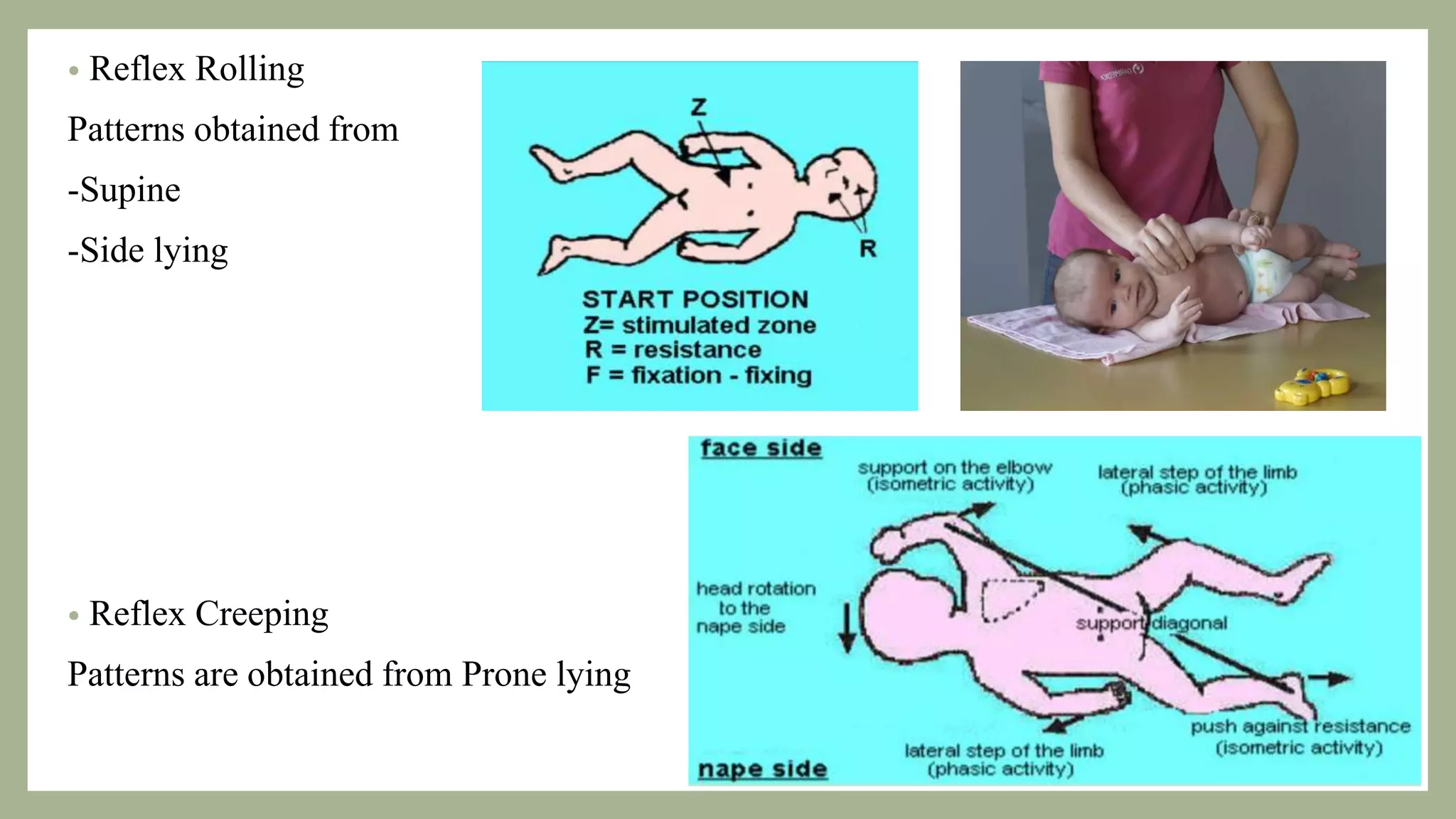
• Reflex Rolling
Patterns obtained from
-Supine
-Side lying
• Reflex Creeping
Patterns are obtained from Prone lying
MOTOR RE-LEARNING
Principles
• Analysis of task – Observation, Comparison, Analysis
• Practice of missing component – Identification of goal, Instruction and Practice +
Feedback + Manual guidance
• Practice of Task – Re-evaluation, Encourage
• Transference of Training – Opportunity to practice in context, Consistency to
practice, Self-monitored practice, Structured learning environment, Involvement of
relatives and staff
Techniques
1. Upper limb function
2. Oro-facial Function
3. Sitting up from supine
4. Sitting
5. Standing up and sitting down
6. Standing
7. Gait
NEURAL TISSUE MOBILIZATION
Principles
• Sequencing
• Force
• Resistance
• Extent of Movement
• Duration
• Speed of Movement
Technique Progression
Sliders : It is a neurodynamic maneuver used to produce a sliding movement of neural
structures relative to their adjacent tissues.
Tensioners : It is a neurodynamic technique that produces an increase in neural structure
within natural viscoelastic limit.
Techniques
During neurodynamic testing, a positive test is considered present only when one or more of the following
occur:
• There is a reproduction of the patient’s symptoms.
• There is asymmetric sensation between right and left limbs.
• There is significant deviation from normal sensation.
• Symptoms change with sensitizing movements
Level 0 - Contraindication
Level 1 - Limited
Level 2 - Standard
Level 3a - Neuro dynamically sensitized
Level 3b - Neuro dynamically sequencing
Level 3c - Multi structural
Level 3d - Symptomatic movement
CONSTARINED INDUCED MOVEMENT THERAPY
Principles
• Massing of repetitive, structured, practice intensive therapy in use of the movement
of affected arm.
• Restrain of the less affected arm.
• Application of package of behavioral techniques that transfers gains from clinical
setting to the functional tasks.
Techniques
CIMT
• Treatment for 2-3 weeks
with Constrain for 90% of
waking hours per day
• 3-6hours constrain per
day with training.
M-CIMT
• Treatment for 3Hrs/Day
for 5Days/Week for
minimum 4 weeks
• Less than 3 hours
constrain per day with
training
Techniques Type Frequency and Duration
CIMT Restraint cast for 90% of waking hours 3 to 6hours/ Day for 2 to 3
Weeks
M-CIMT Restraint sling only during intervention
hours
3Hrs/Day for 5Days/Week for
minimum 4 weeks ( 2 to 10
Weeks)
HABIT No restraint, Bimanual training, Practice
specificity of task
3Hrs/Day for 21Days
• Temple Fay -
• Doman Delecto
• Peto Therapy/ Conductive Educational System
• Saebo Approach
• Affolter Approach
Contemporary Task Oriented Approach
THANKYOU

Neurological Approaches

  • 1.
    Principles Of VariousNeurological Approaches And Its Application
  • 2.
    • Content • Introduction •Types of Neurological Approaches • Principles and Its Application • Recent Advances
  • 3.
    INTRODUCTION • Neurotherapeutic Approachesplays an important role in managing neurological disorders, delays as well as diseases. • These interventional approaches are aligned with motor learning, developmental patterns and neuroplasticity theory which leads to train non-affected part of the brain to functionally compensate for affected area of the brain. • Patients with neurological symptoms, approached with a step wise manner, which consists of : 1. Identifying the anatomic location of lesion causing symptoms 2. Identifying the pathology involved 3. Generating differential diagnosis 4. Selecting appropriate tests and intervention
  • 4.
    Types of NeurologicalApproaches • Proprioceptive Neuromuscular Facilitatory Approach – Knott and Voss • Roods - Sensory-motor Approach • Bruunstorm – Movement therapy Approach • Neurodevelopmental Approach • Bobath • Sensory Integration Approach • Vojta Approach • Muscle Re-education Approach/ Motor Re-learning Approach - Carr Shepherd Approach
  • 5.
    • Neural TissueMobilization • Constrained Induced Movement Therapy • Temple Fay Approach • Doman Delecto Approach • Peto Conductive Therapy Approach • Saebo Approach • Affolter Approach • Contemporary Task Oriented Approach
  • 6.
    PROPRIOCEPTIVE NEUROMUSCULAR FACILITATORYAPPROACH Principles : Utilize combination of these principles to obtain maximal response from the patient. • Resistance • Irradiation and reinforcement • Manual contact • Body position and body mechanics • Verbal • Vision • Traction or approximation • Stretch • Timing • Patterns
  • 8.
    Application: Neck, Face,Tongue, Respiratory, Trunk, Scapula-Pelvis, Upper Extremity and Lower Extremity Technique Application Repeated Stretch/ Repeated Contraction Weakness, Inability to initiate motion due to weakness or rigidity, Fatigue, Decreased awareness of motion Eg. Parkinson, Motor Learning Rhythmic Initiation Difficulties in initiating motion, Movement too slow or fast, Uncoordinated or dysrhythmic motion, Regulate or normalize muscle tone, General tension Eg. Parkinson, Apraxia Reversal of Antagonists -Dynamic Reversal of Antagonists -Stabilizing Reversal -Rhythmic Stabilization Active ROM, Weakness, Decreased ability to change direction of motion, Fatigue, Relaxation of hypertonic muscle groups, Reduced stability, Balance Contract-Relax Passive ROM Hold-Relax Passive ROM, Pain
  • 9.
    Technique Application Perioral Stimulation Improve sucking,Increase epigastric excursion, Enhances deep breathing and Facilitates mouth closure Vertebral Pressure-T2 to T5 T7 to T10 Activate upper-dorsal intercostal muscles, Inspiratory movement of Apical thorax, Increase epigastric excursion and Enhance deep breathing Activate lower-dorsal intercostal muscles and enhances breathing in lower lung segments, Facilitates diaphragm activity Ant. stretch Basal Lift Expansion of basal areas, Increase epigastric movements Abdominal co- contraction Increases epigastric movement and abdominal muscle activity-tone, facilitates respiration, and facilitates diaphragm activity Intercostal Stretch Restore normal breathing Maintained Manual Pressure Increases costal activity and COPD cases
  • 10.
    ROODS Principles • Normalizing Tone-Sensory input is required for normalization of tone to evoke desired responses. • Sequential Development of Ontogenic Motor Pattern – Sensory motor control is based developmentally. • Tonic neck and Labyrinthine reflexes assist or retard effects of sensory stimulation • Stimulation of specific receptors produce three major reactions • Different muscles have different duties • Heavy work muscles should be integrated before light work muscles
  • 11.
    Techniques ROODS Facilitatory TechniquesInhibitory Techniques - Heavy Joint Compression - Quick Stretch - Intrinsic Stretch - Secondary Ending Stretch - Stretch Pressure - Resistance - Tapping - Vestibular Stimulation - Inversion - Therapeutic Vibration - Osteo pressure - Thermal Facilitation - A Icing, C Icing, Autonomic Icing - Cutaneous Facilitation - Light Moving Touch, Fast Brushing - Neutral Warmth - Gentle shaking and rocking - Slow stroking - Tendinous pressure - Light joint compression - Maintained Stretch - Rocking in Developmental Patterns
  • 12.
    Technique Application Light MovingTouch Activates light work muscles, corticosteroid, Perioral midline, Perioral lateral, Naval T10 dermatome, Dorsal web space of toes and fingers, Sole of feet Fast Brushing Apply same dermatome supply as of myotome, Vertebral column (Post rami and Anterior rami), Dermatome S2-S4, A Icing C Icing Autonomic Icing Hypotonia, Dorsal web space, Alerts mental status Facilitate postural response, Activates diaphragm and abdominal muscles Influences activity - adrenal and thyroid gland, Stimulate mucosa and mouth opening and closure, Upper sternal notch Heavy Joint Compression Facilitates contraction at joints; can be combined with developmental patterns Quick Stretch Intrinsic Stretch Secondary Ending Stretch Stretch Pressure Facilitate muscles Promotes stability Facilitates developmental muscle pattern Facilitate muscles
  • 13.
    Technique Application Resistance Isotonicmuscles in developmental patterns Tapping Over muscle belly, Facilitate tone Vestibular Stimulation Promote extensor pattern, Activate antigravity muscles, Tone, Balance, Inversion Increase tone of neck, midline trunk extensor and selective limb muscles Therapeutic Vibration Desensitizes hypersensitive skin, Activates muscles, Suppresses pain perception, Osteopressure Lateral epicondyle, Medial malleolus, Lateral malleolus, ASIS
  • 14.
    Technique Application Neutral WarmthHypertonia, Generalized relaxation Gentle shaking and rocking Head, Forearm, Shoulder, Pelvis, Legs Slow stroking Spinous process( From occiput to coccyx) Tendinous pressure Hypertonia, Rigidity, Light joint compression Alleviate pain and stiffness, Incorporates joint approximation Maintained Stretch Hypertonic muscles Rocking in Developmental Patterns Hypertonic muscles
  • 15.
    NEURODEVELOPMENTAL THERAPY Principles • TherapyWorks • Treat The Individual As A Whole • The Purpose Of Therapy Is To Increase The Individual’s Participation And Activity • Build On The Individual’s Strength While Addressing The Impairments • Individualize Intervention • Treat In Past, Present And Future • Team Work Is Critical For Best Care • Typical Development Provides An Important Framework For Examination And Intervention • Active Carryover Throughout Daily Life Is Important For Best Care • NDT Reflects A Hands-on Intervention Process To Enhance Outcomes • The Living Concept: The Integration Of Classic NDT Tenets With Current Scientific Findings And Principles Of Neuroplasticity, Motor Control, Motor Development and Motor Learning
  • 16.
    BOBATH Principles • Treat theindividual as whole • Basis for intervention is normal movement and their inter-relation • Treatment includes facilitation and inhibition using key points of body control • Encouragement of normal movement patterns and Discouragement of compensatory movement • Focusing on the quality of movement. • Abnormal tone is always inhibited and normal response once elicited are always repeated • Improvement of maximal functional recovery to promote the QoL
  • 17.
    Stages 1. Initial flaccidstage 2. Stage Spasticity 3. Stage of Relative recovery Application E.g. Donning the shirt - Position the shirt across knees with armhole visible and sleeve between knees - Bend forward placing affected extremity inside sleeve - Bring collar to neck - Sit upright dress the non-hemiplegic sleeve - Button shirt from bottom to top
  • 18.
    BRUNNSTORM Principles • Postural andattitudinal reflexes used as a means to alter tone in specific muscle • Associated reactions used to initiate or alter synergy in early stage of recovery • Stimulating skin over a muscle produces contraction of that muscle and facilitation of that synergy to which that muscle belongs. • Muscles are facilitated when are placed in their lengthened position and quick stretch facilitates that muscle to contract and inhibits its antagonists • Resistance facilitates the contraction of the muscle resisted • Visual stimulation of self movement of part facilitates motion; and auditory stimuli assists to perform desired movement.
  • 19.
    STAGE BRUNNSTROM VOLUNTARYCONTROL GRADING I Flaccidity II Spasticity begins to develop. Associated reactions or minimal voluntary movement in synergistic muscle groups. III Spasticity reaches its peak. Voluntary movement in full synergy pattern (either flexion or extension). IV Spasticity begins to decline. Some movement combinations that do not follow the paths of basic limb synergies. V Spasticity continues to decline. More difficult movement combinations are mastered. Basic limb synergies lose their dominance. VI Spasticity disappears. Individual joint movement or isolation is possible. Coordination approaches normalcy. VII Normal motor function.
  • 20.
    STAGE BRUNNSTROM VOLUNTARYCONTROL GRADING I Flaccidity. Muscles are flaccid on involved side II Spasticity begins to develop. Minimal spasticity and little or no active finger flexion III Spasticity reaches its peak. Patient able to hold but unable to release through voluntary finger flexion IV Spasticity begins to decline. Patient able to release by lateral thumb movement with minimal finger extension or through normal functional synergy V Spasticity continues to decline. Voluntary mass extension of digits possible. Patient able to hold onto cylindrical and spherical grasp with limited functional use VI Spasticity disappears. Voluntary finger extension of fingers, lateral palmar grasp, three point prehension and individual finger movement possible VII Normal motor function.
  • 21.
    Joint Flexor SynergyPattern UL Extensor Synergy Pattern UL Scapula Retraction and/elevation Protraction and/ depression Shoulder Abduction & external rotation Adduction & internal rotation Elbow Flexion Extension Forearm Supination Pronation Fingers Flexion Extension or flexion
  • 22.
    Joint Flexor SynergyPattern LL Extensor Synergy Pattern LL Hip Flexion, abduction & external rotation Extension, Adduction & Internal rotation Knee Flexion Extension Ankle and subtalar Dorsiflexion and inversion Plantar flexion and inversion Toes Extension Flexion
  • 23.
    Name Associated Reaction Homolaterallimb synkinesis Mutual dependency exists between synergies of upper and lower limbs. E.g. LL flexion on affected side evokes flexion of UL on the same side. Imitation synkinesis Mirroring of movements occur in the affected side when movements are attempted or performed on the unaffected side. E.g. Flexion of the unaffected side will evoke flexion of the affected side. Raimiste’s phenomena Associated movement produced during resisted abduction or adduction movements. E.g. Abduction phenomenon - Resisted hip abduction of unaffected side will evoke hip abduction on the affected side Instinctive Grasp Reaction Closure of hand in response to contact of stationary object with palm of the hand Instinctive Avoiding Reaction Stroking over palmar surface of hand in distal direction causes hyperextension of fingers Souques’s finger phenomenon Elevation of the affected arm causes the paralyzed fingers to extend automatically Proprioceptive traction response Stretch of any of the flexor muscles in upper limb evokes contraction of flexor muscles of all other joints of pattern of UL
  • 24.
    SENSORY INTEGRATION Principles • AdaptiveResponses • Just the right Challenge • Active engagement • Child Direction Astronaut Video
  • 25.
    B] Sensory stimulationTechniques - Sensory diet - Swinging - Floor time - Snoezelen room intervention(Controlled multisensory ENV) - Animal assisted therapy - Sensory garden - Play skills - Sensory based Intervention – Single Sensory or Multisensory A] Sensory stimulation Protocols : - Wilbarger Protocol - Astronaut Program - Brain gym activities - Miller method - Reciprocal imitation training
  • 26.
    VOJTA Principles • Ontogenic Development •Postural Control • Innate Movement Sequence • Chin • Tip of acromion • Medial epicondyle of the humerus • Just above the styloid process of radius • In between 7 th & 8 th Ribs in line with nipple • Root of the spine of the scapula • ASIS • Gluteus medius • Medial condyle of the femur • Lateral border of the calcaneum Video
  • 27.
    • Reflex Rolling Patternsobtained from -Supine -Side lying • Reflex Creeping Patterns are obtained from Prone lying
  • 28.
    MOTOR RE-LEARNING Principles • Analysisof task – Observation, Comparison, Analysis • Practice of missing component – Identification of goal, Instruction and Practice + Feedback + Manual guidance • Practice of Task – Re-evaluation, Encourage • Transference of Training – Opportunity to practice in context, Consistency to practice, Self-monitored practice, Structured learning environment, Involvement of relatives and staff
  • 29.
    Techniques 1. Upper limbfunction 2. Oro-facial Function 3. Sitting up from supine 4. Sitting 5. Standing up and sitting down 6. Standing 7. Gait
  • 30.
    NEURAL TISSUE MOBILIZATION Principles •Sequencing • Force • Resistance • Extent of Movement • Duration • Speed of Movement Technique Progression Sliders : It is a neurodynamic maneuver used to produce a sliding movement of neural structures relative to their adjacent tissues. Tensioners : It is a neurodynamic technique that produces an increase in neural structure within natural viscoelastic limit.
  • 31.
    Techniques During neurodynamic testing,a positive test is considered present only when one or more of the following occur: • There is a reproduction of the patient’s symptoms. • There is asymmetric sensation between right and left limbs. • There is significant deviation from normal sensation. • Symptoms change with sensitizing movements Level 0 - Contraindication Level 1 - Limited Level 2 - Standard Level 3a - Neuro dynamically sensitized Level 3b - Neuro dynamically sequencing Level 3c - Multi structural Level 3d - Symptomatic movement
  • 32.
    CONSTARINED INDUCED MOVEMENTTHERAPY Principles • Massing of repetitive, structured, practice intensive therapy in use of the movement of affected arm. • Restrain of the less affected arm. • Application of package of behavioral techniques that transfers gains from clinical setting to the functional tasks.
  • 33.
    Techniques CIMT • Treatment for2-3 weeks with Constrain for 90% of waking hours per day • 3-6hours constrain per day with training. M-CIMT • Treatment for 3Hrs/Day for 5Days/Week for minimum 4 weeks • Less than 3 hours constrain per day with training
  • 34.
    Techniques Type Frequencyand Duration CIMT Restraint cast for 90% of waking hours 3 to 6hours/ Day for 2 to 3 Weeks M-CIMT Restraint sling only during intervention hours 3Hrs/Day for 5Days/Week for minimum 4 weeks ( 2 to 10 Weeks) HABIT No restraint, Bimanual training, Practice specificity of task 3Hrs/Day for 21Days
  • 35.
    • Temple Fay- • Doman Delecto • Peto Therapy/ Conductive Educational System • Saebo Approach • Affolter Approach Contemporary Task Oriented Approach
  • 36.