CONDITIONAL SYLLOGISM
DISJUNCTIVE SYLLOGISM
CONJUNCTIVE SYLLOGISM
HYPOTHETICAL SYLLOGISM
 A hypothetical syllogism is one wherein the
major premise is a hypothetical proposition, and
the minor premise and conclusion are categorical
proposition.
There are three types of hypothetical propositions:
1. Conditional
2. Disjunctive
3. Conjunctive
CONDITIONAL SYLLOGISM
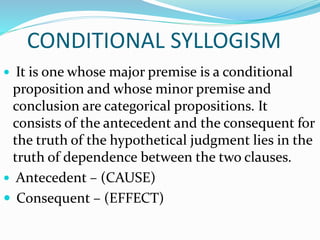
 It is one whose major premise is a conditional
proposition and whose minor premise and
conclusion are categorical propositions. It
consists of the antecedent and the consequent for
the truth of the hypothetical judgment lies in the
truth of dependence between the two clauses.
 Antecedent – (CAUSE)
 Consequent – (EFFECT)
EXAMPLE:
 MAJOR PREMISE – If illegal loggers
continue cutting trees, then the forest will
be devastated.
 MINOR PREMISE – Illegal loggers
continue cutting trees.
 CONCLUSION – Therefore, the forest will
be devastated.
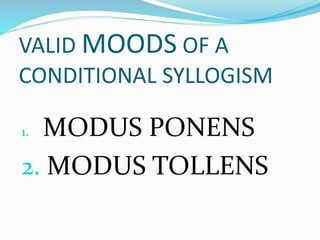
VALID MOODS OF A
CONDITIONAL SYLLOGISM
1. MODUS PONENS
2. MODUS TOLLENS
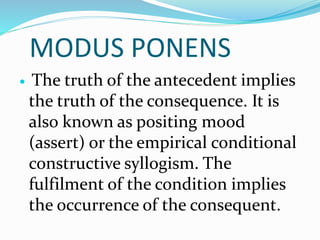
MODUS PONENS
 The truth of the antecedent implies
the truth of the consequence. It is
also known as positing mood
(assert) or the empirical conditional
constructive syllogism. The
fulfilment of the condition implies
the occurrence of the consequent.
EXAMPLE:
 Valid mood (accepting the antecedent)
If A is B, then X is Y.
But A is B.
Therefore, X is Y.
1) If Myra talks, then she speaks.
But Myra is talking.
Therefore, Myra is speaking.
EXAMPLE:
 Invalid mood (rejecting the antecedent)
If a person has cancer, then he is
seriously ill.
But Mang Nestor is not sick of cancer.
Therefore, Mang Nestor is not seriously ill.
MODUS TOLLENS
 The falsity of the consequent implies
the falsity of the antecedent. I t is also
known as sublating mood or empirical
conditional destructive syllogism. If
the consequent is rejected in the minor
premise, the antecedent must also be
rejected in the conclusion.
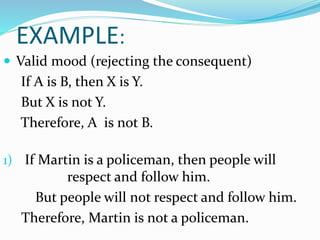
EXAMPLE:
 Valid mood (rejecting the consequent)
If A is B, then X is Y.
But X is not Y.
Therefore, A is not B.
1) If Martin is a policeman, then people will
respect and follow him.
But people will not respect and follow him.
Therefore, Martin is not a policeman.
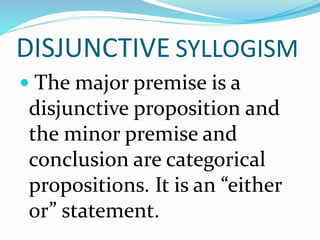
DISJUNCTIVE SYLLOGISM
 The major premise is a
disjunctive proposition and
the minor premise and
conclusion are categorical
propositions. It is an “either
or” statement.
EXAMPLE:
 A is either B or C.
But A is B.
Therefore, A is not C.
1) The weather forecast is either accurate or
imprecise.
But the weather forecast is imprecise.
Therefore, it is not accurate.
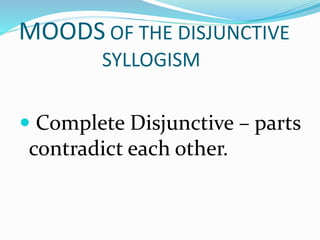
MOODS OF THE DISJUNCTIVE
SYLLOGISM
 Complete Disjunctive – parts
contradict each other.
VALID MOODS ARE
POSSIBLE:
1. PONENDO TOLLENS
2. TOLLENDO PONENS
VALID MOODS ARE POSSIBLE
 Ponendo Tollens – positing
mood (accept or affirm), minor
premise affirms one of the
alternatives of the major
premise and the conclusion
denies the other.
EXAMPLE:
 The suspect is either guilty or
innocent.
But the suspect is innocent.
Therefore, the suspect is not
guilty.
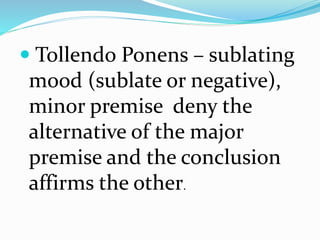
 Tollendo Ponens – sublating
mood (sublate or negative),
minor premise deny the
alternative of the major
premise and the conclusion
affirms the other.
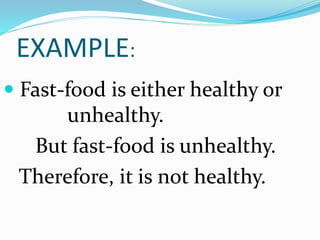
EXAMPLE:
 Fast-food is either healthy or
unhealthy.
But fast-food is unhealthy.
Therefore, it is not healthy.
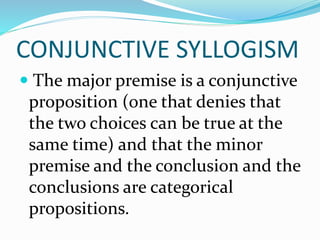
CONJUNCTIVE SYLLOGISM
 The major premise is a conjunctive
proposition (one that denies that
the two choices can be true at the
same time) and that the minor
premise and the conclusion and the
conclusions are categorical
propositions.
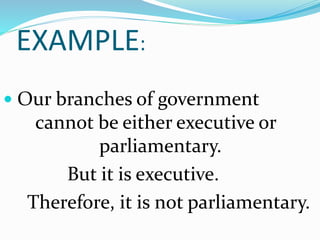
EXAMPLE:
 Our branches of government
cannot be either executive or
parliamentary.
But it is executive.
Therefore, it is not parliamentary.
Group 3 Selfie w/ Sir Urs
Reporting Photos
Reporting Photos

Hypothetical Syllogism

  • 1.
  • 2.
    HYPOTHETICAL SYLLOGISM  Ahypothetical syllogism is one wherein the major premise is a hypothetical proposition, and the minor premise and conclusion are categorical proposition. There are three types of hypothetical propositions: 1. Conditional 2. Disjunctive 3. Conjunctive
  • 3.
    CONDITIONAL SYLLOGISM  Itis one whose major premise is a conditional proposition and whose minor premise and conclusion are categorical propositions. It consists of the antecedent and the consequent for the truth of the hypothetical judgment lies in the truth of dependence between the two clauses.  Antecedent – (CAUSE)  Consequent – (EFFECT)
  • 4.
    EXAMPLE:  MAJOR PREMISE– If illegal loggers continue cutting trees, then the forest will be devastated.  MINOR PREMISE – Illegal loggers continue cutting trees.  CONCLUSION – Therefore, the forest will be devastated.
  • 5.
    VALID MOODS OFA CONDITIONAL SYLLOGISM 1. MODUS PONENS 2. MODUS TOLLENS
  • 6.
    MODUS PONENS  Thetruth of the antecedent implies the truth of the consequence. It is also known as positing mood (assert) or the empirical conditional constructive syllogism. The fulfilment of the condition implies the occurrence of the consequent.
  • 7.
    EXAMPLE:  Valid mood(accepting the antecedent) If A is B, then X is Y. But A is B. Therefore, X is Y. 1) If Myra talks, then she speaks. But Myra is talking. Therefore, Myra is speaking.
  • 8.
    EXAMPLE:  Invalid mood(rejecting the antecedent) If a person has cancer, then he is seriously ill. But Mang Nestor is not sick of cancer. Therefore, Mang Nestor is not seriously ill.
  • 9.
    MODUS TOLLENS  Thefalsity of the consequent implies the falsity of the antecedent. I t is also known as sublating mood or empirical conditional destructive syllogism. If the consequent is rejected in the minor premise, the antecedent must also be rejected in the conclusion.
  • 10.
    EXAMPLE:  Valid mood(rejecting the consequent) If A is B, then X is Y. But X is not Y. Therefore, A is not B. 1) If Martin is a policeman, then people will respect and follow him. But people will not respect and follow him. Therefore, Martin is not a policeman.
  • 11.
    DISJUNCTIVE SYLLOGISM  Themajor premise is a disjunctive proposition and the minor premise and conclusion are categorical propositions. It is an “either or” statement.
  • 12.
    EXAMPLE:  A iseither B or C. But A is B. Therefore, A is not C. 1) The weather forecast is either accurate or imprecise. But the weather forecast is imprecise. Therefore, it is not accurate.
  • 13.
    MOODS OF THEDISJUNCTIVE SYLLOGISM  Complete Disjunctive – parts contradict each other.
  • 14.
    VALID MOODS ARE POSSIBLE: 1.PONENDO TOLLENS 2. TOLLENDO PONENS
  • 15.
    VALID MOODS AREPOSSIBLE  Ponendo Tollens – positing mood (accept or affirm), minor premise affirms one of the alternatives of the major premise and the conclusion denies the other.
  • 16.
    EXAMPLE:  The suspectis either guilty or innocent. But the suspect is innocent. Therefore, the suspect is not guilty.
  • 17.
     Tollendo Ponens– sublating mood (sublate or negative), minor premise deny the alternative of the major premise and the conclusion affirms the other.
  • 18.
    EXAMPLE:  Fast-food iseither healthy or unhealthy. But fast-food is unhealthy. Therefore, it is not healthy.
  • 19.
    CONJUNCTIVE SYLLOGISM  Themajor premise is a conjunctive proposition (one that denies that the two choices can be true at the same time) and that the minor premise and the conclusion and the conclusions are categorical propositions.
  • 20.
    EXAMPLE:  Our branchesof government cannot be either executive or parliamentary. But it is executive. Therefore, it is not parliamentary.
  • 22.
    Group 3 Selfiew/ Sir Urs
  • 23.
  • 24.