ERROR, FIRST & SECOND ORDER
RESPONSE
SUBMITTED TO
DR. PIYUSH VERMA
(PROFESSOR)
SUBMITTED BY
Sharvendra more
Roll No.-212504
Outline
 Error
Type of Error
Accuracy
Sensitivity
Resolution
Linearity
First Order Response
Second Order Response
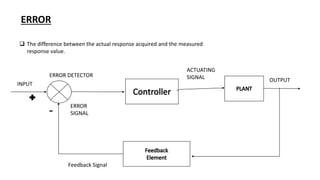
ERROR
 The difference between the actual response acquired and the measured
response value.
INPUT
ERROR DETECTOR
ERROR
SIGNAL
ACTUATING
SIGNAL OUTPUT
Feedback Signal
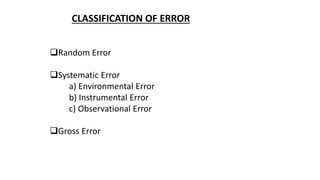
CLASSIFICATION OF ERROR
Random Error
Systematic Error
a) Environmental Error
b) Instrumental Error
c) Observational Error
Gross Error
Random Error
The errors, which occur due to unknown sources
during measurement time are known as random
errors
Hence, it is not possible to eliminate or minimize
these errors.
But, if we want to get the more accurate
measurement values without any random error, then
it is possible by following these two steps.
Step1 − Take more number of readings by different
observers.
Step2 − Do statistical analysis on the readings obtained
in Step1.
Following are the parameters that are used in statistical analysis.
1) Mean
2) Median
3) Variance
4)Deviation
5)Standard Deviation
Gross Errors
o The errors, which occur due to the lack of experience of the observer while
taking the measurement values are known as gross errors.
o The values of gross errors will vary from observer to observer. Sometimes,
the gross errors may also occur due to improper selection of the
instrument.
Systematic Errors
If the instrument produces an error, which is of a constant
uniform deviation during its operation is known as systematic
error. The systematic errors occur due to the characteristics of
the materials used in the instrument
Types of Systematic Errors
Instrumental Errors − This type of errors occur due to shortcomings of instruments and
loading effects.
Environmental Errors − This type of errors occur due to the changes in environment such
as change in temperature, pressure & etc.
observational Errors − This type of errors occur due to observer while taking the meter
readings. Parallax errors belong to this type of errors.
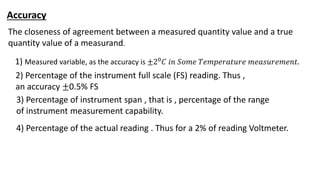
Accuracy
The closeness of agreement between a measured quantity value and a true
quantity value of a measurand.
1) Measured variable, as the accuracy is ±20𝐶 𝑖𝑛 𝑆𝑜𝑚𝑒 𝑇𝑒𝑚𝑝𝑒𝑟𝑎𝑡𝑢𝑟𝑒 𝑚𝑒𝑎𝑠𝑢𝑟𝑒𝑚𝑒𝑛𝑡.
2) Percentage of the instrument full scale (FS) reading. Thus ,
an accuracy ±0.5% FS
3) Percentage of instrument span , that is , percentage of the range
of instrument measurement capability.
4) Percentage of the actual reading . Thus for a 2% of reading Voltmeter.
Sensitivity
• Sensitivity is a measure of the change in output of an instrument for a
change in input.
• High Sensitivity is Desirable in an instrument because a large change in
output for a small change in input implies.
• Sensitivity must be evaluated together with other parameter, Such as
Linearity of Output to Input.
• When a Temperature transducer output 5 mv per degree Celsius, the
sensitivity is 5mV/C
Resolution
1. The ability of the measurement system to detect and faithfully indicate
small changes in the characteristic of the measurement result.
Linearity
• A measure of how the size of the part affects the bias of a
measurement system.
• It is the difference in the observed bias values through the expected
range of measurement.
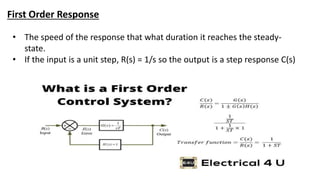
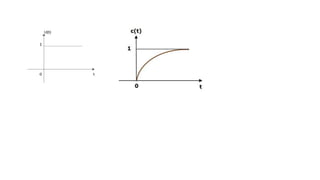
First Order Response
• The speed of the response that what duration it reaches the steady-
state.
• If the input is a unit step, R(s) = 1/s so the output is a step response C(s)
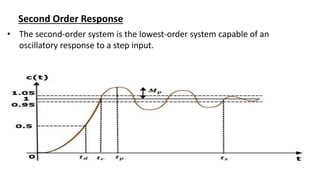
Second Order Response
• The second-order system is the lowest-order system capable of an
oscillatory response to a step input.
Thank You

Process dynamic control

  • 1.
    ERROR, FIRST &SECOND ORDER RESPONSE SUBMITTED TO DR. PIYUSH VERMA (PROFESSOR) SUBMITTED BY Sharvendra more Roll No.-212504
  • 2.
    Outline  Error Type ofError Accuracy Sensitivity Resolution Linearity First Order Response Second Order Response
  • 3.
    ERROR  The differencebetween the actual response acquired and the measured response value. INPUT ERROR DETECTOR ERROR SIGNAL ACTUATING SIGNAL OUTPUT Feedback Signal
  • 4.
    CLASSIFICATION OF ERROR RandomError Systematic Error a) Environmental Error b) Instrumental Error c) Observational Error Gross Error
  • 5.
    Random Error The errors,which occur due to unknown sources during measurement time are known as random errors Hence, it is not possible to eliminate or minimize these errors. But, if we want to get the more accurate measurement values without any random error, then it is possible by following these two steps. Step1 − Take more number of readings by different observers. Step2 − Do statistical analysis on the readings obtained in Step1.
  • 6.
    Following are theparameters that are used in statistical analysis. 1) Mean 2) Median 3) Variance 4)Deviation 5)Standard Deviation Gross Errors o The errors, which occur due to the lack of experience of the observer while taking the measurement values are known as gross errors. o The values of gross errors will vary from observer to observer. Sometimes, the gross errors may also occur due to improper selection of the instrument.
  • 7.
    Systematic Errors If theinstrument produces an error, which is of a constant uniform deviation during its operation is known as systematic error. The systematic errors occur due to the characteristics of the materials used in the instrument Types of Systematic Errors Instrumental Errors − This type of errors occur due to shortcomings of instruments and loading effects. Environmental Errors − This type of errors occur due to the changes in environment such as change in temperature, pressure & etc. observational Errors − This type of errors occur due to observer while taking the meter readings. Parallax errors belong to this type of errors.
  • 8.
    Accuracy The closeness ofagreement between a measured quantity value and a true quantity value of a measurand. 1) Measured variable, as the accuracy is ±20𝐶 𝑖𝑛 𝑆𝑜𝑚𝑒 𝑇𝑒𝑚𝑝𝑒𝑟𝑎𝑡𝑢𝑟𝑒 𝑚𝑒𝑎𝑠𝑢𝑟𝑒𝑚𝑒𝑛𝑡. 2) Percentage of the instrument full scale (FS) reading. Thus , an accuracy ±0.5% FS 3) Percentage of instrument span , that is , percentage of the range of instrument measurement capability. 4) Percentage of the actual reading . Thus for a 2% of reading Voltmeter.
  • 9.
    Sensitivity • Sensitivity isa measure of the change in output of an instrument for a change in input. • High Sensitivity is Desirable in an instrument because a large change in output for a small change in input implies. • Sensitivity must be evaluated together with other parameter, Such as Linearity of Output to Input. • When a Temperature transducer output 5 mv per degree Celsius, the sensitivity is 5mV/C
  • 10.
    Resolution 1. The abilityof the measurement system to detect and faithfully indicate small changes in the characteristic of the measurement result. Linearity • A measure of how the size of the part affects the bias of a measurement system. • It is the difference in the observed bias values through the expected range of measurement.
  • 11.
    First Order Response •The speed of the response that what duration it reaches the steady- state. • If the input is a unit step, R(s) = 1/s so the output is a step response C(s)
  • 13.
    Second Order Response •The second-order system is the lowest-order system capable of an oscillatory response to a step input.
  • 14.