GORDON FUNCTIONAL
HEALTH PATTERNS
(GFHP)
1
Gordon's functional health patterns
 Proposed by Marjorie Gordon as a guide for establishing
and organizing a comprehensive nursing data base
 Based on the belief that all human beings have in
common 11 functional health patterns that contribute to
their health.
 The format addresses and reflects concepts of holism
 The 11 categories make possible a systematic and
standardized approach to data collection, and enable the
nurse to determine the aspects of health and human
function:
2
Functional health patterns
 All human beings have in common certain
functional patterns that contribute to their health
,quality of life and achievement of human
potentials
 These common patterns are the focus of nursing
assessment
 Description and evaluation of health patterns
permit the nurse to identify functional patterns
( client's strengths) and dysfunctional patterns
(nursing diagnosis)
3
 For each pattern, combine subjective and objective
data to identify diagnosis and etiological
/contributing factors.
 Health is measured by parameters and norms in
combination with a subjective client description.
 Health-Defined within the context of functional
health patterns is the optimum level of functioning
that allows individuals , families and communities
to develop their potentials to the fullest
4
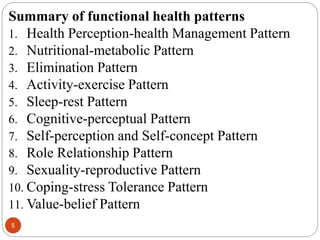
Summary of functional health patterns
1. Health Perception-health Management Pattern
2. Nutritional-metabolic Pattern
3. Elimination Pattern
4. Activity-exercise Pattern
5. Sleep-rest Pattern
6. Cognitive-perceptual Pattern
7. Self-perception and Self-concept Pattern
8. Role Relationship Pattern
9. Sexuality-reproductive Pattern
10. Coping-stress Tolerance Pattern
11. Value-belief Pattern
5
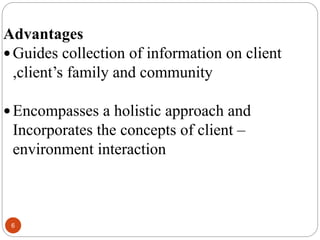
Advantages
Guides collection of information on client
,client’s family and community
Encompasses a holistic approach and
Incorporates the concepts of client –
environment interaction
6
The 11functional health patterns
7
8
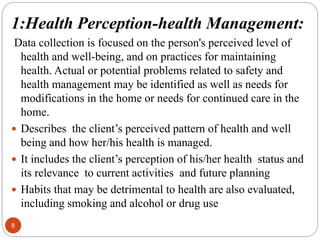
1:Health Perception-health Management:
Data collection is focused on the person's perceived level of
health and well-being, and on practices for maintaining
health. Actual or potential problems related to safety and
health management may be identified as well as needs for
modifications in the home or needs for continued care in the
home.
 Describes the client’s perceived pattern of health and well
being and how her/his health is managed.
 It includes the client’s perception of his/her health status and
its relevance to current activities and future planning
 Habits that may be detrimental to health are also evaluated,
including smoking and alcohol or drug use
 It also includes the general level of health care
behavior
 Promotional activities
Self examinations-breast , testicular exams
Preventive practices
Medical and nursing perceptions
Follow up care.
 The focus is the individual ,family and
community perceived level of health, well-being
and practices for promoting and maintaining
health
9
10
Assessment of functional health perception- health
management patterns
Individual assessment
 History
How has general health been
Previous and current health problems and diseases
Activities for promoting and maintaining health
Perceptions on causes of previous and current health or
disease status
 Examination-General health status
Family assessment
 History & Examination
Community assessment
 History & examination
Sample NANDA nursing diagnosis
 Health Maintenance, Ineffective
 Infection, Risk for
 Injury, Risk for
 Risk for injury, Suffocation , Poisoning
 Management of Therapeutic Regimen (Individual,
Family, Community), Ineffective
 Management of Therapeutic Regimen, Readiness for
Enhanced
 Surgical Recovery, Delayed
11
12
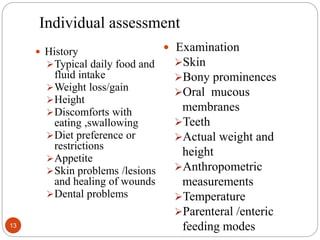
2:Nutrition and Metabolism:
Assessment is focused on the pattern of food and
fluid consumption relative to metabolic need. The
adequacy of local nutrient supplies is evaluated.
Actual or potential problems related to fluid
balance, feeding difficulties tissue integrity, and
host defenses may be identified as well as
problems with the gastrointestinal system.
 Assessment objective
 To obtain data about typical pattern of food
and fluid consumption
Identify gross indicators of metabolic need
Individual assessment
13
 History
Typical daily food and
fluid intake
Weight loss/gain
Height
Discomforts with
eating ,swallowing
Diet preference or
restrictions
Appetite
Skin problems /lesions
and healing of wounds
Dental problems
 Examination
Skin
Bony prominences
Oral mucous
membranes
Teeth
Actual weight and
height
Anthropometric
measurements
Temperature
Parenteral /enteric
feeding modes
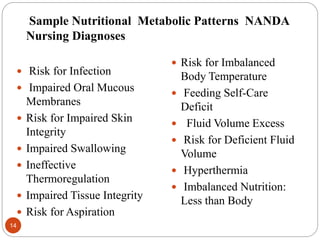
Sample Nutritional Metabolic Patterns NANDA
Nursing Diagnoses
 Risk for Infection
 Impaired Oral Mucous
Membranes
 Risk for Impaired Skin
Integrity
 Impaired Swallowing
 Ineffective
Thermoregulation
 Impaired Tissue Integrity
 Risk for Aspiration
 Risk for Imbalanced
Body Temperature
 Feeding Self-Care
Deficit
 Fluid Volume Excess
 Risk for Deficient Fluid
Volume
 Hyperthermia
 Imbalanced Nutrition:
Less than Body
14
15
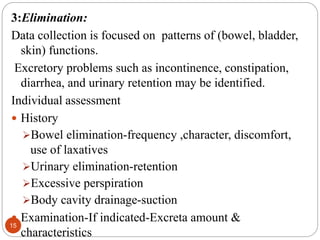
3:Elimination:
Data collection is focused on patterns of (bowel, bladder,
skin) functions.
Excretory problems such as incontinence, constipation,
diarrhea, and urinary retention may be identified.
Individual assessment
 History
Bowel elimination-frequency ,character, discomfort,
use of laxatives
Urinary elimination-retention
Excessive perspiration
Body cavity drainage-suction
 Examination-If indicated-Excreta amount &
characteristics
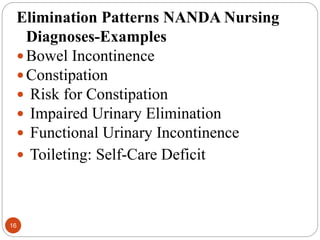
Elimination Patterns NANDA Nursing
Diagnoses-Examples
Bowel Incontinence
Constipation
 Risk for Constipation
 Impaired Urinary Elimination
 Functional Urinary Incontinence
 Toileting: Self-Care Deficit
16
17
4:Activity and Exercise:
Assessment is focused on the activities of daily living
requiring energy expenditure, including self-care
activities, exercise, recreation and leisure activities.
The status of major body systems involved with activity and
exercise is evaluated, including the respiratory,
cardiovascular, and musculoskeletal systems
Individual assessment.
 History
Sufficient energy for required activities
Exercises
Recreational activities
Perceived ability for ADLs- Functional level assessment
18
Level 0:Full self care
Level 1:Requires use of equipment
Level11:Requires assistance or supervision
Level 111:Requires assistance from another and use of
equipment device
Level IV: Is dependant and does not participate
 Examination
Demonstrated ability to perform ADLs
Gait
Posture
Range of motion-Joints
Muscle strength
Blood pressure
Pulse and respirations
General appearance (grooming, Hygiene ,energy level)
Activity-exercise Patterns NANDA Nursing Diagnoses
 Activity Intolerance
 Risk for Activity Intolerance
 Bathing/Hygiene, Self-Care Deficit
 Dressing/Grooming, Self-Care Deficit
 Ineffective Breathing Pattern
 Ineffective Airway Clearance
 Impaired Gas Exchange
 Risk for Peripheral Neurovascular Dysfunction
 Impaired Tissue Integrity
 Ineffective Tissue Perfusion
 Impaired Spontaneous Ventilation
19
20
5:Cognition and Perception:
 Describes sensory-perceptual and cognitive
adequacy.
 Assessment is focused on the sensory
functions and ability to comprehend and use
information.
 Data pertaining to functions of the sensory
modes, pain and cognitive abilities are
obtained.
Individual assessment
 History
Hearing difficulty,
hearing aids
Vision-use of glasses
Any change in
memory
Ability to make
decisions
Learning difficulties
Examination
MSE
Hearing tests
Tests of vision
Reading tests
Language
spoken
21
Cognitive-perceptual Patterns NANDA
Nursing Diagnoses-examples
 Acute Confusion
 Impaired Verbal Communication
 Acute Pain
 Risk for Peripheral Neurovascular Dysfunction
 Ineffective Protection
 Disturbed Sensory Perception
 Disturbed Thought Processes
 Decisional Conflict
22
23
6:Sleep and Rest.
 Assessment is focused on the person's sleep, rest,
and relaxation practices.
 The objective is to describe effectiveness of the
pattern from the client’s perspective
 Data on sleep characteristics during 24-period is
collected to include whether the client feels
rested
 Dysfunctional sleep patterns, fatigue, and
responses to sleep deprivation may be identified.
Individual assessment
 History
Sleep onset problems
Sleeping aids
Early awakening
Rest-relaxation periods
Sleep interruptions-dreams
Generally rested and ready for daily activities
 Examination
Sleeping times & presence of sleep pattern
Interruptions during sleep
Prescribed nocte drugs
24
Sample NANDA nursing diagnosis
Sleep, Readiness for Enhanced
Sleep Deprivation
Sleep Pattern, Disturbed
25
26
7.Self-Perception and Self-Concept: Assessment
is focused on the person's attitudes toward self, including
identity, body image, and sense of self-worth. The person's
level of self-esteem and response to threats to his or her self-
concept may be identified.
Individual assessment
 History
 Clients feelings towards self most of the time
 Changes in body or things client can do
 Changes in ways client feels about self or image since illness
started
 Sources of anger, annoyance, fearful
 Any hopelessness
 Examination
Eye contact
Body posture
Assertiveness
Signs of identity confusion
27
Self-perception And Self-concept Pattern-
Sample NANDA nursing diagnosis
Body Image, Disturbed
Loneliness, Risk for
Personal Identity, Disturbed
Self-Concept, Readiness for Enhanced
Self-Esteem, Chronic Low, Situational
Low,
 Risk for Situational Low
28
29
8:Roles and Relationships:
Assessment is focused on the person's
roles engagement and relationships
with others.
Includes perception of the current
major roles and responsibilities
 Satisfaction with roles, role strain, or
dysfunctional relationships within the
family and socially may be identified.
Individual assessment
 History
 Living alone
 Family structure
 Difficulty in handling family problems
 Feeling of family members about client’s illness
 Difficulty handling children
 Social group membership and positions held
 Income in relationship to needs
 Feeling part of the family, friends, neighborhood or isolated
 Examination
 Interactions- Family, relatives, work mates
30
Sample NANDA Nursing Diagnosis
 Caregiver Role Strain, Risk for and Actual
 Communication, Readiness for Enhanced
 Family Process, Interrupted
 Family Process, Readiness for Enhanced
 Parent, Infant, and Child Attachment, Impaired,
Risk for
 Parenting, Impaired, Risk for and Actual
 Parenting, Readiness for Enhanced
31
32
9:Sexuality and Reproduction:
Assessment is focused on the person's satisfaction or
dissatisfaction with sexuality patterns and reproductive
functions. Concerns with sexuality may he identified.
Individual assessment
 History-consider age and situation
Sexual relationships and whether satisfying, any
Changes
Use of contraceptives
Menarche and menopause / andropose
LMP, dysmenorrhea,parity
Examination- Antenatal, pelvic examination & genital
examination if appropriate
Sexuality and reproduction sample NANDA
nursing diagnosis
 Rape-Trauma Syndrome:
 Sexual Dysfunction
 Sexuality Patterns, Ineffective
33
34
10:Coping and Stress Tolerance:
 Assessment is focused on the person's perception
of stress and his or her coping strategies.
 Includes ability to exert a sense of control over
threat to integrity
Individual assessment
 History
Any big changes in the client’s life in the last year
and following previous crisis
The most helpful person in times of stress &
Confidants
Use of stress-relieving drugs
Ways of handling stressful issues and their
effectiveness
Sample NANDA nursing Diagnosis
 Adjustment, Impaired
 Coping, Readiness for Enhanced
 Family Coping, Compromised and Disabled
 Individual Coping, Ineffective
 Coping, Defensive
 Denial, Ineffective
35
36
11.Values and Belief.
 Assessment is focused on the person's values and
beliefs (including spiritual beliefs), or on the goals
that guide client’s choices or decisions.
 It includes what is perceived as important in life
and perceived conflicts in values, beliefs or
expectations that are health related.
 History
Important plans for the future
Importance Religion in life
Health actions that contradict beliefs
 Sample NANDA nursing Diagnosis
 Impaired Religious faith, Risk for and Actual
 Spiritual Distress, Risk for and Actual
 Spiritual Well-Being, Readiness for Enhanced
37
REFERENCES AND FURTHER READINGS
 Fuller Jill Ayers-Scheller Jenipher: Health Assessment a
Nursing Approach .J.B.-Lippincott company
 Gordon Marjory-Nursing Diagnosis : process & applications
Mosby
 Web sites and relevant texts
38
THANK YOU
HAVE FUNCTIONAL HEALTH PATTERNS
39

GORDONS 11 HEALTH FUNCTIONAL PATTERNS.ppt

  • 1.
  • 2.
    Gordon's functional healthpatterns  Proposed by Marjorie Gordon as a guide for establishing and organizing a comprehensive nursing data base  Based on the belief that all human beings have in common 11 functional health patterns that contribute to their health.  The format addresses and reflects concepts of holism  The 11 categories make possible a systematic and standardized approach to data collection, and enable the nurse to determine the aspects of health and human function: 2
  • 3.
    Functional health patterns All human beings have in common certain functional patterns that contribute to their health ,quality of life and achievement of human potentials  These common patterns are the focus of nursing assessment  Description and evaluation of health patterns permit the nurse to identify functional patterns ( client's strengths) and dysfunctional patterns (nursing diagnosis) 3
  • 4.
     For eachpattern, combine subjective and objective data to identify diagnosis and etiological /contributing factors.  Health is measured by parameters and norms in combination with a subjective client description.  Health-Defined within the context of functional health patterns is the optimum level of functioning that allows individuals , families and communities to develop their potentials to the fullest 4
  • 5.
    Summary of functionalhealth patterns 1. Health Perception-health Management Pattern 2. Nutritional-metabolic Pattern 3. Elimination Pattern 4. Activity-exercise Pattern 5. Sleep-rest Pattern 6. Cognitive-perceptual Pattern 7. Self-perception and Self-concept Pattern 8. Role Relationship Pattern 9. Sexuality-reproductive Pattern 10. Coping-stress Tolerance Pattern 11. Value-belief Pattern 5
  • 6.
    Advantages Guides collection ofinformation on client ,client’s family and community Encompasses a holistic approach and Incorporates the concepts of client – environment interaction 6
  • 7.
  • 8.
    8 1:Health Perception-health Management: Datacollection is focused on the person's perceived level of health and well-being, and on practices for maintaining health. Actual or potential problems related to safety and health management may be identified as well as needs for modifications in the home or needs for continued care in the home.  Describes the client’s perceived pattern of health and well being and how her/his health is managed.  It includes the client’s perception of his/her health status and its relevance to current activities and future planning  Habits that may be detrimental to health are also evaluated, including smoking and alcohol or drug use
  • 9.
     It alsoincludes the general level of health care behavior  Promotional activities Self examinations-breast , testicular exams Preventive practices Medical and nursing perceptions Follow up care.  The focus is the individual ,family and community perceived level of health, well-being and practices for promoting and maintaining health 9
  • 10.
    10 Assessment of functionalhealth perception- health management patterns Individual assessment  History How has general health been Previous and current health problems and diseases Activities for promoting and maintaining health Perceptions on causes of previous and current health or disease status  Examination-General health status Family assessment  History & Examination Community assessment  History & examination
  • 11.
    Sample NANDA nursingdiagnosis  Health Maintenance, Ineffective  Infection, Risk for  Injury, Risk for  Risk for injury, Suffocation , Poisoning  Management of Therapeutic Regimen (Individual, Family, Community), Ineffective  Management of Therapeutic Regimen, Readiness for Enhanced  Surgical Recovery, Delayed 11
  • 12.
    12 2:Nutrition and Metabolism: Assessmentis focused on the pattern of food and fluid consumption relative to metabolic need. The adequacy of local nutrient supplies is evaluated. Actual or potential problems related to fluid balance, feeding difficulties tissue integrity, and host defenses may be identified as well as problems with the gastrointestinal system.  Assessment objective  To obtain data about typical pattern of food and fluid consumption Identify gross indicators of metabolic need
  • 13.
    Individual assessment 13  History Typicaldaily food and fluid intake Weight loss/gain Height Discomforts with eating ,swallowing Diet preference or restrictions Appetite Skin problems /lesions and healing of wounds Dental problems  Examination Skin Bony prominences Oral mucous membranes Teeth Actual weight and height Anthropometric measurements Temperature Parenteral /enteric feeding modes
  • 14.
    Sample Nutritional MetabolicPatterns NANDA Nursing Diagnoses  Risk for Infection  Impaired Oral Mucous Membranes  Risk for Impaired Skin Integrity  Impaired Swallowing  Ineffective Thermoregulation  Impaired Tissue Integrity  Risk for Aspiration  Risk for Imbalanced Body Temperature  Feeding Self-Care Deficit  Fluid Volume Excess  Risk for Deficient Fluid Volume  Hyperthermia  Imbalanced Nutrition: Less than Body 14
  • 15.
    15 3:Elimination: Data collection isfocused on patterns of (bowel, bladder, skin) functions. Excretory problems such as incontinence, constipation, diarrhea, and urinary retention may be identified. Individual assessment  History Bowel elimination-frequency ,character, discomfort, use of laxatives Urinary elimination-retention Excessive perspiration Body cavity drainage-suction  Examination-If indicated-Excreta amount & characteristics
  • 16.
    Elimination Patterns NANDANursing Diagnoses-Examples Bowel Incontinence Constipation  Risk for Constipation  Impaired Urinary Elimination  Functional Urinary Incontinence  Toileting: Self-Care Deficit 16
  • 17.
    17 4:Activity and Exercise: Assessmentis focused on the activities of daily living requiring energy expenditure, including self-care activities, exercise, recreation and leisure activities. The status of major body systems involved with activity and exercise is evaluated, including the respiratory, cardiovascular, and musculoskeletal systems Individual assessment.  History Sufficient energy for required activities Exercises Recreational activities Perceived ability for ADLs- Functional level assessment
  • 18.
    18 Level 0:Full selfcare Level 1:Requires use of equipment Level11:Requires assistance or supervision Level 111:Requires assistance from another and use of equipment device Level IV: Is dependant and does not participate  Examination Demonstrated ability to perform ADLs Gait Posture Range of motion-Joints Muscle strength Blood pressure Pulse and respirations General appearance (grooming, Hygiene ,energy level)
  • 19.
    Activity-exercise Patterns NANDANursing Diagnoses  Activity Intolerance  Risk for Activity Intolerance  Bathing/Hygiene, Self-Care Deficit  Dressing/Grooming, Self-Care Deficit  Ineffective Breathing Pattern  Ineffective Airway Clearance  Impaired Gas Exchange  Risk for Peripheral Neurovascular Dysfunction  Impaired Tissue Integrity  Ineffective Tissue Perfusion  Impaired Spontaneous Ventilation 19
  • 20.
    20 5:Cognition and Perception: Describes sensory-perceptual and cognitive adequacy.  Assessment is focused on the sensory functions and ability to comprehend and use information.  Data pertaining to functions of the sensory modes, pain and cognitive abilities are obtained.
  • 21.
    Individual assessment  History Hearingdifficulty, hearing aids Vision-use of glasses Any change in memory Ability to make decisions Learning difficulties Examination MSE Hearing tests Tests of vision Reading tests Language spoken 21
  • 22.
    Cognitive-perceptual Patterns NANDA NursingDiagnoses-examples  Acute Confusion  Impaired Verbal Communication  Acute Pain  Risk for Peripheral Neurovascular Dysfunction  Ineffective Protection  Disturbed Sensory Perception  Disturbed Thought Processes  Decisional Conflict 22
  • 23.
    23 6:Sleep and Rest. Assessment is focused on the person's sleep, rest, and relaxation practices.  The objective is to describe effectiveness of the pattern from the client’s perspective  Data on sleep characteristics during 24-period is collected to include whether the client feels rested  Dysfunctional sleep patterns, fatigue, and responses to sleep deprivation may be identified.
  • 24.
    Individual assessment  History Sleeponset problems Sleeping aids Early awakening Rest-relaxation periods Sleep interruptions-dreams Generally rested and ready for daily activities  Examination Sleeping times & presence of sleep pattern Interruptions during sleep Prescribed nocte drugs 24
  • 25.
    Sample NANDA nursingdiagnosis Sleep, Readiness for Enhanced Sleep Deprivation Sleep Pattern, Disturbed 25
  • 26.
    26 7.Self-Perception and Self-Concept:Assessment is focused on the person's attitudes toward self, including identity, body image, and sense of self-worth. The person's level of self-esteem and response to threats to his or her self- concept may be identified. Individual assessment  History  Clients feelings towards self most of the time  Changes in body or things client can do  Changes in ways client feels about self or image since illness started  Sources of anger, annoyance, fearful  Any hopelessness
  • 27.
     Examination Eye contact Bodyposture Assertiveness Signs of identity confusion 27
  • 28.
    Self-perception And Self-conceptPattern- Sample NANDA nursing diagnosis Body Image, Disturbed Loneliness, Risk for Personal Identity, Disturbed Self-Concept, Readiness for Enhanced Self-Esteem, Chronic Low, Situational Low,  Risk for Situational Low 28
  • 29.
    29 8:Roles and Relationships: Assessmentis focused on the person's roles engagement and relationships with others. Includes perception of the current major roles and responsibilities  Satisfaction with roles, role strain, or dysfunctional relationships within the family and socially may be identified.
  • 30.
    Individual assessment  History Living alone  Family structure  Difficulty in handling family problems  Feeling of family members about client’s illness  Difficulty handling children  Social group membership and positions held  Income in relationship to needs  Feeling part of the family, friends, neighborhood or isolated  Examination  Interactions- Family, relatives, work mates 30
  • 31.
    Sample NANDA NursingDiagnosis  Caregiver Role Strain, Risk for and Actual  Communication, Readiness for Enhanced  Family Process, Interrupted  Family Process, Readiness for Enhanced  Parent, Infant, and Child Attachment, Impaired, Risk for  Parenting, Impaired, Risk for and Actual  Parenting, Readiness for Enhanced 31
  • 32.
    32 9:Sexuality and Reproduction: Assessmentis focused on the person's satisfaction or dissatisfaction with sexuality patterns and reproductive functions. Concerns with sexuality may he identified. Individual assessment  History-consider age and situation Sexual relationships and whether satisfying, any Changes Use of contraceptives Menarche and menopause / andropose LMP, dysmenorrhea,parity Examination- Antenatal, pelvic examination & genital examination if appropriate
  • 33.
    Sexuality and reproductionsample NANDA nursing diagnosis  Rape-Trauma Syndrome:  Sexual Dysfunction  Sexuality Patterns, Ineffective 33
  • 34.
    34 10:Coping and StressTolerance:  Assessment is focused on the person's perception of stress and his or her coping strategies.  Includes ability to exert a sense of control over threat to integrity Individual assessment  History Any big changes in the client’s life in the last year and following previous crisis The most helpful person in times of stress & Confidants Use of stress-relieving drugs Ways of handling stressful issues and their effectiveness
  • 35.
    Sample NANDA nursingDiagnosis  Adjustment, Impaired  Coping, Readiness for Enhanced  Family Coping, Compromised and Disabled  Individual Coping, Ineffective  Coping, Defensive  Denial, Ineffective 35
  • 36.
    36 11.Values and Belief. Assessment is focused on the person's values and beliefs (including spiritual beliefs), or on the goals that guide client’s choices or decisions.  It includes what is perceived as important in life and perceived conflicts in values, beliefs or expectations that are health related.
  • 37.
     History Important plansfor the future Importance Religion in life Health actions that contradict beliefs  Sample NANDA nursing Diagnosis  Impaired Religious faith, Risk for and Actual  Spiritual Distress, Risk for and Actual  Spiritual Well-Being, Readiness for Enhanced 37
  • 38.
    REFERENCES AND FURTHERREADINGS  Fuller Jill Ayers-Scheller Jenipher: Health Assessment a Nursing Approach .J.B.-Lippincott company  Gordon Marjory-Nursing Diagnosis : process & applications Mosby  Web sites and relevant texts 38
  • 39.
    THANK YOU HAVE FUNCTIONALHEALTH PATTERNS 39