Nursing Diagnosing is the
second phase of the nursing
process.
 In this phase, nurses use critical
thinking skills to interpret
assessment data and identify
client strengths and problems.
 This phase are directed toward
formulating the nursing
diagnoses.
 The care planning activities
following this phase are based on
the nursing diagnosis.
 The identification and development of
nursing diagnoses began formally in
1973, when two faculty members of
Saint Louis University, Kristine
Gebbie and Mary Ann Lavin, perceived
a need to identify nurses’ roles in an
ambulatory care setting.
 The first national conference to
identify nursing diagnoses was
sponsored by the Saint Louis
University School of Nursing
and Allied Health Professions in
1973.
 International recognition came with
the First Canadian Conference in
Toronto in 1977 and the International
Nursing Conference in May 1987 in
Calgary, Alberta, Canada.
 In 1982, the conference group
accepted the name North American
Nursing Diagnosis Association
(NANDA), recognizing the
participation and contributions of
nurses in the United States and
Canada.
In 2002, the organization
changed its name to NANDA
International to further reflect
the worldwide interest in
nursing diagnosis.
 The purpose of NANDA
International is to define, refine,
and promote a taxonomy of nursing
diagnostic terminology of general
use to professional nurses.
N
A
N
D
A
A taxonomy is a classification
system or set of categories
arranged based on a single
principle or set of principles.
 The members of NANDA include
staff nurses, clinical specialists,
faculty, directors of nursing,
deans, theorists, and
researchers.
 To use the concept of nursing
diagnoses effectively in generating
and completing a nursing care plan,
the nurse must be familiar with the
definitions of terms used and the
components of nursing diagnoses.
 The term diagnosing refers to the
reasoning process, whereas the
term diagnosis is a statement or
conclusion regarding the nature
of a phenomenon.
 The standardized NANDA names for the
diagnoses are called Diagnostic labels;
The official NANDA definition of a
nursing diagnosis is:
“. . . a clinical judgment concerning a
human response to health conditions/
life processes, or a vulnerability for that
response, by an individual, family,
group, or community”.
Domain 1: Health Promotion
Domain 2: Nutrition
Domain 3: Elimination and
Exchange
Con--
Domain 4: Activity/Rest
Domain 5:
Perception/Cognition
Domain 6: Self-Perception
 Con---
 Domain 7: Role Relationships
 Domain 8: Sexuality
 Domain 9: Coping/Stress Tolerance
 Domain 10: Life Principles
Con---
 Domain 11: Safety/Protection
 Domain 12: Comfort
 Domain 13: Growth/Development
DOMAIN 1: HEALTH
PROMOTION
CLASS 1. HEALTH
AWARENESS
CLASS 2. HEALTH
MANAGEMENT
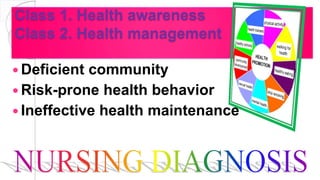
Class 1. Health awareness
Class 2. Health management
 Deficient community
 Risk-prone health behavior
 Ineffective health maintenance
Con------
 Ineffective health management
 Ineffective family health
management
 Ineffective protection
DOMAIN 2: NUTRITION
CLASS 1. INGESTION
CLASS 2. DIGESTION
CLASS 3. ABSORPTION
CLASS 4. METABOLISM
CLASS 5. HYDRATION
CLASS 1. INGESTION
 Insufficient breast milk
 Ineffective breastfeeding
 Interrupted breastfeeding
 Readiness for enhanced
breastfeeding
Con-------
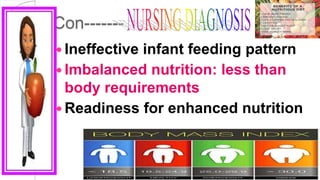
 Ineffective infant feeding pattern
 Imbalanced nutrition: less than
body requirements
 Readiness for enhanced nutrition
Con---
 Obesity
 Overweight
 Risk for overweight
 Impaired swallowing
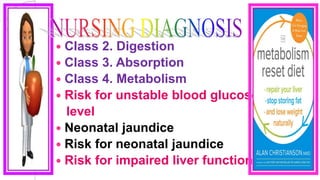
 Class 2. Digestion
 Class 3. Absorption
 Class 4. Metabolism
 Risk for unstable blood glucose
level
 Neonatal jaundice
 Risk for neonatal jaundice
 Risk for impaired liver function
Class 5. Hydration
 Risk for electrolyte imbalance
 Readiness for enhanced fluid
balance
 Deficient fluid volume
Con--
 Risk for deficient fluid volume
 Excess fluid volume
 Risk for imbalanced fluid volume
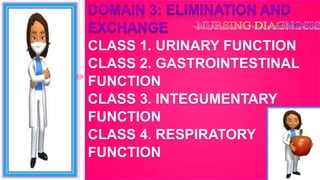
CLASS 1. URINARY FUNCTION
CLASS 2. GASTROINTESTINAL
FUNCTION
CLASS 3. INTEGUMENTARY
FUNCTION
CLASS 4. RESPIRATORY
FUNCTION
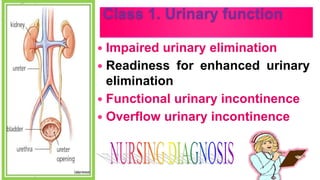
Class 1. Urinary function
 Impaired urinary elimination
 Readiness for enhanced urinary
elimination
 Functional urinary incontinence
 Overflow urinary incontinence
Con---
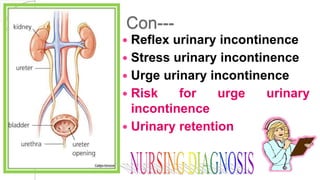
 Reflex urinary incontinence
 Stress urinary incontinence
 Urge urinary incontinence
 Risk for urge urinary
incontinence
 Urinary retention
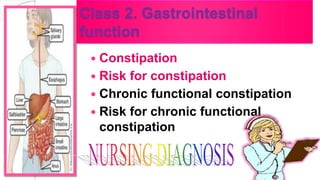
Class 2. Gastrointestinal
function
 Constipation
 Risk for constipation
 Chronic functional constipation
 Risk for chronic functional
constipation
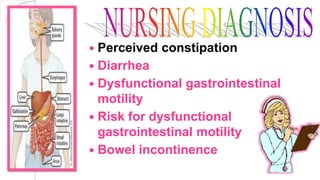
 Perceived constipation
 Diarrhea
 Dysfunctional gastrointestinal
motility
 Risk for dysfunctional
gastrointestinal motility
 Bowel incontinence
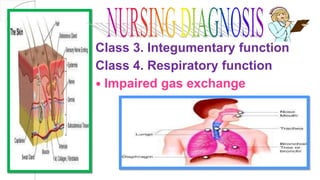
Class 3. Integumentary function
Class 4. Respiratory function
 Impaired gas exchange
DOMAIN 4: ACTIVITY/REST
CLASS 1. SLEEP/REST
CLASS 2. ACTIVITY/EXERCISE
CLASS 3. ENERGY BALANCE
CLASS 4.
CARDIOVASCULAR/PULMONA
RY RESPONSES
CLASS 5. SELF-CARE
Class 1. Sleep/rest
 Insomnia
 Sleep deprivation
 Readiness for enhanced
sleep
 Disturbed sleep pattern
Class 2. Activity/exercise
 Risk for disuse syndrome
 Impaired bed mobility
 Impaired physical mobility
 Impaired wheelchair mobility
Con---
Impaired sitting
Impaired standing
Impaired transfer ability
Impaired walking
Class 3. Energy balance
 Fatigue
 Wandering
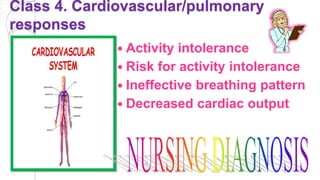
Class 4. Cardiovascular/pulmonary
responses
 Activity intolerance
 Risk for activity intolerance
 Ineffective breathing pattern
 Decreased cardiac output
Con--
 Risk for decreased cardiac output
 Risk for impaired cardiovascular
function
 Risk for ineffective
gastrointestinal perfusion
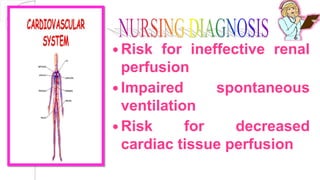
 Risk for ineffective renal
perfusion
 Impaired spontaneous
ventilation
 Risk for decreased
cardiac tissue perfusion
Risk for ineffective
cerebral tissue perfusion
Ineffective peripheral
tissue perfusion
Con--
Risk for ineffective peripheral
tissue perfusion
Dysfunctional ventilatory
weaning response
Class 5. Self-care
 Impaired home maintenance
 Bathing self-care deficit
 Dressing self-care deficit
 Feeding self-care deficit
Toileting self-care deficit
Readiness for enhanced self-
care
Self-neglect
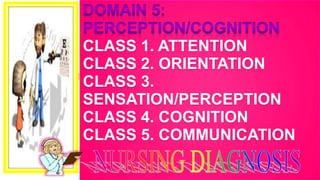
CLASS 1. ATTENTION
CLASS 2. ORIENTATION
CLASS 3.
SENSATION/PERCEPTION
CLASS 4. COGNITION
CLASS 5. COMMUNICATION
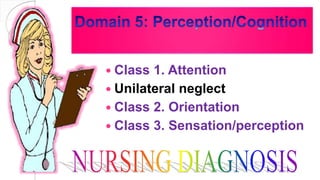
 Class 1. Attention
 Unilateral neglect
 Class 2. Orientation
 Class 3. Sensation/perception
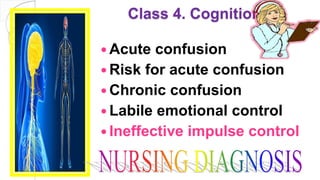
Class 4. Cognition
 Acute confusion
 Risk for acute confusion
 Chronic confusion
 Labile emotional control
 Ineffective impulse control
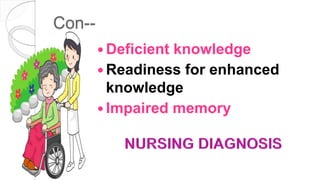
Con--
 Deficient knowledge
 Readiness for enhanced
knowledge
 Impaired memory
Class 5. Communication
 Readiness for enhanced
communication
 Impaired verbal communication
DOMAIN 6: SELF-
PERCEPTION
CLASS 1. SELF-CONCEPT
CLASS 2. SELF-ESTEEM
CLASS 3. BODY IMAGE
 Class 1. Self-concept
 Readiness for enhanced hope
 Hopelessness
 Risk for compromised human
dignity
Con--
 Disturbed personal identity
 Risk for disturbed personal identity
 Readiness for enhanced self-
concept
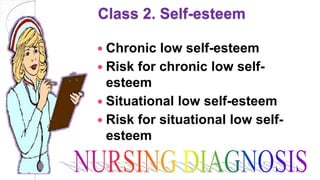
Class 2. Self-esteem
 Chronic low self-esteem
 Risk for chronic low self-
esteem
 Situational low self-esteem
 Risk for situational low self-
esteem
Class 3. Body image
 Disturbed body image
DOMAIN 7: ROLE
RELATIONSHIPS
CLASS 1. CAREGIVING
ROLES
CLASS 2. FAMILY
RELATIONSHIPS
CLASS 3. ROLE
PERFORMANCE
Class 1. Caregiving roles
 Caregiver role strain
 Risk for caregiver role strain
 Impaired parenting
 Readiness for enhanced
parenting
 Risk for impaired parenting
DOMAIN 8: SEXUALITY
CLASS 1. SEXUAL IDENTITY
CLASS 2. SEXUAL FUNCTION
CLASS 3. REPRODUCTION
Class 2. Family
relationships
 Risk for impaired attachment
 Dysfunctional family
processes
 Interrupted family processes
 Readiness for enhanced family
processes
Class 3. Role performance
 Ineffective relationship
 Readiness for enhanced
relationship
 Risk for ineffective
relationship
Con--
 Parental role conflict
 Ineffective role performance
 Impaired social interaction
DOMAIN 8: SEXUALITY
CLASS 1. SEXUAL
IDENTITY
CLASS 2. SEXUAL
FUNCTION
SEXUAL DYSFUNCTION
INEFFECTIVE SEXUALITY
PATTERN
 Class 1. Sexual identity
 Class 2. Sexual function
 Sexual dysfunction
 Ineffective sexuality pattern
Class 3. Reproduction
 Ineffective childbearing process
 Readiness for enhanced
childbearing process
 Risk for ineffective childbearing
process
 Risk for disturbed maternal–fetal
dyad
DOMAIN 9: COPING/STRESS
TOLERANCE
CLASS 1. POST-TRAUMA
RESPONSES POST-TRAUMA
SYNDROME
CLASS 2. COPING RESPONSES
CLASS 3. NEUROBEHAVIORAL
STRESS
 Class 1. Post-trauma responses
Post-trauma syndrome
 Risk for post-trauma syndrome
 Rape-trauma syndrome
 Relocation stress syndrome
 Risk for relocation stress syndrome
Class 2. Coping responses
 Ineffective activity planning
 Risk for ineffective activity
planning
 Anxiety
 Defensive coping
Con--
 Ineffective coping
 Readiness for enhanced
coping
 Ineffective community coping
 Readiness for enhanced
community coping
 Compromised family coping
 Disabled family coping
 Readiness for enhanced family
coping
 Death anxiety
Con---
 Ineffective denial
 Fear
 Grieving
 Complicated grieving
 Risk for complicated grieving
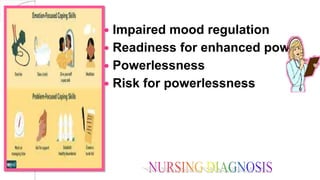
 Impaired mood regulation
 Readiness for enhanced power
 Powerlessness
 Risk for powerlessness
Con--
 Impaired resilience
 Readiness for enhanced
resilience
 Risk for impaired resilience
 Chronic sorrow
 Stress overload
Class 3. Neurobehavioral
stress
 Decreased intracranial adaptive
capacity
 Autonomic dysreflexia
 Risk for autonomic dysreflexia
Con--
 Disorganized infant behavior
 Readiness for enhanced
organized infant behavior
 Risk for disorganized infant
behavior
DOMAIN 10: LIFE PRINCIPLES
CLASS 1. VALUES
CLASS 2. BELIEFS
CLASS 3.
VALUE/BELIEF/ACTION
CONGRUENCE
Class 1. Values
Class 2. Beliefs
 Readiness for enhanced
spiritual well-being
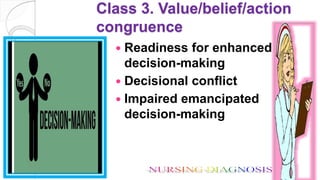
Class 3. Value/belief/action
congruence
 Readiness for enhanced
decision-making
 Decisional conflict
 Impaired emancipated
decision-making
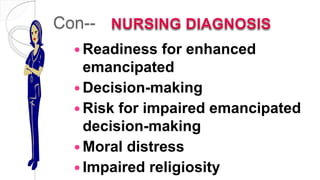
Con--
 Readiness for enhanced
emancipated
 Decision-making
 Risk for impaired emancipated
decision-making
 Moral distress
 Impaired religiosity
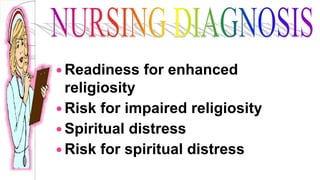
 Readiness for enhanced
religiosity
 Risk for impaired religiosity
 Spiritual distress
 Risk for spiritual distress
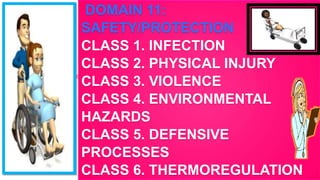
DOMAIN 11:
SAFETY/PROTECTION
CLASS 1. INFECTION
CLASS 2. PHYSICAL INJURY
CLASS 3. VIOLENCE
CLASS 4. ENVIRONMENTAL
HAZARDS
CLASS 5. DEFENSIVE
PROCESSES
CLASS 6. THERMOREGULATION
 Class 1. Infection
 Risk for infection
 Class 2. Physical injury
 Ineffective airway clearance
 Risk for aspiration
 Risk for bleeding
 Risk for dry eye
Risk for falls
Risk for injury
Risk for corneal injury
Risk for perioperative
positioning injury
Con--
 Risk for thermal injury
 Risk for urinary tract injury
 Impaired dentition
 Impaired oral mucous membrane
 Risk for impaired oral mucous
membrane
 Risk for peripheral
neurovascular dysfunction
 Risk for pressure ulcer
Con--
 Risk for shock
 Impaired skin integrity
 Risk for impaired skin integrity
 Risk for sudden infant death
syndrome
 Risk for suffocation Delayed
surgical recovery
 Risk for delayed surgical recovery
 Impaired tissue integrity
 Risk for impaired tissue integrity
 Risk for trauma
 Risk for vascular trauma
Class 3. Violence
 Risk for other-directed violence
 Risk for self-directed violence
 Self-mutilation
 Risk for self-mutilation
 Risk for suicide
Class 4. Environmental
hazards
 Contamination
 Risk for contamination
 Risk for poisoning
Class 5. Defensive
processes
 Risk for adverse reaction to
iodinated contrast media
 Risk for allergy response
 Latex allergy response
 Risk for latex allergy response
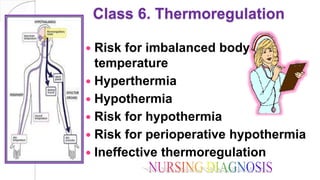
Class 6. Thermoregulation
 Risk for imbalanced body
temperature
 Hyperthermia
 Hypothermia
 Risk for hypothermia
 Risk for perioperative hypothermia
 Ineffective thermoregulation
DOMAIN 12: COMFORT
CLASS 1. PHYSICAL COMFORT
CLASS 2. ENVIRONMENTAL
COMFORT
CLASS 3. SOCIAL COMFORT
Class 1. Physical comfort
•Impaired comfort
•Readiness for enhanced comfort
•Nausea
•Acute pain
•Chronic pain
•Labor pain
•Chronic pain syndrome
Class 2. Environmental
comfort
 Impaired comfort
 Readiness for enhanced comfort
Class 3. Social comfort
 Impaired comfort
 Readiness for enhanced comfort
 Risk for loneliness
 Social isolation
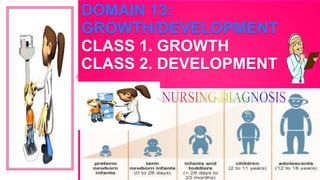
DOMAIN 13:
GROWTH/DEVELOPMENT
CLASS 1. GROWTH
CLASS 2. DEVELOPMENT
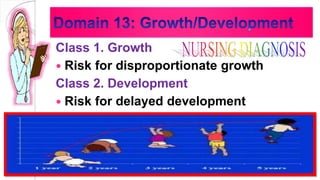
Class 1. Growth
 Risk for disproportionate growth
Class 2. Development
 Risk for delayed development
nsgdiagnosis-190712005448.pdf

nsgdiagnosis-190712005448.pdf

  • 3.
    Nursing Diagnosing isthe second phase of the nursing process.
  • 4.
     In thisphase, nurses use critical thinking skills to interpret assessment data and identify client strengths and problems.
  • 5.
     This phaseare directed toward formulating the nursing diagnoses.
  • 6.
     The careplanning activities following this phase are based on the nursing diagnosis.
  • 7.
     The identificationand development of nursing diagnoses began formally in 1973, when two faculty members of Saint Louis University, Kristine Gebbie and Mary Ann Lavin, perceived a need to identify nurses’ roles in an ambulatory care setting.
  • 8.
     The firstnational conference to identify nursing diagnoses was sponsored by the Saint Louis University School of Nursing and Allied Health Professions in 1973.
  • 9.
     International recognitioncame with the First Canadian Conference in Toronto in 1977 and the International Nursing Conference in May 1987 in Calgary, Alberta, Canada.
  • 10.
     In 1982,the conference group accepted the name North American Nursing Diagnosis Association (NANDA), recognizing the participation and contributions of nurses in the United States and Canada.
  • 11.
    In 2002, theorganization changed its name to NANDA International to further reflect the worldwide interest in nursing diagnosis.
  • 12.
     The purposeof NANDA International is to define, refine, and promote a taxonomy of nursing diagnostic terminology of general use to professional nurses. N A N D A
  • 13.
    A taxonomy isa classification system or set of categories arranged based on a single principle or set of principles.
  • 14.
     The membersof NANDA include staff nurses, clinical specialists, faculty, directors of nursing, deans, theorists, and researchers.
  • 16.
     To usethe concept of nursing diagnoses effectively in generating and completing a nursing care plan, the nurse must be familiar with the definitions of terms used and the components of nursing diagnoses.
  • 17.
     The termdiagnosing refers to the reasoning process, whereas the term diagnosis is a statement or conclusion regarding the nature of a phenomenon.
  • 18.
     The standardizedNANDA names for the diagnoses are called Diagnostic labels;
  • 21.
    The official NANDAdefinition of a nursing diagnosis is: “. . . a clinical judgment concerning a human response to health conditions/ life processes, or a vulnerability for that response, by an individual, family, group, or community”.
  • 23.
    Domain 1: HealthPromotion Domain 2: Nutrition Domain 3: Elimination and Exchange
  • 24.
    Con-- Domain 4: Activity/Rest Domain5: Perception/Cognition Domain 6: Self-Perception
  • 25.
     Con---  Domain7: Role Relationships  Domain 8: Sexuality  Domain 9: Coping/Stress Tolerance  Domain 10: Life Principles
  • 26.
    Con---  Domain 11:Safety/Protection  Domain 12: Comfort  Domain 13: Growth/Development
  • 27.
    DOMAIN 1: HEALTH PROMOTION CLASS1. HEALTH AWARENESS CLASS 2. HEALTH MANAGEMENT
  • 28.
    Class 1. Healthawareness Class 2. Health management  Deficient community  Risk-prone health behavior  Ineffective health maintenance
  • 29.
    Con------  Ineffective healthmanagement  Ineffective family health management  Ineffective protection
  • 30.
    DOMAIN 2: NUTRITION CLASS1. INGESTION CLASS 2. DIGESTION CLASS 3. ABSORPTION CLASS 4. METABOLISM CLASS 5. HYDRATION
  • 31.
    CLASS 1. INGESTION Insufficient breast milk  Ineffective breastfeeding  Interrupted breastfeeding  Readiness for enhanced breastfeeding
  • 32.
    Con-------  Ineffective infantfeeding pattern  Imbalanced nutrition: less than body requirements  Readiness for enhanced nutrition
  • 33.
    Con---  Obesity  Overweight Risk for overweight  Impaired swallowing
  • 34.
     Class 2.Digestion  Class 3. Absorption  Class 4. Metabolism  Risk for unstable blood glucose level  Neonatal jaundice  Risk for neonatal jaundice  Risk for impaired liver function
  • 35.
    Class 5. Hydration Risk for electrolyte imbalance  Readiness for enhanced fluid balance  Deficient fluid volume
  • 36.
    Con--  Risk fordeficient fluid volume  Excess fluid volume  Risk for imbalanced fluid volume
  • 37.
    CLASS 1. URINARYFUNCTION CLASS 2. GASTROINTESTINAL FUNCTION CLASS 3. INTEGUMENTARY FUNCTION CLASS 4. RESPIRATORY FUNCTION
  • 38.
    Class 1. Urinaryfunction  Impaired urinary elimination  Readiness for enhanced urinary elimination  Functional urinary incontinence  Overflow urinary incontinence
  • 39.
    Con---  Reflex urinaryincontinence  Stress urinary incontinence  Urge urinary incontinence  Risk for urge urinary incontinence  Urinary retention
  • 40.
    Class 2. Gastrointestinal function Constipation  Risk for constipation  Chronic functional constipation  Risk for chronic functional constipation
  • 41.
     Perceived constipation Diarrhea  Dysfunctional gastrointestinal motility  Risk for dysfunctional gastrointestinal motility  Bowel incontinence
  • 42.
    Class 3. Integumentaryfunction Class 4. Respiratory function  Impaired gas exchange
  • 43.
    DOMAIN 4: ACTIVITY/REST CLASS1. SLEEP/REST CLASS 2. ACTIVITY/EXERCISE CLASS 3. ENERGY BALANCE CLASS 4. CARDIOVASCULAR/PULMONA RY RESPONSES CLASS 5. SELF-CARE
  • 44.
    Class 1. Sleep/rest Insomnia  Sleep deprivation  Readiness for enhanced sleep  Disturbed sleep pattern
  • 45.
    Class 2. Activity/exercise Risk for disuse syndrome  Impaired bed mobility  Impaired physical mobility  Impaired wheelchair mobility
  • 46.
  • 47.
    Class 3. Energybalance  Fatigue  Wandering
  • 48.
    Class 4. Cardiovascular/pulmonary responses Activity intolerance  Risk for activity intolerance  Ineffective breathing pattern  Decreased cardiac output
  • 49.
    Con--  Risk fordecreased cardiac output  Risk for impaired cardiovascular function  Risk for ineffective gastrointestinal perfusion
  • 50.
     Risk forineffective renal perfusion  Impaired spontaneous ventilation  Risk for decreased cardiac tissue perfusion
  • 51.
    Risk for ineffective cerebraltissue perfusion Ineffective peripheral tissue perfusion
  • 52.
    Con-- Risk for ineffectiveperipheral tissue perfusion Dysfunctional ventilatory weaning response
  • 53.
    Class 5. Self-care Impaired home maintenance  Bathing self-care deficit  Dressing self-care deficit  Feeding self-care deficit
  • 54.
    Toileting self-care deficit Readinessfor enhanced self- care Self-neglect
  • 55.
    CLASS 1. ATTENTION CLASS2. ORIENTATION CLASS 3. SENSATION/PERCEPTION CLASS 4. COGNITION CLASS 5. COMMUNICATION
  • 56.
     Class 1.Attention  Unilateral neglect  Class 2. Orientation  Class 3. Sensation/perception
  • 57.
    Class 4. Cognition Acute confusion  Risk for acute confusion  Chronic confusion  Labile emotional control  Ineffective impulse control
  • 58.
    Con--  Deficient knowledge Readiness for enhanced knowledge  Impaired memory
  • 59.
    Class 5. Communication Readiness for enhanced communication  Impaired verbal communication
  • 60.
    DOMAIN 6: SELF- PERCEPTION CLASS1. SELF-CONCEPT CLASS 2. SELF-ESTEEM CLASS 3. BODY IMAGE
  • 61.
     Class 1.Self-concept  Readiness for enhanced hope  Hopelessness  Risk for compromised human dignity
  • 62.
    Con--  Disturbed personalidentity  Risk for disturbed personal identity  Readiness for enhanced self- concept
  • 63.
    Class 2. Self-esteem Chronic low self-esteem  Risk for chronic low self- esteem  Situational low self-esteem  Risk for situational low self- esteem
  • 64.
    Class 3. Bodyimage  Disturbed body image
  • 65.
    DOMAIN 7: ROLE RELATIONSHIPS CLASS1. CAREGIVING ROLES CLASS 2. FAMILY RELATIONSHIPS CLASS 3. ROLE PERFORMANCE
  • 66.
    Class 1. Caregivingroles  Caregiver role strain  Risk for caregiver role strain  Impaired parenting  Readiness for enhanced parenting  Risk for impaired parenting
  • 67.
    DOMAIN 8: SEXUALITY CLASS1. SEXUAL IDENTITY CLASS 2. SEXUAL FUNCTION CLASS 3. REPRODUCTION
  • 68.
    Class 2. Family relationships Risk for impaired attachment  Dysfunctional family processes  Interrupted family processes  Readiness for enhanced family processes
  • 69.
    Class 3. Roleperformance  Ineffective relationship  Readiness for enhanced relationship  Risk for ineffective relationship
  • 70.
    Con--  Parental roleconflict  Ineffective role performance  Impaired social interaction
  • 71.
    DOMAIN 8: SEXUALITY CLASS1. SEXUAL IDENTITY CLASS 2. SEXUAL FUNCTION SEXUAL DYSFUNCTION INEFFECTIVE SEXUALITY PATTERN
  • 72.
     Class 1.Sexual identity  Class 2. Sexual function  Sexual dysfunction  Ineffective sexuality pattern
  • 73.
    Class 3. Reproduction Ineffective childbearing process  Readiness for enhanced childbearing process  Risk for ineffective childbearing process  Risk for disturbed maternal–fetal dyad
  • 74.
    DOMAIN 9: COPING/STRESS TOLERANCE CLASS1. POST-TRAUMA RESPONSES POST-TRAUMA SYNDROME CLASS 2. COPING RESPONSES CLASS 3. NEUROBEHAVIORAL STRESS
  • 75.
     Class 1.Post-trauma responses Post-trauma syndrome  Risk for post-trauma syndrome  Rape-trauma syndrome  Relocation stress syndrome  Risk for relocation stress syndrome
  • 76.
    Class 2. Copingresponses  Ineffective activity planning  Risk for ineffective activity planning  Anxiety  Defensive coping
  • 77.
    Con--  Ineffective coping Readiness for enhanced coping  Ineffective community coping  Readiness for enhanced community coping
  • 78.
     Compromised familycoping  Disabled family coping  Readiness for enhanced family coping  Death anxiety
  • 79.
    Con---  Ineffective denial Fear  Grieving  Complicated grieving  Risk for complicated grieving
  • 80.
     Impaired moodregulation  Readiness for enhanced power  Powerlessness  Risk for powerlessness
  • 81.
    Con--  Impaired resilience Readiness for enhanced resilience  Risk for impaired resilience  Chronic sorrow  Stress overload
  • 82.
    Class 3. Neurobehavioral stress Decreased intracranial adaptive capacity  Autonomic dysreflexia  Risk for autonomic dysreflexia
  • 83.
    Con--  Disorganized infantbehavior  Readiness for enhanced organized infant behavior  Risk for disorganized infant behavior
  • 84.
    DOMAIN 10: LIFEPRINCIPLES CLASS 1. VALUES CLASS 2. BELIEFS CLASS 3. VALUE/BELIEF/ACTION CONGRUENCE
  • 85.
    Class 1. Values Class2. Beliefs  Readiness for enhanced spiritual well-being
  • 86.
    Class 3. Value/belief/action congruence Readiness for enhanced decision-making  Decisional conflict  Impaired emancipated decision-making
  • 87.
    Con--  Readiness forenhanced emancipated  Decision-making  Risk for impaired emancipated decision-making  Moral distress  Impaired religiosity
  • 88.
     Readiness forenhanced religiosity  Risk for impaired religiosity  Spiritual distress  Risk for spiritual distress
  • 89.
    DOMAIN 11: SAFETY/PROTECTION CLASS 1.INFECTION CLASS 2. PHYSICAL INJURY CLASS 3. VIOLENCE CLASS 4. ENVIRONMENTAL HAZARDS CLASS 5. DEFENSIVE PROCESSES CLASS 6. THERMOREGULATION
  • 90.
     Class 1.Infection  Risk for infection  Class 2. Physical injury  Ineffective airway clearance  Risk for aspiration  Risk for bleeding  Risk for dry eye
  • 91.
    Risk for falls Riskfor injury Risk for corneal injury Risk for perioperative positioning injury
  • 92.
    Con--  Risk forthermal injury  Risk for urinary tract injury  Impaired dentition  Impaired oral mucous membrane
  • 93.
     Risk forimpaired oral mucous membrane  Risk for peripheral neurovascular dysfunction  Risk for pressure ulcer
  • 94.
    Con--  Risk forshock  Impaired skin integrity  Risk for impaired skin integrity  Risk for sudden infant death syndrome  Risk for suffocation Delayed surgical recovery
  • 95.
     Risk fordelayed surgical recovery  Impaired tissue integrity  Risk for impaired tissue integrity  Risk for trauma  Risk for vascular trauma
  • 96.
    Class 3. Violence Risk for other-directed violence  Risk for self-directed violence  Self-mutilation  Risk for self-mutilation  Risk for suicide
  • 97.
    Class 4. Environmental hazards Contamination  Risk for contamination  Risk for poisoning
  • 98.
    Class 5. Defensive processes Risk for adverse reaction to iodinated contrast media  Risk for allergy response  Latex allergy response  Risk for latex allergy response
  • 99.
    Class 6. Thermoregulation Risk for imbalanced body temperature  Hyperthermia  Hypothermia  Risk for hypothermia  Risk for perioperative hypothermia  Ineffective thermoregulation
  • 100.
    DOMAIN 12: COMFORT CLASS1. PHYSICAL COMFORT CLASS 2. ENVIRONMENTAL COMFORT CLASS 3. SOCIAL COMFORT
  • 101.
    Class 1. Physicalcomfort •Impaired comfort •Readiness for enhanced comfort •Nausea •Acute pain •Chronic pain •Labor pain •Chronic pain syndrome
  • 102.
    Class 2. Environmental comfort Impaired comfort  Readiness for enhanced comfort
  • 103.
    Class 3. Socialcomfort  Impaired comfort  Readiness for enhanced comfort  Risk for loneliness  Social isolation
  • 104.
    DOMAIN 13: GROWTH/DEVELOPMENT CLASS 1.GROWTH CLASS 2. DEVELOPMENT
  • 105.
    Class 1. Growth Risk for disproportionate growth Class 2. Development  Risk for delayed development