• ✓ASSIGNMENT OF NURSING PROCESS
• ✓Title content
• ✓11'Gordon's functions health patterns
• ✓Objectives
• ✓Introductions
• ✓Functions
• ✓Limitation
• ✓Reference
ADDIS ABABA MEDICAL AND BUSSINUSS COLLEGE
. NAME TEDASE TESAMA
BSC NURSING
INTRODUCTION_
• The modern practice of nursing has
evolved from the situations
where the nurse used to only look at
the clinical aspects of the
health of the patients.
• Nowadays, nursing takes a holistic
approach to the patient;
• • It attempts to understand some of
the problems, which, though not _
FUNCTIONAL HEALTH PATTERNS_
• • A pattern is a configuration of behavior that occur
sequentially
•
• over a period of time rather than isolated events.
•
• • Health patterns is a manifestation of the whole
•
• • They are the data used for clinical inference and
judgments
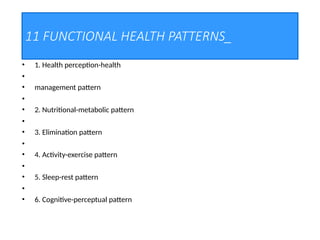
11 FUNCTIONAL HEALTH PATTERNS_
• 1. Health perception-health
•
• management pattern
•
• 2. Nutritional-metabolic pattern
•
• 3. Elimination pattern
•
• 4. Activity-exercise pattern
•
• 5. Sleep-rest pattern
•
• 6. Cognitive-perceptual pattern
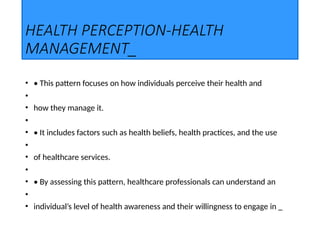
HEALTH PERCEPTION-HEALTH
MANAGEMENT_
• • This pattern focuses on how individuals perceive their health and
•
• how they manage it.
•
• • It includes factors such as health beliefs, health practices, and the use
•
• of healthcare services.
•
• • By assessing this pattern, healthcare professionals can understand an
•
• individual’s level of health awareness and their willingness to engage in _
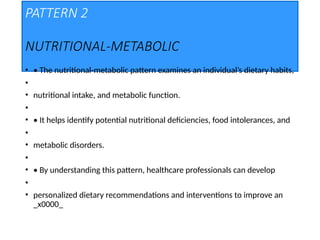
PATTERN 2
NUTRITIONAL-METABOLIC
• • The nutritional-metabolic pattern examines an individual’s dietary habits,
•
• nutritional intake, and metabolic function.
•
• • It helps identify potential nutritional deficiencies, food intolerances, and
•
• metabolic disorders.
•
• • By understanding this pattern, healthcare professionals can develop
•
• personalized dietary recommendations and interventions to improve an
_x0000_
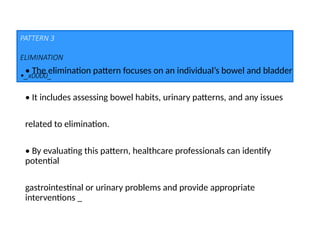
PATTERN 3
ELIMINATION
•_x0000_
• The elimination pattern focuses on an individual’s bowel and bladder
• It includes assessing bowel habits, urinary patterns, and any issues
related to elimination.
• By evaluating this pattern, healthcare professionals can identify
potential
gastrointestinal or urinary problems and provide appropriate
interventions _
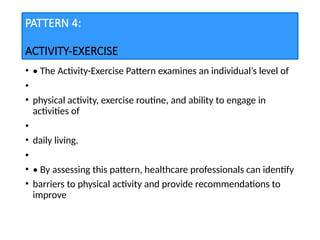
PATTERN 4:
ACTIVITY-EXERCISE
• • The Activity-Exercise Pattern examines an individual’s level of
•
• physical activity, exercise routine, and ability to engage in
activities of
•
• daily living.
•
• • By assessing this pattern, healthcare professionals can identify
• barriers to physical activity and provide recommendations to
improve
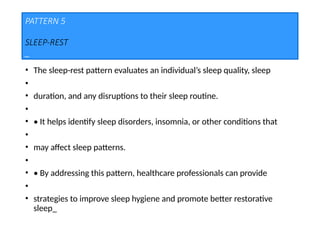
PATTERN 5
SLEEP-REST
_
• The sleep-rest pattern evaluates an individual’s sleep quality, sleep
•
• duration, and any disruptions to their sleep routine.
•
• • It helps identify sleep disorders, insomnia, or other conditions that
•
• may affect sleep patterns.
•
• • By addressing this pattern, healthcare professionals can provide
•
• strategies to improve sleep hygiene and promote better restorative
sleep_
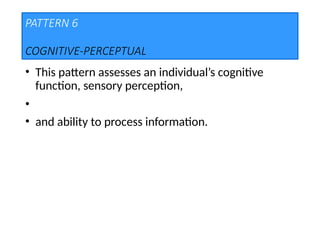
PATTERN 6
COGNITIVE-PERCEPTUAL
• This pattern assesses an individual’s cognitive
function, sensory perception,
•
• and ability to process information.
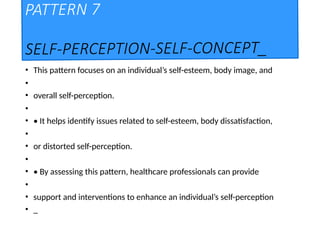
PATTERN 7
SELF-PERCEPTION-SELF-CONCEPT_
• This pattern focuses on an individual’s self-esteem, body image, and
•
• overall self-perception.
•
• • It helps identify issues related to self-esteem, body dissatisfaction,
•
• or distorted self-perception.
•
• • By assessing this pattern, healthcare professionals can provide
•
• support and interventions to enhance an individual’s self-perception
• _
PATTERN 8
ROLE-RELATIONSHIP_x0000_
• This pattern examines an individual’s roles, responsibilities, and
•
• relationships with others.
•
• • It helps identify issues related to role strain, role conflict, or
•
• dysfunctional relationships.
•
• • By assessing this pattern, healthcare professionals can provide
•
• guidance and interventions to improve an individual’s role performance
PATTERN 9
SEXUALITY-REPRODUCTIVE_x0000_
• The sexuality-reproductive pattern focuses on an individual’s sexual
•
• health, reproductive function, and sexual relationships.
•
• • It helps identify sexual dysfunction, reproductive issues, or
•
• concerns related to sexual health.
•
• • By addressing this pattern, healthcare professionals can provide
•
• education, counseling, or referrals to support an individual’s sexual _
PATTERN 10
COPING-STRESS TOLERANCE_
• This pattern examines how individuals cope with stressors and their
•
• ability to adapt to challenging situations.
•
• • It helps identify maladaptive coping mechanisms, high levels of
•
• stress, or ineffective stress management strategies.
•
• • By assessing this pattern, healthcare professionals can provide
•
• support, resources, and interventions to improve an individual’s _
PATTERN 11
VALUE-BELIEF_
• The value-belief pattern explores an individual’s personal values,
•
• beliefs, and spiritual practices.
•
• • It helps identify values conflicts, spiritual distress, or issues related to
•
• belief systems.
•
• • By understanding this pattern, healthcare professionals can provide
•
• support and interventions to promote spiritual well-being and address
•
• any conflicts or distress related to personal values and beliefs.
• _
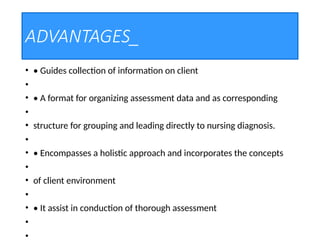
ADVANTAGES_
• • Guides collection of information on client
•
• • A format for organizing assessment data and as corresponding
•
• structure for grouping and leading directly to nursing diagnosis.
•
• • Encompasses a holistic approach and incorporates the concepts
•
• of client environment
•
• • It assist in conduction of thorough assessment
•
•
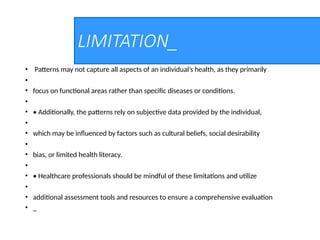
LIMITATION_
• Patterns may not capture all aspects of an individual’s health, as they primarily
•
• focus on functional areas rather than specific diseases or conditions.
•
• • Additionally, the patterns rely on subjective data provided by the individual,
•
• which may be influenced by factors such as cultural beliefs, social desirability
•
• bias, or limited health literacy.
•
• • Healthcare professionals should be mindful of these limitations and utilize
•
• additional assessment tools and resources to ensure a comprehensive evaluation
• _
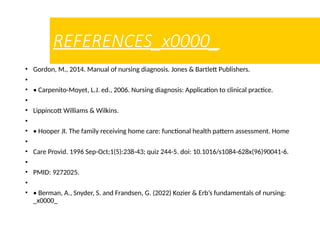
REFERENCES_x0000_
• Gordon, M., 2014. Manual of nursing diagnosis. Jones & Bartlett Publishers.
•
• • Carpenito-Moyet, L.J. ed., 2006. Nursing diagnosis: Application to clinical practice.
•
• Lippincott Williams & Wilkins.
•
• • Hooper JI. The family receiving home care: functional health pattern assessment. Home
•
• Care Provid. 1996 Sep-Oct;1(5):238-43; quiz 244-5. doi: 10.1016/s1084-628x(96)90041-6.
•
• PMID: 9272025.
•
• • Berman, A., Snyder, S. and Frandsen, G. (2022) Kozier & Erb’s fundamentals of nursing:
_x0000_

ASSIGNMENT Gordon's Patterns functions .pptx

  • 1.
    • ✓ASSIGNMENT OFNURSING PROCESS • ✓Title content • ✓11'Gordon's functions health patterns • ✓Objectives • ✓Introductions • ✓Functions • ✓Limitation • ✓Reference ADDIS ABABA MEDICAL AND BUSSINUSS COLLEGE . NAME TEDASE TESAMA BSC NURSING
  • 2.
    INTRODUCTION_ • The modernpractice of nursing has evolved from the situations where the nurse used to only look at the clinical aspects of the health of the patients. • Nowadays, nursing takes a holistic approach to the patient; • • It attempts to understand some of the problems, which, though not _
  • 3.
    FUNCTIONAL HEALTH PATTERNS_ •• A pattern is a configuration of behavior that occur sequentially • • over a period of time rather than isolated events. • • • Health patterns is a manifestation of the whole • • • They are the data used for clinical inference and judgments
  • 4.
    11 FUNCTIONAL HEALTHPATTERNS_ • 1. Health perception-health • • management pattern • • 2. Nutritional-metabolic pattern • • 3. Elimination pattern • • 4. Activity-exercise pattern • • 5. Sleep-rest pattern • • 6. Cognitive-perceptual pattern
  • 5.
    HEALTH PERCEPTION-HEALTH MANAGEMENT_ • •This pattern focuses on how individuals perceive their health and • • how they manage it. • • • It includes factors such as health beliefs, health practices, and the use • • of healthcare services. • • • By assessing this pattern, healthcare professionals can understand an • • individual’s level of health awareness and their willingness to engage in _
  • 6.
    PATTERN 2 NUTRITIONAL-METABOLIC • •The nutritional-metabolic pattern examines an individual’s dietary habits, • • nutritional intake, and metabolic function. • • • It helps identify potential nutritional deficiencies, food intolerances, and • • metabolic disorders. • • • By understanding this pattern, healthcare professionals can develop • • personalized dietary recommendations and interventions to improve an _x0000_
  • 7.
    PATTERN 3 ELIMINATION •_x0000_ • Theelimination pattern focuses on an individual’s bowel and bladder • It includes assessing bowel habits, urinary patterns, and any issues related to elimination. • By evaluating this pattern, healthcare professionals can identify potential gastrointestinal or urinary problems and provide appropriate interventions _
  • 8.
    PATTERN 4: ACTIVITY-EXERCISE • •The Activity-Exercise Pattern examines an individual’s level of • • physical activity, exercise routine, and ability to engage in activities of • • daily living. • • • By assessing this pattern, healthcare professionals can identify • barriers to physical activity and provide recommendations to improve
  • 9.
    PATTERN 5 SLEEP-REST _ • Thesleep-rest pattern evaluates an individual’s sleep quality, sleep • • duration, and any disruptions to their sleep routine. • • • It helps identify sleep disorders, insomnia, or other conditions that • • may affect sleep patterns. • • • By addressing this pattern, healthcare professionals can provide • • strategies to improve sleep hygiene and promote better restorative sleep_
  • 10.
    PATTERN 6 COGNITIVE-PERCEPTUAL • Thispattern assesses an individual’s cognitive function, sensory perception, • • and ability to process information.
  • 11.
    PATTERN 7 SELF-PERCEPTION-SELF-CONCEPT_ • Thispattern focuses on an individual’s self-esteem, body image, and • • overall self-perception. • • • It helps identify issues related to self-esteem, body dissatisfaction, • • or distorted self-perception. • • • By assessing this pattern, healthcare professionals can provide • • support and interventions to enhance an individual’s self-perception • _
  • 12.
    PATTERN 8 ROLE-RELATIONSHIP_x0000_ • Thispattern examines an individual’s roles, responsibilities, and • • relationships with others. • • • It helps identify issues related to role strain, role conflict, or • • dysfunctional relationships. • • • By assessing this pattern, healthcare professionals can provide • • guidance and interventions to improve an individual’s role performance
  • 13.
    PATTERN 9 SEXUALITY-REPRODUCTIVE_x0000_ • Thesexuality-reproductive pattern focuses on an individual’s sexual • • health, reproductive function, and sexual relationships. • • • It helps identify sexual dysfunction, reproductive issues, or • • concerns related to sexual health. • • • By addressing this pattern, healthcare professionals can provide • • education, counseling, or referrals to support an individual’s sexual _
  • 14.
    PATTERN 10 COPING-STRESS TOLERANCE_ •This pattern examines how individuals cope with stressors and their • • ability to adapt to challenging situations. • • • It helps identify maladaptive coping mechanisms, high levels of • • stress, or ineffective stress management strategies. • • • By assessing this pattern, healthcare professionals can provide • • support, resources, and interventions to improve an individual’s _
  • 15.
    PATTERN 11 VALUE-BELIEF_ • Thevalue-belief pattern explores an individual’s personal values, • • beliefs, and spiritual practices. • • • It helps identify values conflicts, spiritual distress, or issues related to • • belief systems. • • • By understanding this pattern, healthcare professionals can provide • • support and interventions to promote spiritual well-being and address • • any conflicts or distress related to personal values and beliefs. • _
  • 16.
    ADVANTAGES_ • • Guidescollection of information on client • • • A format for organizing assessment data and as corresponding • • structure for grouping and leading directly to nursing diagnosis. • • • Encompasses a holistic approach and incorporates the concepts • • of client environment • • • It assist in conduction of thorough assessment • •
  • 17.
    LIMITATION_ • Patterns maynot capture all aspects of an individual’s health, as they primarily • • focus on functional areas rather than specific diseases or conditions. • • • Additionally, the patterns rely on subjective data provided by the individual, • • which may be influenced by factors such as cultural beliefs, social desirability • • bias, or limited health literacy. • • • Healthcare professionals should be mindful of these limitations and utilize • • additional assessment tools and resources to ensure a comprehensive evaluation • _
  • 18.
    REFERENCES_x0000_ • Gordon, M.,2014. Manual of nursing diagnosis. Jones & Bartlett Publishers. • • • Carpenito-Moyet, L.J. ed., 2006. Nursing diagnosis: Application to clinical practice. • • Lippincott Williams & Wilkins. • • • Hooper JI. The family receiving home care: functional health pattern assessment. Home • • Care Provid. 1996 Sep-Oct;1(5):238-43; quiz 244-5. doi: 10.1016/s1084-628x(96)90041-6. • • PMID: 9272025. • • • Berman, A., Snyder, S. and Frandsen, G. (2022) Kozier & Erb’s fundamentals of nursing: _x0000_