AKSHAY ANAND M
I Year – Master of Pharmacy
Pharmaceutical Regulatory Affairs
JSS College Of Pharmacy
Mysuru 570015, Karnataka
REGULATORYAPPROVAL
PROCESSFOR
MEDICALDEVICESINEUROPEANUNION
©2015
akshayanand
ASPECTS
©2015
akshayanand
• Medical Devices –What are they?
• European Union – An Overview
• EU Directives that impact Medical Devices
• Medical Devices as defined by EU
• Classification of Medical Devices as per EU
• The CE Certification
• The Registration Process for MD
• The ProcessTimeline for Registration
OF THIS PRESENTATION
01
• A medical device is an instrument, apparatus, implant, in
vitro reagent, or similar or related article that is used to
diagnose, prevent, or treat disease or other conditions
• It does not achieve its purposes through chemical action within
or on the body.
• Medical devices vary greatly in complexity and application.
• The design of medical devices constitutes a major segment of
the field of biomedical engineering.
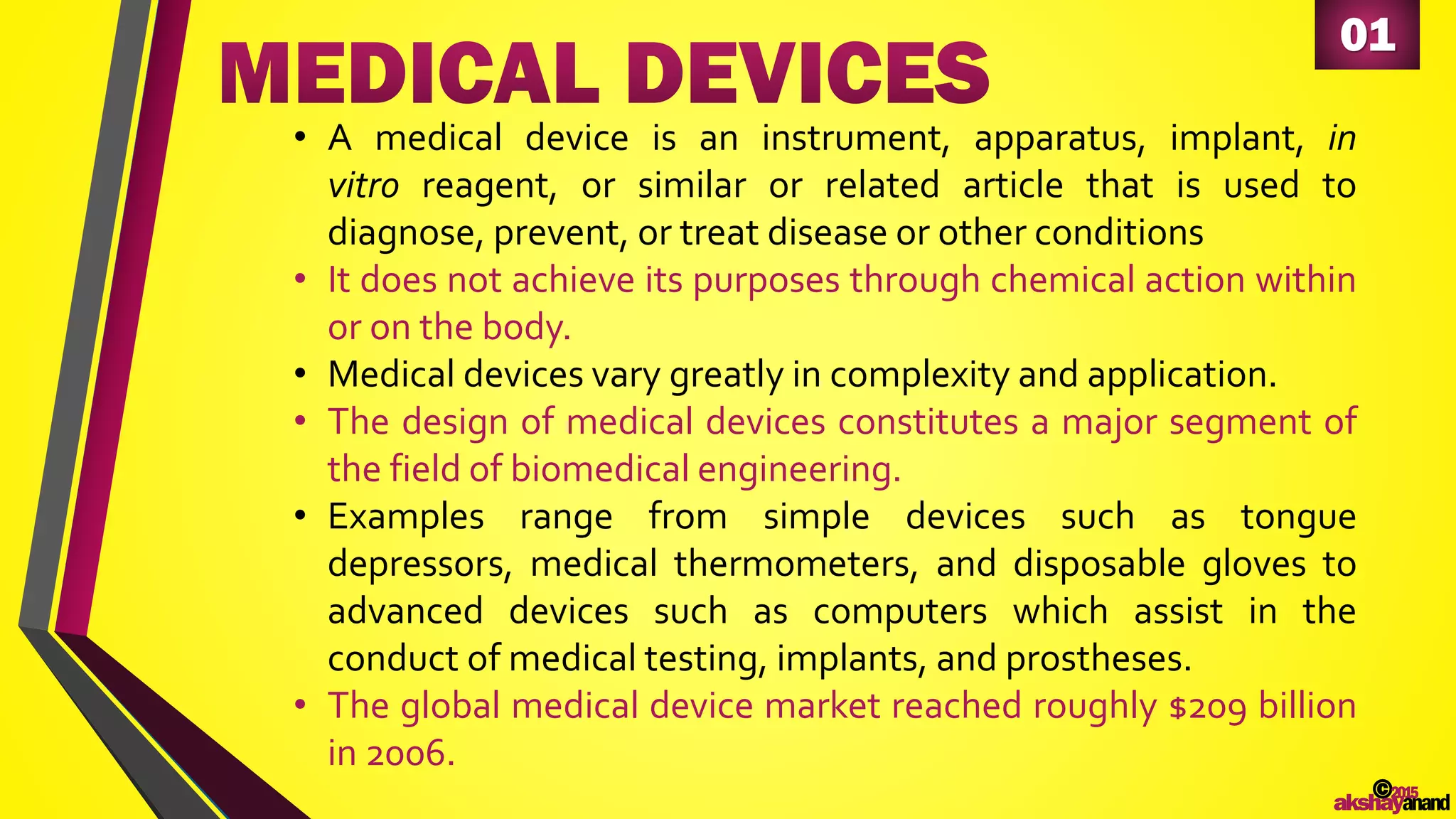
• Examples range from simple devices such as tongue
depressors, medical thermometers, and disposable gloves to
advanced devices such as computers which assist in the
conduct of medical testing, implants, and prostheses.
• The global medical device market reached roughly $209 billion
in 2006.
©2015
akshayanand
02
©2015
akshayanand
03
• 28 member states plus
European FreeTrade
Association members.
• 24 languages.
• Population of more than
500 million people.
• GDP of $18.124 trillion.
• Euro, the currency
equalling 71.47 Indian
Rupee per unit.
©2015
akshayanand
04
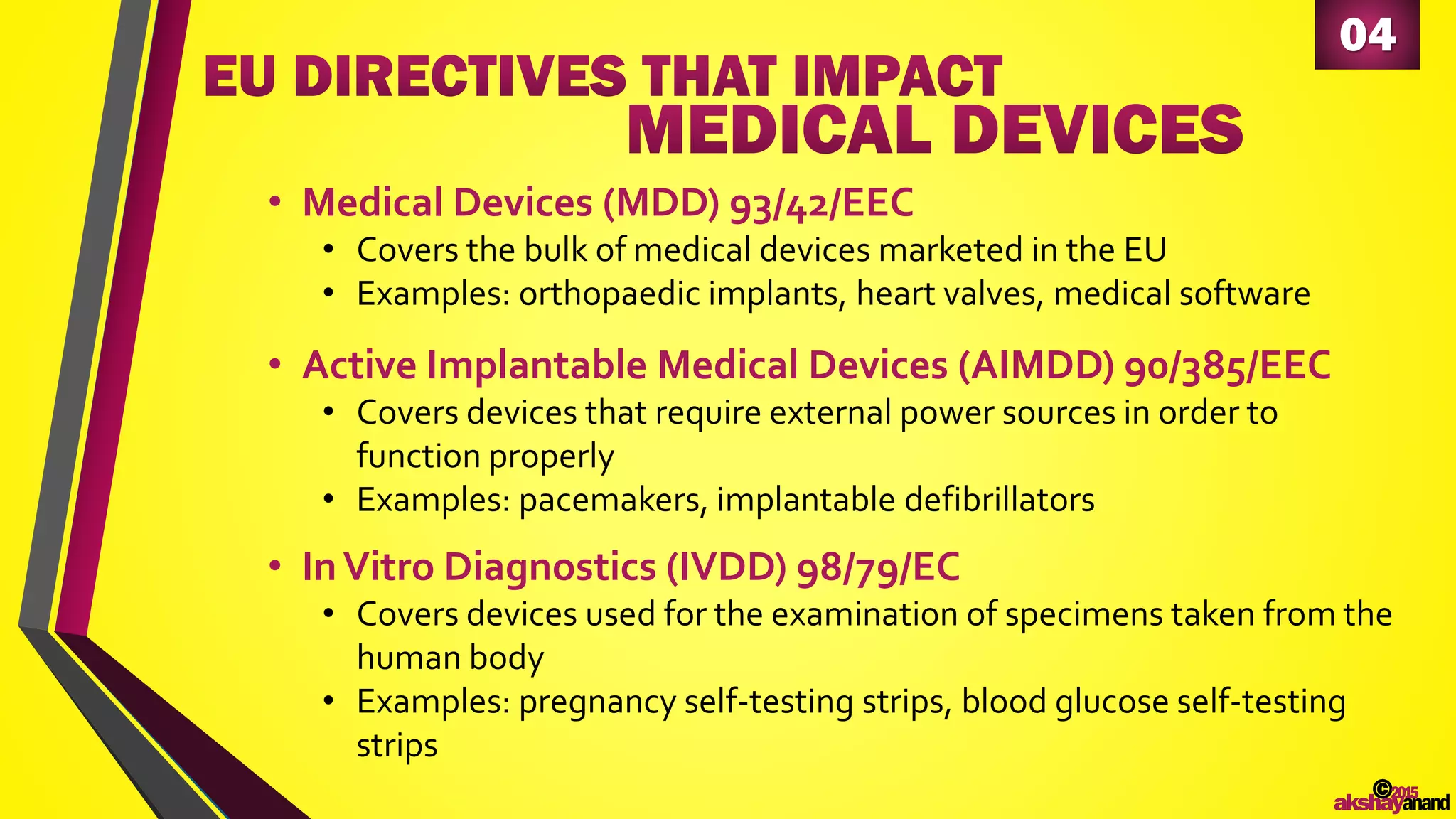
• Medical Devices (MDD) 93/42/EEC
• Covers the bulk of medical devices marketed in the EU
• Examples: orthopaedic implants, heart valves, medical software
©2015
akshayanand
• Active Implantable Medical Devices (AIMDD) 90/385/EEC
• Covers devices that require external power sources in order to
function properly
• Examples: pacemakers, implantable defibrillators
• InVitro Diagnostics (IVDD) 98/79/EC
• Covers devices used for the examination of specimens taken from the
human body
• Examples: pregnancy self-testing strips, blood glucose self-testing
strips
05
©2015
akshayanand
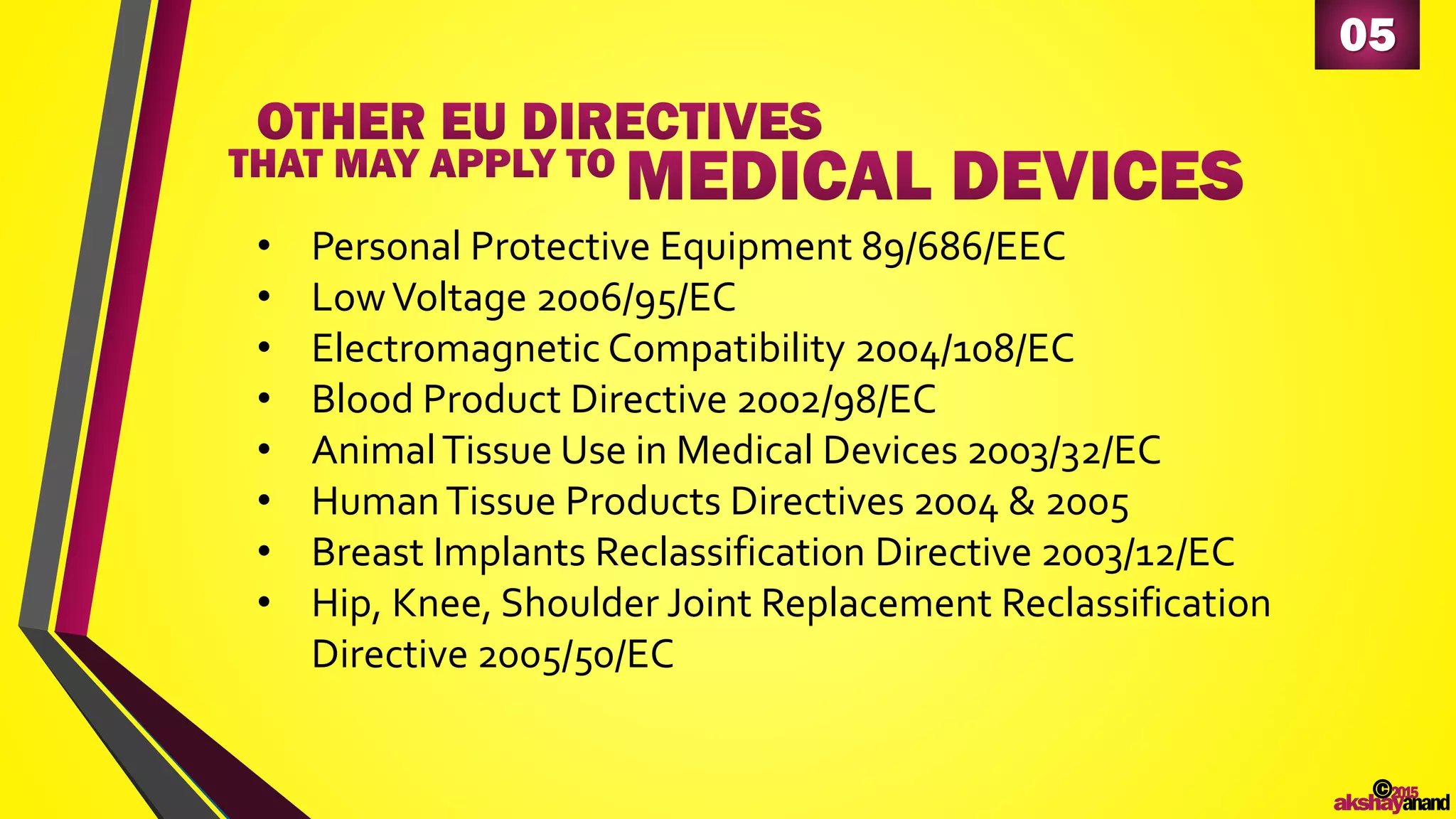
• Personal Protective Equipment 89/686/EEC
• LowVoltage 2006/95/EC
• Electromagnetic Compatibility 2004/108/EC
• Blood Product Directive 2002/98/EC
• AnimalTissue Use in Medical Devices 2003/32/EC
• HumanTissue Products Directives 2004 & 2005
• Breast Implants Reclassification Directive 2003/12/EC
• Hip, Knee, Shoulder Joint Replacement Reclassification
Directive 2005/50/EC
06
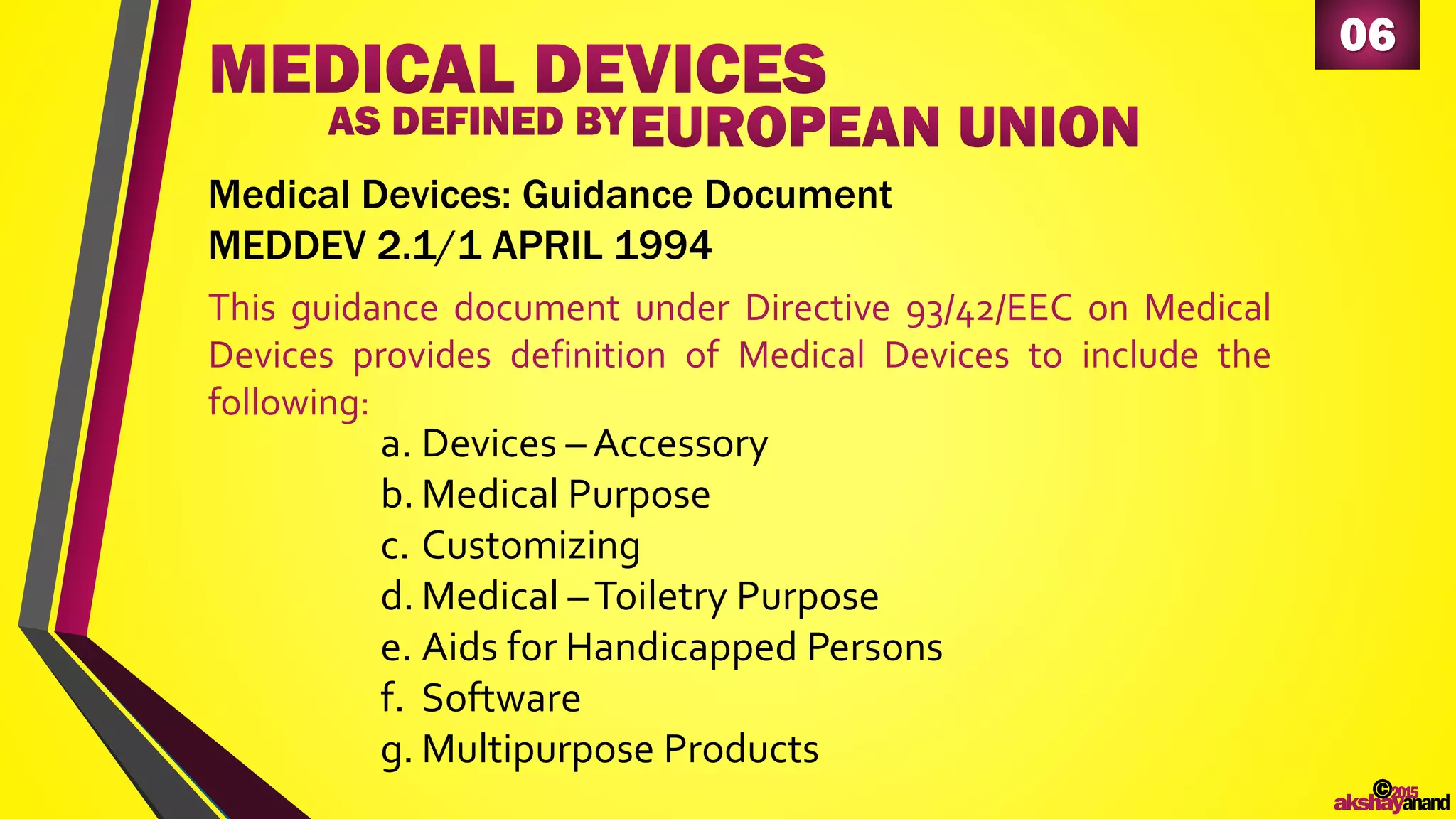
This guidance document under Directive 93/42/EEC on Medical
Devices provides definition of Medical Devices to include the
following:
Medical Devices: Guidance Document
MEDDEV 2.1/1 APRIL 1994
a. Devices – Accessory
b. Medical Purpose
c. Customizing
d. Medical –Toiletry Purpose
e. Aids for Handicapped Persons
f. Software
g. Multipurpose Products
©2015
akshayanand
07
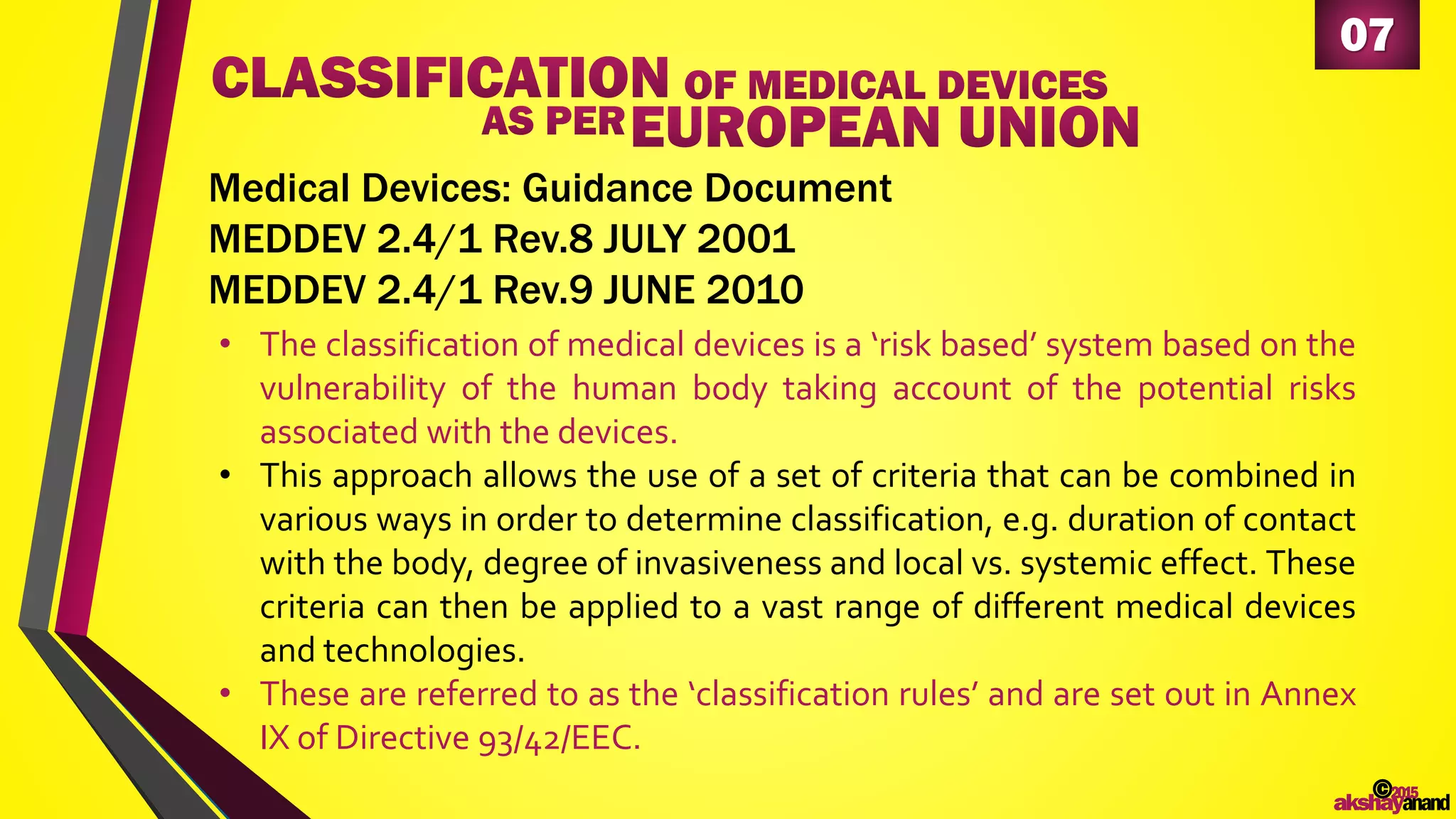
• The classification of medical devices is a ‘risk based’ system based on the
vulnerability of the human body taking account of the potential risks
associated with the devices.
• This approach allows the use of a set of criteria that can be combined in
various ways in order to determine classification, e.g. duration of contact
with the body, degree of invasiveness and local vs. systemic effect. These
criteria can then be applied to a vast range of different medical devices
and technologies.
• These are referred to as the ‘classification rules’ and are set out in Annex
IX of Directive 93/42/EEC.
Medical Devices: Guidance Document
MEDDEV 2.4/1 Rev.8 JULY 2001
MEDDEV 2.4/1 Rev.9 JUNE 2010
©2015
akshayanand
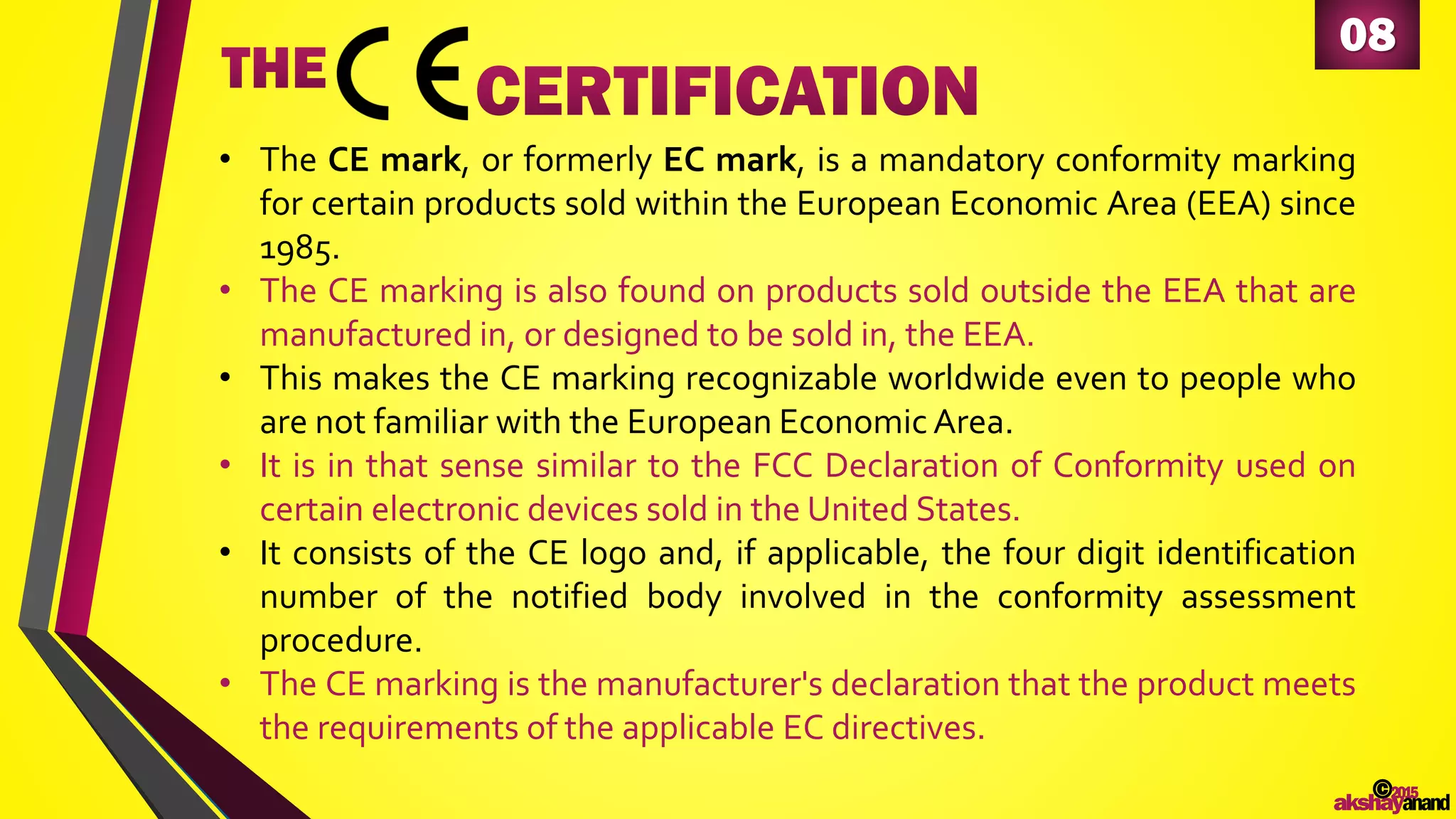
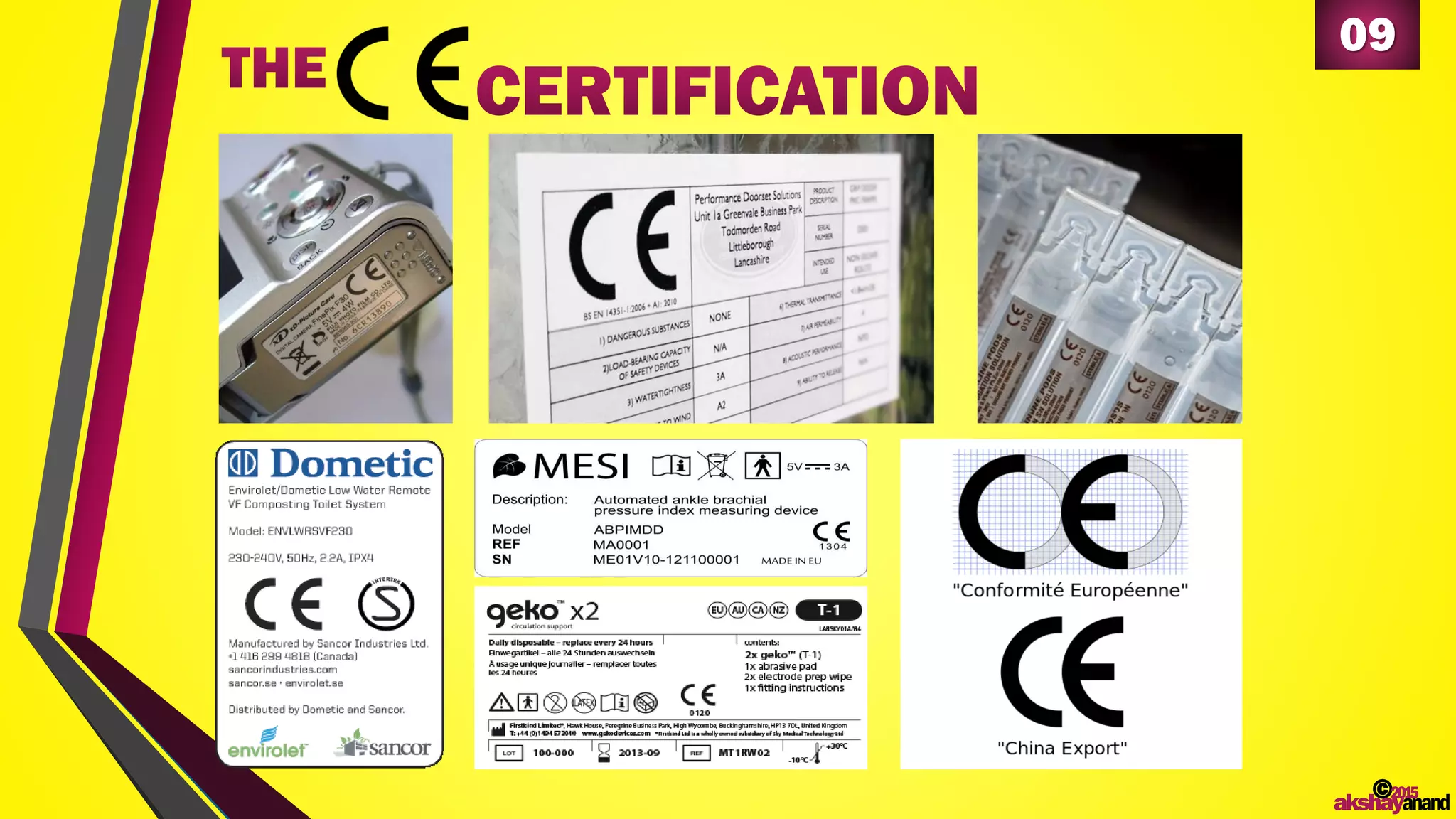
• The CE mark, or formerly EC mark, is a mandatory conformity marking
for certain products sold within the European Economic Area (EEA) since
1985.
• The CE marking is also found on products sold outside the EEA that are
manufactured in, or designed to be sold in, the EEA.
• This makes the CE marking recognizable worldwide even to people who
are not familiar with the European Economic Area.
• It is in that sense similar to the FCC Declaration of Conformity used on
certain electronic devices sold in the United States.
• It consists of the CE logo and, if applicable, the four digit identification
number of the notified body involved in the conformity assessment
procedure.
• The CE marking is the manufacturer's declaration that the product meets
the requirements of the applicable EC directives.
08
©2015
akshayanand
09
©2015
akshayanand
10
©2015
akshayanand
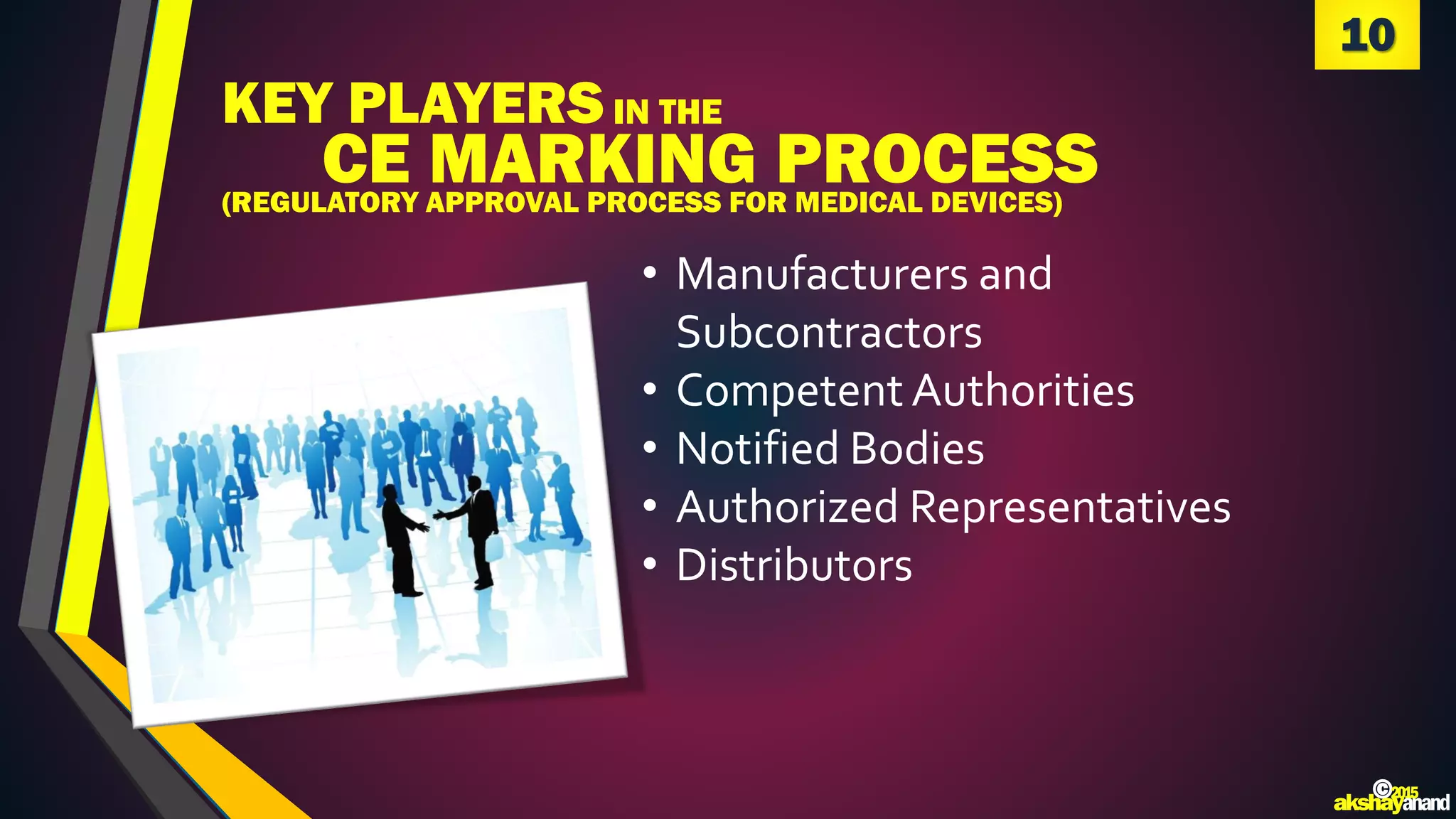
KEY PLAYERSIN THE
CE MARKING PROCESS(REGULATORY APPROVAL PROCESS FOR MEDICAL DEVICES)
• Manufacturers and
Subcontractors
• Competent Authorities
• Notified Bodies
• Authorized Representatives
• Distributors
11
©2015
akshayanand
• Competent Authorities are entities
enforcing Medical Device Directives at
the national level in each EU member
state.
• Member states and their Competent
Authorities each have their own
interpretations of how Directives
should be carried out.
• Manufacturers seeking to sell in more
than one EU member state should take
this into account.
12
©2015
akshayanand
• Notified Bodies are authorized to audit manufacturers’ quality
systems and test/review devices for compliance with applicable
EU Directives and standards.
• Their responsibilities include:
• Advising on device classification and ConformityAssessment routes
• Pre-assessment of devices
• Product and quality system evaluation
• Concluding and evaluating manufacturers’Corrective Actions
• Issuance of certifications
• Maintaining programmed surveillance of devices in the EU
13
©2015
akshayanand
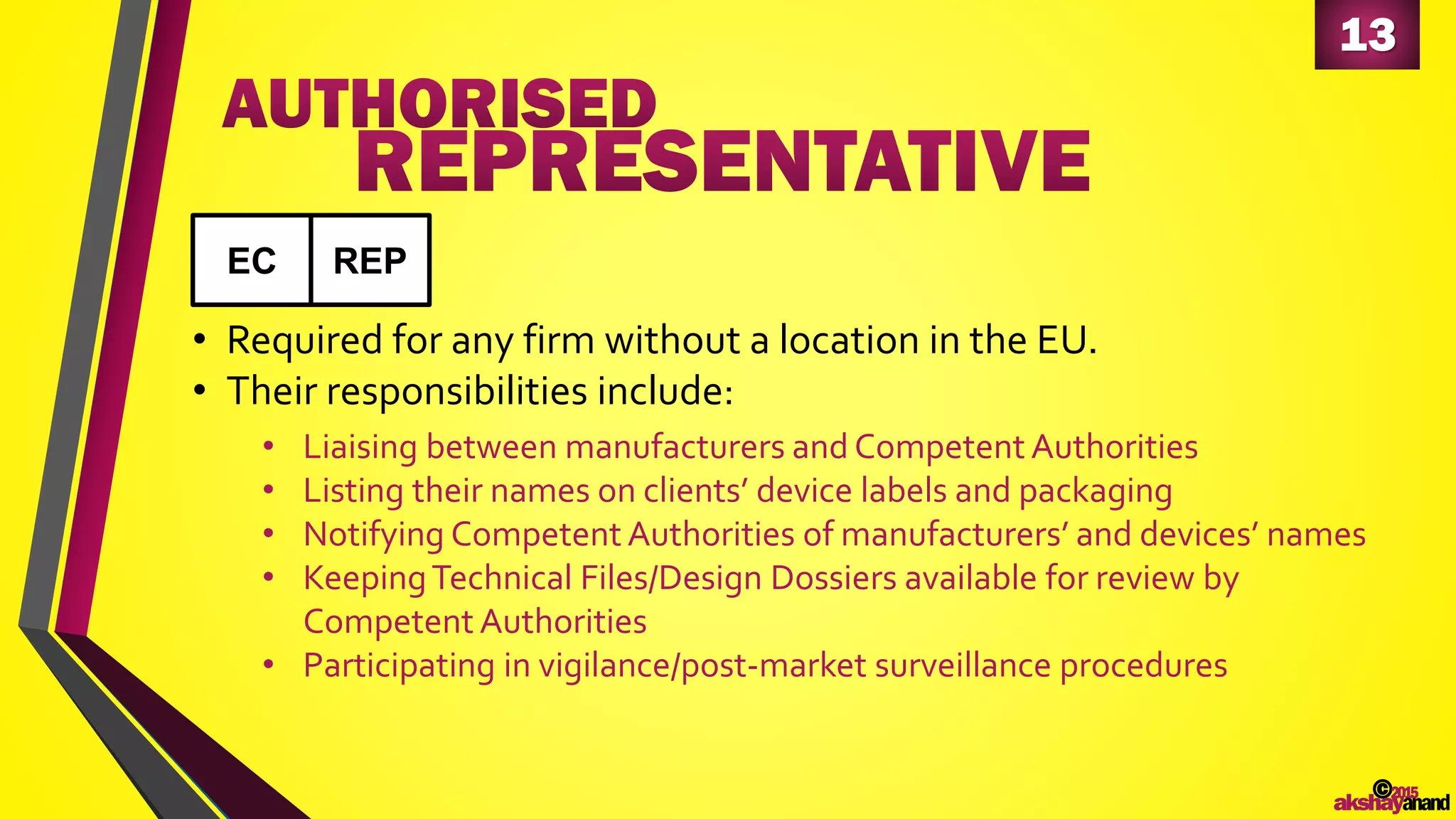
• Required for any firm without a location in the EU.
• Their responsibilities include:
• Liaising between manufacturers and Competent Authorities
• Listing their names on clients’ device labels and packaging
• Notifying Competent Authorities of manufacturers’ and devices’ names
• KeepingTechnical Files/Design Dossiers available for review by
Competent Authorities
• Participating in vigilance/post-market surveillance procedures
EC REP
14
©2015
akshayanand
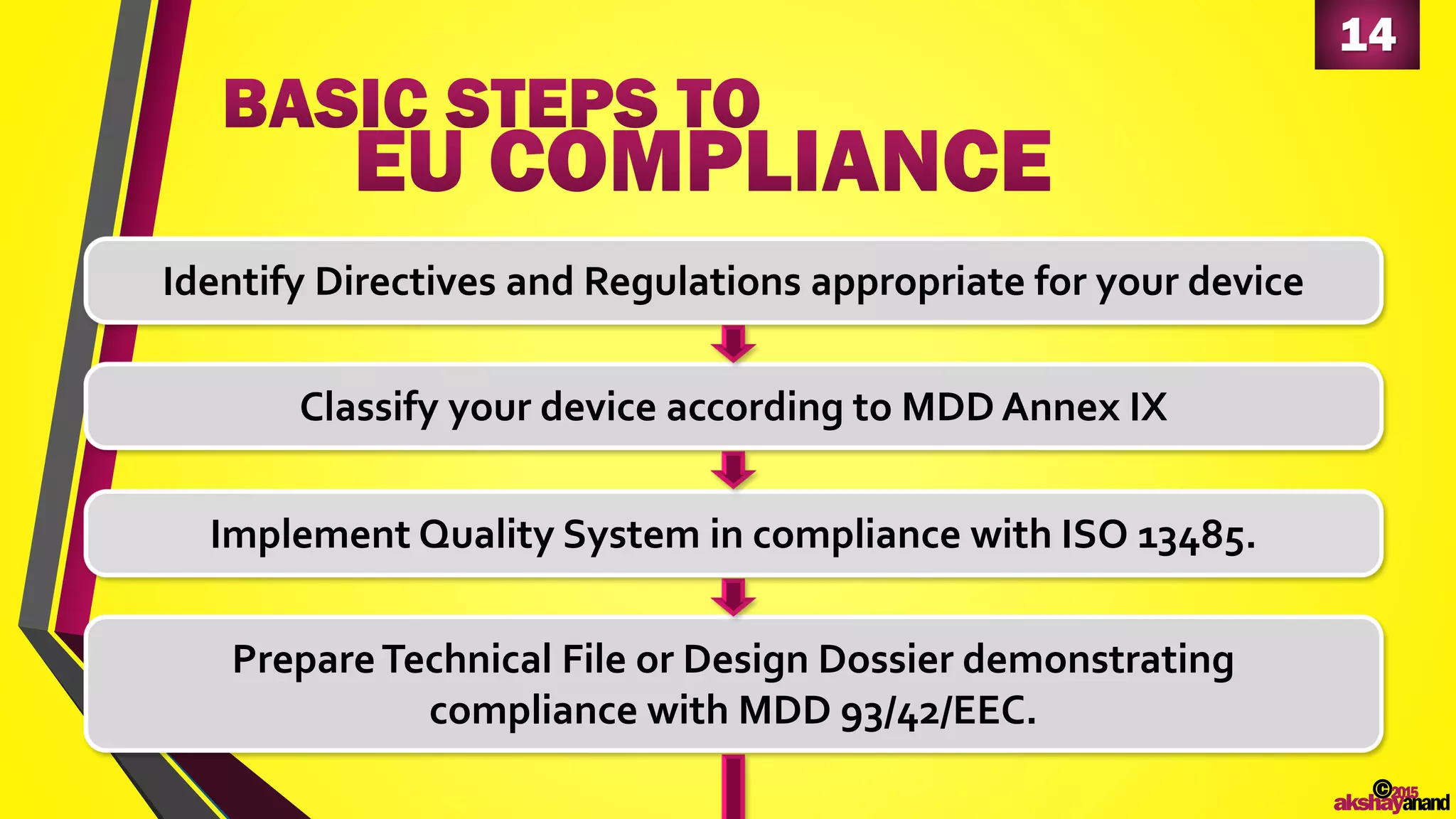
Identify Directives and Regulations appropriate for your device
Classify your device according to MDD Annex IX
Implement Quality System in compliance with ISO 13485.
PrepareTechnical File or Design Dossier demonstrating
compliance with MDD 93/42/EEC.
15
©2015
akshayanand
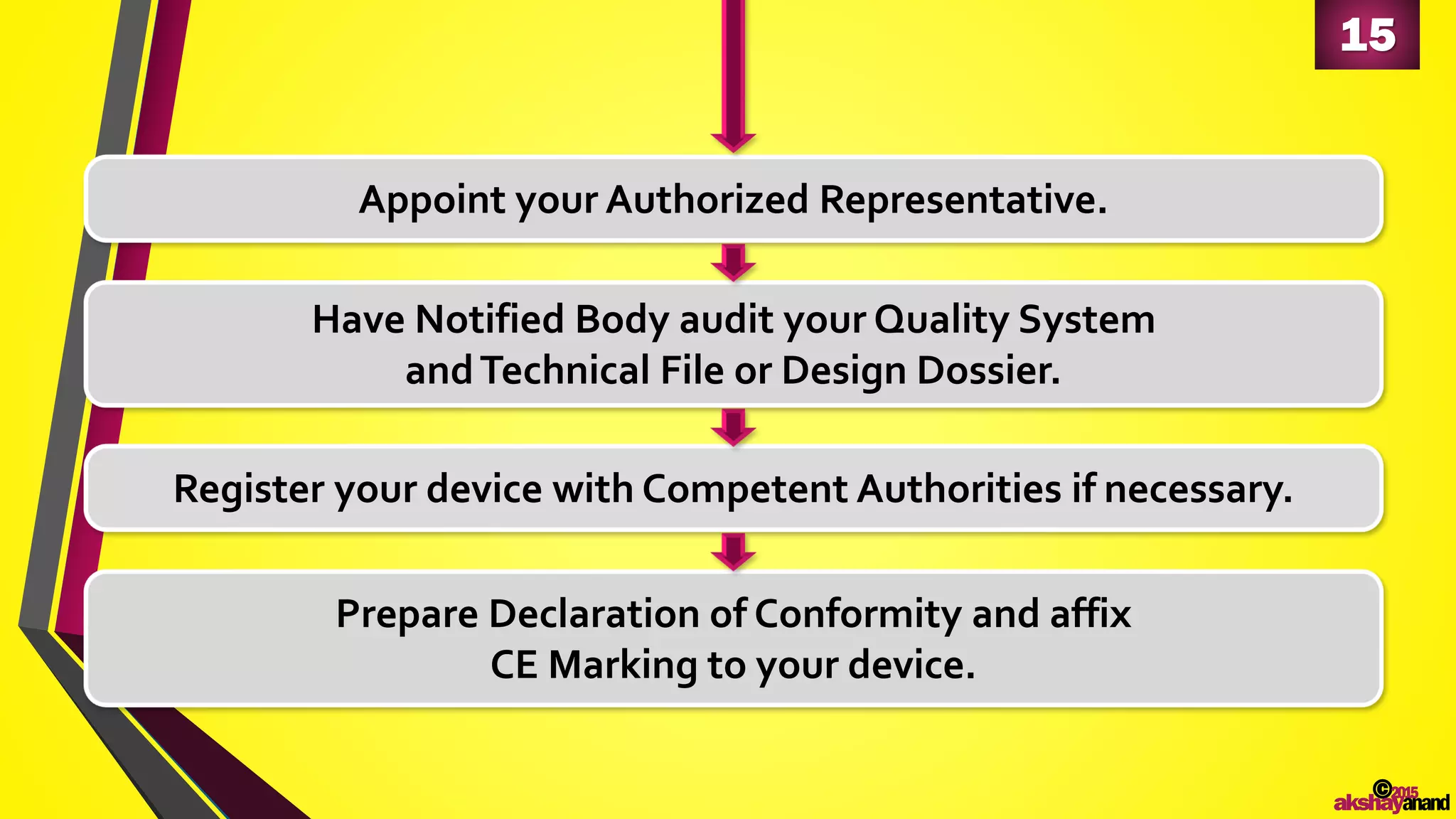
Appoint your Authorized Representative.
Have Notified Body audit your Quality System
andTechnical File or Design Dossier.
Register your device with Competent Authorities if necessary.
Prepare Declaration of Conformity and affix
CE Marking to your device.
16
©2015
akshayanand
• First, determine which Medical Device Directive (MDD,
AIMDD or IVDD) applies to your device.
• Then determine device classification using Annex IX of
MDD 93/42/EEC.
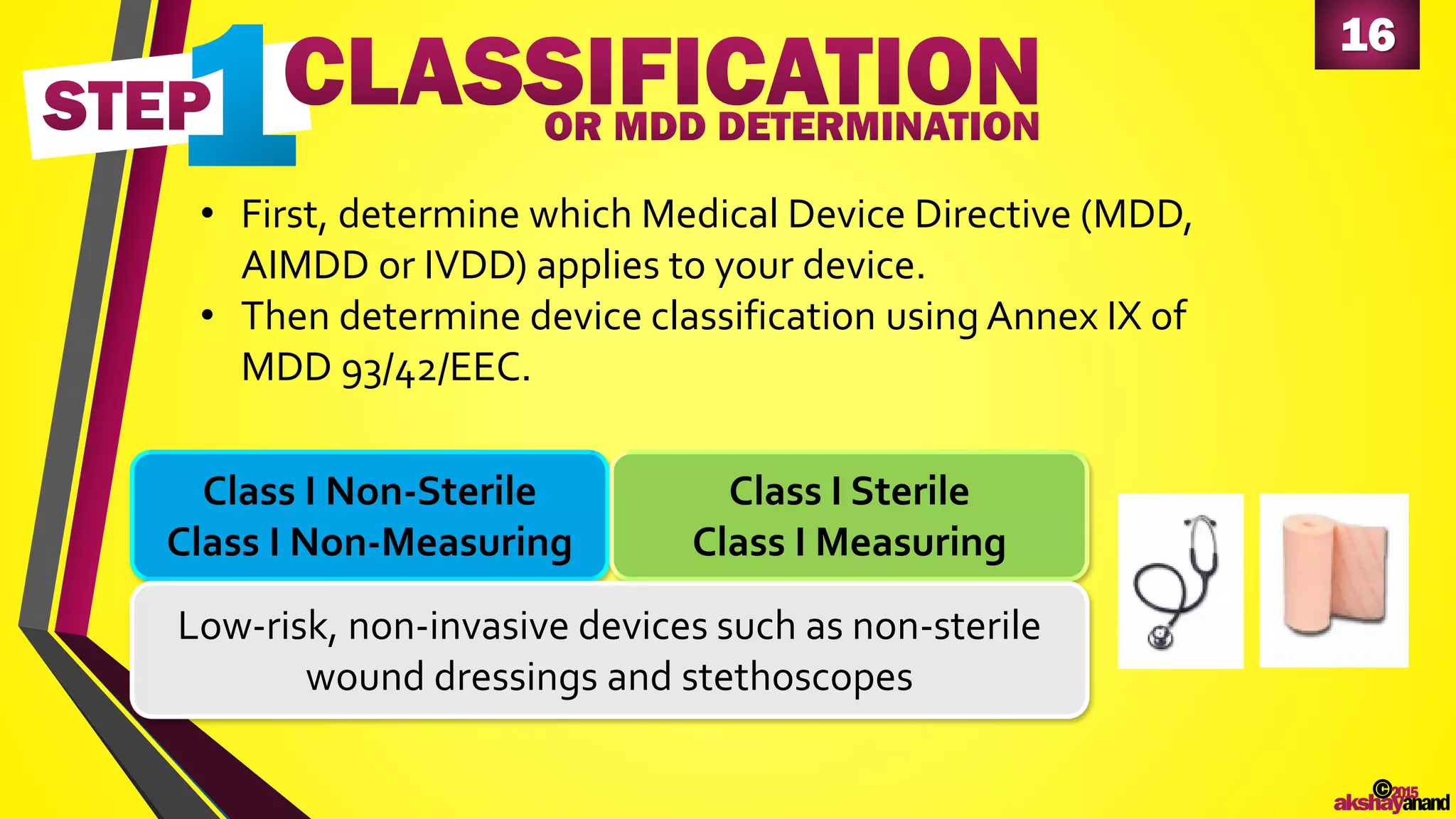
Class I Non-Sterile
Class I Non-Measuring
Class I Sterile
Class I Measuring
Low-risk, non-invasive devices such as non-sterile
wound dressings and stethoscopes
17
©2015
akshayanand
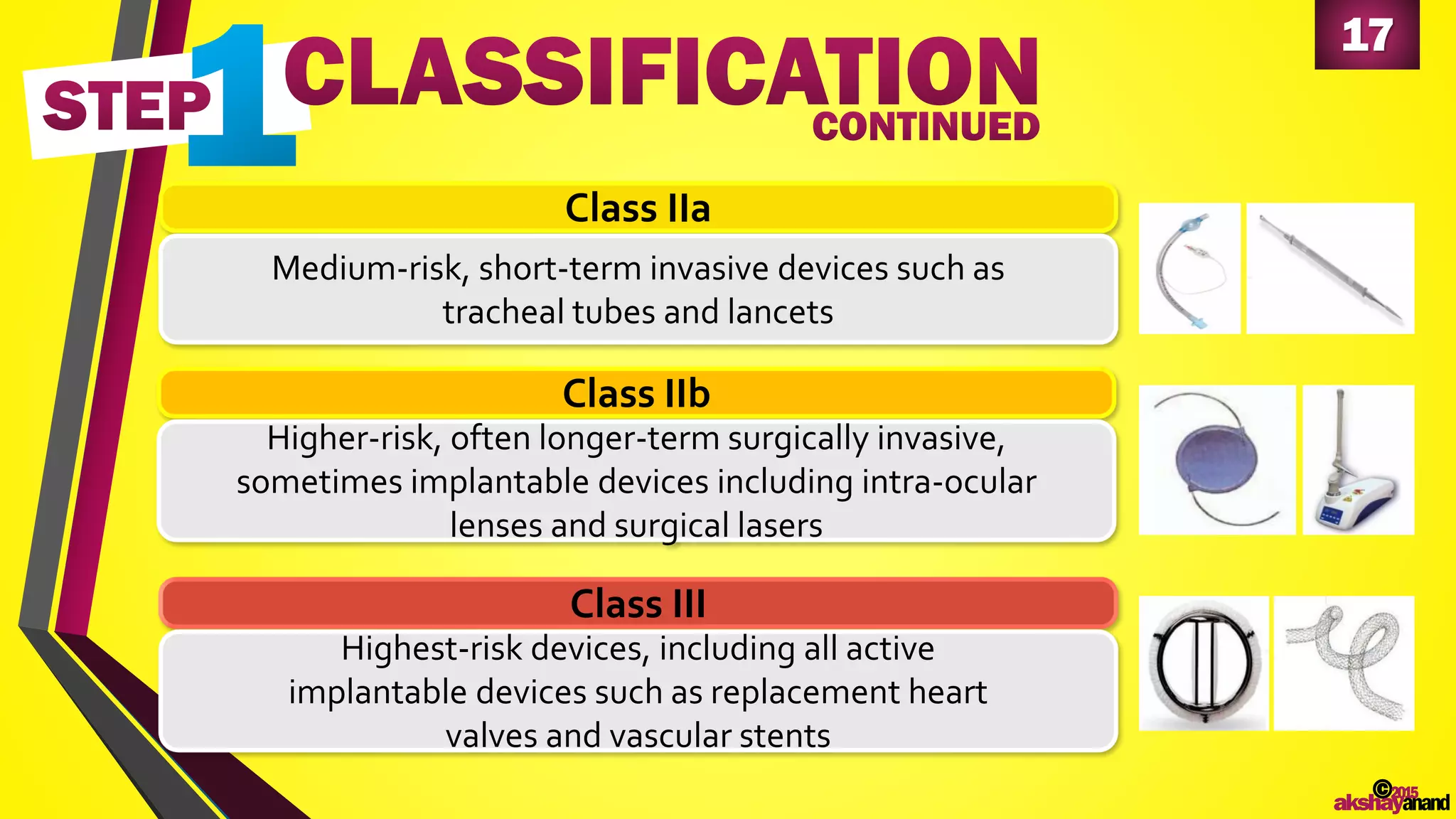
Class IIa
Medium-risk, short-term invasive devices such as
tracheal tubes and lancets
Class IIb
Higher-risk, often longer-term surgically invasive,
sometimes implantable devices including intra-ocular
lenses and surgical lasers
Class III
Highest-risk devices, including all active
implantable devices such as replacement heart
valves and vascular stents
18
©2015
akshayanand
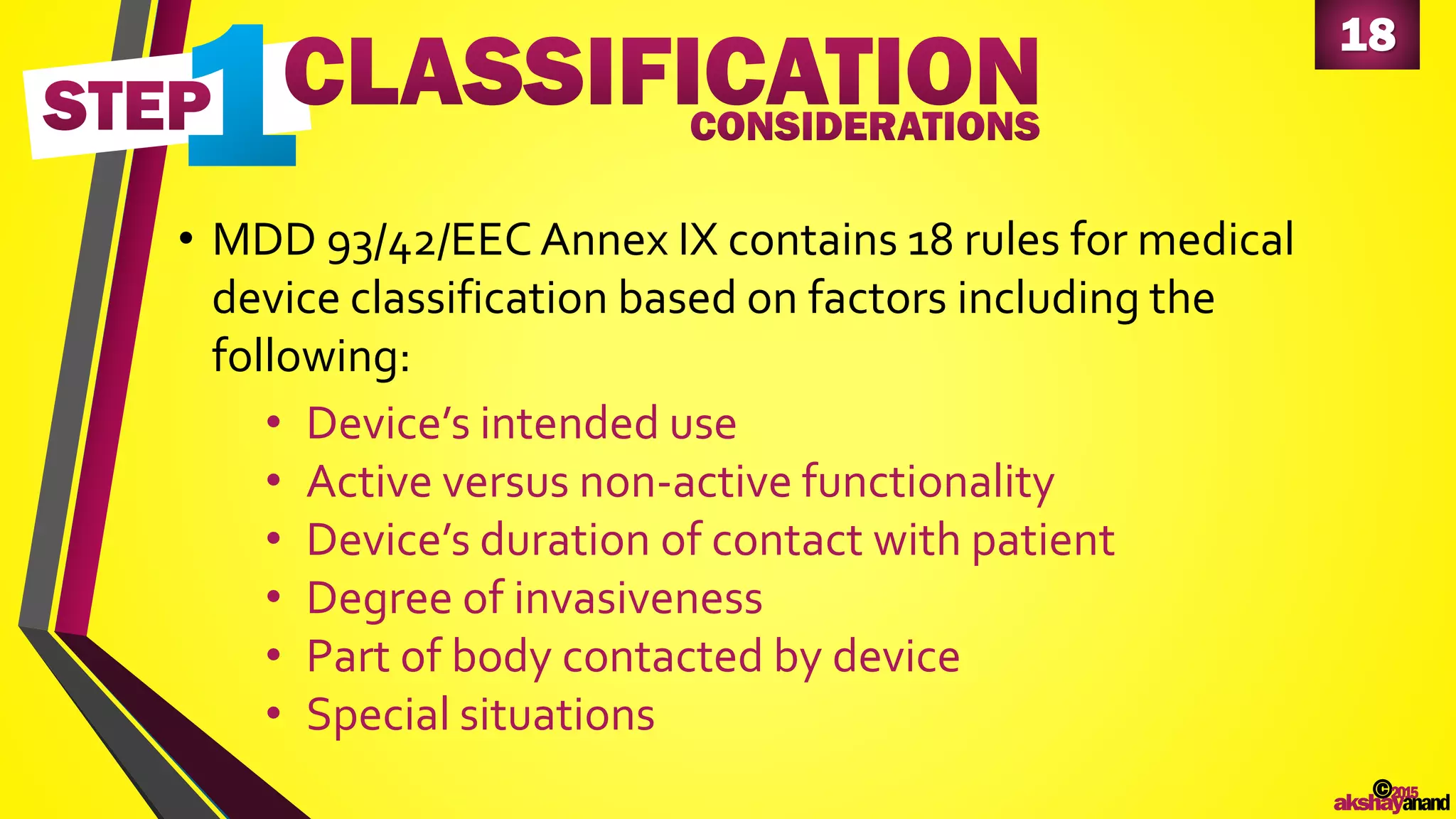
• MDD 93/42/EEC Annex IX contains 18 rules for medical
device classification based on factors including the
following:
• Device’s intended use
• Active versus non-active functionality
• Device’s duration of contact with patient
• Degree of invasiveness
• Part of body contacted by device
• Special situations
19
©2015
akshayanand
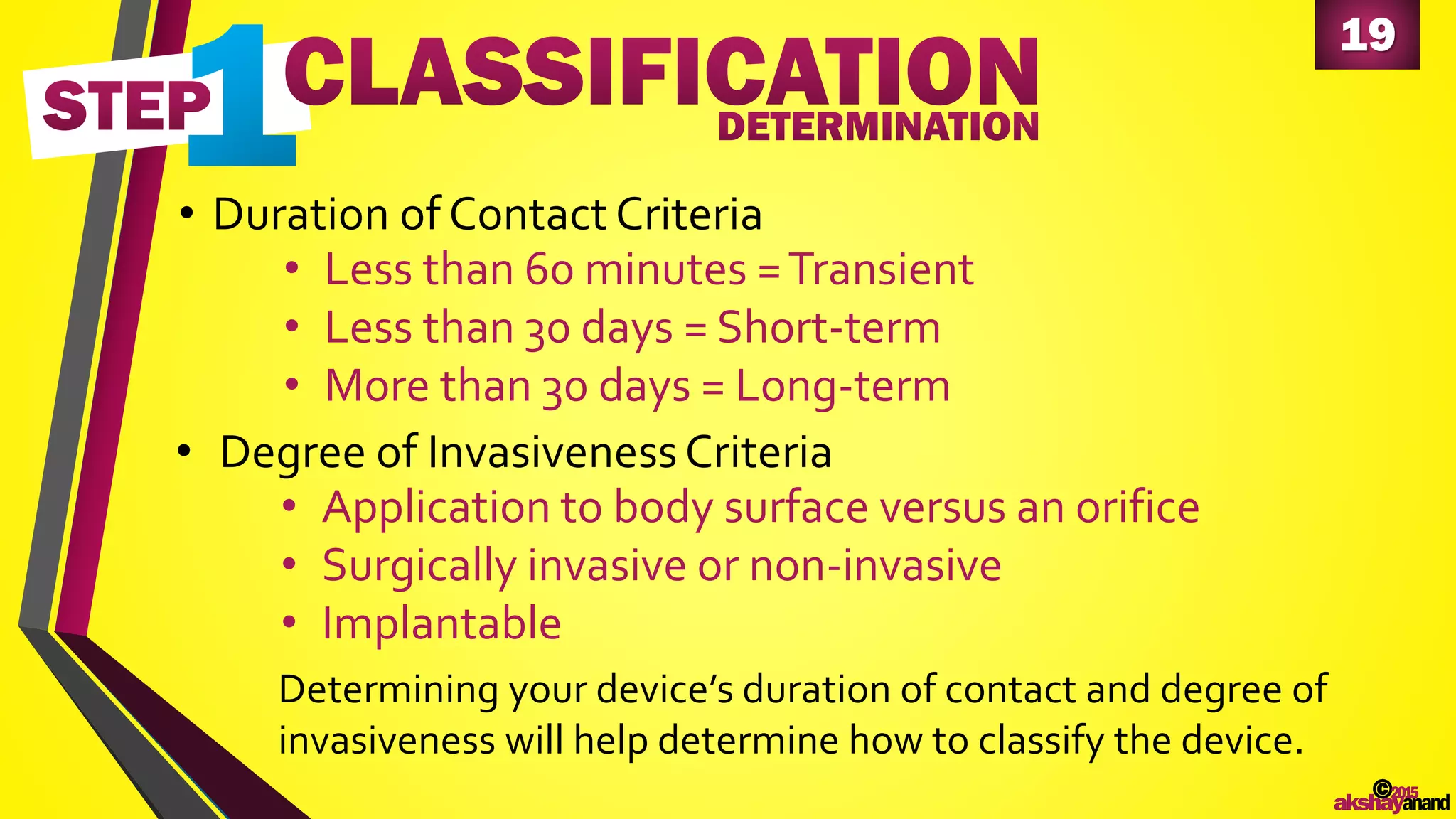
• Duration of Contact Criteria
• Less than 60 minutes =Transient
• Less than 30 days = Short-term
• More than 30 days = Long-term
• Degree of InvasivenessCriteria
• Application to body surface versus an orifice
• Surgically invasive or non-invasive
• Implantable
Determining your device’s duration of contact and degree of
invasiveness will help determine how to classify the device.
20
©2015
akshayanand
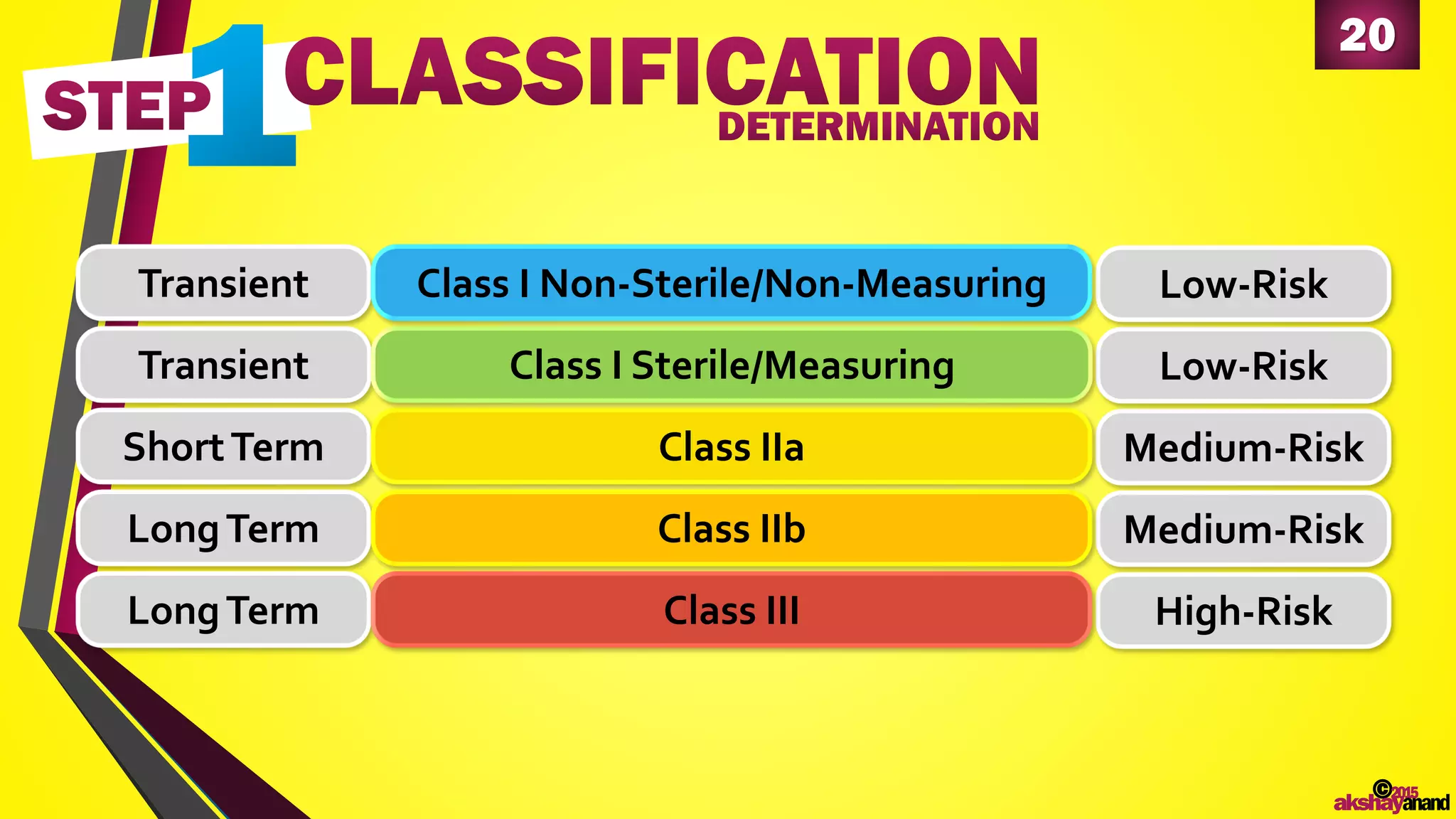
ShortTerm
LongTerm
LongTerm
Transient
Transient
Medium-Risk
Medium-Risk
High-Risk
Low-Risk
Low-Risk
Class IIa
Class IIb
Class III
Class I Sterile/Measuring
Class I Non-Sterile/Non-Measuring
21
©2015
akshayanand
Manufacturers of Class I
sterile/measuring, IIa, IIb and III devices
must implement quality management
systems (QMS) (in compliance with
Annex II orV of the MDD).
Most manufacturers meet this
requirement using ISO 13485.
22
©2015
akshayanand
Phase I: Quality system preparation and development
• Management buy-in
• Assign resources and staff
• Conduct gap analysis
• Develop quality manual and documentation controls
Phase II: Implementation
• Employee training
• Internal auditing
• Corrective and preventative actions
Phase III: Registration
• Registration audit performed by Notified Body
• Final ISO 13485 certification
23
©2015
akshayanand
• All Class I, IIa and IIb device manufacturers
must prepareTechnical Files containing data
to demonstrate MDD 93/42/EEC compliance.
• Class III device manufacturers must prepare
Design Dossiers to demonstrate compliance
to MDD.
• All manufacturers must have clinical data to
demonstrate compliance to MDD.
24
©2015
akshayanand
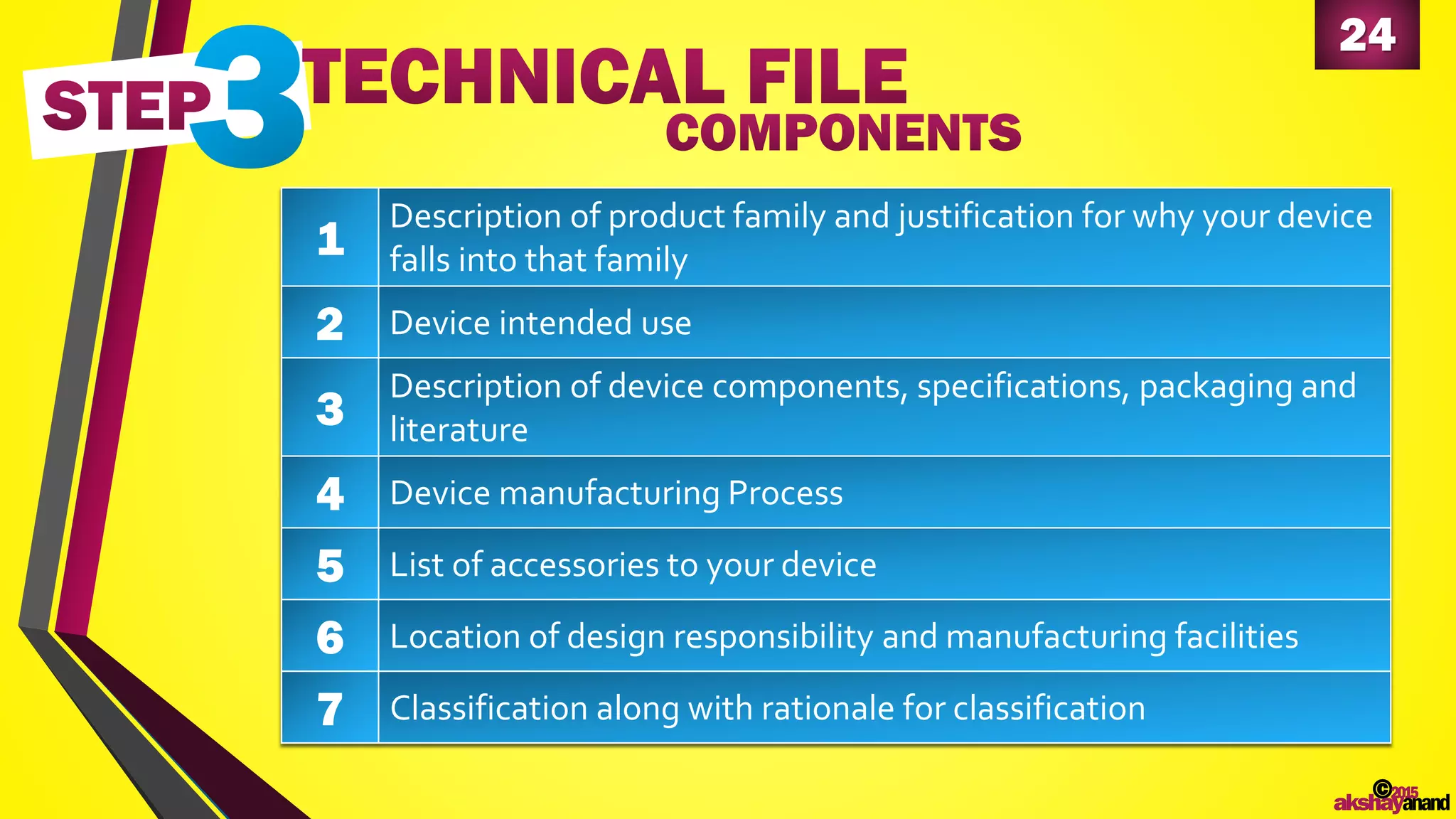
1
Description of product family and justification for why your device
falls into that family
2 Device intended use
3
Description of device components, specifications, packaging and
literature
4 Device manufacturing Process
5 List of accessories to your device
6 Location of design responsibility and manufacturing facilities
7 Classification along with rationale for classification
25
©2015
akshayanand
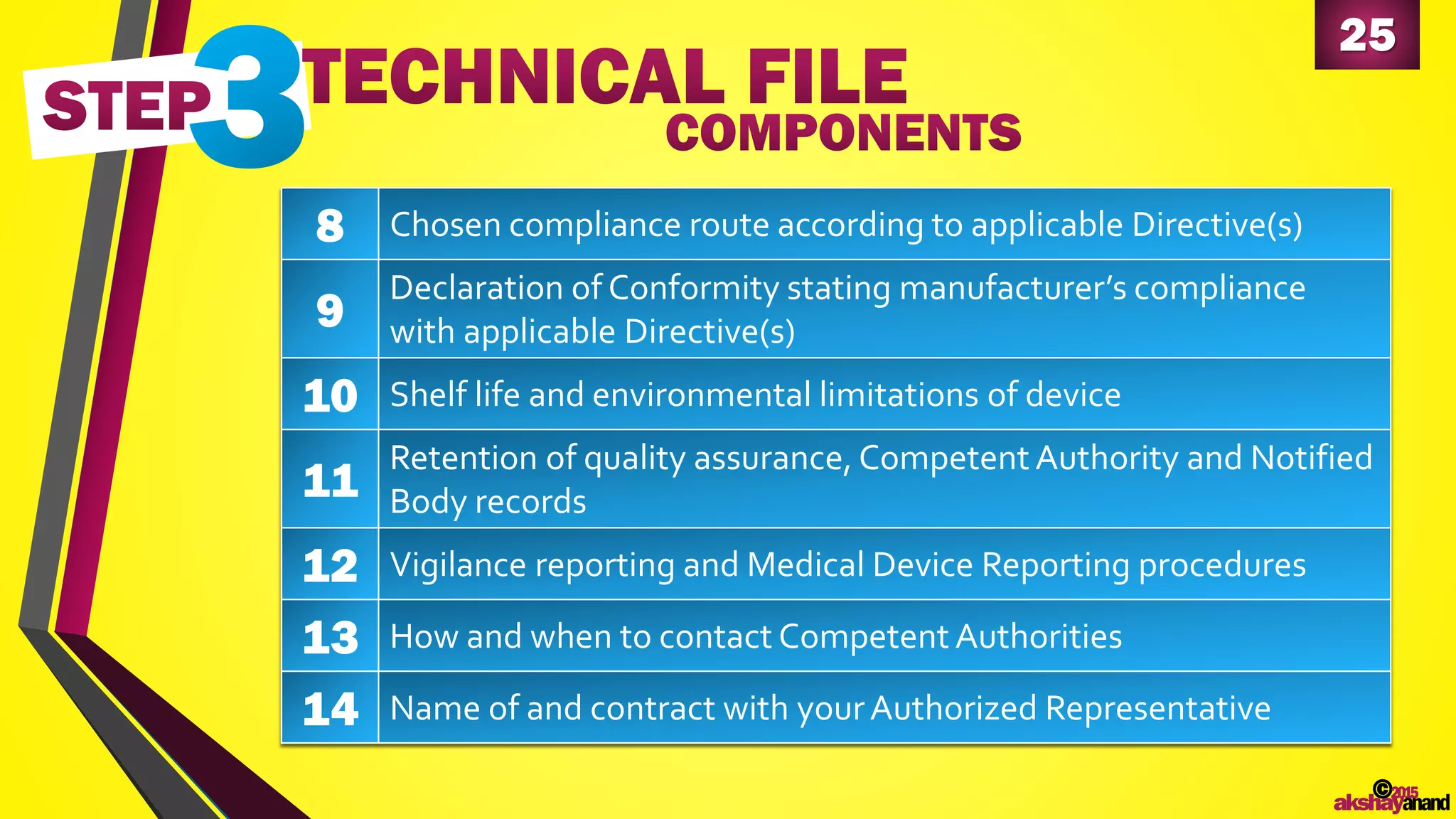
8 Chosen compliance route according to applicable Directive(s)
9
Declaration of Conformity stating manufacturer’s compliance
with applicable Directive(s)
10 Shelf life and environmental limitations of device
11
Retention of quality assurance, Competent Authority and Notified
Body records
12 Vigilance reporting and Medical Device Reporting procedures
13 How and when to contact Competent Authorities
14 Name of and contract with yourAuthorized Representative
26
©2015
akshayanand
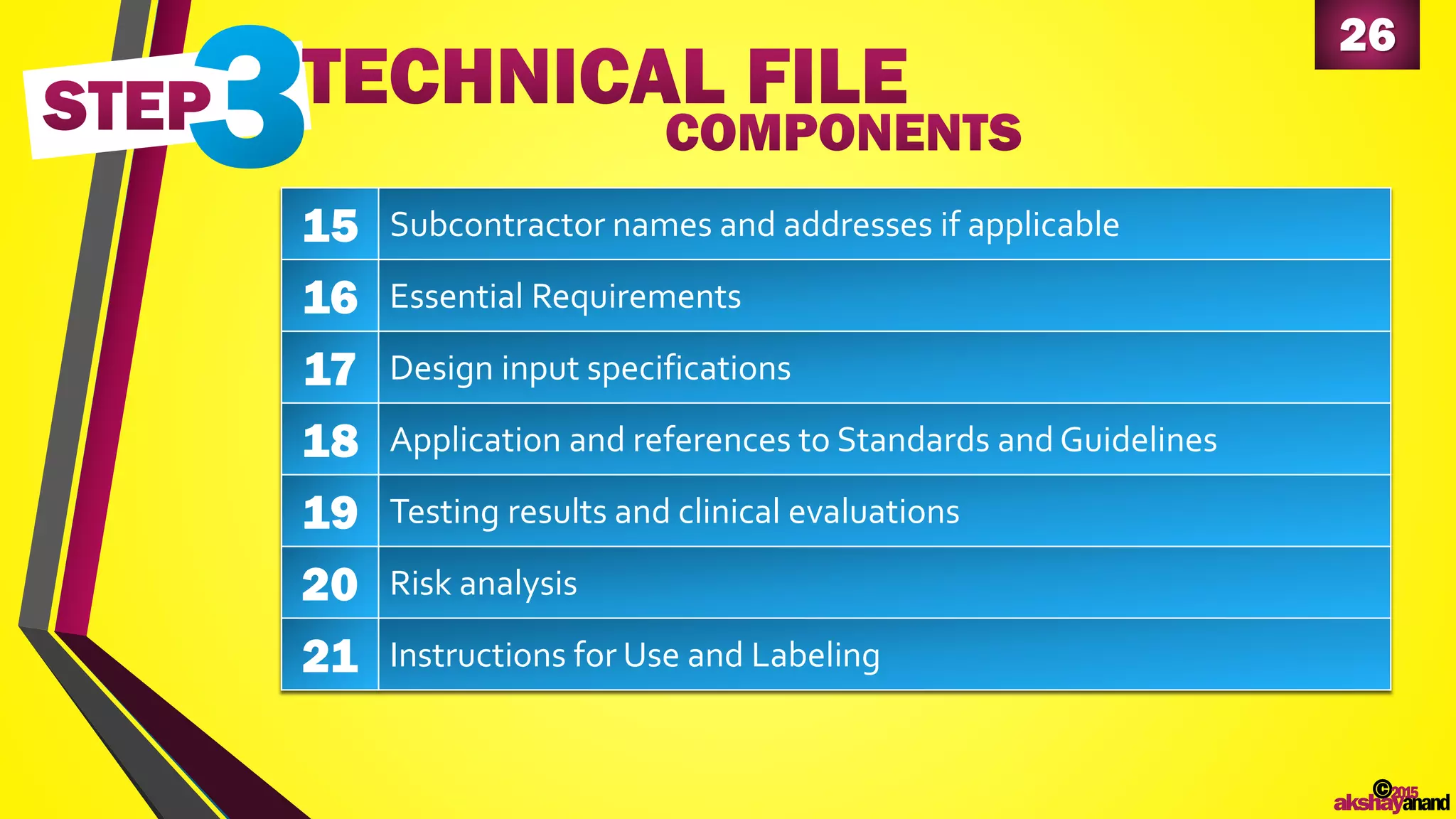
15 Subcontractor names and addresses if applicable
16 Essential Requirements
17 Design input specifications
18 Application and references to Standards and Guidelines
19 Testing results and clinical evaluations
20 Risk analysis
21 Instructions for Use and Labeling
27
©2015
akshayanand
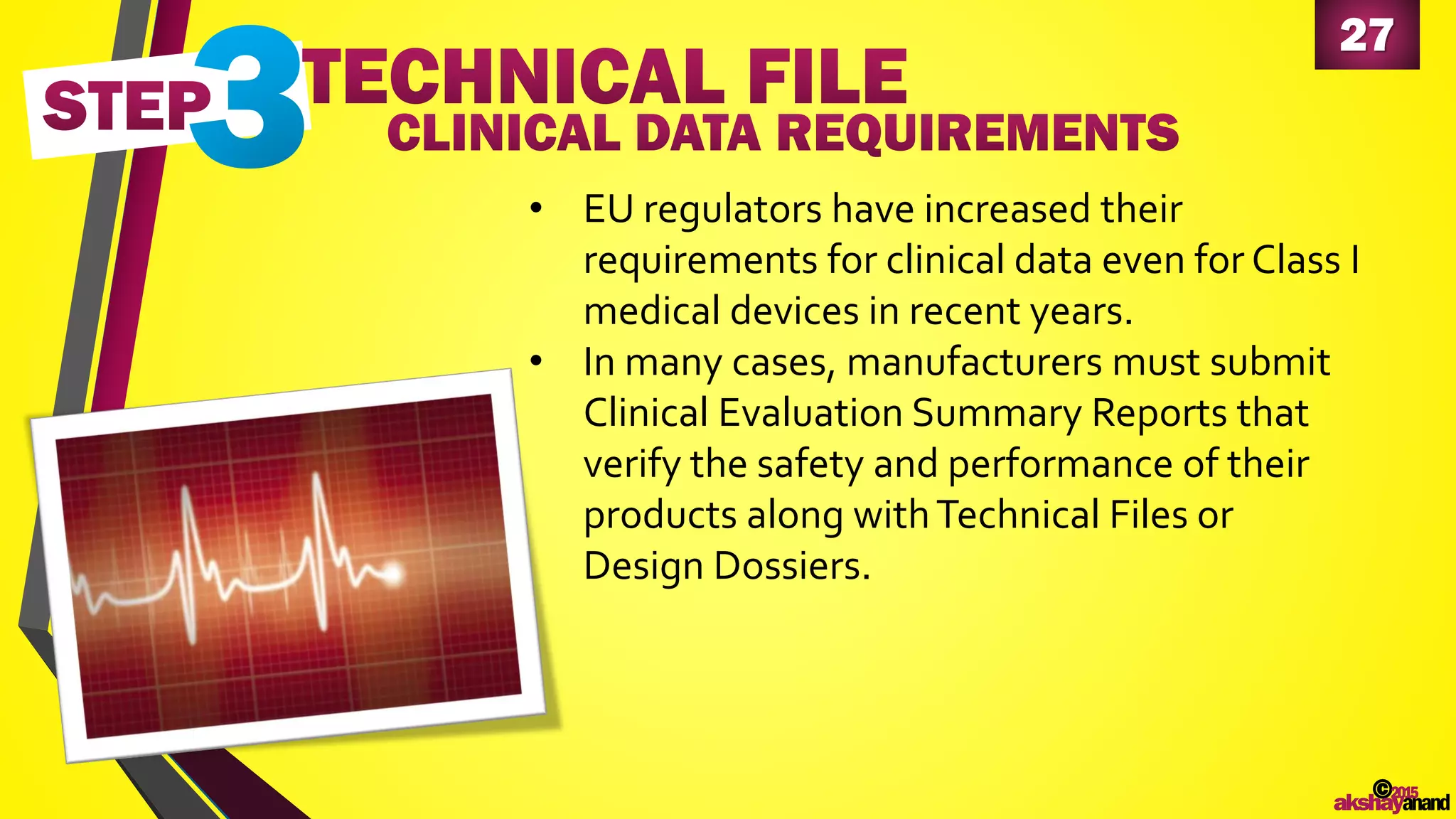
• EU regulators have increased their
requirements for clinical data even for Class I
medical devices in recent years.
• In many cases, manufacturers must submit
Clinical Evaluation Summary Reports that
verify the safety and performance of their
products along withTechnical Files or
Design Dossiers.
28
©2015
akshayanand
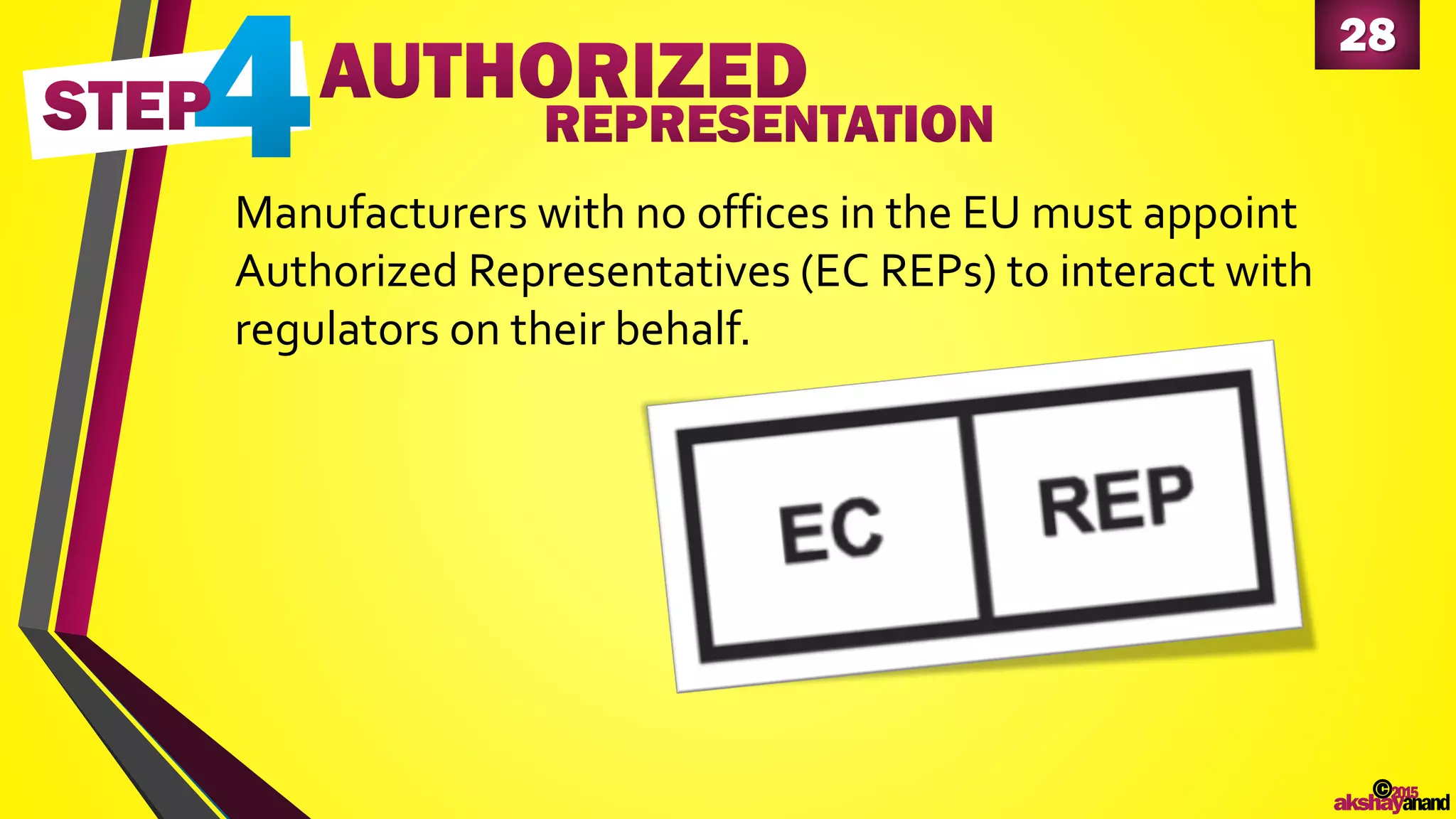
Manufacturers with no offices in the EU must appoint
Authorized Representatives (EC REPs) to interact with
regulators on their behalf.
29
©2015
akshayanand
• Registering your device with Competent Authorities before commercialization
• Serving as primary point of contact with all EU Competent Authorities
• Keeping a current copy of yourTechnical File/Design Dossier available for
inspections by Competent Authorities
• Authorizing you to place EC REP name and address on your device labels,
packaging and instructions for use
• Handling Incident and Field Safety Corrective Action (FSCA) reporting to
Competent Authorities
• Representing you before the European Commission in the event that your
product is withdrawn in a member state
• Protecting the confidentiality of your product information
• Maintaining reports on clinical evaluation data for review by Competent
Authorities
• Communicating with Competent Authorities on serious device incidents or FSCAs
30
©2015
akshayanand
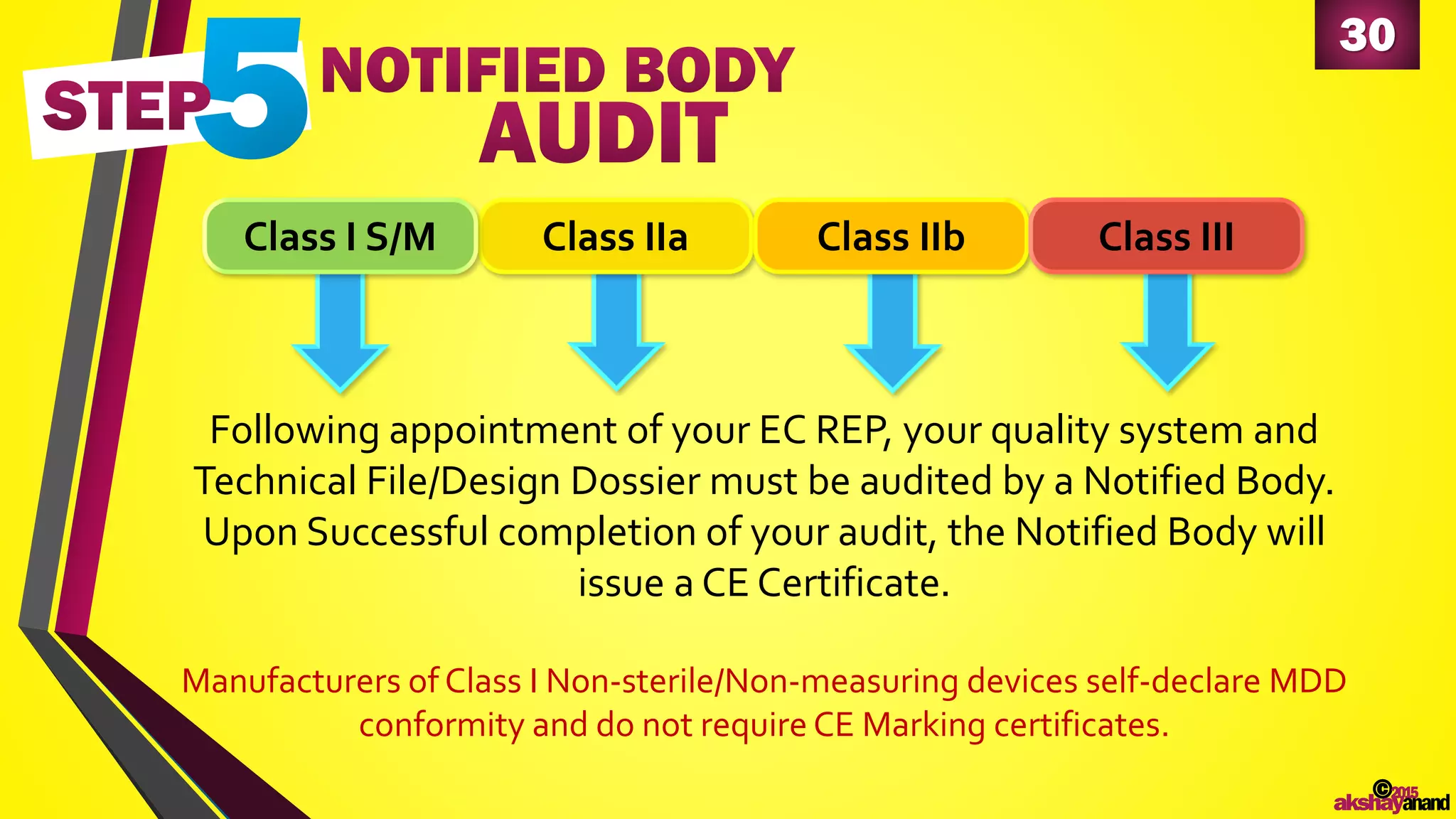
Following appointment of your EC REP, your quality system and
Technical File/Design Dossier must be audited by a Notified Body.
Upon Successful completion of your audit, the Notified Body will
issue a CE Certificate.
Manufacturers of Class I Non-sterile/Non-measuring devices self-declare MDD
conformity and do not require CE Marking certificates.
Class IIa Class IIb Class IIIClass I S/M
31
©2015
akshayanand
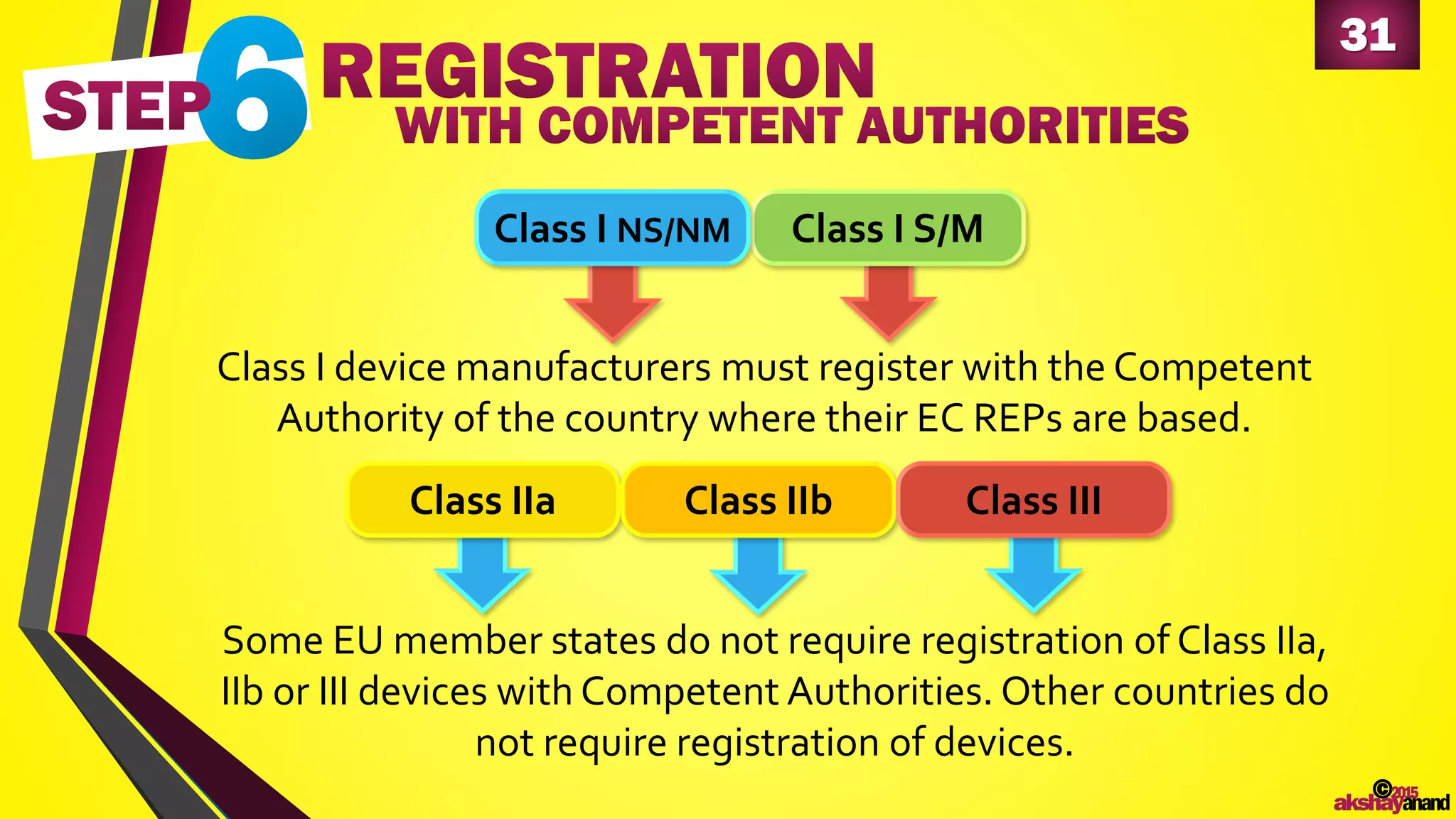
Class I device manufacturers must register with the Competent
Authority of the country where their EC REPs are based.
Class I S/MClass I NS/NM
Class IIa Class IIb Class III
Some EU member states do not require registration of Class IIa,
IIb or III devices with Competent Authorities. Other countries do
not require registration of devices.
32
©2015
akshayanand
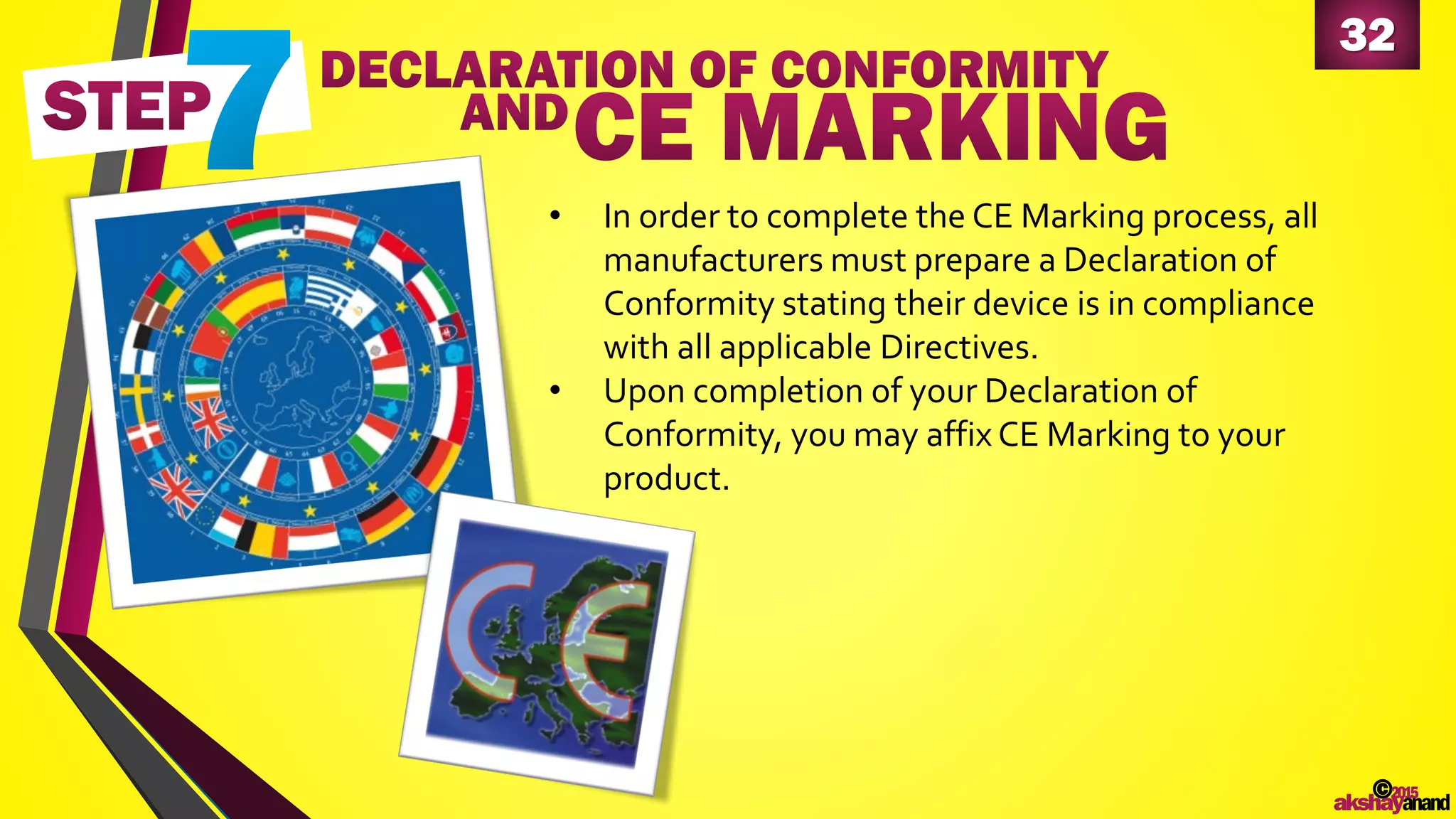
• In order to complete the CE Marking process, all
manufacturers must prepare a Declaration of
Conformity stating their device is in compliance
with all applicable Directives.
• Upon completion of your Declaration of
Conformity, you may affix CE Marking to your
product.
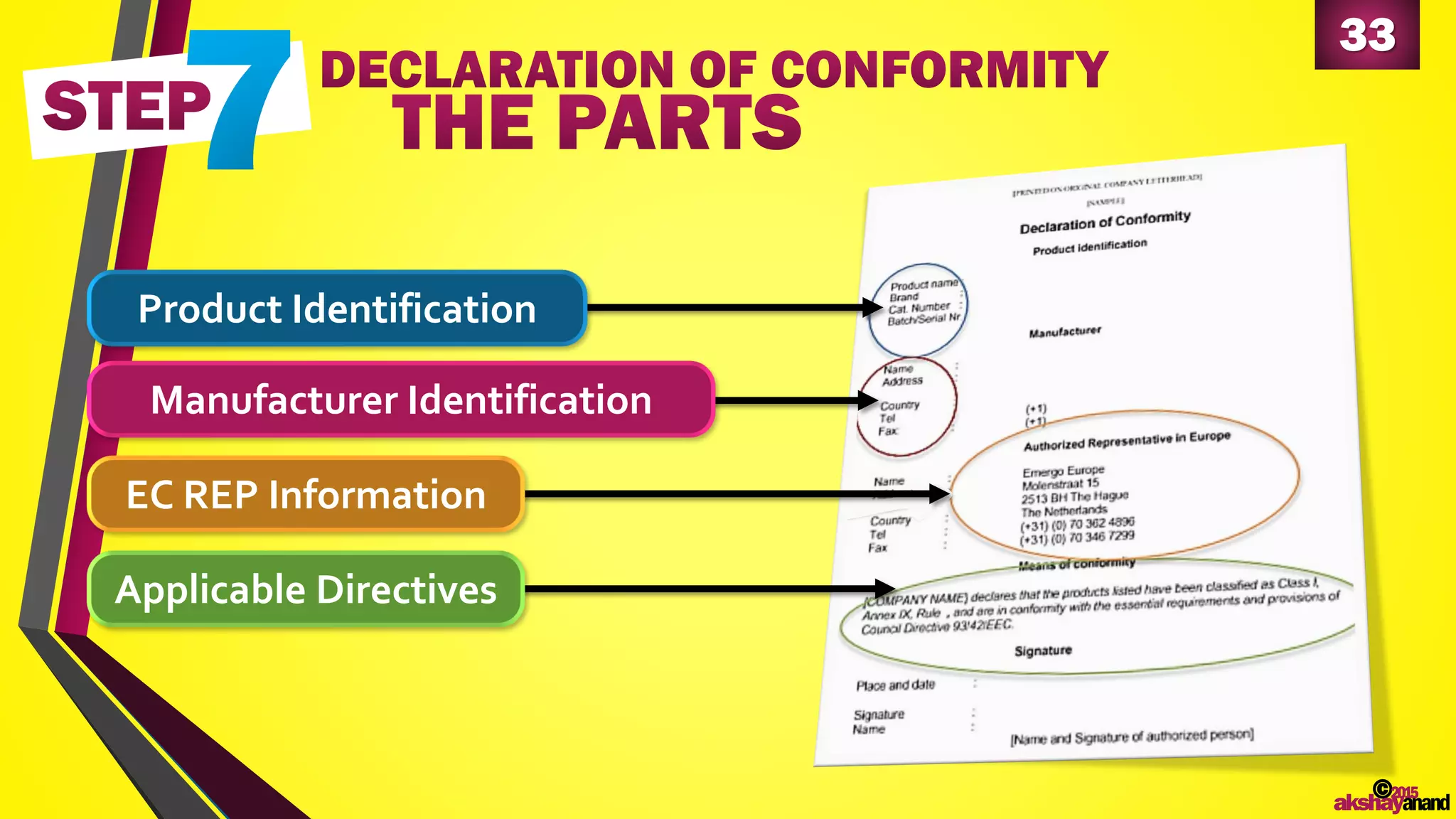
33
©2015
akshayanand
Product Identification
Manufacturer Identification
EC REP Information
Applicable Directives
34
©2015
akshayanand
• EU member states MAY require labeling
information be made available in their local
languages or another European Community
language to patients and users in
accordance with Annex I, point 13 of the
MDD.
• All languages subject to subsidiarity All EU
member states require device labeling in
their official languages Label information in
yourTechnical File should only appear in
ONE language
35
©2015
akshayanand
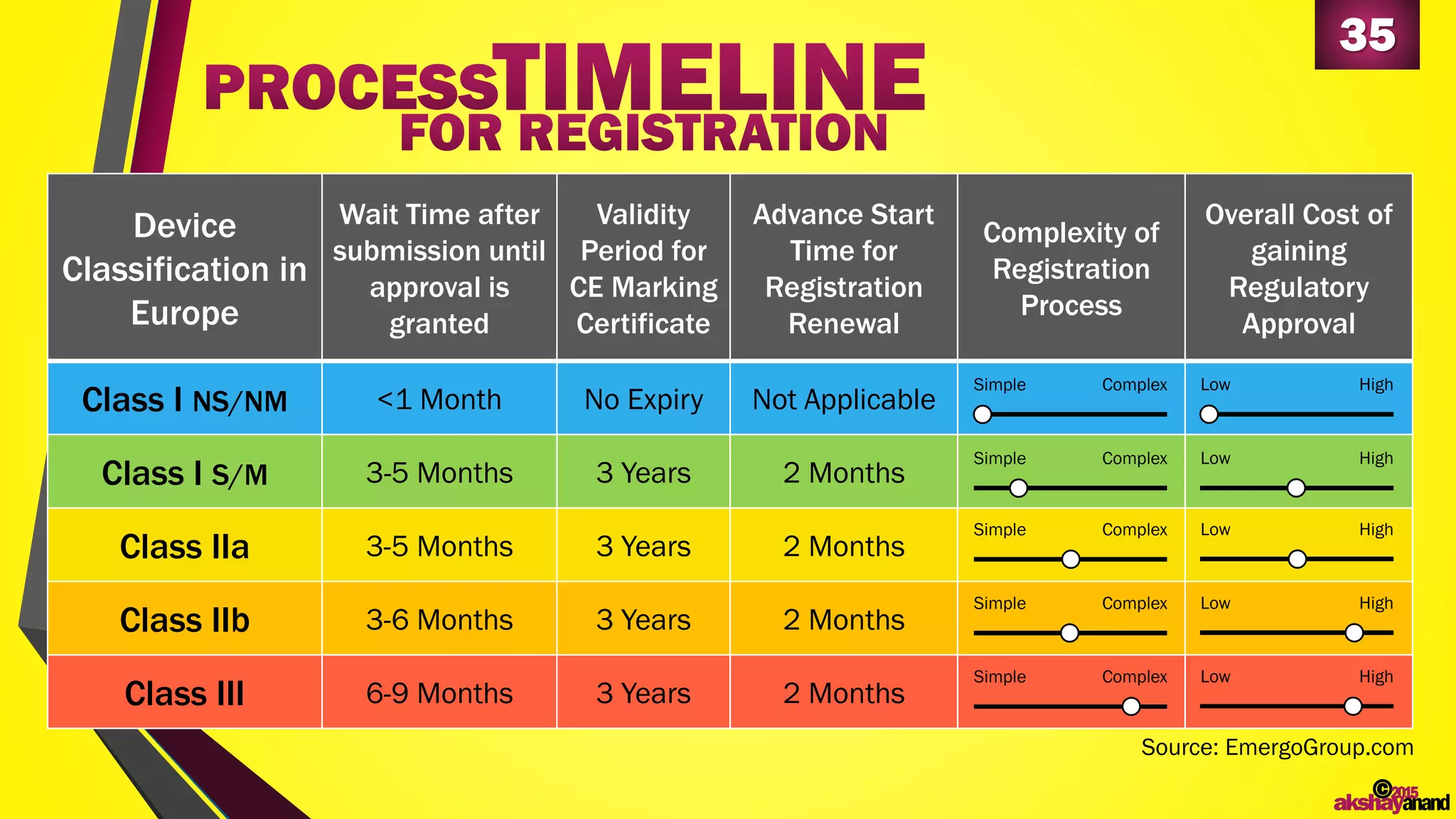
Source: EmergoGroup.com
Device
Classification in
Europe
Wait Time after
submission until
approval is
granted
Validity
Period for
CE Marking
Certificate
Advance Start
Time for
Registration
Renewal
Complexity of
Registration
Process
Overall Cost of
gaining
Regulatory
Approval
Class I NS/NM <1 Month No Expiry Not Applicable
Class I S/M 3-5 Months 3 Years 2 Months
Class IIa 3-5 Months 3 Years 2 Months
Class IIb 3-6 Months 3 Years 2 Months
Class III 6-9 Months 3 Years 2 Months
Simple Complex Low High
36
©2015
akshayanand
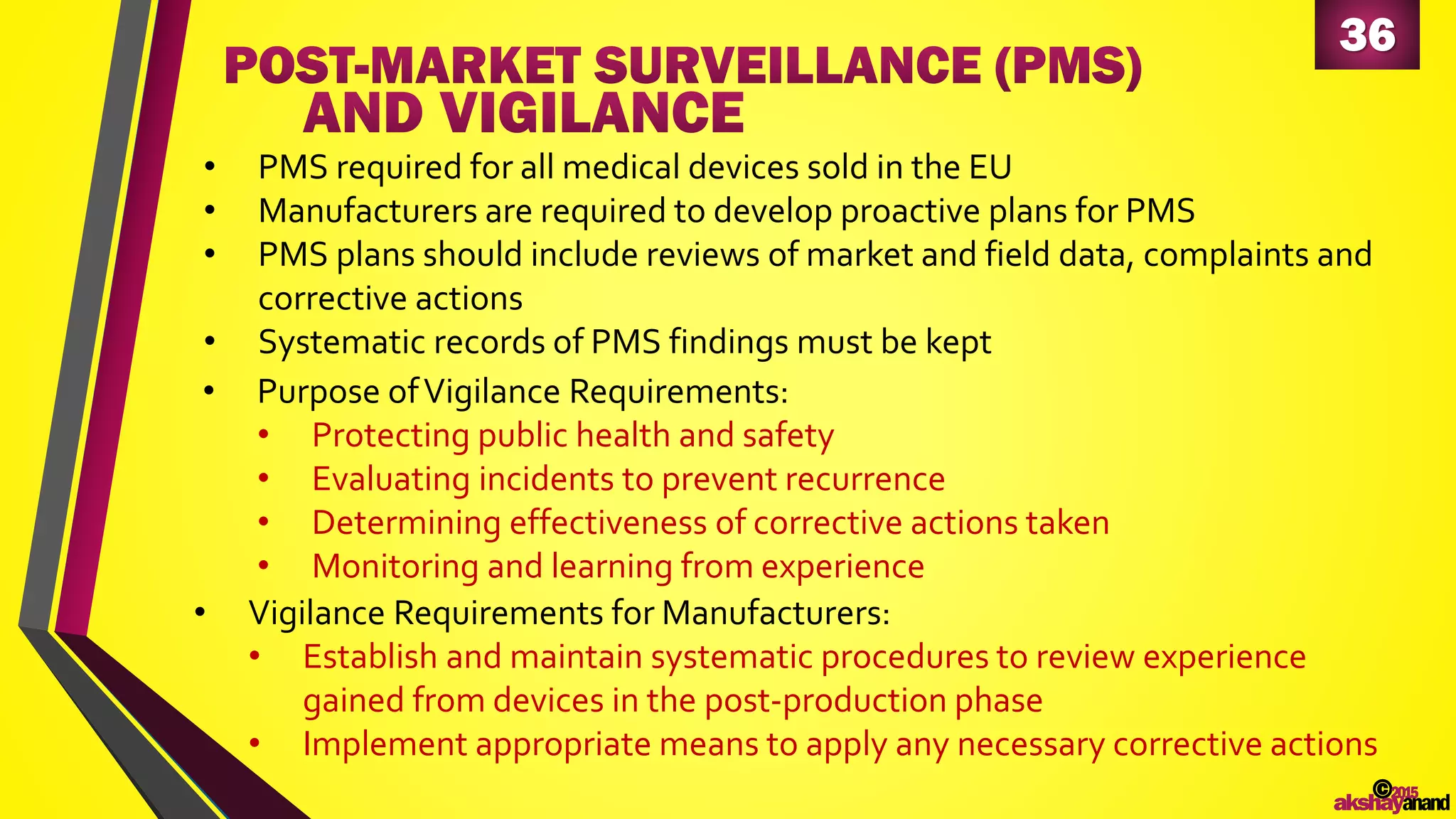
• PMS required for all medical devices sold in the EU
• Manufacturers are required to develop proactive plans for PMS
• PMS plans should include reviews of market and field data, complaints and
corrective actions
• Systematic records of PMS findings must be kept
• Purpose ofVigilance Requirements:
• Protecting public health and safety
• Evaluating incidents to prevent recurrence
• Determining effectiveness of corrective actions taken
• Monitoring and learning from experience
• Vigilance Requirements for Manufacturers:
• Establish and maintain systematic procedures to review experience
gained from devices in the post-production phase
• Implement appropriate means to apply any necessary corrective actions
37
• https://en.wikipedia.org/wiki/Medical_device - Wikipedia article on Medical Devices
• http://eur-lex.europa.eu/LexUriServ/LexUriServ.do?uri=CONSLEG:1993L0042:20071011:en:PDF – Official EU
Document : Council Directive 93/42/EEC
• http://ec.europa.eu/health/medical-devices/documents/guidelines/index_en.htm - Guidance MEDDEVs Online
Directory
• http://ec.europa.eu/health/medical-devices/files/meddev/2_1-1___04-1994_en.pdf - Guidance Document
MEDDEV 2.1/1April 1994
• http://ec.europa.eu/health/medical-devices/files/meddev/2_2_4-1part1_07-2001_en.pdf - Guidance Document
MEDDEV 2.4/1 Rev.8 July 2001
• http://ec.europa.eu/health/medical-devices/files/meddev/2_4_1_rev_9_classification_en.pdf - Guidance
Document MEDDEV 2.4/1 Rev.9 June 2010
• https://en.wikipedia.org/wiki/CE_marking- Wikipedia article on CE Certification
• http://www.lne-gmed.com/pdf/en/annex9-directive-93-42-amended.pdf - Official EU Document : Annex IX of
Council Directive 93/42/EEC
• http://ec.europa.eu/health/medical-devices/faq/market_en.htm - Information about the Medical Device
Registration on the Official Website of European Commission
• http://medicaldevices.bsigroup.com/en-GB/our-services/ce-marking/ - Information about CE Marking Approval
for Medical Devices in Europe
• http://www.emergogroup.com/resources/europe-process-chart - Europe CE Approval Process for Medical
Devices – Charts &Timelines
©2015
akshayanand
thankyou!axayanand@gmail.com

Regulatory approval process for medical Devices

  • 1.
    AKSHAY ANAND M IYear – Master of Pharmacy Pharmaceutical Regulatory Affairs JSS College Of Pharmacy Mysuru 570015, Karnataka REGULATORYAPPROVAL PROCESSFOR MEDICALDEVICESINEUROPEANUNION ©2015 akshayanand
  • 2.
    ASPECTS ©2015 akshayanand • Medical Devices–What are they? • European Union – An Overview • EU Directives that impact Medical Devices • Medical Devices as defined by EU • Classification of Medical Devices as per EU • The CE Certification • The Registration Process for MD • The ProcessTimeline for Registration OF THIS PRESENTATION
  • 3.
    01 • A medicaldevice is an instrument, apparatus, implant, in vitro reagent, or similar or related article that is used to diagnose, prevent, or treat disease or other conditions • It does not achieve its purposes through chemical action within or on the body. • Medical devices vary greatly in complexity and application. • The design of medical devices constitutes a major segment of the field of biomedical engineering. • Examples range from simple devices such as tongue depressors, medical thermometers, and disposable gloves to advanced devices such as computers which assist in the conduct of medical testing, implants, and prostheses. • The global medical device market reached roughly $209 billion in 2006. ©2015 akshayanand
  • 4.
  • 5.
    03 • 28 memberstates plus European FreeTrade Association members. • 24 languages. • Population of more than 500 million people. • GDP of $18.124 trillion. • Euro, the currency equalling 71.47 Indian Rupee per unit. ©2015 akshayanand
  • 6.
    04 • Medical Devices(MDD) 93/42/EEC • Covers the bulk of medical devices marketed in the EU • Examples: orthopaedic implants, heart valves, medical software ©2015 akshayanand • Active Implantable Medical Devices (AIMDD) 90/385/EEC • Covers devices that require external power sources in order to function properly • Examples: pacemakers, implantable defibrillators • InVitro Diagnostics (IVDD) 98/79/EC • Covers devices used for the examination of specimens taken from the human body • Examples: pregnancy self-testing strips, blood glucose self-testing strips
  • 7.
    05 ©2015 akshayanand • Personal ProtectiveEquipment 89/686/EEC • LowVoltage 2006/95/EC • Electromagnetic Compatibility 2004/108/EC • Blood Product Directive 2002/98/EC • AnimalTissue Use in Medical Devices 2003/32/EC • HumanTissue Products Directives 2004 & 2005 • Breast Implants Reclassification Directive 2003/12/EC • Hip, Knee, Shoulder Joint Replacement Reclassification Directive 2005/50/EC
  • 8.
    06 This guidance documentunder Directive 93/42/EEC on Medical Devices provides definition of Medical Devices to include the following: Medical Devices: Guidance Document MEDDEV 2.1/1 APRIL 1994 a. Devices – Accessory b. Medical Purpose c. Customizing d. Medical –Toiletry Purpose e. Aids for Handicapped Persons f. Software g. Multipurpose Products ©2015 akshayanand
  • 9.
    07 • The classificationof medical devices is a ‘risk based’ system based on the vulnerability of the human body taking account of the potential risks associated with the devices. • This approach allows the use of a set of criteria that can be combined in various ways in order to determine classification, e.g. duration of contact with the body, degree of invasiveness and local vs. systemic effect. These criteria can then be applied to a vast range of different medical devices and technologies. • These are referred to as the ‘classification rules’ and are set out in Annex IX of Directive 93/42/EEC. Medical Devices: Guidance Document MEDDEV 2.4/1 Rev.8 JULY 2001 MEDDEV 2.4/1 Rev.9 JUNE 2010 ©2015 akshayanand
  • 10.
    • The CEmark, or formerly EC mark, is a mandatory conformity marking for certain products sold within the European Economic Area (EEA) since 1985. • The CE marking is also found on products sold outside the EEA that are manufactured in, or designed to be sold in, the EEA. • This makes the CE marking recognizable worldwide even to people who are not familiar with the European Economic Area. • It is in that sense similar to the FCC Declaration of Conformity used on certain electronic devices sold in the United States. • It consists of the CE logo and, if applicable, the four digit identification number of the notified body involved in the conformity assessment procedure. • The CE marking is the manufacturer's declaration that the product meets the requirements of the applicable EC directives. 08 ©2015 akshayanand
  • 11.
  • 12.
    10 ©2015 akshayanand KEY PLAYERSIN THE CEMARKING PROCESS(REGULATORY APPROVAL PROCESS FOR MEDICAL DEVICES) • Manufacturers and Subcontractors • Competent Authorities • Notified Bodies • Authorized Representatives • Distributors
  • 13.
    11 ©2015 akshayanand • Competent Authoritiesare entities enforcing Medical Device Directives at the national level in each EU member state. • Member states and their Competent Authorities each have their own interpretations of how Directives should be carried out. • Manufacturers seeking to sell in more than one EU member state should take this into account.
  • 14.
    12 ©2015 akshayanand • Notified Bodiesare authorized to audit manufacturers’ quality systems and test/review devices for compliance with applicable EU Directives and standards. • Their responsibilities include: • Advising on device classification and ConformityAssessment routes • Pre-assessment of devices • Product and quality system evaluation • Concluding and evaluating manufacturers’Corrective Actions • Issuance of certifications • Maintaining programmed surveillance of devices in the EU
  • 15.
    13 ©2015 akshayanand • Required forany firm without a location in the EU. • Their responsibilities include: • Liaising between manufacturers and Competent Authorities • Listing their names on clients’ device labels and packaging • Notifying Competent Authorities of manufacturers’ and devices’ names • KeepingTechnical Files/Design Dossiers available for review by Competent Authorities • Participating in vigilance/post-market surveillance procedures EC REP
  • 16.
    14 ©2015 akshayanand Identify Directives andRegulations appropriate for your device Classify your device according to MDD Annex IX Implement Quality System in compliance with ISO 13485. PrepareTechnical File or Design Dossier demonstrating compliance with MDD 93/42/EEC.
  • 17.
    15 ©2015 akshayanand Appoint your AuthorizedRepresentative. Have Notified Body audit your Quality System andTechnical File or Design Dossier. Register your device with Competent Authorities if necessary. Prepare Declaration of Conformity and affix CE Marking to your device.
  • 18.
    16 ©2015 akshayanand • First, determinewhich Medical Device Directive (MDD, AIMDD or IVDD) applies to your device. • Then determine device classification using Annex IX of MDD 93/42/EEC. Class I Non-Sterile Class I Non-Measuring Class I Sterile Class I Measuring Low-risk, non-invasive devices such as non-sterile wound dressings and stethoscopes
  • 19.
    17 ©2015 akshayanand Class IIa Medium-risk, short-terminvasive devices such as tracheal tubes and lancets Class IIb Higher-risk, often longer-term surgically invasive, sometimes implantable devices including intra-ocular lenses and surgical lasers Class III Highest-risk devices, including all active implantable devices such as replacement heart valves and vascular stents
  • 20.
    18 ©2015 akshayanand • MDD 93/42/EECAnnex IX contains 18 rules for medical device classification based on factors including the following: • Device’s intended use • Active versus non-active functionality • Device’s duration of contact with patient • Degree of invasiveness • Part of body contacted by device • Special situations
  • 21.
    19 ©2015 akshayanand • Duration ofContact Criteria • Less than 60 minutes =Transient • Less than 30 days = Short-term • More than 30 days = Long-term • Degree of InvasivenessCriteria • Application to body surface versus an orifice • Surgically invasive or non-invasive • Implantable Determining your device’s duration of contact and degree of invasiveness will help determine how to classify the device.
  • 22.
  • 23.
    21 ©2015 akshayanand Manufacturers of ClassI sterile/measuring, IIa, IIb and III devices must implement quality management systems (QMS) (in compliance with Annex II orV of the MDD). Most manufacturers meet this requirement using ISO 13485.
  • 24.
    22 ©2015 akshayanand Phase I: Qualitysystem preparation and development • Management buy-in • Assign resources and staff • Conduct gap analysis • Develop quality manual and documentation controls Phase II: Implementation • Employee training • Internal auditing • Corrective and preventative actions Phase III: Registration • Registration audit performed by Notified Body • Final ISO 13485 certification
  • 25.
    23 ©2015 akshayanand • All ClassI, IIa and IIb device manufacturers must prepareTechnical Files containing data to demonstrate MDD 93/42/EEC compliance. • Class III device manufacturers must prepare Design Dossiers to demonstrate compliance to MDD. • All manufacturers must have clinical data to demonstrate compliance to MDD.
  • 26.
    24 ©2015 akshayanand 1 Description of productfamily and justification for why your device falls into that family 2 Device intended use 3 Description of device components, specifications, packaging and literature 4 Device manufacturing Process 5 List of accessories to your device 6 Location of design responsibility and manufacturing facilities 7 Classification along with rationale for classification
  • 27.
    25 ©2015 akshayanand 8 Chosen complianceroute according to applicable Directive(s) 9 Declaration of Conformity stating manufacturer’s compliance with applicable Directive(s) 10 Shelf life and environmental limitations of device 11 Retention of quality assurance, Competent Authority and Notified Body records 12 Vigilance reporting and Medical Device Reporting procedures 13 How and when to contact Competent Authorities 14 Name of and contract with yourAuthorized Representative
  • 28.
    26 ©2015 akshayanand 15 Subcontractor namesand addresses if applicable 16 Essential Requirements 17 Design input specifications 18 Application and references to Standards and Guidelines 19 Testing results and clinical evaluations 20 Risk analysis 21 Instructions for Use and Labeling
  • 29.
    27 ©2015 akshayanand • EU regulatorshave increased their requirements for clinical data even for Class I medical devices in recent years. • In many cases, manufacturers must submit Clinical Evaluation Summary Reports that verify the safety and performance of their products along withTechnical Files or Design Dossiers.
  • 30.
    28 ©2015 akshayanand Manufacturers with nooffices in the EU must appoint Authorized Representatives (EC REPs) to interact with regulators on their behalf.
  • 31.
    29 ©2015 akshayanand • Registering yourdevice with Competent Authorities before commercialization • Serving as primary point of contact with all EU Competent Authorities • Keeping a current copy of yourTechnical File/Design Dossier available for inspections by Competent Authorities • Authorizing you to place EC REP name and address on your device labels, packaging and instructions for use • Handling Incident and Field Safety Corrective Action (FSCA) reporting to Competent Authorities • Representing you before the European Commission in the event that your product is withdrawn in a member state • Protecting the confidentiality of your product information • Maintaining reports on clinical evaluation data for review by Competent Authorities • Communicating with Competent Authorities on serious device incidents or FSCAs
  • 32.
    30 ©2015 akshayanand Following appointment ofyour EC REP, your quality system and Technical File/Design Dossier must be audited by a Notified Body. Upon Successful completion of your audit, the Notified Body will issue a CE Certificate. Manufacturers of Class I Non-sterile/Non-measuring devices self-declare MDD conformity and do not require CE Marking certificates. Class IIa Class IIb Class IIIClass I S/M
  • 33.
    31 ©2015 akshayanand Class I devicemanufacturers must register with the Competent Authority of the country where their EC REPs are based. Class I S/MClass I NS/NM Class IIa Class IIb Class III Some EU member states do not require registration of Class IIa, IIb or III devices with Competent Authorities. Other countries do not require registration of devices.
  • 34.
    32 ©2015 akshayanand • In orderto complete the CE Marking process, all manufacturers must prepare a Declaration of Conformity stating their device is in compliance with all applicable Directives. • Upon completion of your Declaration of Conformity, you may affix CE Marking to your product.
  • 35.
  • 36.
    34 ©2015 akshayanand • EU memberstates MAY require labeling information be made available in their local languages or another European Community language to patients and users in accordance with Annex I, point 13 of the MDD. • All languages subject to subsidiarity All EU member states require device labeling in their official languages Label information in yourTechnical File should only appear in ONE language
  • 37.
    35 ©2015 akshayanand Source: EmergoGroup.com Device Classification in Europe WaitTime after submission until approval is granted Validity Period for CE Marking Certificate Advance Start Time for Registration Renewal Complexity of Registration Process Overall Cost of gaining Regulatory Approval Class I NS/NM <1 Month No Expiry Not Applicable Class I S/M 3-5 Months 3 Years 2 Months Class IIa 3-5 Months 3 Years 2 Months Class IIb 3-6 Months 3 Years 2 Months Class III 6-9 Months 3 Years 2 Months Simple Complex Low High Simple Complex Low High Simple Complex Low High Simple Complex Low High Simple Complex Low High
  • 38.
    36 ©2015 akshayanand • PMS requiredfor all medical devices sold in the EU • Manufacturers are required to develop proactive plans for PMS • PMS plans should include reviews of market and field data, complaints and corrective actions • Systematic records of PMS findings must be kept • Purpose ofVigilance Requirements: • Protecting public health and safety • Evaluating incidents to prevent recurrence • Determining effectiveness of corrective actions taken • Monitoring and learning from experience • Vigilance Requirements for Manufacturers: • Establish and maintain systematic procedures to review experience gained from devices in the post-production phase • Implement appropriate means to apply any necessary corrective actions
  • 39.
    37 • https://en.wikipedia.org/wiki/Medical_device -Wikipedia article on Medical Devices • http://eur-lex.europa.eu/LexUriServ/LexUriServ.do?uri=CONSLEG:1993L0042:20071011:en:PDF – Official EU Document : Council Directive 93/42/EEC • http://ec.europa.eu/health/medical-devices/documents/guidelines/index_en.htm - Guidance MEDDEVs Online Directory • http://ec.europa.eu/health/medical-devices/files/meddev/2_1-1___04-1994_en.pdf - Guidance Document MEDDEV 2.1/1April 1994 • http://ec.europa.eu/health/medical-devices/files/meddev/2_2_4-1part1_07-2001_en.pdf - Guidance Document MEDDEV 2.4/1 Rev.8 July 2001 • http://ec.europa.eu/health/medical-devices/files/meddev/2_4_1_rev_9_classification_en.pdf - Guidance Document MEDDEV 2.4/1 Rev.9 June 2010 • https://en.wikipedia.org/wiki/CE_marking- Wikipedia article on CE Certification • http://www.lne-gmed.com/pdf/en/annex9-directive-93-42-amended.pdf - Official EU Document : Annex IX of Council Directive 93/42/EEC • http://ec.europa.eu/health/medical-devices/faq/market_en.htm - Information about the Medical Device Registration on the Official Website of European Commission • http://medicaldevices.bsigroup.com/en-GB/our-services/ce-marking/ - Information about CE Marking Approval for Medical Devices in Europe • http://www.emergogroup.com/resources/europe-process-chart - Europe CE Approval Process for Medical Devices – Charts &Timelines ©2015 akshayanand
  • 40.