Web Content Mavens
April 28, 2015
Sarah Newcomb, Ph.D.
Behavioral Researcher
HelloWallet
Encouraging Action
Through Design and Testing
Encouraging
Behavior Change
WHERE WE’RE HEADED
1. Decisions in The Age of Consumer Empowerment
2. How to Encourage Action
3. Bottom Line: Test!
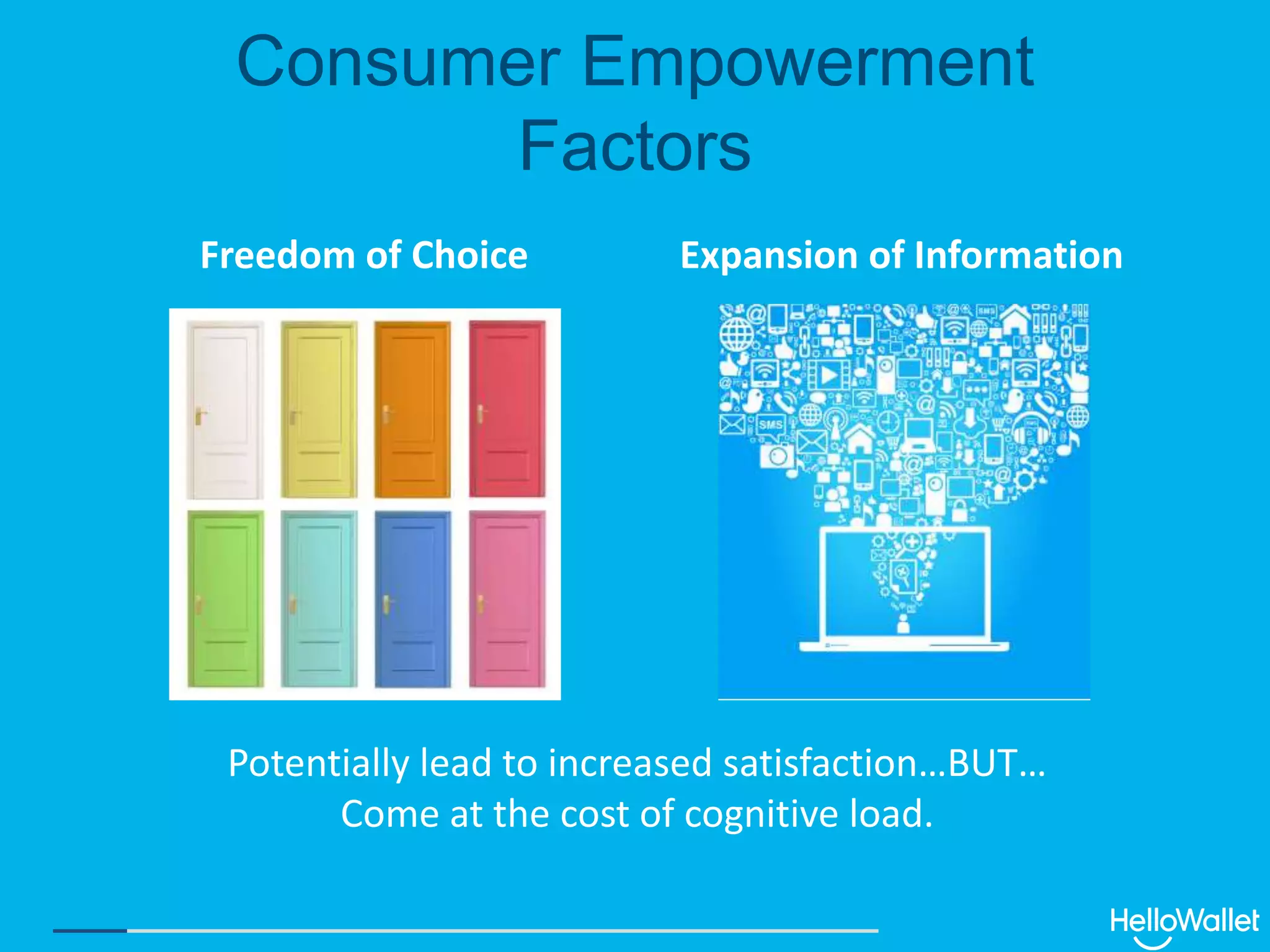
Consumer Empowerment
Factors
Freedom of Choice Expansion of Information
Potentially lead to increased satisfaction…BUT…
Come at the cost of cognitive load.
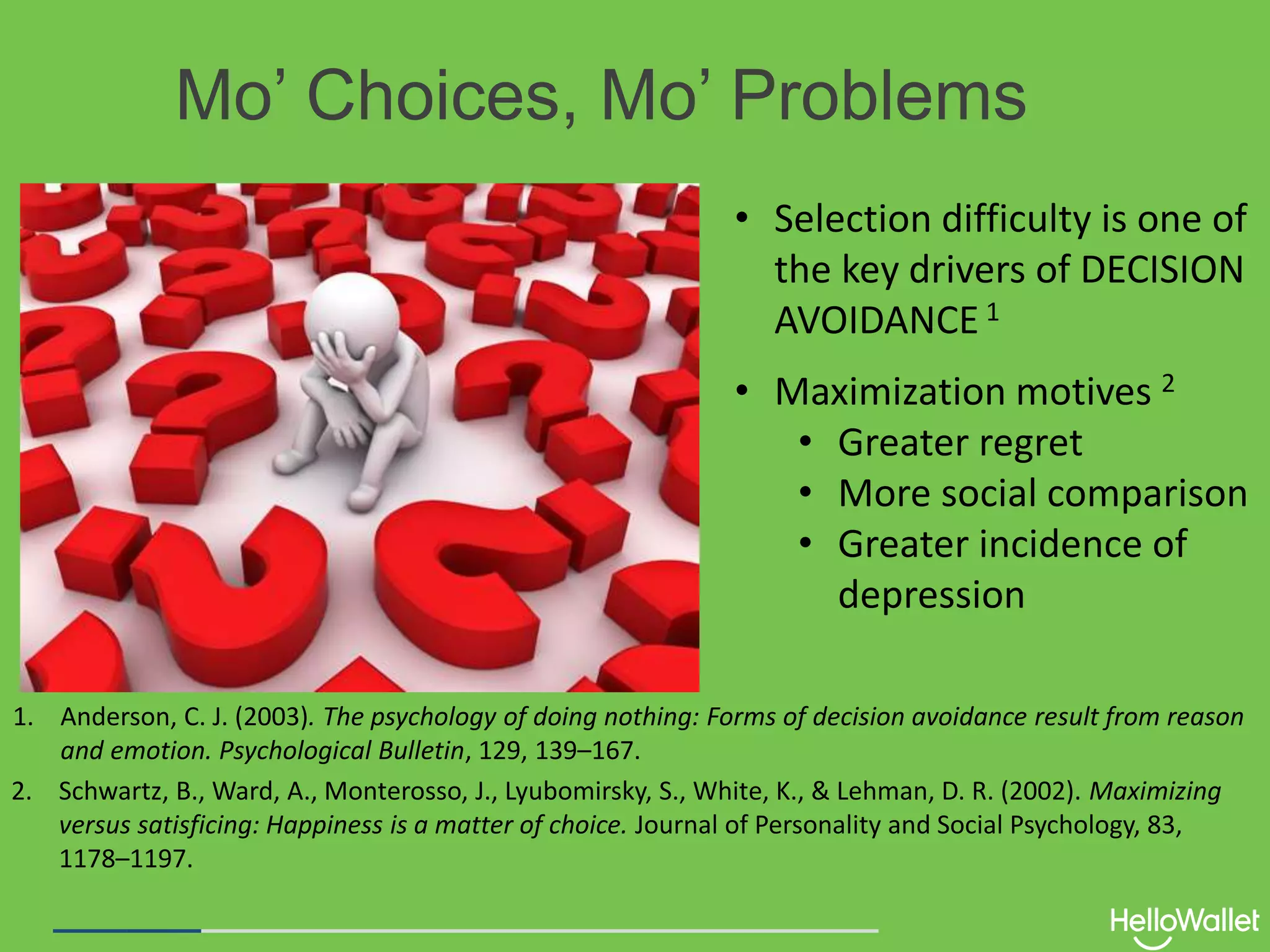
Mo’ Choices, Mo’ Problems
• Selection difficulty is one of
the key drivers of DECISION
AVOIDANCE 1
1. Anderson, C. J. (2003). The psychology of doing nothing: Forms of decision avoidance result from reason
and emotion. Psychological Bulletin, 129, 139–167.
2. Schwartz, B., Ward, A., Monterosso, J., Lyubomirsky, S., White, K., & Lehman, D. R. (2002). Maximizing
versus satisficing: Happiness is a matter of choice. Journal of Personality and Social Psychology, 83,
1178–1197.
• Maximization motives 2
• Greater regret
• More social comparison
• Greater incidence of
depression
Encouraging Action:
Make it Simple
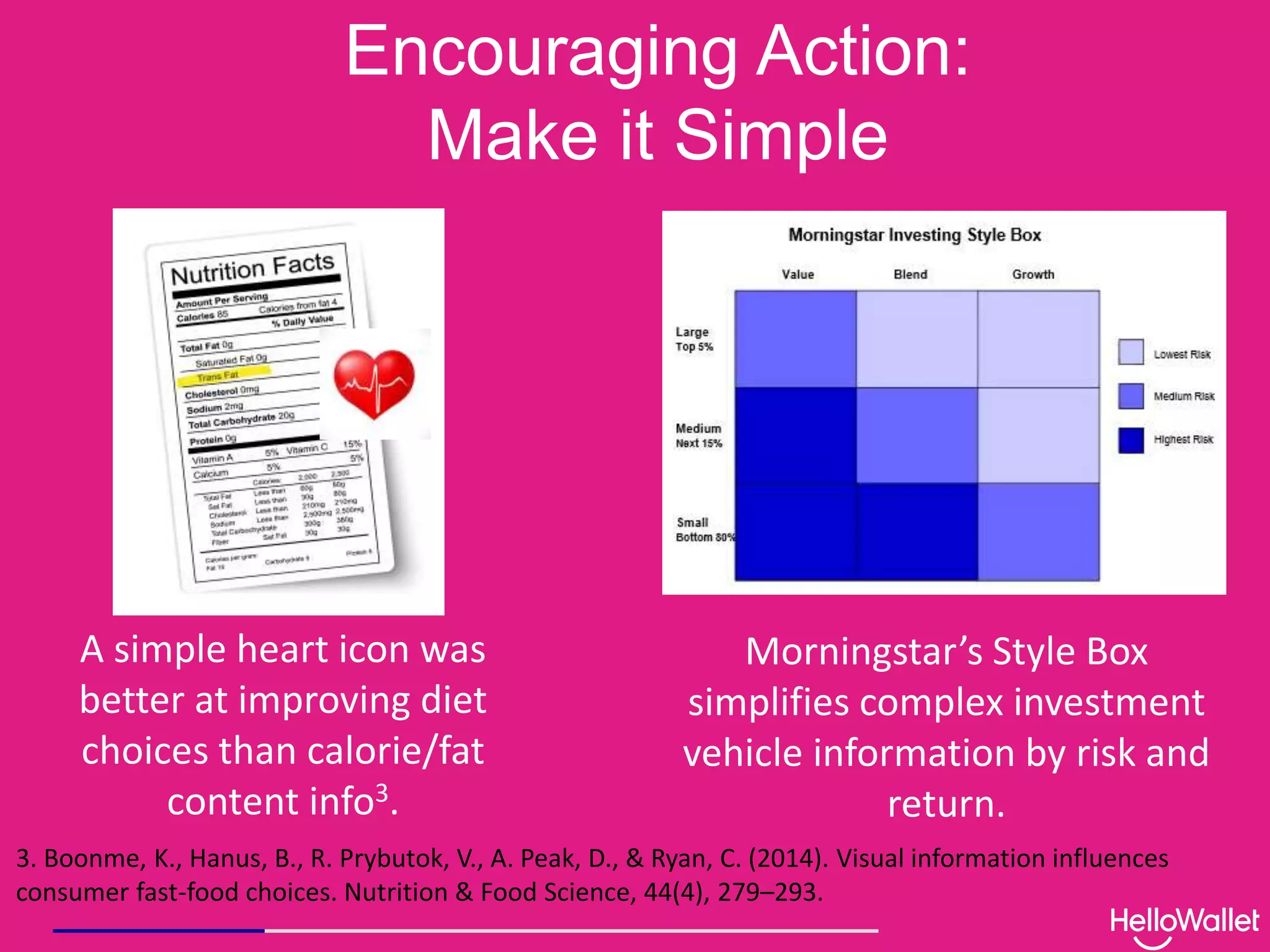
Morningstar’s Style Box
simplifies complex investment
vehicle information by risk and
return.
A simple heart icon was
better at improving diet
choices than calorie/fat
content info3.
3. Boonme, K., Hanus, B., R. Prybutok, V., A. Peak, D., & Ryan, C. (2014). Visual information influences
consumer fast-food choices. Nutrition & Food Science, 44(4), 279–293.
Encouraging Action:
But not Too Simple!
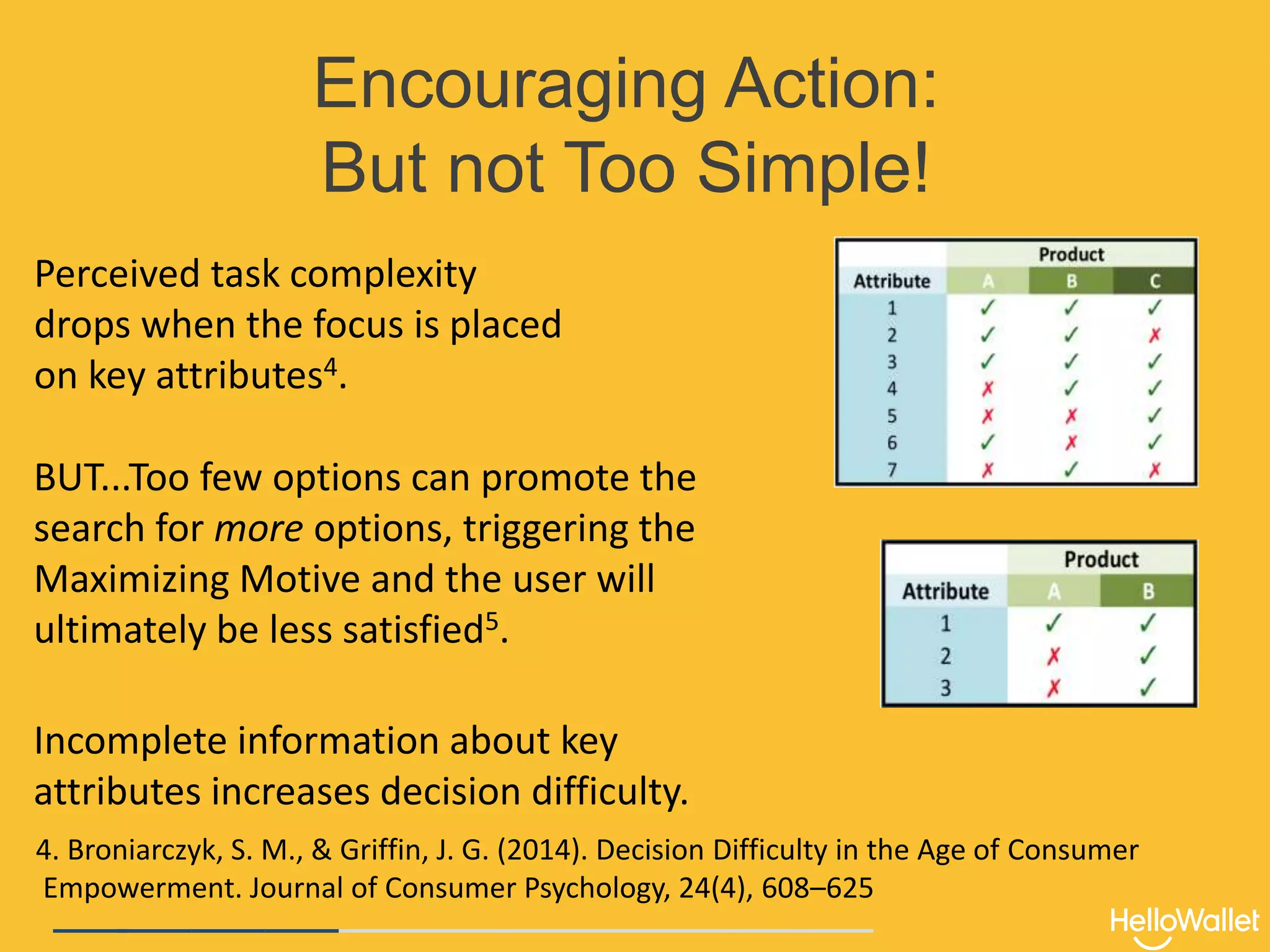
Perceived task complexity
drops when the focus is placed
on key attributes4.
BUT...Too few options can promote the
search for more options, triggering the
Maximizing Motive and the user will
ultimately be less satisfied5.
Incomplete information about key
attributes increases decision difficulty.
4. Broniarczyk, S. M., & Griffin, J. G. (2014). Decision Difficulty in the Age of Consumer
Empowerment. Journal of Consumer Psychology, 24(4), 608–625
Encouraging Action:
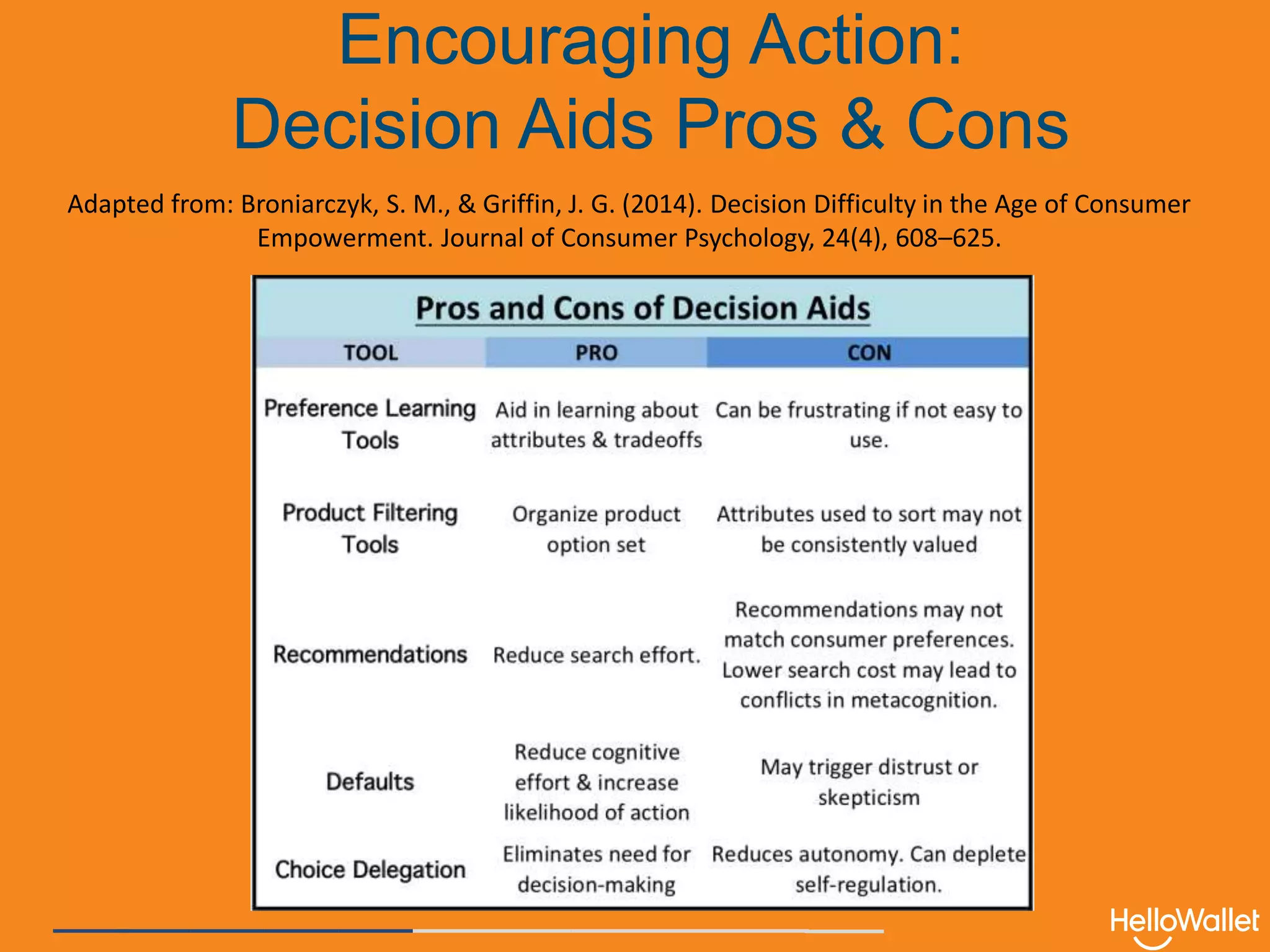
Decision Aids Pros & Cons
Adapted from: Broniarczyk, S. M., & Griffin, J. G. (2014). Decision Difficulty in the Age of Consumer
Empowerment. Journal of Consumer Psychology, 24(4), 608–625.
Encouraging Action:
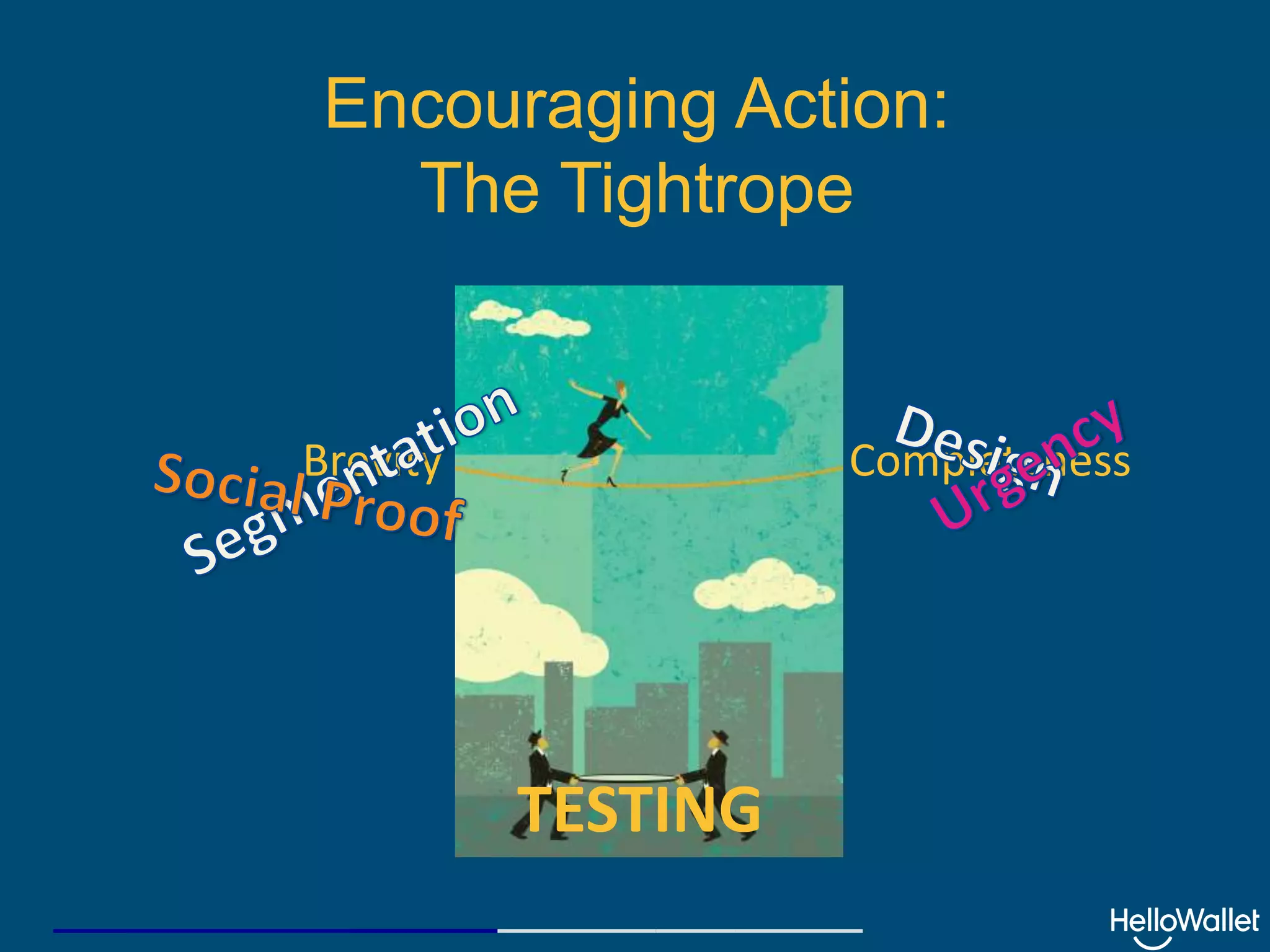
The Tightrope
Brevity Completeness
TESTING
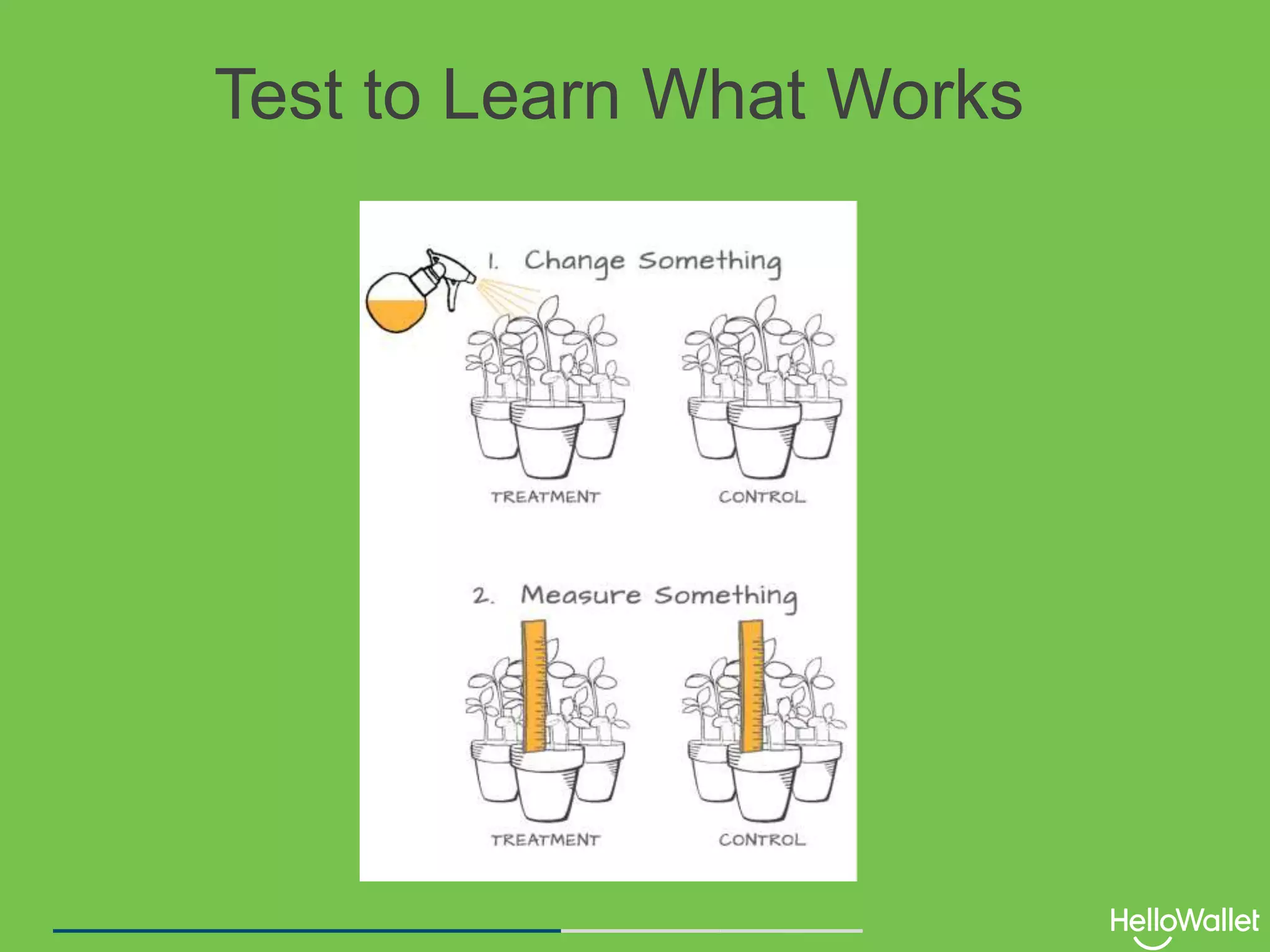
Test to Learn What Works
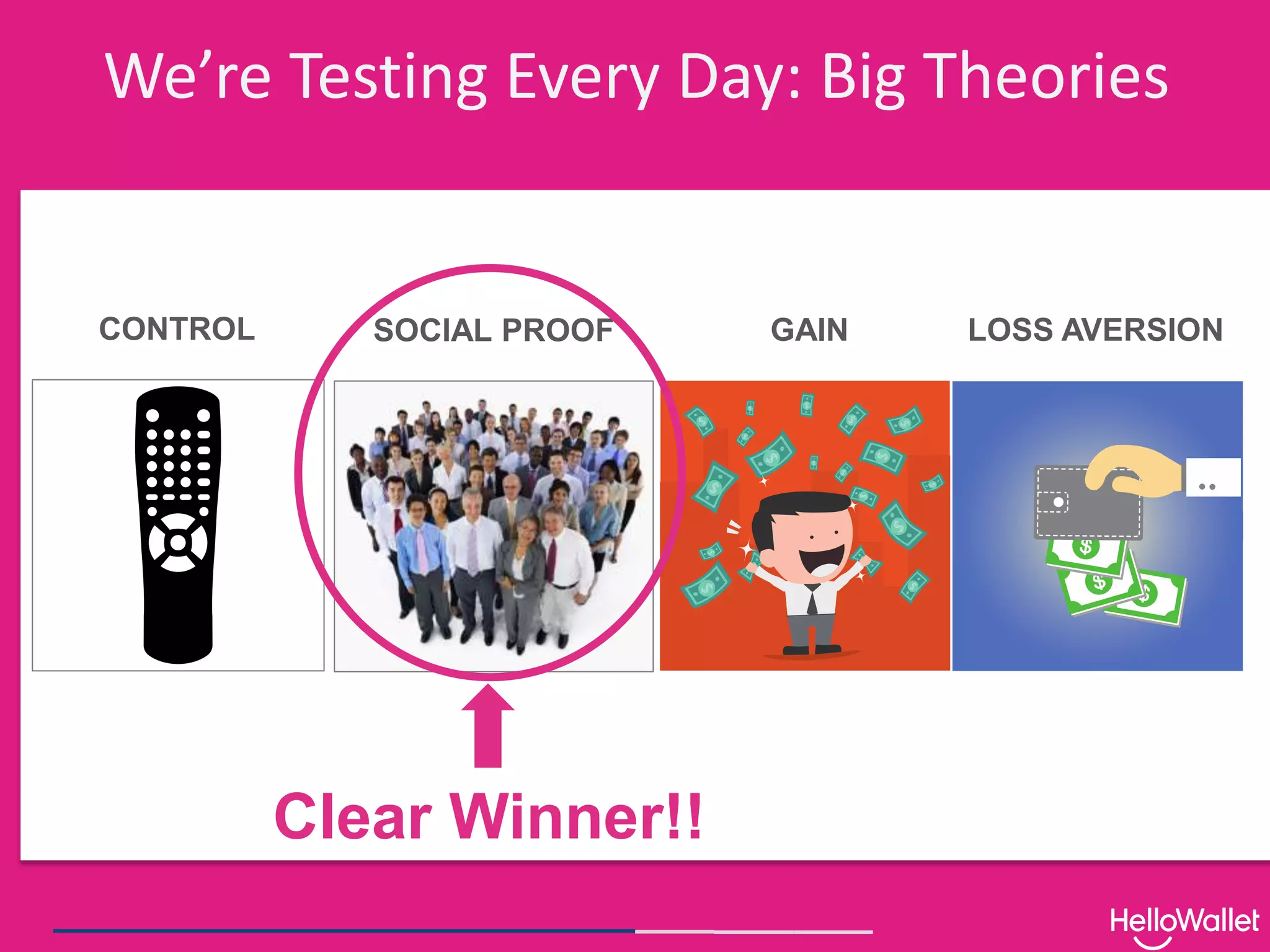
We’re testing everyday: big theories
SOCIAL PROOF GAIN LOSS AVERSIONCONTROL
Clear Winner!!
We’re Testing Every Day: Big Theories
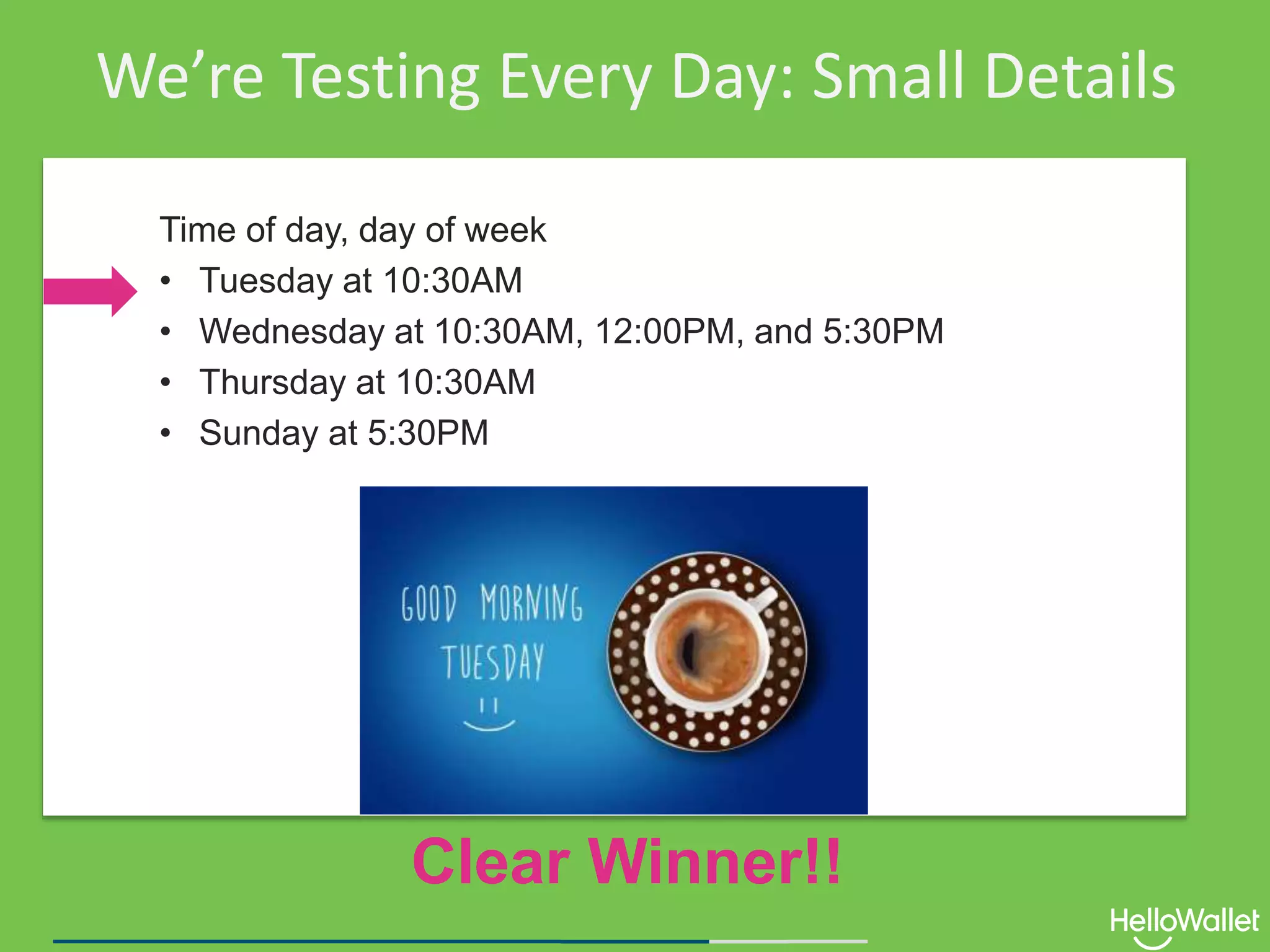
We’re testing everyday: small details
Time of day, day of week
• Tuesday at 10:30AM
• Wednesday at 10:30AM, 12:00PM, and 5:30PM
• Thursday at 10:30AM
• Sunday at 5:30PM
Clear Winner!!
We’re Testing Every Day: Small Details
We learned a lot, and increased
conversion by 80%!
Key Findings: What’s Worked
Call to Action
Original: “Start Today”
New: “Get My Account”
Result: 42% Conversion Increase
Time of Day & Subject Line
Original: “[Employer] Associates, Introducing a new
tool from your 401(k) plan!” at 11:00AM EST
New: “[Employer] Associates, Your HelloWallet
Account is Ready!” at 10:30AM EST
Result: 13.7%* Conversion Increase
Ease of Sign Up
Original: Email to Landing Page
New: Email to Sign Up Page
Result: 36% Conversion Increase
Key Findings: We’re Wrong!
Aspirational Template
Base: Original Template Design
Tested: Aspirational template design
Result: 37% Conversion drop for test group
Unique Subject Line & Sender
Base: [Employer] Benefits sender and “Reminder, Your
HelloWallet Account is Ready!” subject
Tested: “Your Financial Future” sender and “Come Find
me On HelloWallet” subject
Result: 66%* Conversion drop for test group
Omit “Free” and Shift to Social Proof
Base: Reminder with “Free” in Header and no social
proof
Tested: Remove “free” and include social proof statement
Result: 36% Conversion drop for test group
Testing Helped Us increase Conversions
By 80%
Resources
45 posts on A/B, Multivariate,
and Usability Testing:
http://tinyurl.com/pa259rx
http://www.amazon.com/Designing-Behavior-Change-
Psychology-Behavioral/dp/1449367623
https://whichtestwon.com/
Encouraging Action Through Design and Testing

Encouraging Action Through Design and Testing

  • 1.
    Web Content Mavens April28, 2015 Sarah Newcomb, Ph.D. Behavioral Researcher HelloWallet Encouraging Action Through Design and Testing
  • 2.
    Encouraging Behavior Change WHERE WE’REHEADED 1. Decisions in The Age of Consumer Empowerment 2. How to Encourage Action 3. Bottom Line: Test!
  • 3.
    Consumer Empowerment Factors Freedom ofChoice Expansion of Information Potentially lead to increased satisfaction…BUT… Come at the cost of cognitive load.
  • 4.
    Mo’ Choices, Mo’Problems • Selection difficulty is one of the key drivers of DECISION AVOIDANCE 1 1. Anderson, C. J. (2003). The psychology of doing nothing: Forms of decision avoidance result from reason and emotion. Psychological Bulletin, 129, 139–167. 2. Schwartz, B., Ward, A., Monterosso, J., Lyubomirsky, S., White, K., & Lehman, D. R. (2002). Maximizing versus satisficing: Happiness is a matter of choice. Journal of Personality and Social Psychology, 83, 1178–1197. • Maximization motives 2 • Greater regret • More social comparison • Greater incidence of depression
  • 5.
    Encouraging Action: Make itSimple Morningstar’s Style Box simplifies complex investment vehicle information by risk and return. A simple heart icon was better at improving diet choices than calorie/fat content info3. 3. Boonme, K., Hanus, B., R. Prybutok, V., A. Peak, D., & Ryan, C. (2014). Visual information influences consumer fast-food choices. Nutrition & Food Science, 44(4), 279–293.
  • 6.
    Encouraging Action: But notToo Simple! Perceived task complexity drops when the focus is placed on key attributes4. BUT...Too few options can promote the search for more options, triggering the Maximizing Motive and the user will ultimately be less satisfied5. Incomplete information about key attributes increases decision difficulty. 4. Broniarczyk, S. M., & Griffin, J. G. (2014). Decision Difficulty in the Age of Consumer Empowerment. Journal of Consumer Psychology, 24(4), 608–625
  • 7.
    Encouraging Action: Decision AidsPros & Cons Adapted from: Broniarczyk, S. M., & Griffin, J. G. (2014). Decision Difficulty in the Age of Consumer Empowerment. Journal of Consumer Psychology, 24(4), 608–625.
  • 8.
  • 9.
    Test to LearnWhat Works
  • 10.
    We’re testing everyday:big theories SOCIAL PROOF GAIN LOSS AVERSIONCONTROL Clear Winner!! We’re Testing Every Day: Big Theories
  • 11.
    We’re testing everyday:small details Time of day, day of week • Tuesday at 10:30AM • Wednesday at 10:30AM, 12:00PM, and 5:30PM • Thursday at 10:30AM • Sunday at 5:30PM Clear Winner!! We’re Testing Every Day: Small Details
  • 12.
    We learned alot, and increased conversion by 80%! Key Findings: What’s Worked Call to Action Original: “Start Today” New: “Get My Account” Result: 42% Conversion Increase Time of Day & Subject Line Original: “[Employer] Associates, Introducing a new tool from your 401(k) plan!” at 11:00AM EST New: “[Employer] Associates, Your HelloWallet Account is Ready!” at 10:30AM EST Result: 13.7%* Conversion Increase Ease of Sign Up Original: Email to Landing Page New: Email to Sign Up Page Result: 36% Conversion Increase Key Findings: We’re Wrong! Aspirational Template Base: Original Template Design Tested: Aspirational template design Result: 37% Conversion drop for test group Unique Subject Line & Sender Base: [Employer] Benefits sender and “Reminder, Your HelloWallet Account is Ready!” subject Tested: “Your Financial Future” sender and “Come Find me On HelloWallet” subject Result: 66%* Conversion drop for test group Omit “Free” and Shift to Social Proof Base: Reminder with “Free” in Header and no social proof Tested: Remove “free” and include social proof statement Result: 36% Conversion drop for test group Testing Helped Us increase Conversions By 80%
  • 13.
    Resources 45 posts onA/B, Multivariate, and Usability Testing: http://tinyurl.com/pa259rx http://www.amazon.com/Designing-Behavior-Change- Psychology-Behavioral/dp/1449367623 https://whichtestwon.com/

Editor's Notes