A facilitator’s guide to running a
“breaking the rules” session
#FutureNursing #FutureMidwifery
1
Contents
Mission
Section A
Why “break the rules”?
Preparing for the session
3
4
Section B Templates for printing
Draft letter
Poster
Ice breaker
Breaking the Rules
Giving Permission
Action Planning
6
Section C Your slide by slide facilitation guide. This pack includes examples of the
analysis from other organisations that have analysed their “rule breaking” and “permissions”
13
Section E Additional resources 42
Resources developed by NHS Horizons for Transforming Perceptions of Nursing and Midwifery 30 Day Challenges 2018
2
Why break the rules?
Rules are important. They keep us and our patients safe. Rules ensure fairness. They
help make sure that everyone knows what to do. They keep the health and care system
operating every day.
But there is a downside to rules. Often they have an unintended impact on us and the
people we serve. They can make us feel that we cannot innovate or improve things
because we don’t have “permission”. Rules sometimes contribute to a culture of
conformity and get in the way of intelligent judgment and actually doing what is right.
So, in suggesting that you “break the rules” for the August 30 day challenge, we aren’t
asking you to create havoc in your organisation! Rather, we are asking you to think
about the rules, customs, ways of working, habits, policies, and procedures that get in
the way of great care and great team working. Rules that restrict more than they enable
deserve to be broken.
Breaking the rules is about showing that nurses and midwives can lead the way to better
care and better ways of working. Effective rules are not static — they evolve. But that
evolution has to be driven by people who are willing to stand up for what is right,
challenge the status quo and create a better future. Nurses and midwives can be these
people. 3
Section A:
Preparing for the session
Resources required
 Slide set
 Post it notes
(ideally in 3 different colours or )
 Pens
 Dice
 Two large wall posters*
(4 sheets of flipchart sticky taped together)
 Personalised slide deck
Things to do
 Recruit 5-10 colleagues
 Book a room or workspace
 Invite your Chief Nurse or DoN or
HoM to drop in
 Arrange refreshments
 Personalise the pre-prepared slide
deck
 Printing:
Dice
Breaking the Rules Poster
Giving Permission Poster
4
A: Find your people
What to do
 Draft a letter for your DoN or HoM
to send to all nurses and midwives
inviting them to take part
 Put a notice on the staff intranet
 Consider how more people can
get involved after the meeting by
creating a physical or virtual
display board
5
Section B:
Templates for a “break the rules”
session
6
B. Sample text for an email or announcement
Feel free to adapt the following to raise awareness of your session and to invite other nurses and midwives to join in
you “Break the Rules” 30 Day Challenge for building positive perceptions
{Your organisation name} is pleased to confirm that we are engaging in the Transforming Perceptions of Nursing and
Midwifery 12 30 Day Challenges. August’s challenge is to host a “Break the Rules” session.
We aim to support our colleagues and patients to have positive experiences. However, sometimes we inadvertently create
processes or policies that have unintended impact on the people in our care. To view the existing systems through a new lens,
for August {insert your timeframe if different} we will encourage nurses and midwives, as well as our wider team colleagues
across our Trust to answer this question:
If you could break, challenge or change rules in service of a better experience or outcome for patients and staff,
what would they be?
The suggestions we receive will be used to improve care across our organisation {insert other words if needed}
{Insert how here}
To find about more, or to get involved please email {insert name and email address}
Kind regards
{insert names}
Source: The IHI (adapted)
7
B. Poster
8
B. Ice breaker
9
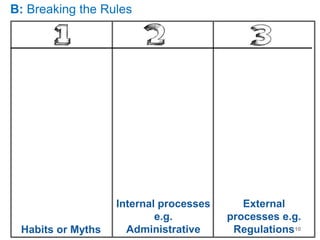
B: Breaking the Rules
Habits or Myths
Internal processes
e.g.
Administrative
External
processes e.g.
Regulations10
B: Giving permission
11
Activity Action By
whom
By
when
Breaking the Rules
Giving Permission
Sharing your session
B: Action Plan
12
Section C:
Slide by slide facilitation guide for
a “breaking the rules” session
13
map
14
• On your tables are some “introductions
dice”
• Each person should introduce themselves
to others on the table, roll the dice and
answer the question they get from the dice
• Time: 5 minutes in total
Our starting point
C: The Ice Breaker
This ice breaker will:
• Kick start your session
• Create a break from regular work
• Break down any existing barriers
• Encourage interactions that
wouldn't usually take place
To play:
• Create the dice ahead of the
session (one per group of 5)
Activity: Ask individuals
on each table to role the dice and
answer the question that they get.
5 mins16
Sign up: bit.do/futurenursing
C: Setting the scene
This slide is to give an update on the
background of the 30 Day Challenges:
• Programme launches by Professor Jane
Cummings, Chief Nursing Officer for England
in March 2017
• Ideas Channel was open for six weeks from
December 2017 – it generated 250 ideas from
25,000 interactions
• 10 Building Blocks and 10 Enemies were
developed from looking at what the ideas were
telling us
• 30 Day Challenges were developed to respond
to these findings and to build positive
perceptions of the professions.
Activity:
encourage all participants to become
ambassadors and sign up to the 30
Day challenges
18
19
C: Setting the scene
This slide describes issues with
permission that people often
experience.
Too often staff feel unable to take the
initiative and start even small
improvements without filling in forms
or asking for a decision from
someone often more senior than
them.
This is sometimes real, and
sometimes a perception. When it is a
perception, it is real to that individual,
sometimes from historic relationships
rather than the current environment.
Activity:
you may want to ask the group to
share their experiences,
which may be positive or negative
5 mins 20
Two kinds of people at work
The Compliant
• Feel disconnected from
purpose
• Controlled & coordinated
through performance
management and
standardised procedures
• Hold back
• Resist change
• Work to a role specification
Adapted from The Emotional Economy http://emotionaleconomy.com.au/papers-articles/why-the-
winners-in-business-are-taking-the-time-to-build-a-positive-kind-social-culture/
Two kinds of people at work
• Feel connected to a
higher purpose
• Direction set through
shared goals & values
(“magnetic north”)
• Collaborate
• Embrace change
• Work to who they are
The Contributor
• Feel disconnected from
purpose
• Controlled & coordinated
through performance
management and
standardised procedures
• Hold back
• Resist change
• Work to a role specification
Adapted from The Emotional Economy http://emotionaleconomy.com.au/papers-articles/why-the-
winners-in-business-are-taking-the-time-to-build-a-positive-kind-social-culture/
The Compliant
Two kinds of people at work
• Feel connected to a
higher purpose
• Direction set
through shared goals &
values (“magnetic
north”)
• Collaborate
• Embrace change
• Work to who they are
The Contributor
Adapted from The Emotional Economy http://emotionaleconomy.com.au/papers-articles/why-the-
winners-in-business-are-taking-the-time-to-build-a-positive-kind-social-culture/
Gallup
global research:
• Only 13% of the workforce
are engaged (Contributors)
• Contributors create six
times the value to an
organisation compared to
the compliant
The Compliant
http://www.gallup.com/poll/165269/w
orldwide-employees-engaged-
work.aspx
C: Two kinds of people at work
This slide is to start to get the group
thinking about the two kinds of people
at work.
The Compliant will appear first for
the presentation and reflects a
negative environment for change.
The Contributor will appear on the
second click and reflects a different
way of thinking that empowers
colleagues and is inclusive of diverse
views.
The next slide gives you a Gallup
Survey quote.
Activity: you may want to
ask the group to share experiences of
working with (or for) both these types
of people
5 mins24
• What ‘rules’ get in the way and stop
us being contributors?
• What ‘rules’ are barriers to us
commissioning/supporting/delivering
great care to every patient and
citizen?
• What ‘rules’ would you like to break?
C: Break the rules: Slide 1 of 3
This slide starts to get the group into
thinking about some of the things
that get in the way of us being a
contributor.
Here are some examples:
• Calling student nurses ‘the
student’
• Not being allowed to have a bottle
of water on the ward
• Only band 7 and above can use
lifts
• Duplication of paperwork
• Flexibility of break times
• Planning off duty only a few weeks
ahead
Activity:
on the next slide
26
If you could break, challenge or change any
rules in service of a better experience and/or
outcome for patients, population or staff,
what would they be?
Discuss as a table and write each idea on a
post it note
Time available: 20 minutes
C Break the rules: slide 2 of 3
This slide is to get the group taking
action. Working as small groups of 4
to 5 ask the participants should start
sharing the rules that they would like
to break, challenge or change if they
could. They can come up with as
many as they like.
It’s important that the ideas generated
are written clearly on individual sticky
notes.
You may want to use different colours
for break, challenge and change
rules.
Activity:
discuss as a table what rules the
group would break, challenge or
change if the could. Write ideas on a
post-it.
20 mins28
Kinds of rules:
1. Habits or myths that are perceived to be
rules but might not be
2. Administrative rules or policies that your
organisation has the power to change
3. Rules that are in place due to regulations or
policies beyond the control of the
organisation
Source: The IHI
C: Break the rules: slide 3 of 3
This slide is to set out the three kinds
of rules that often appear to get in the
way of giving great care:
1. Habit and myths
Often long held views, passed down
from people who have since left the
organisation
2. Administrative rules
Internal organisational policies and
procedures
3. Regulations beyond the control of
the organisation
Rules that require national input,
influence or action to change
Activity:
using the large poster (slide 8) agree
together and place the post-its in the
column that it best fits. See example
slide
15 mins
31
Habits or Myths Internal processes
e.g. Administrative
External processes
e.g. Regulations
“The action of officially allowing
someone to do a particular thing;
consent or authorisation”
C: Giving permission: slide 1 of 3
This slide is for you to start
switching the ‘can’t do’ to a ‘can do’
mind-set.
At this point you will make the
declaration that you will start moving
towards giving permission to
yourselves individually, as well as
your teams.
Activity: two slides ahead
33
C: Giving permission: slide 2 of 3
This slide gives some examples
of what permissions you may like
to take as a group.
Activity: on next slide
34
C: Giving permission: slide 3 of 3
This slide is for the group
to take action and start
coming up with 6 – 9
permissions that you want
to agree to as a group
Activity: agree together
the permissions that you want to work
with together going forward
6 mins
35
C: Action Plan
This slide is a visual of the
action planner. It is to ensure
you leave the session with
clarity on your next steps are
and who will do what by when.
Activity: list the key
activities in the different tasks
from today’s session and agree
together what needs doing now
to make this happen
Activity Action By
whom
By when
Breaking the
Rules
1. Insert rules to
break
Add here what you will now to
make this happen e.g who will
you share this with? How will
you share it
who will
take the
lead
When
will this
be done
by
2. Insert rules to
challenge
Add here what you will now to
make this happen e.g who will
you share this with? How will
you share it
who will
take the
lead
When
will this
be done
by
3. Insert rules to
change
Add here what you will now to
make this happen e.g who will
you share this with? How will
you share it
who will
take the
lead
When
will this
be done
by
Giving Permission Add here what you will now to
make this happen e.g who will
you share this with? How will
you share it
who will
take the
lead
When
will this
be done
by
Sharing your
session
How will you share the outputs
from your session across your
organisations to include others
who will
take the
lead
When
will this
be done
by
36
C: Thank you
This slide has some examples of
‘thank you’ images that you may
like to use for your personalised
slide deck if you don’t have one
already:
40
E: Resources
The following may be useful resources if you would like to read
more about Breaking the Rules:
IHI “Breaking the Rules” resources guide
http://www.ihi.org/Engage/collaboratives/LeadershipAlliance/Documents/
Breaking-Rules-Better-Care-Resource-Guide.pdf
Koen Smets “The rules illusion”
https://medium.com/new-organizational-insights/the-rule-illusion-
c692fb007fff
The emotional economy
http://emotionaleconomy.com.au/papers-articles/why-the-winners-in-
business-are-taking-the-time-to-build-a-positive-kind-social-culture/
41

Break the "Rules"_ Facilitators Guide_aug2018

  • 1.
    A facilitator’s guideto running a “breaking the rules” session #FutureNursing #FutureMidwifery 1
  • 2.
    Contents Mission Section A Why “breakthe rules”? Preparing for the session 3 4 Section B Templates for printing Draft letter Poster Ice breaker Breaking the Rules Giving Permission Action Planning 6 Section C Your slide by slide facilitation guide. This pack includes examples of the analysis from other organisations that have analysed their “rule breaking” and “permissions” 13 Section E Additional resources 42 Resources developed by NHS Horizons for Transforming Perceptions of Nursing and Midwifery 30 Day Challenges 2018 2
  • 3.
    Why break therules? Rules are important. They keep us and our patients safe. Rules ensure fairness. They help make sure that everyone knows what to do. They keep the health and care system operating every day. But there is a downside to rules. Often they have an unintended impact on us and the people we serve. They can make us feel that we cannot innovate or improve things because we don’t have “permission”. Rules sometimes contribute to a culture of conformity and get in the way of intelligent judgment and actually doing what is right. So, in suggesting that you “break the rules” for the August 30 day challenge, we aren’t asking you to create havoc in your organisation! Rather, we are asking you to think about the rules, customs, ways of working, habits, policies, and procedures that get in the way of great care and great team working. Rules that restrict more than they enable deserve to be broken. Breaking the rules is about showing that nurses and midwives can lead the way to better care and better ways of working. Effective rules are not static — they evolve. But that evolution has to be driven by people who are willing to stand up for what is right, challenge the status quo and create a better future. Nurses and midwives can be these people. 3
  • 4.
    Section A: Preparing forthe session Resources required  Slide set  Post it notes (ideally in 3 different colours or )  Pens  Dice  Two large wall posters* (4 sheets of flipchart sticky taped together)  Personalised slide deck Things to do  Recruit 5-10 colleagues  Book a room or workspace  Invite your Chief Nurse or DoN or HoM to drop in  Arrange refreshments  Personalise the pre-prepared slide deck  Printing: Dice Breaking the Rules Poster Giving Permission Poster 4
  • 5.
    A: Find yourpeople What to do  Draft a letter for your DoN or HoM to send to all nurses and midwives inviting them to take part  Put a notice on the staff intranet  Consider how more people can get involved after the meeting by creating a physical or virtual display board 5
  • 6.
    Section B: Templates fora “break the rules” session 6
  • 7.
    B. Sample textfor an email or announcement Feel free to adapt the following to raise awareness of your session and to invite other nurses and midwives to join in you “Break the Rules” 30 Day Challenge for building positive perceptions {Your organisation name} is pleased to confirm that we are engaging in the Transforming Perceptions of Nursing and Midwifery 12 30 Day Challenges. August’s challenge is to host a “Break the Rules” session. We aim to support our colleagues and patients to have positive experiences. However, sometimes we inadvertently create processes or policies that have unintended impact on the people in our care. To view the existing systems through a new lens, for August {insert your timeframe if different} we will encourage nurses and midwives, as well as our wider team colleagues across our Trust to answer this question: If you could break, challenge or change rules in service of a better experience or outcome for patients and staff, what would they be? The suggestions we receive will be used to improve care across our organisation {insert other words if needed} {Insert how here} To find about more, or to get involved please email {insert name and email address} Kind regards {insert names} Source: The IHI (adapted) 7
  • 8.
  • 9.
  • 10.
    B: Breaking theRules Habits or Myths Internal processes e.g. Administrative External processes e.g. Regulations10
  • 11.
  • 12.
    Activity Action By whom By when Breakingthe Rules Giving Permission Sharing your session B: Action Plan 12
  • 13.
    Section C: Slide byslide facilitation guide for a “breaking the rules” session 13
  • 14.
  • 15.
    • On yourtables are some “introductions dice” • Each person should introduce themselves to others on the table, roll the dice and answer the question they get from the dice • Time: 5 minutes in total Our starting point
  • 16.
    C: The IceBreaker This ice breaker will: • Kick start your session • Create a break from regular work • Break down any existing barriers • Encourage interactions that wouldn't usually take place To play: • Create the dice ahead of the session (one per group of 5) Activity: Ask individuals on each table to role the dice and answer the question that they get. 5 mins16
  • 17.
  • 18.
    C: Setting thescene This slide is to give an update on the background of the 30 Day Challenges: • Programme launches by Professor Jane Cummings, Chief Nursing Officer for England in March 2017 • Ideas Channel was open for six weeks from December 2017 – it generated 250 ideas from 25,000 interactions • 10 Building Blocks and 10 Enemies were developed from looking at what the ideas were telling us • 30 Day Challenges were developed to respond to these findings and to build positive perceptions of the professions. Activity: encourage all participants to become ambassadors and sign up to the 30 Day challenges 18
  • 19.
  • 20.
    C: Setting thescene This slide describes issues with permission that people often experience. Too often staff feel unable to take the initiative and start even small improvements without filling in forms or asking for a decision from someone often more senior than them. This is sometimes real, and sometimes a perception. When it is a perception, it is real to that individual, sometimes from historic relationships rather than the current environment. Activity: you may want to ask the group to share their experiences, which may be positive or negative 5 mins 20
  • 21.
    Two kinds ofpeople at work The Compliant • Feel disconnected from purpose • Controlled & coordinated through performance management and standardised procedures • Hold back • Resist change • Work to a role specification Adapted from The Emotional Economy http://emotionaleconomy.com.au/papers-articles/why-the- winners-in-business-are-taking-the-time-to-build-a-positive-kind-social-culture/
  • 22.
    Two kinds ofpeople at work • Feel connected to a higher purpose • Direction set through shared goals & values (“magnetic north”) • Collaborate • Embrace change • Work to who they are The Contributor • Feel disconnected from purpose • Controlled & coordinated through performance management and standardised procedures • Hold back • Resist change • Work to a role specification Adapted from The Emotional Economy http://emotionaleconomy.com.au/papers-articles/why-the- winners-in-business-are-taking-the-time-to-build-a-positive-kind-social-culture/ The Compliant
  • 23.
    Two kinds ofpeople at work • Feel connected to a higher purpose • Direction set through shared goals & values (“magnetic north”) • Collaborate • Embrace change • Work to who they are The Contributor Adapted from The Emotional Economy http://emotionaleconomy.com.au/papers-articles/why-the- winners-in-business-are-taking-the-time-to-build-a-positive-kind-social-culture/ Gallup global research: • Only 13% of the workforce are engaged (Contributors) • Contributors create six times the value to an organisation compared to the compliant The Compliant http://www.gallup.com/poll/165269/w orldwide-employees-engaged- work.aspx
  • 24.
    C: Two kindsof people at work This slide is to start to get the group thinking about the two kinds of people at work. The Compliant will appear first for the presentation and reflects a negative environment for change. The Contributor will appear on the second click and reflects a different way of thinking that empowers colleagues and is inclusive of diverse views. The next slide gives you a Gallup Survey quote. Activity: you may want to ask the group to share experiences of working with (or for) both these types of people 5 mins24
  • 25.
    • What ‘rules’get in the way and stop us being contributors? • What ‘rules’ are barriers to us commissioning/supporting/delivering great care to every patient and citizen? • What ‘rules’ would you like to break?
  • 26.
    C: Break therules: Slide 1 of 3 This slide starts to get the group into thinking about some of the things that get in the way of us being a contributor. Here are some examples: • Calling student nurses ‘the student’ • Not being allowed to have a bottle of water on the ward • Only band 7 and above can use lifts • Duplication of paperwork • Flexibility of break times • Planning off duty only a few weeks ahead Activity: on the next slide 26
  • 27.
    If you couldbreak, challenge or change any rules in service of a better experience and/or outcome for patients, population or staff, what would they be? Discuss as a table and write each idea on a post it note Time available: 20 minutes
  • 28.
    C Break therules: slide 2 of 3 This slide is to get the group taking action. Working as small groups of 4 to 5 ask the participants should start sharing the rules that they would like to break, challenge or change if they could. They can come up with as many as they like. It’s important that the ideas generated are written clearly on individual sticky notes. You may want to use different colours for break, challenge and change rules. Activity: discuss as a table what rules the group would break, challenge or change if the could. Write ideas on a post-it. 20 mins28
  • 29.
    Kinds of rules: 1.Habits or myths that are perceived to be rules but might not be 2. Administrative rules or policies that your organisation has the power to change 3. Rules that are in place due to regulations or policies beyond the control of the organisation Source: The IHI
  • 30.
    C: Break therules: slide 3 of 3 This slide is to set out the three kinds of rules that often appear to get in the way of giving great care: 1. Habit and myths Often long held views, passed down from people who have since left the organisation 2. Administrative rules Internal organisational policies and procedures 3. Regulations beyond the control of the organisation Rules that require national input, influence or action to change Activity: using the large poster (slide 8) agree together and place the post-its in the column that it best fits. See example slide 15 mins
  • 31.
    31 Habits or MythsInternal processes e.g. Administrative External processes e.g. Regulations
  • 32.
    “The action ofofficially allowing someone to do a particular thing; consent or authorisation”
  • 33.
    C: Giving permission:slide 1 of 3 This slide is for you to start switching the ‘can’t do’ to a ‘can do’ mind-set. At this point you will make the declaration that you will start moving towards giving permission to yourselves individually, as well as your teams. Activity: two slides ahead 33
  • 34.
    C: Giving permission:slide 2 of 3 This slide gives some examples of what permissions you may like to take as a group. Activity: on next slide 34
  • 35.
    C: Giving permission:slide 3 of 3 This slide is for the group to take action and start coming up with 6 – 9 permissions that you want to agree to as a group Activity: agree together the permissions that you want to work with together going forward 6 mins 35
  • 36.
    C: Action Plan Thisslide is a visual of the action planner. It is to ensure you leave the session with clarity on your next steps are and who will do what by when. Activity: list the key activities in the different tasks from today’s session and agree together what needs doing now to make this happen Activity Action By whom By when Breaking the Rules 1. Insert rules to break Add here what you will now to make this happen e.g who will you share this with? How will you share it who will take the lead When will this be done by 2. Insert rules to challenge Add here what you will now to make this happen e.g who will you share this with? How will you share it who will take the lead When will this be done by 3. Insert rules to change Add here what you will now to make this happen e.g who will you share this with? How will you share it who will take the lead When will this be done by Giving Permission Add here what you will now to make this happen e.g who will you share this with? How will you share it who will take the lead When will this be done by Sharing your session How will you share the outputs from your session across your organisations to include others who will take the lead When will this be done by 36
  • 40.
    C: Thank you Thisslide has some examples of ‘thank you’ images that you may like to use for your personalised slide deck if you don’t have one already: 40
  • 41.
    E: Resources The followingmay be useful resources if you would like to read more about Breaking the Rules: IHI “Breaking the Rules” resources guide http://www.ihi.org/Engage/collaboratives/LeadershipAlliance/Documents/ Breaking-Rules-Better-Care-Resource-Guide.pdf Koen Smets “The rules illusion” https://medium.com/new-organizational-insights/the-rule-illusion- c692fb007fff The emotional economy http://emotionaleconomy.com.au/papers-articles/why-the-winners-in- business-are-taking-the-time-to-build-a-positive-kind-social-culture/ 41

Editor's Notes

  • #14 aisyeashfksdjhfiauebedfiugws