Consumer Behavior
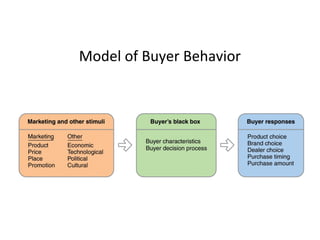
Model of Buyer Behavior
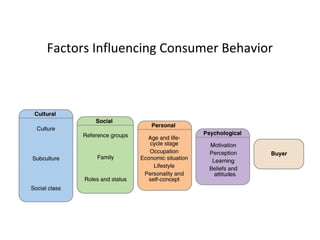
Factors Influencing Consumer Behavior
• Culture is often the most powerful cause of a
person's needs, wants and behavior.
• Characteristics of Culture
– Culture is learned.
– Certain aspects of culture never change.
– Cultural shifts create opportunities.
– Subcultures can be of even greater interest to
marketers than cultures.
Culture
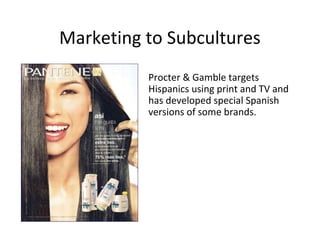
Marketing to Subcultures
Procter & Gamble targets
Hispanics using print and TV and
has developed special Spanish
versions of some brands.
• Society’s relatively permanent and ordered
divisions
• Social Class Members share similar values,
interests, and purchase behaviors
• Indentify by: income, occupation, education,
wealth, and other variables
• Opportunity: “Social Mobility” products
Social Class
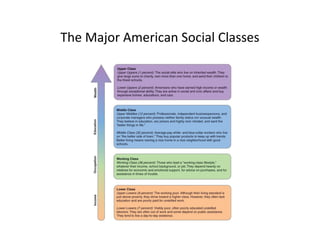
The Major American Social Classes
• Groups:
– Reference Groups
– Aspirational Groups
– Dissociative Groups
• Opinion Leaders
• Family
• Roles and Status
Social Factors
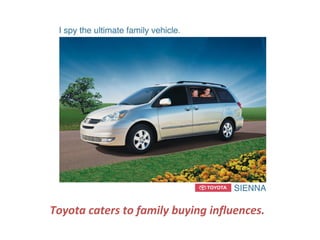
Toyota caters to family buying influences.
• Age and Life-Cycle Stage
– Tastes and preferences change over time.
• Occupation
– Occupation influences the purchase of clothing, cars, memberships, etc.
• Economic Situation
– Income-sensitive goods
– Counter-cyclical goods
Personal Factors
Personal Factors
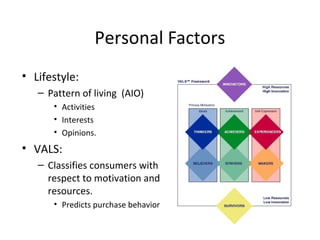
• Lifestyle:
– Pattern of living (AIO)
• Activities
• Interests
• Opinions.
• VALS:
– Classifies consumers with
respect to motivation and
resources.
• Predicts purchase behavior
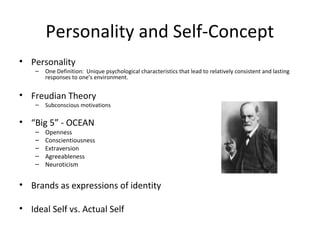
• Personality
– One Definition: Unique psychological characteristics that lead to relatively consistent and lasting
responses to one’s environment.
• Freudian Theory
– Subconscious motivations
• “Big 5” - OCEAN
– Openness
– Conscientiousness
– Extraversion
– Agreeableness
– Neuroticism
• Brands as expressions of identity
• Ideal Self vs. Actual Self
Personality and Self-Concept
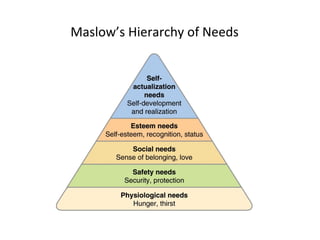
Maslow’s Hierarchy of Needs
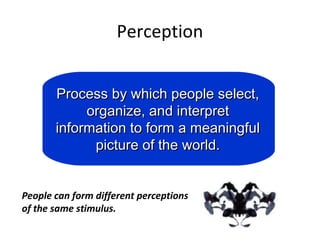
Perception
Process by which people select,Process by which people select,
organize, and interpretorganize, and interpret
information to form a meaningfulinformation to form a meaningful
picture of the world.picture of the world.
People can form different perceptions
of the same stimulus.
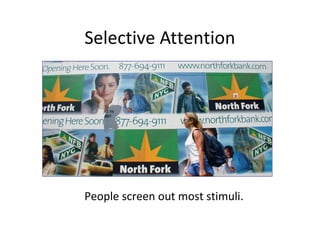
Selective Attention
People screen out most stimuli.
Selective Distortion vs. Retention
• Selective Distortion
– Interpreting information in a way that supports what you already
believe.
• Selective Retention
– Remembering the good aspects of something you like and forgetting
the bad aspects of something you dislike.
• One Definition:
– A relatively permanent change in behavior due to experience.
• Driven by stimulus-response chains (conditioning).
• Strongly influenced by behavioral consequences
(Operant Conditioning)
– Behaviors with satisfying results are repeated.
– Behaviors with unsatisfying results are avoided.
• Different from deliberation
Learning
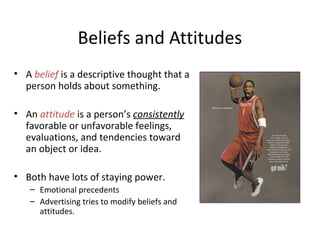
Beliefs and Attitudes
• A belief is a descriptive thought that a
person holds about something.
• An attitude is a person’s consistently
favorable or unfavorable feelings,
evaluations, and tendencies toward
an object or idea.
• Both have lots of staying power.
– Emotional precedents
– Advertising tries to modify beliefs and
attitudes.
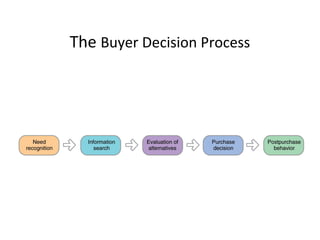
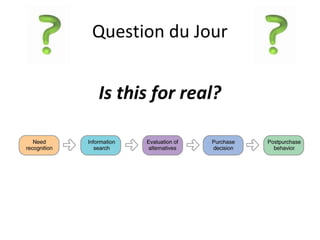
The Buyer Decision Process
Need Recognition
Buyers recognize aBuyers recognize a
need or problem as aneed or problem as a
result of internal orresult of internal or
external stimuli.external stimuli.
Marketing communications often stimulate
need recognition.
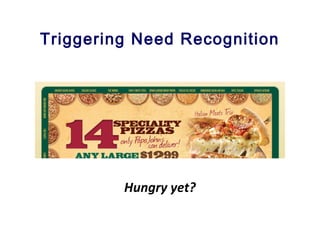
Hungry yet?
Triggering Need Recognition
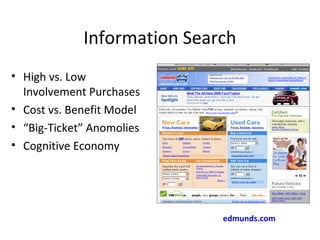
Information Search
• High vs. Low
Involvement Purchases
• Cost vs. Benefit Model
• “Big-Ticket” Anomolies
• Cognitive Economy
edmunds.com
Information Sources
– Personal
• Family, friends, neighbors,
and casual or work
acquaintances
– Commercial
• Advertising, salespeople,
dealers, Web sites,
packaging, and displays
– Public
• Mass media articles or news
programs, Internet searches,
consumer rating organizations
– Experiential
• Using, handling, examining or
sampling the product
Which source is most influential?
• ELM: Central vs. Peripheral Route processing
• Some Types of Evaluation Calculus:
– Compensatory vs. Non-compensatory
– Weighted Tally Processes
– Elimination-by-aspects
– Lexicographic
– “Checkbox Choice”
– Affect Referral
Evaluation of Alternatives
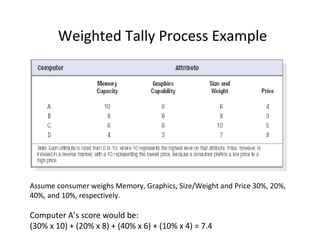
Weighted Tally Process Example
Assume consumer weighs Memory, Graphics, Size/Weight and Price 30%, 20%,
40%, and 10%, respectively.
Computer A’s score would be:
(30% x 10) + (20% x 8) + (40% x 6) + (10% x 4) = 7.4
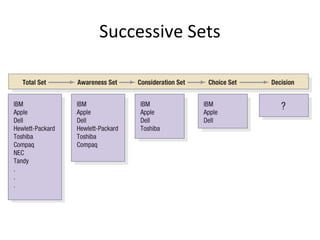
Successive Sets
Purchase Decision
• Intentions to purchase are sometimes
interrupted.
• Potential “Interrupters”:
– Attitudes & influences of others
– Unexpected situational
factors
– Buyer’s Remorse
– Speed of decision
Postpurchase Behavior
• Consumer satisfaction/dissatisfaction results from gaps
between expectations and perceived performance.
– Performance BELOW Expectations → Disappointment
– Performance EQUALS Expectations → Satisfaction
– Performance GREATER than Expectations → Delight
– Performance MUCH GREATER than Expectations →
Expectation Recalibration
• Cognitive Dissonance: “Did I make the right
purchase? Should I have bought this?”
• Minimize dissonance by:
– Offering mechanisms for making complaints
(Customer Service, 800 hotlines, e-mail, etc.)
– Being responsive to problems and questions
– Advertising (remind consumer why choice made sense)
– Minimizing the potential for product misuse (good product
instructions) and “Poke-Yoke”.
Cognitive Dissonance
Question du Jour
Is this for real?
1. Awareness
2. Interest
3. Evaluation
4. Trial
5. Re-Trial
6. Adoption
The Adoption Process
Not everyone adopts at the same pace.
• Innovators: venturesome, try new ideas at some
risk.
• Early adopters: opinion leaders who adopt new ideas
early, but carefully.
• Early majority: deliberate adopters, who adopt
before the average person.
• Late majority: skeptical, adopt only after the majority
of people have tried a product.
• Laggards: last to adopt, tradition bound, and
skeptical of change.
Product Adopter Categories
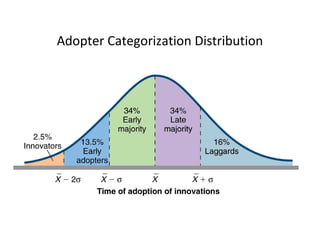
Adopter Categorization Distribution
• Relative Advantage
– Is the innovation perceived as superior to existing products?
• Compatibility
– Does the innovation fit the values, behavior and experience of the
target market?
• Complexity
– Is the innovation difficult to understand or use or perceived as such?
• Utility & Cost-Benefit
– Can the innovation be used extensively or on a more limited basis?
• Communicability
– Can results be easily observed and described to others?
Product Characteristics That Influence the
Rate of Adoption
Question du Jour
Do consumers always know what
they really want or need?
Other Consumer Behavior
Models & Theories
Reactance
• Reactance is an
emotional reaction in
direct contradiction to
rules or regulations that
threaten or eliminate
specific behavioral
freedoms. - Wikipedia
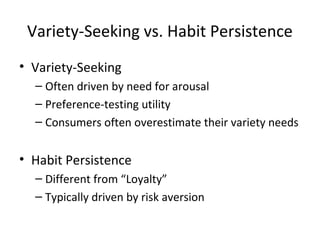
Variety-Seeking vs. Habit Persistence
• Variety-Seeking
– Often driven by need for arousal
– Preference-testing utility
– Consumers often overestimate their variety needs
• Habit Persistence
– Different from “Loyalty”
– Typically driven by risk aversion
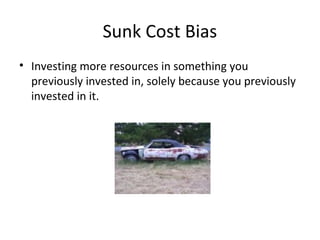
Sunk Cost Bias
• Investing more resources in something you
previously invested in, solely because you previously
invested in it.
False Consensus Bias
• Not everyone thinks like you, expects what
you expect, believes what you believe.
Very dangerous for marketers.
Decision Heuristics
• Anchoring & Adjustment
– Reference Points
• Emotion
– Mood Regulation
• Elevation
• Maintenance
– Affect Evaluation
– Effects on Risk Taking
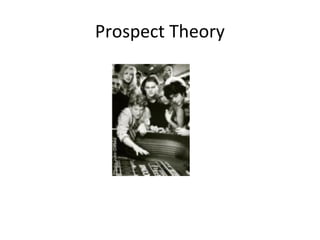
Prospect Theory
Mental Accounting
• Consumers…
– Segregate gains
– Integrate losses
– Integrate smaller losses with larger gains
– Segregate small gains from large losses
Implications for marketing strategy?
In-Class Activity – WHY WE BUY
Choose a product, product line, brand, or company and answer the following:
• What are the obvious (i.e. more superficial) reasons why consumers buy
these products?
• What are the not-so-obvious, more deep-seated reasons/motivations why
consumers buy these products?
• What are the obvious (i.e. more superficial) reasons why consumers do
not buy these products?
• What are the not-so-obvious, more deep-seated reasons/motivations why
consumers do not buy these products?
• Choose one or more of the above reasons/motivations to buy or not buy
and provide an appropriate implication for Marketing strategy.

Consumer behavior notes

  • 1.
  • 2.
  • 3.
  • 4.
    • Culture isoften the most powerful cause of a person's needs, wants and behavior. • Characteristics of Culture – Culture is learned. – Certain aspects of culture never change. – Cultural shifts create opportunities. – Subcultures can be of even greater interest to marketers than cultures. Culture
  • 5.
    Marketing to Subcultures Procter& Gamble targets Hispanics using print and TV and has developed special Spanish versions of some brands.
  • 6.
    • Society’s relativelypermanent and ordered divisions • Social Class Members share similar values, interests, and purchase behaviors • Indentify by: income, occupation, education, wealth, and other variables • Opportunity: “Social Mobility” products Social Class
  • 7.
    The Major AmericanSocial Classes
  • 8.
    • Groups: – ReferenceGroups – Aspirational Groups – Dissociative Groups • Opinion Leaders • Family • Roles and Status Social Factors
  • 9.
    Toyota caters tofamily buying influences.
  • 10.
    • Age andLife-Cycle Stage – Tastes and preferences change over time. • Occupation – Occupation influences the purchase of clothing, cars, memberships, etc. • Economic Situation – Income-sensitive goods – Counter-cyclical goods Personal Factors
  • 11.
    Personal Factors • Lifestyle: –Pattern of living (AIO) • Activities • Interests • Opinions. • VALS: – Classifies consumers with respect to motivation and resources. • Predicts purchase behavior
  • 12.
    • Personality – OneDefinition: Unique psychological characteristics that lead to relatively consistent and lasting responses to one’s environment. • Freudian Theory – Subconscious motivations • “Big 5” - OCEAN – Openness – Conscientiousness – Extraversion – Agreeableness – Neuroticism • Brands as expressions of identity • Ideal Self vs. Actual Self Personality and Self-Concept
  • 13.
  • 14.
    Perception Process by whichpeople select,Process by which people select, organize, and interpretorganize, and interpret information to form a meaningfulinformation to form a meaningful picture of the world.picture of the world. People can form different perceptions of the same stimulus.
  • 15.
  • 16.
    Selective Distortion vs.Retention • Selective Distortion – Interpreting information in a way that supports what you already believe. • Selective Retention – Remembering the good aspects of something you like and forgetting the bad aspects of something you dislike.
  • 17.
    • One Definition: –A relatively permanent change in behavior due to experience. • Driven by stimulus-response chains (conditioning). • Strongly influenced by behavioral consequences (Operant Conditioning) – Behaviors with satisfying results are repeated. – Behaviors with unsatisfying results are avoided. • Different from deliberation Learning
  • 18.
    Beliefs and Attitudes •A belief is a descriptive thought that a person holds about something. • An attitude is a person’s consistently favorable or unfavorable feelings, evaluations, and tendencies toward an object or idea. • Both have lots of staying power. – Emotional precedents – Advertising tries to modify beliefs and attitudes.
  • 19.
  • 20.
    Need Recognition Buyers recognizeaBuyers recognize a need or problem as aneed or problem as a result of internal orresult of internal or external stimuli.external stimuli. Marketing communications often stimulate need recognition.
  • 21.
  • 22.
    Information Search • Highvs. Low Involvement Purchases • Cost vs. Benefit Model • “Big-Ticket” Anomolies • Cognitive Economy edmunds.com
  • 23.
    Information Sources – Personal •Family, friends, neighbors, and casual or work acquaintances – Commercial • Advertising, salespeople, dealers, Web sites, packaging, and displays – Public • Mass media articles or news programs, Internet searches, consumer rating organizations – Experiential • Using, handling, examining or sampling the product Which source is most influential?
  • 24.
    • ELM: Centralvs. Peripheral Route processing • Some Types of Evaluation Calculus: – Compensatory vs. Non-compensatory – Weighted Tally Processes – Elimination-by-aspects – Lexicographic – “Checkbox Choice” – Affect Referral Evaluation of Alternatives
  • 25.
    Weighted Tally ProcessExample Assume consumer weighs Memory, Graphics, Size/Weight and Price 30%, 20%, 40%, and 10%, respectively. Computer A’s score would be: (30% x 10) + (20% x 8) + (40% x 6) + (10% x 4) = 7.4
  • 26.
  • 27.
    Purchase Decision • Intentionsto purchase are sometimes interrupted. • Potential “Interrupters”: – Attitudes & influences of others – Unexpected situational factors – Buyer’s Remorse – Speed of decision
  • 28.
    Postpurchase Behavior • Consumersatisfaction/dissatisfaction results from gaps between expectations and perceived performance. – Performance BELOW Expectations → Disappointment – Performance EQUALS Expectations → Satisfaction – Performance GREATER than Expectations → Delight – Performance MUCH GREATER than Expectations → Expectation Recalibration
  • 29.
    • Cognitive Dissonance:“Did I make the right purchase? Should I have bought this?” • Minimize dissonance by: – Offering mechanisms for making complaints (Customer Service, 800 hotlines, e-mail, etc.) – Being responsive to problems and questions – Advertising (remind consumer why choice made sense) – Minimizing the potential for product misuse (good product instructions) and “Poke-Yoke”. Cognitive Dissonance
  • 30.
    Question du Jour Isthis for real?
  • 31.
    1. Awareness 2. Interest 3.Evaluation 4. Trial 5. Re-Trial 6. Adoption The Adoption Process
  • 32.
    Not everyone adoptsat the same pace. • Innovators: venturesome, try new ideas at some risk. • Early adopters: opinion leaders who adopt new ideas early, but carefully. • Early majority: deliberate adopters, who adopt before the average person. • Late majority: skeptical, adopt only after the majority of people have tried a product. • Laggards: last to adopt, tradition bound, and skeptical of change. Product Adopter Categories
  • 33.
  • 34.
    • Relative Advantage –Is the innovation perceived as superior to existing products? • Compatibility – Does the innovation fit the values, behavior and experience of the target market? • Complexity – Is the innovation difficult to understand or use or perceived as such? • Utility & Cost-Benefit – Can the innovation be used extensively or on a more limited basis? • Communicability – Can results be easily observed and described to others? Product Characteristics That Influence the Rate of Adoption
  • 35.
    Question du Jour Doconsumers always know what they really want or need?
  • 36.
  • 37.
    Reactance • Reactance isan emotional reaction in direct contradiction to rules or regulations that threaten or eliminate specific behavioral freedoms. - Wikipedia
  • 38.
    Variety-Seeking vs. HabitPersistence • Variety-Seeking – Often driven by need for arousal – Preference-testing utility – Consumers often overestimate their variety needs • Habit Persistence – Different from “Loyalty” – Typically driven by risk aversion
  • 39.
    Sunk Cost Bias •Investing more resources in something you previously invested in, solely because you previously invested in it.
  • 40.
    False Consensus Bias •Not everyone thinks like you, expects what you expect, believes what you believe. Very dangerous for marketers.
  • 41.
    Decision Heuristics • Anchoring& Adjustment – Reference Points • Emotion – Mood Regulation • Elevation • Maintenance – Affect Evaluation – Effects on Risk Taking
  • 42.
  • 43.
    Mental Accounting • Consumers… –Segregate gains – Integrate losses – Integrate smaller losses with larger gains – Segregate small gains from large losses Implications for marketing strategy?
  • 44.
    In-Class Activity –WHY WE BUY Choose a product, product line, brand, or company and answer the following: • What are the obvious (i.e. more superficial) reasons why consumers buy these products? • What are the not-so-obvious, more deep-seated reasons/motivations why consumers buy these products? • What are the obvious (i.e. more superficial) reasons why consumers do not buy these products? • What are the not-so-obvious, more deep-seated reasons/motivations why consumers do not buy these products? • Choose one or more of the above reasons/motivations to buy or not buy and provide an appropriate implication for Marketing strategy.