
Lists Chapter 6 Nyhoff, ADTs, Data Structures and Problem Solving with C++, Second Edition, © 2005 Pearson Education, Inc. All rights reserved. 0-13-140909-3
Chapter Contents 6.1 List as an ADT 6.2 An Array-Based Implementation of Lists 6.3 An array Based Implementation of Lists with Dynamic Allocation 6.4 Introduction to Linked Lists 6.5 A Pointer-Based Implementation of Linked Lists in C++ 6.6 An Array-Based Implementation of Linked Lists optional) Nyhoff, ADTs, Data Structures and Problem Solving with C++, Second Edition, © 2005 Pearson Education, Inc. All rights reserved. 0-13-140909-3
Chapter Objectives To study list as an ADT Build a static-array-based implementation of lists and note strengths, weaknesses Build a dynamic-array-based implementation of lists, noting strengths and weaknesses See need for destructor, copy constructor, assignment methods Take first look at linked lists, note strengths, weaknesses Study pointer-based implementation of linked lists (Optional) Study array-based implementation of linked lists Nyhoff, ADTs, Data Structures and Problem Solving with C++, Second Edition, © 2005 Pearson Education, Inc. All rights reserved. 0-13-140909-3
Consider Every Day Lists Groceries to be purchased Job to-do list List of assignments for a course Dean's list Can you name some others?? Nyhoff, ADTs, Data Structures and Problem Solving with C++, Second Edition, © 2005 Pearson Education, Inc. All rights reserved. 0-13-140909-3
Properties of Lists Can have a single element Can have  no  elements There can be lists of lists We will look at the list as an abstract data type Homogeneous Finite length Sequential elements Nyhoff, ADTs, Data Structures and Problem Solving with C++, Second Edition, © 2005 Pearson Education, Inc. All rights reserved. 0-13-140909-3
Basic Operations Construct an empty list Determine whether or not empty Insert an element into the list Delete an element from the list Traverse (iterate through) the list to Modify Output Search for a specific value Copy or save Rearrange Nyhoff, ADTs, Data Structures and Problem Solving with C++, Second Edition, © 2005 Pearson Education, Inc. All rights reserved. 0-13-140909-3
Designing a  List  Class Should contain at least the following function members Constructor empty() insert() delete() display() Implementation involves Defining data members Defining function members from design phase Nyhoff, ADTs, Data Structures and Problem Solving with C++, Second Edition, © 2005 Pearson Education, Inc. All rights reserved. 0-13-140909-3
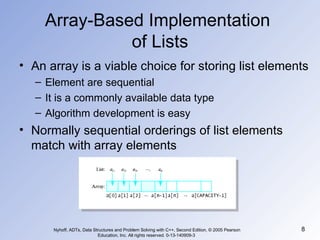
Array-Based Implementation  of Lists An array is a viable choice for storing list elements Element are sequential It is a commonly available data type Algorithm development is easy Normally sequential orderings of list elements match with array elements Nyhoff, ADTs, Data Structures and Problem Solving with C++, Second Edition, © 2005 Pearson Education, Inc. All rights reserved. 0-13-140909-3
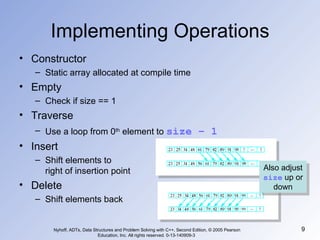
Implementing Operations Constructor Static array allocated at compile time Empty Check if size == 1 Traverse Use a loop from 0 th  element to  size – 1 Insert Shift elements to  right of insertion point Delete Shift elements back Nyhoff, ADTs, Data Structures and Problem Solving with C++, Second Edition, © 2005 Pearson Education, Inc. All rights reserved. 0-13-140909-3  Also adjust  size  up or down
List  Class with Static Array Must deal with issue of declaration of CAPACITY Use  typedef  mechanism typedef   Some_Specific_Type ElementType ElementType array[CAPACITY]; For specific implementation of our class we simply fill in desired type for  Some_Specific_Type Nyhoff, ADTs, Data Structures and Problem Solving with C++, Second Edition, © 2005 Pearson Education, Inc. All rights reserved. 0-13-140909-3
List  Class with Static Array Can put  typedef  declaration inside or outside of class Inside: must specify  List::ElementType  for reference to the type outside the class Outside: now able to use the  template  mechanism (this will be our choice) Also specify the  CAPACITY  as a  const Also choose to declare outside class Nyhoff, ADTs, Data Structures and Problem Solving with C++, Second Edition, © 2005 Pearson Education, Inc. All rights reserved. 0-13-140909-3
List  Class with Static Array - Problems Stuck with "one size fits all" Could be wasting space Could run out of space Better to have instantiation of specific list specify what the capacity should be Thus we consider creating a  List  class with dynamically-allocated array Nyhoff, ADTs, Data Structures and Problem Solving with C++, Second Edition, © 2005 Pearson Education, Inc. All rights reserved. 0-13-140909-3
Dynamic-Allocation for  List  Class Changes required in data members Eliminate const declaration for CAPACITY Add variable data member to store capacity specified by client program Change array data member to a pointer Constructor requires considerable change Little or no changes required for  empty() display() erase() insert() Nyhoff, ADTs, Data Structures and Problem Solving with C++, Second Edition, © 2005 Pearson Education, Inc. All rights reserved. 0-13-140909-3
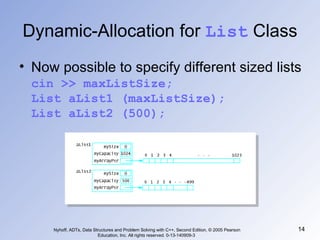
Dynamic-Allocation for  List  Class Now possible to specify different sized lists cin >> maxListSize; List aList1 (maxListSize); List aList2 (500); Nyhoff, ADTs, Data Structures and Problem Solving with C++, Second Edition, © 2005 Pearson Education, Inc. All rights reserved. 0-13-140909-3
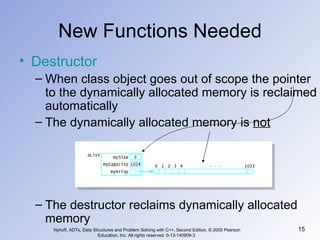
New Functions Needed Destructor When class object goes out of scope the pointer to the dynamically allocated memory is reclaimed automatically The dynamically allocated memory is  not The destructor reclaims dynamically allocated memory Nyhoff, ADTs, Data Structures and Problem Solving with C++, Second Edition, © 2005 Pearson Education, Inc. All rights reserved. 0-13-140909-3
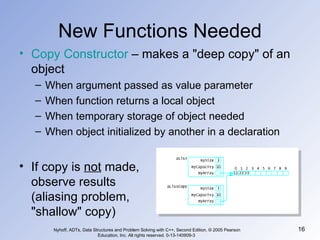
New Functions Needed Copy Constructor  – makes a "deep copy" of an object When argument passed as value parameter When function returns a local object When temporary storage of object needed When object initialized by another in a declaration If copy is  not  made,  observe results (aliasing problem,  "shallow" copy) Nyhoff, ADTs, Data Structures and Problem Solving with C++, Second Edition, © 2005 Pearson Education, Inc. All rights reserved. 0-13-140909-3
Linked List For the array-based implementation: First element is at location 0 Successor of item at location i is at location  i + 1 End is at location  size – 1 Fix: Remove requirement that list elements be stored in consecutive location. But then need a "link" that connects each element to its successor Nyhoff, ADTs, Data Structures and Problem Solving with C++, Second Edition, © 2005 Pearson Education, Inc. All rights reserved. 0-13-140909-3  Linked Lists !!
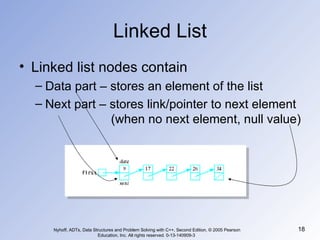
Linked List Linked list nodes contain Data part – stores an element of the list Next part – stores link/pointer to next element   (when no next element, null value) Nyhoff, ADTs, Data Structures and Problem Solving with C++, Second Edition, © 2005 Pearson Education, Inc. All rights reserved. 0-13-140909-3
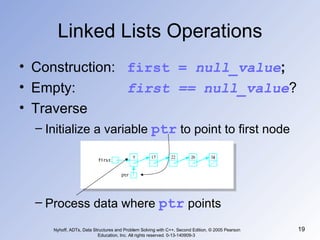
Linked Lists Operations Construction:  first =  null_value ; Empty:  first == null_value ? Traverse Initialize a variable  ptr  to point to first node Process data where  ptr  points Nyhoff, ADTs, Data Structures and Problem Solving with C++, Second Edition, © 2005 Pearson Education, Inc. All rights reserved. 0-13-140909-3
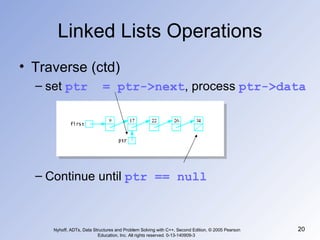
Linked Lists Operations Traverse (ctd) set  ptr  = ptr->next , process  ptr->data Continue until  ptr == null Nyhoff, ADTs, Data Structures and Problem Solving with C++, Second Edition, © 2005 Pearson Education, Inc. All rights reserved. 0-13-140909-3
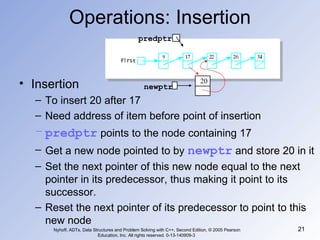
Operations: Insertion Insertion  To insert 20 after 17 Need address of item before point of insertion predptr  points to the node containing 17 Get a new node pointed to by  newptr  and store 20 in it Set the next pointer of this new node equal to the next pointer in its predecessor, thus making it point to its successor.  Reset the next pointer of its predecessor to point to this new node Nyhoff, ADTs, Data Structures and Problem Solving with C++, Second Edition, © 2005 Pearson Education, Inc. All rights reserved. 0-13-140909-3  20 newptr predptr
Operations: Insertion Note: insertion also works at  end  of list pointer member of new node set to  null Insertion at the  beginning  of the list predptr  must be set to  first pointer member of  newptr  set to that value first  set to value of  newptr    Note:  In all cases,   no shifting of list elements is required ! Nyhoff, ADTs, Data Structures and Problem Solving with C++, Second Edition, © 2005 Pearson Education, Inc. All rights reserved. 0-13-140909-3
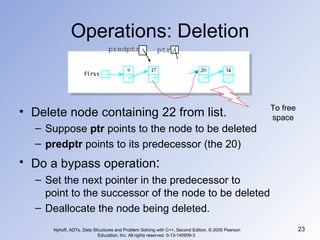
Operations: Deletion Delete node containing 22 from list. Suppose  ptr  points to the node to be deleted predptr  points to its predecessor (the 20) Do a bypass operation :  Set the next pointer in the predecessor to  point to the successor of the node to be deleted Deallocate the node being deleted.  Nyhoff, ADTs, Data Structures and Problem Solving with C++, Second Edition, © 2005 Pearson Education, Inc. All rights reserved. 0-13-140909-3  ptr predptr To free space
Linked Lists - Advantages Access any item as long as external link to first item maintained Insert new item without shifting Delete existing item without shifting Can expand/contract as necessary Nyhoff, ADTs, Data Structures and Problem Solving with C++, Second Edition, © 2005 Pearson Education, Inc. All rights reserved. 0-13-140909-3
Linked Lists - Disadvantages List-processing algorithms that require fast access to each element cannot be done as efficiently with linked lists. Consider adding an element at the end of the list Nyhoff, ADTs, Data Structures and Problem Solving with C++, Second Edition, © 2005 Pearson Education, Inc. All rights reserved. 0-13-140909-3  Array Linked List a[ size ++] = value; Get a new node;  set data part = value  next part =  null_value If list is empty Set first to point to new node. Else Traverse list to find last node  Set next part of last node to point to new node. This is the inefficient part
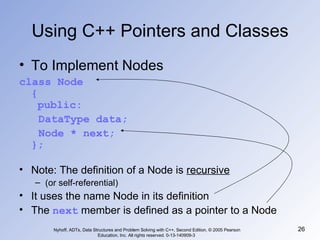
Using C++ Pointers and Classes To Implement Nodes class Node {  public: DataType data; Node * next; }; Note: The definition of a Node is  recursive   (or self-referential) It uses the name Node in its definition The  next  member is defined as a pointer to a Node  Nyhoff, ADTs, Data Structures and Problem Solving with C++, Second Edition, © 2005 Pearson Education, Inc. All rights reserved. 0-13-140909-3
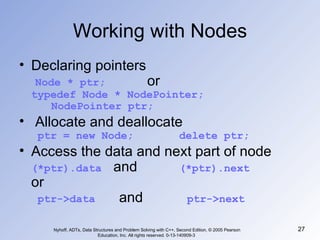
Working with Nodes Declaring pointers   Node * ptr; or typedef Node * NodePointer; NodePointer ptr; Allocate and deallocate   ptr = new Node; delete ptr; Access the data and next part of node (*ptr).data   and  (*ptr).next or   ptr->data    and    ptr->next Nyhoff, ADTs, Data Structures and Problem Solving with C++, Second Edition, © 2005 Pearson Education, Inc. All rights reserved. 0-13-140909-3
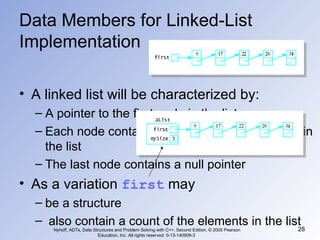
Data Members for Linked-List Implementation A linked list will be characterized by: A pointer to the first node in the list. Each node contains a pointer to the next node in the list The last node contains a null pointer As a variation  first  may  be a structure also contain a count of the elements in the list Nyhoff, ADTs, Data Structures and Problem Solving with C++, Second Edition, © 2005 Pearson Education, Inc. All rights reserved. 0-13-140909-3
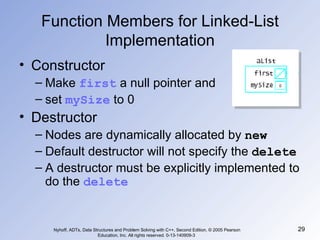
Function Members for Linked-List Implementation Constructor Make  first  a null pointer and  set  mySize  to 0 Destructor Nodes are dynamically allocated by  new Default destructor will not specify the  delete A destructor must be explicitly implemented to do the  delete Nyhoff, ADTs, Data Structures and Problem Solving with C++, Second Edition, © 2005 Pearson Education, Inc. All rights reserved. 0-13-140909-3  0

Lec5

  • 1.
    Lists Chapter 6Nyhoff, ADTs, Data Structures and Problem Solving with C++, Second Edition, © 2005 Pearson Education, Inc. All rights reserved. 0-13-140909-3
  • 2.
    Chapter Contents 6.1List as an ADT 6.2 An Array-Based Implementation of Lists 6.3 An array Based Implementation of Lists with Dynamic Allocation 6.4 Introduction to Linked Lists 6.5 A Pointer-Based Implementation of Linked Lists in C++ 6.6 An Array-Based Implementation of Linked Lists optional) Nyhoff, ADTs, Data Structures and Problem Solving with C++, Second Edition, © 2005 Pearson Education, Inc. All rights reserved. 0-13-140909-3
  • 3.
    Chapter Objectives Tostudy list as an ADT Build a static-array-based implementation of lists and note strengths, weaknesses Build a dynamic-array-based implementation of lists, noting strengths and weaknesses See need for destructor, copy constructor, assignment methods Take first look at linked lists, note strengths, weaknesses Study pointer-based implementation of linked lists (Optional) Study array-based implementation of linked lists Nyhoff, ADTs, Data Structures and Problem Solving with C++, Second Edition, © 2005 Pearson Education, Inc. All rights reserved. 0-13-140909-3
  • 4.
    Consider Every DayLists Groceries to be purchased Job to-do list List of assignments for a course Dean's list Can you name some others?? Nyhoff, ADTs, Data Structures and Problem Solving with C++, Second Edition, © 2005 Pearson Education, Inc. All rights reserved. 0-13-140909-3
  • 5.
    Properties of ListsCan have a single element Can have no elements There can be lists of lists We will look at the list as an abstract data type Homogeneous Finite length Sequential elements Nyhoff, ADTs, Data Structures and Problem Solving with C++, Second Edition, © 2005 Pearson Education, Inc. All rights reserved. 0-13-140909-3
  • 6.
    Basic Operations Constructan empty list Determine whether or not empty Insert an element into the list Delete an element from the list Traverse (iterate through) the list to Modify Output Search for a specific value Copy or save Rearrange Nyhoff, ADTs, Data Structures and Problem Solving with C++, Second Edition, © 2005 Pearson Education, Inc. All rights reserved. 0-13-140909-3
  • 7.
    Designing a List Class Should contain at least the following function members Constructor empty() insert() delete() display() Implementation involves Defining data members Defining function members from design phase Nyhoff, ADTs, Data Structures and Problem Solving with C++, Second Edition, © 2005 Pearson Education, Inc. All rights reserved. 0-13-140909-3
  • 8.
    Array-Based Implementation of Lists An array is a viable choice for storing list elements Element are sequential It is a commonly available data type Algorithm development is easy Normally sequential orderings of list elements match with array elements Nyhoff, ADTs, Data Structures and Problem Solving with C++, Second Edition, © 2005 Pearson Education, Inc. All rights reserved. 0-13-140909-3
  • 9.
    Implementing Operations ConstructorStatic array allocated at compile time Empty Check if size == 1 Traverse Use a loop from 0 th element to size – 1 Insert Shift elements to right of insertion point Delete Shift elements back Nyhoff, ADTs, Data Structures and Problem Solving with C++, Second Edition, © 2005 Pearson Education, Inc. All rights reserved. 0-13-140909-3 Also adjust size up or down
  • 10.
    List Classwith Static Array Must deal with issue of declaration of CAPACITY Use typedef mechanism typedef Some_Specific_Type ElementType ElementType array[CAPACITY]; For specific implementation of our class we simply fill in desired type for Some_Specific_Type Nyhoff, ADTs, Data Structures and Problem Solving with C++, Second Edition, © 2005 Pearson Education, Inc. All rights reserved. 0-13-140909-3
  • 11.
    List Classwith Static Array Can put typedef declaration inside or outside of class Inside: must specify List::ElementType for reference to the type outside the class Outside: now able to use the template mechanism (this will be our choice) Also specify the CAPACITY as a const Also choose to declare outside class Nyhoff, ADTs, Data Structures and Problem Solving with C++, Second Edition, © 2005 Pearson Education, Inc. All rights reserved. 0-13-140909-3
  • 12.
    List Classwith Static Array - Problems Stuck with "one size fits all" Could be wasting space Could run out of space Better to have instantiation of specific list specify what the capacity should be Thus we consider creating a List class with dynamically-allocated array Nyhoff, ADTs, Data Structures and Problem Solving with C++, Second Edition, © 2005 Pearson Education, Inc. All rights reserved. 0-13-140909-3
  • 13.
    Dynamic-Allocation for List Class Changes required in data members Eliminate const declaration for CAPACITY Add variable data member to store capacity specified by client program Change array data member to a pointer Constructor requires considerable change Little or no changes required for empty() display() erase() insert() Nyhoff, ADTs, Data Structures and Problem Solving with C++, Second Edition, © 2005 Pearson Education, Inc. All rights reserved. 0-13-140909-3
  • 14.
    Dynamic-Allocation for List Class Now possible to specify different sized lists cin >> maxListSize; List aList1 (maxListSize); List aList2 (500); Nyhoff, ADTs, Data Structures and Problem Solving with C++, Second Edition, © 2005 Pearson Education, Inc. All rights reserved. 0-13-140909-3
  • 15.
    New Functions NeededDestructor When class object goes out of scope the pointer to the dynamically allocated memory is reclaimed automatically The dynamically allocated memory is not The destructor reclaims dynamically allocated memory Nyhoff, ADTs, Data Structures and Problem Solving with C++, Second Edition, © 2005 Pearson Education, Inc. All rights reserved. 0-13-140909-3
  • 16.
    New Functions NeededCopy Constructor – makes a "deep copy" of an object When argument passed as value parameter When function returns a local object When temporary storage of object needed When object initialized by another in a declaration If copy is not made, observe results (aliasing problem, "shallow" copy) Nyhoff, ADTs, Data Structures and Problem Solving with C++, Second Edition, © 2005 Pearson Education, Inc. All rights reserved. 0-13-140909-3
  • 17.
    Linked List Forthe array-based implementation: First element is at location 0 Successor of item at location i is at location i + 1 End is at location size – 1 Fix: Remove requirement that list elements be stored in consecutive location. But then need a "link" that connects each element to its successor Nyhoff, ADTs, Data Structures and Problem Solving with C++, Second Edition, © 2005 Pearson Education, Inc. All rights reserved. 0-13-140909-3 Linked Lists !!
  • 18.
    Linked List Linkedlist nodes contain Data part – stores an element of the list Next part – stores link/pointer to next element (when no next element, null value) Nyhoff, ADTs, Data Structures and Problem Solving with C++, Second Edition, © 2005 Pearson Education, Inc. All rights reserved. 0-13-140909-3
  • 19.
    Linked Lists OperationsConstruction: first = null_value ; Empty: first == null_value ? Traverse Initialize a variable ptr to point to first node Process data where ptr points Nyhoff, ADTs, Data Structures and Problem Solving with C++, Second Edition, © 2005 Pearson Education, Inc. All rights reserved. 0-13-140909-3
  • 20.
    Linked Lists OperationsTraverse (ctd) set ptr = ptr->next , process ptr->data Continue until ptr == null Nyhoff, ADTs, Data Structures and Problem Solving with C++, Second Edition, © 2005 Pearson Education, Inc. All rights reserved. 0-13-140909-3
  • 21.
    Operations: Insertion Insertion To insert 20 after 17 Need address of item before point of insertion predptr points to the node containing 17 Get a new node pointed to by newptr and store 20 in it Set the next pointer of this new node equal to the next pointer in its predecessor, thus making it point to its successor. Reset the next pointer of its predecessor to point to this new node Nyhoff, ADTs, Data Structures and Problem Solving with C++, Second Edition, © 2005 Pearson Education, Inc. All rights reserved. 0-13-140909-3 20 newptr predptr
  • 22.
    Operations: Insertion Note:insertion also works at end of list pointer member of new node set to null Insertion at the beginning of the list predptr must be set to first pointer member of newptr set to that value first set to value of newptr  Note: In all cases, no shifting of list elements is required ! Nyhoff, ADTs, Data Structures and Problem Solving with C++, Second Edition, © 2005 Pearson Education, Inc. All rights reserved. 0-13-140909-3
  • 23.
    Operations: Deletion Deletenode containing 22 from list. Suppose ptr points to the node to be deleted predptr points to its predecessor (the 20) Do a bypass operation : Set the next pointer in the predecessor to point to the successor of the node to be deleted Deallocate the node being deleted. Nyhoff, ADTs, Data Structures and Problem Solving with C++, Second Edition, © 2005 Pearson Education, Inc. All rights reserved. 0-13-140909-3 ptr predptr To free space
  • 24.
    Linked Lists -Advantages Access any item as long as external link to first item maintained Insert new item without shifting Delete existing item without shifting Can expand/contract as necessary Nyhoff, ADTs, Data Structures and Problem Solving with C++, Second Edition, © 2005 Pearson Education, Inc. All rights reserved. 0-13-140909-3
  • 25.
    Linked Lists -Disadvantages List-processing algorithms that require fast access to each element cannot be done as efficiently with linked lists. Consider adding an element at the end of the list Nyhoff, ADTs, Data Structures and Problem Solving with C++, Second Edition, © 2005 Pearson Education, Inc. All rights reserved. 0-13-140909-3 Array Linked List a[ size ++] = value; Get a new node; set data part = value next part = null_value If list is empty Set first to point to new node. Else Traverse list to find last node Set next part of last node to point to new node. This is the inefficient part
  • 26.
    Using C++ Pointersand Classes To Implement Nodes class Node { public: DataType data; Node * next; }; Note: The definition of a Node is recursive (or self-referential) It uses the name Node in its definition The next member is defined as a pointer to a Node Nyhoff, ADTs, Data Structures and Problem Solving with C++, Second Edition, © 2005 Pearson Education, Inc. All rights reserved. 0-13-140909-3
  • 27.
    Working with NodesDeclaring pointers Node * ptr; or typedef Node * NodePointer; NodePointer ptr; Allocate and deallocate ptr = new Node; delete ptr; Access the data and next part of node (*ptr).data and (*ptr).next or ptr->data and ptr->next Nyhoff, ADTs, Data Structures and Problem Solving with C++, Second Edition, © 2005 Pearson Education, Inc. All rights reserved. 0-13-140909-3
  • 28.
    Data Members forLinked-List Implementation A linked list will be characterized by: A pointer to the first node in the list. Each node contains a pointer to the next node in the list The last node contains a null pointer As a variation first may be a structure also contain a count of the elements in the list Nyhoff, ADTs, Data Structures and Problem Solving with C++, Second Edition, © 2005 Pearson Education, Inc. All rights reserved. 0-13-140909-3
  • 29.
    Function Members forLinked-List Implementation Constructor Make first a null pointer and set mySize to 0 Destructor Nodes are dynamically allocated by new Default destructor will not specify the delete A destructor must be explicitly implemented to do the delete Nyhoff, ADTs, Data Structures and Problem Solving with C++, Second Edition, © 2005 Pearson Education, Inc. All rights reserved. 0-13-140909-3 0