ORAL COMMUNICATION
PRESENTED BY
Aswana Sahadevan
M tech GE
Roll.no:1
1
COMMUNICATION
Communication can be defined as “purposefully and actively
exchanging information between two or more people to convey or
receive the intended meanings through a shared of signs and symbols”
2
ORAL COMMUNICATION
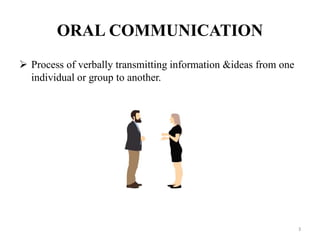
 Process of verbally transmitting information &ideas from one
individual or group to another.
3
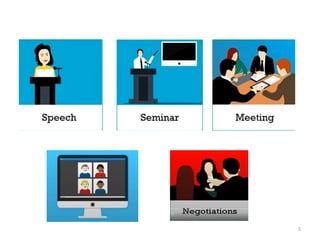
TYPES OF ORAL COMMUNICATION
 Face to face
 Video conferencing
 Telephone
 Active-passive communication
 Interviews
 Group discussion
 Presentations
 Grape vine
4
5
FORMAL COMMUNICATION
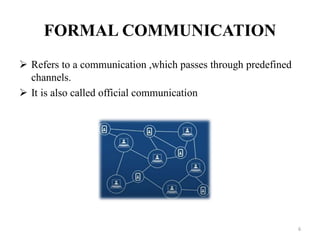
 Refers to a communication ,which passes through predefined
channels.
 It is also called official communication
6
TYPES OF FORMAL
COMMUNICATION
 Downward communication
 Upward communication
 Horizontal communication
 Diagonal communication
7
INFORMAL COMMUNICATION
• Doesnot follow any lines of communication and moves freely
in all directions.
• Also called as grape vine communication
8
CASUAL
This is an informal communication between groups and peers.
Casual style is used in conversation between friends and insiders who have
something to share but don’t have close relations
 Phone calls
Everyday conversation with friends
Chats
9
Formal communication Informal communication
VS
Passes through predefined
channels
Moves freely in all directions
Official communication
Maintains secrecy
Non official communication
Difficulty in maintaining secrecy
Flow
Type
Secrecy
Due to long chain ,it consumes a lot
of time
Information passes quickly
Time
consuming
Reliable &systematic form of
communication
Employees can discuss work related
issues which saves time &
resources
Leads to spread rumors
Message can be distorted due to
long chain of communication
Adv
Dis adv
10
INTERACTIVE COMMUNICATION
It is an exchange of idea where both participants whether
human/machine/art etc are active and have effect on one another.
It is a dynamic two way flow of information.
Why to Use?
1.Task coordination
2.Problem solving
3.Information sharing
4.Conflict Resolution
11
VERBAL COMMUNICATION
 Verbal communication is defined as communication to express our
views, information, and ideas in the form of sound and words.
 The spoken part usually involves face-to-face communication.
 It also includes communication through radio, television, or mobile
phones.
12
The series of words and grammar rules define the language. Two or
more persons can quickly communicate if they are aware of their
languages.
It might be difficult for people to communicate without a common
known language. For effective communication, there must be a
common language, which everyone present can understand.
13
Types of Verbal
Communication
Public communication Small group communication
Intrapersonal
communication
Inter personal
communication
14
PUBLIC COMMUNICATION
 The public communication is defined as the communication of a person
with the public.
 It involves a massive assembly of people. For example, the Prime
Minister addressing the public about the multiple developing projects;
Other examples include elections, campaigns, public speeches, etc.
SMALL-GROUP COMMUNICATION
 The small group communication is defined as communication within
two or more people.
15
The number of people participating in such communication is enough to
have a good interaction with each other;
For example school meetings, board meetings, press conferences, office
meetings, team meetings, family gatherings, etc.
16
INTRA PERSONALCOMMUNICATION
 Intrapersonal communication is communication within us. It is also
called as internal communication. It includes self-thinking, analysis,
thoughts, assessments, etc. associated with the inner state of mind.
 The person's internal thoughts or feelings play a vital role in
intrapersonal communication. It also includes various activities, such as
solo speaking, solo writing, solo dancing, concentration, and self-
awareness.
17
INTERPERSONALCOMMUNICATION
Interpersonal communication is the communication between us and
others over the channel. The communication can be online, face-to-face,
video conference on mobile, etc.
Interpersonal skills are essential, whether we are a manager, employee,
or looking for work. Such skills are also known as soft skills that
determine how well a person can communicate, behave, and relate to
others.
18
ADVANTAGES
There is high level of understanding and transparency in oral
communication .
 There is no element of rigidity in oral communication.
 There is flexibility for allowing changes in the decisions previously
taken.
 The feedback is spontaneous in case of oral communication. Thus,
decisions can be made quickly without any delay.
 Oral communication is not only time saving, but it also saves upon
money and efforts.
 Oral communication is best in case of problem resolution.
 Oral communication is an essential for teamwork and group energy.
19
DISADVANTAGES:
 Relying only on oral communication may not be sufficient as business
communication is formal and very organized.
 Oral communication is less authentic than written communication as
they are informal and not as organized as written communication.
 Oral communication is time-saving as far as daily interactions are
concerned, but in case of meetings, long speeches consume lot of time and
are unproductive at times.
 Oral communications are not easy to maintain and thus they are
unsteady.
There may be misunderstandings as the information is not complete and
may lack essentials.
 It requires attentiveness and great receptivity on part of the 20
NONVERBAL COMMUNICATION
It is the transmission of messages or signals through a nonverbal
platform such as eye contact, facial expressions, gestures, posture, and the
distance between two individuals.
 It includes the use of visual cues such as body language (kinesics),
distance (proxemics) and physical environments/appearance, of voice
(paralanguage) and of touch (haptics).
21
It can also include the use of time (chronemics) and eye contact and
the actions of looking while talking and listening, frequency of glances,
pupil dilation, and blink rate
22
TYPES &EFFECTS
Facial expressions:eg: If your friend have told you he was happy, but
his apathetic facial expression may have communicated different
information. Facial expressions-happy, sad, angry help you convey your
message.
 Be aware of your facial expression when you talk and particularly
when you listen, which is when it’s easy to forget.
23
Gestures: When you speak, a gesture can make your message stronger.
Pointing out something you want your listener to look at more closely is
an example of nonverbal communication that makes your message
understood.
Motioning warmly toward a coworker who deserves special
recognition, making a fist to show frustration or anger, such gestures help
further engage your audience when you speak
24
Proximity: How close you are to your audience when you speak sends
a nonverbal message.
 If your size is imposing and you leave a very small distance
between you and your listener, it’s likely your nonverbal
communication will be a bit threatening.
 On the other hand, giving someone too much space is an awkward
nonverbal communication that might confuse your listener.
Touch: Shaking an audience member’s hand, putting your hand on
his shoulder, these are nonverbal cues that can affect the success of
your message.
25
Eye contact: Making and maintaining eye contact with an audience
when you’re verbally communicating or listening communicates to
the other party that you are interested and engaged in the
conversation.
Good eye contact often conveys the trait of honesty to the other
party.
Appearance: Your clothing, hair, and jewelry are also a part of
nonverbal communication. The quality and condition of your
clothing, how it fits, if it’s appropriate for the season etc
All of these things speak nonverbally about you as a
communicator.
26
REFERENCES
Effective oral and written communication
R.Prabavathi ,P.C Nagasubramani , Journal of Applied and Advanced
research 2018
Oral presentation skills for elementary education students :peer group
as a resource for development.2015
Oral communication and Oral Communication in Todays Culture
L.R.P Stiegelbauer, N.Tirban and P.A. Onfrei
International Journal Of Information and Education Technology 2012
27
THANKYOU
28

RM SEMINAR 1.pdf

  • 1.
    ORAL COMMUNICATION PRESENTED BY AswanaSahadevan M tech GE Roll.no:1 1
  • 2.
    COMMUNICATION Communication can bedefined as “purposefully and actively exchanging information between two or more people to convey or receive the intended meanings through a shared of signs and symbols” 2
  • 3.
    ORAL COMMUNICATION  Processof verbally transmitting information &ideas from one individual or group to another. 3
  • 4.
    TYPES OF ORALCOMMUNICATION  Face to face  Video conferencing  Telephone  Active-passive communication  Interviews  Group discussion  Presentations  Grape vine 4
  • 5.
  • 6.
    FORMAL COMMUNICATION  Refersto a communication ,which passes through predefined channels.  It is also called official communication 6
  • 7.
    TYPES OF FORMAL COMMUNICATION Downward communication  Upward communication  Horizontal communication  Diagonal communication 7
  • 8.
    INFORMAL COMMUNICATION • Doesnotfollow any lines of communication and moves freely in all directions. • Also called as grape vine communication 8
  • 9.
    CASUAL This is aninformal communication between groups and peers. Casual style is used in conversation between friends and insiders who have something to share but don’t have close relations  Phone calls Everyday conversation with friends Chats 9
  • 10.
    Formal communication Informalcommunication VS Passes through predefined channels Moves freely in all directions Official communication Maintains secrecy Non official communication Difficulty in maintaining secrecy Flow Type Secrecy Due to long chain ,it consumes a lot of time Information passes quickly Time consuming Reliable &systematic form of communication Employees can discuss work related issues which saves time & resources Leads to spread rumors Message can be distorted due to long chain of communication Adv Dis adv 10
  • 11.
    INTERACTIVE COMMUNICATION It isan exchange of idea where both participants whether human/machine/art etc are active and have effect on one another. It is a dynamic two way flow of information. Why to Use? 1.Task coordination 2.Problem solving 3.Information sharing 4.Conflict Resolution 11
  • 12.
    VERBAL COMMUNICATION  Verbalcommunication is defined as communication to express our views, information, and ideas in the form of sound and words.  The spoken part usually involves face-to-face communication.  It also includes communication through radio, television, or mobile phones. 12
  • 13.
    The series ofwords and grammar rules define the language. Two or more persons can quickly communicate if they are aware of their languages. It might be difficult for people to communicate without a common known language. For effective communication, there must be a common language, which everyone present can understand. 13
  • 14.
    Types of Verbal Communication Publiccommunication Small group communication Intrapersonal communication Inter personal communication 14
  • 15.
    PUBLIC COMMUNICATION  Thepublic communication is defined as the communication of a person with the public.  It involves a massive assembly of people. For example, the Prime Minister addressing the public about the multiple developing projects; Other examples include elections, campaigns, public speeches, etc. SMALL-GROUP COMMUNICATION  The small group communication is defined as communication within two or more people. 15
  • 16.
    The number ofpeople participating in such communication is enough to have a good interaction with each other; For example school meetings, board meetings, press conferences, office meetings, team meetings, family gatherings, etc. 16
  • 17.
    INTRA PERSONALCOMMUNICATION  Intrapersonalcommunication is communication within us. It is also called as internal communication. It includes self-thinking, analysis, thoughts, assessments, etc. associated with the inner state of mind.  The person's internal thoughts or feelings play a vital role in intrapersonal communication. It also includes various activities, such as solo speaking, solo writing, solo dancing, concentration, and self- awareness. 17
  • 18.
    INTERPERSONALCOMMUNICATION Interpersonal communication isthe communication between us and others over the channel. The communication can be online, face-to-face, video conference on mobile, etc. Interpersonal skills are essential, whether we are a manager, employee, or looking for work. Such skills are also known as soft skills that determine how well a person can communicate, behave, and relate to others. 18
  • 19.
    ADVANTAGES There is highlevel of understanding and transparency in oral communication .  There is no element of rigidity in oral communication.  There is flexibility for allowing changes in the decisions previously taken.  The feedback is spontaneous in case of oral communication. Thus, decisions can be made quickly without any delay.  Oral communication is not only time saving, but it also saves upon money and efforts.  Oral communication is best in case of problem resolution.  Oral communication is an essential for teamwork and group energy. 19
  • 20.
    DISADVANTAGES:  Relying onlyon oral communication may not be sufficient as business communication is formal and very organized.  Oral communication is less authentic than written communication as they are informal and not as organized as written communication.  Oral communication is time-saving as far as daily interactions are concerned, but in case of meetings, long speeches consume lot of time and are unproductive at times.  Oral communications are not easy to maintain and thus they are unsteady. There may be misunderstandings as the information is not complete and may lack essentials.  It requires attentiveness and great receptivity on part of the 20
  • 21.
    NONVERBAL COMMUNICATION It isthe transmission of messages or signals through a nonverbal platform such as eye contact, facial expressions, gestures, posture, and the distance between two individuals.  It includes the use of visual cues such as body language (kinesics), distance (proxemics) and physical environments/appearance, of voice (paralanguage) and of touch (haptics). 21
  • 22.
    It can alsoinclude the use of time (chronemics) and eye contact and the actions of looking while talking and listening, frequency of glances, pupil dilation, and blink rate 22
  • 23.
    TYPES &EFFECTS Facial expressions:eg:If your friend have told you he was happy, but his apathetic facial expression may have communicated different information. Facial expressions-happy, sad, angry help you convey your message.  Be aware of your facial expression when you talk and particularly when you listen, which is when it’s easy to forget. 23
  • 24.
    Gestures: When youspeak, a gesture can make your message stronger. Pointing out something you want your listener to look at more closely is an example of nonverbal communication that makes your message understood. Motioning warmly toward a coworker who deserves special recognition, making a fist to show frustration or anger, such gestures help further engage your audience when you speak 24
  • 25.
    Proximity: How closeyou are to your audience when you speak sends a nonverbal message.  If your size is imposing and you leave a very small distance between you and your listener, it’s likely your nonverbal communication will be a bit threatening.  On the other hand, giving someone too much space is an awkward nonverbal communication that might confuse your listener. Touch: Shaking an audience member’s hand, putting your hand on his shoulder, these are nonverbal cues that can affect the success of your message. 25
  • 26.
    Eye contact: Makingand maintaining eye contact with an audience when you’re verbally communicating or listening communicates to the other party that you are interested and engaged in the conversation. Good eye contact often conveys the trait of honesty to the other party. Appearance: Your clothing, hair, and jewelry are also a part of nonverbal communication. The quality and condition of your clothing, how it fits, if it’s appropriate for the season etc All of these things speak nonverbally about you as a communicator. 26
  • 27.
    REFERENCES Effective oral andwritten communication R.Prabavathi ,P.C Nagasubramani , Journal of Applied and Advanced research 2018 Oral presentation skills for elementary education students :peer group as a resource for development.2015 Oral communication and Oral Communication in Todays Culture L.R.P Stiegelbauer, N.Tirban and P.A. Onfrei International Journal Of Information and Education Technology 2012 27
  • 28.