SFScon
Security
metrics for
open-source
projects
Bolzano, 12 - 13 November, 2021
SFScon
:~$ whoami
Currently Security Engineer at Smallpdf.
Previously Security Manager at Arduino. In
recent years, I have tried to understand
how disinformation spreads on Twitter. I
contribute to the Open Source Security
Foundation’s “Security Metrics” project, to
define security metrics for open-source
projects.
● Linux user
● Twitter addicted
● Cats and bowties lover
@evaristegal0is luigi.gubello@protonmail.com
SFScon
Bolzano, 12 - 13 November, 2021
What is a
supply chain
attack
SFScon
Bolzano, 12 - 13 November, 2021
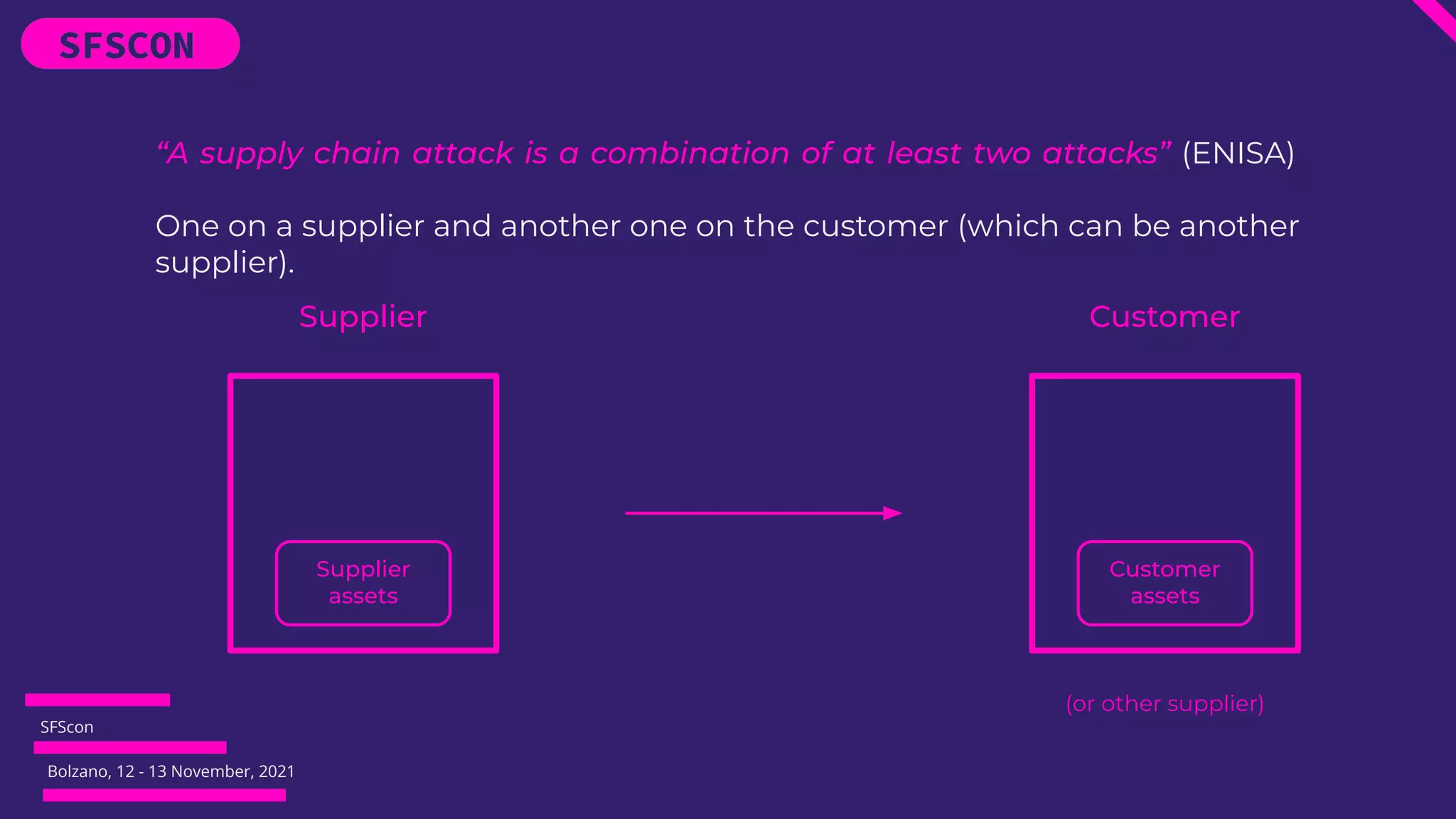
Supplier Customer
(or other supplier)
Supplier
assets
Customer
assets
“A supply chain attack is a combination of at least two attacks” (ENISA)
One on a supplier and another one on the customer (which can be another
supplier).
SFScon
Bolzano, 12 - 13 November, 2021
According to an ENISA report, at least 20 supply-chain attacks have been
identified in one year (July 2020 - July 2021).
● SolarWinds, a cloud management company. Attack attributed to
APT29 group (December 2020);
● Mimecast, a cloud-based cybersecurity service. Attack attributed to
APT29 group (January 2021);
● Codecov, a code coverage service. Attack without attribution (April
2021);
● Kaseya, IT Management software. Attack attributed to REvil Group
(July 2021)
SFScon
Bolzano, 12 - 13 November, 2021
How supply-chain
attacks can affect
open-source
SFScon
Bolzano, 12 - 13 November, 2021
According to a Sonatype report, the supply-chain attacks increased 650%
YoY over 2020.
The most common types of supply-chain attack in 2021 have been
namespace (or dependency) confusion, typosquatting and malicious code
injection.
Only in March 2021, Sonatype identified more than 10.000 dependency
confusion copycats infiltrated in npm, PyPI and other ecosystems.
SFScon
Bolzano, 12 - 13 November, 2021
Namespace (or dependency) confusion
It is a technique where attackers - knowing internal packages’ names used
by the target - publish malicious packages with the same name but a
higher semantic version. This can lead the development tools to download
and install the malicious packages instead of the internal ones.
Typosquatting
Typosquatting attacks consist to publish packages with misspelled names
that can be installed due to human errors (e.g. typo when writing the
package name).
Malicious code injection
Malicious code injection by exploiting different techniques (credentials
stealing, fraudulent pull-requests, …).
SFScon
Bolzano, 12 - 13 November, 2021
Reduce
supply-chain
attacks risk
SFScon
Bolzano, 12 - 13 November, 2021
Open Source Security Foundation
(OpenSSF) is a project which goal is
to create a community and define
best practices to improve the
security of the open-source
ecosystem.
To reduce risks related to
supply-chain attacks in open-source
projects, OpenSSF offers two key
tools: OpenSSF Security Metrics
and OpenSSF Security Scorecards.
SFScon
Bolzano, 12 - 13 November, 2021
OpenSSF Security Metrics offers a data-driven overview of open-source
projects, by helping stakeholders to make reliable decisions.
Security Metrics does data collection from sources such as:
● Security Scorecards – measures the security posture of open source
projects
● Criticality Score – determines the influence and importance of open
source projects
● Best Practices Badge – communicates how well security best
practices are followed
● Security Reviews – displays security assessments performed by
researchers
SFScon
Bolzano, 12 - 13 November, 2021
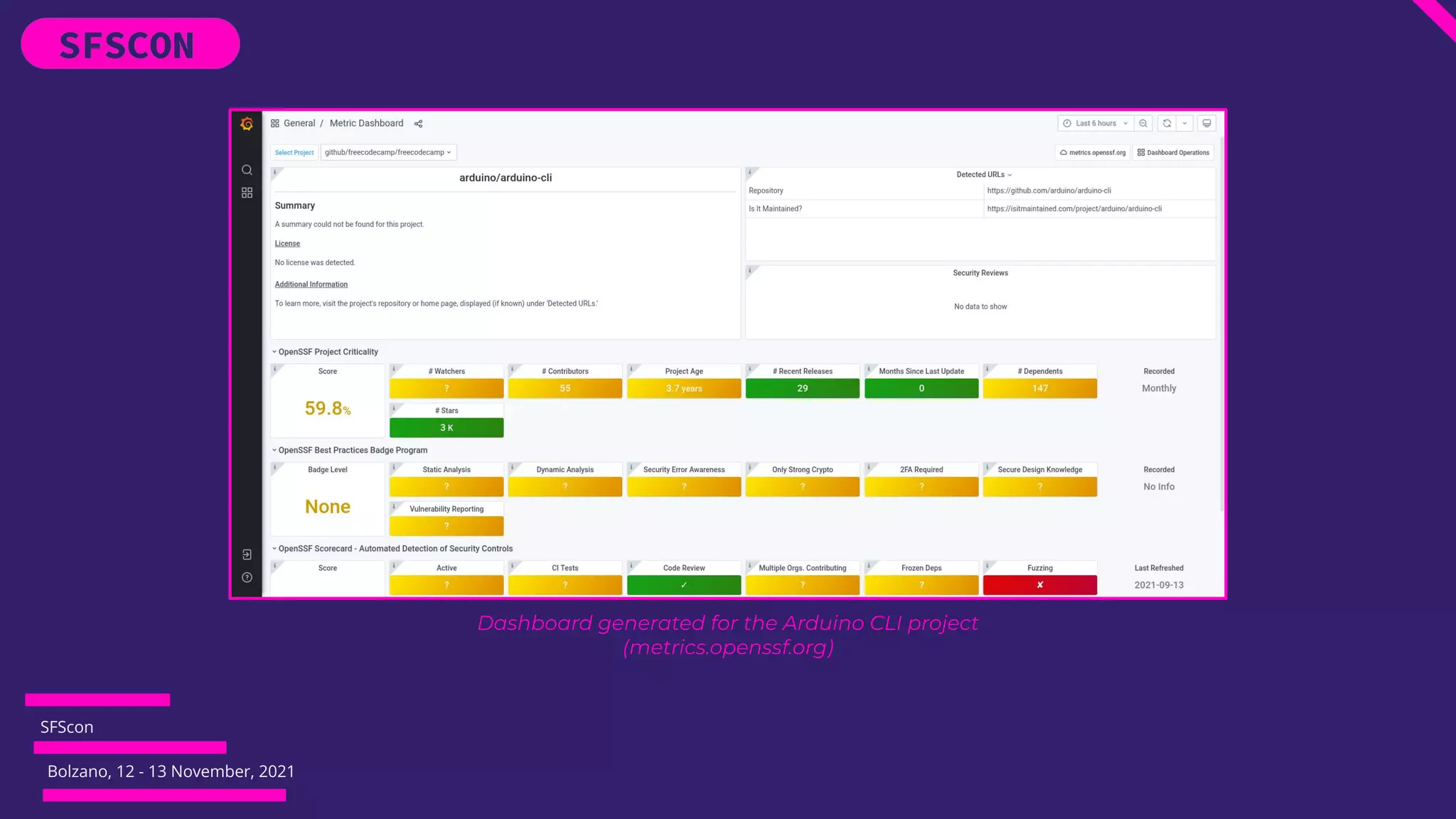
Dashboard generated for the Arduino CLI project
(metrics.openssf.org)
SFScon
Bolzano, 12 - 13 November, 2021
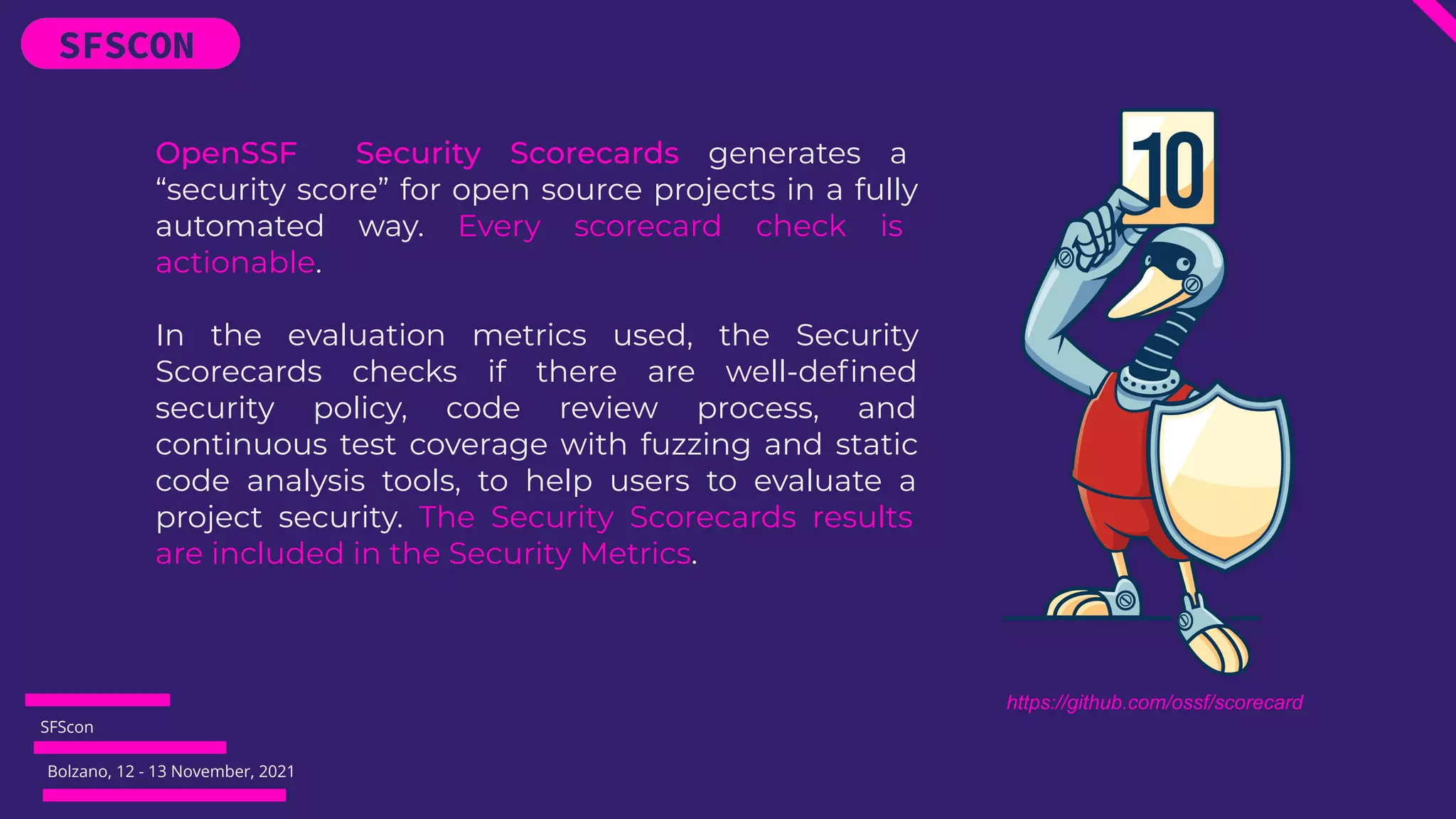
OpenSSF Security Scorecards generates a
“security score” for open source projects in a fully
automated way. Every scorecard check is
actionable.
In the evaluation metrics used, the Security
Scorecards checks if there are well-defined
security policy, code review process, and
continuous test coverage with fuzzing and static
code analysis tools, to help users to evaluate a
project security. The Security Scorecards results
are included in the Security Metrics.
https://github.com/ossf/scorecard
SFScon
Bolzano, 12 - 13 November, 2021
End _
Thank you! HONK 🤍
SFScon
Bolzano, 12 - 13 November, 2021

SFScon 21 - Luigi Gubello - Security metrics for open-source projects

  • 1.
  • 2.
    Bolzano, 12 -13 November, 2021 SFScon :~$ whoami Currently Security Engineer at Smallpdf. Previously Security Manager at Arduino. In recent years, I have tried to understand how disinformation spreads on Twitter. I contribute to the Open Source Security Foundation’s “Security Metrics” project, to define security metrics for open-source projects. ● Linux user ● Twitter addicted ● Cats and bowties lover @evaristegal0is luigi.gubello@protonmail.com
  • 3.
    SFScon Bolzano, 12 -13 November, 2021 What is a supply chain attack
  • 4.
    SFScon Bolzano, 12 -13 November, 2021 Supplier Customer (or other supplier) Supplier assets Customer assets “A supply chain attack is a combination of at least two attacks” (ENISA) One on a supplier and another one on the customer (which can be another supplier).
  • 5.
    SFScon Bolzano, 12 -13 November, 2021 According to an ENISA report, at least 20 supply-chain attacks have been identified in one year (July 2020 - July 2021). ● SolarWinds, a cloud management company. Attack attributed to APT29 group (December 2020); ● Mimecast, a cloud-based cybersecurity service. Attack attributed to APT29 group (January 2021); ● Codecov, a code coverage service. Attack without attribution (April 2021); ● Kaseya, IT Management software. Attack attributed to REvil Group (July 2021)
  • 6.
    SFScon Bolzano, 12 -13 November, 2021 How supply-chain attacks can affect open-source
  • 7.
    SFScon Bolzano, 12 -13 November, 2021 According to a Sonatype report, the supply-chain attacks increased 650% YoY over 2020. The most common types of supply-chain attack in 2021 have been namespace (or dependency) confusion, typosquatting and malicious code injection. Only in March 2021, Sonatype identified more than 10.000 dependency confusion copycats infiltrated in npm, PyPI and other ecosystems.
  • 8.
    SFScon Bolzano, 12 -13 November, 2021 Namespace (or dependency) confusion It is a technique where attackers - knowing internal packages’ names used by the target - publish malicious packages with the same name but a higher semantic version. This can lead the development tools to download and install the malicious packages instead of the internal ones. Typosquatting Typosquatting attacks consist to publish packages with misspelled names that can be installed due to human errors (e.g. typo when writing the package name). Malicious code injection Malicious code injection by exploiting different techniques (credentials stealing, fraudulent pull-requests, …).
  • 9.
    SFScon Bolzano, 12 -13 November, 2021 Reduce supply-chain attacks risk
  • 10.
    SFScon Bolzano, 12 -13 November, 2021 Open Source Security Foundation (OpenSSF) is a project which goal is to create a community and define best practices to improve the security of the open-source ecosystem. To reduce risks related to supply-chain attacks in open-source projects, OpenSSF offers two key tools: OpenSSF Security Metrics and OpenSSF Security Scorecards.
  • 11.
    SFScon Bolzano, 12 -13 November, 2021 OpenSSF Security Metrics offers a data-driven overview of open-source projects, by helping stakeholders to make reliable decisions. Security Metrics does data collection from sources such as: ● Security Scorecards – measures the security posture of open source projects ● Criticality Score – determines the influence and importance of open source projects ● Best Practices Badge – communicates how well security best practices are followed ● Security Reviews – displays security assessments performed by researchers
  • 12.
    SFScon Bolzano, 12 -13 November, 2021 Dashboard generated for the Arduino CLI project (metrics.openssf.org)
  • 13.
    SFScon Bolzano, 12 -13 November, 2021 OpenSSF Security Scorecards generates a “security score” for open source projects in a fully automated way. Every scorecard check is actionable. In the evaluation metrics used, the Security Scorecards checks if there are well-defined security policy, code review process, and continuous test coverage with fuzzing and static code analysis tools, to help users to evaluate a project security. The Security Scorecards results are included in the Security Metrics. https://github.com/ossf/scorecard
  • 14.
    SFScon Bolzano, 12 -13 November, 2021 End _ Thank you! HONK 🤍
  • 15.
    SFScon Bolzano, 12 -13 November, 2021