Security Automation Data
supply chain security lost in a maze of XML and
JSON
Marcus Meissner
Projectmanager Security / Distinguished Engineer
meissner@suse.de
2
Agenda
●
Introduction
●
The SCAP family
●
Newcomers
●
New things and changes past Solarwinds and log4shell
5
Introduction
6
Introduction – Why?
• Amount of computers growing
– Hard to even enumerate the ones at home
• Laptop, tablet, phones, tv, car, cameras, toys, home automation, etc.
– Enterprise setting
• Baremetal / Edge
• VMs
• Containers
• Public Cloud instances
• Amount of care needed differs, depends:
– How much access / control do we have
– Managed by us or by others … or no one
– Internet connected / Importance / relevance
7
Inventory
Without Inventory we are blind
• Hardware (not in scope here)
• Operating System
• Software installed
• Configurations and Settings…
• Recursion into Vms or Containers
8
Operating System / Software
Interesting pieces about software
• Lifecycle
• Affectedness by security issues
• Recursion for embedded sources
• Recursion for static builds (e.g. builds with go, rust etc)
• Dependency on build environment
• How to proof or verify this is correct
Manual work impossible, automate everything!
9
The SCAP family
Secure Content Automation Protocol
10
Secure Content Automation Protocol - SCAP
One of the early comers, defined by the US NIST
Encompasses formats:
• OVAL, XCCDF, OCIL, ARF, CCE, CPE, CVE, CVSS, CCSS
Standard Version: 1.3
Supporting tool: openscap
11
CVE – Common Vulnerability & Exposures
Goal: A dictionary entry identifying a specific security vulnerability.
CVE-Year-NR
• Year is the time the security issue was identified.
• NR is allocated out of non-linear blocks (no specific meaning)
Assigned by CNAs (Candidate Naming Authorities).
When use, make sure you copy and paste only to avoid typos!
12
CVSS - Common Vulnerability Scoring System
Goal: Trying to classify security vulnerabilities into schemes and
numbers.
• Base Vector, Temporal Vector, Environmental Vector
• Sample Base Vector: CVSS:3.1/AV:L/AC:L/PR:N/UI:R/S:U/C:H/I:H/A:H
• Score: 0.0-10.0 (above is 7.8)
Currently at revision 3.1, revision 4 being worked on.

Facts:
• As security issues are programmatic, translation into a simple arithmetic vector is
hard
• Not all criteria map well
• There is a lot of human judgment involved, rating might vary
13
CPE – Common Platform Enumeration
Goal: Specify operating systems and/or software in a defined way.
Standardized hierarchic tag format:
• cpe : ID : vendor : product : version : minor version …
Idea is that you can synthesize it yourself, but there is a global
dictionary.
Examples used by SUSE:
• cpe:/o:suse:sles:15:sp4 ( in /etc/os-release )
• cpe:/o:opensuse:tumbleweed:20230510
• cpe:2.3:a:samba:samba:*:*:*:*:*:*:*:* (in some other security data)
Not very widespread, also replaced by other formats like purl.
14
CCE – Common Configuration Enumeration
Goal: Dictionary to reference configuration issues
IDs handed out by NIST to vendors.
Used in hardening automation.
15
CCSS – Common Configuration Scoring System
Goal: Measure severity of configuration mismatches
So /etc/shadow world-readable is higher than “telnet client” installed.
Used in the hardening tooling.
16
OCIL – Open Checklist Interactive Language
Goal: Allow automation of manual security checklist processing
Going over the checklist is automated.
The tests and remediations for each check are manual actions.
Not used at SUSE.
17
OVAL – Open Vulnerability Assessment
Language
Goal: Detection of system conditions
Uses: CVE, CPE, CVSS ids
Checks for:
• Presence, permission, ownership of files
• Content of files (line based)
• RPM – presence , name , version , release based detection
• More
Definitions that describe vulnerabilities, patches, inventory
• Metadata like description, references, cpe ids, cvss scores
• Link to checks via a tree of criteria that can be combined with OR/AND logic
18
OVAL – Open Vulnerability Assessment
Language
Example available logic:
System is affected by a CVE when:
• product X OR product Y is installed
• AND
– Package P1 is less than version1-release1, OR
– Package P2 is less than version2-release2
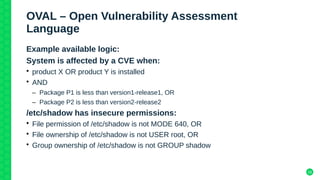
/etc/shadow has insecure permissions:
• File permission of /etc/shadow is not MODE 640, OR
• File ownership of /etc/shadow is not USER root, OR
• Group ownership of /etc/shadow is not GROUP shadow
19
OVAL – Open Vulnerability Assessment
Language
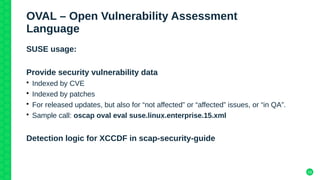
SUSE usage:
Provide security vulnerability data
• Indexed by CVE
• Indexed by patches
• For released updates, but also for “not affected” or “affected” issues, or “in QA”.
• Sample call: oscap oval eval suse.linux.enterprise.15.xml
Detection logic for XCCDF in scap-security-guide
20
XCCDF – eXtensible Configuration and Definition
Format
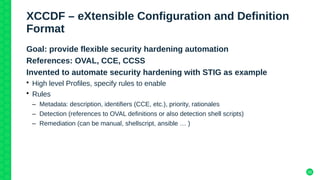
Goal: provide flexible security hardening automation
References: OVAL, CCE, CCSS
Invented to automate security hardening with STIG as example
• High level Profiles, specify rules to enable
• Rules
– Metadata: description, identifiers (CCE, etc.), priority, rationales
– Detection (references to OVAL definitions or also detection shell scripts)
– Remediation (can be manual, shellscript, ansible … )
21
SCAP - ComplianceAsCode
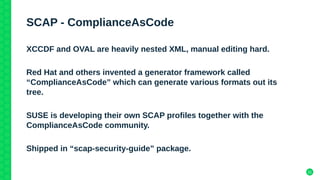
XCCDF and OVAL are heavily nested XML, manual editing hard.
Red Hat and others invented a generator framework called
“ComplianceAsCode” which can generate various formats out its
tree.
SUSE is developing their own SCAP profiles together with the
ComplianceAsCode community.
Shipped in “scap-security-guide” package.
22
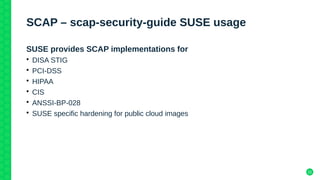
SCAP – scap-security-guide SUSE usage
SUSE provides SCAP implementations for
• DISA STIG
• PCI-DSS
• HIPAA
• CIS
• ANSSI-BP-028
• SUSE specific hardening for public cloud images
23
The newcomers
24
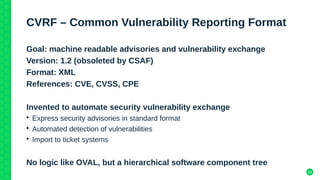
CVRF – Common Vulnerability Reporting Format
Goal: machine readable advisories and vulnerability exchange
Version: 1.2 (obsoleted by CSAF)
Format: XML
References: CVE, CVSS, CPE
Invented to automate security vulnerability exchange
• Express security advisories in standard format
• Automated detection of vulnerabilities
• Import to ticket systems
No logic like OVAL, but a hierarchical software component tree
25
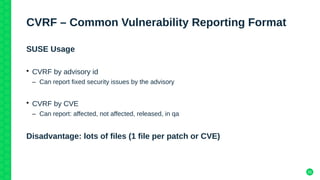
CVRF – Common Vulnerability Reporting Format
SUSE Usage
• CVRF by advisory id
– Can report fixed security issues by the advisory
• CVRF by CVE
– Can report: affected, not affected, released, in qa
Disadvantage: lots of files (1 file per patch or CVE)
26
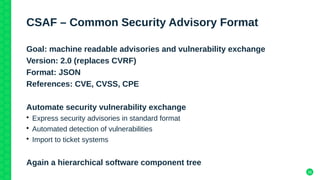
CSAF – Common Security Advisory Format
Goal: machine readable advisories and vulnerability exchange
Version: 2.0 (replaces CVRF)
Format: JSON
References: CVE, CVSS, CPE
Automate security vulnerability exchange
• Express security advisories in standard format
• Automated detection of vulnerabilities
• Import to ticket systems
Again a hierarchical software component tree
27
CSAF – Common Security Advisory Format
SUSE Usage
• CSAF by advisory id
– Can report fixed security issues by the advisory
• CSAF by CVE
– Can report: affected, not affected, released, in qa
Disadvantage: lots of files (1 file per patch or CVE)
28
New things and changes in recent years
29
What changed?
• Software becoming more interlinked and more complex
• Attacks becoming more direct / more impactful
– Not just smuggling out information
– Destructive / distributed denial of service
– Ransom – whole companies
– Make money out of crypto mining
• Exploits targeting the software supply chain to be more widespread
Solarwinds and log4shell as key triggers
30
What changed?
• People and Governments identified software supply chain security as
having gaps and reacted on it
• US government issued Executive Order 14028 May 12th
2021
• Europe is working on a cyber resilience act
Gaps covered:
• Software Bill of Materials (SBOM)
• Attestation or provenance of build (SLSA attestation)
• Cryptographic assurances
31
SBOM – Software Bill of Materials
Goal: Clear inventory of Software Deliveries
Wanted: structured export of
• Producers and redistributors/suppliers
• Exact versions, licenses
• Software embedded in other software
• Cryptographic hashes / verification
Three main file formats currently:
• SPDX 2.0
• CycloneDX
• SWID
32
SBOM – SUSE Deliveries
Formats:
• SPDX 2.0 (prefered by the LinuxFoundation)
• CycloneDX (widespread use in the container ecosystem)
Delivered for:
• ISO: SPDX 2.0 and CycloneDX
• Containers: SPDX 2.0 embedded in SLSA attestation
33
SBOM – SPDX 2.0
Originally SPDX was for standardized license tracking.
Enhanced to support full SBOM for 2.0 version.
Fileformats: various: plaintext, XML, JSON, …
SUSE uses JSON variant.
34
SBOM – CycloneDX
Fileformats: XML or JSON
CycloneDX can not just cover SBOM, but also
• Saas BOM
• HW BOM
• Operations BOM
• Vulnerability Disclosure Reports (VDR)
• Vulnerability Exploitability eXchange (VEX)
35
VEX – Vulnerability Exploitability eXchange
Goal: Declare affected or not affected for security issues
Existing:
• CVRF: CVE indexed format would qualify
• CSAF (has a VEX profile): ready
Others:
• CycloneDX
• OpenVEX project (picked up by OSSF)
36
VDR – Vulnerability Disclosure Report
Goal: Declare affected or not affected of a product
Supplements an SBOM.
Currently not clear what is needed here.
37
Attestation and Provenance
Goal: define how software was built into binary
Why: defined description how a binary was built, reproducibility
Primary contender:
• SLSA attestation “in-toto”
38
SLSA In-toto provenance
Specify every package this target was built with
• RPMs listed with URLs and SHA2 hashes (rpms provided externally)
• Buildconfiguration linked (OBS projectconfig) with SHA2
• Sources within package linked and referenced with SHA2
Provenance provided parallel to built RPM, ISO, Container.
Challenges:
• Rolling releases (how many Terabyte diskspace do you own?)
• Bootstrapping (where do you start?)
80
Landing page: https://www.suse.com/security/
E-Mail: security@suse.de
Questions?
81
82
84
Internal Use Slides
Presentation Title(36pt)
Subhead or Second Line (20pt)
Presenter Name (14pt)
Title
Company/Email
For Internal Use Only

OSC2023_security_automation_data.pdf

  • 1.
    Security Automation Data supplychain security lost in a maze of XML and JSON Marcus Meissner Projectmanager Security / Distinguished Engineer meissner@suse.de
  • 2.
    2 Agenda ● Introduction ● The SCAP family ● Newcomers ● Newthings and changes past Solarwinds and log4shell
  • 3.
  • 4.
    6 Introduction – Why? •Amount of computers growing – Hard to even enumerate the ones at home • Laptop, tablet, phones, tv, car, cameras, toys, home automation, etc. – Enterprise setting • Baremetal / Edge • VMs • Containers • Public Cloud instances • Amount of care needed differs, depends: – How much access / control do we have – Managed by us or by others … or no one – Internet connected / Importance / relevance
  • 5.
    7 Inventory Without Inventory weare blind • Hardware (not in scope here) • Operating System • Software installed • Configurations and Settings… • Recursion into Vms or Containers
  • 6.
    8 Operating System /Software Interesting pieces about software • Lifecycle • Affectedness by security issues • Recursion for embedded sources • Recursion for static builds (e.g. builds with go, rust etc) • Dependency on build environment • How to proof or verify this is correct Manual work impossible, automate everything!
  • 7.
    9 The SCAP family SecureContent Automation Protocol
  • 8.
    10 Secure Content AutomationProtocol - SCAP One of the early comers, defined by the US NIST Encompasses formats: • OVAL, XCCDF, OCIL, ARF, CCE, CPE, CVE, CVSS, CCSS Standard Version: 1.3 Supporting tool: openscap
  • 9.
    11 CVE – CommonVulnerability & Exposures Goal: A dictionary entry identifying a specific security vulnerability. CVE-Year-NR • Year is the time the security issue was identified. • NR is allocated out of non-linear blocks (no specific meaning) Assigned by CNAs (Candidate Naming Authorities). When use, make sure you copy and paste only to avoid typos!
  • 10.
    12 CVSS - CommonVulnerability Scoring System Goal: Trying to classify security vulnerabilities into schemes and numbers. • Base Vector, Temporal Vector, Environmental Vector • Sample Base Vector: CVSS:3.1/AV:L/AC:L/PR:N/UI:R/S:U/C:H/I:H/A:H • Score: 0.0-10.0 (above is 7.8) Currently at revision 3.1, revision 4 being worked on. Facts: • As security issues are programmatic, translation into a simple arithmetic vector is hard • Not all criteria map well • There is a lot of human judgment involved, rating might vary
  • 11.
    13 CPE – CommonPlatform Enumeration Goal: Specify operating systems and/or software in a defined way. Standardized hierarchic tag format: • cpe : ID : vendor : product : version : minor version … Idea is that you can synthesize it yourself, but there is a global dictionary. Examples used by SUSE: • cpe:/o:suse:sles:15:sp4 ( in /etc/os-release ) • cpe:/o:opensuse:tumbleweed:20230510 • cpe:2.3:a:samba:samba:*:*:*:*:*:*:*:* (in some other security data) Not very widespread, also replaced by other formats like purl.
  • 12.
    14 CCE – CommonConfiguration Enumeration Goal: Dictionary to reference configuration issues IDs handed out by NIST to vendors. Used in hardening automation.
  • 13.
    15 CCSS – CommonConfiguration Scoring System Goal: Measure severity of configuration mismatches So /etc/shadow world-readable is higher than “telnet client” installed. Used in the hardening tooling.
  • 14.
    16 OCIL – OpenChecklist Interactive Language Goal: Allow automation of manual security checklist processing Going over the checklist is automated. The tests and remediations for each check are manual actions. Not used at SUSE.
  • 15.
    17 OVAL – OpenVulnerability Assessment Language Goal: Detection of system conditions Uses: CVE, CPE, CVSS ids Checks for: • Presence, permission, ownership of files • Content of files (line based) • RPM – presence , name , version , release based detection • More Definitions that describe vulnerabilities, patches, inventory • Metadata like description, references, cpe ids, cvss scores • Link to checks via a tree of criteria that can be combined with OR/AND logic
  • 16.
    18 OVAL – OpenVulnerability Assessment Language Example available logic: System is affected by a CVE when: • product X OR product Y is installed • AND – Package P1 is less than version1-release1, OR – Package P2 is less than version2-release2 /etc/shadow has insecure permissions: • File permission of /etc/shadow is not MODE 640, OR • File ownership of /etc/shadow is not USER root, OR • Group ownership of /etc/shadow is not GROUP shadow
  • 17.
    19 OVAL – OpenVulnerability Assessment Language SUSE usage: Provide security vulnerability data • Indexed by CVE • Indexed by patches • For released updates, but also for “not affected” or “affected” issues, or “in QA”. • Sample call: oscap oval eval suse.linux.enterprise.15.xml Detection logic for XCCDF in scap-security-guide
  • 18.
    20 XCCDF – eXtensibleConfiguration and Definition Format Goal: provide flexible security hardening automation References: OVAL, CCE, CCSS Invented to automate security hardening with STIG as example • High level Profiles, specify rules to enable • Rules – Metadata: description, identifiers (CCE, etc.), priority, rationales – Detection (references to OVAL definitions or also detection shell scripts) – Remediation (can be manual, shellscript, ansible … )
  • 19.
    21 SCAP - ComplianceAsCode XCCDFand OVAL are heavily nested XML, manual editing hard. Red Hat and others invented a generator framework called “ComplianceAsCode” which can generate various formats out its tree. SUSE is developing their own SCAP profiles together with the ComplianceAsCode community. Shipped in “scap-security-guide” package.
  • 20.
    22 SCAP – scap-security-guideSUSE usage SUSE provides SCAP implementations for • DISA STIG • PCI-DSS • HIPAA • CIS • ANSSI-BP-028 • SUSE specific hardening for public cloud images
  • 21.
  • 22.
    24 CVRF – CommonVulnerability Reporting Format Goal: machine readable advisories and vulnerability exchange Version: 1.2 (obsoleted by CSAF) Format: XML References: CVE, CVSS, CPE Invented to automate security vulnerability exchange • Express security advisories in standard format • Automated detection of vulnerabilities • Import to ticket systems No logic like OVAL, but a hierarchical software component tree
  • 23.
    25 CVRF – CommonVulnerability Reporting Format SUSE Usage • CVRF by advisory id – Can report fixed security issues by the advisory • CVRF by CVE – Can report: affected, not affected, released, in qa Disadvantage: lots of files (1 file per patch or CVE)
  • 24.
    26 CSAF – CommonSecurity Advisory Format Goal: machine readable advisories and vulnerability exchange Version: 2.0 (replaces CVRF) Format: JSON References: CVE, CVSS, CPE Automate security vulnerability exchange • Express security advisories in standard format • Automated detection of vulnerabilities • Import to ticket systems Again a hierarchical software component tree
  • 25.
    27 CSAF – CommonSecurity Advisory Format SUSE Usage • CSAF by advisory id – Can report fixed security issues by the advisory • CSAF by CVE – Can report: affected, not affected, released, in qa Disadvantage: lots of files (1 file per patch or CVE)
  • 26.
    28 New things andchanges in recent years
  • 27.
    29 What changed? • Softwarebecoming more interlinked and more complex • Attacks becoming more direct / more impactful – Not just smuggling out information – Destructive / distributed denial of service – Ransom – whole companies – Make money out of crypto mining • Exploits targeting the software supply chain to be more widespread Solarwinds and log4shell as key triggers
  • 28.
    30 What changed? • Peopleand Governments identified software supply chain security as having gaps and reacted on it • US government issued Executive Order 14028 May 12th 2021 • Europe is working on a cyber resilience act Gaps covered: • Software Bill of Materials (SBOM) • Attestation or provenance of build (SLSA attestation) • Cryptographic assurances
  • 29.
    31 SBOM – SoftwareBill of Materials Goal: Clear inventory of Software Deliveries Wanted: structured export of • Producers and redistributors/suppliers • Exact versions, licenses • Software embedded in other software • Cryptographic hashes / verification Three main file formats currently: • SPDX 2.0 • CycloneDX • SWID
  • 30.
    32 SBOM – SUSEDeliveries Formats: • SPDX 2.0 (prefered by the LinuxFoundation) • CycloneDX (widespread use in the container ecosystem) Delivered for: • ISO: SPDX 2.0 and CycloneDX • Containers: SPDX 2.0 embedded in SLSA attestation
  • 31.
    33 SBOM – SPDX2.0 Originally SPDX was for standardized license tracking. Enhanced to support full SBOM for 2.0 version. Fileformats: various: plaintext, XML, JSON, … SUSE uses JSON variant.
  • 32.
    34 SBOM – CycloneDX Fileformats:XML or JSON CycloneDX can not just cover SBOM, but also • Saas BOM • HW BOM • Operations BOM • Vulnerability Disclosure Reports (VDR) • Vulnerability Exploitability eXchange (VEX)
  • 33.
    35 VEX – VulnerabilityExploitability eXchange Goal: Declare affected or not affected for security issues Existing: • CVRF: CVE indexed format would qualify • CSAF (has a VEX profile): ready Others: • CycloneDX • OpenVEX project (picked up by OSSF)
  • 34.
    36 VDR – VulnerabilityDisclosure Report Goal: Declare affected or not affected of a product Supplements an SBOM. Currently not clear what is needed here.
  • 35.
    37 Attestation and Provenance Goal:define how software was built into binary Why: defined description how a binary was built, reproducibility Primary contender: • SLSA attestation “in-toto”
  • 36.
    38 SLSA In-toto provenance Specifyevery package this target was built with • RPMs listed with URLs and SHA2 hashes (rpms provided externally) • Buildconfiguration linked (OBS projectconfig) with SHA2 • Sources within package linked and referenced with SHA2 Provenance provided parallel to built RPM, ISO, Container. Challenges: • Rolling releases (how many Terabyte diskspace do you own?) • Bootstrapping (where do you start?)
  • 37.
  • 38.
  • 39.
  • 41.
  • 42.
    Presentation Title(36pt) Subhead orSecond Line (20pt) Presenter Name (14pt) Title Company/Email For Internal Use Only