Basic Concepts
 Electric circuit theory and electromagnetic theory are
the two fundamental theories upon which all
branches of electrical engineering are built.
 In electrical engineering, we are often interested in
communicating or transferring energy from one
point to another. To do this requires an
interconnection of electrical devices
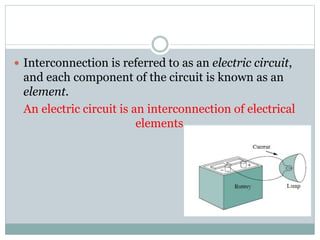
 Interconnection is referred to as an electric circuit,
and each component of the circuit is known as an
element.
An electric circuit is an interconnection of electrical
elements
SYSTEMS OF UNITS
 As electrical engineers, we deal with measurable
quantities. Our measurement, however, must be
communicated in a standard language that virtually
all professionals can understand, irrespective of the
country where the measurement is conducted
 Such an international measurement language is the
International System of Units (SI)
SYSTEMS OF UNITS
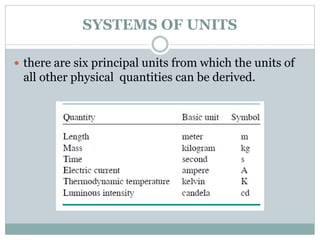
 there are six principal units from which the units of
all other physical quantities can be derived.
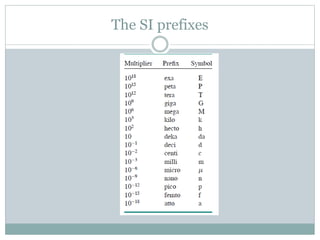
The SI prefixes
CHARGE AND CURRENT
 The most basic quantity in an electric circuit is the
electric charge. We all experience the effect of
electric
 charge when we try to remove our wool sweater and
have it stick to our body or walk across a carpet and
receive a shock.
Charge is an electrical property of the atomic
particles of which matter consists,
measured in coulombs (C).
 The following points should be noted about electric
charge:
 The coulomb is a large unit for charges. In 1 C of
charge, there are 1/(1.602 × 10−19) = 6.24 × 10¹⁸
electrons. Thus realistic or laboratory values of
charges are on the order of pC, nC, or μC.1
 The law of conservation of charge states that charge
can neither be created nor destroyed, only
transferred.
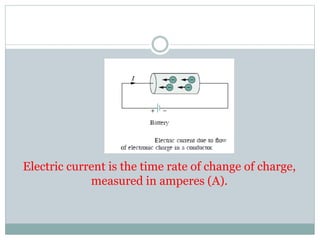
Electric current is the time rate of change of charge,
measured in amperes (A).
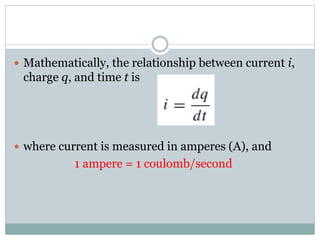
 Mathematically, the relationship between current i,
charge q, and time t is
 where current is measured in amperes (A), and
1 ampere = 1 coulomb/second
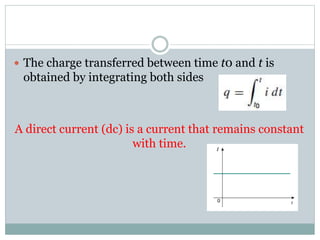
 The charge transferred between time t0 and t is
obtained by integrating both sides
A direct current (dc) is a current that remains constant
with time.
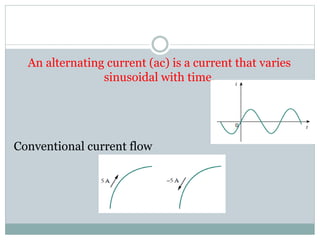
An alternating current (ac) is a current that varies
sinusoidal with time.
Conventional current flow
VOLTAGE
OHM’S LAW
 Materials in general have a characteristic behavior of
resisting the flow of electric charge. This physical
property, or ability to resist current, is known as
resistance and is represented by the symbol R.
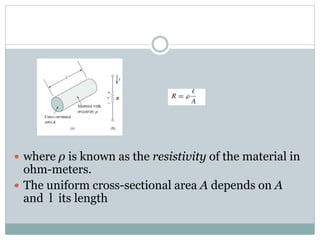
 where ρ is known as the resistivity of the material in
ohm-meters.
 The uniform cross-sectional area A depends on A
and l its length
 Ohm’s law states that the voltage v across a resistor
is directly proportional to the current i flowing
through the resistor.
 v ∝ i
 Ohm defined the constant of proportionality for a
resistor to be the resistance, R. (The resistance is a
material property which can change if the internal or
external conditions of the element are altered, e.g., if
there are changes in the temperature.) Thus, v = iR
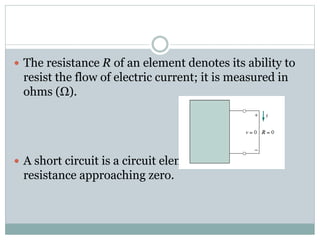
 The resistance R of an element denotes its ability to
resist the flow of electric current; it is measured in
ohms (Ω).
 A short circuit is a circuit element with
resistance approaching zero.
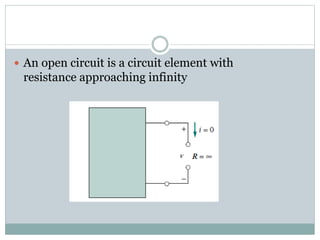
 An open circuit is a circuit element with
resistance approaching infinity
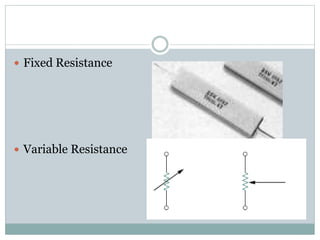
 Fixed Resistance
 Variable Resistance
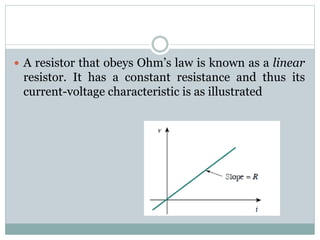
 A resistor that obeys Ohm’s law is known as a linear
resistor. It has a constant resistance and thus its
current-voltage characteristic is as illustrated
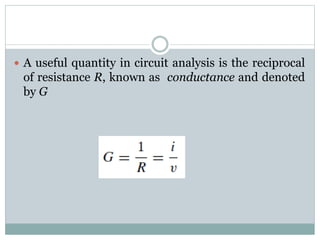
 A useful quantity in circuit analysis is the reciprocal
of resistance R, known as conductance and denoted
by G
 The conductance is a measure of how well an
element will conduct electric current.
 The unit of conductance is the mho (ohm spelled
backward) or reciprocal ohm, with symbol , the
inverted omega.
 Although engineers often use the mhos, or siemens
(S), the SI unit of conductance
1 S = 1 Ʊ = 1 A/V
 Conductance is the ability of an element to conduct
electric current; it is measured in mhos ( Ʊ) or
siemens (S).
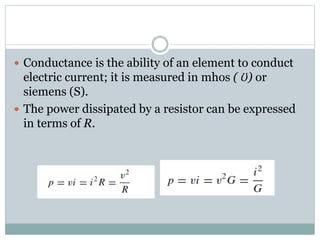
 The power dissipated by a resistor can be expressed
in terms of R.
Points to be Remember
 The power dissipated in a resistor is a nonlinear function
of either current or voltage.
 Since R and G are positive quantities, the power
dissipated in a resistor is always positive. Thus, a resistor
always absorbs power from the circuit. This confirms the
idea that a resistor is a passive element, incapable of
generating energy.

Basic laws

  • 1.
  • 2.
     Electric circuittheory and electromagnetic theory are the two fundamental theories upon which all branches of electrical engineering are built.  In electrical engineering, we are often interested in communicating or transferring energy from one point to another. To do this requires an interconnection of electrical devices
  • 3.
     Interconnection isreferred to as an electric circuit, and each component of the circuit is known as an element. An electric circuit is an interconnection of electrical elements
  • 4.
    SYSTEMS OF UNITS As electrical engineers, we deal with measurable quantities. Our measurement, however, must be communicated in a standard language that virtually all professionals can understand, irrespective of the country where the measurement is conducted  Such an international measurement language is the International System of Units (SI)
  • 5.
    SYSTEMS OF UNITS there are six principal units from which the units of all other physical quantities can be derived.
  • 6.
  • 7.
    CHARGE AND CURRENT The most basic quantity in an electric circuit is the electric charge. We all experience the effect of electric  charge when we try to remove our wool sweater and have it stick to our body or walk across a carpet and receive a shock. Charge is an electrical property of the atomic particles of which matter consists, measured in coulombs (C).
  • 8.
     The followingpoints should be noted about electric charge:  The coulomb is a large unit for charges. In 1 C of charge, there are 1/(1.602 × 10−19) = 6.24 × 10¹⁸ electrons. Thus realistic or laboratory values of charges are on the order of pC, nC, or μC.1  The law of conservation of charge states that charge can neither be created nor destroyed, only transferred.
  • 9.
    Electric current isthe time rate of change of charge, measured in amperes (A).
  • 10.
     Mathematically, therelationship between current i, charge q, and time t is  where current is measured in amperes (A), and 1 ampere = 1 coulomb/second
  • 11.
     The chargetransferred between time t0 and t is obtained by integrating both sides A direct current (dc) is a current that remains constant with time.
  • 12.
    An alternating current(ac) is a current that varies sinusoidal with time. Conventional current flow
  • 13.
  • 14.
    OHM’S LAW  Materialsin general have a characteristic behavior of resisting the flow of electric charge. This physical property, or ability to resist current, is known as resistance and is represented by the symbol R.
  • 15.
     where ρis known as the resistivity of the material in ohm-meters.  The uniform cross-sectional area A depends on A and l its length
  • 16.
     Ohm’s lawstates that the voltage v across a resistor is directly proportional to the current i flowing through the resistor.  v ∝ i  Ohm defined the constant of proportionality for a resistor to be the resistance, R. (The resistance is a material property which can change if the internal or external conditions of the element are altered, e.g., if there are changes in the temperature.) Thus, v = iR
  • 17.
     The resistanceR of an element denotes its ability to resist the flow of electric current; it is measured in ohms (Ω).  A short circuit is a circuit element with resistance approaching zero.
  • 18.
     An opencircuit is a circuit element with resistance approaching infinity
  • 19.
     Fixed Resistance Variable Resistance
  • 20.
     A resistorthat obeys Ohm’s law is known as a linear resistor. It has a constant resistance and thus its current-voltage characteristic is as illustrated
  • 21.
     A usefulquantity in circuit analysis is the reciprocal of resistance R, known as conductance and denoted by G
  • 22.
     The conductanceis a measure of how well an element will conduct electric current.  The unit of conductance is the mho (ohm spelled backward) or reciprocal ohm, with symbol , the inverted omega.  Although engineers often use the mhos, or siemens (S), the SI unit of conductance 1 S = 1 Ʊ = 1 A/V
  • 23.
     Conductance isthe ability of an element to conduct electric current; it is measured in mhos ( Ʊ) or siemens (S).  The power dissipated by a resistor can be expressed in terms of R.
  • 24.
    Points to beRemember  The power dissipated in a resistor is a nonlinear function of either current or voltage.  Since R and G are positive quantities, the power dissipated in a resistor is always positive. Thus, a resistor always absorbs power from the circuit. This confirms the idea that a resistor is a passive element, incapable of generating energy.