An Automated Approach for
Recommending When to Stop
Performance Tests
Hammam
AlGhamdi
Weiyi
Shang 
Mark D.
Syer 
Ahmed E.
Hassan
1
Failures in ultra
large-scale systems
are often due to
performance issues
rather than
functional issues
2
A 25-minutes service outage in 2013
cost Amazon approximately $1.7M
3
4
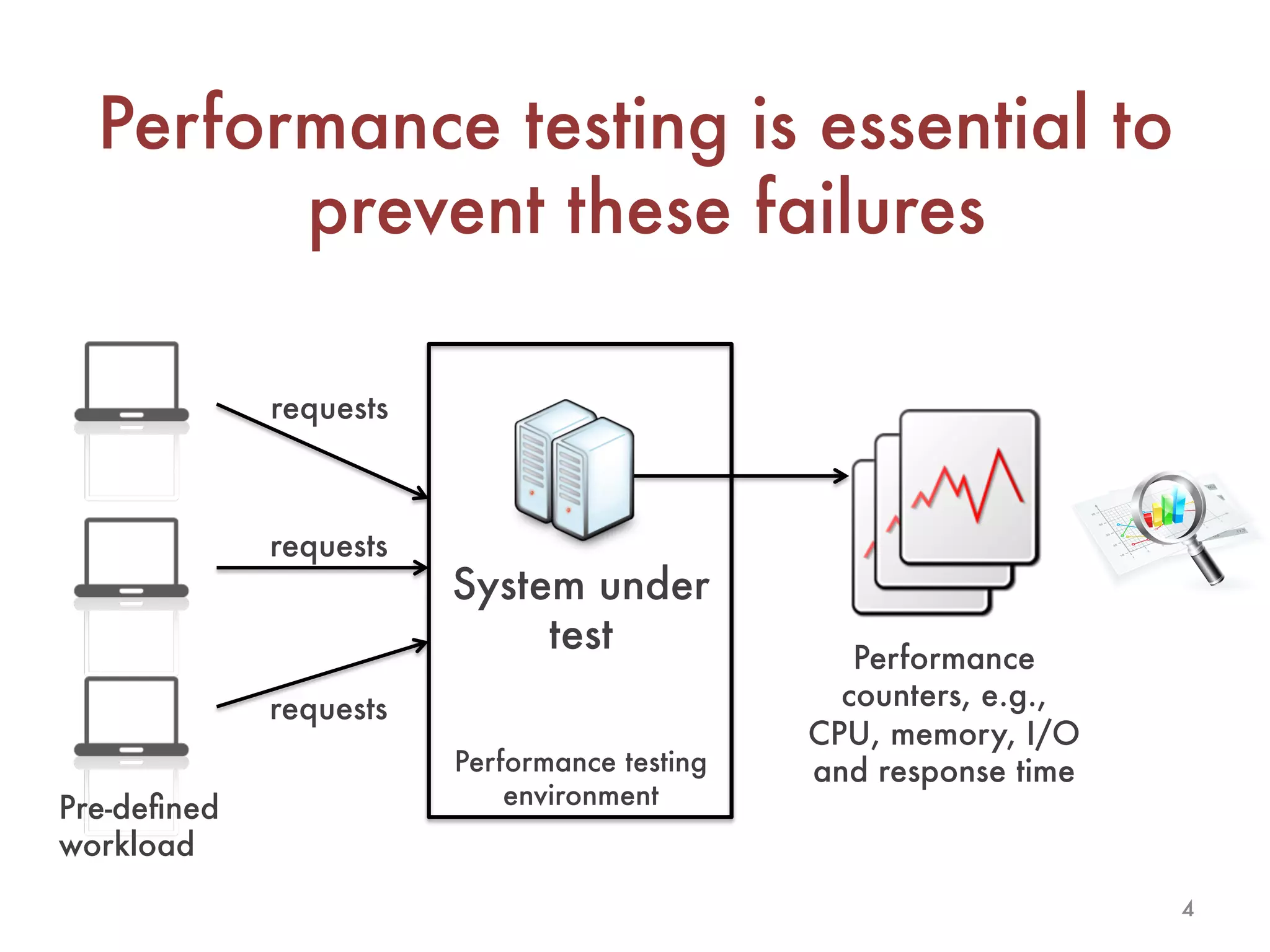
Performance testing is essential to
prevent these failures
System under
test
requests
requests
requests
Performance
counters, e.g.,
CPU, memory, I/O
and response time
Pre-defined
workload
Performance testing
environment
5
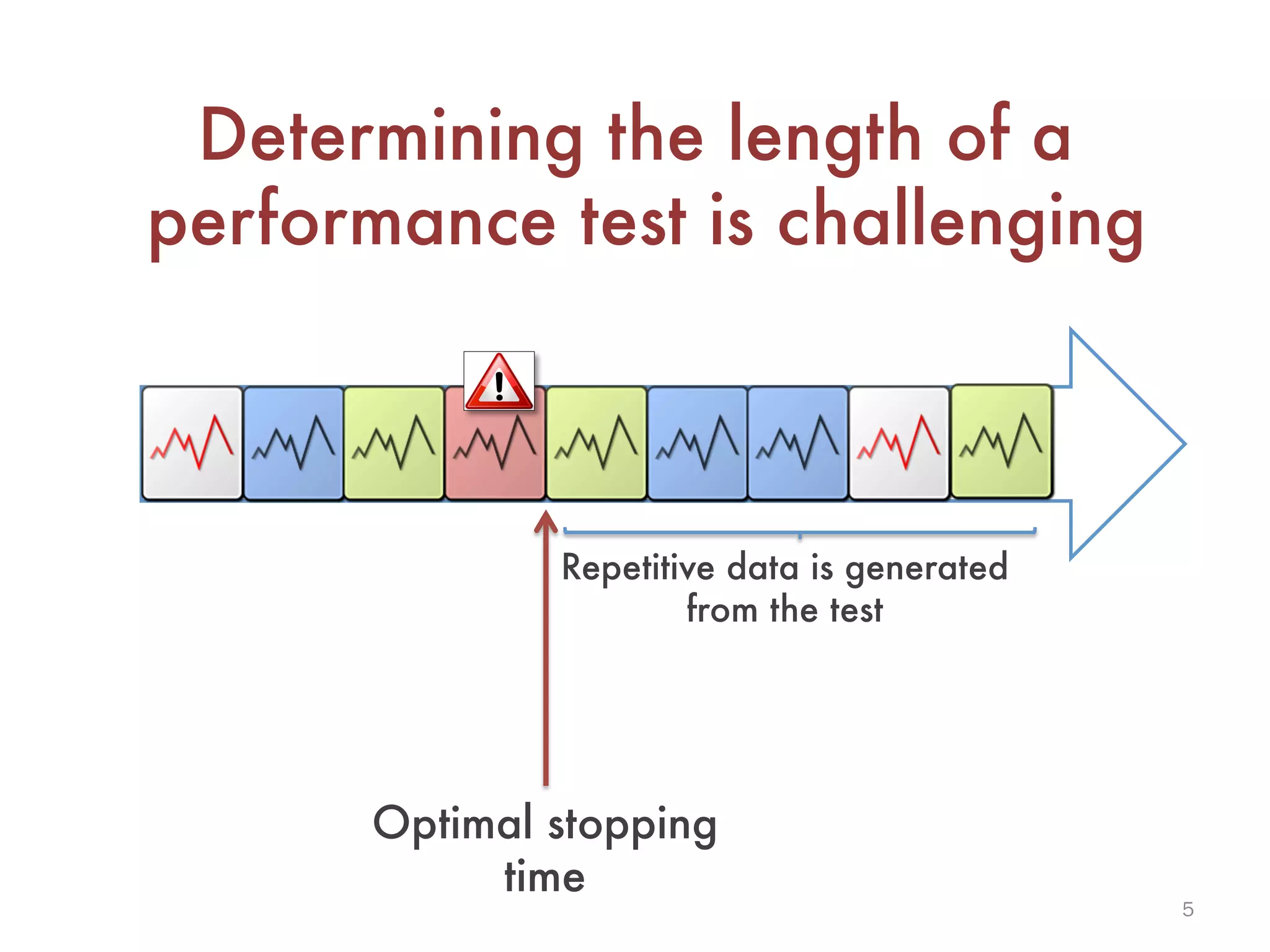
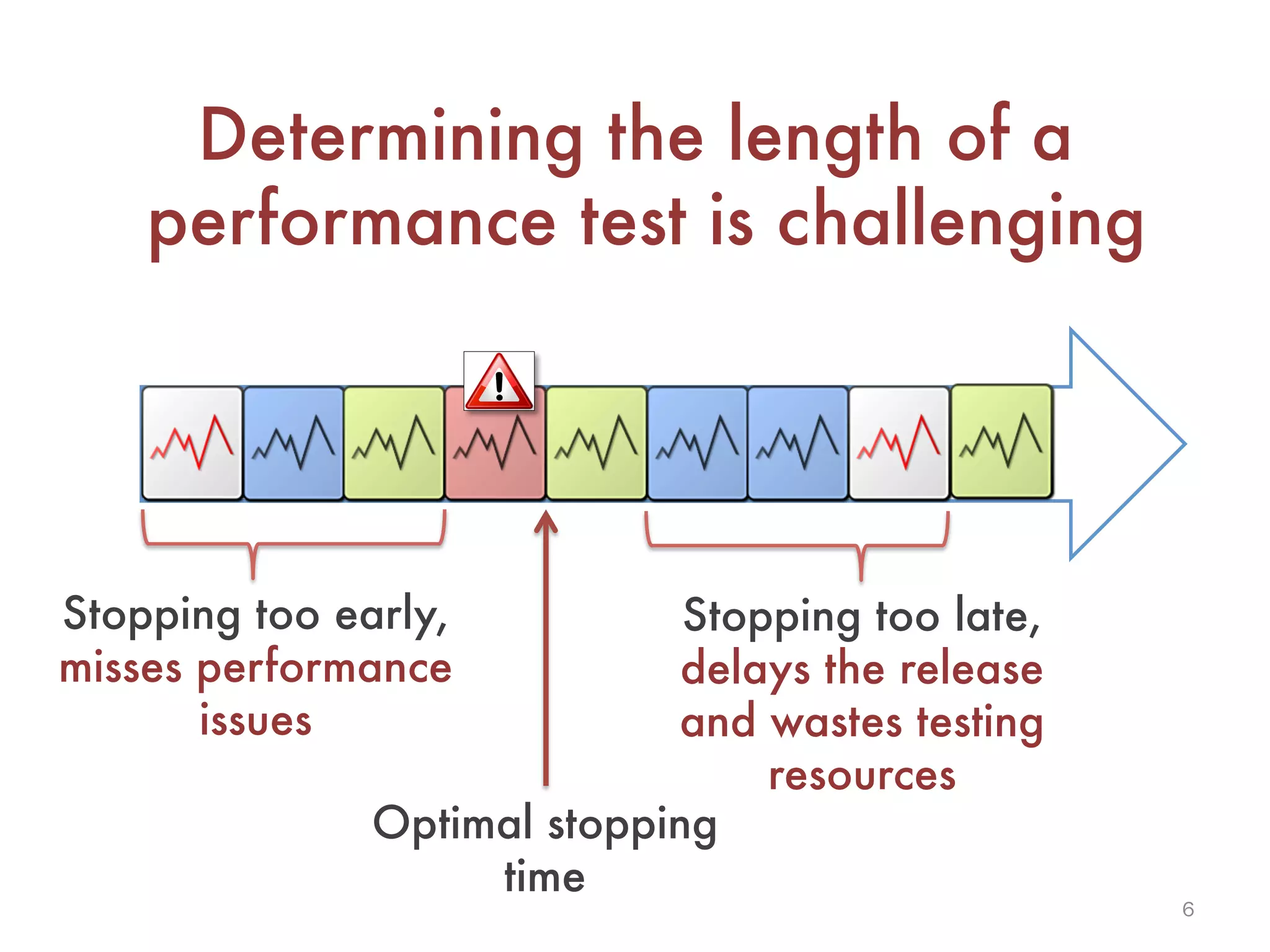
Determining the length of a
performance test is challenging
Time
Repetitive data is generated
from the test
Optimal stopping
time
6
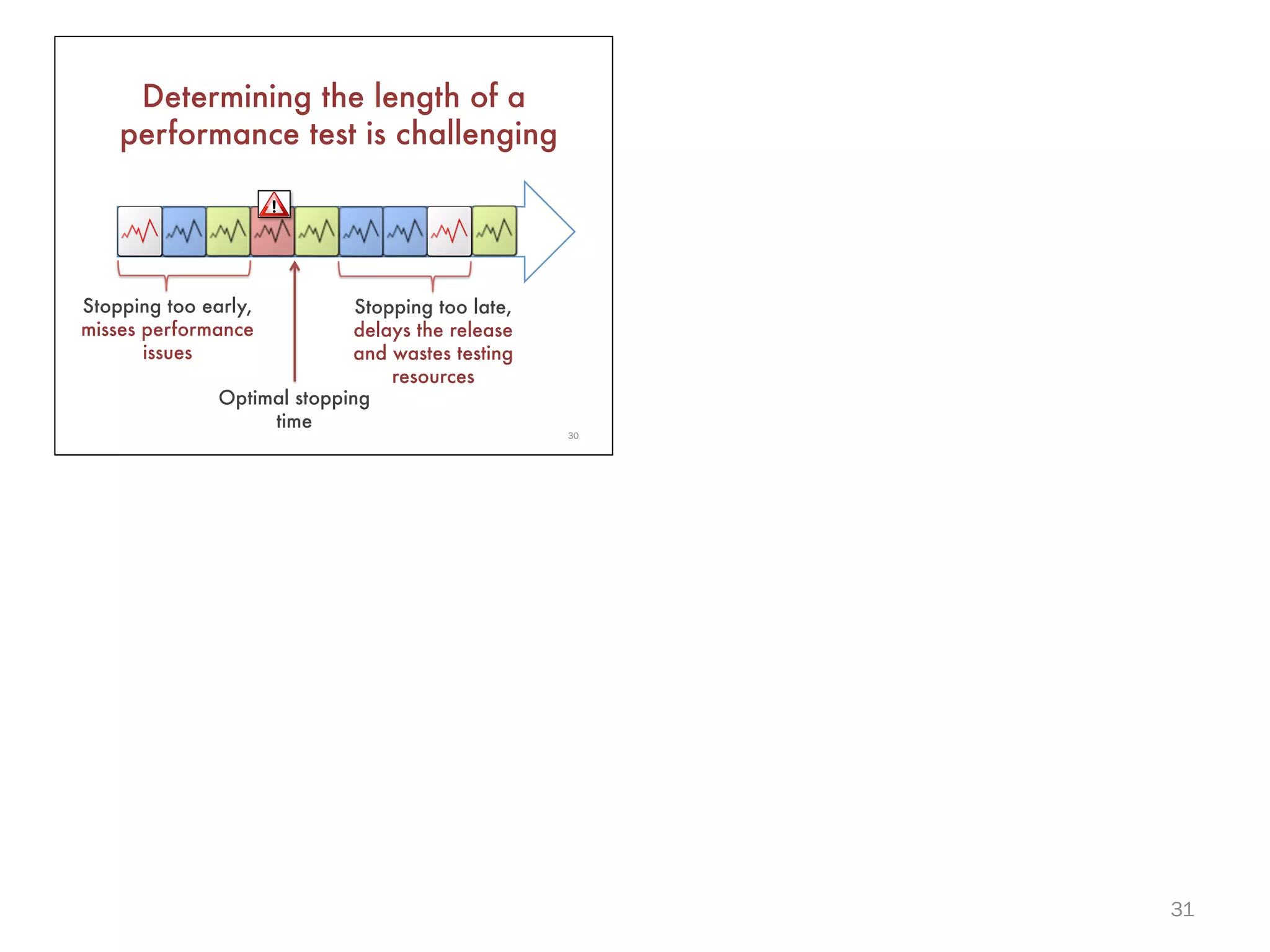
Determining the length of a
performance test is challenging
Time
Stopping too early,
misses performance
issues
Stopping too late, 
delays the release
and wastes testing
resources
Optimal stopping
time
7
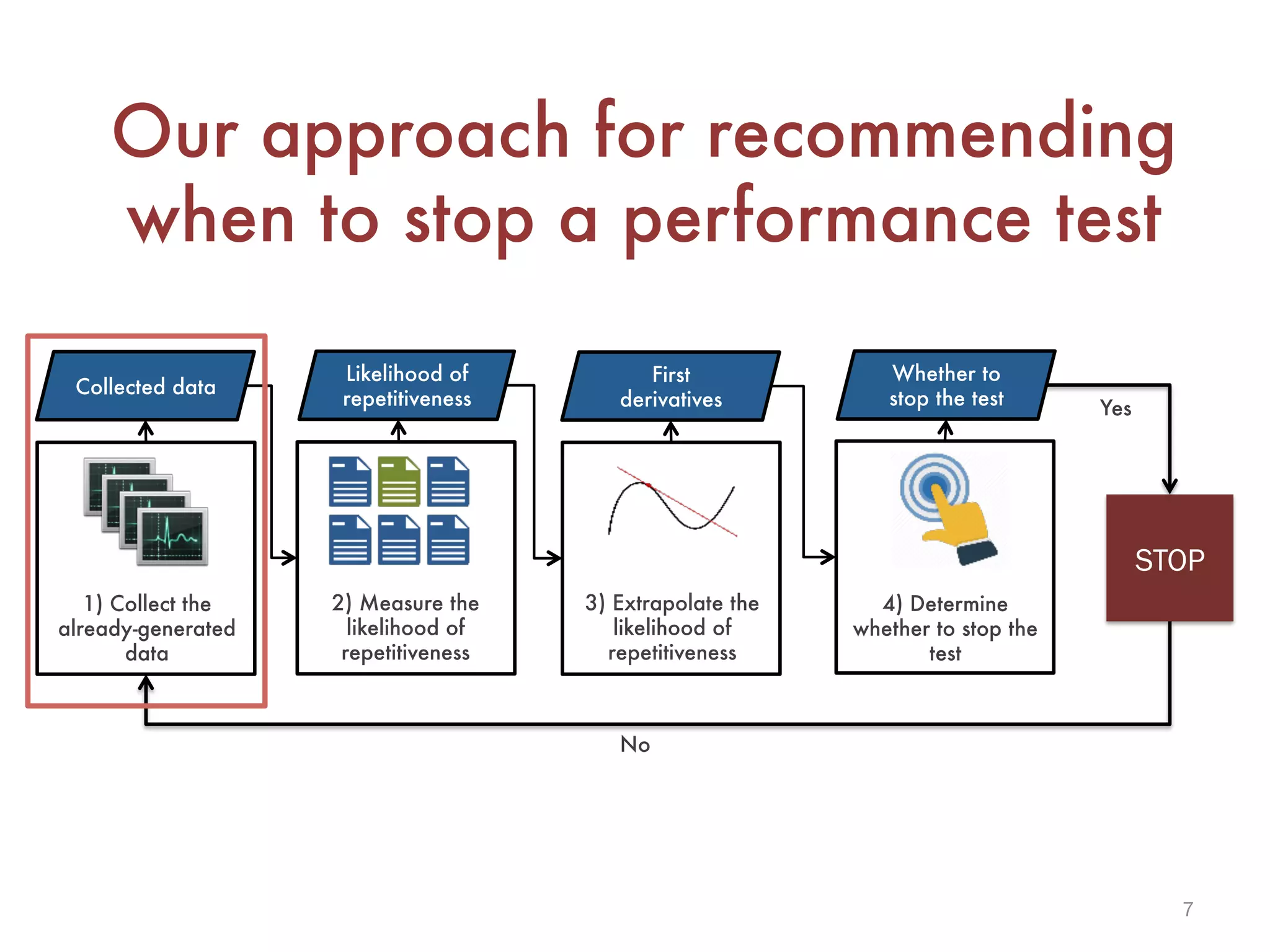
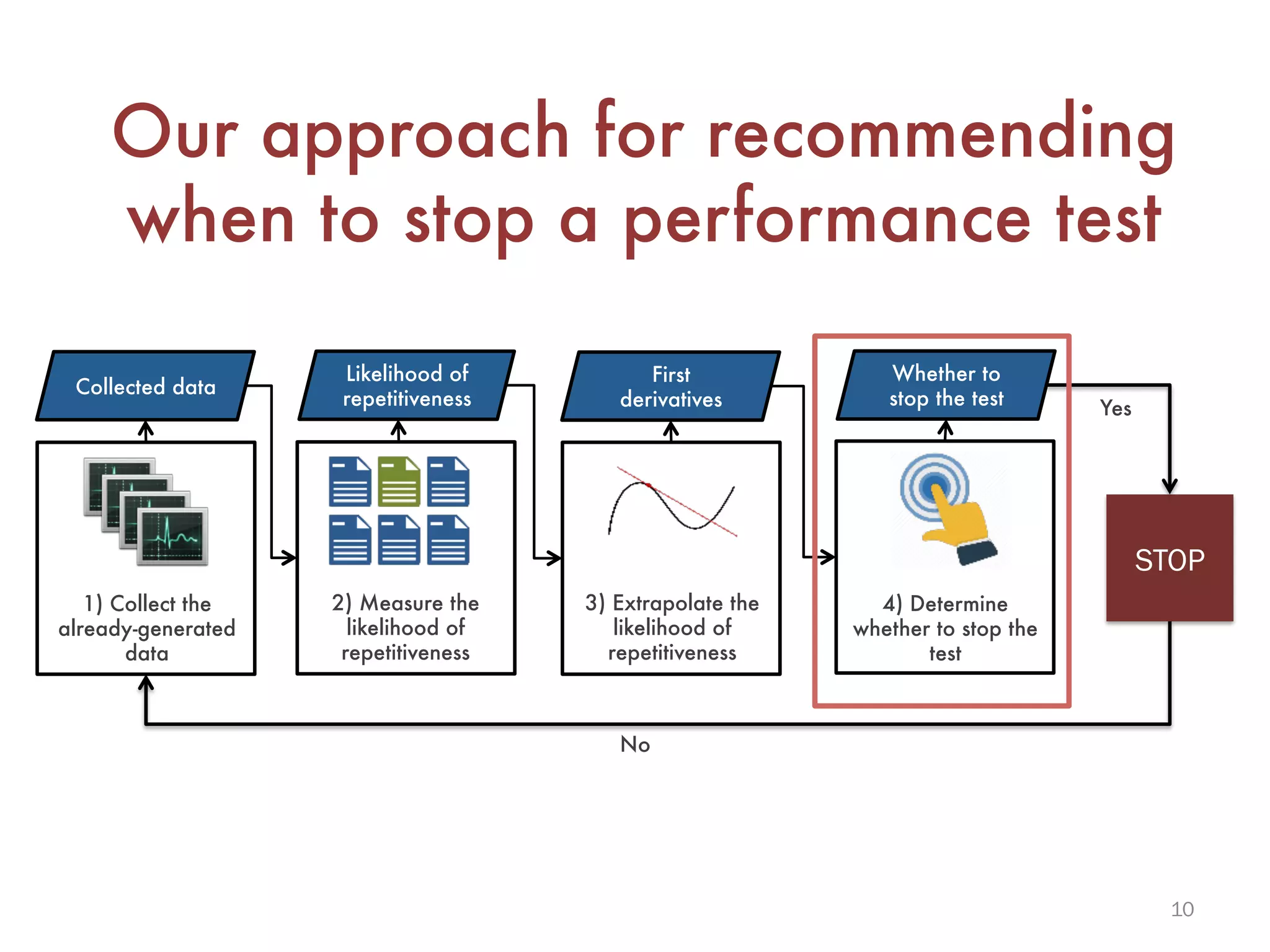
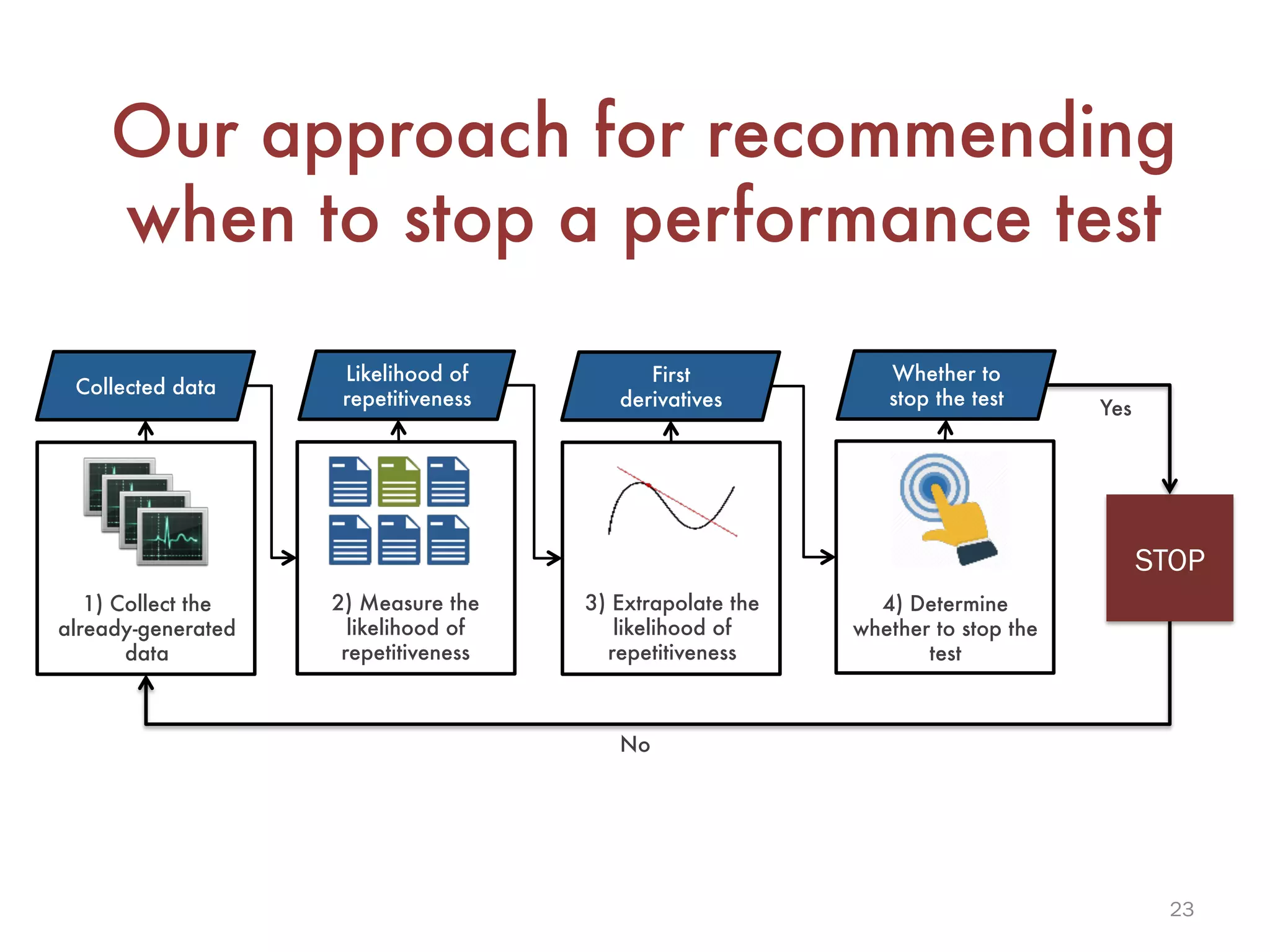
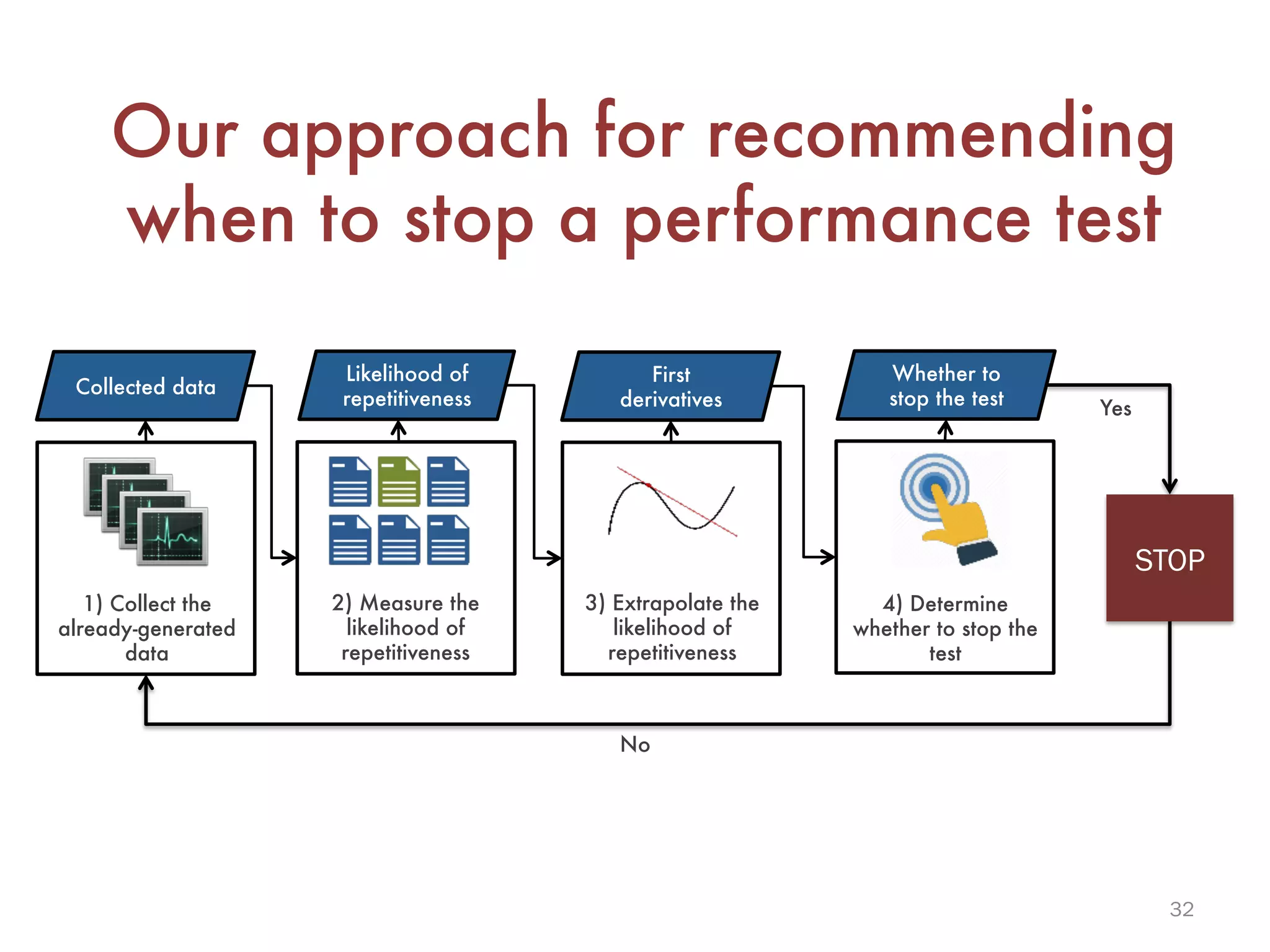
Our approach for recommending
when to stop a performance test
Collected data
Likelihood of
repetitiveness
First
derivatives
Whether to
stop the test
1) Collect the
already-generated
data
2) Measure the
likelihood of
repetitiveness
3) Extrapolate the
likelihood of
repetitiveness
4) Determine
whether to stop the
test
STOP
No
Yes
8
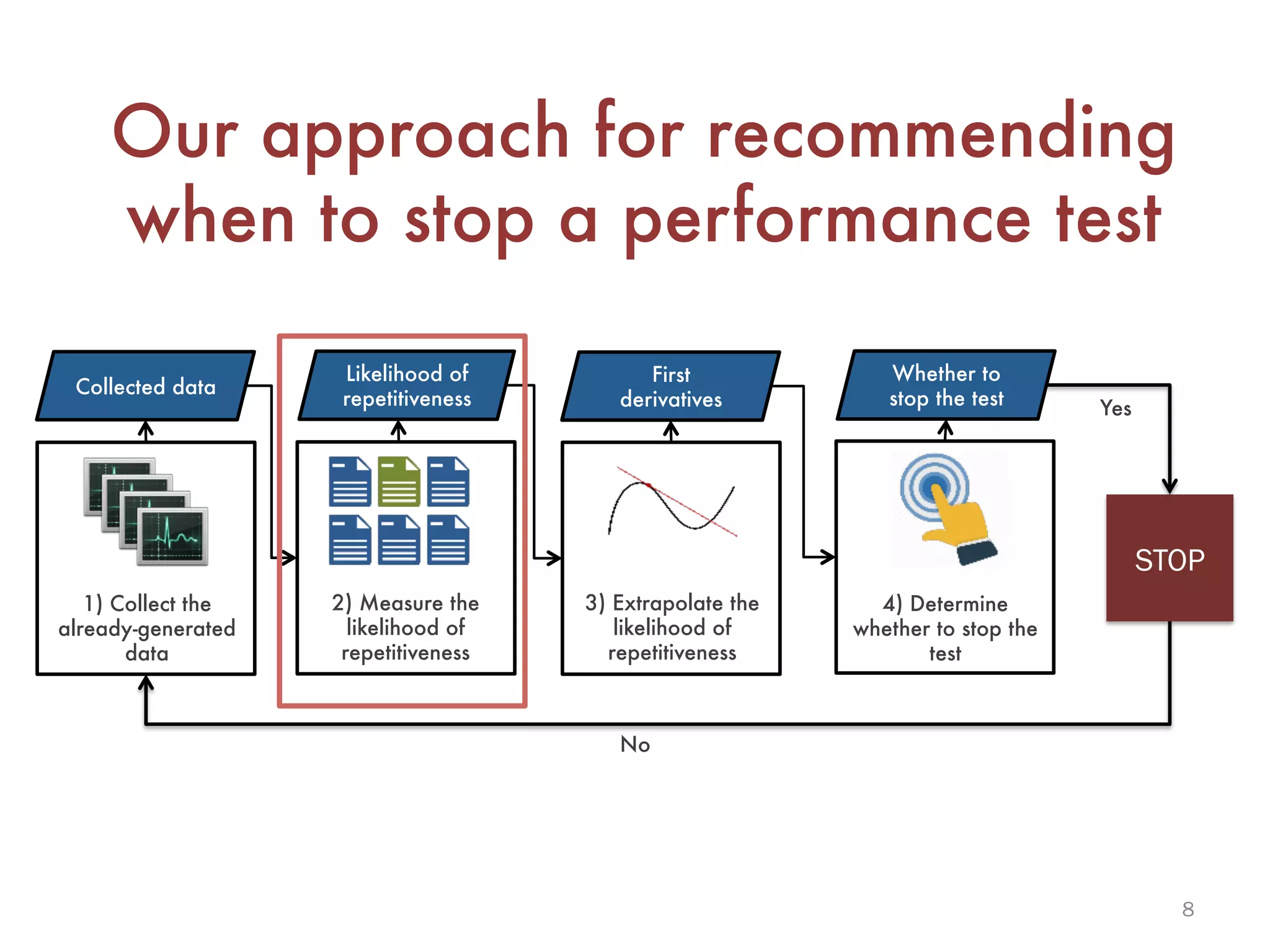
Our approach for recommending
when to stop a performance test
Collected data
Likelihood of
repetitiveness
First
derivatives
Whether to
stop the test
1) Collect the
already-generated
data
2) Measure the
likelihood of
repetitiveness
3) Extrapolate the
likelihood of
repetitiveness
4) Determine
whether to stop the
test
STOP
No
Yes
9
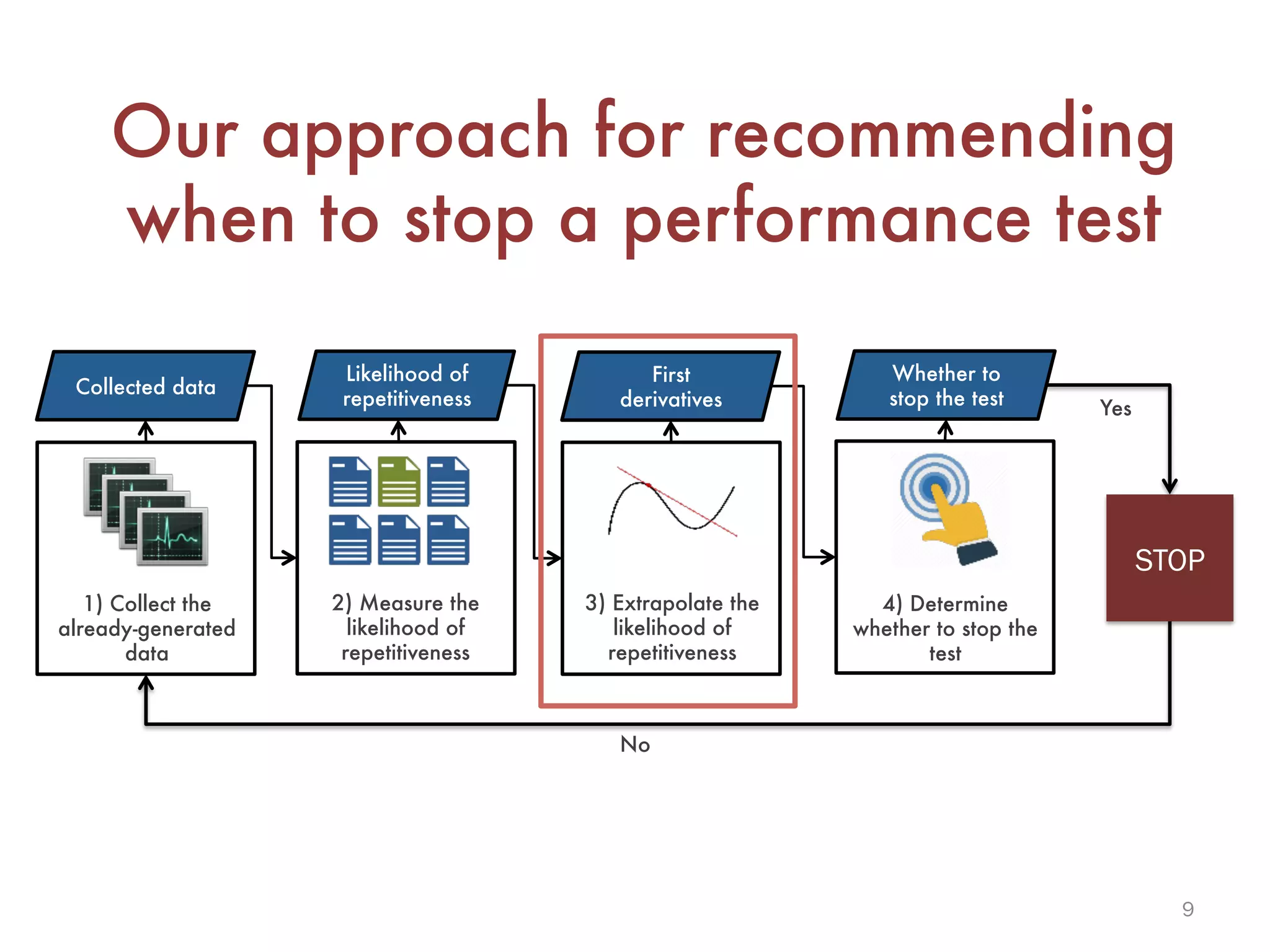
Our approach for recommending
when to stop a performance test
Collected data
Likelihood of
repetitiveness
First
derivatives
Whether to
stop the test
1) Collect the
already-generated
data
2) Measure the
likelihood of
repetitiveness
3) Extrapolate the
likelihood of
repetitiveness
4) Determine
whether to stop the
test
STOP
No
Yes
10
Our approach for recommending
when to stop a performance test
Collected data
Likelihood of
repetitiveness
First
derivatives
Whether to
stop the test
1) Collect the
already-generated
data
2) Measure the
likelihood of
repetitiveness
3) Extrapolate the
likelihood of
repetitiveness
4) Determine
whether to stop the
test
STOP
No
Yes
11
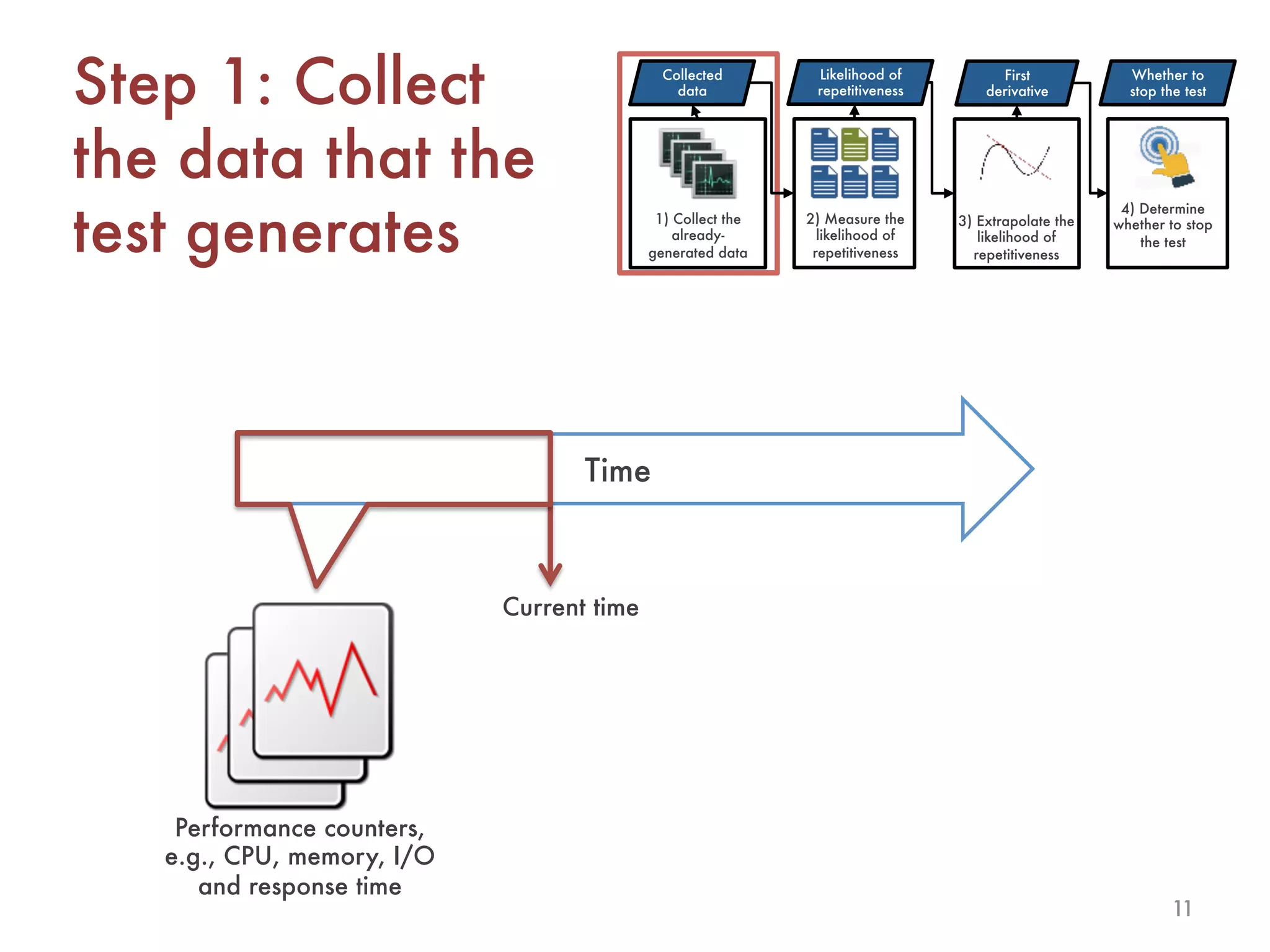
Time
Current time
Collected
data
Likelihood of
repetitiveness
First
derivative
Whether to
stop the test
1) Collect the
already-
generated data
2) Measure the
likelihood of
repetitiveness
3) Extrapolate the
likelihood of
repetitiveness
4) Determine
whether to stop
the test
Step 1: Collect
the data that the
test generates
Performance counters,
e.g., CPU, memory, I/O
and response time
12
Time
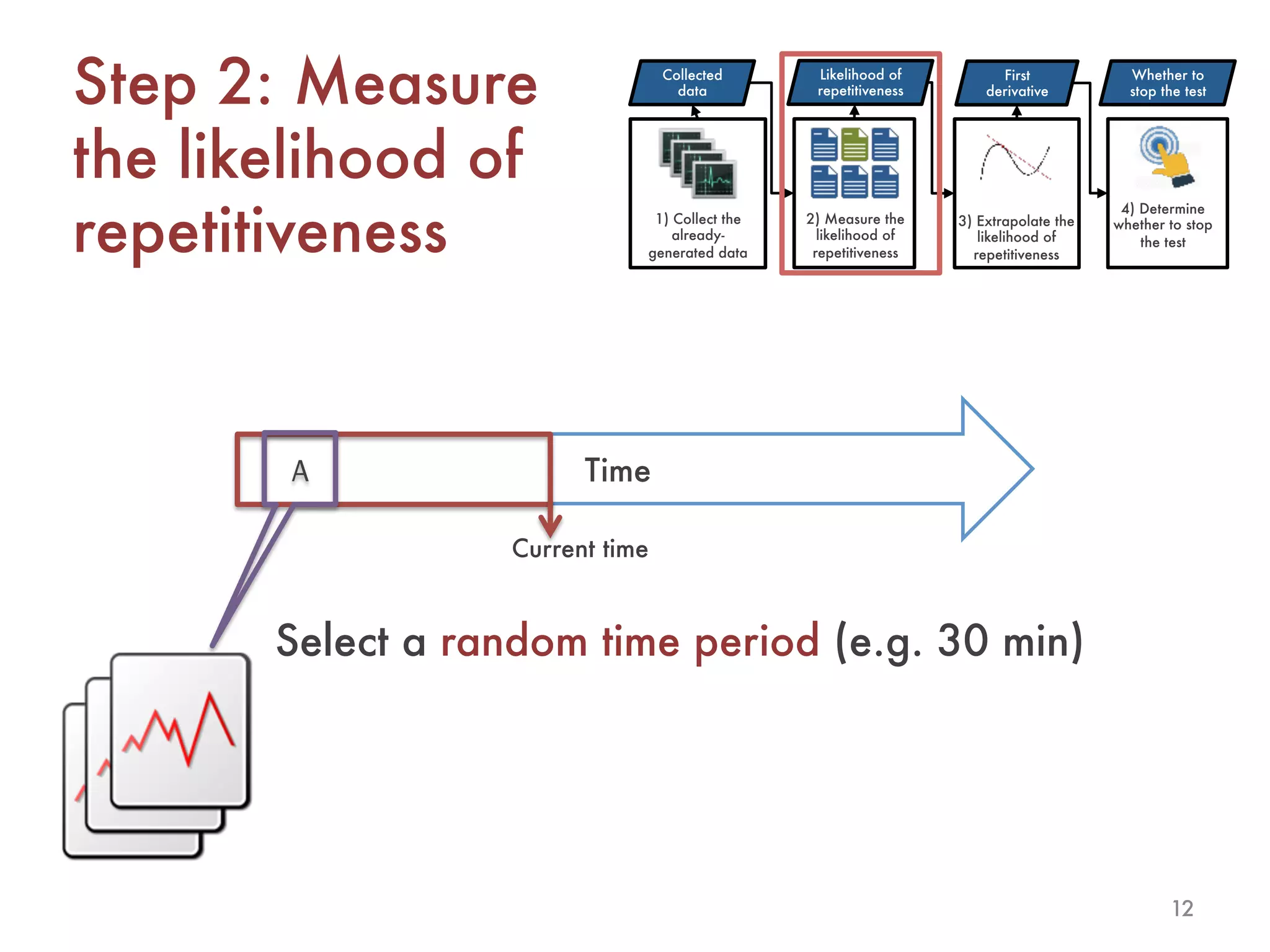
Step 2: Measure
the likelihood of
repetitiveness
Select a random time period (e.g. 30 min) 
Current time
Collected
data
Likelihood of
repetitiveness
First
derivative
Whether to
stop the test
1) Collect the
already-
generated data
2) Measure the
likelihood of
repetitiveness
3) Extrapolate the
likelihood of
repetitiveness
4) Determine
whether to stop
the test
A
13
Time
Current time
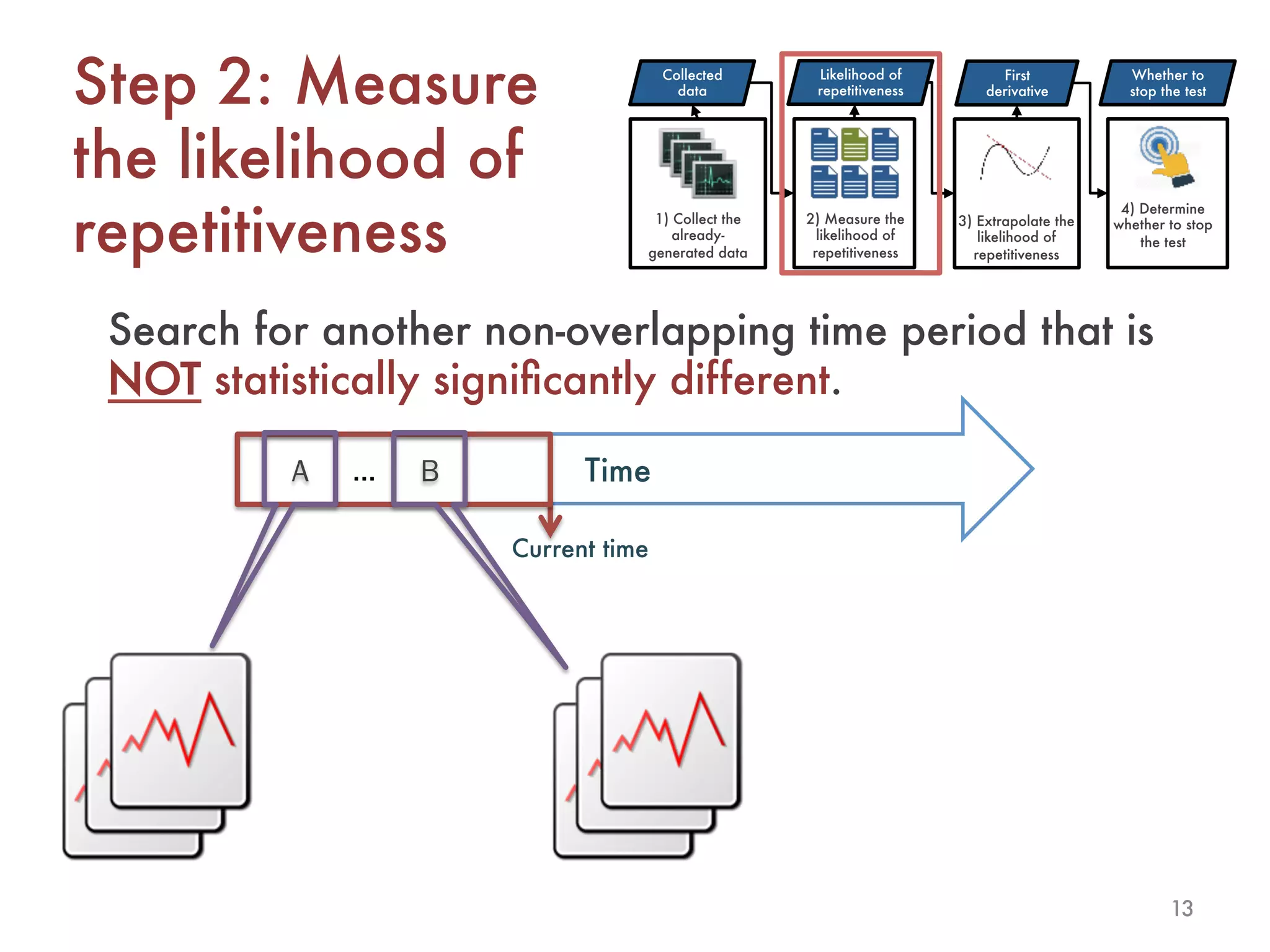
Search for another non-overlapping time period that is
NOT statistically significantly different. 
…
Step 2: Measure
the likelihood of
repetitiveness
… B…A
Collected
data
Likelihood of
repetitiveness
First
derivative
Whether to
stop the test
1) Collect the
already-
generated data
2) Measure the
likelihood of
repetitiveness
3) Extrapolate the
likelihood of
repetitiveness
4) Determine
whether to stop
the test
14
Time
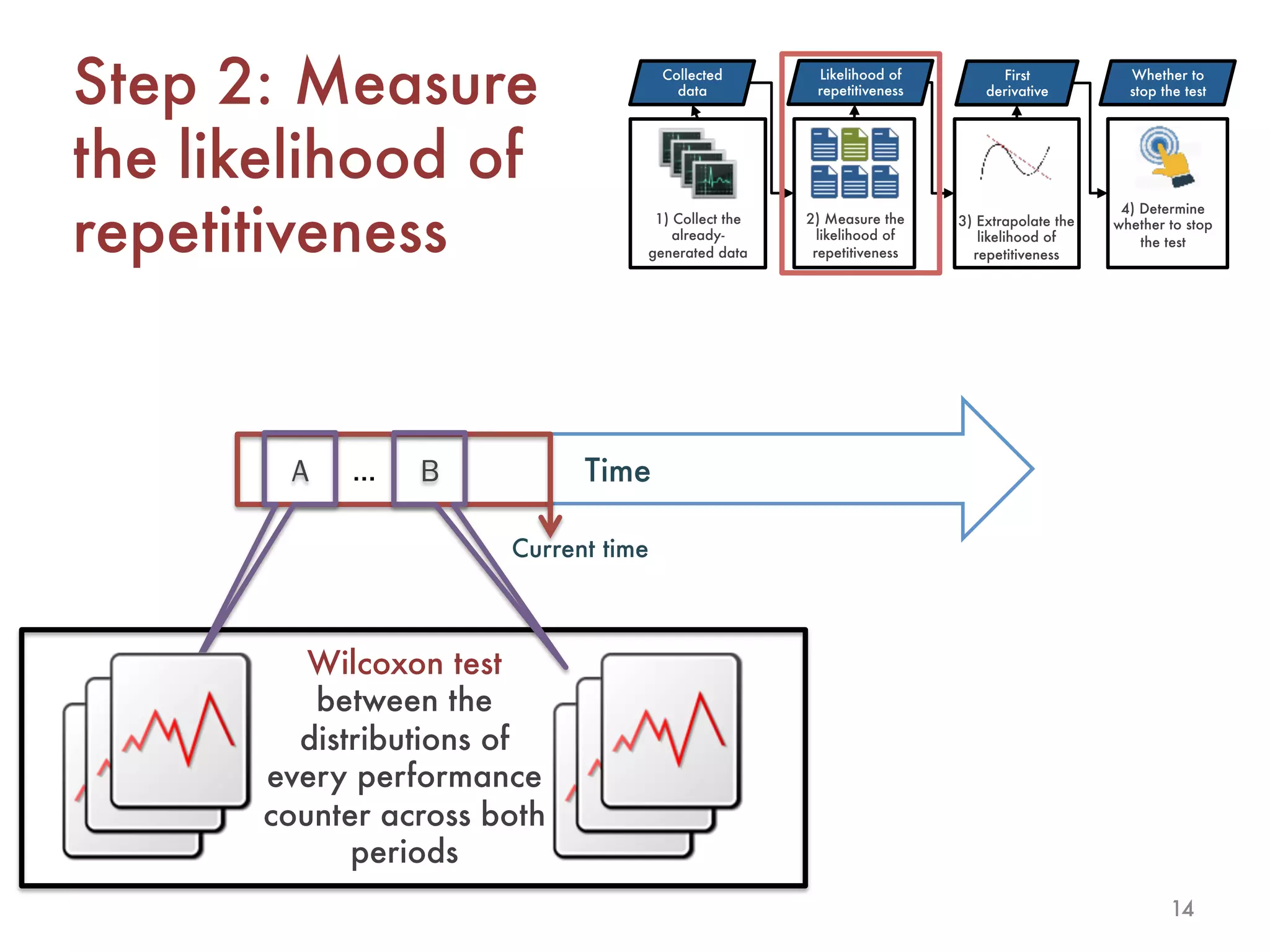
Wilcoxon test
between the
distributions of
every performance
counter across both
periods
…
Current time
Step 2: Measure
the likelihood of
repetitiveness
B…A
Collected
data
Likelihood of
repetitiveness
First
derivative
Whether to
stop the test
1) Collect the
already-
generated data
2) Measure the
likelihood of
repetitiveness
3) Extrapolate the
likelihood of
repetitiveness
4) Determine
whether to stop
the test
15
Step 2: Measure
the likelihood of
repetitiveness
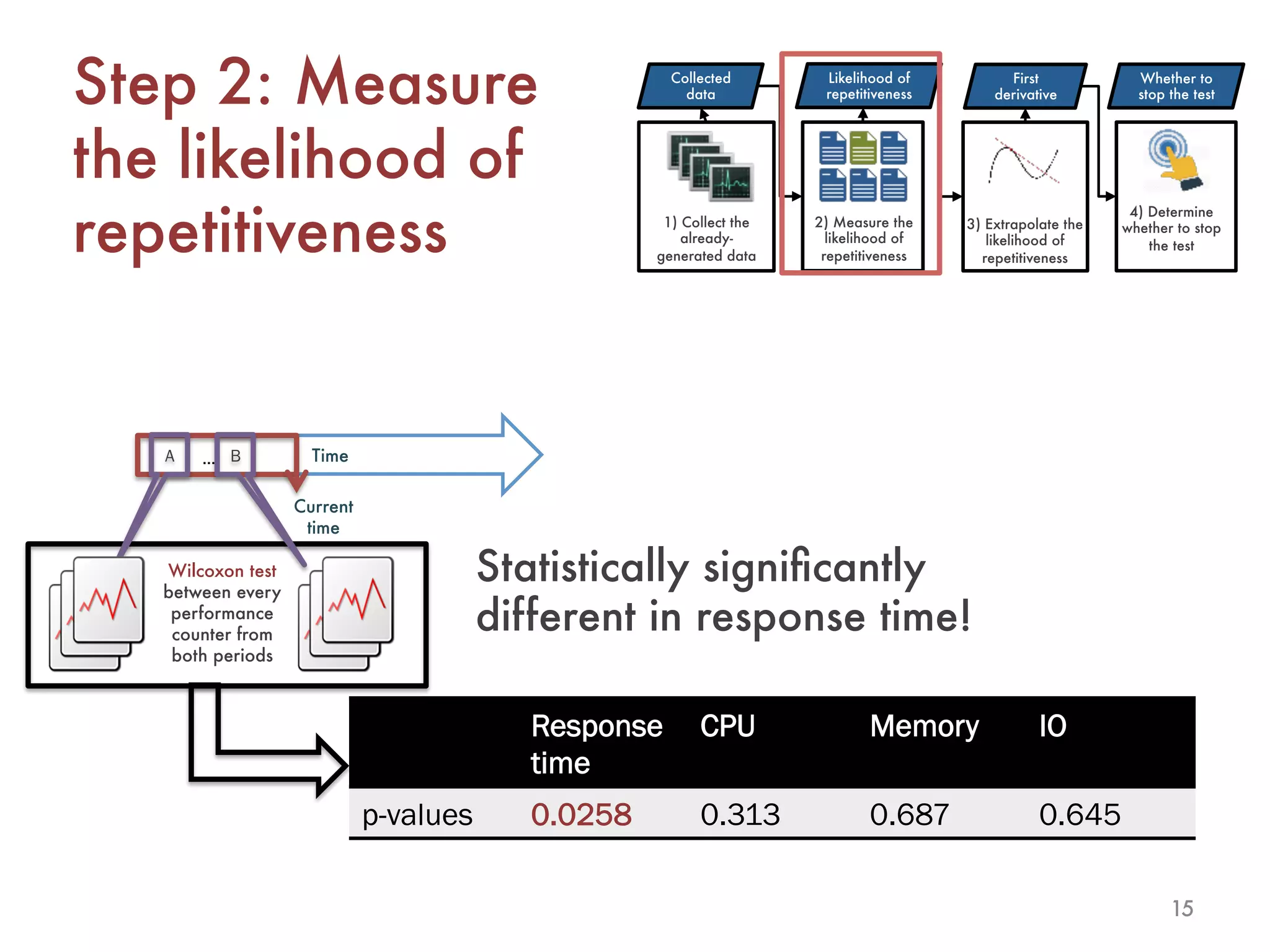
Response
time
CPU Memory IO
p-values 0.0258 0.313 0.687 0.645
Statistically significantly
different in response time!
Collected
data
Likelihood of
repetitiveness
First
derivative
Whether to
stop the test
1) Collect the
already-
generated data
2) Measure the
likelihood of
repetitiveness
3) Extrapolate the
likelihood of
repetitiveness
4) Determine
whether to stop
the test
Time
Wilcoxon test
between every
performance
counter from
both periods
…
Current
time
B…A
16
Step 2: Measure
the likelihood of
repetitiveness
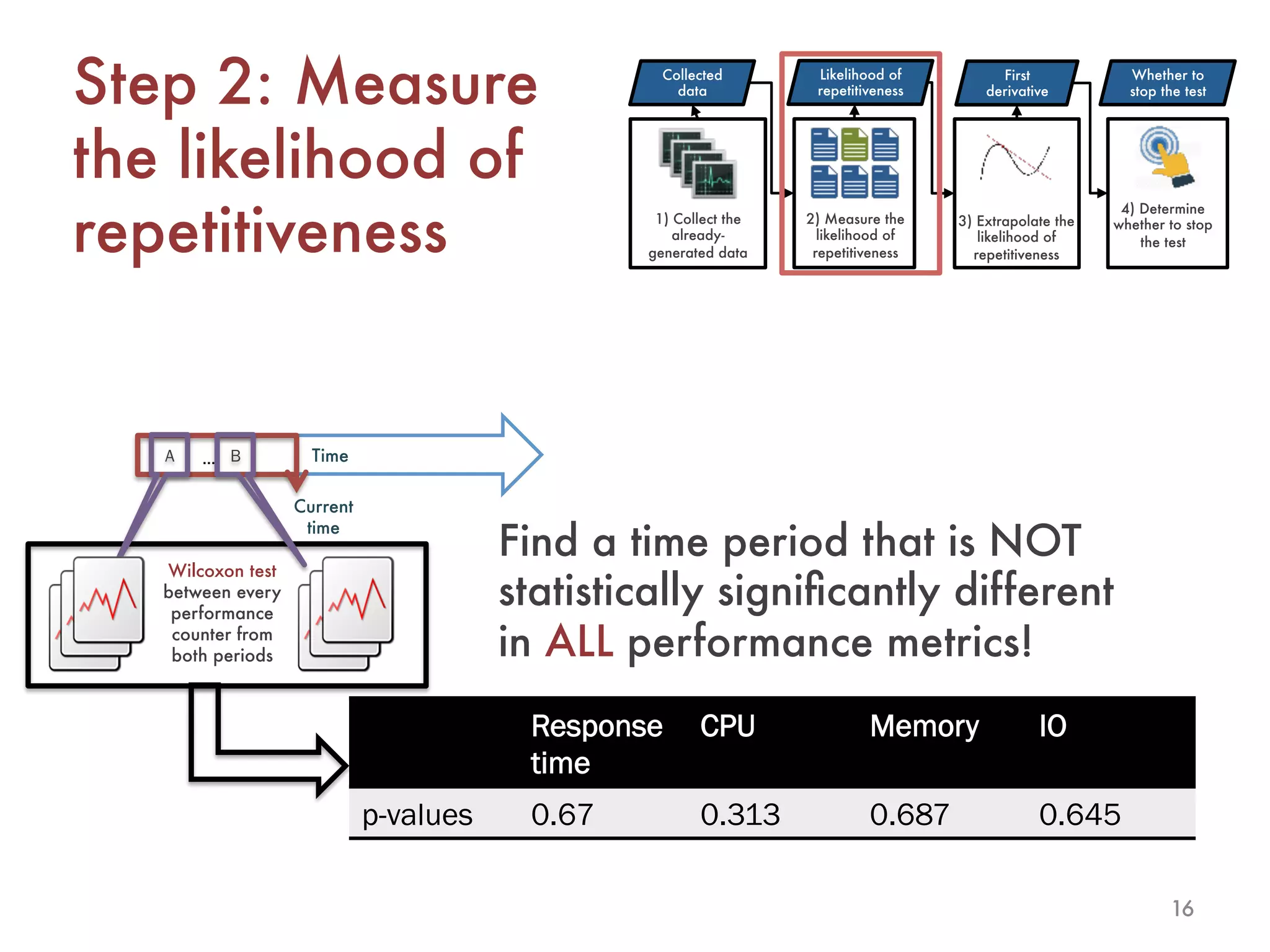
Response
time
CPU Memory IO
p-values 0.67 0.313 0.687 0.645
Find a time period that is NOT
statistically significantly different
in ALL performance metrics!
Collected
data
Likelihood of
repetitiveness
First
derivative
Whether to
stop the test
1) Collect the
already-
generated data
2) Measure the
likelihood of
repetitiveness
3) Extrapolate the
likelihood of
repetitiveness
4) Determine
whether to stop
the test
Time
Wilcoxon test
between every
performance
counter from
both periods
…
Current
time
B…A
17
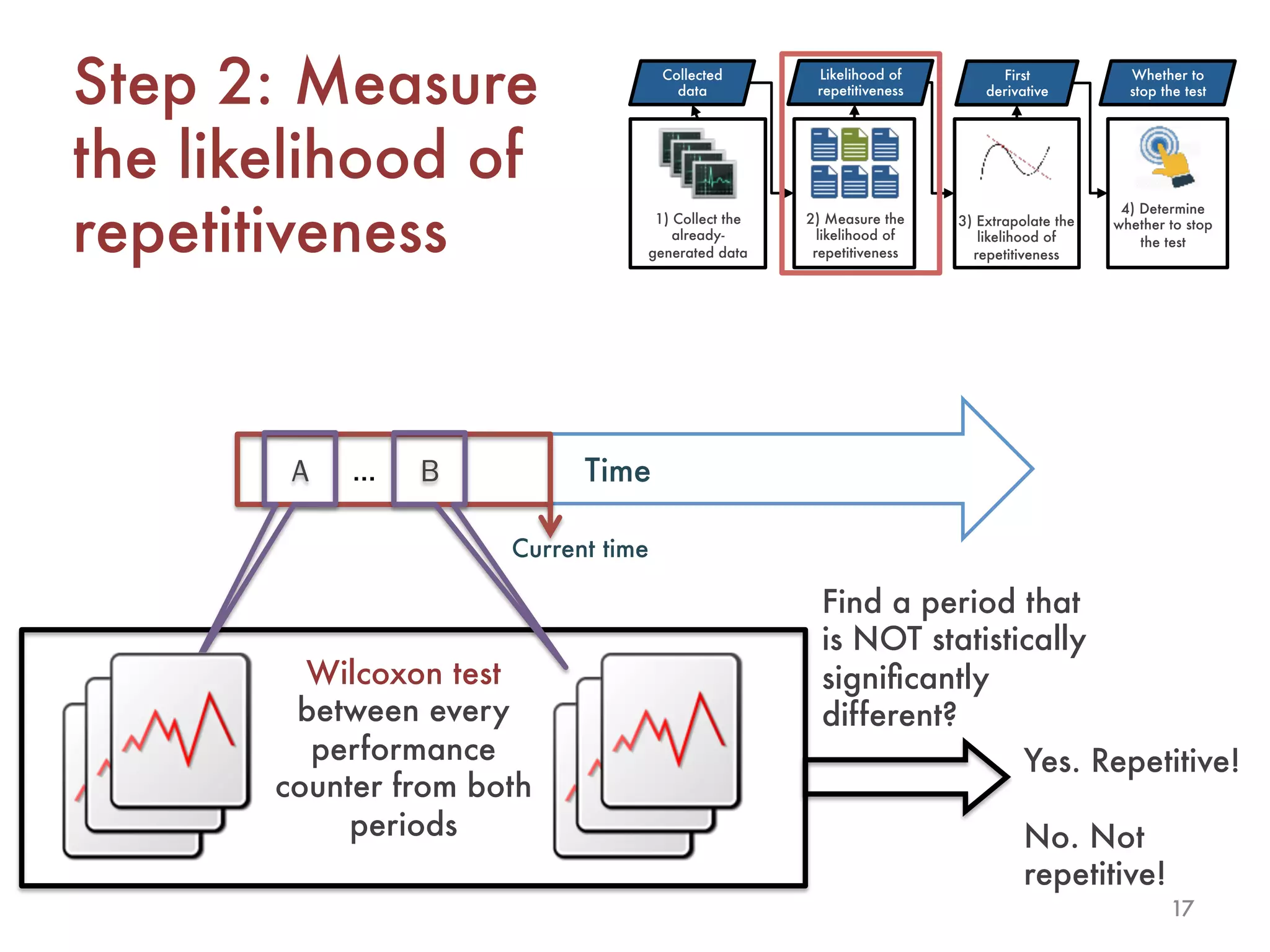
Find a period that
is NOT statistically
significantly
different?
Yes. Repetitive!

No. Not
repetitive!
Step 2: Measure
the likelihood of
repetitiveness
Collected
data
Likelihood of
repetitiveness
First
derivative
Whether to
stop the test
1) Collect the
already-
generated data
2) Measure the
likelihood of
repetitiveness
3) Extrapolate the
likelihood of
repetitiveness
4) Determine
whether to stop
the test
Time
Wilcoxon test
between every
performance
counter from both
periods
…
Current time
B…A
18
Step 2: Measure
the likelihood of
repetitiveness
Collected
data
Likelihood of
repetitiveness
First
derivative
Whether to
stop the test
1) Collect the
already-
generated data
2) Measure the
likelihood of
repetitiveness
3) Extrapolate the
likelihood of
repetitiveness
4) Determine
whether to stop
the test
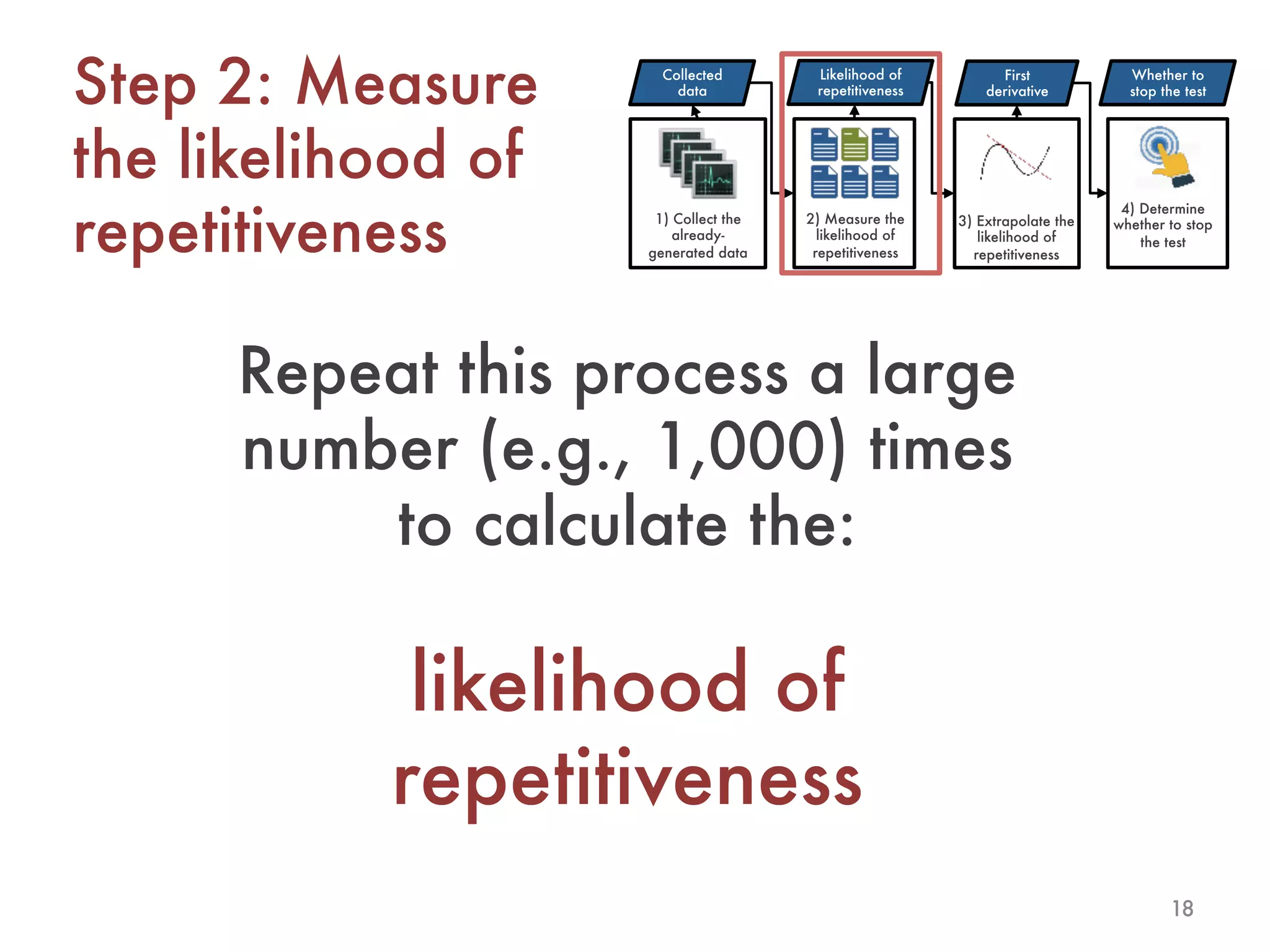
Repeat this process a large
number (e.g., 1,000) times
to calculate the:

likelihood of
repetitiveness
19
Step 2: Measure
the likelihood of
repetitiveness
30 min
40 min
Time
…
1h 10 min
Collected
data
Likelihood of
repetitiveness
First
derivative
Whether to
stop the test
1) Collect the
already-
generated data
2) Measure the
likelihood of
repetitiveness
3) Extrapolate the
likelihood of
repetitiveness
4) Determine
whether to stop
the test
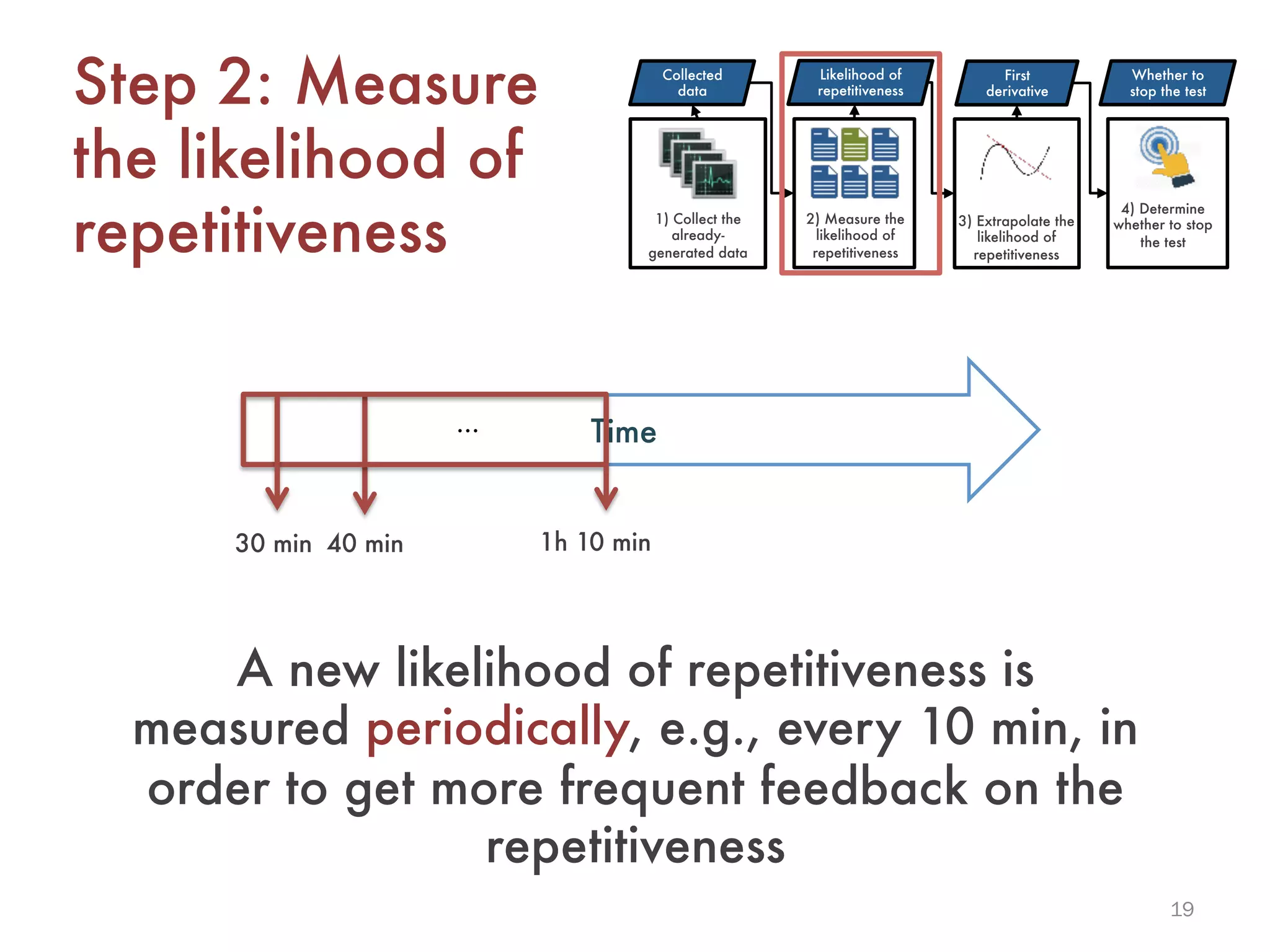
A new likelihood of repetitiveness is
measured periodically, e.g., every 10 min, in
order to get more frequent feedback on the
repetitiveness
20
Step 2: Measure
the likelihood of
repetitiveness
Time
likelihood of
repetitiveness
00:00
 24:00
1%
100%
Stabilization
(little new information)
Collected
data
Likelihood of
repetitiveness
First
derivative
Whether to
stop the test
1) Collect the
already-
generated data
2) Measure the
likelihood of
repetitiveness
3) Extrapolate the
likelihood of
repetitiveness
4) Determine
whether to stop
the test
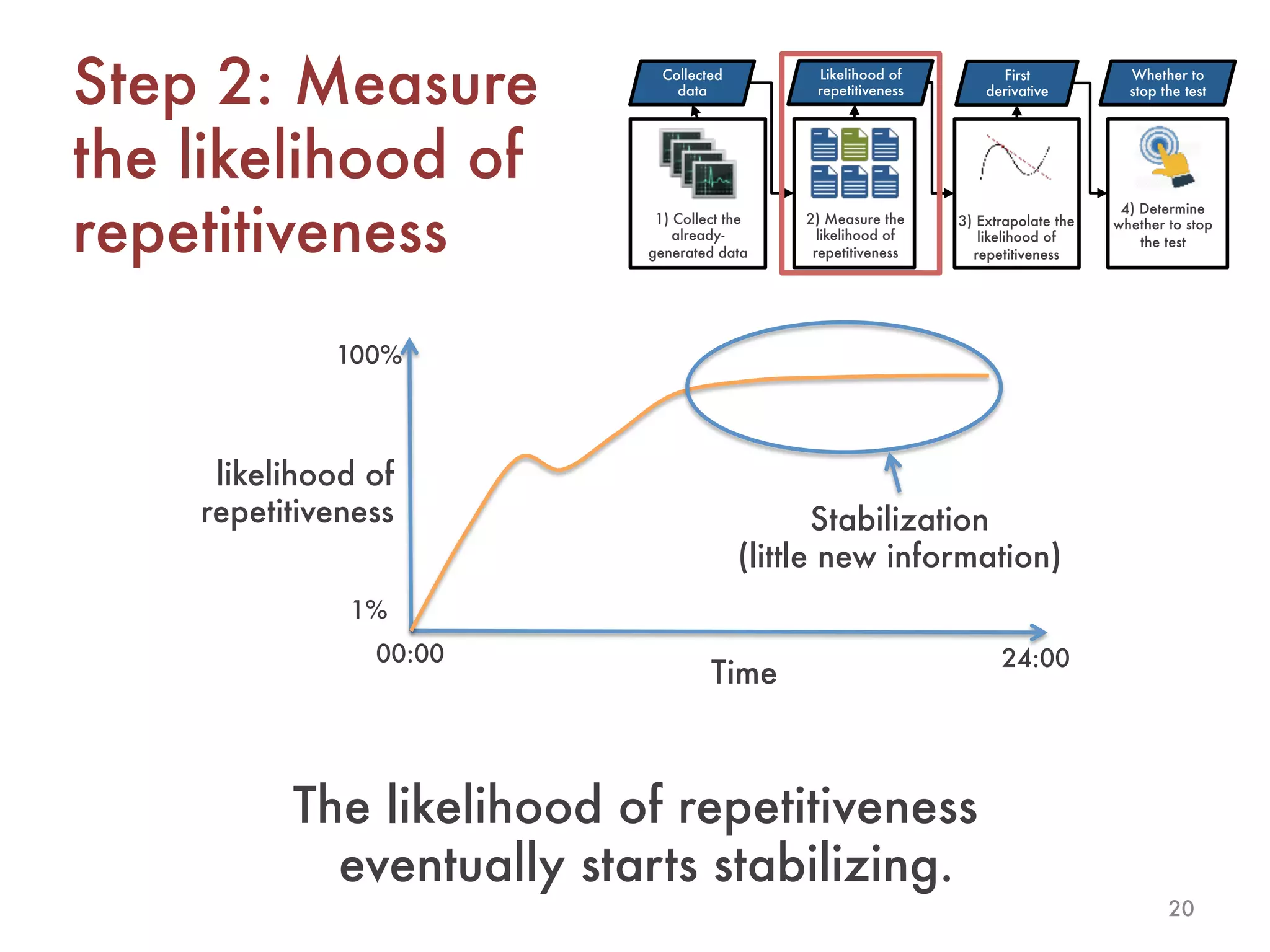
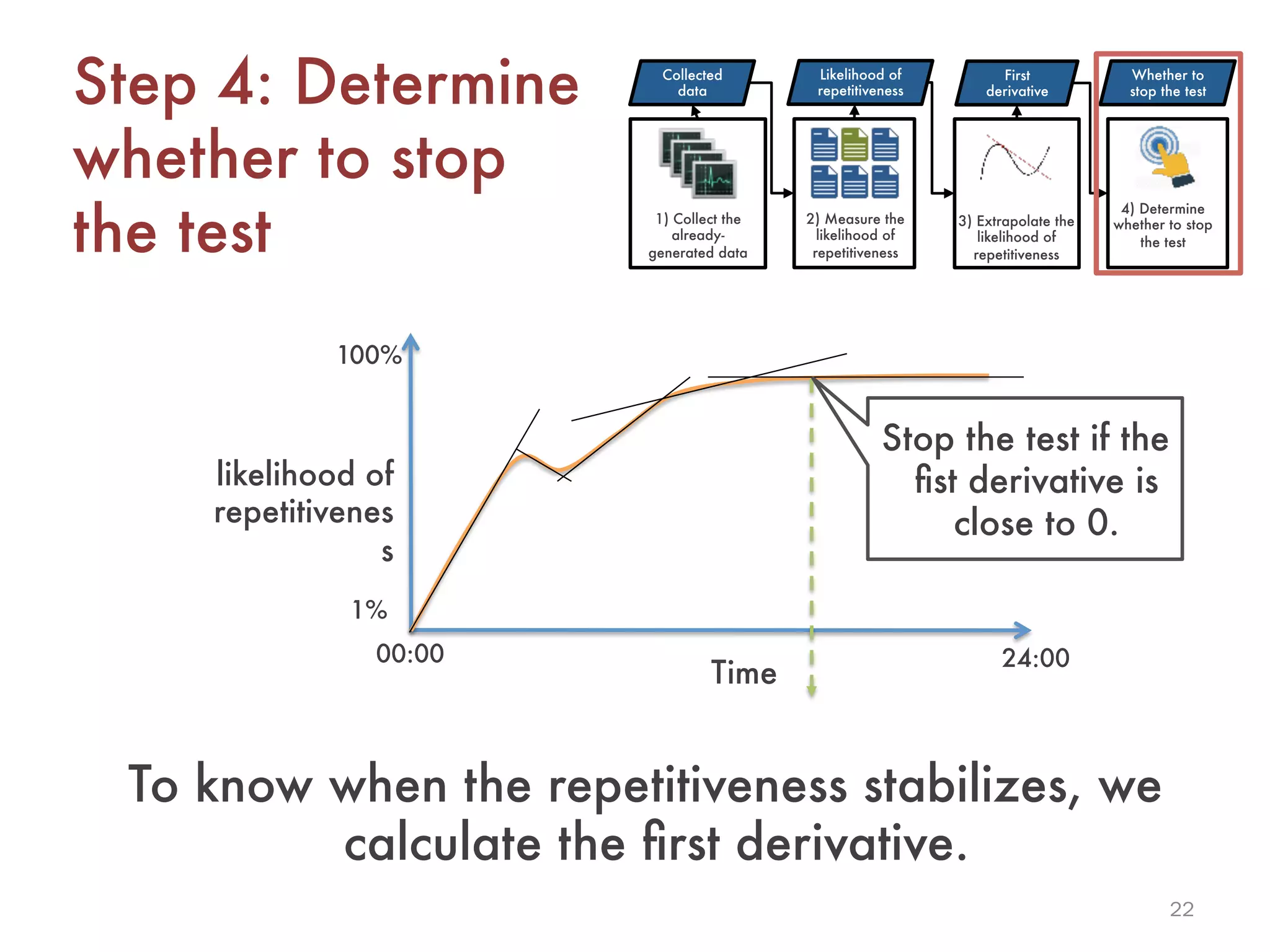
The likelihood of repetitiveness
eventually starts stabilizing.
21
Step 3: Extrapolate
the likelihood of
repetitiveness
Time
likelihood of
repetitiveness
00:00
 24:00
1%
100%
Collected
data
Likelihood of
repetitiveness
First
derivative
Whether to
stop the test
1) Collect the
already-
generated data
2) Measure the
likelihood of
repetitiveness
3) Extrapolate the
likelihood of
repetitiveness
4) Determine
whether to stop
the test
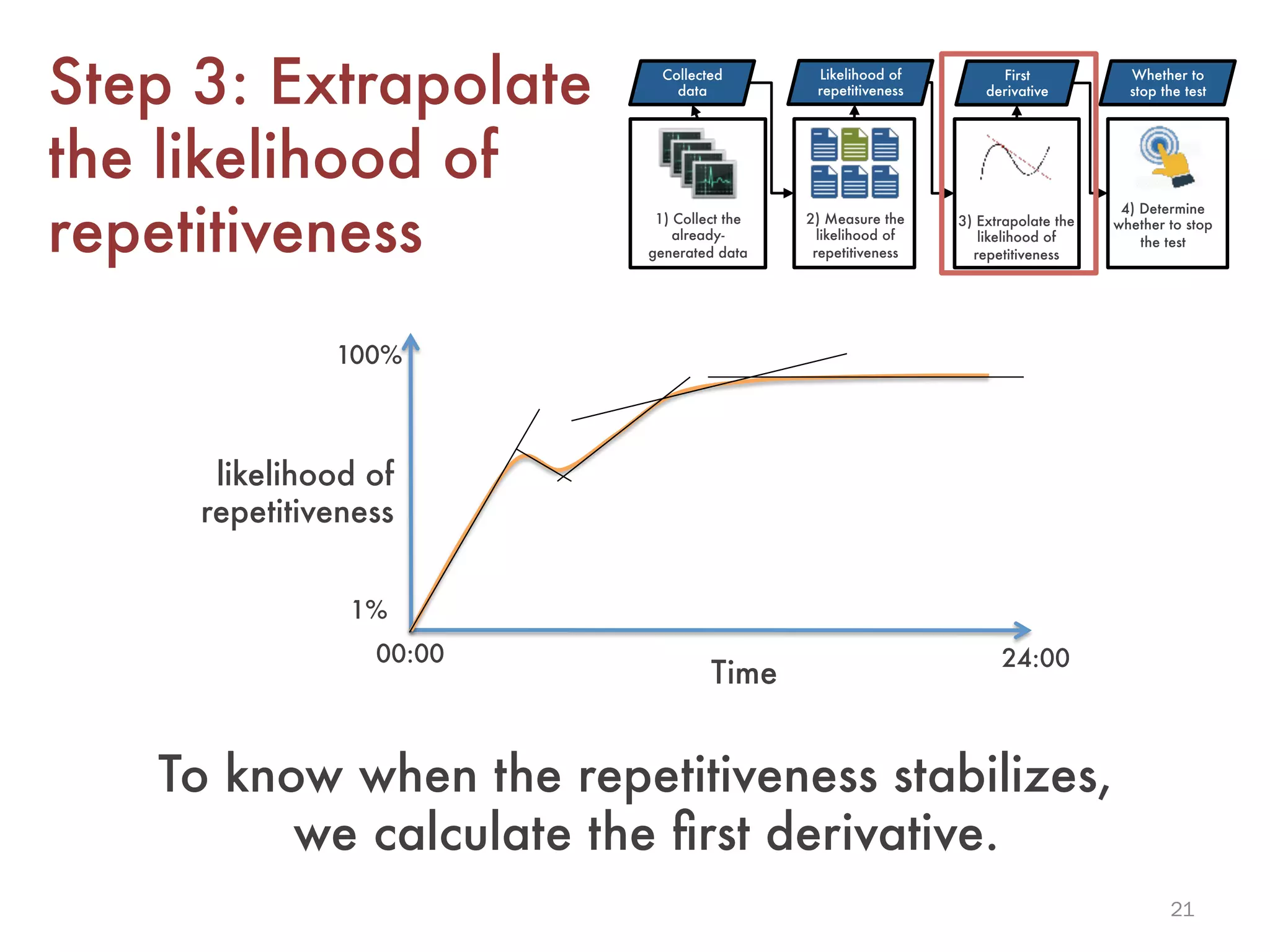
To know when the repetitiveness stabilizes,
we calculate the first derivative.
22
Step 4: Determine
whether to stop
the test
Time
likelihood of
repetitivenes
s
00:00
 24:00
1%
100%
Stop the test if the
fist derivative is
close to 0.
Collected
data
Likelihood of
repetitiveness
First
derivative
Whether to
stop the test
1) Collect the
already-
generated data
2) Measure the
likelihood of
repetitiveness
3) Extrapolate the
likelihood of
repetitiveness
4) Determine
whether to stop
the test
To know when the repetitiveness stabilizes, we
calculate the first derivative.
23
Our approach for recommending
when to stop a performance test
Collected data
Likelihood of
repetitiveness
First
derivatives
Whether to
stop the test
1) Collect the
already-generated
data
2) Measure the
likelihood of
repetitiveness
3) Extrapolate the
likelihood of
repetitiveness
4) Determine
whether to stop the
test
STOP
No
Yes
PetClinic
 Dell DVD Store
CloudStore
24
We conduct 24-hour performance
tests on three systems
25
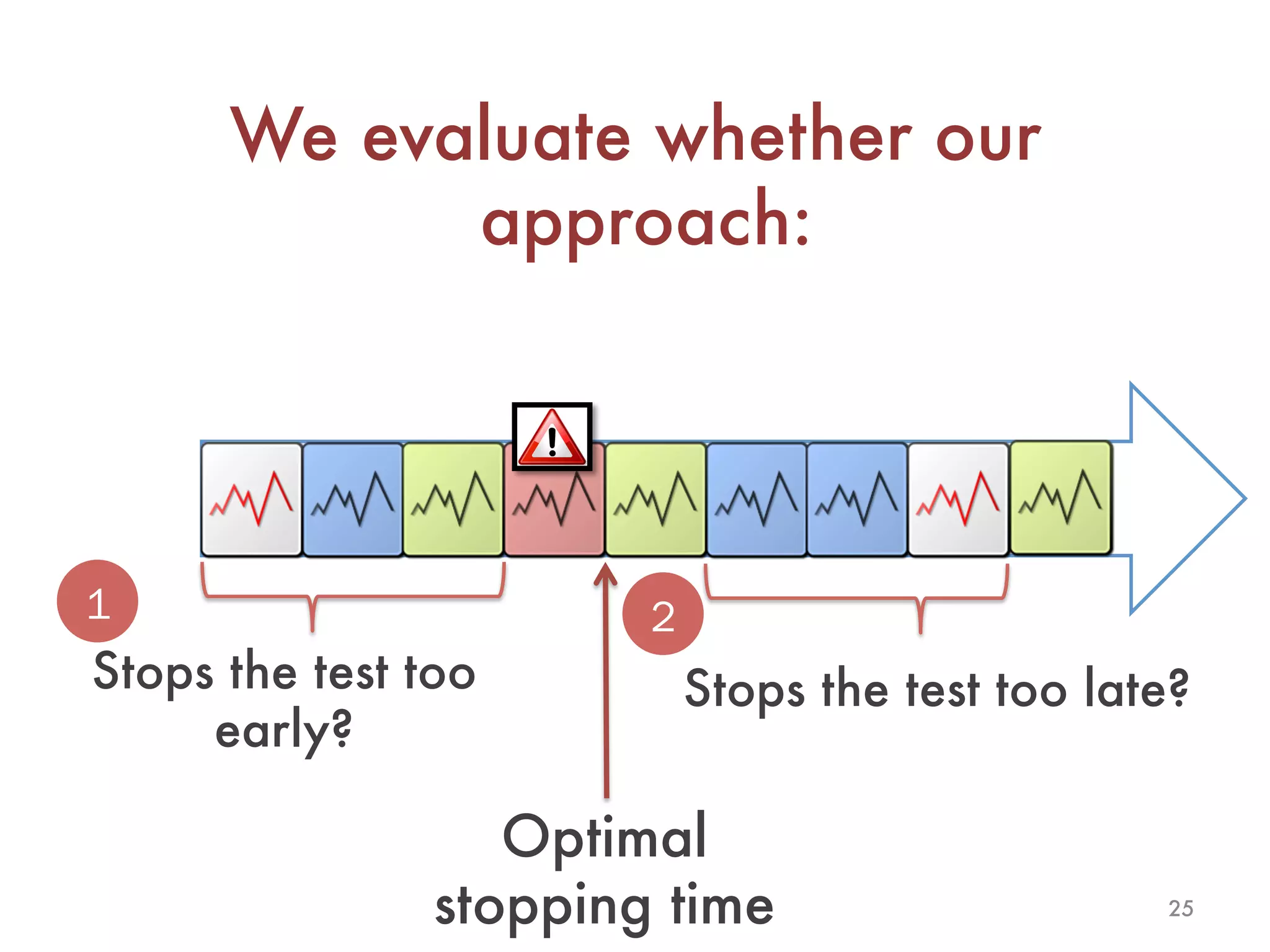
We evaluate whether our
approach: 
Stops the test too
early?
Stops the test too late?
Optimal
stopping time
1 2
26
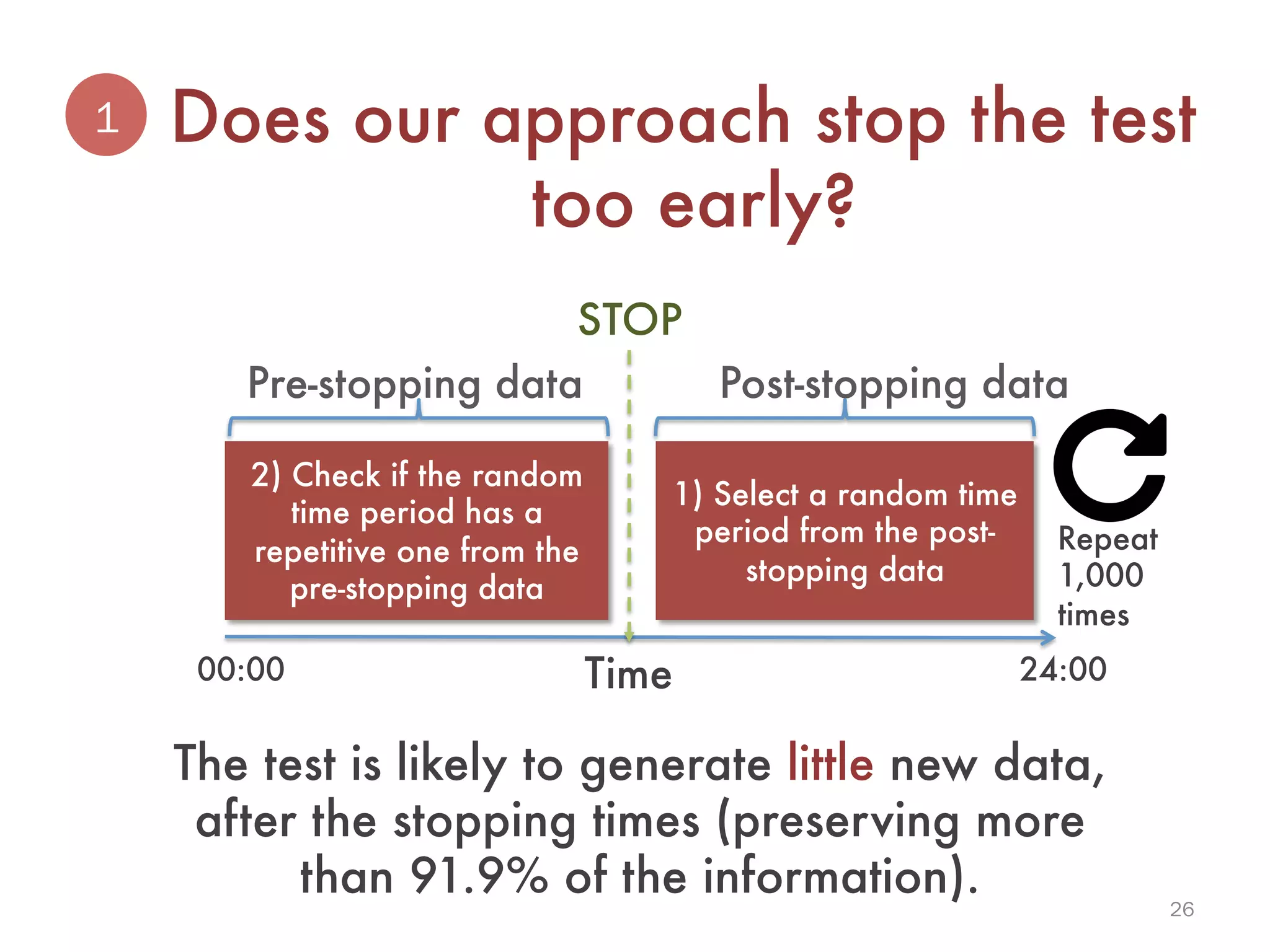
Pre-stopping data
 Post-stopping data
Time
STOP
Does our approach stop the test
too early?
00:00
 24:00
1
1) Select a random time
period from the post-
stopping data
2) Check if the random
time period has a
repetitive one from the
pre-stopping data
The test is likely to generate little new data,
after the stopping times (preserving more
than 91.9% of the information).
Repeat
1,000
times
27
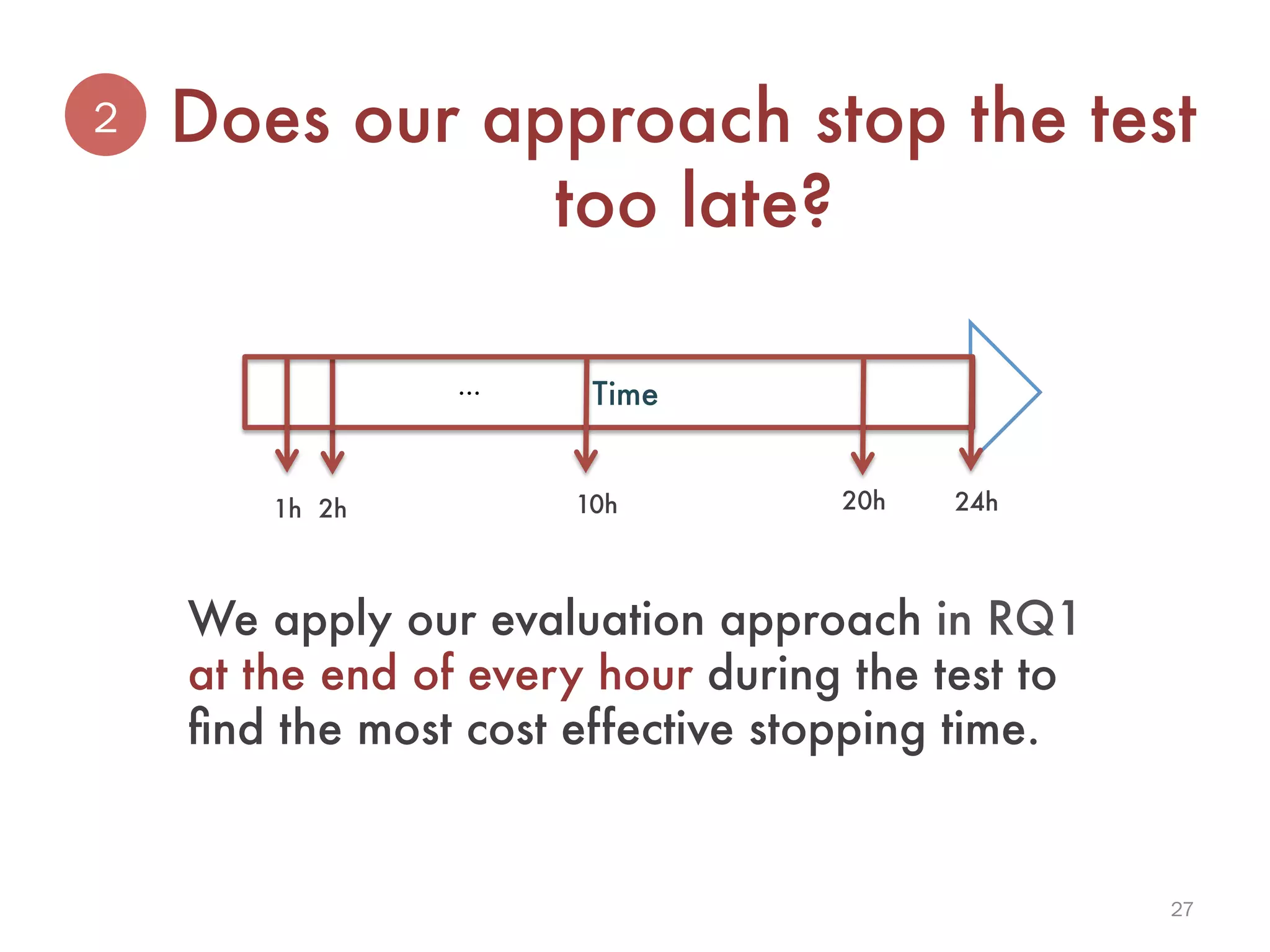
We apply our evaluation approach in RQ1
at the end of every hour during the test to
find the most cost effective stopping time.
Does our approach stop the test
too late?
2
1h
 2h
Time
…
10h
 20h
 24h
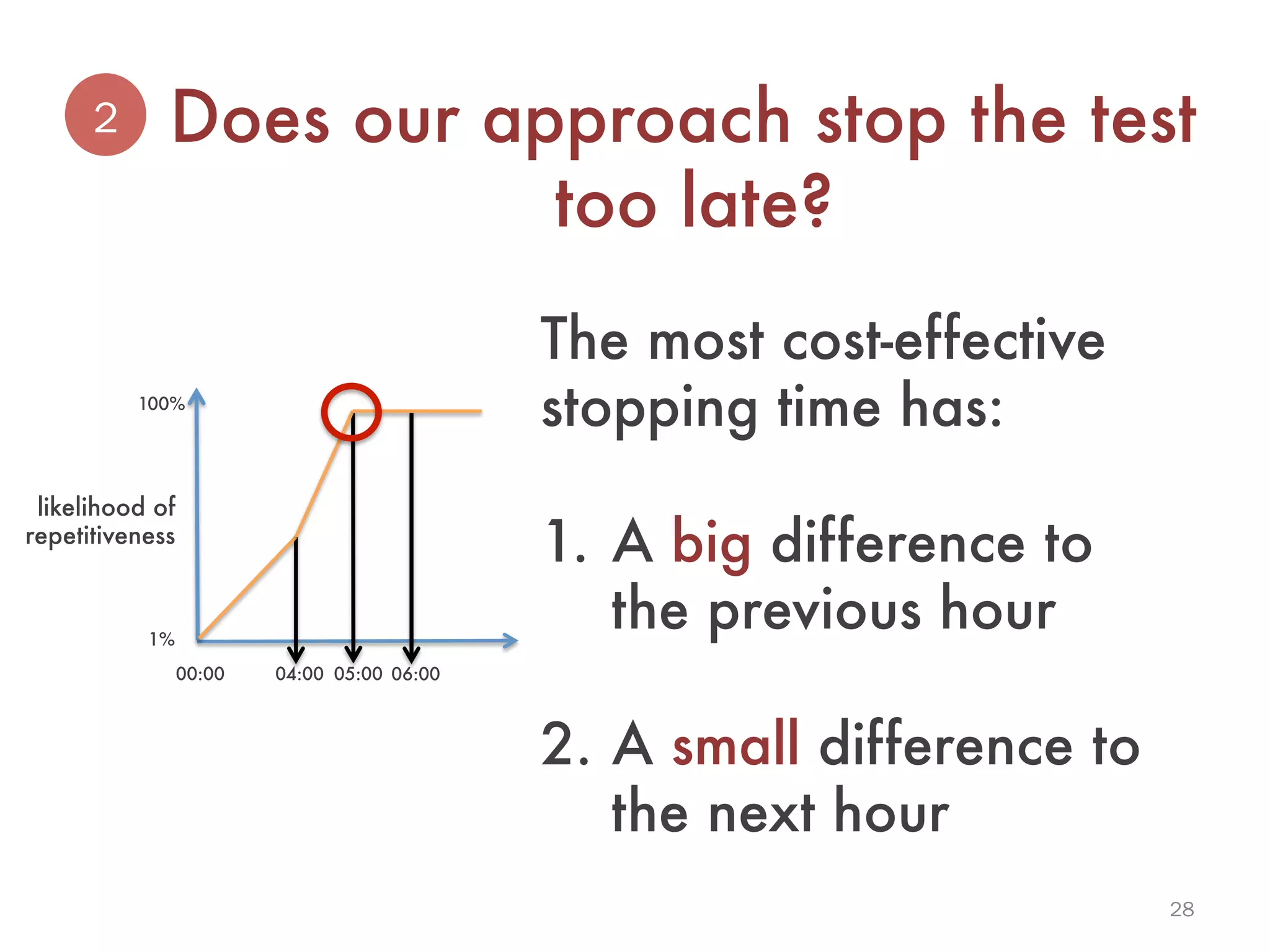
The most cost-effective
stopping time has:

1.  A big difference to
the previous hour
2.  A small difference to
the next hour
28
1%
100%
00:00
 04:00
05:00
06:00
Does our approach stop the test
too late?
2
likelihood of
repetitiveness
29
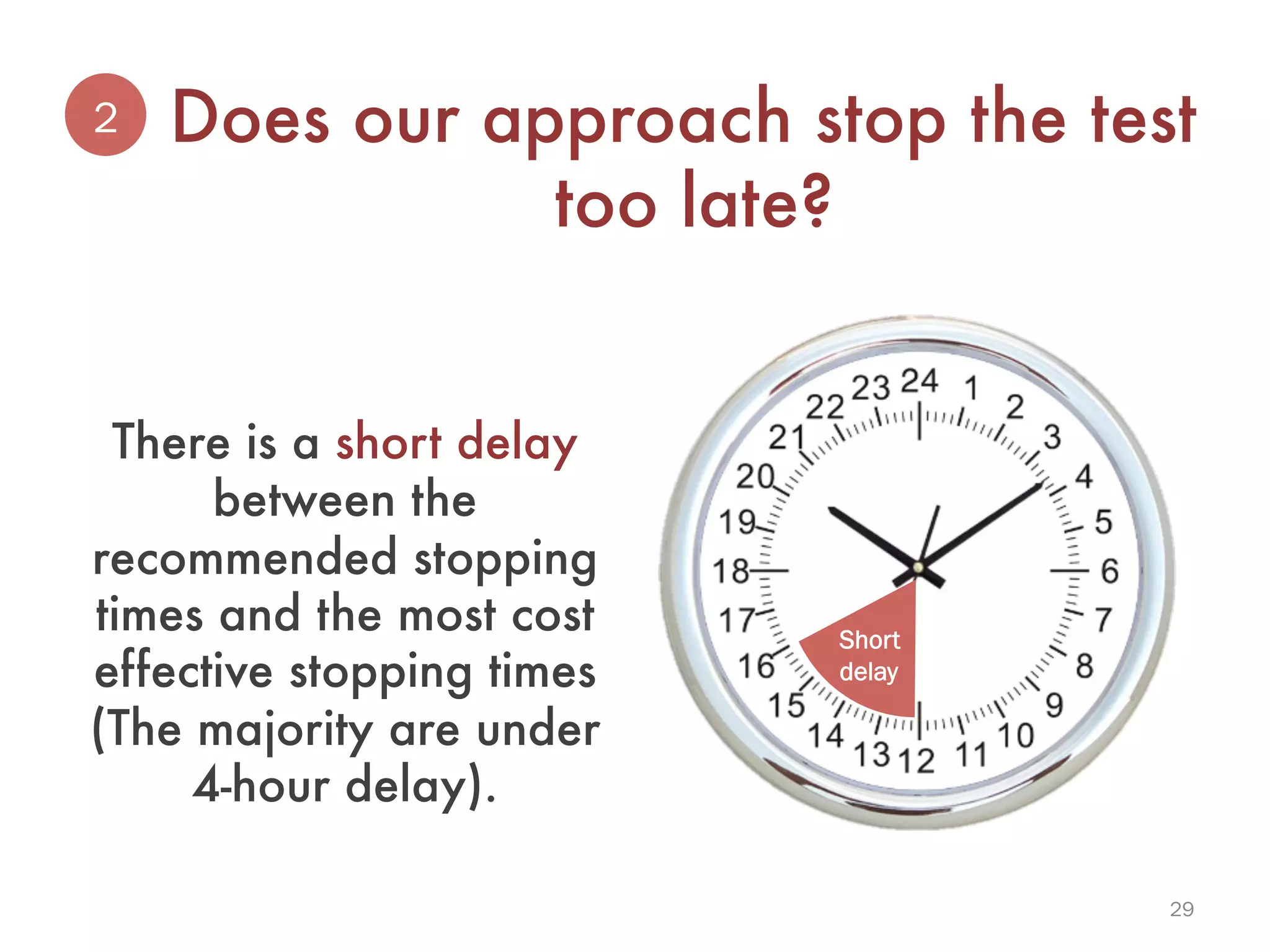
There is a short delay
between the
recommended stopping
times and the most cost
effective stopping times
(The majority are under
4-hour delay).
Short
delay
Does our approach stop the test
too late?
2
30
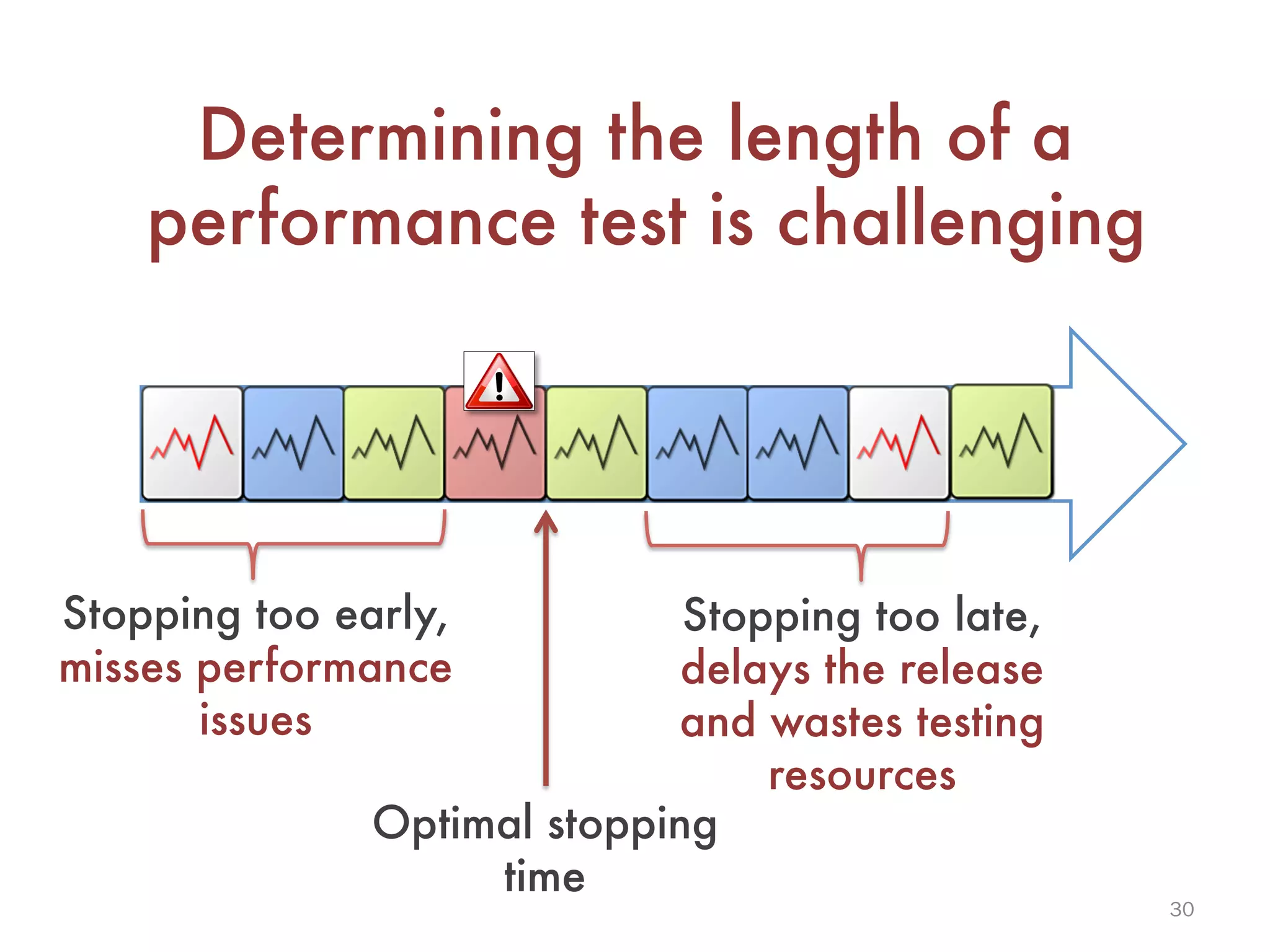
Determining the length of a
performance test is challenging
Time
Stopping too early,
misses performance
issues
Stopping too late, 
delays the release
and wastes testing
resources
Optimal stopping
time
31
30
Determining the length of a
performance test is challenging
Time
Stopping too early,
misses performance
issues
Stopping too late, 
delays the release
and wastes testing
resources
Optimal stopping
time
32
Our approach for recommending
when to stop a performance test
Collected data
Likelihood of
repetitiveness
First
derivatives
Whether to
stop the test
1) Collect the
already-generated
data
2) Measure the
likelihood of
repetitiveness
3) Extrapolate the
likelihood of
repetitiveness
4) Determine
whether to stop the
test
STOP
No
Yes
33
30
Determining the length of a
performance test is challenging
Time
Stopping too early,
misses performance
issues
Stopping too late, 
delays the release
and wastes testing
resources
Optimal stopping
time
32
Our approach for recommending
when to stop a performance test
Collected data
Likelihood of
repetitiveness
First
derivatives
Whether to
stop the test
1) Collect the
already-generated
data
2) Measure the
likelihood of
repetitiveness
3) Extrapolate the
likelihood of
repetitiveness
4) Determine
whether to stop the
test
STOP
No
Yes
34
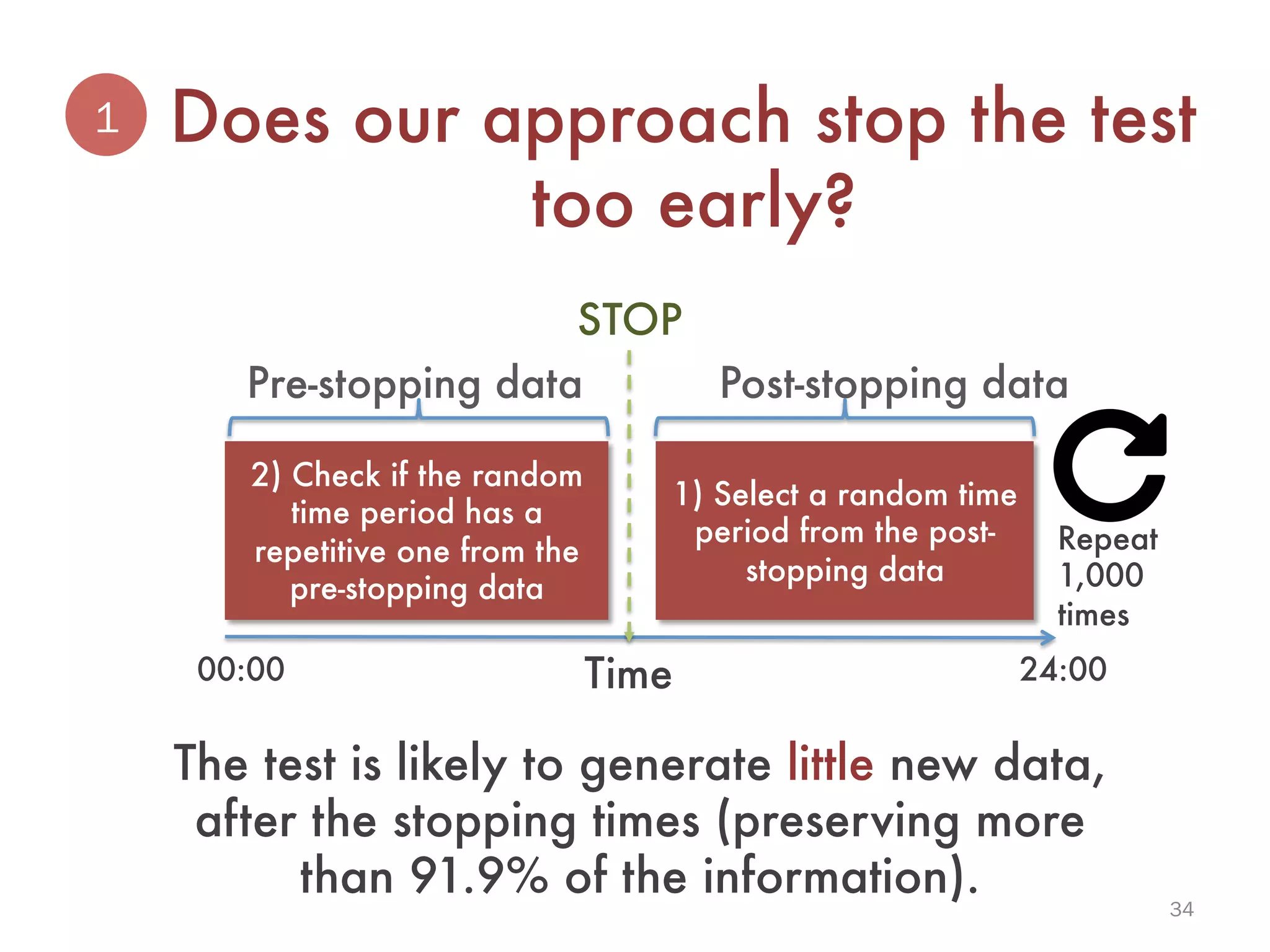
Pre-stopping data
 Post-stopping data
Time
STOP
Does our approach stop the test
too early?
00:00
 24:00
1
1) Select a random time
period from the post-
stopping data
2) Check if the random
time period has a
repetitive one from the
pre-stopping data
The test is likely to generate little new data,
after the stopping times (preserving more
than 91.9% of the information).
Repeat
1,000
times
35
30
Determining the length of a
performance test is challenging
Time
Stopping too early,
misses performance
issues
Stopping too late, 
delays the release
and wastes testing
resources
Optimal stopping
time
32
Pre-stopping data
 Post-stopping data
Time
STOP
Does our approach stop the test
too early?
00:00
 24:00
1
1) Select a random time
period from the post-
stopping data
2) Check if the random
time period has a
repetitive one from the
pre-stopping data
The test is likely to generate little new data,
after the stopping times (preserving more
than 91.9% of the information).
Repeat
1,000
times
32
Our approach for recommending
when to stop a performance test
Collected data
Likelihood of
repetitiveness
First
derivatives
Whether to
stop the test
1) Collect the
already-generated
data
2) Measure the
likelihood of
repetitiveness
3) Extrapolate the
likelihood of
repetitiveness
4) Determine
whether to stop the
test
STOP
No
Yes
36
There is a short delay
between the
recommended stopping
times and the most cost
effective stopping times
(The majority are under
4-hour delay).
Short
delay
Does our approach stop the test
too late?
2
37
30
Determining the length of a
performance test is challenging
Time
Stopping too early,
misses performance
issues
Stopping too late, 
delays the release
and wastes testing
resources
Optimal stopping
time
32
Pre-stopping data
 Post-stopping data
Time
STOP
Does our approach stop the test
too early?
00:00
 24:00
1
1) Select a random time
period from the post-
stopping data
2) Check if the random
time period has a
repetitive one from the
pre-stopping data
The test is likely to generate little new data,
after the stopping times (preserving more
than 91.9% of the information).
Repeat
1,000
times
33
There is a short delay
between the
recommended stopping
times and the most cost
effective stopping times
(The majority are under
4-hour delay).
Short
delay
Does our approach stop the test
too late?
2
32
Our approach for recommending
when to stop a performance test
Collected data
Likelihood of
repetitiveness
First
derivatives
Whether to
stop the test
1) Collect the
already-generated
data
2) Measure the
likelihood of
repetitiveness
3) Extrapolate the
likelihood of
repetitiveness
4) Determine
whether to stop the
test
STOP
No
Yes

An Automated Approach for Recommending When to Stop Performance Tests

  • 1.
    An Automated Approachfor Recommending When to Stop Performance Tests Hammam AlGhamdi Weiyi Shang Mark D. Syer Ahmed E. Hassan 1
  • 2.
    Failures in ultra large-scalesystems are often due to performance issues rather than functional issues 2
  • 3.
    A 25-minutes serviceoutage in 2013 cost Amazon approximately $1.7M 3
  • 4.
    4 Performance testing isessential to prevent these failures System under test requests requests requests Performance counters, e.g., CPU, memory, I/O and response time Pre-defined workload Performance testing environment
  • 5.
    5 Determining the lengthof a performance test is challenging Time Repetitive data is generated from the test Optimal stopping time
  • 6.
    6 Determining the lengthof a performance test is challenging Time Stopping too early, misses performance issues Stopping too late, delays the release and wastes testing resources Optimal stopping time
  • 7.
    7 Our approach forrecommending when to stop a performance test Collected data Likelihood of repetitiveness First derivatives Whether to stop the test 1) Collect the already-generated data 2) Measure the likelihood of repetitiveness 3) Extrapolate the likelihood of repetitiveness 4) Determine whether to stop the test STOP No Yes
  • 8.
    8 Our approach forrecommending when to stop a performance test Collected data Likelihood of repetitiveness First derivatives Whether to stop the test 1) Collect the already-generated data 2) Measure the likelihood of repetitiveness 3) Extrapolate the likelihood of repetitiveness 4) Determine whether to stop the test STOP No Yes
  • 9.
    9 Our approach forrecommending when to stop a performance test Collected data Likelihood of repetitiveness First derivatives Whether to stop the test 1) Collect the already-generated data 2) Measure the likelihood of repetitiveness 3) Extrapolate the likelihood of repetitiveness 4) Determine whether to stop the test STOP No Yes
  • 10.
    10 Our approach forrecommending when to stop a performance test Collected data Likelihood of repetitiveness First derivatives Whether to stop the test 1) Collect the already-generated data 2) Measure the likelihood of repetitiveness 3) Extrapolate the likelihood of repetitiveness 4) Determine whether to stop the test STOP No Yes
  • 11.
    11 Time Current time Collected data Likelihood of repetitiveness First derivative Whetherto stop the test 1) Collect the already- generated data 2) Measure the likelihood of repetitiveness 3) Extrapolate the likelihood of repetitiveness 4) Determine whether to stop the test Step 1: Collect the data that the test generates Performance counters, e.g., CPU, memory, I/O and response time
  • 12.
    12 Time Step 2: Measure thelikelihood of repetitiveness Select a random time period (e.g. 30 min) Current time Collected data Likelihood of repetitiveness First derivative Whether to stop the test 1) Collect the already- generated data 2) Measure the likelihood of repetitiveness 3) Extrapolate the likelihood of repetitiveness 4) Determine whether to stop the test A
  • 13.
    13 Time Current time Search foranother non-overlapping time period that is NOT statistically significantly different. … Step 2: Measure the likelihood of repetitiveness … B…A Collected data Likelihood of repetitiveness First derivative Whether to stop the test 1) Collect the already- generated data 2) Measure the likelihood of repetitiveness 3) Extrapolate the likelihood of repetitiveness 4) Determine whether to stop the test
  • 14.
    14 Time Wilcoxon test between the distributionsof every performance counter across both periods … Current time Step 2: Measure the likelihood of repetitiveness B…A Collected data Likelihood of repetitiveness First derivative Whether to stop the test 1) Collect the already- generated data 2) Measure the likelihood of repetitiveness 3) Extrapolate the likelihood of repetitiveness 4) Determine whether to stop the test
  • 15.
    15 Step 2: Measure thelikelihood of repetitiveness Response time CPU Memory IO p-values 0.0258 0.313 0.687 0.645 Statistically significantly different in response time! Collected data Likelihood of repetitiveness First derivative Whether to stop the test 1) Collect the already- generated data 2) Measure the likelihood of repetitiveness 3) Extrapolate the likelihood of repetitiveness 4) Determine whether to stop the test Time Wilcoxon test between every performance counter from both periods … Current time B…A
  • 16.
    16 Step 2: Measure thelikelihood of repetitiveness Response time CPU Memory IO p-values 0.67 0.313 0.687 0.645 Find a time period that is NOT statistically significantly different in ALL performance metrics! Collected data Likelihood of repetitiveness First derivative Whether to stop the test 1) Collect the already- generated data 2) Measure the likelihood of repetitiveness 3) Extrapolate the likelihood of repetitiveness 4) Determine whether to stop the test Time Wilcoxon test between every performance counter from both periods … Current time B…A
  • 17.
    17 Find a periodthat is NOT statistically significantly different? Yes. Repetitive! No. Not repetitive! Step 2: Measure the likelihood of repetitiveness Collected data Likelihood of repetitiveness First derivative Whether to stop the test 1) Collect the already- generated data 2) Measure the likelihood of repetitiveness 3) Extrapolate the likelihood of repetitiveness 4) Determine whether to stop the test Time Wilcoxon test between every performance counter from both periods … Current time B…A
  • 18.
    18 Step 2: Measure thelikelihood of repetitiveness Collected data Likelihood of repetitiveness First derivative Whether to stop the test 1) Collect the already- generated data 2) Measure the likelihood of repetitiveness 3) Extrapolate the likelihood of repetitiveness 4) Determine whether to stop the test Repeat this process a large number (e.g., 1,000) times to calculate the: likelihood of repetitiveness
  • 19.
    19 Step 2: Measure thelikelihood of repetitiveness 30 min 40 min Time … 1h 10 min Collected data Likelihood of repetitiveness First derivative Whether to stop the test 1) Collect the already- generated data 2) Measure the likelihood of repetitiveness 3) Extrapolate the likelihood of repetitiveness 4) Determine whether to stop the test A new likelihood of repetitiveness is measured periodically, e.g., every 10 min, in order to get more frequent feedback on the repetitiveness
  • 20.
    20 Step 2: Measure thelikelihood of repetitiveness Time likelihood of repetitiveness 00:00 24:00 1% 100% Stabilization (little new information) Collected data Likelihood of repetitiveness First derivative Whether to stop the test 1) Collect the already- generated data 2) Measure the likelihood of repetitiveness 3) Extrapolate the likelihood of repetitiveness 4) Determine whether to stop the test The likelihood of repetitiveness eventually starts stabilizing.
  • 21.
    21 Step 3: Extrapolate thelikelihood of repetitiveness Time likelihood of repetitiveness 00:00 24:00 1% 100% Collected data Likelihood of repetitiveness First derivative Whether to stop the test 1) Collect the already- generated data 2) Measure the likelihood of repetitiveness 3) Extrapolate the likelihood of repetitiveness 4) Determine whether to stop the test To know when the repetitiveness stabilizes, we calculate the first derivative.
  • 22.
    22 Step 4: Determine whetherto stop the test Time likelihood of repetitivenes s 00:00 24:00 1% 100% Stop the test if the fist derivative is close to 0. Collected data Likelihood of repetitiveness First derivative Whether to stop the test 1) Collect the already- generated data 2) Measure the likelihood of repetitiveness 3) Extrapolate the likelihood of repetitiveness 4) Determine whether to stop the test To know when the repetitiveness stabilizes, we calculate the first derivative.
  • 23.
    23 Our approach forrecommending when to stop a performance test Collected data Likelihood of repetitiveness First derivatives Whether to stop the test 1) Collect the already-generated data 2) Measure the likelihood of repetitiveness 3) Extrapolate the likelihood of repetitiveness 4) Determine whether to stop the test STOP No Yes
  • 24.
    PetClinic Dell DVDStore CloudStore 24 We conduct 24-hour performance tests on three systems
  • 25.
    25 We evaluate whetherour approach: Stops the test too early? Stops the test too late? Optimal stopping time 1 2
  • 26.
    26 Pre-stopping data Post-stoppingdata Time STOP Does our approach stop the test too early? 00:00 24:00 1 1) Select a random time period from the post- stopping data 2) Check if the random time period has a repetitive one from the pre-stopping data The test is likely to generate little new data, after the stopping times (preserving more than 91.9% of the information). Repeat 1,000 times
  • 27.
    27 We apply ourevaluation approach in RQ1 at the end of every hour during the test to find the most cost effective stopping time. Does our approach stop the test too late? 2 1h 2h Time … 10h 20h 24h
  • 28.
    The most cost-effective stoppingtime has: 1.  A big difference to the previous hour 2.  A small difference to the next hour 28 1% 100% 00:00 04:00 05:00 06:00 Does our approach stop the test too late? 2 likelihood of repetitiveness
  • 29.
    29 There is ashort delay between the recommended stopping times and the most cost effective stopping times (The majority are under 4-hour delay). Short delay Does our approach stop the test too late? 2
  • 30.
    30 Determining the lengthof a performance test is challenging Time Stopping too early, misses performance issues Stopping too late, delays the release and wastes testing resources Optimal stopping time
  • 31.
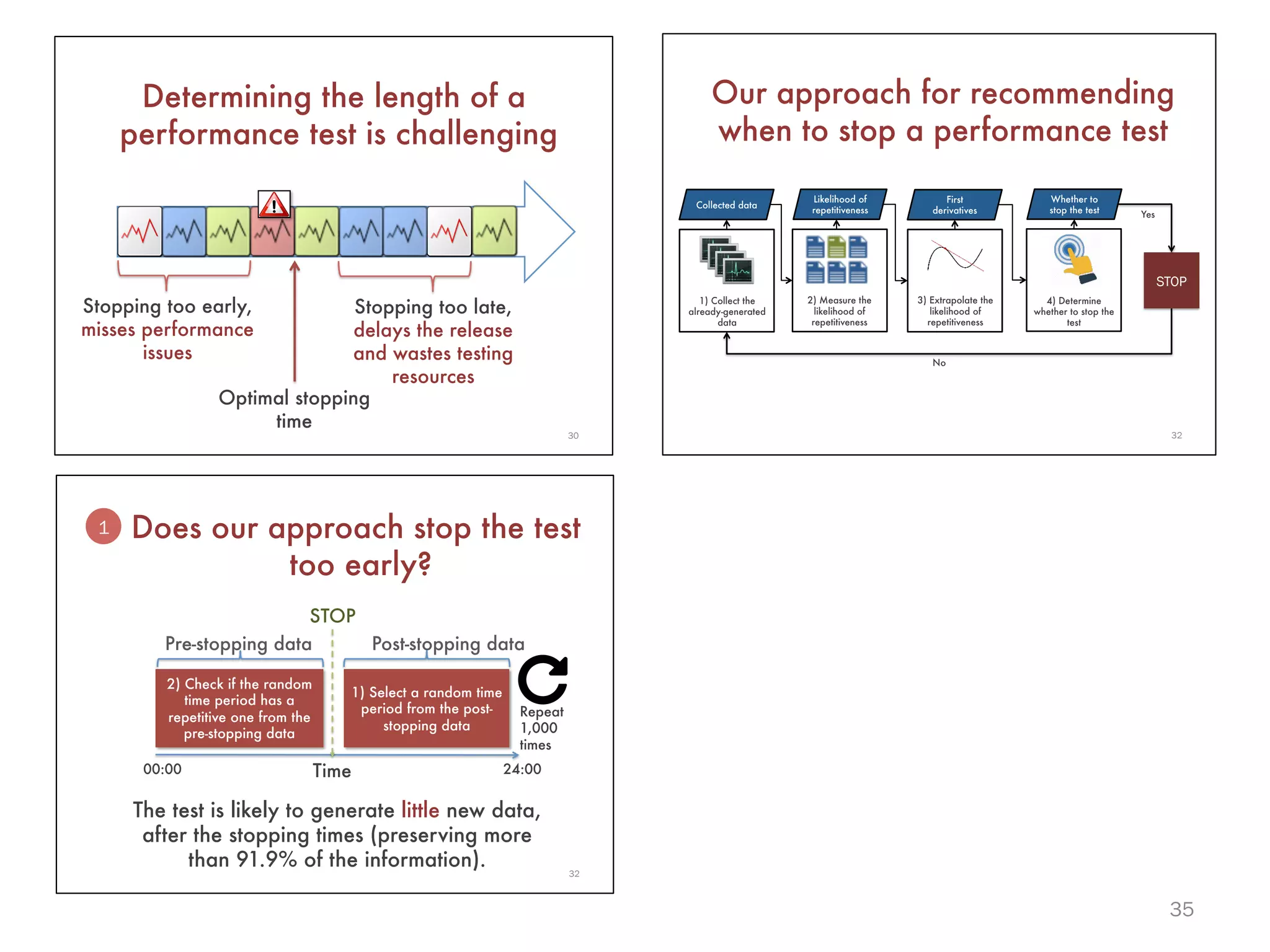
    31 30 Determining the lengthof a performance test is challenging Time Stopping too early, misses performance issues Stopping too late, delays the release and wastes testing resources Optimal stopping time
  • 32.
    32 Our approach forrecommending when to stop a performance test Collected data Likelihood of repetitiveness First derivatives Whether to stop the test 1) Collect the already-generated data 2) Measure the likelihood of repetitiveness 3) Extrapolate the likelihood of repetitiveness 4) Determine whether to stop the test STOP No Yes
  • 33.
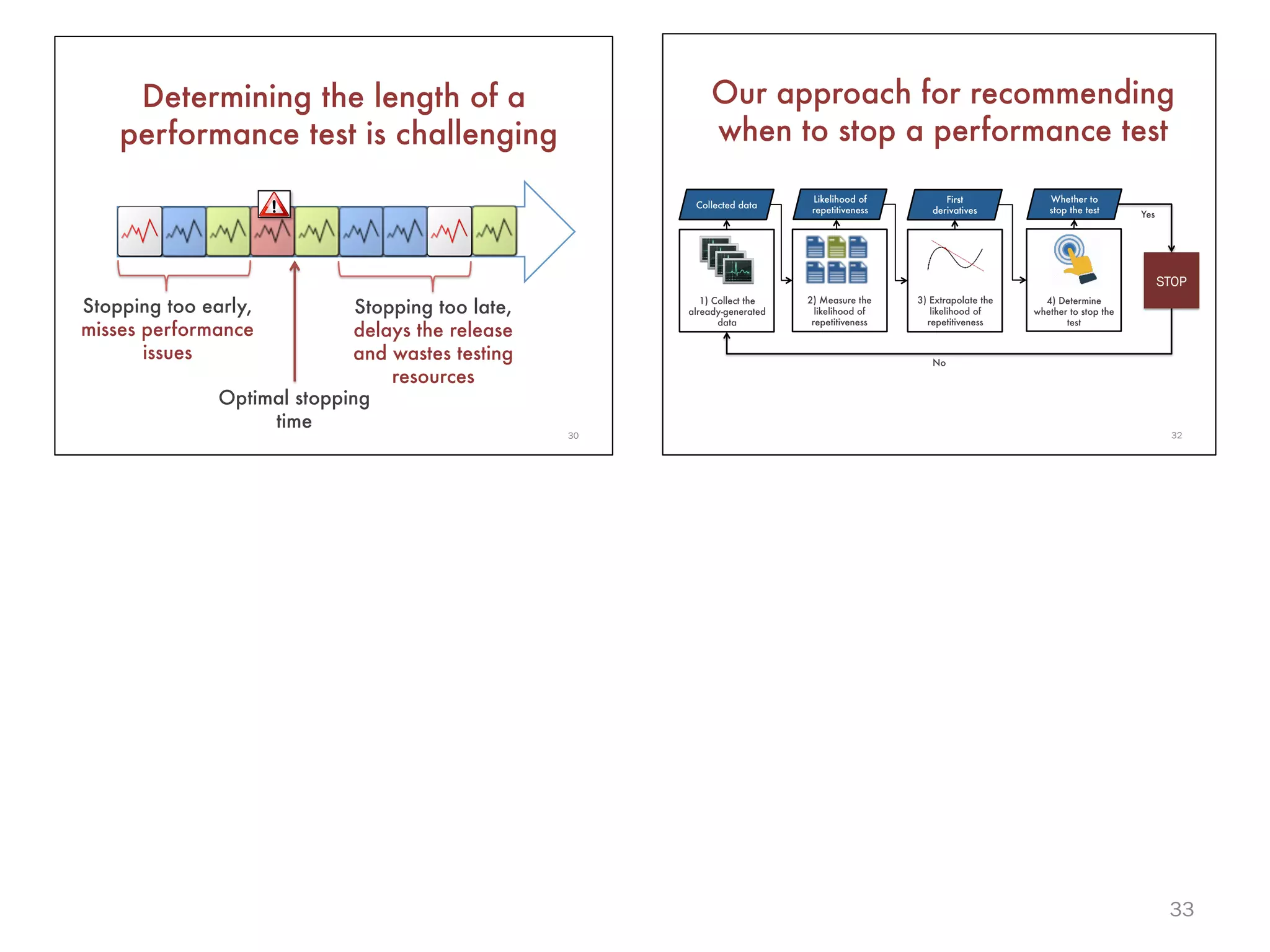
    33 30 Determining the lengthof a performance test is challenging Time Stopping too early, misses performance issues Stopping too late, delays the release and wastes testing resources Optimal stopping time 32 Our approach for recommending when to stop a performance test Collected data Likelihood of repetitiveness First derivatives Whether to stop the test 1) Collect the already-generated data 2) Measure the likelihood of repetitiveness 3) Extrapolate the likelihood of repetitiveness 4) Determine whether to stop the test STOP No Yes
  • 34.
    34 Pre-stopping data Post-stoppingdata Time STOP Does our approach stop the test too early? 00:00 24:00 1 1) Select a random time period from the post- stopping data 2) Check if the random time period has a repetitive one from the pre-stopping data The test is likely to generate little new data, after the stopping times (preserving more than 91.9% of the information). Repeat 1,000 times
  • 35.
    35 30 Determining the lengthof a performance test is challenging Time Stopping too early, misses performance issues Stopping too late, delays the release and wastes testing resources Optimal stopping time 32 Pre-stopping data Post-stopping data Time STOP Does our approach stop the test too early? 00:00 24:00 1 1) Select a random time period from the post- stopping data 2) Check if the random time period has a repetitive one from the pre-stopping data The test is likely to generate little new data, after the stopping times (preserving more than 91.9% of the information). Repeat 1,000 times 32 Our approach for recommending when to stop a performance test Collected data Likelihood of repetitiveness First derivatives Whether to stop the test 1) Collect the already-generated data 2) Measure the likelihood of repetitiveness 3) Extrapolate the likelihood of repetitiveness 4) Determine whether to stop the test STOP No Yes
  • 36.
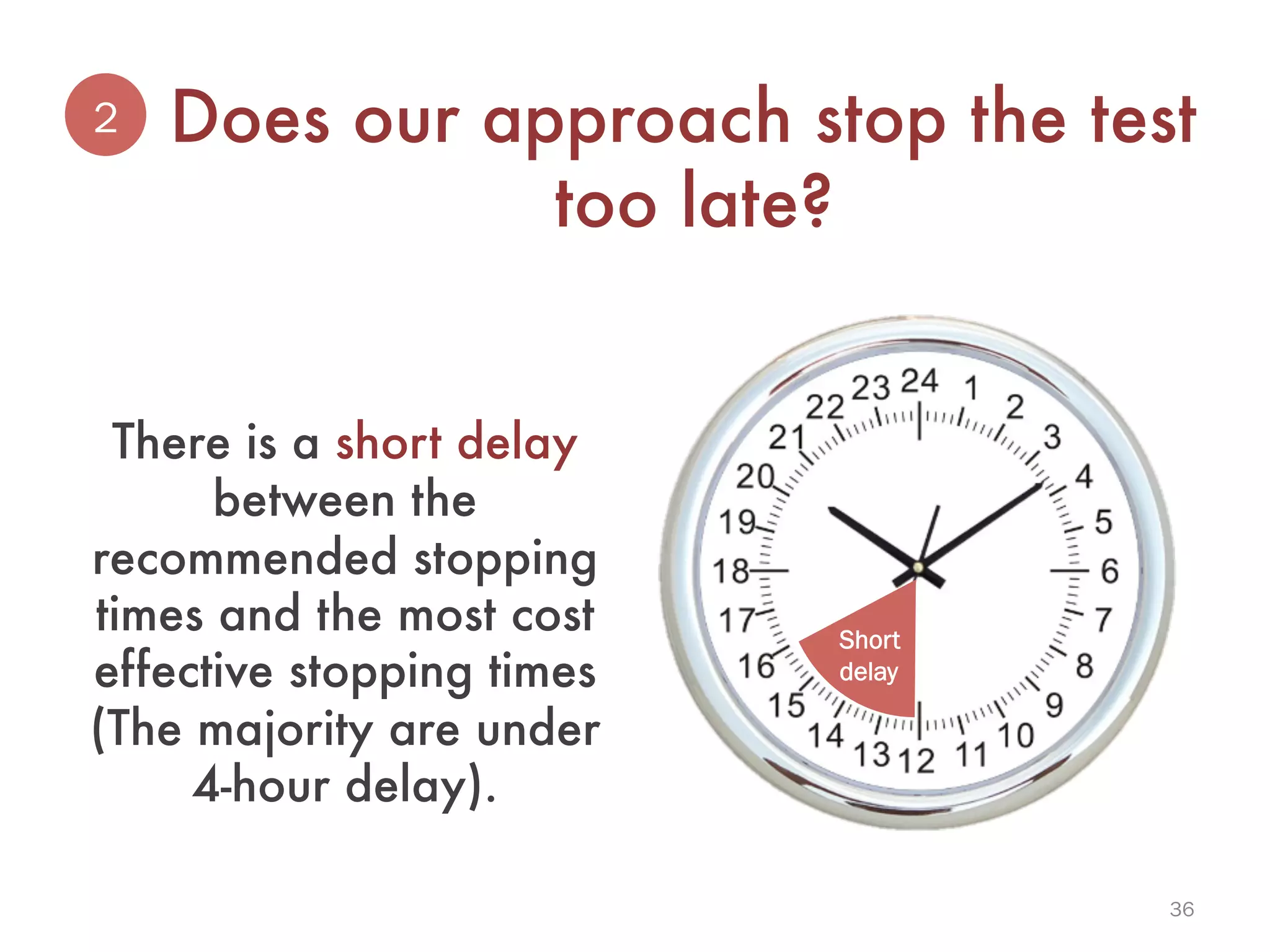
    36 There is ashort delay between the recommended stopping times and the most cost effective stopping times (The majority are under 4-hour delay). Short delay Does our approach stop the test too late? 2
  • 37.
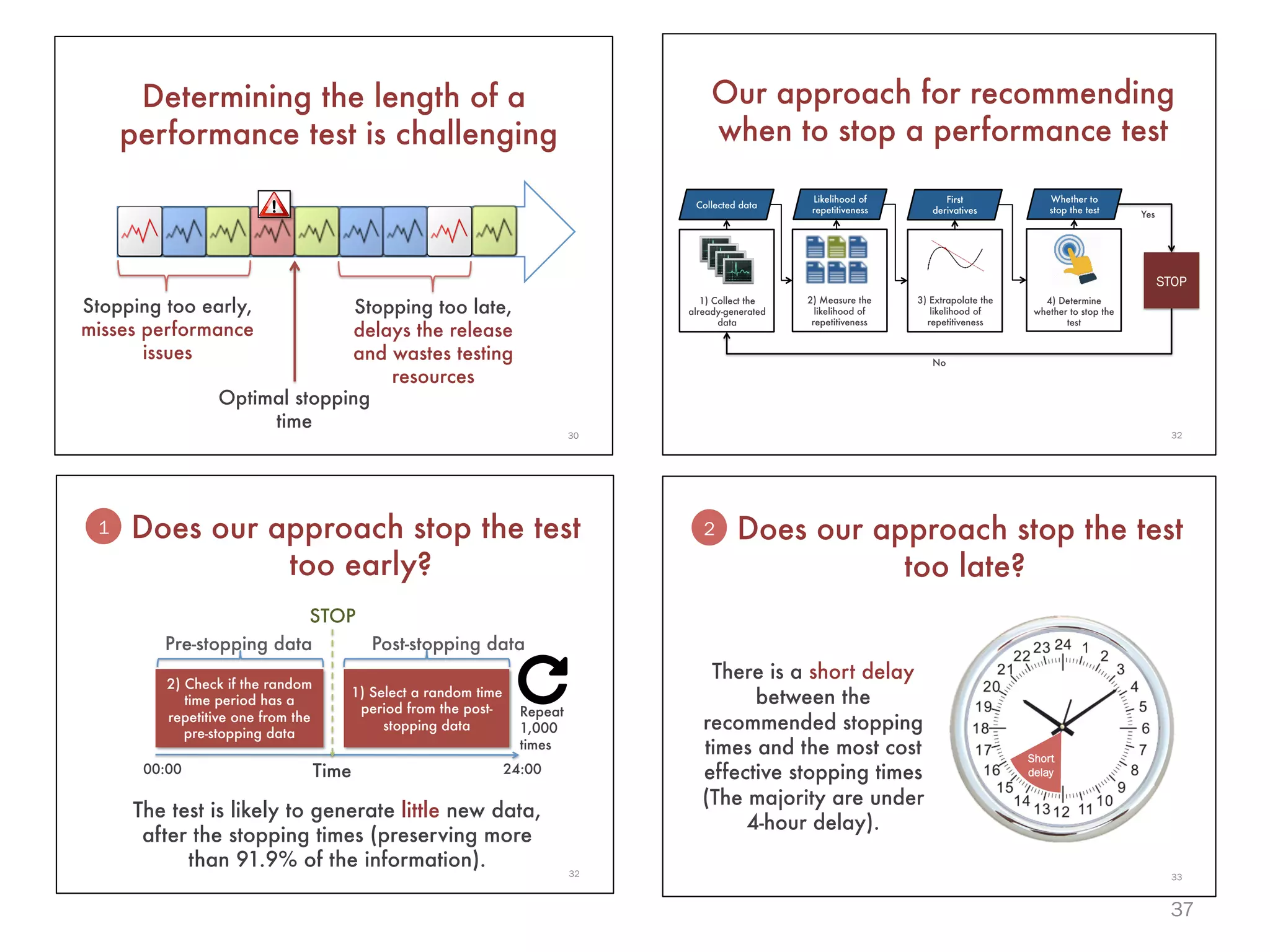
    37 30 Determining the lengthof a performance test is challenging Time Stopping too early, misses performance issues Stopping too late, delays the release and wastes testing resources Optimal stopping time 32 Pre-stopping data Post-stopping data Time STOP Does our approach stop the test too early? 00:00 24:00 1 1) Select a random time period from the post- stopping data 2) Check if the random time period has a repetitive one from the pre-stopping data The test is likely to generate little new data, after the stopping times (preserving more than 91.9% of the information). Repeat 1,000 times 33 There is a short delay between the recommended stopping times and the most cost effective stopping times (The majority are under 4-hour delay). Short delay Does our approach stop the test too late? 2 32 Our approach for recommending when to stop a performance test Collected data Likelihood of repetitiveness First derivatives Whether to stop the test 1) Collect the already-generated data 2) Measure the likelihood of repetitiveness 3) Extrapolate the likelihood of repetitiveness 4) Determine whether to stop the test STOP No Yes