Role of Trace Elements
Presentation on
Group- 5
Teammates
1. IRFAT JAHAN TULY
2. ABID REZA
3. SHAKIL SHAHARIAR
4. MD. SK FAHAD
5. SHAHADAT HOSSAIN
6. MD. SAIFUL ISLAM
What is Trace Element?
A trace element is a chemical element whose concentration is very
low in soil and its concentration is less than 100mg/kg.
Sources of Trace Elements
 Soil Parent Material
 Fertilizer
 Biosolid
 Irrigation Water
 Metal Smelting Industries
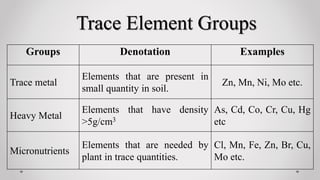
Trace Element Groups
Groups Denotation Examples
Trace metal
Elements that are present in
small quantity in soil.
Zn, Mn, Ni, Mo etc.
Heavy Metal
Elements that have density
>5g/cm3
As, Cd, Co, Cr, Cu, Hg
etc
Micronutrients
Elements that are needed by
plant in trace quantities.
Cl, Mn, Fe, Zn, Br, Cu,
Mo etc.
Zinc
Role of Zinc
• Zinc, one of the essential micronutrients and an important constituent for plant.
• The normal range for zinc in plant tissue is 15-60 ppm.
• zinc toxicity can occur when its levels in the tissue exceed 200 ppm.
• Zinc activates enzymes that are responsible for the synthesis of certain proteins.
• Zn is important constituent of several enzyme.
• Excess zinc compete with plant uptake of phosphorus, iron, manganese or copper.
• Zn toxicity symptoms are expressed as smaller leaf, chlorosis of the newer leaves,
reduced root growth.
Copper
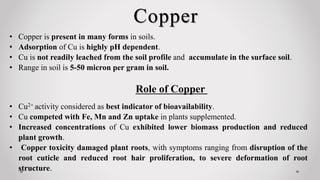
• Copper is present in many forms in soils.
• Adsorption of Cu is highly pH dependent.
• Cu is not readily leached from the soil profile and accumulate in the surface soil.
• Range in soil is 5-50 micron per gram in soil.
• Cu2+ activity considered as best indicator of bioavailability.
• Cu competed with Fe, Mn and Zn uptake in plants supplemented.
• Increased concentrations of Cu exhibited lower biomass production and reduced
plant growth.
• Copper toxicity damaged plant roots, with symptoms ranging from disruption of the
root cuticle and reduced root hair proliferation, to severe deformation of root
structure.
Role of Copper
Chlorine
• It is absorbed in larger quantities by most crop plants than any of the micronutrients
except iron.
• Cl is present in sufficient quantities in most soils to meet its requirement for most crops.
• Chlorine is found in the soil as the highly soluble chloride anion.
• Most commonly, Cl– and complex Cl anions are easily soluble, leached from soil profile,
and transported to water basins.
• Cl– is typically the predominant anion in saline soils.
• Extremely high loadings of Cl– in the soils have highly deleterious effects on both soils
and vegetations.
Chlorine in Soil
Chlorine
Chlorine in Plants
• Plants take up Cl in its monovalent ion chloride: Cl–
• Soluble Cl fraction in soils is taken up passively by roots, and is easily transported in
plants.
• Plays a role in photosynthesis and is significantly concentrated in chloroplasts.
• Important in the opening and closing of stomata.
• Plays essential role for making chemically balance the Potassium ion (K+)
concentration.
• Chloride functions in cation balance and transport within the plant.
• There is some research that shows chlorine can lessen the effects of fungal infections.
• Chloride competes with nitrate uptake, tending to promote the use of ammonium
nitrogen.
Molybdenum
Molybdenum in Soil
• Ideally, for healthy and productive soil the concentration of Mo should be at least
2 mg/kg.
• Concentration in soils ranges from 0.013 to 17.0 mg kg–1, with a mean value of 1.8
mg kg–1 .
• Exist in soil solutions and other natural waters as soluble species. The Mo species
in most waters are molybdic acid, H2MoO4, and its oxyanions, major soluble ions
HMoO4
– and MoO4
2–
• Sandy soils and acidic soils contain less available molybdenum for plant growth.
Molybdenum
Molybdenum in Plant
• Plants take up Mo mainly as molybdate MoO4
2– ions, and its absorption is proportional
to its concentration in the soil solution.
• Molybdenum is essential to plant growth as a component of two enzymes: Nitrate
reductase and Nitrogenase. These two Mo-containing enzymes do N metabolism that
involved in either N2 fixation or NO3
- reduction. Without molybdenum, plants may be
able to take up nitrogen but if it's in the form of a nitrate (NO3
-) they can't process it and
use it for it's intended purpose (to make amino acids and proteins for instance).
• Legumes need more molybdenum than other crops, because the symbiotic bacteria
living in the root nodules of legumes require molybdenum for the fixation of atmospheric
nitrogen.
• Have essential role in the use of phosphorus within plants.
• Important for potassium absorption.
Cobalt
Cobalt in Soil
 Ideally, for healthy and productive soil, the concentration of cobalt should at least 1-2 mg/kg.
 The acidity of the soil can influence the solubility of Co and its uptake by plants.
 Liming the soils may cause a considerable decrease in the uptake of Co by plants.
 Co deficiency often occurs on coarse textured soils.
 In general, Co is poorly absorbed by plants from calcareous soils.
 The mobility of Co is strongly related to the kind of organic matter in soils.
Cobalt’s role in Microorganisms
 Required by Rhizobia for nitrogen fixation.
 In nitrogen fixation by Rhizobia, Co plays a part in the formation of vitamin B12.
 Also required for some species of nitrogen fixing blue-green algae and needed for their normal
growth. In blue-green algae Co deficiency results in reduced growth and chlorosis.
Cobalt
Cobalt in Plant
 Component of a number of enzymes and increases the drought resistance of seeds.
 In legumes, Co is important for nitrogen fixation by the bacteria that associate with
legumes.
 Co is a primary constituent of Vitamin B12 as well as Propionate.
 Some research suggests that cobalt plays a role in the production of ethylene by plants.
 High levels of cobalt can reduce the amount of cadmium that is uptaken by plants.
 Sufficient levels of cobalt needed in plant in order to properly expand the leaf discs.
Selenium
• Most agricultural soils, the range is generally from 0.1 to 2.0 mg kg-1.
• Selenium can exist in different organic and inorganic forms with
different oxidation numbers such as -2, 0, +4, +6.
• The predominant Se inorganic forms in cultivated soils are selenate and
selenite.
• In clay soils, Se content was generally higher than one coarse mineral
soils.
Selenium in Soil
Selenium
• Selenate promotes germination of various plants such as bitter gourd, radish,
tomato etc.
• Se applied at low concentrations enhances growth of plants.
• Se can delay aging and promote the growth of aging seedlings
• Selenium under stressful condition play important role. Selenium reduces salt
stress damage by enhancing their antioxidant defense and detoxification systems.
Se has the ability to regulate the water status of plants under conditions of
drought.
Selenium in Plant
Iodine
• Found in soils mainly in the form of iodide (I−) and iodate (IO3
–).
• Usually, light soils of humid climatic regions are Iodine poor whereas high humus and
clayed soils are Iodine rich.
• Soils from coastal districts are known to be enriched in this element.
• Iodine leaches readily from soils and its content in most soils is generally low.
• A greater abundance of I content in soils is observed than in their parent material.
• The I content is reported to be closely correlated with organic carbon content of
sediments.
• In alkali soils of arid and semiarid regions, I is known to be greatly accumulated.
Iodine in Soil
Iodine
Iodine in Plants
• In general, iodate had a more favourable effect on growth than iodide, particularly
in the initial stages of development.
• Fertilizing with iodine derivatives has been shown to aid in biomass production
and increase the antioxidant levels in plants which provide drought and stress
resistance.
• When small doses of iodine are included in nitrogen-rich fertilizers, it enables
plants to more rapidly assimilate nitrogen, which is necessary for growth.
• Treatment with iodine-containing fertilizers can increase the concentrations of
iodine in vegetables, providing a way to biofortify crops.
Boron
• Boron is a micronutrient critical to the growth of all crops.
• It is a mobile nutrient within the soil.
• B is absorbed more strongly by soils than other anions.
• B is not uniformly distributed in the Earth's crust.
• It is termed as a synthetic element.
• An adequate amount of B in soil is 12mg/kg.
• Highly leached sandy soil & basic soil contain low amount of B.
• In acid, sandy or podzolic soils, Boron is easily leached from soil but in arid or semi arid
regions B may accumulate to toxic concentration.
Boron in soils
• B is used with Ca in cell wall synthesis & is essential for cell division.
• B is required for pollination & seed development.
• B helps to transport Sugar.
• B is essential for the growth of higher plants and tissue development.
• Nucleic acid & phytohormone synthesis formation of cell wall.
Boron in plants
Boron
Iron
• Iron is second only to aluminum in the list of abundant metals.
• It makes up about 5% of the earth's crust.
• Iron is an essential mineral for plants that is required for biological redox system.
• Vital component of many enzymes that play important roles in the physiological and biochemical
processes of plants.
• Acts as a cofactor of key enzymes involved in plant hormone synthesis.
• Iron is necessary for the maintenance and synthesis of chlorophyll and RNA metabolism in the
chloroplasts. It increases the thickness of the leaf.
• It is a constituent of non-heme iron proteins that are involved in photosynthesis, N2 fixation, and
respiration.
Iron in Plant
Iron in Soil
• The total Fe contents of temperate soils usually vary from about 1 to 5 percent. Values lower than
one percent are usually found in acid coarse textured soils, in peat soils and in the leached.
• In most soils, Fe is bound mainly in the clay and silt fractions.
Lead
• Lead ranks first among heavy metals produced and release into the environment.
• Lead is highly malleable and easy to extract and to smelt.
• Excessive lead accumulation in plant tissue impairs various morphological,
physiological, and biochemical functions in plants, either directly or indirectly, and
induces a range of deleterious effects.
• It causes phytotoxicity by changing cell membrane permeability, by reacting with active
groups of different enzymes.
• Lead toxicity causes inhibition of ATP production, lipid peroxidation, and DNA
damage.
• In addition, lead strongly inhibits seed germination, root elongation, seedling
development, plant growth, transpiration, chlorophyll production, and protein
content.
Role of Lead
Fluorine
• In soil, range of fluoride concentrations are from ten to thousands of parts per
million. The range for most normal soils seems to be from 150 to 40ppm.
• Larger concentration (850 to 1200 ppm) is found in intermediate and acid siliceous
igneous rocks . In sediments, F is known to be associated with clay fractions.
• The lowest F amounts are in sandy soils in a humid climate, whereas higher F
concentrations occur in heavy clay soils and in soils derived from mafic rocks.
• Higher concentrations of Ca in soil inhibit the F accumulation in plants from
soil.
Fluorine in Soil
• Uptake of F from air is higher than from the soil.
• It was found that the level of fluoride in roots is lower than the leaves.
• Fluoride treatment induces a number of physiological and biochemical changes in
plant tissue that may contribute to increased tissue respiration.
• Fluoride interferes with phosphorylation of phosphoproteins in cellular
membranes, enzyme activities and photosynthetic pigments synthesis and other
metabolic process.
• F affects photosynthesis is mainly by reducing the synthesis of chlorophyll &
degradation of chloroplasts.
Fluorine in Plants
Fluorine
Arsenic
• Arsenic is present in soil in inorganic and organic forms. The inorganic forms of
arsenic are more prevalent than the organic forms.
• Arsenic concentrations in the soils were measured from 6.1 to 16.7 mgkg−1.
• Arsenic can be translocated across cellular membranes by phosphate transport proteins,
leading to imbalances in phosphate supply.
• The toxicity symptoms may include inhibition of seed germination, decrease in plant
height, depressed tillering , reduction in root growth and some necrosis, decrease in
shoot growth , and lower fruit and grain yield.
• Sometimes it leads to death, discolored and stunted roots, withered and yellow leaves,
and reductions in chlorophyll and protein contents, and in photosynthetic capacity.
Role of Arsenic
Cadmium
• Although Cd is a non-essential element for crop plants, it is easily taken up by plants
growing on Cd-supplemented or Cd-contaminated soils, entering food chain and causing
damage to plant and human health.
• The fate of Cd in the soil depends mainly on the relative balance between sorption,
leaching, and plant uptake.
• Amount of Cd in soil generally is 0.2 mg/kg.
• Plant nutrients and Cd compete for the same transporters and, therefore, presence of Cd
results in mineral nutrients deficiency.
• The accumulation of Cd in plants may cause several physiological, biochemical and
structural changes.
• Cadmium accumulation alters mineral nutrients.
• Cd induced toxic effects by enhancing biochemical reactions and physiological processes
in plants.
Role of Cadmium
Nickel
• Nickel (Ni) is the 24th most abundant element in the Earth’s crust.
• Ideally, for healthy and productive soil the concentration of 1-20 mg/kg.
Nickel in Plant
 Nickel is a component urease enzyme
 Used as a catalyst in enzymes to help legumes fix nitrogen.
 Contributes for seed germination.
 Required for iron absorption.
 Becomes less available for plant uptake as the pH of the growing medium increases.
Nickel
Nickel’s Role in Microorganisms
 Used as a cofactor by several well-characterized microbial enzymes.
 In bacteria, Ni participates in several important metabolic reactions.
 High levels of zinc, copper, iron, cobalt, cadmium or magnesium in the growing medium can
induce nickel deficiency.
 Reduce growth and yield of plants.
 Display visual symptoms typically in the old leaves of the plants.
Nickel Deficiency
Chromium
 The concentration of Cr in plants grown on uncontaminated soils is generally
between 0.02 and 1.0 mg kg-1.
 Chromium VI being substantially more toxic.
 Chromium affects seed germination, plant growth, photosynthesis and the
uptake of a variety of nutrients.
 The low solubility of Cr (III) in soils leads generally to relatively small
concentrations of Cr in plants.
Chromium
 Plant Cr toxicity symptoms appear as
 Stunted plant growth
 Root injury
 Chlorosis in young leaves.
 Toxic effects of Cr on plant growth and development include:
 Alterations in the germination process.
 Reduction in plant production.
 Toxicity in the nutritional contents.
 Physiological processes such as photosynthesis, water movement and transpiration.
 Metabolic alterations.
Chromium Toxicity in Plant
Manganese
Manganese in Soil
 Total amount of Mn in soil is between 20 - 3000 ppm and 600 ppm on average.
 Mn occurs as exchangeable manganese, manganese oxide, organic
manganese and the manganese ion (Mn2+, Mn3+, or Mn4+).
 In well-oxidized neutral and alkaline soils the availability and mobility of Mn
are limited.
 Required in small amounts 20–40 mg kg-1 dry weight.
 Major contributor to various biological systems including photosynthesis,
respiration, and nitrogen assimilation.
 Manganese is a cofactor activating over 35 enzymes.
 Manganese contributes to the resistance against diseases.
 Contributes greatly to plant tolerance to different environmental stress.
Manganese in Plant
Manganese
Role of trace elements in Plant and Soil

Role of trace elements in Plant and Soil

  • 1.
    Role of TraceElements Presentation on
  • 2.
    Group- 5 Teammates 1. IRFATJAHAN TULY 2. ABID REZA 3. SHAKIL SHAHARIAR 4. MD. SK FAHAD 5. SHAHADAT HOSSAIN 6. MD. SAIFUL ISLAM
  • 3.
    What is TraceElement? A trace element is a chemical element whose concentration is very low in soil and its concentration is less than 100mg/kg. Sources of Trace Elements  Soil Parent Material  Fertilizer  Biosolid  Irrigation Water  Metal Smelting Industries
  • 4.
    Trace Element Groups GroupsDenotation Examples Trace metal Elements that are present in small quantity in soil. Zn, Mn, Ni, Mo etc. Heavy Metal Elements that have density >5g/cm3 As, Cd, Co, Cr, Cu, Hg etc Micronutrients Elements that are needed by plant in trace quantities. Cl, Mn, Fe, Zn, Br, Cu, Mo etc.
  • 5.
    Zinc Role of Zinc •Zinc, one of the essential micronutrients and an important constituent for plant. • The normal range for zinc in plant tissue is 15-60 ppm. • zinc toxicity can occur when its levels in the tissue exceed 200 ppm. • Zinc activates enzymes that are responsible for the synthesis of certain proteins. • Zn is important constituent of several enzyme. • Excess zinc compete with plant uptake of phosphorus, iron, manganese or copper. • Zn toxicity symptoms are expressed as smaller leaf, chlorosis of the newer leaves, reduced root growth.
  • 6.
    Copper • Copper ispresent in many forms in soils. • Adsorption of Cu is highly pH dependent. • Cu is not readily leached from the soil profile and accumulate in the surface soil. • Range in soil is 5-50 micron per gram in soil. • Cu2+ activity considered as best indicator of bioavailability. • Cu competed with Fe, Mn and Zn uptake in plants supplemented. • Increased concentrations of Cu exhibited lower biomass production and reduced plant growth. • Copper toxicity damaged plant roots, with symptoms ranging from disruption of the root cuticle and reduced root hair proliferation, to severe deformation of root structure. Role of Copper
  • 7.
    Chlorine • It isabsorbed in larger quantities by most crop plants than any of the micronutrients except iron. • Cl is present in sufficient quantities in most soils to meet its requirement for most crops. • Chlorine is found in the soil as the highly soluble chloride anion. • Most commonly, Cl– and complex Cl anions are easily soluble, leached from soil profile, and transported to water basins. • Cl– is typically the predominant anion in saline soils. • Extremely high loadings of Cl– in the soils have highly deleterious effects on both soils and vegetations. Chlorine in Soil
  • 8.
    Chlorine Chlorine in Plants •Plants take up Cl in its monovalent ion chloride: Cl– • Soluble Cl fraction in soils is taken up passively by roots, and is easily transported in plants. • Plays a role in photosynthesis and is significantly concentrated in chloroplasts. • Important in the opening and closing of stomata. • Plays essential role for making chemically balance the Potassium ion (K+) concentration. • Chloride functions in cation balance and transport within the plant. • There is some research that shows chlorine can lessen the effects of fungal infections. • Chloride competes with nitrate uptake, tending to promote the use of ammonium nitrogen.
  • 9.
    Molybdenum Molybdenum in Soil •Ideally, for healthy and productive soil the concentration of Mo should be at least 2 mg/kg. • Concentration in soils ranges from 0.013 to 17.0 mg kg–1, with a mean value of 1.8 mg kg–1 . • Exist in soil solutions and other natural waters as soluble species. The Mo species in most waters are molybdic acid, H2MoO4, and its oxyanions, major soluble ions HMoO4 – and MoO4 2– • Sandy soils and acidic soils contain less available molybdenum for plant growth.
  • 10.
    Molybdenum Molybdenum in Plant •Plants take up Mo mainly as molybdate MoO4 2– ions, and its absorption is proportional to its concentration in the soil solution. • Molybdenum is essential to plant growth as a component of two enzymes: Nitrate reductase and Nitrogenase. These two Mo-containing enzymes do N metabolism that involved in either N2 fixation or NO3 - reduction. Without molybdenum, plants may be able to take up nitrogen but if it's in the form of a nitrate (NO3 -) they can't process it and use it for it's intended purpose (to make amino acids and proteins for instance). • Legumes need more molybdenum than other crops, because the symbiotic bacteria living in the root nodules of legumes require molybdenum for the fixation of atmospheric nitrogen. • Have essential role in the use of phosphorus within plants. • Important for potassium absorption.
  • 11.
    Cobalt Cobalt in Soil Ideally, for healthy and productive soil, the concentration of cobalt should at least 1-2 mg/kg.  The acidity of the soil can influence the solubility of Co and its uptake by plants.  Liming the soils may cause a considerable decrease in the uptake of Co by plants.  Co deficiency often occurs on coarse textured soils.  In general, Co is poorly absorbed by plants from calcareous soils.  The mobility of Co is strongly related to the kind of organic matter in soils. Cobalt’s role in Microorganisms  Required by Rhizobia for nitrogen fixation.  In nitrogen fixation by Rhizobia, Co plays a part in the formation of vitamin B12.  Also required for some species of nitrogen fixing blue-green algae and needed for their normal growth. In blue-green algae Co deficiency results in reduced growth and chlorosis.
  • 12.
    Cobalt Cobalt in Plant Component of a number of enzymes and increases the drought resistance of seeds.  In legumes, Co is important for nitrogen fixation by the bacteria that associate with legumes.  Co is a primary constituent of Vitamin B12 as well as Propionate.  Some research suggests that cobalt plays a role in the production of ethylene by plants.  High levels of cobalt can reduce the amount of cadmium that is uptaken by plants.  Sufficient levels of cobalt needed in plant in order to properly expand the leaf discs.
  • 13.
    Selenium • Most agriculturalsoils, the range is generally from 0.1 to 2.0 mg kg-1. • Selenium can exist in different organic and inorganic forms with different oxidation numbers such as -2, 0, +4, +6. • The predominant Se inorganic forms in cultivated soils are selenate and selenite. • In clay soils, Se content was generally higher than one coarse mineral soils. Selenium in Soil
  • 14.
    Selenium • Selenate promotesgermination of various plants such as bitter gourd, radish, tomato etc. • Se applied at low concentrations enhances growth of plants. • Se can delay aging and promote the growth of aging seedlings • Selenium under stressful condition play important role. Selenium reduces salt stress damage by enhancing their antioxidant defense and detoxification systems. Se has the ability to regulate the water status of plants under conditions of drought. Selenium in Plant
  • 15.
    Iodine • Found insoils mainly in the form of iodide (I−) and iodate (IO3 –). • Usually, light soils of humid climatic regions are Iodine poor whereas high humus and clayed soils are Iodine rich. • Soils from coastal districts are known to be enriched in this element. • Iodine leaches readily from soils and its content in most soils is generally low. • A greater abundance of I content in soils is observed than in their parent material. • The I content is reported to be closely correlated with organic carbon content of sediments. • In alkali soils of arid and semiarid regions, I is known to be greatly accumulated. Iodine in Soil
  • 16.
    Iodine Iodine in Plants •In general, iodate had a more favourable effect on growth than iodide, particularly in the initial stages of development. • Fertilizing with iodine derivatives has been shown to aid in biomass production and increase the antioxidant levels in plants which provide drought and stress resistance. • When small doses of iodine are included in nitrogen-rich fertilizers, it enables plants to more rapidly assimilate nitrogen, which is necessary for growth. • Treatment with iodine-containing fertilizers can increase the concentrations of iodine in vegetables, providing a way to biofortify crops.
  • 17.
    Boron • Boron isa micronutrient critical to the growth of all crops. • It is a mobile nutrient within the soil. • B is absorbed more strongly by soils than other anions. • B is not uniformly distributed in the Earth's crust. • It is termed as a synthetic element. • An adequate amount of B in soil is 12mg/kg. • Highly leached sandy soil & basic soil contain low amount of B. • In acid, sandy or podzolic soils, Boron is easily leached from soil but in arid or semi arid regions B may accumulate to toxic concentration. Boron in soils
  • 18.
    • B isused with Ca in cell wall synthesis & is essential for cell division. • B is required for pollination & seed development. • B helps to transport Sugar. • B is essential for the growth of higher plants and tissue development. • Nucleic acid & phytohormone synthesis formation of cell wall. Boron in plants Boron
  • 19.
    Iron • Iron issecond only to aluminum in the list of abundant metals. • It makes up about 5% of the earth's crust. • Iron is an essential mineral for plants that is required for biological redox system. • Vital component of many enzymes that play important roles in the physiological and biochemical processes of plants. • Acts as a cofactor of key enzymes involved in plant hormone synthesis. • Iron is necessary for the maintenance and synthesis of chlorophyll and RNA metabolism in the chloroplasts. It increases the thickness of the leaf. • It is a constituent of non-heme iron proteins that are involved in photosynthesis, N2 fixation, and respiration. Iron in Plant Iron in Soil • The total Fe contents of temperate soils usually vary from about 1 to 5 percent. Values lower than one percent are usually found in acid coarse textured soils, in peat soils and in the leached. • In most soils, Fe is bound mainly in the clay and silt fractions.
  • 20.
    Lead • Lead ranksfirst among heavy metals produced and release into the environment. • Lead is highly malleable and easy to extract and to smelt. • Excessive lead accumulation in plant tissue impairs various morphological, physiological, and biochemical functions in plants, either directly or indirectly, and induces a range of deleterious effects. • It causes phytotoxicity by changing cell membrane permeability, by reacting with active groups of different enzymes. • Lead toxicity causes inhibition of ATP production, lipid peroxidation, and DNA damage. • In addition, lead strongly inhibits seed germination, root elongation, seedling development, plant growth, transpiration, chlorophyll production, and protein content. Role of Lead
  • 21.
    Fluorine • In soil,range of fluoride concentrations are from ten to thousands of parts per million. The range for most normal soils seems to be from 150 to 40ppm. • Larger concentration (850 to 1200 ppm) is found in intermediate and acid siliceous igneous rocks . In sediments, F is known to be associated with clay fractions. • The lowest F amounts are in sandy soils in a humid climate, whereas higher F concentrations occur in heavy clay soils and in soils derived from mafic rocks. • Higher concentrations of Ca in soil inhibit the F accumulation in plants from soil. Fluorine in Soil
  • 22.
    • Uptake ofF from air is higher than from the soil. • It was found that the level of fluoride in roots is lower than the leaves. • Fluoride treatment induces a number of physiological and biochemical changes in plant tissue that may contribute to increased tissue respiration. • Fluoride interferes with phosphorylation of phosphoproteins in cellular membranes, enzyme activities and photosynthetic pigments synthesis and other metabolic process. • F affects photosynthesis is mainly by reducing the synthesis of chlorophyll & degradation of chloroplasts. Fluorine in Plants Fluorine
  • 23.
    Arsenic • Arsenic ispresent in soil in inorganic and organic forms. The inorganic forms of arsenic are more prevalent than the organic forms. • Arsenic concentrations in the soils were measured from 6.1 to 16.7 mgkg−1. • Arsenic can be translocated across cellular membranes by phosphate transport proteins, leading to imbalances in phosphate supply. • The toxicity symptoms may include inhibition of seed germination, decrease in plant height, depressed tillering , reduction in root growth and some necrosis, decrease in shoot growth , and lower fruit and grain yield. • Sometimes it leads to death, discolored and stunted roots, withered and yellow leaves, and reductions in chlorophyll and protein contents, and in photosynthetic capacity. Role of Arsenic
  • 24.
    Cadmium • Although Cdis a non-essential element for crop plants, it is easily taken up by plants growing on Cd-supplemented or Cd-contaminated soils, entering food chain and causing damage to plant and human health. • The fate of Cd in the soil depends mainly on the relative balance between sorption, leaching, and plant uptake. • Amount of Cd in soil generally is 0.2 mg/kg. • Plant nutrients and Cd compete for the same transporters and, therefore, presence of Cd results in mineral nutrients deficiency. • The accumulation of Cd in plants may cause several physiological, biochemical and structural changes. • Cadmium accumulation alters mineral nutrients. • Cd induced toxic effects by enhancing biochemical reactions and physiological processes in plants. Role of Cadmium
  • 25.
    Nickel • Nickel (Ni)is the 24th most abundant element in the Earth’s crust. • Ideally, for healthy and productive soil the concentration of 1-20 mg/kg. Nickel in Plant  Nickel is a component urease enzyme  Used as a catalyst in enzymes to help legumes fix nitrogen.  Contributes for seed germination.  Required for iron absorption.  Becomes less available for plant uptake as the pH of the growing medium increases.
  • 26.
    Nickel Nickel’s Role inMicroorganisms  Used as a cofactor by several well-characterized microbial enzymes.  In bacteria, Ni participates in several important metabolic reactions.  High levels of zinc, copper, iron, cobalt, cadmium or magnesium in the growing medium can induce nickel deficiency.  Reduce growth and yield of plants.  Display visual symptoms typically in the old leaves of the plants. Nickel Deficiency
  • 27.
    Chromium  The concentrationof Cr in plants grown on uncontaminated soils is generally between 0.02 and 1.0 mg kg-1.  Chromium VI being substantially more toxic.  Chromium affects seed germination, plant growth, photosynthesis and the uptake of a variety of nutrients.  The low solubility of Cr (III) in soils leads generally to relatively small concentrations of Cr in plants.
  • 28.
    Chromium  Plant Crtoxicity symptoms appear as  Stunted plant growth  Root injury  Chlorosis in young leaves.  Toxic effects of Cr on plant growth and development include:  Alterations in the germination process.  Reduction in plant production.  Toxicity in the nutritional contents.  Physiological processes such as photosynthesis, water movement and transpiration.  Metabolic alterations. Chromium Toxicity in Plant
  • 29.
    Manganese Manganese in Soil Total amount of Mn in soil is between 20 - 3000 ppm and 600 ppm on average.  Mn occurs as exchangeable manganese, manganese oxide, organic manganese and the manganese ion (Mn2+, Mn3+, or Mn4+).  In well-oxidized neutral and alkaline soils the availability and mobility of Mn are limited.
  • 30.
     Required insmall amounts 20–40 mg kg-1 dry weight.  Major contributor to various biological systems including photosynthesis, respiration, and nitrogen assimilation.  Manganese is a cofactor activating over 35 enzymes.  Manganese contributes to the resistance against diseases.  Contributes greatly to plant tolerance to different environmental stress. Manganese in Plant Manganese