The document discusses various valuation methods used in mergers and acquisitions, including:
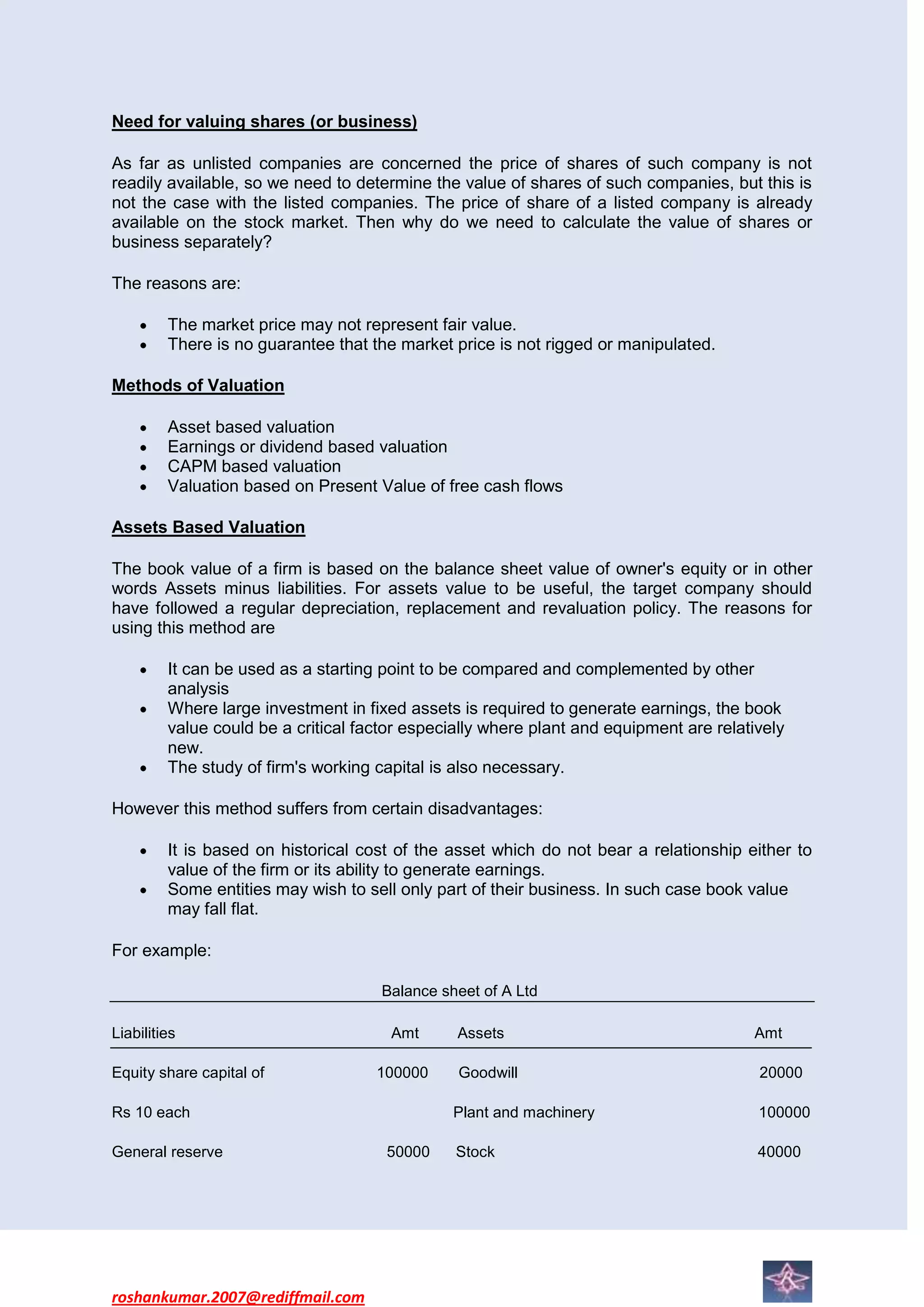
1) Asset-based valuation which values a company based on the book value of its assets and liabilities.
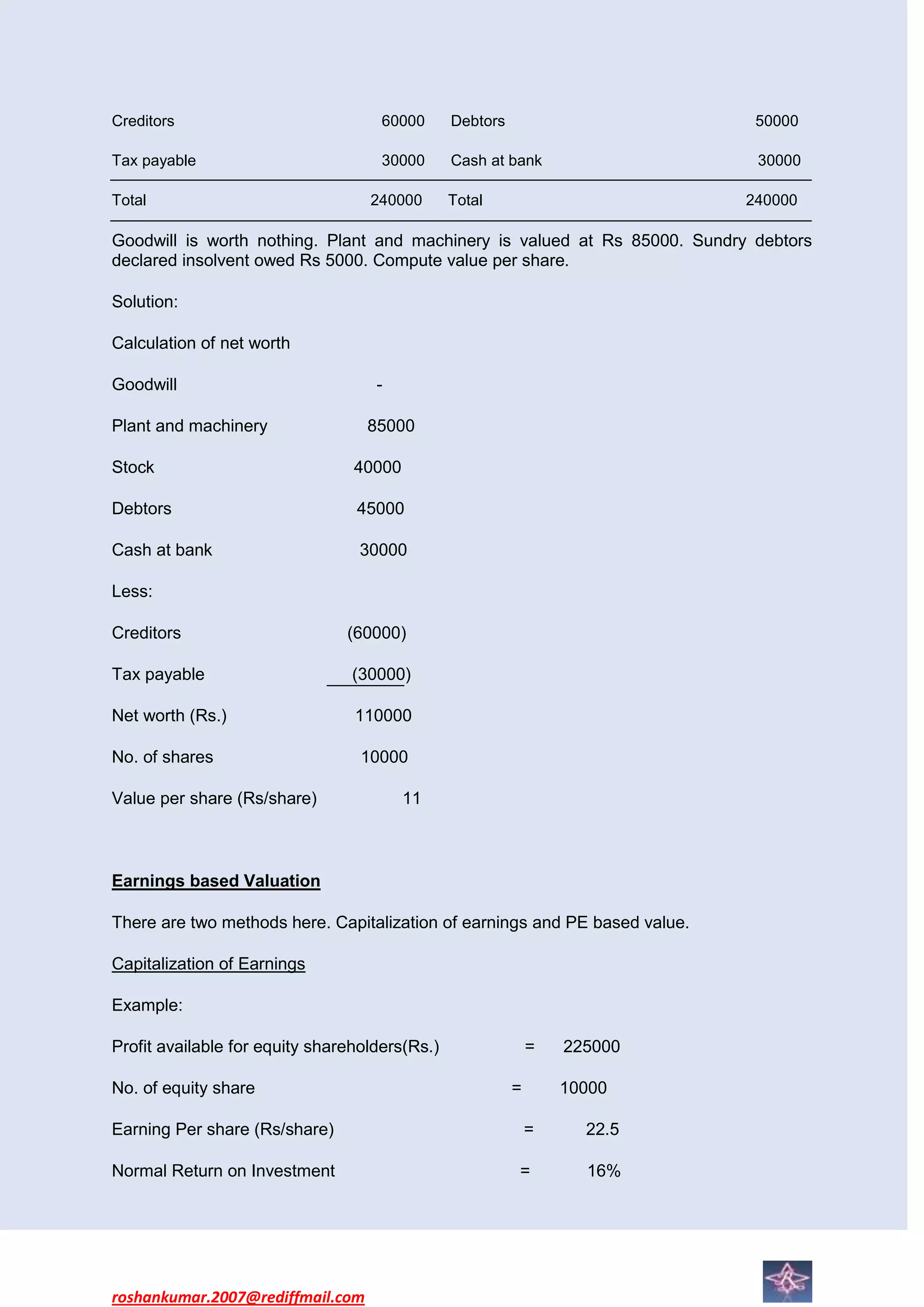
2) Earnings-based valuation which values a company based on capitalizing its earnings or using its price-earnings ratio.
3) Discounted cash flow valuation which values a company based on the present value of its future free cash flows.
The document recommends using multiple valuation methods and averaging the results to determine a company's fair value for an acquisition.
![D1 - Dividend
Ke - cost of equity
Constant Growth in Dividends
S = [Do(1+g)] / (Ke-g)
where,
Do - Dividend of last year
g - Expected growth rate
CAPM based valuation
The Capital Asset pricing model can be used to value the shares. This method is useful
when we need to estimate the price for initial listing in the stock exchange. The crux of this
model is to arrive at the cost of the equity and then use it as the capitalization of dividend or
earning to arrive at the value of share.
The formula is:
ke = Rf + beta of the firm (Rm-Rf)
where,
Ke - cost of equity
Rf - Risk free rate of return
Rm - market rate of return.
Free Cash flow model
Free cash flow model facilitates estimating the maximum worthwhile price that one may pay
for a business. Free cash flow analysis utilizes the financial statements of the target-
business, to determine the distributable cash surpluses, and takes into account not merely
the additional investments required to maintain growth, but also the tie-up of funds needed to
meet incremental working capital requirements. Under this model value of the firm is
estimated by a three step procedure:
Determine the free future cash flows:
Net operating income + Depreciation - incremental investment in capital or current
asset for each year separately.
Determine terminal cash flows, on the assumption that there would be constant
growth, or no growth.
Present values these cash flows can then be compared with the price that we would
pay for the acquisition..
roshankumar.2007@rediffmail.com](https://image.slidesharecdn.com/valuationmethodsusedinmergersacquisitions-120610203258-phpapp02/75/Valuation-methods-used-in-mergers-acquisitions-5-2048.jpg)