AMINO ACID METABOLISM
PREPARED & PRESENTED BY:
G. THIRUMALA ROOPESH M.PHARM., (Ph.D)
ASSO. PROF
9985111787
General reactions of amino acid metabolism: Transamination,
deamination & decarboxylation, urea cycle and its disorders;
Catabolism of phenylalanine and tyrosine and their metabolic disorders;
(Phenyketonuria, Albinism, alkeptonuria, tyrosinemia);
Synthesis and significance of biological substances;
5-HT, melatonin, dopamine, noradrenaline, adrenaline,
Catabolism of heme; hyperbilirubinemia and jaundice.
Amino acid metabolism
Phenylalanine (Phe, F) and tyrosine (Tyr, Y) are structurally related aromatic amino acids.
Phenylalanine is an essential amino acid while tyrosine is non-essential.
Besides its incorporation into proteins, the only function of phenylalanine is its conversion to
tyrosine. For this reason, ingestion of tyrosine can reduce the dietary requirement of
phenylalanine. This phenomenon is referred to as ‘sparing action’ of tyrosine on phenylalanine.
The predominant metabolism of phenylalanine occurs through tyrosine. Tyrosine is incorporated
into proteins and is involved in the synthesis of a variety of biologically important compounds—
epinephrine, norepinephrine, dopamine (catecholamines), thyroid hormones—
and the pigment melanin (Fig.15.17).
CATABOLISM OF PHENYLALANINE AND TYROSINE
During the course of degradation, phenylalanine and tyrosine are converted to metabolites
which can serve as precursors for the synthesis of glucose and fat. Hence, these amino acids are
both glucogenic and ketogenic. Biochemists attach special significance to phenylalanine and
tyrosine metabolism for two reasons—synthesis of biologically important compounds and the
metabolic disorders due to enzyme defects.
Conversion of phenylalanineto tyrosine Under normal circumstances, the degradation of
phenylalanine mostly occurs through tyrosine.
Phenylalanine is hydroxylated at para-position by phenylalanine hydroxylase to produce
tyrosine (p-hydroxy phenylalanine). This is an irreversible reaction and requires the participation
of a specific coenzyme biopterin (containing pteridine ring) which is structurally related to
folate. The active form of biopterin is tetrahydrobiopterin (H4-biopterin). In the phenylalanine
hydroxylase reaction, tetrahydrobiopterin is oxidized to dihydrobiopterin (H2-biopterin).
Tetrahydrobiopterin is then regenerated by an NADPH-dependent dihydrobiopterin reductase
(Fig.15.18).
The enzyme phenylalanine hydroxylase is present in the
liver. In the conversion of phenylalanine to tyrosine, the
reaction involves the incorporation of one atom of
molecular oxygen (O2) into the para position of
phenylalanine while the other atom of O2 is reduced to
form water.
It is the tetrahydrobiopterin that supplies the reducing
equivalents which, in turn, are provided by NADPH. Due to
a defect in phenylalanine hydroxylase, the conversion of
phenylalanine to tyrosine is blocked resulting in the
disorder phenylketonuria (PKU).
DEGRADATION OF TYROSINE (PHENYLALANINE)
The metabolism of phenylalanine and tyrosine is considered together. The sequence of the
reactions in the degradation of these amino acids, depicted in Fig.15.19, is described hereunder
1. As phenylalanine is converted to tyrosine (details in Fig.15.18), a
single pathway is responsible for the degradation of both these amino
acids, which occurs mostly in liver.
2. Tyrosine first undergoes transamination to give p-
hydroxyphenylpyruvate. This reaction is catalysed by tyrosine
transaminase (PLP dependent).
3. p-Hydroxyphenylpyruvate hydroxylase (or dioxygenase) is a copper-
containing enzyme. It catalyses oxidative decarboxylation as well as
hydroxylation of the phenyl ring of p-hydroxyphenylpyruvate to
produce homogentisate. This reaction involves a shift in hydroxyl group
from para position to meta position, and incorporates a new hydroxyl
group at para position. This step in tyrosine metabolism requires
ascorbic acid.
4. Homogentisate oxidase (iron metalloprotein) cleaves the benzene ring
ofhomogentisate to form 4-maleylacetoacetate.
Molecular oxygen is required for this reaction to break the
aromatic ring.
5. Maleylacetoacetate undergoes isomerization to form 4-
fumaryl acetoacetate and this reaction is catalysed by
maleylacetoacetate isomerase.
6. Fumaryl acetoacetase (fumaryl acetoacetate hydrolase)
brings about the hydrolysis of fumaryl acetoacetate to
liberate fumarate and acetoacetate.
Fumarate is an intermediate of citric acid cycle and can also
serve as precursor for gluconeogenesis. Acetoacetate is a
ketone body from which fat can be synthesized.
Phenylalanine and tyrosine are, therefore, both glucogenic
and ketogenic.
The inborn errors of phenylalanine and tyrosine metabolism
are indicated in Fig.15.19.
Phenyketonuria,
Albinism,
Alkeptonuria,
Tyrosinemia
Synthesis of melanin
Biosynthesis of thyroid hormones
Biosynthesis of catecholamines
Phenylalanine
Tyrosine
Phenylalanine hydroxylase
Synthesis of melanin
Melanin (Greek : melan—black) is the pigment of skin, hair and eye. The synthesis of
melanin occurs in melanosomes present in melanocytes, the pigment-producing cells.
Tyrosine is the precursor for melanin and only one enzyme, namely tyrosinase (a
copper-containing oxygenase), is involved in its formation. Tyrosinase hydroxylates
tyrosine to form 3,4-dihydroxyphenylalanine (DOPA) (Fig.15.20). DOPA can act as a
cofactor for tyrosinase. The next reaction is also catalysed by tyrosinase in which DOPA
is converted to dopaquinone. It is believed that the subsequent couple of reactions
occur spontaneously, forming leucodopachrome followed by 5,6-dihydroxyindole. The
oxidation of 5, 6-dihydroxyindole to indole 5, 6-quinone is catalysed by tyrosinase, and
DOPA serves as a cofactor. This reaction, inhibited by tyrosine regulates the synthesis
of melanin. Melanochromes are formed from indole quinone, which on
polymerization are converted to black melanin.
Another pathway from dopaquinone is also identified. Cysteine condenses with
dopaquinone and in the next series of reactions results the synthesis of red melanins.
The structure of melanin pigments is not clearly known.
Melanin—the colour pigment : The skin colour of the individual is
determined by the relative concentrations of black and red melanins. This, in turn, is
dependent on many factors, both genetic and environmental. These include the activity of
tyrosinase, the density of melanocytes, availability of tyrosine etc.
The presence of moles on the
body represents
a localized severe
hyperpigmentation due to
hyperactivity of melanocytes. On
the other hand, localized absence
or degeneration of
melanocytes results in white
patches on the skin commonly
known as leucoderma. Greying of
hair is due to lack of melanocytes
at hair roots.
Albinism is an inborn error with
generalized lack of melanin
synthesis
METABOLISM OF TYROSINE INTO MELANIN
Biosynthesis of thyroid hormones
Thyroid hormones—thyroxine
(tetraiodothyronine)
and triiodothyronine—are
synthesized
from the tyrosine residues of the
protein
thyroglobulin and activated iodine
(Fig.15.21).
Iodination of tyrosine ring occurs
to produce mono- and
diiodotyrosine from which
triiodothyronine (T3) and
thyroxine (T4) are synthesized.
The protein thyroglobulin
undergoes
proteolytic breakdown to release
the free hormones, T3 and T4.
Biosynthesis of thyroid hormones
Biosynthesis of catecholamines
The name catechol refers to the
dihydroxylated phenyl ring. The amine
derivatives of catechol are called
catecholamines.
Tyrosine is the precursor for the
synthesis of
catecholamines, namely dopamine,
norepinephrine (noradrenaline) and
epinephrine (adrenaline).
The conversion of tyrosine to
catecholamines
occurs in adrenal medulla and central
nervous
system involving the following
reactions
(Fig.15.22).
METABOLISM OF TYROSINE INTO CATECHOL
AMINES
Tyrosine is hydroxylated to 3,4-dihydroxyphenylalanine
(DOPA) by tyrosine hydroxylase.
This enzyme catalyses the rate limiting reaction and requires tetrahydrobiopterin as
coenzyme (like phenylalanine hydroxylase). In contrast to this enzyme, tyrosinase
present in melanocytes converts tyrosine to DOPA Hence, two different enzyme
systems exist to convert tyrosine to DOPA.
DOPA undergoes PLP-dependent decarboxylation to give dopamine which, in turn, is
hydroxylated to produce norepinephrine. Methylation of norepinephrine by S-
adenosylmethionine gives epinephrine. The difference between epinephrine and
norepinephrine is only a methyl group (remember that norepinephrine has no
methyl group).
There exists tissue specificity in the formation of catecholamines. In adrenal
medulla, synthesis of the hormones, norepinephrine and epinephrine is prominent.
Norepinephrine is
produced in certain areas of the brain while dopamine is predominantly synthesized
in substantia nigra and coeruleus of brain.
Functions of catecholamines : Norepinephrine and epinephrine regulate
carbohydrate and lipid metabolisms. They stimulate the degradation of
triacylglycerol and glycogen. They cause an increase in the blood pressure.
Dopamine and norepinephrine serve as neurotransmitters in the brain and
autonomous nervous system.
Dopamine and Parkinson’s disease
Parkinson’s disease is a common disorder in many elderly people, with
about 1% of the population above 60 years being affected. It is characterized
by muscular rigidity, tremors, expressionless face, lethargy, involuntary
movements etc.
Biochemical basis : The exact biochemical cause of this disorder has not
been identified.
Parkinson’s disease is, however, linked with a decreased production of
dopamine. The disease is due to degeneration of certain parts of the brain
(substantia nigra and locus coeruleus), leading to the impairment in the
synthesis of dopamine.
Treatment : Dopamine cannot enter the brain, hence its administration is of
no use. DOPA (levodopa or L-dopa) is used in the treatment of Parkinson’s
disease. In the brain, DOPA is decarboxylated to dopamine which alleviates the
symptoms of this disorder. Unfortunately, dopamine synthesis occurs in various
other tissues and results in side-effects such as nausea, vomiting, hypretension
etc. Administration of dopa analogs—that inhibit dopa decarboxylase (in various
tissues) but not enter brain (due to blood-brain barrier)—are found to be
effective.
Carbidopa and 􀁊-methyl-dopa (dopa analogs) are administered along with
dopa for the treatment of Parkinson’s disease.
DISORDERS OF TYROSINE (PHENYLALANINE) METABOLISM
Several enzyme defects in phenylalanine/ tyrosine degradation leading to metabolic
disorders are known. In Fig.15.19, the deficient enzymes and the respective inborn errors are
depicted and they are discussed here under.
Phenylketonuria
Neonatal tyrosinemia
Alkaptonuria (Black urine disease)
Tyrosinemia type II
Tyrosinosis or tyrosinemia type I
Albinism
Hypopigmentation
DISORDERS OF TYROSINE (PHENYLALANINE) METABOLISM
Phenylketonuria (PKU) is the most common metabolic disorder in
amino acid metabolism.
The incidence of PKU is 1 in 10,000 births. It is due to the
deficiency of the hepatic enzyme, phenylalanine hydroxylase,
caused by an autosomal recessive gene. In recent years, a variant
of PKU—due to a defect in dihydrobiopterin reductase (relatively
less)—has been reported. This enzyme deficiency impairs the
synthesis of tetrahydrobiopterin required for the action of
phenylalanine hydroxylase (See Fig.15.18). The net outcome in
PKU is that phenylalanine is not converted to tyrosine.
Phenylalanine metabolism in PKU :
Phenylketonuria primarily causes the accumulation of phenylalanine
in tissues and blood, and results in its increased excretion in urine.
Due to disturbances in the routine metabolism, phenylalanine is
diverted to alternate pathways (Fig.15.23), resulting in the
excessive production of phenylpyruvate, phenylacetate,
phenyllactate and phenylglutamine. All these metabolites are
excreted in urine in high concentration in PKU.
Phenylacetate gives the urine a mousey odour.
The name phenylketonuria is coined due to
the fact that the metabolite phenylpyruvate is a keto acid
(C6H5CH2 CO COO–) excreted in urine in high amounts.
Phenylketonuria (PKU)
Clinical/biochemical manifestations of PKU :
The disturbed metabolism of phenylalanine— resulting in the increased concentration
of phenylalanine and its metabolites in the body— causes many clinical and
biochemical manisfestations.
1. Effects on central nervous system : Mental retardation, failure to walk or
talk, failure of growth, seizures and tremor are the characteristic findings in PKU. If
untreated, the patients show very low IQ (below 50). The biochemical basis of mental
retardation in PKU is not well understood.
There are, however, many explanations offered…………….
Accumulation of phenylalanine in brain impairs the transport and metabolism of
other.
aromatic amino acids (tryptophan andtyrosine).
The synthesis of serotonin (an excitatory neurotransmitter) from tryptophan is
insufficient. This is due to the competition of phenylalanine and its metabolites with
tryptophan that impairs the synthesis of serotonin.
Defect in myelin formation is observed in PKU patients.
2. Effect on pigmentation : Melanin is the pigment synthesized from
tyrosine by tyrosinase. Accumulation of phenylalanine competitively inhibits
tyrosinase and impairs melanin formation. The result is hypopigmentation that causes
light skin colour, fair hair, blue eyes etc.
Diagnosis of PKU :
PKU is mostly detected by screening the newborn babies for
the increased plasma levels of phenylalanine (PKU, 20–65
mg/ dl; normal 1–2mg/dl). This is usually carried out
by Guthrie test, which is a bacterial (Bacillus subtilis)
bioassay for phenylalanine.
The test is usually performed after the baby is fed with breast
milk for a couple of days by testing elevated levels of
phenylalanine. Phenylpyruvate in urine can be detected by
ferric chloride test (a green colour is obtained). This test is
not specific, since many other compounds give a false positive
test. Prenatal diagnosis of PKU can also be done by using
cultured amniotic cells.
Treatment of PKU :
The maintenance of plasma phenylalanine concentration within the
normal range is a challenging task in the treatment of PKU. This is
done by selecting foods with low phenylalanine content and/or feeding
synthetic amino acid preparations, low in phenylalanine. Dietary intake
of phenylalanine should be adjusted by measuring plasma levels. Early
diagnosis (in the first couple of months of baby’s life) and treatment for
4–5 years can prevent the damage to brain. However, the restriction to
protein diet should be continued for many more years in life. Since the
amino acid tyrosine cannot be synthesized in PKU patients, it becomes
essential and should be provided in the diet in sufficient quantity. In
some seriously affected PKU patients, treatment includes
administration of 5-hydroxytryptophan and dopa to restore the
synthesis of serotonin and catecholamines. PKU patients with
tetrahydrobiopterin deficiency require tetrahydrobiopterin
supplementation.
In some individuals, a reduced synthesis of
melanin (instead of total lack) is often
observed. Hypopigmentation disorders may be
either diffuse or localized.
A good example of diffuse hypopigmentation
is oculocutaneous albinism which is mostly
due to mutations in the tyrosinase gene. The
degree of hypopigmentation depends on the
type and severity of mutated genes.
Vitiligo and leukoderma are the important
among the localized hypopigmentation
disorders.
Vitiligo is an acquired progressive disease with
loss of pigmentation around mouth, nose, eyes and
nipples. Leukoderma is comparable with vitiligo, but
lack of pigmentation usually begins with hands and
then spreads.
Greying of hair is due to lack of melanin
synthesis which usually occurs as a result of
disappearance of melanocytes from the hair
roots.
Hypopigmentation
Neonatal Tyrosinemia
The absence of the enzyme p-hydroxyphenylpyruvate dioxygenase causes
neonatal tyrosinemia. This is mostly a temporary condition and usually
responds to ascorbic acid.
It is explained that the substrate inhibition of the enzyme is overcome by the
presence of ascorbic acid.
This is due to the deficiency of the
enzymes
fumarylacetoacetate hydroxylase and/or
maleylacetoacetate
isomerase. Tyrosinosis is a rare but
serious disorder. It causes liver failure,
rickets,renal tubular dysfunction and
polyneuropathy.
Tyrosine, its metabolites and many other
aminoacids are excreted in urine.
In acute tyrosinosis, the infant exhibits
diarrhea, vomiting, and ‘cabbage-like’
odor.
Death may even occur due to liver failure
withinone year.
For the treatment, diets low
in tyrosine, phenylalanine and
methionine are
recommended.
Tyrosinosis or tyrosinemia type I
Tyrosinemia type
II (OR) Richner-
Hanhart syndrome
This disorder—also known as Richner-
Hanhart syndrome, is due to a defect in the
enzyme tyrosine transaminase. The result is a
blockade in the routine degradative pathway of
tyrosine. Accumulation and excretion of tyrosine
and its metabolites—namely p-
hydroxyphenylpyruvate,
p-hydroxyphenyllactate, phydroxyphenylacetate,
N-acetyltyrosine—and tyramine
are observed.
Tyrosinemia type II is characterized by skin
(dermatitis) and eye lesions and, rarely, mental
retardation. A disturbed self-coordination is seen
in these patients.
Albinism
Albinism (Greek: albino—white) is an inborn error, due to the lack of
synthesis of the pigment melanin. It is an autosomal recessive
disorder with a frequency of 1 in 20,000.
Biochemical basis : The colour of skin and hair is controlled by a large
number of genes.
About 150 genes have been identified in mice.
The melanin synthesis can be influenced by a variety of factors. Many
possible causes (rather explanations) for albinism have been identified
1. Deficiency or lack of the enzyme tyrosinase.
2. Decrease in melanosomes of melanocytes.
3. Impairment in melanin polymerization.
4. Lack of protein matrix in melanosomes.
5. Limitation of substrate (tyrosine) availability.
6. Presence of inhibitors of tyrosinase.
The most common cause of albinism is a defect in tyrosinase, the
enzyme most responsible for the synthesis of melanin (See Fig.15.20).
Clinical manifestations : The most important function of melanin is
the protection of the body from sun radiation. Lack of melanin in
albinos makes them sensitive to sunlight. Increased susceptibility to
skin cancer (carcinoma) is observed. Photophobia (intolerance to
light) is associated with lack of pigment in the eyes.
However, there is no impairment in the eyesight of albinos.
Tryptophan (Trp, W) was the first to be identified as an
essential amino acid. It contains
an indole ring and chemically it is α-amino β-indole
propionic acid. Tryptophan is both
glucogenic and ketogenic in nature. It is a precursor for
the synthesis of important
compounds, namely NAD+ and NADP+ (coenzymes of
niacin), serotonin and melatonin (Fig.15.25).
The metabolism of tryptophan is divided into
I. Kynurenine (kynurenine-anthranilate) pathway;
II. Serotonin pathway.
Tryptophan
I. Kynurenine pathway
II. Serotonin pathway
The excretion of 5-hydroxy indole
acetate in urine is tremendously elevated (upto 500mg/day against
normal <5 mg/day) in carcinoid syndrome. The estimation
of 5 HIA in urine is used for the diagnosis of this disorder. In general,
urine concentration of 5 HIA above 25 mg/day should be viewed with
caution as it may be suggestive of carcinoid syndrome.
Sufficient precaution should, however, be taken for sample collection.
During the course of urine collection, the patients should not ingest
certain foods (banana, tomato etc.) that increase urine 5 HIA.
Diagnosis :
Degradation of serotonin : Monoamine oxidase
(MAO) degrades serotonin to 5-
hydroxyindoleacetate (5HIA) which is excreted in
urine.
Functions of serotonin : Serotonin is a neurotransmitter and performs a
variety of functions.
1. Serotonin is a powerful vasoconstrictor and results in smooth muscle contraction in
bronchioles and arterioles.
2. It is closely involved in the regulation of cerebral activity (excitation).
3. Serotonin controls the behavioural patterns, sleep, blood pressure and body
temperature.
4. Serotonin evokes the release of peptide hormones from gastrointestinal tract.
5. It is also necessary for the motility of GIT (peristalsis).
Serotonin and brain : The brain itselfsynthesizes 5HT which is in a bound
form. The outside serotonin cannot enter the brain due to blood-brain barrier.
Primarily, serotonin is a stimulator (excitation) of brain activity, hence its deficiency
causes depression. Serotonin level is decreased in psychosis patients.
Defects in monoamine oxidase gene (lowered MAO activity) are linked to violent
behaviour and slight mental retardation.
Effect of drugs on serotonin :
The drug, iproniazid (isopropyl isonicotinyl hydrazine)
inhibits MAO and elevates serotonin levels, therefore, this
drug is a psychic stimulant. On the other hand, reserpine
increases the degradation of serotonin, hence acts as a
depressant drug. Lysergic acid diethylamide (LSD) competes
with serotonin and, therefore, acts as a depressant.
Malignant carcinoid syndrome : Serotonin is
produced by argentaffin cells of gastrointestinal tract. When these cells undergo
uncontrolled growth, they develop into a tumor called malignant carcinoid or
argentaffinomas. The patients exhibit symptoms like respiratory distress, sweating,
hypertension etc.
Normally about 1% of the tryptophan is utilized for serotonin synthesis. In
case of carcinoid syndrome, very high amount (up to 60%) of tryptophan
is diverted for serotonin production. This disturbs the normal tryptophan
metabolism and impairs the synthesis of NAD+ and NADP+. Hence, the
patients of carcinoid syndrome develop symptoms of pellagra (niacin
Melatonin is a hormone, mostly synthesized by the pineal gland. Serotonin—
produced from tryptophan—is acted upon by serotonin N-acetylase (the rate limiting
enzyme), to give N-acetylserotonin. The latter undergoes methylation, S-
adenosylmethionine being the methyl group donor to produce melatonin or N-acetyl
5-methoxyserotonin (Fig.15.27). The synthesis and secretion of melatonin from pineal
gland is controlled by light.
Functions of melatonin
1. Melatonin is involved in circadian rhythms or diurnal
variations (24 hr cyclic process) of the body. It plays a
significant role in sleep and wake process.
2. Melatonin inhibits the production of melanocyte
stimulating hormone (MSH) and adrenocorticotropic
hormone (ACTH).
3. It has some inhibitory effect on ovarian functions. 4.
Melatonin also performs a neurotransmitter function.
Melatonin
This disorder was first described in the family of Hartnup, hence the
name—Hartnup’s disease.
It is a hereditary disorder of tryptophan metabolism. The clinical
symptoms include dermatitis, ataxia, mental retardation etc. Hartnup’s
disease is characterized by low plasma levels of tryptophan and other
neutral amino acids and their elevated urinary excretion. Increased
urinary output of indoleacetic acid and indolepyruvic acid is also
observed. Pellagra-like symptoms are common in these patients. There
is an impairment in the synthesis of NAD+ and serotonin from
tryptophan. Some authors (earlier) attributed Hartnup’s disease to a
defect in the enzyme tryptophan pyrrolase. This, however, does not
appear to be true. Hartnup’s disease is now believed to be due to an
impairment in the absorption and/or transport of tryptophan and
other neutral amino acids from the intestine, renal tubules and,
probably brain. Some more details on Hartnup’s disease are given under
digestion and absorption
Hartnup’s disease
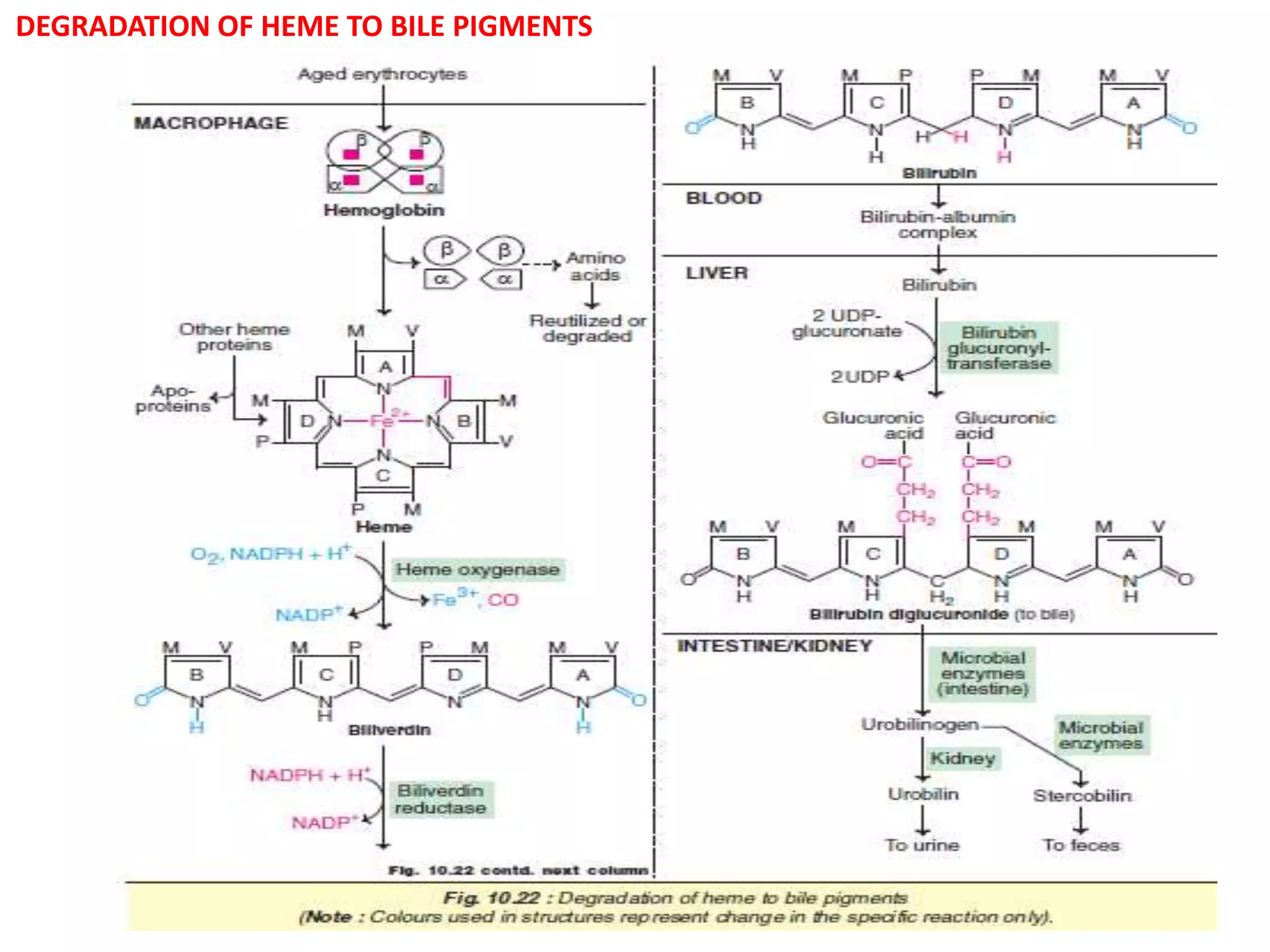
DEGRADATION OF HEME TO BILE PIGMENTS
Sources of heme : It is estimated that about 80% of the heme that is subjected
for degradation comes from the erythrocytes and the rest (20%) comes from immature
RBC, myoglobin and cytochromes.
Heme oxygenase : A complex microsomal enzyme namely heme Oxygenase
utilizes NADPH and O2 and cleaves the methenyl bridges between the two pyrrole rings
(A and B) to form biliverdin. Simultaneously, ferrous iron (Fe2+) is oxidized to ferric
form (Fe3+) and released. The products of heme oxygenase reaction are biliverdin (a
green pigment), Fe3+ and carbon monoxide (CO). Heme promotes the activity of this
enzyme.
Biliverdin is excreted in birds and amphibia while in mammals it is further degraded.
Biliverdin reductase : Biliverdin’s methenyl bridges (between the pyrrole rings C and
D) are reduced to methylene group to form bilirubin (yellow pigment). This reaction is
catalysed by
an NADPH dependent soluble enzyme, biliverdin reductase (Fig.10.22). One gram of
hemoglobin on degradation finally yields about 35 mg bilirubin. Approximately
250-350 mg of bilirubin is daily produced in human adults. The term bile pigments is
used to collectively represent bilirubin and its derivatives.
DEGRADATION OF HEME TO BILE PIGMENTS
SUMMARY OF HEME SYNTHESIS ALONG WITH PORPHYRIAS
Regulation in the erythroid cells : The
enzyme ALA synthase does not
appear to control
the heme synthesis in the erythroid
cells.
Uroporphyrinogen synthase and
ferrochelatse
mostly regulate heme formation in
these cells.
Porphyrias are the metabolic disorders of heme synthesis,
characterized by the increased excretion of porphyrins or porphyrin
precursors. Porphyrias are either inherited or acquired.
They are broadly classified into two categories
1. Erythropoietic : Enzyme deficiency occurs in the erythrocytes.
2. Hepatic : Enzyme defect lies in the liver.
Porphyrias
Acute intermittent porphyria
Congenital erythropoietic porphyria
Porphyria cutanea tarda
Hereditary coproporphyria
Variegate porphyria
Hepatic Erythropoietic
Acquired (toxic) porphyrias
Transport of bilirubin to liver : Bilirubin is lipophilic and
therefore insoluble in aqueous solution. Bilirubin is transported in the
plasma in a bound (non-covalently) form to albumin. Albumin has two
binding sites for bilirubin—a high affinity site and a low affinity site.
Approximately 25 mg of bilirubin can bind tightly to albumin (at high
affinity sites) per 100 ml of plasma. The rest of the bilirubin binds
loosely (at the low affinity sites) which can be easily detached from
albumin to enter the tissues. Certain drugs and antibiotics (e.g
sulfonamides, salicylates) can displace bilirubin from albumin. Due to
this, bilirubin can enter the central nervous system and cause damage to
neurons.
As the albumin-bilirubin complex enters the liver, bilirubin dissociates
and is taken up by sinusoidal surface of the hepatocytes by a carrier
mediated active transport. The transport system has a very high capacity
and therefore is not a limitation for further metabolism of bilirubin.
Inside the hepatocytes, bilirubin binds to a specific intracellular protein
namely ligandin .
Conjugation of bilirubin
In the liver, bilirubin is conjugated with two molecules of glucuronate supplied
by UDPglucuronate.
This reaction, catalysed by bilirubin glucuronyltransferase (of smooth
endoplasmic reticulum) results in the formation of a water soluble bilirubin
diglucuronide (Figs.10.22 and 10.23). When bilirubin is in excess, bilirubin
monoglucuronides also accumulate in the body. The enzyme bilirubin
glucuronyltransferase can be induced by a number of drugs (e.g.
phenobarbital),
Excretion of bilirubin into bile
Conjugated bilirubin is excreted into the bile canaliculi against a concentration
gradient which then enters the bile. The transport of bilirubin diglucuronide is
an active, energy-dependent and rate limiting process. This step is easily
susceptible to any impairment in liver function. Normally, there is a good
coordination between the bilirubin conjugation and its excretion into bile. Thus
almost all the bilirubin (> 98%) that enters bile is in the conjugated form.
JAUNDICE
The normal serum total bilirubin concentration is in the range of 0.2 to 1.0
mg/dl. Of this, about 0.2-0.6 mg/dl is unconjugated while 0.2 to 0.4 mg/dl is
conjugated bilirubin. Jaundice (French : Jaune-yellow) is a clinical condition
characterized by yellow colour of the white of the eyes (sclerae) and skin. It is
caused by the deposition of bilirubin due to its elevated levels in the serum. The
term hyperbilirubinemia is often used to represent the increased
concentration of serum bilirubin.
Classification of jaundice
Jaundice (also known as icterus) may be more
appropriately considered as a symptom rather
than a disease. It is rather difficult to classify
jaundice, since it is frequently caused due to
multiple factors. For the sake of convenience to
understand, jaundice is classified into three
major types—hemolytic, hepatic and obstructive.
1. Hemolytic jaundice : This condition is associated with
increased hemolysis of erythrocytes (e.g. incompatible blood
transfusion, malaria, sickle-cell anemia). This results in the
overproduction of bilirubin beyond the ability of the liver to
conjugate and excrete the same. It should, however be noted
that liver possesses a large capacity to conjugate about 3.0 g
of bilirubin per day against the normal bilirubin production of
0.3 g/day.
In hemolytic jaundice, more bilirubin is excreted into the bile
leading to the increased formation of urobilinogen and
stercobilinogen.
Hemolytic jaundice is characterized by
Elevation in the serum unconjugated bilirubin.
 Increased excretion of urobilinogen in urine.
Dark brown colour of feces due to high content of
stercobilinogen.
2. Hepatic (hepatocellular) jaundice :
This type of jaundice is caused by dysfunction of the liver due to
damage to the parenchymal cells. This may be attributed to viral
infection (viral hepatitis), poisons and toxins (chloroform,
carbon tetrachloride, phosphorus etc.) cirrhosis of liver, cardiac failure
etc. Among these, viral hepatitis is the most common.
Damage to the liver adversely affects the bilirubin uptake and its
conjugation by liver cells.
Hepatic jaundice is characterized by
Increased levels of conjugated and unconjugated bilirubin in the serum.
Dark coloured urine due to the excessive excretion of bilirubin and
urobilinogen.
Increased activities of alanine transaminase (SGPT) and aspartate
transaminase (SGOT)
released into circulation due to damage to hepatocytes.
The patients pass pale, clay coloured stools due to the absence of
stercobilinogen.
The affected individuals experience nausea and anorexia (loss of
appetite).
3. Obstructive (regurgitation) jaundice :
This is due to an obstruction in the bile duct that prevents the passage
of bile into the intestine.
The obstruction may be caused by gall stones, tumors etc.
Due to the blockage in bile duct, the conjugated bilirubin from the liver
enters the circulation.
Obstructive jaundice is characterized by
Increased concentration of conjugated bilirubin in serum.
Serum alkaline phosphatase is elevated as it is released from the
cells of the damaged bile duct.
 Dark coloured urine due to elevated excretion of bilirubin and clay
coloured feces due to absence of stercobilinogen.
Feces contain excess fat indicating impairment in fat digestion and
absorption in the absence of bile (specifically bile salts).
The patients experience nausea and gastrointestinal pain.
SUMMARY OF BILIRUBIN METABOLISM
JAUNDICE DUE TO GENETIC DEFECTS
There are certain hereditary abnormalities that cause jaundice.
Neonatal-physiologic jaundice
Physiological jaundice is not truly a genetic defect. It is caused by
increased hemolysis coupled with immature hepatic system for the
uptake, conjugation and secretion of bilirubin.
The activity of the enzyme UDP-glucuronyltransferase is low in the
newborn. Further, there is a limitation in the availability of the
substrate UDP-glucuronic acid for conjugation. The net effect is that in
some infants the serum uncojugated bilirubin is highly elevated (may go
beyond 25mg/dl), which can cross the bloodbrain barrier. This results in
hyperbilirubinemic toxic encephalopathy or kernicterus that causes
mental retardation. The drug phenobarbital is used in the treatment of
neonatal jaundice, as it can induce bilirubin metabolising enzymes in
liver. In some neonates, blood transfusion may be necessary to prevent
brain damage.
Phototherapy : Bilirubin can absorb blue light (420–470 nm) maximally.
Phototherapy deals with the exposure of the jaundiced neonates to blue light. By a process
called photoisomerization, the toxic native unconjugated bilirubin gets converted into a non-
toxic isomer namely lumirubin. Lumirubin can be easily excreted by the kidneys in the
unconjugated form (in contrast to bilirubin which cannot be excreted). Serum bilirubin is
monitored every 12–24 hours, and phototherapy is continuously carried out till the serum
bilirubin becomes normal (< 1 mg/dl).
Crigler-Najjar syndrome type I
This is also known as congenital nonhemolytic jaundice. It is a rare disorder and is due to a
defect in the hepatic enzyme UDPglucuronyltransferase.
Generally, the children die within first two years of life.
Crigler-Najjar syndrome type II
This is again a rare hereditary disorder and is due to a less severe defect in the
bilirubin conjugation. It is believed that hepatic UDPglucuronyltransferase that
catalyses the addition of second glucuronyl group is defective. The serum bilirubin
concentration is usually less than 20 mg/dl and this is less dangerous than type I.
Gilbert’s disease : This is not a single disease but a combination of disorders. These
include………………
1. A defect in the uptake of bilirubin by liver cells.
2. An impairment in conjugation due to reduced activity of UDP-glucuronyltransferase.
3. Decreased hepatic clearance of bilirubin.
Hyperbilirubinemia is a condition in which there is too much bilirubin in your baby's blood.
When red blood cells break down, a substance called bilirubin is formed. Babies are not
easily able to get rid of the bilirubin, and it can build up in the blood and other tissues and
fluids of your baby's body.
Hyperbilirubinemia
3.Metaboilsm of aminoacids.pptx

3.Metaboilsm of aminoacids.pptx

  • 1.
    AMINO ACID METABOLISM PREPARED& PRESENTED BY: G. THIRUMALA ROOPESH M.PHARM., (Ph.D) ASSO. PROF 9985111787
  • 2.
    General reactions ofamino acid metabolism: Transamination, deamination & decarboxylation, urea cycle and its disorders; Catabolism of phenylalanine and tyrosine and their metabolic disorders; (Phenyketonuria, Albinism, alkeptonuria, tyrosinemia); Synthesis and significance of biological substances; 5-HT, melatonin, dopamine, noradrenaline, adrenaline, Catabolism of heme; hyperbilirubinemia and jaundice. Amino acid metabolism
  • 3.
    Phenylalanine (Phe, F)and tyrosine (Tyr, Y) are structurally related aromatic amino acids. Phenylalanine is an essential amino acid while tyrosine is non-essential. Besides its incorporation into proteins, the only function of phenylalanine is its conversion to tyrosine. For this reason, ingestion of tyrosine can reduce the dietary requirement of phenylalanine. This phenomenon is referred to as ‘sparing action’ of tyrosine on phenylalanine. The predominant metabolism of phenylalanine occurs through tyrosine. Tyrosine is incorporated into proteins and is involved in the synthesis of a variety of biologically important compounds— epinephrine, norepinephrine, dopamine (catecholamines), thyroid hormones— and the pigment melanin (Fig.15.17). CATABOLISM OF PHENYLALANINE AND TYROSINE
  • 4.
    During the courseof degradation, phenylalanine and tyrosine are converted to metabolites which can serve as precursors for the synthesis of glucose and fat. Hence, these amino acids are both glucogenic and ketogenic. Biochemists attach special significance to phenylalanine and tyrosine metabolism for two reasons—synthesis of biologically important compounds and the metabolic disorders due to enzyme defects. Conversion of phenylalanineto tyrosine Under normal circumstances, the degradation of phenylalanine mostly occurs through tyrosine. Phenylalanine is hydroxylated at para-position by phenylalanine hydroxylase to produce tyrosine (p-hydroxy phenylalanine). This is an irreversible reaction and requires the participation of a specific coenzyme biopterin (containing pteridine ring) which is structurally related to folate. The active form of biopterin is tetrahydrobiopterin (H4-biopterin). In the phenylalanine hydroxylase reaction, tetrahydrobiopterin is oxidized to dihydrobiopterin (H2-biopterin). Tetrahydrobiopterin is then regenerated by an NADPH-dependent dihydrobiopterin reductase (Fig.15.18).
  • 5.
    The enzyme phenylalaninehydroxylase is present in the liver. In the conversion of phenylalanine to tyrosine, the reaction involves the incorporation of one atom of molecular oxygen (O2) into the para position of phenylalanine while the other atom of O2 is reduced to form water. It is the tetrahydrobiopterin that supplies the reducing equivalents which, in turn, are provided by NADPH. Due to a defect in phenylalanine hydroxylase, the conversion of phenylalanine to tyrosine is blocked resulting in the disorder phenylketonuria (PKU).
  • 6.
    DEGRADATION OF TYROSINE(PHENYLALANINE) The metabolism of phenylalanine and tyrosine is considered together. The sequence of the reactions in the degradation of these amino acids, depicted in Fig.15.19, is described hereunder 1. As phenylalanine is converted to tyrosine (details in Fig.15.18), a single pathway is responsible for the degradation of both these amino acids, which occurs mostly in liver. 2. Tyrosine first undergoes transamination to give p- hydroxyphenylpyruvate. This reaction is catalysed by tyrosine transaminase (PLP dependent). 3. p-Hydroxyphenylpyruvate hydroxylase (or dioxygenase) is a copper- containing enzyme. It catalyses oxidative decarboxylation as well as hydroxylation of the phenyl ring of p-hydroxyphenylpyruvate to produce homogentisate. This reaction involves a shift in hydroxyl group from para position to meta position, and incorporates a new hydroxyl group at para position. This step in tyrosine metabolism requires ascorbic acid. 4. Homogentisate oxidase (iron metalloprotein) cleaves the benzene ring ofhomogentisate to form 4-maleylacetoacetate.
  • 7.
    Molecular oxygen isrequired for this reaction to break the aromatic ring. 5. Maleylacetoacetate undergoes isomerization to form 4- fumaryl acetoacetate and this reaction is catalysed by maleylacetoacetate isomerase. 6. Fumaryl acetoacetase (fumaryl acetoacetate hydrolase) brings about the hydrolysis of fumaryl acetoacetate to liberate fumarate and acetoacetate. Fumarate is an intermediate of citric acid cycle and can also serve as precursor for gluconeogenesis. Acetoacetate is a ketone body from which fat can be synthesized. Phenylalanine and tyrosine are, therefore, both glucogenic and ketogenic. The inborn errors of phenylalanine and tyrosine metabolism are indicated in Fig.15.19.
  • 8.
  • 9.
    Synthesis of melanin Biosynthesisof thyroid hormones Biosynthesis of catecholamines Phenylalanine Tyrosine Phenylalanine hydroxylase
  • 10.
    Synthesis of melanin Melanin(Greek : melan—black) is the pigment of skin, hair and eye. The synthesis of melanin occurs in melanosomes present in melanocytes, the pigment-producing cells. Tyrosine is the precursor for melanin and only one enzyme, namely tyrosinase (a copper-containing oxygenase), is involved in its formation. Tyrosinase hydroxylates tyrosine to form 3,4-dihydroxyphenylalanine (DOPA) (Fig.15.20). DOPA can act as a cofactor for tyrosinase. The next reaction is also catalysed by tyrosinase in which DOPA is converted to dopaquinone. It is believed that the subsequent couple of reactions occur spontaneously, forming leucodopachrome followed by 5,6-dihydroxyindole. The oxidation of 5, 6-dihydroxyindole to indole 5, 6-quinone is catalysed by tyrosinase, and DOPA serves as a cofactor. This reaction, inhibited by tyrosine regulates the synthesis of melanin. Melanochromes are formed from indole quinone, which on polymerization are converted to black melanin. Another pathway from dopaquinone is also identified. Cysteine condenses with dopaquinone and in the next series of reactions results the synthesis of red melanins. The structure of melanin pigments is not clearly known. Melanin—the colour pigment : The skin colour of the individual is determined by the relative concentrations of black and red melanins. This, in turn, is dependent on many factors, both genetic and environmental. These include the activity of tyrosinase, the density of melanocytes, availability of tyrosine etc.
  • 11.
    The presence ofmoles on the body represents a localized severe hyperpigmentation due to hyperactivity of melanocytes. On the other hand, localized absence or degeneration of melanocytes results in white patches on the skin commonly known as leucoderma. Greying of hair is due to lack of melanocytes at hair roots. Albinism is an inborn error with generalized lack of melanin synthesis METABOLISM OF TYROSINE INTO MELANIN
  • 12.
    Biosynthesis of thyroidhormones Thyroid hormones—thyroxine (tetraiodothyronine) and triiodothyronine—are synthesized from the tyrosine residues of the protein thyroglobulin and activated iodine (Fig.15.21). Iodination of tyrosine ring occurs to produce mono- and diiodotyrosine from which triiodothyronine (T3) and thyroxine (T4) are synthesized. The protein thyroglobulin undergoes proteolytic breakdown to release the free hormones, T3 and T4. Biosynthesis of thyroid hormones
  • 13.
    Biosynthesis of catecholamines Thename catechol refers to the dihydroxylated phenyl ring. The amine derivatives of catechol are called catecholamines. Tyrosine is the precursor for the synthesis of catecholamines, namely dopamine, norepinephrine (noradrenaline) and epinephrine (adrenaline). The conversion of tyrosine to catecholamines occurs in adrenal medulla and central nervous system involving the following reactions (Fig.15.22). METABOLISM OF TYROSINE INTO CATECHOL AMINES
  • 14.
    Tyrosine is hydroxylatedto 3,4-dihydroxyphenylalanine (DOPA) by tyrosine hydroxylase. This enzyme catalyses the rate limiting reaction and requires tetrahydrobiopterin as coenzyme (like phenylalanine hydroxylase). In contrast to this enzyme, tyrosinase present in melanocytes converts tyrosine to DOPA Hence, two different enzyme systems exist to convert tyrosine to DOPA. DOPA undergoes PLP-dependent decarboxylation to give dopamine which, in turn, is hydroxylated to produce norepinephrine. Methylation of norepinephrine by S- adenosylmethionine gives epinephrine. The difference between epinephrine and norepinephrine is only a methyl group (remember that norepinephrine has no methyl group). There exists tissue specificity in the formation of catecholamines. In adrenal medulla, synthesis of the hormones, norepinephrine and epinephrine is prominent. Norepinephrine is produced in certain areas of the brain while dopamine is predominantly synthesized in substantia nigra and coeruleus of brain. Functions of catecholamines : Norepinephrine and epinephrine regulate carbohydrate and lipid metabolisms. They stimulate the degradation of triacylglycerol and glycogen. They cause an increase in the blood pressure. Dopamine and norepinephrine serve as neurotransmitters in the brain and autonomous nervous system.
  • 15.
    Dopamine and Parkinson’sdisease Parkinson’s disease is a common disorder in many elderly people, with about 1% of the population above 60 years being affected. It is characterized by muscular rigidity, tremors, expressionless face, lethargy, involuntary movements etc. Biochemical basis : The exact biochemical cause of this disorder has not been identified. Parkinson’s disease is, however, linked with a decreased production of dopamine. The disease is due to degeneration of certain parts of the brain (substantia nigra and locus coeruleus), leading to the impairment in the synthesis of dopamine. Treatment : Dopamine cannot enter the brain, hence its administration is of no use. DOPA (levodopa or L-dopa) is used in the treatment of Parkinson’s disease. In the brain, DOPA is decarboxylated to dopamine which alleviates the symptoms of this disorder. Unfortunately, dopamine synthesis occurs in various other tissues and results in side-effects such as nausea, vomiting, hypretension etc. Administration of dopa analogs—that inhibit dopa decarboxylase (in various tissues) but not enter brain (due to blood-brain barrier)—are found to be effective. Carbidopa and 􀁊-methyl-dopa (dopa analogs) are administered along with dopa for the treatment of Parkinson’s disease.
  • 16.
    DISORDERS OF TYROSINE(PHENYLALANINE) METABOLISM Several enzyme defects in phenylalanine/ tyrosine degradation leading to metabolic disorders are known. In Fig.15.19, the deficient enzymes and the respective inborn errors are depicted and they are discussed here under. Phenylketonuria Neonatal tyrosinemia Alkaptonuria (Black urine disease) Tyrosinemia type II Tyrosinosis or tyrosinemia type I Albinism Hypopigmentation DISORDERS OF TYROSINE (PHENYLALANINE) METABOLISM
  • 17.
    Phenylketonuria (PKU) isthe most common metabolic disorder in amino acid metabolism. The incidence of PKU is 1 in 10,000 births. It is due to the deficiency of the hepatic enzyme, phenylalanine hydroxylase, caused by an autosomal recessive gene. In recent years, a variant of PKU—due to a defect in dihydrobiopterin reductase (relatively less)—has been reported. This enzyme deficiency impairs the synthesis of tetrahydrobiopterin required for the action of phenylalanine hydroxylase (See Fig.15.18). The net outcome in PKU is that phenylalanine is not converted to tyrosine. Phenylalanine metabolism in PKU : Phenylketonuria primarily causes the accumulation of phenylalanine in tissues and blood, and results in its increased excretion in urine. Due to disturbances in the routine metabolism, phenylalanine is diverted to alternate pathways (Fig.15.23), resulting in the excessive production of phenylpyruvate, phenylacetate, phenyllactate and phenylglutamine. All these metabolites are excreted in urine in high concentration in PKU. Phenylacetate gives the urine a mousey odour. The name phenylketonuria is coined due to the fact that the metabolite phenylpyruvate is a keto acid (C6H5CH2 CO COO–) excreted in urine in high amounts. Phenylketonuria (PKU)
  • 18.
    Clinical/biochemical manifestations ofPKU : The disturbed metabolism of phenylalanine— resulting in the increased concentration of phenylalanine and its metabolites in the body— causes many clinical and biochemical manisfestations. 1. Effects on central nervous system : Mental retardation, failure to walk or talk, failure of growth, seizures and tremor are the characteristic findings in PKU. If untreated, the patients show very low IQ (below 50). The biochemical basis of mental retardation in PKU is not well understood. There are, however, many explanations offered……………. Accumulation of phenylalanine in brain impairs the transport and metabolism of other. aromatic amino acids (tryptophan andtyrosine). The synthesis of serotonin (an excitatory neurotransmitter) from tryptophan is insufficient. This is due to the competition of phenylalanine and its metabolites with tryptophan that impairs the synthesis of serotonin. Defect in myelin formation is observed in PKU patients. 2. Effect on pigmentation : Melanin is the pigment synthesized from tyrosine by tyrosinase. Accumulation of phenylalanine competitively inhibits tyrosinase and impairs melanin formation. The result is hypopigmentation that causes light skin colour, fair hair, blue eyes etc.
  • 19.
    Diagnosis of PKU: PKU is mostly detected by screening the newborn babies for the increased plasma levels of phenylalanine (PKU, 20–65 mg/ dl; normal 1–2mg/dl). This is usually carried out by Guthrie test, which is a bacterial (Bacillus subtilis) bioassay for phenylalanine. The test is usually performed after the baby is fed with breast milk for a couple of days by testing elevated levels of phenylalanine. Phenylpyruvate in urine can be detected by ferric chloride test (a green colour is obtained). This test is not specific, since many other compounds give a false positive test. Prenatal diagnosis of PKU can also be done by using cultured amniotic cells.
  • 20.
    Treatment of PKU: The maintenance of plasma phenylalanine concentration within the normal range is a challenging task in the treatment of PKU. This is done by selecting foods with low phenylalanine content and/or feeding synthetic amino acid preparations, low in phenylalanine. Dietary intake of phenylalanine should be adjusted by measuring plasma levels. Early diagnosis (in the first couple of months of baby’s life) and treatment for 4–5 years can prevent the damage to brain. However, the restriction to protein diet should be continued for many more years in life. Since the amino acid tyrosine cannot be synthesized in PKU patients, it becomes essential and should be provided in the diet in sufficient quantity. In some seriously affected PKU patients, treatment includes administration of 5-hydroxytryptophan and dopa to restore the synthesis of serotonin and catecholamines. PKU patients with tetrahydrobiopterin deficiency require tetrahydrobiopterin supplementation.
  • 21.
    In some individuals,a reduced synthesis of melanin (instead of total lack) is often observed. Hypopigmentation disorders may be either diffuse or localized. A good example of diffuse hypopigmentation is oculocutaneous albinism which is mostly due to mutations in the tyrosinase gene. The degree of hypopigmentation depends on the type and severity of mutated genes. Vitiligo and leukoderma are the important among the localized hypopigmentation disorders. Vitiligo is an acquired progressive disease with loss of pigmentation around mouth, nose, eyes and nipples. Leukoderma is comparable with vitiligo, but lack of pigmentation usually begins with hands and then spreads. Greying of hair is due to lack of melanin synthesis which usually occurs as a result of disappearance of melanocytes from the hair roots. Hypopigmentation
  • 22.
    Neonatal Tyrosinemia The absenceof the enzyme p-hydroxyphenylpyruvate dioxygenase causes neonatal tyrosinemia. This is mostly a temporary condition and usually responds to ascorbic acid. It is explained that the substrate inhibition of the enzyme is overcome by the presence of ascorbic acid.
  • 23.
    This is dueto the deficiency of the enzymes fumarylacetoacetate hydroxylase and/or maleylacetoacetate isomerase. Tyrosinosis is a rare but serious disorder. It causes liver failure, rickets,renal tubular dysfunction and polyneuropathy. Tyrosine, its metabolites and many other aminoacids are excreted in urine. In acute tyrosinosis, the infant exhibits diarrhea, vomiting, and ‘cabbage-like’ odor. Death may even occur due to liver failure withinone year. For the treatment, diets low in tyrosine, phenylalanine and methionine are recommended. Tyrosinosis or tyrosinemia type I
  • 24.
    Tyrosinemia type II (OR)Richner- Hanhart syndrome This disorder—also known as Richner- Hanhart syndrome, is due to a defect in the enzyme tyrosine transaminase. The result is a blockade in the routine degradative pathway of tyrosine. Accumulation and excretion of tyrosine and its metabolites—namely p- hydroxyphenylpyruvate, p-hydroxyphenyllactate, phydroxyphenylacetate, N-acetyltyrosine—and tyramine are observed. Tyrosinemia type II is characterized by skin (dermatitis) and eye lesions and, rarely, mental retardation. A disturbed self-coordination is seen in these patients.
  • 25.
    Albinism Albinism (Greek: albino—white)is an inborn error, due to the lack of synthesis of the pigment melanin. It is an autosomal recessive disorder with a frequency of 1 in 20,000. Biochemical basis : The colour of skin and hair is controlled by a large number of genes. About 150 genes have been identified in mice. The melanin synthesis can be influenced by a variety of factors. Many possible causes (rather explanations) for albinism have been identified 1. Deficiency or lack of the enzyme tyrosinase. 2. Decrease in melanosomes of melanocytes. 3. Impairment in melanin polymerization. 4. Lack of protein matrix in melanosomes. 5. Limitation of substrate (tyrosine) availability. 6. Presence of inhibitors of tyrosinase. The most common cause of albinism is a defect in tyrosinase, the enzyme most responsible for the synthesis of melanin (See Fig.15.20). Clinical manifestations : The most important function of melanin is the protection of the body from sun radiation. Lack of melanin in albinos makes them sensitive to sunlight. Increased susceptibility to skin cancer (carcinoma) is observed. Photophobia (intolerance to light) is associated with lack of pigment in the eyes. However, there is no impairment in the eyesight of albinos.
  • 26.
    Tryptophan (Trp, W)was the first to be identified as an essential amino acid. It contains an indole ring and chemically it is α-amino β-indole propionic acid. Tryptophan is both glucogenic and ketogenic in nature. It is a precursor for the synthesis of important compounds, namely NAD+ and NADP+ (coenzymes of niacin), serotonin and melatonin (Fig.15.25). The metabolism of tryptophan is divided into I. Kynurenine (kynurenine-anthranilate) pathway; II. Serotonin pathway. Tryptophan
  • 27.
  • 28.
    II. Serotonin pathway Theexcretion of 5-hydroxy indole acetate in urine is tremendously elevated (upto 500mg/day against normal <5 mg/day) in carcinoid syndrome. The estimation of 5 HIA in urine is used for the diagnosis of this disorder. In general, urine concentration of 5 HIA above 25 mg/day should be viewed with caution as it may be suggestive of carcinoid syndrome. Sufficient precaution should, however, be taken for sample collection. During the course of urine collection, the patients should not ingest certain foods (banana, tomato etc.) that increase urine 5 HIA. Diagnosis :
  • 29.
    Degradation of serotonin: Monoamine oxidase (MAO) degrades serotonin to 5- hydroxyindoleacetate (5HIA) which is excreted in urine. Functions of serotonin : Serotonin is a neurotransmitter and performs a variety of functions. 1. Serotonin is a powerful vasoconstrictor and results in smooth muscle contraction in bronchioles and arterioles. 2. It is closely involved in the regulation of cerebral activity (excitation). 3. Serotonin controls the behavioural patterns, sleep, blood pressure and body temperature. 4. Serotonin evokes the release of peptide hormones from gastrointestinal tract. 5. It is also necessary for the motility of GIT (peristalsis). Serotonin and brain : The brain itselfsynthesizes 5HT which is in a bound form. The outside serotonin cannot enter the brain due to blood-brain barrier. Primarily, serotonin is a stimulator (excitation) of brain activity, hence its deficiency causes depression. Serotonin level is decreased in psychosis patients. Defects in monoamine oxidase gene (lowered MAO activity) are linked to violent behaviour and slight mental retardation.
  • 30.
    Effect of drugson serotonin : The drug, iproniazid (isopropyl isonicotinyl hydrazine) inhibits MAO and elevates serotonin levels, therefore, this drug is a psychic stimulant. On the other hand, reserpine increases the degradation of serotonin, hence acts as a depressant drug. Lysergic acid diethylamide (LSD) competes with serotonin and, therefore, acts as a depressant. Malignant carcinoid syndrome : Serotonin is produced by argentaffin cells of gastrointestinal tract. When these cells undergo uncontrolled growth, they develop into a tumor called malignant carcinoid or argentaffinomas. The patients exhibit symptoms like respiratory distress, sweating, hypertension etc. Normally about 1% of the tryptophan is utilized for serotonin synthesis. In case of carcinoid syndrome, very high amount (up to 60%) of tryptophan is diverted for serotonin production. This disturbs the normal tryptophan metabolism and impairs the synthesis of NAD+ and NADP+. Hence, the patients of carcinoid syndrome develop symptoms of pellagra (niacin
  • 31.
    Melatonin is ahormone, mostly synthesized by the pineal gland. Serotonin— produced from tryptophan—is acted upon by serotonin N-acetylase (the rate limiting enzyme), to give N-acetylserotonin. The latter undergoes methylation, S- adenosylmethionine being the methyl group donor to produce melatonin or N-acetyl 5-methoxyserotonin (Fig.15.27). The synthesis and secretion of melatonin from pineal gland is controlled by light. Functions of melatonin 1. Melatonin is involved in circadian rhythms or diurnal variations (24 hr cyclic process) of the body. It plays a significant role in sleep and wake process. 2. Melatonin inhibits the production of melanocyte stimulating hormone (MSH) and adrenocorticotropic hormone (ACTH). 3. It has some inhibitory effect on ovarian functions. 4. Melatonin also performs a neurotransmitter function. Melatonin
  • 32.
    This disorder wasfirst described in the family of Hartnup, hence the name—Hartnup’s disease. It is a hereditary disorder of tryptophan metabolism. The clinical symptoms include dermatitis, ataxia, mental retardation etc. Hartnup’s disease is characterized by low plasma levels of tryptophan and other neutral amino acids and their elevated urinary excretion. Increased urinary output of indoleacetic acid and indolepyruvic acid is also observed. Pellagra-like symptoms are common in these patients. There is an impairment in the synthesis of NAD+ and serotonin from tryptophan. Some authors (earlier) attributed Hartnup’s disease to a defect in the enzyme tryptophan pyrrolase. This, however, does not appear to be true. Hartnup’s disease is now believed to be due to an impairment in the absorption and/or transport of tryptophan and other neutral amino acids from the intestine, renal tubules and, probably brain. Some more details on Hartnup’s disease are given under digestion and absorption Hartnup’s disease
  • 33.
    DEGRADATION OF HEMETO BILE PIGMENTS Sources of heme : It is estimated that about 80% of the heme that is subjected for degradation comes from the erythrocytes and the rest (20%) comes from immature RBC, myoglobin and cytochromes. Heme oxygenase : A complex microsomal enzyme namely heme Oxygenase utilizes NADPH and O2 and cleaves the methenyl bridges between the two pyrrole rings (A and B) to form biliverdin. Simultaneously, ferrous iron (Fe2+) is oxidized to ferric form (Fe3+) and released. The products of heme oxygenase reaction are biliverdin (a green pigment), Fe3+ and carbon monoxide (CO). Heme promotes the activity of this enzyme. Biliverdin is excreted in birds and amphibia while in mammals it is further degraded. Biliverdin reductase : Biliverdin’s methenyl bridges (between the pyrrole rings C and D) are reduced to methylene group to form bilirubin (yellow pigment). This reaction is catalysed by an NADPH dependent soluble enzyme, biliverdin reductase (Fig.10.22). One gram of hemoglobin on degradation finally yields about 35 mg bilirubin. Approximately 250-350 mg of bilirubin is daily produced in human adults. The term bile pigments is used to collectively represent bilirubin and its derivatives.
  • 34.
    DEGRADATION OF HEMETO BILE PIGMENTS
  • 35.
    SUMMARY OF HEMESYNTHESIS ALONG WITH PORPHYRIAS Regulation in the erythroid cells : The enzyme ALA synthase does not appear to control the heme synthesis in the erythroid cells. Uroporphyrinogen synthase and ferrochelatse mostly regulate heme formation in these cells.
  • 36.
    Porphyrias are themetabolic disorders of heme synthesis, characterized by the increased excretion of porphyrins or porphyrin precursors. Porphyrias are either inherited or acquired. They are broadly classified into two categories 1. Erythropoietic : Enzyme deficiency occurs in the erythrocytes. 2. Hepatic : Enzyme defect lies in the liver. Porphyrias Acute intermittent porphyria Congenital erythropoietic porphyria Porphyria cutanea tarda Hereditary coproporphyria Variegate porphyria Hepatic Erythropoietic Acquired (toxic) porphyrias
  • 38.
    Transport of bilirubinto liver : Bilirubin is lipophilic and therefore insoluble in aqueous solution. Bilirubin is transported in the plasma in a bound (non-covalently) form to albumin. Albumin has two binding sites for bilirubin—a high affinity site and a low affinity site. Approximately 25 mg of bilirubin can bind tightly to albumin (at high affinity sites) per 100 ml of plasma. The rest of the bilirubin binds loosely (at the low affinity sites) which can be easily detached from albumin to enter the tissues. Certain drugs and antibiotics (e.g sulfonamides, salicylates) can displace bilirubin from albumin. Due to this, bilirubin can enter the central nervous system and cause damage to neurons. As the albumin-bilirubin complex enters the liver, bilirubin dissociates and is taken up by sinusoidal surface of the hepatocytes by a carrier mediated active transport. The transport system has a very high capacity and therefore is not a limitation for further metabolism of bilirubin. Inside the hepatocytes, bilirubin binds to a specific intracellular protein namely ligandin .
  • 39.
    Conjugation of bilirubin Inthe liver, bilirubin is conjugated with two molecules of glucuronate supplied by UDPglucuronate. This reaction, catalysed by bilirubin glucuronyltransferase (of smooth endoplasmic reticulum) results in the formation of a water soluble bilirubin diglucuronide (Figs.10.22 and 10.23). When bilirubin is in excess, bilirubin monoglucuronides also accumulate in the body. The enzyme bilirubin glucuronyltransferase can be induced by a number of drugs (e.g. phenobarbital), Excretion of bilirubin into bile Conjugated bilirubin is excreted into the bile canaliculi against a concentration gradient which then enters the bile. The transport of bilirubin diglucuronide is an active, energy-dependent and rate limiting process. This step is easily susceptible to any impairment in liver function. Normally, there is a good coordination between the bilirubin conjugation and its excretion into bile. Thus almost all the bilirubin (> 98%) that enters bile is in the conjugated form.
  • 40.
    JAUNDICE The normal serumtotal bilirubin concentration is in the range of 0.2 to 1.0 mg/dl. Of this, about 0.2-0.6 mg/dl is unconjugated while 0.2 to 0.4 mg/dl is conjugated bilirubin. Jaundice (French : Jaune-yellow) is a clinical condition characterized by yellow colour of the white of the eyes (sclerae) and skin. It is caused by the deposition of bilirubin due to its elevated levels in the serum. The term hyperbilirubinemia is often used to represent the increased concentration of serum bilirubin. Classification of jaundice Jaundice (also known as icterus) may be more appropriately considered as a symptom rather than a disease. It is rather difficult to classify jaundice, since it is frequently caused due to multiple factors. For the sake of convenience to understand, jaundice is classified into three major types—hemolytic, hepatic and obstructive.
  • 41.
    1. Hemolytic jaundice: This condition is associated with increased hemolysis of erythrocytes (e.g. incompatible blood transfusion, malaria, sickle-cell anemia). This results in the overproduction of bilirubin beyond the ability of the liver to conjugate and excrete the same. It should, however be noted that liver possesses a large capacity to conjugate about 3.0 g of bilirubin per day against the normal bilirubin production of 0.3 g/day. In hemolytic jaundice, more bilirubin is excreted into the bile leading to the increased formation of urobilinogen and stercobilinogen. Hemolytic jaundice is characterized by Elevation in the serum unconjugated bilirubin.  Increased excretion of urobilinogen in urine. Dark brown colour of feces due to high content of stercobilinogen.
  • 42.
    2. Hepatic (hepatocellular)jaundice : This type of jaundice is caused by dysfunction of the liver due to damage to the parenchymal cells. This may be attributed to viral infection (viral hepatitis), poisons and toxins (chloroform, carbon tetrachloride, phosphorus etc.) cirrhosis of liver, cardiac failure etc. Among these, viral hepatitis is the most common. Damage to the liver adversely affects the bilirubin uptake and its conjugation by liver cells. Hepatic jaundice is characterized by Increased levels of conjugated and unconjugated bilirubin in the serum. Dark coloured urine due to the excessive excretion of bilirubin and urobilinogen. Increased activities of alanine transaminase (SGPT) and aspartate transaminase (SGOT) released into circulation due to damage to hepatocytes. The patients pass pale, clay coloured stools due to the absence of stercobilinogen. The affected individuals experience nausea and anorexia (loss of appetite).
  • 43.
    3. Obstructive (regurgitation)jaundice : This is due to an obstruction in the bile duct that prevents the passage of bile into the intestine. The obstruction may be caused by gall stones, tumors etc. Due to the blockage in bile duct, the conjugated bilirubin from the liver enters the circulation. Obstructive jaundice is characterized by Increased concentration of conjugated bilirubin in serum. Serum alkaline phosphatase is elevated as it is released from the cells of the damaged bile duct.  Dark coloured urine due to elevated excretion of bilirubin and clay coloured feces due to absence of stercobilinogen. Feces contain excess fat indicating impairment in fat digestion and absorption in the absence of bile (specifically bile salts). The patients experience nausea and gastrointestinal pain.
  • 44.
  • 45.
    JAUNDICE DUE TOGENETIC DEFECTS There are certain hereditary abnormalities that cause jaundice. Neonatal-physiologic jaundice Physiological jaundice is not truly a genetic defect. It is caused by increased hemolysis coupled with immature hepatic system for the uptake, conjugation and secretion of bilirubin. The activity of the enzyme UDP-glucuronyltransferase is low in the newborn. Further, there is a limitation in the availability of the substrate UDP-glucuronic acid for conjugation. The net effect is that in some infants the serum uncojugated bilirubin is highly elevated (may go beyond 25mg/dl), which can cross the bloodbrain barrier. This results in hyperbilirubinemic toxic encephalopathy or kernicterus that causes mental retardation. The drug phenobarbital is used in the treatment of neonatal jaundice, as it can induce bilirubin metabolising enzymes in liver. In some neonates, blood transfusion may be necessary to prevent brain damage.
  • 46.
    Phototherapy : Bilirubincan absorb blue light (420–470 nm) maximally. Phototherapy deals with the exposure of the jaundiced neonates to blue light. By a process called photoisomerization, the toxic native unconjugated bilirubin gets converted into a non- toxic isomer namely lumirubin. Lumirubin can be easily excreted by the kidneys in the unconjugated form (in contrast to bilirubin which cannot be excreted). Serum bilirubin is monitored every 12–24 hours, and phototherapy is continuously carried out till the serum bilirubin becomes normal (< 1 mg/dl). Crigler-Najjar syndrome type I This is also known as congenital nonhemolytic jaundice. It is a rare disorder and is due to a defect in the hepatic enzyme UDPglucuronyltransferase. Generally, the children die within first two years of life. Crigler-Najjar syndrome type II This is again a rare hereditary disorder and is due to a less severe defect in the bilirubin conjugation. It is believed that hepatic UDPglucuronyltransferase that catalyses the addition of second glucuronyl group is defective. The serum bilirubin concentration is usually less than 20 mg/dl and this is less dangerous than type I. Gilbert’s disease : This is not a single disease but a combination of disorders. These include……………… 1. A defect in the uptake of bilirubin by liver cells. 2. An impairment in conjugation due to reduced activity of UDP-glucuronyltransferase. 3. Decreased hepatic clearance of bilirubin.
  • 47.
    Hyperbilirubinemia is acondition in which there is too much bilirubin in your baby's blood. When red blood cells break down, a substance called bilirubin is formed. Babies are not easily able to get rid of the bilirubin, and it can build up in the blood and other tissues and fluids of your baby's body. Hyperbilirubinemia