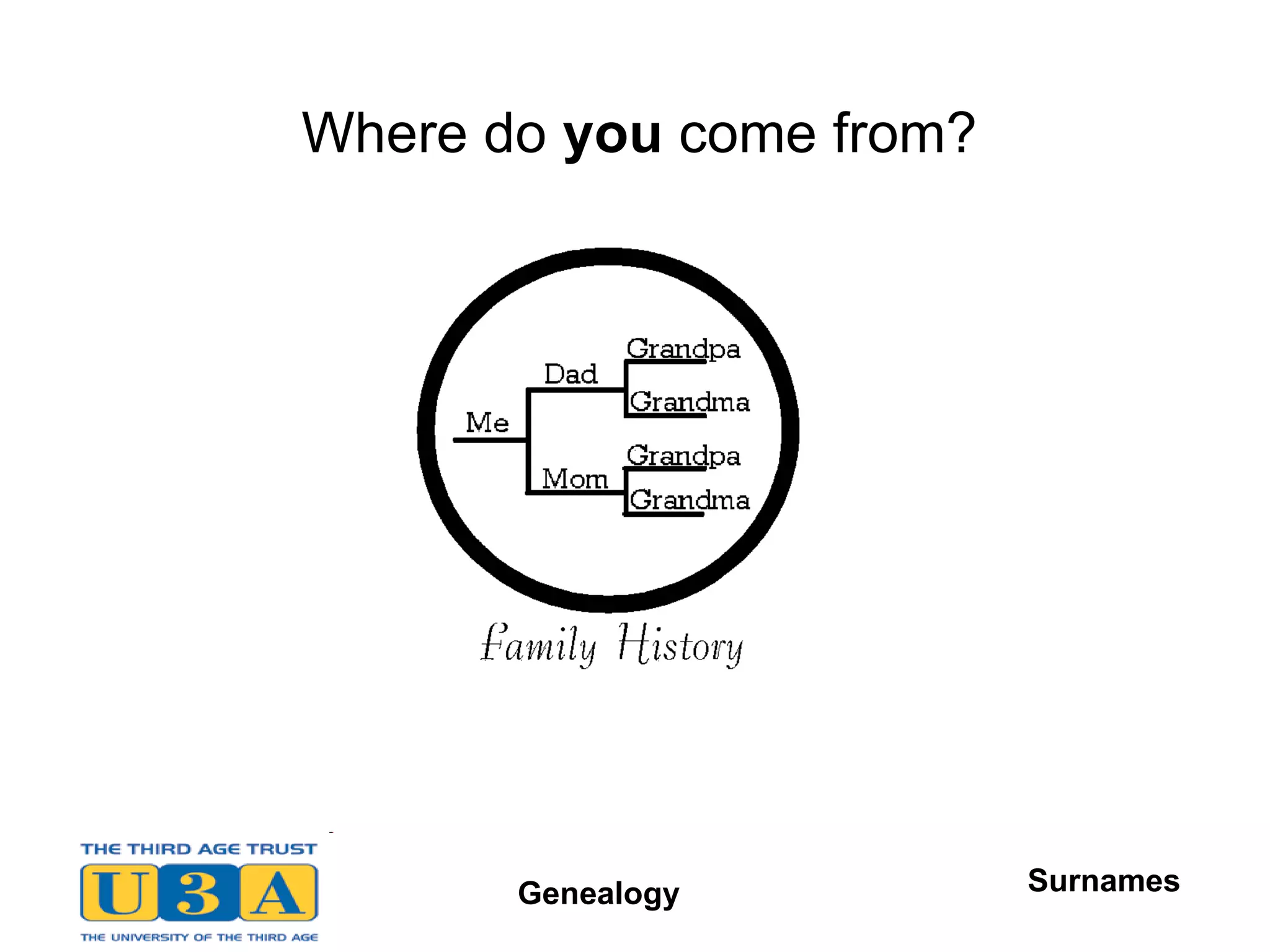
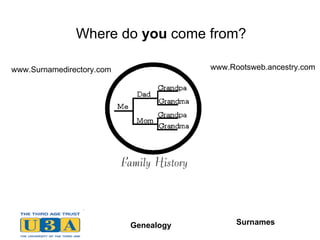
Where do  you  come from? BMDBMD Surnames
What’s in a Name? In England alone there are around 45,000 different surnames, each with a history behind it.  The sources from which names are derived are almost endless: nicknames, physical attributes, counties, trades, heraldic charges, and almost every object known to mankind. Tracing a family tree in practice involves looking at lists of these names - this is how we recognise our ancestors when we find them.
Why? When communities were small each person was identifiable by a single name, but as the population increased, it gradually became necessary to identify people further - leading to names such as John the butcher, William the short, Henry from Sutton, Mary of the wood, Roger son of Richard. Over time many names became corrupted and their original meaning is now not easily seen.
Local Names 25% of English surnames are derived from particular places  Barnsley Yorkshire Pickering Yorkshire Lancaster, Lancashire Chester, Cheshire
Natural Names Derived from features of the landscape, and indicate where a family lived in a parish Wood, Brook, Green, Townend, Hill, Atwood Bywater, Underwood, Bridge, Marsh Sometimes different words for the same feature Wood = Shaw, Hirst, Firth, Holt
Defined by Work At the time of surname formation the most common occupational surnames became hereditary: Smith, Wright, Tailor, Turner, Bowyer, Baker, Butcher, Sawyer,  Most villages had one craftsman pursuing each trade Some trades are now obscure, e.g. Palliser, Frobisher
Defined by Work Sometimes the surname relates to a position, rather than a craft/skill Sheriff, Constable, Priest, Deacon The use of dialect words for the same craft produces distinct regional patterns Fuller Tucker in the southwest Walker in the north Bowker in south-eastern Lancashire
Defined by Work Sometimes a nickname becomes a surname Prince Abbot Knight Bishop King Often that person was working for one of the above, not holding the position himself
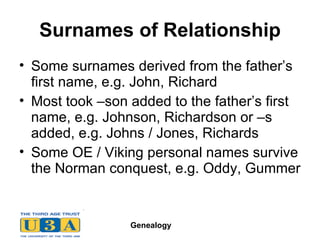
Surnames of Relationship Some surnames derived from the father’s first name, e.g. John, Richard Most took –son added to the father’s first name, e.g. Johnson, Richardson or –s added, e.g. Johns / Jones, Richards Some OE / Viking personal names survive the Norman conquest, e.g. Oddy, Gummer
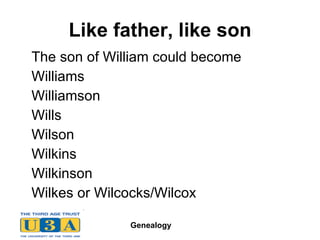
Like father, like son The son of William could become  Williams  Williamson Wills Wilson Wilkins Wilkinson Wilkes or Wilcocks/Wilcox
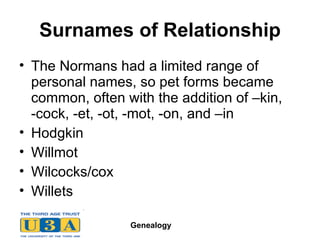
Surnames of Relationship The Normans had a limited range of personal names, so pet forms became common, often with the addition of –kin,  -cock, -et, -ot, -mot, -on, and –in Hodgkin Willmot Wilcocks/cox Willets
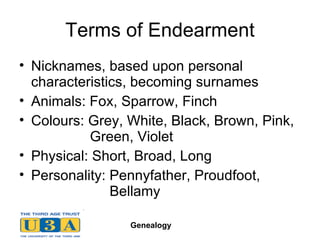
Terms of Endearment Nicknames, based upon personal characteristics, becoming surnames Animals: Fox, Sparrow, Finch Colours: Grey, White, Black, Brown, Pink,    Green, Violet Physical: Short, Broad, Long Personality: Pennyfather, Proudfoot,    Bellamy
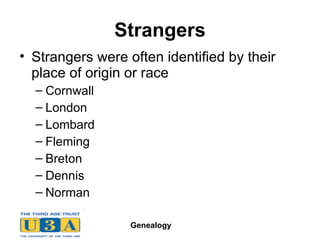
Strangers Strangers were often identified by their place of origin or race Cornwall London Lombard Fleming Breton Dennis Norman
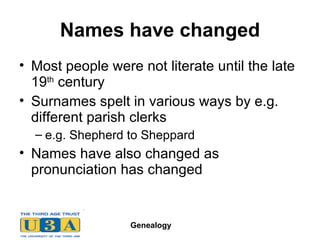
Names have changed Most people were not literate until the late 19 th  century Surnames spelt in various ways by e.g. different parish clerks e.g. Shepherd to Sheppard Names have also changed as pronunciation has changed
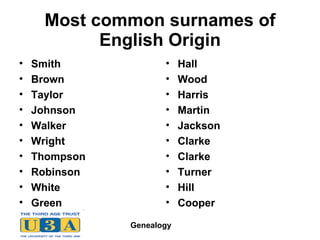
Most common surnames of English Origin Smith Brown Taylor Johnson Walker Wright Thompson Robinson White Green Hall Wood Harris Martin Jackson Clarke Clarke Turner Hill Cooper
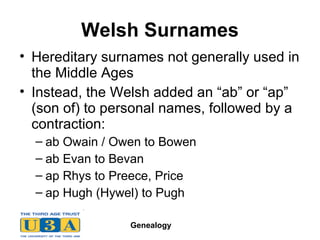
Welsh Surnames Hereditary surnames not generally used in the Middle Ages Instead, the Welsh added an “ab” or “ap” (son of) to personal names, followed by a contraction: ab Owain / Owen to Bowen ab Evan to Bevan ap Rhys to Preece, Price ap Hugh (Hywel) to Pugh
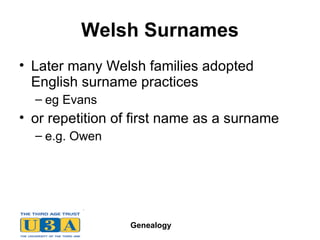
Welsh Surnames Later many Welsh families adopted English surname practices eg Evans or repetition of first name as a surname e.g. Owen
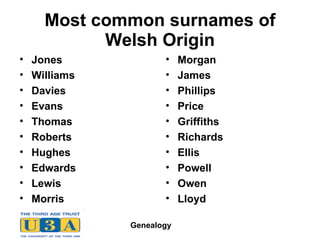
Most common surnames of Welsh Origin Jones Williams Davies Evans Thomas Roberts Hughes Edwards Lewis Morris Morgan James Phillips Price Griffiths Richards Ellis Powell Owen Lloyd
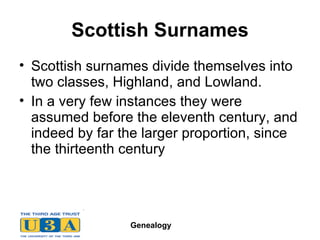
Scottish Surnames Scottish surnames divide themselves into two classes, Highland, and Lowland. In a very few instances they were assumed before the eleventh century, and indeed by far the larger proportion, since the thirteenth century
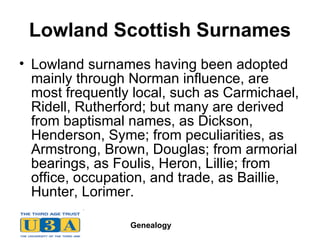
Lowland Scottish Surnames Lowland surnames having been adopted mainly through Norman influence, are most frequently local, such as Carmichael, Ridell, Rutherford; but many are derived from baptismal names, as Dickson, Henderson, Syme; from peculiarities, as Armstrong, Brown, Douglas; from armorial bearings, as Foulis, Heron, Lillie; from office, occupation, and trade, as Baillie, Hunter, Lorimer.
Lowland Scottish Surnames More examples include; derived from localities, as Maxwell, Nisbet, Ralston; baptismal names, as Anderson, Bennett, Lawrence; trades, as Baxter, Fletcher, Nasmyth; offices, as Bannerman, Grieve, Walker; professions, as Clerk, Freer, Kemp; peculiarities of body and mind, as Fairfax, Laing, May; armorial bearings, as Cross, Heart, Horn; nativity, as Fleming, Inglis, Scott; and from many other sources.
Highland Scottish Surnames Highland surnames are chiefly patronymics, with various prefixes and additions, as Farquhar, Mackenzie, Robertson ; but there are some exceptions, a few being derived from localities, as Lennox, Murray, Boss; a good number from peculiarities, as Cameron, Campbell, Grant; and some from armorial bearings, and offices, as Frazer, Skene, Stewart.
Most common surnames of Scottish Origin Wilson Scott Campbell Simpson Stewart Robertson Murray Graham Gibson Thomson Reid Henderson Grant Ross McDonald Hamilton Johnston Kennedy Davidson MacDonald
Most common surnames of Irish Origin Kelly Murphy O’Brien Ryan O’Neill Byrne McCarthy Burke Quinn Doyle O’Connor Lynch Gallagher Sullivan Carroll Duffy Boyle Farrell Brennan Flynn
Guild of One-Name Studies The world's leading organisation for one-name studies  A one-name study is a project researching facts about a surname and all the people who have held it, as opposed to a particular pedigree  Currently, over 2,300 people have registered nearly 7,850 study surnames with GOONS.
Pettit Definition:  From the Old French for "small," the Petit surname was often bestowed upon an individual of small stature.  Surname Origin:  French  Alternate Surname Spellings:  PETTIT, PETET, PETTET
Riley This surname can be either English or Irish. It is found in both countries in several spellings including Riley, Ryley, Reily, Reely and Reilly, as well as the pure Gaelic McReilly, O'Reilly and O'Ralilly. In England the surname is usually locational, iIn Ireland from the pre 10th century Gaelic O'Raghailligh, meaning the descendant of Raghallach
Embling This surname is a variant of Emmett, which is of early medieval English origin, and is a Middle English diminutive of the female given name "Emma". Introduced by the Normans, the modern surname can be found as Emmett, Emmott, Emmitt, Emmatt, Hemmett, Emeline, Emblin(g) and Emblem.
Ecclestone This name is of English locational origin from any of the various places so called in Cheshire and Lancashire which get their name from an ancient British word meaning "church" reflected in the Welsh "eglwys", plus the old English "tun", an enclosure or settlement.
Goodwin This Anglo-Saxon name is derived from the personal name "Godwine", composed of the elements "god", meaning either "god" or "good", with the second element of "wine", meaning friend or protector or "sweyn", meaning "follower of“. It is recorded in various forms including Godwin, Goodwin, Goodswin, and the Norfolk and East Anglian Godswen,
Dawson This surname is of English origins. It has  twenty-two coats of arms, and is a patronymic form of the medieval male given name Daw. This is a nickname form of David, adopted from the Hebrew male given name Dodavehu meaning "beloved of Jehovah". In Britain the popularity of the name was increased by the fame of St. David, the patron saint of Wales, and by the fact that it was borne by two kings of Scotland,
Barker Definition:  1) A tanner of leather, derived from Middle English "bark," meaning to tan 2) From the Old French "berquier, berchier, bercher, berkier, berker," meaning shepherd. 3) A variant of the German surname Berger, used to describe a man who lived on or by a hill or mountain, from the Old High German "berg," meaning mountain.  Surname Origin:  English, French, German  Alternate Surname Spellings:  BERKER, BERCHER, BERGER, BERGEY, LE BARKERE, BARKE, BARKA, BARKAR
Crouch English, of Anglo-Saxon origin, and is a topographical name for someone who lived by a cross. The derivation of the name is from the Middle English "crouch", a cross, itself from the Old English pre 7th Century "cruc". This word was replaced in Middle English by the Old Norse form "cross".  Dutch: from Middle Dutch  croech  ‘jug’, ‘pitcher’, hence an occupational name for a potter.
Malyon This rare and unusual surname is a dialectal variant of the medieval personal name "Marion", a diminutive of the given name Mary, itself coming from the Latin "Maria", from "mar" meaning drop, plus "yam", sea. The first recorded spelling of the family name is shown to be that of John Malyon, which was dated 1351 - 1354, in the "Personal Names of Essex"
Pashley Habitational name from Pashley in the parish of Ticehurst, Sussex, named with an unattested Old English personal name  Pæcca  or  Pacca   + Old English  leah  ‘wood’, ‘clearing’. A district of Eastbourne, Sussex, bearing this name derives it from the surname; a family called Pashley had moved there from Ticehurst by the later part of the 13th century.  The surname now occurs chiefly in southern Yorkshire.
Where do  you  come from? Surnames www.Surnamedirectory.com www.Rootsweb.ancestry.com

UK surnames and their origins

  • 1.
    Where do you come from? BMDBMD Surnames
  • 2.
    What’s in aName? In England alone there are around 45,000 different surnames, each with a history behind it. The sources from which names are derived are almost endless: nicknames, physical attributes, counties, trades, heraldic charges, and almost every object known to mankind. Tracing a family tree in practice involves looking at lists of these names - this is how we recognise our ancestors when we find them.
  • 3.
    Why? When communitieswere small each person was identifiable by a single name, but as the population increased, it gradually became necessary to identify people further - leading to names such as John the butcher, William the short, Henry from Sutton, Mary of the wood, Roger son of Richard. Over time many names became corrupted and their original meaning is now not easily seen.
  • 4.
    Local Names 25%of English surnames are derived from particular places Barnsley Yorkshire Pickering Yorkshire Lancaster, Lancashire Chester, Cheshire
  • 5.
    Natural Names Derivedfrom features of the landscape, and indicate where a family lived in a parish Wood, Brook, Green, Townend, Hill, Atwood Bywater, Underwood, Bridge, Marsh Sometimes different words for the same feature Wood = Shaw, Hirst, Firth, Holt
  • 6.
    Defined by WorkAt the time of surname formation the most common occupational surnames became hereditary: Smith, Wright, Tailor, Turner, Bowyer, Baker, Butcher, Sawyer, Most villages had one craftsman pursuing each trade Some trades are now obscure, e.g. Palliser, Frobisher
  • 7.
    Defined by WorkSometimes the surname relates to a position, rather than a craft/skill Sheriff, Constable, Priest, Deacon The use of dialect words for the same craft produces distinct regional patterns Fuller Tucker in the southwest Walker in the north Bowker in south-eastern Lancashire
  • 8.
    Defined by WorkSometimes a nickname becomes a surname Prince Abbot Knight Bishop King Often that person was working for one of the above, not holding the position himself
  • 9.
    Surnames of RelationshipSome surnames derived from the father’s first name, e.g. John, Richard Most took –son added to the father’s first name, e.g. Johnson, Richardson or –s added, e.g. Johns / Jones, Richards Some OE / Viking personal names survive the Norman conquest, e.g. Oddy, Gummer
  • 10.
    Like father, likeson The son of William could become Williams Williamson Wills Wilson Wilkins Wilkinson Wilkes or Wilcocks/Wilcox
  • 11.
    Surnames of RelationshipThe Normans had a limited range of personal names, so pet forms became common, often with the addition of –kin, -cock, -et, -ot, -mot, -on, and –in Hodgkin Willmot Wilcocks/cox Willets
  • 12.
    Terms of EndearmentNicknames, based upon personal characteristics, becoming surnames Animals: Fox, Sparrow, Finch Colours: Grey, White, Black, Brown, Pink, Green, Violet Physical: Short, Broad, Long Personality: Pennyfather, Proudfoot, Bellamy
  • 13.
    Strangers Strangers wereoften identified by their place of origin or race Cornwall London Lombard Fleming Breton Dennis Norman
  • 14.
    Names have changedMost people were not literate until the late 19 th century Surnames spelt in various ways by e.g. different parish clerks e.g. Shepherd to Sheppard Names have also changed as pronunciation has changed
  • 15.
    Most common surnamesof English Origin Smith Brown Taylor Johnson Walker Wright Thompson Robinson White Green Hall Wood Harris Martin Jackson Clarke Clarke Turner Hill Cooper
  • 16.
    Welsh Surnames Hereditarysurnames not generally used in the Middle Ages Instead, the Welsh added an “ab” or “ap” (son of) to personal names, followed by a contraction: ab Owain / Owen to Bowen ab Evan to Bevan ap Rhys to Preece, Price ap Hugh (Hywel) to Pugh
  • 17.
    Welsh Surnames Latermany Welsh families adopted English surname practices eg Evans or repetition of first name as a surname e.g. Owen
  • 18.
    Most common surnamesof Welsh Origin Jones Williams Davies Evans Thomas Roberts Hughes Edwards Lewis Morris Morgan James Phillips Price Griffiths Richards Ellis Powell Owen Lloyd
  • 19.
    Scottish Surnames Scottishsurnames divide themselves into two classes, Highland, and Lowland. In a very few instances they were assumed before the eleventh century, and indeed by far the larger proportion, since the thirteenth century
  • 20.
    Lowland Scottish SurnamesLowland surnames having been adopted mainly through Norman influence, are most frequently local, such as Carmichael, Ridell, Rutherford; but many are derived from baptismal names, as Dickson, Henderson, Syme; from peculiarities, as Armstrong, Brown, Douglas; from armorial bearings, as Foulis, Heron, Lillie; from office, occupation, and trade, as Baillie, Hunter, Lorimer.
  • 21.
    Lowland Scottish SurnamesMore examples include; derived from localities, as Maxwell, Nisbet, Ralston; baptismal names, as Anderson, Bennett, Lawrence; trades, as Baxter, Fletcher, Nasmyth; offices, as Bannerman, Grieve, Walker; professions, as Clerk, Freer, Kemp; peculiarities of body and mind, as Fairfax, Laing, May; armorial bearings, as Cross, Heart, Horn; nativity, as Fleming, Inglis, Scott; and from many other sources.
  • 22.
    Highland Scottish SurnamesHighland surnames are chiefly patronymics, with various prefixes and additions, as Farquhar, Mackenzie, Robertson ; but there are some exceptions, a few being derived from localities, as Lennox, Murray, Boss; a good number from peculiarities, as Cameron, Campbell, Grant; and some from armorial bearings, and offices, as Frazer, Skene, Stewart.
  • 23.
    Most common surnamesof Scottish Origin Wilson Scott Campbell Simpson Stewart Robertson Murray Graham Gibson Thomson Reid Henderson Grant Ross McDonald Hamilton Johnston Kennedy Davidson MacDonald
  • 24.
    Most common surnamesof Irish Origin Kelly Murphy O’Brien Ryan O’Neill Byrne McCarthy Burke Quinn Doyle O’Connor Lynch Gallagher Sullivan Carroll Duffy Boyle Farrell Brennan Flynn
  • 25.
    Guild of One-NameStudies The world's leading organisation for one-name studies A one-name study is a project researching facts about a surname and all the people who have held it, as opposed to a particular pedigree Currently, over 2,300 people have registered nearly 7,850 study surnames with GOONS.
  • 26.
    Pettit Definition: From the Old French for "small," the Petit surname was often bestowed upon an individual of small stature. Surname Origin: French Alternate Surname Spellings: PETTIT, PETET, PETTET
  • 27.
    Riley This surnamecan be either English or Irish. It is found in both countries in several spellings including Riley, Ryley, Reily, Reely and Reilly, as well as the pure Gaelic McReilly, O'Reilly and O'Ralilly. In England the surname is usually locational, iIn Ireland from the pre 10th century Gaelic O'Raghailligh, meaning the descendant of Raghallach
  • 28.
    Embling This surnameis a variant of Emmett, which is of early medieval English origin, and is a Middle English diminutive of the female given name "Emma". Introduced by the Normans, the modern surname can be found as Emmett, Emmott, Emmitt, Emmatt, Hemmett, Emeline, Emblin(g) and Emblem.
  • 29.
    Ecclestone This nameis of English locational origin from any of the various places so called in Cheshire and Lancashire which get their name from an ancient British word meaning "church" reflected in the Welsh "eglwys", plus the old English "tun", an enclosure or settlement.
  • 30.
    Goodwin This Anglo-Saxonname is derived from the personal name "Godwine", composed of the elements "god", meaning either "god" or "good", with the second element of "wine", meaning friend or protector or "sweyn", meaning "follower of“. It is recorded in various forms including Godwin, Goodwin, Goodswin, and the Norfolk and East Anglian Godswen,
  • 31.
    Dawson This surnameis of English origins. It has twenty-two coats of arms, and is a patronymic form of the medieval male given name Daw. This is a nickname form of David, adopted from the Hebrew male given name Dodavehu meaning "beloved of Jehovah". In Britain the popularity of the name was increased by the fame of St. David, the patron saint of Wales, and by the fact that it was borne by two kings of Scotland,
  • 32.
    Barker Definition: 1) A tanner of leather, derived from Middle English "bark," meaning to tan 2) From the Old French "berquier, berchier, bercher, berkier, berker," meaning shepherd. 3) A variant of the German surname Berger, used to describe a man who lived on or by a hill or mountain, from the Old High German "berg," meaning mountain. Surname Origin: English, French, German Alternate Surname Spellings: BERKER, BERCHER, BERGER, BERGEY, LE BARKERE, BARKE, BARKA, BARKAR
  • 33.
    Crouch English, ofAnglo-Saxon origin, and is a topographical name for someone who lived by a cross. The derivation of the name is from the Middle English "crouch", a cross, itself from the Old English pre 7th Century "cruc". This word was replaced in Middle English by the Old Norse form "cross". Dutch: from Middle Dutch croech ‘jug’, ‘pitcher’, hence an occupational name for a potter.
  • 34.
    Malyon This rareand unusual surname is a dialectal variant of the medieval personal name "Marion", a diminutive of the given name Mary, itself coming from the Latin "Maria", from "mar" meaning drop, plus "yam", sea. The first recorded spelling of the family name is shown to be that of John Malyon, which was dated 1351 - 1354, in the "Personal Names of Essex"
  • 35.
    Pashley Habitational namefrom Pashley in the parish of Ticehurst, Sussex, named with an unattested Old English personal name Pæcca or Pacca + Old English leah ‘wood’, ‘clearing’. A district of Eastbourne, Sussex, bearing this name derives it from the surname; a family called Pashley had moved there from Ticehurst by the later part of the 13th century. The surname now occurs chiefly in southern Yorkshire.
  • 36.
    Where do you come from? Surnames www.Surnamedirectory.com www.Rootsweb.ancestry.com