ARTS AND CRAFTS
OF MINDANAO
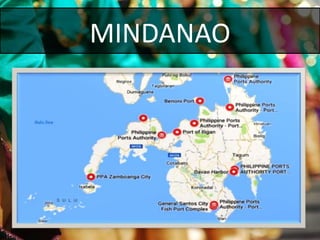
MINDANAO
MINDANAO
Mindanao, referred to
as “THE LAND OF
PROMISE”
MINDANAO
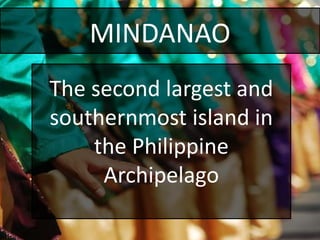
The second largest and
southernmost island in
the Philippine
Archipelago
MINDANAO
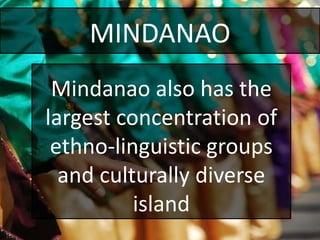
Mindanao also has the
largest concentration of
ethno-linguistic groups
and culturally diverse
island
MINDANAO
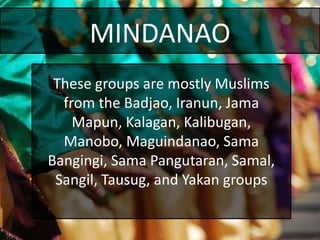
These groups are mostly Muslims
from the Badjao, Iranun, Jama
Mapun, Kalagan, Kalibugan,
Manobo, Maguindanao, Sama
Bangingi, Sama Pangutaran, Samal,
Sangil, Tausug, and Yakan groups
MINDANAO
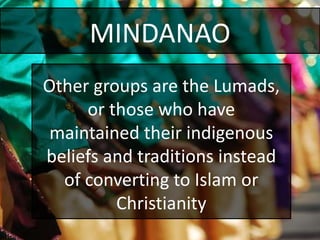
Other groups are the Lumads,
or those who have
maintained their indigenous
beliefs and traditions instead
of converting to Islam or
Christianity
MINDANAO
Before Islam came to the
Philippines, early Filipinos
worshipped believe that
plants and inanimate objects
are home to ancestral spirits.
MINDANAO
They also believed that
natural phenomena are
caused by gods. This
indigenous beliefs system is
called animism
MINDANAO
The conversation of the natives
and the arrival of Muslim traders
and merchants resulted in new
forms of artistic impressions. This
fusion of beliefs created a unique
blend of spirituality and
creativity
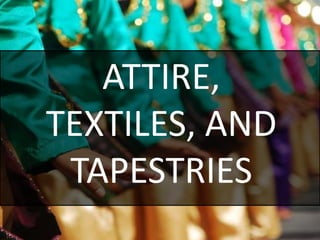
ATTIRE,
TEXTILES, AND
TAPESTRIES
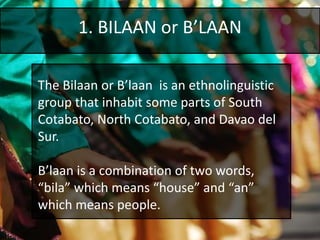
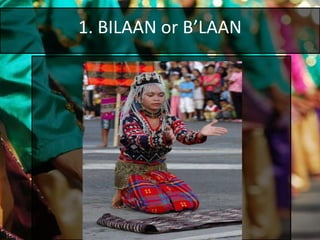
1. BILAAN or B’LAAN
The Bilaan or B’laan is an ethnolinguistic
group that inhabit some parts of South
Cotabato, North Cotabato, and Davao del
Sur.
B’laan is a combination of two words,
“bila” which means “house” and “an”
which means people.
1. BILAAN or B’LAAN
1. BILAAN or B’LAAN
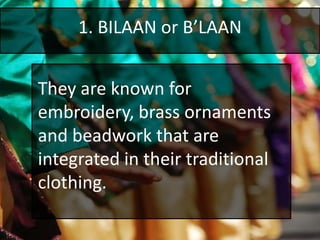
They are known for
embroidery, brass ornaments
and beadwork that are
integrated in their traditional
clothing.
1. BILAAN or B’LAAN
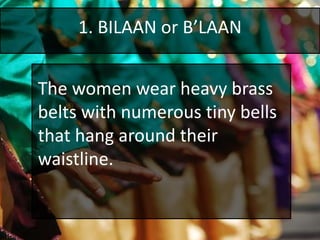
The women wear heavy brass
belts with numerous tiny bells
that hang around their
waistline.
1. BILAAN or B’LAAN
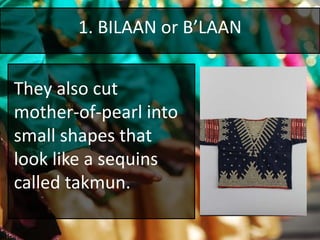
They also cut
mother-of-pearl into
small shapes that
look like a sequins
called takmun.
1. BILAAN or B’LAAN
Ikat is a process of dyeing the
fabric wheree the yarns are
tightly wrapped with the
strings and dyed before
weaving.
1. BILAAN or B’LAAN
the textiles usually contain
three colors: shades of black or
browns, red or ochre (darker
shade of orange), and ecru (the
color of undyed abaca).
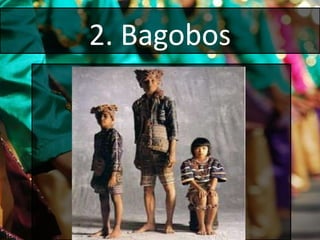
2. Bagobos
The bagobos are the group of people
that live in Davao. According to
anthropologists, the name of this
ethnolinguistic group comes from the
words “bago” means “new” and
“obo” means “growth”
2. Bagobos
2. Bagobos
This is because they are believed to
have come from the mixture of the
native population with the Hindu
migrants that entered Mindanao
during the Sri Vijayan and Majapahit
Empires.
2. Bagobos
They make these clothes from a
special textile woven from abaca
fibers called T’nalak
2. Bagobos
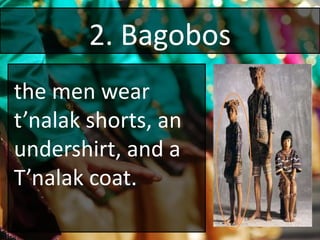
the men wear
t’nalak shorts, an
undershirt, and a
T’nalak coat.
2. Bagobos
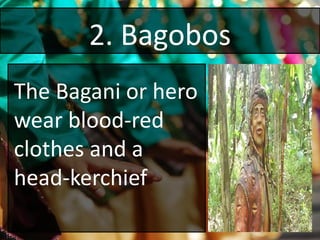
The Bagani or hero
wear blood-red
clothes and a
head-kerchief
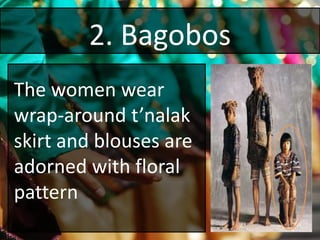
2. Bagobos
The women wear
wrap-around t’nalak
skirt and blouses are
adorned with floral
pattern
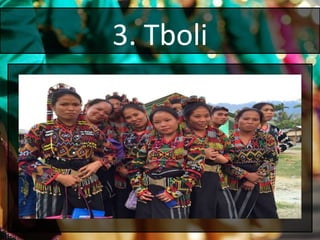
3. Tiboli
The T’boli who live in and around
Lake Sebu, South Cotabato are
famous for their complicated
beadwork, wonderful woven
fabrics, and beautiful brass
ornaments.
3. Tboli
3. Tboli
The weavers believe that their
gods and ancestors visit them in
their dreams to teach them the
designs and patterns that they
have to weave.
3. Tboli
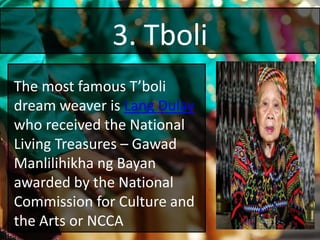
The most famous T’boli
dream weaver is Lang Dulay
who received the National
Living Treasures – Gawad
Manlilihikha ng Bayan
awarded by the National
Commission for Culture and
the Arts or NCCA
3. Tboli
Men are not allowed to touch the
materials used in the weaving
process. They believe that if they
break the rules, the fiber will
snap and the designed will be
ruined.
3. Tboli
T’nalak production is a
painstaking process that requires
patience, a lot of creativity, good
memory, and a range of skills
learned from a young age by the
weavers.
4. Maranao
Maranao means “People of the
Lake” referring to the people who
occupy the lands surrounding
Lake Lanao
4. Maranao
4. Maranao
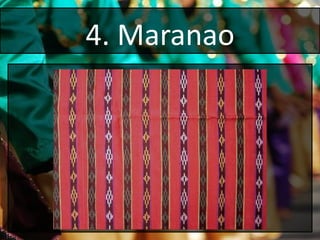
The Maranaos are known for
their Malong. The Malong is a
traditional Filipino tube skirt that
is made of hand woven or
machine made multi colored
cotton cloth.
4. Maranao
4. Maranao
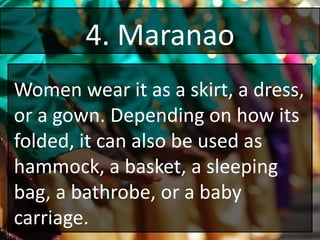
Women wear it as a skirt, a dress,
or a gown. Depending on how its
folded, it can also be used as
hammock, a basket, a sleeping
bag, a bathrobe, or a baby
carriage.
4. Maranao
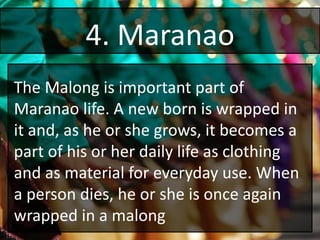
The Malong is important part of
Maranao life. A new born is wrapped in
it and, as he or she grows, it becomes a
part of his or her daily life as clothing
and as material for everyday use. When
a person dies, he or she is once again
wrapped in a malong
4. Maranao
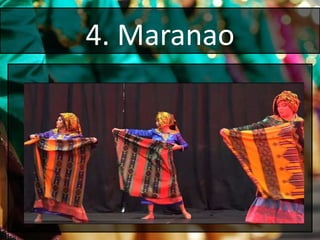
A traditional dance called Kapa Malong
Malong or Sambisa Malong,
demonstrates the various ways of
wearing a malong and its uses.
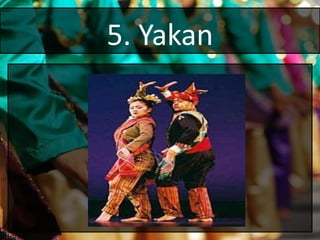
5. Yakan
Basilan is the home to the Yakans. They
are popular for their skills in weaving.
They weave very intricate designs in
their textiles, which they use for their
clothes and other accessories
5. Yakan
5. Yakan
Yakan hand-gloomed fabrics
are known for their use of
bold colors and geometric
patterns.
5. Yakan
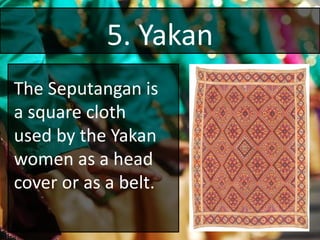
The Seputangan is
a square cloth
used by the Yakan
women as a head
cover or as a belt.
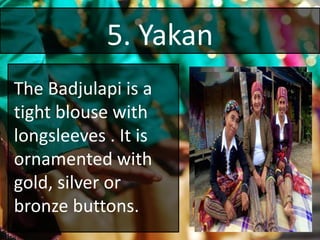
5. Yakan
The Badjulapi is a
tight blouse with
longsleeves . It is
ornamented with
gold, silver or
bronze buttons.
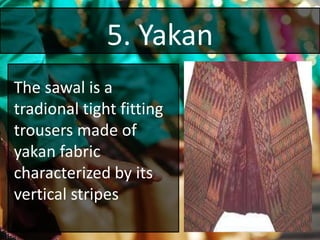
5. Yakan
The sawal is a
tradional tight fitting
trousers made of
yakan fabric
characterized by its
vertical stripes
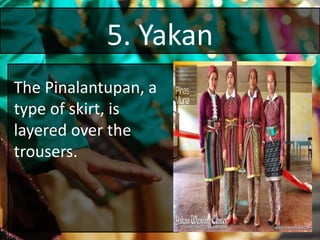
5. Yakan
The Pinalantupan, a
type of skirt, is
layered over the
trousers.

Arts and-craft-of-mindanao-1

  • 2.
  • 3.
  • 4.
    MINDANAO Mindanao, referred to as“THE LAND OF PROMISE”
  • 5.
    MINDANAO The second largestand southernmost island in the Philippine Archipelago
  • 6.
    MINDANAO Mindanao also hasthe largest concentration of ethno-linguistic groups and culturally diverse island
  • 7.
    MINDANAO These groups aremostly Muslims from the Badjao, Iranun, Jama Mapun, Kalagan, Kalibugan, Manobo, Maguindanao, Sama Bangingi, Sama Pangutaran, Samal, Sangil, Tausug, and Yakan groups
  • 8.
    MINDANAO Other groups arethe Lumads, or those who have maintained their indigenous beliefs and traditions instead of converting to Islam or Christianity
  • 9.
    MINDANAO Before Islam cameto the Philippines, early Filipinos worshipped believe that plants and inanimate objects are home to ancestral spirits.
  • 10.
    MINDANAO They also believedthat natural phenomena are caused by gods. This indigenous beliefs system is called animism
  • 11.
    MINDANAO The conversation ofthe natives and the arrival of Muslim traders and merchants resulted in new forms of artistic impressions. This fusion of beliefs created a unique blend of spirituality and creativity
  • 12.
  • 13.
    1. BILAAN orB’LAAN The Bilaan or B’laan is an ethnolinguistic group that inhabit some parts of South Cotabato, North Cotabato, and Davao del Sur. B’laan is a combination of two words, “bila” which means “house” and “an” which means people.
  • 14.
    1. BILAAN orB’LAAN
  • 15.
    1. BILAAN orB’LAAN They are known for embroidery, brass ornaments and beadwork that are integrated in their traditional clothing.
  • 16.
    1. BILAAN orB’LAAN The women wear heavy brass belts with numerous tiny bells that hang around their waistline.
  • 17.
    1. BILAAN orB’LAAN They also cut mother-of-pearl into small shapes that look like a sequins called takmun.
  • 18.
    1. BILAAN orB’LAAN Ikat is a process of dyeing the fabric wheree the yarns are tightly wrapped with the strings and dyed before weaving.
  • 19.
    1. BILAAN orB’LAAN the textiles usually contain three colors: shades of black or browns, red or ochre (darker shade of orange), and ecru (the color of undyed abaca).
  • 20.
    2. Bagobos The bagobosare the group of people that live in Davao. According to anthropologists, the name of this ethnolinguistic group comes from the words “bago” means “new” and “obo” means “growth”
  • 21.
  • 22.
    2. Bagobos This isbecause they are believed to have come from the mixture of the native population with the Hindu migrants that entered Mindanao during the Sri Vijayan and Majapahit Empires.
  • 23.
    2. Bagobos They makethese clothes from a special textile woven from abaca fibers called T’nalak
  • 24.
    2. Bagobos the menwear t’nalak shorts, an undershirt, and a T’nalak coat.
  • 25.
    2. Bagobos The Baganior hero wear blood-red clothes and a head-kerchief
  • 26.
    2. Bagobos The womenwear wrap-around t’nalak skirt and blouses are adorned with floral pattern
  • 27.
    3. Tiboli The T’boliwho live in and around Lake Sebu, South Cotabato are famous for their complicated beadwork, wonderful woven fabrics, and beautiful brass ornaments.
  • 28.
  • 29.
    3. Tboli The weaversbelieve that their gods and ancestors visit them in their dreams to teach them the designs and patterns that they have to weave.
  • 30.
    3. Tboli The mostfamous T’boli dream weaver is Lang Dulay who received the National Living Treasures – Gawad Manlilihikha ng Bayan awarded by the National Commission for Culture and the Arts or NCCA
  • 31.
    3. Tboli Men arenot allowed to touch the materials used in the weaving process. They believe that if they break the rules, the fiber will snap and the designed will be ruined.
  • 32.
    3. Tboli T’nalak productionis a painstaking process that requires patience, a lot of creativity, good memory, and a range of skills learned from a young age by the weavers.
  • 33.
    4. Maranao Maranao means“People of the Lake” referring to the people who occupy the lands surrounding Lake Lanao
  • 34.
  • 35.
    4. Maranao The Maranaosare known for their Malong. The Malong is a traditional Filipino tube skirt that is made of hand woven or machine made multi colored cotton cloth.
  • 36.
  • 37.
    4. Maranao Women wearit as a skirt, a dress, or a gown. Depending on how its folded, it can also be used as hammock, a basket, a sleeping bag, a bathrobe, or a baby carriage.
  • 38.
    4. Maranao The Malongis important part of Maranao life. A new born is wrapped in it and, as he or she grows, it becomes a part of his or her daily life as clothing and as material for everyday use. When a person dies, he or she is once again wrapped in a malong
  • 39.
    4. Maranao A traditionaldance called Kapa Malong Malong or Sambisa Malong, demonstrates the various ways of wearing a malong and its uses.
  • 40.
    5. Yakan Basilan isthe home to the Yakans. They are popular for their skills in weaving. They weave very intricate designs in their textiles, which they use for their clothes and other accessories
  • 41.
  • 42.
    5. Yakan Yakan hand-gloomedfabrics are known for their use of bold colors and geometric patterns.
  • 43.
    5. Yakan The Seputanganis a square cloth used by the Yakan women as a head cover or as a belt.
  • 44.
    5. Yakan The Badjulapiis a tight blouse with longsleeves . It is ornamented with gold, silver or bronze buttons.
  • 45.
    5. Yakan The sawalis a tradional tight fitting trousers made of yakan fabric characterized by its vertical stripes
  • 46.
    5. Yakan The Pinalantupan,a type of skirt, is layered over the trousers.