ARTS AND CRAFTS
OF MINDANAO
ATTIRE,
TEXTILES AND
TAPESTRIES
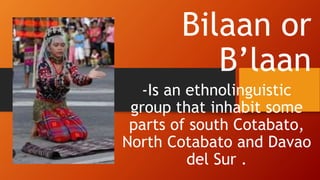
Bilaan or
B’laan
-Is an ethnolinguistic
group that inhabit some
parts of south Cotabato,
North Cotabato and Davao
del Sur .
B’laan is a combination of
two words, “bila” means
“house’ and “an” means
“people”
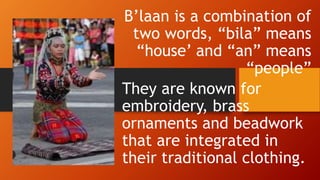
They are known for
embroidery, brass
ornaments and beadwork
that are integrated in
their traditional clothing.
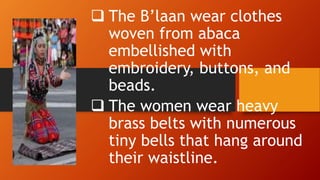
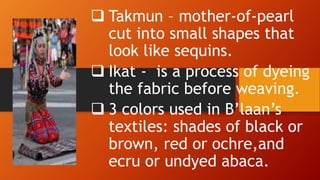
 The B’laan wear clothes
woven from abaca
embellished with
embroidery, buttons, and
beads.
 The women wear heavy
brass belts with numerous
tiny bells that hang around
their waistline.
 Takmun – mother-of-pearl
cut into small shapes that
look like sequins.
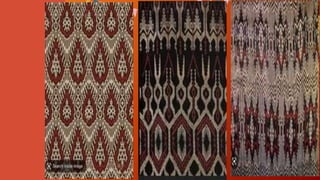
 Ikat - is a process of dyeing
the fabric before weaving.
 3 colors used in B’laan’s
textiles: shades of black or
brown, red or ochre,and
ecru or undyed abaca.
Bagobo and T’boli
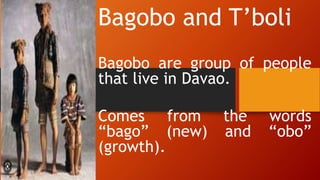
Bagobo are group of people
that live in Davao.
Comes from the words
“bago” (new) and “obo”
(growth).
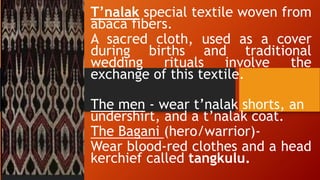
T’nalak special textile woven from
abaca fibers.
A sacred cloth, used as a cover
during births and traditional
wedding rituals involve the
exchange of this textile.
The men - wear t’nalak shorts, an
undershirt, and a t’nalak coat.
The Bagani (hero/warrior)-
Wear blood-red clothes and a head
kerchief called tangkulu.
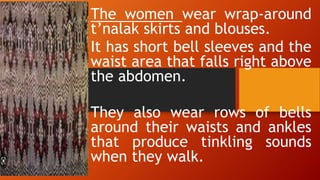
The women wear wrap-around
t’nalak skirts and blouses.
It has short bell sleeves and the
waist area that falls right above
the abdomen.
They also wear rows of bells
around their waists and ankles
that produce tinkling sounds
when they walk.
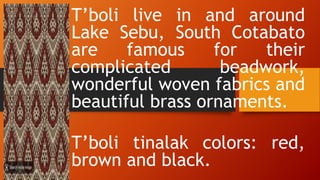
T’boli live in and around
Lake Sebu, South Cotabato
are famous for their
complicated beadwork,
wonderful woven fabrics and
beautiful brass ornaments.
T’boli tinalak colors: red,
brown and black.
Lang Dulay – most famous T’boli
dream weaver.
Awarded national Living Treasures
– Gawad manlilikha ng Bayan
(GAMABA) award by National
Commission for Culture and the
Arts (NCCA) in 1998.
Maranao
Means “people of the Lake”, referring to
people who occupy the lands surrounding
Lake Lanao.
They are famous for their artworks,
intricate weaving, wood carving, metal
craft, and their epics.
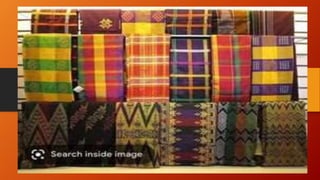
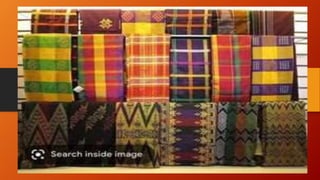
 Maranaos are known for their malong.
 Malong – is a traditional Filipino tube skirt
that is made of hand-woven or machine-
made multi-colored cotton cloth, bearing a
variety of geometric or floral designs.
 It can be used as a skirt, a dress, a blouse
or a gown.
 Also used as hammock, a basket, a sleeping
bag, a bathrobe or a baby carriage.
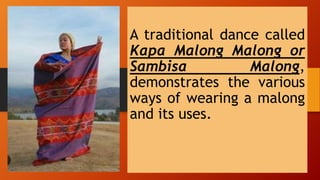
A traditional dance called
Kapa Malong Malong or
Sambisa Malong,
demonstrates the various
ways of wearing a malong
and its uses.
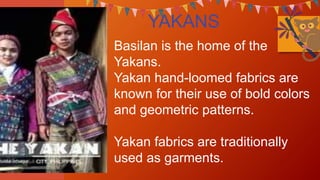
YAKANS
Basilan is the home of the
Yakans.
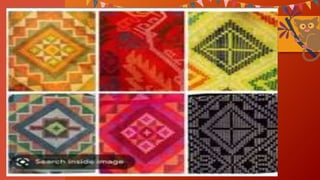
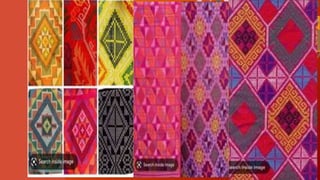
Yakan hand-loomed fabrics are
known for their use of bold colors
and geometric patterns.
Yakan fabrics are traditionally
used as garments.
YAKANS
Seputangan is a square cloth
used by the Yakan women as a
head cover or as belt.
Badjulapi is a tight blouse with
long sleeves.
Sawal is the traditional tight-fitting
trousers characterized by its
vertical stripes
YAKANS
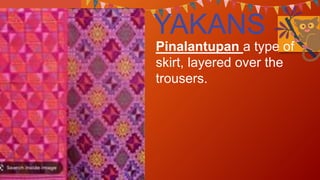
Pinalantupan a type of
skirt, layered over the
trousers.
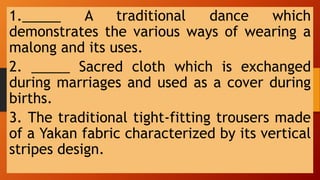
1._____ A traditional dance which
demonstrates the various ways of wearing a
malong and its uses.
2. _____ Sacred cloth which is exchanged
during marriages and used as a cover during
births.
3. The traditional tight-fitting trousers made
of a Yakan fabric characterized by its vertical
stripes design.
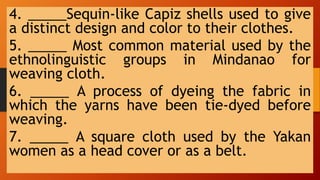
4. _____Sequin-like Capiz shells used to give
a distinct design and color to their clothes.
5. _____ Most common material used by the
ethnolinguistic groups in Mindanao for
weaving cloth.
6. _____ A process of dyeing the fabric in
which the yarns have been tie-dyed before
weaving.
7. _____ A square cloth used by the Yakan
women as a head cover or as a belt.
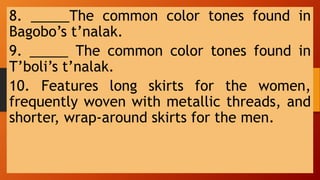
8. _____The common color tones found in
Bagobo’s t’nalak.
9. _____ The common color tones found in
T’boli’s t’nalak.
10. Features long skirts for the women,
frequently woven with metallic threads, and
shorter, wrap-around skirts for the men.

textiles.pptx

  • 1.
  • 2.
  • 3.
    Bilaan or B’laan -Is anethnolinguistic group that inhabit some parts of south Cotabato, North Cotabato and Davao del Sur .
  • 4.
    B’laan is acombination of two words, “bila” means “house’ and “an” means “people” They are known for embroidery, brass ornaments and beadwork that are integrated in their traditional clothing.
  • 5.
     The B’laanwear clothes woven from abaca embellished with embroidery, buttons, and beads.  The women wear heavy brass belts with numerous tiny bells that hang around their waistline.
  • 6.
     Takmun –mother-of-pearl cut into small shapes that look like sequins.  Ikat - is a process of dyeing the fabric before weaving.  3 colors used in B’laan’s textiles: shades of black or brown, red or ochre,and ecru or undyed abaca.
  • 7.
    Bagobo and T’boli Bagoboare group of people that live in Davao. Comes from the words “bago” (new) and “obo” (growth).
  • 8.
    T’nalak special textilewoven from abaca fibers. A sacred cloth, used as a cover during births and traditional wedding rituals involve the exchange of this textile. The men - wear t’nalak shorts, an undershirt, and a t’nalak coat. The Bagani (hero/warrior)- Wear blood-red clothes and a head kerchief called tangkulu.
  • 9.
    The women wearwrap-around t’nalak skirts and blouses. It has short bell sleeves and the waist area that falls right above the abdomen. They also wear rows of bells around their waists and ankles that produce tinkling sounds when they walk.
  • 10.
    T’boli live inand around Lake Sebu, South Cotabato are famous for their complicated beadwork, wonderful woven fabrics and beautiful brass ornaments. T’boli tinalak colors: red, brown and black.
  • 11.
    Lang Dulay –most famous T’boli dream weaver. Awarded national Living Treasures – Gawad manlilikha ng Bayan (GAMABA) award by National Commission for Culture and the Arts (NCCA) in 1998.
  • 12.
    Maranao Means “people ofthe Lake”, referring to people who occupy the lands surrounding Lake Lanao. They are famous for their artworks, intricate weaving, wood carving, metal craft, and their epics.
  • 13.
     Maranaos areknown for their malong.  Malong – is a traditional Filipino tube skirt that is made of hand-woven or machine- made multi-colored cotton cloth, bearing a variety of geometric or floral designs.  It can be used as a skirt, a dress, a blouse or a gown.  Also used as hammock, a basket, a sleeping bag, a bathrobe or a baby carriage.
  • 14.
    A traditional dancecalled Kapa Malong Malong or Sambisa Malong, demonstrates the various ways of wearing a malong and its uses.
  • 16.
    YAKANS Basilan is thehome of the Yakans. Yakan hand-loomed fabrics are known for their use of bold colors and geometric patterns. Yakan fabrics are traditionally used as garments.
  • 17.
    YAKANS Seputangan is asquare cloth used by the Yakan women as a head cover or as belt. Badjulapi is a tight blouse with long sleeves. Sawal is the traditional tight-fitting trousers characterized by its vertical stripes
  • 18.
    YAKANS Pinalantupan a typeof skirt, layered over the trousers.
  • 23.
    1._____ A traditionaldance which demonstrates the various ways of wearing a malong and its uses. 2. _____ Sacred cloth which is exchanged during marriages and used as a cover during births. 3. The traditional tight-fitting trousers made of a Yakan fabric characterized by its vertical stripes design.
  • 24.
    4. _____Sequin-like Capizshells used to give a distinct design and color to their clothes. 5. _____ Most common material used by the ethnolinguistic groups in Mindanao for weaving cloth. 6. _____ A process of dyeing the fabric in which the yarns have been tie-dyed before weaving. 7. _____ A square cloth used by the Yakan women as a head cover or as a belt.
  • 25.
    8. _____The commoncolor tones found in Bagobo’s t’nalak. 9. _____ The common color tones found in T’boli’s t’nalak. 10. Features long skirts for the women, frequently woven with metallic threads, and shorter, wrap-around skirts for the men.