CRDTs and Redis
From sequential to concurrent executions
Carlos Baquero
HASLab, INESC TEC & Univ. Minho, Portugal
April 26th 2018
The speed of communication in the 19th century
W. H. Harrison’s death
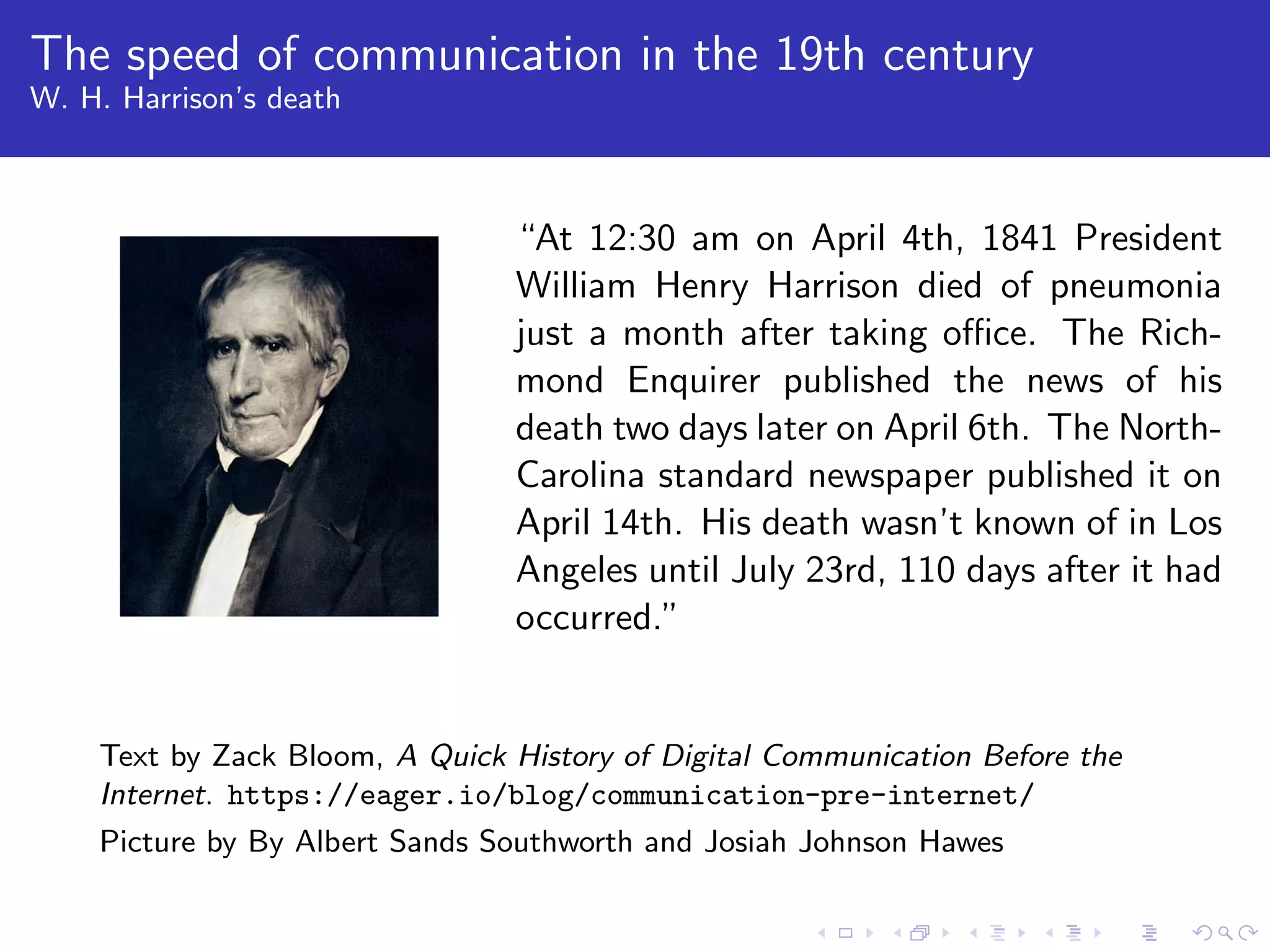
“At 12:30 am on April 4th, 1841 President
William Henry Harrison died of pneumonia
just a month after taking office. The Rich-
mond Enquirer published the news of his
death two days later on April 6th. The North-
Carolina standard newspaper published it on
April 14th. His death wasn’t known of in Los
Angeles until July 23rd, 110 days after it had
occurred.”
Text by Zack Bloom, A Quick History of Digital Communication Before the
Internet. https://eager.io/blog/communication-pre-internet/
Picture by By Albert Sands Southworth and Josiah Johnson Hawes
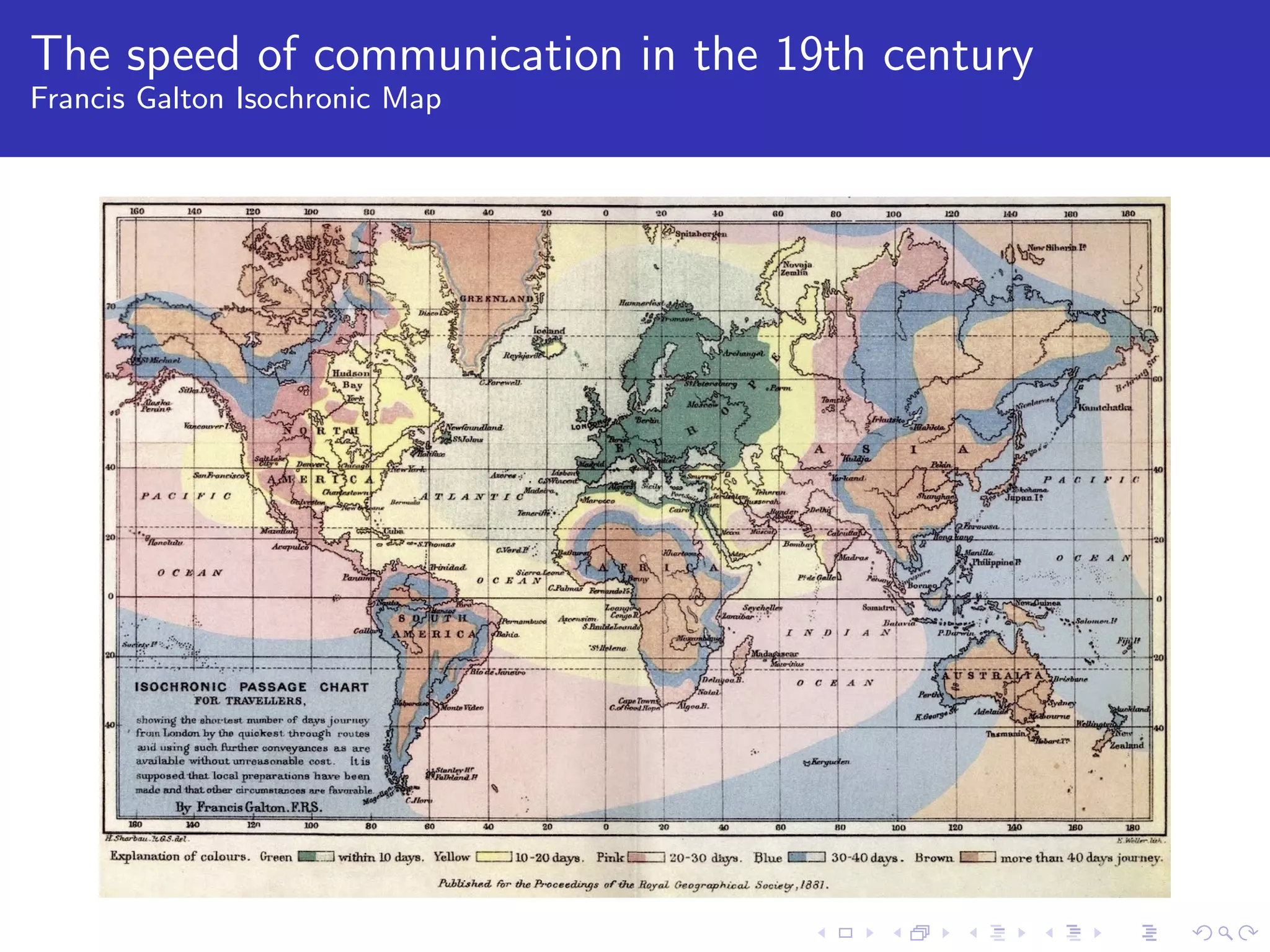
The speed of communication in the 19th century
Francis Galton Isochronic Map
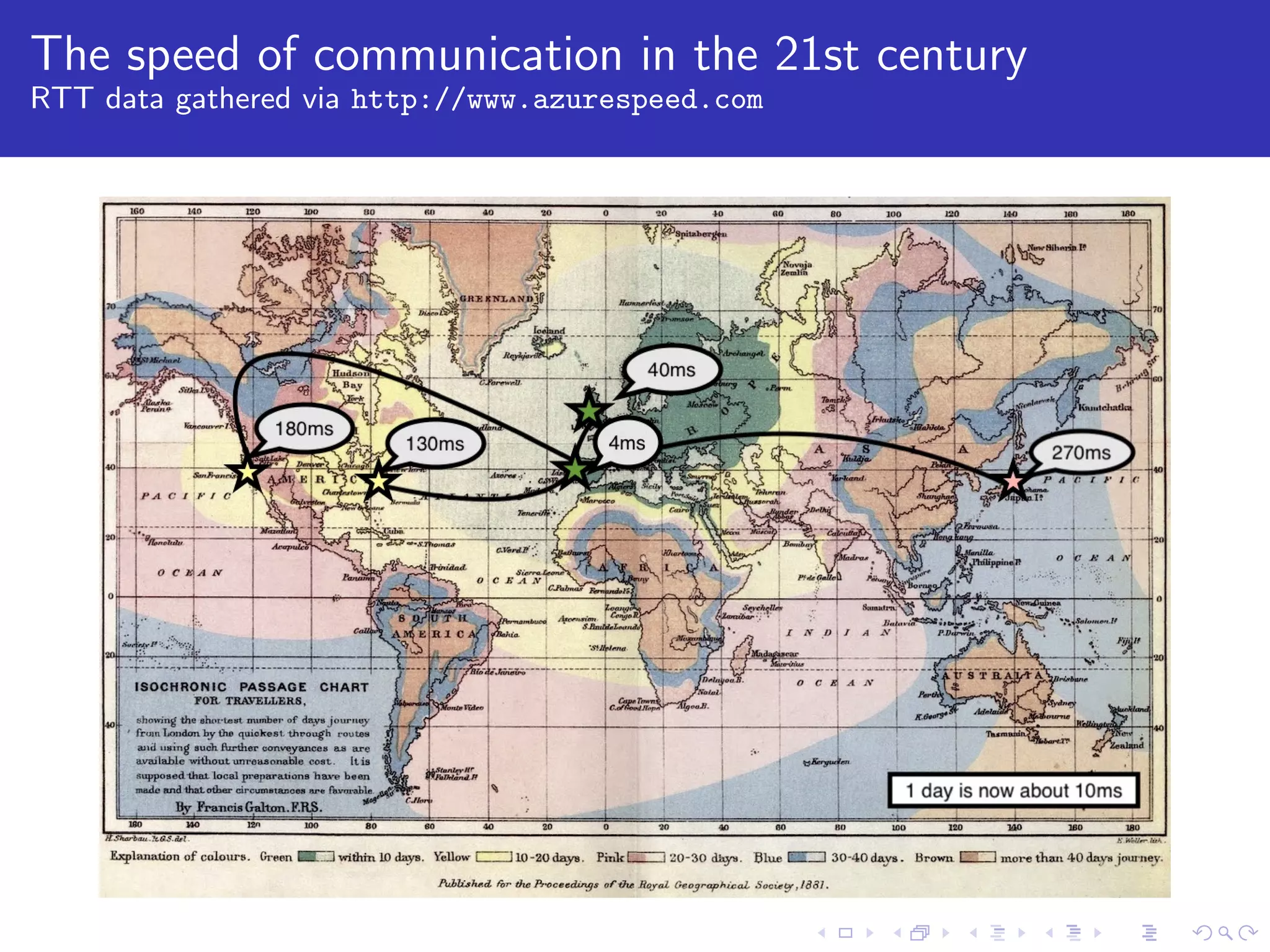
The speed of communication in the 21st century
RTT data gathered via http://www.azurespeed.com
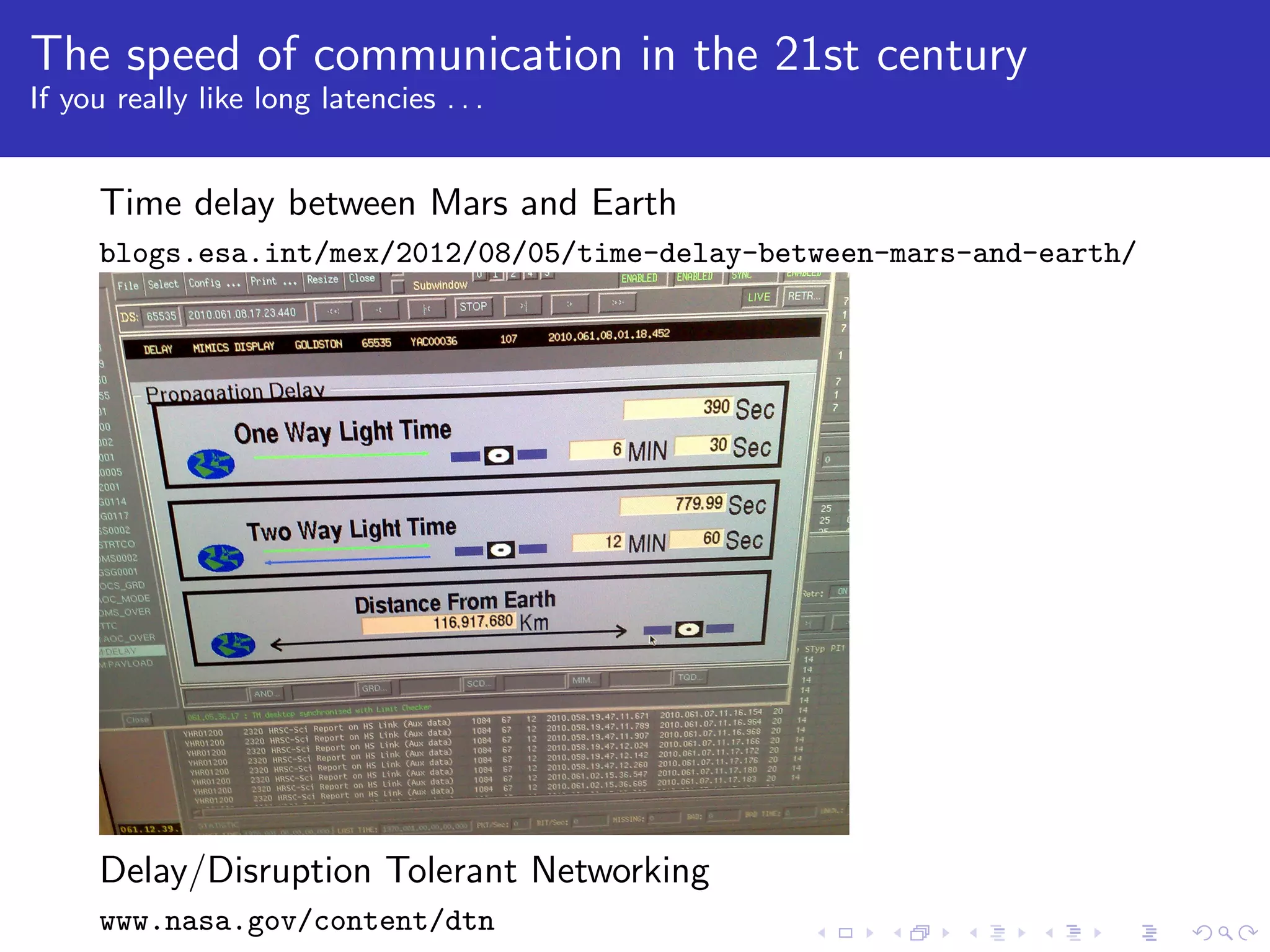
The speed of communication in the 21st century
If you really like long latencies . . .
Time delay between Mars and Earth
blogs.esa.int/mex/2012/08/05/time-delay-between-mars-and-earth/
Delay/Disruption Tolerant Networking
www.nasa.gov/content/dtn
Latency magnitudes
Geo-replication
λ, up to 50ms (local region DC)
Λ, between 100ms and 300ms (inter-continental)
No inter-DC replication
Client writes observe λ latency
Planet-wide geo-replication
Replication techniques versus client side write latency ranges
Consensus/Paxos [Λ, 2Λ] (with no divergence)
Primary-Backup [λ, Λ] (asynchronous version)
Multi-Master λ (allowing divergence)
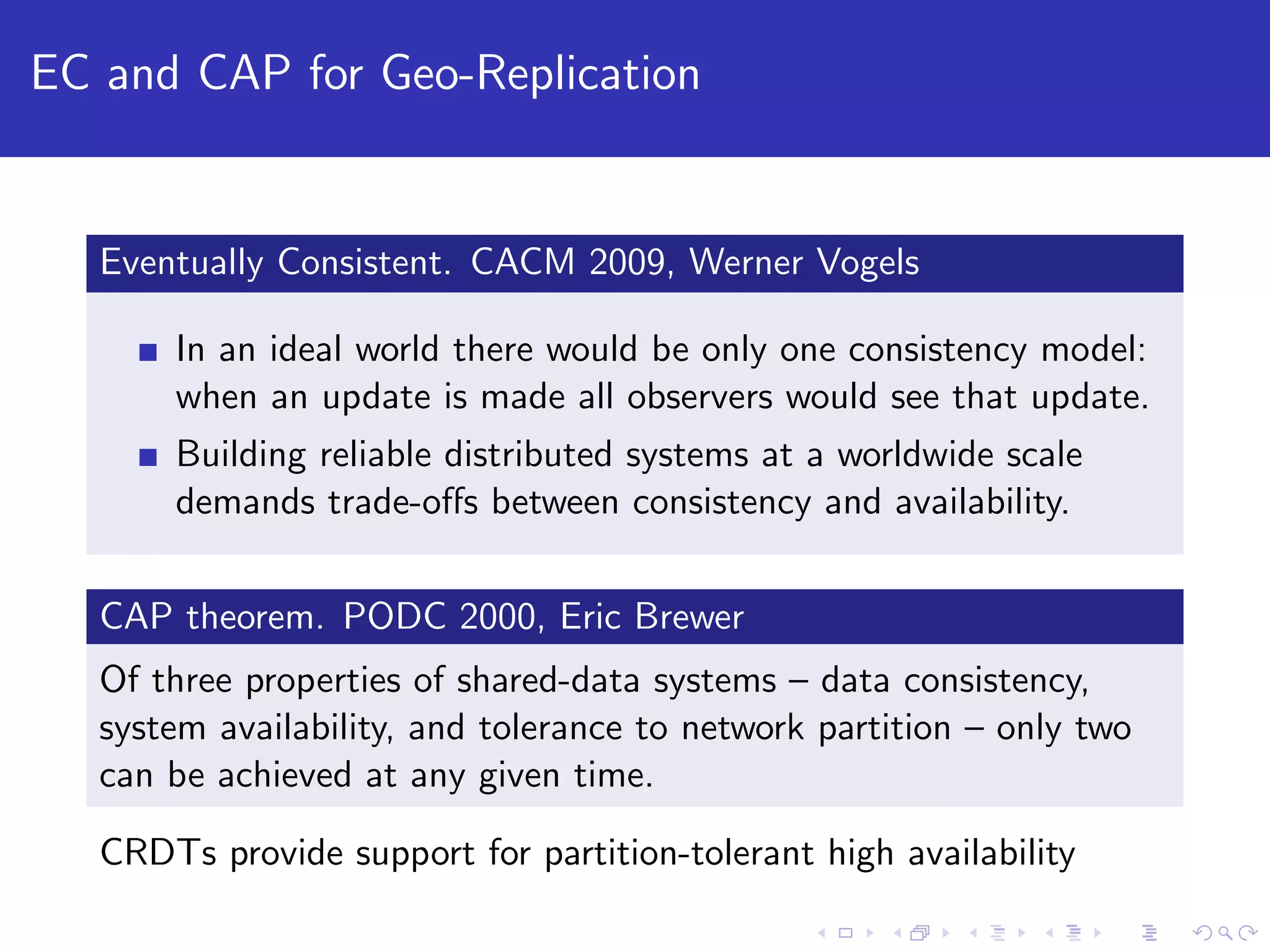
EC and CAP for Geo-Replication
Eventually Consistent. CACM 2009, Werner Vogels
In an ideal world there would be only one consistency model:
when an update is made all observers would see that update.
Building reliable distributed systems at a worldwide scale
demands trade-offs between consistency and availability.
CAP theorem. PODC 2000, Eric Brewer
Of three properties of shared-data systems – data consistency,
system availability, and tolerance to network partition – only two
can be achieved at any given time.
CRDTs provide support for partition-tolerant high availability
From sequential to concurrent executions
Consensus and Primary-Backup provide illusion of a single replica
This also preserves some illusion of sequential behaviour
Sequential execution
Ops O o // p // q
Time //
We have an ordered set (O, <). O = {o, p, q} and o < p < q
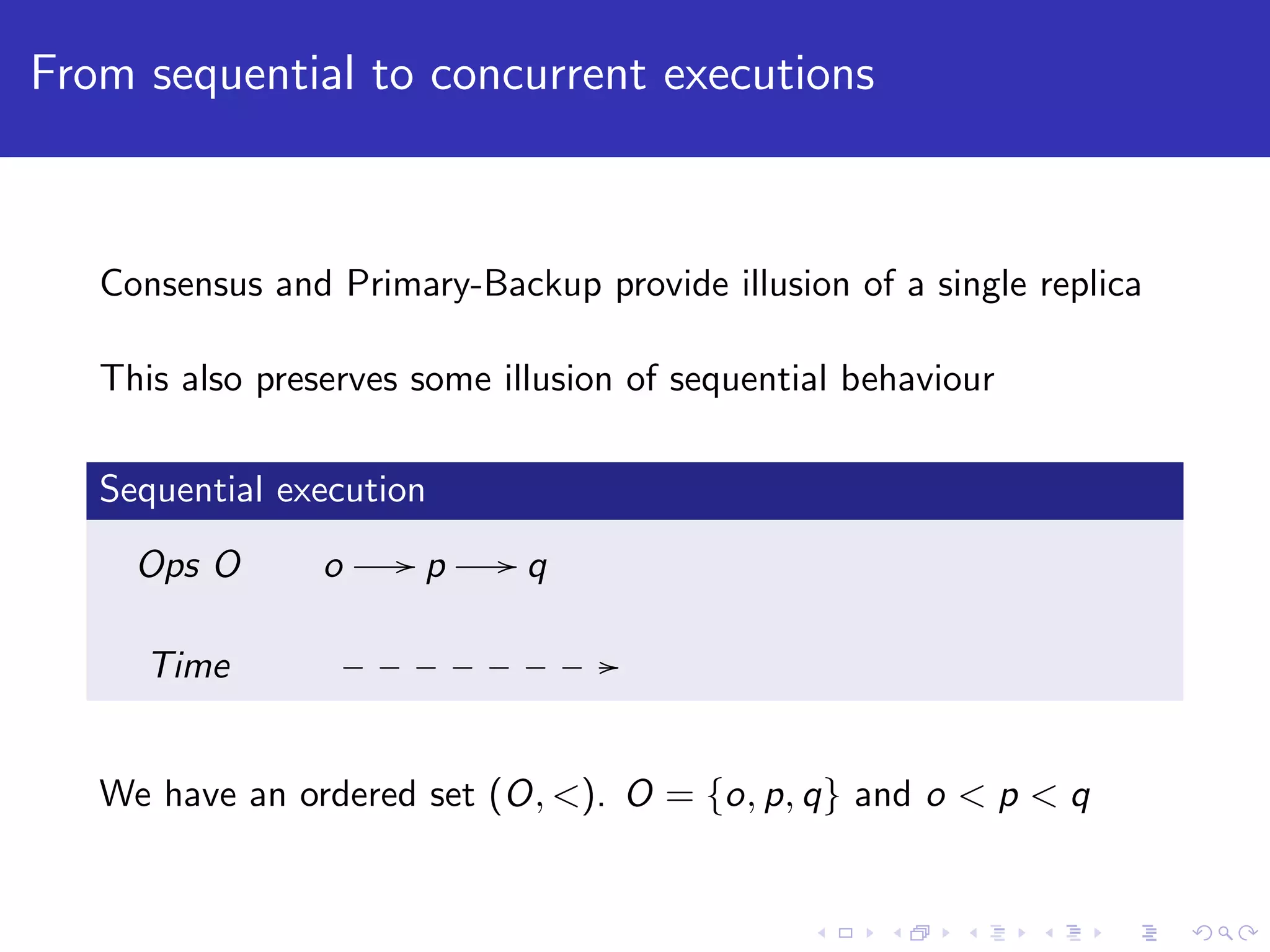
From sequential to concurrent executions
Consensus and Primary-Backup provide illusion of a single replica
This also preserves some illusion of sequential behaviour
Sequential execution
Ops O o // p // q
Time //
We have an ordered set (O, <). O = {o, p, q} and o < p < q
From sequential to concurrent executions
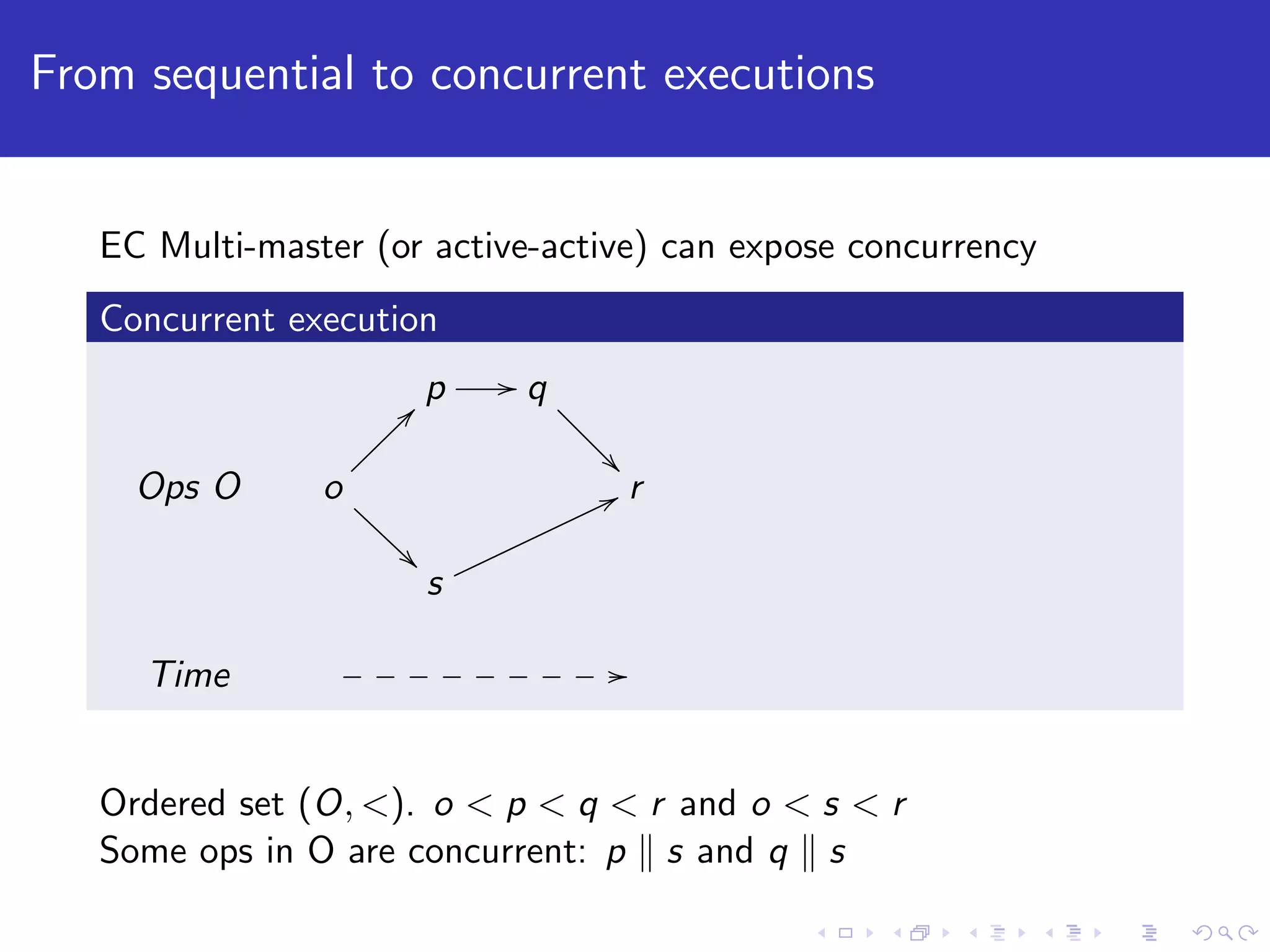
EC Multi-master (or active-active) can expose concurrency
Concurrent execution
p // q

Ops O o
??
r
s
77
Time //
Ordered set (O, ). o  p  q  r and o  s  r
Some ops in O are concurrent: p s and q s
Design of Conflict-Free Replicated Data Types
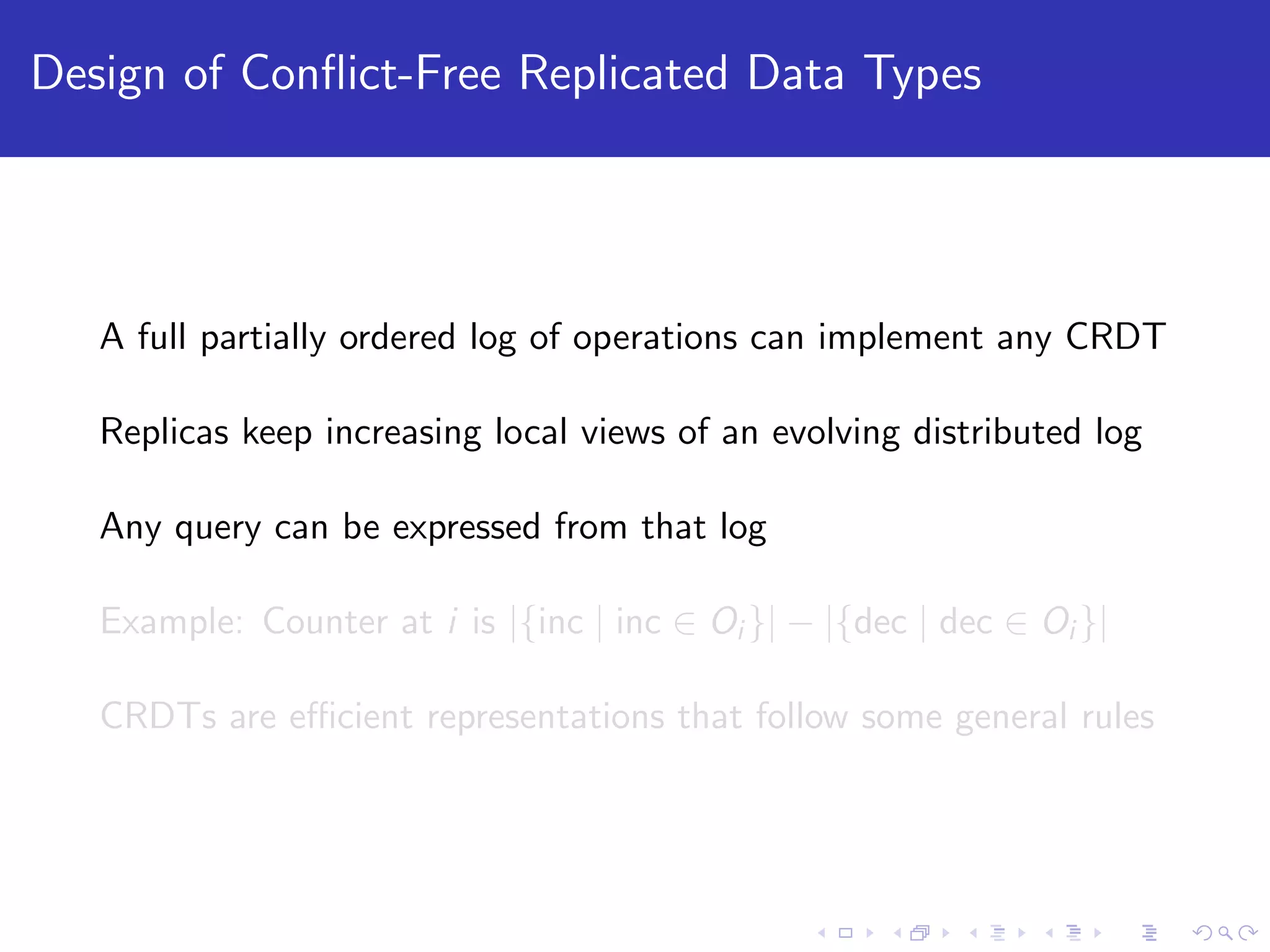
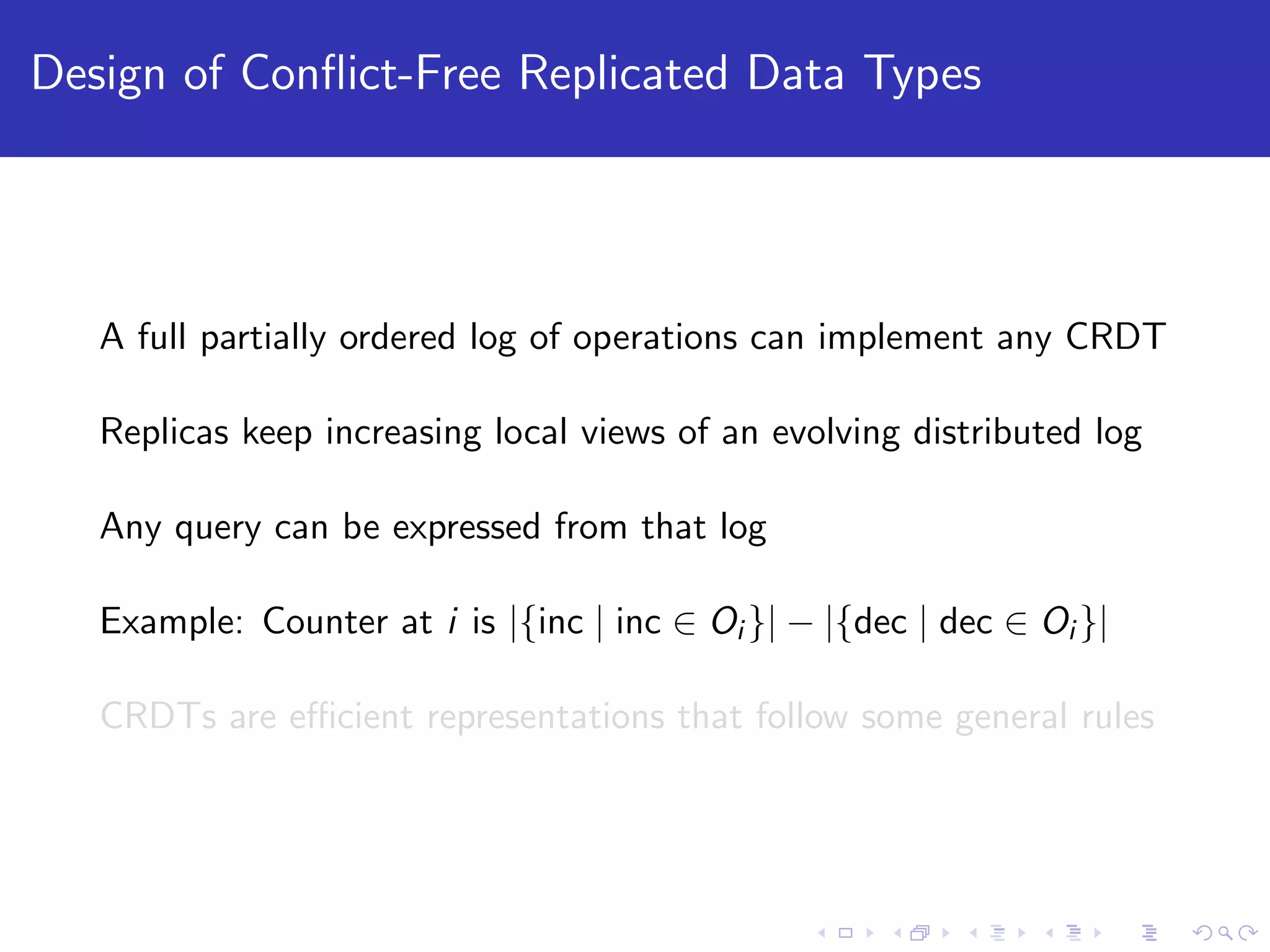
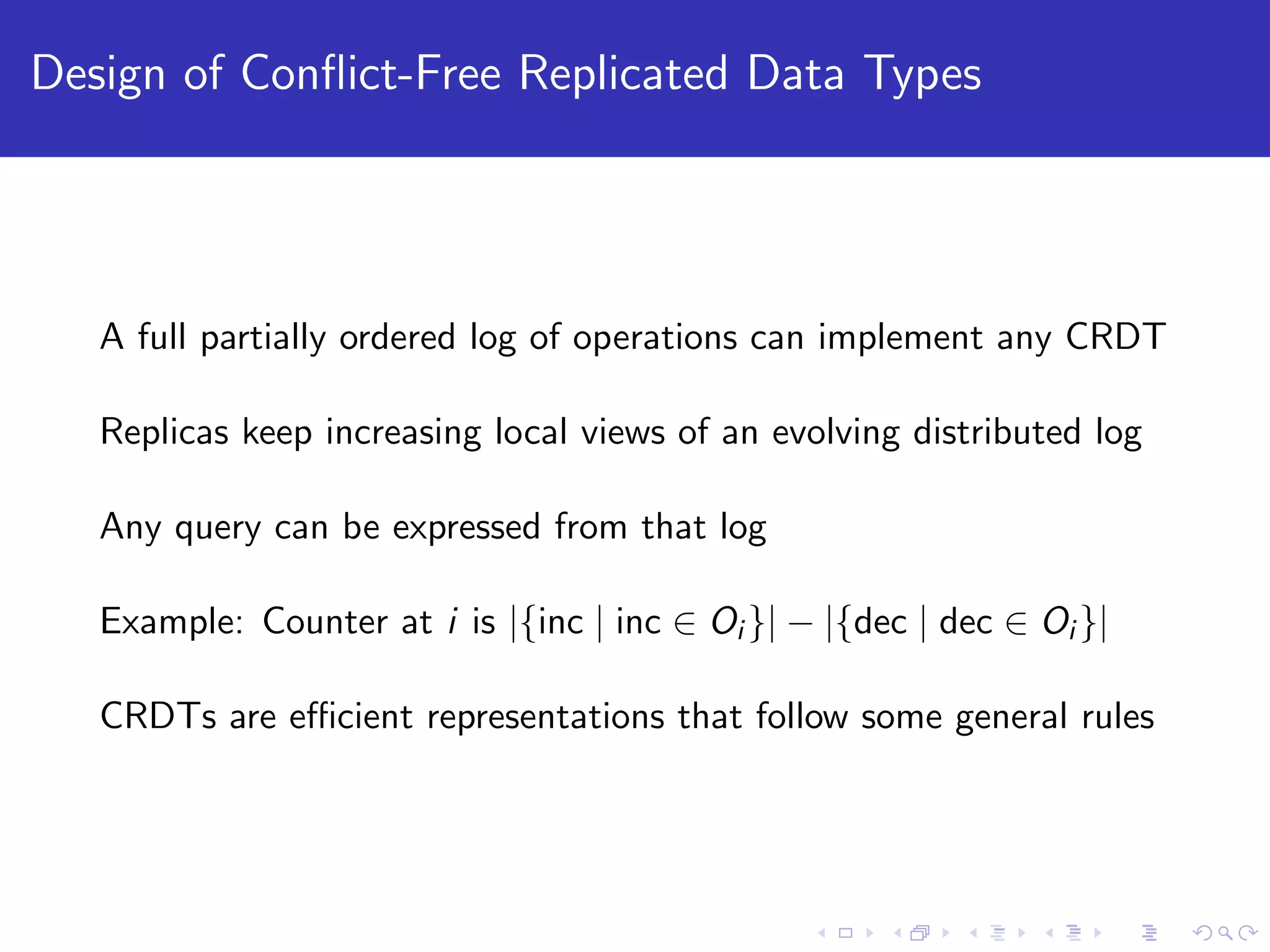
A full partially ordered log of operations can implement any CRDT
Replicas keep increasing local views of an evolving distributed log
Any query can be expressed from that log
Example: Counter at i is |{inc | inc ∈ Oi }| − |{dec | dec ∈ Oi }|
CRDTs are efficient representations that follow some general rules
Design of Conflict-Free Replicated Data Types
A full partially ordered log of operations can implement any CRDT
Replicas keep increasing local views of an evolving distributed log
Any query can be expressed from that log
Example: Counter at i is |{inc | inc ∈ Oi }| − |{dec | dec ∈ Oi }|
CRDTs are efficient representations that follow some general rules
Design of Conflict-Free Replicated Data Types
A full partially ordered log of operations can implement any CRDT
Replicas keep increasing local views of an evolving distributed log
Any query can be expressed from that log
Example: Counter at i is |{inc | inc ∈ Oi }| − |{dec | dec ∈ Oi }|
CRDTs are efficient representations that follow some general rules
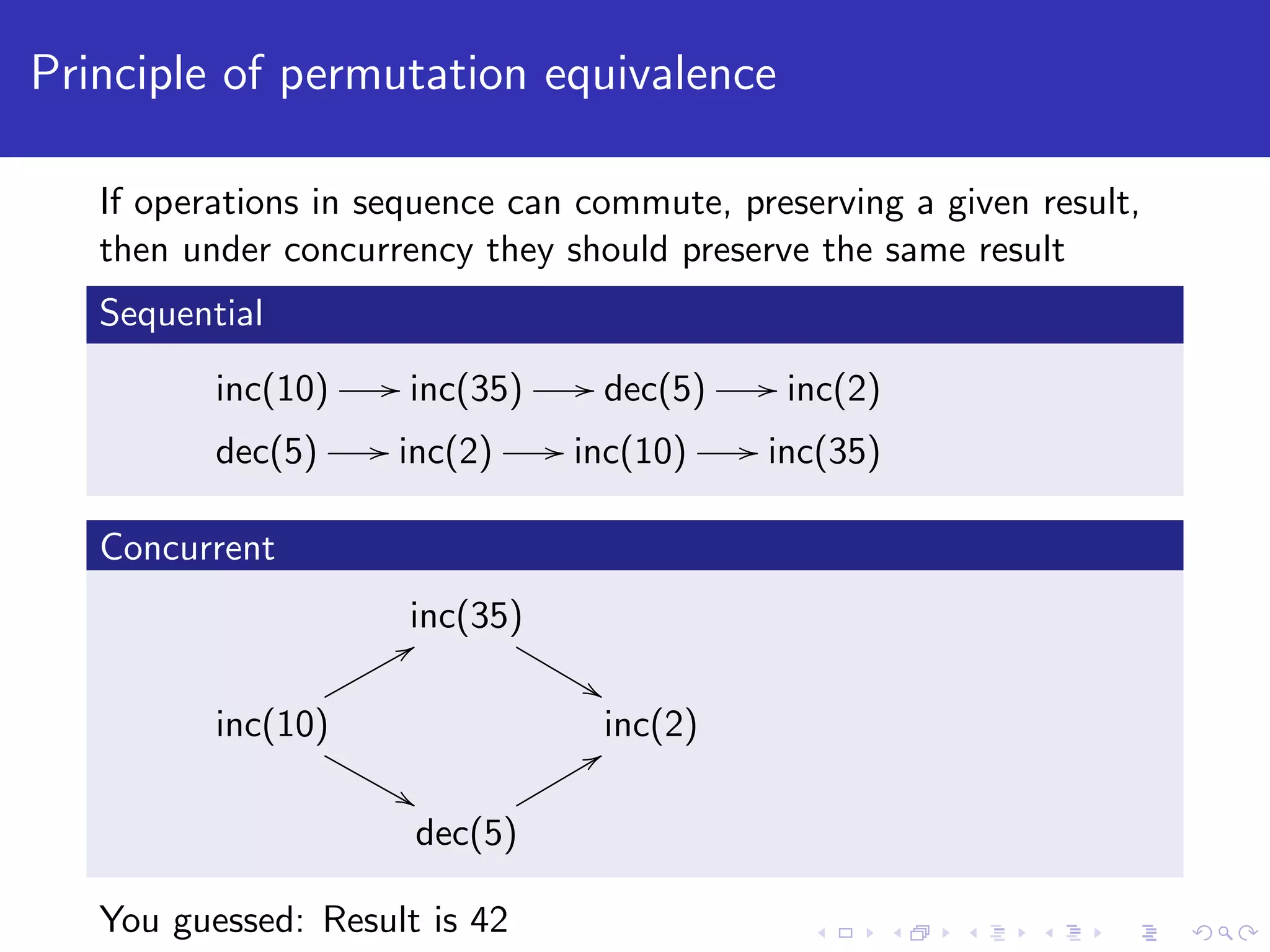
Principle of permutation equivalence
If operations in sequence can commute, preserving a given result,
then under concurrency they should preserve the same result
Sequential
inc(10) // inc(35) // dec(5) // inc(2)
dec(5) // inc(2) // inc(10) // inc(35)
Concurrent
inc(35)

inc(10)
88

inc(2)
dec(5)
88
You guessed: Result is 42
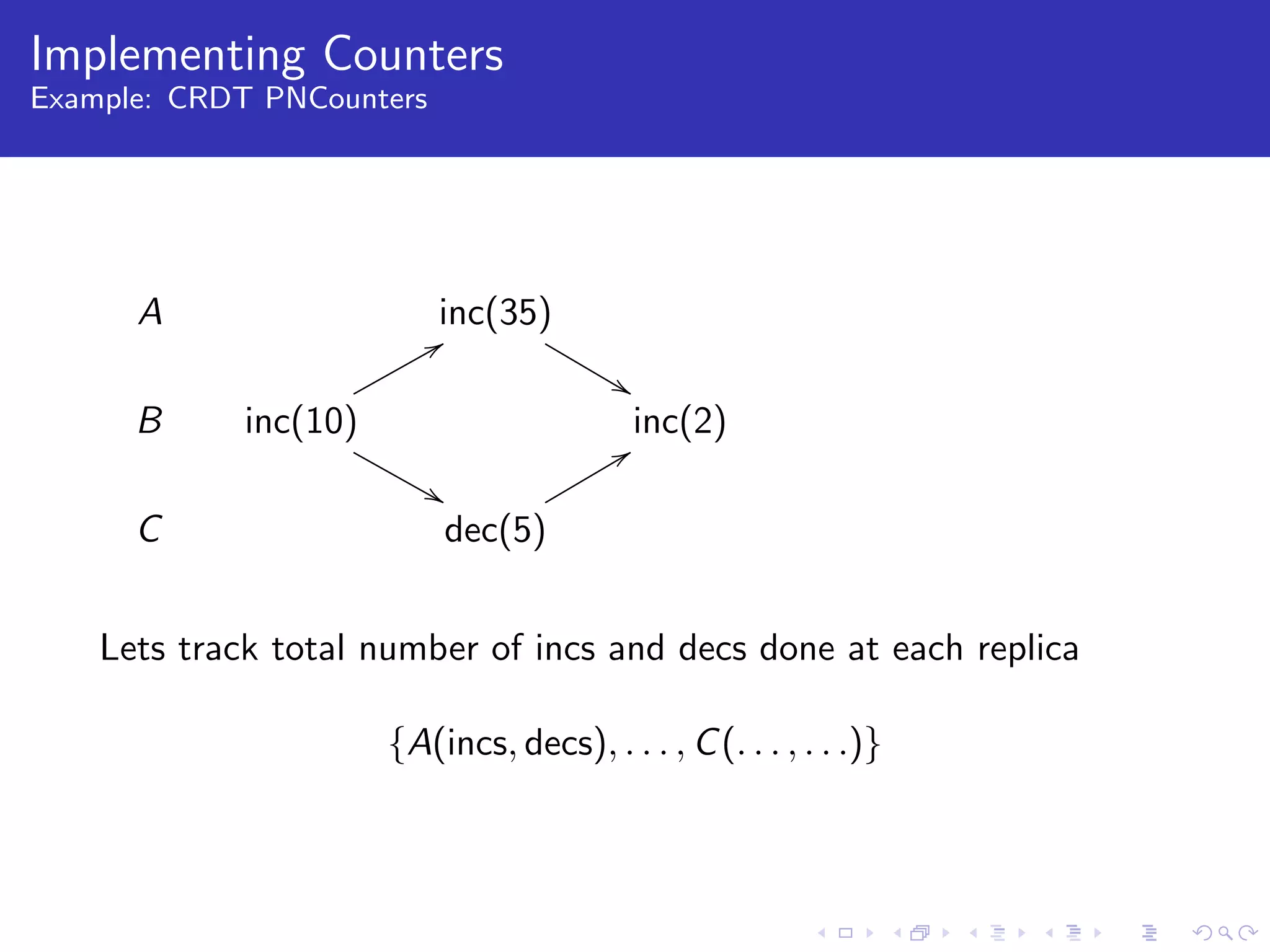
Implementing Counters
Example: CRDT PNCounters
A inc(35)

B inc(10)
88

inc(2)
C dec(5)
88
Lets track total number of incs and decs done at each replica
{A(incs, decs), . . . , C(. . . , . . .)}
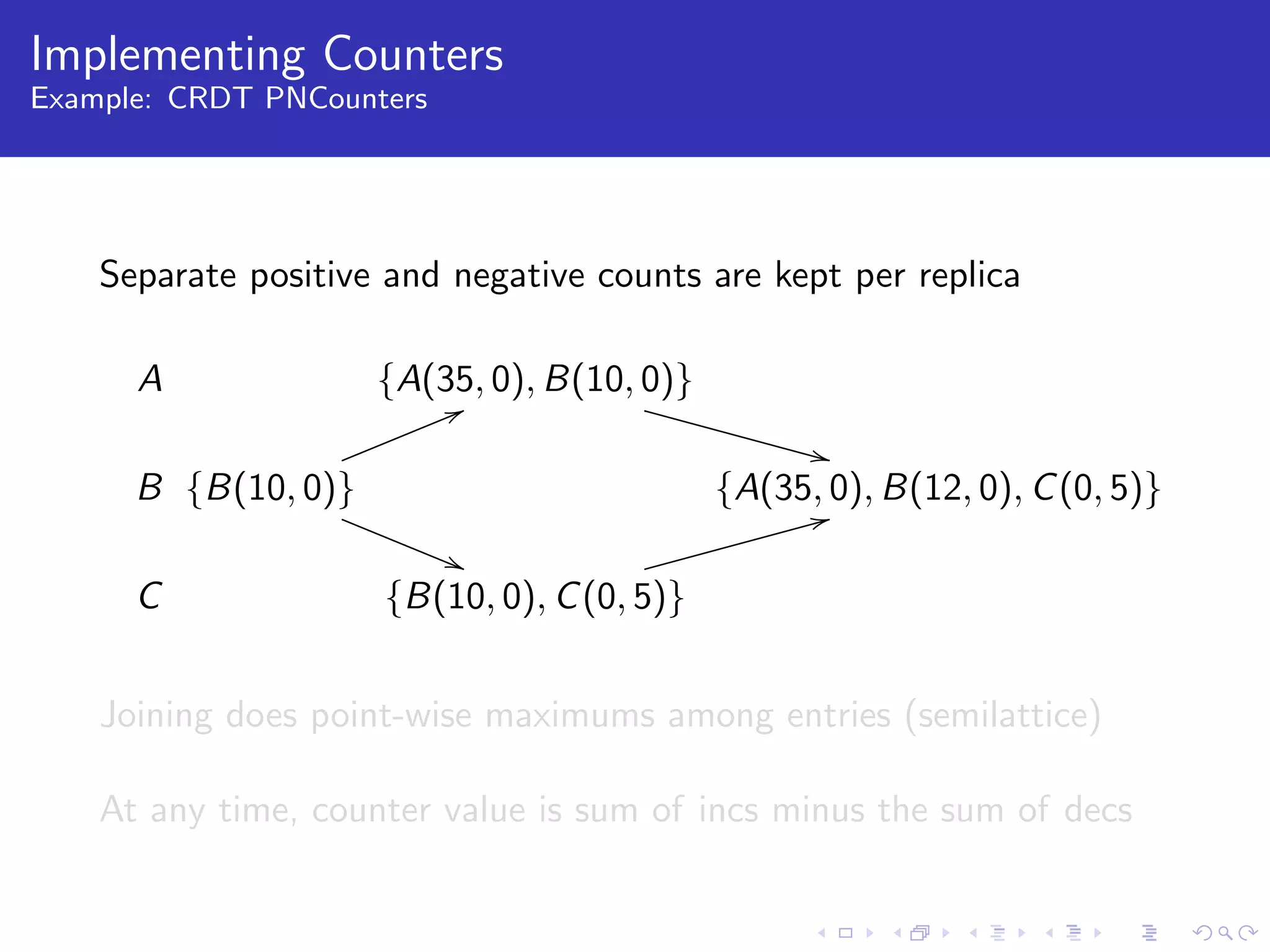
Implementing Counters
Example: CRDT PNCounters
Separate positive and negative counts are kept per replica
A {A(35, 0), B(10, 0)}
++
B {B(10, 0)}
66
((
{A(35, 0), B(12, 0), C(0, 5)}
C {B(10, 0), C(0, 5)}
33
Joining does point-wise maximums among entries (semilattice)
At any time, counter value is sum of incs minus the sum of decs
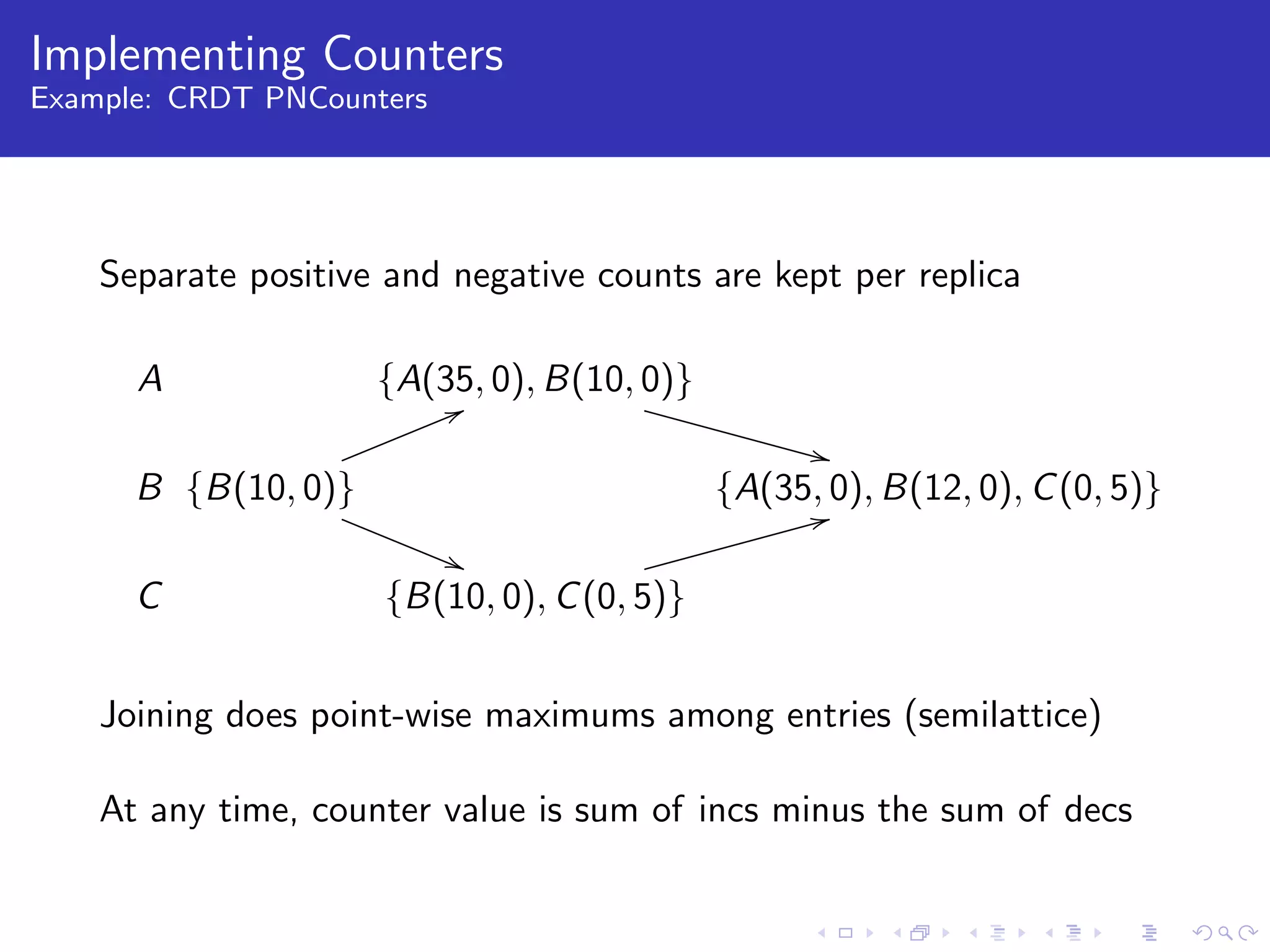
Implementing Counters
Example: CRDT PNCounters
Separate positive and negative counts are kept per replica
A {A(35, 0), B(10, 0)}
++
B {B(10, 0)}
66
((
{A(35, 0), B(12, 0), C(0, 5)}
C {B(10, 0), C(0, 5)}
33
Joining does point-wise maximums among entries (semilattice)
At any time, counter value is sum of incs minus the sum of decs
Implementing Counters
Redis CRDT Counters
There are multiple ways to implement CRDT counters
Redis has a distinct implementation that favours garbage collection
Redis CRDT counters are 59 bits (not 64) to avoid overflows
Registers
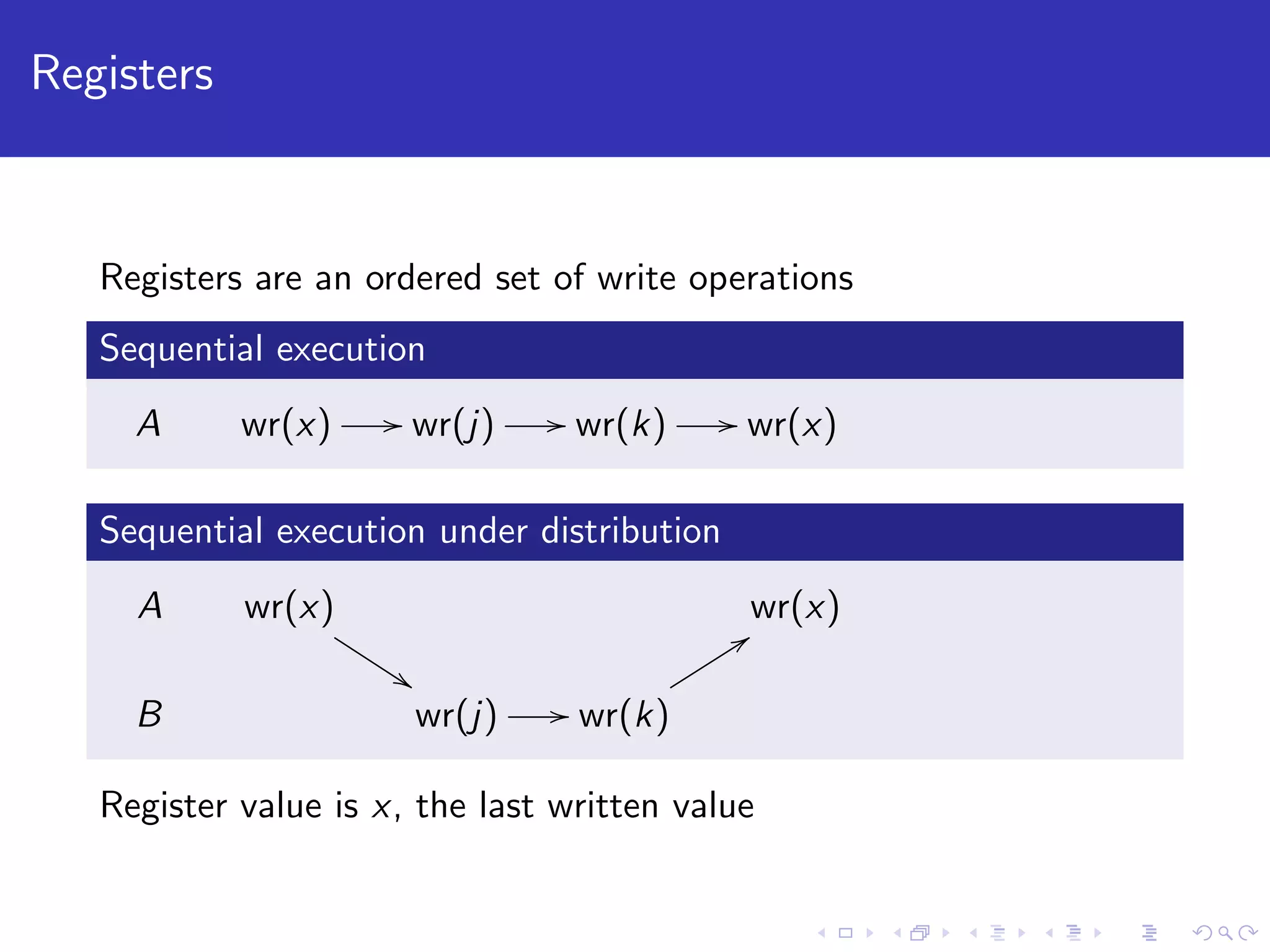
Registers are an ordered set of write operations
Sequential execution
A wr(x) // wr(j) // wr(k) // wr(x)
Sequential execution under distribution
A wr(x)
%%
wr(x)
B wr(j) // wr(k)
99
Register value is x, the last written value
Implementing Registers
Naif Last-Writer-Wins
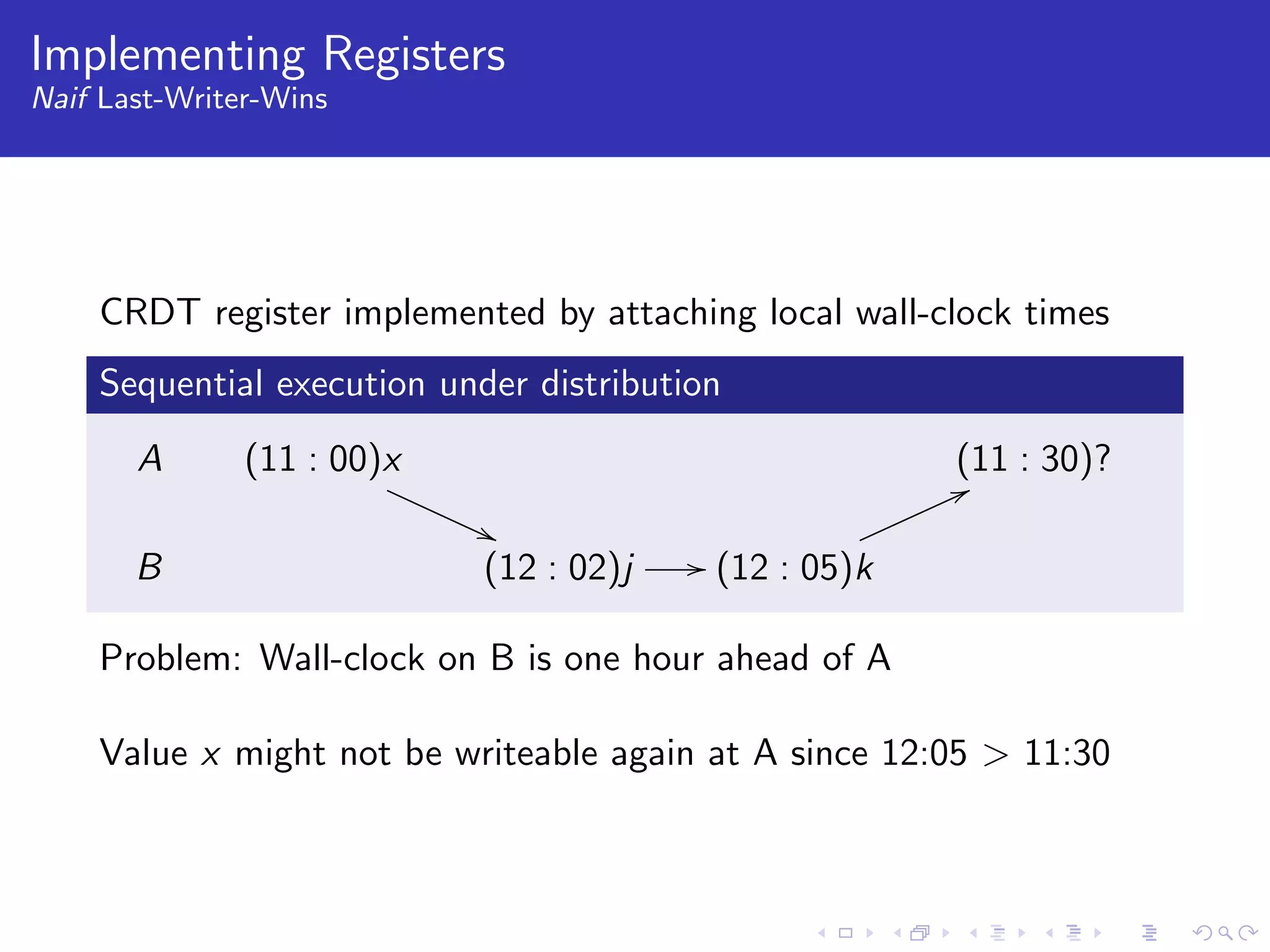
CRDT register implemented by attaching local wall-clock times
Sequential execution under distribution
A (11 : 00)x
((
(11 : 30)?
B (12 : 02)j // (12 : 05)k
66
Problem: Wall-clock on B is one hour ahead of A
Value x might not be writeable again at A since 12:05  11:30
Registers
Sequential Semantics
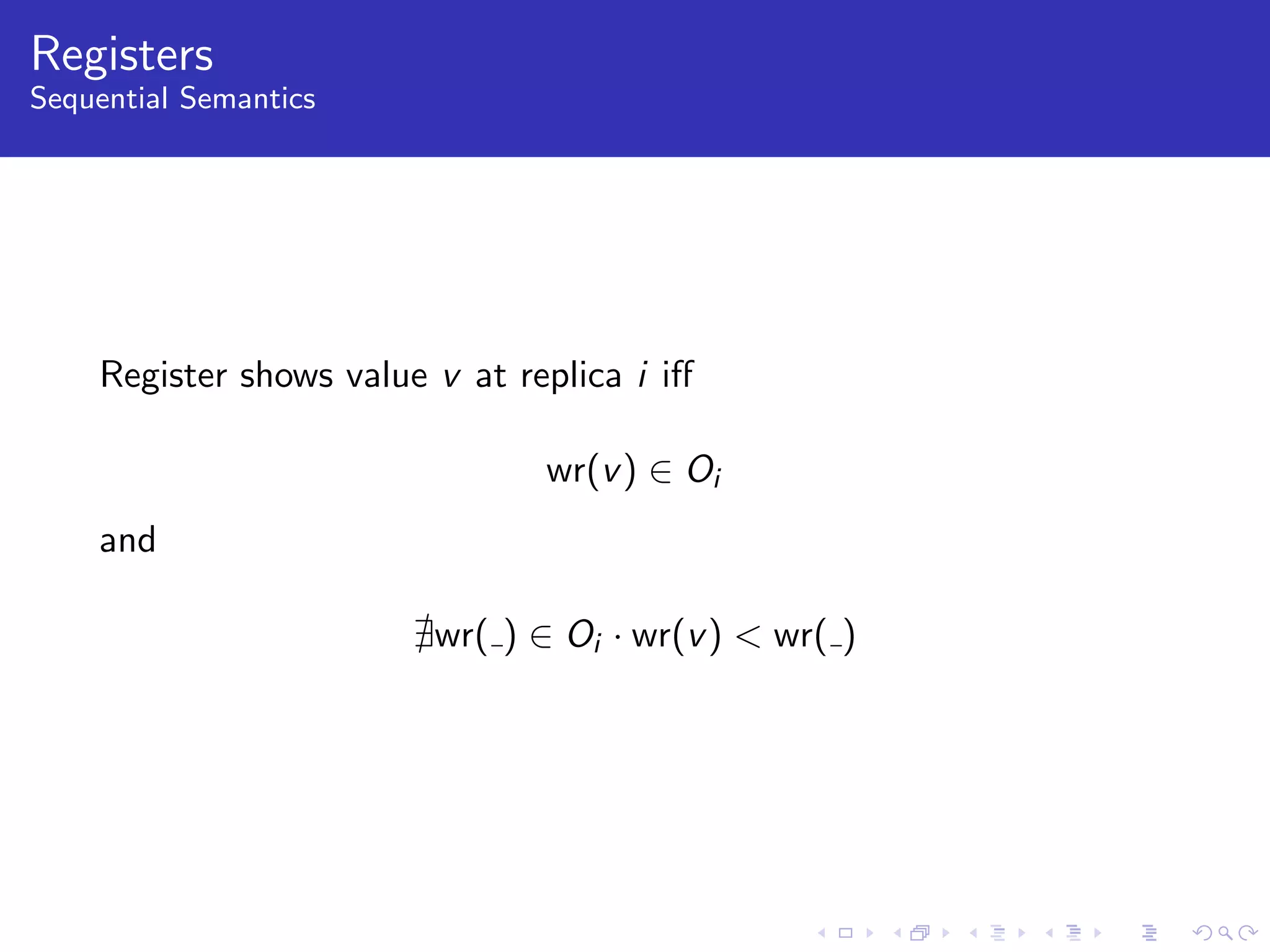
Register shows value v at replica i iff
wr(v) ∈ Oi
and
wr( ) ∈ Oi · wr(v)  wr( )
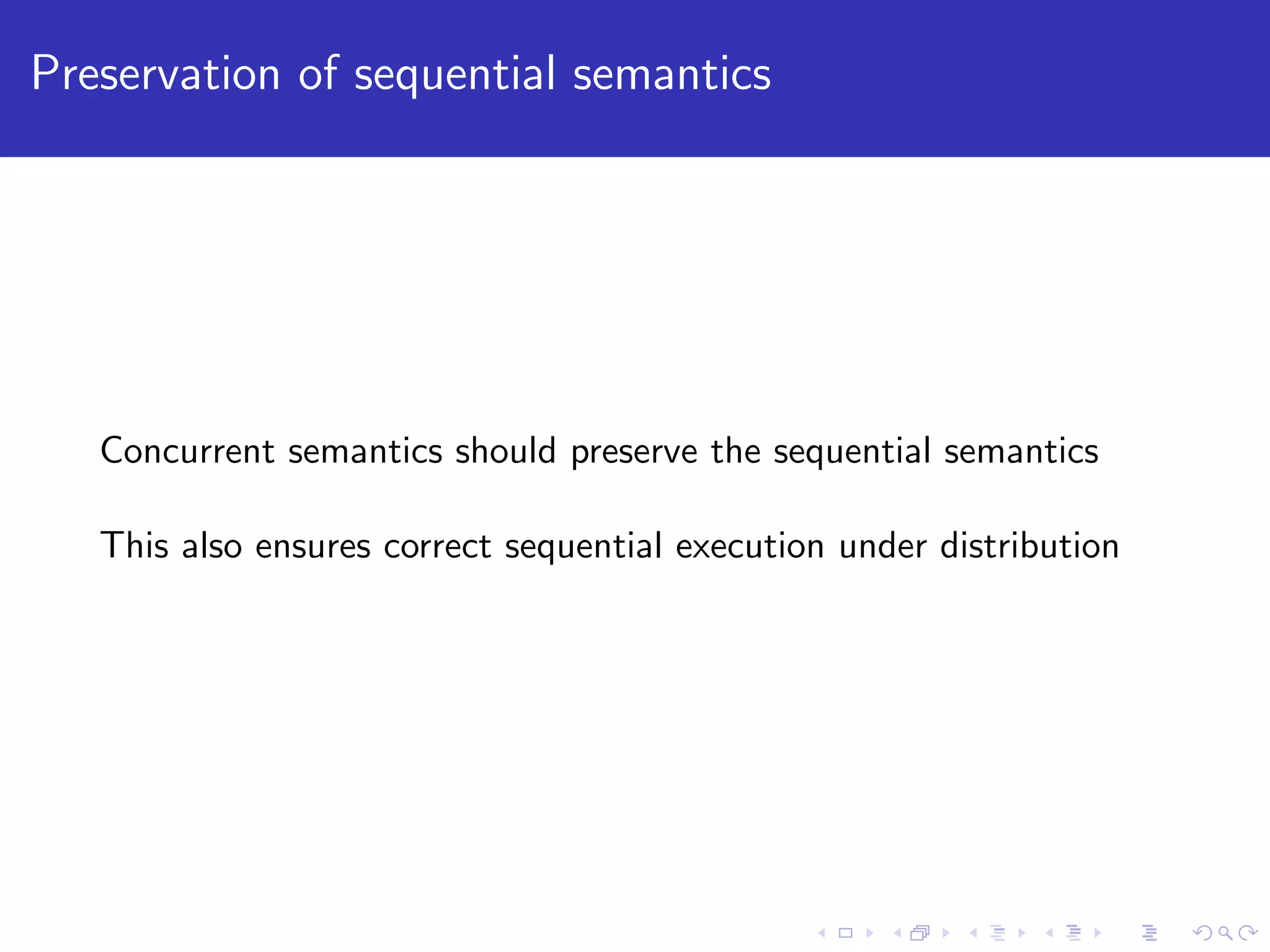
Preservation of sequential semantics
Concurrent semantics should preserve the sequential semantics
This also ensures correct sequential execution under distribution
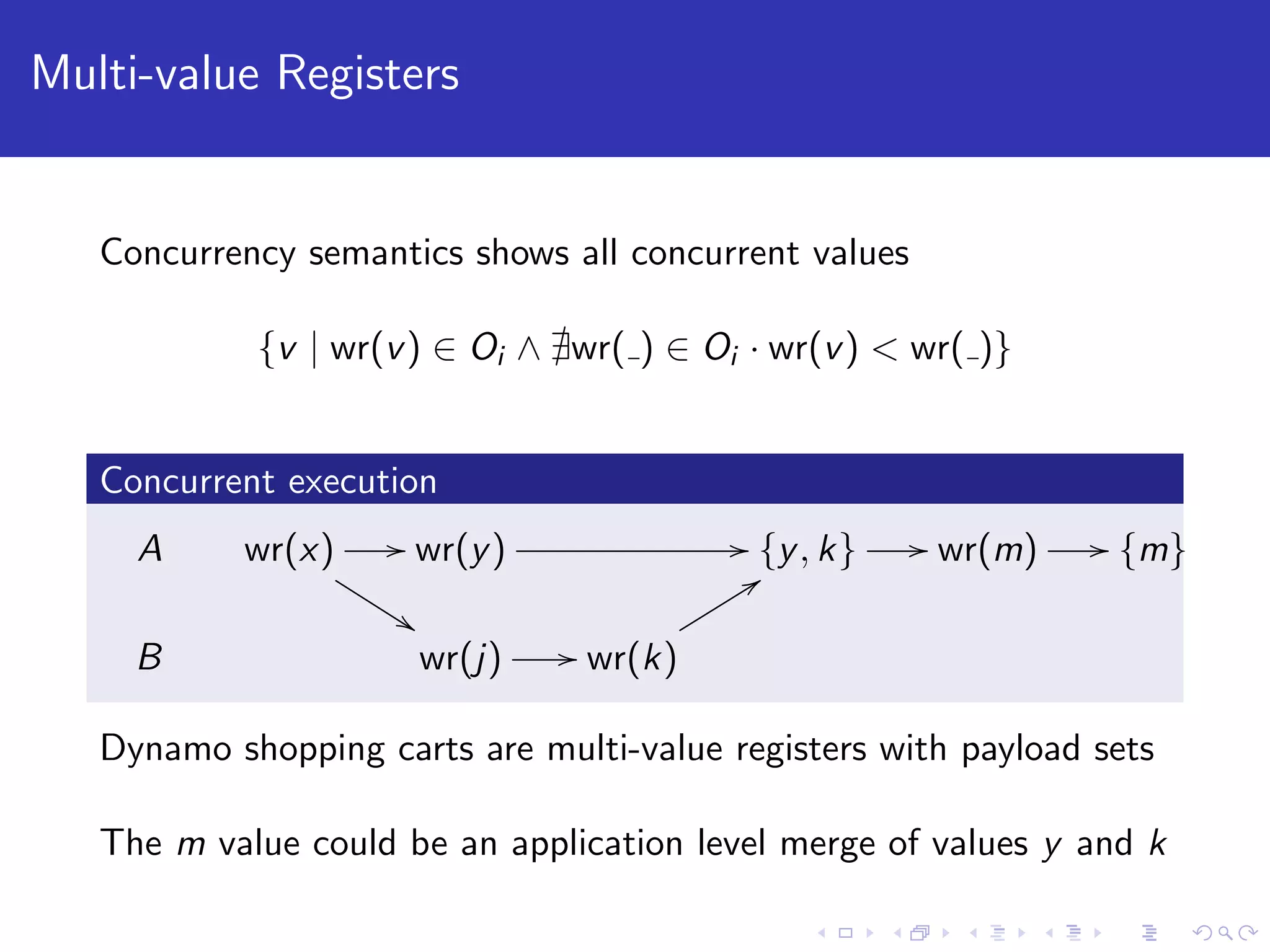
Multi-value Registers
Concurrency semantics shows all concurrent values
{v | wr(v) ∈ Oi ∧ wr( ) ∈ Oi · wr(v)  wr( )}
Concurrent execution
A wr(x)
%%
// wr(y) // {y, k} // wr(m) // {m}
B wr(j) // wr(k)
99
Dynamo shopping carts are multi-value registers with payload sets
The m value could be an application level merge of values y and k
Implementing Multi-value Registers
Concurrency can be preciselly tracked with version vectors
Concurrent execution (version vectors)
A [1, 0]x
%%
// [2, 0]y // [2, 0]y, [1, 2]k // [3, 2]m
B [1, 1]j // [1, 2]k
66
Metadata can be compressed with a common causal context and a
single scalar per value (dotted version vectors)
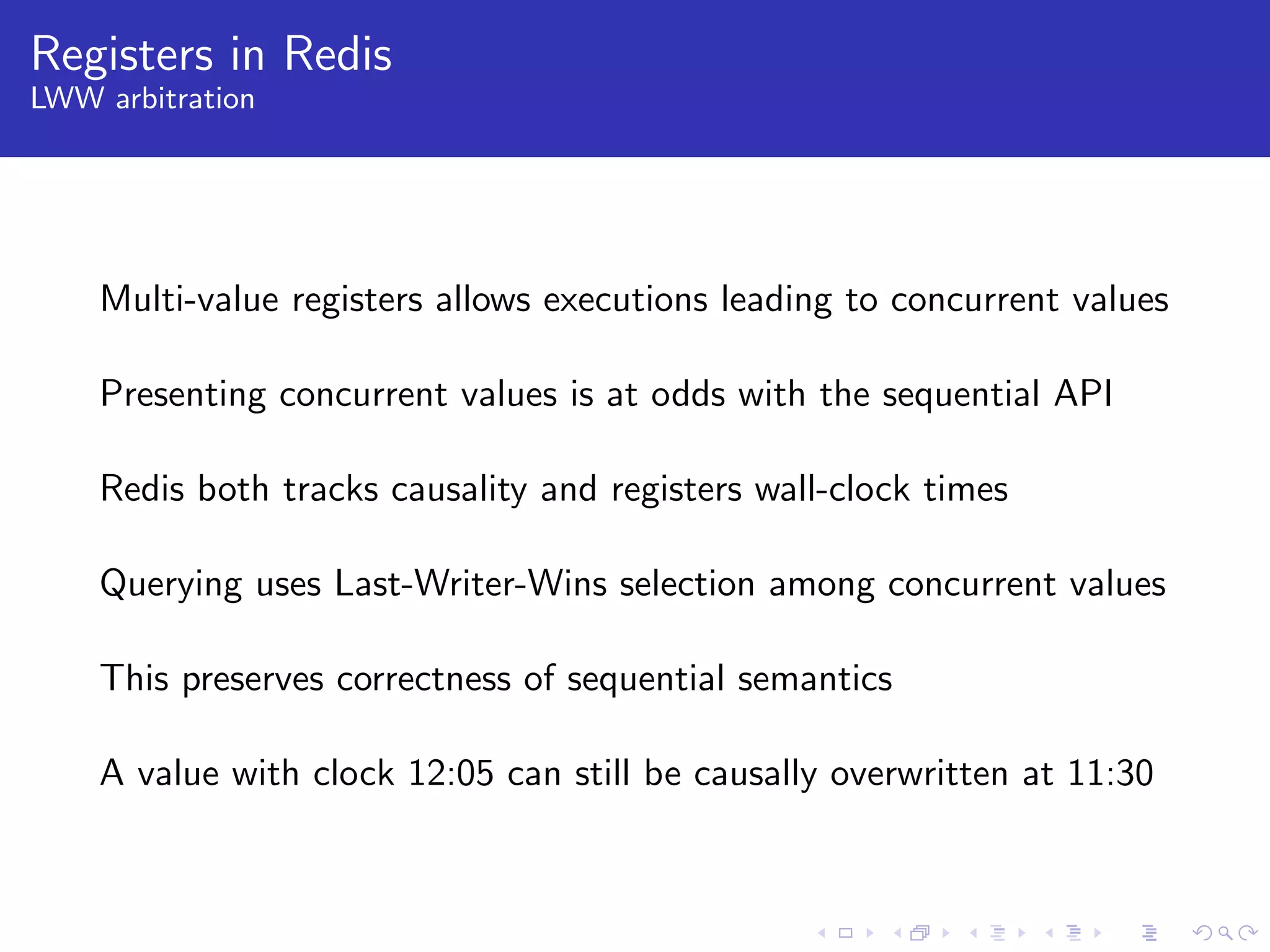
Registers in Redis
LWW arbitration
Multi-value registers allows executions leading to concurrent values
Presenting concurrent values is at odds with the sequential API
Redis both tracks causality and registers wall-clock times
Querying uses Last-Writer-Wins selection among concurrent values
This preserves correctness of sequential semantics
A value with clock 12:05 can still be causally overwritten at 11:30
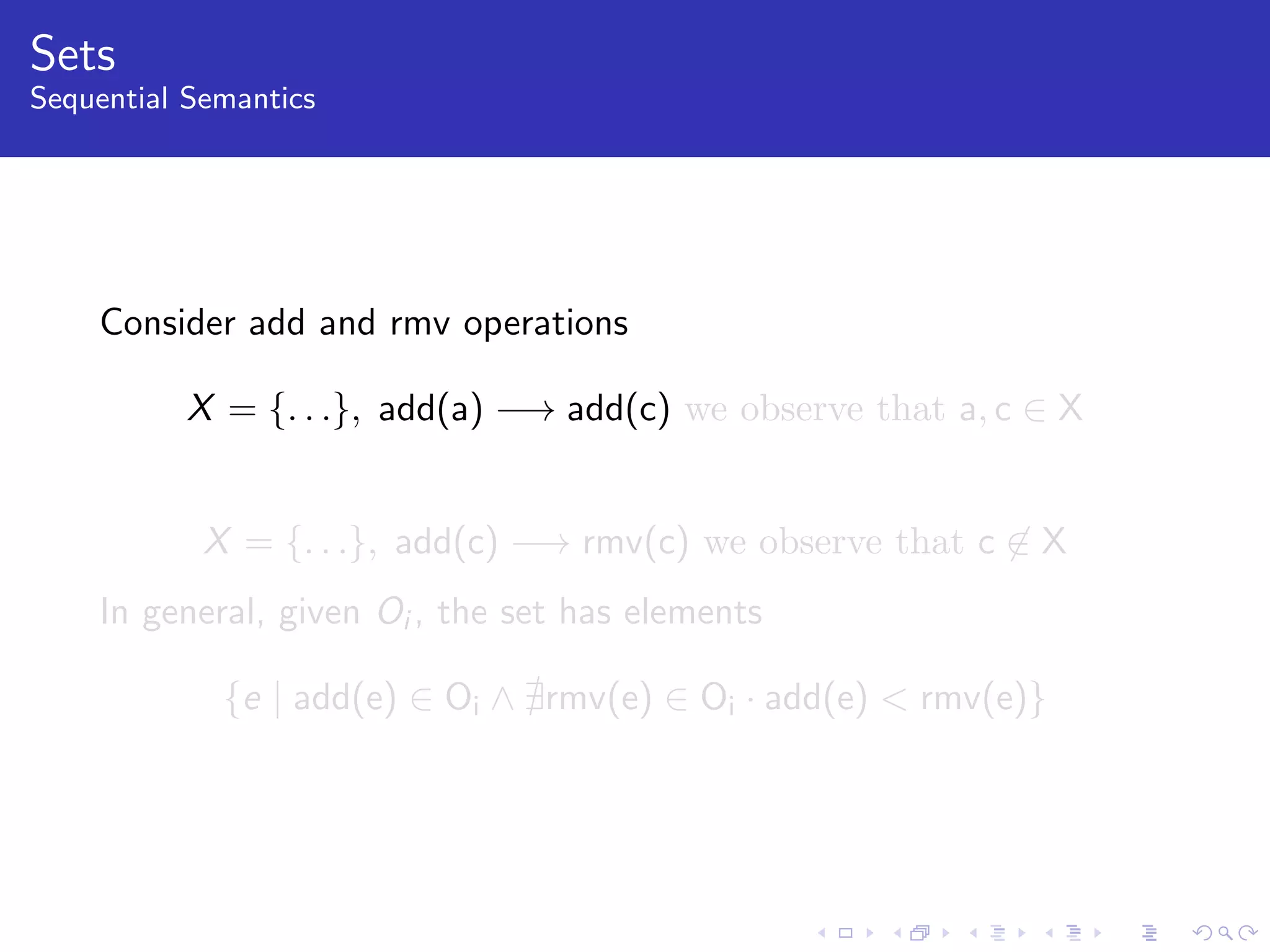
Sets
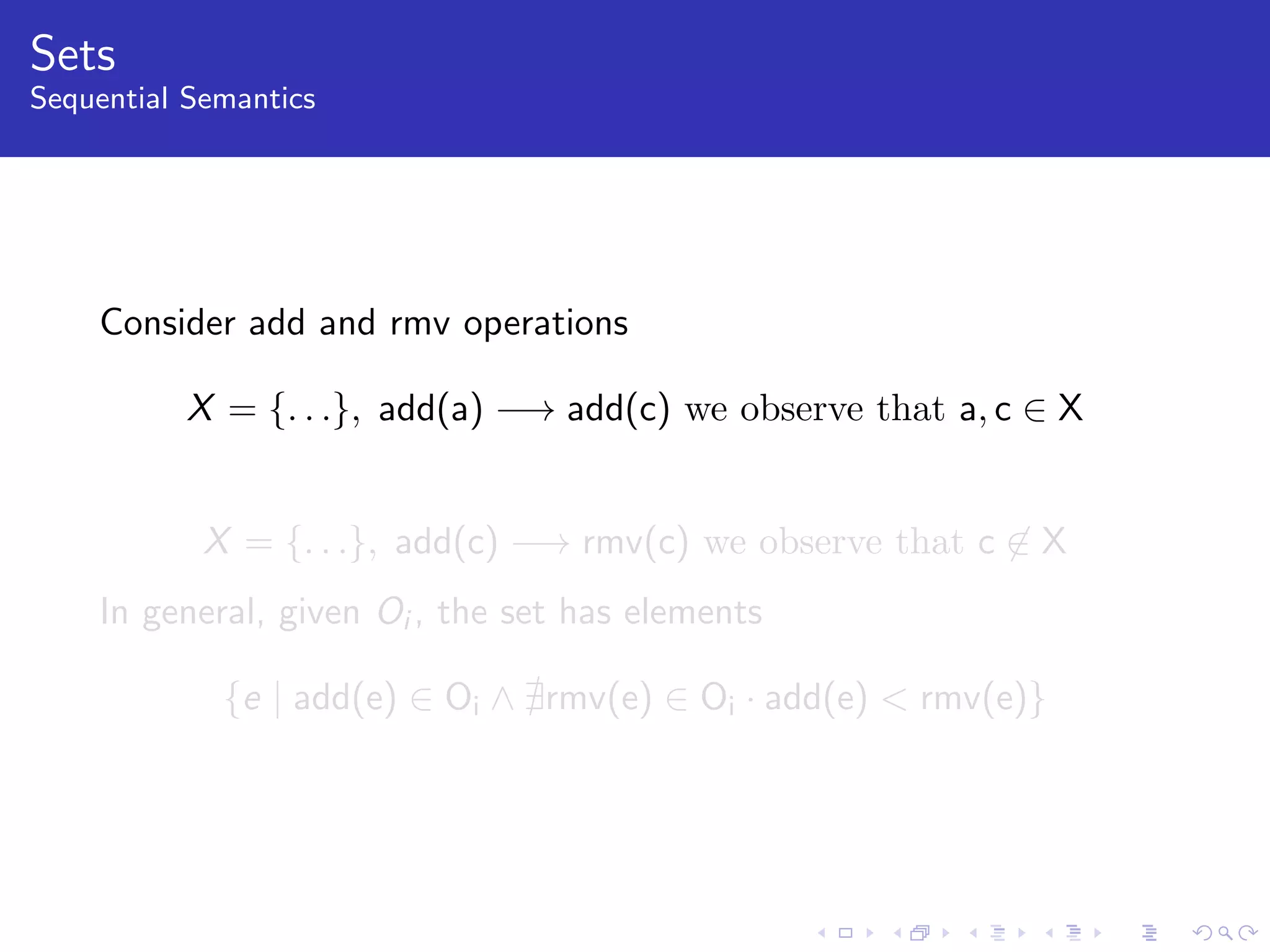
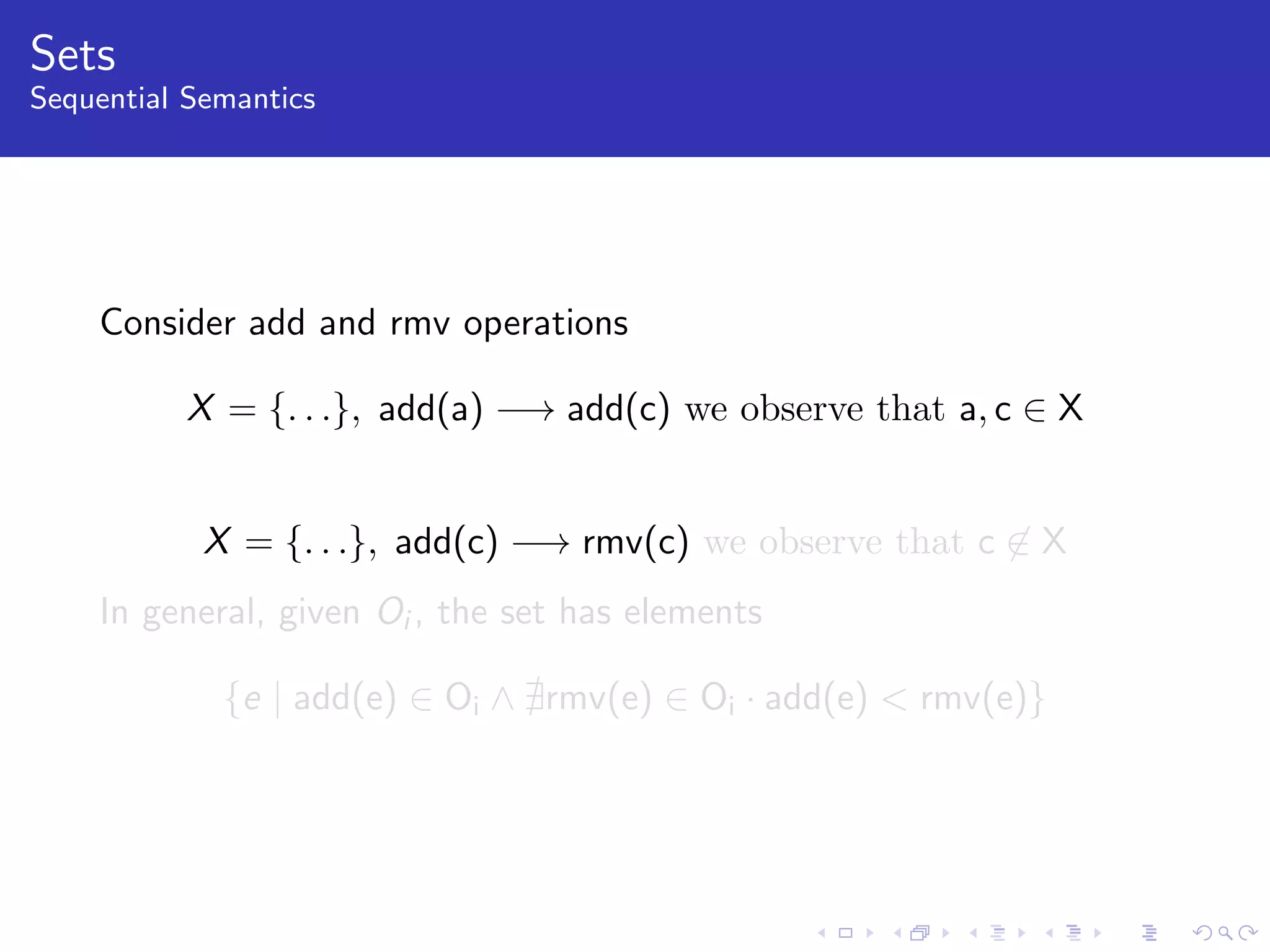
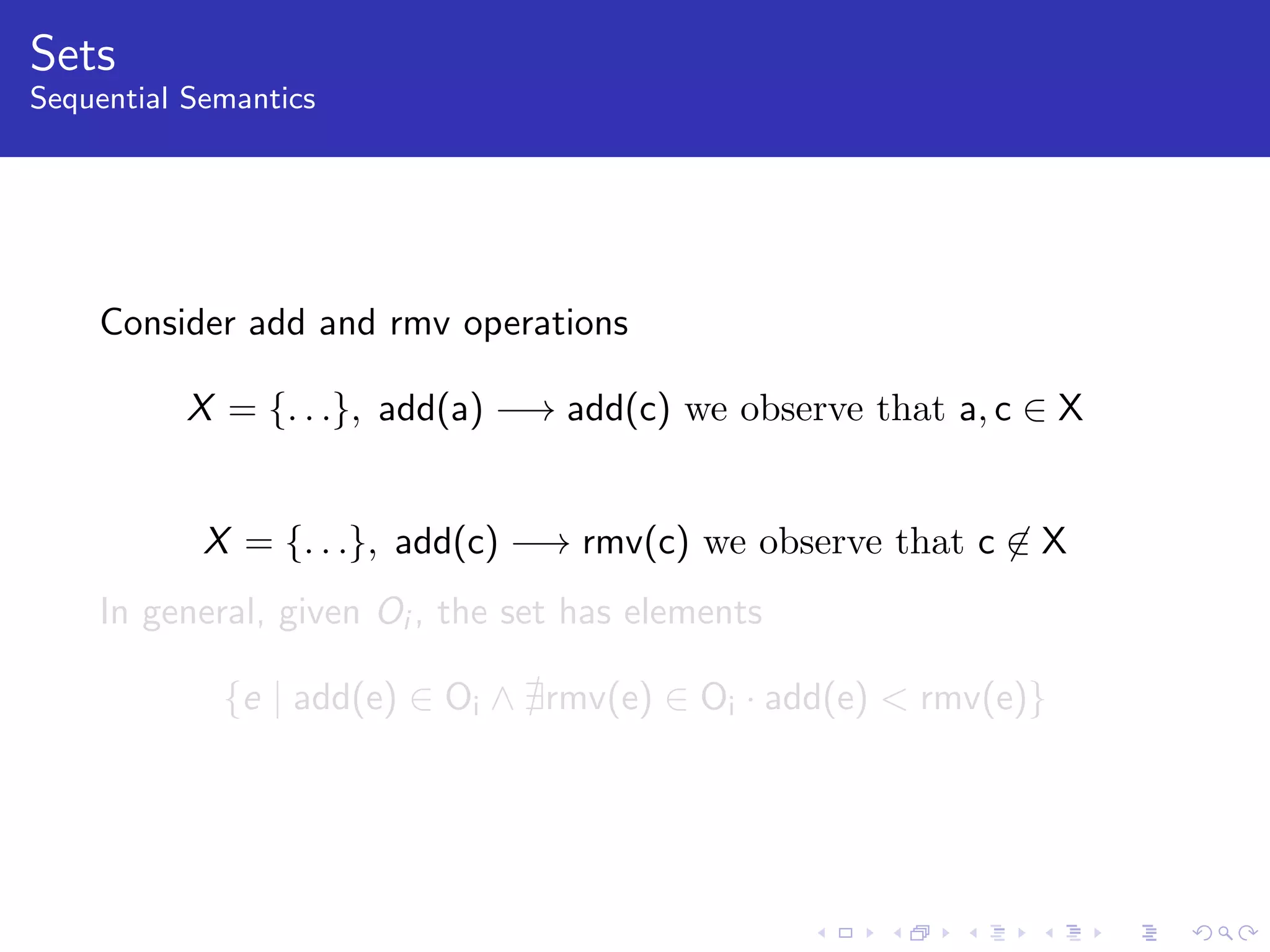
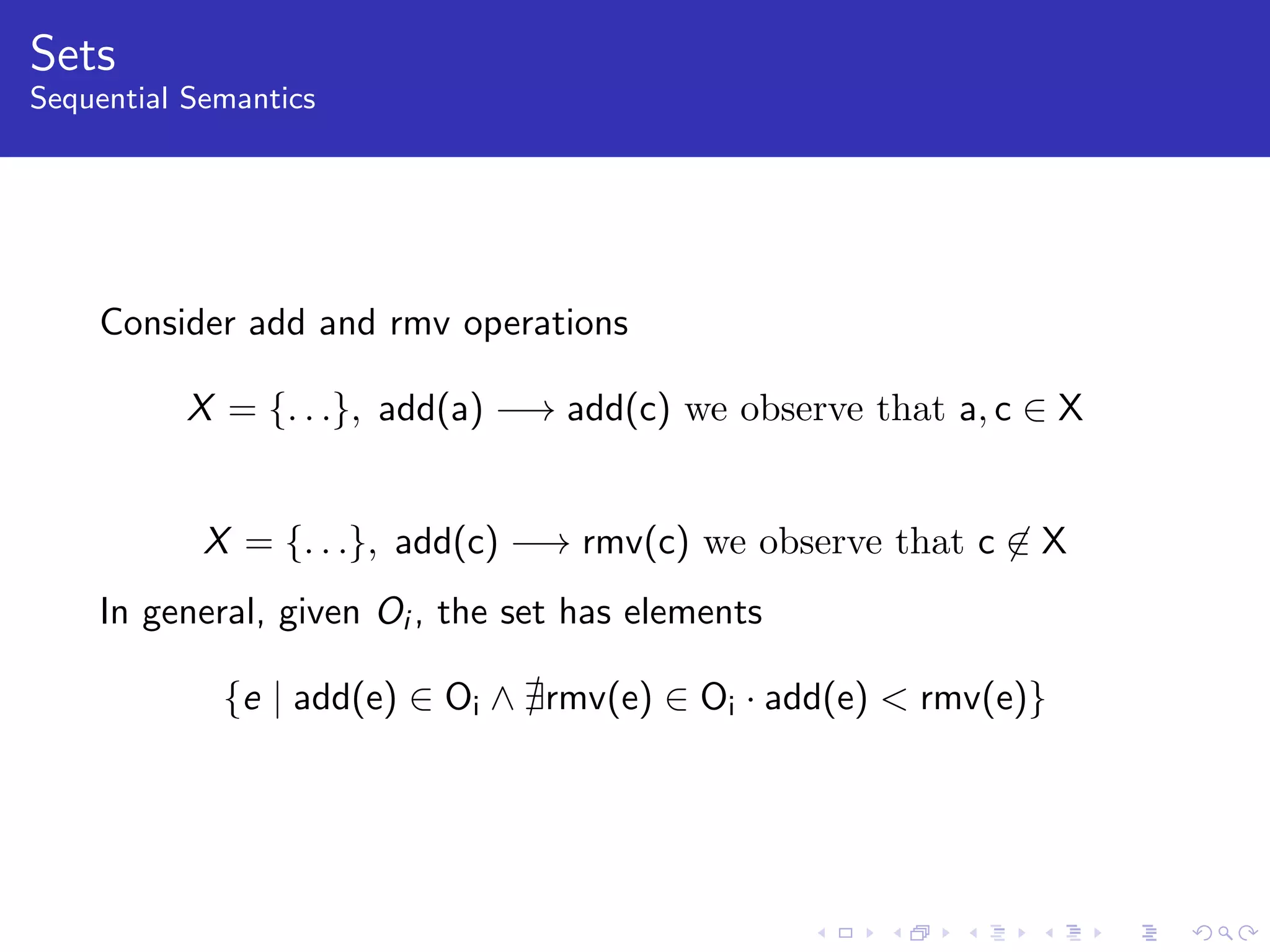
Sequential Semantics
Consider add and rmv operations
X = {. . .}, add(a) −→ add(c) we observe that a, c ∈ X
X = {. . .}, add(c) −→ rmv(c) we observe that c ∈ X
In general, given Oi , the set has elements
{e | add(e) ∈ Oi ∧ rmv(e) ∈ Oi · add(e)  rmv(e)}
Sets
Sequential Semantics
Consider add and rmv operations
X = {. . .}, add(a) −→ add(c) we observe that a, c ∈ X
X = {. . .}, add(c) −→ rmv(c) we observe that c ∈ X
In general, given Oi , the set has elements
{e | add(e) ∈ Oi ∧ rmv(e) ∈ Oi · add(e)  rmv(e)}
Sets
Sequential Semantics
Consider add and rmv operations
X = {. . .}, add(a) −→ add(c) we observe that a, c ∈ X
X = {. . .}, add(c) −→ rmv(c) we observe that c ∈ X
In general, given Oi , the set has elements
{e | add(e) ∈ Oi ∧ rmv(e) ∈ Oi · add(e)  rmv(e)}
Sets
Sequential Semantics
Consider add and rmv operations
X = {. . .}, add(a) −→ add(c) we observe that a, c ∈ X
X = {. . .}, add(c) −→ rmv(c) we observe that c ∈ X
In general, given Oi , the set has elements
{e | add(e) ∈ Oi ∧ rmv(e) ∈ Oi · add(e)  rmv(e)}
Sets
Sequential Semantics
Consider add and rmv operations
X = {. . .}, add(a) −→ add(c) we observe that a, c ∈ X
X = {. . .}, add(c) −→ rmv(c) we observe that c ∈ X
In general, given Oi , the set has elements
{e | add(e) ∈ Oi ∧ rmv(e) ∈ Oi · add(e)  rmv(e)}
Sets
Concurrency Semantics
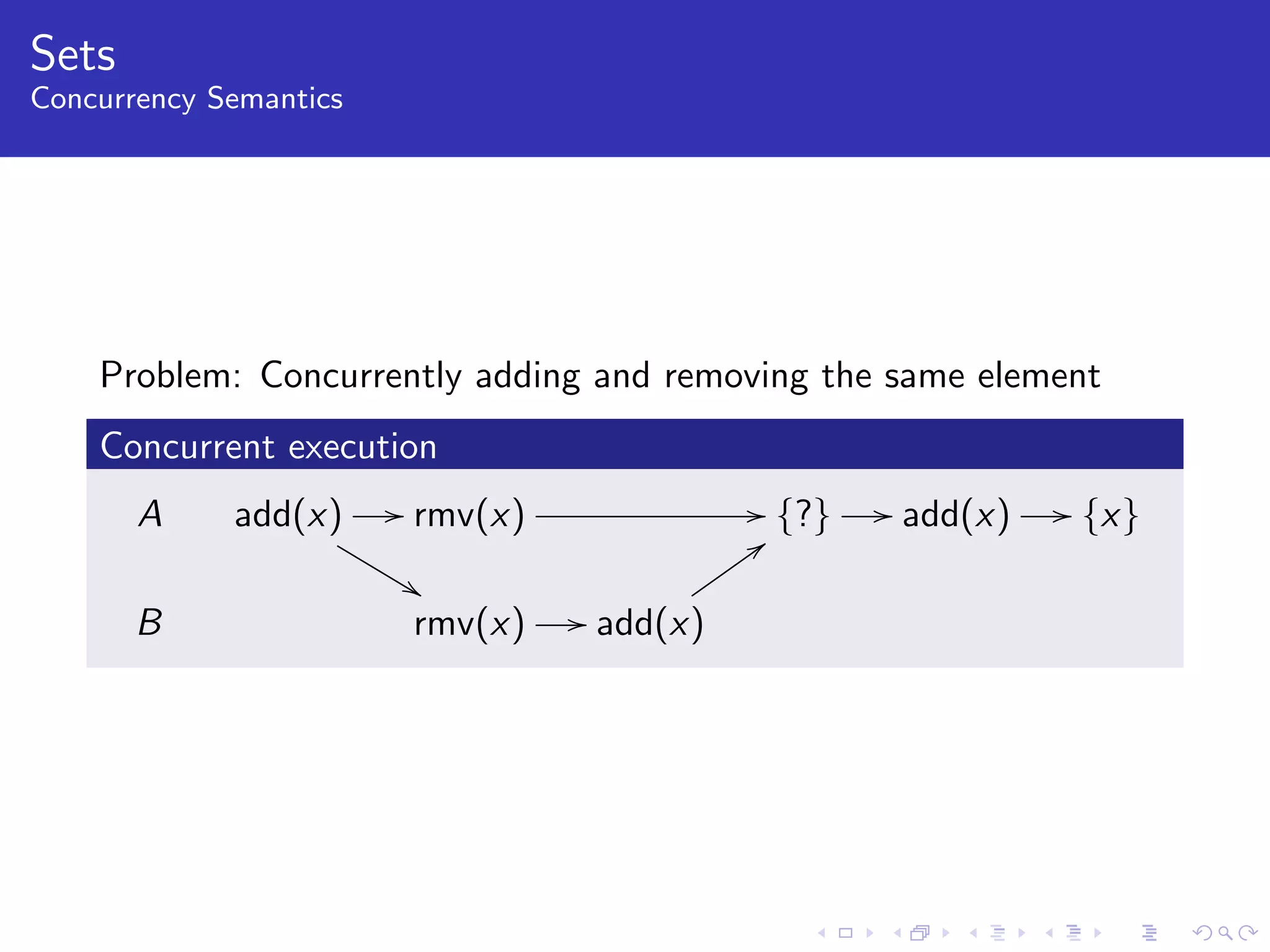
Problem: Concurrently adding and removing the same element
Concurrent execution
A add(x)
%%
// rmv(x) // {?} // add(x) // {x}
B rmv(x) // add(x)
::
Concurrency Semantics
Add-Wins Sets
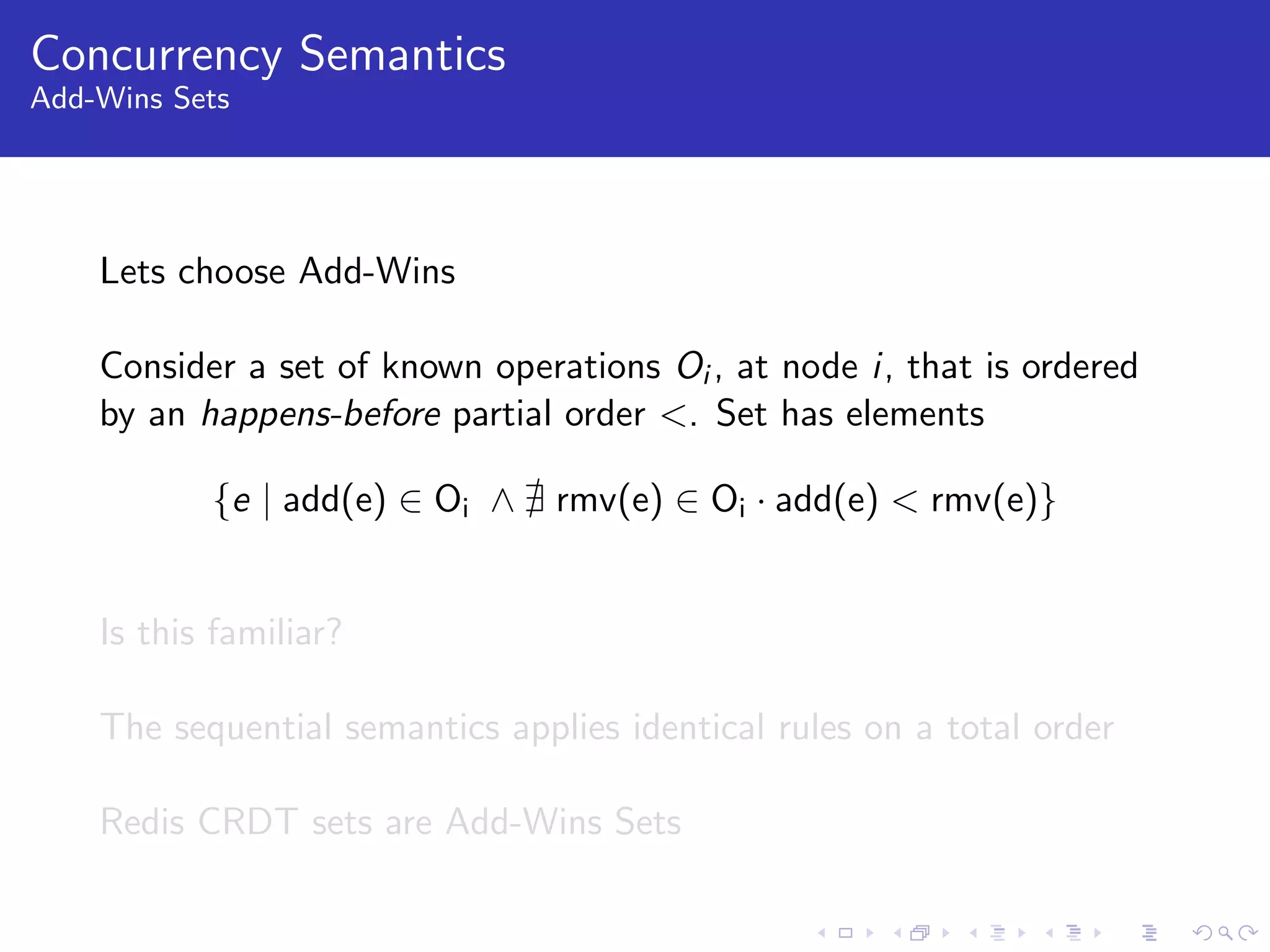
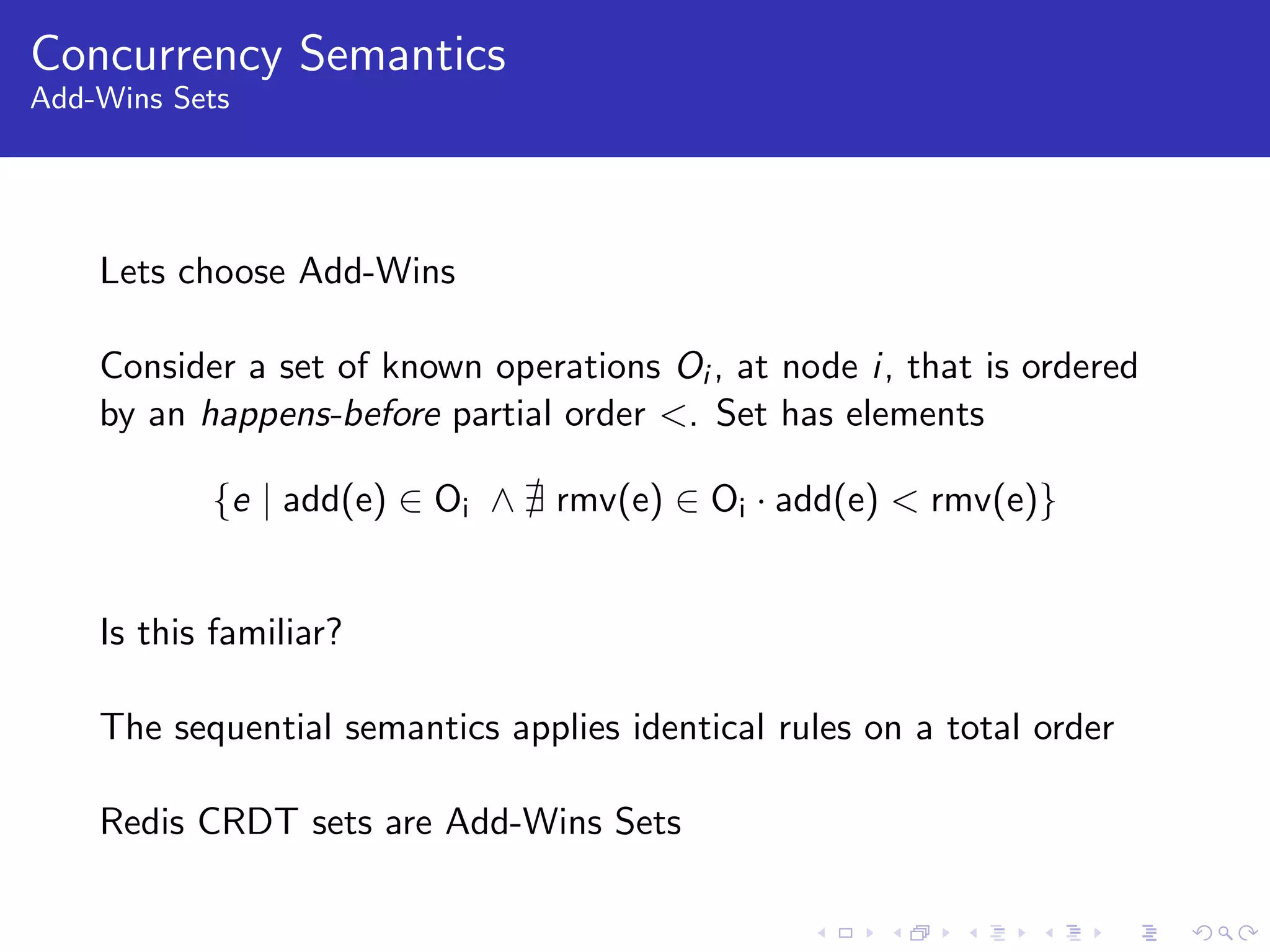
Lets choose Add-Wins
Consider a set of known operations Oi , at node i, that is ordered
by an happens-before partial order . Set has elements
{e | add(e) ∈ Oi ∧ rmv(e) ∈ Oi · add(e)  rmv(e)}
Is this familiar?
The sequential semantics applies identical rules on a total order
Redis CRDT sets are Add-Wins Sets
Concurrency Semantics
Add-Wins Sets
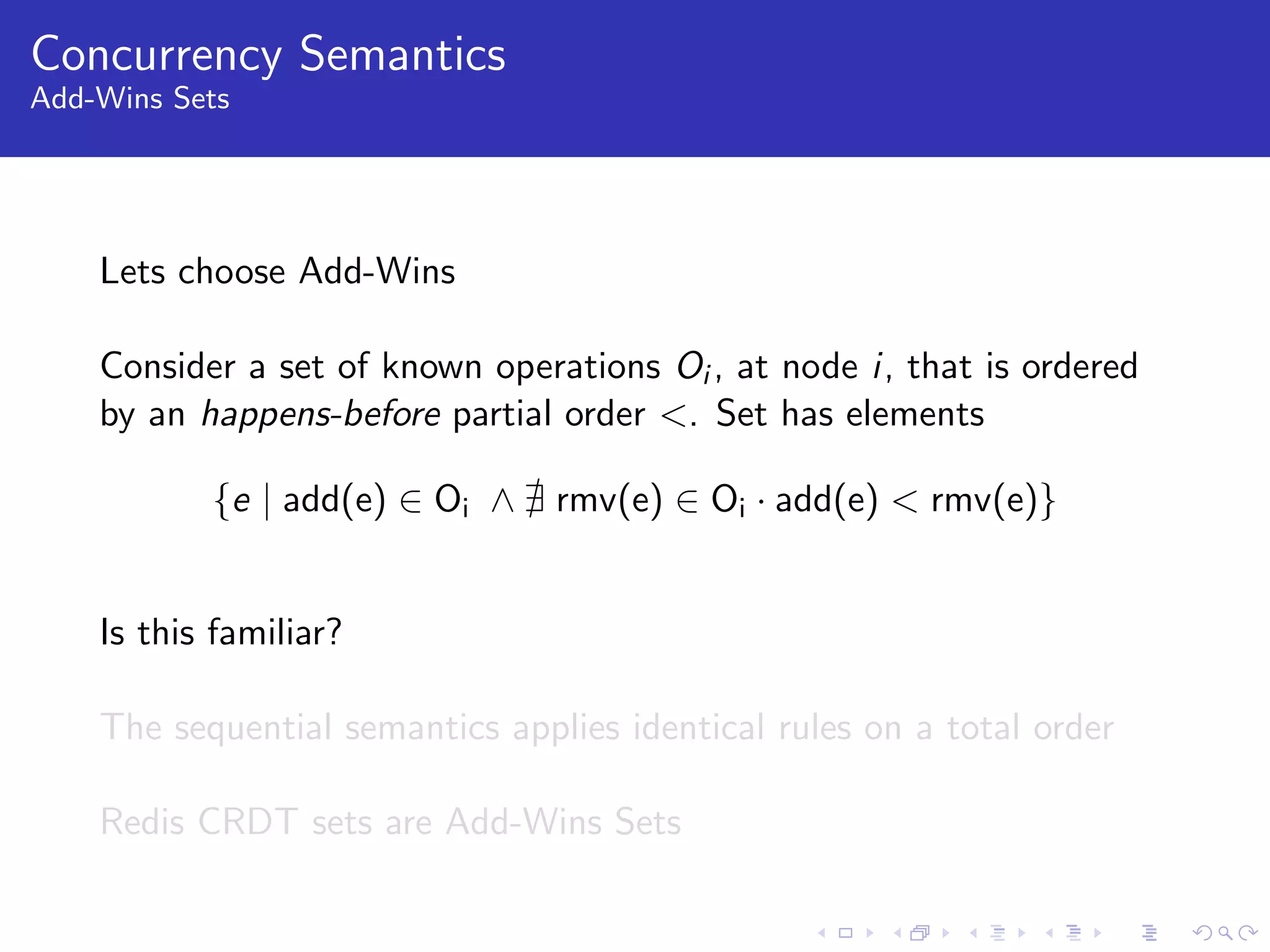
Lets choose Add-Wins
Consider a set of known operations Oi , at node i, that is ordered
by an happens-before partial order . Set has elements
{e | add(e) ∈ Oi ∧ rmv(e) ∈ Oi · add(e)  rmv(e)}
Is this familiar?
The sequential semantics applies identical rules on a total order
Redis CRDT sets are Add-Wins Sets
Concurrency Semantics
Add-Wins Sets
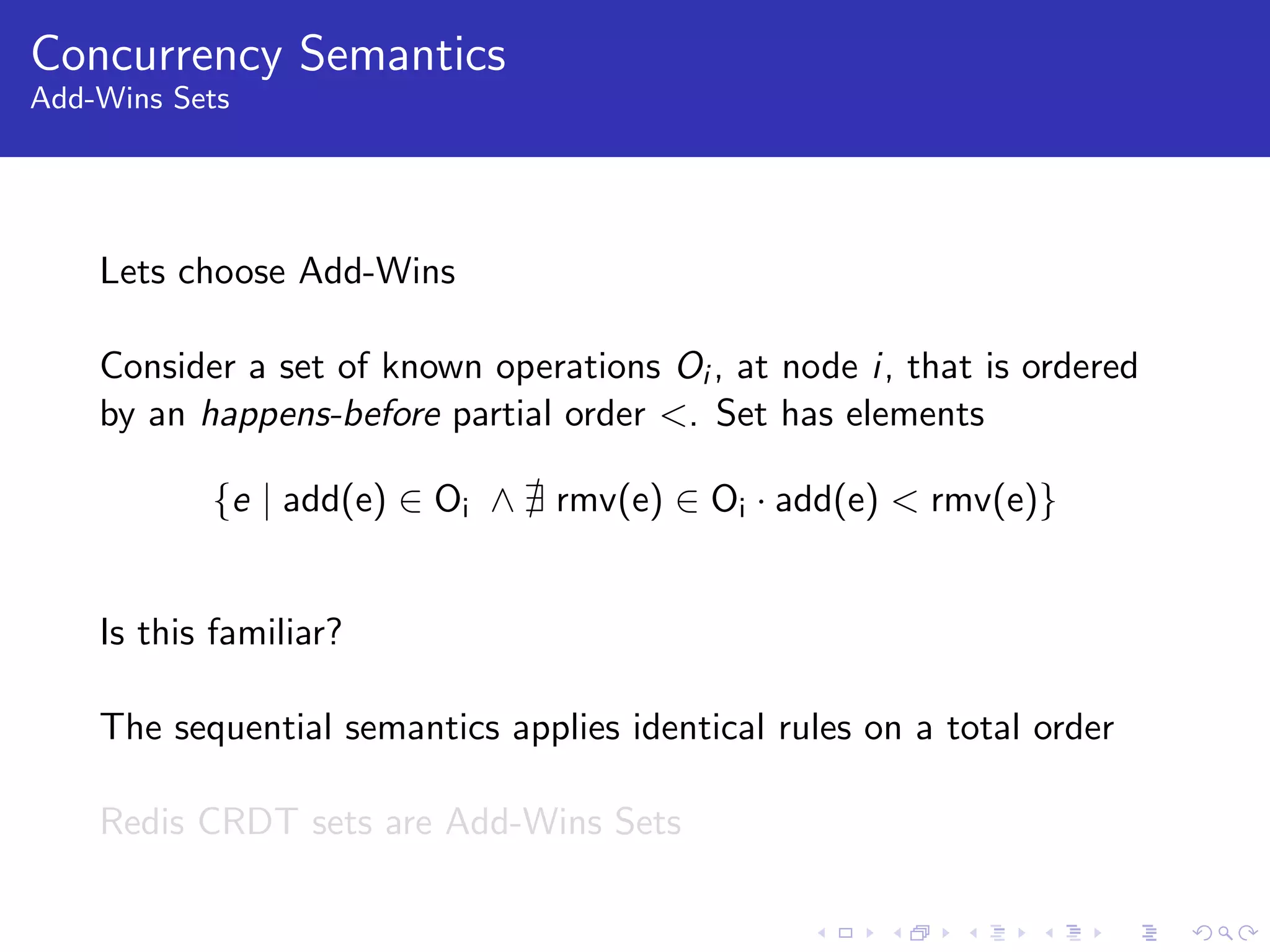
Lets choose Add-Wins
Consider a set of known operations Oi , at node i, that is ordered
by an happens-before partial order . Set has elements
{e | add(e) ∈ Oi ∧ rmv(e) ∈ Oi · add(e)  rmv(e)}
Is this familiar?
The sequential semantics applies identical rules on a total order
Redis CRDT sets are Add-Wins Sets
Concurrency Semantics
Add-Wins Sets
Lets choose Add-Wins
Consider a set of known operations Oi , at node i, that is ordered
by an happens-before partial order . Set has elements
{e | add(e) ∈ Oi ∧ rmv(e) ∈ Oi · add(e)  rmv(e)}
Is this familiar?
The sequential semantics applies identical rules on a total order
Redis CRDT sets are Add-Wins Sets
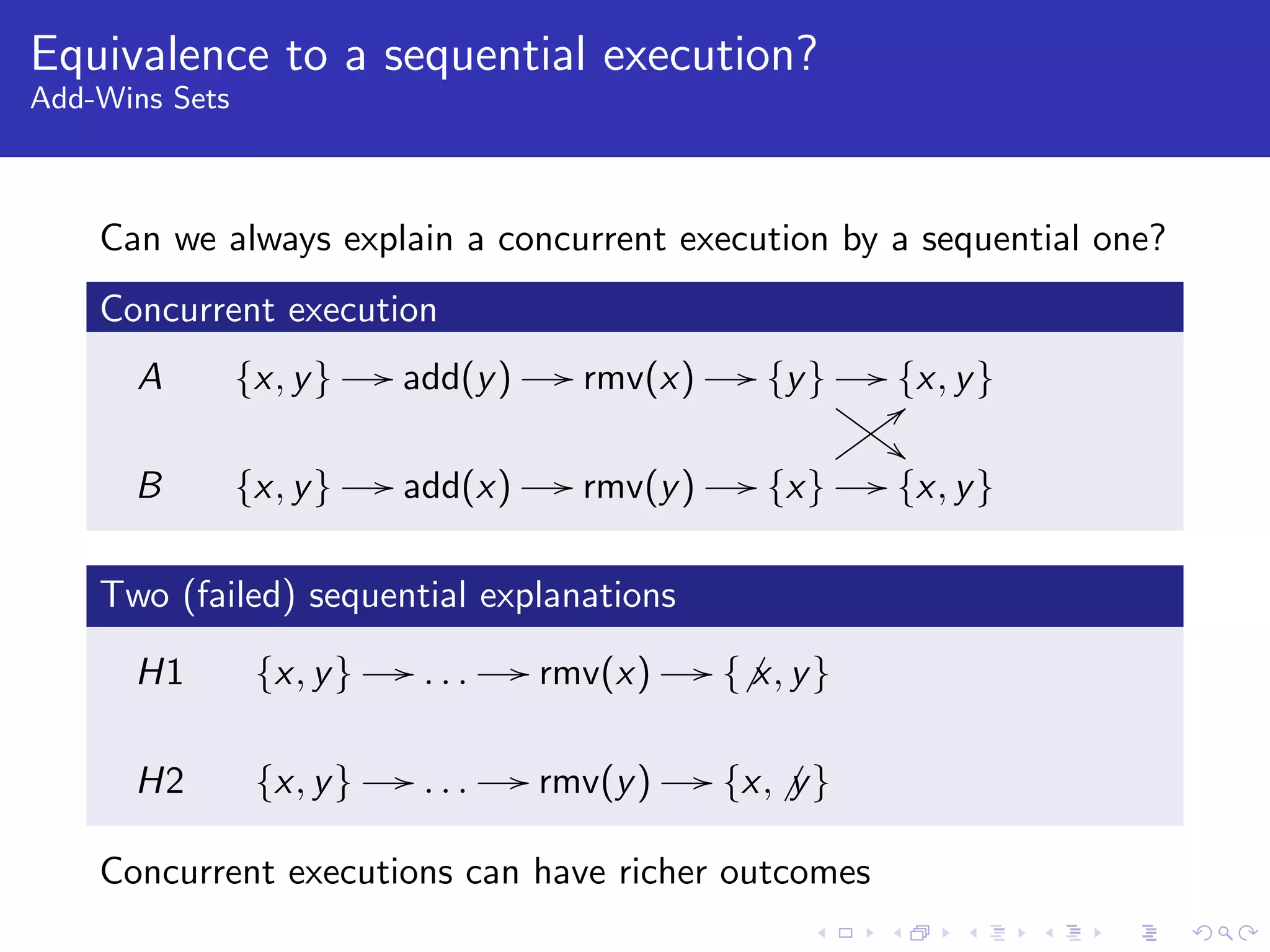
Equivalence to a sequential execution?
Add-Wins Sets
Can we always explain a concurrent execution by a sequential one?
Concurrent execution
A {x, y} // add(y) // rmv(x) // {y} //
##
{x, y}
B {x, y} // add(x) // rmv(y) // {x} //
;;
{x, y}
Two (failed) sequential explanations
H1 {x, y} // . . . // rmv(x) // { x, y}
H2 {x, y} // . . . // rmv(y) // {x, y}
Concurrent executions can have richer outcomes
Concurrency Semantics
Remove-Wins Sets
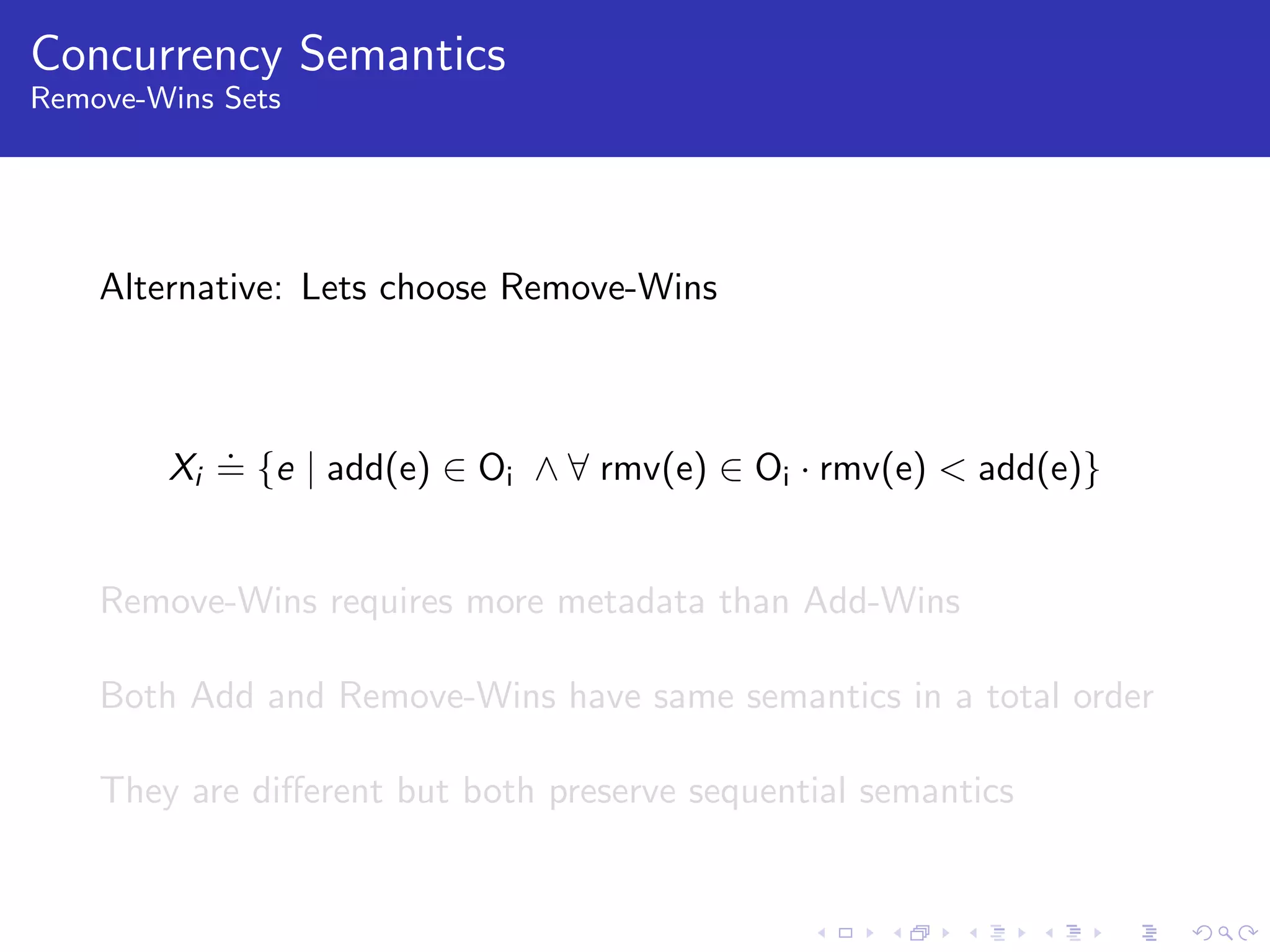
Alternative: Lets choose Remove-Wins
Xi
.
= {e | add(e) ∈ Oi ∧ ∀ rmv(e) ∈ Oi · rmv(e)  add(e)}
Remove-Wins requires more metadata than Add-Wins
Both Add and Remove-Wins have same semantics in a total order
They are different but both preserve sequential semantics
Concurrency Semantics
Remove-Wins Sets
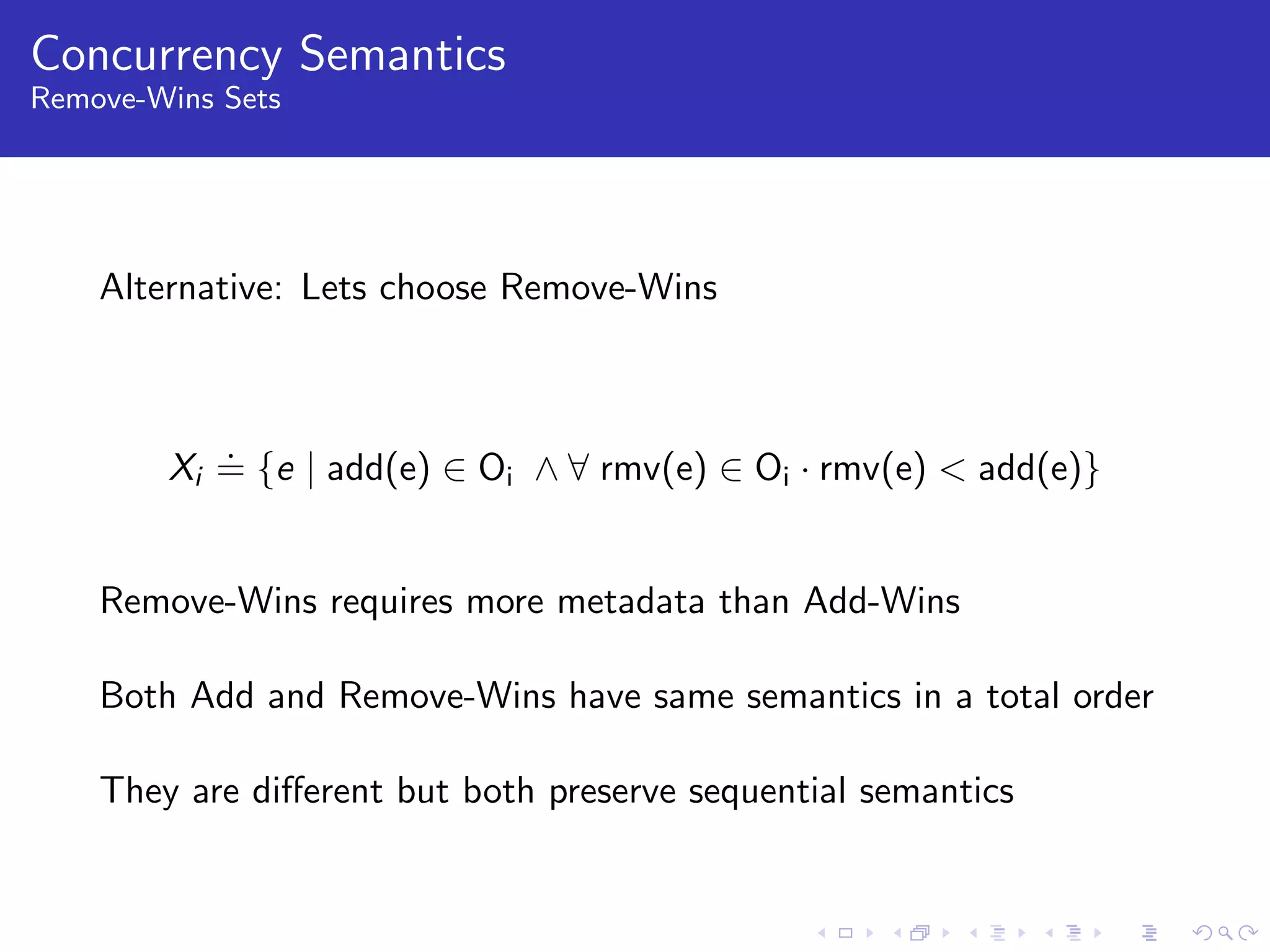
Alternative: Lets choose Remove-Wins
Xi
.
= {e | add(e) ∈ Oi ∧ ∀ rmv(e) ∈ Oi · rmv(e)  add(e)}
Remove-Wins requires more metadata than Add-Wins
Both Add and Remove-Wins have same semantics in a total order
They are different but both preserve sequential semantics
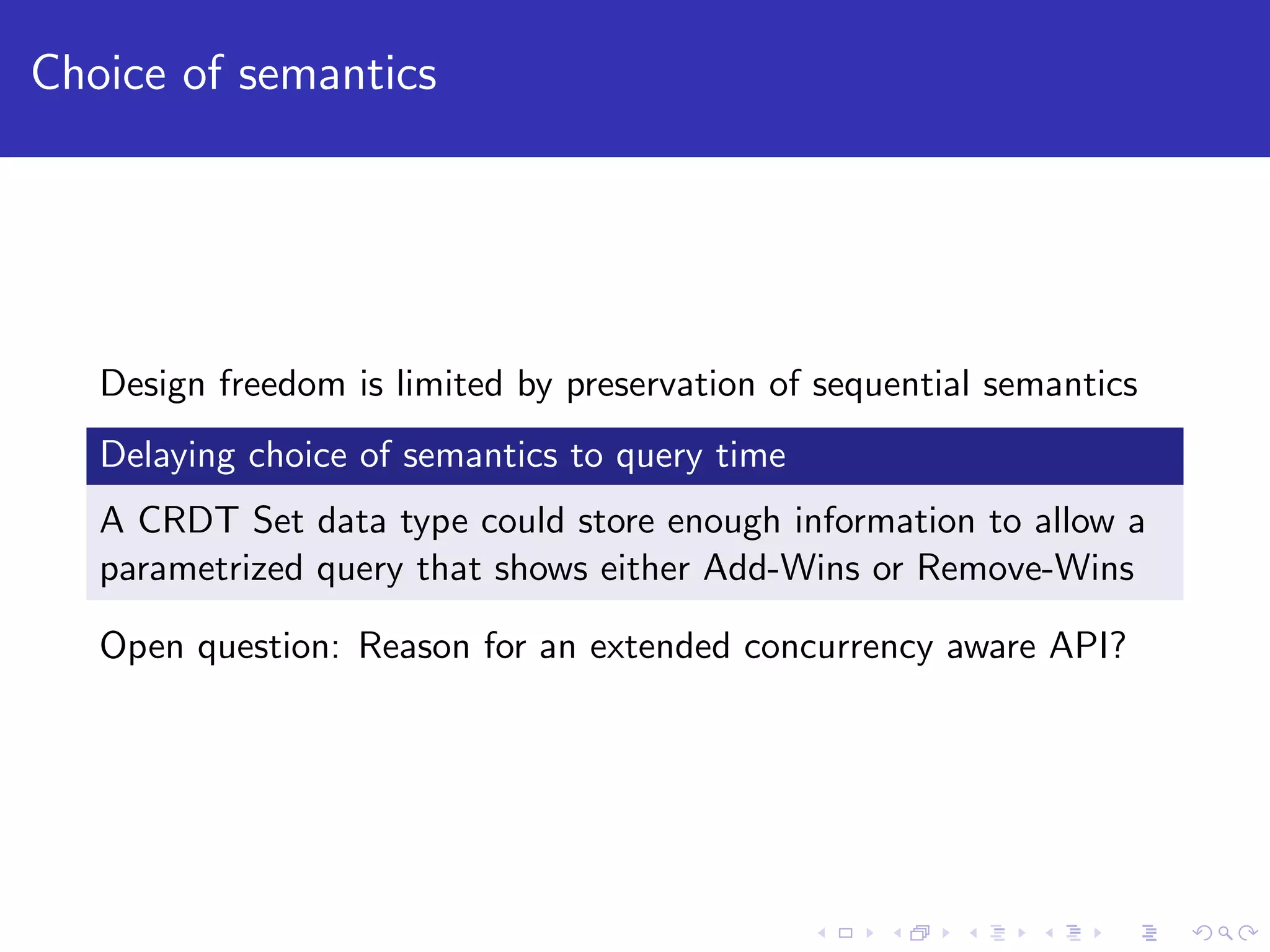
Choice of semantics
Design freedom is limited by preservation of sequential semantics
Delaying choice of semantics to query time
A CRDT Set data type could store enough information to allow a
parametrized query that shows either Add-Wins or Remove-Wins
Open question: Reason for an extended concurrency aware API?
Sequence/List
Weak/Strong Specification [Attiya et al, PODC 16]
Element x is kept
rpush(b) // xb
$$
// lpush(x) // x
99
%%
axb
lpush(a) // ax
::
Element x is removed (Redis enforces Strong Specification)
rpush(b) // xb
##
// lpush(x) // x
::
$$
// rem(x) // // ab ¬ ba
lpush(a) // ax
;;
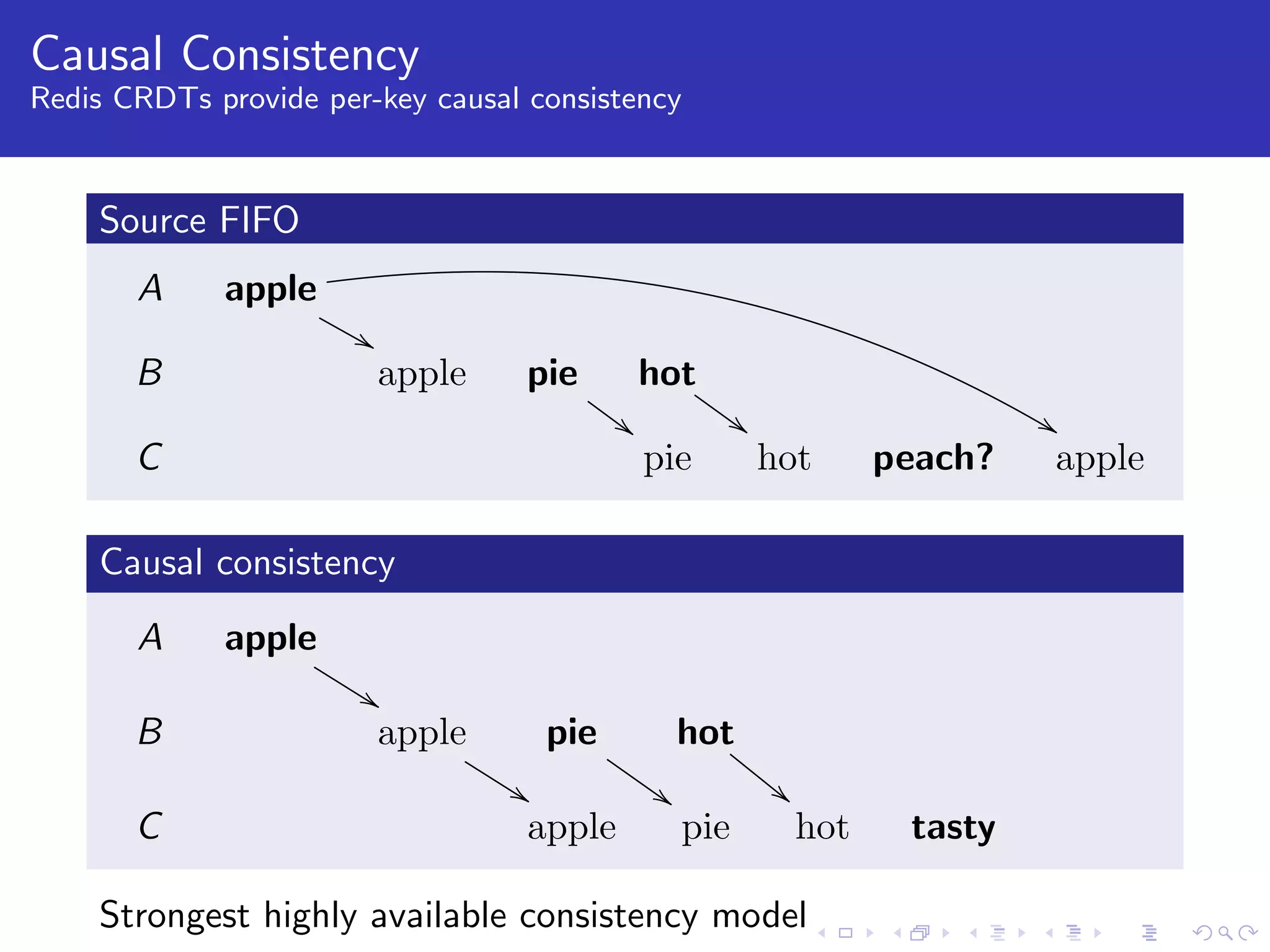
Causal Consistency
Redis CRDTs provide per-key causal consistency
Source FIFO
A apple

%%
B apple pie
##
hot
##
C pie hot peach? apple
Causal consistency
A apple
%%
B apple
%%
pie
$$
hot

C apple pie hot tasty
Strongest highly available consistency model
Thanks and Questions
Thanks to Yiftach, Yuval, Yossi, Meir, Cihan for their inputs
Glad to try to answer any questions
Carlos Baquero, cbm@di.uminho.pt, @xmal
#Redis #RedisConf

RedisConf18 - CRDTs and Redis - From sequential to concurrent executions

  • 1.
    CRDTs and Redis Fromsequential to concurrent executions Carlos Baquero HASLab, INESC TEC & Univ. Minho, Portugal April 26th 2018
  • 2.
    The speed ofcommunication in the 19th century W. H. Harrison’s death “At 12:30 am on April 4th, 1841 President William Henry Harrison died of pneumonia just a month after taking office. The Rich- mond Enquirer published the news of his death two days later on April 6th. The North- Carolina standard newspaper published it on April 14th. His death wasn’t known of in Los Angeles until July 23rd, 110 days after it had occurred.” Text by Zack Bloom, A Quick History of Digital Communication Before the Internet. https://eager.io/blog/communication-pre-internet/ Picture by By Albert Sands Southworth and Josiah Johnson Hawes
  • 3.
    The speed ofcommunication in the 19th century Francis Galton Isochronic Map
  • 4.
    The speed ofcommunication in the 21st century RTT data gathered via http://www.azurespeed.com
  • 5.
    The speed ofcommunication in the 21st century If you really like long latencies . . . Time delay between Mars and Earth blogs.esa.int/mex/2012/08/05/time-delay-between-mars-and-earth/ Delay/Disruption Tolerant Networking www.nasa.gov/content/dtn
  • 6.
    Latency magnitudes Geo-replication λ, upto 50ms (local region DC) Λ, between 100ms and 300ms (inter-continental) No inter-DC replication Client writes observe λ latency Planet-wide geo-replication Replication techniques versus client side write latency ranges Consensus/Paxos [Λ, 2Λ] (with no divergence) Primary-Backup [λ, Λ] (asynchronous version) Multi-Master λ (allowing divergence)
  • 7.
    EC and CAPfor Geo-Replication Eventually Consistent. CACM 2009, Werner Vogels In an ideal world there would be only one consistency model: when an update is made all observers would see that update. Building reliable distributed systems at a worldwide scale demands trade-offs between consistency and availability. CAP theorem. PODC 2000, Eric Brewer Of three properties of shared-data systems – data consistency, system availability, and tolerance to network partition – only two can be achieved at any given time. CRDTs provide support for partition-tolerant high availability
  • 8.
    From sequential toconcurrent executions Consensus and Primary-Backup provide illusion of a single replica This also preserves some illusion of sequential behaviour Sequential execution Ops O o // p // q Time // We have an ordered set (O, <). O = {o, p, q} and o < p < q
  • 9.
    From sequential toconcurrent executions Consensus and Primary-Backup provide illusion of a single replica This also preserves some illusion of sequential behaviour Sequential execution Ops O o // p // q Time // We have an ordered set (O, <). O = {o, p, q} and o < p < q
  • 10.
    From sequential toconcurrent executions EC Multi-master (or active-active) can expose concurrency Concurrent execution p // q Ops O o ?? r s 77 Time // Ordered set (O, ). o p q r and o s r Some ops in O are concurrent: p s and q s
  • 11.
    Design of Conflict-FreeReplicated Data Types A full partially ordered log of operations can implement any CRDT Replicas keep increasing local views of an evolving distributed log Any query can be expressed from that log Example: Counter at i is |{inc | inc ∈ Oi }| − |{dec | dec ∈ Oi }| CRDTs are efficient representations that follow some general rules
  • 12.
    Design of Conflict-FreeReplicated Data Types A full partially ordered log of operations can implement any CRDT Replicas keep increasing local views of an evolving distributed log Any query can be expressed from that log Example: Counter at i is |{inc | inc ∈ Oi }| − |{dec | dec ∈ Oi }| CRDTs are efficient representations that follow some general rules
  • 13.
    Design of Conflict-FreeReplicated Data Types A full partially ordered log of operations can implement any CRDT Replicas keep increasing local views of an evolving distributed log Any query can be expressed from that log Example: Counter at i is |{inc | inc ∈ Oi }| − |{dec | dec ∈ Oi }| CRDTs are efficient representations that follow some general rules
  • 14.
    Principle of permutationequivalence If operations in sequence can commute, preserving a given result, then under concurrency they should preserve the same result Sequential inc(10) // inc(35) // dec(5) // inc(2) dec(5) // inc(2) // inc(10) // inc(35) Concurrent inc(35) inc(10) 88 inc(2) dec(5) 88 You guessed: Result is 42
  • 15.
    Implementing Counters Example: CRDTPNCounters A inc(35) B inc(10) 88 inc(2) C dec(5) 88 Lets track total number of incs and decs done at each replica {A(incs, decs), . . . , C(. . . , . . .)}
  • 16.
    Implementing Counters Example: CRDTPNCounters Separate positive and negative counts are kept per replica A {A(35, 0), B(10, 0)} ++ B {B(10, 0)} 66 (( {A(35, 0), B(12, 0), C(0, 5)} C {B(10, 0), C(0, 5)} 33 Joining does point-wise maximums among entries (semilattice) At any time, counter value is sum of incs minus the sum of decs
  • 17.
    Implementing Counters Example: CRDTPNCounters Separate positive and negative counts are kept per replica A {A(35, 0), B(10, 0)} ++ B {B(10, 0)} 66 (( {A(35, 0), B(12, 0), C(0, 5)} C {B(10, 0), C(0, 5)} 33 Joining does point-wise maximums among entries (semilattice) At any time, counter value is sum of incs minus the sum of decs
  • 18.
    Implementing Counters Redis CRDTCounters There are multiple ways to implement CRDT counters Redis has a distinct implementation that favours garbage collection Redis CRDT counters are 59 bits (not 64) to avoid overflows
  • 19.
    Registers Registers are anordered set of write operations Sequential execution A wr(x) // wr(j) // wr(k) // wr(x) Sequential execution under distribution A wr(x) %% wr(x) B wr(j) // wr(k) 99 Register value is x, the last written value
  • 20.
    Implementing Registers Naif Last-Writer-Wins CRDTregister implemented by attaching local wall-clock times Sequential execution under distribution A (11 : 00)x (( (11 : 30)? B (12 : 02)j // (12 : 05)k 66 Problem: Wall-clock on B is one hour ahead of A Value x might not be writeable again at A since 12:05 11:30
  • 21.
    Registers Sequential Semantics Register showsvalue v at replica i iff wr(v) ∈ Oi and wr( ) ∈ Oi · wr(v) wr( )
  • 22.
    Preservation of sequentialsemantics Concurrent semantics should preserve the sequential semantics This also ensures correct sequential execution under distribution
  • 23.
    Multi-value Registers Concurrency semanticsshows all concurrent values {v | wr(v) ∈ Oi ∧ wr( ) ∈ Oi · wr(v) wr( )} Concurrent execution A wr(x) %% // wr(y) // {y, k} // wr(m) // {m} B wr(j) // wr(k) 99 Dynamo shopping carts are multi-value registers with payload sets The m value could be an application level merge of values y and k
  • 24.
    Implementing Multi-value Registers Concurrencycan be preciselly tracked with version vectors Concurrent execution (version vectors) A [1, 0]x %% // [2, 0]y // [2, 0]y, [1, 2]k // [3, 2]m B [1, 1]j // [1, 2]k 66 Metadata can be compressed with a common causal context and a single scalar per value (dotted version vectors)
  • 25.
    Registers in Redis LWWarbitration Multi-value registers allows executions leading to concurrent values Presenting concurrent values is at odds with the sequential API Redis both tracks causality and registers wall-clock times Querying uses Last-Writer-Wins selection among concurrent values This preserves correctness of sequential semantics A value with clock 12:05 can still be causally overwritten at 11:30
  • 26.
    Sets Sequential Semantics Consider addand rmv operations X = {. . .}, add(a) −→ add(c) we observe that a, c ∈ X X = {. . .}, add(c) −→ rmv(c) we observe that c ∈ X In general, given Oi , the set has elements {e | add(e) ∈ Oi ∧ rmv(e) ∈ Oi · add(e) rmv(e)}
  • 27.
    Sets Sequential Semantics Consider addand rmv operations X = {. . .}, add(a) −→ add(c) we observe that a, c ∈ X X = {. . .}, add(c) −→ rmv(c) we observe that c ∈ X In general, given Oi , the set has elements {e | add(e) ∈ Oi ∧ rmv(e) ∈ Oi · add(e) rmv(e)}
  • 28.
    Sets Sequential Semantics Consider addand rmv operations X = {. . .}, add(a) −→ add(c) we observe that a, c ∈ X X = {. . .}, add(c) −→ rmv(c) we observe that c ∈ X In general, given Oi , the set has elements {e | add(e) ∈ Oi ∧ rmv(e) ∈ Oi · add(e) rmv(e)}
  • 29.
    Sets Sequential Semantics Consider addand rmv operations X = {. . .}, add(a) −→ add(c) we observe that a, c ∈ X X = {. . .}, add(c) −→ rmv(c) we observe that c ∈ X In general, given Oi , the set has elements {e | add(e) ∈ Oi ∧ rmv(e) ∈ Oi · add(e) rmv(e)}
  • 30.
    Sets Sequential Semantics Consider addand rmv operations X = {. . .}, add(a) −→ add(c) we observe that a, c ∈ X X = {. . .}, add(c) −→ rmv(c) we observe that c ∈ X In general, given Oi , the set has elements {e | add(e) ∈ Oi ∧ rmv(e) ∈ Oi · add(e) rmv(e)}
  • 31.
    Sets Concurrency Semantics Problem: Concurrentlyadding and removing the same element Concurrent execution A add(x) %% // rmv(x) // {?} // add(x) // {x} B rmv(x) // add(x) ::
  • 32.
    Concurrency Semantics Add-Wins Sets Letschoose Add-Wins Consider a set of known operations Oi , at node i, that is ordered by an happens-before partial order . Set has elements {e | add(e) ∈ Oi ∧ rmv(e) ∈ Oi · add(e) rmv(e)} Is this familiar? The sequential semantics applies identical rules on a total order Redis CRDT sets are Add-Wins Sets
  • 33.
    Concurrency Semantics Add-Wins Sets Letschoose Add-Wins Consider a set of known operations Oi , at node i, that is ordered by an happens-before partial order . Set has elements {e | add(e) ∈ Oi ∧ rmv(e) ∈ Oi · add(e) rmv(e)} Is this familiar? The sequential semantics applies identical rules on a total order Redis CRDT sets are Add-Wins Sets
  • 34.
    Concurrency Semantics Add-Wins Sets Letschoose Add-Wins Consider a set of known operations Oi , at node i, that is ordered by an happens-before partial order . Set has elements {e | add(e) ∈ Oi ∧ rmv(e) ∈ Oi · add(e) rmv(e)} Is this familiar? The sequential semantics applies identical rules on a total order Redis CRDT sets are Add-Wins Sets
  • 35.
    Concurrency Semantics Add-Wins Sets Letschoose Add-Wins Consider a set of known operations Oi , at node i, that is ordered by an happens-before partial order . Set has elements {e | add(e) ∈ Oi ∧ rmv(e) ∈ Oi · add(e) rmv(e)} Is this familiar? The sequential semantics applies identical rules on a total order Redis CRDT sets are Add-Wins Sets
  • 36.
    Equivalence to asequential execution? Add-Wins Sets Can we always explain a concurrent execution by a sequential one? Concurrent execution A {x, y} // add(y) // rmv(x) // {y} // ## {x, y} B {x, y} // add(x) // rmv(y) // {x} // ;; {x, y} Two (failed) sequential explanations H1 {x, y} // . . . // rmv(x) // { x, y} H2 {x, y} // . . . // rmv(y) // {x, y} Concurrent executions can have richer outcomes
  • 37.
    Concurrency Semantics Remove-Wins Sets Alternative:Lets choose Remove-Wins Xi . = {e | add(e) ∈ Oi ∧ ∀ rmv(e) ∈ Oi · rmv(e) add(e)} Remove-Wins requires more metadata than Add-Wins Both Add and Remove-Wins have same semantics in a total order They are different but both preserve sequential semantics
  • 38.
    Concurrency Semantics Remove-Wins Sets Alternative:Lets choose Remove-Wins Xi . = {e | add(e) ∈ Oi ∧ ∀ rmv(e) ∈ Oi · rmv(e) add(e)} Remove-Wins requires more metadata than Add-Wins Both Add and Remove-Wins have same semantics in a total order They are different but both preserve sequential semantics
  • 39.
    Choice of semantics Designfreedom is limited by preservation of sequential semantics Delaying choice of semantics to query time A CRDT Set data type could store enough information to allow a parametrized query that shows either Add-Wins or Remove-Wins Open question: Reason for an extended concurrency aware API?
  • 40.
    Sequence/List Weak/Strong Specification [Attiyaet al, PODC 16] Element x is kept rpush(b) // xb $$ // lpush(x) // x 99 %% axb lpush(a) // ax :: Element x is removed (Redis enforces Strong Specification) rpush(b) // xb ## // lpush(x) // x :: $$ // rem(x) // // ab ¬ ba lpush(a) // ax ;;
  • 41.
    Causal Consistency Redis CRDTsprovide per-key causal consistency Source FIFO A apple %% B apple pie ## hot ## C pie hot peach? apple Causal consistency A apple %% B apple %% pie $$ hot C apple pie hot tasty Strongest highly available consistency model
  • 42.
    Thanks and Questions Thanksto Yiftach, Yuval, Yossi, Meir, Cihan for their inputs Glad to try to answer any questions Carlos Baquero, cbm@di.uminho.pt, @xmal #Redis #RedisConf