What is DRAMA? 
 Drama comes from Greek words meaning “to 
do” or “to act” 
 Drama is the specific mode of fiction represented 
in performance. 
 It is essentially social and involves contact, 
communication and the negotiation of meaning.
What is DRAMA? 
 Drama needs an individual or a group of people 
who use themselves – their bodies and their minds 
– through action and offers through speech to tell a 
story. 
 It is a social encounter in a special place and in a 
special time. The actors and the spectators move 
between real time and imaginary time, from 
existential reality to dramatic reality.
Chinese 
Drama
Chinese Drama 
1. Vun Pan Shi 
 The oldest form, focuses on patriotism and filial 
devotion. 
 Music and action are meant to play on the 
audience's emotion.
Chinese Drama 
2. Sin Pan Shi 
 This play presents civil and military conditions. 
 It differs from the Vun Pan Shi in the manner of 
singing certain roles and in the acting.
Chinese Drama 
3. Vun Min Shi 
 The modern play 
 Colloquial dialects are allowed instead of 
Mandarin.
Japanese 
Drama
Japanese Drama 
1. Noh Play 
 The oldest Japanese drama. Developed in the 
1300s, it reached its present form in the 1600s. 
 They are poetic treatments of history, legends, 
love and war stories, influenced by Buddhism and 
Shintoism.
Japanese Drama 
1. Noh Play 
 Shorter than Western plays and undramatic. 
Preformed by masked actors. 
 2 types: The Dramatic and Dream Noh 
 Dream Noh is rich in symbolic and poetic beauty.
Japanese Drama 
1. Noh Play 
 Although roughly 1000 plays were written, only 
about 250 plays are used today. 
 Hagoromo is one of the most performed Noh 
plays
Japanese Drama
Japanese Drama 
2. Joruri Play 
 A puppet drama. The puppets are extremely 
complex. 
 The puppeteers are often visible on stage. 
 Founded 1864 in Osaka. 
 The most popular subject for these plays was 
the lovers' double suicide.
Japanese Drama 
2. Joruri Play 
 The puppets height range from 2 ½ to 4 feet tall. 
The mouth, tongue, eyelids, etc. can be manipulated 
and some can even transform into a demon's face.
Japanese Drama
Japanese Drama 
3. Kabuki Drama 
 The most popular form of traditional Japanese 
Drama. 
 Originated at the end of the 16th century. 
 It is much more extravagant than the Noh plays.
Japanese Drama 
3. Kabuki Drama 
 Focuses on the visual aspects of theater: 
heavy makeup, exaggerated acting, and special 
effects.
Japanese Drama
History of 
Philippine 
Drama
Early forms of the Philippine 
Drama: 
 Duplo 
 It was a poetical debate held by trained men and 
women in the ninth night, the last night of the 
mourning period for the dead. 
 The male participants, bellacos , are the heads of 
the game.
Early forms of the Philippine 
Drama: 
 Karagatan 
 It was also a poetical debate like duplo, but its 
participants were amateurs. 
 The theme was all about a ring that fell into the 
sea.
Early forms of the Philippine 
Drama: 
 1598- The first recorded drama was staged 
in Cebu. It was a Comedia written by Vicente 
Puche and was performed in honor of Msgr. 
Pedro de Agurto, Cebu’s first bishop.
Early forms of the Philippine 
Drama: 
 1609- Eleven year after, another stage play 
portraying The Life of Santa Barbara was 
staged in Bicol.
Three Plays And Two Street 
Dramas That Became Popular 
During Spanish Era:
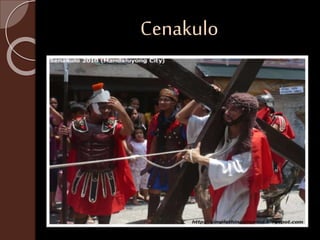
1. Cenakulo 
 It is a very heavy drama shown in relation to the 
life sacrifices and death f Jesus Christ. 
 It is like a passion play presented and celebrated 
during the month of March or April, depending upon 
the exact date of the Holy Week.
1. Cenakulo 
 Two kinds of presenting Cenakulo : 
Ablada – oral 
Kantada – song
Cenakulo
2. Moro-Moro 
 It is a cloak-and-dagger play depicting the wars 
between the Christians and the Muslims, with the 
Christians always on the winning side. 
 The first Moro-Moro was written by Fr. Jeronimo 
Perez and was staged in manila in 1637, to 
commemorate Governor General Consueras’ victory 
over the Muslims of Mindanao.
2. Moro-Moro 
Consueras’ victory over the Muslims of Mindanao. 
 Since then, it has become the favorite play of the 
people, especially during the town festivals.
Moro-Moro
3. Zarzuela 
 It is a melodrama with songs and dances that 
have a three-in-one-act play. 
 It is intended to make the mass feeling towards 
love, fear, grief, sorrow or any emotional reactions 
sublime. It sometimes shows the political and social 
conditions of our country.
3. Zarzuela 
 Jose Rizal wrote a zarzuela entitled Junto Al Pasig 
(Beside the Pasig). It was staged at the Ateneo de 
Manila on December 8, 1880 on the occasion of the 
celebration of the Feast Day of the Immaculate 
Conception, patron saint of the college.
Zarzuela 
Walang Sugat
4. Moriones 
 Morion festivals are a Lenten ritual that is as 
colorful as it is unique. 
 It is celebrated every Holy Week in Marinduque, 
an island at the southern end of Luzon, particularly 
in the towns of Boac, Gasan, and Mogpog.
4. Moriones 
 Morion means mask or visor which is the top part 
of the medieval Roman armor covering the face. It is 
this mask carved from dapdap wood that is the focal 
point of the Moriones celebration. 
 The climax of the festival is the pugutan 
ceremony held at noon of Easter Sunday.
Moriones
5. Ati-Atihan 
 It is a pagan ritual which has become an annual 
affair that the natives look forward to with great 
expectation. 
 It is the most extravagant fiesta in the Philippines 
celebrated in Kalibo, Aklan, and every third Sunday 
of January in honor of the Infant Jesus.
Ati-Atihan
Modern 
Philippine 
Drama
The Modern Philippine Drama/stage play was 
rejuvenated upon the establishment of the 
Repertory Philippines on June of 1967 which was 
founded by Zeneida “Bibot” Amador and Baby 
Barredo. 
 In its years of existence, Repertory Philippines 
has become the country’s leading theater company, 
keeping abreast of new materials and demanding 
outstanding performances from its extraordinary 
talents.
Alice in Wonderland 
Repertory Philippines 2013
Pinocchio 
Repertory Philippines 2014
Do You Know That? 
A world-wide show (A Dramatic Entertainment) , 
Miss Saigon , which was produced by Cameron 
Mackintosh of England whose company received a 
Queen’s award for Export Achievement was staged 
in the Cultural Center of the Philippines in March 
2001.
Do You Know That? 
 As to casting, the producers unanimously felt that 
they needed Asian voices that could sing Western 
music. And this world-wide search took them to 10 
countries including the Philippines where they 
found the majority of their original London cast.
Do You Know That? 
It is here that 
Miss Lea 
Salonga of the 
Philippines 
became the first 
star of the 
show. (Bilang 
Kim)
The Cinema
Cinema 
 The cinema or motion picture is one of the most 
popular forms of art and entertainment in the 
Philippines. 
 Philippine motion picture is also source of 
information as well as of entertainment. It can 
introduce us to new ideas and help us explore 
serious social issues.
Cinema 
 Students, industries and our government uses it 
for educational, to advertise their products and to 
inform and influence the Filipino and people from 
other countries. 
 It is an art form that has been called “a wild 
combination of art, culture, commerce, and 
technology.”
Cinema 
 The film extensively makes use of sound and 
light. It has its intellectual, imaginative, and technical 
aspects. 
 The introduction of the first moving pictures to 
the country on January 1, 1897 at the Salón de 
Pertierra in Manila.
Cinema 
 Dalagang Bukid (1919), a movie based on a 
popular musical play, was the first Filipino movie 
made and shown by Filipino filmmaker José 
Nepomuceno. Dubbed as the "Father of Philippine 
Cinema", his work marked the start of cinema as an 
art form in the Philippines.
Dalagang Bukid
Elements of 
Philippine 
Motion Picture
1. Music and Musical Director 
 During the era of silent movies, every cinema 
house employed musicians who played music that 
suited the tempo and varying moods of the scenes as 
they were projected on the screen while others used 
phonograph records for economy.
1. Music and Musical Director 
 The musician required to see the pictures and 
make musical arrangements that suited the tempo 
and moods on different scenes. 
 The musical director, in charge of the music, 
composed new songs and wrote their orchestration, 
repaired background music, created music scores, 
and supervised all recording and re-recording.
2. Make-Up, Coiffeur, and Costumes 
 Make-up consists of the sticky substances, which 
are applied on the face of the actors before facing 
the camera. 
 The hair of the actress should suit the part she 
place in the picture.
2. Make-Up, Coiffeur, and Costumes 
 Before, the actors were required to furnish their 
own attire. However, if they did not have particular 
attire or suit which the script required, the producer 
supplied them at his own expense.
3. Acting and the Stars 
 Acting is the art of portraying or impersonating a 
character. 
 A performer should forget his own personality 
and live the life of the character his portraying.
3. Acting and the Stars 
 Costumes, hair, make-up, body movement, 
mannerisms, and way of speaking, expression of the 
eyes and other parts of the face, the gesture of the 
hand are the factors that help the performers in 
perfecting the role he is portraying.
3. Color in the Movies 
 Color is the latest innovation in cinematography. 
 Color in local movies was attempted in 1941 by 
LVN Pictures Inc. in Ibong Adarna. LVN Pictures Inc 
was the first to introduce color in local movies.
4. Color in the Movies 
 Today, LVN color film laboratory is considered 
the best in the Far East. Color films and their 
processing cost twice as much as the black and 
white film. 
 At present, all the local pictures are already in 
color.
4. Color in the Movies 
 Today, LVN color film laboratory is considered 
the best in the Far East. Color films and their 
processing cost twice as much as the black and 
white film. 
 At present, all the local pictures are already in 
color.
5. Set and Art Director 
 Beautiful setting gives beauty to the pictures and 
pleases the eye. 
 Art directors should know the natural setting and 
build artificial sets. They should get the inspiration 
from liberal producers and disappoint the stingy 
ones.
5. Sounds, Cameras and Technicians 
 Technicians exert efforts in making the dialogue 
clear and music of fine quality. 
 Recording is the process where an orchestra 
playing the music or song is being recorded in the 
sound track by the recording apparatus.
5. Sounds, Cameras and Technicians 
 Playback is the method employed when an 
actress or actor borrows the voice of another. 
 Camera man is responsible for exact framing and 
also decides the use of masking, the choice of lens, 
the camera angle and the control of camera 
movements.

Drama (Philippine)

  • 2.
    What is DRAMA?  Drama comes from Greek words meaning “to do” or “to act”  Drama is the specific mode of fiction represented in performance.  It is essentially social and involves contact, communication and the negotiation of meaning.
  • 3.
    What is DRAMA?  Drama needs an individual or a group of people who use themselves – their bodies and their minds – through action and offers through speech to tell a story.  It is a social encounter in a special place and in a special time. The actors and the spectators move between real time and imaginary time, from existential reality to dramatic reality.
  • 4.
  • 5.
    Chinese Drama 1.Vun Pan Shi  The oldest form, focuses on patriotism and filial devotion.  Music and action are meant to play on the audience's emotion.
  • 6.
    Chinese Drama 2.Sin Pan Shi  This play presents civil and military conditions.  It differs from the Vun Pan Shi in the manner of singing certain roles and in the acting.
  • 7.
    Chinese Drama 3.Vun Min Shi  The modern play  Colloquial dialects are allowed instead of Mandarin.
  • 8.
  • 9.
    Japanese Drama 1.Noh Play  The oldest Japanese drama. Developed in the 1300s, it reached its present form in the 1600s.  They are poetic treatments of history, legends, love and war stories, influenced by Buddhism and Shintoism.
  • 10.
    Japanese Drama 1.Noh Play  Shorter than Western plays and undramatic. Preformed by masked actors.  2 types: The Dramatic and Dream Noh  Dream Noh is rich in symbolic and poetic beauty.
  • 11.
    Japanese Drama 1.Noh Play  Although roughly 1000 plays were written, only about 250 plays are used today.  Hagoromo is one of the most performed Noh plays
  • 12.
  • 13.
    Japanese Drama 2.Joruri Play  A puppet drama. The puppets are extremely complex.  The puppeteers are often visible on stage.  Founded 1864 in Osaka.  The most popular subject for these plays was the lovers' double suicide.
  • 14.
    Japanese Drama 2.Joruri Play  The puppets height range from 2 ½ to 4 feet tall. The mouth, tongue, eyelids, etc. can be manipulated and some can even transform into a demon's face.
  • 15.
  • 16.
    Japanese Drama 3.Kabuki Drama  The most popular form of traditional Japanese Drama.  Originated at the end of the 16th century.  It is much more extravagant than the Noh plays.
  • 17.
    Japanese Drama 3.Kabuki Drama  Focuses on the visual aspects of theater: heavy makeup, exaggerated acting, and special effects.
  • 18.
  • 19.
  • 20.
    Early forms ofthe Philippine Drama:  Duplo  It was a poetical debate held by trained men and women in the ninth night, the last night of the mourning period for the dead.  The male participants, bellacos , are the heads of the game.
  • 21.
    Early forms ofthe Philippine Drama:  Karagatan  It was also a poetical debate like duplo, but its participants were amateurs.  The theme was all about a ring that fell into the sea.
  • 22.
    Early forms ofthe Philippine Drama:  1598- The first recorded drama was staged in Cebu. It was a Comedia written by Vicente Puche and was performed in honor of Msgr. Pedro de Agurto, Cebu’s first bishop.
  • 23.
    Early forms ofthe Philippine Drama:  1609- Eleven year after, another stage play portraying The Life of Santa Barbara was staged in Bicol.
  • 24.
    Three Plays AndTwo Street Dramas That Became Popular During Spanish Era:
  • 25.
    1. Cenakulo It is a very heavy drama shown in relation to the life sacrifices and death f Jesus Christ.  It is like a passion play presented and celebrated during the month of March or April, depending upon the exact date of the Holy Week.
  • 26.
    1. Cenakulo Two kinds of presenting Cenakulo : Ablada – oral Kantada – song
  • 27.
  • 28.
    2. Moro-Moro It is a cloak-and-dagger play depicting the wars between the Christians and the Muslims, with the Christians always on the winning side.  The first Moro-Moro was written by Fr. Jeronimo Perez and was staged in manila in 1637, to commemorate Governor General Consueras’ victory over the Muslims of Mindanao.
  • 29.
    2. Moro-Moro Consueras’victory over the Muslims of Mindanao.  Since then, it has become the favorite play of the people, especially during the town festivals.
  • 30.
  • 31.
    3. Zarzuela It is a melodrama with songs and dances that have a three-in-one-act play.  It is intended to make the mass feeling towards love, fear, grief, sorrow or any emotional reactions sublime. It sometimes shows the political and social conditions of our country.
  • 32.
    3. Zarzuela Jose Rizal wrote a zarzuela entitled Junto Al Pasig (Beside the Pasig). It was staged at the Ateneo de Manila on December 8, 1880 on the occasion of the celebration of the Feast Day of the Immaculate Conception, patron saint of the college.
  • 33.
  • 34.
    4. Moriones Morion festivals are a Lenten ritual that is as colorful as it is unique.  It is celebrated every Holy Week in Marinduque, an island at the southern end of Luzon, particularly in the towns of Boac, Gasan, and Mogpog.
  • 35.
    4. Moriones Morion means mask or visor which is the top part of the medieval Roman armor covering the face. It is this mask carved from dapdap wood that is the focal point of the Moriones celebration.  The climax of the festival is the pugutan ceremony held at noon of Easter Sunday.
  • 36.
  • 37.
    5. Ati-Atihan It is a pagan ritual which has become an annual affair that the natives look forward to with great expectation.  It is the most extravagant fiesta in the Philippines celebrated in Kalibo, Aklan, and every third Sunday of January in honor of the Infant Jesus.
  • 38.
  • 39.
  • 40.
    The Modern PhilippineDrama/stage play was rejuvenated upon the establishment of the Repertory Philippines on June of 1967 which was founded by Zeneida “Bibot” Amador and Baby Barredo.  In its years of existence, Repertory Philippines has become the country’s leading theater company, keeping abreast of new materials and demanding outstanding performances from its extraordinary talents.
  • 41.
    Alice in Wonderland Repertory Philippines 2013
  • 42.
  • 43.
    Do You KnowThat? A world-wide show (A Dramatic Entertainment) , Miss Saigon , which was produced by Cameron Mackintosh of England whose company received a Queen’s award for Export Achievement was staged in the Cultural Center of the Philippines in March 2001.
  • 44.
    Do You KnowThat?  As to casting, the producers unanimously felt that they needed Asian voices that could sing Western music. And this world-wide search took them to 10 countries including the Philippines where they found the majority of their original London cast.
  • 45.
    Do You KnowThat? It is here that Miss Lea Salonga of the Philippines became the first star of the show. (Bilang Kim)
  • 46.
  • 47.
    Cinema  Thecinema or motion picture is one of the most popular forms of art and entertainment in the Philippines.  Philippine motion picture is also source of information as well as of entertainment. It can introduce us to new ideas and help us explore serious social issues.
  • 48.
    Cinema  Students,industries and our government uses it for educational, to advertise their products and to inform and influence the Filipino and people from other countries.  It is an art form that has been called “a wild combination of art, culture, commerce, and technology.”
  • 49.
    Cinema  Thefilm extensively makes use of sound and light. It has its intellectual, imaginative, and technical aspects.  The introduction of the first moving pictures to the country on January 1, 1897 at the Salón de Pertierra in Manila.
  • 50.
    Cinema  DalagangBukid (1919), a movie based on a popular musical play, was the first Filipino movie made and shown by Filipino filmmaker José Nepomuceno. Dubbed as the "Father of Philippine Cinema", his work marked the start of cinema as an art form in the Philippines.
  • 51.
  • 52.
    Elements of Philippine Motion Picture
  • 53.
    1. Music andMusical Director  During the era of silent movies, every cinema house employed musicians who played music that suited the tempo and varying moods of the scenes as they were projected on the screen while others used phonograph records for economy.
  • 54.
    1. Music andMusical Director  The musician required to see the pictures and make musical arrangements that suited the tempo and moods on different scenes.  The musical director, in charge of the music, composed new songs and wrote their orchestration, repaired background music, created music scores, and supervised all recording and re-recording.
  • 55.
    2. Make-Up, Coiffeur,and Costumes  Make-up consists of the sticky substances, which are applied on the face of the actors before facing the camera.  The hair of the actress should suit the part she place in the picture.
  • 56.
    2. Make-Up, Coiffeur,and Costumes  Before, the actors were required to furnish their own attire. However, if they did not have particular attire or suit which the script required, the producer supplied them at his own expense.
  • 57.
    3. Acting andthe Stars  Acting is the art of portraying or impersonating a character.  A performer should forget his own personality and live the life of the character his portraying.
  • 58.
    3. Acting andthe Stars  Costumes, hair, make-up, body movement, mannerisms, and way of speaking, expression of the eyes and other parts of the face, the gesture of the hand are the factors that help the performers in perfecting the role he is portraying.
  • 59.
    3. Color inthe Movies  Color is the latest innovation in cinematography.  Color in local movies was attempted in 1941 by LVN Pictures Inc. in Ibong Adarna. LVN Pictures Inc was the first to introduce color in local movies.
  • 60.
    4. Color inthe Movies  Today, LVN color film laboratory is considered the best in the Far East. Color films and their processing cost twice as much as the black and white film.  At present, all the local pictures are already in color.
  • 61.
    4. Color inthe Movies  Today, LVN color film laboratory is considered the best in the Far East. Color films and their processing cost twice as much as the black and white film.  At present, all the local pictures are already in color.
  • 62.
    5. Set andArt Director  Beautiful setting gives beauty to the pictures and pleases the eye.  Art directors should know the natural setting and build artificial sets. They should get the inspiration from liberal producers and disappoint the stingy ones.
  • 63.
    5. Sounds, Camerasand Technicians  Technicians exert efforts in making the dialogue clear and music of fine quality.  Recording is the process where an orchestra playing the music or song is being recorded in the sound track by the recording apparatus.
  • 64.
    5. Sounds, Camerasand Technicians  Playback is the method employed when an actress or actor borrows the voice of another.  Camera man is responsible for exact framing and also decides the use of masking, the choice of lens, the camera angle and the control of camera movements.