

Dispatch Assisted CPR in
Singapore
Dr Benjamin Leong
National University Health System
Ministry of Health
Singapore
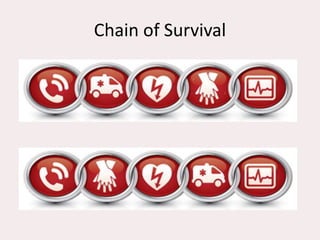
Chain of Survival
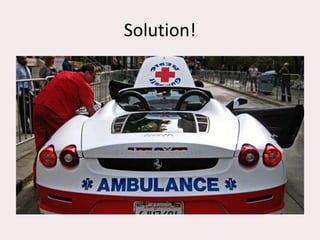
Solution!
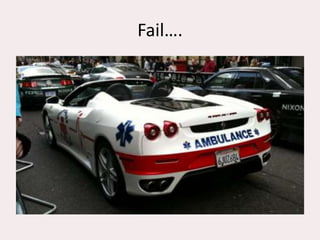
Fail….
True First Responder
• First point of contact
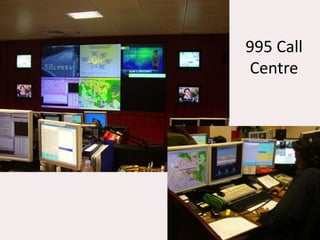
995 Call
Centre
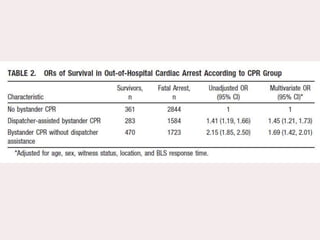
Why DA CPR?
• Circulation 2001
• 17 year population-based cohort study (1983-
2000)
• King’s County, Washington
• 7265 cases of cardiac arrest from EMS
• DA CPR - ventilation and compression
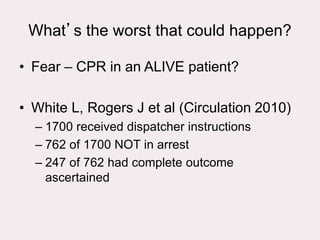
What’s the worst that could happen?
• Fear – CPR in an ALIVE patient?
• White L, Rogers J et al (Circulation 2010)
– 1700 received dispatcher instructions
– 762 of 1700 NOT in arrest
– 247 of 762 had complete outcome
ascertained
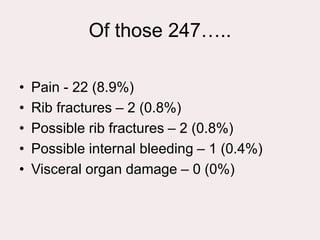
Of those 247…..
• Pain - 22 (8.9%)
• Rib fractures – 2 (0.8%)
• Possible rib fractures – 2 (0.8%)
• Possible internal bleeding – 1 (0.4%)
• Visceral organ damage – 0 (0%)
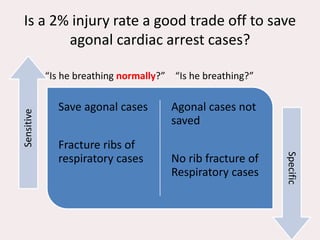
Is a 2% injury rate a good trade off to save
agonal cardiac arrest cases?
Save agonal cases
Fracture ribs of
respiratory cases
Agonal cases not
saved
No rib fracture of
Respiratory cases
Sensitive
Specific
“Is he breathing normally?” “Is he breathing?”
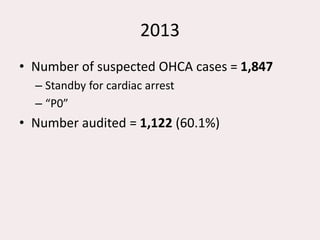
2013
• Number of suspected OHCA cases = 1,847
– Standby for cardiac arrest
– “P0”
• Number audited = 1,122 (60.1%)
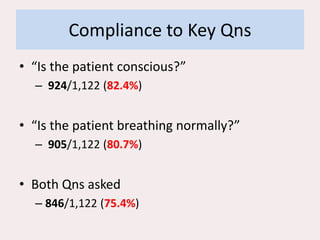
Compliance to Key Qns
• “Is the patient conscious?”
– 924/1,122 (82.4%)
• “Is the patient breathing normally?”
– 905/1,122 (80.7%)
• Both Qns asked
– 846/1,122 (75.4%)
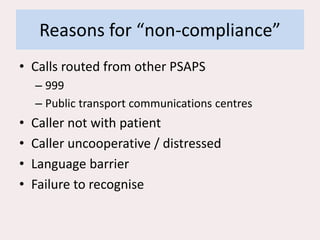
Reasons for “non-compliance”
• Calls routed from other PSAPS
– 999
– Public transport communications centres
• Caller not with patient
• Caller uncooperative / distressed
• Language barrier
• Failure to recognise
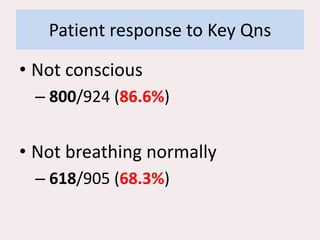
Patient response to Key Qns
• Not conscious
– 800/924 (86.6%)
• Not breathing normally
– 618/905 (68.3%)
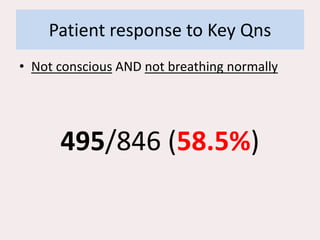
Patient response to Key Qns
• Not conscious AND not breathing normally
495/846 (58.5%)
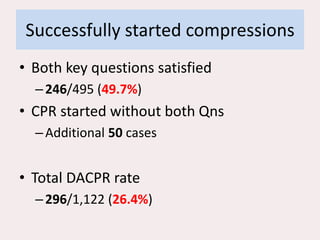
Successfully started compressions
• Both key questions satisfied
–246/495 (49.7%)
• CPR started without both Qns
–Additional 50 cases
• Total DACPR rate
–296/1,122 (26.4%)
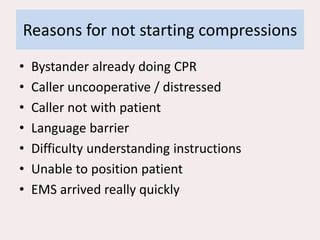
Reasons for not starting compressions
• Bystander already doing CPR
• Caller uncooperative / distressed
• Caller not with patient
• Language barrier
• Difficulty understanding instructions
• Unable to position patient
• EMS arrived really quickly
Example case
Case Example 2
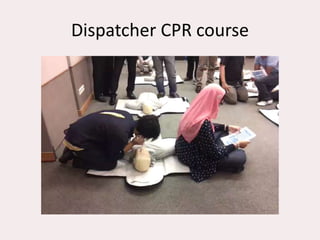
Dispatcher CPR course
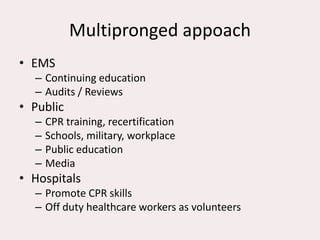
Multipronged appoach
• EMS
– Continuing education
– Audits / Reviews
• Public
– CPR training, recertification
– Schools, military, workplace
– Public education
– Media
• Hospitals
– Promote CPR skills
– Off duty healthcare workers as volunteers
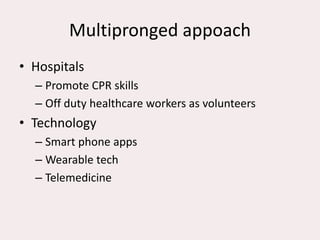
Multipronged appoach
• Hospitals
– Promote CPR skills
– Off duty healthcare workers as volunteers
• Technology
– Smart phone apps
– Wearable tech
– Telemedicine
Benjamin Leong - Dispatch assisted CPR in Singapore

Benjamin Leong - Dispatch assisted CPR in Singapore

  • 1.
    Dispatch Assisted CPRin Singapore Dr Benjamin Leong National University Health System Ministry of Health Singapore
  • 2.
  • 3.
  • 4.
  • 6.
    True First Responder •First point of contact
  • 7.
  • 8.
    Why DA CPR? •Circulation 2001 • 17 year population-based cohort study (1983- 2000) • King’s County, Washington • 7265 cases of cardiac arrest from EMS • DA CPR - ventilation and compression
  • 10.
    What’s the worstthat could happen? • Fear – CPR in an ALIVE patient? • White L, Rogers J et al (Circulation 2010) – 1700 received dispatcher instructions – 762 of 1700 NOT in arrest – 247 of 762 had complete outcome ascertained
  • 11.
    Of those 247….. •Pain - 22 (8.9%) • Rib fractures – 2 (0.8%) • Possible rib fractures – 2 (0.8%) • Possible internal bleeding – 1 (0.4%) • Visceral organ damage – 0 (0%)
  • 12.
    Is a 2%injury rate a good trade off to save agonal cardiac arrest cases? Save agonal cases Fracture ribs of respiratory cases Agonal cases not saved No rib fracture of Respiratory cases Sensitive Specific “Is he breathing normally?” “Is he breathing?”
  • 13.
    2013 • Number ofsuspected OHCA cases = 1,847 – Standby for cardiac arrest – “P0” • Number audited = 1,122 (60.1%)
  • 14.
    Compliance to KeyQns • “Is the patient conscious?” – 924/1,122 (82.4%) • “Is the patient breathing normally?” – 905/1,122 (80.7%) • Both Qns asked – 846/1,122 (75.4%)
  • 15.
    Reasons for “non-compliance” •Calls routed from other PSAPS – 999 – Public transport communications centres • Caller not with patient • Caller uncooperative / distressed • Language barrier • Failure to recognise
  • 16.
    Patient response toKey Qns • Not conscious – 800/924 (86.6%) • Not breathing normally – 618/905 (68.3%)
  • 17.
    Patient response toKey Qns • Not conscious AND not breathing normally 495/846 (58.5%)
  • 18.
    Successfully started compressions •Both key questions satisfied –246/495 (49.7%) • CPR started without both Qns –Additional 50 cases • Total DACPR rate –296/1,122 (26.4%)
  • 19.
    Reasons for notstarting compressions • Bystander already doing CPR • Caller uncooperative / distressed • Caller not with patient • Language barrier • Difficulty understanding instructions • Unable to position patient • EMS arrived really quickly
  • 20.
  • 21.
  • 22.
  • 25.
    Multipronged appoach • EMS –Continuing education – Audits / Reviews • Public – CPR training, recertification – Schools, military, workplace – Public education – Media • Hospitals – Promote CPR skills – Off duty healthcare workers as volunteers
  • 26.
    Multipronged appoach • Hospitals –Promote CPR skills – Off duty healthcare workers as volunteers • Technology – Smart phone apps – Wearable tech – Telemedicine