General Chemistry
Principles and Modern Applications
   Petrucci • Harwood • Herring
             8th Edition


   Chapter 8: The Atmospheric Gases and
                 Hydrogen

                            Philip Dutton
                   University of Windsor, Canada

                       Prentice-Hall © 2002


  Prentice-Hall      General Chemistry: ChapterSlide 1 of 32
                                                8
Contents
8-1   The Atmosphere
8-3   Nitrogen
8-4   Oxygen
8-5   The Noble Gases
8-6   Hydrogen
      Focus on The Carbon Cycle


Prentice-Hall   General Chemistry: ChapterSlide 2 of 32
                                           8
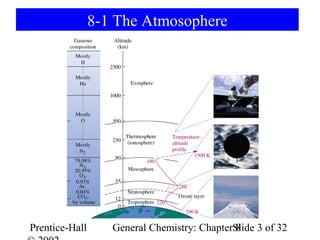
8-1 The Atmosophere


Prentice-Hall      General Chemistry: ChapterSlide 3 of 32
                                              8
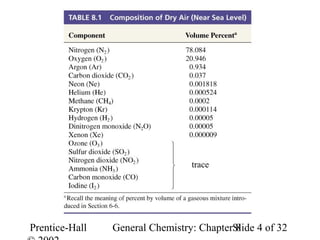
Composition of Dry Air


                                 trace


Prentice-Hall   General Chemistry: ChapterSlide 4 of 32
                                           8
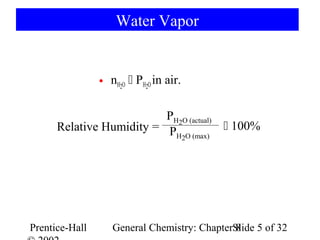
Water Vapor


                • nH2O  PH2O in air.

                          PH2O (actual)
      Relative Humidity = P              100%
                            H2O (max)


Prentice-Hall      General Chemistry: ChapterSlide 5 of 32
                                              8
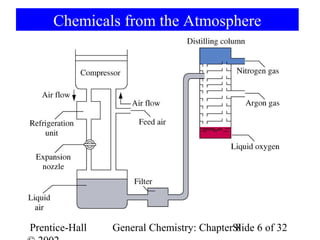
Chemicals from the Atmosphere


Prentice-Hall   General Chemistry: ChapterSlide 6 of 32
                                           8
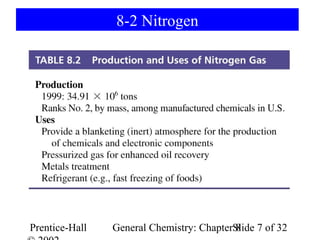
8-2 Nitrogen


Prentice-Hall   General Chemistry: ChapterSlide 7 of 32
                                           8
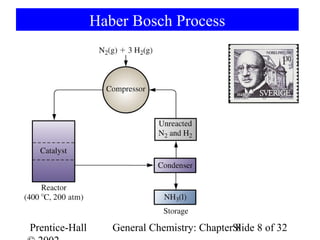
Haber Bosch Process


Prentice-Hall      General Chemistry: ChapterSlide 8 of 32
                                              8
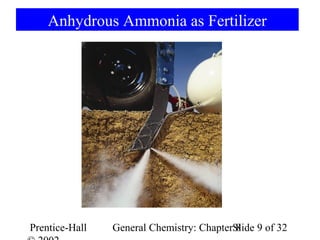
Anhydrous Ammonia as Fertilizer


Prentice-Hall   General Chemistry: ChapterSlide 9 of 32
                                           8
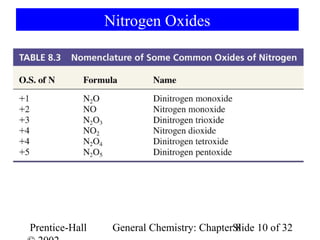
Nitrogen Oxides


Prentice-Hall    General Chemistry: ChapterSlide 10 of 32
                                            8
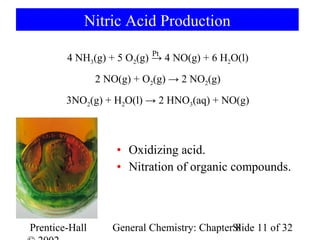
Nitric Acid Production
                           Pt
        4 NH3(g) + 5 O2(g) → 4 NO(g) + 6 H2O(l)
                2 NO(g) + O2(g) → 2 NO2(g)
        3NO2(g) + H2O(l) → 2 HNO3(aq) + NO(g)


                    • Oxidizing acid.
                    • Nitration of organic compounds.


Prentice-Hall      General Chemistry: ChapterSlide 11 of 32
                                              8
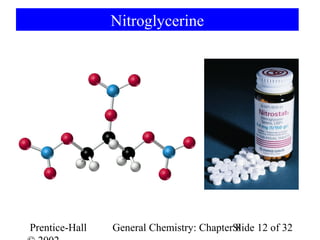
Nitroglycerine


Prentice-Hall   General Chemistry: ChapterSlide 12 of 32
                                           8
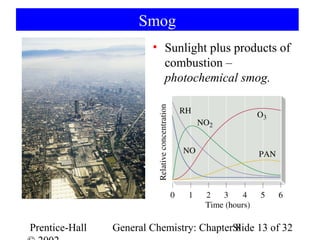
Smog
                        • Sunlight plus products of
                          combustion –
                          photochemical smog.


Prentice-Hall   General Chemistry: ChapterSlide 13 of 32
                                           8
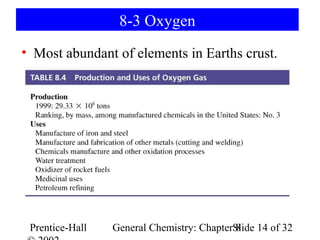
8-3 Oxygen
• Most abundant of elements in Earths crust.


 Prentice-Hall   General Chemistry: ChapterSlide 14 of 32
                                            8
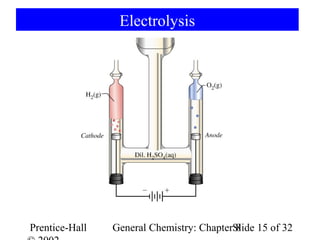
Electrolysis


Prentice-Hall   General Chemistry: ChapterSlide 15 of 32
                                           8
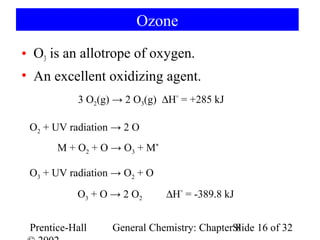
Ozone

• O3 is an allotrope of oxygen.
• An excellent oxidizing agent.
            3 O2(g) → 2 O3(g) ∆H° = +285 kJ

 O2 + UV radiation → 2 O
       M + O2 + O → O3 + M*

 O3 + UV radiation → O2 + O
           O3 + O → 2 O2      ∆H° = -389.8 kJ


 Prentice-Hall     General Chemistry: ChapterSlide 16 of 32
                                              8
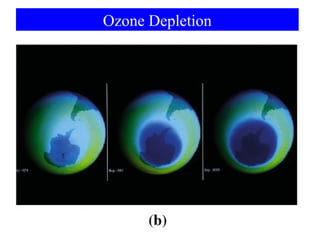
Ozone Depletion


Prentice-Hall    General Chemistry: ChapterSlide 17 of 32
                                            8
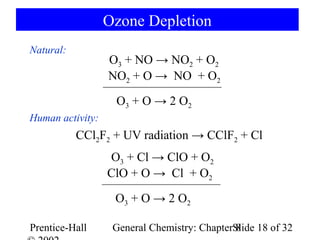
Ozone Depletion
Natural:
                  O3 + NO → NO2 + O2
                  NO2 + O → NO + O2

                   O3 + O → 2 O2
Human activity:
           CCl2F2 + UV radiation → CClF2 + Cl
                  O3 + Cl → ClO + O2
                  ClO + O → Cl + O2

                   O3 + O → 2 O2

Prentice-Hall      General Chemistry: ChapterSlide 18 of 32
                                              8
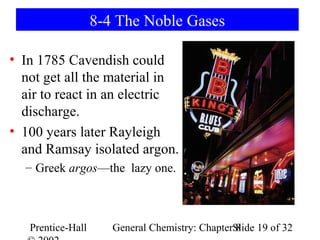
8-4 The Noble Gases

• In 1785 Cavendish could
  not get all the material in
  air to react in an electric
  discharge.
• 100 years later Rayleigh
  and Ramsay isolated argon.
  – Greek argos—the lazy one.


   Prentice-Hall      General Chemistry: ChapterSlide 19 of 32
                                                 8
Noble Gases

• Used in light bulbs, lasers and flash bulbs.
• He and Ar are used as “blanket” materials to
  keep air out of certain systems.
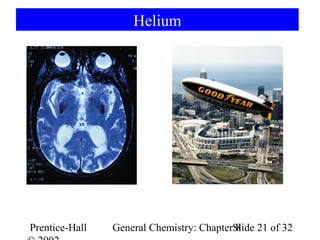
• He is used as a breathing mixture for deep
  diving applications.
• Superconducting magnets use He(l) as coolant.


 Prentice-Hall   General Chemistry: ChapterSlide 20 of 32
                                            8
Helium


Prentice-Hall   General Chemistry: ChapterSlide 21 of 32
                                           8
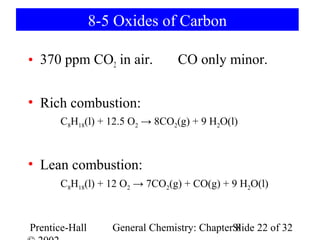
8-5 Oxides of Carbon

• 370 ppm CO2 in air.            CO only minor.


• Rich combustion:
       C8H18(l) + 12.5 O2 → 8CO2(g) + 9 H2O(l)


• Lean combustion:
       C8H18(l) + 12 O2 → 7CO2(g) + CO(g) + 9 H2O(l)


Prentice-Hall      General Chemistry: ChapterSlide 22 of 32
                                              8
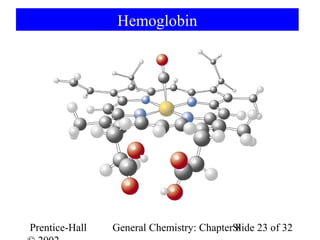
Hemoglobin


Prentice-Hall   General Chemistry: ChapterSlide 23 of 32
                                           8
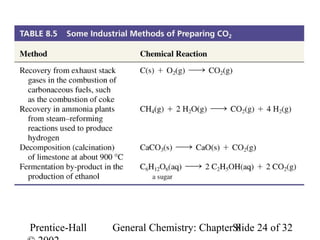
Industrial Preparation of CO2


Prentice-Hall   General Chemistry: ChapterSlide 24 of 32
                                           8
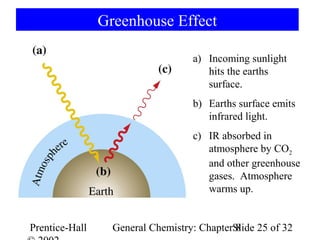
Greenhouse Effect

                                   a) Incoming sunlight
                                      hits the earths
                                      surface.
                                   b) Earths surface emits
                                      infrared light.
                                   c) IR absorbed in
                                      atmosphere by CO2
                                      and other greenhouse
                                      gases. Atmosphere
                                      warms up.


Prentice-Hall     General Chemistry: ChapterSlide 25 of 32
                                             8
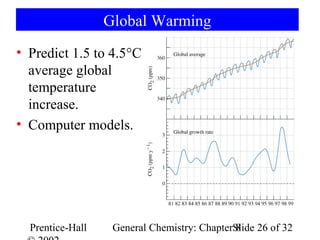
Global Warming
• Predict 1.5 to 4.5°C
  average global
  temperature
  increase.
• Computer models.


  Prentice-Hall    General Chemistry: ChapterSlide 26 of 32
                                              8
8-6 Hydrogen
• Minor component of atmosphere.
• 90% of atoms and 75% of universe mass.
• Produced using the water—gas reactions:
             C(s) + H2O(g) → CO(g) + H2(g)
           CO(g) + H2O(g) → CO2(g) + H2(g)

  Or by the reforming of methane:
           CH4(g) + H2O(g) → CO(g) + 3 H2(g)


 Prentice-Hall    General Chemistry: ChapterSlide 27 of 32
                                             8
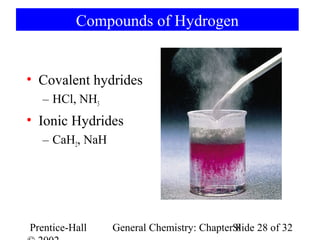
Compounds of Hydrogen


• Covalent hydrides
  – HCl, NH3
• Ionic Hydrides
  – CaH2, NaH


Prentice-Hall   General Chemistry: ChapterSlide 28 of 32
                                           8
Uses of Hydrogen

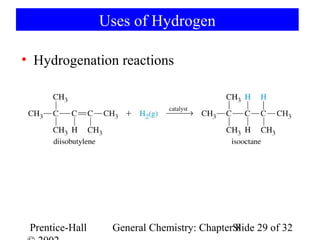
• Hydrogenation reactions


 Prentice-Hall    General Chemistry: ChapterSlide 29 of 32
                                             8
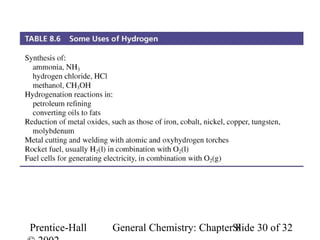
Uses of Hydrogen


Prentice-Hall    General Chemistry: ChapterSlide 30 of 32
                                            8
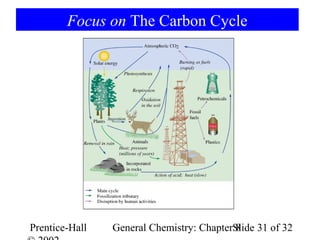
Focus on The Carbon Cycle


Prentice-Hall   General Chemistry: ChapterSlide 31 of 32
                                           8
Chapter 8 Questions


            1, 2, 5, 9, 10, 23,
            29, 35, 41, 45, 53,
            60, 63.


Prentice-Hall     General Chemistry: ChapterSlide 32 of 32
                                             8

Ch08

  • 1.
    General Chemistry Principles andModern Applications Petrucci • Harwood • Herring 8th Edition Chapter 8: The Atmospheric Gases and Hydrogen Philip Dutton University of Windsor, Canada Prentice-Hall © 2002 Prentice-Hall General Chemistry: ChapterSlide 1 of 32 8
  • 2.
    Contents 8-1 The Atmosphere 8-3 Nitrogen 8-4 Oxygen 8-5 The Noble Gases 8-6 Hydrogen Focus on The Carbon Cycle Prentice-Hall General Chemistry: ChapterSlide 2 of 32 8
  • 3.
    8-1 The Atmosophere Prentice-Hall General Chemistry: ChapterSlide 3 of 32 8
  • 4.
    Composition of DryAir trace Prentice-Hall General Chemistry: ChapterSlide 4 of 32 8
  • 5.
    Water Vapor • nH2O  PH2O in air. PH2O (actual) Relative Humidity = P  100% H2O (max) Prentice-Hall General Chemistry: ChapterSlide 5 of 32 8
  • 6.
    Chemicals from theAtmosphere Prentice-Hall General Chemistry: ChapterSlide 6 of 32 8
  • 7.
    8-2 Nitrogen Prentice-Hall General Chemistry: ChapterSlide 7 of 32 8
  • 8.
    Haber Bosch Process Prentice-Hall General Chemistry: ChapterSlide 8 of 32 8
  • 9.
    Anhydrous Ammonia asFertilizer Prentice-Hall General Chemistry: ChapterSlide 9 of 32 8
  • 10.
    Nitrogen Oxides Prentice-Hall General Chemistry: ChapterSlide 10 of 32 8
  • 11.
    Nitric Acid Production Pt 4 NH3(g) + 5 O2(g) → 4 NO(g) + 6 H2O(l) 2 NO(g) + O2(g) → 2 NO2(g) 3NO2(g) + H2O(l) → 2 HNO3(aq) + NO(g) • Oxidizing acid. • Nitration of organic compounds. Prentice-Hall General Chemistry: ChapterSlide 11 of 32 8
  • 12.
    Nitroglycerine Prentice-Hall General Chemistry: ChapterSlide 12 of 32 8
  • 13.
    Smog • Sunlight plus products of combustion – photochemical smog. Prentice-Hall General Chemistry: ChapterSlide 13 of 32 8
  • 14.
    8-3 Oxygen • Mostabundant of elements in Earths crust. Prentice-Hall General Chemistry: ChapterSlide 14 of 32 8
  • 15.
    Electrolysis Prentice-Hall General Chemistry: ChapterSlide 15 of 32 8
  • 16.
    Ozone • O3 isan allotrope of oxygen. • An excellent oxidizing agent. 3 O2(g) → 2 O3(g) ∆H° = +285 kJ O2 + UV radiation → 2 O M + O2 + O → O3 + M* O3 + UV radiation → O2 + O O3 + O → 2 O2 ∆H° = -389.8 kJ Prentice-Hall General Chemistry: ChapterSlide 16 of 32 8
  • 17.
    Ozone Depletion Prentice-Hall General Chemistry: ChapterSlide 17 of 32 8
  • 18.
    Ozone Depletion Natural: O3 + NO → NO2 + O2 NO2 + O → NO + O2 O3 + O → 2 O2 Human activity: CCl2F2 + UV radiation → CClF2 + Cl O3 + Cl → ClO + O2 ClO + O → Cl + O2 O3 + O → 2 O2 Prentice-Hall General Chemistry: ChapterSlide 18 of 32 8
  • 19.
    8-4 The NobleGases • In 1785 Cavendish could not get all the material in air to react in an electric discharge. • 100 years later Rayleigh and Ramsay isolated argon. – Greek argos—the lazy one. Prentice-Hall General Chemistry: ChapterSlide 19 of 32 8
  • 20.
    Noble Gases • Usedin light bulbs, lasers and flash bulbs. • He and Ar are used as “blanket” materials to keep air out of certain systems. • He is used as a breathing mixture for deep diving applications. • Superconducting magnets use He(l) as coolant. Prentice-Hall General Chemistry: ChapterSlide 20 of 32 8
  • 21.
    Helium Prentice-Hall General Chemistry: ChapterSlide 21 of 32 8
  • 22.
    8-5 Oxides ofCarbon • 370 ppm CO2 in air. CO only minor. • Rich combustion: C8H18(l) + 12.5 O2 → 8CO2(g) + 9 H2O(l) • Lean combustion: C8H18(l) + 12 O2 → 7CO2(g) + CO(g) + 9 H2O(l) Prentice-Hall General Chemistry: ChapterSlide 22 of 32 8
  • 23.
    Hemoglobin Prentice-Hall General Chemistry: ChapterSlide 23 of 32 8
  • 24.
    Industrial Preparation ofCO2 Prentice-Hall General Chemistry: ChapterSlide 24 of 32 8
  • 25.
    Greenhouse Effect a) Incoming sunlight hits the earths surface. b) Earths surface emits infrared light. c) IR absorbed in atmosphere by CO2 and other greenhouse gases. Atmosphere warms up. Prentice-Hall General Chemistry: ChapterSlide 25 of 32 8
  • 26.
    Global Warming • Predict1.5 to 4.5°C average global temperature increase. • Computer models. Prentice-Hall General Chemistry: ChapterSlide 26 of 32 8
  • 27.
    8-6 Hydrogen • Minorcomponent of atmosphere. • 90% of atoms and 75% of universe mass. • Produced using the water—gas reactions: C(s) + H2O(g) → CO(g) + H2(g) CO(g) + H2O(g) → CO2(g) + H2(g) Or by the reforming of methane: CH4(g) + H2O(g) → CO(g) + 3 H2(g) Prentice-Hall General Chemistry: ChapterSlide 27 of 32 8
  • 28.
    Compounds of Hydrogen •Covalent hydrides – HCl, NH3 • Ionic Hydrides – CaH2, NaH Prentice-Hall General Chemistry: ChapterSlide 28 of 32 8
  • 29.
    Uses of Hydrogen •Hydrogenation reactions Prentice-Hall General Chemistry: ChapterSlide 29 of 32 8
  • 30.
    Uses of Hydrogen Prentice-Hall General Chemistry: ChapterSlide 30 of 32 8
  • 31.
    Focus on TheCarbon Cycle Prentice-Hall General Chemistry: ChapterSlide 31 of 32 8
  • 32.
    Chapter 8 Questions 1, 2, 5, 9, 10, 23, 29, 35, 41, 45, 53, 60, 63. Prentice-Hall General Chemistry: ChapterSlide 32 of 32 8

Editor's Notes

  • #2 Thermochemistry branch of chemistry concerned with heat effects accompanying chemical reactions. Direct and indirect measurement of heat. Answer practical questions: why is natural gas a better fuel than coal, and why do fats have higher energy value than carbohydrates and protiens.
  • #14 PAN is peroxyacetyl nitrate. Reduce smog by using catalytic converters.
  • #15 Oxygen in crust is 45.5% Compounds with all elements except He Ne and Ar.
  • #16 Not economical unless you are only making small volumes.
  • #17 Ozone production in the upper atmosphere uses UV Ozone itself also uses UV during its decomposition.
  • #19 NO goes a long way. There is a balance of production and loss maintaining O 3 at about 8 ppm. Other depletion pathways that are formed by human activity upset the balance.