Presentation on Invention of shoe
PRESENTED BY PRANAB DEBBARMA
REDG NO.2008-V-38
10/27/15
1
pb
COURSE NO.-VSR -511
A History of Shoes
The history of shoes--that is to say, archaeological and
pale anthropological evidence for the earliest use of
protective coverings for the human foot--appears to start
during the Middle Paleolithic period of approximately
40,000 years ago.
10/27/15
2
pb
The Origins of Shoe Use
• It is probable that the first shoes were worn by ancient
man in the Ice Age, around 500,000 years ago, out of
necessity to protect against the harsh climate.
• Historians hypothesise that indeed footwear must have
been necessary to deal with the conditions.
• However, protective footwear similar to the modern-day
shoe is considered to be a much later development.
• It has been difficult for archaeologists to determine
exactly when humans stopped going barefoot, however,
because the plant and animal materials used to make
prehistoric shoes is highly perishable.
10/27/15
3
pb
Scientists have suggested that strong protective first came
into widespread use between 40,000 and 26,000 years
ago. These dates were established by examining the foot
bones of early modern humans from 10,000 to 100,000
years ago.
• Humans from 100,000 to 40,000 years ago have stronger
and thicker small toes that those of around 26,000 years
ago.
•Currently, the earliest use of shoes that hard evidence
supports is the end of the Upper Palaeolithic period, and
the end of the last Ice Age, around 10,000 years ago.
10/27/15
4
pb
When was the first shoe
invented?
• In Mesopotamia, (c. 1600-1200 BC) a type of soft shoes
were worn by the mountain people who lived on the
border of Iran.
• The soft shoe was made of wraparound leather.
10/27/15
5
pb
Who invented the shoe?
• At the time, no machine could attach the upper part of a shoe
to the sole. This had to be done manually by a "hand laster"; a
skilled one could produce 50 pairs in a ten-hour day.
• After five years of work, J.E Matzeliger obtained a patent
for his invention in 1883.
10/27/15
6
pb
Timeline of Shoes
• 40000 BC – First archeological evidence of protective foot
covering found in Ice Age settlements.
• 4000 BC –First recorded mentioning of shoes as “flexible
pieces of leather” came from Ancient Egypt.
• 3627 BC – Archeologist found the earliest known leather shoe
near one of the cave dwellings in Armenia.
10/27/15
7
pb
• 3rd to 1st millennia BC – Many civilizations around the world
used simple leather sandals in their daily life.
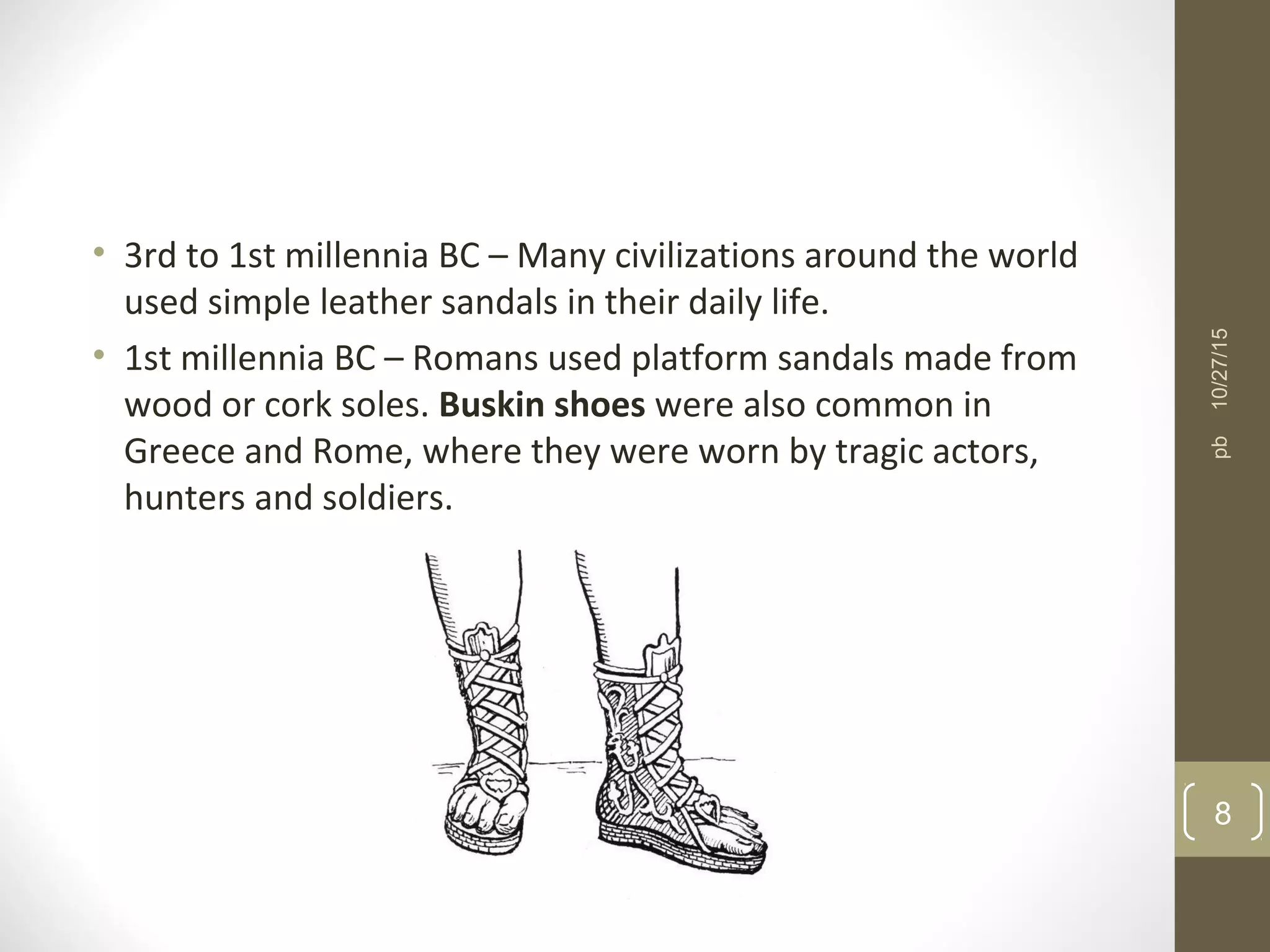
• 1st millennia BC – Romans used platform sandals made from
wood or cork soles. Buskin shoes were also common in
Greece and Rome, where they were worn by tragic actors,
hunters and soldiers.
10/27/15
8
pb
• Around 1000 AD – Shoes and sandals become commonplace across
Europe, but they are often crude and hard to wear for long periods
of time..
• 12th and 13th century – Fashionable shoes started being produced
for nobility and royalty.
• 1533 – Italian noblewoman Catherine d’Medici
introduced to France fashion of high heels.
• 1789 – French Revolution brought to the end the fashion
of high heeled man and female footwear, and
popularized more “down to earth” designs.
10/27/15
9
pb
• 1790 – English inventors introduced shoelaces for the first time.
• 1800 – In 19th century shoes finally became made for each foot
individually.
• 1883 - African-American inventor Jan Ernst Matzeliger invented
machine for automated production of shoes. This invention
changed the shoe industry forever.
10/27/15
10
pb
• 1888 – First high heeled shoe factory opened in United
States. This event enabled US females to largely abandon
import of expensive shoes from France.
• 1899 – Irish-American inventor Humphrey O'Sullivan
successfully patented rubber heel for shoes.
• 1917 – First successful sneakers (canvas top design with
rubber sole) started being sold in United States.
• 1980 – Athletic shoes that were first introduced in early 20th
century became widely popular across the world.
10/27/15
11
pb
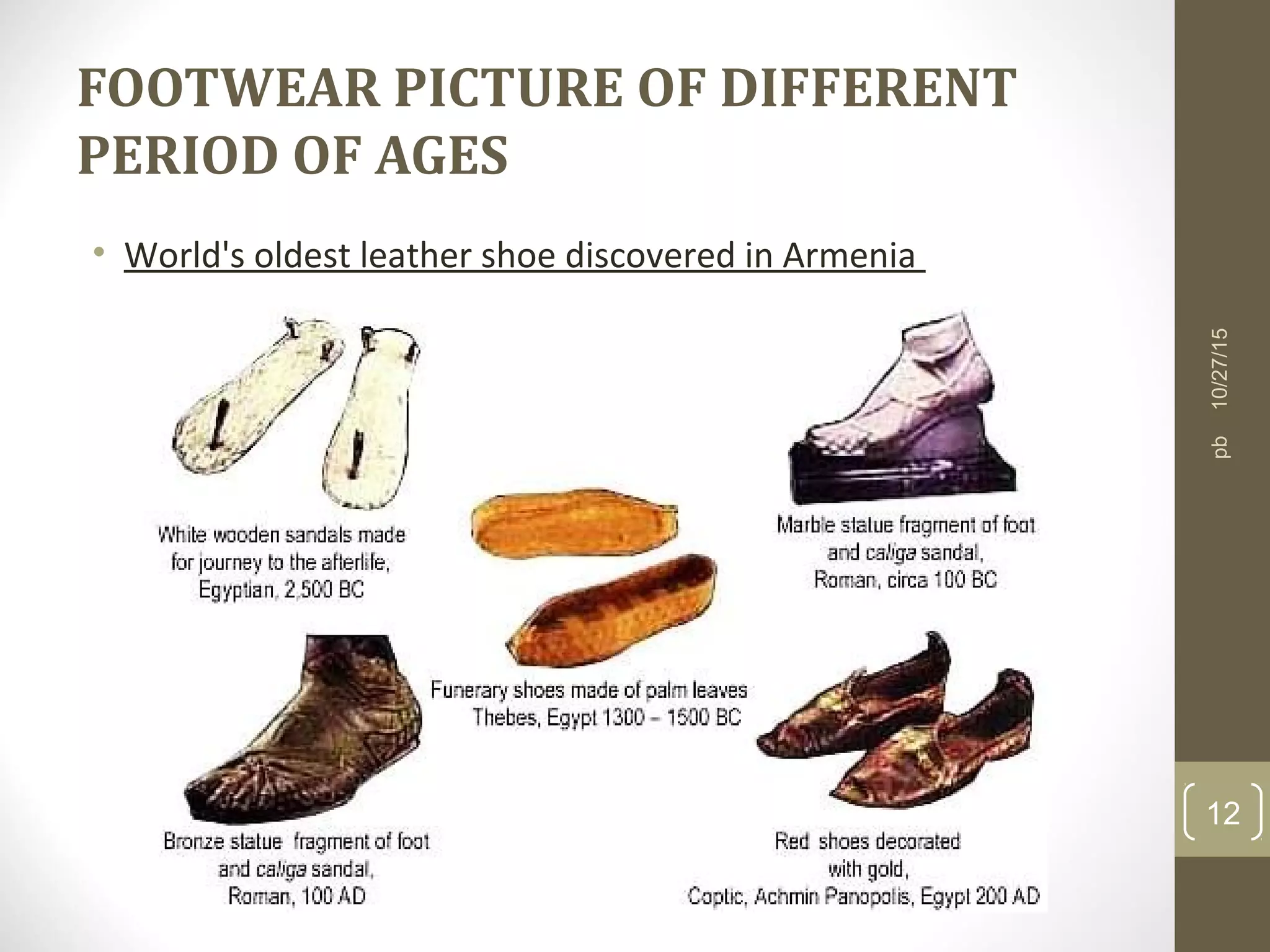
FOOTWEAR PICTURE OF DIFFERENT
PERIOD OF AGES
• World's oldest leather shoe discovered in Armenia
10/27/15
12
pb
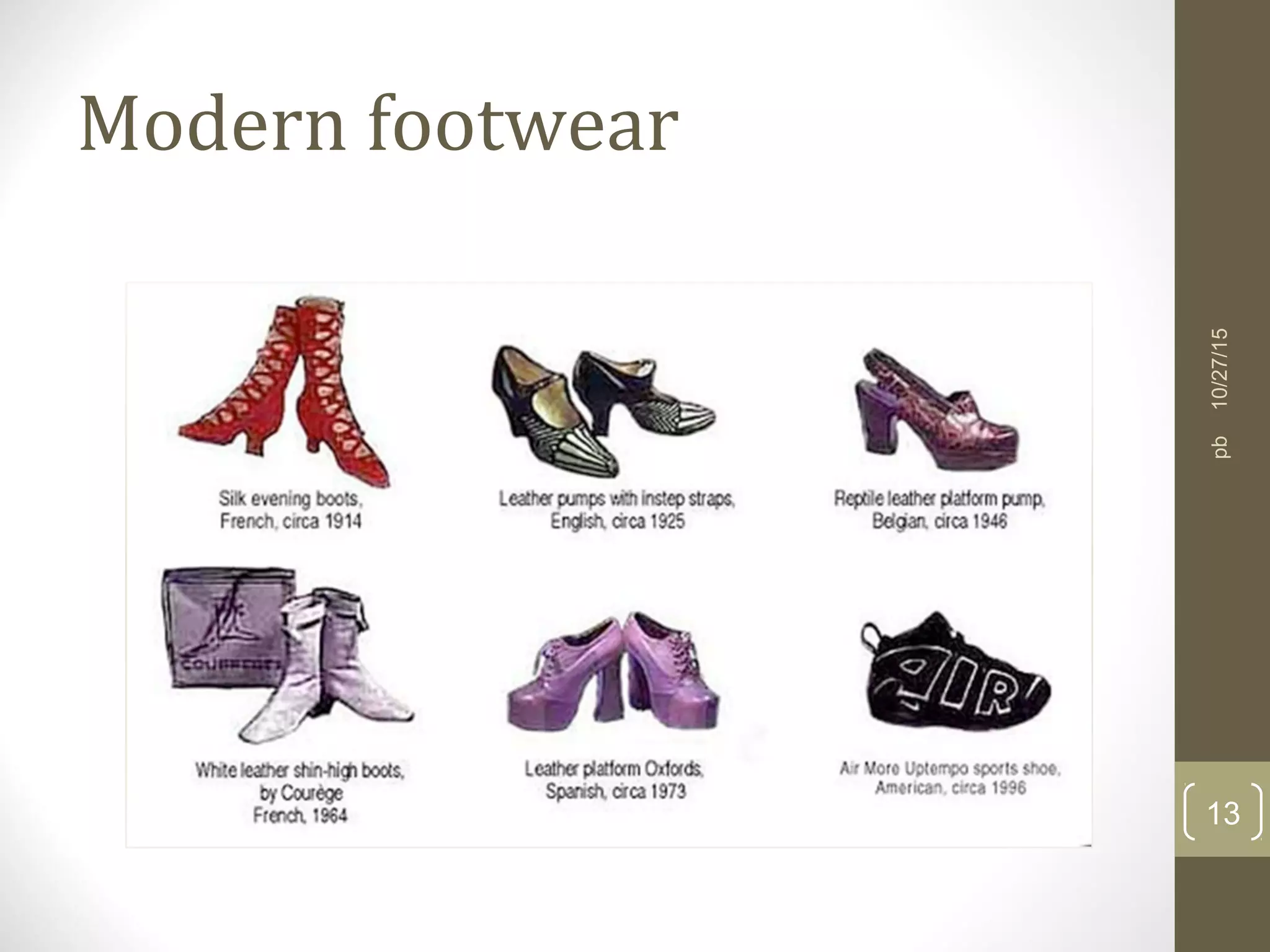
Modern footwear
10/27/15
13
pb
The Oldest Shoes
• The oldest shoes recovered to date are sandals
found at several Archaic (~6500-9000 years bp)
and a few Paleoindian (~9000-12,000 years bp)
sites in the American southwest.
• Dozens of Archaic period sandals were recovered by
Luther Cressman at the Fort Rock site in Oregon,
direct-dated ~7500 BP.
• Fort Rock-style sandals have also been found at
sites dated 10,500-9200 cal BP at Cougar Mountain
and Catlow Caves.
10/27/15
14
pb
Evidence for Shoe Usein
Prehistory
• Earlier evidence for shoe use is based on
anatomical changes that may have been created by
wearing shoes.
• Erik Trinkaus has argued that wearing footwear
produces physical changes in the toes, and this
change is reflected in human feet beginning in the
Middle Paleolithic period.
10/27/15
15
pb
Stone Age China
Seven thousand years ago, people in China's northern provinces made leather
shoes by binding sections of skins to their feet using leather strips and bone
needles, while at the same time, the people in the eastern regions made shoes
using flax thread and bamboo needles. The oldest pair of boots unearthed in
China, made from sheep skin, belonged to a woman buried four thousand years
ago.
Straw Sandals
Straw sandals are one of the earliest styles of shoes worn by Chinese people.
Today, millions of Chinese wear the same straw shoe their ancestors wore
thousands of years ago.
10/27/15
16
pb
Zhou Dynasty
Clothing on unearthed terra-cotta military figures from this period shows the
same style of stitched soles on handmade cloth shoes still worn in China today.
Stitch-soled cloth shoes developed over two thousand years ago specifically for
the Chinese military.
Qinq Dynasty
During the Qing Dynasty (1644-1911 C.E.), the pointed toe boot adorned feet for
everyday wear. Attending court functions required wearing the square-toed boot.
Chinese history saw the last of this style shoe with the downfall of the last ruling
emperor of China--Emperor Xuantong--in 1911.
10/27/15
17
pb
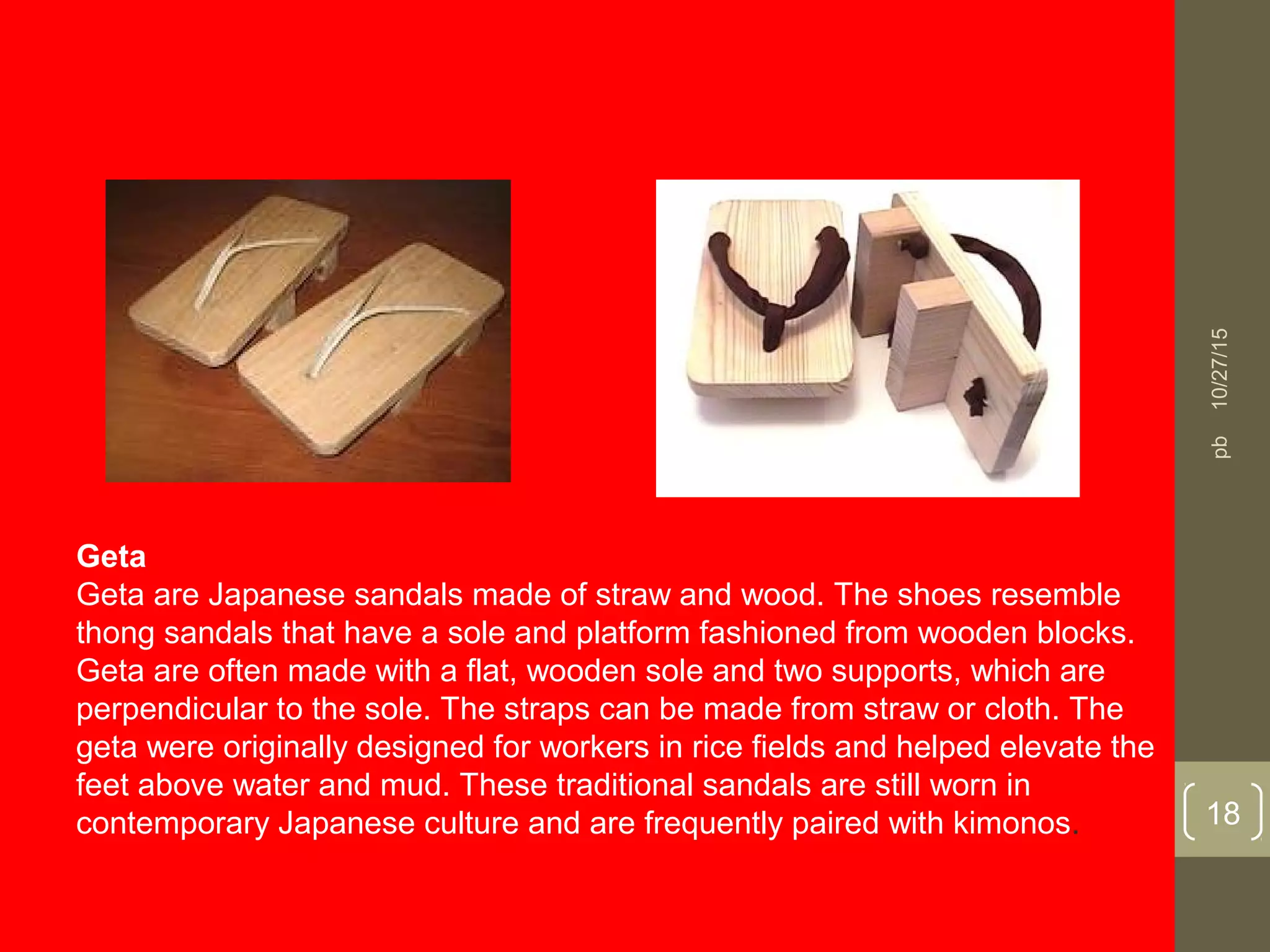
Geta
Geta are Japanese sandals made of straw and wood. The shoes resemble
thong sandals that have a sole and platform fashioned from wooden blocks.
Geta are often made with a flat, wooden sole and two supports, which are
perpendicular to the sole. The straps can be made from straw or cloth. The
geta were originally designed for workers in rice fields and helped elevate the
feet above water and mud. These traditional sandals are still worn in
contemporary Japanese culture and are frequently paired with kimonos.
10/27/15
18
pb
TYPES OF FOOTWEAR IN
MODERN HISTORY
• There are a wide variety of different types of shoes. Most
types of shoes are designed for specific activities.
• Athletic
• Boot
• Dress and casual- Dress shoes are characterized by smooth
and supple leather uppers, leather soles, and narrow sleek
figure. Casual shoes are characterized by sturdy leather
uppers, non-leather outsoles, and wide profile.
• Unisex
• Dance
• Orthopedic
• Non-human
10/27/15
19
pb
CONCLUSION
•
The power of footwear is extraordinary, from its function as
an incredibly important cultural identifier to its ability to
communicate with the spirit world.
10/27/15
20
pb
THANK YOU
10/27/15
21
pb

History of-shoes

  • 1.
    Presentation on Inventionof shoe PRESENTED BY PRANAB DEBBARMA REDG NO.2008-V-38 10/27/15 1 pb COURSE NO.-VSR -511
  • 2.
    A History ofShoes The history of shoes--that is to say, archaeological and pale anthropological evidence for the earliest use of protective coverings for the human foot--appears to start during the Middle Paleolithic period of approximately 40,000 years ago. 10/27/15 2 pb
  • 3.
    The Origins ofShoe Use • It is probable that the first shoes were worn by ancient man in the Ice Age, around 500,000 years ago, out of necessity to protect against the harsh climate. • Historians hypothesise that indeed footwear must have been necessary to deal with the conditions. • However, protective footwear similar to the modern-day shoe is considered to be a much later development. • It has been difficult for archaeologists to determine exactly when humans stopped going barefoot, however, because the plant and animal materials used to make prehistoric shoes is highly perishable. 10/27/15 3 pb
  • 4.
    Scientists have suggestedthat strong protective first came into widespread use between 40,000 and 26,000 years ago. These dates were established by examining the foot bones of early modern humans from 10,000 to 100,000 years ago. • Humans from 100,000 to 40,000 years ago have stronger and thicker small toes that those of around 26,000 years ago. •Currently, the earliest use of shoes that hard evidence supports is the end of the Upper Palaeolithic period, and the end of the last Ice Age, around 10,000 years ago. 10/27/15 4 pb
  • 5.
    When was thefirst shoe invented? • In Mesopotamia, (c. 1600-1200 BC) a type of soft shoes were worn by the mountain people who lived on the border of Iran. • The soft shoe was made of wraparound leather. 10/27/15 5 pb
  • 6.
    Who invented theshoe? • At the time, no machine could attach the upper part of a shoe to the sole. This had to be done manually by a "hand laster"; a skilled one could produce 50 pairs in a ten-hour day. • After five years of work, J.E Matzeliger obtained a patent for his invention in 1883. 10/27/15 6 pb
  • 7.
    Timeline of Shoes •40000 BC – First archeological evidence of protective foot covering found in Ice Age settlements. • 4000 BC –First recorded mentioning of shoes as “flexible pieces of leather” came from Ancient Egypt. • 3627 BC – Archeologist found the earliest known leather shoe near one of the cave dwellings in Armenia. 10/27/15 7 pb
  • 8.
    • 3rd to1st millennia BC – Many civilizations around the world used simple leather sandals in their daily life. • 1st millennia BC – Romans used platform sandals made from wood or cork soles. Buskin shoes were also common in Greece and Rome, where they were worn by tragic actors, hunters and soldiers. 10/27/15 8 pb
  • 9.
    • Around 1000AD – Shoes and sandals become commonplace across Europe, but they are often crude and hard to wear for long periods of time.. • 12th and 13th century – Fashionable shoes started being produced for nobility and royalty. • 1533 – Italian noblewoman Catherine d’Medici introduced to France fashion of high heels. • 1789 – French Revolution brought to the end the fashion of high heeled man and female footwear, and popularized more “down to earth” designs. 10/27/15 9 pb
  • 10.
    • 1790 –English inventors introduced shoelaces for the first time. • 1800 – In 19th century shoes finally became made for each foot individually. • 1883 - African-American inventor Jan Ernst Matzeliger invented machine for automated production of shoes. This invention changed the shoe industry forever. 10/27/15 10 pb
  • 11.
    • 1888 –First high heeled shoe factory opened in United States. This event enabled US females to largely abandon import of expensive shoes from France. • 1899 – Irish-American inventor Humphrey O'Sullivan successfully patented rubber heel for shoes. • 1917 – First successful sneakers (canvas top design with rubber sole) started being sold in United States. • 1980 – Athletic shoes that were first introduced in early 20th century became widely popular across the world. 10/27/15 11 pb
  • 12.
    FOOTWEAR PICTURE OFDIFFERENT PERIOD OF AGES • World's oldest leather shoe discovered in Armenia 10/27/15 12 pb
  • 13.
  • 14.
    The Oldest Shoes •The oldest shoes recovered to date are sandals found at several Archaic (~6500-9000 years bp) and a few Paleoindian (~9000-12,000 years bp) sites in the American southwest. • Dozens of Archaic period sandals were recovered by Luther Cressman at the Fort Rock site in Oregon, direct-dated ~7500 BP. • Fort Rock-style sandals have also been found at sites dated 10,500-9200 cal BP at Cougar Mountain and Catlow Caves. 10/27/15 14 pb
  • 15.
    Evidence for ShoeUsein Prehistory • Earlier evidence for shoe use is based on anatomical changes that may have been created by wearing shoes. • Erik Trinkaus has argued that wearing footwear produces physical changes in the toes, and this change is reflected in human feet beginning in the Middle Paleolithic period. 10/27/15 15 pb
  • 16.
    Stone Age China Seventhousand years ago, people in China's northern provinces made leather shoes by binding sections of skins to their feet using leather strips and bone needles, while at the same time, the people in the eastern regions made shoes using flax thread and bamboo needles. The oldest pair of boots unearthed in China, made from sheep skin, belonged to a woman buried four thousand years ago. Straw Sandals Straw sandals are one of the earliest styles of shoes worn by Chinese people. Today, millions of Chinese wear the same straw shoe their ancestors wore thousands of years ago. 10/27/15 16 pb
  • 17.
    Zhou Dynasty Clothing onunearthed terra-cotta military figures from this period shows the same style of stitched soles on handmade cloth shoes still worn in China today. Stitch-soled cloth shoes developed over two thousand years ago specifically for the Chinese military. Qinq Dynasty During the Qing Dynasty (1644-1911 C.E.), the pointed toe boot adorned feet for everyday wear. Attending court functions required wearing the square-toed boot. Chinese history saw the last of this style shoe with the downfall of the last ruling emperor of China--Emperor Xuantong--in 1911. 10/27/15 17 pb
  • 18.
    Geta Geta are Japanesesandals made of straw and wood. The shoes resemble thong sandals that have a sole and platform fashioned from wooden blocks. Geta are often made with a flat, wooden sole and two supports, which are perpendicular to the sole. The straps can be made from straw or cloth. The geta were originally designed for workers in rice fields and helped elevate the feet above water and mud. These traditional sandals are still worn in contemporary Japanese culture and are frequently paired with kimonos. 10/27/15 18 pb
  • 19.
    TYPES OF FOOTWEARIN MODERN HISTORY • There are a wide variety of different types of shoes. Most types of shoes are designed for specific activities. • Athletic • Boot • Dress and casual- Dress shoes are characterized by smooth and supple leather uppers, leather soles, and narrow sleek figure. Casual shoes are characterized by sturdy leather uppers, non-leather outsoles, and wide profile. • Unisex • Dance • Orthopedic • Non-human 10/27/15 19 pb
  • 20.
    CONCLUSION • The power offootwear is extraordinary, from its function as an incredibly important cultural identifier to its ability to communicate with the spirit world. 10/27/15 20 pb
  • 21.