Sustained release drug delivery system
Prepared by – Pooja Sadgir
Contents:
 Introduction
 Difference between sustained and controlled release
 Advantages
 Disadvantages
 Fundamental of kinetics of drug release for SRDF
 Evaluation
 Classification of polymer
 Characteristics of drug suitable SRDDS
 Mechanism of matrix dives
 Polymer used in matrix system
Introduction-
 Oral administration of drug has been the most common and preferred route for delivery of most
therapeutic agents .It remains the preferred route of administration investigated in the discovery
and development of new drug candidates and formulations .The popularity of oral route is
attributed to patient acceptance , ease of administration , accurate dosing means preventing the
fluctuation of the therapeutic concentration level of the drug in the body ,less side effects, cost
effective manufacturing methods and generally improved shelf life of the product . In recent
years, considerable attention has been focused on development of sustained release drug
delivery system .
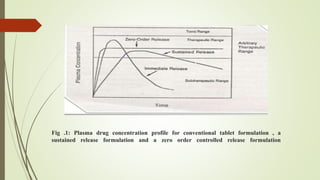
Fig .1: Plasma drug concentration profile for conventional tablet formulation , a
sustained release formulation and a zero order controlled release formulation
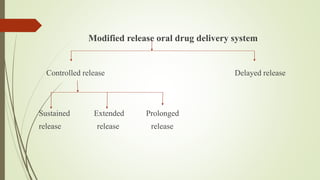
Modified release oral drug delivery system
Controlled release Delayed release
Sustained Extended Prolonged
release release release
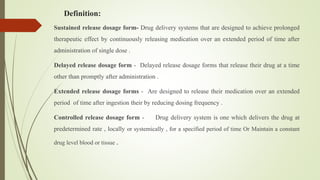
Definition:
Sustained release dosage form- Drug delivery systems that are designed to achieve prolonged
therapeutic effect by continuously releasing medication over an extended period of time after
administration of single dose .
Delayed release dosage form - Delayed release dosage forms that release their drug at a time
other than promptly after administration .
Extended release dosage forms - Are designed to release their medication over an extended
period of time after ingestion their by reducing dosing frequency .
Controlled release dosage form - Drug delivery system is one which delivers the drug at
predetermined rate , locally or systemically , for a specified period of time Or Maintain a constant
drug level blood or tissue .
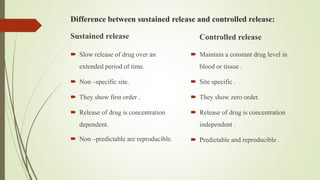
Difference between sustained release and controlled release:
Sustained release
 Slow release of drug over an
extended period of time.
 Non –specific site.
 They show first order .
 Release of drug is concentration
dependent.
 Non –predictable are reproducible.
 Maintain a constant drug level in
blood or tissue .
 Site specific .
 They show zero order.
 Release of drug is concentration
independent .
 Predictable and reproducible .
Controlled release
Advantages of sustained release products -
1. Reduced dosing frequency .
2. Improved patient compliance .
3. Reduced toxicity due to overdose .
4. Night time dosing can be avoided .
5. Uniform release of drug substance over time .
6. Reduce adverse side effect .
7. Uniform pharmacological response .
Disadvantages of sustained release products-
1. Delay in onset of action .
2. Possibility of dose dumping due to food , physiological or formulation variables
and thus increased risk of toxicity .
3. Dose dumping .
4. Higher cost of formulation .
5. Reduced potential for dosage adjustment .
The following are the rational of developing SR Matrix DDS-
 To extend the duration of action of the drug .
 To reduce the frequency of dosing .
 Improved drug utilization .
 Less adverse effect .
Fundamentals of kinetic of drug release for sustained release
dosage forms -
1. Noyes – Whitney Rule
2. Nernst and Brunner Film theory
3. Model Dependent Methods
4. Zero order Model
5. Higuchi Model
6. Hixson Crowell model
7. Korsmeyer - peppas Model
8. .Baker – Lonsdale Model
9. Weibull model
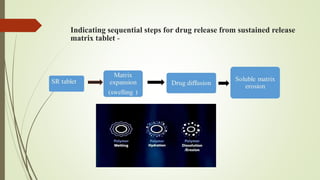
Indicating sequential steps for drug release from sustained release
matrix tablet -
Mechanism :
Our matrix drug absorption system incorporates ones or more hydrophilic matrix forming
polymers into solid oral dosage form to act as a mechanism for controlling the release of the
active ingredients. The release of drug from this system is a dynamic process. Comprised
polymer wetting, polymer hydration, polymer erosion / dissolution . Upon contact with the
GIT fluids the tablet surface wets & the hydrophilic polymer beings to partially hydrates.
These polymer in contact with the Constance of the GIT absorb liquid & swell forming a
viscous gel drug then diffused at through the viscous mass or is exposed to the gastric fluid by
polymer erosion to release drug in control in manner over predetermine of time .
Criteria for selection of drug for sustained release form -
The concept of biopharmaceutics and pharmacokinetic have important role in design of
sustained release dosage forms .
1. Biopharmaceutics properties
2. Pharmacokinetics properties
3. Pharmacodynamics properties
1.Biopharmaceutics characteristics of drug -
 Molecular weight of drug
 Aqueous solubility
 Apparent partition co-efficient of the drug
 Drug stability
 Dose size
 Mechanism of site of absorption
 Drug pka & Ionization at physiological pH
2.Pharmacokinetics characteristics of drugs -
 Absorption
 Distribution
 Metabolism
 Elimination half life of drug
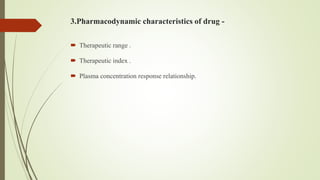
3.Pharmacodynamic characteristics of drug -
 Therapeutic range .
 Therapeutic index .
 Plasma concentration response relationship.
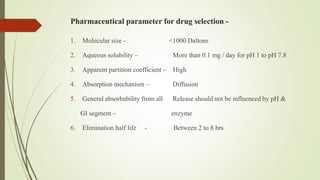
Pharmaceutical parameter for drug selection -
1. Molecular size - ˂1000 Daltons
2. Aqueous solubility – More than 0.1 mg / day for pH 1 to pH 7.8
3. Apparent partition coefficient – High
4. Absorption mechanism – Diffusion
5. General absorbability from all Release should not be influenced by pH &
GI segment – enzyme
6. Elimination half life - Between 2 to 8 hrs
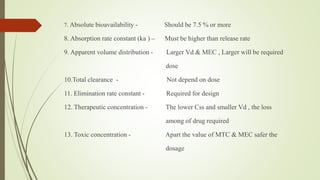
7. Absolute bioavailability - Should be 7.5 % or more
8. Absorption rate constant (ka ) – Must be higher than release rate
9. Apparent volume distribution - Larger Vd & MEC , Larger will be required
dose
10.Total clearance - Not depend on dose
11. Elimination rate constant - Required for design
12. Therapeutic concentration - The lower Css and smaller Vd , the loss
among of drug required
13. Toxic concentration - Apart the value of MTC & MEC safer the
dosage
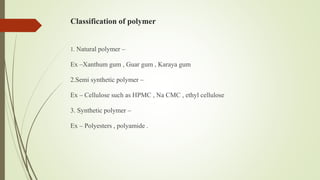
Classification of polymer
1. Natural polymer –
Ex –Xanthum gum , Guar gum , Karaya gum
2.Semi synthetic polymer –
Ex – Cellulose such as HPMC , Na CMC , ethyl cellulose
3. Synthetic polymer –
Ex – Polyesters , polyamide .
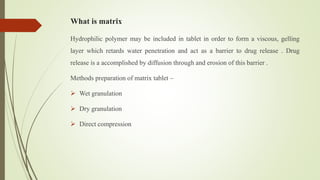
What is matrix
Hydrophilic polymer may be included in tablet in order to form a viscous, gelling
layer which retards water penetration and act as a barrier to drug release . Drug
release is a accomplished by diffusion through and erosion of this barrier .
Methods preparation of matrix tablet –
 Wet granulation
 Dry granulation
 Direct compression
Granulation -
 Granulation is any process of size enlargement where small particles are gathered
together into larger , permanent aggregates to render them into a free flowing state
similar to that of dry sand .
 Reasons why granulation is done –
1. Render the material free flowing .
2. Density materials .
3. Prepare uniform mixtures that do not separate .
4. Improve the compression characteristics of drug .
5. Reduce dusting .
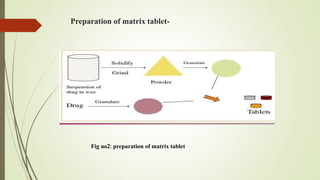
Preparation of matrix tablet-
Fig no2: preparation of matrix tablet
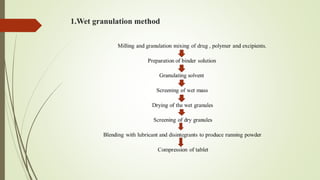
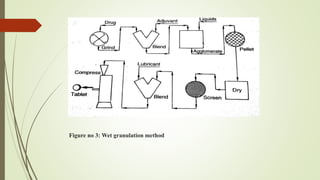
1.Wet granulation method
Figure no 3: Wet granulation method
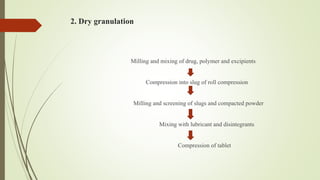
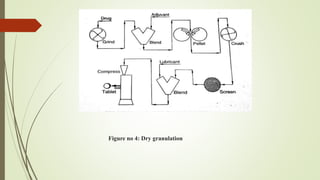
2. Dry granulation
Milling and mixing of drug, polymer and excipients
Compression into slug of roll compression
Milling and screening of slugs and compacted powder
Mixing with lubricant and disintegrants
Compression of tablet
Figure no 4: Dry granulation
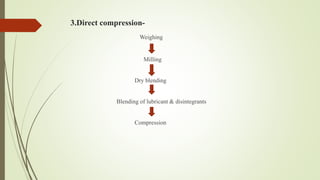
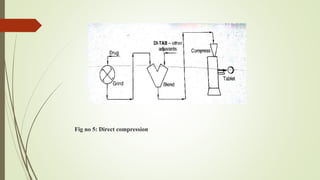
3.Direct compression-
Weighing
Milling
Dry blending
Blending of lubricant & disintegrants
Compression
Fig no 5: Direct compression
Two classes of retardant material used to formulate matrix tablet-
1.Insoluble, inert
2.Insoluble,erodible
Material
1.Polyethylene, polyvinyl chloride ,
ethyl cellulose
2.Carnauba wax ,stearic acid
,polyethylene glycol
Matrix characteristics
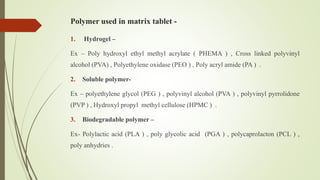
Polymer used in matrix tablet -
1. Hydrogel –
Ex – Poly hydroxyl ethyl methyl acrylate ( PHEMA ) , Cross linked polyvinyl
alcohol (PVA) , Polyethylene oxidase (PEO ) , Poly acryl amide (PA ) .
2. Soluble polymer-
Ex – polyethylene glycol (PEG ) , polyvinyl alcohol (PVA ) , polyvinyl pyrrolidone
(PVP ) , Hydroxyl propyl methyl cellulose (HPMC ) .
3. Biodegradable polymer –
Ex- Polylactic acid (PLA ) , poly glycolic acid (PGA ) , polycaprolacton (PCL ) ,
poly anhydries .
4. Non biodegradable polymer –
Ex – polyethylene vinyl acetate (PVA ) , poly dimethyl siloxane (PDS ) ,
poly vinyl chloride (PVC ) , cellulose acetate (CA ) , ethyl cellulose (EC ) .
5. Mucoadhesive polymer –
Ex – poly cartophily , sodium carboxyl methyl cellulose , poly acrylic acid , pectin ,
tragacanth .
Evaluation parameter of SRMT -
1.Pre compression parameter
2.Post compression parameter
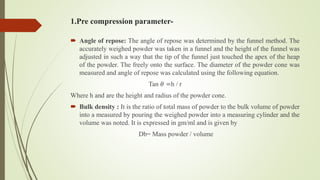
1.Pre compression parameter-
 Angle of repose: The angle of repose was determined by the funnel method. The
accurately weighed powder was taken in a funnel and the height of the funnel was
adjusted in such a way that the tip of the funnel just touched the apex of the heap
of the powder. The freely onto the surface. The diameter of the powder cone was
measured and angle of repose was calculated using the following equation.
Tan 𝜃 =h / r
Where h and are the height and radius of the powder cone.
 Bulk density : It is the ratio of total mass of powder to the bulk volume of powder
into a measured by pouring the weighed powder into a measuring cylinder and the
volume was noted. It is expressed in gm/ml and is given by
Db= Mass powder / volume
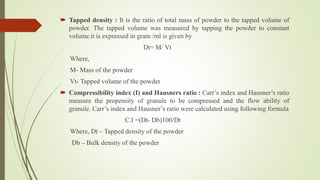
 Tapped density : It is the ratio of total mass of powder to the tapped volume of
powder. The tapped volume was measured by tapping the powder to constant
volume.it is expressed in gram /ml is given by
Dt= M/ Vt
Where,
M- Mass of the powder
Vt- Tapped volume of the powder
 Compressibility index (I) and Hausners ratio : Carr’s index and Hausner’s ratio
measure the propensity of granule to be compressed and the flow ability of
granule. Carr’s index and Hausner’s ratio were calculated using following formula
C.I =(Dt- Db)100/Dt
Where, Dt – Tapped density of the powder
Db – Bulk density of the powder
2. Post compression parameter
The various post compression evaluation parameter like
 Hardness
 Friability
 Thickness
 Weight variation
 Drug content
 Disintegration time
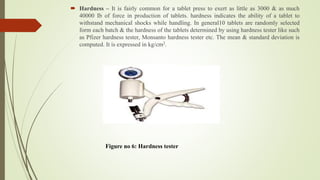
 Hardness – It is fairly common for a tablet press to exert as little as 3000 & as much
40000 Ib of force in production of tablets. hardness indicates the ability of a tablet to
withstand mechanical shocks while handling. In general10 tablets are randomly selected
form each batch & the hardness of the tablets determined by using hardness tester like such
as Pfizer hardness tester, Monsanto hardness tester etc. The mean & standard deviation is
computed. It is expressed in kg/cm2.
Figure no 6: Hardness tester
 Friability: A tablets durability may be determined through the use of a friabilator. This apparatus
determines the tablets friability or tendency to crumble, by allowing it to roll and fall within the
drum. In general method is the 20 tablets are randomly selected, weigh before rotation and placed
in the electro lab friabilator (Roche friability teste) and apparatus rotate at specified number of
rpm for few min. After revolution the tablets weighed again and calculate the % friability. So
resistance to loss of weight indicates the tablets ability to withstand abrasion in handling,
packaging and shipment. A maximum weight loss of not more than 1 % generally is considered
acceptable for more products. It is expressed in %. The % friability is determined by using the
formula as follows
% F = [ 1- (Wt/W)] x 100
Where, %
F – Friability in percentage
W – Initial weight of tablet
Wt- - Weight of tablet after revolution
Figure no 7: Friability tester
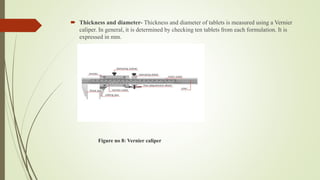
Figure no 8: Vernier caliper
 Thickness and diameter- Thickness and diameter of tablets is measured using a Vernier
caliper. In general, it is determined by checking ten tablets from each formulation. It is
expressed in mm.
 Weight variation – In the test ten tablets are randomly selected form each batch and
individually weigh. The average weight and standard deviation of 10 tablet are calculate. The
batch passes the test for weight variation test if not more than two of the individual.
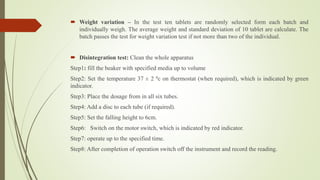
 Disintegration test: Clean the whole apparatus
Step1: fill the beaker with specified media up to volume
Step2: Set the temperature 37 ± 2 0c on thermostat (when required), which is indicated by green
indicator.
Step3: Place the dosage from in all six tubes.
Step4: Add a disc to each tube (if required).
Step5: Set the falling height to 6cm.
Step6: Switch on the motor switch, which is indicated by red indicator.
Step7: operate up to the specified time.
Step8: After completion of operation switch off the instrument and record the reading.
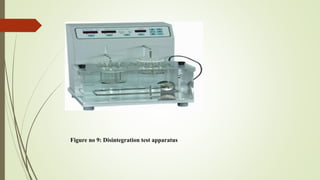
Figure no 9: Disintegration test apparatus
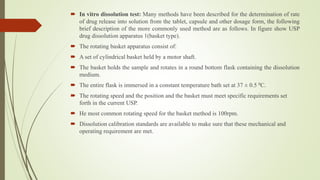
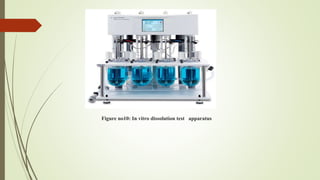
 In vitro dissolution test: Many methods have been described for the determination of rate
of drug release into solution from the tablet, capsule and other dosage form, the following
brief description of the more commonly used method are as follows. In figure show USP
drug dissolution apparatus 1(basket type).
 The rotating basket apparatus consist of:
 A set of cylindrical basket held by a motor shaft.
 The basket holds the sample and rotates in a round bottom flask containing the dissolution
medium.
 The entire flask is immersed in a constant temperature bath set at 37 ± 0.5 0C.
 The rotating speed and the position and the basket must meet specific requirements set
forth in the current USP.
 He most common rotating speed for the basket method is 100rpm.
 Dissolution calibration standards are available to make sure that these mechanical and
operating requirement are met.
Figure no10: In vitro dissolution test apparatus
Conclusion-
The sustained release drug delivery system is very helpful in increasing the efficiency of the
dose, safety of dose as well as the patient compliance. Nowadays, the oral route of
administration for sustained release drug delivery system has received more attention due to its
more flexibility, reduced dosing frequency and better patient compliance. The design of oral
sustained release drug delivery system depends on various factors like, physicochemical
properties of drug, type of delivery system, disease being treated, patient condition, treatment
duration, presences of food, gastrointestinal motility and co-administration of other drugs.
From the above discussion, we can have concluded that moreover; the reasonable cost of oral
sustained release drug delivery system has lead ease of market penetration as replacement of
oral conventional drug delivery system.
Sustained release drug deliveru system

Sustained release drug deliveru system

  • 1.
    Sustained release drugdelivery system Prepared by – Pooja Sadgir
  • 2.
    Contents:  Introduction  Differencebetween sustained and controlled release  Advantages  Disadvantages  Fundamental of kinetics of drug release for SRDF  Evaluation  Classification of polymer  Characteristics of drug suitable SRDDS  Mechanism of matrix dives  Polymer used in matrix system
  • 3.
    Introduction-  Oral administrationof drug has been the most common and preferred route for delivery of most therapeutic agents .It remains the preferred route of administration investigated in the discovery and development of new drug candidates and formulations .The popularity of oral route is attributed to patient acceptance , ease of administration , accurate dosing means preventing the fluctuation of the therapeutic concentration level of the drug in the body ,less side effects, cost effective manufacturing methods and generally improved shelf life of the product . In recent years, considerable attention has been focused on development of sustained release drug delivery system .
  • 4.
    Fig .1: Plasmadrug concentration profile for conventional tablet formulation , a sustained release formulation and a zero order controlled release formulation
  • 5.
    Modified release oraldrug delivery system Controlled release Delayed release Sustained Extended Prolonged release release release
  • 6.
    Definition: Sustained release dosageform- Drug delivery systems that are designed to achieve prolonged therapeutic effect by continuously releasing medication over an extended period of time after administration of single dose . Delayed release dosage form - Delayed release dosage forms that release their drug at a time other than promptly after administration . Extended release dosage forms - Are designed to release their medication over an extended period of time after ingestion their by reducing dosing frequency . Controlled release dosage form - Drug delivery system is one which delivers the drug at predetermined rate , locally or systemically , for a specified period of time Or Maintain a constant drug level blood or tissue .
  • 7.
    Difference between sustainedrelease and controlled release: Sustained release  Slow release of drug over an extended period of time.  Non –specific site.  They show first order .  Release of drug is concentration dependent.  Non –predictable are reproducible.  Maintain a constant drug level in blood or tissue .  Site specific .  They show zero order.  Release of drug is concentration independent .  Predictable and reproducible . Controlled release
  • 8.
    Advantages of sustainedrelease products - 1. Reduced dosing frequency . 2. Improved patient compliance . 3. Reduced toxicity due to overdose . 4. Night time dosing can be avoided . 5. Uniform release of drug substance over time . 6. Reduce adverse side effect . 7. Uniform pharmacological response .
  • 9.
    Disadvantages of sustainedrelease products- 1. Delay in onset of action . 2. Possibility of dose dumping due to food , physiological or formulation variables and thus increased risk of toxicity . 3. Dose dumping . 4. Higher cost of formulation . 5. Reduced potential for dosage adjustment .
  • 10.
    The following arethe rational of developing SR Matrix DDS-  To extend the duration of action of the drug .  To reduce the frequency of dosing .  Improved drug utilization .  Less adverse effect .
  • 11.
    Fundamentals of kineticof drug release for sustained release dosage forms - 1. Noyes – Whitney Rule 2. Nernst and Brunner Film theory 3. Model Dependent Methods 4. Zero order Model 5. Higuchi Model 6. Hixson Crowell model 7. Korsmeyer - peppas Model 8. .Baker – Lonsdale Model 9. Weibull model
  • 12.
    Indicating sequential stepsfor drug release from sustained release matrix tablet -
  • 13.
    Mechanism : Our matrixdrug absorption system incorporates ones or more hydrophilic matrix forming polymers into solid oral dosage form to act as a mechanism for controlling the release of the active ingredients. The release of drug from this system is a dynamic process. Comprised polymer wetting, polymer hydration, polymer erosion / dissolution . Upon contact with the GIT fluids the tablet surface wets & the hydrophilic polymer beings to partially hydrates. These polymer in contact with the Constance of the GIT absorb liquid & swell forming a viscous gel drug then diffused at through the viscous mass or is exposed to the gastric fluid by polymer erosion to release drug in control in manner over predetermine of time .
  • 14.
    Criteria for selectionof drug for sustained release form - The concept of biopharmaceutics and pharmacokinetic have important role in design of sustained release dosage forms . 1. Biopharmaceutics properties 2. Pharmacokinetics properties 3. Pharmacodynamics properties
  • 15.
    1.Biopharmaceutics characteristics ofdrug -  Molecular weight of drug  Aqueous solubility  Apparent partition co-efficient of the drug  Drug stability  Dose size  Mechanism of site of absorption  Drug pka & Ionization at physiological pH
  • 16.
    2.Pharmacokinetics characteristics ofdrugs -  Absorption  Distribution  Metabolism  Elimination half life of drug
  • 17.
    3.Pharmacodynamic characteristics ofdrug -  Therapeutic range .  Therapeutic index .  Plasma concentration response relationship.
  • 18.
    Pharmaceutical parameter fordrug selection - 1. Molecular size - ˂1000 Daltons 2. Aqueous solubility – More than 0.1 mg / day for pH 1 to pH 7.8 3. Apparent partition coefficient – High 4. Absorption mechanism – Diffusion 5. General absorbability from all Release should not be influenced by pH & GI segment – enzyme 6. Elimination half life - Between 2 to 8 hrs
  • 19.
    7. Absolute bioavailability- Should be 7.5 % or more 8. Absorption rate constant (ka ) – Must be higher than release rate 9. Apparent volume distribution - Larger Vd & MEC , Larger will be required dose 10.Total clearance - Not depend on dose 11. Elimination rate constant - Required for design 12. Therapeutic concentration - The lower Css and smaller Vd , the loss among of drug required 13. Toxic concentration - Apart the value of MTC & MEC safer the dosage
  • 20.
    Classification of polymer 1.Natural polymer – Ex –Xanthum gum , Guar gum , Karaya gum 2.Semi synthetic polymer – Ex – Cellulose such as HPMC , Na CMC , ethyl cellulose 3. Synthetic polymer – Ex – Polyesters , polyamide .
  • 21.
    What is matrix Hydrophilicpolymer may be included in tablet in order to form a viscous, gelling layer which retards water penetration and act as a barrier to drug release . Drug release is a accomplished by diffusion through and erosion of this barrier . Methods preparation of matrix tablet –  Wet granulation  Dry granulation  Direct compression
  • 22.
    Granulation -  Granulationis any process of size enlargement where small particles are gathered together into larger , permanent aggregates to render them into a free flowing state similar to that of dry sand .  Reasons why granulation is done – 1. Render the material free flowing . 2. Density materials . 3. Prepare uniform mixtures that do not separate . 4. Improve the compression characteristics of drug . 5. Reduce dusting .
  • 23.
    Preparation of matrixtablet- Fig no2: preparation of matrix tablet
  • 24.
  • 25.
    Figure no 3:Wet granulation method
  • 26.
    2. Dry granulation Millingand mixing of drug, polymer and excipients Compression into slug of roll compression Milling and screening of slugs and compacted powder Mixing with lubricant and disintegrants Compression of tablet
  • 27.
    Figure no 4:Dry granulation
  • 28.
    3.Direct compression- Weighing Milling Dry blending Blendingof lubricant & disintegrants Compression
  • 29.
    Fig no 5:Direct compression
  • 30.
    Two classes ofretardant material used to formulate matrix tablet- 1.Insoluble, inert 2.Insoluble,erodible Material 1.Polyethylene, polyvinyl chloride , ethyl cellulose 2.Carnauba wax ,stearic acid ,polyethylene glycol Matrix characteristics
  • 31.
    Polymer used inmatrix tablet - 1. Hydrogel – Ex – Poly hydroxyl ethyl methyl acrylate ( PHEMA ) , Cross linked polyvinyl alcohol (PVA) , Polyethylene oxidase (PEO ) , Poly acryl amide (PA ) . 2. Soluble polymer- Ex – polyethylene glycol (PEG ) , polyvinyl alcohol (PVA ) , polyvinyl pyrrolidone (PVP ) , Hydroxyl propyl methyl cellulose (HPMC ) . 3. Biodegradable polymer – Ex- Polylactic acid (PLA ) , poly glycolic acid (PGA ) , polycaprolacton (PCL ) , poly anhydries .
  • 32.
    4. Non biodegradablepolymer – Ex – polyethylene vinyl acetate (PVA ) , poly dimethyl siloxane (PDS ) , poly vinyl chloride (PVC ) , cellulose acetate (CA ) , ethyl cellulose (EC ) . 5. Mucoadhesive polymer – Ex – poly cartophily , sodium carboxyl methyl cellulose , poly acrylic acid , pectin , tragacanth .
  • 33.
    Evaluation parameter ofSRMT - 1.Pre compression parameter 2.Post compression parameter
  • 34.
    1.Pre compression parameter- Angle of repose: The angle of repose was determined by the funnel method. The accurately weighed powder was taken in a funnel and the height of the funnel was adjusted in such a way that the tip of the funnel just touched the apex of the heap of the powder. The freely onto the surface. The diameter of the powder cone was measured and angle of repose was calculated using the following equation. Tan 𝜃 =h / r Where h and are the height and radius of the powder cone.  Bulk density : It is the ratio of total mass of powder to the bulk volume of powder into a measured by pouring the weighed powder into a measuring cylinder and the volume was noted. It is expressed in gm/ml and is given by Db= Mass powder / volume
  • 35.
     Tapped density: It is the ratio of total mass of powder to the tapped volume of powder. The tapped volume was measured by tapping the powder to constant volume.it is expressed in gram /ml is given by Dt= M/ Vt Where, M- Mass of the powder Vt- Tapped volume of the powder  Compressibility index (I) and Hausners ratio : Carr’s index and Hausner’s ratio measure the propensity of granule to be compressed and the flow ability of granule. Carr’s index and Hausner’s ratio were calculated using following formula C.I =(Dt- Db)100/Dt Where, Dt – Tapped density of the powder Db – Bulk density of the powder
  • 36.
    2. Post compressionparameter The various post compression evaluation parameter like  Hardness  Friability  Thickness  Weight variation  Drug content  Disintegration time
  • 37.
     Hardness –It is fairly common for a tablet press to exert as little as 3000 & as much 40000 Ib of force in production of tablets. hardness indicates the ability of a tablet to withstand mechanical shocks while handling. In general10 tablets are randomly selected form each batch & the hardness of the tablets determined by using hardness tester like such as Pfizer hardness tester, Monsanto hardness tester etc. The mean & standard deviation is computed. It is expressed in kg/cm2. Figure no 6: Hardness tester
  • 38.
     Friability: Atablets durability may be determined through the use of a friabilator. This apparatus determines the tablets friability or tendency to crumble, by allowing it to roll and fall within the drum. In general method is the 20 tablets are randomly selected, weigh before rotation and placed in the electro lab friabilator (Roche friability teste) and apparatus rotate at specified number of rpm for few min. After revolution the tablets weighed again and calculate the % friability. So resistance to loss of weight indicates the tablets ability to withstand abrasion in handling, packaging and shipment. A maximum weight loss of not more than 1 % generally is considered acceptable for more products. It is expressed in %. The % friability is determined by using the formula as follows % F = [ 1- (Wt/W)] x 100 Where, % F – Friability in percentage W – Initial weight of tablet Wt- - Weight of tablet after revolution Figure no 7: Friability tester
  • 39.
    Figure no 8:Vernier caliper  Thickness and diameter- Thickness and diameter of tablets is measured using a Vernier caliper. In general, it is determined by checking ten tablets from each formulation. It is expressed in mm.
  • 40.
     Weight variation– In the test ten tablets are randomly selected form each batch and individually weigh. The average weight and standard deviation of 10 tablet are calculate. The batch passes the test for weight variation test if not more than two of the individual.  Disintegration test: Clean the whole apparatus Step1: fill the beaker with specified media up to volume Step2: Set the temperature 37 ± 2 0c on thermostat (when required), which is indicated by green indicator. Step3: Place the dosage from in all six tubes. Step4: Add a disc to each tube (if required). Step5: Set the falling height to 6cm. Step6: Switch on the motor switch, which is indicated by red indicator. Step7: operate up to the specified time. Step8: After completion of operation switch off the instrument and record the reading.
  • 41.
    Figure no 9:Disintegration test apparatus
  • 42.
     In vitrodissolution test: Many methods have been described for the determination of rate of drug release into solution from the tablet, capsule and other dosage form, the following brief description of the more commonly used method are as follows. In figure show USP drug dissolution apparatus 1(basket type).  The rotating basket apparatus consist of:  A set of cylindrical basket held by a motor shaft.  The basket holds the sample and rotates in a round bottom flask containing the dissolution medium.  The entire flask is immersed in a constant temperature bath set at 37 ± 0.5 0C.  The rotating speed and the position and the basket must meet specific requirements set forth in the current USP.  He most common rotating speed for the basket method is 100rpm.  Dissolution calibration standards are available to make sure that these mechanical and operating requirement are met.
  • 43.
    Figure no10: Invitro dissolution test apparatus
  • 44.
    Conclusion- The sustained releasedrug delivery system is very helpful in increasing the efficiency of the dose, safety of dose as well as the patient compliance. Nowadays, the oral route of administration for sustained release drug delivery system has received more attention due to its more flexibility, reduced dosing frequency and better patient compliance. The design of oral sustained release drug delivery system depends on various factors like, physicochemical properties of drug, type of delivery system, disease being treated, patient condition, treatment duration, presences of food, gastrointestinal motility and co-administration of other drugs. From the above discussion, we can have concluded that moreover; the reasonable cost of oral sustained release drug delivery system has lead ease of market penetration as replacement of oral conventional drug delivery system.