CARBONYL COMPOUNDS
PHARMABRIDGES
PHARMABRIDGES
INTRODUCTION
Carbonyl group, in organic chemistry, a divalent chemical unit
consisting of a carbon (C) and an oxygen (O) atom connected by a
double bond.
The group is a constituent of carboxylic acids, esters, anhydrides,
acyl halides, amides, and quinones, and it is the characteristic
functional group (reactive group) of aldehydes and ketones.
Carboxylic acids (and their derivatives), aldehydes, ketones, and
quinones are also known collectively as carbonyl compounds.
PHARMABRIDGES
Because of a difference in the electron affinities of the carbon and
oxygen atoms, the electron pairs that constitute the double bond are
held closer to the oxygen atom than to the carbon atom; the electron-
rich oxygen atom acquires a negative charge and the electron-deficient
carbon atom a positive charge.
Thus, molecules containing the carbonyl group are polar.
Compounds containing a carbonyl group have higher melting and
boiling points than hydrocarbons containing the same number of
carbon atoms and are more soluble in polar solvents such as water.
PHARMABRIDGES
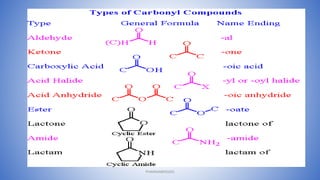
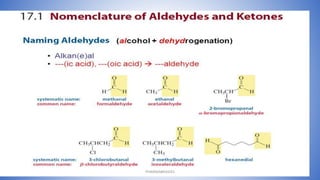
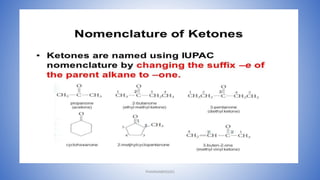
The IUPAC system of nomenclature assigns a characteristic suffix to
these classes, al to aldehydes and one to ketones.
Chain numbering normally starts from the end nearest the carbonyl
group. In cyclic ketones the carbonyl group is assigned position #1,
and this number is not cited in the name, unless more than one
carbonyl group is present.
The atom adjacent to the function is alpha, the next removed is beta
and so on. Since ketones have two sets of neighboring atoms, one set
is labeled α, β etc., and the other α', β' etc.
PHARMABRIDGES
PHARMABRIDGES
PHARMABRIDGES
PHARMABRIDGES
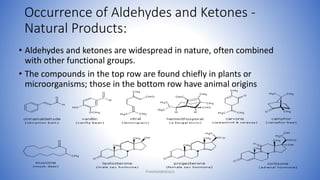
Occurrence of Aldehydes and Ketones -
Natural Products:
• Aldehydes and ketones are widespread in nature, often combined
with other functional groups.
• The compounds in the top row are found chiefly in plants or
microorganisms; those in the bottom row have animal origins
PHARMABRIDGES
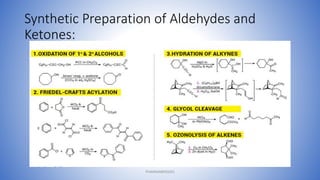
Synthetic Preparation of Aldehydes and
Ketones:
PHARMABRIDGES
PHARMABRIDGES

Carbonyl compound

  • 1.
  • 2.
    INTRODUCTION Carbonyl group, inorganic chemistry, a divalent chemical unit consisting of a carbon (C) and an oxygen (O) atom connected by a double bond. The group is a constituent of carboxylic acids, esters, anhydrides, acyl halides, amides, and quinones, and it is the characteristic functional group (reactive group) of aldehydes and ketones. Carboxylic acids (and their derivatives), aldehydes, ketones, and quinones are also known collectively as carbonyl compounds. PHARMABRIDGES
  • 3.
    Because of adifference in the electron affinities of the carbon and oxygen atoms, the electron pairs that constitute the double bond are held closer to the oxygen atom than to the carbon atom; the electron- rich oxygen atom acquires a negative charge and the electron-deficient carbon atom a positive charge. Thus, molecules containing the carbonyl group are polar. Compounds containing a carbonyl group have higher melting and boiling points than hydrocarbons containing the same number of carbon atoms and are more soluble in polar solvents such as water. PHARMABRIDGES
  • 4.
    The IUPAC systemof nomenclature assigns a characteristic suffix to these classes, al to aldehydes and one to ketones. Chain numbering normally starts from the end nearest the carbonyl group. In cyclic ketones the carbonyl group is assigned position #1, and this number is not cited in the name, unless more than one carbonyl group is present. The atom adjacent to the function is alpha, the next removed is beta and so on. Since ketones have two sets of neighboring atoms, one set is labeled α, β etc., and the other α', β' etc. PHARMABRIDGES
  • 5.
  • 6.
  • 7.
  • 8.
    Occurrence of Aldehydesand Ketones - Natural Products: • Aldehydes and ketones are widespread in nature, often combined with other functional groups. • The compounds in the top row are found chiefly in plants or microorganisms; those in the bottom row have animal origins PHARMABRIDGES
  • 9.
    Synthetic Preparation ofAldehydes and Ketones: PHARMABRIDGES
  • 10.