Foot and Ankle
Instability
 Ankle is the 2nd most common only injured body site
 Ankle sprains are the most common type of ankle injury
 Inversion injury most common mechanism
 Risk factor is previous ankle sprain
• It is estimated that 80 to 85% of ankle sprains occur to the lateral ligaments
• It is generally accepted that an eversion ankle sprain is more severe, with
greater instability. However, an inversion ankle sprain is more common, with
the lateral ligaments being involved in 80% to 85% of all ankle sprains
• ATFL is most common injured ligament
• High rate of recurrence (20- 40%)
• Chronic ankle instability (20 - 40%)
Introduction
Charles M. Court-Brown, James D. Heckman, Margaret M. Mc Queen, William M Ricci, Paul Tornetta III. (2015). Rockwood and Green's Fractures in adults eighth edition
Solomon, L., Warwick, D., & Nayagam, S. (2010). Apley's system of orthopaedics and fractures ninth edition. CRC press.
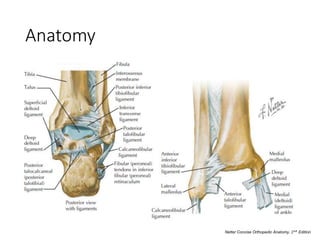
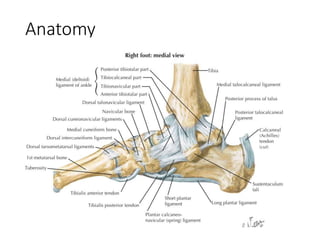
Anatomy
Netter Concise Orthopedic Anatomy, 2𝑛𝑑 Edition
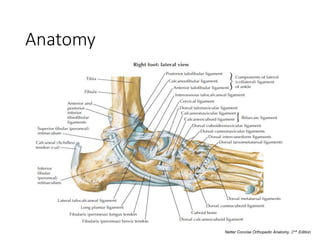
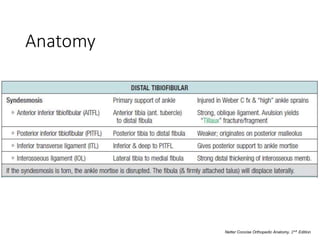
Anatomy
Netter Concise Orthopedic Anatomy, 2𝑛𝑑 Edition
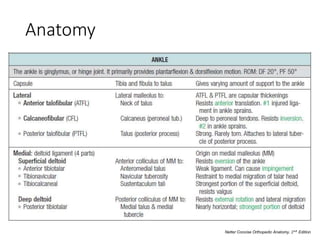
Anatomy
Anatomy
Netter Concise Orthopedic Anatomy, 2𝑛𝑑 Edition
Anatomy
Netter Concise Orthopedic Anatomy, 2𝑛𝑑 Edition
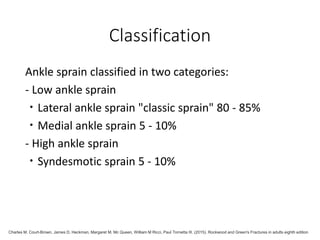
Classification
Ankle sprain classified in two categories:
- Low ankle sprain
ㆍLateral ankle sprain "classic sprain" 80 - 85%
ㆍMedial ankle sprain 5 - 10%
- High ankle sprain
ㆍSyndesmotic sprain 5 - 10%
Charles M. Court-Brown, James D. Heckman, Margaret M. Mc Queen, William M Ricci, Paul Tornetta III. (2015). Rockwood and Green's Fractures in adults eighth edition
Low Ankle Sprain
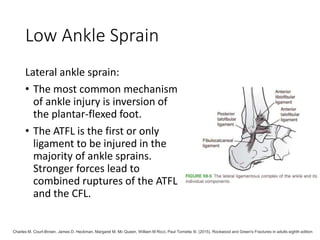
Lateral ankle sprain:
• The most common mechanism
of ankle injury is inversion of
the plantar-flexed foot.
• The ATFL is the first or only
ligament to be injured in the
majority of ankle sprains.
Stronger forces lead to
combined ruptures of the ATFL
and the CFL.
Charles M. Court-Brown, James D. Heckman, Margaret M. Mc Queen, William M Ricci, Paul Tornetta III. (2015). Rockwood and Green's Fractures in adults eighth edition
Low Ankle Sprain
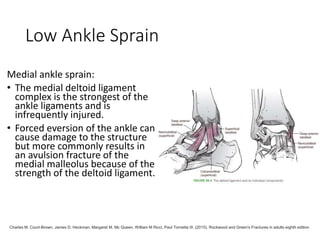
Medial ankle sprain:
• The medial deltoid ligament
complex is the strongest of the
ankle ligaments and is
infrequently injured.
• Forced eversion of the ankle can
cause damage to the structure
but more commonly results in
an avulsion fracture of the
medial malleolus because of the
strength of the deltoid ligament.
Charles M. Court-Brown, James D. Heckman, Margaret M. Mc Queen, William M Ricci, Paul Tornetta III. (2015). Rockwood and Green's Fractures in adults eighth edition
High Ankle Sprain
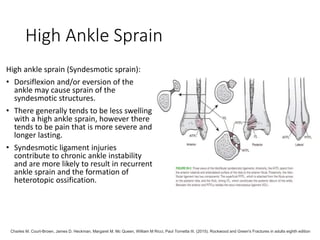
High ankle sprain (Syndesmotic sprain):
• Dorsiflexion and/or eversion of the
ankle may cause sprain of the
syndesmotic structures.
• There generally tends to be less swelling
with a high ankle sprain, however there
tends to be pain that is more severe and
longer lasting.
• Syndesmotic ligament injuries
contribute to chronic ankle instability
and are more likely to result in recurrent
ankle sprain and the formation of
heterotopic ossification.
Charles M. Court-Brown, James D. Heckman, Margaret M. Mc Queen, William M Ricci, Paul Tornetta III. (2015). Rockwood and Green's Fractures in adults eighth edition
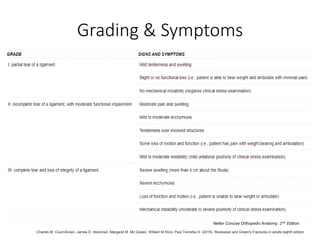
Grading & Symptoms
Charles M. Court-Brown, James D. Heckman, Margaret M. Mc Queen, William M Ricci, Paul Tornetta III. (2015). Rockwood and Green's Fractures in adults eighth edition
Netter Concise Orthopedic Anatomy, 2𝑛𝑑 Edition
Physical Examination
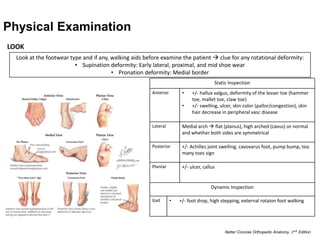
LOOK
Netter Concise Orthopedic Anatomy, 2𝑛𝑑 Edition
Look at the footwear type and if any, walking aids before examine the patient  clue for any rotational deformity:
• Supination deformity: Early lateral, proximal, and mid shoe wear
• Pronation deformity: Medial border
Static Inspection
Anterior • +/- hallux valgus, deformity of the lesser toe (hammer
toe, mallet toe, claw toe)
• +/- swelling, ulcer, skin color (pallor/congestion), skin
hair decrease in peripheral vasc disease
Lateral Medial arch  flat (planus), high arched (cavus) or normal
and whether both sides are symmetrical
Posterior +/- Achilles joint swelling, cavovarus foot, pump bump, too
many toes sign
Plantar +/- ulcer, callus
Dynamic Inspection
Gait • +/- foot drop, high stepping, external rotaion foot walking
Physical Examination
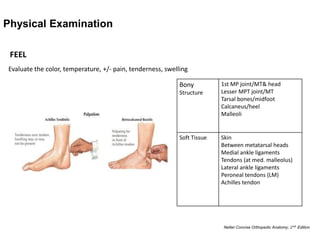
FEEL
Bony
Structure
1st MP joint/MT& head
Lesser MPT joint/MT
Tarsal bones/midfoot
Calcaneus/heel
Malleoli
Soft Tissue Skin
Between metatarsal heads
Medial ankle ligaments
Tendons (at med. malleolus)
Lateral ankle ligaments
Peroneal tendons (LM)
Achilles tendon
Evaluate the color, temperature, +/- pain, tenderness, swelling
Netter Concise Orthopedic Anatomy, 2𝑛𝑑 Edition
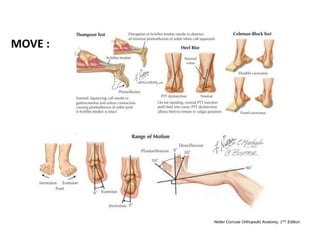
MOVE :
Management
Conservative Management
Initial Management
Initial management of ankle sprains requires the PRICE regimen:
P = Protection (crutches, splint or brace)
R = Rest
I = Ice (cold compresses 20 minutes every 2 hours & after any activity that
exacerbates the symptoms
C = Compression
E = Elevation (RICE continued for 1-3 weeks)
Rehabilitation:
• This is probably the single most important factor in treatment, particularly with
Grade I and Grade Il injuries.
• Pain and swelling can be reduced with the use of electrotherapeutic modalities.
• Analgesics (NSAID) may be required.
Solomon, L., Warwick, D., & Nayagam, S. (2010). Apley's system of orthopaedics and fractures ninth edition. CRC press.
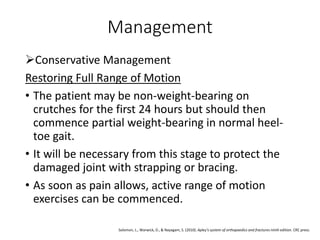
Management
Conservative Management
Restoring Full Range of Motion
• The patient may be non-weight-bearing on
crutches for the first 24 hours but should then
commence partial weight-bearing in normal heel-
toe gait.
• It will be necessary from this stage to protect the
damaged joint with strapping or bracing.
• As soon as pain allows, active range of motion
exercises can be commenced.
Solomon, L., Warwick, D., & Nayagam, S. (2010). Apley's system of orthopaedics and fractures ninth edition. CRC press.
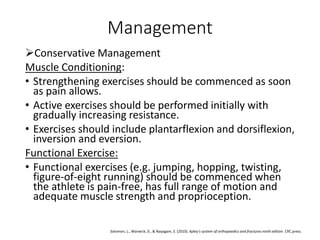
Management
Conservative Management
Muscle Conditioning:
• Strengthening exercises should be commenced as soon
as pain allows.
• Active exercises should be performed initially with
gradually increasing resistance.
• Exercises should include plantarflexion and dorsiflexion,
inversion and eversion.
Functional Exercise:
• Functional exercises (e.g. jumping, hopping, twisting,
figure-of-eight running) should be commenced when
the athlete is pain-free, has full range of motion and
adequate muscle strength and proprioception.
Solomon, L., Warwick, D., & Nayagam, S. (2010). Apley's system of orthopaedics and fractures ninth edition. CRC press.
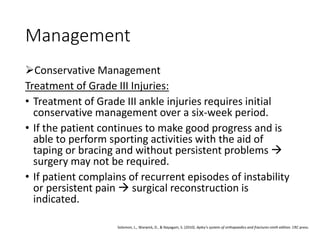
Management
Conservative Management
Treatment of Grade III Injuries:
• Treatment of Grade III ankle injuries requires initial
conservative management over a six-week period.
• If the patient continues to make good progress and is
able to perform sporting activities with the aid of
taping or bracing and without persistent problems 
surgery may not be required.
• If patient complains of recurrent episodes of instability
or persistent pain  surgical reconstruction is
indicated.
Solomon, L., Warwick, D., & Nayagam, S. (2010). Apley's system of orthopaedics and fractures ninth edition. CRC press.
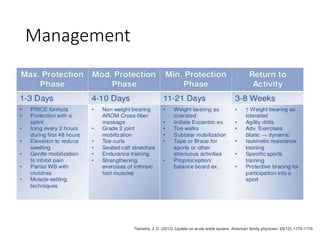
Management
Tiemstra, J. D. (2012). Update on acute ankle sprains. American family physician, 85(12), 1170-1176.
Surgical Treatment
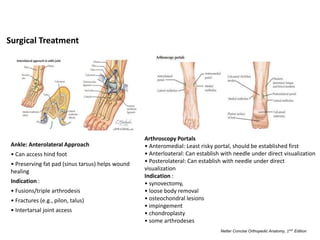
Ankle: Anterolateral Approach
• Can access hind foot
• Preserving fat pad (sinus tarsus) helps wound
healing
Indication :
• Fusions/triple arthrodesis
• Fractures (e.g., pilon, talus)
• Intertarsal joint access
Arthroscopy Portals
• Anteromedial: Least risky portal, should be established first
• Anterloateral: Can establish with needle under direct visualization
• Posterolateral: Can establish with needle under direct
visualization
Indication :
• synovectomy,
• loose body removal
• osteochondral lesions
• impingement
• chondroplasty
• some arthrodeses
Netter Concise Orthopedic Anatomy, 2𝑛𝑑 Edition
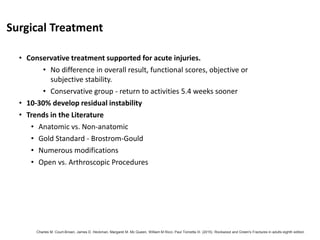
• Conservative treatment supported for acute injuries.
• No difference in overall result, functional scores, objective or
subjective stability.
• Conservative group - return to activities 5.4 weeks sooner
• 10-30% develop residual instability
• Trends in the Literature
• Anatomic vs. Non-anatomic
• Gold Standard - Brostrom-Gould
• Numerous modifications
• Open vs. Arthroscopic Procedures
Surgical Treatment
Charles M. Court-Brown, James D. Heckman, Margaret M. Mc Queen, William M Ricci, Paul Tornetta III. (2015). Rockwood and Green's Fractures in adults eighth edition
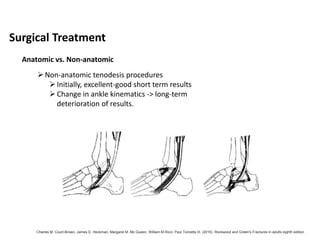
Non-anatomic tenodesis procedures
Initially, excellent-good short term results
Change in ankle kinematics -> long-term
deterioration of results.
Surgical Treatment
Anatomic vs. Non-anatomic
Charles M. Court-Brown, James D. Heckman, Margaret M. Mc Queen, William M Ricci, Paul Tornetta III. (2015). Rockwood and Green's Fractures in adults eighth edition
SurgicalTreatment
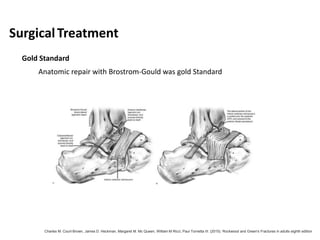
Gold Standard
Anatomic repair with Brostrom-Gould was gold Standard
Charles M. Court-Brown, James D. Heckman, Margaret M. Mc Queen, William M Ricci, Paul Tornetta III. (2015). Rockwood and Green's Fractures in adults eighth edition
THANK YOU

Foot and ankle instability

  • 1.
  • 2.
     Ankle isthe 2nd most common only injured body site  Ankle sprains are the most common type of ankle injury  Inversion injury most common mechanism  Risk factor is previous ankle sprain • It is estimated that 80 to 85% of ankle sprains occur to the lateral ligaments • It is generally accepted that an eversion ankle sprain is more severe, with greater instability. However, an inversion ankle sprain is more common, with the lateral ligaments being involved in 80% to 85% of all ankle sprains • ATFL is most common injured ligament • High rate of recurrence (20- 40%) • Chronic ankle instability (20 - 40%) Introduction Charles M. Court-Brown, James D. Heckman, Margaret M. Mc Queen, William M Ricci, Paul Tornetta III. (2015). Rockwood and Green's Fractures in adults eighth edition Solomon, L., Warwick, D., & Nayagam, S. (2010). Apley's system of orthopaedics and fractures ninth edition. CRC press.
  • 3.
    Anatomy Netter Concise OrthopedicAnatomy, 2𝑛𝑑 Edition
  • 4.
    Anatomy Netter Concise OrthopedicAnatomy, 2𝑛𝑑 Edition
  • 5.
  • 6.
    Anatomy Netter Concise OrthopedicAnatomy, 2𝑛𝑑 Edition
  • 7.
    Anatomy Netter Concise OrthopedicAnatomy, 2𝑛𝑑 Edition
  • 8.
    Classification Ankle sprain classifiedin two categories: - Low ankle sprain ㆍLateral ankle sprain "classic sprain" 80 - 85% ㆍMedial ankle sprain 5 - 10% - High ankle sprain ㆍSyndesmotic sprain 5 - 10% Charles M. Court-Brown, James D. Heckman, Margaret M. Mc Queen, William M Ricci, Paul Tornetta III. (2015). Rockwood and Green's Fractures in adults eighth edition
  • 9.
    Low Ankle Sprain Lateralankle sprain: • The most common mechanism of ankle injury is inversion of the plantar-flexed foot. • The ATFL is the first or only ligament to be injured in the majority of ankle sprains. Stronger forces lead to combined ruptures of the ATFL and the CFL. Charles M. Court-Brown, James D. Heckman, Margaret M. Mc Queen, William M Ricci, Paul Tornetta III. (2015). Rockwood and Green's Fractures in adults eighth edition
  • 10.
    Low Ankle Sprain Medialankle sprain: • The medial deltoid ligament complex is the strongest of the ankle ligaments and is infrequently injured. • Forced eversion of the ankle can cause damage to the structure but more commonly results in an avulsion fracture of the medial malleolus because of the strength of the deltoid ligament. Charles M. Court-Brown, James D. Heckman, Margaret M. Mc Queen, William M Ricci, Paul Tornetta III. (2015). Rockwood and Green's Fractures in adults eighth edition
  • 11.
    High Ankle Sprain Highankle sprain (Syndesmotic sprain): • Dorsiflexion and/or eversion of the ankle may cause sprain of the syndesmotic structures. • There generally tends to be less swelling with a high ankle sprain, however there tends to be pain that is more severe and longer lasting. • Syndesmotic ligament injuries contribute to chronic ankle instability and are more likely to result in recurrent ankle sprain and the formation of heterotopic ossification. Charles M. Court-Brown, James D. Heckman, Margaret M. Mc Queen, William M Ricci, Paul Tornetta III. (2015). Rockwood and Green's Fractures in adults eighth edition
  • 12.
    Grading & Symptoms CharlesM. Court-Brown, James D. Heckman, Margaret M. Mc Queen, William M Ricci, Paul Tornetta III. (2015). Rockwood and Green's Fractures in adults eighth edition Netter Concise Orthopedic Anatomy, 2𝑛𝑑 Edition
  • 13.
    Physical Examination LOOK Netter ConciseOrthopedic Anatomy, 2𝑛𝑑 Edition Look at the footwear type and if any, walking aids before examine the patient  clue for any rotational deformity: • Supination deformity: Early lateral, proximal, and mid shoe wear • Pronation deformity: Medial border Static Inspection Anterior • +/- hallux valgus, deformity of the lesser toe (hammer toe, mallet toe, claw toe) • +/- swelling, ulcer, skin color (pallor/congestion), skin hair decrease in peripheral vasc disease Lateral Medial arch  flat (planus), high arched (cavus) or normal and whether both sides are symmetrical Posterior +/- Achilles joint swelling, cavovarus foot, pump bump, too many toes sign Plantar +/- ulcer, callus Dynamic Inspection Gait • +/- foot drop, high stepping, external rotaion foot walking
  • 14.
    Physical Examination FEEL Bony Structure 1st MPjoint/MT& head Lesser MPT joint/MT Tarsal bones/midfoot Calcaneus/heel Malleoli Soft Tissue Skin Between metatarsal heads Medial ankle ligaments Tendons (at med. malleolus) Lateral ankle ligaments Peroneal tendons (LM) Achilles tendon Evaluate the color, temperature, +/- pain, tenderness, swelling Netter Concise Orthopedic Anatomy, 2𝑛𝑑 Edition
  • 15.
    Netter Concise OrthopedicAnatomy, 2𝑛𝑑 Edition MOVE :
  • 16.
    Management Conservative Management Initial Management Initialmanagement of ankle sprains requires the PRICE regimen: P = Protection (crutches, splint or brace) R = Rest I = Ice (cold compresses 20 minutes every 2 hours & after any activity that exacerbates the symptoms C = Compression E = Elevation (RICE continued for 1-3 weeks) Rehabilitation: • This is probably the single most important factor in treatment, particularly with Grade I and Grade Il injuries. • Pain and swelling can be reduced with the use of electrotherapeutic modalities. • Analgesics (NSAID) may be required. Solomon, L., Warwick, D., & Nayagam, S. (2010). Apley's system of orthopaedics and fractures ninth edition. CRC press.
  • 17.
    Management Conservative Management Restoring FullRange of Motion • The patient may be non-weight-bearing on crutches for the first 24 hours but should then commence partial weight-bearing in normal heel- toe gait. • It will be necessary from this stage to protect the damaged joint with strapping or bracing. • As soon as pain allows, active range of motion exercises can be commenced. Solomon, L., Warwick, D., & Nayagam, S. (2010). Apley's system of orthopaedics and fractures ninth edition. CRC press.
  • 18.
    Management Conservative Management Muscle Conditioning: •Strengthening exercises should be commenced as soon as pain allows. • Active exercises should be performed initially with gradually increasing resistance. • Exercises should include plantarflexion and dorsiflexion, inversion and eversion. Functional Exercise: • Functional exercises (e.g. jumping, hopping, twisting, figure-of-eight running) should be commenced when the athlete is pain-free, has full range of motion and adequate muscle strength and proprioception. Solomon, L., Warwick, D., & Nayagam, S. (2010). Apley's system of orthopaedics and fractures ninth edition. CRC press.
  • 19.
    Management Conservative Management Treatment ofGrade III Injuries: • Treatment of Grade III ankle injuries requires initial conservative management over a six-week period. • If the patient continues to make good progress and is able to perform sporting activities with the aid of taping or bracing and without persistent problems  surgery may not be required. • If patient complains of recurrent episodes of instability or persistent pain  surgical reconstruction is indicated. Solomon, L., Warwick, D., & Nayagam, S. (2010). Apley's system of orthopaedics and fractures ninth edition. CRC press.
  • 20.
    Management Tiemstra, J. D.(2012). Update on acute ankle sprains. American family physician, 85(12), 1170-1176.
  • 21.
    Surgical Treatment Ankle: AnterolateralApproach • Can access hind foot • Preserving fat pad (sinus tarsus) helps wound healing Indication : • Fusions/triple arthrodesis • Fractures (e.g., pilon, talus) • Intertarsal joint access Arthroscopy Portals • Anteromedial: Least risky portal, should be established first • Anterloateral: Can establish with needle under direct visualization • Posterolateral: Can establish with needle under direct visualization Indication : • synovectomy, • loose body removal • osteochondral lesions • impingement • chondroplasty • some arthrodeses Netter Concise Orthopedic Anatomy, 2𝑛𝑑 Edition
  • 22.
    • Conservative treatmentsupported for acute injuries. • No difference in overall result, functional scores, objective or subjective stability. • Conservative group - return to activities 5.4 weeks sooner • 10-30% develop residual instability • Trends in the Literature • Anatomic vs. Non-anatomic • Gold Standard - Brostrom-Gould • Numerous modifications • Open vs. Arthroscopic Procedures Surgical Treatment Charles M. Court-Brown, James D. Heckman, Margaret M. Mc Queen, William M Ricci, Paul Tornetta III. (2015). Rockwood and Green's Fractures in adults eighth edition
  • 23.
    Non-anatomic tenodesis procedures Initially,excellent-good short term results Change in ankle kinematics -> long-term deterioration of results. Surgical Treatment Anatomic vs. Non-anatomic Charles M. Court-Brown, James D. Heckman, Margaret M. Mc Queen, William M Ricci, Paul Tornetta III. (2015). Rockwood and Green's Fractures in adults eighth edition
  • 24.
    SurgicalTreatment Gold Standard Anatomic repairwith Brostrom-Gould was gold Standard Charles M. Court-Brown, James D. Heckman, Margaret M. Mc Queen, William M Ricci, Paul Tornetta III. (2015). Rockwood and Green's Fractures in adults eighth edition
  • 25.

Editor's Notes

  • #13 Grade I Sprain: It results from mild stretching of a ligament with microscopic tears. Patients have mild swelling and tenderness. There is no joint instability on examination, and the patient is able to bear weight and ambulate with minimal pain. Grade II Sprain: Is more severe injury involving an incomplete tear of a ligament. Patients have moderate pain, swelling, tenderness and ecchymosis. There is mild to moderate joint instability on exam with some restriction of the range of motion and loss of function. Weight bearing and ambulation are painful.
  • #14 Iliotibial tract (band) Tightness can cause lateral knee and/or thigh pain. Quadriceps muscle Atrophy can indicate an injury and/or contribute to knee pain. Quadriceps tendon Can rupture with eccentric loading. Defect is palpated here. Patella Tenderness can indicate fracture; swelling can be prepatellar bursitis. Patellar tendon Can rupture with eccentric loading. Defect is palpated here. Patellar retinaculum Patellar femoral ligaments palpated here. They can be injured in patellar dislocation. Plicae can also be palpated here. Joint line Tenderness here can indicate meniscal pathology. Tibial tubercle Tender in Osgood-Schlatter disease. Pes anserinus & bursa Insertion of medial hamstrings. Bursitis can develop. Site of hamstring tendon harvest. Gerdy’s tubercle Insertion of the iliotibial tract (band). Popliteal fossa Popliteal artery pulse can be palpated here. Muscle compartments Will be fi rm or tense in compartment syndrome. Anterior most common
  • #15 Iliotibial tract (band) Tightness can cause lateral knee and/or thigh pain. Quadriceps muscle Atrophy can indicate an injury and/or contribute to knee pain. Quadriceps tendon Can rupture with eccentric loading. Defect is palpated here. Patella Tenderness can indicate fracture; swelling can be prepatellar bursitis. Patellar tendon Can rupture with eccentric loading. Defect is palpated here. Patellar retinaculum Patellar femoral ligaments palpated here. They can be injured in patellar dislocation. Plicae can also be palpated here. Joint line Tenderness here can indicate meniscal pathology. Tibial tubercle Tender in Osgood-Schlatter disease. Pes anserinus & bursa Insertion of medial hamstrings. Bursitis can develop. Site of hamstring tendon harvest. Gerdy’s tubercle Insertion of the iliotibial tract (band). Popliteal fossa Popliteal artery pulse can be palpated here. Muscle compartments Will be fi rm or tense in compartment syndrome. Anterior most common