Kristen Lilly, MHA, CHC®, CPHQ, RHIA®
PYA
2018 ANNUAL MEETING
TENNESSEE HEALTH INFORMATION MANAGEMENT ASSOCIATION
How HIM Supports the Seven Elements
of an Effective Compliance Program
Prepared for THIMA 2018 Annual Meeting Page 1
Agenda
 What is compliance and why is it important?
 Understand the seven elements of a robust compliance
program as outlined in the Federal Sentencing
Guidelines
 Review the regulatory guidance surrounding compliance
programs
 Identify HIM’s role in organization compliance
 Discuss the intersection between HIM and compliance
What Is Compliance and Why Is It
Important?
Prepared for THIMA 2018 Annual Meeting Page 3
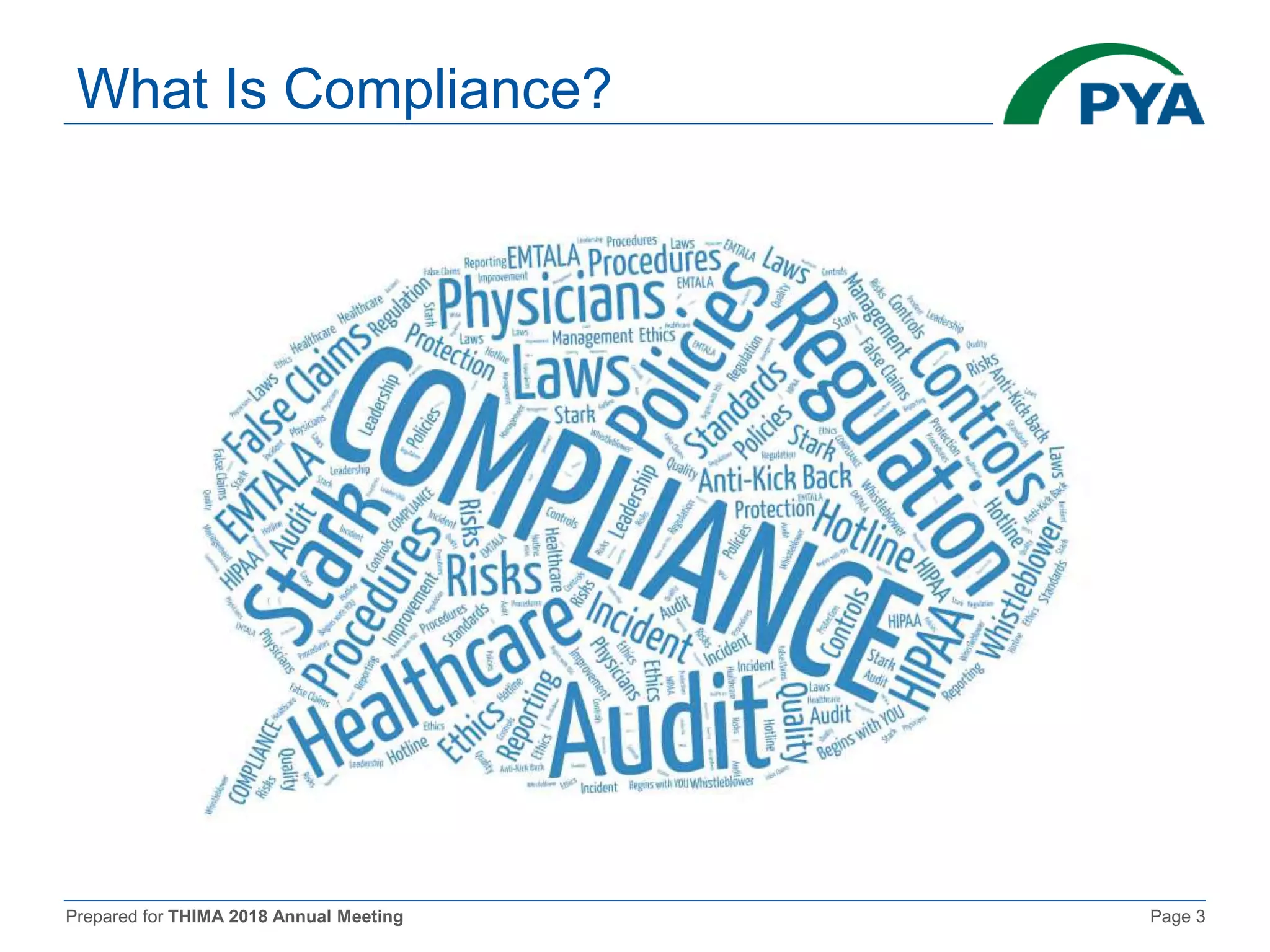
What Is Compliance?
Prepared for THIMA 2018 Annual Meeting Page 4
Definition of Compliance
General Definition of Compliance
 Meeting the expectations of others
Compliance for Healthcare Providers
 Activities that assist organizations and providers with
conducting operations and activities ethically, with the
highest level of integrity, and in compliance with legal
and regulatory requirements
 Help prevent violations and reduce risk and liability to
the provider organization
Prepared for THIMA 2018 Annual Meeting Page 5
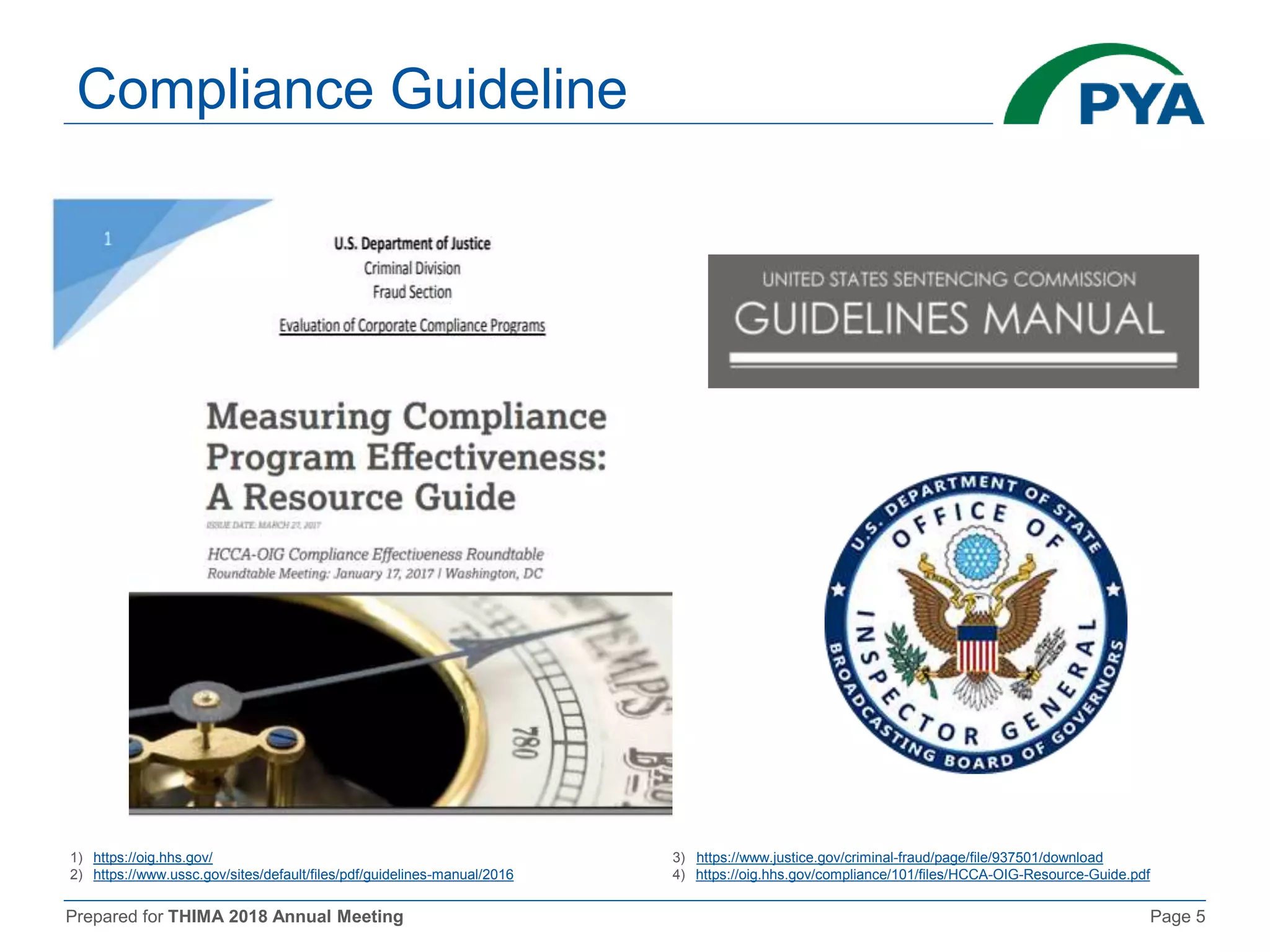
Compliance Guideline
3) https://www.justice.gov/criminal-fraud/page/file/937501/download
4) https://oig.hhs.gov/compliance/101/files/HCCA-OIG-Resource-Guide.pdf
1) https://oig.hhs.gov/
2) https://www.ussc.gov/sites/default/files/pdf/guidelines-manual/2016
Prepared for THIMA 2018 Annual Meeting Page 6
CMS Mandates for Compliance
 Section 6401 of the Patient Protection and Affordable
Care Act (PPACA), enacted March 23, 2010, mandates
that all healthcare providers enrolled in Medicare,
Medicaid, and the Children’s Health Insurance Program
(CHIP) establish a compliance program as a condition of
enrollment1
 CMS believes that compliance efforts are fundamentally
designed to establish a culture within an organization
that promotes the prevention, detection, and resolution
of instances of conduct that do not conform to federal
and state law, or to federal healthcare program
requirements2
1) 42 U.S.C. § 1395cc(j)(8). Section 6401,Health and Human Services (HHS)
2) Compliance Program Guidance for Medicare Fee-For-Service Contractor, March 2005, Health and Human Services (HHS)
Prepared for THIMA 2018 Annual Meeting Page 7
Compliance Program Essentials
 A Compliance Program establishes and maintains a
“culture of compliance”
 A Compliance Program is a series of internal controls,
monitoring activities, and metrics to help organizations
meet the requirements of state and federal regulatory
agencies
 A Compliance Program provides an opportunity for
organizations to identify and correct potential risk areas
that may otherwise be obscured
Prepared for THIMA 2018 Annual Meeting Page 8
Benefits of a Solid Compliance Program
 Compliance is vital in deterring fraud and abuse
 The ultimate goal is to create an ethical, comfortable
corporate culture
 Patient care is improved when healthcare decisions are
based on proper motives
 When fraud and abuse happen, an effective Compliance
Program will mitigate the risk of undetected non-
compliance
Prepared for THIMA 2018 Annual Meeting Page 9
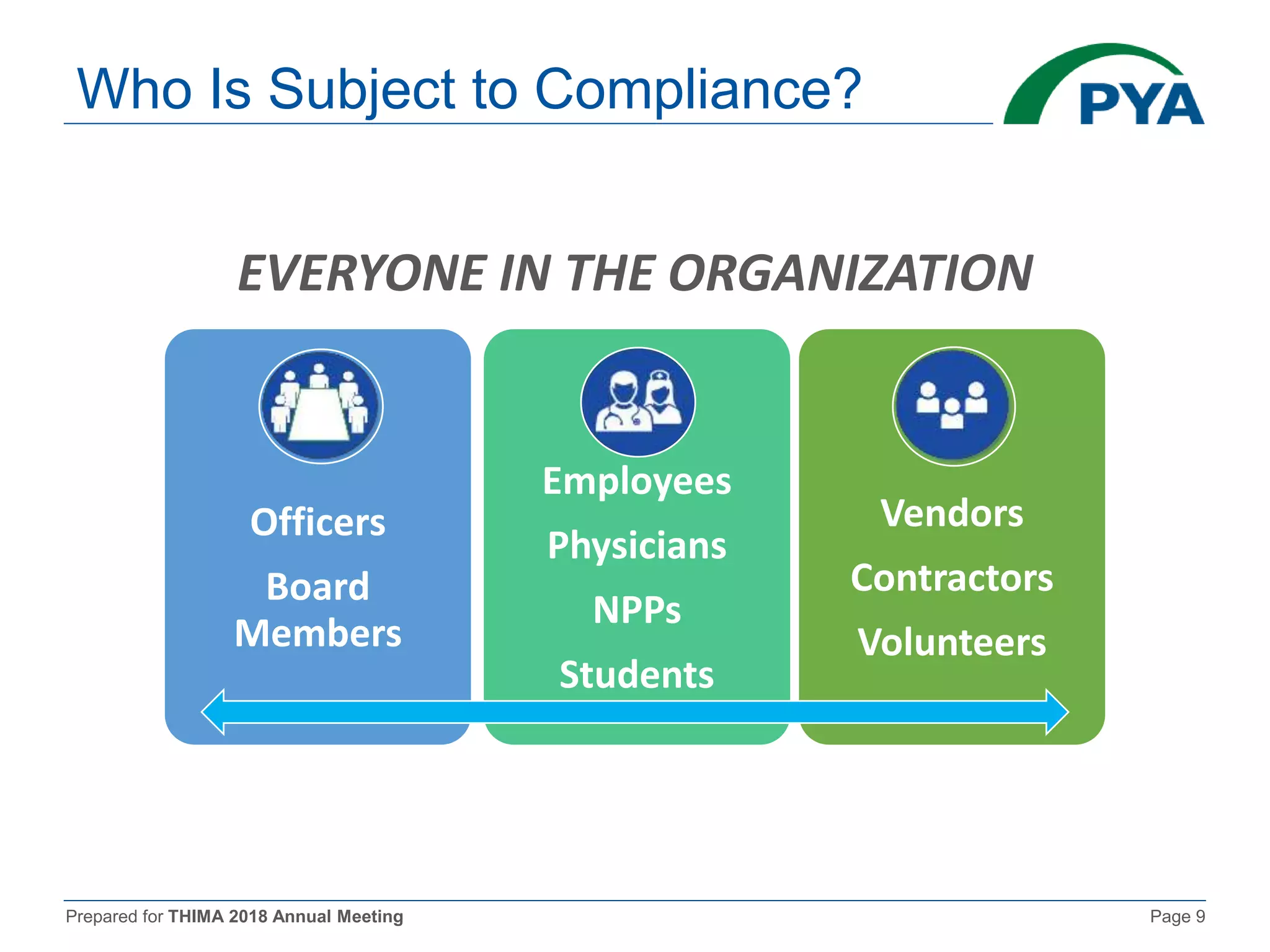
Who Is Subject to Compliance?
EVERYONE IN THE ORGANIZATION
Officers
Board
Members
Employees
Physicians
NPPs
Students
Vendors
Contractors
Volunteers
The Seven Elements of an Effective
Compliance Program and HIM’s Impact
Prepared for THIMA 2018 Annual Meeting Page 11
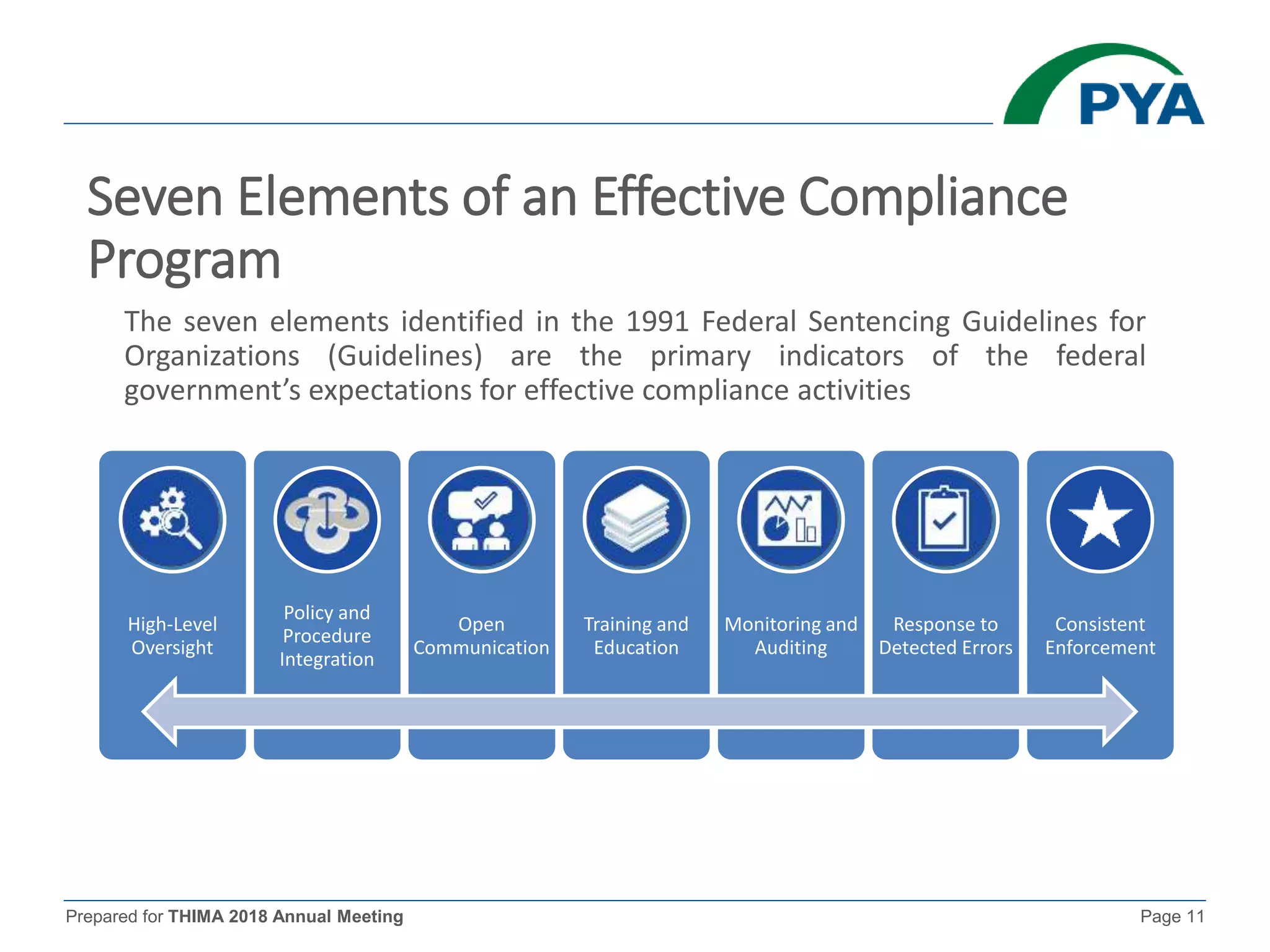
Seven Elements of an Effective Compliance
Program
The seven elements identified in the 1991 Federal Sentencing Guidelines for
Organizations (Guidelines) are the primary indicators of the federal
government’s expectations for effective compliance activities
High-Level
Oversight
Policy and
Procedure
Integration
Open
Communication
Training and
Education
Monitoring and
Auditing
Response to
Detected Errors
Consistent
Enforcement
High-Level Oversight
Prepared for THIMA 2018 Annual Meeting Page 13
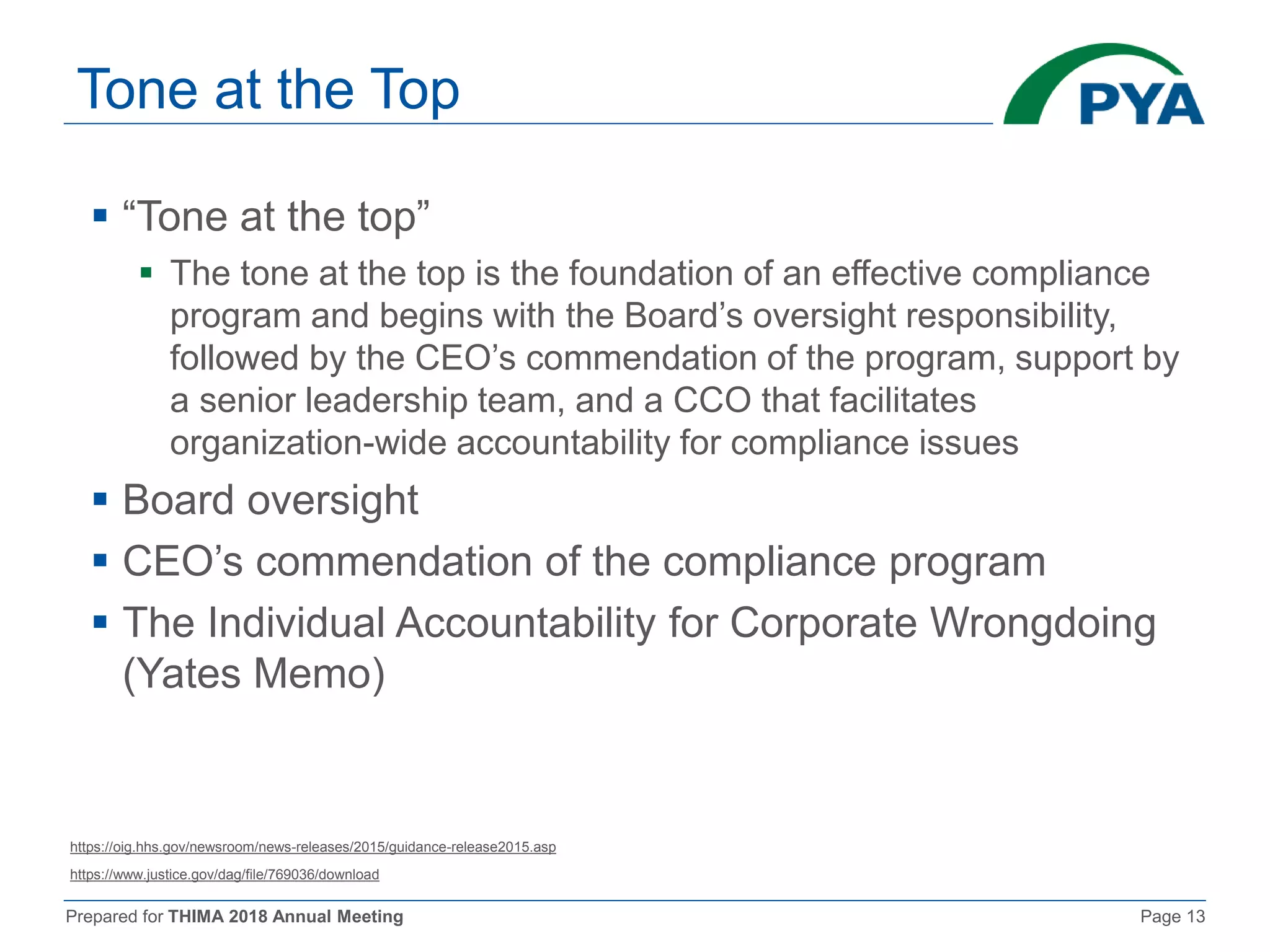
Tone at the Top
 “Tone at the top”
 The tone at the top is the foundation of an effective compliance
program and begins with the Board’s oversight responsibility,
followed by the CEO’s commendation of the program, support by
a senior leadership team, and a CCO that facilitates
organization-wide accountability for compliance issues
 Board oversight
 CEO’s commendation of the compliance program
 The Individual Accountability for Corporate Wrongdoing
(Yates Memo)
https://oig.hhs.gov/newsroom/news-releases/2015/guidance-release2015.asp
https://www.justice.gov/dag/file/769036/download
Prepared for THIMA 2018 Annual Meeting Page 14
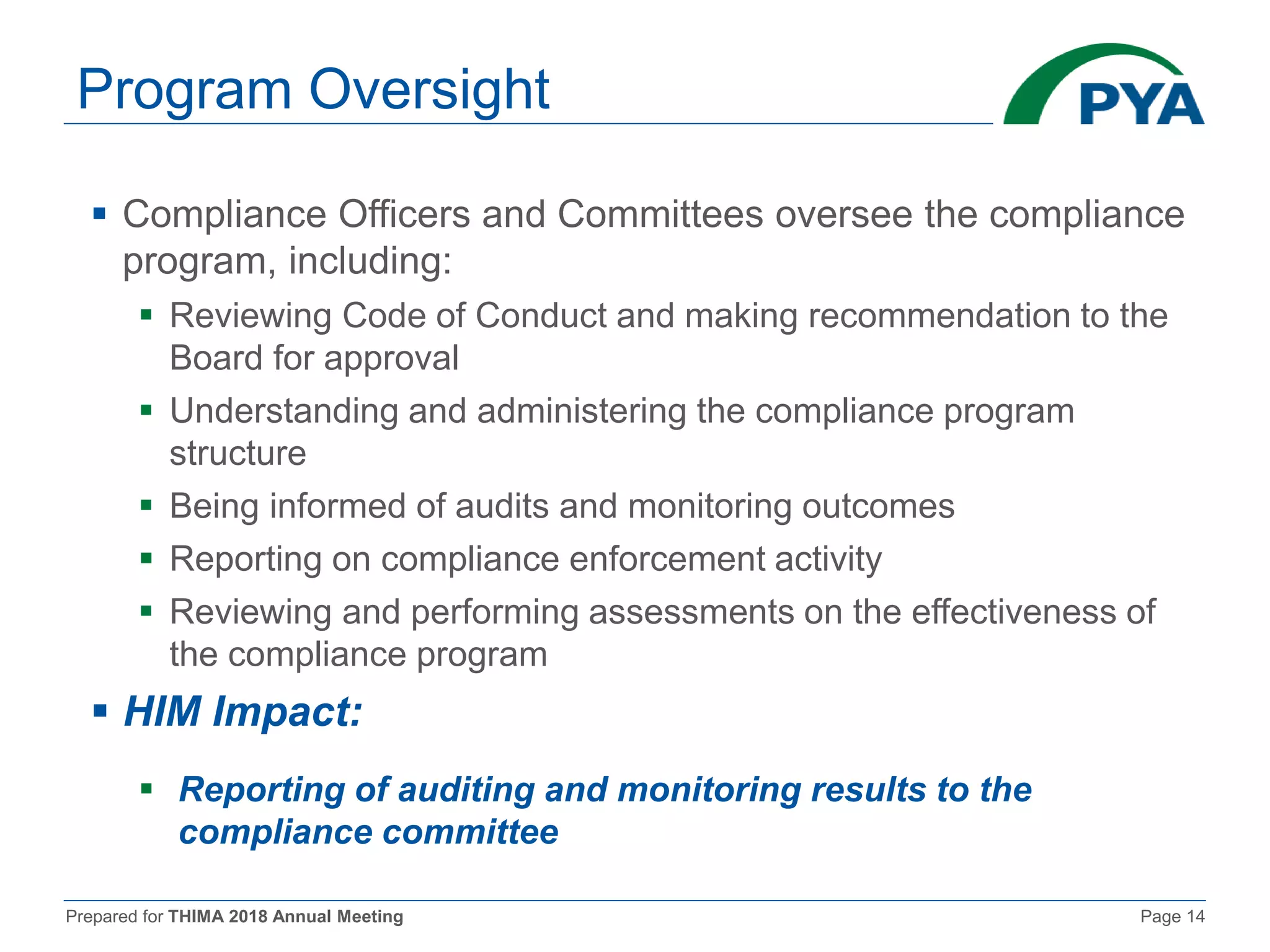
Program Oversight
 Compliance Officers and Committees oversee the compliance
program, including:
 Reviewing Code of Conduct and making recommendation to the
Board for approval
 Understanding and administering the compliance program
structure
 Being informed of audits and monitoring outcomes
 Reporting on compliance enforcement activity
 Reviewing and performing assessments on the effectiveness of
the compliance program
 HIM Impact:
 Reporting of auditing and monitoring results to the
compliance committee
Policies and Procedures
Prepared for THIMA 2018 Annual Meeting Page 16
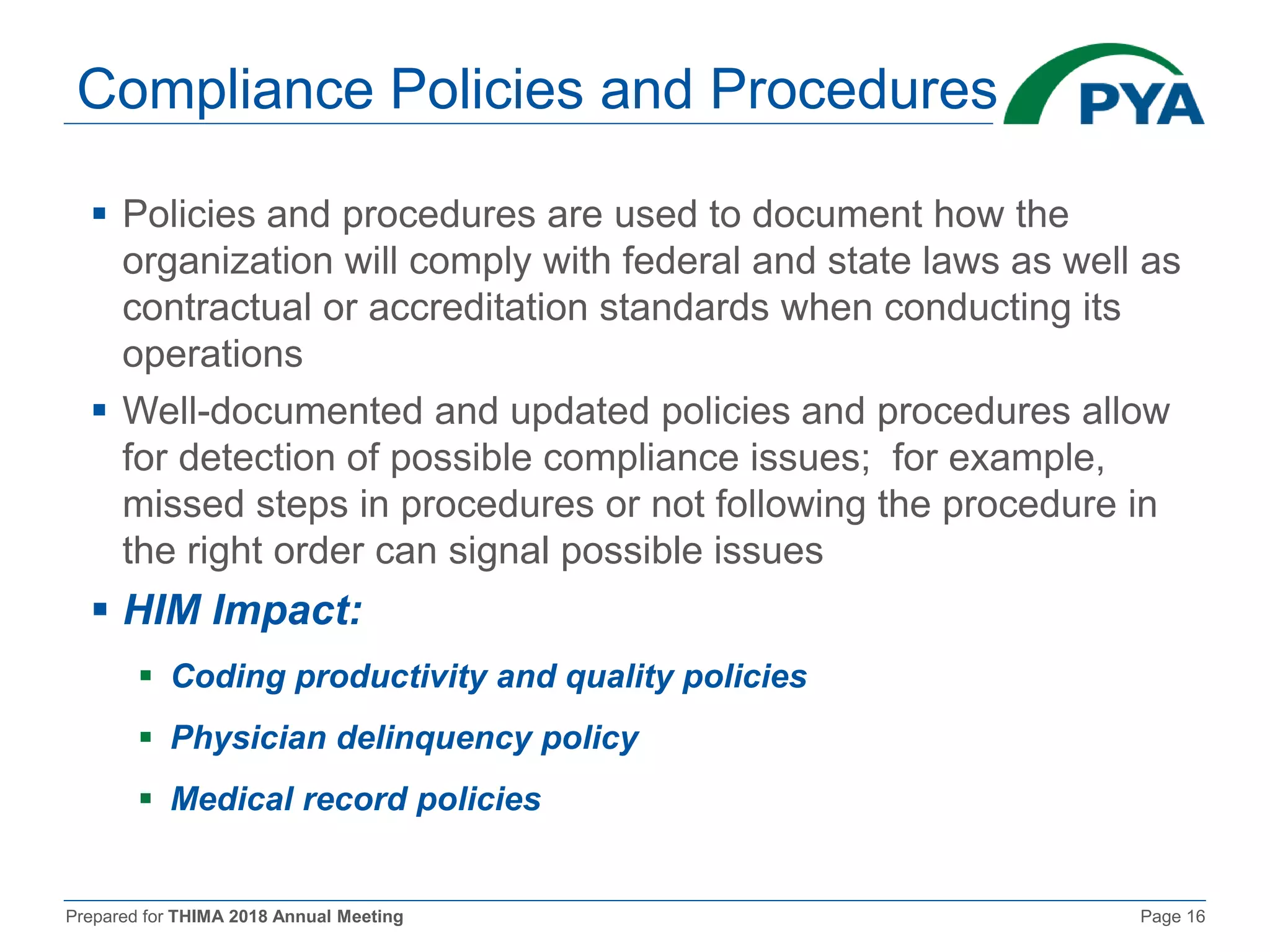
Compliance Policies and Procedures
 Policies and procedures are used to document how the
organization will comply with federal and state laws as well as
contractual or accreditation standards when conducting its
operations
 Well-documented and updated policies and procedures allow
for detection of possible compliance issues; for example,
missed steps in procedures or not following the procedure in
the right order can signal possible issues
 HIM Impact:
 Coding productivity and quality policies
 Physician delinquency policy
 Medical record policies
Open Lines of Communication
Prepared for THIMA 2018 Annual Meeting Page 18
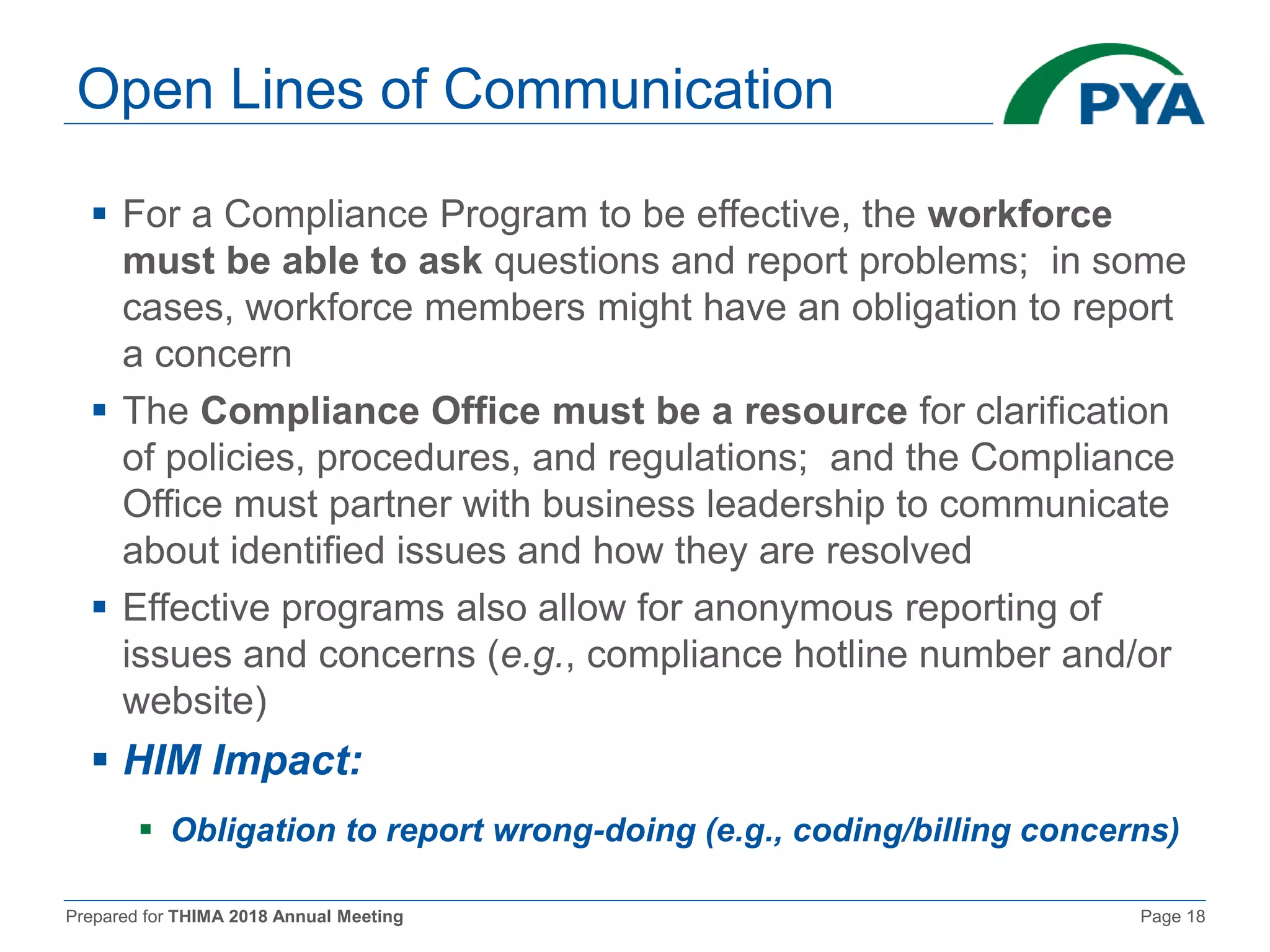
Open Lines of Communication
 For a Compliance Program to be effective, the workforce
must be able to ask questions and report problems; in some
cases, workforce members might have an obligation to report
a concern
 The Compliance Office must be a resource for clarification
of policies, procedures, and regulations; and the Compliance
Office must partner with business leadership to communicate
about identified issues and how they are resolved
 Effective programs also allow for anonymous reporting of
issues and concerns (e.g., compliance hotline number and/or
website)
 HIM Impact:
 Obligation to report wrong-doing (e.g., coding/billing concerns)
Training and Education
Prepared for THIMA 2018 Annual Meeting Page 20
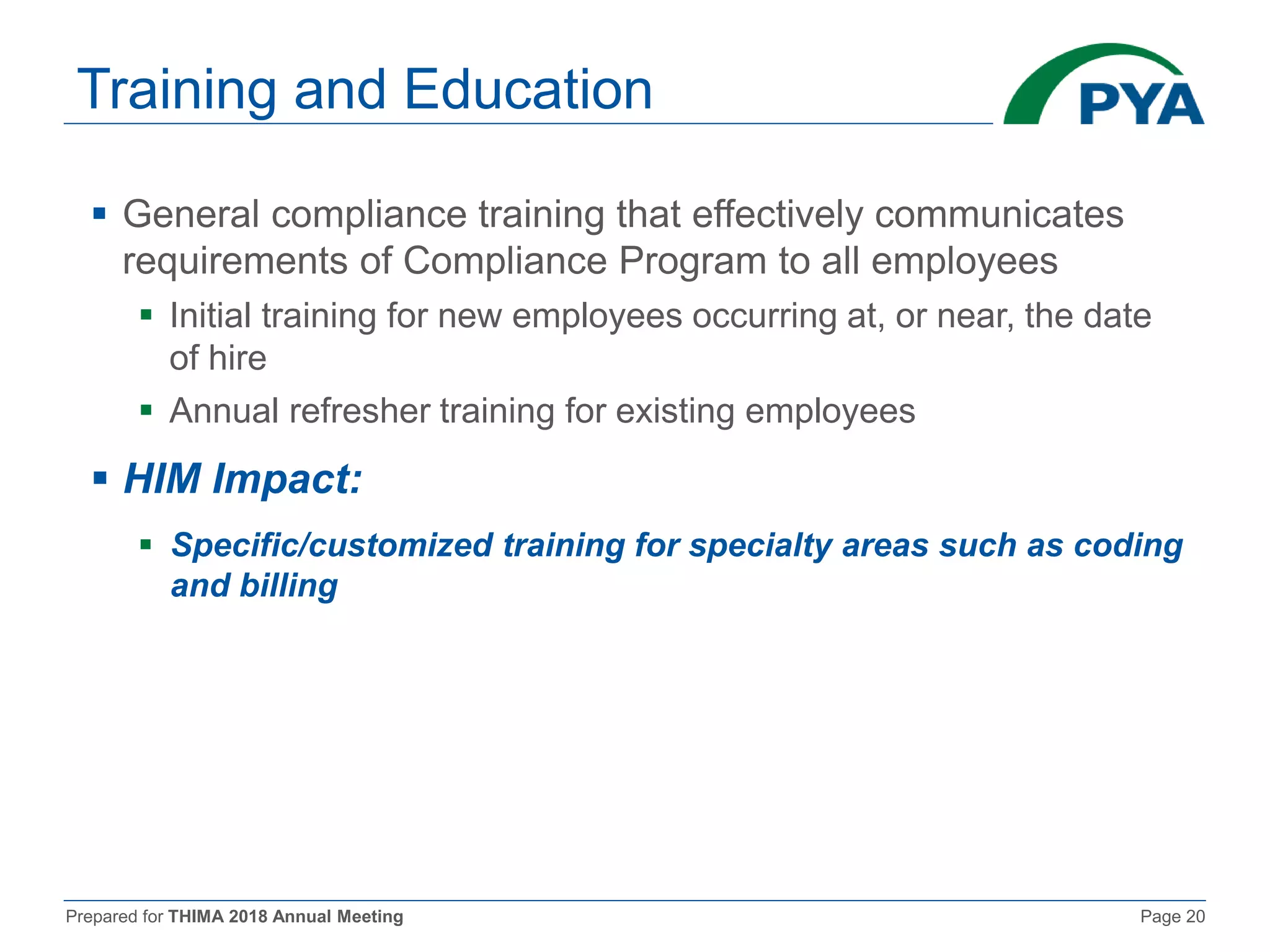
Training and Education
 General compliance training that effectively communicates
requirements of Compliance Program to all employees
 Initial training for new employees occurring at, or near, the date
of hire
 Annual refresher training for existing employees
 HIM Impact:
 Specific/customized training for specialty areas such as coding
and billing
Consistent Enforcement
Prepared for THIMA 2018 Annual Meeting Page 22
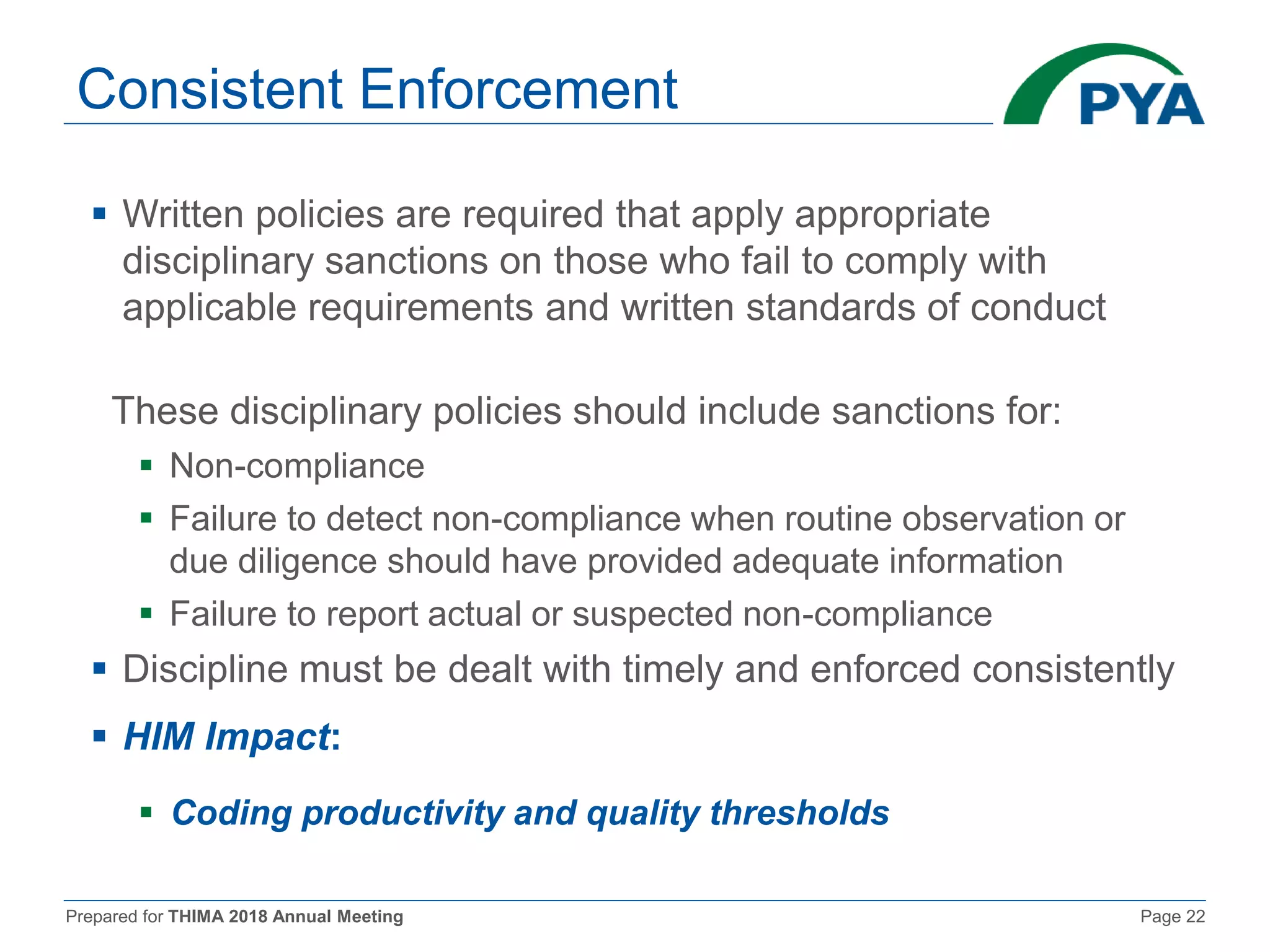
Consistent Enforcement
 Written policies are required that apply appropriate
disciplinary sanctions on those who fail to comply with
applicable requirements and written standards of conduct
These disciplinary policies should include sanctions for:
 Non-compliance
 Failure to detect non-compliance when routine observation or
due diligence should have provided adequate information
 Failure to report actual or suspected non-compliance
 Discipline must be dealt with timely and enforced consistently
 HIM Impact:
 Coding productivity and quality thresholds
Response to Detected Errors
Prepared for THIMA 2018 Annual Meeting Page 24
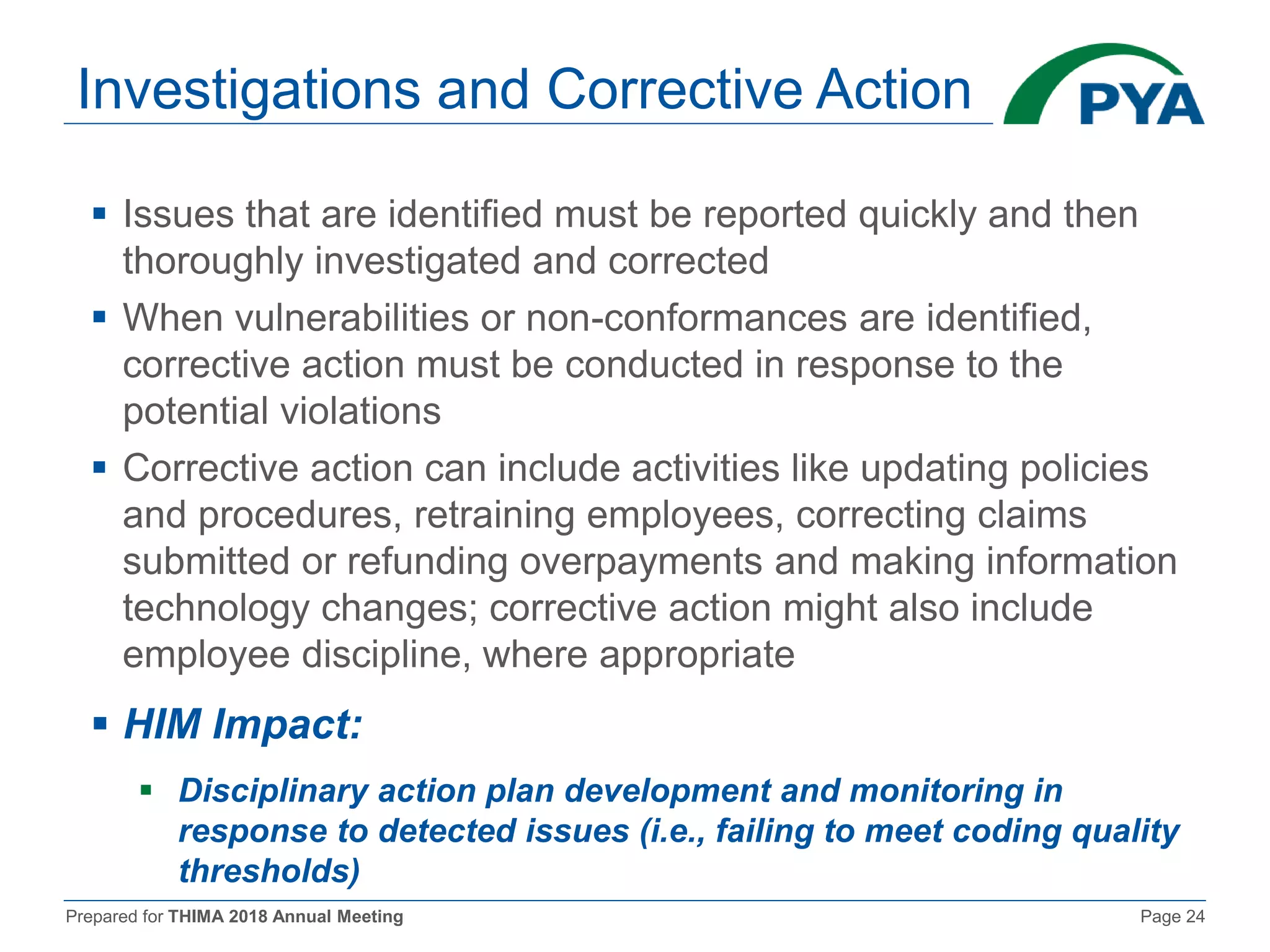
Investigations and Corrective Action
 Issues that are identified must be reported quickly and then
thoroughly investigated and corrected
 When vulnerabilities or non-conformances are identified,
corrective action must be conducted in response to the
potential violations
 Corrective action can include activities like updating policies
and procedures, retraining employees, correcting claims
submitted or refunding overpayments and making information
technology changes; corrective action might also include
employee discipline, where appropriate
 HIM Impact:
 Disciplinary action plan development and monitoring in
response to detected issues (i.e., failing to meet coding quality
thresholds)
Auditing and Monitoring
HIM’s Biggest Impact
Prepared for THIMA 2018 Annual Meeting Page 26
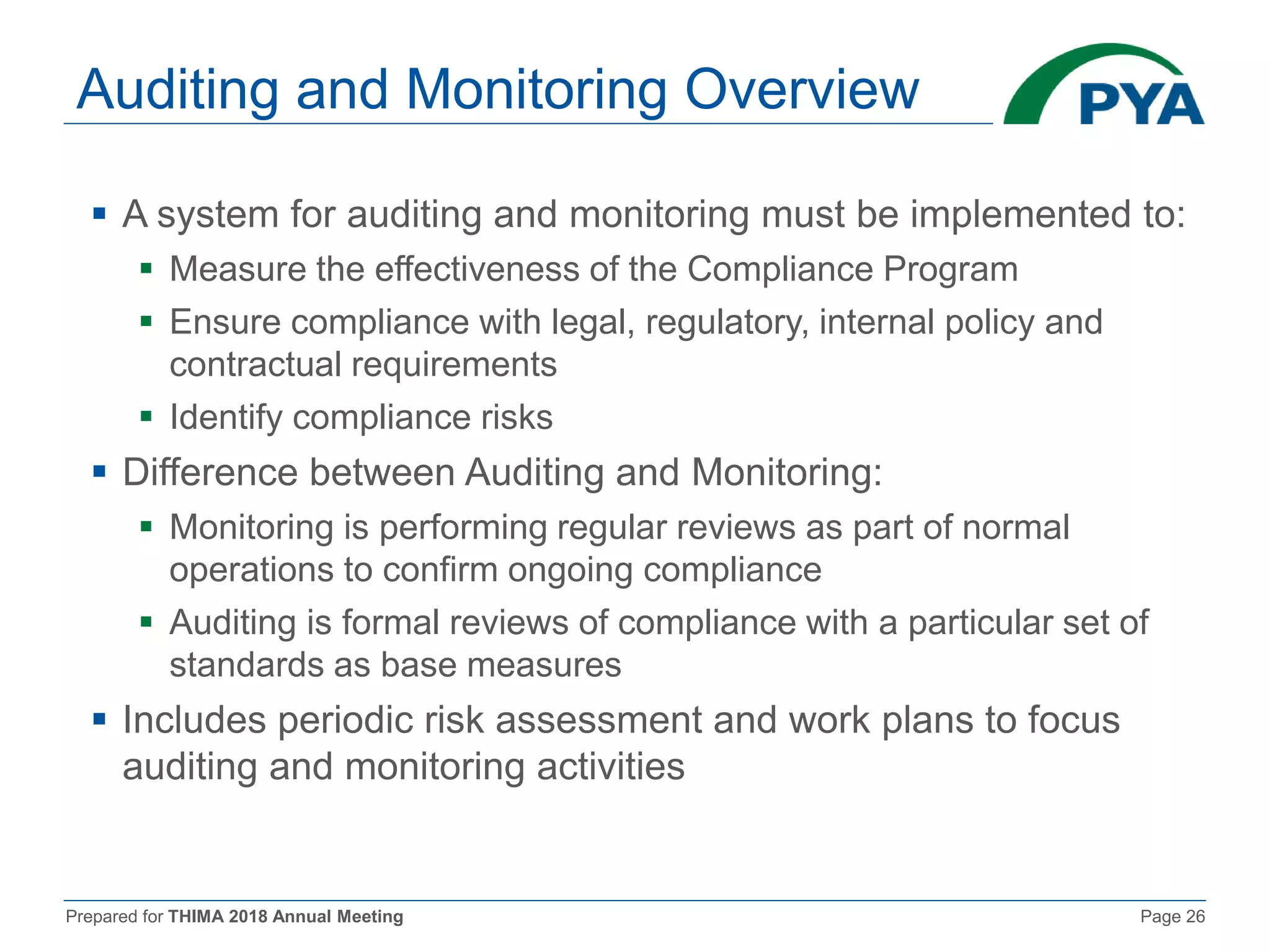
Auditing and Monitoring Overview
 A system for auditing and monitoring must be implemented to:
 Measure the effectiveness of the Compliance Program
 Ensure compliance with legal, regulatory, internal policy and
contractual requirements
 Identify compliance risks
 Difference between Auditing and Monitoring:
 Monitoring is performing regular reviews as part of normal
operations to confirm ongoing compliance
 Auditing is formal reviews of compliance with a particular set of
standards as base measures
 Includes periodic risk assessment and work plans to focus
auditing and monitoring activities
Prepared for THIMA 2018 Annual Meeting Page 27
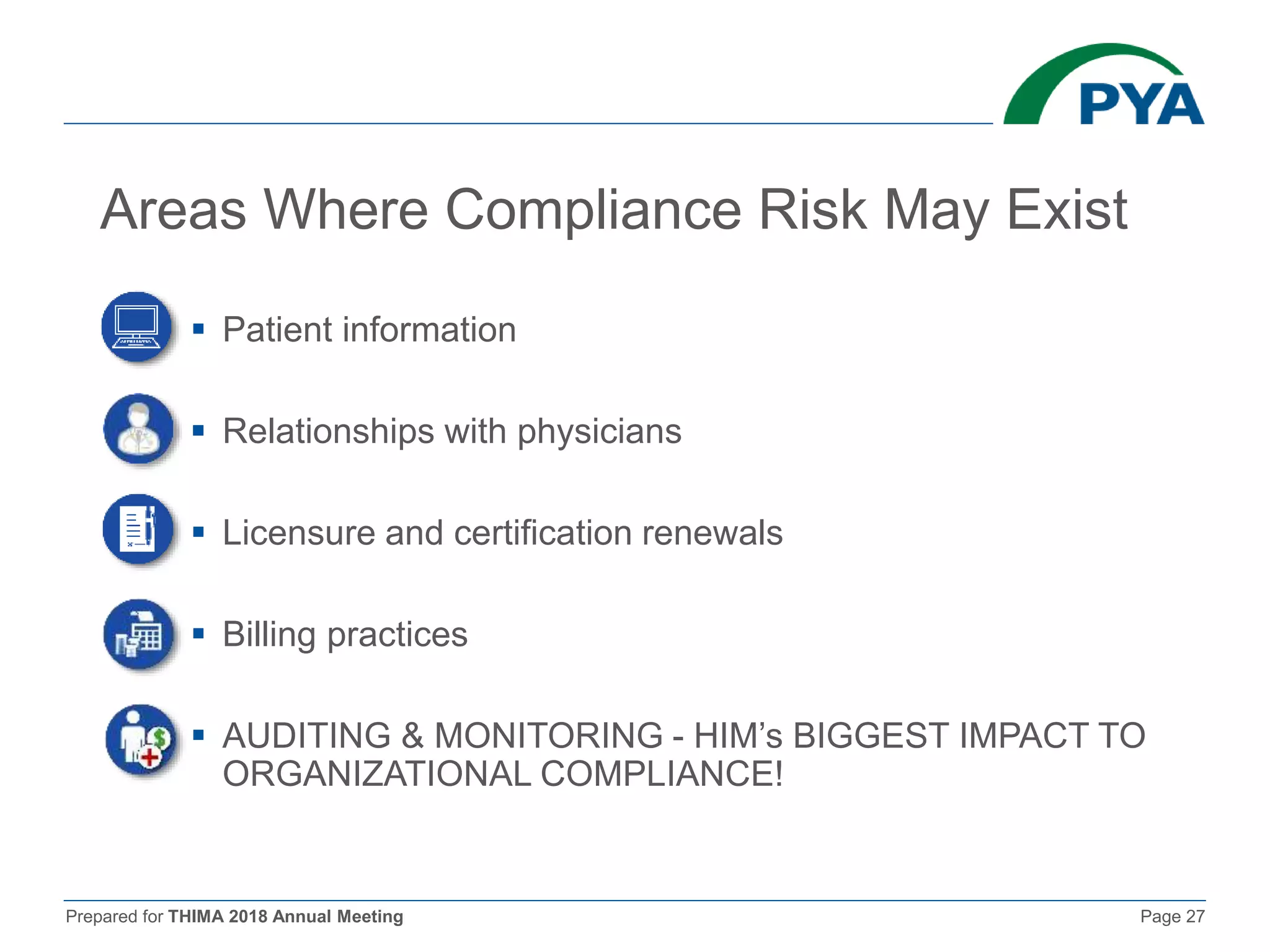
Areas Where Compliance Risk May Exist
 Patient information
 Relationships with physicians
 Licensure and certification renewals
 Billing practices
 AUDITING & MONITORING - HIM’s BIGGEST IMPACT TO
ORGANIZATIONAL COMPLIANCE!
Auditing and Monitoring Spotlight
Documentation Accuracy
Prepared for THIMA 2018 Annual Meeting Page 29
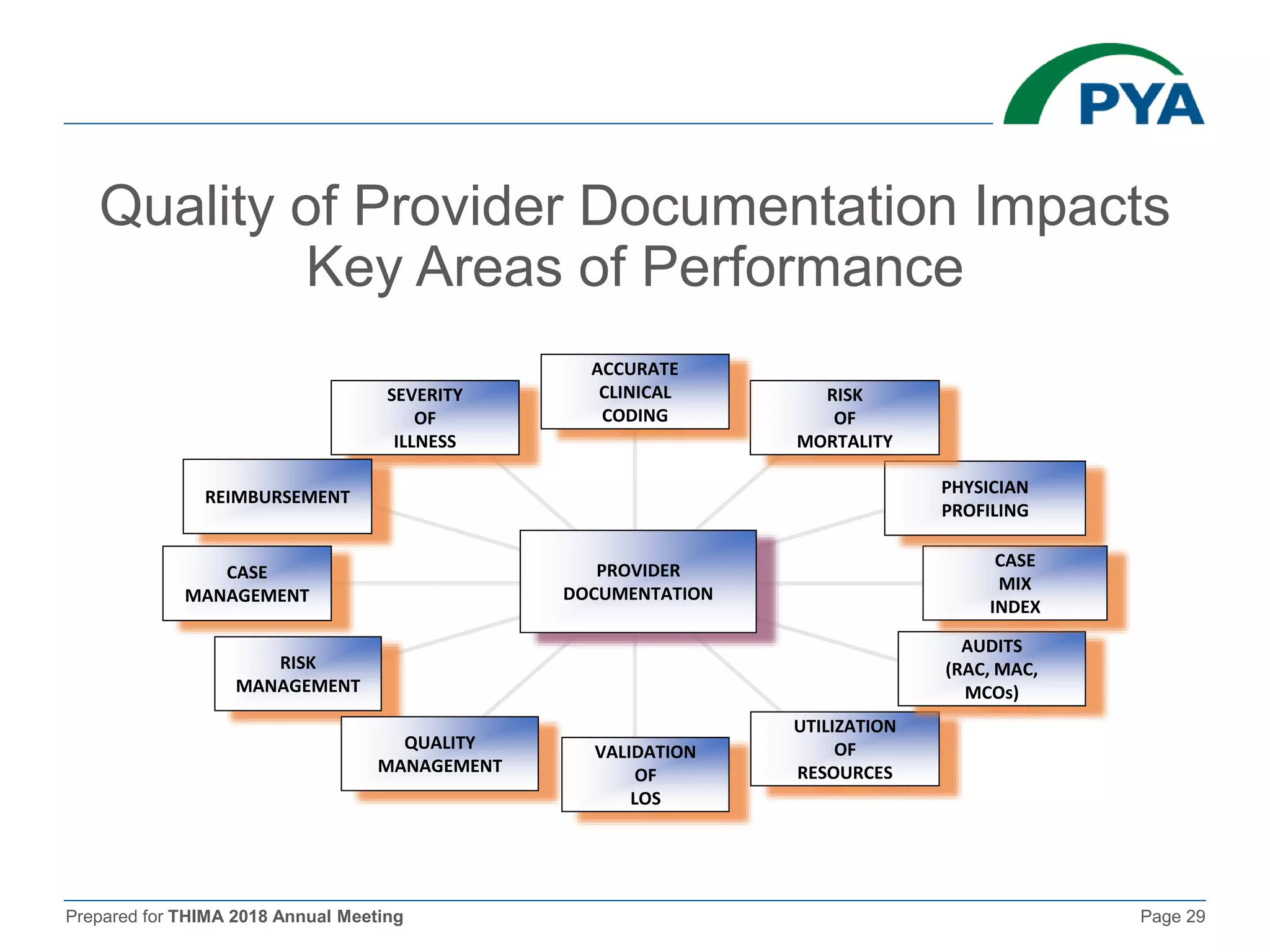
Quality of Provider Documentation Impacts
Key Areas of Performance
SEVERITY
OF
ILLNESS
REIMBURSEMENT
CASE
MANAGEMENT
RISK
MANAGEMENT
QUALITY
MANAGEMENT
VALIDATION
OF
LOS
UTILIZATION
OF
RESOURCES
AUDITS
(RAC, MAC,
MCOs)
CASE
MIX
INDEX
PHYSICIAN
PROFILING
RISK
OF
MORTALITY
ACCURATE
CLINICAL
CODING
PROVIDER
DOCUMENTATION
Prepared for THIMA 2018 Annual Meeting Page 30
Quality Documentation
 Documentation for coding
 Documentation billing (e.g., modifiers)
 Documentation for quality reporting (POAs, HACs, etc.)
 The role of Clinical Documentation Improvement
Specialist
 The ultimate role of the coder to ensure compliance
Prepared for THIMA 2018 Annual Meeting Page 31
Effect of Billing and Coding Integrity
 The quality of healthcare across the continuum
depends on the integrity, reliability, and accuracy
of health information
 Documentation
 Coding
 Billing
 Lack of integrity results in Fraud, Waste, and
Abuse (FWA)
 FWA triggers legal and regulatory intervention,
including fines, penalties, sanctions, exclusion,
and incarceration
Prepared for THIMA 2018 Annual Meeting Page 32
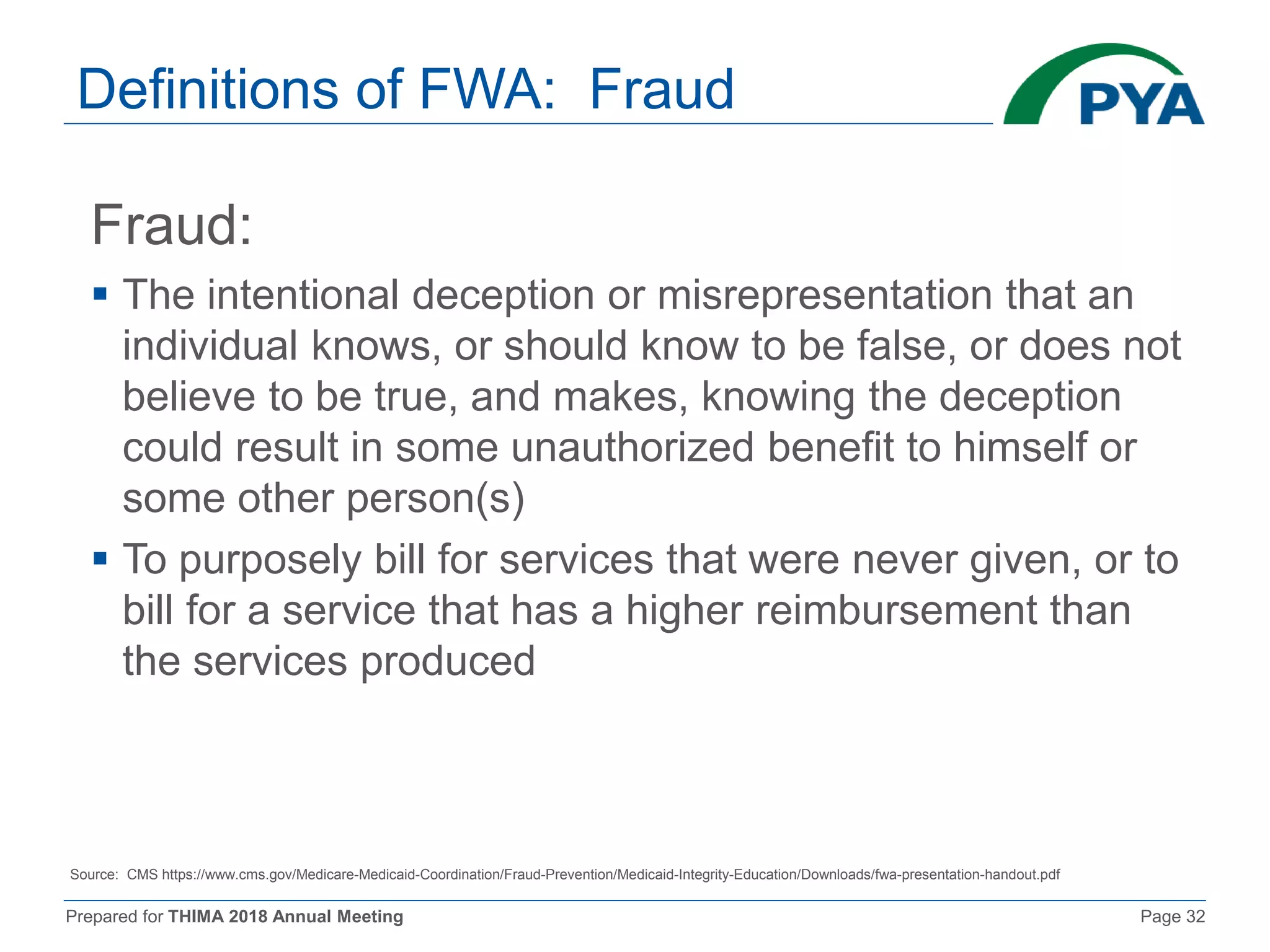
Definitions of FWA: Fraud
Fraud:
 The intentional deception or misrepresentation that an
individual knows, or should know to be false, or does not
believe to be true, and makes, knowing the deception
could result in some unauthorized benefit to himself or
some other person(s)
 To purposely bill for services that were never given, or to
bill for a service that has a higher reimbursement than
the services produced
Source: CMS https://www.cms.gov/Medicare-Medicaid-Coordination/Fraud-Prevention/Medicaid-Integrity-Education/Downloads/fwa-presentation-handout.pdf
Prepared for THIMA 2018 Annual Meeting Page 33
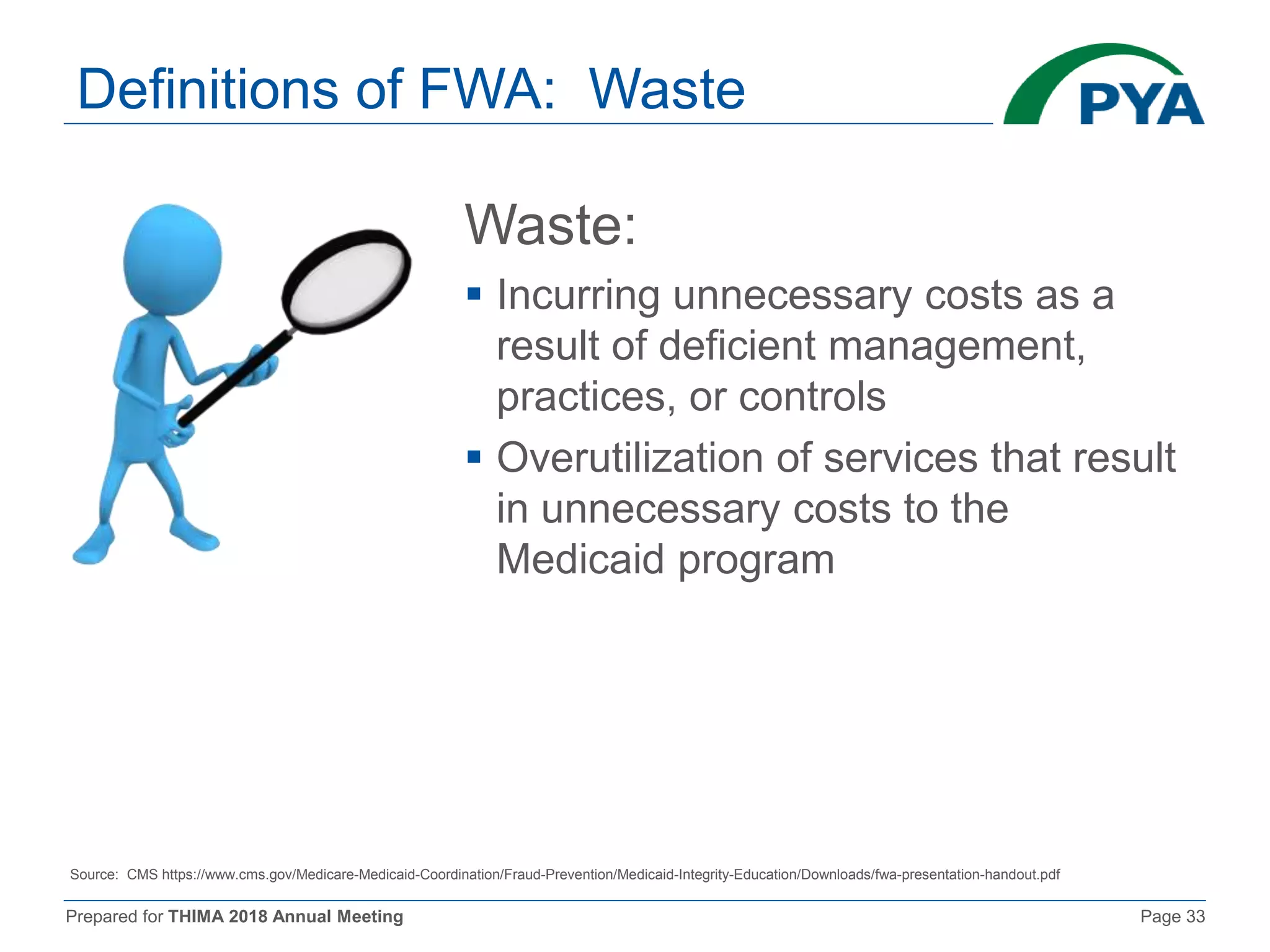
Definitions of FWA: Waste
Waste:
 Incurring unnecessary costs as a
result of deficient management,
practices, or controls
 Overutilization of services that result
in unnecessary costs to the
Medicaid program
Source: CMS https://www.cms.gov/Medicare-Medicaid-Coordination/Fraud-Prevention/Medicaid-Integrity-Education/Downloads/fwa-presentation-handout.pdf
Prepared for THIMA 2018 Annual Meeting Page 34
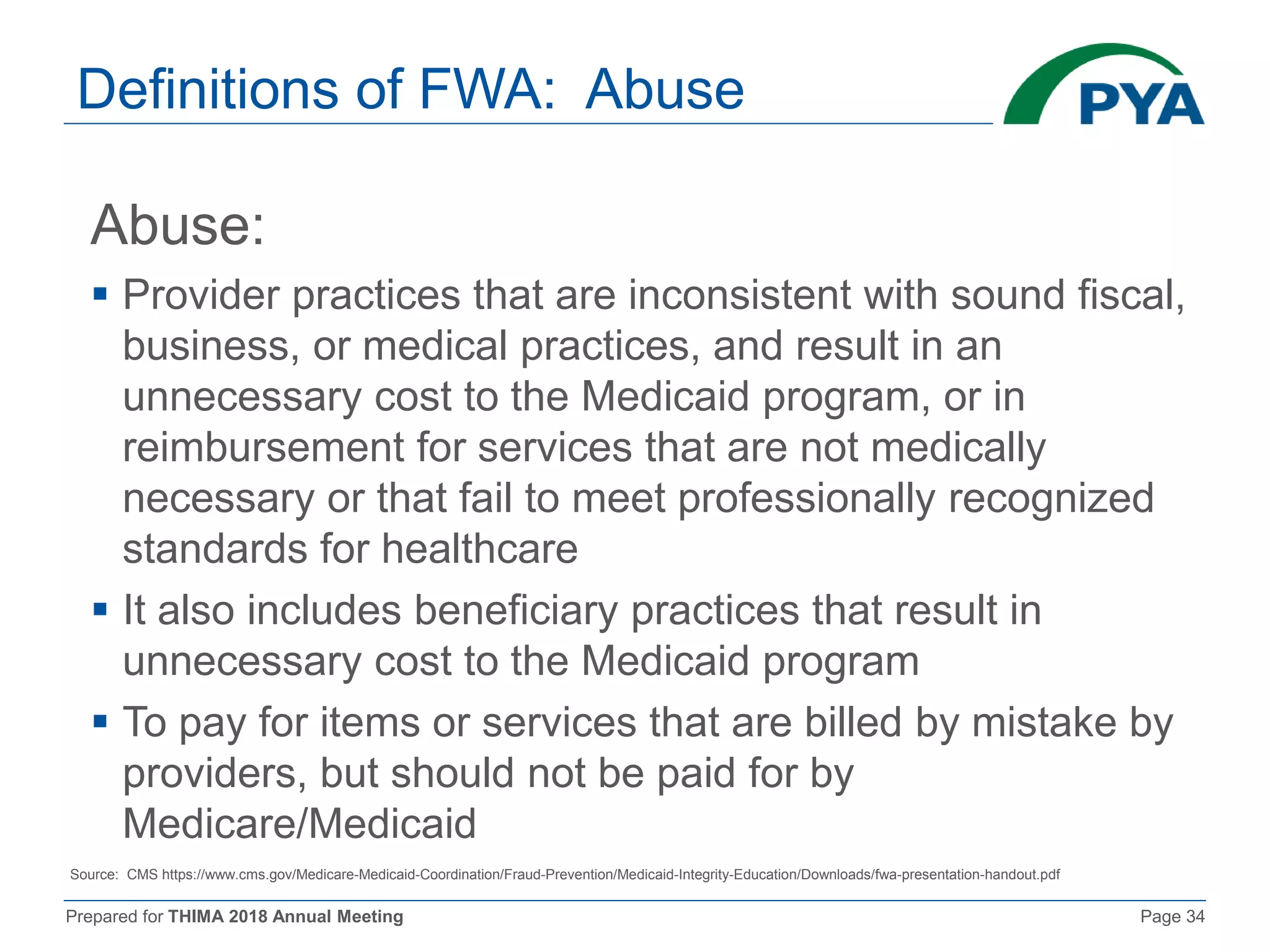
Definitions of FWA: Abuse
Abuse:
 Provider practices that are inconsistent with sound fiscal,
business, or medical practices, and result in an
unnecessary cost to the Medicaid program, or in
reimbursement for services that are not medically
necessary or that fail to meet professionally recognized
standards for healthcare
 It also includes beneficiary practices that result in
unnecessary cost to the Medicaid program
 To pay for items or services that are billed by mistake by
providers, but should not be paid for by
Medicare/Medicaid
Source: CMS https://www.cms.gov/Medicare-Medicaid-Coordination/Fraud-Prevention/Medicaid-Integrity-Education/Downloads/fwa-presentation-handout.pdf
Prepared for THIMA 2018 Annual Meeting Page 35
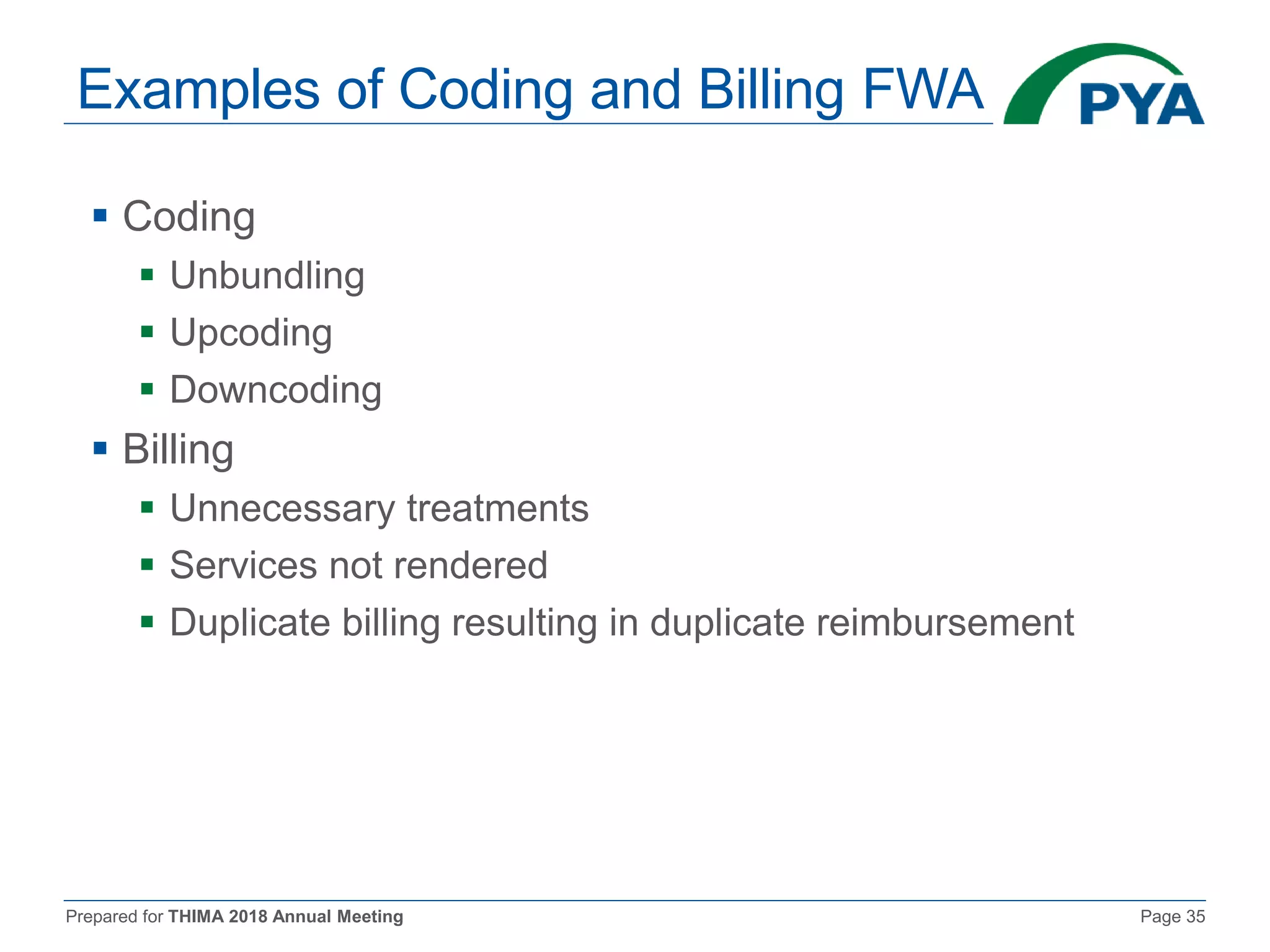
Examples of Coding and Billing FWA
 Coding
 Unbundling
 Upcoding
 Downcoding
 Billing
 Unnecessary treatments
 Services not rendered
 Duplicate billing resulting in duplicate reimbursement
Prepared for THIMA 2018 Annual Meeting Page 36
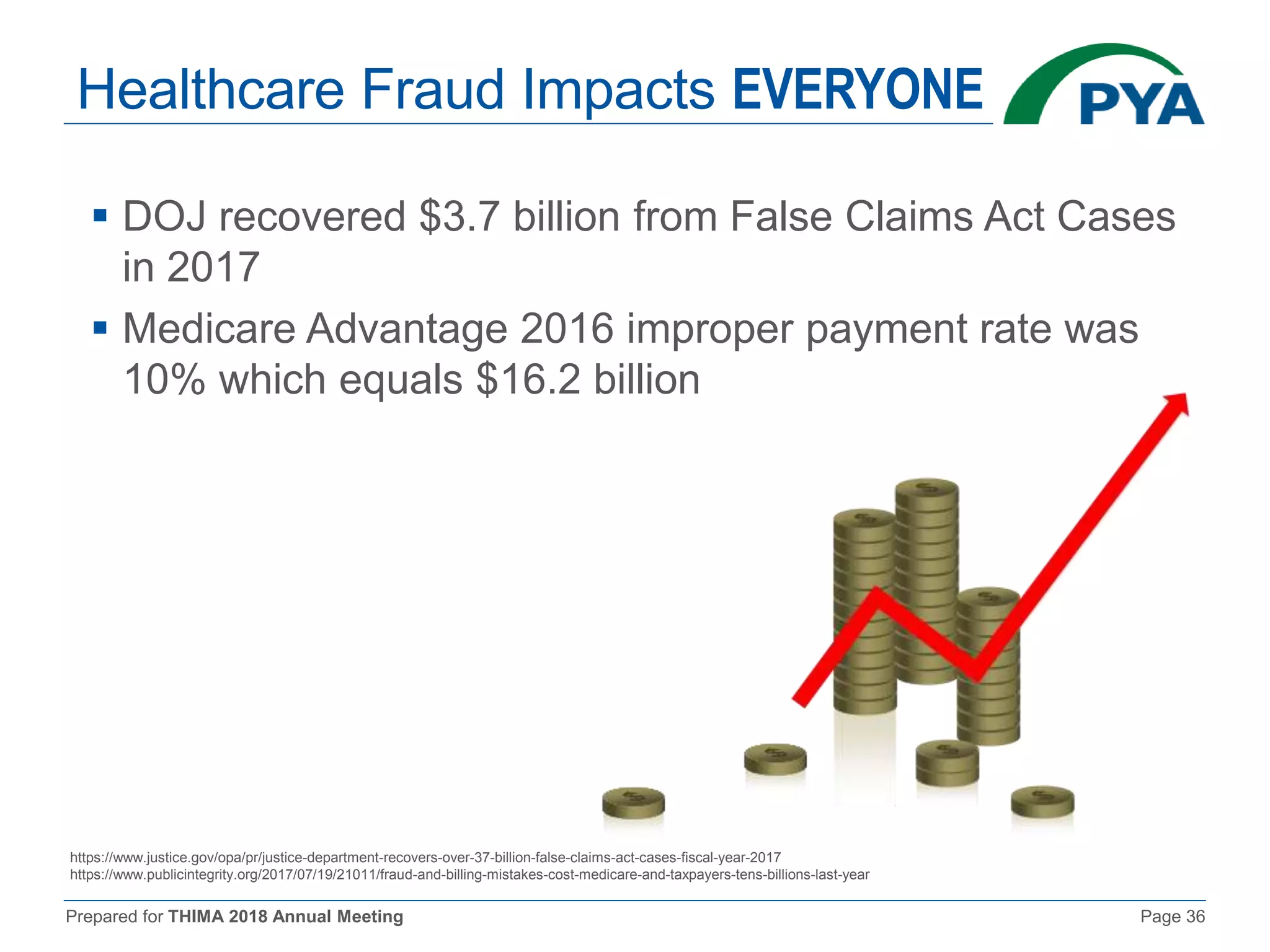
Healthcare Fraud Impacts EVERYONE
 DOJ recovered $3.7 billion from False Claims Act Cases
in 2017
 Medicare Advantage 2016 improper payment rate was
10% which equals $16.2 billion
https://www.justice.gov/opa/pr/justice-department-recovers-over-37-billion-false-claims-act-cases-fiscal-year-2017
https://www.publicintegrity.org/2017/07/19/21011/fraud-and-billing-mistakes-cost-medicare-and-taxpayers-tens-billions-last-year
Prepared for THIMA 2018 Annual Meeting Page 37
False Claims Act
 The FCA has become an important government tool, if
not the most important tool, for demanding healthcare
providers’ compliance with the requirements of the
federal healthcare programs
 Prohibits any person from knowingly presenting or
causing the presentation of a fraudulent claim for
payment
 The False Claims Act, is also known as the “Lincoln
Law”
 Enacted during the Civil War to combat fraud perpetrated by
companies that sold faulty supplies to the Union Army
 Congress passed the statute on March 2, 1863
Source: White Paper. The Supreme Court’s Decision in Universal Health Services v. U.S. ex rel. Escobar: Professor David Freeman Engstrom Answers Critical Legal Questions,
June 17, 2016
Prepared for THIMA 2018 Annual Meeting Page 38
False Claims Act
 Creates liability for anyone who knowingly
submits, uses, or causes to be submitted or
used a false record, statement, or claim for
payment to the government
 Acts in purposeful or deliberate ignorance of
truth or falsity, acts in reckless disregard of
truth or falsity; proof of intent to defraud is
NOT required
Prepared for THIMA 2018 Annual Meeting Page 39
False Claims Act
 Medicaid claims are subject to BOTH the Federal FCA
and the FCA in your state
 Patient Protection and Affordable Care Act (PPACA)
added provision that person/organization must report
any overpayments greater than $50 within 60 days of
identification; non-reporting may be considered false
claims and subject to a credible allegation of fraud
referral
 Violations can result in liability for repayment up to
THREE TIMES the original dollar amount and potential
civil penalties of $11,000 for EACH CLAIM
Prepared for THIMA 2018 Annual Meeting Page 40
False Claims Act
 FCA contains provision for Whistleblower (i.e., Qui Tam)
Actions
 70% of FCA actions are initiated by whistleblowers
 An individual can file an action on behalf of the
government
 15-25% of recovered claims go to the person who
brought the action (government decides each case)
 Over $3.7 billion has been recovered under FCA in
FY2017
 Whistleblowers:
 46 in 2017 awarded approximately $160 million
https://www.sec.gov/files/sec-2017-annual-report-whistleblower-program.pdf
https://www.justice.gov/opa/pr/justice-department-recovers-over-35-billion-false-claims-act-cases-fiscal-year-2015
Non-Physician Provider (NPP) Issues
Prepared for THIMA 2018 Annual Meeting Page 42
Who Can See the NPP?
The questions are:
 Is the payer private, Medicare, or Medicaid?
 Is the patient new or established?
 Is the patient presenting with only established problems
or are any new problems to be addressed?
 Was the service incident-to?
 Where were the services provided?
 Which provider do I bill under?
Prepared for THIMA 2018 Annual Meeting Page 43
NPPs – Medicare, Medicaid, Commercial Payers
 Medicare has the most specific guidance for NPP billing
 The information detailed in this presentation is related to
Medicare regulations
 Medicaid has different rules from Medicare when it
comes to NPPs
 Medicaid pays NPPs on a separate fee schedule and has a
separate limitation and coverage book for NPPs
 Follow the requirements set out by private payers; some
payers may defer to state law
Prepared for THIMA 2018 Annual Meeting Page 44
Medicare NPP Reimbursement
What can be reimbursed?
 85% of the physician fee schedule for
services which include independent
medical decision making (MDM)
 100% of the physician fee schedule under
the supervising physician on site for
incident-to service
Prepared for THIMA 2018 Annual Meeting Page 45
Medicare NPP Reimbursement
 General Rule
 Medicare generally requires that the identity of the person who
actually performed the service be reported on the claim
 The Incident-to billing rule is an exception that permits reporting
of services actually performed by one person to be reported
under the name of another, provided that specific and rather
complex requirements are met
Prepared for THIMA 2018 Annual Meeting Page 46
Medicare Incident-To Requirements
 All the following requirements must be met before a NPP
may bill under the incident-to provision:
 The NPP must be an employee of the healthcare organization
 The initial visit (for that condition) must be performed by the physician;
this does not mean that on each occasion of an incidental service
performed by an NPP, that the patient must also see the physician
 There must be direct personal supervision by the physician as an
integral part of the physician's personal in-office service
 The physician must be physically present in the same office suite and
be immediately available to render assistance if that becomes
necessary
 The physician has an active part in the ongoing care of the patient
 Subsequent services by the physician must be of a frequency that
reflects his/her continuing active participation in, and management of,
the course of the treatment
Prepared for THIMA 2018 Annual Meeting Page 47
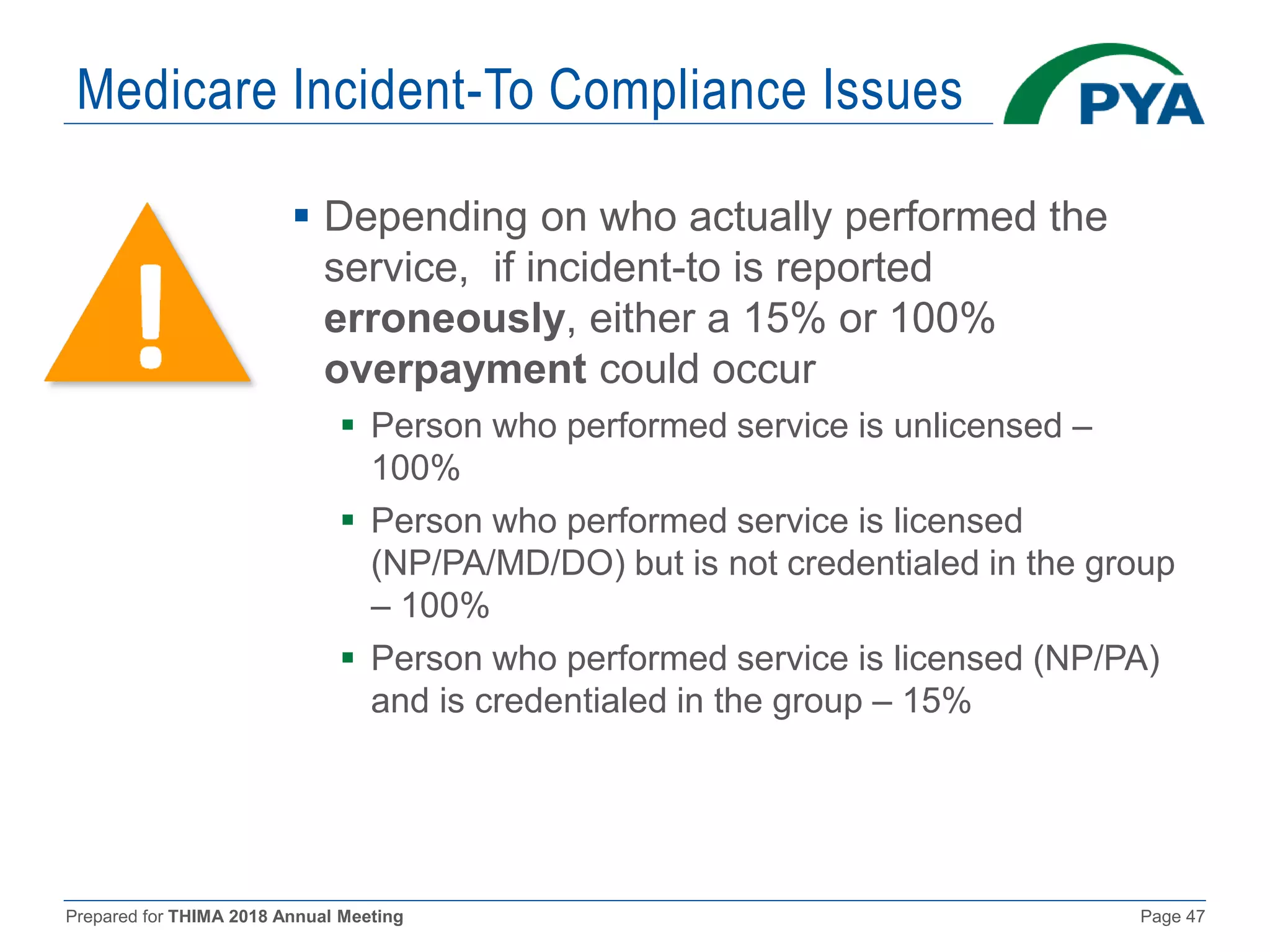
Medicare Incident-To Compliance Issues
 Depending on who actually performed the
service, if incident-to is reported
erroneously, either a 15% or 100%
overpayment could occur
 Person who performed service is unlicensed –
100%
 Person who performed service is licensed
(NP/PA/MD/DO) but is not credentialed in the group
– 100%
 Person who performed service is licensed (NP/PA)
and is credentialed in the group – 15%
Prepared for THIMA 2018 Annual Meeting Page 48
Questions?
PYA, P.C.
800.270.9629 | www.pyapc.com
Thank you!
Kristen Lilly
MHA, CHC®, CPHQ, RHIA®
PYA
klilly@pyapc.com

How HIM Supports the Seven Elements of an Effective Compliance Program

  • 1.
    Kristen Lilly, MHA,CHC®, CPHQ, RHIA® PYA 2018 ANNUAL MEETING TENNESSEE HEALTH INFORMATION MANAGEMENT ASSOCIATION How HIM Supports the Seven Elements of an Effective Compliance Program
  • 2.
    Prepared for THIMA2018 Annual Meeting Page 1 Agenda  What is compliance and why is it important?  Understand the seven elements of a robust compliance program as outlined in the Federal Sentencing Guidelines  Review the regulatory guidance surrounding compliance programs  Identify HIM’s role in organization compliance  Discuss the intersection between HIM and compliance
  • 3.
    What Is Complianceand Why Is It Important?
  • 4.
    Prepared for THIMA2018 Annual Meeting Page 3 What Is Compliance?
  • 5.
    Prepared for THIMA2018 Annual Meeting Page 4 Definition of Compliance General Definition of Compliance  Meeting the expectations of others Compliance for Healthcare Providers  Activities that assist organizations and providers with conducting operations and activities ethically, with the highest level of integrity, and in compliance with legal and regulatory requirements  Help prevent violations and reduce risk and liability to the provider organization
  • 6.
    Prepared for THIMA2018 Annual Meeting Page 5 Compliance Guideline 3) https://www.justice.gov/criminal-fraud/page/file/937501/download 4) https://oig.hhs.gov/compliance/101/files/HCCA-OIG-Resource-Guide.pdf 1) https://oig.hhs.gov/ 2) https://www.ussc.gov/sites/default/files/pdf/guidelines-manual/2016
  • 7.
    Prepared for THIMA2018 Annual Meeting Page 6 CMS Mandates for Compliance  Section 6401 of the Patient Protection and Affordable Care Act (PPACA), enacted March 23, 2010, mandates that all healthcare providers enrolled in Medicare, Medicaid, and the Children’s Health Insurance Program (CHIP) establish a compliance program as a condition of enrollment1  CMS believes that compliance efforts are fundamentally designed to establish a culture within an organization that promotes the prevention, detection, and resolution of instances of conduct that do not conform to federal and state law, or to federal healthcare program requirements2 1) 42 U.S.C. § 1395cc(j)(8). Section 6401,Health and Human Services (HHS) 2) Compliance Program Guidance for Medicare Fee-For-Service Contractor, March 2005, Health and Human Services (HHS)
  • 8.
    Prepared for THIMA2018 Annual Meeting Page 7 Compliance Program Essentials  A Compliance Program establishes and maintains a “culture of compliance”  A Compliance Program is a series of internal controls, monitoring activities, and metrics to help organizations meet the requirements of state and federal regulatory agencies  A Compliance Program provides an opportunity for organizations to identify and correct potential risk areas that may otherwise be obscured
  • 9.
    Prepared for THIMA2018 Annual Meeting Page 8 Benefits of a Solid Compliance Program  Compliance is vital in deterring fraud and abuse  The ultimate goal is to create an ethical, comfortable corporate culture  Patient care is improved when healthcare decisions are based on proper motives  When fraud and abuse happen, an effective Compliance Program will mitigate the risk of undetected non- compliance
  • 10.
    Prepared for THIMA2018 Annual Meeting Page 9 Who Is Subject to Compliance? EVERYONE IN THE ORGANIZATION Officers Board Members Employees Physicians NPPs Students Vendors Contractors Volunteers
  • 11.
    The Seven Elementsof an Effective Compliance Program and HIM’s Impact
  • 12.
    Prepared for THIMA2018 Annual Meeting Page 11 Seven Elements of an Effective Compliance Program The seven elements identified in the 1991 Federal Sentencing Guidelines for Organizations (Guidelines) are the primary indicators of the federal government’s expectations for effective compliance activities High-Level Oversight Policy and Procedure Integration Open Communication Training and Education Monitoring and Auditing Response to Detected Errors Consistent Enforcement
  • 13.
  • 14.
    Prepared for THIMA2018 Annual Meeting Page 13 Tone at the Top  “Tone at the top”  The tone at the top is the foundation of an effective compliance program and begins with the Board’s oversight responsibility, followed by the CEO’s commendation of the program, support by a senior leadership team, and a CCO that facilitates organization-wide accountability for compliance issues  Board oversight  CEO’s commendation of the compliance program  The Individual Accountability for Corporate Wrongdoing (Yates Memo) https://oig.hhs.gov/newsroom/news-releases/2015/guidance-release2015.asp https://www.justice.gov/dag/file/769036/download
  • 15.
    Prepared for THIMA2018 Annual Meeting Page 14 Program Oversight  Compliance Officers and Committees oversee the compliance program, including:  Reviewing Code of Conduct and making recommendation to the Board for approval  Understanding and administering the compliance program structure  Being informed of audits and monitoring outcomes  Reporting on compliance enforcement activity  Reviewing and performing assessments on the effectiveness of the compliance program  HIM Impact:  Reporting of auditing and monitoring results to the compliance committee
  • 16.
  • 17.
    Prepared for THIMA2018 Annual Meeting Page 16 Compliance Policies and Procedures  Policies and procedures are used to document how the organization will comply with federal and state laws as well as contractual or accreditation standards when conducting its operations  Well-documented and updated policies and procedures allow for detection of possible compliance issues; for example, missed steps in procedures or not following the procedure in the right order can signal possible issues  HIM Impact:  Coding productivity and quality policies  Physician delinquency policy  Medical record policies
  • 18.
    Open Lines ofCommunication
  • 19.
    Prepared for THIMA2018 Annual Meeting Page 18 Open Lines of Communication  For a Compliance Program to be effective, the workforce must be able to ask questions and report problems; in some cases, workforce members might have an obligation to report a concern  The Compliance Office must be a resource for clarification of policies, procedures, and regulations; and the Compliance Office must partner with business leadership to communicate about identified issues and how they are resolved  Effective programs also allow for anonymous reporting of issues and concerns (e.g., compliance hotline number and/or website)  HIM Impact:  Obligation to report wrong-doing (e.g., coding/billing concerns)
  • 20.
  • 21.
    Prepared for THIMA2018 Annual Meeting Page 20 Training and Education  General compliance training that effectively communicates requirements of Compliance Program to all employees  Initial training for new employees occurring at, or near, the date of hire  Annual refresher training for existing employees  HIM Impact:  Specific/customized training for specialty areas such as coding and billing
  • 22.
  • 23.
    Prepared for THIMA2018 Annual Meeting Page 22 Consistent Enforcement  Written policies are required that apply appropriate disciplinary sanctions on those who fail to comply with applicable requirements and written standards of conduct These disciplinary policies should include sanctions for:  Non-compliance  Failure to detect non-compliance when routine observation or due diligence should have provided adequate information  Failure to report actual or suspected non-compliance  Discipline must be dealt with timely and enforced consistently  HIM Impact:  Coding productivity and quality thresholds
  • 24.
  • 25.
    Prepared for THIMA2018 Annual Meeting Page 24 Investigations and Corrective Action  Issues that are identified must be reported quickly and then thoroughly investigated and corrected  When vulnerabilities or non-conformances are identified, corrective action must be conducted in response to the potential violations  Corrective action can include activities like updating policies and procedures, retraining employees, correcting claims submitted or refunding overpayments and making information technology changes; corrective action might also include employee discipline, where appropriate  HIM Impact:  Disciplinary action plan development and monitoring in response to detected issues (i.e., failing to meet coding quality thresholds)
  • 26.
  • 27.
    Prepared for THIMA2018 Annual Meeting Page 26 Auditing and Monitoring Overview  A system for auditing and monitoring must be implemented to:  Measure the effectiveness of the Compliance Program  Ensure compliance with legal, regulatory, internal policy and contractual requirements  Identify compliance risks  Difference between Auditing and Monitoring:  Monitoring is performing regular reviews as part of normal operations to confirm ongoing compliance  Auditing is formal reviews of compliance with a particular set of standards as base measures  Includes periodic risk assessment and work plans to focus auditing and monitoring activities
  • 28.
    Prepared for THIMA2018 Annual Meeting Page 27 Areas Where Compliance Risk May Exist  Patient information  Relationships with physicians  Licensure and certification renewals  Billing practices  AUDITING & MONITORING - HIM’s BIGGEST IMPACT TO ORGANIZATIONAL COMPLIANCE!
  • 29.
    Auditing and MonitoringSpotlight Documentation Accuracy
  • 30.
    Prepared for THIMA2018 Annual Meeting Page 29 Quality of Provider Documentation Impacts Key Areas of Performance SEVERITY OF ILLNESS REIMBURSEMENT CASE MANAGEMENT RISK MANAGEMENT QUALITY MANAGEMENT VALIDATION OF LOS UTILIZATION OF RESOURCES AUDITS (RAC, MAC, MCOs) CASE MIX INDEX PHYSICIAN PROFILING RISK OF MORTALITY ACCURATE CLINICAL CODING PROVIDER DOCUMENTATION
  • 31.
    Prepared for THIMA2018 Annual Meeting Page 30 Quality Documentation  Documentation for coding  Documentation billing (e.g., modifiers)  Documentation for quality reporting (POAs, HACs, etc.)  The role of Clinical Documentation Improvement Specialist  The ultimate role of the coder to ensure compliance
  • 32.
    Prepared for THIMA2018 Annual Meeting Page 31 Effect of Billing and Coding Integrity  The quality of healthcare across the continuum depends on the integrity, reliability, and accuracy of health information  Documentation  Coding  Billing  Lack of integrity results in Fraud, Waste, and Abuse (FWA)  FWA triggers legal and regulatory intervention, including fines, penalties, sanctions, exclusion, and incarceration
  • 33.
    Prepared for THIMA2018 Annual Meeting Page 32 Definitions of FWA: Fraud Fraud:  The intentional deception or misrepresentation that an individual knows, or should know to be false, or does not believe to be true, and makes, knowing the deception could result in some unauthorized benefit to himself or some other person(s)  To purposely bill for services that were never given, or to bill for a service that has a higher reimbursement than the services produced Source: CMS https://www.cms.gov/Medicare-Medicaid-Coordination/Fraud-Prevention/Medicaid-Integrity-Education/Downloads/fwa-presentation-handout.pdf
  • 34.
    Prepared for THIMA2018 Annual Meeting Page 33 Definitions of FWA: Waste Waste:  Incurring unnecessary costs as a result of deficient management, practices, or controls  Overutilization of services that result in unnecessary costs to the Medicaid program Source: CMS https://www.cms.gov/Medicare-Medicaid-Coordination/Fraud-Prevention/Medicaid-Integrity-Education/Downloads/fwa-presentation-handout.pdf
  • 35.
    Prepared for THIMA2018 Annual Meeting Page 34 Definitions of FWA: Abuse Abuse:  Provider practices that are inconsistent with sound fiscal, business, or medical practices, and result in an unnecessary cost to the Medicaid program, or in reimbursement for services that are not medically necessary or that fail to meet professionally recognized standards for healthcare  It also includes beneficiary practices that result in unnecessary cost to the Medicaid program  To pay for items or services that are billed by mistake by providers, but should not be paid for by Medicare/Medicaid Source: CMS https://www.cms.gov/Medicare-Medicaid-Coordination/Fraud-Prevention/Medicaid-Integrity-Education/Downloads/fwa-presentation-handout.pdf
  • 36.
    Prepared for THIMA2018 Annual Meeting Page 35 Examples of Coding and Billing FWA  Coding  Unbundling  Upcoding  Downcoding  Billing  Unnecessary treatments  Services not rendered  Duplicate billing resulting in duplicate reimbursement
  • 37.
    Prepared for THIMA2018 Annual Meeting Page 36 Healthcare Fraud Impacts EVERYONE  DOJ recovered $3.7 billion from False Claims Act Cases in 2017  Medicare Advantage 2016 improper payment rate was 10% which equals $16.2 billion https://www.justice.gov/opa/pr/justice-department-recovers-over-37-billion-false-claims-act-cases-fiscal-year-2017 https://www.publicintegrity.org/2017/07/19/21011/fraud-and-billing-mistakes-cost-medicare-and-taxpayers-tens-billions-last-year
  • 38.
    Prepared for THIMA2018 Annual Meeting Page 37 False Claims Act  The FCA has become an important government tool, if not the most important tool, for demanding healthcare providers’ compliance with the requirements of the federal healthcare programs  Prohibits any person from knowingly presenting or causing the presentation of a fraudulent claim for payment  The False Claims Act, is also known as the “Lincoln Law”  Enacted during the Civil War to combat fraud perpetrated by companies that sold faulty supplies to the Union Army  Congress passed the statute on March 2, 1863 Source: White Paper. The Supreme Court’s Decision in Universal Health Services v. U.S. ex rel. Escobar: Professor David Freeman Engstrom Answers Critical Legal Questions, June 17, 2016
  • 39.
    Prepared for THIMA2018 Annual Meeting Page 38 False Claims Act  Creates liability for anyone who knowingly submits, uses, or causes to be submitted or used a false record, statement, or claim for payment to the government  Acts in purposeful or deliberate ignorance of truth or falsity, acts in reckless disregard of truth or falsity; proof of intent to defraud is NOT required
  • 40.
    Prepared for THIMA2018 Annual Meeting Page 39 False Claims Act  Medicaid claims are subject to BOTH the Federal FCA and the FCA in your state  Patient Protection and Affordable Care Act (PPACA) added provision that person/organization must report any overpayments greater than $50 within 60 days of identification; non-reporting may be considered false claims and subject to a credible allegation of fraud referral  Violations can result in liability for repayment up to THREE TIMES the original dollar amount and potential civil penalties of $11,000 for EACH CLAIM
  • 41.
    Prepared for THIMA2018 Annual Meeting Page 40 False Claims Act  FCA contains provision for Whistleblower (i.e., Qui Tam) Actions  70% of FCA actions are initiated by whistleblowers  An individual can file an action on behalf of the government  15-25% of recovered claims go to the person who brought the action (government decides each case)  Over $3.7 billion has been recovered under FCA in FY2017  Whistleblowers:  46 in 2017 awarded approximately $160 million https://www.sec.gov/files/sec-2017-annual-report-whistleblower-program.pdf https://www.justice.gov/opa/pr/justice-department-recovers-over-35-billion-false-claims-act-cases-fiscal-year-2015
  • 42.
  • 43.
    Prepared for THIMA2018 Annual Meeting Page 42 Who Can See the NPP? The questions are:  Is the payer private, Medicare, or Medicaid?  Is the patient new or established?  Is the patient presenting with only established problems or are any new problems to be addressed?  Was the service incident-to?  Where were the services provided?  Which provider do I bill under?
  • 44.
    Prepared for THIMA2018 Annual Meeting Page 43 NPPs – Medicare, Medicaid, Commercial Payers  Medicare has the most specific guidance for NPP billing  The information detailed in this presentation is related to Medicare regulations  Medicaid has different rules from Medicare when it comes to NPPs  Medicaid pays NPPs on a separate fee schedule and has a separate limitation and coverage book for NPPs  Follow the requirements set out by private payers; some payers may defer to state law
  • 45.
    Prepared for THIMA2018 Annual Meeting Page 44 Medicare NPP Reimbursement What can be reimbursed?  85% of the physician fee schedule for services which include independent medical decision making (MDM)  100% of the physician fee schedule under the supervising physician on site for incident-to service
  • 46.
    Prepared for THIMA2018 Annual Meeting Page 45 Medicare NPP Reimbursement  General Rule  Medicare generally requires that the identity of the person who actually performed the service be reported on the claim  The Incident-to billing rule is an exception that permits reporting of services actually performed by one person to be reported under the name of another, provided that specific and rather complex requirements are met
  • 47.
    Prepared for THIMA2018 Annual Meeting Page 46 Medicare Incident-To Requirements  All the following requirements must be met before a NPP may bill under the incident-to provision:  The NPP must be an employee of the healthcare organization  The initial visit (for that condition) must be performed by the physician; this does not mean that on each occasion of an incidental service performed by an NPP, that the patient must also see the physician  There must be direct personal supervision by the physician as an integral part of the physician's personal in-office service  The physician must be physically present in the same office suite and be immediately available to render assistance if that becomes necessary  The physician has an active part in the ongoing care of the patient  Subsequent services by the physician must be of a frequency that reflects his/her continuing active participation in, and management of, the course of the treatment
  • 48.
    Prepared for THIMA2018 Annual Meeting Page 47 Medicare Incident-To Compliance Issues  Depending on who actually performed the service, if incident-to is reported erroneously, either a 15% or 100% overpayment could occur  Person who performed service is unlicensed – 100%  Person who performed service is licensed (NP/PA/MD/DO) but is not credentialed in the group – 100%  Person who performed service is licensed (NP/PA) and is credentialed in the group – 15%
  • 49.
    Prepared for THIMA2018 Annual Meeting Page 48 Questions?
  • 50.
    PYA, P.C. 800.270.9629 |www.pyapc.com Thank you! Kristen Lilly MHA, CHC®, CPHQ, RHIA® PYA klilly@pyapc.com