Mark A. Testa, DC, MHA, MCS-P
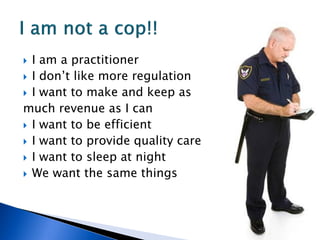
 I am a practitioner
 I don’t like more regulation
 I want to make and keep as
much revenue as I can
 I want to be efficient
 I want to provide quality care
 I want to sleep at night
 We want the same things
   Required by law if you accept federal funds
   Will be enforced in ~2014
   Proactive vs. Reactive
   OIG provides guidelines and help
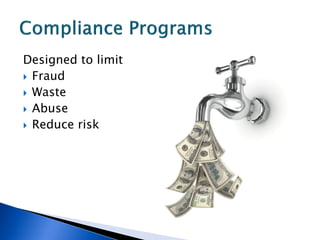
Designed to limit
 Fraud
 Waste
 Abuse
 Reduce risk
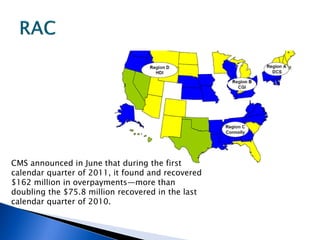
CMS announced in June that during the first
calendar quarter of 2011, it found and recovered
$162 million in overpayments—more than
doubling the $75.8 million recovered in the last
calendar quarter of 2010.
   $10-50,000 per violation
   Repayment of over payments
   Jail time with fraud
   Sanctions
   Exclusion
   Corporate integrity agreements
 Who evaluates the OIG exclusion list?
 Which EM guidelines does your practice use?
 What was the error rate of your last chart
  audit? How did you fix the problems?
 Do you have a Code of Conduct?
 Do you have a compliance
  hotline/officer/log?
 Does your billing service have a
compliance program?
   Provides a protective shield
   Reduces risk of whistleblowers
   Increases revenue
   Improves documentation and coding quality
   Providing medically necessary, quality care
1.   Written policies and procedures
2.   Compliance professionals
3.   Effective training
4.   Effective communication
5.   Internal monitoring
6.   Enforcement of standards
7.   Prompt response
   Policies and procedures are up to-date and
    user-friendly
   Standards of conduct
   Code of conduct
   Retention of Records and Information
    Systems
   Compliance as an Element of
    Performance Plan
   Site Name is committed to providing quality,
    comprehensive health care to the patients of
    our Community. Our services will be
    provided in a professional manner within a
    safe and orderly environment. All personnel
    will be expected to maintain high moral and
    ethical standards and abide by the State and
    Federal regulations as they pertain to the
    delivery of health care. All personnel will
    adhere to the Compliance Program of Site
    Name.
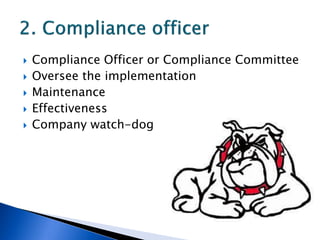
   Compliance Officer or Compliance Committee
   Oversee the implementation
   Maintenance
   Effectiveness
   Company watch-dog
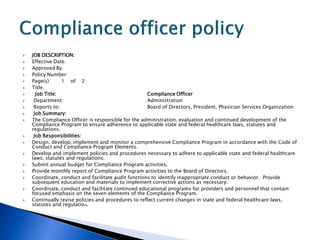
   JOB DESCRIPTION:
   Effective Date:
   Approved By:
   Policy Number:
   Page(s)      1 of 2
   Title:
     Job Title:                                     Compliance Officer
    Department:                                     Administration
    Reports to:                                     Board of Directors, President, Physician Services Organization
    Job Summary:
   The Compliance Officer is responsible for the administration, evaluation and continued development of the
    Compliance Program to ensure adherence to applicable state and federal healthcare laws, statutes and
    regulations.
    Job Responsibilities:
   Design, develop, implement and monitor a comprehensive Compliance Program in accordance with the Code of
    Conduct and Compliance Program Elements.
   Develop and implement policies and procedures necessary to adhere to applicable state and federal healthcare
    laws, statutes and regulations.
   Submit annual budget for Compliance Program activities.
   Provide monthly report of Compliance Program activities to the Board of Directors.
   Coordinate, conduct and facilitate audit functions to identify inappropriate conduct or behavior. Provide
    subsequent education and materials to implement corrective actions as necessary.
   Coordinate, conduct and facilitate continued educational programs for providers and personnel that contain
    focused emphasis on the seven elements of the Compliance Program.
   Continually revise policies and procedures to reflect current changes in state and federal healthcare laws,
    statutes and regulations.
   Formal Training Programs
   Informal On-going Compliance Training
   Staff
   Physicians
   Billing department
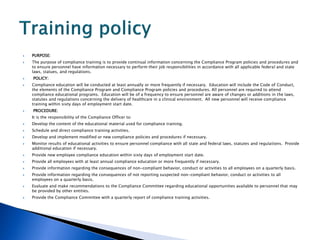
   PURPOSE:
   The purpose of compliance training is to provide continual information concerning the Compliance Program policies and procedures and
    to ensure personnel have information necessary to perform their job responsibilities in accordance with all applicable federal and state
    laws, statues, and regulations.
   POLICY:
   Compliance education will be conducted at least annually or more frequently if necessary. Education will include the Code of Conduct,
    the elements of the Compliance Program and Compliance Program policies and procedures. All personnel are required to attend
    compliance educational programs. Education will be of a frequency to ensure personnel are aware of changes or additions in the laws,
    statutes and regulations concerning the delivery of healthcare in a clinical environment. All new personnel will receive compliance
    training within sixty days of employment start date.
   PROCEDURE:
    It is the responsibility of the Compliance Officer to:
   Develop the content of the educational material used for compliance training.
   Schedule and direct compliance training activities.
   Develop and implement modified or new compliance policies and procedures if necessary.
   Monitor results of educational activities to ensure personnel compliance with all state and federal laws, statutes and regulations. Provide
    additional education if necessary.
   Provide new employee compliance education within sixty days of employment start date.
   Provide all employees with at least annual compliance education or more frequently if necessary.
   Provide information regarding the consequences of non-compliant behavior, conduct or activities to all employees on a quarterly basis.
   Provide information regarding the consequences of not reporting suspected non-compliant behavior, conduct or activities to all
    employees on a quarterly basis.
   Evaluate and make recommendations to the Compliance Committee regarding educational opportunities available to personnel that may
    be provided by other entities.
   Provide the Compliance Committee with a quarterly report of compliance training activities.
   Hotline or Other System for Reporting
    Suspected Noncompliance
   Routine Communication and Access to the
    Compliance Officer
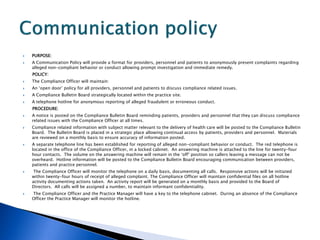
   PURPOSE:
   A Communication Policy will provide a format for providers, personnel and patients to anonymously present complaints regarding
    alleged non-compliant behavior or conduct allowing prompt investigation and immediate remedy.
    POLICY:
   The Compliance Officer will maintain:
   An ‘open door’ policy for all providers, personnel and patients to discuss compliance related issues.
   A Compliance Bulletin Board strategically located within the practice site.
   A telephone hotline for anonymous reporting of alleged fraudulent or erroneous conduct.
    PROCEDURE:
   A notice is posted on the Compliance Bulletin Board reminding patients, providers and personnel that they can discuss compliance
    related issues with the Compliance Officer at all times.
   Compliance related information with subject matter relevant to the delivery of health care will be posted to the Compliance Bulletin
    Board. The Bulletin Board is placed in a strategic place allowing continual access by patients, providers and personnel. Materials
    are reviewed on a monthly basis to ensure accuracy of information posted.
   A separate telephone line has been established for reporting of alleged non-compliant behavior or conduct. The red telephone is
    located in the office of the Compliance Officer, in a locked cabinet. An answering machine is attached to the line for twenty-four
    hour contacts. The volume on the answering machine will remain in the ‘off’ position so callers leaving a message can not be
    overheard. Hotline information will be posted to the Compliance Bulletin Board encouraging communication between providers,
    patients and practice personnel.
    The Compliance Officer will monitor the telephone on a daily basis, documenting all calls. Responsive actions will be initiated
    within twenty-four hours of receipt of alleged complaint. The Compliance Officer will maintain confidential files on all hotline
    activity documenting actions taken. An activity report will be generated on a monthly basis and provided to the Board of
    Directors. All calls will be assigned a number, to maintain informant confidentiality.
   The Compliance Officer and the Practice Manager will have a key to the telephone cabinet. During an absence of the Compliance
    Officer the Practice Manager will monitor the hotline.
   Chart Audit
   Coding Audit
   Monitoring
   Risk Areas
   Error Rate
   Consistent Enforcement of Disciplinary
    Policies
   Employment of, and Contracting with,
    Ineligible Persons
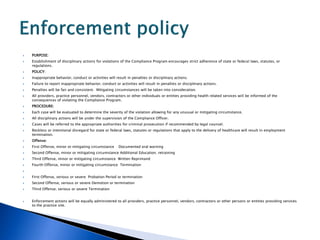
   PURPOSE:
   Establishment of disciplinary actions for violations of the Compliance Program encourages strict adherence of state or federal laws, statutes, or
    regulations.
   POLICY:
   Inappropriate behavior, conduct or activities will result in penalties or disciplinary actions.
   Failure to report inappropriate behavior, conduct or activities will result in penalties or disciplinary actions.
   Penalties will be fair and consistent. Mitigating circumstances will be taken into consideration.
   All providers, practice personnel, vendors, contractors or other individuals or entities providing health related services will be informed of the
    consequences of violating the Compliance Program.
   PROCEDURE:
   Each case will be evaluated to determine the severity of the violation allowing for any unusual or mitigating circumstance.
   All disciplinary actions will be under the supervision of the Compliance Officer.
   Cases will be referred to the appropriate authorities for criminal prosecution if recommended by legal counsel.
   Reckless or intentional disregard for state or federal laws, statutes or regulations that apply to the delivery of healthcare will result in employment
    termination.
   Offense:
   First Offense, minor or mitigating circumstance     Documented oral warning
   Second Offense, minor or mitigating circumstance Additional Education; retraining
   Third Offense, minor or mitigating circumstance Written Reprimand
   Fourth Offense, minor or mitigating circumstance Termination


   First Offense, serious or severe Probation Period or termination
   Second Offense, serious or severe Demotion or termination
   Third Offense, serious or severe Termination


   Enforcement actions will be equally administered to all providers, practice personnel, vendors, contractors or other persons or entities providing services
    to the practice site.
   Responding to Offenses and Developing
    Corrective Action
   Reporting to the Government
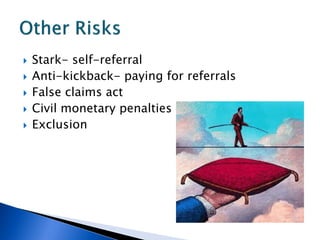
   Stark- self-referral
   Anti-kickback- paying for referrals
   False claims act
   Civil monetary penalties
   Exclusion
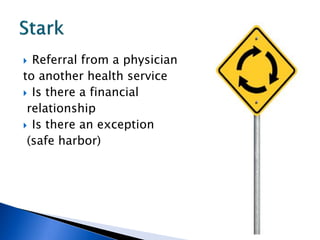
 Referral from a physician
to another health service
 Is there a financial
 relationship
 Is there an exception
 (safe harbor)
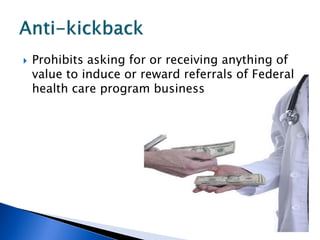
   Prohibits asking for or receiving anything of
    value to induce or reward referrals of Federal
    health care program business
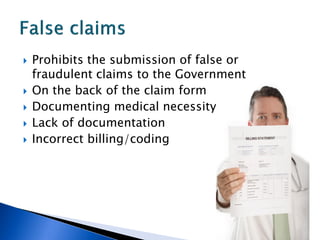
   Prohibits the submission of false or
    fraudulent claims to the Government
   On the back of the claim form
   Documenting medical necessity
   Lack of documentation
   Incorrect billing/coding
   HIPAA
   OSHA
   CLIA
   FMLA
   HR Policies
A message of
quality and caring
to stakeholders
To improve revenue
To build a culture
 of quality, safety and collaboration
As a tool of fiduciary responsibility
In marketing messages
When renegotiating insurance
contracts
   Mark A. Testa, DC, MHA, MCS-P
   Doctesta@hotmail.com
   303.885.9630


          It takes less time to do things right
          than to explain why you did it wrong.
          Henry Wadsworth Longfellow

Medical compliance testa

  • 1.
    Mark A. Testa,DC, MHA, MCS-P
  • 2.
     I ama practitioner  I don’t like more regulation  I want to make and keep as much revenue as I can  I want to be efficient  I want to provide quality care  I want to sleep at night  We want the same things
  • 3.
    Required by law if you accept federal funds  Will be enforced in ~2014  Proactive vs. Reactive  OIG provides guidelines and help
  • 4.
    Designed to limit Fraud  Waste  Abuse  Reduce risk
  • 5.
    CMS announced inJune that during the first calendar quarter of 2011, it found and recovered $162 million in overpayments—more than doubling the $75.8 million recovered in the last calendar quarter of 2010.
  • 6.
    $10-50,000 per violation  Repayment of over payments  Jail time with fraud  Sanctions  Exclusion  Corporate integrity agreements
  • 7.
     Who evaluatesthe OIG exclusion list?  Which EM guidelines does your practice use?  What was the error rate of your last chart audit? How did you fix the problems?  Do you have a Code of Conduct?  Do you have a compliance hotline/officer/log?  Does your billing service have a compliance program?
  • 8.
    Provides a protective shield  Reduces risk of whistleblowers  Increases revenue  Improves documentation and coding quality  Providing medically necessary, quality care
  • 9.
    1. Written policies and procedures 2. Compliance professionals 3. Effective training 4. Effective communication 5. Internal monitoring 6. Enforcement of standards 7. Prompt response
  • 10.
    Policies and procedures are up to-date and user-friendly  Standards of conduct  Code of conduct  Retention of Records and Information Systems  Compliance as an Element of Performance Plan
  • 11.
    Site Name is committed to providing quality, comprehensive health care to the patients of our Community. Our services will be provided in a professional manner within a safe and orderly environment. All personnel will be expected to maintain high moral and ethical standards and abide by the State and Federal regulations as they pertain to the delivery of health care. All personnel will adhere to the Compliance Program of Site Name.
  • 12.
    Compliance Officer or Compliance Committee  Oversee the implementation  Maintenance  Effectiveness  Company watch-dog
  • 13.
    JOB DESCRIPTION:  Effective Date:  Approved By:  Policy Number:  Page(s) 1 of 2  Title:  Job Title: Compliance Officer  Department: Administration  Reports to: Board of Directors, President, Physician Services Organization  Job Summary:  The Compliance Officer is responsible for the administration, evaluation and continued development of the Compliance Program to ensure adherence to applicable state and federal healthcare laws, statutes and regulations.  Job Responsibilities:  Design, develop, implement and monitor a comprehensive Compliance Program in accordance with the Code of Conduct and Compliance Program Elements.  Develop and implement policies and procedures necessary to adhere to applicable state and federal healthcare laws, statutes and regulations.  Submit annual budget for Compliance Program activities.  Provide monthly report of Compliance Program activities to the Board of Directors.  Coordinate, conduct and facilitate audit functions to identify inappropriate conduct or behavior. Provide subsequent education and materials to implement corrective actions as necessary.  Coordinate, conduct and facilitate continued educational programs for providers and personnel that contain focused emphasis on the seven elements of the Compliance Program.  Continually revise policies and procedures to reflect current changes in state and federal healthcare laws, statutes and regulations.
  • 14.
    Formal Training Programs  Informal On-going Compliance Training  Staff  Physicians  Billing department
  • 15.
    PURPOSE:  The purpose of compliance training is to provide continual information concerning the Compliance Program policies and procedures and to ensure personnel have information necessary to perform their job responsibilities in accordance with all applicable federal and state laws, statues, and regulations.  POLICY:  Compliance education will be conducted at least annually or more frequently if necessary. Education will include the Code of Conduct, the elements of the Compliance Program and Compliance Program policies and procedures. All personnel are required to attend compliance educational programs. Education will be of a frequency to ensure personnel are aware of changes or additions in the laws, statutes and regulations concerning the delivery of healthcare in a clinical environment. All new personnel will receive compliance training within sixty days of employment start date.  PROCEDURE: It is the responsibility of the Compliance Officer to:  Develop the content of the educational material used for compliance training.  Schedule and direct compliance training activities.  Develop and implement modified or new compliance policies and procedures if necessary.  Monitor results of educational activities to ensure personnel compliance with all state and federal laws, statutes and regulations. Provide additional education if necessary.  Provide new employee compliance education within sixty days of employment start date.  Provide all employees with at least annual compliance education or more frequently if necessary.  Provide information regarding the consequences of non-compliant behavior, conduct or activities to all employees on a quarterly basis.  Provide information regarding the consequences of not reporting suspected non-compliant behavior, conduct or activities to all employees on a quarterly basis.  Evaluate and make recommendations to the Compliance Committee regarding educational opportunities available to personnel that may be provided by other entities.  Provide the Compliance Committee with a quarterly report of compliance training activities.
  • 16.
    Hotline or Other System for Reporting Suspected Noncompliance  Routine Communication and Access to the Compliance Officer
  • 17.
    PURPOSE:  A Communication Policy will provide a format for providers, personnel and patients to anonymously present complaints regarding alleged non-compliant behavior or conduct allowing prompt investigation and immediate remedy. POLICY:  The Compliance Officer will maintain:  An ‘open door’ policy for all providers, personnel and patients to discuss compliance related issues.  A Compliance Bulletin Board strategically located within the practice site.  A telephone hotline for anonymous reporting of alleged fraudulent or erroneous conduct. PROCEDURE:  A notice is posted on the Compliance Bulletin Board reminding patients, providers and personnel that they can discuss compliance related issues with the Compliance Officer at all times.  Compliance related information with subject matter relevant to the delivery of health care will be posted to the Compliance Bulletin Board. The Bulletin Board is placed in a strategic place allowing continual access by patients, providers and personnel. Materials are reviewed on a monthly basis to ensure accuracy of information posted.  A separate telephone line has been established for reporting of alleged non-compliant behavior or conduct. The red telephone is located in the office of the Compliance Officer, in a locked cabinet. An answering machine is attached to the line for twenty-four hour contacts. The volume on the answering machine will remain in the ‘off’ position so callers leaving a message can not be overheard. Hotline information will be posted to the Compliance Bulletin Board encouraging communication between providers, patients and practice personnel.  The Compliance Officer will monitor the telephone on a daily basis, documenting all calls. Responsive actions will be initiated within twenty-four hours of receipt of alleged complaint. The Compliance Officer will maintain confidential files on all hotline activity documenting actions taken. An activity report will be generated on a monthly basis and provided to the Board of Directors. All calls will be assigned a number, to maintain informant confidentiality.  The Compliance Officer and the Practice Manager will have a key to the telephone cabinet. During an absence of the Compliance Officer the Practice Manager will monitor the hotline.
  • 18.
    Chart Audit  Coding Audit  Monitoring  Risk Areas  Error Rate
  • 19.
    Consistent Enforcement of Disciplinary Policies  Employment of, and Contracting with, Ineligible Persons
  • 20.
    PURPOSE:  Establishment of disciplinary actions for violations of the Compliance Program encourages strict adherence of state or federal laws, statutes, or regulations.  POLICY:  Inappropriate behavior, conduct or activities will result in penalties or disciplinary actions.  Failure to report inappropriate behavior, conduct or activities will result in penalties or disciplinary actions.  Penalties will be fair and consistent. Mitigating circumstances will be taken into consideration.  All providers, practice personnel, vendors, contractors or other individuals or entities providing health related services will be informed of the consequences of violating the Compliance Program.  PROCEDURE:  Each case will be evaluated to determine the severity of the violation allowing for any unusual or mitigating circumstance.  All disciplinary actions will be under the supervision of the Compliance Officer.  Cases will be referred to the appropriate authorities for criminal prosecution if recommended by legal counsel.  Reckless or intentional disregard for state or federal laws, statutes or regulations that apply to the delivery of healthcare will result in employment termination.  Offense:  First Offense, minor or mitigating circumstance Documented oral warning  Second Offense, minor or mitigating circumstance Additional Education; retraining  Third Offense, minor or mitigating circumstance Written Reprimand  Fourth Offense, minor or mitigating circumstance Termination   First Offense, serious or severe Probation Period or termination  Second Offense, serious or severe Demotion or termination  Third Offense, serious or severe Termination  Enforcement actions will be equally administered to all providers, practice personnel, vendors, contractors or other persons or entities providing services to the practice site.
  • 21.
    Responding to Offenses and Developing Corrective Action  Reporting to the Government
  • 22.
    Stark- self-referral  Anti-kickback- paying for referrals  False claims act  Civil monetary penalties  Exclusion
  • 23.
     Referral froma physician to another health service  Is there a financial relationship  Is there an exception (safe harbor)
  • 24.
    Prohibits asking for or receiving anything of value to induce or reward referrals of Federal health care program business
  • 25.
    Prohibits the submission of false or fraudulent claims to the Government  On the back of the claim form  Documenting medical necessity  Lack of documentation  Incorrect billing/coding
  • 26.
    HIPAA  OSHA  CLIA  FMLA  HR Policies
  • 27.
    A message of qualityand caring to stakeholders To improve revenue To build a culture of quality, safety and collaboration As a tool of fiduciary responsibility In marketing messages When renegotiating insurance contracts
  • 28.
    Mark A. Testa, DC, MHA, MCS-P  Doctesta@hotmail.com  303.885.9630 It takes less time to do things right than to explain why you did it wrong. Henry Wadsworth Longfellow