Consumerism’s Impact on Health
System Acquisition Strategy
R. Michael Barry
Partner
Arnall Golden Gregory
Michael G. Ramey
Principal
PYA
Objectives
 What is “consumerism,” and how are health
systems adopting to meet consumer demand
 Escalating requirements for price transparency
 Types of market transactions that enable a
consumer-driver strategy
 Competition to health systems pursuing
consumer-driven strategies
 Legal challenges in advising health systems on
consumer-driven investments
1
2
3
4
5
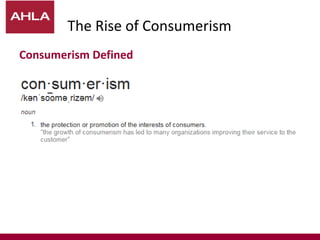
The Rise of Consumerism
Consumerism Defined
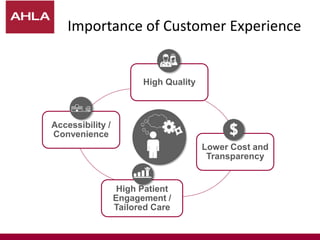
Importance of Customer Experience
High Quality
Lower Cost and
Transparency
High Patient
Engagement /
Tailored Care
Accessibility /
Convenience
Importance of Customer Experience
Source: Consumerism: How Steady Is Your Consumer-Based Platform (PYA)
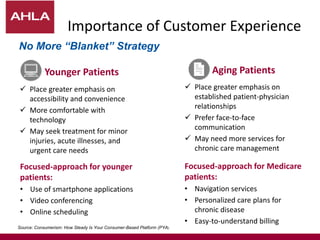
No More “Blanket” Strategy
Younger Patients
 Place greater emphasis on
accessibility and convenience
 More comfortable with
technology
 May seek treatment for minor
injuries, acute illnesses, and
urgent care needs
Aging Patients
 Place greater emphasis on
established patient-physician
relationships
 Prefer face-to-face
communication
 May need more services for
chronic care management
Focused-approach for younger
patients:
• Use of smartphone applications
• Video conferencing
• Online scheduling
Focused-approach for Medicare
patients:
• Navigation services
• Personalized care plans for
chronic disease
• Easy-to-understand billing
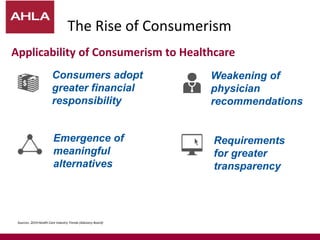
Weakening of
physician
recommendations
The Rise of Consumerism
Sources: 2019 Health Care Industry Trends (Advisory Board)
Emergence of
meaningful
alternatives
Consumers adopt
greater financial
responsibility
Requirements
for greater
transparency
Applicability of Consumerism to Healthcare
The Rise of Consumerism
Sources: Playbook for the Consumer-Focused Health System (Advisory Board), Competing on Consumer Experience (Advisory Board), Impacts
of Consumerism in the Payments Industry (HIMSS) Building a Value Culture of Health: The Value Proposition of Retail Clinics (Robert Wood
Johnson Foundation and Manatt Health)
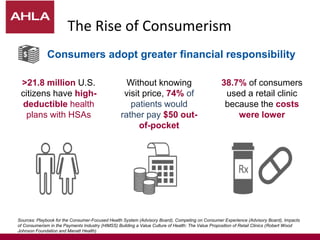
38.7% of consumers
used a retail clinic
because the costs
were lower
Without knowing
visit price, 74% of
patients would
rather pay $50 out-
of-pocket
>21.8 million U.S.
citizens have high-
deductible health
plans with HSAs
Consumers adopt greater financial responsibility
The Rise of Consumerism
Source: American Journal of Managed Care, Enrollment in High-Deductible Health Plans Continues to Grow, August 2018
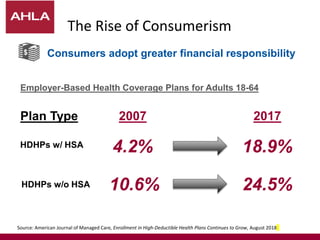
Consumers adopt greater financial responsibility
2007 2017
4.2%
10.6% 24.5%
18.9%HDHPs w/ HSA
HDHPs w/o HSA
Employer-Based Health Coverage Plans for Adults 18-64
Plan Type
The Rise of Consumerism
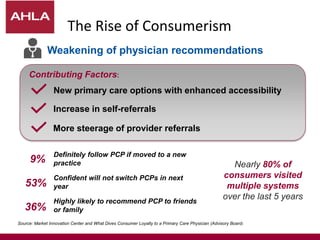
New primary care options with enhanced accessibility
More steerage of provider referrals
Increase in self-referrals
Source: Market Innovation Center and What Dives Consumer Loyalty to a Primary Care Physician (Advisory Board)
Weakening of physician recommendations
Nearly 80% of
consumers visited
multiple systems
over the last 5 years
Contributing Factors:
Definitely follow PCP if moved to a new
practice
Confident will not switch PCPs in next
year
Highly likely to recommend PCP to friends
or family
9%
53%
36%
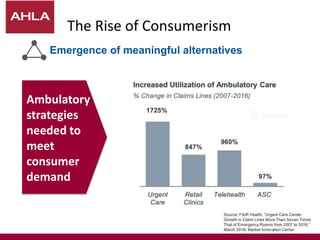
Ambulatory
strategies
needed to
meet
consumer
demand
The Rise of Consumerism
Emergence of meaningful alternatives
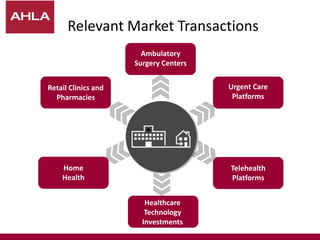
Relevant Market Transactions
Ambulatory
Surgery Centers
Retail Clinics and
Pharmacies
Home
Health
Urgent Care
Platforms
Telehealth
Platforms
Healthcare
Technology
Investments
Relevant Market Transactions
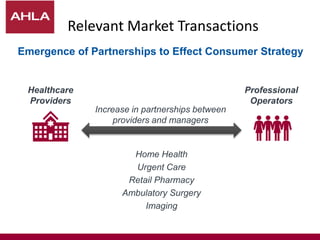
Emergence of Partnerships to Effect Consumer Strategy
Home Health
Urgent Care
Retail Pharmacy
Ambulatory Surgery
Imaging
Healthcare
Providers
Professional
Operators
Increase in partnerships between
providers and managers
Relevant Market Transactions
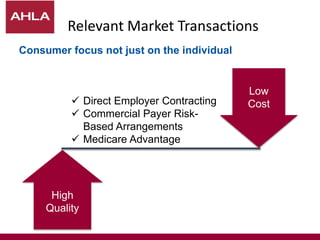
Consumer focus not just on the individual
High
Quality
Low
Cost Direct Employer Contracting
 Commercial Payer Risk-
Based Arrangements
 Medicare Advantage
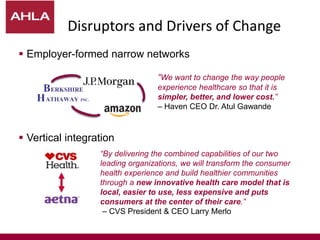
Disruptors and Drivers of Change
 Employer-formed narrow networks
 Vertical integration
“By delivering the combined capabilities of our two
leading organizations, we will transform the consumer
health experience and build healthier communities
through a new innovative health care model that is
local, easier to use, less expensive and puts
consumers at the center of their care.”
– CVS President & CEO Larry Merlo
“We want to change the way people
experience healthcare so that it is
simpler, better, and lower cost.”
– Haven CEO Dr. Atul Gawande
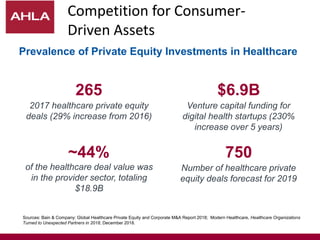
Competition for Consumer-
Driven Assets
Prevalence of Private Equity Investments in Healthcare
of the healthcare deal value was
in the provider sector, totaling
$18.9B
~44%
2017 healthcare private equity
deals (29% increase from 2016)
265
Sources: Bain & Company: Global Healthcare Private Equity and Corporate M&A Report 2018; Modern Healthcare, Healthcare Organizations
Turned to Unexpected Partners in 2018, December 2018.
Venture capital funding for
digital health startups (230%
increase over 5 years)
$6.9B
Number of healthcare private
equity deals forecast for 2019
750
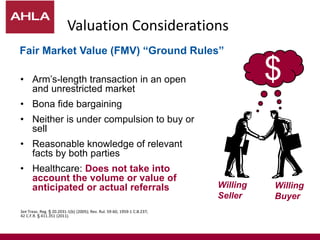
Valuation Considerations
• Arm’s-length transaction in an open
and unrestricted market
• Bona fide bargaining
• Neither is under compulsion to buy or
sell
• Reasonable knowledge of relevant
facts by both parties
• Healthcare: Does not take into
account the volume or value of
anticipated or actual referrals
See Treas. Reg. § 20.2031-1(b) (2005); Rev. Rul. 59-60, 1959-1 C.B.237;
42 C.F.R. § 411.351 (2011).
$
Willing
Seller
Willing
Buyer
$
Fair Market Value (FMV) “Ground Rules”
IRS Definition1
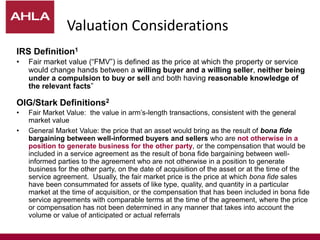
• Fair market value (“FMV”) is defined as the price at which the property or service
would change hands between a willing buyer and a willing seller, neither being
under a compulsion to buy or sell and both having reasonable knowledge of
the relevant facts”
OIG/Stark Definitions2
• Fair Market Value: the value in arm’s-length transactions, consistent with the general
market value
• General Market Value: the price that an asset would bring as the result of bona fide
bargaining between well-informed buyers and sellers who are not otherwise in a
position to generate business for the other party, or the compensation that would be
included in a service agreement as the result of bona fide bargaining between well-
informed parties to the agreement who are not otherwise in a position to generate
business for the other party, on the date of acquisition of the asset or at the time of the
service agreement. Usually, the fair market price is the price at which bona fide sales
have been consummated for assets of like type, quality, and quantity in a particular
market at the time of acquisition, or the compensation that has been included in bona fide
service agreements with comparable terms at the time of the agreement, where the price
or compensation has not been determined in any manner that takes into account the
volume or value of anticipated or actual referrals
Valuation Considerations
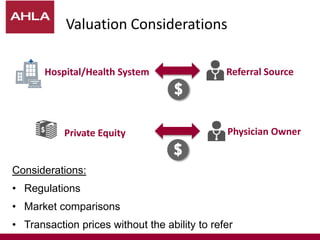
Hospital/Health System
Considerations:
• Regulations
• Market comparisons
• Transaction prices without the ability to refer
Referral Source
Physician OwnerPrivate Equity
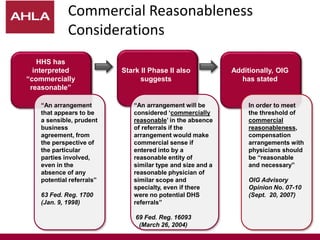
HHS has
interpreted
“commercially
reasonable”
Stark II Phase II also
suggests
Additionally, OIG
has stated
“An arrangement
that appears to be
a sensible, prudent
business
agreement, from
the perspective of
the particular
parties involved,
even in the
absence of any
potential referrals”
63 Fed. Reg. 1700
(Jan. 9, 1998)
“An arrangement will be
considered ‘commercially
reasonable’ in the absence
of referrals if the
arrangement would make
commercial sense if
entered into by a
reasonable entity of
similar type and size and a
reasonable physician of
similar scope and
specialty, even if there
were no potential DHS
referrals”
69 Fed. Reg. 16093
(March 26, 2004)
In order to meet
the threshold of
commercial
reasonableness,
compensation
arrangements with
physicians should
be “reasonable
and necessary”
OIG Advisory
Opinion No. 07-10
(Sept. 20, 2007)
Commercial Reasonableness
Considerations
Commercial Reasonableness
Considerations
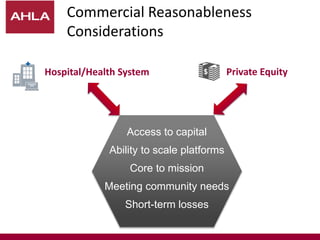
Hospital/Health System
Access to capital
Ability to scale platforms
Core to mission
Meeting community needs
Short-term losses
Private Equity
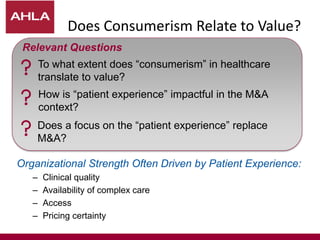
Does Consumerism Relate to Value?
Organizational Strength Often Driven by Patient Experience:
– Clinical quality
– Availability of complex care
– Access
– Pricing certainty
To what extent does “consumerism” in healthcare
translate to value?
Does a focus on the “patient experience” replace
M&A?
How is “patient experience” impactful in the M&A
context?
Relevant Questions
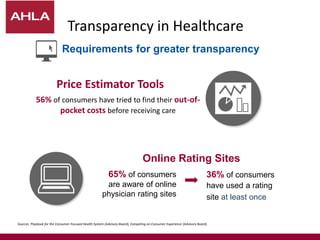
Transparency in Healthcare
Sources: Playbook for the Consumer-Focused Health System (Advisory Board), Competing on Consumer Experience (Advisory Board)
65% of consumers
are aware of online
physician rating sites
36% of consumers
have used a rating
site at least once
Online Rating Sites
Price Estimator Tools
56% of consumers have tried to find their out-of-
pocket costs before receiving care
Requirements for greater transparency
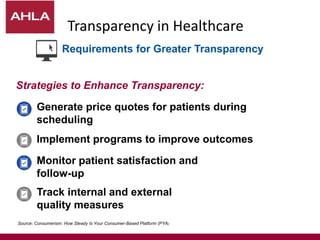
Transparency in Healthcare
Generate price quotes for patients during
scheduling
Monitor patient satisfaction and
follow-up
Implement programs to improve outcomes
Track internal and external
quality measures
Strategies to Enhance Transparency:
Source: Consumerism: How Steady Is Your Consumer-Based Platform (PYA)
Requirements for Greater Transparency
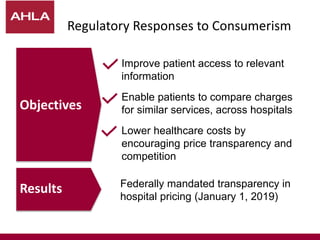
Objectives
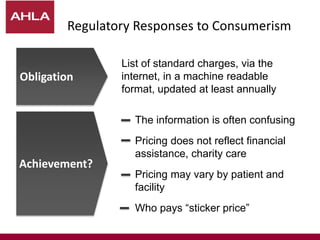
Regulatory Responses to Consumerism
Results
Improve patient access to relevant
information
Enable patients to compare charges
for similar services, across hospitals
Lower healthcare costs by
encouraging price transparency and
competition
Federally mandated transparency in
hospital pricing (January 1, 2019)
Obligation
Regulatory Responses to Consumerism
Achievement?
List of standard charges, via the
internet, in a machine readable
format, updated at least annually
The information is often confusing
Pricing does not reflect financial
assistance, charity care
Pricing may vary by patient and
facility
Who pays “sticker price”
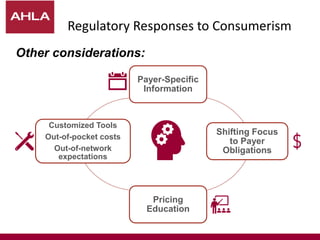
Regulatory Responses to Consumerism
Other considerations:
Payer-Specific
Information
Shifting Focus
to Payer
Obligations
Pricing
Education
Customized Tools
Out-of-pocket costs
Out-of-network
expectations
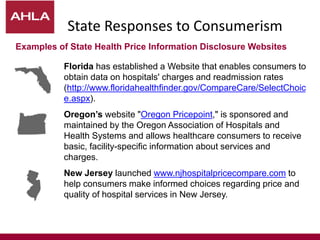
State Responses to Consumerism
Florida has established a Website that enables consumers to
obtain data on hospitals' charges and readmission rates
(http://www.floridahealthfinder.gov/CompareCare/SelectChoic
e.aspx).
Oregon’s website "Oregon Pricepoint," is sponsored and
maintained by the Oregon Association of Hospitals and
Health Systems and allows healthcare consumers to receive
basic, facility-specific information about services and
charges.
New Jersey launched www.njhospitalpricecompare.com to
help consumers make informed choices regarding price and
quality of hospital services in New Jersey.
Examples of State Health Price Information Disclosure Websites
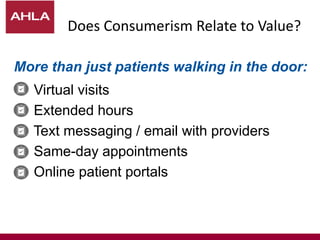
Does Consumerism Relate to Value?
More than just patients walking in the door:
- Virtual visits
- Extended hours
- Text messaging / email with providers
- Same-day appointments
- Online patient portals
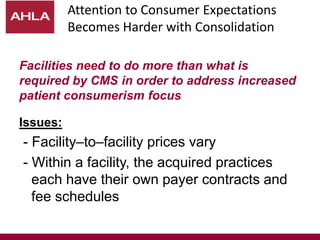
Attention to Consumer Expectations
Becomes Harder with Consolidation
Facilities need to do more than what is
required by CMS in order to address increased
patient consumerism focus
Issues:
- Facility–to–facility prices vary
- Within a facility, the acquired practices
each have their own payer contracts and
fee schedules
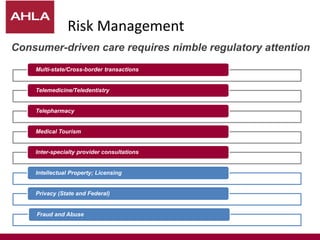
Risk Management
Consumer-driven care requires nimble regulatory attention
Multi-state/Cross-border transactions
Telemedicine/Teledentistry
Telepharmacy
Medical Tourism
Inter-specialty provider consultations
Intellectual Property; Licensing
Privacy (State and Federal)
Fraud and Abuse
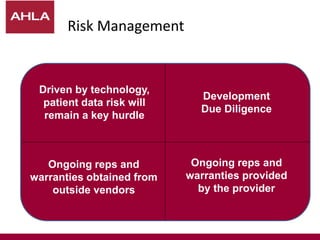
Risk Management
Driven by technology,
patient data risk will
remain a key hurdle
Ongoing reps and
warranties obtained from
outside vendors
Development
Due Diligence
Ongoing reps and
warranties provided
by the provider
Questions?
?
R. Michael Barry
Partner
Arnall Golden Gregory
michael.barry@agg.com
(404) 873-8698
Michael G. Ramey
Principal
PYA
mramey@pyapc.com
(865) 684-2709

Consumerism's Impact on Health System Acquisition Strategy

  • 1.
    Consumerism’s Impact onHealth System Acquisition Strategy R. Michael Barry Partner Arnall Golden Gregory Michael G. Ramey Principal PYA
  • 2.
    Objectives  What is“consumerism,” and how are health systems adopting to meet consumer demand  Escalating requirements for price transparency  Types of market transactions that enable a consumer-driver strategy  Competition to health systems pursuing consumer-driven strategies  Legal challenges in advising health systems on consumer-driven investments 1 2 3 4 5
  • 3.
    The Rise ofConsumerism Consumerism Defined
  • 4.
    Importance of CustomerExperience High Quality Lower Cost and Transparency High Patient Engagement / Tailored Care Accessibility / Convenience
  • 5.
    Importance of CustomerExperience Source: Consumerism: How Steady Is Your Consumer-Based Platform (PYA) No More “Blanket” Strategy Younger Patients  Place greater emphasis on accessibility and convenience  More comfortable with technology  May seek treatment for minor injuries, acute illnesses, and urgent care needs Aging Patients  Place greater emphasis on established patient-physician relationships  Prefer face-to-face communication  May need more services for chronic care management Focused-approach for younger patients: • Use of smartphone applications • Video conferencing • Online scheduling Focused-approach for Medicare patients: • Navigation services • Personalized care plans for chronic disease • Easy-to-understand billing
  • 6.
    Weakening of physician recommendations The Riseof Consumerism Sources: 2019 Health Care Industry Trends (Advisory Board) Emergence of meaningful alternatives Consumers adopt greater financial responsibility Requirements for greater transparency Applicability of Consumerism to Healthcare
  • 7.
    The Rise ofConsumerism Sources: Playbook for the Consumer-Focused Health System (Advisory Board), Competing on Consumer Experience (Advisory Board), Impacts of Consumerism in the Payments Industry (HIMSS) Building a Value Culture of Health: The Value Proposition of Retail Clinics (Robert Wood Johnson Foundation and Manatt Health) 38.7% of consumers used a retail clinic because the costs were lower Without knowing visit price, 74% of patients would rather pay $50 out- of-pocket >21.8 million U.S. citizens have high- deductible health plans with HSAs Consumers adopt greater financial responsibility
  • 8.
    The Rise ofConsumerism Source: American Journal of Managed Care, Enrollment in High-Deductible Health Plans Continues to Grow, August 2018 Consumers adopt greater financial responsibility 2007 2017 4.2% 10.6% 24.5% 18.9%HDHPs w/ HSA HDHPs w/o HSA Employer-Based Health Coverage Plans for Adults 18-64 Plan Type
  • 9.
    The Rise ofConsumerism New primary care options with enhanced accessibility More steerage of provider referrals Increase in self-referrals Source: Market Innovation Center and What Dives Consumer Loyalty to a Primary Care Physician (Advisory Board) Weakening of physician recommendations Nearly 80% of consumers visited multiple systems over the last 5 years Contributing Factors: Definitely follow PCP if moved to a new practice Confident will not switch PCPs in next year Highly likely to recommend PCP to friends or family 9% 53% 36%
  • 10.
    Ambulatory strategies needed to meet consumer demand The Riseof Consumerism Emergence of meaningful alternatives
  • 11.
    Relevant Market Transactions Ambulatory SurgeryCenters Retail Clinics and Pharmacies Home Health Urgent Care Platforms Telehealth Platforms Healthcare Technology Investments
  • 12.
    Relevant Market Transactions Emergenceof Partnerships to Effect Consumer Strategy Home Health Urgent Care Retail Pharmacy Ambulatory Surgery Imaging Healthcare Providers Professional Operators Increase in partnerships between providers and managers
  • 13.
    Relevant Market Transactions Consumerfocus not just on the individual High Quality Low Cost Direct Employer Contracting  Commercial Payer Risk- Based Arrangements  Medicare Advantage
  • 14.
    Disruptors and Driversof Change  Employer-formed narrow networks  Vertical integration “By delivering the combined capabilities of our two leading organizations, we will transform the consumer health experience and build healthier communities through a new innovative health care model that is local, easier to use, less expensive and puts consumers at the center of their care.” – CVS President & CEO Larry Merlo “We want to change the way people experience healthcare so that it is simpler, better, and lower cost.” – Haven CEO Dr. Atul Gawande
  • 15.
    Competition for Consumer- DrivenAssets Prevalence of Private Equity Investments in Healthcare of the healthcare deal value was in the provider sector, totaling $18.9B ~44% 2017 healthcare private equity deals (29% increase from 2016) 265 Sources: Bain & Company: Global Healthcare Private Equity and Corporate M&A Report 2018; Modern Healthcare, Healthcare Organizations Turned to Unexpected Partners in 2018, December 2018. Venture capital funding for digital health startups (230% increase over 5 years) $6.9B Number of healthcare private equity deals forecast for 2019 750
  • 16.
    Valuation Considerations • Arm’s-lengthtransaction in an open and unrestricted market • Bona fide bargaining • Neither is under compulsion to buy or sell • Reasonable knowledge of relevant facts by both parties • Healthcare: Does not take into account the volume or value of anticipated or actual referrals See Treas. Reg. § 20.2031-1(b) (2005); Rev. Rul. 59-60, 1959-1 C.B.237; 42 C.F.R. § 411.351 (2011). $ Willing Seller Willing Buyer $ Fair Market Value (FMV) “Ground Rules”
  • 17.
    IRS Definition1 • Fairmarket value (“FMV”) is defined as the price at which the property or service would change hands between a willing buyer and a willing seller, neither being under a compulsion to buy or sell and both having reasonable knowledge of the relevant facts” OIG/Stark Definitions2 • Fair Market Value: the value in arm’s-length transactions, consistent with the general market value • General Market Value: the price that an asset would bring as the result of bona fide bargaining between well-informed buyers and sellers who are not otherwise in a position to generate business for the other party, or the compensation that would be included in a service agreement as the result of bona fide bargaining between well- informed parties to the agreement who are not otherwise in a position to generate business for the other party, on the date of acquisition of the asset or at the time of the service agreement. Usually, the fair market price is the price at which bona fide sales have been consummated for assets of like type, quality, and quantity in a particular market at the time of acquisition, or the compensation that has been included in bona fide service agreements with comparable terms at the time of the agreement, where the price or compensation has not been determined in any manner that takes into account the volume or value of anticipated or actual referrals Valuation Considerations
  • 18.
    Valuation Considerations Hospital/Health System Considerations: •Regulations • Market comparisons • Transaction prices without the ability to refer Referral Source Physician OwnerPrivate Equity
  • 19.
    HHS has interpreted “commercially reasonable” Stark IIPhase II also suggests Additionally, OIG has stated “An arrangement that appears to be a sensible, prudent business agreement, from the perspective of the particular parties involved, even in the absence of any potential referrals” 63 Fed. Reg. 1700 (Jan. 9, 1998) “An arrangement will be considered ‘commercially reasonable’ in the absence of referrals if the arrangement would make commercial sense if entered into by a reasonable entity of similar type and size and a reasonable physician of similar scope and specialty, even if there were no potential DHS referrals” 69 Fed. Reg. 16093 (March 26, 2004) In order to meet the threshold of commercial reasonableness, compensation arrangements with physicians should be “reasonable and necessary” OIG Advisory Opinion No. 07-10 (Sept. 20, 2007) Commercial Reasonableness Considerations
  • 20.
    Commercial Reasonableness Considerations Hospital/Health System Accessto capital Ability to scale platforms Core to mission Meeting community needs Short-term losses Private Equity
  • 21.
    Does Consumerism Relateto Value? Organizational Strength Often Driven by Patient Experience: – Clinical quality – Availability of complex care – Access – Pricing certainty To what extent does “consumerism” in healthcare translate to value? Does a focus on the “patient experience” replace M&A? How is “patient experience” impactful in the M&A context? Relevant Questions
  • 22.
    Transparency in Healthcare Sources:Playbook for the Consumer-Focused Health System (Advisory Board), Competing on Consumer Experience (Advisory Board) 65% of consumers are aware of online physician rating sites 36% of consumers have used a rating site at least once Online Rating Sites Price Estimator Tools 56% of consumers have tried to find their out-of- pocket costs before receiving care Requirements for greater transparency
  • 23.
    Transparency in Healthcare Generateprice quotes for patients during scheduling Monitor patient satisfaction and follow-up Implement programs to improve outcomes Track internal and external quality measures Strategies to Enhance Transparency: Source: Consumerism: How Steady Is Your Consumer-Based Platform (PYA) Requirements for Greater Transparency
  • 24.
    Objectives Regulatory Responses toConsumerism Results Improve patient access to relevant information Enable patients to compare charges for similar services, across hospitals Lower healthcare costs by encouraging price transparency and competition Federally mandated transparency in hospital pricing (January 1, 2019)
  • 25.
    Obligation Regulatory Responses toConsumerism Achievement? List of standard charges, via the internet, in a machine readable format, updated at least annually The information is often confusing Pricing does not reflect financial assistance, charity care Pricing may vary by patient and facility Who pays “sticker price”
  • 26.
    Regulatory Responses toConsumerism Other considerations: Payer-Specific Information Shifting Focus to Payer Obligations Pricing Education Customized Tools Out-of-pocket costs Out-of-network expectations
  • 27.
    State Responses toConsumerism Florida has established a Website that enables consumers to obtain data on hospitals' charges and readmission rates (http://www.floridahealthfinder.gov/CompareCare/SelectChoic e.aspx). Oregon’s website "Oregon Pricepoint," is sponsored and maintained by the Oregon Association of Hospitals and Health Systems and allows healthcare consumers to receive basic, facility-specific information about services and charges. New Jersey launched www.njhospitalpricecompare.com to help consumers make informed choices regarding price and quality of hospital services in New Jersey. Examples of State Health Price Information Disclosure Websites
  • 28.
    Does Consumerism Relateto Value? More than just patients walking in the door: - Virtual visits - Extended hours - Text messaging / email with providers - Same-day appointments - Online patient portals
  • 29.
    Attention to ConsumerExpectations Becomes Harder with Consolidation Facilities need to do more than what is required by CMS in order to address increased patient consumerism focus Issues: - Facility–to–facility prices vary - Within a facility, the acquired practices each have their own payer contracts and fee schedules
  • 30.
    Risk Management Consumer-driven carerequires nimble regulatory attention Multi-state/Cross-border transactions Telemedicine/Teledentistry Telepharmacy Medical Tourism Inter-specialty provider consultations Intellectual Property; Licensing Privacy (State and Federal) Fraud and Abuse
  • 31.
    Risk Management Driven bytechnology, patient data risk will remain a key hurdle Ongoing reps and warranties obtained from outside vendors Development Due Diligence Ongoing reps and warranties provided by the provider
  • 32.
    Questions? ? R. Michael Barry Partner ArnallGolden Gregory michael.barry@agg.com (404) 873-8698 Michael G. Ramey Principal PYA mramey@pyapc.com (865) 684-2709