Homelessness
Prevention
1
Contents
2
Project Aim 3
Project Plan 4
Research Insights 5 - 11
Developing the Ideas 12 - 19
Prototype Feedback 20
Annex:
Project Methodology 21 - 22
Prototypes 23 - 57
Prototype Testing Insight 58 - 63
Project Aim
Homelessness is increasing in the UK. Statutory homelessness is up 44% since 2010 and
rough sleeping has doubled. To help address this the Prime Minister has launched a
Homelessness Prevention Programme, kick starting with £40m funding for areas to take
innovative approaches to preventing and tackling homelessness.
Policy Lab has been working with DCLG, local areas and charities to create fresh insights
and ideas that local areas can use. While we understand more about the structural issues
which are driving homelessness we know less about non-structural issues such as life
events or personal behaviours. This project has helped us explore these non-structural
factors (and how they interact with structural factors) and consider how we can use these
insights to better prevent and relieve homelessness.
The purpose of this pack is to share the methods, insights and ideas that have emerged
from this project so that they are available to areas and as a route into discussing the
themes. We do not expect areas to necessarily replicate these ideas to be successful in any
of our funding competitions – in fact we are hoping to fund a range of projects.
3
To answer the question:
How can we understand the personal (as opposed to structural) reasons
why people become and remain homeless and co-design and test
solutions to prevent homelessness?
Project Plan
Diagnose & Discover Develop & Deliver
Ethnography (spending time with people to
understand their experiences and behaviours)
Data science (using powerful computer techniques to
match and analysis data)
[Apr – Jun]
Idea workshop
To co-design solutions
with stakeholders
[June]
Prototype + test
solutions
with four local areas
[Jun - Sept]
Opening up
insight & ideas
as part of trailblazer
launch
[November]
Kick-off workshop
with stakeholders to
understand problem
[February]
4
Research Insights: Ethnography Ins:
As well as confirming known risk factors, the ethnography revealed some
personal risk and protective factors that are important in preventing
homelessness
Personal risk factors
● Short-term coping strategies to
make everyday life more bearable
● Relying on inappropriate support
networks
● Limited literacy regarding systems
● Limited financial autonomy
● Pride and a loss of identity as a
barrier to accessing support &
services
Personal protective factors
● Resourcefulness and shorter-term
“tactics”
● Goal orientation or taking active
steps to improve their situation
● Preserving identity, a sense of self
and “home”
● Positive mindset – taking positives
out of an adverse situation
● Positive support networks
5
Evidence of systems failure and missed opportunities to prevent homelessness:
● Inadequate/non-existent support for those with known risk factors at an early life
stage
● Inadequate Council/LA action to prevent homelessness, even with advance warning
● Inconsistent assessment of need when individuals present as homeless
● Accommodation and/or wider wraparound support provided to homeless individuals
varies in quality and adequacy
Evidence of positive positive experiences of Local Authority services with frontline
workers doing their best with constrained resources and in the face of challenging
external factors:
● They can be hugely knowledgeable, negotiating complex systems and learning new
ways to “work” the system so they can help people in the most appropriate way(s).
● They consider the long term impact of decisions they make
● They recreated the role of a “traditional” support network e.g. in negotiating
benefits, assisting with budgeting, and providing emotional support or mentoring.
6
Research Insights: Ethnography
More could be done to prevent homelessness by identifying people at risk
early, and by frontline workers taking a flexible and supportive approach
Source: DCLG analysis of British Birth Cohort Survey
7
Research Insights: Data Science
Predictive analysis is possible. There are 10 early years risk factors
that makes some people 15 times more at risk that others, especially
truanting and being in care
The ‘high risk’ group represent 20% of
the birth cohort. Of this group 12.8%
became homeless. They are 16 times
more likely to be homeless than the
‘very low’ risk group
Source: DCLG analysis of British Birth Cohort Survey
8
Research Insights: Data Science
If you are in the top 20% of the country likely to have these risk
factors, you are 16 times more likely to become homeless
The white circles show
that homeless people
have high co-occurrence
of mental health,
physical health and
offending issues.
Newcastle LA linked
together data from 140k
individuals from multiple
datasets: homelessness,
housing benefits, looked
after children & ASB.
Source: ASI analysis of Newcastle LA linked datasets
9
Research Insights: Data Science
Local areas can link data to give a richer picture of people who
are homeless or at risk of it.
Source: ASI analysis of Newcastle LA linked datasets
10
Research Insights: Data Science
But the quality of the data can be poor, and cleaning and
matching it takes a lot of time and resources
Even for something
relatively easy to collect
like gender, the data is
poor
Research Insights:
The key challenges that were highlighted
through the research
1. How can we identify at-risk people upstream and intervene well before they face a
crisis and present as homeless?
2. How can we support a culture shift to homeless prevention and early intervention
amongst those who deliver or commission services for those at risk of
homelessness?
3. How can we ensure services address ‘challenging behaviour’, (including
disengagement from services) firmly but supportively?
4. How can we empower people to help themselves, supporting them to be alert to
impending risk and actively navigate the system?
5. How can service providers help homeless people positively cope in the short-term so
they can focus on aspirations and long-term goals?
6. How can we help people maintain and/or grow their support networks
before/during/after being homeless? (Work on the stage that is most important to you
first).
7. How can policymakers and service providers take a creative and problem-solving
approach with users that builds on their strengths and resources?
11
Developing the Ideas
12
Research showed evidence of systems
failure and missed opportunities to
prevent homelessness. But there are 10
childhood risk factors that are high
predictors of homelessness. Local
authorities can link together data to
create a rich picture about those at risk.
People have resilience and support
networks that helps them cope with and
exit homelessness. Analysis of the British
Birth Cohort Survey shows that the vast
majority of people who self reported being
homeless were only homeless once.
People have a wide range of support
needs, ranging from those that start in
early childhood and develop as a result of
those, to live events along the way.
The best frontline staff were those who
knew how to navigate the system, took
a flexible and coaching approach.
How can we support a cultural shift
towards prevention?
How can we identify people early?
How can we empower people to help
themselves?
How can we take a take a creative and
problem-solving approach with users that
builds on their strengths?
How can services providers help people
cope in the short-term while focusing on
long-term goals?
A toolkit to help local areas to spot and
support different types of people at risk of
homelessness
Commitment from other services to
identify those at risk
Data-driven predictive risk models
A universal resilience programme in
schools
Self referral for those at risk
“Housing and Wellbeing” Plan that:
• starts with a strengths-based
assessment
• links users up with services to deal
with underlying issues as well as
providing housing support
• motivates and coaches people to think
about longer-term goals
Linking up with OGDs, including PHE
We took the insight… turned it into challenges… ...and generated ideas with
local areas
The generated ideas can be
found in the Annex of this slide
deck
LONG-TERM
PREVENTION
NEAR-TERM
PREVENTION
CRISIS
PREVENTION HOMELESS MOVING ON1 2 3 4 5
IDENTIFICATION OF
AT-RISK INDIVIDUALS
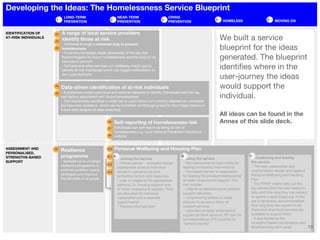
Developing the Ideas: The Homelessness Service Blueprint
A range of local service providers
identify those at risk
- Achieved through a universal duty to prevent
homelessness
- A comms campaign raises awareness of the key risk
factors/triggers for future homelessness and the duty on all
services to prevent
- Schools and other services run wellbeing check-ups to
identify at-risk individuals which can trigger notifications to
the Local Authority
Self-reporting of homelessness risk
Individuals can self-report as being at risk of
homelessness e.g. via a National Prevention Helpline or
website
Data-driven identification of at-risk individuals
- A predictive model uses local and national datasets to identify individuals with the key
risk factors associated with future homelessness.
- This deliberately identifies a wider net to catch those not currently deemed as vulnerable
but have low resilience, which can be funnelled out through a face-to-face triage (below) or
future data analysis (if data collected).
Joining the service
- “Whole person”, strengths-based
assessment looks at individual
situation, personal risk and
protective factors and resources
- User is triaged to the appropriate
pathway i.e. housing support only,
or wider wraparound support. They
are allocated an individual
caseworker and a separate
coach/mentor
- Trauma-informed plan
- Using the service
- The caseworker is responsible for
leading on housing interventions
- The coach/mentor is responsible
for leading the provision/signposting
of wider wraparound support. This
can include:
-- help to re-establish/grow positive
support networks
-- empowering people to make
choices to access a menu of
support services
-- provision of basic tools/advice
e.g.jam jar bank account, PO box for
correspondence, £15 voucher for
‘home & identity’
ASSESSMENT AND
PERSONALISED,
STRENGTHS-BASED
SUPPORT
B CA
Personal Wellbeing and Housing PlanResilience
programme
- Schools run a universal
resilience programme to
promote positive coping
strategies and improve
the life skills of all pupils.
Continuing and leaving
the service
- The user, caseworker and
coach/mentor design and agree a
Personal Wellbeing and Housing
Plan
- The PWHP clearly sets out the
key actions that the user needs to
take and how long they can expect
to spend in each stage e.g. if they
are in temporary accommodation,
how long they can expect to be
there and what local services are
available to support them
- It also builds on the
strengths-based conversation and
develops long-term goals
#1
#2
#3
#4
#7
#8
#9
#5
#6
#10
#11
#12
#13
We built a service
blueprint for the ideas
generated. The blueprint
identifies where in the
user-journey the ideas
would support the
individual.
All ideas can be found in the
Annex of this slide deck.
13
Developing the Ideas
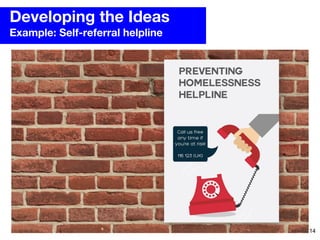
Example: Self-referral helpline
14
Developing the Ideas
Example: Wellbeing and Housing Plan
15
Your wellbeing:
1. What steps are you going to take to improve and
maintain your wellbeing?
Housing:
2. When will you do these by?
3. What steps do you want [service provider] to take
to improve and maintain your wellbeing?
4. When will they do them by?
1. What is your current housing situation?
2. What steps do we collectively need to take to
either maintain this situation or improve it?
3. When do these steps need to be taken by?
Developing the Ideas
Example: Typologies
16
Using inspiration from the Design Council we
created typologies to help frontline staff in identifying
the person they are trying to support. We focused on
trying to show how close someone was to becoming
homeless alongside their current needs (based on
the findings from our ethnographic research).
The draft typologies can be found on the next page.
We are currently considering how we can create
typologies for people who have moved beyond crisis
point and are now homeless.
@PolicyLabUK Homelessness Prevention Programme
These people have had a
traumatic experience in their
past (for example childhood
and/or sexual abuse, domestic
violence, death of a parent)
which is still not resolved and
has meant that they have low
resilience.
These people may have had a
traumatic experience in their
past, and have dealt with it
using coping strategies that
have also been damaging.
These are people that may
have internal issues leading
them to further risky
behaviours which have a
cumulative effect and are
spiralling out of control.
These people are generally
young and display some of risk
factors - for example truanting
from school or being in care -
that can lead to adopting
coping strategies which are
damaging (e.g. support
networks who take drugs) or
lack of resilience (e.g. lack of
family support).
These are people who have
had a string of bad luck
through events that are largely
outside of their control from job
loss, to personal illness or
relationship breakdown. They
have relatively poor resilience.
These are people whose longer
term risk factors such as
truanting at school or being in
care have left them without
many of the coping skills
necessary to deal with
short-term life events or
shocks (e.g. relationship
breakdown), with one breaking
the camel’s back and leading
to a crisis.
?
These are people who might
have some ‘universal’ risk
factors, for example living near
poverty or having poor
education or employment
skills. However, they do have
strong family support, positive
aspirations and goals and are
able to plan to avoid risky
situations.
These are people who are
resource poor on many levels.
On the one hand, they have
little financial resources, no
savings, few educational or
employment skills leaving them
at risk of getting into rent
arrears.
These are people who have
some fairly minor underlying
risky behaviour (either an
unresolved personal trauma or
bereavement, or drug or
alcohol problem) but are living
fairly normal lives until a fairly
large surprise (e.g. a loss of
job, breakdown of a
relationship) sets of a series of
events which quickly leads to
crisis.
ModerateNeedsLowLevelNeedsHighLevelNeeds
At Risk
Close to
Homelessness Crisis Point Homeless
Homelessness Prevention Typologies
Developing the Ideas
Example: Strengths based assessment
18
We tested the prototypes in
Newcastle, Southwark, Croydon,
St Mungo’s London and Shelter in
Birmingham.
Testing involved service users,
frontline staff and those
responsible for strategy level
decisions.
All were presented with the
different ideas and asked to
explain what they liked, disliked
and how they would improve them.
19
Developing the Ideas: Prototyping
Prototype Feedback
Users and service providers could see how these
individual ideas fitted into an improved service.
They saw value in opening up their ‘statutory’
services to people who were not yet classified as
vulnerable so they could intervene early.
Identification by services or self-identification needs
to reflect terms that people use, which might not be
‘homeless’.
There was appetite to try out a strength-based
assessment, and create plans which encompassed
both housing and wider needs.
These ideas need to be supported by a change of
culture which empowers the frontline to be more
empowered & flexible to user needs
The typologies could work at three different levels,
by users, frontline staff and strategic partners
As we know, there are bigger structural issues
outside the scope of the project which need to
change
For example, the Universal Prevention Commitment was
often linked with data identification prototypes and the
asset development prototypes was linked with the coach
model and strengths based assessment
Potential increased demand needs to be mitigated by greater self
service. Identification by other service providers could build on
current multi-disciplinary working. Data would need more support.
Both require some assessment of resilience as well as risks.
For example, it was suggested that rather than use ‘homelessness
prevention’ for the helpline, we should look to use language such
as “keeping a roof over your head” or “keeping your house”,
something that everyone can relate to.
Frontline staff were keen to focus on client’s priorities at each
stage in their journey, which a housing and wellbeing plan could
help to achieve, rather than just focus on housing. Participants too
welcomed support for their mental wellbeing.
There was also debate about whether to separate the housing
officer vs advocate role.
-Self-assessment by users to understand wider causes
-Frontline staff assessment to triage/signpost to other services
-Strategic tool for local area to plan responses.
For participants the benefits system was an issue in resolving their
housing, but for frontline staff lack of housing was key.
20
Annex:
Project
methodology
21
Project methodology
Ethnography
Policy Lab in-house ethnography team conducted video ethnographies with 14
people with different backgrounds and experiencing different situations. This
explored:
● What factors tip the balance into homelessness?
● What is the perception versus the experience of homelessness
services?
● Who are the human networks of these individuals and what role do they
play?
Sprint A 2-day Sprint with stakeholders to identify evidence gaps, develop research
questions and correctly frame the question
Insight sharing
& Co-design
Policy Lab facilitated a session to share the data science and ethnographic
research and develop a set of evidence-based problem statements that were set
as challenges to a co-design day involving users, policymakers and stakeholders
which will generate a series of ideas.
Prototyping J Paul Neeley and Fang-Jui Chang (service designers) turned some of the ideas into
prototypes and these have been tested with local areas.
Data science A data science component lead by ASI. This used both government and
non-government data sources identified during the sprint to ask:
● What are the risk factors of becoming homeless and how can we
predict these?
● What are the factors that make people able to avoid or exit
homelessness compared to those who cannot?
22
Annex:
Homelessness
Prevention
Prototypes with
Feedback
23
HOMELESSNESS PREVENTION SERVICE PROTOTYPES
“How can frontline staff
identify those at risk of
homelessness?”
A range of local service providers identify those at risk
24
Idea 1: Universal Prevention Commitment
A responsibility on all local services to prevent homelessness.
“Is there anyone
you’d like to talk to
about your housing
situation?
"Now we’ve sorted
your healthcare, do
you want to talk
about your
housing?”
"I’ve noticed you’re
struggling with your
finances, is this
going to affect your
housing?”
Schools GPs
Social
Care
Housing
Support
Job
Centre
25
Idea 1: Universal Prevention Commitment
Questions we asked frontline staff, service providers and service users:
How would this work for your service? Who would refer to who? How would people know to
refer? How could you make sure this happens?
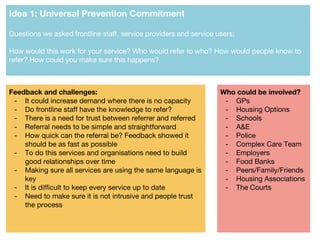
Feedback and challenges:
- It could increase demand where there is no capacity
- Do frontline staff have the knowledge to refer?
- There is a need for trust between referrer and referred
- Referral needs to be simple and straightforward
- How quick can the referral be? Feedback showed it
should be as fast as possible
- To do this services and organisations need to build
good relationships over time
- Making sure all services are using the same language is
key
- It is difficult to keep every service up to date
- Need to make sure it is not intrusive and people trust
the process
Who could be involved?
- GPs
- Housing Options
- Schools
- A&E
- Police
- Complex Care Team
- Employers
- Food Banks
- Peers/Family/Friends
- Housing Associations
- The Courts
Idea 2: Awareness Campaign
A comms campaign to raise awareness of the key risk factors/triggers for future homelessness
and the duty on all services to prevent.
27
Idea 2: Awareness Campaign:
Universal Prevention Commitment
Questions we asked frontline staff, service providers and service users:
What is the best way to do this? How do you currently find out about current
campaigns/changes to the way you work?
Feedback and challenges:
- Will this help change the culture around prevention?
- Is training more important than awareness or is it both?
- This could also happen in schools, focused on raising awareness early on
- The campaign shouldn’t just focus on frontline staff but the public
Idea 3: Wellness Check
Schools and other services run wellbeing check-ups to identify at-risk individuals which can
trigger notifications to the Local Authority.
Schools GPs
Social
Care
Housing
Support
Job
Centre
29
Idea 3: Wellness Check
Questions we asked frontline staff, service providers and service users:
What should we ask? Do you have any examples? Who should deliver this check-up?
Where could this check-up take place?
Feedback and challenges:
- There are lots of different ways to understand mental
wellbeing, how do we know which one is best?
- A conversational approach is preferred by users, but
some frontline staff prefer a form/tick box checklist
- Forms can put people off
- Need to get consent from the individual, explaining the
aims of the Wellness Check
- Linked in with the prevention commitment
- Who would deliver this?
Possible Improvements:
- Could include the
person’s financial
situation
- Mental health has to
be a part of this
- Information on
relationships
- Physical health
“How can data help identify
at-risk individuals?”
Data-driven identification of at-risk individuals
31
Idea 4: Prototype Single Trigger (Truancy Test)
A predictive model uses local and national datasets to identify individuals with the key risk
factors associated with future homelessness.
32
Idea 4: Single Trigger Data Identification
Questions we asked frontline staff, service providers and service users:
How could this be coordinated across organisations? Is it too simplistic to use one
indicator? Who would raise the alarm and what would they do?
Feedback and challenges:
- There are concerns over privacy and invasiveness
- Users believed this should be used in schools, as early
as possible
- Pride may get in the way of someone engaging with the
trigger
- There are worries it might not be discreet
- This could act as a feedback loop for funding if there are
clear services or issues leading to homelessness in a
specific area
- Is a single trigger by itself too simple an identifier leading
to unnecessary engagement? I.e. the trigger needs to be
sense checked
Possible Triggers
- JCP information
- NHS missed
appointments
- Not turning up to
work
- Housing benefit
- Transfer to Universal
Credit
- Parents kicking
children out of their
homes
- Council Tax Arrears
Idea 5: At-risk Identification System
This deliberately identifies a wider net to catch those not currently deemed as vulnerable but have low resilience,
who can be funnelled out through a face-to-face triage or future data analysis (if data collected).
34
Idea 5: At-risk Identification System
Questions we asked frontline staff, service providers and service users:
How feasible is it that services would share data? How could we get hold of the right
data? Who could be responsible for updating data?
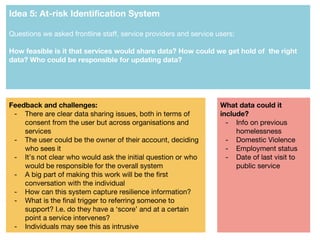
Feedback and challenges:
- There are clear data sharing issues, both in terms of
consent from the user but across organisations and
services
- The user could be the owner of their account, deciding
who sees it
- It’s not clear who would ask the initial question or who
would be responsible for the overall system
- A big part of making this work will be the first
conversation with the individual
- How can this system capture resilience information?
- What is the final trigger to referring someone to
support? I.e. do they have a ‘score’ and at a certain
point a service intervenes?
- Individuals may see this as intrusive
What data could it
include?
- Info on previous
homelessness
- Domestic Violence
- Employment status
- Date of last visit to
public service
HOMELESSNESS PREVENTION SERVICE PROTOTYPES
“Where do I turn if i’m about
to become homeless?”
HOMELESSNESS PREVENTION SERVICE PROTOTYPES
Self-reporting of homelessness risk
36
Idea 6: Preventing Homelessness Helpline
Individuals can self-report as being at risk of homelessness via a helpline.
37
Idea 6: Preventing Homelessness Helpline
Questions we asked frontline staff, service providers and service users:
Who could run this line? SHould it be national or local? What examples are there
already? Who could fund the line? What support could they give on the line? Who would
they refer people to?
Feedback and challenges:
- How do you differentiate this from other lines?
- It is important to make sure it has capacity so that no one waits too long to get through
to an advisor
- It’s not clear what skills the advisor would need, whether they would just signpost or
actually advise
- This may be difficult for people experiencing abuse to use
- What is the outcome of the call meant to be?
- The advisor will need to have knowledge of local support services and even experience
themselves
- Not everyone would see themselves at risk of homelessness even though they are.
Different wording could help, such as “managing your housing” or “keeping a roof over
your head”
- How will people know they are in a situation where they feel they need to ring the
prevention helpline?
Idea 7: Street Link “I’m at risk” button
Individuals can self-report as being at risk of homelessness via a website.
“If you are going to lose your home, please press this button.”
39
Idea 7: I’m At Risk Button
Questions we asked frontline staff, service providers and service users:
Who could run this line? Should the advice be national or local? What examples are
there already? Who could resource the button?
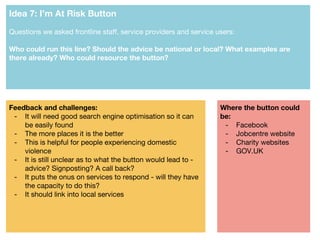
Feedback and challenges:
- It will need good search engine optimisation so it can
be easily found
- The more places it is the better
- This is helpful for people experiencing domestic
violence
- It is still unclear as to what the button would lead to -
advice? Signposting? A call back?
- It puts the onus on services to respond - will they have
the capacity to do this?
- It should link into local services
Where the button could
be:
- Facebook
- Jobcentre website
- Charity websites
- GOV.UK
Idea 8: Self Reporting (Info. Card)
Individuals can self-report as being at risk of homelessness via info. cards.
41
Idea 8: Self Reporting Information Card
Questions we asked frontline staff, service providers and service users:
Who would be responsible for the information on the cards? What information should
be on the cards? Should they be nationally or locally focused?
Feedback and challenges:
- Should be available across the local area in Jobcentres, GP surgeries, A&E etc.
- All those involved in a prevention commitment could hand out the self-reporting cards
- It could include the numbers of local as well as national services
“How can we build
resilience so people can
cope with tough life
events?”
Resilience programme
43
Idea 9: Universal Resilience Programmes
Schools run a universal resilience programme that has an educational workbook to promote positive
coping strategies and improve the life skills of all pupils.
44
Idea 9: Universal Resilience Programme
Questions we asked frontline staff, service providers and service users:
Would this need to be outcome focused? Who could commission this? Should there be
one model of programme or should local areas be able to define their own versions?
Feedback and challenges:
- It needs to be accessible to all potential users in terms of
language and jargon
- For some people, it may be too early to start considering
activities around resilience when they just need to keep a
roof over their head
- It could include information and activities on risky
behaviours as found in the research
- There are lots of examples of this already out there, what
can we learn from them?
- Some frontline staff explained that it can sometimes be
difficult to engage adults on this type of programme
- At what stage will someone be asked to engage with the
programme?
What it could include:
- Information on
co-parenting skills
- Confidence
- Budget Planners and
Financial help
“How do frontline staff start
to support people at risk of
becoming homeless and
build on their strengths?”
Personal Wellbeing and Housing Plan
46
Idea 10: Strengths Based Assessment
“Whole person”, strengths-based assessment which looks at an individual situations,
their personal risk and protective factors and resources.
47
Idea 10: Strengths Based Assessment
Questions we asked frontline staff, service providers and service users:
Is this something you currently do but under another name? When could this
assessment happen? Who would deliver this assessment?
Feedback and challenges:
- There are already versions of this assessment out there, how do they work?
- It needs to be realistic, not just talking about ideal goals, but goals that someone can
manage in the not too distance future
- It should include questions on confidence and qualifications
- The person delivering the assessment has to know what they are doing otherwise it
won’t work
- While an individual’s strengths are important, the service provider will still need to
address key priorities in the individual’s life
Idea 11: Asset Development: Service Menu, Timeline, Personal Wellbeing &
Housing Plan
The user is triaged to the appropriate pathway i.e. housing support only, or wider wraparound support. They have a personal
information pack that includes a tailored service Menu, a timeline and a personal wellbeing & housing plan.
Provided by Mind, this
drop-in service can help
provide light-touch support
for your mental health.
Wellbeing service Peer Mentor
Newcastle Resilience
Course
Digital careers
service Key worker
This online portal allows
you to access to job
searches, CV builders and
employment advice.
We help you to access a
Peer Mentor who has been
in this position before.
We organise for you to
meet a key worker who will
help you navigate the
different services available
to you.
A 2-week course aimed at
giving you strategies and
support to cope with
difficult situations.
49
Idea 11: Asset Development: Service Menu, Timeline, Personal Wellbeing &
Housing Plan
The user is triaged to the appropriate pathway i.e. housing support only, or wider wraparound support. They have a personal
information pack that includes a tailored service Menu, a timeline and a personal wellbeing & housing plan.
● Your strengths based assessment
will take place
● The Housing Options team will help
you choose what services are right
for you and design your Personal
Wellbeing and Housing Plan
● You will attend your first drop-in
centre at Mind
● You will meet with the Housing
Options Support Worker to
discuss your Personal Wellbeing
and Housing Plan
● You will start using the Digital
Careers Service
● You will start your 2 week resilience
course
● You will meet your Peer Mentor
● Your Housing Options team will call
you to see how everything is going
Month 1
Month 2
Month 3
50
Idea 11: Asset Development: Service Menu, Timeline, Personal Wellbeing &
Housing Plan
The user is triaged to the appropriate pathway i.e. housing support only, or wider wraparound support. They have a personal
information pack that includes a tailored service Menu, a timeline and a personal wellbeing & housing plan.
Your wellbeing:
1. What steps are you going to take to improve and
maintain your wellbeing?
Housing:
2. When will you do these by?
3. What steps do you want [service provider] to take
to improve and maintain your wellbeing?
4. When will they do them by?
1. What is your current housing situation?
2. What steps do we collectively need to take to
either maintain this situation or improve it?
3. When do these steps need to be taken by?
51
Idea 11: Asset Development: Service Menu, Timeline, Personal
Wellbeing and Housing Plan
Questions we asked frontline staff, service providers and service users:
Could this work across services, or would one service need to be the focal point? In
terms of choice, what could this look like? E.g. would it be to services within one
provider or across the local area? Would this cause complications?
Feedback and challenges:
- Options and choice are good for the individual but this has to be in relation to what is
feasibly possible in the local area
- For some, it isn’t the menu but the services that are broken
- Can it be flexible enough for all clients?
- The solutions and options will more than likely need to be local - are they available?
- The plan should include realistic goals on wellbeing, training, volunteering etc.
- What would happen if either side don’t fulfil the commitments of the plan?
- Empowering users is good
- Individuals have different needs meaning this may be difficult to deliver to a large
amount of people
- It needs to be tailored to the locality
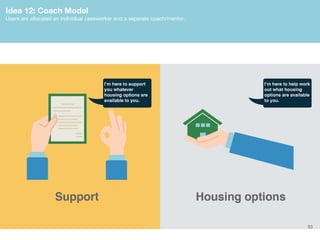
Idea 12: Coach Model
Users are allocated an individual caseworker and a separate coach/mentor.
53
Idea 12: Coach Model
Questions we asked frontline staff, service providers and service users:
Is our understanding right that it causes difficulty? Would it work? How could the two
coaches work together or would you want them to work separately?
Feedback and challenges:
- For some it was important that the advocate coach has lived experience
- What structures would be put in place to keep the two coaches separate/independent of
each other?
- Regular reviews between both coaches and the individual will help smooth any issues
- The coaches would need to be well trained
- Difficulties may arise when the coaches do not agree on the next action to take
Idea 13: DCLG Homelessness Toolkit and Typologies
A toolkit that helps service providers better identify and support potential users through typologies and insights on resilience.
55
Idea 13: DCLG Homelessness Toolkit and Typologies
A toolkit that helps service providers better identify and support potential users through typologies and insights on resilience.
56
DCLG Homelessness Toolkit and Typologies
Questions we asked frontline staff, service providers and service users:
DCLG could provide this centrally, or it could be a local toolkit or a mix of both, what
would work best? What information could this toolkit include that would help?
Feedback on the typologies:
- How the typologies are pitched will be key e.g. making
sure people are aware they are just guidelines
- Clients may want to understand why they have been
referred into a service and ask about the typologies
- How would the frontline staff member gain all the
information needed for the toolkit? Would there need to
be an assessment?
- Signposting would need to take into account not just
local services but local politics (i.e. what the focus of the
local politicians and commissioning structures is)
- It could be a tool for users to help identify themselves
Using the typologies:
- They could be an aide
memoire
- For retrospective
evaluation
- Training
- User-facing - users
use the typologies to
help understand if
they are at-risk of
homelessness
Annex:
Prototype testing
insights
58
Overall Prototype Insights
- Participants were keen to group or join prototypes rather than envisage
them as single entities
- For example, the Universal Prevention Commitment was often linked with
data identification prototypes and the asset development prototypes was
linked with the coach model and strengths based assessment
Potential Next Steps:
- User and service providers could see how different ideas fit together and
become part of an improved wider service
Prototypes
aren’t seen as
single entities
- Different areas have different resources and capacity
- Different areas have different systems already in place, some which facilitate
the prototypes and others that make some prototypes hard to implement
e.g. Southwark Council already host a Homelessness Forum which gives
links into local services for a Universal Prevention Commitment
Potential Next Steps:
- To work with a few local areas (the trailblazers) to ‘hack’ the service
blueprint, picking out elements that they could design into their services,
and trial this.
Location
specific
prototypes
were
favourable,
flexible to
current local
structures and
needs
59
Prototype Insights
- Almost all participants want interventions to happen as soon as possible.
However, it is not completely clear how if someone is not yet know to
services will be targeted e.g. if they aren’t linked in with services it is hard to
gain the right data about the individual to intervene
- Intervention at schools was welcome, as was intervention at transitional
periods in someone’s life
- Culture will be a big part of early intervention across different services, for
example making Jobcentre Plus work coaches think about someone’s
housing rather than just employment
Potential Next Steps:
- Ensure prototype testing focuses on finding those hardest to reach, the
people services don’t know about
Intervention at
the earliest
point is
wanted but is
difficult
- Support delivered by peers was promoted by both service users and
frontline staff, especially in relation to coaches and asset development
- We have previously focused on services and frontline staff delivering the
prototypes, but haven’t thought about the role of family and friends e.g. how
could they support the Universal Prevention Commitment?
Potential Next Steps:
- Explore where peer support can be woven into prototypes/where the key
opportunities are to do this
- Consider how we could engage family and friends within the prototypes
The role of
peers could be
explored
further
60
Prototype Insights
- At nearly all workshops issues around lack of housing, the benefits system
and private landlords were raised
- Whilst not within the scope of the project, prototypes need to take impacts
of these issues into account in order for them to work as effectively as
possible
- What happens to those deemed “intentionally homeless”?
Potential Next Steps:
- Better understand the implications of being declared “intentionally
homeless” and the support someone receives following this
- Build a systems map of prototypes to understand where they fit within the
system to reduce impact of wider issues that are currently out of scope
There are
bigger issues,
outside the
scope of this
project that
may have an
impact
- Many of the prototypes, or the concepts behind the prototypes, have
already been tried across the country just in different formats. Ultimately to
make them a success there needs to be the right culture in the delivering
system.
- We need to shift attitudes and approaches of all those involved in delivery of
support.
Potential Next Steps:
- Think about how we can better under systems change in order to change
culture of support
- Develop a broad communications strategy on the aim of the project
promoting a shift in approach
Creating the
right culture
for change is
key
61
Prototype Insights
- It became clear that for prototypes to be a success, those delivering it will
need to have the right skills and knowledge as well as cultural approach
- There may also need to be a development of workforce in numbers
- Leadership and having the right people onboard is key
- Peer support or support being delivered by people with experience of being
in the same situation was promoted at various workshops
Potential Next Steps:
- To think about how staff can be supported to deliver scaled up prototypes
- Build a prototype ‘job spec’ for those delivering scaled up prototypes
We need a
workforce with
the right skill
and training
- Reciprocity was favoured - especially within the housing and wellbeing plan
- Some prototypes focus heavily on the actions of frontline staff, however this
could be potentially flipped with the at-risk data identification and the use of
typologies, placing the responsibility and agency with the service user
- Participants were keen that prototypes don’t perpetuate dependency with
too much hand holding. Giving people choice and agency in support can
help with this.
Potential Next Steps:
- Consider where prototypes offer empowerment and agency to users and
develop this
- Consider where prototypes don’t have empowerment and agency and how
this could be flipped so that they do
Prototypes
need to
empower not
make people
dependent
62
Prototype Insights
- Language used for the prototypes is very important. Many may not feel
interventions refer to them because they see homelessness as rough
sleeping. Instead we could use language such as ‘keeping a rough over your
head’
- The meaning of the work resilience is unclear and can often have negative
connotations to it i.e. not having resilience is a personal deficit
Potential Next Steps:
- Undertake a textual analysis on how different services describe
homelessness across the prevention system
- Analysis of how the public define homelessness and the wording that best
reflects their housing situation
Homelessness
means
different things
to different
people
63

Homelessness Prevention Project and Prototypes

  • 1.
  • 2.
    Contents 2 Project Aim 3 ProjectPlan 4 Research Insights 5 - 11 Developing the Ideas 12 - 19 Prototype Feedback 20 Annex: Project Methodology 21 - 22 Prototypes 23 - 57 Prototype Testing Insight 58 - 63
  • 3.
    Project Aim Homelessness isincreasing in the UK. Statutory homelessness is up 44% since 2010 and rough sleeping has doubled. To help address this the Prime Minister has launched a Homelessness Prevention Programme, kick starting with £40m funding for areas to take innovative approaches to preventing and tackling homelessness. Policy Lab has been working with DCLG, local areas and charities to create fresh insights and ideas that local areas can use. While we understand more about the structural issues which are driving homelessness we know less about non-structural issues such as life events or personal behaviours. This project has helped us explore these non-structural factors (and how they interact with structural factors) and consider how we can use these insights to better prevent and relieve homelessness. The purpose of this pack is to share the methods, insights and ideas that have emerged from this project so that they are available to areas and as a route into discussing the themes. We do not expect areas to necessarily replicate these ideas to be successful in any of our funding competitions – in fact we are hoping to fund a range of projects. 3 To answer the question: How can we understand the personal (as opposed to structural) reasons why people become and remain homeless and co-design and test solutions to prevent homelessness?
  • 4.
    Project Plan Diagnose &Discover Develop & Deliver Ethnography (spending time with people to understand their experiences and behaviours) Data science (using powerful computer techniques to match and analysis data) [Apr – Jun] Idea workshop To co-design solutions with stakeholders [June] Prototype + test solutions with four local areas [Jun - Sept] Opening up insight & ideas as part of trailblazer launch [November] Kick-off workshop with stakeholders to understand problem [February] 4
  • 5.
    Research Insights: EthnographyIns: As well as confirming known risk factors, the ethnography revealed some personal risk and protective factors that are important in preventing homelessness Personal risk factors ● Short-term coping strategies to make everyday life more bearable ● Relying on inappropriate support networks ● Limited literacy regarding systems ● Limited financial autonomy ● Pride and a loss of identity as a barrier to accessing support & services Personal protective factors ● Resourcefulness and shorter-term “tactics” ● Goal orientation or taking active steps to improve their situation ● Preserving identity, a sense of self and “home” ● Positive mindset – taking positives out of an adverse situation ● Positive support networks 5
  • 6.
    Evidence of systemsfailure and missed opportunities to prevent homelessness: ● Inadequate/non-existent support for those with known risk factors at an early life stage ● Inadequate Council/LA action to prevent homelessness, even with advance warning ● Inconsistent assessment of need when individuals present as homeless ● Accommodation and/or wider wraparound support provided to homeless individuals varies in quality and adequacy Evidence of positive positive experiences of Local Authority services with frontline workers doing their best with constrained resources and in the face of challenging external factors: ● They can be hugely knowledgeable, negotiating complex systems and learning new ways to “work” the system so they can help people in the most appropriate way(s). ● They consider the long term impact of decisions they make ● They recreated the role of a “traditional” support network e.g. in negotiating benefits, assisting with budgeting, and providing emotional support or mentoring. 6 Research Insights: Ethnography More could be done to prevent homelessness by identifying people at risk early, and by frontline workers taking a flexible and supportive approach
  • 7.
    Source: DCLG analysisof British Birth Cohort Survey 7 Research Insights: Data Science Predictive analysis is possible. There are 10 early years risk factors that makes some people 15 times more at risk that others, especially truanting and being in care
  • 8.
    The ‘high risk’group represent 20% of the birth cohort. Of this group 12.8% became homeless. They are 16 times more likely to be homeless than the ‘very low’ risk group Source: DCLG analysis of British Birth Cohort Survey 8 Research Insights: Data Science If you are in the top 20% of the country likely to have these risk factors, you are 16 times more likely to become homeless
  • 9.
    The white circlesshow that homeless people have high co-occurrence of mental health, physical health and offending issues. Newcastle LA linked together data from 140k individuals from multiple datasets: homelessness, housing benefits, looked after children & ASB. Source: ASI analysis of Newcastle LA linked datasets 9 Research Insights: Data Science Local areas can link data to give a richer picture of people who are homeless or at risk of it.
  • 10.
    Source: ASI analysisof Newcastle LA linked datasets 10 Research Insights: Data Science But the quality of the data can be poor, and cleaning and matching it takes a lot of time and resources Even for something relatively easy to collect like gender, the data is poor
  • 11.
    Research Insights: The keychallenges that were highlighted through the research 1. How can we identify at-risk people upstream and intervene well before they face a crisis and present as homeless? 2. How can we support a culture shift to homeless prevention and early intervention amongst those who deliver or commission services for those at risk of homelessness? 3. How can we ensure services address ‘challenging behaviour’, (including disengagement from services) firmly but supportively? 4. How can we empower people to help themselves, supporting them to be alert to impending risk and actively navigate the system? 5. How can service providers help homeless people positively cope in the short-term so they can focus on aspirations and long-term goals? 6. How can we help people maintain and/or grow their support networks before/during/after being homeless? (Work on the stage that is most important to you first). 7. How can policymakers and service providers take a creative and problem-solving approach with users that builds on their strengths and resources? 11
  • 12.
    Developing the Ideas 12 Researchshowed evidence of systems failure and missed opportunities to prevent homelessness. But there are 10 childhood risk factors that are high predictors of homelessness. Local authorities can link together data to create a rich picture about those at risk. People have resilience and support networks that helps them cope with and exit homelessness. Analysis of the British Birth Cohort Survey shows that the vast majority of people who self reported being homeless were only homeless once. People have a wide range of support needs, ranging from those that start in early childhood and develop as a result of those, to live events along the way. The best frontline staff were those who knew how to navigate the system, took a flexible and coaching approach. How can we support a cultural shift towards prevention? How can we identify people early? How can we empower people to help themselves? How can we take a take a creative and problem-solving approach with users that builds on their strengths? How can services providers help people cope in the short-term while focusing on long-term goals? A toolkit to help local areas to spot and support different types of people at risk of homelessness Commitment from other services to identify those at risk Data-driven predictive risk models A universal resilience programme in schools Self referral for those at risk “Housing and Wellbeing” Plan that: • starts with a strengths-based assessment • links users up with services to deal with underlying issues as well as providing housing support • motivates and coaches people to think about longer-term goals Linking up with OGDs, including PHE We took the insight… turned it into challenges… ...and generated ideas with local areas The generated ideas can be found in the Annex of this slide deck
  • 13.
    LONG-TERM PREVENTION NEAR-TERM PREVENTION CRISIS PREVENTION HOMELESS MOVINGON1 2 3 4 5 IDENTIFICATION OF AT-RISK INDIVIDUALS Developing the Ideas: The Homelessness Service Blueprint A range of local service providers identify those at risk - Achieved through a universal duty to prevent homelessness - A comms campaign raises awareness of the key risk factors/triggers for future homelessness and the duty on all services to prevent - Schools and other services run wellbeing check-ups to identify at-risk individuals which can trigger notifications to the Local Authority Self-reporting of homelessness risk Individuals can self-report as being at risk of homelessness e.g. via a National Prevention Helpline or website Data-driven identification of at-risk individuals - A predictive model uses local and national datasets to identify individuals with the key risk factors associated with future homelessness. - This deliberately identifies a wider net to catch those not currently deemed as vulnerable but have low resilience, which can be funnelled out through a face-to-face triage (below) or future data analysis (if data collected). Joining the service - “Whole person”, strengths-based assessment looks at individual situation, personal risk and protective factors and resources - User is triaged to the appropriate pathway i.e. housing support only, or wider wraparound support. They are allocated an individual caseworker and a separate coach/mentor - Trauma-informed plan - Using the service - The caseworker is responsible for leading on housing interventions - The coach/mentor is responsible for leading the provision/signposting of wider wraparound support. This can include: -- help to re-establish/grow positive support networks -- empowering people to make choices to access a menu of support services -- provision of basic tools/advice e.g.jam jar bank account, PO box for correspondence, £15 voucher for ‘home & identity’ ASSESSMENT AND PERSONALISED, STRENGTHS-BASED SUPPORT B CA Personal Wellbeing and Housing PlanResilience programme - Schools run a universal resilience programme to promote positive coping strategies and improve the life skills of all pupils. Continuing and leaving the service - The user, caseworker and coach/mentor design and agree a Personal Wellbeing and Housing Plan - The PWHP clearly sets out the key actions that the user needs to take and how long they can expect to spend in each stage e.g. if they are in temporary accommodation, how long they can expect to be there and what local services are available to support them - It also builds on the strengths-based conversation and develops long-term goals #1 #2 #3 #4 #7 #8 #9 #5 #6 #10 #11 #12 #13 We built a service blueprint for the ideas generated. The blueprint identifies where in the user-journey the ideas would support the individual. All ideas can be found in the Annex of this slide deck. 13
  • 14.
    Developing the Ideas Example:Self-referral helpline 14
  • 15.
    Developing the Ideas Example:Wellbeing and Housing Plan 15 Your wellbeing: 1. What steps are you going to take to improve and maintain your wellbeing? Housing: 2. When will you do these by? 3. What steps do you want [service provider] to take to improve and maintain your wellbeing? 4. When will they do them by? 1. What is your current housing situation? 2. What steps do we collectively need to take to either maintain this situation or improve it? 3. When do these steps need to be taken by?
  • 16.
    Developing the Ideas Example:Typologies 16 Using inspiration from the Design Council we created typologies to help frontline staff in identifying the person they are trying to support. We focused on trying to show how close someone was to becoming homeless alongside their current needs (based on the findings from our ethnographic research). The draft typologies can be found on the next page. We are currently considering how we can create typologies for people who have moved beyond crisis point and are now homeless.
  • 17.
    @PolicyLabUK Homelessness PreventionProgramme These people have had a traumatic experience in their past (for example childhood and/or sexual abuse, domestic violence, death of a parent) which is still not resolved and has meant that they have low resilience. These people may have had a traumatic experience in their past, and have dealt with it using coping strategies that have also been damaging. These are people that may have internal issues leading them to further risky behaviours which have a cumulative effect and are spiralling out of control. These people are generally young and display some of risk factors - for example truanting from school or being in care - that can lead to adopting coping strategies which are damaging (e.g. support networks who take drugs) or lack of resilience (e.g. lack of family support). These are people who have had a string of bad luck through events that are largely outside of their control from job loss, to personal illness or relationship breakdown. They have relatively poor resilience. These are people whose longer term risk factors such as truanting at school or being in care have left them without many of the coping skills necessary to deal with short-term life events or shocks (e.g. relationship breakdown), with one breaking the camel’s back and leading to a crisis. ? These are people who might have some ‘universal’ risk factors, for example living near poverty or having poor education or employment skills. However, they do have strong family support, positive aspirations and goals and are able to plan to avoid risky situations. These are people who are resource poor on many levels. On the one hand, they have little financial resources, no savings, few educational or employment skills leaving them at risk of getting into rent arrears. These are people who have some fairly minor underlying risky behaviour (either an unresolved personal trauma or bereavement, or drug or alcohol problem) but are living fairly normal lives until a fairly large surprise (e.g. a loss of job, breakdown of a relationship) sets of a series of events which quickly leads to crisis. ModerateNeedsLowLevelNeedsHighLevelNeeds At Risk Close to Homelessness Crisis Point Homeless Homelessness Prevention Typologies
  • 18.
    Developing the Ideas Example:Strengths based assessment 18
  • 19.
    We tested theprototypes in Newcastle, Southwark, Croydon, St Mungo’s London and Shelter in Birmingham. Testing involved service users, frontline staff and those responsible for strategy level decisions. All were presented with the different ideas and asked to explain what they liked, disliked and how they would improve them. 19 Developing the Ideas: Prototyping
  • 20.
    Prototype Feedback Users andservice providers could see how these individual ideas fitted into an improved service. They saw value in opening up their ‘statutory’ services to people who were not yet classified as vulnerable so they could intervene early. Identification by services or self-identification needs to reflect terms that people use, which might not be ‘homeless’. There was appetite to try out a strength-based assessment, and create plans which encompassed both housing and wider needs. These ideas need to be supported by a change of culture which empowers the frontline to be more empowered & flexible to user needs The typologies could work at three different levels, by users, frontline staff and strategic partners As we know, there are bigger structural issues outside the scope of the project which need to change For example, the Universal Prevention Commitment was often linked with data identification prototypes and the asset development prototypes was linked with the coach model and strengths based assessment Potential increased demand needs to be mitigated by greater self service. Identification by other service providers could build on current multi-disciplinary working. Data would need more support. Both require some assessment of resilience as well as risks. For example, it was suggested that rather than use ‘homelessness prevention’ for the helpline, we should look to use language such as “keeping a roof over your head” or “keeping your house”, something that everyone can relate to. Frontline staff were keen to focus on client’s priorities at each stage in their journey, which a housing and wellbeing plan could help to achieve, rather than just focus on housing. Participants too welcomed support for their mental wellbeing. There was also debate about whether to separate the housing officer vs advocate role. -Self-assessment by users to understand wider causes -Frontline staff assessment to triage/signpost to other services -Strategic tool for local area to plan responses. For participants the benefits system was an issue in resolving their housing, but for frontline staff lack of housing was key. 20
  • 21.
  • 22.
    Project methodology Ethnography Policy Labin-house ethnography team conducted video ethnographies with 14 people with different backgrounds and experiencing different situations. This explored: ● What factors tip the balance into homelessness? ● What is the perception versus the experience of homelessness services? ● Who are the human networks of these individuals and what role do they play? Sprint A 2-day Sprint with stakeholders to identify evidence gaps, develop research questions and correctly frame the question Insight sharing & Co-design Policy Lab facilitated a session to share the data science and ethnographic research and develop a set of evidence-based problem statements that were set as challenges to a co-design day involving users, policymakers and stakeholders which will generate a series of ideas. Prototyping J Paul Neeley and Fang-Jui Chang (service designers) turned some of the ideas into prototypes and these have been tested with local areas. Data science A data science component lead by ASI. This used both government and non-government data sources identified during the sprint to ask: ● What are the risk factors of becoming homeless and how can we predict these? ● What are the factors that make people able to avoid or exit homelessness compared to those who cannot? 22
  • 23.
  • 24.
    HOMELESSNESS PREVENTION SERVICEPROTOTYPES “How can frontline staff identify those at risk of homelessness?” A range of local service providers identify those at risk 24
  • 25.
    Idea 1: UniversalPrevention Commitment A responsibility on all local services to prevent homelessness. “Is there anyone you’d like to talk to about your housing situation? "Now we’ve sorted your healthcare, do you want to talk about your housing?” "I’ve noticed you’re struggling with your finances, is this going to affect your housing?” Schools GPs Social Care Housing Support Job Centre 25
  • 26.
    Idea 1: UniversalPrevention Commitment Questions we asked frontline staff, service providers and service users: How would this work for your service? Who would refer to who? How would people know to refer? How could you make sure this happens? Feedback and challenges: - It could increase demand where there is no capacity - Do frontline staff have the knowledge to refer? - There is a need for trust between referrer and referred - Referral needs to be simple and straightforward - How quick can the referral be? Feedback showed it should be as fast as possible - To do this services and organisations need to build good relationships over time - Making sure all services are using the same language is key - It is difficult to keep every service up to date - Need to make sure it is not intrusive and people trust the process Who could be involved? - GPs - Housing Options - Schools - A&E - Police - Complex Care Team - Employers - Food Banks - Peers/Family/Friends - Housing Associations - The Courts
  • 27.
    Idea 2: AwarenessCampaign A comms campaign to raise awareness of the key risk factors/triggers for future homelessness and the duty on all services to prevent. 27
  • 28.
    Idea 2: AwarenessCampaign: Universal Prevention Commitment Questions we asked frontline staff, service providers and service users: What is the best way to do this? How do you currently find out about current campaigns/changes to the way you work? Feedback and challenges: - Will this help change the culture around prevention? - Is training more important than awareness or is it both? - This could also happen in schools, focused on raising awareness early on - The campaign shouldn’t just focus on frontline staff but the public
  • 29.
    Idea 3: WellnessCheck Schools and other services run wellbeing check-ups to identify at-risk individuals which can trigger notifications to the Local Authority. Schools GPs Social Care Housing Support Job Centre 29
  • 30.
    Idea 3: WellnessCheck Questions we asked frontline staff, service providers and service users: What should we ask? Do you have any examples? Who should deliver this check-up? Where could this check-up take place? Feedback and challenges: - There are lots of different ways to understand mental wellbeing, how do we know which one is best? - A conversational approach is preferred by users, but some frontline staff prefer a form/tick box checklist - Forms can put people off - Need to get consent from the individual, explaining the aims of the Wellness Check - Linked in with the prevention commitment - Who would deliver this? Possible Improvements: - Could include the person’s financial situation - Mental health has to be a part of this - Information on relationships - Physical health
  • 31.
    “How can datahelp identify at-risk individuals?” Data-driven identification of at-risk individuals 31
  • 32.
    Idea 4: PrototypeSingle Trigger (Truancy Test) A predictive model uses local and national datasets to identify individuals with the key risk factors associated with future homelessness. 32
  • 33.
    Idea 4: SingleTrigger Data Identification Questions we asked frontline staff, service providers and service users: How could this be coordinated across organisations? Is it too simplistic to use one indicator? Who would raise the alarm and what would they do? Feedback and challenges: - There are concerns over privacy and invasiveness - Users believed this should be used in schools, as early as possible - Pride may get in the way of someone engaging with the trigger - There are worries it might not be discreet - This could act as a feedback loop for funding if there are clear services or issues leading to homelessness in a specific area - Is a single trigger by itself too simple an identifier leading to unnecessary engagement? I.e. the trigger needs to be sense checked Possible Triggers - JCP information - NHS missed appointments - Not turning up to work - Housing benefit - Transfer to Universal Credit - Parents kicking children out of their homes - Council Tax Arrears
  • 34.
    Idea 5: At-riskIdentification System This deliberately identifies a wider net to catch those not currently deemed as vulnerable but have low resilience, who can be funnelled out through a face-to-face triage or future data analysis (if data collected). 34
  • 35.
    Idea 5: At-riskIdentification System Questions we asked frontline staff, service providers and service users: How feasible is it that services would share data? How could we get hold of the right data? Who could be responsible for updating data? Feedback and challenges: - There are clear data sharing issues, both in terms of consent from the user but across organisations and services - The user could be the owner of their account, deciding who sees it - It’s not clear who would ask the initial question or who would be responsible for the overall system - A big part of making this work will be the first conversation with the individual - How can this system capture resilience information? - What is the final trigger to referring someone to support? I.e. do they have a ‘score’ and at a certain point a service intervenes? - Individuals may see this as intrusive What data could it include? - Info on previous homelessness - Domestic Violence - Employment status - Date of last visit to public service
  • 36.
    HOMELESSNESS PREVENTION SERVICEPROTOTYPES “Where do I turn if i’m about to become homeless?” HOMELESSNESS PREVENTION SERVICE PROTOTYPES Self-reporting of homelessness risk 36
  • 37.
    Idea 6: PreventingHomelessness Helpline Individuals can self-report as being at risk of homelessness via a helpline. 37
  • 38.
    Idea 6: PreventingHomelessness Helpline Questions we asked frontline staff, service providers and service users: Who could run this line? SHould it be national or local? What examples are there already? Who could fund the line? What support could they give on the line? Who would they refer people to? Feedback and challenges: - How do you differentiate this from other lines? - It is important to make sure it has capacity so that no one waits too long to get through to an advisor - It’s not clear what skills the advisor would need, whether they would just signpost or actually advise - This may be difficult for people experiencing abuse to use - What is the outcome of the call meant to be? - The advisor will need to have knowledge of local support services and even experience themselves - Not everyone would see themselves at risk of homelessness even though they are. Different wording could help, such as “managing your housing” or “keeping a roof over your head” - How will people know they are in a situation where they feel they need to ring the prevention helpline?
  • 39.
    Idea 7: StreetLink “I’m at risk” button Individuals can self-report as being at risk of homelessness via a website. “If you are going to lose your home, please press this button.” 39
  • 40.
    Idea 7: I’mAt Risk Button Questions we asked frontline staff, service providers and service users: Who could run this line? Should the advice be national or local? What examples are there already? Who could resource the button? Feedback and challenges: - It will need good search engine optimisation so it can be easily found - The more places it is the better - This is helpful for people experiencing domestic violence - It is still unclear as to what the button would lead to - advice? Signposting? A call back? - It puts the onus on services to respond - will they have the capacity to do this? - It should link into local services Where the button could be: - Facebook - Jobcentre website - Charity websites - GOV.UK
  • 41.
    Idea 8: SelfReporting (Info. Card) Individuals can self-report as being at risk of homelessness via info. cards. 41
  • 42.
    Idea 8: SelfReporting Information Card Questions we asked frontline staff, service providers and service users: Who would be responsible for the information on the cards? What information should be on the cards? Should they be nationally or locally focused? Feedback and challenges: - Should be available across the local area in Jobcentres, GP surgeries, A&E etc. - All those involved in a prevention commitment could hand out the self-reporting cards - It could include the numbers of local as well as national services
  • 43.
    “How can webuild resilience so people can cope with tough life events?” Resilience programme 43
  • 44.
    Idea 9: UniversalResilience Programmes Schools run a universal resilience programme that has an educational workbook to promote positive coping strategies and improve the life skills of all pupils. 44
  • 45.
    Idea 9: UniversalResilience Programme Questions we asked frontline staff, service providers and service users: Would this need to be outcome focused? Who could commission this? Should there be one model of programme or should local areas be able to define their own versions? Feedback and challenges: - It needs to be accessible to all potential users in terms of language and jargon - For some people, it may be too early to start considering activities around resilience when they just need to keep a roof over their head - It could include information and activities on risky behaviours as found in the research - There are lots of examples of this already out there, what can we learn from them? - Some frontline staff explained that it can sometimes be difficult to engage adults on this type of programme - At what stage will someone be asked to engage with the programme? What it could include: - Information on co-parenting skills - Confidence - Budget Planners and Financial help
  • 46.
    “How do frontlinestaff start to support people at risk of becoming homeless and build on their strengths?” Personal Wellbeing and Housing Plan 46
  • 47.
    Idea 10: StrengthsBased Assessment “Whole person”, strengths-based assessment which looks at an individual situations, their personal risk and protective factors and resources. 47
  • 48.
    Idea 10: StrengthsBased Assessment Questions we asked frontline staff, service providers and service users: Is this something you currently do but under another name? When could this assessment happen? Who would deliver this assessment? Feedback and challenges: - There are already versions of this assessment out there, how do they work? - It needs to be realistic, not just talking about ideal goals, but goals that someone can manage in the not too distance future - It should include questions on confidence and qualifications - The person delivering the assessment has to know what they are doing otherwise it won’t work - While an individual’s strengths are important, the service provider will still need to address key priorities in the individual’s life
  • 49.
    Idea 11: AssetDevelopment: Service Menu, Timeline, Personal Wellbeing & Housing Plan The user is triaged to the appropriate pathway i.e. housing support only, or wider wraparound support. They have a personal information pack that includes a tailored service Menu, a timeline and a personal wellbeing & housing plan. Provided by Mind, this drop-in service can help provide light-touch support for your mental health. Wellbeing service Peer Mentor Newcastle Resilience Course Digital careers service Key worker This online portal allows you to access to job searches, CV builders and employment advice. We help you to access a Peer Mentor who has been in this position before. We organise for you to meet a key worker who will help you navigate the different services available to you. A 2-week course aimed at giving you strategies and support to cope with difficult situations. 49
  • 50.
    Idea 11: AssetDevelopment: Service Menu, Timeline, Personal Wellbeing & Housing Plan The user is triaged to the appropriate pathway i.e. housing support only, or wider wraparound support. They have a personal information pack that includes a tailored service Menu, a timeline and a personal wellbeing & housing plan. ● Your strengths based assessment will take place ● The Housing Options team will help you choose what services are right for you and design your Personal Wellbeing and Housing Plan ● You will attend your first drop-in centre at Mind ● You will meet with the Housing Options Support Worker to discuss your Personal Wellbeing and Housing Plan ● You will start using the Digital Careers Service ● You will start your 2 week resilience course ● You will meet your Peer Mentor ● Your Housing Options team will call you to see how everything is going Month 1 Month 2 Month 3 50
  • 51.
    Idea 11: AssetDevelopment: Service Menu, Timeline, Personal Wellbeing & Housing Plan The user is triaged to the appropriate pathway i.e. housing support only, or wider wraparound support. They have a personal information pack that includes a tailored service Menu, a timeline and a personal wellbeing & housing plan. Your wellbeing: 1. What steps are you going to take to improve and maintain your wellbeing? Housing: 2. When will you do these by? 3. What steps do you want [service provider] to take to improve and maintain your wellbeing? 4. When will they do them by? 1. What is your current housing situation? 2. What steps do we collectively need to take to either maintain this situation or improve it? 3. When do these steps need to be taken by? 51
  • 52.
    Idea 11: AssetDevelopment: Service Menu, Timeline, Personal Wellbeing and Housing Plan Questions we asked frontline staff, service providers and service users: Could this work across services, or would one service need to be the focal point? In terms of choice, what could this look like? E.g. would it be to services within one provider or across the local area? Would this cause complications? Feedback and challenges: - Options and choice are good for the individual but this has to be in relation to what is feasibly possible in the local area - For some, it isn’t the menu but the services that are broken - Can it be flexible enough for all clients? - The solutions and options will more than likely need to be local - are they available? - The plan should include realistic goals on wellbeing, training, volunteering etc. - What would happen if either side don’t fulfil the commitments of the plan? - Empowering users is good - Individuals have different needs meaning this may be difficult to deliver to a large amount of people - It needs to be tailored to the locality
  • 53.
    Idea 12: CoachModel Users are allocated an individual caseworker and a separate coach/mentor. 53
  • 54.
    Idea 12: CoachModel Questions we asked frontline staff, service providers and service users: Is our understanding right that it causes difficulty? Would it work? How could the two coaches work together or would you want them to work separately? Feedback and challenges: - For some it was important that the advocate coach has lived experience - What structures would be put in place to keep the two coaches separate/independent of each other? - Regular reviews between both coaches and the individual will help smooth any issues - The coaches would need to be well trained - Difficulties may arise when the coaches do not agree on the next action to take
  • 55.
    Idea 13: DCLGHomelessness Toolkit and Typologies A toolkit that helps service providers better identify and support potential users through typologies and insights on resilience. 55
  • 56.
    Idea 13: DCLGHomelessness Toolkit and Typologies A toolkit that helps service providers better identify and support potential users through typologies and insights on resilience. 56
  • 57.
    DCLG Homelessness Toolkitand Typologies Questions we asked frontline staff, service providers and service users: DCLG could provide this centrally, or it could be a local toolkit or a mix of both, what would work best? What information could this toolkit include that would help? Feedback on the typologies: - How the typologies are pitched will be key e.g. making sure people are aware they are just guidelines - Clients may want to understand why they have been referred into a service and ask about the typologies - How would the frontline staff member gain all the information needed for the toolkit? Would there need to be an assessment? - Signposting would need to take into account not just local services but local politics (i.e. what the focus of the local politicians and commissioning structures is) - It could be a tool for users to help identify themselves Using the typologies: - They could be an aide memoire - For retrospective evaluation - Training - User-facing - users use the typologies to help understand if they are at-risk of homelessness
  • 58.
  • 59.
    Overall Prototype Insights -Participants were keen to group or join prototypes rather than envisage them as single entities - For example, the Universal Prevention Commitment was often linked with data identification prototypes and the asset development prototypes was linked with the coach model and strengths based assessment Potential Next Steps: - User and service providers could see how different ideas fit together and become part of an improved wider service Prototypes aren’t seen as single entities - Different areas have different resources and capacity - Different areas have different systems already in place, some which facilitate the prototypes and others that make some prototypes hard to implement e.g. Southwark Council already host a Homelessness Forum which gives links into local services for a Universal Prevention Commitment Potential Next Steps: - To work with a few local areas (the trailblazers) to ‘hack’ the service blueprint, picking out elements that they could design into their services, and trial this. Location specific prototypes were favourable, flexible to current local structures and needs 59
  • 60.
    Prototype Insights - Almostall participants want interventions to happen as soon as possible. However, it is not completely clear how if someone is not yet know to services will be targeted e.g. if they aren’t linked in with services it is hard to gain the right data about the individual to intervene - Intervention at schools was welcome, as was intervention at transitional periods in someone’s life - Culture will be a big part of early intervention across different services, for example making Jobcentre Plus work coaches think about someone’s housing rather than just employment Potential Next Steps: - Ensure prototype testing focuses on finding those hardest to reach, the people services don’t know about Intervention at the earliest point is wanted but is difficult - Support delivered by peers was promoted by both service users and frontline staff, especially in relation to coaches and asset development - We have previously focused on services and frontline staff delivering the prototypes, but haven’t thought about the role of family and friends e.g. how could they support the Universal Prevention Commitment? Potential Next Steps: - Explore where peer support can be woven into prototypes/where the key opportunities are to do this - Consider how we could engage family and friends within the prototypes The role of peers could be explored further 60
  • 61.
    Prototype Insights - Atnearly all workshops issues around lack of housing, the benefits system and private landlords were raised - Whilst not within the scope of the project, prototypes need to take impacts of these issues into account in order for them to work as effectively as possible - What happens to those deemed “intentionally homeless”? Potential Next Steps: - Better understand the implications of being declared “intentionally homeless” and the support someone receives following this - Build a systems map of prototypes to understand where they fit within the system to reduce impact of wider issues that are currently out of scope There are bigger issues, outside the scope of this project that may have an impact - Many of the prototypes, or the concepts behind the prototypes, have already been tried across the country just in different formats. Ultimately to make them a success there needs to be the right culture in the delivering system. - We need to shift attitudes and approaches of all those involved in delivery of support. Potential Next Steps: - Think about how we can better under systems change in order to change culture of support - Develop a broad communications strategy on the aim of the project promoting a shift in approach Creating the right culture for change is key 61
  • 62.
    Prototype Insights - Itbecame clear that for prototypes to be a success, those delivering it will need to have the right skills and knowledge as well as cultural approach - There may also need to be a development of workforce in numbers - Leadership and having the right people onboard is key - Peer support or support being delivered by people with experience of being in the same situation was promoted at various workshops Potential Next Steps: - To think about how staff can be supported to deliver scaled up prototypes - Build a prototype ‘job spec’ for those delivering scaled up prototypes We need a workforce with the right skill and training - Reciprocity was favoured - especially within the housing and wellbeing plan - Some prototypes focus heavily on the actions of frontline staff, however this could be potentially flipped with the at-risk data identification and the use of typologies, placing the responsibility and agency with the service user - Participants were keen that prototypes don’t perpetuate dependency with too much hand holding. Giving people choice and agency in support can help with this. Potential Next Steps: - Consider where prototypes offer empowerment and agency to users and develop this - Consider where prototypes don’t have empowerment and agency and how this could be flipped so that they do Prototypes need to empower not make people dependent 62
  • 63.
    Prototype Insights - Languageused for the prototypes is very important. Many may not feel interventions refer to them because they see homelessness as rough sleeping. Instead we could use language such as ‘keeping a rough over your head’ - The meaning of the work resilience is unclear and can often have negative connotations to it i.e. not having resilience is a personal deficit Potential Next Steps: - Undertake a textual analysis on how different services describe homelessness across the prevention system - Analysis of how the public define homelessness and the wording that best reflects their housing situation Homelessness means different things to different people 63