Constituency
MP
THE
CITIZEN
House of
Commons
House of Lords
THE CROWN
Elects MPs
when the Crown,
requested by PM,
dissolves old
Parliament
START
HERE
THE PRIME
MINISTER
Mapping the policy making process
We welcome feedback on the prototype!
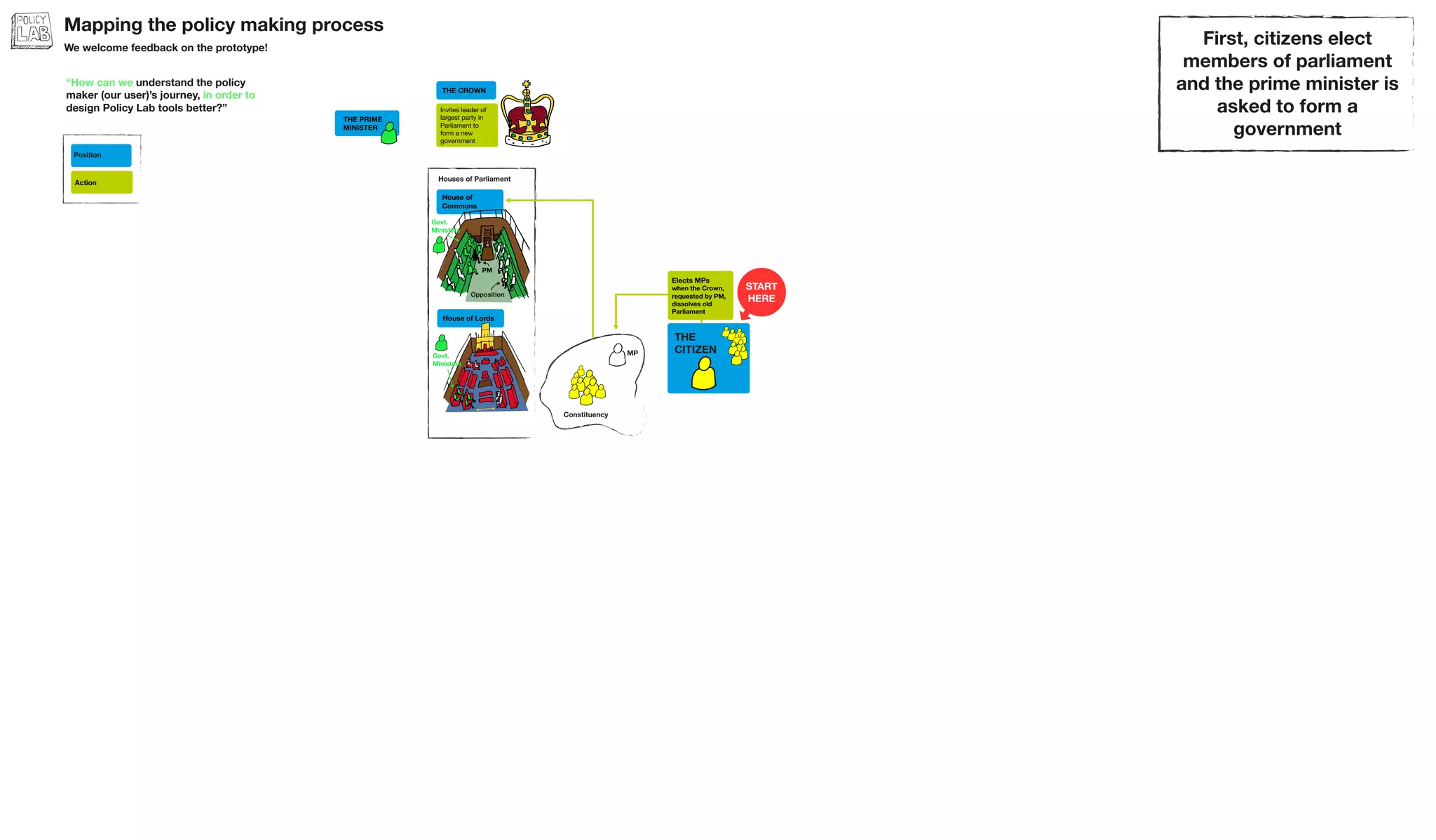
First, citizens elect
members of parliament
and the prime minister is
asked to form a
government
“How can we understand the policy
maker (our user)’s journey, in order to
design Policy Lab tools better?”
PM
Govt.
Ministers
Opposition
Govt.
Ministers
Invites leader of
largest party in
Parliament to
form a new
government
Houses of Parliament
Action
Position
EXECUTIVE LEGISLATURE
JUDICIARY
Separation
of powers
Constituency
MP
Ministerial department e.g.
Department for Education
Under-Secretary
of State
Secretary of
State (SoS)
Lord’s Minister
Minister of State
Holds a policy
brief, also
represents the
department in
the House of
Lords
Often responsible
for department’s
most important
brief
THE
CITIZEN
THE GOVT
MINISTER
(from a ministerial
department)
House of
Commons
House of Lords
The Cabinet
(The government)
~21 MPs and Lords
THE CROWN
Elects MPs
when the Crown,
requested by PM,
dissolves old
Parliament
START
HERE
Selects his/her
ministers
THE PRIME
MINISTER
The Treasury
SECRETARY OF
STATE (SoS)
Cabinet
Committee -
smaller groups of
cabinet ministers
Can independently review policy
and operational decisions,
ensuring they are in line with
laws passed by parliament
The Chancellor
The Chief Secretary
of the Treasury
Responsible for
other policy
briefs
Ministers work
for Prime
Minister and
define policy
need
Mapping the policy making process
We welcome feedback on the prototype!
“How can we understand the policy
maker (our user)’s journey, in order to
design Policy Lab tools better?”
PM
Govt.
Ministers
Opposition
Govt.
Ministers
Invites leader of
largest party in
Parliament to
form a new
government
The judiciary
Houses of Parliament
Welsh
Assembly
Scottish
Parliament
UNITED KINGDOM OF GREAT BRITAIN
AND NORTHERN IRELAND
Regional NI
Assembly
Responsible for all
department policy
Some Secretaries of
State have
responsibility for
reserved or
devolved matters
Devolved matters
fall to:
Otherwise, most of Policy
Lab work is England only
Action
Position
About
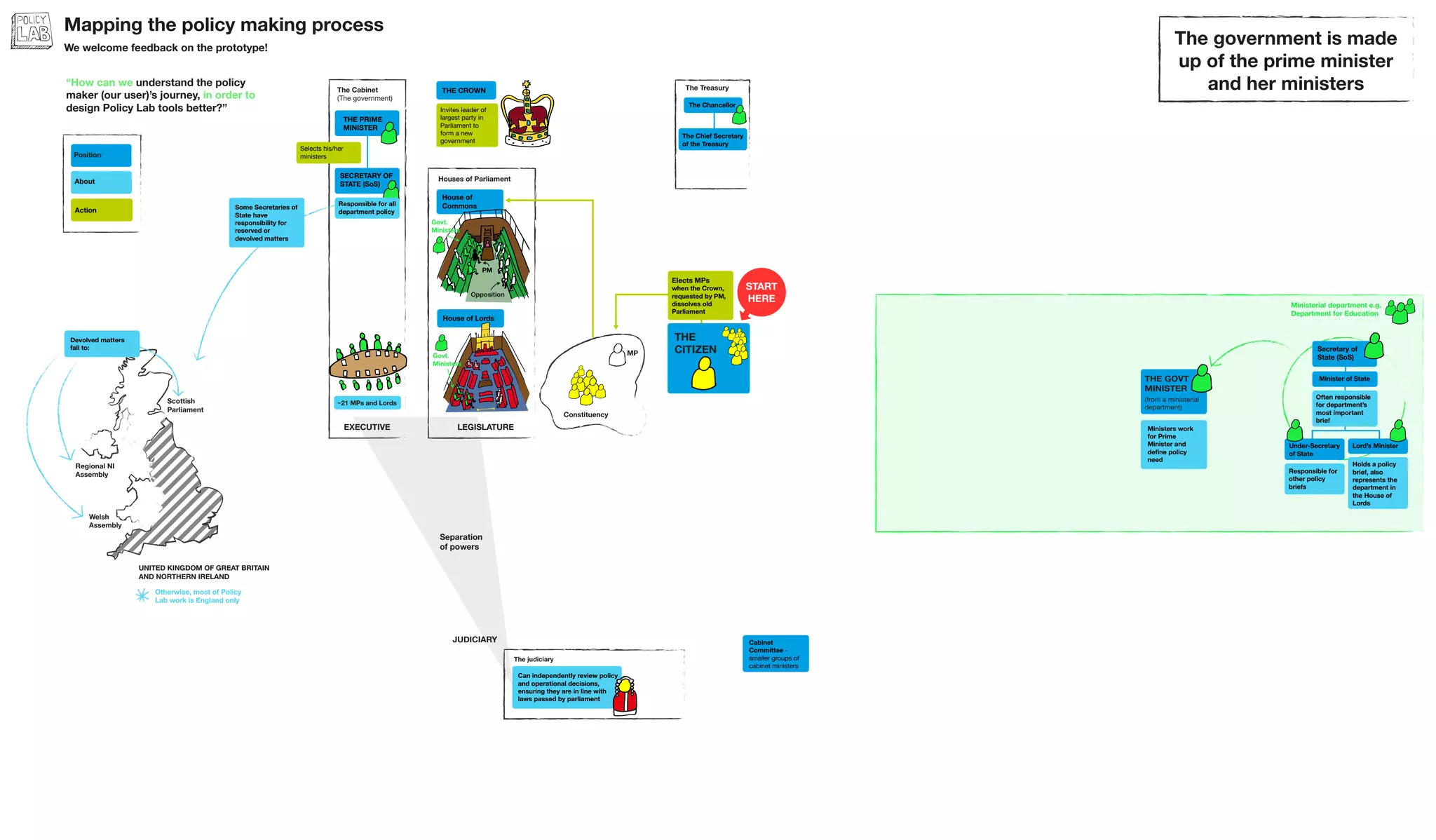
The government is made
up of the prime minister
and her ministers
EXECUTIVE LEGISLATURE
JUDICIARY
Separation
of powers
Constituency
MP
Ministerial department e.g.
Department for Education
Under-Secretary
of State
Secretary of
State (SoS)
Lord’s Minister
Minister of State
Private
Office
Holds a policy
brief, also
represents the
department in
the House of
Lords
Often responsible
for department’s
most important
brief
THE
CITIZEN
THE GOVT
MINISTER
(from a ministerial
department)
THE POLICY
OFFICIAL
(from a
policy unit)
House of
Commons
House of Lords
The Cabinet
(The government)
~21 MPs and Lords
THE CROWN
Elects MPs
when the Crown,
requested by PM,
dissolves old
Parliament
START
HERE
Selects his/her
ministers
THE PRIME
MINISTER
Civil Service
Policy Unit
Senior Civil
Service
The Treasury The Press
Office
SPECIAL
ADVISORS (SpAds)
SECRETARY OF
STATE (SoS)
CIVIL SERVICE
OPERATIONAL
TEAMS e.g.
Help. Define.
Challenge.
Work and Pensions Immigration Prisons
Make delegated
operational decisions
Cabinet
Committee -
smaller groups of
cabinet ministers
Lawyers and
parliamentary
counsel
(TSoC) (GLS)
Civil Servants
Can independently review policy
and operational decisions,
ensuring they are in line with
laws passed by parliament
Temporary civil
servants, appointed
by Secretary of State
Civil servants who
work for ministers
Permanent Secretary
Director General
Director
Deputy Director
Deputy Director
Grade 6
Grade 7
SEO HEO EO AO
The Chancellor
The Chief Secretary
of the Treasury
Treasury Officials
Responsible for
other policy
briefs
Ministers work
for Prime
Minister and
define policy
need
Mapping the policy making process
We welcome feedback on the prototype!
“How can we understand the policy
maker (our user)’s journey, in order to
design Policy Lab tools better?”
The Civil Service
• Delivers policy intent of ministers
• Delivers government services
• ‘Advises’ and ‘warns’ Some important structures within the Civil Service
PM
Govt.
Ministers
Opposition
Govt.
Ministers
Invites leader of
largest party in
Parliament to
form a new
government
Support
The judiciary
Houses of Parliament
POLICY TEAM
Research,
analyse, evidence,
measures impact,
and advise
Welsh
Assembly
Scottish
Parliament
UNITED KINGDOM OF GREAT BRITAIN
AND NORTHERN IRELAND
Regional NI
Assembly
Responsible for all
department policy
Some Secretaries of
State have
responsibility for
reserved or
devolved matters
Devolved matters
fall to:
Otherwise, most of Policy
Lab work is England only
Action
Position
About
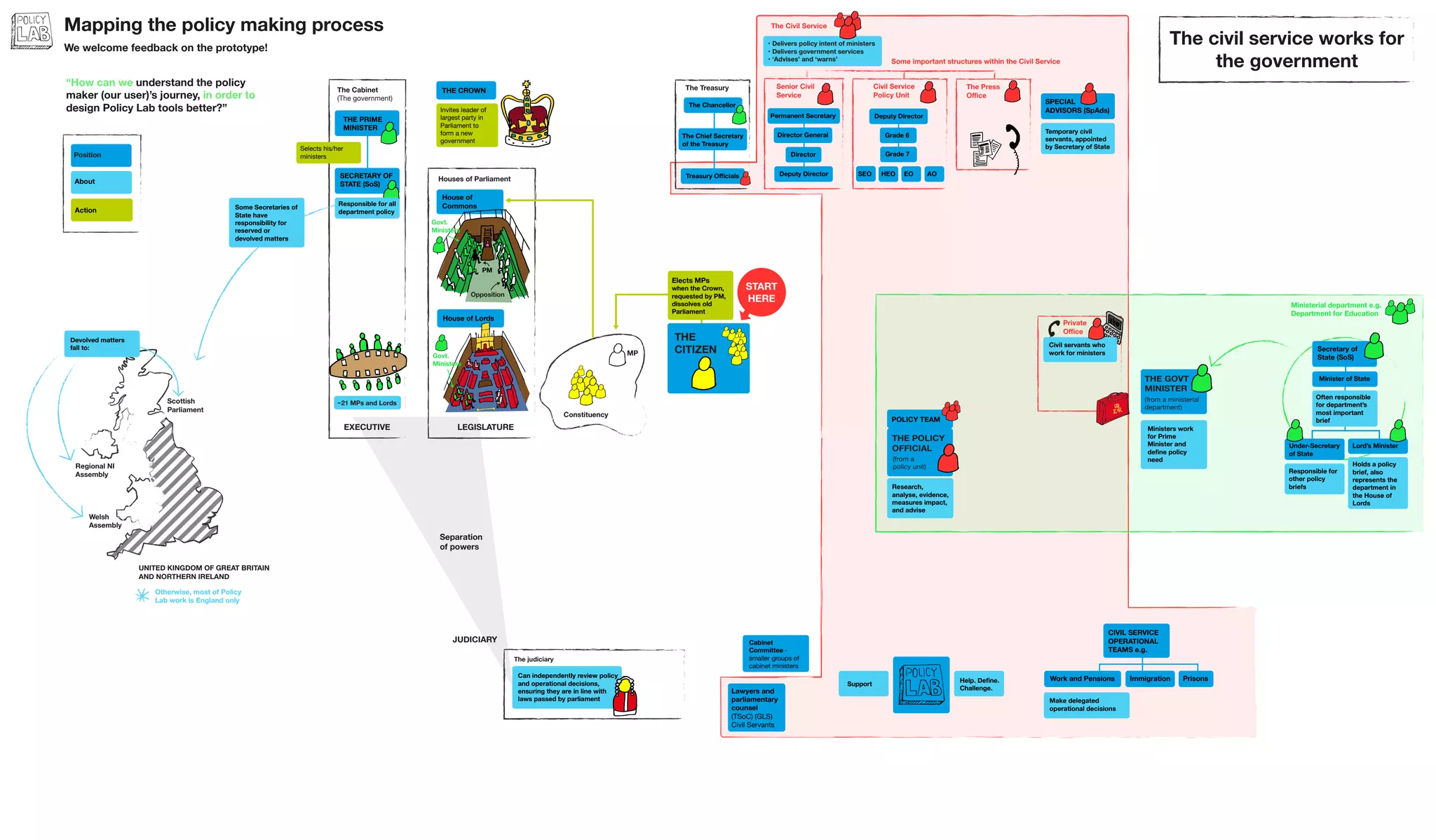
The civil service works for
the government
EXECUTIVE LEGISLATURE
JUDICIARY
Separation
of powers
Public sector operations (non-civil service) e.g.
Police
NHS
Private and VCSE operations e.g.
Welfare
assessments
Grant writing
Outsourced
operational
delivery
Conduct
operations
within bounds
of legislation
Provide
policing and
healthcare
The media e.g.
Newspapers
Television
Social media
Reporting, columns,
letters, opinion,
debates, adverts,
public comments
Special interest groups and stakeholders e.g.
Agencies and public bodies e.g.
Non ministerial departments e.g.
Infrastructure
and Projects
Authority
Student Loans
Company
Office of the
Children’s
Commissioner
Oversee major
projects e.g.
HS2
Promote and
protect rights
of children
Provide loans
to students
Ofsted
Ofqual
Inspect and
regulate
services
Constituency
MP
Ministerial department e.g.
Department for Education
Under-Secretary
of State
Secretary of
State (SoS)
Lord’s Minister
Minister of State
Private
Office
Think tanks Research and
represent
different
groupsTrade unions
Holds a policy
brief, also
represents the
department in
the House of
Lords
Often responsible
for department’s
most important
brief
THE
CITIZEN
THE GOVT
MINISTER
(from a ministerial
department)
THE POLICY
OFFICIAL
(from a
policy unit)
House of
Commons
House of Lords
The Cabinet
(The government)
Local government
Provides a local authority over local matters
Leader of the
council
Deputy leader
Councillor roles e.g.
Committee chairs
Managing director
or CEO
Executive directors
E.g. of finance, children’s
services, adult social
services, community and
environmental services
E.g. of adult social care, business and property,
children's services, communities, digital
innovation and efficiency, environment,
development and transport, policy and resources
Elected Public servants
Local govt. officials
~21 MPs and Lords
THE CROWN
Elects MPs
when the Crown,
requested by PM,
dissolves old
Parliament
START
HERE
Selects his/her
ministers
THE PRIME
MINISTER
Civil Service
Policy Unit
Senior Civil
Service
The Treasury The Press
Office
SPECIAL
ADVISORS (SpAds)
SECRETARY OF
STATE (SoS)
CIVIL SERVICE
OPERATIONAL
TEAMS e.g.
Help. Define.
Challenge.
Work and Pensions Immigration Prisons
Make delegated
operational decisions
Cabinet
Committee -
smaller groups of
cabinet ministers
Lawyers and
parliamentary
counsel
(TSoC) (GLS)
Civil Servants
Can independently review policy
and operational decisions,
ensuring they are in line with
laws passed by parliament
Temporary civil
servants, appointed
by Secretary of State
Civil servants who
work for ministers
Permanent Secretary
Director General
Director
Deputy Director
Deputy Director
Grade 6
Grade 7
SEO HEO EO AO
The Chancellor
The Chief Secretary
of the Treasury
Treasury Officials
Responsible for
other policy
briefs
Ministers work
for Prime
Minister and
define policy
need
Mapping the policy making process
We welcome feedback on the prototype!
“How can we understand the policy
maker (our user)’s journey, in order to
design Policy Lab tools better?”
The Civil Service
• Delivers policy intent of ministers
• Delivers government services
• ‘Advises’ and ‘warns’ Some important structures within the Civil Service
PM
Govt.
Ministers
Opposition
Govt.
Ministers
Invites leader of
largest party in
Parliament to
form a new
government
Support
The judiciary
Houses of Parliament
POLICY TEAM
Research,
analyse, evidence,
measures impact,
and advise
Welsh
Assembly
Scottish
Parliament
UNITED KINGDOM OF GREAT BRITAIN
AND NORTHERN IRELAND
Regional NI
Assembly
Responsible for all
department policy
Some Secretaries of
State have
responsibility for
reserved or
devolved matters
Devolved matters
fall to:
Otherwise, most of Policy
Lab work is England only
Action
Position
About
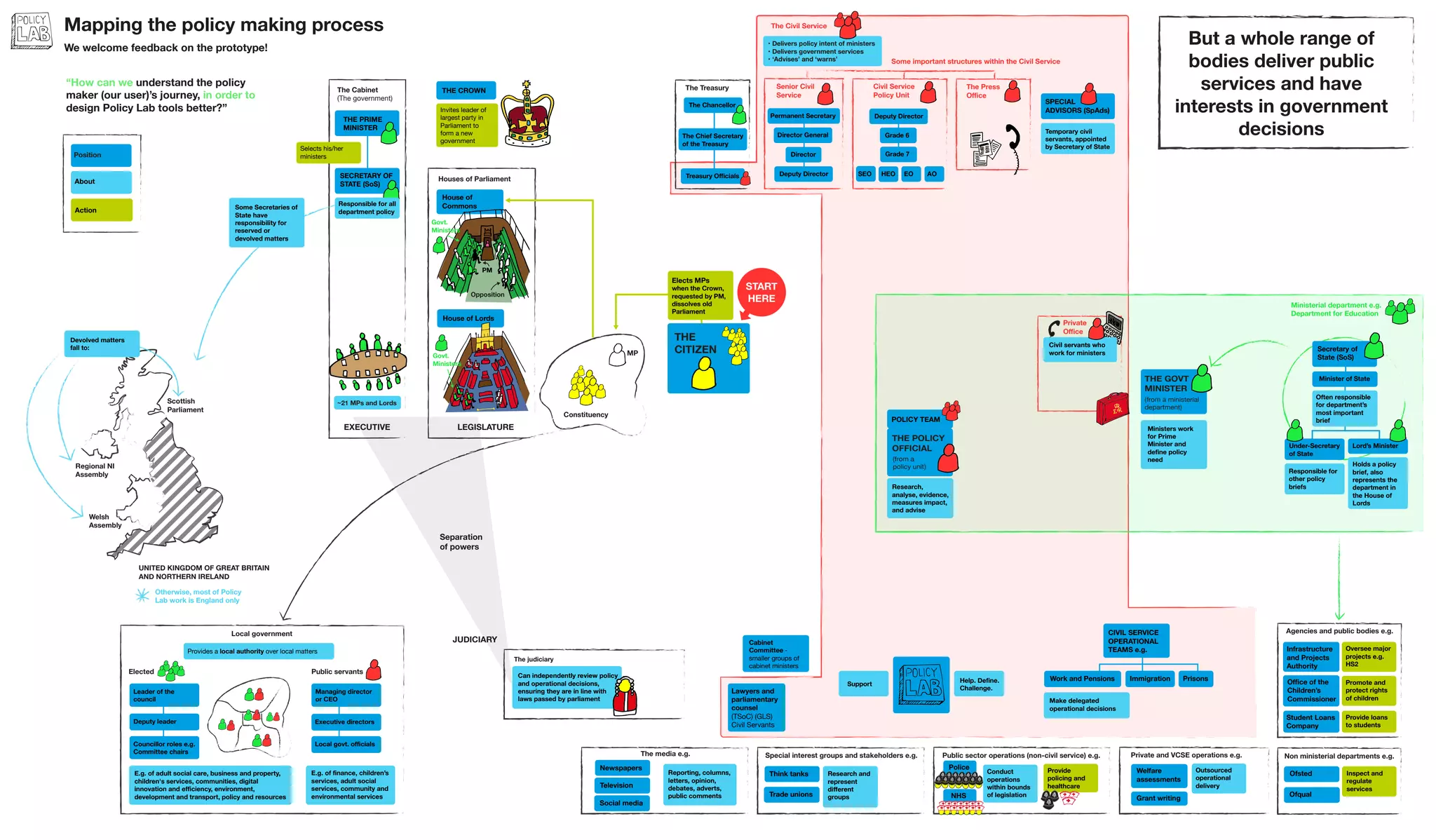
But a whole range of
bodies deliver public
services and have
interests in government
decisions
EXECUTIVE LEGISLATURE
JUDICIARY
Separation
of powers
Public sector operations (non-civil service) e.g.
Police
NHS
Private and VCSE operations e.g.
Welfare
assessments
Grant writing
Outsourced
operational
delivery
Conduct
operations
within bounds
of legislation
Provide
policing and
healthcare
The media e.g.
Newspapers
Television
Social media
Reporting, columns,
letters, opinion,
debates, adverts,
public comments
Special interest groups and stakeholders e.g.
Agencies and public bodies e.g.
Non ministerial departments e.g.
Infrastructure
and Projects
Authority
Student Loans
Company
Office of the
Children’s
Commissioner
Oversee major
projects e.g.
HS2
Promote and
protect rights
of children
Provide loans
to students
Ofsted
Ofqual
Inspect and
regulate
services
Constituency
MP
Ministerial department e.g.
Department for Education
Under-Secretary
of State
Secretary of
State (SoS)
Lord’s Minister
Minister of State
Private
Office
Think tanks Research and
represent
different
groupsTrade unions
“We
think...”
“This is
how we
can do it”
Holds a policy
brief, also
represents the
department in
the House of
Lords
Often responsible
for department’s
most important
brief
THE
CITIZEN
THE GOVT
MINISTER
(from a ministerial
department)
The Ministerial and
Special Advisors’ Code
Winning party manifesto
“We will... We will...”
Stated govt policy
“We have said” / briefing /
Q and A / core lines
The Civil Service Code.
Governs actions of civil servants.
THE POLICY
OFFICIAL
(from a
policy unit)
House of
Commons
House of Lords
The Cabinet
(The government)
Local government
Provides a local authority over local matters
Leader of the
council
Deputy leader
Councillor roles e.g.
Committee chairs
Managing director
or CEO
Executive directors
E.g. of finance, children’s
services, adult social
services, community and
environmental services
E.g. of adult social care, business and property,
children's services, communities, digital
innovation and efficiency, environment,
development and transport, policy and resources
Elected Public servants
Local govt. officials
~21 MPs and Lords
THE CROWN
Elects MPs
when the Crown,
requested by PM,
dissolves old
Parliament
START
HERE
Selects his/her
ministers
THE PRIME
MINISTER
Civil Service
Policy Unit
Senior Civil
Service
The Treasury The Press
Office
SPECIAL
ADVISORS (SpAds)
SECRETARY OF
STATE (SoS)
CIVIL SERVICE
OPERATIONAL
TEAMS e.g.
Help. Define.
Challenge.
Operational guidance and
rules, Operational Policy
Work and Pensions Immigration Prisons
Independent watchdogs,
regulators, commissioners,
inspectorates
Make delegated
operational decisions
Cabinet
Committee -
smaller groups of
cabinet ministers
Lawyers and
parliamentary
counsel
(TSoC) (GLS)
Civil Servants
Can independently review policy
and operational decisions,
ensuring they are in line with
laws passed by parliament
“We believe in
collective
government view
- so clear things
with us!”
“What’s the
government’s
position on ...?”
Temporary civil
servants, appointed
by Secretary of State
Civil servants who
work for ministers
Permanent Secretary
Director General
Director
Deputy Director
Deputy Director
Grade 6
Grade 7
SEO HEO EO AO
The Chancellor
The Chief Secretary
of the Treasury
Treasury Officials
Responsible for
other policy
briefs
Ministers work
for Prime
Minister and
define policy
need
Mapping the policy making process
We welcome feedback on the prototype!
“How can we understand the policy
maker (our user)’s journey, in order to
design Policy Lab tools better?”
The Civil Service
• Delivers policy intent of ministers
• Delivers government services
• ‘Advises’ and ‘warns’ Some important structures within the Civil Service
PM
Govt.
Ministers
Opposition
Govt.
Ministers
Invites leader of
largest party in
Parliament to
form a new
government
Support
The judiciary
“No, you don’t
have the authority
to make that
decision you
made!”
Houses of Parliament
POLICY TEAM
Research,
analyse, evidence,
measures impact,
and advise
Welsh
Assembly
Scottish
Parliament
UNITED KINGDOM OF GREAT BRITAIN
AND NORTHERN IRELAND
Regional NI
Assembly
Responsible for all
department policy
Some Secretaries of
State have
responsibility for
reserved or
devolved matters
Devolved matters
fall to:
Otherwise, most of Policy
Lab work is England only
Action
Position
About
Codes and
influences
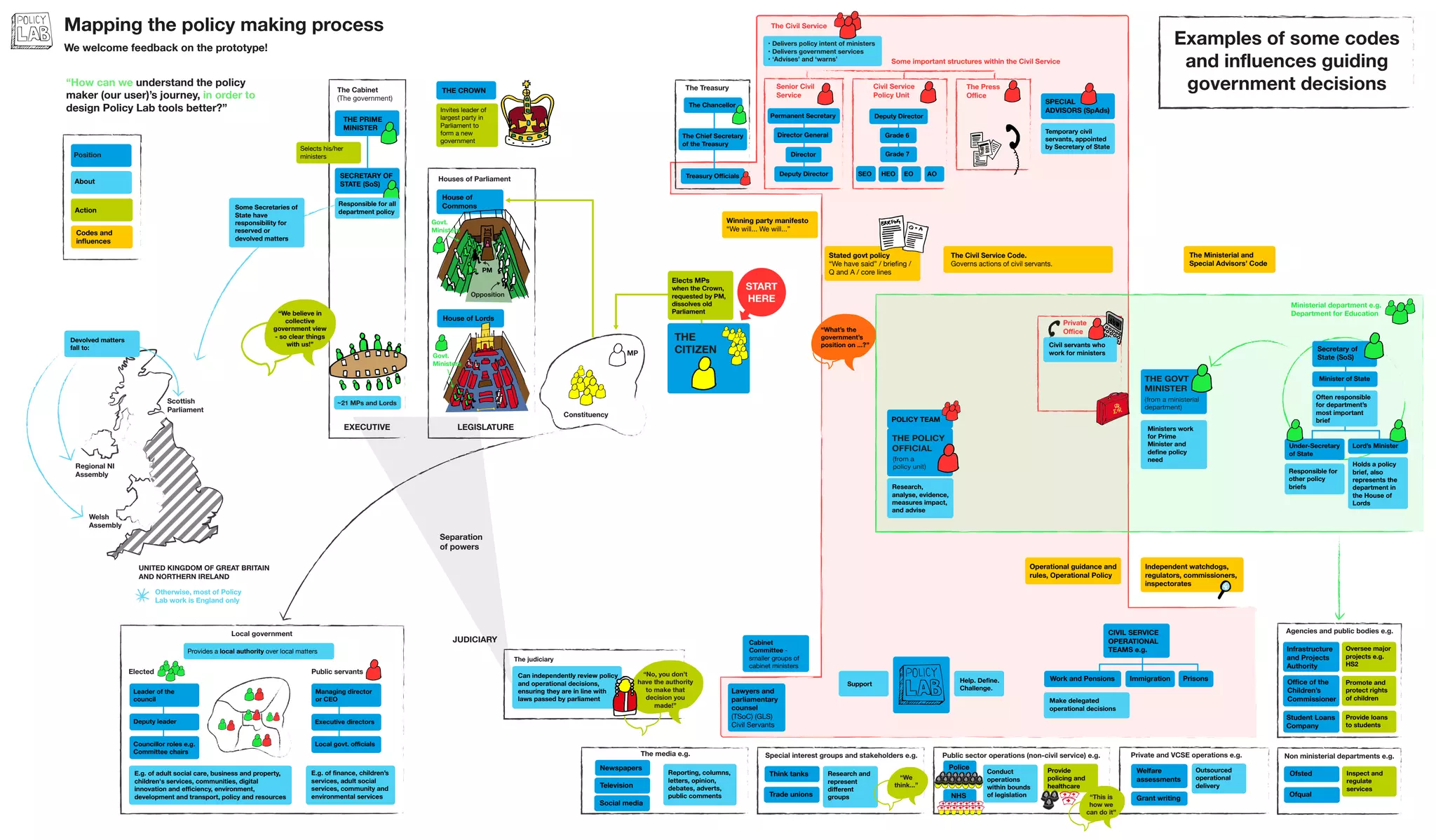
Examples of some codes
and influences guiding
government decisions
EXECUTIVE LEGISLATURE
JUDICIARY
Separation
of powers
Public sector operations (non-civil service) e.g.
Police
NHS
Private and VCSE operations e.g.
Welfare
assessments
Grant writing
Outsourced
operational
delivery
Conduct
operations
within bounds
of legislation
Provide
policing and
healthcare
The media e.g.
Newspapers
Television
Social media
Reporting, columns,
letters, opinion,
debates, adverts,
public comments
Special interest groups and stakeholders e.g.
Agencies and public bodies e.g.
Non ministerial departments e.g.
Infrastructure
and Projects
Authority
Student Loans
Company
Office of the
Children’s
Commissioner
Oversee major
projects e.g.
HS2
Promote and
protect rights
of children
Provide loans
to students
Ofsted
Ofqual
Inspect and
regulate
services
Constituency
MP
Ministerial department e.g.
Department for Education
Under-Secretary
of State
Secretary of
State (SoS)
Lord’s Minister
Minister of State
Private
Office
Giveviews
Think tanks Research and
represent
different
groupsTrade unions
“We
think...”
“This is
how we
can do it”
Holds a policy
brief, also
represents the
department in
the House of
Lords
Often responsible
for department’s
most important
brief
THE
CITIZEN
THE GOVT
MINISTER
(from a ministerial
department)
Updates core lines
Makes speeches
and provides
convening power
Makes policy
decisions based
on advice
Goes on visits
and conducts
meetings (advised
by policy official)
Negotiations with
treasury
Consults (among
others):
Lawyers
Finance
Analysts
Other relevant
departments
Press (media
handling)
Consultancies and
research agencies
Submission e.g.
Issue: How to ...
Recommendation:
Use approach x
Background: your
manifesto said
Consideration:
argument for
approach
Propriety
andethics
Propriety
andethics
The Ministerial and
Special Advisors’ Code
“Youcan...you
can’t
”
“Youcan...
youcan’t”
Responds to
cabinet
committee
clearances
Winning party manifesto
“We will... We will...”
Stated govt policy
“We have said” / briefing /
Q and A / core lines
Writes to MPs
Response from
minister
Visits surgeries
MPs write to the
minister
The Civil Service Code.
Governs actions of civil servants.
THE POLICY
OFFICIAL
(from a
policy unit)Form special
interest groups
Public/companies/
organisations
Submits freedom
of information
requests
Writes to govt
department.
Mostly dealt with
by an official
Special interest
groups write to
govt and MPs
G
ive
views
House of
Commons
House of Lords
The Cabinet
(The government)
Local government
Provides a local authority over local matters
Leader of the
council
Deputy leader
Councillor roles e.g.
Committee chairs
Managing director
or CEO
Executive directors
E.g. of finance, children’s
services, adult social
services, community and
environmental services
E.g. of adult social care, business and property,
children's services, communities, digital
innovation and efficiency, environment,
development and transport, policy and resources
Elected Public servants
Local govt. officials
~21 MPs and Lords
THE CROWN
Elects MPs
when the Crown,
requested by PM,
dissolves old
Parliament
START
HERE
Selects his/her
ministers
THE PRIME
MINISTER
Civil Service
Policy Unit
Senior Civil
Service
The Treasury The Press
Office
SPECIAL
ADVISORS (SpAds)
SECRETARY OF
STATE (SoS)
CIVIL SERVICE
OPERATIONAL
TEAMS e.g.
Help. Define.
Challenge.
Operational guidance and
rules, Operational Policy
Work and Pensions Immigration Prisons
Independent watchdogs,
regulators, commissioners,
inspectorates
Holdtoaccount
Make delegated
operational decisions
E.g. granting entry to
the UK at the border
Hold
toaccount
“You
can... you can’t”
Give views
Give
view
s
Writes speeches
and briefings
Advises on
operational
policy
GREEN PAPER
Preliminary statement
of intent - to
stimulate debate
WHITE PAPER
Statement of intent /
proposed policy for
consultation. (Must
be cleared by
CabCom
Secondary
legislation and
rules e.g. statutory
instruments - laid
in the house
Cabinet
Committee -
smaller groups of
cabinet ministers
Cabinet
Committee
clearance - often
given with
conditions
POLICY
AGREED!
Policy enacted
when
operationally
ready
Lawyers and
parliamentary
counsel
(TSoC) (GLS)
Civil Servants
Can independently review policy
and operational decisions,
ensuring they are in line with
laws passed by parliament
“We believe in
collective
government view
- so clear things
with us!”
“What’s the
government’s
position on ...?”
Respond to
media queries
throughout
Temporary civil
servants, appointed
by Secretary of State
Civil servants who
work for ministers
Permanent Secretary
Director General
Director
Deputy Director
Deputy Director
Grade 6
Grade 7
SEO HEO EO AO
The Chancellor
The Chief Secretary
of the Treasury
Treasury Officials
Responsible for
other policy
briefs
Agrees
department’s
budget with the
chancellor
Ministers work
for Prime
Minister and
define policy
need
The Box
Daily decisions for
ministers. “The box
closes at 15:00”
Clears advice through SCS
Mapping the policy making process
We welcome feedback on the prototype!
“How can we understand the policy
maker (our user)’s journey, in order to
design Policy Lab tools better?”
The Civil Service
• Delivers policy intent of ministers
• Delivers government services
• ‘Advises’ and ‘warns’ Some important structures within the Civil Service
PM
Govt.
Ministers
Opposition
Govt.
Ministers
And urgent
questions
if allowed by
speaker
Invites leader of
largest party in
Parliament to
form a new
government
Parliament asks
questions to
minister
Written and oral -
PMQs
Advise ministers
Support
The judiciary
“No, you don’t
have the authority
to make that
decision you
made!”
Houses of Parliament
POLICY TEAM
Research,
analyse, evidence,
measures impact,
and advise
NEW
POLICY
IDEA
Return for
secondary
legislation
Responsible for all
department policy
Signs statutory
instruments
Statutory
Instruments
(regulations)
Secretaries of
State can make
these under
powers given to
them by Acts of
Parliament
Writes an
impact
assessment
Impact
assessment
published
Minister takes
propsal to
parliament
Welsh
Assembly
Scottish
Parliament
UNITED KINGDOM OF GREAT BRITAIN
AND NORTHERN IRELAND
Regional NI
Assembly
Some Secretaries of
State have
responsibility for
reserved or
devolved matters
Devolved matters
fall to:
Otherwise, most of Policy
Lab work is England only
Primary legislation
e.g. Acts of
Parliament - given
royal assent by the
crown
Action
Position
About
Codes and
influences
Documentation
and processes
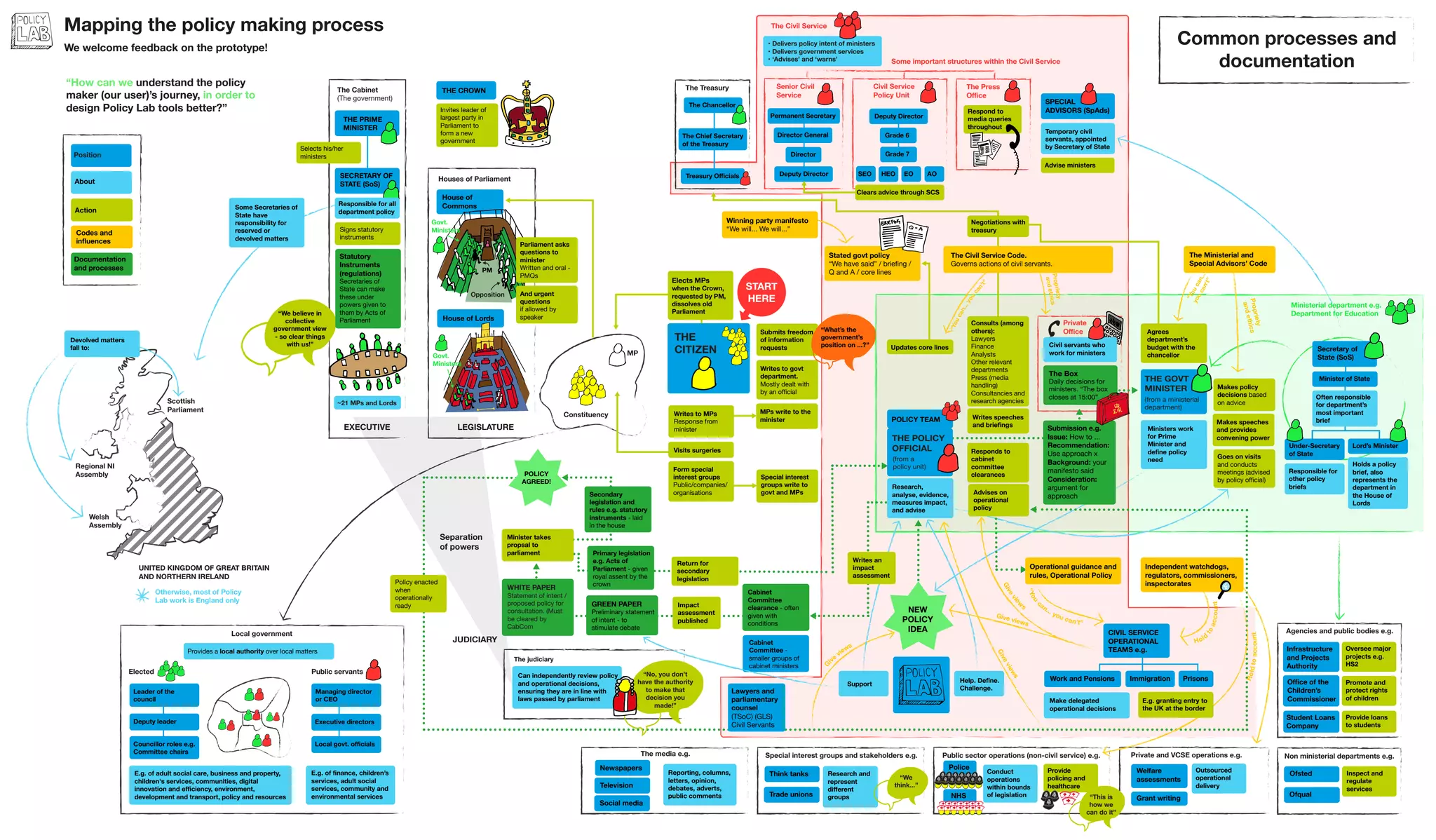
Common processes and
documentation
EXECUTIVE LEGISLATURE
JUDICIARY
Separation
of powers
Public sector operations (non-civil service) e.g.
Police
NHS
Private and VCSE operations e.g.
Welfare
assessments
Grant writing
Outsourced
operational
delivery
Conduct
operations
within bounds
of legislation
Provide
policing and
healthcare
The media e.g.
Newspapers
Television
Social media
Reporting, columns,
letters, opinion,
debates, adverts,
public comments
Special interest groups and stakeholders e.g.
Agencies and public bodies e.g.
Non ministerial departments e.g.
Infrastructure
and Projects
Authority
Student Loans
Company
Office of the
Children’s
Commissioner
Oversee major
projects e.g.
HS2
Promote and
protect rights
of children
Provide loans
to students
Ofsted
Ofqual
Inspect and
regulate
services
Constituency
MP
Ministerial department e.g.
Department for Education
Under-Secretary
of State
Secretary of
State (SoS)
Lord’s Minister
Minister of State
Private
Office
Giveviews
Think tanks Research and
represent
different
groupsTrade unions
“We
think...”
“This is
how we
can do it”
Holds a policy
brief, also
represents the
department in
the House of
Lords
Often responsible
for department’s
most important
brief
THE
CITIZEN
THE GOVT
MINISTER
(from a ministerial
department)
Updates core lines
Makes speeches
and provides
convening power
Makes policy
decisions based
on advice
Goes on visits
and conducts
meetings (advised
by policy official)
Negotiations with
treasury
Consults (among
others):
Lawyers
Finance
Analysts
Other relevant
departments
Press (media
handling)
Consultancies and
research agencies
Submission e.g.
Issue: How to ...
Recommendation:
Use approach x
Background: your
manifesto said
Consideration:
argument for
approach
Propriety
andethics
Propriety
andethics
The Ministerial and
Special Advisors’ Code
“Youcan...you
can’t
”
“Youcan...
youcan’t”
Responds to
cabinet
committee
clearances
Winning party manifesto
“We will... We will...”
Stated govt policy
“We have said” / briefing /
Q and A / core lines
Writes to MPs
Response from
minister
Visits surgeries
MPs write to the
minister
Letter
received
The Civil Service Code.
Governs actions of civil servants.
Find appropriate
department/unit
Minister
changes/agrees
to the response
Policy official
writes response
Letter sent
THE POLICY
OFFICIAL
(from a
policy unit)Form special
interest groups
Public/companies/
organisations
Submits freedom
of information
requests
Writes to govt
department.
Mostly dealt with
by an official
Special interest
groups write to
govt and MPs
G
ive
views
House of
Commons
House of Lords
The Cabinet
(The government)
Local government
Provides a local authority over local matters
Leader of the
council
Deputy leader
Councillor roles e.g.
Committee chairs
Managing director
or CEO
Executive directors
E.g. of finance, children’s
services, adult social
services, community and
environmental services
E.g. of adult social care, business and property,
children's services, communities, digital
innovation and efficiency, environment,
development and transport, policy and resources
Elected Public servants
Local govt. officials
~21 MPs and Lords
THE CROWN
Elects MPs
when the Crown,
requested by PM,
dissolves old
Parliament
START
HERE
Selects his/her
ministers
THE PRIME
MINISTER
Question Deadline
Policy official
writes response
Find appropriate
department/unit
Minister
changes/agrees
Minister submits
or presents
Civil Service
Policy Unit
Senior Civil
Service
The Treasury The Press
Office
SPECIAL
ADVISORS (SpAds)
SECRETARY OF
STATE (SoS)
CIVIL SERVICE
OPERATIONAL
TEAMS e.g.
Help. Define.
Challenge.
Operational guidance and
rules, Operational Policy
Work and Pensions Immigration Prisons
Independent watchdogs,
regulators, commissioners,
inspectorates
Holdtoaccount
Make delegated
operational decisions
E.g. granting entry to
the UK at the border
Hold
toaccount
“You
can... you can’t”
Give views
Give
view
s
Writes speeches
and briefings
Advises on
operational
policy
GREEN PAPER
Preliminary statement
of intent - to
stimulate debate
WHITE PAPER
Statement of intent /
proposed policy for
consultation. (Must
be cleared by
CabCom
Secondary
legislation and
rules e.g. statutory
instruments - laid
in the house
Cabinet
Committee -
smaller groups of
cabinet ministers
Cabinet
Committee
clearance - often
given with
conditions
POLICY
AGREED!
Policy enacted
when
operationally
ready
Lawyers and
parliamentary
counsel
(TSoC) (GLS)
Civil Servants
Can independently review policy
and operational decisions,
ensuring they are in line with
laws passed by parliament
“We believe in
collective
government view
- so clear things
with us!”
“What’s the
government’s
position on ...?”
Respond to
media queries
throughout
Temporary civil
servants, appointed
by Secretary of State
Civil servants who
work for ministers
Permanent Secretary
Director General
Director
Deputy Director
Deputy Director
Grade 6
Grade 7
SEO HEO EO AO
The Chancellor
The Chief Secretary
of the Treasury
Treasury Officials
Responsible for
other policy
briefs
Agrees
department’s
budget with the
chancellor
Ministers work
for Prime
Minister and
define policy
need
The Box
Daily decisions for
ministers. “The box
closes at 15:00”
Clears advice through SCS
Mapping the policy making process
We welcome feedback on the prototype!
“How can we understand the policy
maker (our user)’s journey, in order to
design Policy Lab tools better?”
The Civil Service
• Delivers policy intent of ministers
• Delivers government services
• ‘Advises’ and ‘warns’ Some important structures within the Civil Service
PM
Govt.
Ministers
Opposition
Govt.
Ministers
And urgent
questions
if allowed by
speaker
Invites leader of
largest party in
Parliament to
form a new
government
Parliament asks
questions to
minister
Written and oral -
PMQs
Advise ministers
Support
The judiciary
“No, you don’t
have the authority
to make that
decision you
made!”
Houses of Parliament
POLICY TEAM
Research,
analyse, evidence,
measures impact,
and advise
NEW
POLICY
IDEA
Return for
secondary
legislation
Responsible for all
department policy
Signs statutory
instruments
Statutory
Instruments
(regulations)
Secretaries of
State can make
these under
powers given to
them by Acts of
Parliament
Writes an
impact
assessment
Impact
assessment
published
Minister takes
propsal to
parliament
Welsh
Assembly
Scottish
Parliament
UNITED KINGDOM OF GREAT BRITAIN
AND NORTHERN IRELAND
Regional NI
Assembly
Some Secretaries of
State have
responsibility for
reserved or
devolved matters
Devolved matters
fall to:
Otherwise, most of Policy
Lab work is England only
Primary legislation
e.g. Acts of
Parliament - given
royal assent by the
crown
Action
Citizen
interaction
Position
About
Codes and
influences
Documentation
and processes
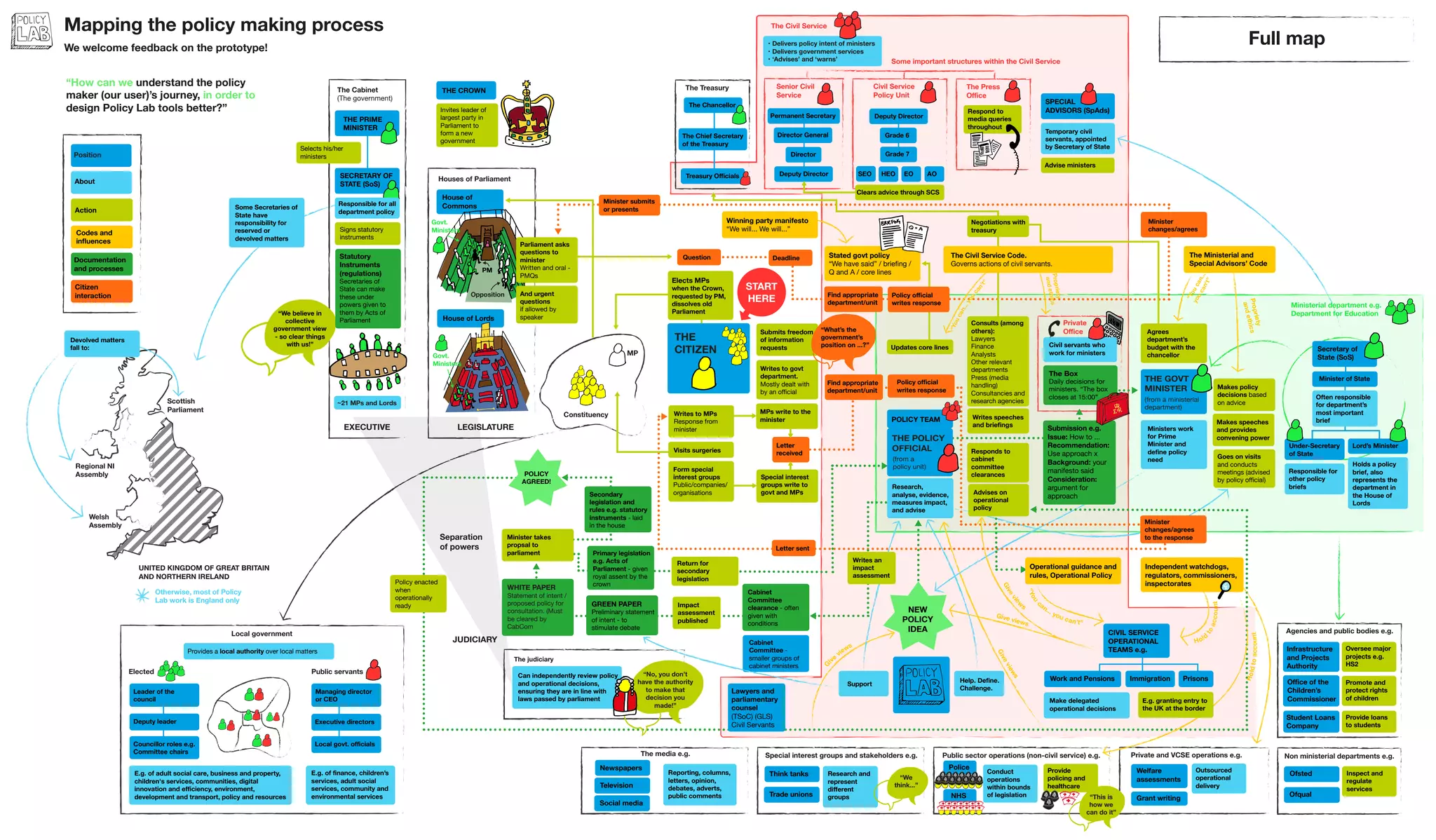
Full map
EXECUTIVE LEGISLATURE
JUDICIARY
Separation
of powers
Public sector operations (non-civil service) e.g.
Police
NHS
Private and VCSE operations e.g.
Welfare
assessments
Grant writing
Outsourced
operational
delivery
Conduct
operations
within bounds
of legislation
Provide
policing and
healthcare
The media e.g.
Newspapers
Television
Social media
Reporting, columns,
letters, opinion,
debates, adverts,
public comments
Special interest groups and stakeholders e.g.
Agencies and public bodies e.g.
Non ministerial departments e.g.
Infrastructure
and Projects
Authority
Student Loans
Company
Office of the
Children’s
Commissioner
Oversee major
projects e.g.
HS2
Promote and
protect rights
of children
Provide loans
to students
Ofsted
Ofqual
Inspect and
regulate
services
Constituency
MP
Ministerial department e.g.
Department for Education
Under-Secretary
of State
Secretary of
State (SoS)
Lord’s Minister
Minister of State
Private
Office
Giveviews
Think tanks Research and
represent
different
groupsTrade unions
“We
think...”
“This is
how we
can do it”
Holds a policy
brief, also
represents the
department in
the House of
Lords
Often responsible
for department’s
most important
brief
THE
CITIZEN
THE GOVT
MINISTER
(from a ministerial
department)
Updates core lines
Makes speeches
and provides
convening power
Makes policy
decisions based
on advice
Goes on visits
and conducts
meetings (advised
by policy official)
Negotiations with
treasury
Consults (among
others):
Lawyers
Finance
Analysts
Other relevant
departments
Press (media
handling)
Consultancies and
research agencies
Submission e.g.
Issue: How to ...
Recommendation:
Use approach x
Background: your
manifesto said
Consideration:
argument for
approach
Propriety
andethics
Propriety
andethics
The Ministerial and
Special Advisors’ Code
“Youcan...you
can’t
”
“Youcan...
youcan’t”
Responds to
cabinet
committee
clearances
Winning party manifesto
“We will... We will...”
Stated govt policy
“We have said” / briefing /
Q and A / core lines
Writes to MPs
Response from
minister
Visits surgeries
MPs write to the
minister
Letter
received
The Civil Service Code.
Governs actions of civil servants.
Find appropriate
department/unit
Minister
changes/agrees
to the response
Policy official
writes response
Letter sent
THE POLICY
OFFICIAL
(from a
policy unit)Form special
interest groups
Public/companies/
organisations
Submits freedom
of information
requests
Writes to govt
department.
Mostly dealt with
by an official
Special interest
groups write to
govt and MPs
G
ive
views
House of
Commons
House of Lords
The Cabinet
(The government)
Local government
Provides a local authority over local matters
Leader of the
council
Deputy leader
Councillor roles e.g.
Committee chairs
Managing director
or CEO
Executive directors
E.g. of finance, children’s
services, adult social
services, community and
environmental services
E.g. of adult social care, business and property,
children's services, communities, digital
innovation and efficiency, environment,
development and transport, policy and resources
Elected Public servants
Local govt. officials
~21 MPs and Lords
THE CROWN
Elects MPs
when the Crown,
requested by PM,
dissolves old
Parliament
START
HERE
Selects his/her
ministers
THE PRIME
MINISTER
Question Deadline
Policy official
writes response
Find appropriate
department/unit
Minister
changes/agrees
Minister submits
or presents
Civil Service
Policy Unit
Senior Civil
Service
The Treasury The Press
Office
SPECIAL
ADVISORS (SpAds)
SECRETARY OF
STATE (SoS)
CIVIL SERVICE
OPERATIONAL
TEAMS e.g.
Help. Define.
Challenge.
Operational guidance and
rules, Operational Policy
Work and Pensions Immigration Prisons
Independent watchdogs,
regulators, commissioners,
inspectorates
Holdtoaccount
Make delegated
operational decisions
E.g. granting entry to
the UK at the border
Hold
toaccount
“You
can... you can’t”
Give views
Give
view
s
Writes speeches
and briefings
Advises on
operational
policy
GREEN PAPER
Preliminary statement
of intent - to
stimulate debate
WHITE PAPER
Statement of intent /
proposed policy for
consultation. (Must
be cleared by
CabCom
Secondary
legislation and
rules e.g. statutory
instruments - laid
in the house
Cabinet
Committee -
smaller groups of
cabinet ministers
Cabinet
Committee
clearance - often
given with
conditions
POLICY
AGREED!
Policy enacted
when
operationally
ready
Lawyers and
parliamentary
counsel
(TSoC) (GLS)
Civil Servants
Can independently review policy
and operational decisions,
ensuring they are in line with
laws passed by parliament
“We believe in
collective
government view
- so clear things
with us!”
“What’s the
government’s
position on ...?”
Respond to
media queries
throughout
Temporary civil
servants, appointed
by Secretary of State
Civil servants who
work for ministers
Permanent Secretary
Director General
Director
Deputy Director
Deputy Director
Grade 6
Grade 7
SEO HEO EO AO
The Chancellor
The Chief Secretary
of the Treasury
Treasury Officials
Responsible for
other policy
briefs
Agrees
department’s
budget with the
chancellor
Ministers work
for Prime
Minister and
define policy
need
The Box
Daily decisions for
ministers. “The box
closes at 15:00”
Clears advice through SCS
Mapping the policy making process
We welcome feedback on the prototype!
“How can we understand the policy
maker (our user)’s journey, in order to
design Policy Lab tools better?”
The Civil Service
• Delivers policy intent of ministers
• Delivers government services
• ‘Advises’ and ‘warns’ Some important structures within the Civil Service
PM
Govt.
Ministers
Opposition
Govt.
Ministers
And urgent
questions
if allowed by
speaker
Invites leader of
largest party in
Parliament to
form a new
government
Parliament asks
questions to
minister
Written and oral -
PMQs
Advise ministers
Support
The judiciary
“No, you don’t
have the authority
to make that
decision you
made!”
Houses of Parliament
POLICY TEAM
Research,
analyse, evidence,
measures impact,
and advise
NEW
POLICY
IDEA
Return for
secondary
legislation
Responsible for all
department policy
Signs statutory
instruments
Statutory
Instruments
(regulations)
Secretaries of
State can make
these under
powers given to
them by Acts of
Parliament
Writes an
impact
assessment
Impact
assessment
published
Minister takes
propsal to
parliament
Welsh
Assembly
Scottish
Parliament
UNITED KINGDOM OF GREAT BRITAIN
AND NORTHERN IRELAND
Regional NI
Assembly
Some Secretaries of
State have
responsibility for
reserved or
devolved matters
Devolved matters
fall to:
Otherwise, most of Policy
Lab work is England only
Primary legislation
e.g. Acts of
Parliament - given
royal assent by the
crown
Action
Citizen
interaction
Position
About
Codes and
influences
Documentation
and processes
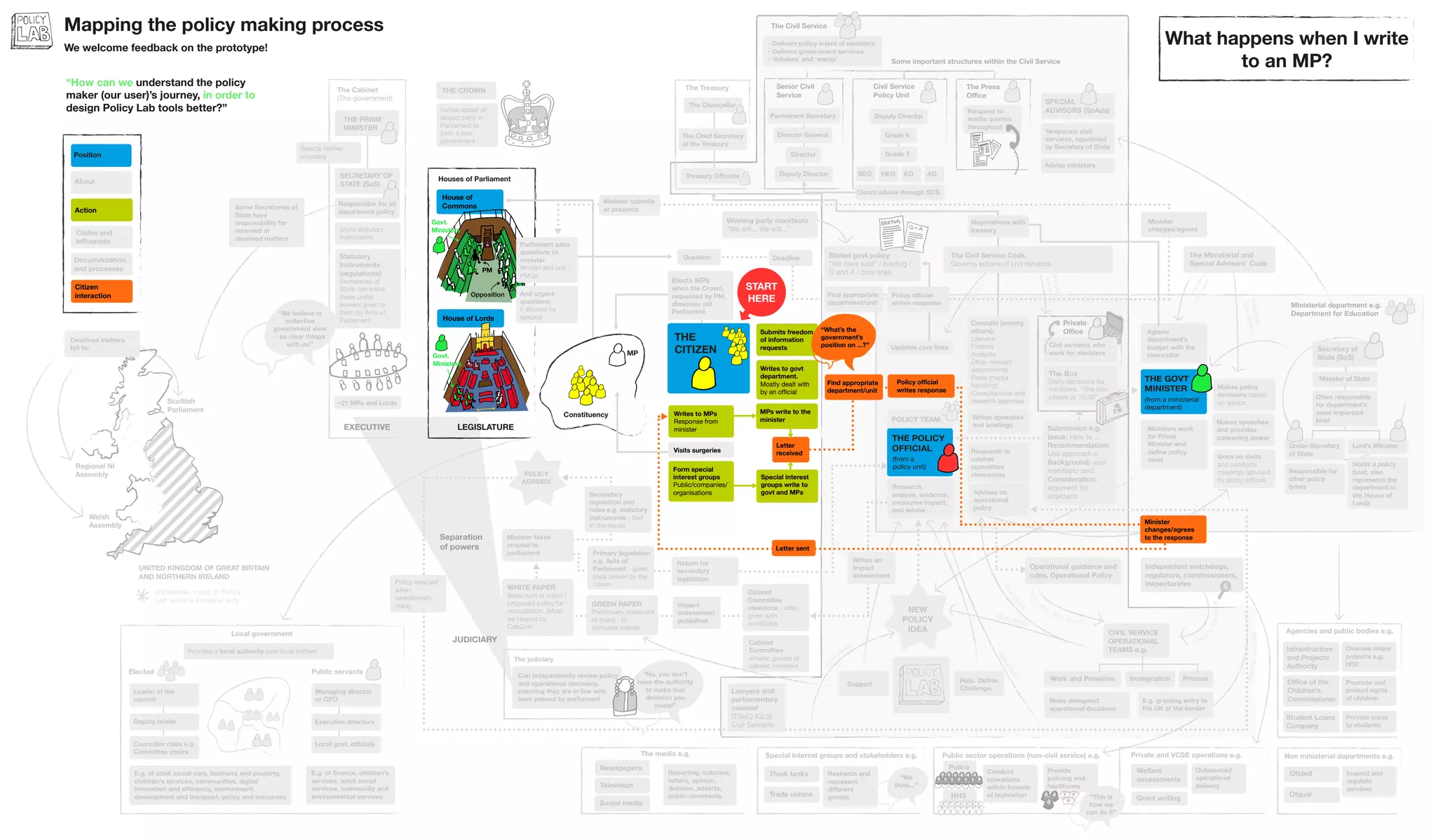
What happens when I write
to an MP?
EXECUTIVE LEGISLATURE
JUDICIARY
Separation
of powers
Public sector operations (non-civil service) e.g.
Police
NHS
Private and VCSE operations e.g.
Welfare
assessments
Grant writing
Outsourced
operational
delivery
Conduct
operations
within bounds
of legislation
Provide
policing and
healthcare
The media e.g.
Newspapers
Television
Social media
Reporting, columns,
letters, opinion,
debates, adverts,
public comments
Special interest groups and stakeholders e.g.
Agencies and public bodies e.g.
Non ministerial departments e.g.
Infrastructure
and Projects
Authority
Student Loans
Company
Office of the
Children’s
Commissioner
Oversee major
projects e.g.
HS2
Promote and
protect rights
of children
Provide loans
to students
Ofsted
Ofqual
Inspect and
regulate
services
Constituency
MP
Ministerial department e.g.
Department for Education
Under-Secretary
of State
Secretary of
State (SoS)
Lord’s Minister
Minister of State
Private
Office
Giveviews
Think tanks Research and
represent
different
groupsTrade unions
“We
think...”
“This is
how we
can do it”
Holds a policy
brief, also
represents the
department in
the House of
Lords
Often responsible
for department’s
most important
brief
THE
CITIZEN
THE GOVT
MINISTER
(From a ministerial
department)
Updates core lines
Makes speeches
and provides
convening power
Makes policy
decisions based
on advice
Goes on visits
and conducts
meetings (advised
by policy official)
Negotiations with
treasury
Consults (among
others):
Submission e.g.
Issue: How to ...
Recommendation:
Use approach x
Background: your
manifesto said
Consideration:
argument for
approach
Propriety
andethics
Propriety
andethics
The Ministerial and
Special Advisors’ Code
“Youcan...youcan’t”
“Youcan...
youcan’t”
Winning party manifesto
“We will... We will...”
Stated govt policy
“We have said” / briefing /
Q and A / core lines
Writes to MPs
Response from
minister
Visits surgeries
MPs write to the
minister
Letter
received
The Civil Service Code.
Governs actions of civil servants.
Find appropriate
department/unit
Minister
changes/agrees
to the response
Policy official
writes response
Letter sent
THE POLICY
OFFICIAL
(from a
policy unit)Form special
interest groups
Public/companies/
organisations
Submits freedom
of information
requests
Writes to govt
department.
Mostly dealt with
by an official
Special interest
groups write to
govt and MPs
G
ive
views
House of
Commons
House of Lords
The Cabinet
(The government)
Local government
Provides a local authority over local matters
Leader of the
council
Deputy leader
Councillor roles e.g.
Committee chairs
Managing director
or CEO
Executive directors
E.g. of finance, children’s
services, adult social
services, community and
environmental services
E.g. of adult social care, business and property,
children's services, communities, digital
innovation and efficiency, environment,
development and transport, policy and resources
Elected Public servants
Local govt. officials
~21 MPs and Lords
THE CROWN
Elects MPs
when the Crown,
requested by PM,
dissolves old
Parliament
START
HERE
Selects his/her
ministers
THE PRIME
MINISTER
Question Deadline
Policy official
writes response
Find appropriate
department/unit
Minister
changes/agrees
Minister submits
or presents
Civil Service
Policy Unit
Senior Civil
Service
The Treasury The Press
Office
SPECIAL
ADVISORS (SpAds)
SECRETARY OF
STATE (SoS)
CIVIL SERVICE
OPERATIONAL
TEAMS e.g.
Help. Define.
Challenge.
Operational guidance and
rules, Operational Policy
Work and Pensions Immigration Prisons
Independent watchdogs,
regulators, commissioners,
inspectorates
Holdtoaccount
Make delegated
operational decisions
E.g. granting entry to
the UK at the border
Hold
toaccount
“You
can... you can’t”
Give views
Give
v
iew
sGREEN PAPER
Preliminary statement
of intent - to
stimulate debate
WHITE PAPER
Statement of intent /
proposed policy for
consultation. (Must
be cleared by
CabCom
Secondary
legislation and
rules e.g. statutory
instruments - laid
in the house
Cabinet
Committee -
smaller groups of
cabinet ministers
Cabinet
Committee
clearance - often
given with
conditions
POLICY
AGREED!
Policy enacted
when
operationally
ready
Lawyers and
parliamentary
counsel
(TSoC) (GLS)
Civil Servants
Can independently review policy
and operational decisions,
ensuring they are in line with
laws passed by parliament
“We believe in
collective
government view
- so clear things
with us!”
“What’s the
government’s
position on ...?”
Respond to
media queries
throughout
Temporary civil
servants, appointed
by Secretary of State
Civil servants who
work for ministers
Permanent Secretary
Director General
Director
Deputy Director
Deputy Director
Grade 6
Grade 7
SEO HEO EO AO
The Chancellor
The Chief Secretary
of the Treasury
Treasury Officials
Responsible for
other policy
briefs
Agrees
department’s
budget with the
chancellor
Ministers work
for Prime
Minister and
define policy
need
The Box
Daily decisions for
ministers. “The box
closes at 15:00”
Clears advice through SCS
Mapping the policy making process
We welcome feedback on the prototype!
“How can we understand the policy
maker (our user)’s journey, in order to
design Policy Lab tools better?”
The Civil Service
• Delivers policy intent of ministers
• Delivers government services
• ‘Advises’ and ‘warns’ Some important structures within the Civil Service
PM
Govt.
Ministers
Opposition
Govt.
Ministers
And urgent
questions
if allowed by
speaker
Invites leader of
largest party in
Parliament to
form a new
government
Parliament asks
questions to
minister
Written and oral -
PMQs
Advise ministers
Support
The judiciary
“No, you don’t
have the authority
to make that
decision you
made!”
Houses of Parliament
POLICY TEAM
Research,
analyse, evidence,
measures impact,
and advise
NEW
POLICY
IDEA
Return for
secondary
legislation
Responsible for all
department policy
Signs statutory
instruments
Statutory
Instruments
(regulations)
Secretaries of
State can make
these under
powers given to
them by Acts of
Parliament
Writes an
impact
assessment
Impact
assessment
published
Minister takes
propsal to
parliament
Welsh
Assembly
Scottish
Parliament
UNITED KINGDOM OF GREAT BRITAIN
AND NORTHERN IRELAND
Regional NI
Assembly
Some Secretaries of
State have
responsibility for
reserved or
devolved matters
Devolved matters
fall to:
Otherwise, most of Policy
Lab work is England only
Primary legislation
e.g. Acts of
Parliament - given
royal assent by the
crown
Action
Citizen
interaction
Position
About
Codes and
influences
Documentation
and processes
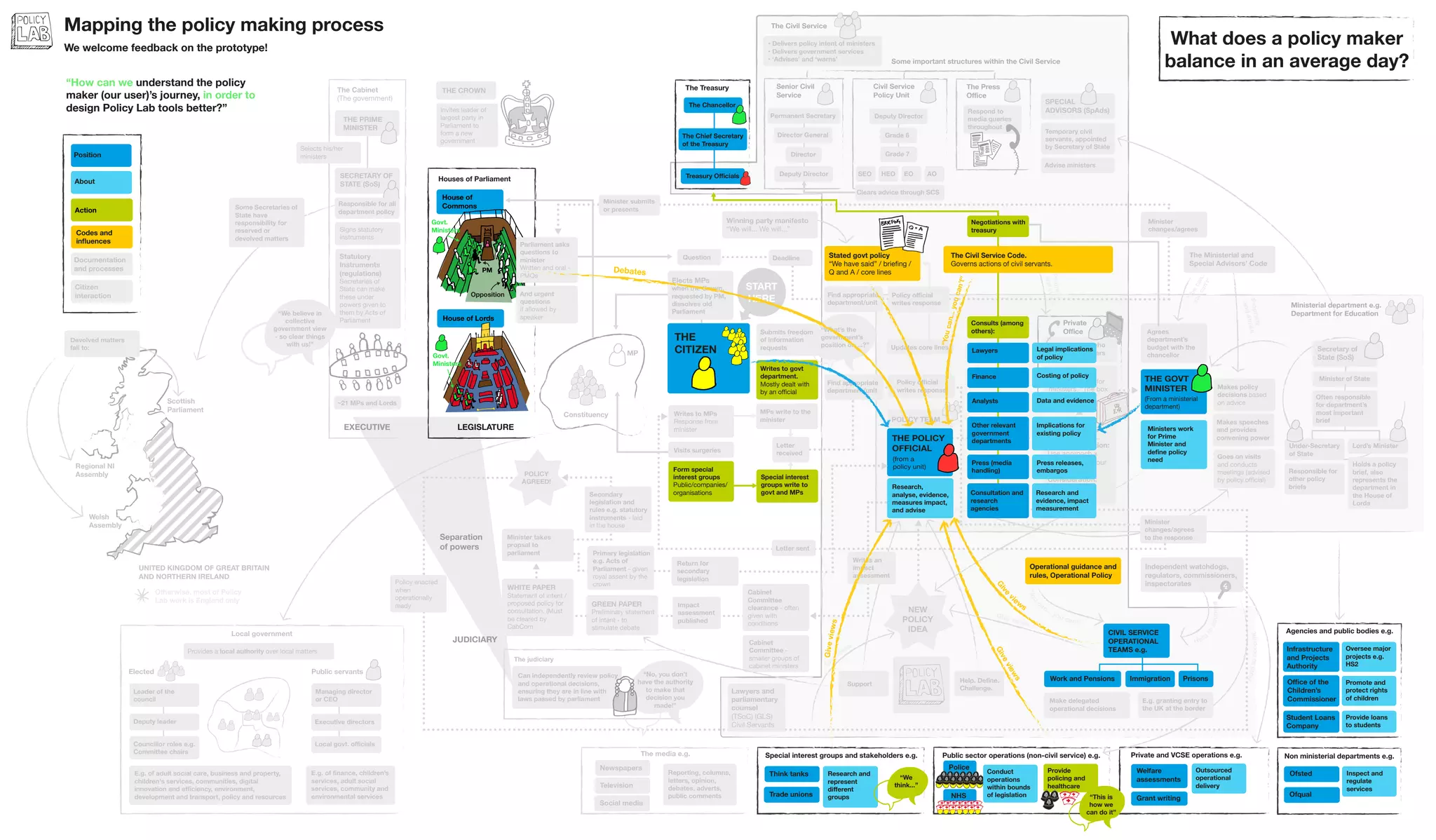
What does a policy maker
balance in an average day?
Debates
Giveviews
Lawyers
Finance
Analysts
Other relevant
government
departments
Press (media
handling)
Consultation and
research
agencies
Legal implications
of policy
Costing of policy
Data and evidence
Implications for
existing policy
Press releases,
embargos
Research and
evidence, impact
measurement
EXECUTIVE LEGISLATURE
JUDICIARY
Separation
of powers
Public sector operations (non-civil service) e.g.
Police
NHS
Private and VCSE operations e.g.
Welfare
assessments
Grant writing
Outsourced
operational
delivery
Conduct
operations
within bounds
of legislation
Provide
policing and
healthcare
The media e.g.
Newspapers
Television
Social media
Reporting, columns,
letters, opinion,
debates, adverts,
public comments
Special interest groups and stakeholders e.g.
Agencies and public bodies e.g.
Non ministerial departments e.g.
Infrastructure
and Projects
Authority
Student Loans
Company
Office of the
Children’s
Commissioner
Oversee major
projects e.g.
HS2
Promote and
protect rights
of children
Provide loans
to students
Ofsted
Ofqual
Inspect and
regulate
services
Constituency
MP
Ministerial department e.g.
Department for Education
Under-Secretary
of State
Secretary of
State (SoS)
Lord’s Minister
Minister of State
Private
Office
Giveviews
Think tanks Research and
represent
different
groupsTrade unions
“We
think...”
“This is
how we
can do it”
Holds a policy
brief, also
represents the
department in
the House of
Lords
Often responsible
for department’s
most important
brief
Updates core lines
Makes speeches
and provides
convening power
Makes policy
decisions based
on advice
Goes on visits
and conducts
meetings (advised
by policy official)
Submission e.g.
Issue: How to ...
Recommendation:
Use approach x
Background: your
manifesto said
Consideration:
argument for
approach
The Ministerial and
Special Advisors’ Code
Responds to
cabinet
committee
clearances
Winning party manifesto
“We will... We will...”
Stated govt policy
“We have said” / briefing /
Q and A / core lines
MPs write to the
minister
Letter
received
The Civil Service Code.
Governs actions of civil servants.
Find appropriate
department/unit
Minister
changes/agrees
to the response
Policy official
writes response
Letter sent
THE POLICY
OFFICIAL
(from a
policy unit)Form special
interest groups
Public/companies/
organisations
Submits freedom
of information
requests
Writes to govt
department.
Mostly dealt with
by an official
Special interest
groups write to
govt and MPs
G
ive
views
House of
Commons
House of Lords
The Cabinet
(The government)
Local government
Provides a local authority over local matters
Leader of the
council
Deputy leader
Councillor roles e.g.
Committee chairs
Managing director
or CEO
Executive directors
E.g. of finance, children’s
services, adult social
services, community and
environmental services
E.g. of adult social care, business and property,
children's services, communities, digital
innovation and efficiency, environment,
development and transport, policy and resources
Elected Public servants
Local govt. officials
~21 MPs and Lords
THE CROWN
Elects MPs
when the Crown,
requested by PM,
dissolves old
Parliament
Selects his/her
ministers
THE PRIME
MINISTER
Question Deadline
Policy official
writes response
Find appropriate
department/unit
Minister
changes/agrees
Minister submits
or presents
Civil Service
Policy Unit
Senior Civil
Service
The Treasury The Press
Office
SPECIAL
ADVISORS (SpAds)
SECRETARY OF
STATE (SoS)
CIVIL SERVICE
OPERATIONAL
TEAMS e.g.
Help. Define.
Challenge.
Operational guidance and
rules, Operational Policy
Work and Pensions Immigration Prisons
Independent watchdogs,
regulators, commissioners,
inspectorates
Make delegated
operational decisions
E.g. granting entry to
the UK at the border
Writes speeches
and briefings
Advises on
operational
policy
GREEN PAPER
Preliminary statement
of intent - to
stimulate debate
WHITE PAPER
Statement of intent /
proposed policy for
consultation. (Must
be cleared by
CabCom
Secondary
legislation and
rules e.g. statutory
instruments - laid
in the house
Cabinet
Committee -
smaller groups of
cabinet ministers
Cabinet
Committee
clearance - often
given with
conditions
POLICY
AGREED!
Policy enacted
when
operationally
ready
Lawyers and
parliamentary
counsel
(TSoC) (GLS)
Civil Servants
Can independently review policy
and operational decisions,
ensuring they are in line with
laws passed by parliament
“We believe in
collective
government view
- so clear things
with us!”
“What’s the
government’s
position on ...?”
Respond to
media queries
throughout
Temporary civil
servants, appointed
by Secretary of State
Civil servants who
work for ministers
Permanent Secretary
Director General
Director
Deputy Director
Deputy Director
Grade 6
Grade 7
SEO HEO EO AO
The Chancellor
The Chief Secretary
of the Treasury
Treasury Officials
Responsible for
other policy
briefs
Ministers work
for Prime
Minister and
define policy
need
The Box
Daily decisions for
ministers. “The box
closes at 15:00”
Clears advice through SCS
Mapping the policy making process
We welcome feedback on the prototype!
“How can we understand the policy
maker (our user)’s journey, in order to
design Policy Lab tools better?”
The Civil Service
• Delivers policy intent of ministers
• Delivers government services
• ‘Advises’ and ‘warns’ Some important structures within the Civil Service
Govt.
Ministers
And urgent
questions
if allowed by
speaker
Invites leader of
largest party in
Parliament to
form a new
government
Parliament asks
questions to
minister
Written and oral -
PMQs
Advise ministers
Support
The judiciary
“No, you don’t
have the authority
to make that
decision you
made!”
Houses of Parliament
POLICY TEAM
Research,
analyse, evidence,
measures impact,
and advise
NEW
POLICY
IDEA
Return for
secondary
legislation
Responsible for all
department policy
Signs statutory
instruments
Statutory
Instruments
(regulations)
Secretaries of
State can make
these under
powers given to
them by Acts of
Parliament
Writes an
impact
assessment
Impact
assessment
published
Minister takes
propsal to
parliament
Welsh
Assembly
Scottish
Parliament
UNITED KINGDOM OF GREAT BRITAIN
AND NORTHERN IRELAND
Regional NI
Assembly
Some Secretaries of
State have
responsibility for
reserved or
devolved matters
Devolved matters
fall to:
Otherwise, most of Policy
Lab work is England only
Primary legislation
e.g. Acts of
Parliament - given
royal assent by the
crown
Action
Citizen
interaction
Position
About
Codes and
influences
Documentation
and processes
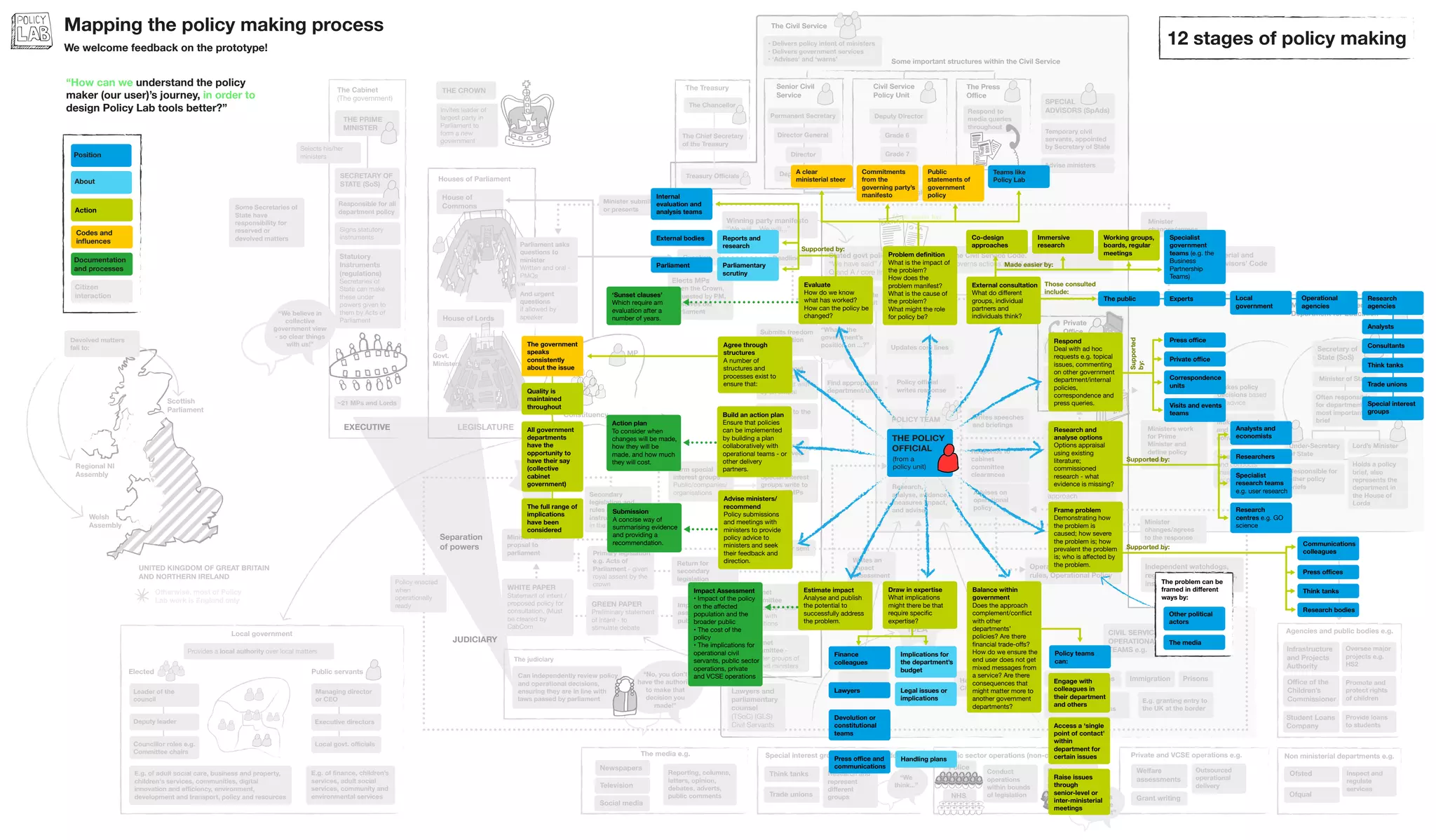
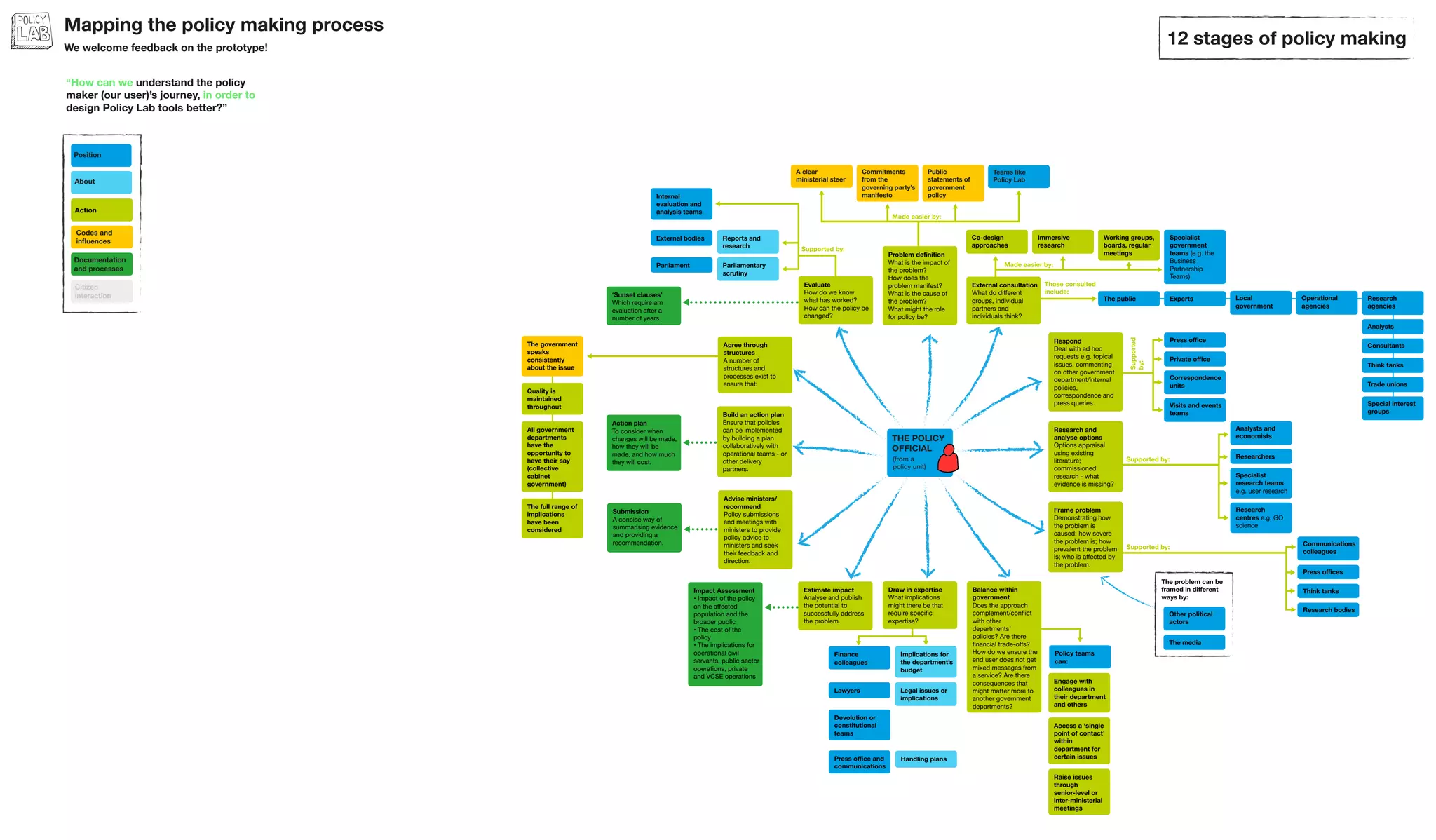
12 stages of policy making
Problem definition
What is the impact of
the problem?
How does the
problem manifest?
What is the cause of
the problem?
What might the role
for policy be?
A clear
ministerial steer
Commitments
from the
governing party’s
manifesto
Public
statements of
government
policy
Teams like
Policy Lab
Made easier by:
Evaluate
How do we know
what has worked?
How can the policy be
changed?
Internal
evaluation and
analysis teams
External bodies Reports and
research
Parliament
‘Sunset clauses’
Which require am
evaluation after a
number of years.
Parliamentary
scrutiny
Supported by:
Agree through
structures
A number of
structures and
processes exist to
ensure that:
The government
speaks
consistently
about the issue
Quality is
maintained
throughout
All government
departments
have the
opportunity to
have their say
(collective
cabinet
government)
The full range of
implications
have been
considered
Build an action plan
Ensure that policies
can be implemented
by building a plan
collaboratively with
operational teams - or
other delivery
partners.
Action plan
To consider when
changes will be made,
how they will be
made, and how much
they will cost.
Advise ministers/
recommend
Policy submissions
and meetings with
ministers to provide
policy advice to
ministers and seek
their feedback and
direction.
Submission
A concise way of
summarising evidence
and providing a
recommendation.
Estimate impact
Analyse and publish
the potential to
successfully address
the problem.
Impact Assessment
• Impact of the policy
on the affected
population and the
broader public
• The cost of the
policy
• The implications for
operational civil
servants, public sector
operations, private
and VCSE operations
Draw in expertise
What implications
might there be that
require specific
expertise?
Finance
colleagues
Implications for
the department’s
budget
Lawyers Legal issues or
implications
Devolution or
constitutional
teams
Press office and
communications
Handling plans
Balance within
government
Does the approach
complement/conflict
with other
departments’
policies? Are there
financial trade-offs?
How do we ensure the
end user does not get
mixed messages from
a service? Are there
consequences that
might matter more to
another government
departments?
Engage with
colleagues in
their department
and others
Access a ‘single
point of contact’
within
department for
certain issues
Raise issues
through
senior-level or
inter-ministerial
meetings
Policy teams
can:
Frame problem
Demonstrating how
the problem is
caused; how severe
the problem is; how
prevalent the problem
is; who is affected by
the problem.
Communications
colleagues
Press offices
Think tanks
Research bodies
Supported by:
The problem can be
framed in different
ways by:
The media
Other political
actors
Research and
analyse options
Options appraisal
using existing
literature;
commissioned
research - what
evidence is missing?
Analysts and
economists
Researchers
Specialist
research teams
e.g. user research
Research
centres e.g. GO
science
Supported by:
Respond
Deal with ad hoc
requests e.g. topical
issues, commenting
on other government
department/internal
policies,
correspondence and
press queries.
Press office
Private office
Correspondence
units
Visits and events
teams
Supported
by:
External consultation
What do different
groups, individual
partners and
individuals think?
Co-design
approaches
Immersive
research
Working groups,
boards, regular
meetings
Specialist
government
teams (e.g. the
Business
Partnership
Teams)
The public Experts Local
government
Operational
agencies
Analysts
Consultants
Research
agencies
Think tanks
Trade unions
Special interest
groups
Those consulted
include:
Made easier by:
THE POLICY
OFFICIAL
(from a
policy unit)
Mapping the policy making process
We welcome feedback on the prototype!
“How can we understand the policy
maker (our user)’s journey, in order to
design Policy Lab tools better?”
Action
Citizen
interaction
Position
About
Codes and
influences
Documentation
and processes
12 stages of policy making
Problem definition
What is the impact of
the problem?
How does the
problem manifest?
What is the cause of
the problem?
What might the role
for policy be?
A clear
ministerial steer
Commitments
from the
governing party’s
manifesto
Public
statements of
government
policy
Teams like
Policy Lab
Made easier by:
Evaluate
How do we know
what has worked?
How can the policy be
changed?
Internal
evaluation and
analysis teams
External bodies Reports and
research
Parliament
‘Sunset clauses’
Which require am
evaluation after a
number of years.
Parliamentary
scrutiny
Supported by:
Agree through
structures
A number of
structures and
processes exist to
ensure that:
The government
speaks
consistently
about the issue
Quality is
maintained
throughout
All government
departments
have the
opportunity to
have their say
(collective
cabinet
government)
The full range of
implications
have been
considered
Build an action plan
Ensure that policies
can be implemented
by building a plan
collaboratively with
operational teams - or
other delivery
partners.
Action plan
To consider when
changes will be made,
how they will be
made, and how much
they will cost.
Advise ministers/
recommend
Policy submissions
and meetings with
ministers to provide
policy advice to
ministers and seek
their feedback and
direction.
Submission
A concise way of
summarising evidence
and providing a
recommendation.
Estimate impact
Analyse and publish
the potential to
successfully address
the problem.
Impact Assessment
• Impact of the policy
on the affected
population and the
broader public
• The cost of the
policy
• The implications for
operational civil
servants, public sector
operations, private
and VCSE operations
Draw in expertise
What implications
might there be that
require specific
expertise?
Finance
colleagues
Implications for
the department’s
budget
Lawyers Legal issues or
implications
Devolution or
constitutional
teams
Press office and
communications
Handling plans
Balance within
government
Does the approach
complement/conflict
with other
departments’
policies? Are there
financial trade-offs?
How do we ensure the
end user does not get
mixed messages from
a service? Are there
consequences that
might matter more to
another government
departments?
Engage with
colleagues in
their department
and others
Access a ‘single
point of contact’
within
department for
certain issues
Raise issues
through
senior-level or
inter-ministerial
meetings
Policy teams
can:
Frame problem
Demonstrating how
the problem is
caused; how severe
the problem is; how
prevalent the problem
is; who is affected by
the problem.
Communications
colleagues
Press offices
Think tanks
Research bodies
Supported by:
The problem can be
framed in different
ways by:
The media
Other political
actors
Research and
analyse options
Options appraisal
using existing
literature;
commissioned
research - what
evidence is missing?
Analysts and
economists
Researchers
Specialist
research teams
e.g. user research
Research
centres e.g. GO
science
Supported by:
Respond
Deal with ad hoc
requests e.g. topical
issues, commenting
on other government
department/internal
policies,
correspondence and
press queries.
Press office
Private office
Correspondence
units
Visits and events
teams
Supported
by:
External consultation
What do different
groups, individual
partners and
individuals think?
Co-design
approaches
Immersive
research
Working groups,
boards, regular
meetings
Specialist
government
teams (e.g. the
Business
Partnership
Teams)
The public Experts Local
government
Operational
agencies
Analysts
Consultants
Research
agencies
Think tanks
Trade unions
Special interest
groups
Those consulted
include:
Made easier by:

Mapping Policy Maker's Experience

  • 1.
    Constituency MP THE CITIZEN House of Commons House ofLords THE CROWN Elects MPs when the Crown, requested by PM, dissolves old Parliament START HERE THE PRIME MINISTER Mapping the policy making process We welcome feedback on the prototype! First, citizens elect members of parliament and the prime minister is asked to form a government “How can we understand the policy maker (our user)’s journey, in order to design Policy Lab tools better?” PM Govt. Ministers Opposition Govt. Ministers Invites leader of largest party in Parliament to form a new government Houses of Parliament Action Position
  • 2.
    EXECUTIVE LEGISLATURE JUDICIARY Separation of powers Constituency MP Ministerialdepartment e.g. Department for Education Under-Secretary of State Secretary of State (SoS) Lord’s Minister Minister of State Holds a policy brief, also represents the department in the House of Lords Often responsible for department’s most important brief THE CITIZEN THE GOVT MINISTER (from a ministerial department) House of Commons House of Lords The Cabinet (The government) ~21 MPs and Lords THE CROWN Elects MPs when the Crown, requested by PM, dissolves old Parliament START HERE Selects his/her ministers THE PRIME MINISTER The Treasury SECRETARY OF STATE (SoS) Cabinet Committee - smaller groups of cabinet ministers Can independently review policy and operational decisions, ensuring they are in line with laws passed by parliament The Chancellor The Chief Secretary of the Treasury Responsible for other policy briefs Ministers work for Prime Minister and define policy need Mapping the policy making process We welcome feedback on the prototype! “How can we understand the policy maker (our user)’s journey, in order to design Policy Lab tools better?” PM Govt. Ministers Opposition Govt. Ministers Invites leader of largest party in Parliament to form a new government The judiciary Houses of Parliament Welsh Assembly Scottish Parliament UNITED KINGDOM OF GREAT BRITAIN AND NORTHERN IRELAND Regional NI Assembly Responsible for all department policy Some Secretaries of State have responsibility for reserved or devolved matters Devolved matters fall to: Otherwise, most of Policy Lab work is England only Action Position About The government is made up of the prime minister and her ministers
  • 3.
    EXECUTIVE LEGISLATURE JUDICIARY Separation of powers Constituency MP Ministerialdepartment e.g. Department for Education Under-Secretary of State Secretary of State (SoS) Lord’s Minister Minister of State Private Office Holds a policy brief, also represents the department in the House of Lords Often responsible for department’s most important brief THE CITIZEN THE GOVT MINISTER (from a ministerial department) THE POLICY OFFICIAL (from a policy unit) House of Commons House of Lords The Cabinet (The government) ~21 MPs and Lords THE CROWN Elects MPs when the Crown, requested by PM, dissolves old Parliament START HERE Selects his/her ministers THE PRIME MINISTER Civil Service Policy Unit Senior Civil Service The Treasury The Press Office SPECIAL ADVISORS (SpAds) SECRETARY OF STATE (SoS) CIVIL SERVICE OPERATIONAL TEAMS e.g. Help. Define. Challenge. Work and Pensions Immigration Prisons Make delegated operational decisions Cabinet Committee - smaller groups of cabinet ministers Lawyers and parliamentary counsel (TSoC) (GLS) Civil Servants Can independently review policy and operational decisions, ensuring they are in line with laws passed by parliament Temporary civil servants, appointed by Secretary of State Civil servants who work for ministers Permanent Secretary Director General Director Deputy Director Deputy Director Grade 6 Grade 7 SEO HEO EO AO The Chancellor The Chief Secretary of the Treasury Treasury Officials Responsible for other policy briefs Ministers work for Prime Minister and define policy need Mapping the policy making process We welcome feedback on the prototype! “How can we understand the policy maker (our user)’s journey, in order to design Policy Lab tools better?” The Civil Service • Delivers policy intent of ministers • Delivers government services • ‘Advises’ and ‘warns’ Some important structures within the Civil Service PM Govt. Ministers Opposition Govt. Ministers Invites leader of largest party in Parliament to form a new government Support The judiciary Houses of Parliament POLICY TEAM Research, analyse, evidence, measures impact, and advise Welsh Assembly Scottish Parliament UNITED KINGDOM OF GREAT BRITAIN AND NORTHERN IRELAND Regional NI Assembly Responsible for all department policy Some Secretaries of State have responsibility for reserved or devolved matters Devolved matters fall to: Otherwise, most of Policy Lab work is England only Action Position About The civil service works for the government
  • 4.
    EXECUTIVE LEGISLATURE JUDICIARY Separation of powers Publicsector operations (non-civil service) e.g. Police NHS Private and VCSE operations e.g. Welfare assessments Grant writing Outsourced operational delivery Conduct operations within bounds of legislation Provide policing and healthcare The media e.g. Newspapers Television Social media Reporting, columns, letters, opinion, debates, adverts, public comments Special interest groups and stakeholders e.g. Agencies and public bodies e.g. Non ministerial departments e.g. Infrastructure and Projects Authority Student Loans Company Office of the Children’s Commissioner Oversee major projects e.g. HS2 Promote and protect rights of children Provide loans to students Ofsted Ofqual Inspect and regulate services Constituency MP Ministerial department e.g. Department for Education Under-Secretary of State Secretary of State (SoS) Lord’s Minister Minister of State Private Office Think tanks Research and represent different groupsTrade unions Holds a policy brief, also represents the department in the House of Lords Often responsible for department’s most important brief THE CITIZEN THE GOVT MINISTER (from a ministerial department) THE POLICY OFFICIAL (from a policy unit) House of Commons House of Lords The Cabinet (The government) Local government Provides a local authority over local matters Leader of the council Deputy leader Councillor roles e.g. Committee chairs Managing director or CEO Executive directors E.g. of finance, children’s services, adult social services, community and environmental services E.g. of adult social care, business and property, children's services, communities, digital innovation and efficiency, environment, development and transport, policy and resources Elected Public servants Local govt. officials ~21 MPs and Lords THE CROWN Elects MPs when the Crown, requested by PM, dissolves old Parliament START HERE Selects his/her ministers THE PRIME MINISTER Civil Service Policy Unit Senior Civil Service The Treasury The Press Office SPECIAL ADVISORS (SpAds) SECRETARY OF STATE (SoS) CIVIL SERVICE OPERATIONAL TEAMS e.g. Help. Define. Challenge. Work and Pensions Immigration Prisons Make delegated operational decisions Cabinet Committee - smaller groups of cabinet ministers Lawyers and parliamentary counsel (TSoC) (GLS) Civil Servants Can independently review policy and operational decisions, ensuring they are in line with laws passed by parliament Temporary civil servants, appointed by Secretary of State Civil servants who work for ministers Permanent Secretary Director General Director Deputy Director Deputy Director Grade 6 Grade 7 SEO HEO EO AO The Chancellor The Chief Secretary of the Treasury Treasury Officials Responsible for other policy briefs Ministers work for Prime Minister and define policy need Mapping the policy making process We welcome feedback on the prototype! “How can we understand the policy maker (our user)’s journey, in order to design Policy Lab tools better?” The Civil Service • Delivers policy intent of ministers • Delivers government services • ‘Advises’ and ‘warns’ Some important structures within the Civil Service PM Govt. Ministers Opposition Govt. Ministers Invites leader of largest party in Parliament to form a new government Support The judiciary Houses of Parliament POLICY TEAM Research, analyse, evidence, measures impact, and advise Welsh Assembly Scottish Parliament UNITED KINGDOM OF GREAT BRITAIN AND NORTHERN IRELAND Regional NI Assembly Responsible for all department policy Some Secretaries of State have responsibility for reserved or devolved matters Devolved matters fall to: Otherwise, most of Policy Lab work is England only Action Position About But a whole range of bodies deliver public services and have interests in government decisions
  • 5.
    EXECUTIVE LEGISLATURE JUDICIARY Separation of powers Publicsector operations (non-civil service) e.g. Police NHS Private and VCSE operations e.g. Welfare assessments Grant writing Outsourced operational delivery Conduct operations within bounds of legislation Provide policing and healthcare The media e.g. Newspapers Television Social media Reporting, columns, letters, opinion, debates, adverts, public comments Special interest groups and stakeholders e.g. Agencies and public bodies e.g. Non ministerial departments e.g. Infrastructure and Projects Authority Student Loans Company Office of the Children’s Commissioner Oversee major projects e.g. HS2 Promote and protect rights of children Provide loans to students Ofsted Ofqual Inspect and regulate services Constituency MP Ministerial department e.g. Department for Education Under-Secretary of State Secretary of State (SoS) Lord’s Minister Minister of State Private Office Think tanks Research and represent different groupsTrade unions “We think...” “This is how we can do it” Holds a policy brief, also represents the department in the House of Lords Often responsible for department’s most important brief THE CITIZEN THE GOVT MINISTER (from a ministerial department) The Ministerial and Special Advisors’ Code Winning party manifesto “We will... We will...” Stated govt policy “We have said” / briefing / Q and A / core lines The Civil Service Code. Governs actions of civil servants. THE POLICY OFFICIAL (from a policy unit) House of Commons House of Lords The Cabinet (The government) Local government Provides a local authority over local matters Leader of the council Deputy leader Councillor roles e.g. Committee chairs Managing director or CEO Executive directors E.g. of finance, children’s services, adult social services, community and environmental services E.g. of adult social care, business and property, children's services, communities, digital innovation and efficiency, environment, development and transport, policy and resources Elected Public servants Local govt. officials ~21 MPs and Lords THE CROWN Elects MPs when the Crown, requested by PM, dissolves old Parliament START HERE Selects his/her ministers THE PRIME MINISTER Civil Service Policy Unit Senior Civil Service The Treasury The Press Office SPECIAL ADVISORS (SpAds) SECRETARY OF STATE (SoS) CIVIL SERVICE OPERATIONAL TEAMS e.g. Help. Define. Challenge. Operational guidance and rules, Operational Policy Work and Pensions Immigration Prisons Independent watchdogs, regulators, commissioners, inspectorates Make delegated operational decisions Cabinet Committee - smaller groups of cabinet ministers Lawyers and parliamentary counsel (TSoC) (GLS) Civil Servants Can independently review policy and operational decisions, ensuring they are in line with laws passed by parliament “We believe in collective government view - so clear things with us!” “What’s the government’s position on ...?” Temporary civil servants, appointed by Secretary of State Civil servants who work for ministers Permanent Secretary Director General Director Deputy Director Deputy Director Grade 6 Grade 7 SEO HEO EO AO The Chancellor The Chief Secretary of the Treasury Treasury Officials Responsible for other policy briefs Ministers work for Prime Minister and define policy need Mapping the policy making process We welcome feedback on the prototype! “How can we understand the policy maker (our user)’s journey, in order to design Policy Lab tools better?” The Civil Service • Delivers policy intent of ministers • Delivers government services • ‘Advises’ and ‘warns’ Some important structures within the Civil Service PM Govt. Ministers Opposition Govt. Ministers Invites leader of largest party in Parliament to form a new government Support The judiciary “No, you don’t have the authority to make that decision you made!” Houses of Parliament POLICY TEAM Research, analyse, evidence, measures impact, and advise Welsh Assembly Scottish Parliament UNITED KINGDOM OF GREAT BRITAIN AND NORTHERN IRELAND Regional NI Assembly Responsible for all department policy Some Secretaries of State have responsibility for reserved or devolved matters Devolved matters fall to: Otherwise, most of Policy Lab work is England only Action Position About Codes and influences Examples of some codes and influences guiding government decisions
  • 6.
    EXECUTIVE LEGISLATURE JUDICIARY Separation of powers Publicsector operations (non-civil service) e.g. Police NHS Private and VCSE operations e.g. Welfare assessments Grant writing Outsourced operational delivery Conduct operations within bounds of legislation Provide policing and healthcare The media e.g. Newspapers Television Social media Reporting, columns, letters, opinion, debates, adverts, public comments Special interest groups and stakeholders e.g. Agencies and public bodies e.g. Non ministerial departments e.g. Infrastructure and Projects Authority Student Loans Company Office of the Children’s Commissioner Oversee major projects e.g. HS2 Promote and protect rights of children Provide loans to students Ofsted Ofqual Inspect and regulate services Constituency MP Ministerial department e.g. Department for Education Under-Secretary of State Secretary of State (SoS) Lord’s Minister Minister of State Private Office Giveviews Think tanks Research and represent different groupsTrade unions “We think...” “This is how we can do it” Holds a policy brief, also represents the department in the House of Lords Often responsible for department’s most important brief THE CITIZEN THE GOVT MINISTER (from a ministerial department) Updates core lines Makes speeches and provides convening power Makes policy decisions based on advice Goes on visits and conducts meetings (advised by policy official) Negotiations with treasury Consults (among others): Lawyers Finance Analysts Other relevant departments Press (media handling) Consultancies and research agencies Submission e.g. Issue: How to ... Recommendation: Use approach x Background: your manifesto said Consideration: argument for approach Propriety andethics Propriety andethics The Ministerial and Special Advisors’ Code “Youcan...you can’t ” “Youcan... youcan’t” Responds to cabinet committee clearances Winning party manifesto “We will... We will...” Stated govt policy “We have said” / briefing / Q and A / core lines Writes to MPs Response from minister Visits surgeries MPs write to the minister The Civil Service Code. Governs actions of civil servants. THE POLICY OFFICIAL (from a policy unit)Form special interest groups Public/companies/ organisations Submits freedom of information requests Writes to govt department. Mostly dealt with by an official Special interest groups write to govt and MPs G ive views House of Commons House of Lords The Cabinet (The government) Local government Provides a local authority over local matters Leader of the council Deputy leader Councillor roles e.g. Committee chairs Managing director or CEO Executive directors E.g. of finance, children’s services, adult social services, community and environmental services E.g. of adult social care, business and property, children's services, communities, digital innovation and efficiency, environment, development and transport, policy and resources Elected Public servants Local govt. officials ~21 MPs and Lords THE CROWN Elects MPs when the Crown, requested by PM, dissolves old Parliament START HERE Selects his/her ministers THE PRIME MINISTER Civil Service Policy Unit Senior Civil Service The Treasury The Press Office SPECIAL ADVISORS (SpAds) SECRETARY OF STATE (SoS) CIVIL SERVICE OPERATIONAL TEAMS e.g. Help. Define. Challenge. Operational guidance and rules, Operational Policy Work and Pensions Immigration Prisons Independent watchdogs, regulators, commissioners, inspectorates Holdtoaccount Make delegated operational decisions E.g. granting entry to the UK at the border Hold toaccount “You can... you can’t” Give views Give view s Writes speeches and briefings Advises on operational policy GREEN PAPER Preliminary statement of intent - to stimulate debate WHITE PAPER Statement of intent / proposed policy for consultation. (Must be cleared by CabCom Secondary legislation and rules e.g. statutory instruments - laid in the house Cabinet Committee - smaller groups of cabinet ministers Cabinet Committee clearance - often given with conditions POLICY AGREED! Policy enacted when operationally ready Lawyers and parliamentary counsel (TSoC) (GLS) Civil Servants Can independently review policy and operational decisions, ensuring they are in line with laws passed by parliament “We believe in collective government view - so clear things with us!” “What’s the government’s position on ...?” Respond to media queries throughout Temporary civil servants, appointed by Secretary of State Civil servants who work for ministers Permanent Secretary Director General Director Deputy Director Deputy Director Grade 6 Grade 7 SEO HEO EO AO The Chancellor The Chief Secretary of the Treasury Treasury Officials Responsible for other policy briefs Agrees department’s budget with the chancellor Ministers work for Prime Minister and define policy need The Box Daily decisions for ministers. “The box closes at 15:00” Clears advice through SCS Mapping the policy making process We welcome feedback on the prototype! “How can we understand the policy maker (our user)’s journey, in order to design Policy Lab tools better?” The Civil Service • Delivers policy intent of ministers • Delivers government services • ‘Advises’ and ‘warns’ Some important structures within the Civil Service PM Govt. Ministers Opposition Govt. Ministers And urgent questions if allowed by speaker Invites leader of largest party in Parliament to form a new government Parliament asks questions to minister Written and oral - PMQs Advise ministers Support The judiciary “No, you don’t have the authority to make that decision you made!” Houses of Parliament POLICY TEAM Research, analyse, evidence, measures impact, and advise NEW POLICY IDEA Return for secondary legislation Responsible for all department policy Signs statutory instruments Statutory Instruments (regulations) Secretaries of State can make these under powers given to them by Acts of Parliament Writes an impact assessment Impact assessment published Minister takes propsal to parliament Welsh Assembly Scottish Parliament UNITED KINGDOM OF GREAT BRITAIN AND NORTHERN IRELAND Regional NI Assembly Some Secretaries of State have responsibility for reserved or devolved matters Devolved matters fall to: Otherwise, most of Policy Lab work is England only Primary legislation e.g. Acts of Parliament - given royal assent by the crown Action Position About Codes and influences Documentation and processes Common processes and documentation
  • 7.
    EXECUTIVE LEGISLATURE JUDICIARY Separation of powers Publicsector operations (non-civil service) e.g. Police NHS Private and VCSE operations e.g. Welfare assessments Grant writing Outsourced operational delivery Conduct operations within bounds of legislation Provide policing and healthcare The media e.g. Newspapers Television Social media Reporting, columns, letters, opinion, debates, adverts, public comments Special interest groups and stakeholders e.g. Agencies and public bodies e.g. Non ministerial departments e.g. Infrastructure and Projects Authority Student Loans Company Office of the Children’s Commissioner Oversee major projects e.g. HS2 Promote and protect rights of children Provide loans to students Ofsted Ofqual Inspect and regulate services Constituency MP Ministerial department e.g. Department for Education Under-Secretary of State Secretary of State (SoS) Lord’s Minister Minister of State Private Office Giveviews Think tanks Research and represent different groupsTrade unions “We think...” “This is how we can do it” Holds a policy brief, also represents the department in the House of Lords Often responsible for department’s most important brief THE CITIZEN THE GOVT MINISTER (from a ministerial department) Updates core lines Makes speeches and provides convening power Makes policy decisions based on advice Goes on visits and conducts meetings (advised by policy official) Negotiations with treasury Consults (among others): Lawyers Finance Analysts Other relevant departments Press (media handling) Consultancies and research agencies Submission e.g. Issue: How to ... Recommendation: Use approach x Background: your manifesto said Consideration: argument for approach Propriety andethics Propriety andethics The Ministerial and Special Advisors’ Code “Youcan...you can’t ” “Youcan... youcan’t” Responds to cabinet committee clearances Winning party manifesto “We will... We will...” Stated govt policy “We have said” / briefing / Q and A / core lines Writes to MPs Response from minister Visits surgeries MPs write to the minister Letter received The Civil Service Code. Governs actions of civil servants. Find appropriate department/unit Minister changes/agrees to the response Policy official writes response Letter sent THE POLICY OFFICIAL (from a policy unit)Form special interest groups Public/companies/ organisations Submits freedom of information requests Writes to govt department. Mostly dealt with by an official Special interest groups write to govt and MPs G ive views House of Commons House of Lords The Cabinet (The government) Local government Provides a local authority over local matters Leader of the council Deputy leader Councillor roles e.g. Committee chairs Managing director or CEO Executive directors E.g. of finance, children’s services, adult social services, community and environmental services E.g. of adult social care, business and property, children's services, communities, digital innovation and efficiency, environment, development and transport, policy and resources Elected Public servants Local govt. officials ~21 MPs and Lords THE CROWN Elects MPs when the Crown, requested by PM, dissolves old Parliament START HERE Selects his/her ministers THE PRIME MINISTER Question Deadline Policy official writes response Find appropriate department/unit Minister changes/agrees Minister submits or presents Civil Service Policy Unit Senior Civil Service The Treasury The Press Office SPECIAL ADVISORS (SpAds) SECRETARY OF STATE (SoS) CIVIL SERVICE OPERATIONAL TEAMS e.g. Help. Define. Challenge. Operational guidance and rules, Operational Policy Work and Pensions Immigration Prisons Independent watchdogs, regulators, commissioners, inspectorates Holdtoaccount Make delegated operational decisions E.g. granting entry to the UK at the border Hold toaccount “You can... you can’t” Give views Give view s Writes speeches and briefings Advises on operational policy GREEN PAPER Preliminary statement of intent - to stimulate debate WHITE PAPER Statement of intent / proposed policy for consultation. (Must be cleared by CabCom Secondary legislation and rules e.g. statutory instruments - laid in the house Cabinet Committee - smaller groups of cabinet ministers Cabinet Committee clearance - often given with conditions POLICY AGREED! Policy enacted when operationally ready Lawyers and parliamentary counsel (TSoC) (GLS) Civil Servants Can independently review policy and operational decisions, ensuring they are in line with laws passed by parliament “We believe in collective government view - so clear things with us!” “What’s the government’s position on ...?” Respond to media queries throughout Temporary civil servants, appointed by Secretary of State Civil servants who work for ministers Permanent Secretary Director General Director Deputy Director Deputy Director Grade 6 Grade 7 SEO HEO EO AO The Chancellor The Chief Secretary of the Treasury Treasury Officials Responsible for other policy briefs Agrees department’s budget with the chancellor Ministers work for Prime Minister and define policy need The Box Daily decisions for ministers. “The box closes at 15:00” Clears advice through SCS Mapping the policy making process We welcome feedback on the prototype! “How can we understand the policy maker (our user)’s journey, in order to design Policy Lab tools better?” The Civil Service • Delivers policy intent of ministers • Delivers government services • ‘Advises’ and ‘warns’ Some important structures within the Civil Service PM Govt. Ministers Opposition Govt. Ministers And urgent questions if allowed by speaker Invites leader of largest party in Parliament to form a new government Parliament asks questions to minister Written and oral - PMQs Advise ministers Support The judiciary “No, you don’t have the authority to make that decision you made!” Houses of Parliament POLICY TEAM Research, analyse, evidence, measures impact, and advise NEW POLICY IDEA Return for secondary legislation Responsible for all department policy Signs statutory instruments Statutory Instruments (regulations) Secretaries of State can make these under powers given to them by Acts of Parliament Writes an impact assessment Impact assessment published Minister takes propsal to parliament Welsh Assembly Scottish Parliament UNITED KINGDOM OF GREAT BRITAIN AND NORTHERN IRELAND Regional NI Assembly Some Secretaries of State have responsibility for reserved or devolved matters Devolved matters fall to: Otherwise, most of Policy Lab work is England only Primary legislation e.g. Acts of Parliament - given royal assent by the crown Action Citizen interaction Position About Codes and influences Documentation and processes Full map
  • 8.
    EXECUTIVE LEGISLATURE JUDICIARY Separation of powers Publicsector operations (non-civil service) e.g. Police NHS Private and VCSE operations e.g. Welfare assessments Grant writing Outsourced operational delivery Conduct operations within bounds of legislation Provide policing and healthcare The media e.g. Newspapers Television Social media Reporting, columns, letters, opinion, debates, adverts, public comments Special interest groups and stakeholders e.g. Agencies and public bodies e.g. Non ministerial departments e.g. Infrastructure and Projects Authority Student Loans Company Office of the Children’s Commissioner Oversee major projects e.g. HS2 Promote and protect rights of children Provide loans to students Ofsted Ofqual Inspect and regulate services Constituency MP Ministerial department e.g. Department for Education Under-Secretary of State Secretary of State (SoS) Lord’s Minister Minister of State Private Office Giveviews Think tanks Research and represent different groupsTrade unions “We think...” “This is how we can do it” Holds a policy brief, also represents the department in the House of Lords Often responsible for department’s most important brief THE CITIZEN THE GOVT MINISTER (from a ministerial department) Updates core lines Makes speeches and provides convening power Makes policy decisions based on advice Goes on visits and conducts meetings (advised by policy official) Negotiations with treasury Consults (among others): Lawyers Finance Analysts Other relevant departments Press (media handling) Consultancies and research agencies Submission e.g. Issue: How to ... Recommendation: Use approach x Background: your manifesto said Consideration: argument for approach Propriety andethics Propriety andethics The Ministerial and Special Advisors’ Code “Youcan...you can’t ” “Youcan... youcan’t” Responds to cabinet committee clearances Winning party manifesto “We will... We will...” Stated govt policy “We have said” / briefing / Q and A / core lines Writes to MPs Response from minister Visits surgeries MPs write to the minister Letter received The Civil Service Code. Governs actions of civil servants. Find appropriate department/unit Minister changes/agrees to the response Policy official writes response Letter sent THE POLICY OFFICIAL (from a policy unit)Form special interest groups Public/companies/ organisations Submits freedom of information requests Writes to govt department. Mostly dealt with by an official Special interest groups write to govt and MPs G ive views House of Commons House of Lords The Cabinet (The government) Local government Provides a local authority over local matters Leader of the council Deputy leader Councillor roles e.g. Committee chairs Managing director or CEO Executive directors E.g. of finance, children’s services, adult social services, community and environmental services E.g. of adult social care, business and property, children's services, communities, digital innovation and efficiency, environment, development and transport, policy and resources Elected Public servants Local govt. officials ~21 MPs and Lords THE CROWN Elects MPs when the Crown, requested by PM, dissolves old Parliament START HERE Selects his/her ministers THE PRIME MINISTER Question Deadline Policy official writes response Find appropriate department/unit Minister changes/agrees Minister submits or presents Civil Service Policy Unit Senior Civil Service The Treasury The Press Office SPECIAL ADVISORS (SpAds) SECRETARY OF STATE (SoS) CIVIL SERVICE OPERATIONAL TEAMS e.g. Help. Define. Challenge. Operational guidance and rules, Operational Policy Work and Pensions Immigration Prisons Independent watchdogs, regulators, commissioners, inspectorates Holdtoaccount Make delegated operational decisions E.g. granting entry to the UK at the border Hold toaccount “You can... you can’t” Give views Give view s Writes speeches and briefings Advises on operational policy GREEN PAPER Preliminary statement of intent - to stimulate debate WHITE PAPER Statement of intent / proposed policy for consultation. (Must be cleared by CabCom Secondary legislation and rules e.g. statutory instruments - laid in the house Cabinet Committee - smaller groups of cabinet ministers Cabinet Committee clearance - often given with conditions POLICY AGREED! Policy enacted when operationally ready Lawyers and parliamentary counsel (TSoC) (GLS) Civil Servants Can independently review policy and operational decisions, ensuring they are in line with laws passed by parliament “We believe in collective government view - so clear things with us!” “What’s the government’s position on ...?” Respond to media queries throughout Temporary civil servants, appointed by Secretary of State Civil servants who work for ministers Permanent Secretary Director General Director Deputy Director Deputy Director Grade 6 Grade 7 SEO HEO EO AO The Chancellor The Chief Secretary of the Treasury Treasury Officials Responsible for other policy briefs Agrees department’s budget with the chancellor Ministers work for Prime Minister and define policy need The Box Daily decisions for ministers. “The box closes at 15:00” Clears advice through SCS Mapping the policy making process We welcome feedback on the prototype! “How can we understand the policy maker (our user)’s journey, in order to design Policy Lab tools better?” The Civil Service • Delivers policy intent of ministers • Delivers government services • ‘Advises’ and ‘warns’ Some important structures within the Civil Service PM Govt. Ministers Opposition Govt. Ministers And urgent questions if allowed by speaker Invites leader of largest party in Parliament to form a new government Parliament asks questions to minister Written and oral - PMQs Advise ministers Support The judiciary “No, you don’t have the authority to make that decision you made!” Houses of Parliament POLICY TEAM Research, analyse, evidence, measures impact, and advise NEW POLICY IDEA Return for secondary legislation Responsible for all department policy Signs statutory instruments Statutory Instruments (regulations) Secretaries of State can make these under powers given to them by Acts of Parliament Writes an impact assessment Impact assessment published Minister takes propsal to parliament Welsh Assembly Scottish Parliament UNITED KINGDOM OF GREAT BRITAIN AND NORTHERN IRELAND Regional NI Assembly Some Secretaries of State have responsibility for reserved or devolved matters Devolved matters fall to: Otherwise, most of Policy Lab work is England only Primary legislation e.g. Acts of Parliament - given royal assent by the crown Action Citizen interaction Position About Codes and influences Documentation and processes What happens when I write to an MP?
  • 9.
    EXECUTIVE LEGISLATURE JUDICIARY Separation of powers Publicsector operations (non-civil service) e.g. Police NHS Private and VCSE operations e.g. Welfare assessments Grant writing Outsourced operational delivery Conduct operations within bounds of legislation Provide policing and healthcare The media e.g. Newspapers Television Social media Reporting, columns, letters, opinion, debates, adverts, public comments Special interest groups and stakeholders e.g. Agencies and public bodies e.g. Non ministerial departments e.g. Infrastructure and Projects Authority Student Loans Company Office of the Children’s Commissioner Oversee major projects e.g. HS2 Promote and protect rights of children Provide loans to students Ofsted Ofqual Inspect and regulate services Constituency MP Ministerial department e.g. Department for Education Under-Secretary of State Secretary of State (SoS) Lord’s Minister Minister of State Private Office Giveviews Think tanks Research and represent different groupsTrade unions “We think...” “This is how we can do it” Holds a policy brief, also represents the department in the House of Lords Often responsible for department’s most important brief THE CITIZEN THE GOVT MINISTER (From a ministerial department) Updates core lines Makes speeches and provides convening power Makes policy decisions based on advice Goes on visits and conducts meetings (advised by policy official) Negotiations with treasury Consults (among others): Submission e.g. Issue: How to ... Recommendation: Use approach x Background: your manifesto said Consideration: argument for approach Propriety andethics Propriety andethics The Ministerial and Special Advisors’ Code “Youcan...youcan’t” “Youcan... youcan’t” Winning party manifesto “We will... We will...” Stated govt policy “We have said” / briefing / Q and A / core lines Writes to MPs Response from minister Visits surgeries MPs write to the minister Letter received The Civil Service Code. Governs actions of civil servants. Find appropriate department/unit Minister changes/agrees to the response Policy official writes response Letter sent THE POLICY OFFICIAL (from a policy unit)Form special interest groups Public/companies/ organisations Submits freedom of information requests Writes to govt department. Mostly dealt with by an official Special interest groups write to govt and MPs G ive views House of Commons House of Lords The Cabinet (The government) Local government Provides a local authority over local matters Leader of the council Deputy leader Councillor roles e.g. Committee chairs Managing director or CEO Executive directors E.g. of finance, children’s services, adult social services, community and environmental services E.g. of adult social care, business and property, children's services, communities, digital innovation and efficiency, environment, development and transport, policy and resources Elected Public servants Local govt. officials ~21 MPs and Lords THE CROWN Elects MPs when the Crown, requested by PM, dissolves old Parliament START HERE Selects his/her ministers THE PRIME MINISTER Question Deadline Policy official writes response Find appropriate department/unit Minister changes/agrees Minister submits or presents Civil Service Policy Unit Senior Civil Service The Treasury The Press Office SPECIAL ADVISORS (SpAds) SECRETARY OF STATE (SoS) CIVIL SERVICE OPERATIONAL TEAMS e.g. Help. Define. Challenge. Operational guidance and rules, Operational Policy Work and Pensions Immigration Prisons Independent watchdogs, regulators, commissioners, inspectorates Holdtoaccount Make delegated operational decisions E.g. granting entry to the UK at the border Hold toaccount “You can... you can’t” Give views Give v iew sGREEN PAPER Preliminary statement of intent - to stimulate debate WHITE PAPER Statement of intent / proposed policy for consultation. (Must be cleared by CabCom Secondary legislation and rules e.g. statutory instruments - laid in the house Cabinet Committee - smaller groups of cabinet ministers Cabinet Committee clearance - often given with conditions POLICY AGREED! Policy enacted when operationally ready Lawyers and parliamentary counsel (TSoC) (GLS) Civil Servants Can independently review policy and operational decisions, ensuring they are in line with laws passed by parliament “We believe in collective government view - so clear things with us!” “What’s the government’s position on ...?” Respond to media queries throughout Temporary civil servants, appointed by Secretary of State Civil servants who work for ministers Permanent Secretary Director General Director Deputy Director Deputy Director Grade 6 Grade 7 SEO HEO EO AO The Chancellor The Chief Secretary of the Treasury Treasury Officials Responsible for other policy briefs Agrees department’s budget with the chancellor Ministers work for Prime Minister and define policy need The Box Daily decisions for ministers. “The box closes at 15:00” Clears advice through SCS Mapping the policy making process We welcome feedback on the prototype! “How can we understand the policy maker (our user)’s journey, in order to design Policy Lab tools better?” The Civil Service • Delivers policy intent of ministers • Delivers government services • ‘Advises’ and ‘warns’ Some important structures within the Civil Service PM Govt. Ministers Opposition Govt. Ministers And urgent questions if allowed by speaker Invites leader of largest party in Parliament to form a new government Parliament asks questions to minister Written and oral - PMQs Advise ministers Support The judiciary “No, you don’t have the authority to make that decision you made!” Houses of Parliament POLICY TEAM Research, analyse, evidence, measures impact, and advise NEW POLICY IDEA Return for secondary legislation Responsible for all department policy Signs statutory instruments Statutory Instruments (regulations) Secretaries of State can make these under powers given to them by Acts of Parliament Writes an impact assessment Impact assessment published Minister takes propsal to parliament Welsh Assembly Scottish Parliament UNITED KINGDOM OF GREAT BRITAIN AND NORTHERN IRELAND Regional NI Assembly Some Secretaries of State have responsibility for reserved or devolved matters Devolved matters fall to: Otherwise, most of Policy Lab work is England only Primary legislation e.g. Acts of Parliament - given royal assent by the crown Action Citizen interaction Position About Codes and influences Documentation and processes What does a policy maker balance in an average day? Debates Giveviews Lawyers Finance Analysts Other relevant government departments Press (media handling) Consultation and research agencies Legal implications of policy Costing of policy Data and evidence Implications for existing policy Press releases, embargos Research and evidence, impact measurement
  • 10.
    EXECUTIVE LEGISLATURE JUDICIARY Separation of powers Publicsector operations (non-civil service) e.g. Police NHS Private and VCSE operations e.g. Welfare assessments Grant writing Outsourced operational delivery Conduct operations within bounds of legislation Provide policing and healthcare The media e.g. Newspapers Television Social media Reporting, columns, letters, opinion, debates, adverts, public comments Special interest groups and stakeholders e.g. Agencies and public bodies e.g. Non ministerial departments e.g. Infrastructure and Projects Authority Student Loans Company Office of the Children’s Commissioner Oversee major projects e.g. HS2 Promote and protect rights of children Provide loans to students Ofsted Ofqual Inspect and regulate services Constituency MP Ministerial department e.g. Department for Education Under-Secretary of State Secretary of State (SoS) Lord’s Minister Minister of State Private Office Giveviews Think tanks Research and represent different groupsTrade unions “We think...” “This is how we can do it” Holds a policy brief, also represents the department in the House of Lords Often responsible for department’s most important brief Updates core lines Makes speeches and provides convening power Makes policy decisions based on advice Goes on visits and conducts meetings (advised by policy official) Submission e.g. Issue: How to ... Recommendation: Use approach x Background: your manifesto said Consideration: argument for approach The Ministerial and Special Advisors’ Code Responds to cabinet committee clearances Winning party manifesto “We will... We will...” Stated govt policy “We have said” / briefing / Q and A / core lines MPs write to the minister Letter received The Civil Service Code. Governs actions of civil servants. Find appropriate department/unit Minister changes/agrees to the response Policy official writes response Letter sent THE POLICY OFFICIAL (from a policy unit)Form special interest groups Public/companies/ organisations Submits freedom of information requests Writes to govt department. Mostly dealt with by an official Special interest groups write to govt and MPs G ive views House of Commons House of Lords The Cabinet (The government) Local government Provides a local authority over local matters Leader of the council Deputy leader Councillor roles e.g. Committee chairs Managing director or CEO Executive directors E.g. of finance, children’s services, adult social services, community and environmental services E.g. of adult social care, business and property, children's services, communities, digital innovation and efficiency, environment, development and transport, policy and resources Elected Public servants Local govt. officials ~21 MPs and Lords THE CROWN Elects MPs when the Crown, requested by PM, dissolves old Parliament Selects his/her ministers THE PRIME MINISTER Question Deadline Policy official writes response Find appropriate department/unit Minister changes/agrees Minister submits or presents Civil Service Policy Unit Senior Civil Service The Treasury The Press Office SPECIAL ADVISORS (SpAds) SECRETARY OF STATE (SoS) CIVIL SERVICE OPERATIONAL TEAMS e.g. Help. Define. Challenge. Operational guidance and rules, Operational Policy Work and Pensions Immigration Prisons Independent watchdogs, regulators, commissioners, inspectorates Make delegated operational decisions E.g. granting entry to the UK at the border Writes speeches and briefings Advises on operational policy GREEN PAPER Preliminary statement of intent - to stimulate debate WHITE PAPER Statement of intent / proposed policy for consultation. (Must be cleared by CabCom Secondary legislation and rules e.g. statutory instruments - laid in the house Cabinet Committee - smaller groups of cabinet ministers Cabinet Committee clearance - often given with conditions POLICY AGREED! Policy enacted when operationally ready Lawyers and parliamentary counsel (TSoC) (GLS) Civil Servants Can independently review policy and operational decisions, ensuring they are in line with laws passed by parliament “We believe in collective government view - so clear things with us!” “What’s the government’s position on ...?” Respond to media queries throughout Temporary civil servants, appointed by Secretary of State Civil servants who work for ministers Permanent Secretary Director General Director Deputy Director Deputy Director Grade 6 Grade 7 SEO HEO EO AO The Chancellor The Chief Secretary of the Treasury Treasury Officials Responsible for other policy briefs Ministers work for Prime Minister and define policy need The Box Daily decisions for ministers. “The box closes at 15:00” Clears advice through SCS Mapping the policy making process We welcome feedback on the prototype! “How can we understand the policy maker (our user)’s journey, in order to design Policy Lab tools better?” The Civil Service • Delivers policy intent of ministers • Delivers government services • ‘Advises’ and ‘warns’ Some important structures within the Civil Service Govt. Ministers And urgent questions if allowed by speaker Invites leader of largest party in Parliament to form a new government Parliament asks questions to minister Written and oral - PMQs Advise ministers Support The judiciary “No, you don’t have the authority to make that decision you made!” Houses of Parliament POLICY TEAM Research, analyse, evidence, measures impact, and advise NEW POLICY IDEA Return for secondary legislation Responsible for all department policy Signs statutory instruments Statutory Instruments (regulations) Secretaries of State can make these under powers given to them by Acts of Parliament Writes an impact assessment Impact assessment published Minister takes propsal to parliament Welsh Assembly Scottish Parliament UNITED KINGDOM OF GREAT BRITAIN AND NORTHERN IRELAND Regional NI Assembly Some Secretaries of State have responsibility for reserved or devolved matters Devolved matters fall to: Otherwise, most of Policy Lab work is England only Primary legislation e.g. Acts of Parliament - given royal assent by the crown Action Citizen interaction Position About Codes and influences Documentation and processes 12 stages of policy making Problem definition What is the impact of the problem? How does the problem manifest? What is the cause of the problem? What might the role for policy be? A clear ministerial steer Commitments from the governing party’s manifesto Public statements of government policy Teams like Policy Lab Made easier by: Evaluate How do we know what has worked? How can the policy be changed? Internal evaluation and analysis teams External bodies Reports and research Parliament ‘Sunset clauses’ Which require am evaluation after a number of years. Parliamentary scrutiny Supported by: Agree through structures A number of structures and processes exist to ensure that: The government speaks consistently about the issue Quality is maintained throughout All government departments have the opportunity to have their say (collective cabinet government) The full range of implications have been considered Build an action plan Ensure that policies can be implemented by building a plan collaboratively with operational teams - or other delivery partners. Action plan To consider when changes will be made, how they will be made, and how much they will cost. Advise ministers/ recommend Policy submissions and meetings with ministers to provide policy advice to ministers and seek their feedback and direction. Submission A concise way of summarising evidence and providing a recommendation. Estimate impact Analyse and publish the potential to successfully address the problem. Impact Assessment • Impact of the policy on the affected population and the broader public • The cost of the policy • The implications for operational civil servants, public sector operations, private and VCSE operations Draw in expertise What implications might there be that require specific expertise? Finance colleagues Implications for the department’s budget Lawyers Legal issues or implications Devolution or constitutional teams Press office and communications Handling plans Balance within government Does the approach complement/conflict with other departments’ policies? Are there financial trade-offs? How do we ensure the end user does not get mixed messages from a service? Are there consequences that might matter more to another government departments? Engage with colleagues in their department and others Access a ‘single point of contact’ within department for certain issues Raise issues through senior-level or inter-ministerial meetings Policy teams can: Frame problem Demonstrating how the problem is caused; how severe the problem is; how prevalent the problem is; who is affected by the problem. Communications colleagues Press offices Think tanks Research bodies Supported by: The problem can be framed in different ways by: The media Other political actors Research and analyse options Options appraisal using existing literature; commissioned research - what evidence is missing? Analysts and economists Researchers Specialist research teams e.g. user research Research centres e.g. GO science Supported by: Respond Deal with ad hoc requests e.g. topical issues, commenting on other government department/internal policies, correspondence and press queries. Press office Private office Correspondence units Visits and events teams Supported by: External consultation What do different groups, individual partners and individuals think? Co-design approaches Immersive research Working groups, boards, regular meetings Specialist government teams (e.g. the Business Partnership Teams) The public Experts Local government Operational agencies Analysts Consultants Research agencies Think tanks Trade unions Special interest groups Those consulted include: Made easier by:
  • 11.
    THE POLICY OFFICIAL (from a policyunit) Mapping the policy making process We welcome feedback on the prototype! “How can we understand the policy maker (our user)’s journey, in order to design Policy Lab tools better?” Action Citizen interaction Position About Codes and influences Documentation and processes 12 stages of policy making Problem definition What is the impact of the problem? How does the problem manifest? What is the cause of the problem? What might the role for policy be? A clear ministerial steer Commitments from the governing party’s manifesto Public statements of government policy Teams like Policy Lab Made easier by: Evaluate How do we know what has worked? How can the policy be changed? Internal evaluation and analysis teams External bodies Reports and research Parliament ‘Sunset clauses’ Which require am evaluation after a number of years. Parliamentary scrutiny Supported by: Agree through structures A number of structures and processes exist to ensure that: The government speaks consistently about the issue Quality is maintained throughout All government departments have the opportunity to have their say (collective cabinet government) The full range of implications have been considered Build an action plan Ensure that policies can be implemented by building a plan collaboratively with operational teams - or other delivery partners. Action plan To consider when changes will be made, how they will be made, and how much they will cost. Advise ministers/ recommend Policy submissions and meetings with ministers to provide policy advice to ministers and seek their feedback and direction. Submission A concise way of summarising evidence and providing a recommendation. Estimate impact Analyse and publish the potential to successfully address the problem. Impact Assessment • Impact of the policy on the affected population and the broader public • The cost of the policy • The implications for operational civil servants, public sector operations, private and VCSE operations Draw in expertise What implications might there be that require specific expertise? Finance colleagues Implications for the department’s budget Lawyers Legal issues or implications Devolution or constitutional teams Press office and communications Handling plans Balance within government Does the approach complement/conflict with other departments’ policies? Are there financial trade-offs? How do we ensure the end user does not get mixed messages from a service? Are there consequences that might matter more to another government departments? Engage with colleagues in their department and others Access a ‘single point of contact’ within department for certain issues Raise issues through senior-level or inter-ministerial meetings Policy teams can: Frame problem Demonstrating how the problem is caused; how severe the problem is; how prevalent the problem is; who is affected by the problem. Communications colleagues Press offices Think tanks Research bodies Supported by: The problem can be framed in different ways by: The media Other political actors Research and analyse options Options appraisal using existing literature; commissioned research - what evidence is missing? Analysts and economists Researchers Specialist research teams e.g. user research Research centres e.g. GO science Supported by: Respond Deal with ad hoc requests e.g. topical issues, commenting on other government department/internal policies, correspondence and press queries. Press office Private office Correspondence units Visits and events teams Supported by: External consultation What do different groups, individual partners and individuals think? Co-design approaches Immersive research Working groups, boards, regular meetings Specialist government teams (e.g. the Business Partnership Teams) The public Experts Local government Operational agencies Analysts Consultants Research agencies Think tanks Trade unions Special interest groups Those consulted include: Made easier by: