OpenEnergyMonitor
Hardware Developments
Glyn Hudson 30/05/14 @openenegymon
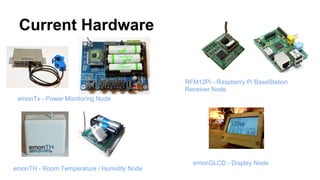
Current Hardware
emonTH - Room Temperature / Humidity Node
emonTx - Power Monitoring Node
RFM12Pi - Raspberry Pi BaseStation
Receiver Node
emonGLCD - Display Node
Current Hardware
Separate Sensor and Base Station
Advantages
● Base station can be located next
to ADSL router and connected
with Ethernet
● Easily add additional wireless
nodes
Disadvantages
● Wireless comms between units
added extra layer of complication
● Increased cost
● Wireless range can be issue
● More units = more potential
things to go wrong!
Introducing: emonPi
● Combined power monitoring and
Raspberry Pi base station
● All-in-one power monitoring
solution
● Integrated 2.5” HDD for local
logging and webserver
● Complement current emonTx
solution
● Raspberry Pi can be connected
via wifi (or Ethernet) for remote
logging
● Optional status LCD
● Open-source design thread http://openenergymonitor.org/emon/node/3937
emonPi - Prototype
https://plus.google.
com/b/114424977493521882459/photos/+OpenenergymonitorOrgpage/albums/5999656723837107313
emonPi - Enclosure Prototype
emonGLCD
● Wireless LCD display
● Useful ‘glanceable’ display
● Real-time indicator of solar PV
import / export
● Built in room temperature sensor
● Easily customisable
● Control buttons
Open-source Customisable -
community developments:
HeatPump Diagram
emonGLCD: http:
//youtu.
be/UrLSAy5oyYw
Heating Control emonGLCD
http://openenergymonitor.blogspot.co.
uk/2013/11/adding-control-to-emoncms-rfm12b-packet.
Current emonGLCD - DIY kit only
emonGLCD - New Version
● Pre-assembled SMT
design
● Nice enclosure
● RGB LCD
● New RFM12B69CW
module
emonGLCD - Enclosure Design
● Low embodied energy
● Medium quantity: batches of 500 - 1000 PCS
● 3D print to prototype
● Injection mould?
● Eco wood plastic? Biodegradable / recyclable
plastic
● Local facilities for prototype design and
manufacture?

OpenEnergyMonitor Hardware Developments May - June 2014

  • 1.
  • 2.
  • 3.
    emonTH - RoomTemperature / Humidity Node emonTx - Power Monitoring Node RFM12Pi - Raspberry Pi BaseStation Receiver Node emonGLCD - Display Node Current Hardware
  • 4.
    Separate Sensor andBase Station Advantages ● Base station can be located next to ADSL router and connected with Ethernet ● Easily add additional wireless nodes Disadvantages ● Wireless comms between units added extra layer of complication ● Increased cost ● Wireless range can be issue ● More units = more potential things to go wrong!
  • 5.
    Introducing: emonPi ● Combinedpower monitoring and Raspberry Pi base station ● All-in-one power monitoring solution ● Integrated 2.5” HDD for local logging and webserver ● Complement current emonTx solution ● Raspberry Pi can be connected via wifi (or Ethernet) for remote logging ● Optional status LCD ● Open-source design thread http://openenergymonitor.org/emon/node/3937
  • 6.
  • 7.
  • 8.
    emonGLCD ● Wireless LCDdisplay ● Useful ‘glanceable’ display ● Real-time indicator of solar PV import / export ● Built in room temperature sensor ● Easily customisable ● Control buttons
  • 9.
    Open-source Customisable - communitydevelopments: HeatPump Diagram emonGLCD: http: //youtu. be/UrLSAy5oyYw Heating Control emonGLCD http://openenergymonitor.blogspot.co. uk/2013/11/adding-control-to-emoncms-rfm12b-packet.
  • 10.
    Current emonGLCD -DIY kit only
  • 11.
    emonGLCD - NewVersion ● Pre-assembled SMT design ● Nice enclosure ● RGB LCD ● New RFM12B69CW module
  • 12.
    emonGLCD - EnclosureDesign ● Low embodied energy ● Medium quantity: batches of 500 - 1000 PCS ● 3D print to prototype ● Injection mould? ● Eco wood plastic? Biodegradable / recyclable plastic ● Local facilities for prototype design and manufacture?