What is regional development policy for and how does it work? 
4th International Conference on Overcoming Regional Disparities “Implementing Regional Development Policies: What are the key factors for success?” 
Chişinǎu, 22 May 2014 
William Tompson 
Head of the Urban Development Programme 
Public Governance and Territorial Development Directorate OECD
What is the problem? 
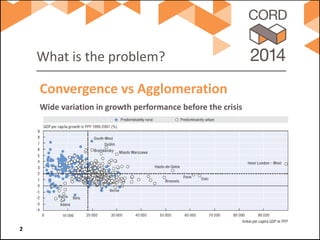
Wide variation in growth performance before the crisis 
Convergence vs Agglomeration 2
What is the problem? 
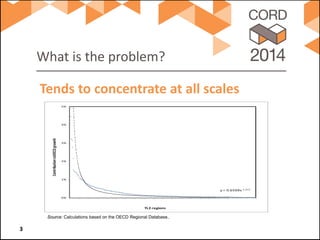
Tends to concentrate at all scales 
3 
y = 0.6509x-1.3110% 1% 2% 3% 4% 5% Contribution toOECD growth TL2 regions 
Source: Calculations based on the OECD Regional Database..
What is the problem? 
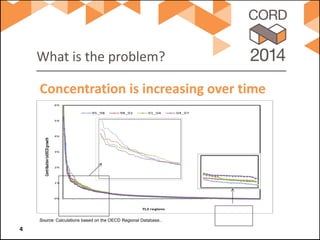
Concentration is increasing over time 
4 
0% 1% 2% 3% 4% 5% 6% Contribution toOECD growth TL2 regions95_9898_0101_0404_07 
Source: Calculations based on the OECD Regional Database..
What is the problem? 
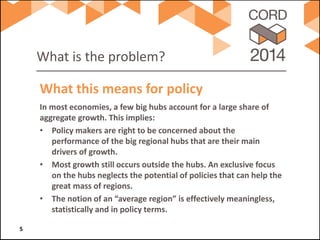
In most economies, a few big hubs account for a large share of aggregate growth. This implies: 
• 
Policy makers are right to be concerned about the performance of the big regional hubs that are their main drivers of growth. 
• 
Most growth still occurs outside the hubs. An exclusive focus on the hubs neglects the potential of policies that can help the great mass of regions. 
• 
The notion of an “average region” is effectively meaningless, statistically and in policy terms. 
What this means for policy 5
What is the problem? 
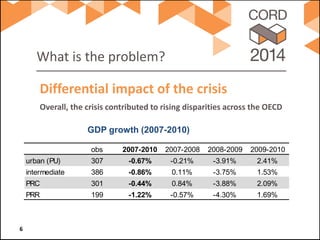
Overall, the crisis contributed to rising disparities across the OECD 
Differential impact of the crisis 6 
obs2007-20102007-20082008-20092009-2010urban (PU)307-0.67%-0.21%-3.91%2.41% intermediate386-0.86%0.11%-3.75%1.53% PRC301-0.44%0.84%-3.88%2.09% PRR199-1.22%-0.57%-4.30%1.69% 
GDP growth (2007-2010)
What is the problem? 
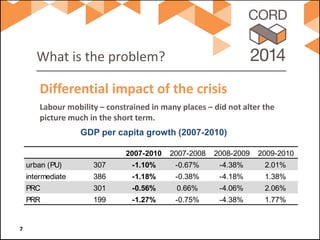
Labour mobility – constrained in many places – did not alter the picture much in the short term. 
Differential impact of the crisis 7 
2007-20102007-20082008-20092009-2010urban (PU)307-1.10%-0.67%-4.38%2.01% intermediate386-1.18%-0.38%-4.18%1.38% PRC301-0.56%0.66%-4.06%2.06% PRR199-1.27%-0.75%-4.38%1.77% 
GDP per capita growth (2007-2010)
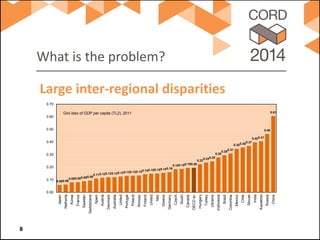
What is the problem? 
0.61 
0.46 
0.41 
0.40 
0.37 
0.36 
0.35 
0.31 
0.29 
0.28 
0.25 
0.24 
0.22 
0.20 
0.19 
0.19 
0.18 
0.16 
0.15 
0.15 
0.15 
0.14 
0.13 
0.13 
0.13 
0.13 
0.12 
0.12 
0.12 
0.11 
0.09 
0.09 
0.08 
0.08 
0.06 
0.06 
0.00 
0.10 
0.20 
0.30 
0.40 
0.50 
0.60 
0.70 
China 
Russia 
Kazakhst… 
India 
Slovak… 
Chile 
Mexico 
Colombia 
Brazil 
Indonesia 
Ukraine 
Turkey 
Hungary 
OECD av 
Canada 
South… 
Czech… 
Germany 
Greece 
Italy 
United… 
Finland 
Norway 
Poland 
Portugal 
United… 
Australia 
Denmark 
Austria 
Spain 
Switzerland 
Sweden 
France 
Korea 
Netherla… 
Japan 
Gini idex of GDP per capita (TL2), 2011 
Large inter-regional disparities 8
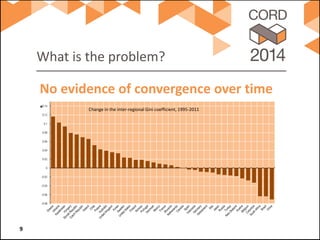
What is the problem? 
• 
Little evidence of convergence over time 
No evidence of convergence over time 9 
-0.08 
-0.06 
-0.04 
-0.02 
0 
0.02 
0.04 
0.06 
0.08 
0.1 
0.12 
0.14 
Change in the inter-regional Gini coefficient, 1995-2011
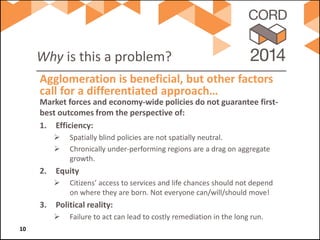
Why is this a problem? 
Market forces and economy-wide policies do not guarantee first- best outcomes from the perspective of: 
1. 
Efficiency: 
 
Spatially blind policies are not spatially neutral. 
 
Chronically under-performing regions are a drag on aggregate growth. 
2. 
Equity 
 
Citizens’ access to services and life chances should not depend on where they are born. Not everyone can/will/should move! 
3. 
Political reality: 
 
Failure to act can lead to costly remediation in the long run. 
Agglomeration is beneficial, but other factors call for a differentiated approach… 10
The solution: unlocking regions’ potential 
• 
Regions compete on absolute advantage. (Forget your Ricardo!) 
• 
This  a need to focus on immobile assets. 
• 
Regional development strategy  relatively immobile assets + policy co-ordination + multi-level governance. 
• 
This is where much stakeholder engagement occurs: information revelation and balancing top-down leadership and bottom-up initiative. 
Designing regional development strategies 11
The solution 
It’s not all about cohesion investments and shiny new infrastructure projects. Good regional development policy is nothing more nor less than good economic policy, without recourse to macroeconomic policy instruments. So think about: 
• 
Entrepreneurship, entry, regulation and competition. 
• 
Education, training and skills. 
• 
Innovation. 
• 
Active labour-market policies. 
Don’t neglect the boring bits 12
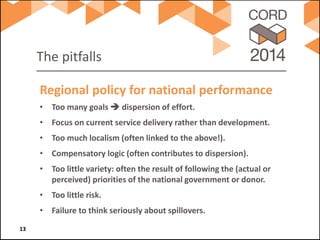
The pitfalls 
• 
Too many goals  dispersion of effort. 
• 
Focus on current service delivery rather than development. 
• 
Too much localism (often linked to the above!). 
• 
Compensatory logic (often contributes to dispersion). 
• 
Too little variety: often the result of following the (actual or perceived) priorities of the national government or donor. 
• 
Too little risk. 
• 
Failure to think seriously about spillovers. 
Regional policy for national performance 13
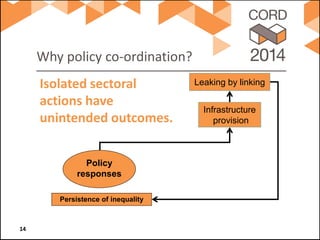
Why policy co-ordination? 
Isolated sectoral actions have unintended outcomes. 14 
Persistence of inequality 
Infrastructure provision 
Leaking by linking 
Policy 
responses
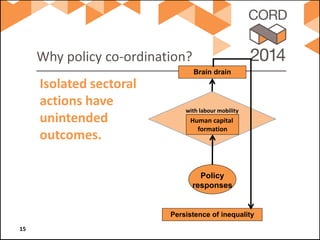
Why policy co-ordination? 
Isolated sectoral actions have unintended outcomes. 15 
with labour mobility 
Persistence of inequality 
Policy responses 
Human capital 
formation 
Brain drain
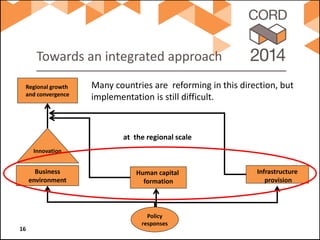
Towards an integrated approach 16 
Infrastructure provision 
Human capital formation 
Business 
environment 
Innovation 
Regional growth and convergence 
at the regional scale 
Many countries are reforming in this direction, but implementation is still difficult. 
Policy 
responses
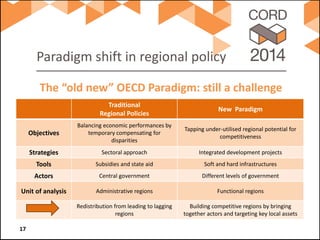
Paradigm shift in regional policy 
The “old new” OECD Paradigm: still a challenge 
17 
Traditional 
Regional Policies 
New Paradigm 
Objectives 
Balancing economic performances by temporary compensating for disparities 
Tapping under-utilised regional potential for competitiveness 
Strategies 
Sectoral approach 
Integrated development projects 
Tools 
Subsidies and state aid 
Soft and hard infrastructures 
Actors 
Central government 
Different levels of government 
Unit of analysis 
Administrative regions 
Functional regions 
Redistribution from leading to lagging regions 
Building competitive regions by bringing together actors and targeting key local assets
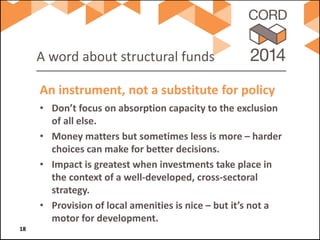
A word about structural funds 
• 
Don’t focus on absorption capacity to the exclusion of all else. 
• 
Money matters but sometimes less is more – harder choices can make for better decisions. 
• 
Impact is greatest when investments take place in the context of a well-developed, cross-sectoral strategy. 
• 
Provision of local amenities is nice – but it’s not a motor for development. 
An instrument, not a substitute for policy 18
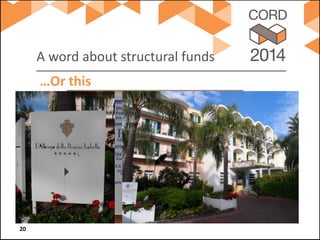
A word about structural funds 
Good practice doesn’t look like this… 19
A word about structural funds 
…Or this 20
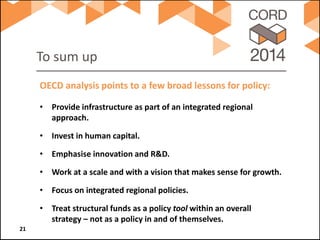
To sum up 
• 
Provide infrastructure as part of an integrated regional approach. 
• 
Invest in human capital. 
• 
Emphasise innovation and R&D. 
• 
Work at a scale and with a vision that makes sense for growth. 
• 
Focus on integrated regional policies. 
• 
Treat structural funds as a policy tool within an overall strategy – not as a policy in and of themselves. 
OECD analysis points to a few broad lessons for policy: 21
Thank you for attention! 
www.cord2014.md

What is regional development policy for and how does it work

  • 1.
    What is regionaldevelopment policy for and how does it work? 4th International Conference on Overcoming Regional Disparities “Implementing Regional Development Policies: What are the key factors for success?” Chişinǎu, 22 May 2014 William Tompson Head of the Urban Development Programme Public Governance and Territorial Development Directorate OECD
  • 2.
    What is theproblem? Wide variation in growth performance before the crisis Convergence vs Agglomeration 2
  • 3.
    What is theproblem? Tends to concentrate at all scales 3 y = 0.6509x-1.3110% 1% 2% 3% 4% 5% Contribution toOECD growth TL2 regions Source: Calculations based on the OECD Regional Database..
  • 4.
    What is theproblem? Concentration is increasing over time 4 0% 1% 2% 3% 4% 5% 6% Contribution toOECD growth TL2 regions95_9898_0101_0404_07 Source: Calculations based on the OECD Regional Database..
  • 5.
    What is theproblem? In most economies, a few big hubs account for a large share of aggregate growth. This implies: • Policy makers are right to be concerned about the performance of the big regional hubs that are their main drivers of growth. • Most growth still occurs outside the hubs. An exclusive focus on the hubs neglects the potential of policies that can help the great mass of regions. • The notion of an “average region” is effectively meaningless, statistically and in policy terms. What this means for policy 5
  • 6.
    What is theproblem? Overall, the crisis contributed to rising disparities across the OECD Differential impact of the crisis 6 obs2007-20102007-20082008-20092009-2010urban (PU)307-0.67%-0.21%-3.91%2.41% intermediate386-0.86%0.11%-3.75%1.53% PRC301-0.44%0.84%-3.88%2.09% PRR199-1.22%-0.57%-4.30%1.69% GDP growth (2007-2010)
  • 7.
    What is theproblem? Labour mobility – constrained in many places – did not alter the picture much in the short term. Differential impact of the crisis 7 2007-20102007-20082008-20092009-2010urban (PU)307-1.10%-0.67%-4.38%2.01% intermediate386-1.18%-0.38%-4.18%1.38% PRC301-0.56%0.66%-4.06%2.06% PRR199-1.27%-0.75%-4.38%1.77% GDP per capita growth (2007-2010)
  • 8.
    What is theproblem? 0.61 0.46 0.41 0.40 0.37 0.36 0.35 0.31 0.29 0.28 0.25 0.24 0.22 0.20 0.19 0.19 0.18 0.16 0.15 0.15 0.15 0.14 0.13 0.13 0.13 0.13 0.12 0.12 0.12 0.11 0.09 0.09 0.08 0.08 0.06 0.06 0.00 0.10 0.20 0.30 0.40 0.50 0.60 0.70 China Russia Kazakhst… India Slovak… Chile Mexico Colombia Brazil Indonesia Ukraine Turkey Hungary OECD av Canada South… Czech… Germany Greece Italy United… Finland Norway Poland Portugal United… Australia Denmark Austria Spain Switzerland Sweden France Korea Netherla… Japan Gini idex of GDP per capita (TL2), 2011 Large inter-regional disparities 8
  • 9.
    What is theproblem? • Little evidence of convergence over time No evidence of convergence over time 9 -0.08 -0.06 -0.04 -0.02 0 0.02 0.04 0.06 0.08 0.1 0.12 0.14 Change in the inter-regional Gini coefficient, 1995-2011
  • 10.
    Why is thisa problem? Market forces and economy-wide policies do not guarantee first- best outcomes from the perspective of: 1. Efficiency:  Spatially blind policies are not spatially neutral.  Chronically under-performing regions are a drag on aggregate growth. 2. Equity  Citizens’ access to services and life chances should not depend on where they are born. Not everyone can/will/should move! 3. Political reality:  Failure to act can lead to costly remediation in the long run. Agglomeration is beneficial, but other factors call for a differentiated approach… 10
  • 11.
    The solution: unlockingregions’ potential • Regions compete on absolute advantage. (Forget your Ricardo!) • This  a need to focus on immobile assets. • Regional development strategy  relatively immobile assets + policy co-ordination + multi-level governance. • This is where much stakeholder engagement occurs: information revelation and balancing top-down leadership and bottom-up initiative. Designing regional development strategies 11
  • 12.
    The solution It’snot all about cohesion investments and shiny new infrastructure projects. Good regional development policy is nothing more nor less than good economic policy, without recourse to macroeconomic policy instruments. So think about: • Entrepreneurship, entry, regulation and competition. • Education, training and skills. • Innovation. • Active labour-market policies. Don’t neglect the boring bits 12
  • 13.
    The pitfalls • Too many goals  dispersion of effort. • Focus on current service delivery rather than development. • Too much localism (often linked to the above!). • Compensatory logic (often contributes to dispersion). • Too little variety: often the result of following the (actual or perceived) priorities of the national government or donor. • Too little risk. • Failure to think seriously about spillovers. Regional policy for national performance 13
  • 14.
    Why policy co-ordination? Isolated sectoral actions have unintended outcomes. 14 Persistence of inequality Infrastructure provision Leaking by linking Policy responses
  • 15.
    Why policy co-ordination? Isolated sectoral actions have unintended outcomes. 15 with labour mobility Persistence of inequality Policy responses Human capital formation Brain drain
  • 16.
    Towards an integratedapproach 16 Infrastructure provision Human capital formation Business environment Innovation Regional growth and convergence at the regional scale Many countries are reforming in this direction, but implementation is still difficult. Policy responses
  • 17.
    Paradigm shift inregional policy The “old new” OECD Paradigm: still a challenge 17 Traditional Regional Policies New Paradigm Objectives Balancing economic performances by temporary compensating for disparities Tapping under-utilised regional potential for competitiveness Strategies Sectoral approach Integrated development projects Tools Subsidies and state aid Soft and hard infrastructures Actors Central government Different levels of government Unit of analysis Administrative regions Functional regions Redistribution from leading to lagging regions Building competitive regions by bringing together actors and targeting key local assets
  • 18.
    A word aboutstructural funds • Don’t focus on absorption capacity to the exclusion of all else. • Money matters but sometimes less is more – harder choices can make for better decisions. • Impact is greatest when investments take place in the context of a well-developed, cross-sectoral strategy. • Provision of local amenities is nice – but it’s not a motor for development. An instrument, not a substitute for policy 18
  • 19.
    A word aboutstructural funds Good practice doesn’t look like this… 19
  • 20.
    A word aboutstructural funds …Or this 20
  • 21.
    To sum up • Provide infrastructure as part of an integrated regional approach. • Invest in human capital. • Emphasise innovation and R&D. • Work at a scale and with a vision that makes sense for growth. • Focus on integrated regional policies. • Treat structural funds as a policy tool within an overall strategy – not as a policy in and of themselves. OECD analysis points to a few broad lessons for policy: 21
  • 22.
    Thank you forattention! www.cord2014.md