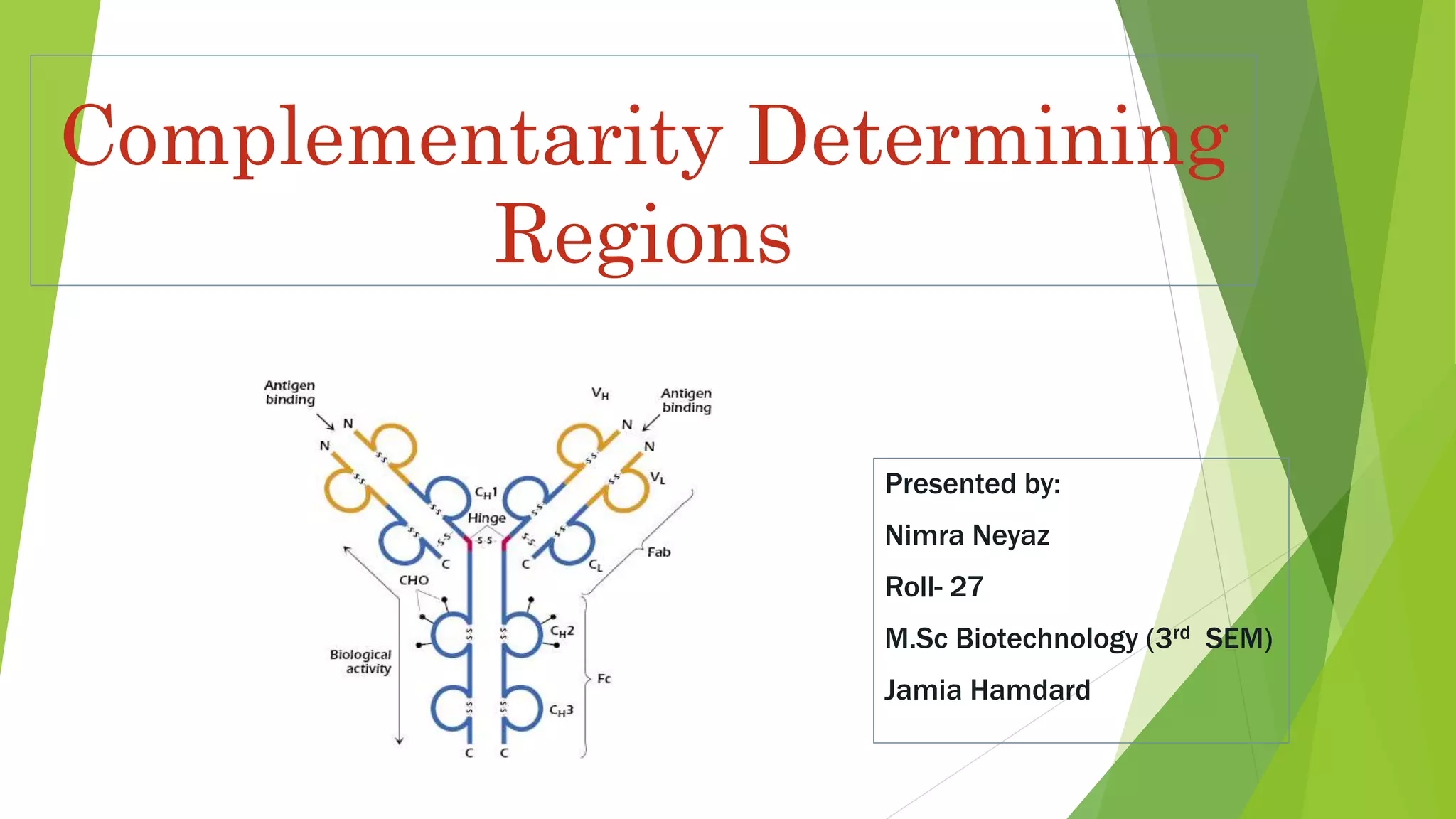
Complementarity Determining
Regions
Presented by:
Nimra Neyaz
Roll- 27
M.Sc Biotechnology (3rd SEM)
Jamia Hamdard
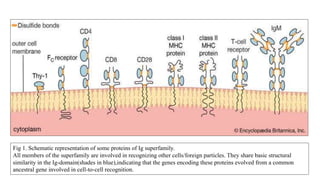
Fig 1. Schematic representation of some proteins of Ig superfamily.
All members of the superfamily are involved in recognizing other cells/foreign particles. They share basic structural
similarity in the Ig-domain(shades in blue),indicating that the genes encoding these proteins evolved from a common
ancestral gene involved in cell-to-cell recognition.
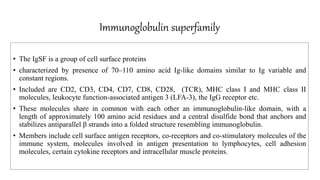
Immunoglobulin superfamily
• The IgSF is a group of cell surface proteins
• characterized by presence of 70–110 amino acid Ig-like domains similar to Ig variable and
constant regions.
• Included are CD2, CD3, CD4, CD7, CD8, CD28, (TCR), MHC class I and MHC class II
molecules, leukocyte function-associated antigen 3 (LFA-3), the IgG receptor etc.
• These molecules share in common with each other an immunoglobulin-like domain, with a
length of approximately 100 amino acid residues and a central disulfide bond that anchors and
stabilizes antiparallel β strands into a folded structure resembling immunoglobulin.
• Members include cell surface antigen receptors, co-receptors and co-stimulatory molecules of the
immune system, molecules involved in antigen presentation to lymphocytes, cell adhesion
molecules, certain cytokine receptors and intracellular muscle proteins.
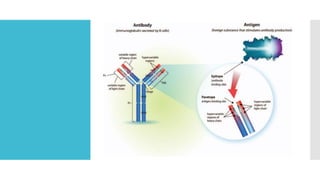
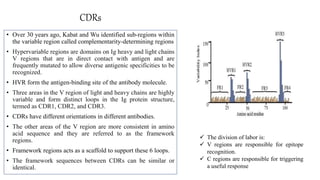
• Over 30 years ago, Kabat and Wu identified sub-regions within
the variable region called complementarity-determining regions
• Hypervariable regions are domains on Ig heavy and light chains
V regions that are in direct contact with antigen and are
frequently mutated to allow diverse antigenic specificities to be
recognized.
• HVR form the antigen-binding site of the antibody molecule.
• Three areas in the V region of light and heavy chains are highly
variable and form distinct loops in the Ig protein structure,
termed as CDR1, CDR2, and CDR3.
• CDRs have different orientations in different antibodies.
• The other areas of the V region are more consistent in amino
acid sequence and they are referred to as the framework
regions.
• Framework regions acts as a scaffold to support these 6 loops.
• The framework sequences between CDRs can be similar or
identical.
CDRs
 The division of labor is:
 V regions are responsible for epitope
recognition.
 C regions are responsible for triggering
a useful response
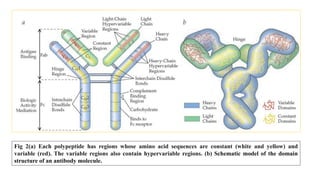
Fig 2(a) Each polypeptide has regions whose amino acid sequences are constant (white and yellow) and
variable (red). The variable regions also contain hypervariable regions. (b) Schematic model of the domain
structure of an antibody molecule.
Diversity
• The specificity of a particular antibody, i.e. what the antibody recognises, is determined by the shape of
its variable region ; a particular antibody will bind to a protein that has a region with a complementary
structure to the antibody’s own variable region
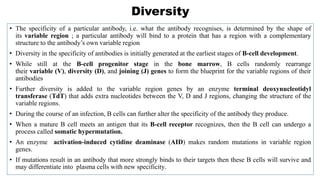
• Diversity in the specificity of antibodies is initially generated at the earliest stages of B-cell development.
• While still at the B-cell progenitor stage in the bone marrow, B cells randomly rearrange
their variable (V), diversity (D), and joining (J) genes to form the blueprint for the variable regions of their
antibodies
• Further diversity is added to the variable region genes by an enzyme terminal deoxynucleotidyl
transferase (TdT) that adds extra nucleotides between the V, D and J regions, changing the structure of the
variable regions.
• During the course of an infection, B cells can further alter the specificity of the antibody they produce.
• When a mature B cell meets an antigen that its B-cell receptor recognizes, then the B cell can undergo a
process called somatic hypermutation.
• An enzyme activation-induced cytidine deaminase (AID) makes random mutations in variable region
genes.
• If mutations result in an antibody that more strongly binds to their targets then these B cells will survive and
may differentiate into plasma cells with new specificity.
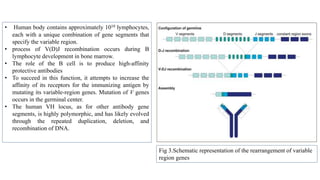
Fig 3.Schematic representation of the rearrangement of variable
region genes
• Human body contains approximately 1010 lymphocytes,
each with a unique combination of gene segments that
specify the variable region.
• process of V(D)J recombination occurs during B
lymphocyte development in bone marrow.
• The role of the B cell is to produce high-affinity
protective antibodies
• To succeed in this function, it attempts to increase the
affinity of its receptors for the immunizing antigen by
mutating its variable-region genes. Mutation of V genes
occurs in the germinal center.
• The human VH locus, as for other antibody gene
segments, is highly polymorphic, and has likely evolved
through the repeated duplication, deletion, and
recombination of DNA.
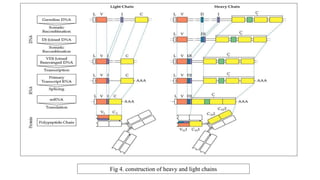
Fig 4. construction of heavy and light chains
Affinity maturation and Somatic
hypermutation
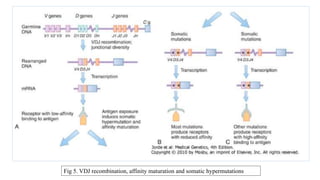
Fig 5. VDJ recombination, affinity maturation and somatic hypermutations
• Somatic hypermutation involves introduction of point mutations into V regions of rapidly
proliferating B‐cells in the germinal centers of Lymphoid follicles.
• Antigen‐driven somatic hypermutation of variable immunoglobulin genes can result in an increase
in binding affinity of the B‐cell receptor for its cognate ligand.
• affinity maturation is the process by which B cells produce antibodies with increased affinity for
antigen during the course of an immune response.
• With repeated exposures to the same antigen, a host will produce antibodies of successively
greater affinities.
• Somatic hypermutation occurs at a high rate, thought to be on the order of about 1 × 10⁻³
mutations per base‐pair per generation, which is approximately 106 times higher than the mutation
rate of cellular housekeeping genes
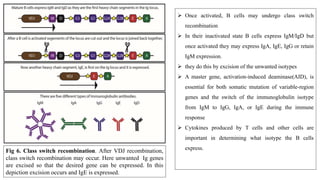
 Once activated, B cells may undergo class switch
recombination
 In their inactivated state B cells express IgM/IgD but
once activated they may express IgA, IgE, IgG or retain
IgM expression.
 they do this by excision of the unwanted isotypes
 A master gene, activation-induced deaminase(AID), is
essential for both somatic mutation of variable-region
genes and the switch of the immunoglobulin isotype
from IgM to IgG, IgA, or IgE during the immune
response
 Cytokines produced by T cells and other cells are
important in determining what isotype the B cells
express.Fig 6. Class switch recombination. After VDJ recombination,
class switch recombination may occur. Here unwanted Ig genes
are excised so that the desired gene can be expressed. In this
depiction excision occurs and IgE is expressed.
Complementarity Determining Regions

Complementarity Determining Regions

  • 1.
    Complementarity Determining Regions Presented by: NimraNeyaz Roll- 27 M.Sc Biotechnology (3rd SEM) Jamia Hamdard
  • 3.
    Fig 1. Schematicrepresentation of some proteins of Ig superfamily. All members of the superfamily are involved in recognizing other cells/foreign particles. They share basic structural similarity in the Ig-domain(shades in blue),indicating that the genes encoding these proteins evolved from a common ancestral gene involved in cell-to-cell recognition.
  • 4.
    Immunoglobulin superfamily • TheIgSF is a group of cell surface proteins • characterized by presence of 70–110 amino acid Ig-like domains similar to Ig variable and constant regions. • Included are CD2, CD3, CD4, CD7, CD8, CD28, (TCR), MHC class I and MHC class II molecules, leukocyte function-associated antigen 3 (LFA-3), the IgG receptor etc. • These molecules share in common with each other an immunoglobulin-like domain, with a length of approximately 100 amino acid residues and a central disulfide bond that anchors and stabilizes antiparallel β strands into a folded structure resembling immunoglobulin. • Members include cell surface antigen receptors, co-receptors and co-stimulatory molecules of the immune system, molecules involved in antigen presentation to lymphocytes, cell adhesion molecules, certain cytokine receptors and intracellular muscle proteins.
  • 5.
    • Over 30years ago, Kabat and Wu identified sub-regions within the variable region called complementarity-determining regions • Hypervariable regions are domains on Ig heavy and light chains V regions that are in direct contact with antigen and are frequently mutated to allow diverse antigenic specificities to be recognized. • HVR form the antigen-binding site of the antibody molecule. • Three areas in the V region of light and heavy chains are highly variable and form distinct loops in the Ig protein structure, termed as CDR1, CDR2, and CDR3. • CDRs have different orientations in different antibodies. • The other areas of the V region are more consistent in amino acid sequence and they are referred to as the framework regions. • Framework regions acts as a scaffold to support these 6 loops. • The framework sequences between CDRs can be similar or identical. CDRs  The division of labor is:  V regions are responsible for epitope recognition.  C regions are responsible for triggering a useful response
  • 6.
    Fig 2(a) Eachpolypeptide has regions whose amino acid sequences are constant (white and yellow) and variable (red). The variable regions also contain hypervariable regions. (b) Schematic model of the domain structure of an antibody molecule.
  • 7.
    Diversity • The specificityof a particular antibody, i.e. what the antibody recognises, is determined by the shape of its variable region ; a particular antibody will bind to a protein that has a region with a complementary structure to the antibody’s own variable region • Diversity in the specificity of antibodies is initially generated at the earliest stages of B-cell development. • While still at the B-cell progenitor stage in the bone marrow, B cells randomly rearrange their variable (V), diversity (D), and joining (J) genes to form the blueprint for the variable regions of their antibodies • Further diversity is added to the variable region genes by an enzyme terminal deoxynucleotidyl transferase (TdT) that adds extra nucleotides between the V, D and J regions, changing the structure of the variable regions. • During the course of an infection, B cells can further alter the specificity of the antibody they produce. • When a mature B cell meets an antigen that its B-cell receptor recognizes, then the B cell can undergo a process called somatic hypermutation. • An enzyme activation-induced cytidine deaminase (AID) makes random mutations in variable region genes. • If mutations result in an antibody that more strongly binds to their targets then these B cells will survive and may differentiate into plasma cells with new specificity.
  • 8.
    Fig 3.Schematic representationof the rearrangement of variable region genes • Human body contains approximately 1010 lymphocytes, each with a unique combination of gene segments that specify the variable region. • process of V(D)J recombination occurs during B lymphocyte development in bone marrow. • The role of the B cell is to produce high-affinity protective antibodies • To succeed in this function, it attempts to increase the affinity of its receptors for the immunizing antigen by mutating its variable-region genes. Mutation of V genes occurs in the germinal center. • The human VH locus, as for other antibody gene segments, is highly polymorphic, and has likely evolved through the repeated duplication, deletion, and recombination of DNA.
  • 9.
    Fig 4. constructionof heavy and light chains
  • 10.
    Affinity maturation andSomatic hypermutation
  • 11.
    Fig 5. VDJrecombination, affinity maturation and somatic hypermutations
  • 12.
    • Somatic hypermutationinvolves introduction of point mutations into V regions of rapidly proliferating B‐cells in the germinal centers of Lymphoid follicles. • Antigen‐driven somatic hypermutation of variable immunoglobulin genes can result in an increase in binding affinity of the B‐cell receptor for its cognate ligand. • affinity maturation is the process by which B cells produce antibodies with increased affinity for antigen during the course of an immune response. • With repeated exposures to the same antigen, a host will produce antibodies of successively greater affinities. • Somatic hypermutation occurs at a high rate, thought to be on the order of about 1 × 10⁻³ mutations per base‐pair per generation, which is approximately 106 times higher than the mutation rate of cellular housekeeping genes
  • 13.
     Once activated,B cells may undergo class switch recombination  In their inactivated state B cells express IgM/IgD but once activated they may express IgA, IgE, IgG or retain IgM expression.  they do this by excision of the unwanted isotypes  A master gene, activation-induced deaminase(AID), is essential for both somatic mutation of variable-region genes and the switch of the immunoglobulin isotype from IgM to IgG, IgA, or IgE during the immune response  Cytokines produced by T cells and other cells are important in determining what isotype the B cells express.Fig 6. Class switch recombination. After VDJ recombination, class switch recombination may occur. Here unwanted Ig genes are excised so that the desired gene can be expressed. In this depiction excision occurs and IgE is expressed.