Uncertainty Reduction
Theory
May 23, 2023
INTRODUCTION
The Uncertainty Reduction Theory is a
communication theory that aims to explain how
people use communication strategies to reduce
their uncertainty regarding other people.
• It is also known as Initial Interaction Theory.
• First introduced In1975
• Proposed by Charles R. Berger, professor of communication at
University of California, Davis, USA
HISTORICAL BACKGROUND
Charles R. Berger
New relationship causes uncertainty
•01
 Uncertainty is uncomfortable
 People communicate to alleviate
discomfort
In attempting to reduce that uncertainty, people tend to utilize
passive, active, and interactive strategies to help predict and
explain someone’s behavior during an interaction.
•A passive strategy : Observe the target and determining
information based upon those observations.
• A active strategy : Ask someone for information or from
the social media.
•An interactive strategy : Face-to-face interaction or talk
directly to the target.
Berger notes that there are two kinds of
uncertainty you will face as you set out for your
first meeting. These are;
Behavioral uncertainty
Cognitive uncertainty
Your Date Here Your Footer Here 6
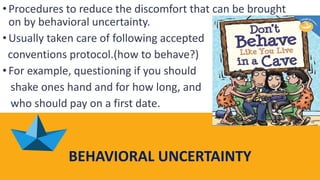
BEHAVIORAL UNCERTAINTY
7
•Procedures to reduce the discomfort that can be brought
on by behavioral uncertainty.
•Usually taken care of following accepted
conventions protocol.(how to behave?)
•For example, questioning if you should
shake ones hand and for how long, and
who should pay on a first date.
COGNITIVE UNCERTAINTY
•Usually taken care of by
acquiring more information
about others.
(who is this person?)
Berger then proposed a series of axioms (self-evident truths that
require no additional proof) to explain the connection between his
central concept of uncertainty and eight key variables of relationship
development. These are;
1. Verbal Communication – basic talking
2. Nonverbal Warmth – eye contact, smiles
3. Information Seeking – observing words and actions
4. Self-Disclosure – attitudes, values, beliefs, feelings
5. Reciprocity – mutuality
6. Similarity – common likes, same quality
7. Liking – Do like/dislike this person?
8. Shared Network – family and friends involvements
AXIOM 1: VERBAL COMMUNICATION
As verbal Communication between strangers increases,
uncertainty for each will decrease.
AXIOM 2: NONVERBAL WARMTH
As nonverbal warmth (expressiveness) increases,
uncertainty level will decrease in an initial interaction.
AXIOM 3: INFORMATION SEEKING
High level of uncertainty cause increases information-
seeking behavior.
AXIOM 4: SELF - DISCLOSURE
High level of uncertainty in a relationship cause
decreases in the attachment level.
High level of uncertainty produce high rates of reciprocity.
AXIOM 5: RECIPROCITY
Similarities between individuals reduces uncertainty.
AXIOM 6: SIMILARITY
Increase in uncertainty level produce decreases in liking.
AXIOM 7: LIKING
Shared communication networks reduces uncertainty,
While lack of shared networks increases uncertainty.
AXIOM 8: SHARED NETWOEKS
Uncertainty Reduction Theory.pptx

Uncertainty Reduction Theory.pptx

  • 1.
  • 2.
    INTRODUCTION The Uncertainty ReductionTheory is a communication theory that aims to explain how people use communication strategies to reduce their uncertainty regarding other people. • It is also known as Initial Interaction Theory.
  • 3.
    • First introducedIn1975 • Proposed by Charles R. Berger, professor of communication at University of California, Davis, USA HISTORICAL BACKGROUND Charles R. Berger
  • 4.
    New relationship causesuncertainty •01  Uncertainty is uncomfortable  People communicate to alleviate discomfort
  • 5.
    In attempting toreduce that uncertainty, people tend to utilize passive, active, and interactive strategies to help predict and explain someone’s behavior during an interaction. •A passive strategy : Observe the target and determining information based upon those observations. • A active strategy : Ask someone for information or from the social media. •An interactive strategy : Face-to-face interaction or talk directly to the target.
  • 6.
    Berger notes thatthere are two kinds of uncertainty you will face as you set out for your first meeting. These are; Behavioral uncertainty Cognitive uncertainty Your Date Here Your Footer Here 6
  • 7.
    BEHAVIORAL UNCERTAINTY 7 •Procedures toreduce the discomfort that can be brought on by behavioral uncertainty. •Usually taken care of following accepted conventions protocol.(how to behave?) •For example, questioning if you should shake ones hand and for how long, and who should pay on a first date.
  • 8.
    COGNITIVE UNCERTAINTY •Usually takencare of by acquiring more information about others. (who is this person?)
  • 9.
    Berger then proposeda series of axioms (self-evident truths that require no additional proof) to explain the connection between his central concept of uncertainty and eight key variables of relationship development. These are; 1. Verbal Communication – basic talking 2. Nonverbal Warmth – eye contact, smiles 3. Information Seeking – observing words and actions 4. Self-Disclosure – attitudes, values, beliefs, feelings 5. Reciprocity – mutuality 6. Similarity – common likes, same quality 7. Liking – Do like/dislike this person? 8. Shared Network – family and friends involvements
  • 10.
    AXIOM 1: VERBALCOMMUNICATION As verbal Communication between strangers increases, uncertainty for each will decrease.
  • 11.
    AXIOM 2: NONVERBALWARMTH As nonverbal warmth (expressiveness) increases, uncertainty level will decrease in an initial interaction.
  • 12.
    AXIOM 3: INFORMATIONSEEKING High level of uncertainty cause increases information- seeking behavior.
  • 13.
    AXIOM 4: SELF- DISCLOSURE High level of uncertainty in a relationship cause decreases in the attachment level.
  • 14.
    High level ofuncertainty produce high rates of reciprocity. AXIOM 5: RECIPROCITY
  • 15.
    Similarities between individualsreduces uncertainty. AXIOM 6: SIMILARITY
  • 16.
    Increase in uncertaintylevel produce decreases in liking. AXIOM 7: LIKING
  • 17.
    Shared communication networksreduces uncertainty, While lack of shared networks increases uncertainty. AXIOM 8: SHARED NETWOEKS

Editor's Notes

  • #2 Success is a journey, not a destination 
  • #3 Success is a journey, not a destination 
  • #4 Success is a journey, not a destination 
  • #5 Success is a journey, not a destination 
  • #6 Success is a journey, not a destination 
  • #7 Success is a journey, not a destination 
  • #9 Success is a journey, not a destination 
  • #10 Success is a journey, not a destination 
  • #11 Success is a journey, not a destination 
  • #12 Success is a journey, not a destination 
  • #13 Success is a journey, not a destination 
  • #14 Success is a journey, not a destination 
  • #15 Success is a journey, not a destination 
  • #16 Success is a journey, not a destination 
  • #17 Success is a journey, not a destination 
  • #18 Success is a journey, not a destination 
  • #19 THANK YOU 