
A PAPER PRESENTATION
                     ON

         PEDIATRIC ASTHMA
                      BY
             Mr. NAMDEO SHINDE
                      M. Pharm

SATARA COLLEGE OF PHARMACY DEGAON, SATARA.(MH)
                     INDIA.
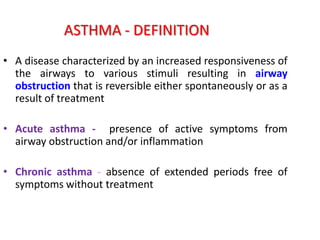
ASTHMA - DEFINITION
• A disease characterized by an increased responsiveness of
  the airways to various stimuli resulting in airway
  obstruction that is reversible either spontaneously or as a
  result of treatment

• Acute asthma - presence of active symptoms from
  airway obstruction and/or inflammation

• Chronic asthma - absence of extended periods free of
  symptoms without treatment
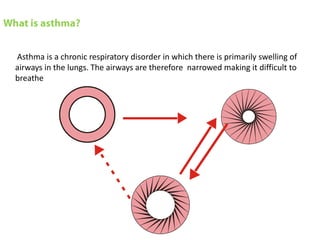
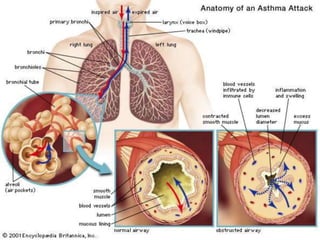
Asthma is a chronic respiratory disorder in which there is primarily swelling of
airways in the lungs. The airways are therefore narrowed making it difficult to
breathe          Normal                              Inflamed (untreated)


              Regular
              Inhaled
              Steroid                               Partly
                                                    Treated
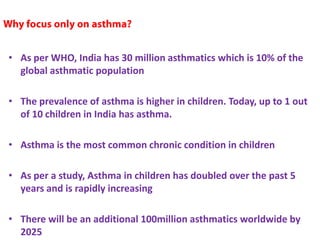
• As per WHO, India has 30 million asthmatics which is 10% of the
  global asthmatic population

• The prevalence of asthma is higher in children. Today, up to 1 out
  of 10 children in India has asthma.

• Asthma is the most common chronic condition in children

• As per a study, Asthma in children has doubled over the past 5
  years and is rapidly increasing

• There will be an additional 100million asthmatics worldwide by
  2025
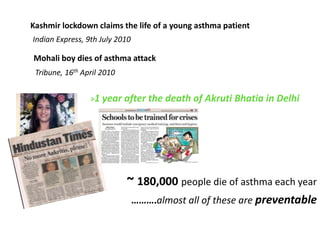
Kashmir lockdown claims the life of a young asthma patient
Indian Express, 9th July 2010

Mohali boy dies of asthma attack
 Tribune, 16th April 2010


                 >1 year    after the death of Akruti Bhatia in Delhi


                            ~ 180,000 people die of asthma each year
                                ……….almost all of these are preventable
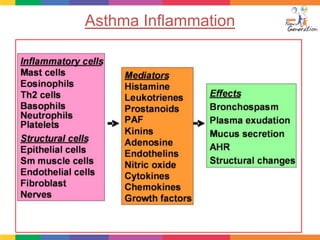
Asthma Inflammation
Factors Influencing the Development
                    and Expression of Asthma

     Host factors –

•    Genetic

    1. Genes predisposing to atopy

    2.   Genes predisposing to airway hyper responsiveness

• Obesity

• Sex
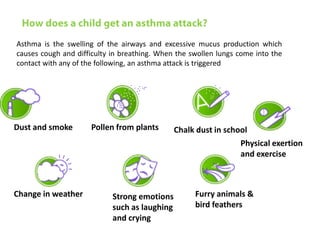
Asthma is the swelling of the airways and excessive mucus production which
causes cough and difficulty in breathing. When the swollen lungs come into the
contact with any of the following, an asthma attack is triggered


Dust and smoke       Pollen from plants        Chalk dust in school
                                                                 Physical exertion
                                                                 and exercise


Change in weather           Strong emotions         Furry animals &
                            such as laughing        bird feathers
                            and crying
Other Challenges
• Most of the children are below 5 years of age, who cannot tell
  their problems

• Parents are proxy story teller, who may mislead the doctor

• PEF cannot be performed in children below 5 years of age

• Fear of addiction to inhalation therapy

• Physicians lack of knowledge and time
Risk factors of Asthma in younger children
• Sensitization to allergen.


• Maternal diet during pregnancy and/ or lactation.


• Pollutants (particularly environmental tobacco smoke).


• Microbes and their products.


• Respiratory (viral) infections.


• Psychosocial factors.
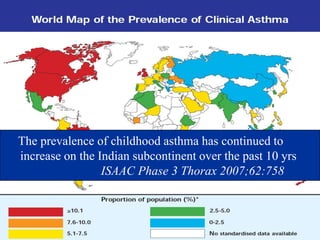
The prevalence of childhood asthma has continued to
increase on the Indian subcontinent over the past 10 yrs
                 ISAAC Phase 3 Thorax 2007;62:758
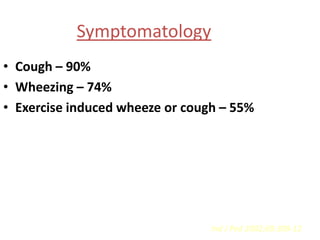
Symptomatology
• Cough – 90%
• Wheezing – 74%
• Exercise induced wheeze or cough – 55%


                                 Ind J Ped 2002;69:309-12
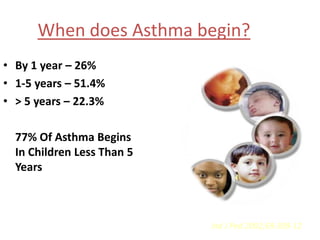
When does Asthma begin?
• By 1 year – 26%
• 1-5 years – 51.4%
• > 5 years – 22.3%

  77% Of Asthma Begins
  In Children Less Than 5
  Years


                            Ind J Ped 2002;69:309-12
Physical Examination (Look)
• General Attitude And Well Being

• Deformity Of The Chest

• Character Of Breathing

• Thorough Auscultation Of Breath Sounds

• Signs Of Any Other Allergic Disorders On The Body

• Growth And Development Status
                           CHILDHOOD ASTHMA by KHUBCHANDANI R.P. et al
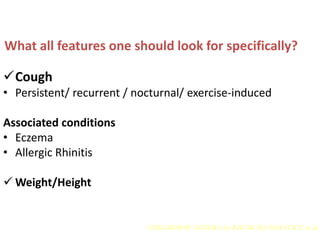
What all features one should look for specifically?

Cough
• Persistent/ recurrent / nocturnal/ exercise-induced

Associated conditions
• Eczema
• Allergic Rhinitis

 Weight/Height


                            CHILDHOOD ASTHMA by KHUBCHANDANI R.P. et al
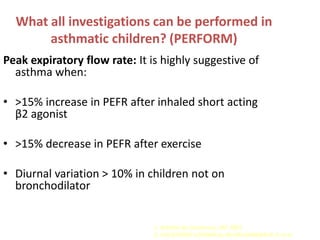
What all investigations can be performed in
       asthmatic children? (PERFORM)
Peak expiratory flow rate: It is highly suggestive of
  asthma when:

• >15% increase in PEFR after inhaled short acting
  β2 agonist

• >15% decrease in PEFR after exercise

• Diurnal variation > 10% in children not on
  bronchodilator                      OR
  >20% In children on bronchodilator

                               1. Asthma by Consensus, IAP 2003
                               2. CHILDHOOD ASTHMA by KHUBCHANDANI R.P. et al
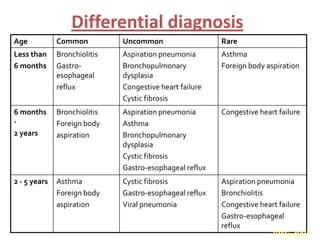
Differential diagnosis
Age           Common          Uncommon                   Rare
Less than     Bronchiolitis   Aspiration pneumonia       Asthma
6 months      Gastro-         Bronchopulmonary           Foreign body aspiration
              esophageal      dysplasia
              reflux          Congestive heart failure
                              Cystic fibrosis
6 months      Bronchiolitis   Aspiration pneumonia       Congestive heart failure
-             Foreign body    Asthma
2 years       aspiration      Bronchopulmonary
                              dysplasia
                              Cystic fibrosis
                              Gastro-esophageal reflux
2 - 5 years   Asthma          Cystic fibrosis            Aspiration pneumonia
              Foreign body    Gastro-esophageal reflux   Bronchiolitis
              aspiration      Viral pneumonia            Congestive heart failure
                                                         Gastro-esophageal
                                                         reflux
                                                                        IPAG 2007
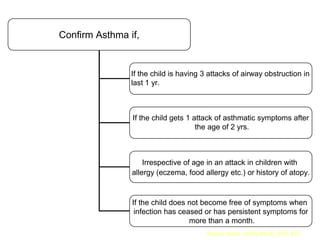
Confirm Asthma if,


                If the child is having 3 attacks of airway obstruction in
                last 1 yr.


                If the child gets 1 attack of asthmatic symptoms after
                                     the age of 2 yrs.


                    Irrespective of age in an attack in children with
                allergy (eczema, food allergy etc.) or history of atopy.


                If the child does not become free of symptoms when
                 infection has ceased or has persistent symptoms for
                                  more than a month.
                                        Respir Med. 2000;94(4):299-327
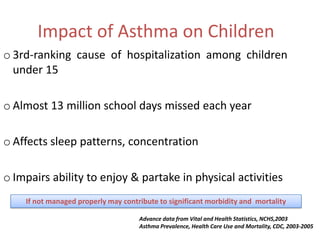
Impact of Asthma on Children
o 3rd-ranking cause of hospitalization among children
  under 15

o Almost 13 million school days missed each year

o Affects sleep patterns, concentration

o Impairs ability to enjoy & partake in physical activities
    If not managed properly may contribute to significant morbidity and mortality

                                     Advance data from Vital and Health Statistics, NCHS,2003
                                     Asthma Prevalence, Health Care Use and Mortality, CDC, 2003-2005
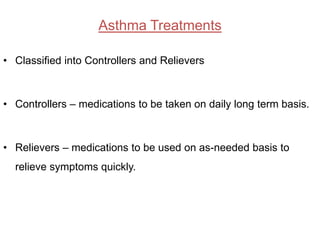
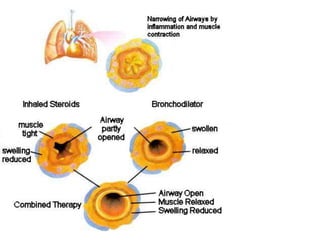
Asthma Treatments

• Classified into Controllers and Relievers


• Controllers – medications to be taken on daily long term basis.


• Relievers – medications to be used on as-needed basis to
  relieve symptoms quickly.
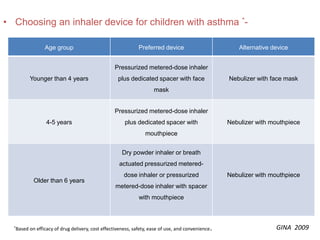
• Choosing an inhaler device for children with asthma *-

                  Age group                                    Preferred device                           Alternative device


                                                    Pressurized metered-dose inhaler
           Younger than 4 years                      plus dedicated spacer with face                  Nebulizer with face mask
                                                                      mask


                                                    Pressurized metered-dose inhaler
                  4-5 years                             plus dedicated spacer with                    Nebulizer with mouthpiece
                                                                  mouthpiece


                                                       Dry powder inhaler or breath
                                                      actuated pressurized metered-
                                                        dose inhaler or pressurized                   Nebulizer with mouthpiece
            Older than 6 years
                                                    metered-dose inhaler with spacer
                                                               with mouthpiece


  *Based   on efficacy of drug delivery, cost effectiveness, safety, ease of use, and convenience .                    GINA 2009
Asthma management and prevention
• The goals for successful management of asthma are

   1. Achieve and maintain control of symptoms


   2. Maintain normal activity levels, including exercise


   3. Avoid adverse effects from asthma medications


   4. Prevent asthma mortality
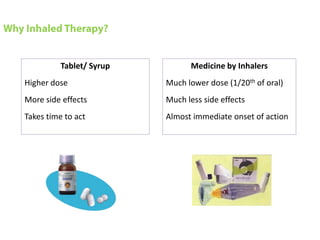
Tablet/ Syrup         Medicine by Inhalers
Higher dose               Much lower dose (1/20th of oral)
More side effects         Much less side effects
Takes time to act         Almost immediate onset of action
To summarize…

Diagnosis

• Asthma is an inflammatory illness

• Diagnosis of asthma is clinical, and relies on history

• All asthma does not wheeze

• In children < 3 yrs, WALRI is an important differential diagnosis

• 2 out of 3 children outgrow their asthma

• A family history of asthma / atopy increases risk of asthma
To summarize…
Long term management
 • Patient education is a very important part of asthma management
 • Drugs control, but do not cure asthma
 • Clinical grading over time, decides long term management plan
 • Mild intermittent asthma does not merit controllers
 • Inhaled steroids are mainstay of long term asthma management
 • Treatment should be stepped up or stepped down depending upon patient
    response
CONCLUSION
     So, today an asthma patient in
Any interiors of India can be given the
      same quality of treatment
       as an asthma patient in
                New York

    … and far more economically
Cipla has created an educational website with the help of
   doctors


                 www.breathefree.com

          Please inform one and all about the website
REFERENCES
www.medicinenet.com/asthma
www.mayoclinic.com/health/childhood-asthma/DS00849
www.bbc.co.uk/news/health-21067532
en.wikipedia.org/wiki/Asthma
http://www.mayoclinic.com/health/childhood-asthma/DS00849
http://en.wikipedia.org/wiki/Asthma
http://www.nhs.uk/conditions/Asthma-in-children/
http://www.patient.co.uk/doctor/diagnosing-childhood-asthma
http://www.medicalnewstoday.com/articles/257110.php
http://www.bbc.co.uk/news/health-21067532
http://www.noattacks.org/
http://www.environmentalhealthnews.org/ehs/news/2013/asthma-
www.healthecare.us/Asthma
http://www.bcguidelines.ca/pdf/asthma.pdf
Thank You

Asthma ppt

  • 1.
    A PAPER PRESENTATION ON PEDIATRIC ASTHMA BY Mr. NAMDEO SHINDE M. Pharm SATARA COLLEGE OF PHARMACY DEGAON, SATARA.(MH) INDIA.
  • 2.
    ASTHMA - DEFINITION •A disease characterized by an increased responsiveness of the airways to various stimuli resulting in airway obstruction that is reversible either spontaneously or as a result of treatment • Acute asthma - presence of active symptoms from airway obstruction and/or inflammation • Chronic asthma - absence of extended periods free of symptoms without treatment
  • 3.
    Asthma is achronic respiratory disorder in which there is primarily swelling of airways in the lungs. The airways are therefore narrowed making it difficult to breathe Normal Inflamed (untreated) Regular Inhaled Steroid Partly Treated
  • 4.
    • As perWHO, India has 30 million asthmatics which is 10% of the global asthmatic population • The prevalence of asthma is higher in children. Today, up to 1 out of 10 children in India has asthma. • Asthma is the most common chronic condition in children • As per a study, Asthma in children has doubled over the past 5 years and is rapidly increasing • There will be an additional 100million asthmatics worldwide by 2025
  • 5.
    Kashmir lockdown claimsthe life of a young asthma patient Indian Express, 9th July 2010 Mohali boy dies of asthma attack Tribune, 16th April 2010 >1 year after the death of Akruti Bhatia in Delhi ~ 180,000 people die of asthma each year ……….almost all of these are preventable
  • 7.
  • 8.
    Factors Influencing theDevelopment and Expression of Asthma Host factors – • Genetic 1. Genes predisposing to atopy 2. Genes predisposing to airway hyper responsiveness • Obesity • Sex
  • 9.
    Asthma is theswelling of the airways and excessive mucus production which causes cough and difficulty in breathing. When the swollen lungs come into the contact with any of the following, an asthma attack is triggered Dust and smoke Pollen from plants Chalk dust in school Physical exertion and exercise Change in weather Strong emotions Furry animals & such as laughing bird feathers and crying
  • 10.
    Other Challenges • Mostof the children are below 5 years of age, who cannot tell their problems • Parents are proxy story teller, who may mislead the doctor • PEF cannot be performed in children below 5 years of age • Fear of addiction to inhalation therapy • Physicians lack of knowledge and time
  • 11.
    Risk factors ofAsthma in younger children • Sensitization to allergen. • Maternal diet during pregnancy and/ or lactation. • Pollutants (particularly environmental tobacco smoke). • Microbes and their products. • Respiratory (viral) infections. • Psychosocial factors.
  • 12.
    The prevalence ofchildhood asthma has continued to increase on the Indian subcontinent over the past 10 yrs ISAAC Phase 3 Thorax 2007;62:758
  • 13.
    Symptomatology • Cough –90% • Wheezing – 74% • Exercise induced wheeze or cough – 55% Ind J Ped 2002;69:309-12
  • 14.
    When does Asthmabegin? • By 1 year – 26% • 1-5 years – 51.4% • > 5 years – 22.3% 77% Of Asthma Begins In Children Less Than 5 Years Ind J Ped 2002;69:309-12
  • 15.
    Physical Examination (Look) •General Attitude And Well Being • Deformity Of The Chest • Character Of Breathing • Thorough Auscultation Of Breath Sounds • Signs Of Any Other Allergic Disorders On The Body • Growth And Development Status CHILDHOOD ASTHMA by KHUBCHANDANI R.P. et al
  • 16.
    What all featuresone should look for specifically? Cough • Persistent/ recurrent / nocturnal/ exercise-induced Associated conditions • Eczema • Allergic Rhinitis  Weight/Height CHILDHOOD ASTHMA by KHUBCHANDANI R.P. et al
  • 17.
    What all investigationscan be performed in asthmatic children? (PERFORM) Peak expiratory flow rate: It is highly suggestive of asthma when: • >15% increase in PEFR after inhaled short acting β2 agonist • >15% decrease in PEFR after exercise • Diurnal variation > 10% in children not on bronchodilator OR >20% In children on bronchodilator 1. Asthma by Consensus, IAP 2003 2. CHILDHOOD ASTHMA by KHUBCHANDANI R.P. et al
  • 18.
    Differential diagnosis Age Common Uncommon Rare Less than Bronchiolitis Aspiration pneumonia Asthma 6 months Gastro- Bronchopulmonary Foreign body aspiration esophageal dysplasia reflux Congestive heart failure Cystic fibrosis 6 months Bronchiolitis Aspiration pneumonia Congestive heart failure - Foreign body Asthma 2 years aspiration Bronchopulmonary dysplasia Cystic fibrosis Gastro-esophageal reflux 2 - 5 years Asthma Cystic fibrosis Aspiration pneumonia Foreign body Gastro-esophageal reflux Bronchiolitis aspiration Viral pneumonia Congestive heart failure Gastro-esophageal reflux IPAG 2007
  • 19.
    Confirm Asthma if, If the child is having 3 attacks of airway obstruction in last 1 yr. If the child gets 1 attack of asthmatic symptoms after the age of 2 yrs. Irrespective of age in an attack in children with allergy (eczema, food allergy etc.) or history of atopy. If the child does not become free of symptoms when infection has ceased or has persistent symptoms for more than a month. Respir Med. 2000;94(4):299-327
  • 20.
    Impact of Asthmaon Children o 3rd-ranking cause of hospitalization among children under 15 o Almost 13 million school days missed each year o Affects sleep patterns, concentration o Impairs ability to enjoy & partake in physical activities If not managed properly may contribute to significant morbidity and mortality Advance data from Vital and Health Statistics, NCHS,2003 Asthma Prevalence, Health Care Use and Mortality, CDC, 2003-2005
  • 21.
    Asthma Treatments • Classifiedinto Controllers and Relievers • Controllers – medications to be taken on daily long term basis. • Relievers – medications to be used on as-needed basis to relieve symptoms quickly.
  • 23.
    • Choosing aninhaler device for children with asthma *- Age group Preferred device Alternative device Pressurized metered-dose inhaler Younger than 4 years plus dedicated spacer with face Nebulizer with face mask mask Pressurized metered-dose inhaler 4-5 years plus dedicated spacer with Nebulizer with mouthpiece mouthpiece Dry powder inhaler or breath actuated pressurized metered- dose inhaler or pressurized Nebulizer with mouthpiece Older than 6 years metered-dose inhaler with spacer with mouthpiece *Based on efficacy of drug delivery, cost effectiveness, safety, ease of use, and convenience . GINA 2009
  • 24.
    Asthma management andprevention • The goals for successful management of asthma are 1. Achieve and maintain control of symptoms 2. Maintain normal activity levels, including exercise 3. Avoid adverse effects from asthma medications 4. Prevent asthma mortality
  • 25.
    Tablet/ Syrup Medicine by Inhalers Higher dose Much lower dose (1/20th of oral) More side effects Much less side effects Takes time to act Almost immediate onset of action
  • 26.
    To summarize… Diagnosis • Asthmais an inflammatory illness • Diagnosis of asthma is clinical, and relies on history • All asthma does not wheeze • In children < 3 yrs, WALRI is an important differential diagnosis • 2 out of 3 children outgrow their asthma • A family history of asthma / atopy increases risk of asthma
  • 27.
    To summarize… Long termmanagement • Patient education is a very important part of asthma management • Drugs control, but do not cure asthma • Clinical grading over time, decides long term management plan • Mild intermittent asthma does not merit controllers • Inhaled steroids are mainstay of long term asthma management • Treatment should be stepped up or stepped down depending upon patient response
  • 28.
    CONCLUSION So, today an asthma patient in Any interiors of India can be given the same quality of treatment as an asthma patient in New York … and far more economically
  • 29.
    Cipla has createdan educational website with the help of doctors www.breathefree.com Please inform one and all about the website
  • 30.
  • 31.

Editor's Notes