Group Member
Muhammad Manan28476
SUPPLY CHAIN MANAGEMENT
HUMANITARIAN SUPPLY CHAIN
MANAGEMENT
SUPPLY CHAIN MANAGEMENT
Outline
 What is a Humanitarian supply chain?
 Commercial versus Humanitarian supply chain
 Elements Humanitarian Supply Chain
 Principle Humanitarian Supply Chain
 Typical Humanitarian supply chain
 How To Manage Humanitarian supply chain
 Graphic of a Humanitarian Supply Chain
 Challenges in Humanitarian supply chain
Conclusion
What is a humanitarian supply chain?
The Acquisition,
Storage,
Transportation,
Distribution Of relief items in the time of disaster
is called humanitarian supply chain.
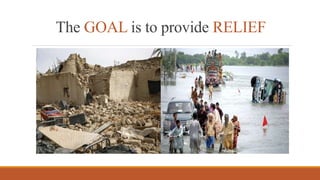
The GOAL is to provide RELIEF
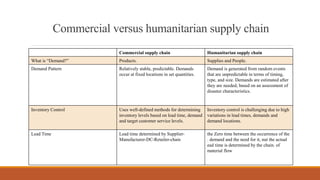
Commercial versus humanitarian supply chain
Commercial supply chain Humanitarian supply chain
What is “Demand?” Products. Supplies and People.
Demand Pattern Relatively stable, predictable. Demands
occur at fixed locations in set quantities.
Demand is generated from random events
that are unpredictable in terms of timing,
type, and size. Demands are estimated after
they are needed, based on an assessment of
disaster characteristics.
Inventory Control Uses well-defined methods for determining
inventory levels based on lead time, demand
and target customer service levels.
Inventory control is challenging due to high
variations in lead times, demands and
demand locations.
Lead Time Lead time determined by Supplier-
Manufacturer-DC-Retailer-chain
the Zero time between the occurrence of the
. demand and the need for it, nut the actual
ead time is determined by the chain. of
material flow
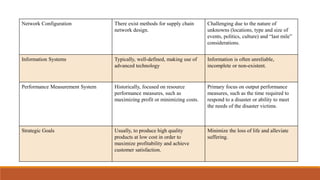
Network Configuration There exist methods for supply chain
network design.
Challenging due to the nature of
unknowns (locations, type and size of
events, politics, culture) and “last mile”
considerations.
Information Systems Typically, well-defined, making use of
advanced technology
Information is often unreliable,
incomplete or non-existent.
Performance Measurement System Historically, focused on resource
performance measures, such as
maximizing profit or minimizing costs.
Primary focus on output performance
measures, such as the time required to
respond to a disaster or ability to meet
the needs of the disaster victims.
Strategic Goals Usually, to produce high quality
products at low cost in order to
maximize profitability and achieve
customer satisfaction.
Minimize the loss of life and alleviate
suffering.
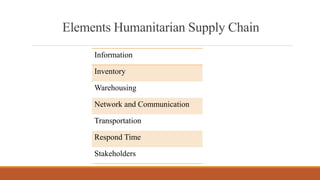
Elements Humanitarian Supply Chain
Information
Inventory
Warehousing
Network and Communication
Transportation
Respond Time
Stakeholders
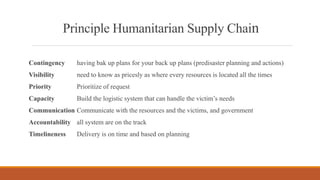
Principle Humanitarian Supply Chain
Contingency having bak up plans for your back up plans (predisaster planning and actions)
Visibility need to know as pricesly as where every resources is located all the times
Priority Prioritize of request
Capacity Build the logistic system that can handle the victim’s needs
Communication Communicate with the resources and the victims, and government
Accountability all system are on the track
Timelineness Delivery is on time and based on planning
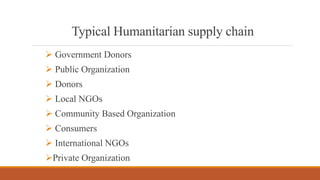
Typical Humanitarian supply chain
 Government Donors
 Public Organization
 Donors
 Local NGOs
 Community Based Organization
 Consumers
 International NGOs
Private Organization
How To Manage Humanitarian supply chain
 Mitigation
 Preparation
 Response
 Reconstruction
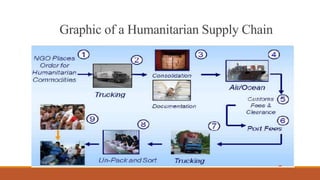
Graphic of a Humanitarian Supply Chain
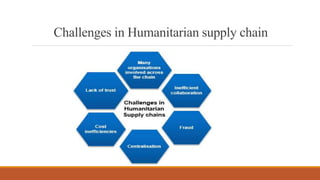
Challenges in Humanitarian supply chain
Conclusion
Many Humanitarian Organizations also realized the value of utilizing integrated
technology systems to capture and analyze information resulting in a more
effective and efficient relief effort.
The analysis also mentioned that relief efforts need more attention on the
following areas: Assessment, collaboration, human resources and supply chain
analysis.
The Relief Supply Chain response and to integrate, coordinate, collaborate and
communicate between all the functions of the relief chain.

humanitarian supply chain management

  • 1.
  • 2.
  • 3.
    Outline  What isa Humanitarian supply chain?  Commercial versus Humanitarian supply chain  Elements Humanitarian Supply Chain  Principle Humanitarian Supply Chain  Typical Humanitarian supply chain  How To Manage Humanitarian supply chain  Graphic of a Humanitarian Supply Chain  Challenges in Humanitarian supply chain Conclusion
  • 4.
    What is ahumanitarian supply chain? The Acquisition, Storage, Transportation, Distribution Of relief items in the time of disaster is called humanitarian supply chain.
  • 5.
    The GOAL isto provide RELIEF
  • 6.
    Commercial versus humanitariansupply chain Commercial supply chain Humanitarian supply chain What is “Demand?” Products. Supplies and People. Demand Pattern Relatively stable, predictable. Demands occur at fixed locations in set quantities. Demand is generated from random events that are unpredictable in terms of timing, type, and size. Demands are estimated after they are needed, based on an assessment of disaster characteristics. Inventory Control Uses well-defined methods for determining inventory levels based on lead time, demand and target customer service levels. Inventory control is challenging due to high variations in lead times, demands and demand locations. Lead Time Lead time determined by Supplier- Manufacturer-DC-Retailer-chain the Zero time between the occurrence of the . demand and the need for it, nut the actual ead time is determined by the chain. of material flow
  • 7.
    Network Configuration Thereexist methods for supply chain network design. Challenging due to the nature of unknowns (locations, type and size of events, politics, culture) and “last mile” considerations. Information Systems Typically, well-defined, making use of advanced technology Information is often unreliable, incomplete or non-existent. Performance Measurement System Historically, focused on resource performance measures, such as maximizing profit or minimizing costs. Primary focus on output performance measures, such as the time required to respond to a disaster or ability to meet the needs of the disaster victims. Strategic Goals Usually, to produce high quality products at low cost in order to maximize profitability and achieve customer satisfaction. Minimize the loss of life and alleviate suffering.
  • 8.
    Elements Humanitarian SupplyChain Information Inventory Warehousing Network and Communication Transportation Respond Time Stakeholders
  • 9.
    Principle Humanitarian SupplyChain Contingency having bak up plans for your back up plans (predisaster planning and actions) Visibility need to know as pricesly as where every resources is located all the times Priority Prioritize of request Capacity Build the logistic system that can handle the victim’s needs Communication Communicate with the resources and the victims, and government Accountability all system are on the track Timelineness Delivery is on time and based on planning
  • 10.
    Typical Humanitarian supplychain  Government Donors  Public Organization  Donors  Local NGOs  Community Based Organization  Consumers  International NGOs Private Organization
  • 11.
    How To ManageHumanitarian supply chain  Mitigation  Preparation  Response  Reconstruction
  • 12.
    Graphic of aHumanitarian Supply Chain
  • 13.
  • 14.
    Conclusion Many Humanitarian Organizationsalso realized the value of utilizing integrated technology systems to capture and analyze information resulting in a more effective and efficient relief effort. The analysis also mentioned that relief efforts need more attention on the following areas: Assessment, collaboration, human resources and supply chain analysis. The Relief Supply Chain response and to integrate, coordinate, collaborate and communicate between all the functions of the relief chain.