Classification of Coleoptera –
Suborders; Adephaga (Carabidae, Cicindellidae,
Dytiscidae and Gyrinidae )
V.Mugunthan
2021004067
Coleoptera
It is also known as Elytroptera.
Coleo – Sheath; Ptera – wing.
It is the largest order contains 40% of known species in
Insecta and also more than 3,30,000 described.
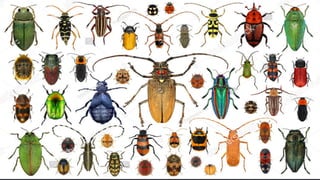
The common names are beetles, weevils.
It can be found everywhere such as land, air, water etc...,
It includes predators, scavengers and many crop pests
which can also damage stored products.
Characters of Order Coleoptera
Size – Minute to large.
Antenna – 11 segmented.
Mouthparts – Chewing type.
Mandibles are short with blunt teeth at the mesal
face in phytophagous group.
In predators mandibles are long, sharply pointed with
blade like inner ridge.
In pollen feeders – teeth absent and mandibles
covered with stiff hairs.
In many species mandibles sexually dimorphic.
Characters of Order Coleoptera
Head – Primitively prognathous, sometimes
hypognathous, heavily sclerotized and of varied shape
Eyes – Compound eyes (present or absent)
Forewings – Heavily sclerotized, veinless and hardened
elytra. It is not used for flight.
Hindwings – Membranous with few veins and are useful
in flight.
In some weevils and ground beetles the fore wings are
fused and the hind wings are atrophied.
Characters of Order Coleoptera
Prothorax – large, distinct and mobile.
Mesothorax and Metathorax – fused with first
abdominal segment.
Forewings fused and hindwings atrophied in weevils
and ground beetles.
Cerci and distinct ovipositor absent.
Metamorphosis – Complete
Life stages : eggs – grub – pupa – adult
Four basic larval types :campodeiform, eruciform,
scarabaeiform and apodous.
Classification of Coleoptera
The order Coleoptera can be classified into four
suborders namely
1)Suborder Adephaga
2)Suborder Archostemata
3)Suborder Myxophaga
4)Suborder Polyphaga
Suborder Adephaga
Domain : Eukaryota
Kingdom : Animalia
Phylum : Arthropoda
Class : Insecta
Order : Coleoptera
Suborder : Adephaga
Adephaga
The Adephaga are a suborder of beetles and with
more than 40,000 recorded species in 10 families, the
second largest of the four beetle suborders.
They are devourers.
Hindwings with an oblongum.
Notopleural sulcus on prothorax.
Segmented urogomphi – present in most species.
Families of Suborder Adephaga
i. Family Cicindellidae
ii. Family Carabidae
iii. Family Dytiscidae
iv. Family Gyrinidae
FAMILY CICINDELIDAE: (Tiger beetles – Grubs
and adults – predators.)
Head – wider than prothorax.
Eyes – larger and have very keen vision.
Mandibles – long, sharply pointed, sickle shaped and
acutely toothed for capturing.
Legs – long and tarsi slender which are enable to run
fast.
Elytra without grooves and rows of punctures. Elytra
– spots and stripes.
Tiger beetle
FAMILY CARABIDAE: (Ground beetles)
 They are known as ground beetles.
 Adults – Black, some brightly spotted.
 Fused elytra and atrophied HW.
 Legs suited for running.
 Larvae – caliper like mandibles, well developed legs and
terminal cerci like structures – urogomphi.
 Nocturnal – Ground beetles – voracious predators.
 Six spotted carabid : Anthia sexguttata.
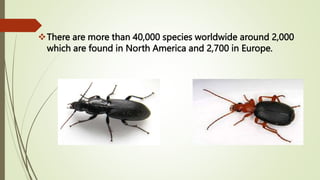
There are more than 40,000 species worldwide around 2,000
which are found in North America and 2,700 in Europe.
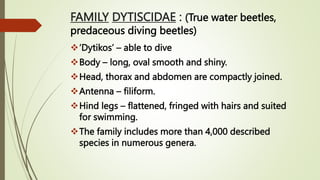
FAMILY DYTISCIDAE : (True water beetles,
predaceous diving beetles)
‘Dytikos’ – able to dive
Body – long, oval smooth and shiny.
Head, thorax and abdomen are compactly joined.
Antenna – filiform.
Hind legs – flattened, fringed with hairs and suited
for swimming.
The family includes more than 4,000 described
species in numerous genera.
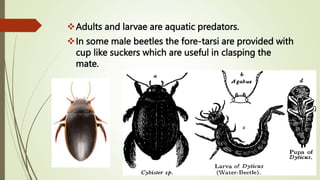
Adults and larvae are aquatic predators.
In some male beetles the fore-tarsi are provided with
cup like suckers which are useful in clasping the
mate.
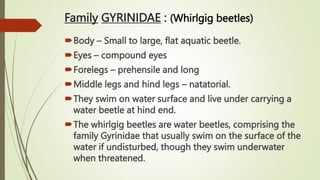
Family GYRINIDAE : (Whirlgig beetles)
Body – Small to large, flat aquatic beetle.
Eyes – compound eyes
Forelegs – prehensile and long
Middle legs and hind legs – natatorial.
They swim on water surface and live under carrying a
water beetle at hind end.
The whirlgig beetles are water beetles, comprising the
family Gyrinidae that usually swim on the surface of the
water if undisturbed, though they swim underwater
when threatened.
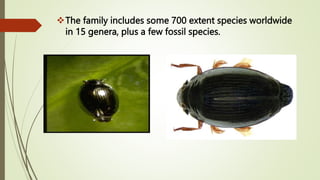
The family includes some 700 extent species worldwide
in 15 genera, plus a few fossil species.
Thank You

Classification of Coleoptera – suborders.pptx

  • 1.
    Classification of Coleoptera– Suborders; Adephaga (Carabidae, Cicindellidae, Dytiscidae and Gyrinidae ) V.Mugunthan 2021004067
  • 2.
    Coleoptera It is alsoknown as Elytroptera. Coleo – Sheath; Ptera – wing. It is the largest order contains 40% of known species in Insecta and also more than 3,30,000 described. The common names are beetles, weevils. It can be found everywhere such as land, air, water etc..., It includes predators, scavengers and many crop pests which can also damage stored products.
  • 4.
    Characters of OrderColeoptera Size – Minute to large. Antenna – 11 segmented. Mouthparts – Chewing type. Mandibles are short with blunt teeth at the mesal face in phytophagous group. In predators mandibles are long, sharply pointed with blade like inner ridge. In pollen feeders – teeth absent and mandibles covered with stiff hairs. In many species mandibles sexually dimorphic.
  • 5.
    Characters of OrderColeoptera Head – Primitively prognathous, sometimes hypognathous, heavily sclerotized and of varied shape Eyes – Compound eyes (present or absent) Forewings – Heavily sclerotized, veinless and hardened elytra. It is not used for flight. Hindwings – Membranous with few veins and are useful in flight. In some weevils and ground beetles the fore wings are fused and the hind wings are atrophied.
  • 6.
    Characters of OrderColeoptera Prothorax – large, distinct and mobile. Mesothorax and Metathorax – fused with first abdominal segment. Forewings fused and hindwings atrophied in weevils and ground beetles. Cerci and distinct ovipositor absent. Metamorphosis – Complete Life stages : eggs – grub – pupa – adult Four basic larval types :campodeiform, eruciform, scarabaeiform and apodous.
  • 7.
    Classification of Coleoptera Theorder Coleoptera can be classified into four suborders namely 1)Suborder Adephaga 2)Suborder Archostemata 3)Suborder Myxophaga 4)Suborder Polyphaga
  • 8.
    Suborder Adephaga Domain :Eukaryota Kingdom : Animalia Phylum : Arthropoda Class : Insecta Order : Coleoptera Suborder : Adephaga
  • 9.
    Adephaga The Adephaga area suborder of beetles and with more than 40,000 recorded species in 10 families, the second largest of the four beetle suborders. They are devourers. Hindwings with an oblongum. Notopleural sulcus on prothorax. Segmented urogomphi – present in most species.
  • 10.
    Families of SuborderAdephaga i. Family Cicindellidae ii. Family Carabidae iii. Family Dytiscidae iv. Family Gyrinidae
  • 11.
    FAMILY CICINDELIDAE: (Tigerbeetles – Grubs and adults – predators.) Head – wider than prothorax. Eyes – larger and have very keen vision. Mandibles – long, sharply pointed, sickle shaped and acutely toothed for capturing. Legs – long and tarsi slender which are enable to run fast. Elytra without grooves and rows of punctures. Elytra – spots and stripes.
  • 12.
  • 13.
    FAMILY CARABIDAE: (Groundbeetles)  They are known as ground beetles.  Adults – Black, some brightly spotted.  Fused elytra and atrophied HW.  Legs suited for running.  Larvae – caliper like mandibles, well developed legs and terminal cerci like structures – urogomphi.  Nocturnal – Ground beetles – voracious predators.  Six spotted carabid : Anthia sexguttata.
  • 14.
    There are morethan 40,000 species worldwide around 2,000 which are found in North America and 2,700 in Europe.
  • 15.
    FAMILY DYTISCIDAE :(True water beetles, predaceous diving beetles) ‘Dytikos’ – able to dive Body – long, oval smooth and shiny. Head, thorax and abdomen are compactly joined. Antenna – filiform. Hind legs – flattened, fringed with hairs and suited for swimming. The family includes more than 4,000 described species in numerous genera.
  • 16.
    Adults and larvaeare aquatic predators. In some male beetles the fore-tarsi are provided with cup like suckers which are useful in clasping the mate.
  • 17.
    Family GYRINIDAE :(Whirlgig beetles) Body – Small to large, flat aquatic beetle. Eyes – compound eyes Forelegs – prehensile and long Middle legs and hind legs – natatorial. They swim on water surface and live under carrying a water beetle at hind end. The whirlgig beetles are water beetles, comprising the family Gyrinidae that usually swim on the surface of the water if undisturbed, though they swim underwater when threatened.
  • 18.
    The family includessome 700 extent species worldwide in 15 genera, plus a few fossil species.
  • 19.