REPRESENTATION -
SEXUALITY
What do these words mean?
 homosexual
 heterosexual
 bisexual
 asexual
 straight
 gay
 lesbian
Can you think of examples from TV drama?
SEXUALITY
 …..A name for the sexual feelings and behaviour of a
person
 .….When applied to groups of people (e.g.
heterosexuals/homosexuals/bisexuals) ideas of social
attitude and organisation are implied. (Nelmes, J.,
Introduction to Film Studies (Routledge 2007) )
 Despite changing equality laws and a wider acceptance of different
sexualities within much of society, TV has always remained quite conservative
as they are scared of offending their viewers.
 Heterosexual (straight) characters are represented as the “norm” and
homosexual (gay) characters are often represented as being different,
strange, or separate from mainstream society.
 Some critics say that when TV does feature gay characters, they are never
just characters that “happen to be gay.” Their sexuality always plays a key
part in their storylines and they don’t seem to have any issues outside of their
sexuality.
What are the common stereotypes of
the following?
 Heterosexual women
 Heterosexual men
 Homosexual women (lesbian)
 Homosexual men (gay)
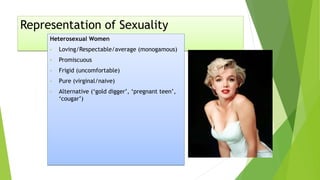
Representation of Sexuality
Heterosexual Women
• Loving/Respectable/average (monogamous)
• Promiscuous
• Frigid (uncomfortable)
• Pure (virginal/naive)
• Alternative (‘gold digger’, ‘pregnant teen’,
‘cougar’)
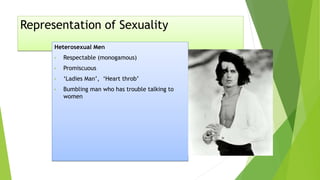
Representation of Sexuality
Heterosexual Men
• Respectable (monogamous)
• Promiscuous
• ‘Ladies Man’, ‘Heart throb’
• Bumbling man who has trouble talking to
women
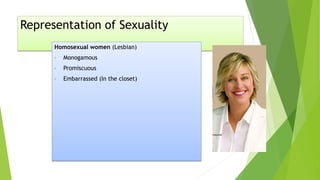
Representation of Sexuality
Homosexual women (Lesbian)
• Monogamous
• Promiscuous
• Embarrassed (In the closet)
Representation of Sexuality
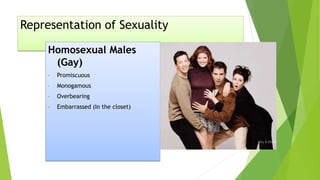
Homosexual Males
(Gay)
• Promiscuous
• Monogamous
• Overbearing
• Embarrassed (In the closet)
Representation of Sexuality
Important points to consider
• Gender closely ties in with sexuality.
• Sexuality is often expressed through physical
means; clothes, props, setting, acting.
• Understanding how a particular characters gender is
constructed will help you analyse how their
sexuality is being represented.
 As society has developed, and times have changed, so
has the representation of sexuality in TV Dramas.
 However, Gay and lesbian characters are often
marginalised and are seen as supporting characters.
 It is sometimes difficult for the characters to grow and
develop.
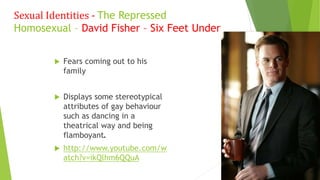
 Fears coming out to his
family
 Displays some stereotypical
attributes of gay behaviour
such as dancing in a
theatrical way and being
flamboyant.
 http://www.youtube.com/w
atch?v=ikQlhm6QQuA
Sexual Identities - The Repressed
Homosexual – David Fisher – Six Feet Under
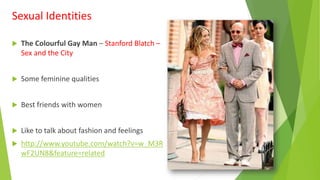
 The Colourful Gay Man – Stanford Blatch –
Sex and the City
 Some feminine qualities
 Best friends with women
 Like to talk about fashion and feelings
 http://www.youtube.com/watch?v=w_M3R
wF2UN8&feature=related
Sexual Identities
Sexual Identities
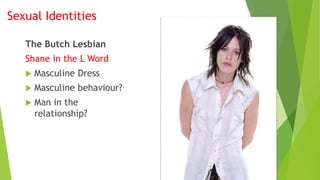
The Butch Lesbian
Shane in the L Word
 Masculine Dress
 Masculine behaviour?
 Man in the
relationship?
Sexual Identities
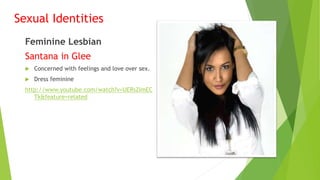
Feminine Lesbian
Santana in Glee
 Concerned with feelings and love over sex.
 Dress feminine
http://www.youtube.com/watch?v=UERsZImEC
Tk&feature=related
QUESTIONS TO CONSIDER
 Can I identify what the sexualities of the characters are?
 Are people of different sexualities shown as having different interests,
personalities, attitudes, behaviours? If so, how?
 Is their sexuality represented as being important in their life?
 Are particular sexualities represented as being normal / powerful / better? If
so, how?
 Are particular sexualities represented as being abnormal? If so, how?
 What is the message the clip is trying to portray about sexuality?
 Don’t forget that “straight” is a sexuality too. Don’t ignore the straight
characters as they need to be analysed too!
Research examples of the different types of
sexuality represented in British and
American TV drama.
Key words:
 homosexual
 heterosexual
 bisexual
 asexual
 straight
 gay
 lesbian

Representation sexuality

  • 1.
  • 2.
    What do thesewords mean?  homosexual  heterosexual  bisexual  asexual  straight  gay  lesbian Can you think of examples from TV drama?
  • 3.
    SEXUALITY  …..A namefor the sexual feelings and behaviour of a person  .….When applied to groups of people (e.g. heterosexuals/homosexuals/bisexuals) ideas of social attitude and organisation are implied. (Nelmes, J., Introduction to Film Studies (Routledge 2007) )
  • 4.
     Despite changingequality laws and a wider acceptance of different sexualities within much of society, TV has always remained quite conservative as they are scared of offending their viewers.  Heterosexual (straight) characters are represented as the “norm” and homosexual (gay) characters are often represented as being different, strange, or separate from mainstream society.  Some critics say that when TV does feature gay characters, they are never just characters that “happen to be gay.” Their sexuality always plays a key part in their storylines and they don’t seem to have any issues outside of their sexuality.
  • 5.
    What are thecommon stereotypes of the following?  Heterosexual women  Heterosexual men  Homosexual women (lesbian)  Homosexual men (gay)
  • 6.
    Representation of Sexuality HeterosexualWomen • Loving/Respectable/average (monogamous) • Promiscuous • Frigid (uncomfortable) • Pure (virginal/naive) • Alternative (‘gold digger’, ‘pregnant teen’, ‘cougar’)
  • 7.
    Representation of Sexuality HeterosexualMen • Respectable (monogamous) • Promiscuous • ‘Ladies Man’, ‘Heart throb’ • Bumbling man who has trouble talking to women
  • 8.
    Representation of Sexuality Homosexualwomen (Lesbian) • Monogamous • Promiscuous • Embarrassed (In the closet)
  • 9.
    Representation of Sexuality HomosexualMales (Gay) • Promiscuous • Monogamous • Overbearing • Embarrassed (In the closet)
  • 10.
    Representation of Sexuality Importantpoints to consider • Gender closely ties in with sexuality. • Sexuality is often expressed through physical means; clothes, props, setting, acting. • Understanding how a particular characters gender is constructed will help you analyse how their sexuality is being represented.
  • 11.
     As societyhas developed, and times have changed, so has the representation of sexuality in TV Dramas.  However, Gay and lesbian characters are often marginalised and are seen as supporting characters.  It is sometimes difficult for the characters to grow and develop.
  • 12.
     Fears comingout to his family  Displays some stereotypical attributes of gay behaviour such as dancing in a theatrical way and being flamboyant.  http://www.youtube.com/w atch?v=ikQlhm6QQuA Sexual Identities - The Repressed Homosexual – David Fisher – Six Feet Under
  • 13.
     The ColourfulGay Man – Stanford Blatch – Sex and the City  Some feminine qualities  Best friends with women  Like to talk about fashion and feelings  http://www.youtube.com/watch?v=w_M3R wF2UN8&feature=related Sexual Identities
  • 14.
    Sexual Identities The ButchLesbian Shane in the L Word  Masculine Dress  Masculine behaviour?  Man in the relationship?
  • 15.
    Sexual Identities Feminine Lesbian Santanain Glee  Concerned with feelings and love over sex.  Dress feminine http://www.youtube.com/watch?v=UERsZImEC Tk&feature=related
  • 16.
    QUESTIONS TO CONSIDER Can I identify what the sexualities of the characters are?  Are people of different sexualities shown as having different interests, personalities, attitudes, behaviours? If so, how?  Is their sexuality represented as being important in their life?  Are particular sexualities represented as being normal / powerful / better? If so, how?  Are particular sexualities represented as being abnormal? If so, how?  What is the message the clip is trying to portray about sexuality?  Don’t forget that “straight” is a sexuality too. Don’t ignore the straight characters as they need to be analysed too!
  • 17.
    Research examples ofthe different types of sexuality represented in British and American TV drama. Key words:  homosexual  heterosexual  bisexual  asexual  straight  gay  lesbian