Project
Management
(Basics for all)
⮚ WHAT IS PROJECT & PROJ. MGT.
⮚ 9 KNOWLEDGE AREAS OF PROJ. MGT.
⮚ PROJ. COMPLETION- SUCCESS/FAILURE
⮚ WHY PM STANDARDS - PMBOK / SCRUM
AGENDA
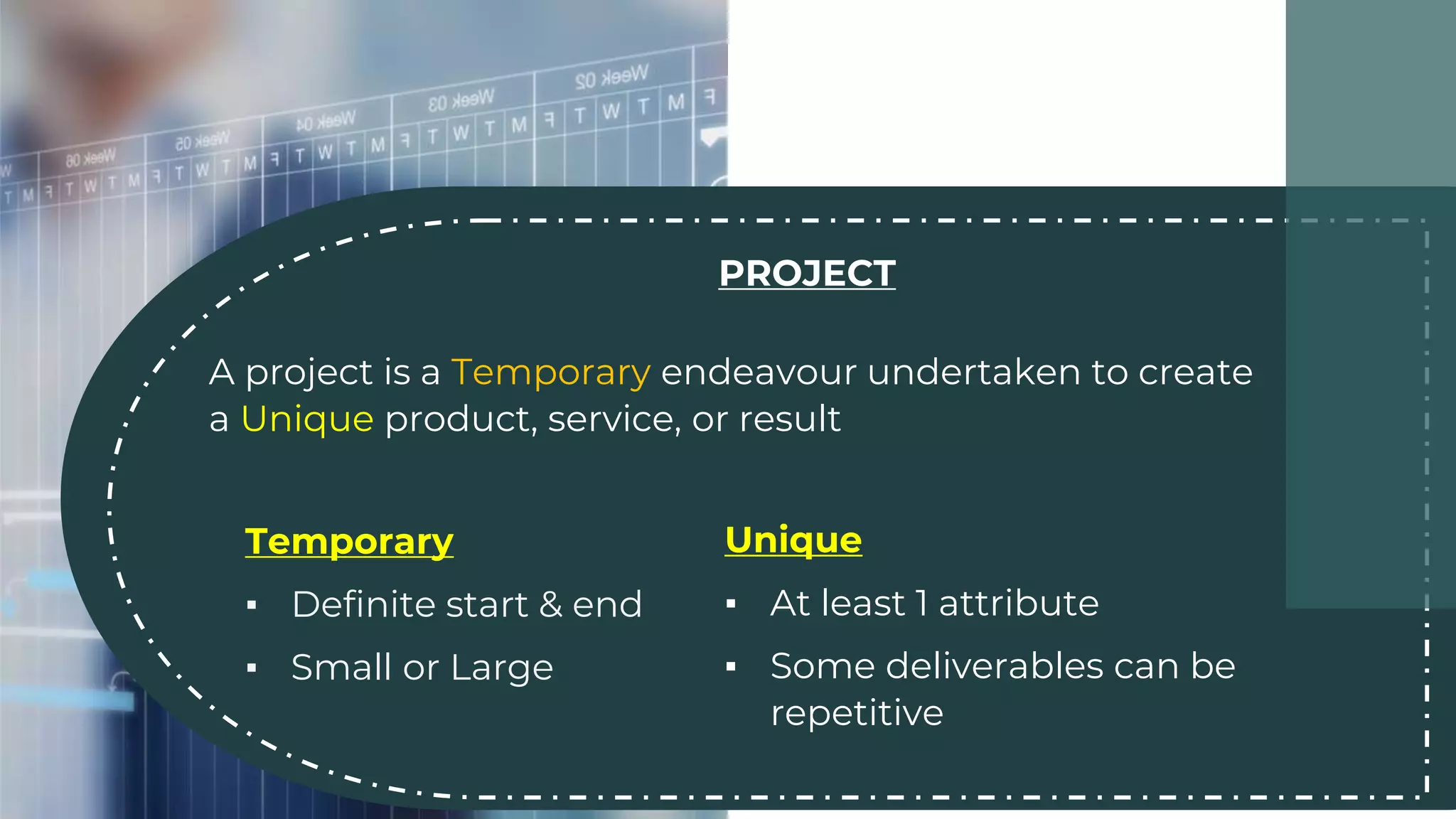
PROJECT
A project is a Temporary endeavour undertaken to create
a Unique product, service, or result
Temporary
▪ Definite start & end
▪ Small or Large
Unique
▪ At least 1 attribute
▪ Some deliverables can be
repetitive
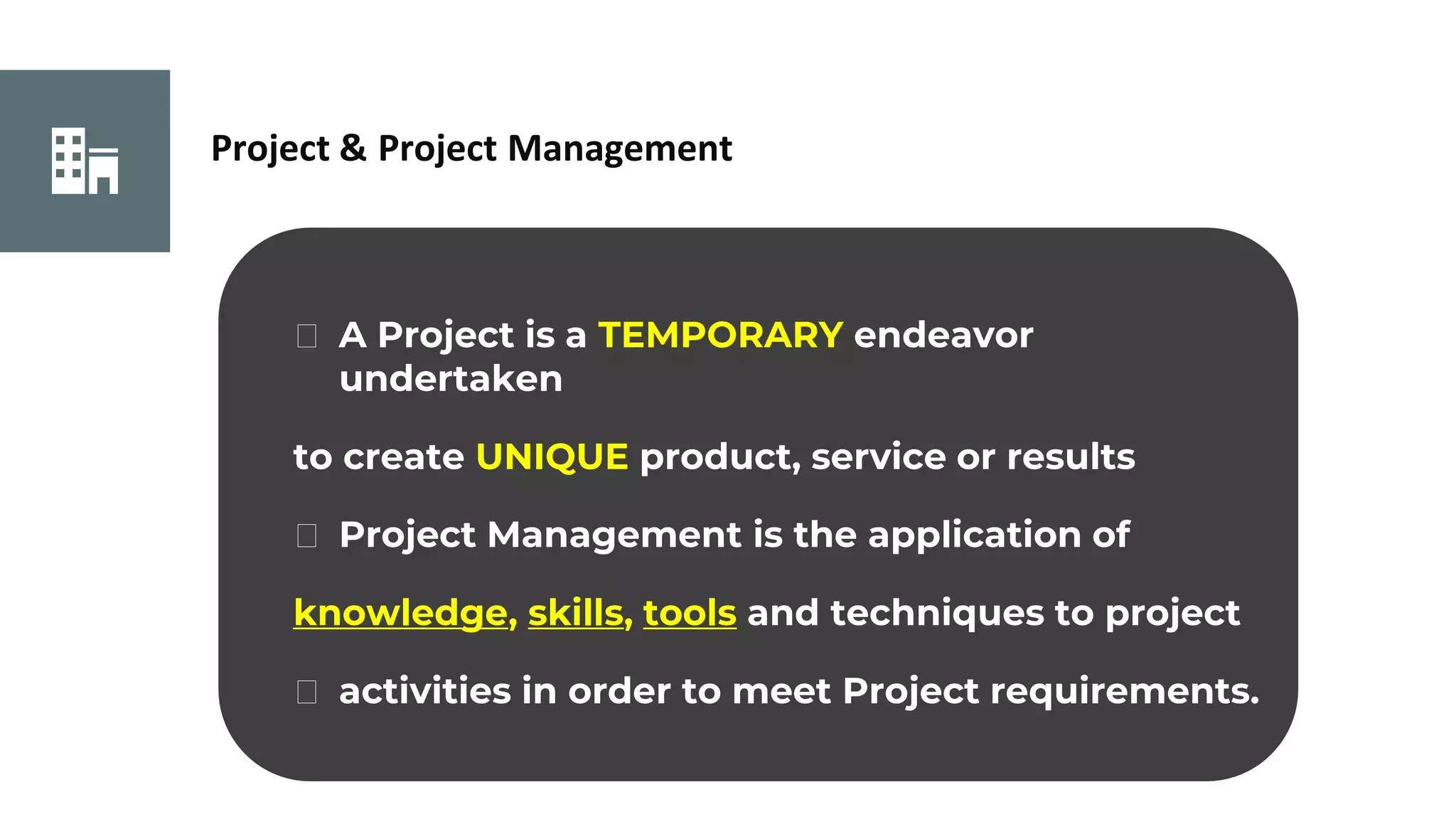
Project & Project Management
⮚ A Project is a TEMPORARY endeavor
undertaken
to create UNIQUE product, service or results
⮚ Project Management is the application of
knowledge, skills, tools and techniques to project
⮚ activities in order to meet Project requirements.
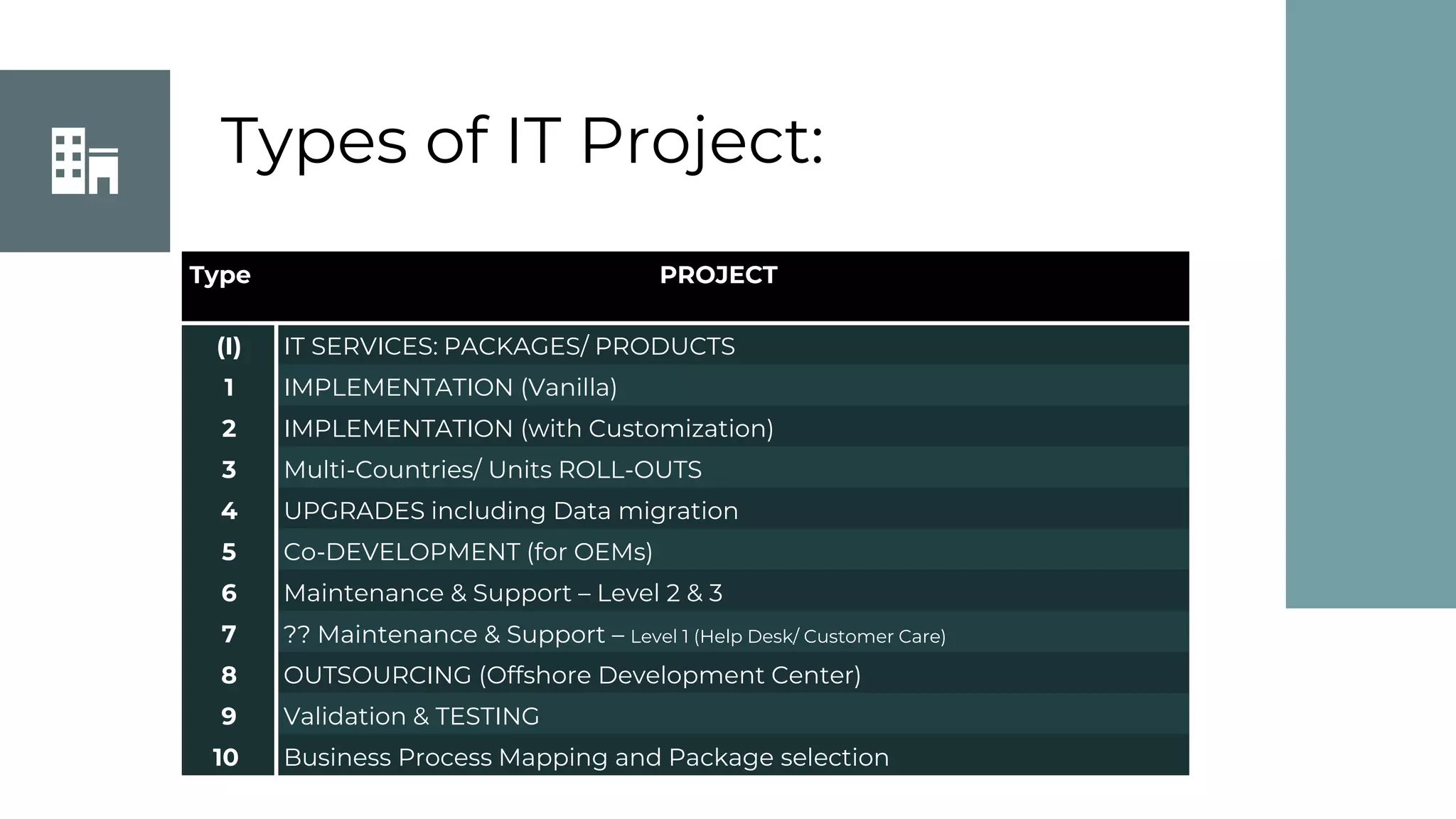
Types of IT Project:
Type PROJECT
(I) IT SERVICES: PACKAGES/ PRODUCTS
1 IMPLEMENTATION (Vanilla)
2 IMPLEMENTATION (with Customization)
3 Multi-Countries/ Units ROLL-OUTS
4 UPGRADES including Data migration
5 Co-DEVELOPMENT (for OEMs)
6 Maintenance & Support – Level 2 & 3
7 ?? Maintenance & Support – Level 1 (Help Desk/ Customer Care)
8 OUTSOURCING (Offshore Development Center)
9 Validation & TESTING
10 Business Process Mapping and Package selection
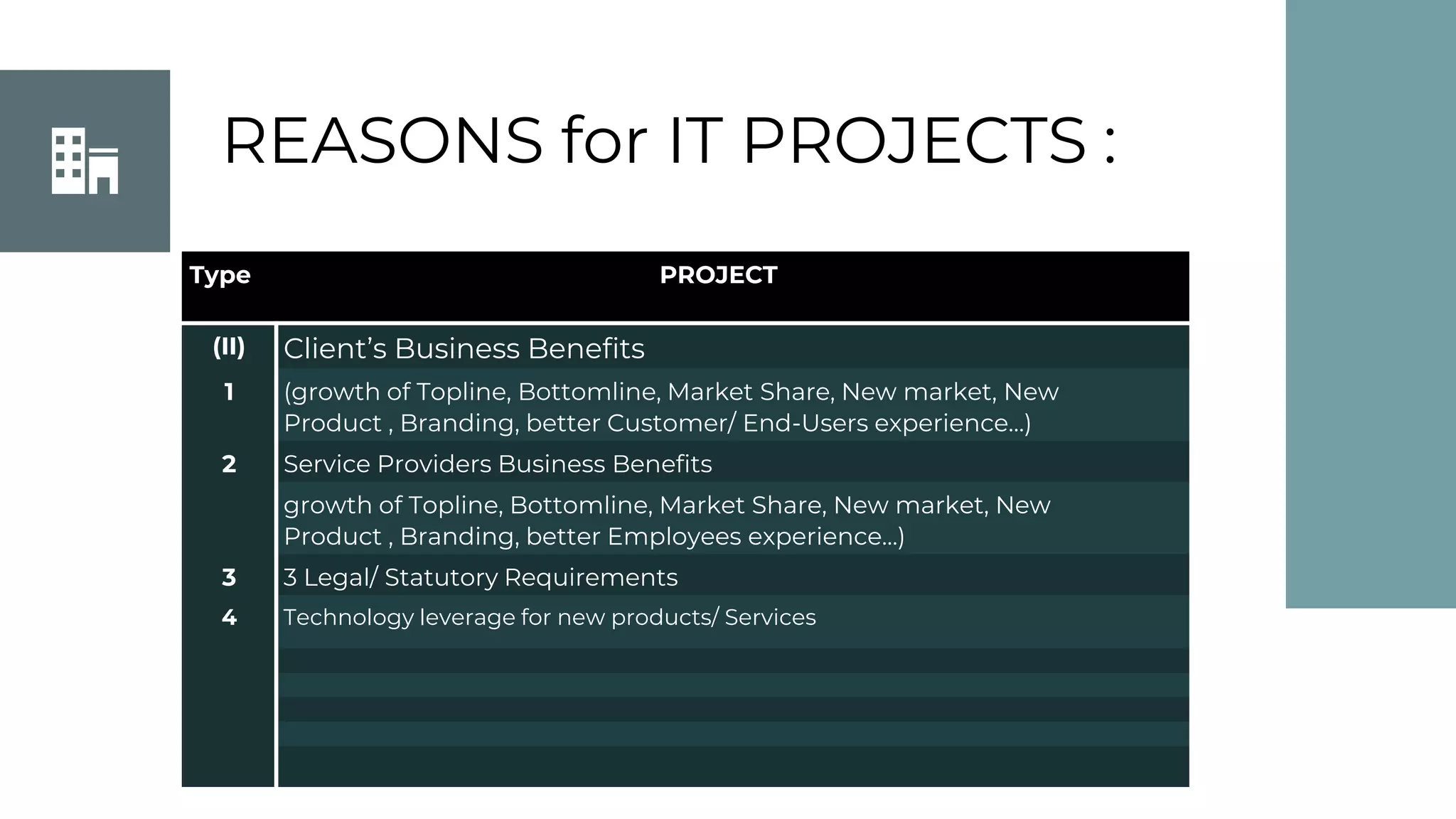
REASONS for IT PROJECTS :
Type PROJECT
(II) Client’s Business Benefits
1 (growth of Topline, Bottomline, Market Share, New market, New
Product , Branding, better Customer/ End-Users experience…)
2 Service Providers Business Benefits
growth of Topline, Bottomline, Market Share, New market, New
Product , Branding, better Employees experience…)
3 3 Legal/ Statutory Requirements
4 Technology leverage for new products/ Services
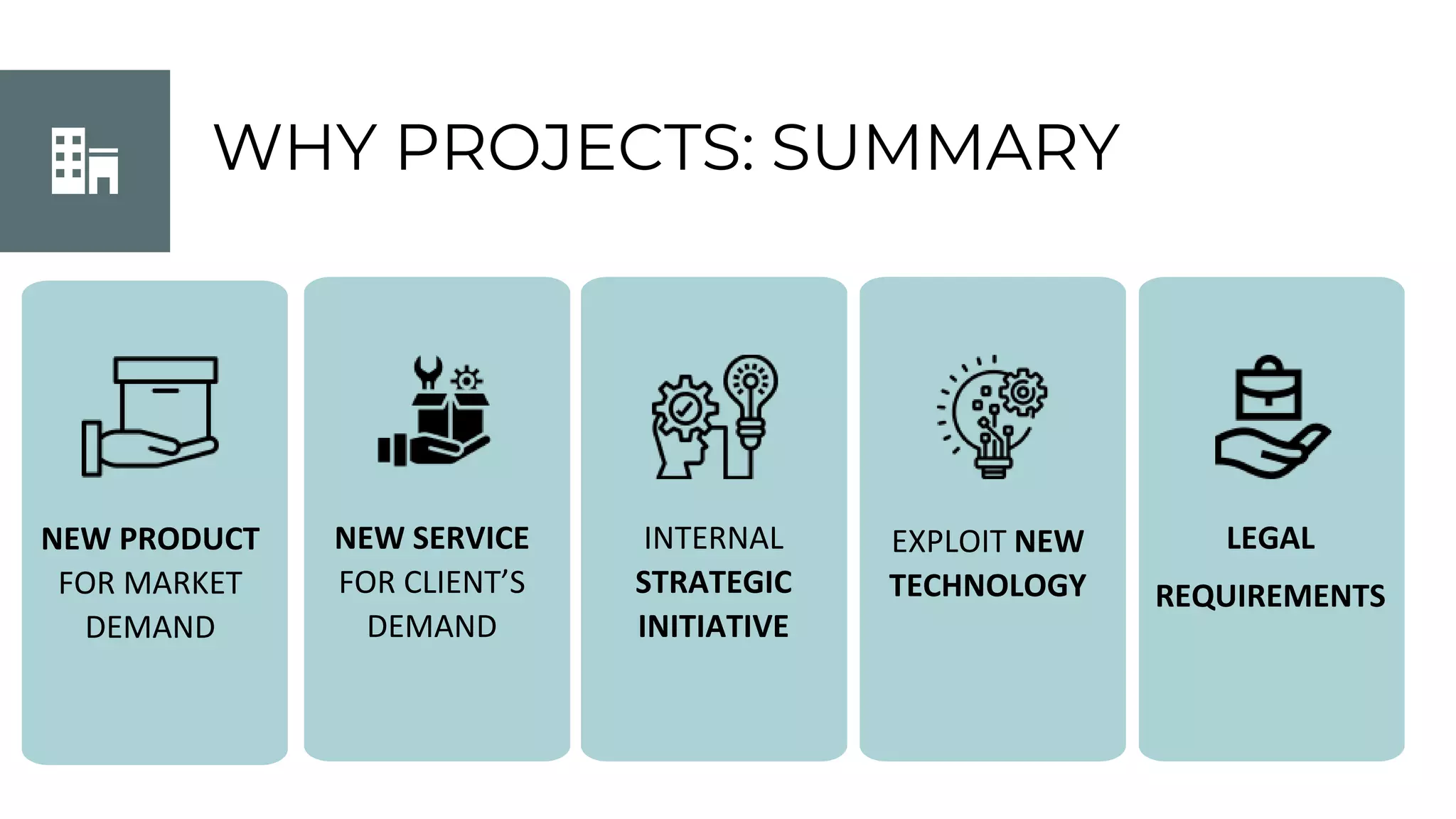
NEW PRODUCT
FOR MARKET
DEMAND
NEW SERVICE
FOR CLIENT’S
DEMAND
INTERNAL
STRATEGIC
INITIATIVE
EXPLOIT NEW
TECHNOLOGY
LEGAL
REQUIREMENTS
WHY PROJECTS: SUMMARY
⮚ WHAT IS PROJECT & PROJ. MGT.
⮚ 9 KNOWLEDGE AREAS OF PROJ. MGT.
⮚ PROJ. COMPLETION- SUCCESS/FAILURE
⮚ WHY PM STANDARDS - PMBOK / SCRUM
AGENDA
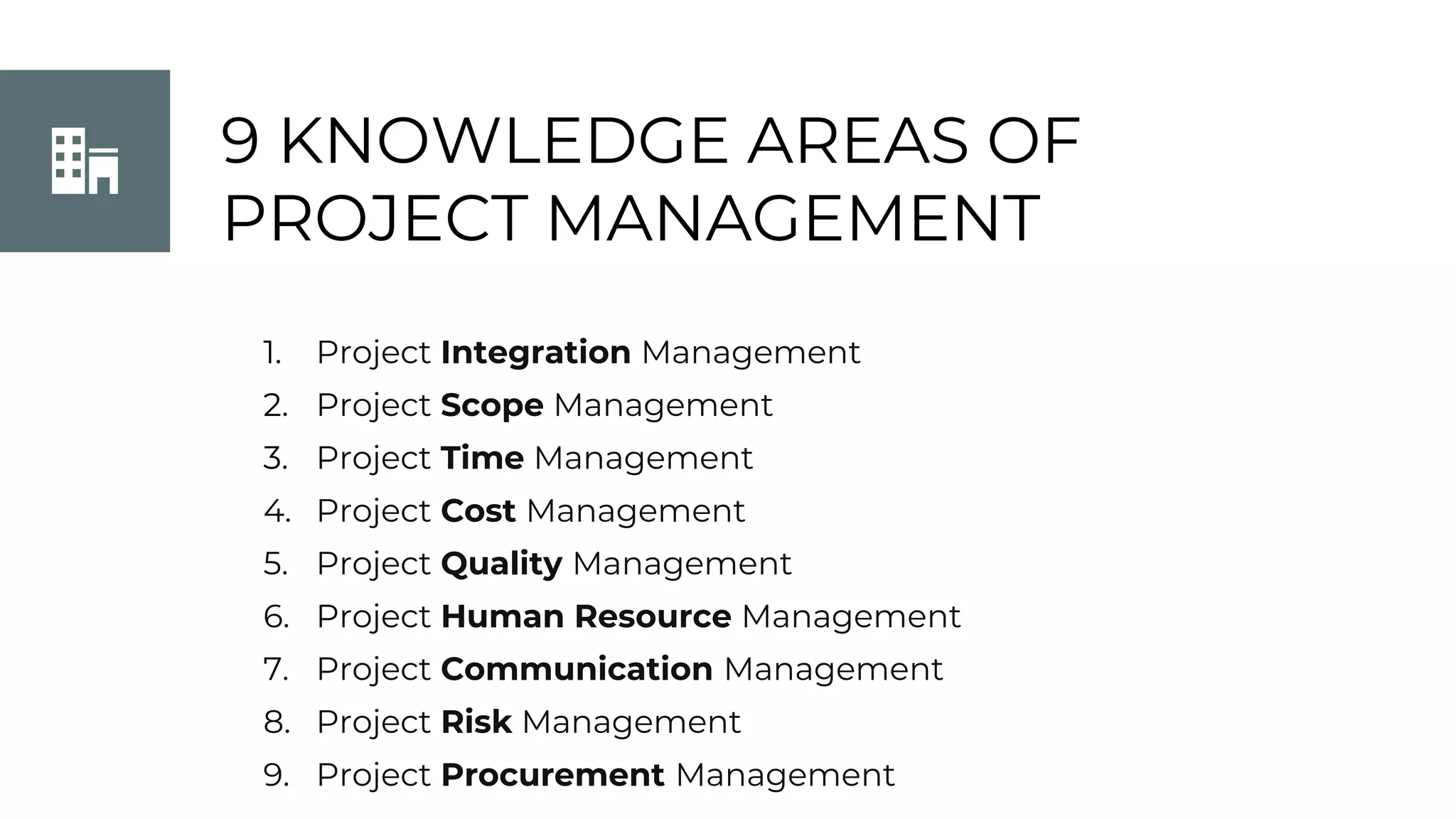
9 KNOWLEDGE AREAS OF
PROJECT MANAGEMENT
Join Us
1. Project Integration Management
2. Project Scope Management
3. Project Time Management
4. Project Cost Management
5. Project Quality Management
6. Project Human Resource Management
7. Project Communication Management
8. Project Risk Management
9. Project Procurement Management
Join Us
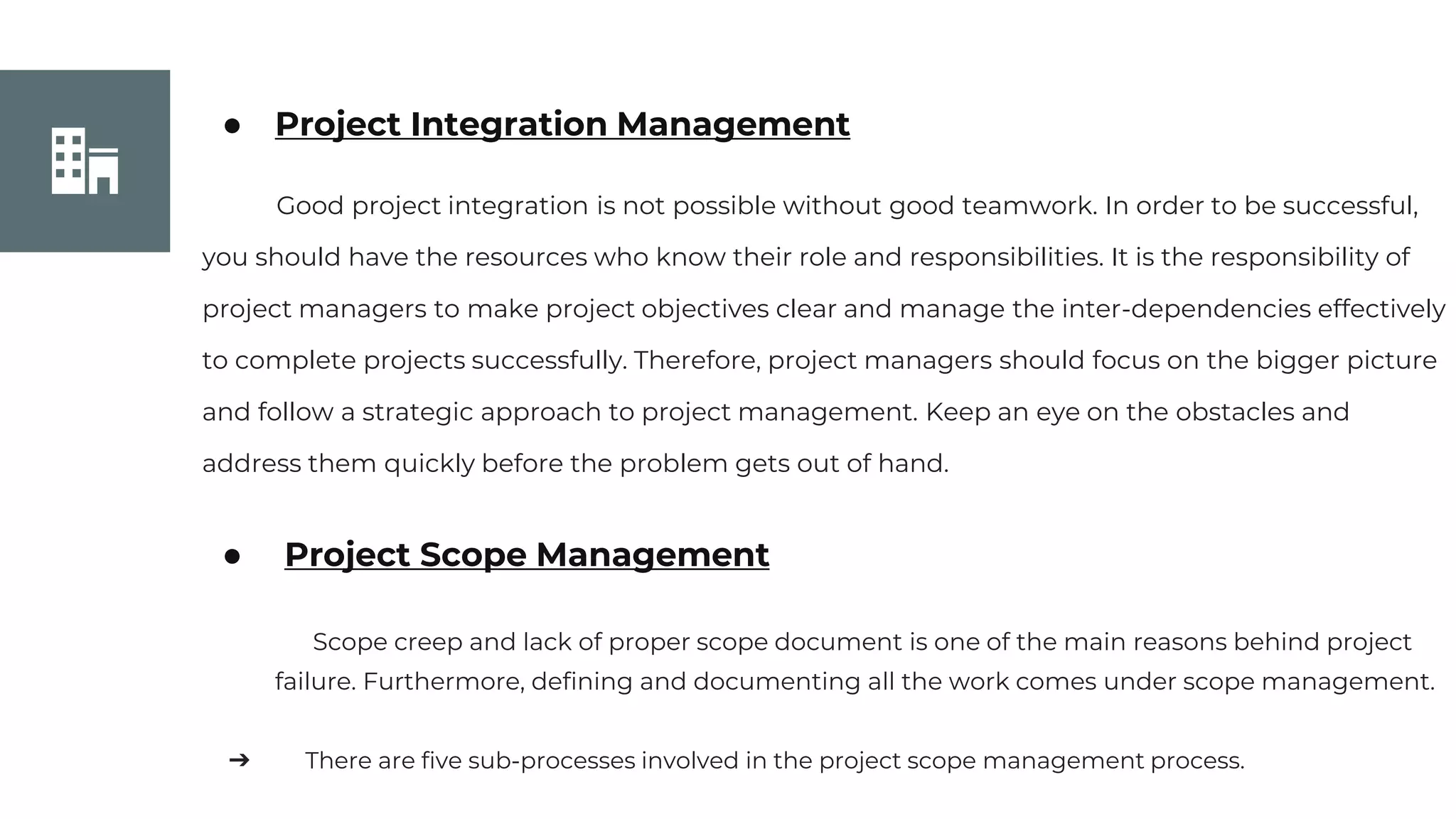
● Project Integration Management
Good project integration is not possible without good teamwork. In order to be successful,
you should have the resources who know their role and responsibilities. It is the responsibility of
project managers to make project objectives clear and manage the inter-dependencies effectively
to complete projects successfully. Therefore, project managers should focus on the bigger picture
and follow a strategic approach to project management. Keep an eye on the obstacles and
address them quickly before the problem gets out of hand.
● Project Scope Management
Scope creep and lack of proper scope document is one of the main reasons behind project
failure. Furthermore, defining and documenting all the work comes under scope management.
➔ There are five sub-processes involved in the project scope management process.
Join Us
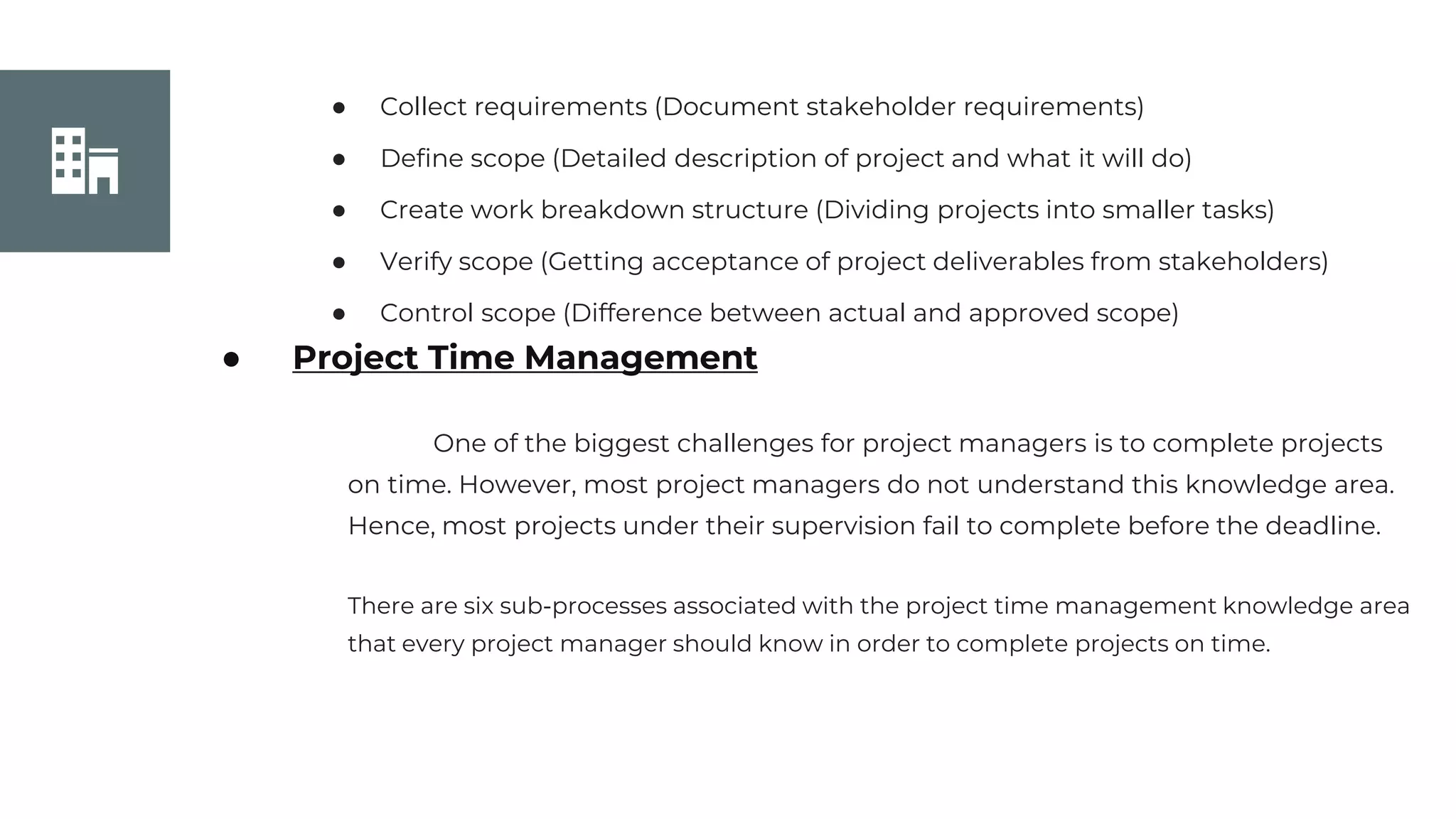
● Collect requirements (Document stakeholder requirements)
● Define scope (Detailed description of project and what it will do)
● Create work breakdown structure (Dividing projects into smaller tasks)
● Verify scope (Getting acceptance of project deliverables from stakeholders)
● Control scope (Difference between actual and approved scope)
● Project Time Management
One of the biggest challenges for project managers is to complete projects
on time. However, most project managers do not understand this knowledge area.
Hence, most projects under their supervision fail to complete before the deadline.
There are six sub-processes associated with the project time management knowledge area
that every project manager should know in order to complete projects on time.
Join Us
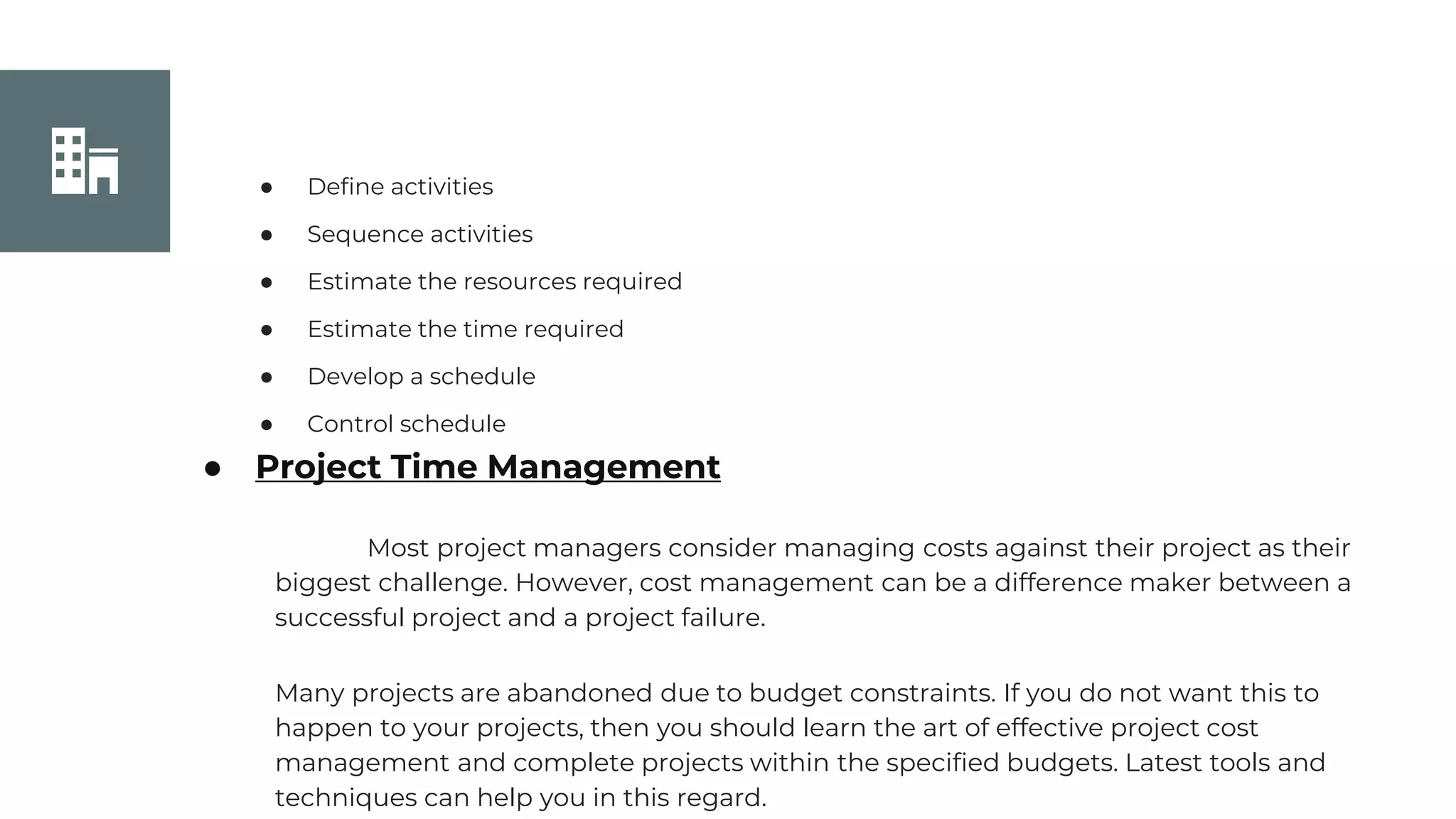
● Define activities
● Sequence activities
● Estimate the resources required
● Estimate the time required
● Develop a schedule
● Control schedule
● Project Time Management
Most project managers consider managing costs against their project as their
biggest challenge. However, cost management can be a difference maker between a
successful project and a project failure.
Many projects are abandoned due to budget constraints. If you do not want this to
happen to your projects, then you should learn the art of effective project cost
management and complete projects within the specified budgets. Latest tools and
techniques can help you in this regard.
Join Us
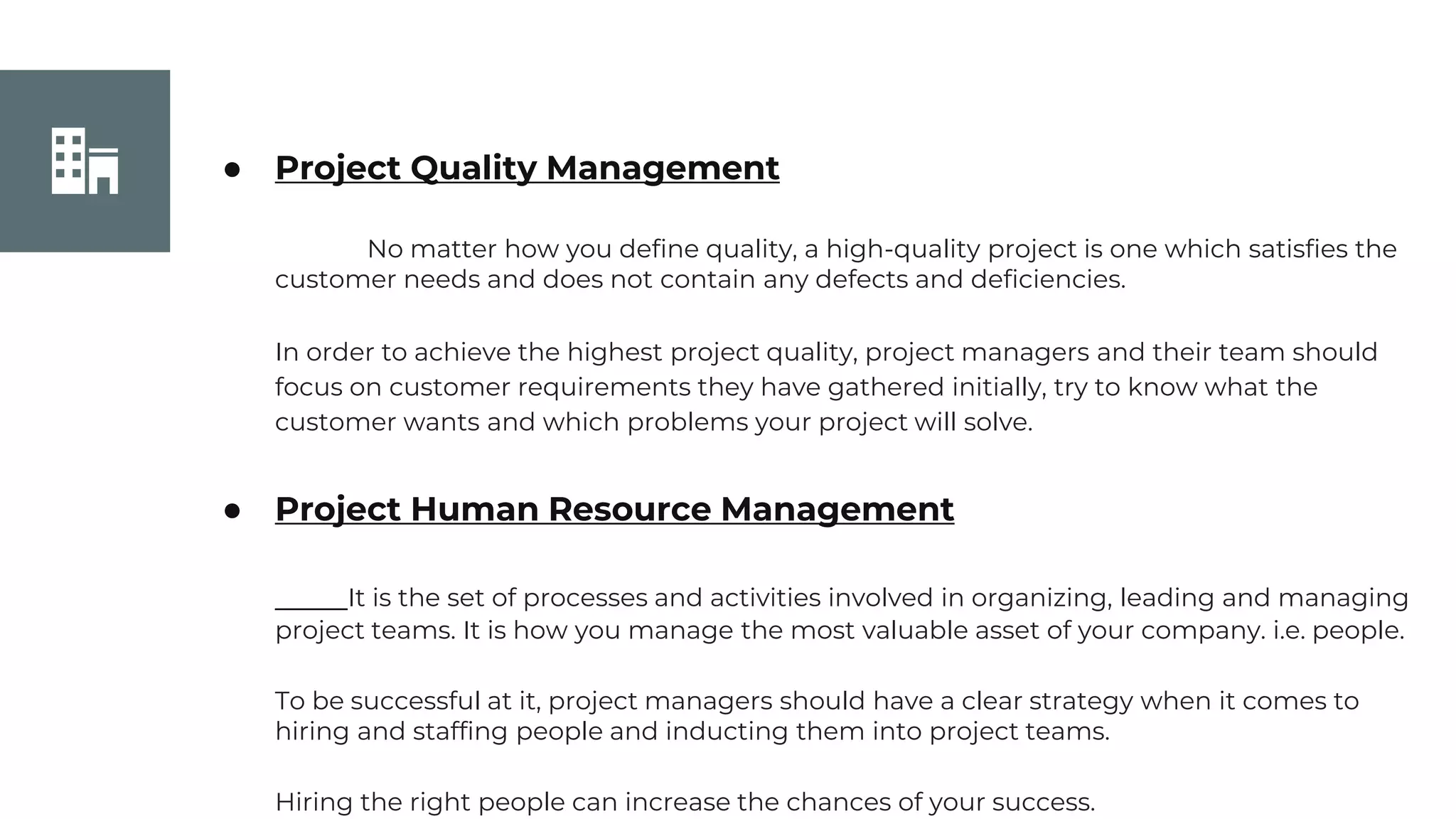
● Project Quality Management
No matter how you define quality, a high-quality project is one which satisfies the
customer needs and does not contain any defects and deficiencies.
In order to achieve the highest project quality, project managers and their team should
focus on customer requirements they have gathered initially, try to know what the
customer wants and which problems your project will solve.
● Project Human Resource Management
It is the set of processes and activities involved in organizing, leading and managing
project teams. It is how you manage the most valuable asset of your company. i.e. people.
To be successful at it, project managers should have a clear strategy when it comes to
hiring and staffing people and inducting them into project teams.
Hiring the right people can increase the chances of your success.
Join Us
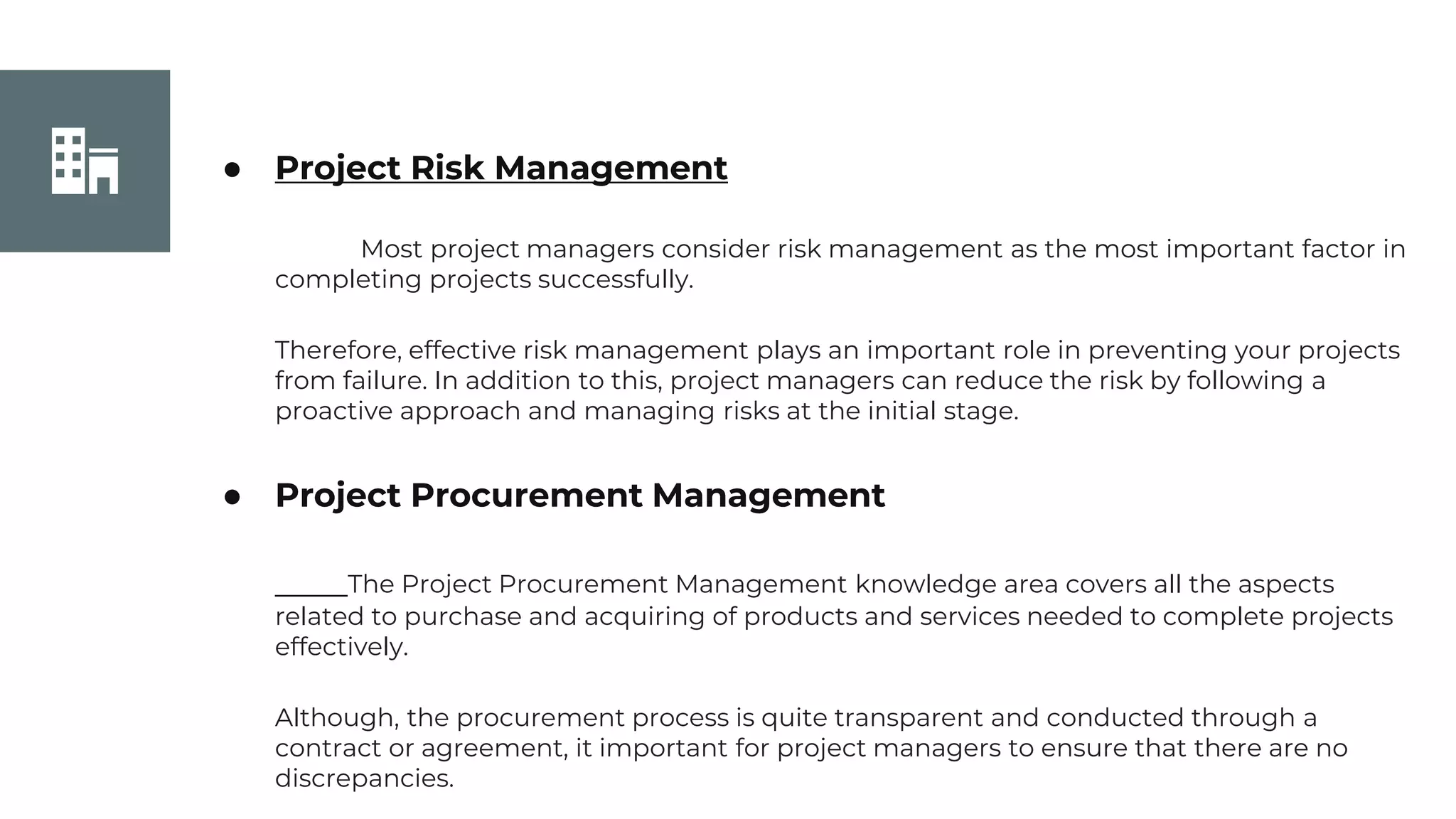
● Project Risk Management
Most project managers consider risk management as the most important factor in
completing projects successfully.
Therefore, effective risk management plays an important role in preventing your projects
from failure. In addition to this, project managers can reduce the risk by following a
proactive approach and managing risks at the initial stage.
● Project Procurement Management
The Project Procurement Management knowledge area covers all the aspects
related to purchase and acquiring of products and services needed to complete projects
effectively.
Although, the procurement process is quite transparent and conducted through a
contract or agreement, it important for project managers to ensure that there are no
discrepancies.
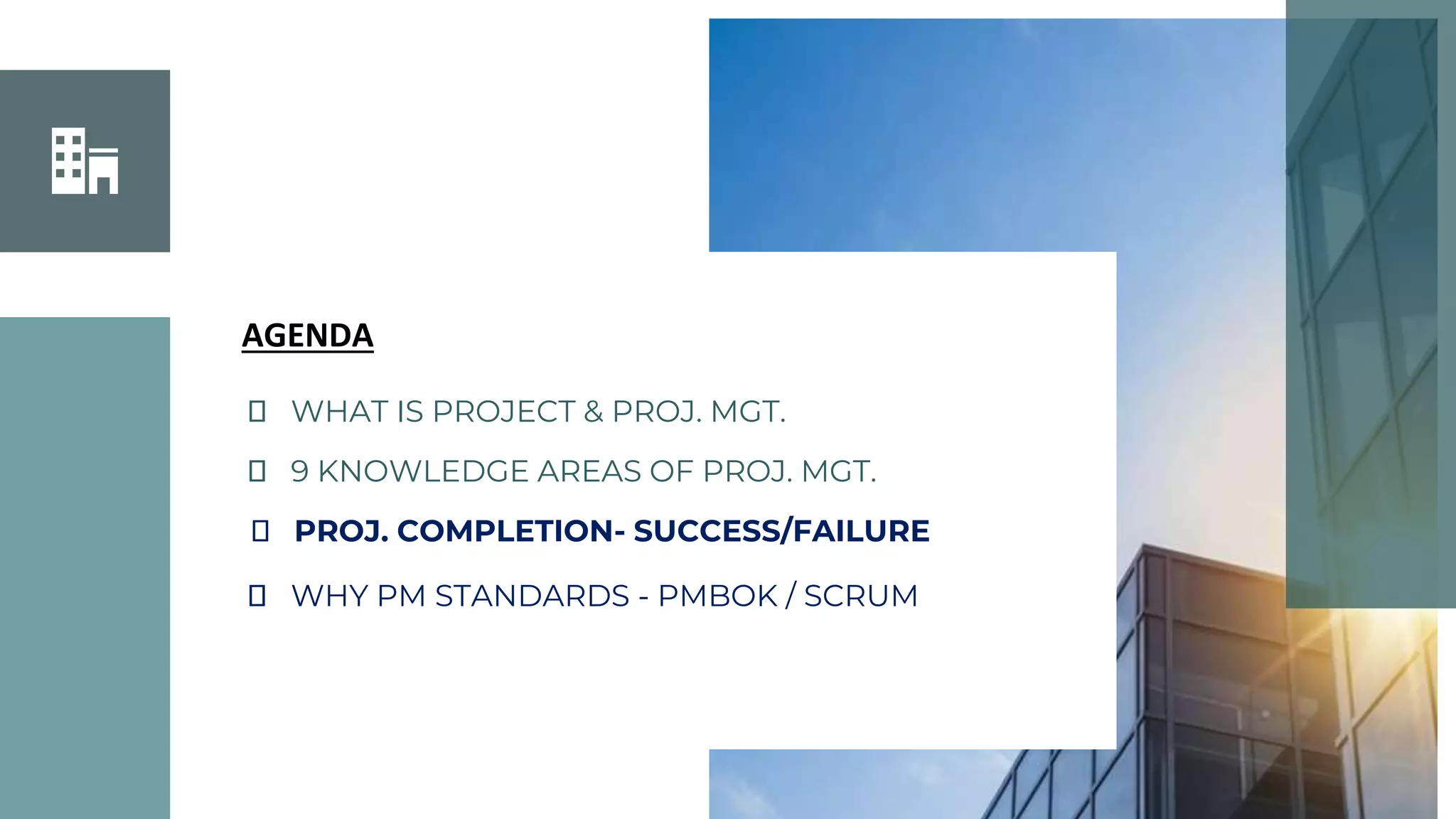
⮚ WHAT IS PROJECT & PROJ. MGT.
⮚ 9 KNOWLEDGE AREAS OF PROJ. MGT.
⮚ PROJ. COMPLETION- SUCCESS/FAILURE
⮚ WHY PM STANDARDS - PMBOK / SCRUM
AGENDA
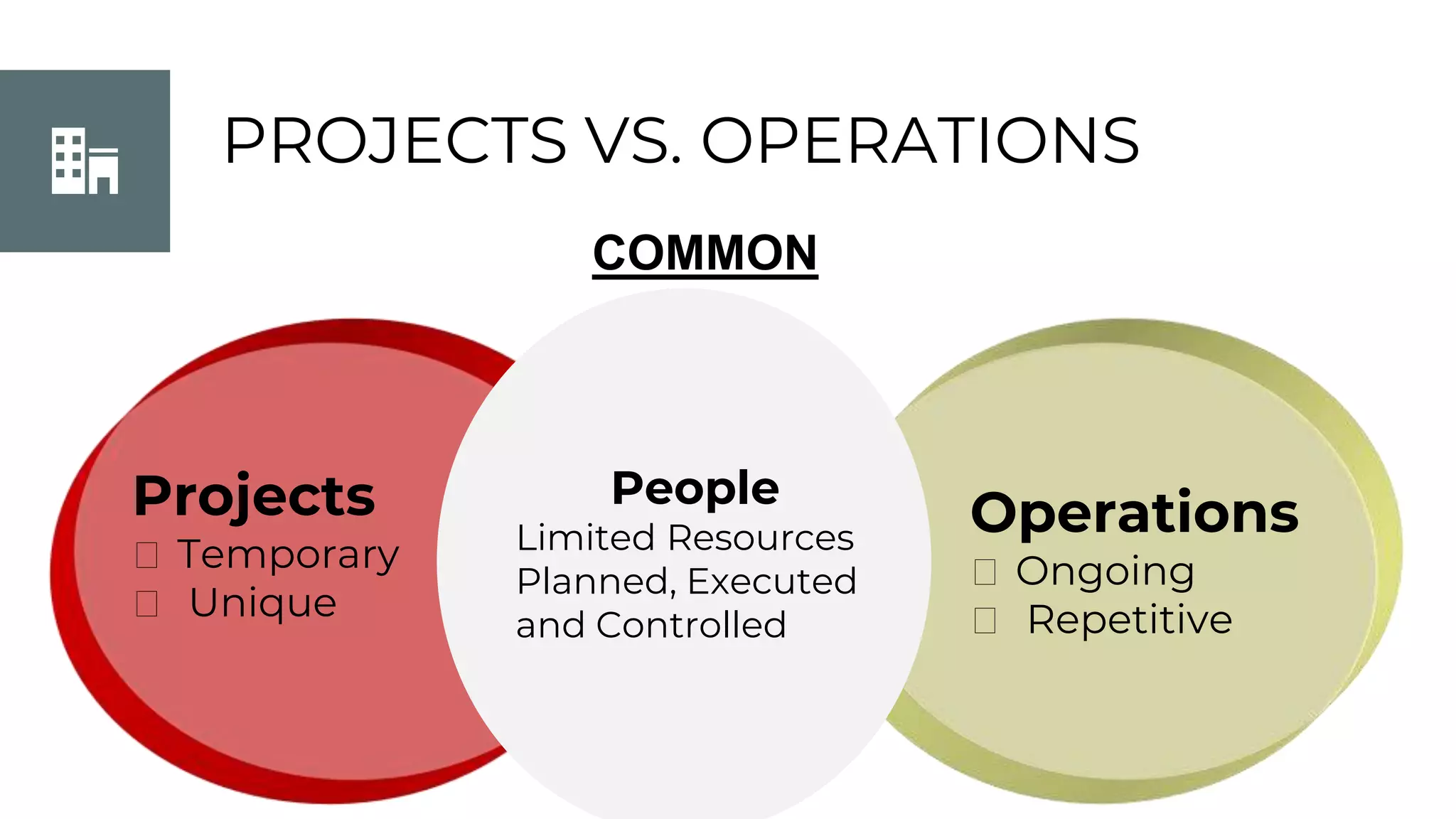
PROJECTS VS. OPERATIONS
John Doe
COMMON
Projects
⮚ Temporary
⮚ Unique
People
Limited Resources
Planned, Executed
and Controlled
Operations
⮚ Ongoing
⮚ Repetitive
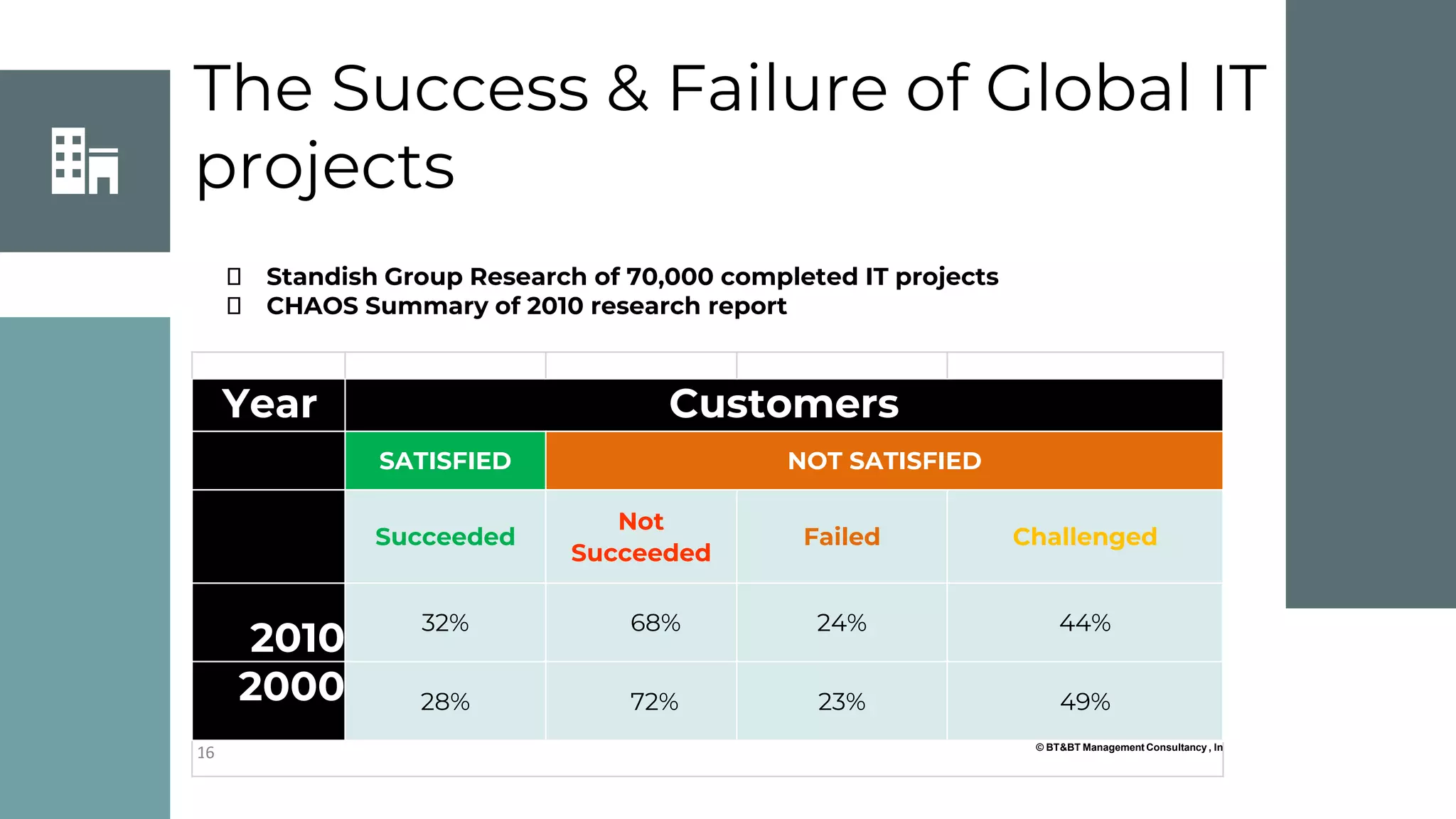
The Success & Failure of Global IT
projects
⮚ Standish Group Research of 70,000 completed IT projects
⮚ CHAOS Summary of 2010 research report
Year Customers
SATISFIED NOT SATISFIED
Succeeded
Not
Succeeded
Failed Challenged
2010
32% 68% 24% 44%
2000 28% 72% 23% 49%
16 © BT&BT Management Consultancy , In
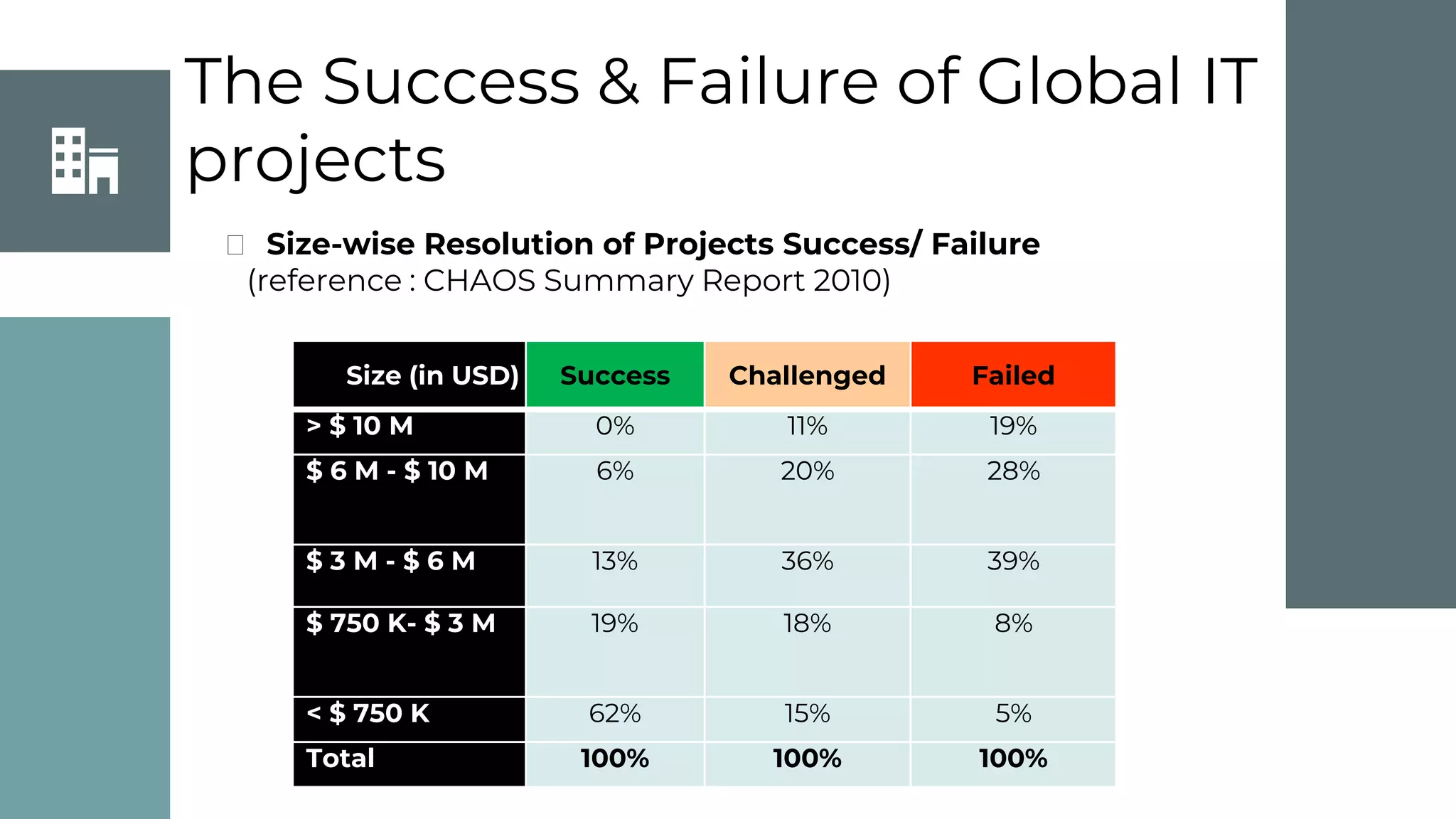
The Success & Failure of Global IT
projects
⮚ Size-wise Resolution of Projects Success/ Failure
(reference : CHAOS Summary Report 2010)
Size (in USD) Success Challenged Failed
> $ 10 M 0% 11% 19%
$ 6 M - $ 10 M 6% 20% 28%
$ 3 M - $ 6 M 13% 36% 39%
$ 750 K- $ 3 M 19% 18% 8%
< $ 750 K 62% 15% 5%
Total 100% 100% 100%
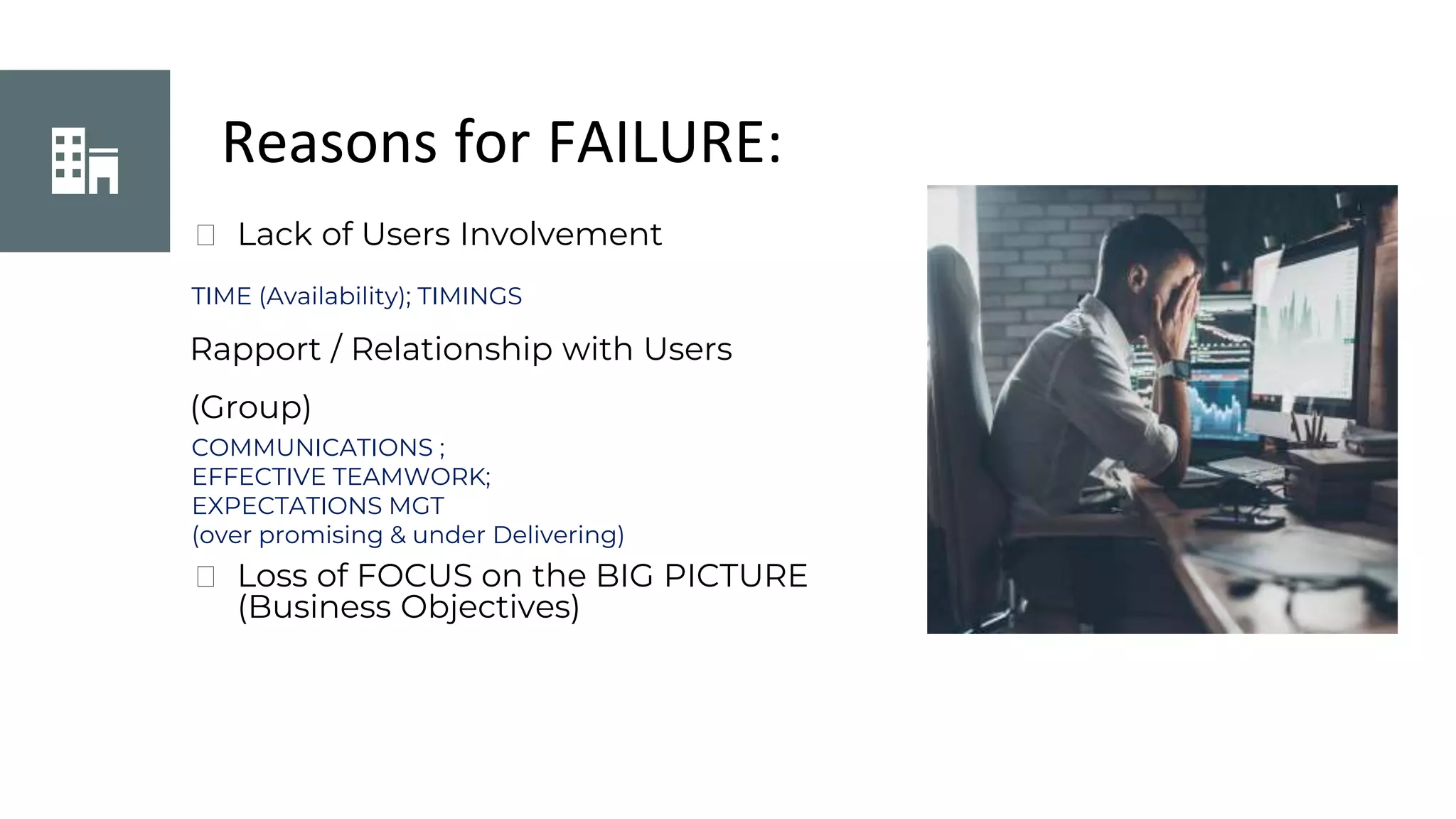
Reasons for FAILURE:
⮚ Lack of Users Involvement
TIME (Availability); TIMINGS
Rapport / Relationship with Users
(Group)
COMMUNICATIONS ;
EFFECTIVE TEAMWORK;
EXPECTATIONS MGT
(over promising & under Delivering)
⮚ Loss of FOCUS on the BIG PICTURE
(Business Objectives)
Reasons for FAILURE:
⮚ Use of Waterfall model rather than Iterative
⮚ Lack of proper PM Skills/ expertise
⮚ Missing (key) Expert/ Leader
(Best person leaves at the worst possible time)
⮚ Inaction on Risk Management
Reasons for FAILURE:
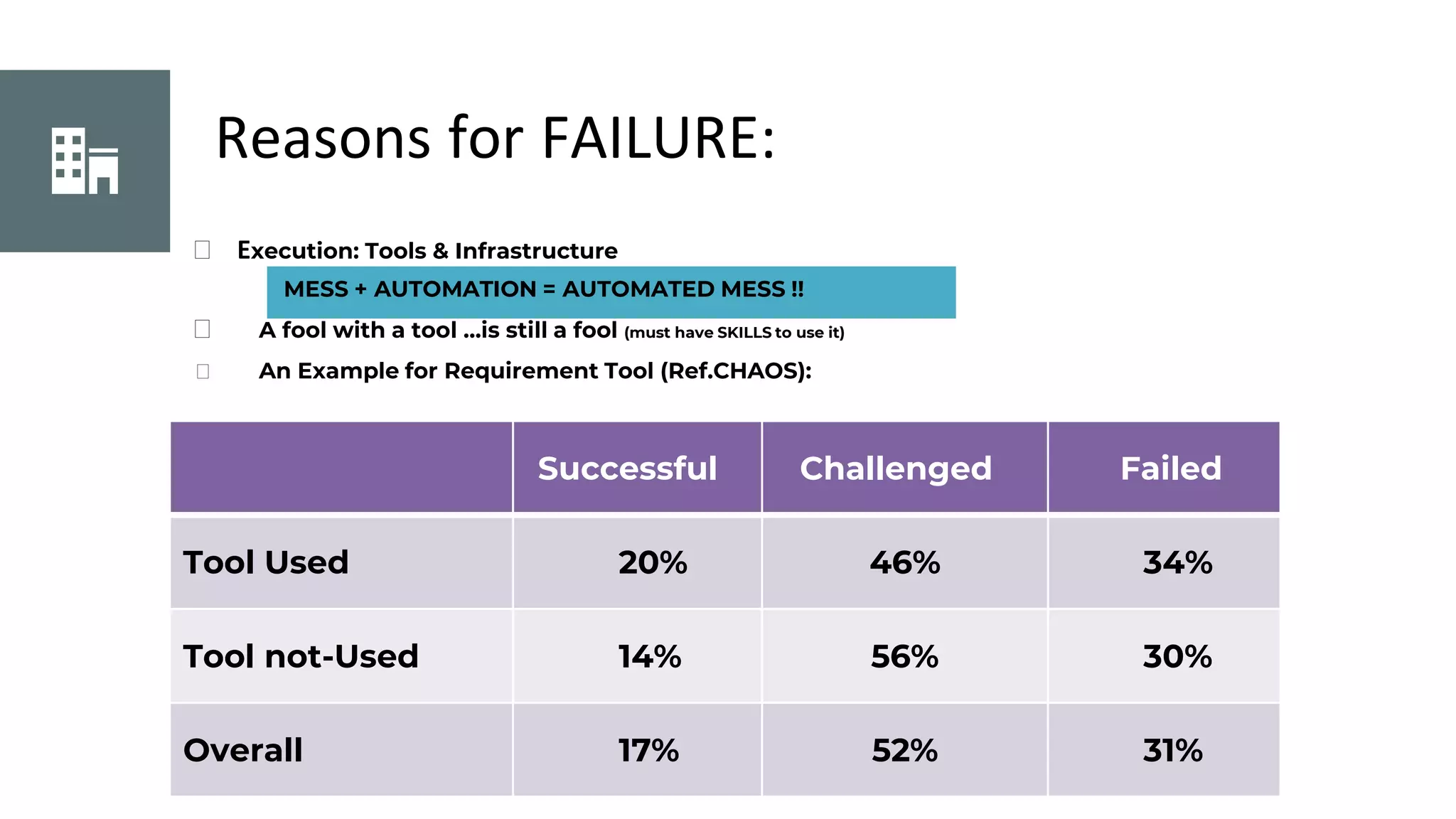
⮚ Execution: Tools & Infrastructure
MESS + AUTOMATION = AUTOMATED MESS !!
⮚ A fool with a tool …is still a fool (must have SKILLS to use it)
⮚ An Example for Requirement Tool (Ref.CHAOS):
Successful Challenged Failed
Tool Used 20% 46% 34%
Tool not-Used 14% 56% 30%
Overall 17% 52% 31%
Define SUCCESS for IT Projects
CUSTOMER:
BUSINESS & IT
OUTCOME/ PROJECT
VALUE/ LONG-TERM
TRUSTED
RELATIONSHIP
SR. MANAGEMENT:
BUSINESS & IT
OUTCOME/ PROJECT
VALUE/ LONG-TERM
TRUSTED
RELATIONSHIP
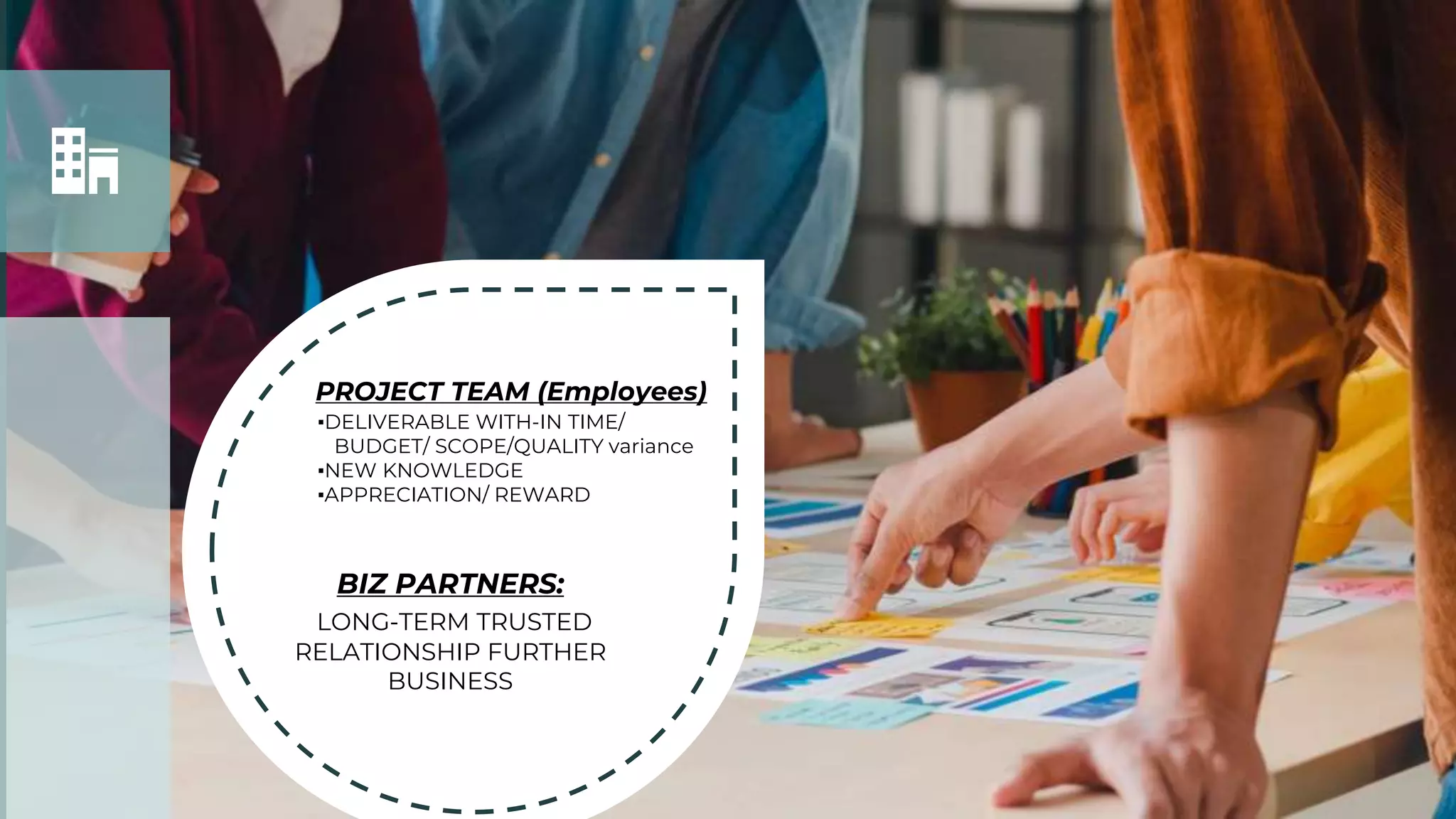
PROJECT TEAM (Employees)
▪DELIVERABLE WITH-IN TIME/
BUDGET/ SCOPE/QUALITY variance
▪NEW KNOWLEDGE
▪APPRECIATION/ REWARD
BIZ PARTNERS:
LONG-TERM TRUSTED
RELATIONSHIP FURTHER
BUSINESS
⮚ WHAT IS PROJECT & PROJ. MGT.
⮚ 9 KNOWLEDGE AREAS OF PROJ. MGT.
⮚ PROJ. COMPLETION- SUCCESS/FAILURE
⮚ WHY PM STANDARDS - PMBOK / SCRUM
AGENDA
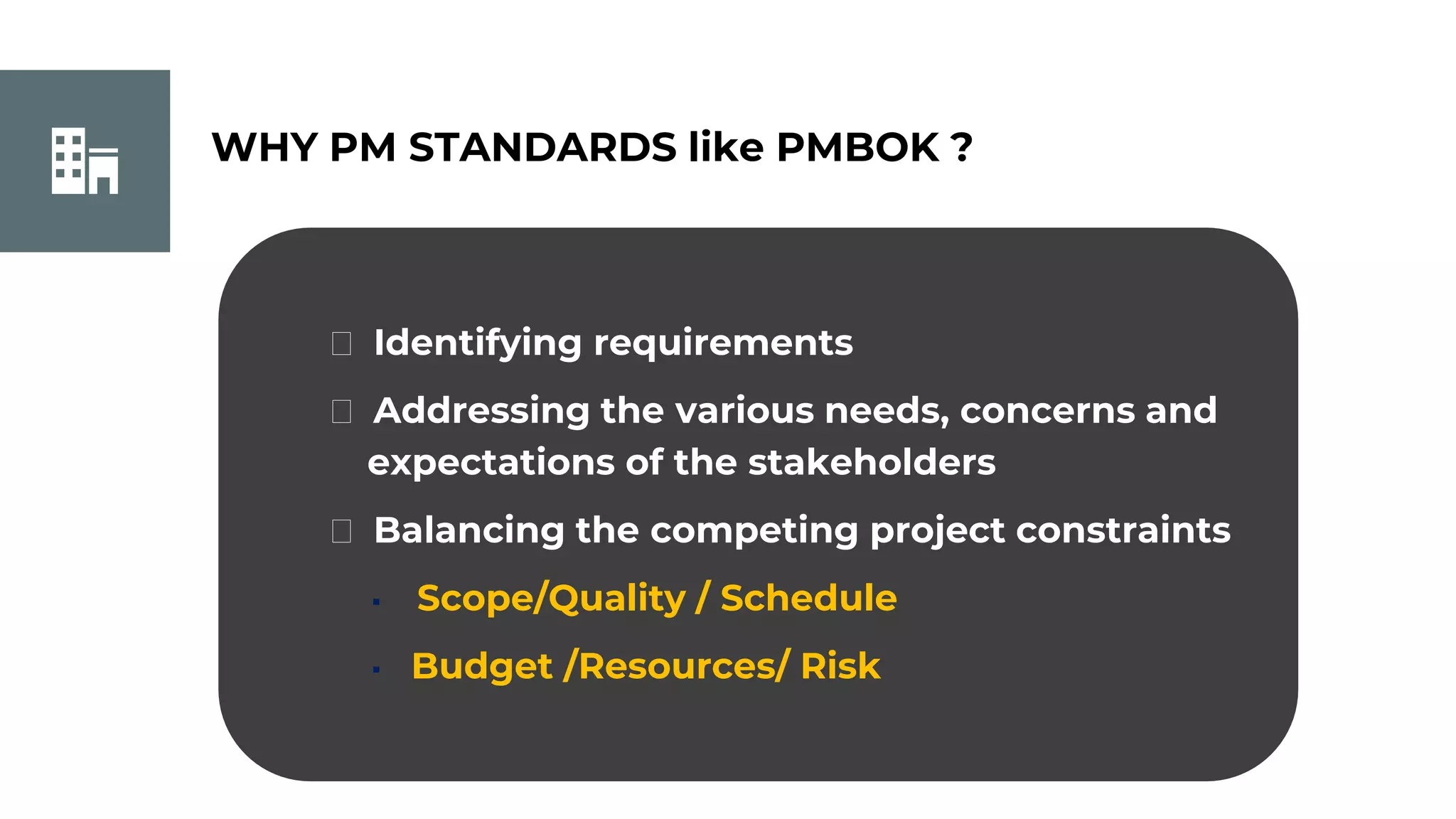
WHY PM STANDARDS like PMBOK ?
⮚ Identifying requirements
⮚ Addressing the various needs, concerns and
expectations of the stakeholders
⮚ Balancing the competing project constraints
▪ Scope/Quality / Schedule
▪ Budget /Resources/ Risk
What is SCRUM?
⮚ For Agile Software Development
⮚ Roles -
■ Product Owner - owns the backlog
■ Scrum Master - servant scrum leader
■ Scrum Team - delivers product increments
⮚ Scrum Process
▪ Sprint Planning
▪ Daily Stand-up
▪ Sprint Review
▪ Retrospective
⮚ PMBOK (PMI.ORG)
⮚ THE SCRUM GUIDE (SCRUM.ORG)
⮚ BLOG.TASKQUE.COM
⮚ Standish Group Research
REFERENCES
⮚ CHAOS Summary of 2010 research report

Project management - Basics for all

  • 1.
  • 2.
    ⮚ WHAT ISPROJECT & PROJ. MGT. ⮚ 9 KNOWLEDGE AREAS OF PROJ. MGT. ⮚ PROJ. COMPLETION- SUCCESS/FAILURE ⮚ WHY PM STANDARDS - PMBOK / SCRUM AGENDA
  • 3.
    PROJECT A project isa Temporary endeavour undertaken to create a Unique product, service, or result Temporary ▪ Definite start & end ▪ Small or Large Unique ▪ At least 1 attribute ▪ Some deliverables can be repetitive
  • 4.
    Project & ProjectManagement ⮚ A Project is a TEMPORARY endeavor undertaken to create UNIQUE product, service or results ⮚ Project Management is the application of knowledge, skills, tools and techniques to project ⮚ activities in order to meet Project requirements.
  • 5.
    Types of ITProject: Type PROJECT (I) IT SERVICES: PACKAGES/ PRODUCTS 1 IMPLEMENTATION (Vanilla) 2 IMPLEMENTATION (with Customization) 3 Multi-Countries/ Units ROLL-OUTS 4 UPGRADES including Data migration 5 Co-DEVELOPMENT (for OEMs) 6 Maintenance & Support – Level 2 & 3 7 ?? Maintenance & Support – Level 1 (Help Desk/ Customer Care) 8 OUTSOURCING (Offshore Development Center) 9 Validation & TESTING 10 Business Process Mapping and Package selection
  • 6.
    REASONS for ITPROJECTS : Type PROJECT (II) Client’s Business Benefits 1 (growth of Topline, Bottomline, Market Share, New market, New Product , Branding, better Customer/ End-Users experience…) 2 Service Providers Business Benefits growth of Topline, Bottomline, Market Share, New market, New Product , Branding, better Employees experience…) 3 3 Legal/ Statutory Requirements 4 Technology leverage for new products/ Services
  • 7.
    NEW PRODUCT FOR MARKET DEMAND NEWSERVICE FOR CLIENT’S DEMAND INTERNAL STRATEGIC INITIATIVE EXPLOIT NEW TECHNOLOGY LEGAL REQUIREMENTS WHY PROJECTS: SUMMARY
  • 8.
    ⮚ WHAT ISPROJECT & PROJ. MGT. ⮚ 9 KNOWLEDGE AREAS OF PROJ. MGT. ⮚ PROJ. COMPLETION- SUCCESS/FAILURE ⮚ WHY PM STANDARDS - PMBOK / SCRUM AGENDA
  • 9.
    9 KNOWLEDGE AREASOF PROJECT MANAGEMENT Join Us 1. Project Integration Management 2. Project Scope Management 3. Project Time Management 4. Project Cost Management 5. Project Quality Management 6. Project Human Resource Management 7. Project Communication Management 8. Project Risk Management 9. Project Procurement Management
  • 10.
    Join Us ● ProjectIntegration Management Good project integration is not possible without good teamwork. In order to be successful, you should have the resources who know their role and responsibilities. It is the responsibility of project managers to make project objectives clear and manage the inter-dependencies effectively to complete projects successfully. Therefore, project managers should focus on the bigger picture and follow a strategic approach to project management. Keep an eye on the obstacles and address them quickly before the problem gets out of hand. ● Project Scope Management Scope creep and lack of proper scope document is one of the main reasons behind project failure. Furthermore, defining and documenting all the work comes under scope management. ➔ There are five sub-processes involved in the project scope management process.
  • 11.
    Join Us ● Collectrequirements (Document stakeholder requirements) ● Define scope (Detailed description of project and what it will do) ● Create work breakdown structure (Dividing projects into smaller tasks) ● Verify scope (Getting acceptance of project deliverables from stakeholders) ● Control scope (Difference between actual and approved scope) ● Project Time Management One of the biggest challenges for project managers is to complete projects on time. However, most project managers do not understand this knowledge area. Hence, most projects under their supervision fail to complete before the deadline. There are six sub-processes associated with the project time management knowledge area that every project manager should know in order to complete projects on time.
  • 12.
    Join Us ● Defineactivities ● Sequence activities ● Estimate the resources required ● Estimate the time required ● Develop a schedule ● Control schedule ● Project Time Management Most project managers consider managing costs against their project as their biggest challenge. However, cost management can be a difference maker between a successful project and a project failure. Many projects are abandoned due to budget constraints. If you do not want this to happen to your projects, then you should learn the art of effective project cost management and complete projects within the specified budgets. Latest tools and techniques can help you in this regard.
  • 13.
    Join Us ● ProjectQuality Management No matter how you define quality, a high-quality project is one which satisfies the customer needs and does not contain any defects and deficiencies. In order to achieve the highest project quality, project managers and their team should focus on customer requirements they have gathered initially, try to know what the customer wants and which problems your project will solve. ● Project Human Resource Management It is the set of processes and activities involved in organizing, leading and managing project teams. It is how you manage the most valuable asset of your company. i.e. people. To be successful at it, project managers should have a clear strategy when it comes to hiring and staffing people and inducting them into project teams. Hiring the right people can increase the chances of your success.
  • 14.
    Join Us ● ProjectRisk Management Most project managers consider risk management as the most important factor in completing projects successfully. Therefore, effective risk management plays an important role in preventing your projects from failure. In addition to this, project managers can reduce the risk by following a proactive approach and managing risks at the initial stage. ● Project Procurement Management The Project Procurement Management knowledge area covers all the aspects related to purchase and acquiring of products and services needed to complete projects effectively. Although, the procurement process is quite transparent and conducted through a contract or agreement, it important for project managers to ensure that there are no discrepancies.
  • 15.
    ⮚ WHAT ISPROJECT & PROJ. MGT. ⮚ 9 KNOWLEDGE AREAS OF PROJ. MGT. ⮚ PROJ. COMPLETION- SUCCESS/FAILURE ⮚ WHY PM STANDARDS - PMBOK / SCRUM AGENDA
  • 16.
    PROJECTS VS. OPERATIONS JohnDoe COMMON Projects ⮚ Temporary ⮚ Unique People Limited Resources Planned, Executed and Controlled Operations ⮚ Ongoing ⮚ Repetitive
  • 17.
    The Success &Failure of Global IT projects ⮚ Standish Group Research of 70,000 completed IT projects ⮚ CHAOS Summary of 2010 research report Year Customers SATISFIED NOT SATISFIED Succeeded Not Succeeded Failed Challenged 2010 32% 68% 24% 44% 2000 28% 72% 23% 49% 16 © BT&BT Management Consultancy , In
  • 18.
    The Success &Failure of Global IT projects ⮚ Size-wise Resolution of Projects Success/ Failure (reference : CHAOS Summary Report 2010) Size (in USD) Success Challenged Failed > $ 10 M 0% 11% 19% $ 6 M - $ 10 M 6% 20% 28% $ 3 M - $ 6 M 13% 36% 39% $ 750 K- $ 3 M 19% 18% 8% < $ 750 K 62% 15% 5% Total 100% 100% 100%
  • 19.
    Reasons for FAILURE: ⮚Lack of Users Involvement TIME (Availability); TIMINGS Rapport / Relationship with Users (Group) COMMUNICATIONS ; EFFECTIVE TEAMWORK; EXPECTATIONS MGT (over promising & under Delivering) ⮚ Loss of FOCUS on the BIG PICTURE (Business Objectives)
  • 20.
    Reasons for FAILURE: ⮚Use of Waterfall model rather than Iterative ⮚ Lack of proper PM Skills/ expertise ⮚ Missing (key) Expert/ Leader (Best person leaves at the worst possible time) ⮚ Inaction on Risk Management
  • 21.
    Reasons for FAILURE: ⮚Execution: Tools & Infrastructure MESS + AUTOMATION = AUTOMATED MESS !! ⮚ A fool with a tool …is still a fool (must have SKILLS to use it) ⮚ An Example for Requirement Tool (Ref.CHAOS): Successful Challenged Failed Tool Used 20% 46% 34% Tool not-Used 14% 56% 30% Overall 17% 52% 31%
  • 22.
    Define SUCCESS forIT Projects CUSTOMER: BUSINESS & IT OUTCOME/ PROJECT VALUE/ LONG-TERM TRUSTED RELATIONSHIP SR. MANAGEMENT: BUSINESS & IT OUTCOME/ PROJECT VALUE/ LONG-TERM TRUSTED RELATIONSHIP
  • 23.
    PROJECT TEAM (Employees) ▪DELIVERABLEWITH-IN TIME/ BUDGET/ SCOPE/QUALITY variance ▪NEW KNOWLEDGE ▪APPRECIATION/ REWARD BIZ PARTNERS: LONG-TERM TRUSTED RELATIONSHIP FURTHER BUSINESS
  • 24.
    ⮚ WHAT ISPROJECT & PROJ. MGT. ⮚ 9 KNOWLEDGE AREAS OF PROJ. MGT. ⮚ PROJ. COMPLETION- SUCCESS/FAILURE ⮚ WHY PM STANDARDS - PMBOK / SCRUM AGENDA
  • 25.
    WHY PM STANDARDSlike PMBOK ? ⮚ Identifying requirements ⮚ Addressing the various needs, concerns and expectations of the stakeholders ⮚ Balancing the competing project constraints ▪ Scope/Quality / Schedule ▪ Budget /Resources/ Risk
  • 26.
    What is SCRUM? ⮚For Agile Software Development ⮚ Roles - ■ Product Owner - owns the backlog ■ Scrum Master - servant scrum leader ■ Scrum Team - delivers product increments ⮚ Scrum Process ▪ Sprint Planning ▪ Daily Stand-up ▪ Sprint Review ▪ Retrospective
  • 28.
    ⮚ PMBOK (PMI.ORG) ⮚THE SCRUM GUIDE (SCRUM.ORG) ⮚ BLOG.TASKQUE.COM ⮚ Standish Group Research REFERENCES ⮚ CHAOS Summary of 2010 research report