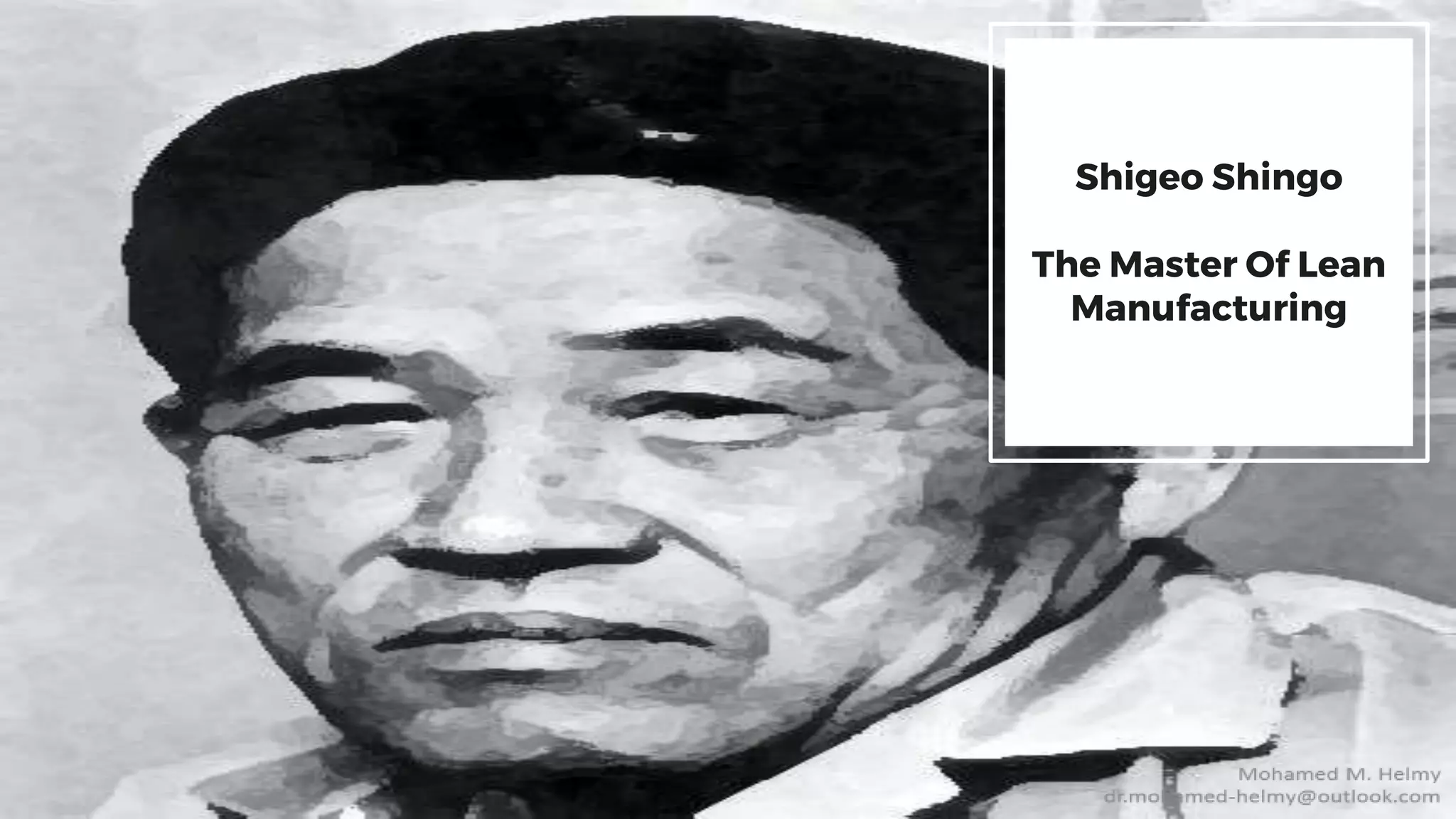
Shigeo Shingo
The Master Of Lean
Manufacturing
HELLO!
I am Mohamed M. Helmy
Diploma of Hospital Management
AASTMT, Cairo Group
You can reach me at dr.mohamed-helmy@outlook.com
Presentation Outlines
We will discuss the following:
▫ Shigeo Shingo biography
▫ Just In Time (JIT)
▫ SMED
▫ Poka-Yoke
▫ Zero Quality Controle
Shigeo Shingo is a Japanese engineer, businessman and quality
guru, he is considered as the world’s leading expert on manufacturing practices.
Biography
Biography
Born in Saga, Japan
Graduated from Yamanashi Technical College with a degree in
Mechanical Engineering. Employed by Taipei Railway Factory
Manufacturing Section Chief at the Amano Manufacturing Plant,
Yokahama. He raises productivity by 100%.He works with other
divisions of manufacturing and continues to increase productivity.
Member of the Japan Management Association
Begins his research on Statistical Quality Control
1909
1930
1943
1945
1951
Biography
Consultant at Toyota Motor Corporation
Leads industrial engineering and factory improvement training at the
Toyota Motor Corporation
Leads a 3 year study on ship building at Mitsubishi Shipbuilding. He is
able to create a system that reduces production time by 50%
Founds the Institute of Management Improvement
Fully develops the SMED system to achieve zero quality defects
After that he dedicated his efforts to education and lecturing
1954
1955
1956
1959
1960
Biography
As a tribute to Dr. Shingo and his lifelong work, The Utah State University has
founded in 1988 the Shingo Prize for Operational Excellence which is awarded
annually for excellence in manufacturing
Biography
Best known for:
▫ Just In Time Manufacturing (JIT)
▫ Single Minute Exchange of Die (SMED)
▫ Poka – Yoke / Mistake Proofing / Zero Defect
“
“The best approach is to dig out
and eliminate problems where
they are assumed not to exist”
Just in time (JIT) is a production strategy that strives to improve
a business’ return on investment by reducing in-process
inventory and associated carrying costs.
Just In Time
Just In Time
Manufacturing
Also known as:
Motorola: Short Cycle Manufacturing (SCM)
IBM: Continuous Flow Manufacturing (CFM)
John Constanza: Demand Flow Manufacturing (DFM)
Just In Time
Manufacturing
Manufacturer Customer
The conventional manufacturing system
Just In Time
Manufacturing
The JIT manufacturing system
Manufacturer Customer
Just In Time
Manufacturing
To work flawlessly, the following are
needed:
▫ Continuous improvement (Simpler,
easier, QC, DRIFT)
▫ Eliminating waste (overproduction,
waiting time, transportation,
processing, inventory, product
defects)
▫ Workplace cleanliness and
organization
▫ Set-up time reduction
▫ Levelled / mixed production
▫ Powerful supply chain mechanism
▫ Kanban System
Advantages
▫ Short
production runs
▫ Fast ROI
▫ Reduce cost
▫ More cash
available in-
hand to utilize
Disadvantages
• Disruptions in
the supply
chain may stop
production
• Sudden
unexpected
orders will
delay delivery
of the product
• May face
variation in raw
materials costs
Just In Time
Manufacturing
Case study:
Toyota uses just-in-time inventory controls as part of its
business model. Toyota sends off orders for parts only
when it receives new orders from customers. The
company started this method in the 1970s, and it took
more than 15 years to perfect. Several elements of just-
in-time manufacturing need to occur for Toyota to
succeed. The company must have steady production,
high-quality workmanship, no machine breakdowns at
the plant, reliable suppliers and quick ways to assemble
machines that put together vehicles.
Just In Time
Manufacturing
Case study:
Toyota's just-in-time concept almost came to a crashing halt in February 1997. A
fire at a brake parts plant owned by Aisin decimated its capacity to produce a P-
valve for Toyota vehicles. The company was the sole supplier of the part, and the
fact that the plant was shut down for weeks could have devastated Toyota's
supply line. The auto manufacturer ran out of P-valve parts after just one day.
Production lines shut down for just two days until a supplier of Aisin was able to
start manufacturing the necessary valves. Other suppliers for Toyota also had to
shut down because the auto manufacturer didn't need other parts to complete
any cars on the assembly line. The fire cost Toyota nearly $15 billion in revenue
and 70,000 cars due to its two-day shutdown, but it could have been much worse.
Kanban System diagram
“
The most dangerous kind of
waste is the waste we do not
recognize
Poka – Yoke is any mechanism in a lean manufacturing process
that helps an equipment operator avoid (yokeru) mistakes
(poka). Its purpose is to eliminate product defects by preventing,
correcting, or drawing attention to human errors as they occur.
Poka - Yoke
Poka - Yoke
Poka-yoke is a Japanese term that means "mistake-proofing" or “inadvertent error
prevention”. The key word in the second translation, often omitted, is "inadvertent". There is
no Poka Yoke solution that protects against an operator’s sabotage, but sabotage is a rare
behavior among people.
The concept was formalized, and the term adopted, by Shigeo Shingo in the 1960s as part
of the Toyota Production System (TPS). Shingo distinguished between the concepts of
inevitable human mistakes and defects in the production. Defects occur when the
mistakes are allowed to reach the customer. The aim of poka-yoke is to design the
process so that mistakes can be detected and corrected immediately, eliminating defects
at the source.
It was originally described as Baka–Yoke which means "fool-proofing" (or "idiot-proofing")
the name was changed to the milder poka-yoke.
Poka - Yoke
Poka - Yoke
Benefits of Poka Yoke implementation
▫ Less time spent on training workers
▫ Elimination of many operations related to quality control
▫ Unburdening of operators from repetitive operations
▫ Promotion of the work improvement-oriented approach and actions
▫ A reduced number of rejects
▫ Immediate action when a problem occurs
“
It's only the last turn of a bolt
that tightens it - the rest is just
movement
SMED (Single-Minute Exchange of Dies) is a system for
dramatically reducing the time it takes to complete equipment
changeovers. The essence of the SMED system is to convert as
many changeover steps as possible to “external” (performed
while the equipment is running), and to simplify and streamline
the remaining steps.
SMED
SMED
SMED was developed by Shigeo Shingo who was extraordinarily successful in helping
companies dramatically reduce their changeover times. His pioneering work led to
documented reductions in changeover times averaging 94% (e.g. from 90 minutes to
less than 5 minutes) across a wide range of companies.
SMED
A successful SMED program will have the following benefits:
▫ Lower manufacturing cost (faster changeovers mean less equipment down time)
▫ Smaller lot sizes (faster changeovers enable more frequent product changes)
▫ Improved responsiveness to customer demand (smaller lot sizes enable more flexible
scheduling)
▫ Lower inventory levels (smaller lot sizes result in lower inventory levels)
▫ Smoother startups (standardized changeover processes improve consistency and
quality)
SMED application in pit crew
Shigeo Shingo
Dr. Shingo Shigeo was perhaps the greatest contributor to modern manufacturing
practices. While his name has little recognition in the western hemisphere, his teachings
and principles have formed the backbone of efficient engineering practices. In applying
his experience and expertise in the field of industrial engineering, Dr. Shigeo was able to
provide a better way of life for both the operators and the corporations. His policies have
gained reputation through results in manufacturing among the companies that have
implemented these teachings
“There are four purposes of improvement: easier, better, faster, and
cheaper. These four goals appear in the order of priority”
Shigeo Shingo
THANKS!
Any questions?
Feel free to contact me at
dr.mohamed-helmy@outlook.com
+2 0122 570 8970

Shigeo Shingo - The Master Of Lean

  • 1.
    Shigeo Shingo The MasterOf Lean Manufacturing
  • 2.
    HELLO! I am MohamedM. Helmy Diploma of Hospital Management AASTMT, Cairo Group You can reach me at dr.mohamed-helmy@outlook.com
  • 3.
    Presentation Outlines We willdiscuss the following: ▫ Shigeo Shingo biography ▫ Just In Time (JIT) ▫ SMED ▫ Poka-Yoke ▫ Zero Quality Controle
  • 4.
    Shigeo Shingo isa Japanese engineer, businessman and quality guru, he is considered as the world’s leading expert on manufacturing practices. Biography
  • 5.
    Biography Born in Saga,Japan Graduated from Yamanashi Technical College with a degree in Mechanical Engineering. Employed by Taipei Railway Factory Manufacturing Section Chief at the Amano Manufacturing Plant, Yokahama. He raises productivity by 100%.He works with other divisions of manufacturing and continues to increase productivity. Member of the Japan Management Association Begins his research on Statistical Quality Control 1909 1930 1943 1945 1951
  • 6.
    Biography Consultant at ToyotaMotor Corporation Leads industrial engineering and factory improvement training at the Toyota Motor Corporation Leads a 3 year study on ship building at Mitsubishi Shipbuilding. He is able to create a system that reduces production time by 50% Founds the Institute of Management Improvement Fully develops the SMED system to achieve zero quality defects After that he dedicated his efforts to education and lecturing 1954 1955 1956 1959 1960
  • 7.
    Biography As a tributeto Dr. Shingo and his lifelong work, The Utah State University has founded in 1988 the Shingo Prize for Operational Excellence which is awarded annually for excellence in manufacturing
  • 8.
    Biography Best known for: ▫Just In Time Manufacturing (JIT) ▫ Single Minute Exchange of Die (SMED) ▫ Poka – Yoke / Mistake Proofing / Zero Defect
  • 9.
    “ “The best approachis to dig out and eliminate problems where they are assumed not to exist”
  • 10.
    Just in time(JIT) is a production strategy that strives to improve a business’ return on investment by reducing in-process inventory and associated carrying costs. Just In Time
  • 11.
    Just In Time Manufacturing Alsoknown as: Motorola: Short Cycle Manufacturing (SCM) IBM: Continuous Flow Manufacturing (CFM) John Constanza: Demand Flow Manufacturing (DFM)
  • 12.
    Just In Time Manufacturing ManufacturerCustomer The conventional manufacturing system
  • 13.
    Just In Time Manufacturing TheJIT manufacturing system Manufacturer Customer
  • 14.
    Just In Time Manufacturing Towork flawlessly, the following are needed: ▫ Continuous improvement (Simpler, easier, QC, DRIFT) ▫ Eliminating waste (overproduction, waiting time, transportation, processing, inventory, product defects) ▫ Workplace cleanliness and organization ▫ Set-up time reduction ▫ Levelled / mixed production ▫ Powerful supply chain mechanism ▫ Kanban System Advantages ▫ Short production runs ▫ Fast ROI ▫ Reduce cost ▫ More cash available in- hand to utilize Disadvantages • Disruptions in the supply chain may stop production • Sudden unexpected orders will delay delivery of the product • May face variation in raw materials costs
  • 15.
    Just In Time Manufacturing Casestudy: Toyota uses just-in-time inventory controls as part of its business model. Toyota sends off orders for parts only when it receives new orders from customers. The company started this method in the 1970s, and it took more than 15 years to perfect. Several elements of just- in-time manufacturing need to occur for Toyota to succeed. The company must have steady production, high-quality workmanship, no machine breakdowns at the plant, reliable suppliers and quick ways to assemble machines that put together vehicles.
  • 16.
    Just In Time Manufacturing Casestudy: Toyota's just-in-time concept almost came to a crashing halt in February 1997. A fire at a brake parts plant owned by Aisin decimated its capacity to produce a P- valve for Toyota vehicles. The company was the sole supplier of the part, and the fact that the plant was shut down for weeks could have devastated Toyota's supply line. The auto manufacturer ran out of P-valve parts after just one day. Production lines shut down for just two days until a supplier of Aisin was able to start manufacturing the necessary valves. Other suppliers for Toyota also had to shut down because the auto manufacturer didn't need other parts to complete any cars on the assembly line. The fire cost Toyota nearly $15 billion in revenue and 70,000 cars due to its two-day shutdown, but it could have been much worse.
  • 17.
  • 18.
    “ The most dangerouskind of waste is the waste we do not recognize
  • 19.
    Poka – Yokeis any mechanism in a lean manufacturing process that helps an equipment operator avoid (yokeru) mistakes (poka). Its purpose is to eliminate product defects by preventing, correcting, or drawing attention to human errors as they occur. Poka - Yoke
  • 20.
    Poka - Yoke Poka-yokeis a Japanese term that means "mistake-proofing" or “inadvertent error prevention”. The key word in the second translation, often omitted, is "inadvertent". There is no Poka Yoke solution that protects against an operator’s sabotage, but sabotage is a rare behavior among people. The concept was formalized, and the term adopted, by Shigeo Shingo in the 1960s as part of the Toyota Production System (TPS). Shingo distinguished between the concepts of inevitable human mistakes and defects in the production. Defects occur when the mistakes are allowed to reach the customer. The aim of poka-yoke is to design the process so that mistakes can be detected and corrected immediately, eliminating defects at the source. It was originally described as Baka–Yoke which means "fool-proofing" (or "idiot-proofing") the name was changed to the milder poka-yoke.
  • 21.
  • 22.
    Poka - Yoke Benefitsof Poka Yoke implementation ▫ Less time spent on training workers ▫ Elimination of many operations related to quality control ▫ Unburdening of operators from repetitive operations ▫ Promotion of the work improvement-oriented approach and actions ▫ A reduced number of rejects ▫ Immediate action when a problem occurs
  • 23.
    “ It's only thelast turn of a bolt that tightens it - the rest is just movement
  • 24.
    SMED (Single-Minute Exchangeof Dies) is a system for dramatically reducing the time it takes to complete equipment changeovers. The essence of the SMED system is to convert as many changeover steps as possible to “external” (performed while the equipment is running), and to simplify and streamline the remaining steps. SMED
  • 25.
    SMED SMED was developedby Shigeo Shingo who was extraordinarily successful in helping companies dramatically reduce their changeover times. His pioneering work led to documented reductions in changeover times averaging 94% (e.g. from 90 minutes to less than 5 minutes) across a wide range of companies.
  • 26.
    SMED A successful SMEDprogram will have the following benefits: ▫ Lower manufacturing cost (faster changeovers mean less equipment down time) ▫ Smaller lot sizes (faster changeovers enable more frequent product changes) ▫ Improved responsiveness to customer demand (smaller lot sizes enable more flexible scheduling) ▫ Lower inventory levels (smaller lot sizes result in lower inventory levels) ▫ Smoother startups (standardized changeover processes improve consistency and quality)
  • 27.
  • 28.
    Shigeo Shingo Dr. ShingoShigeo was perhaps the greatest contributor to modern manufacturing practices. While his name has little recognition in the western hemisphere, his teachings and principles have formed the backbone of efficient engineering practices. In applying his experience and expertise in the field of industrial engineering, Dr. Shigeo was able to provide a better way of life for both the operators and the corporations. His policies have gained reputation through results in manufacturing among the companies that have implemented these teachings
  • 29.
    “There are fourpurposes of improvement: easier, better, faster, and cheaper. These four goals appear in the order of priority” Shigeo Shingo
  • 30.
    THANKS! Any questions? Feel freeto contact me at dr.mohamed-helmy@outlook.com +2 0122 570 8970