


DATA QUALITY MATTERS: EHR DATA
QUALITY, MACRA, AND IMPROVING
HEALTHCARE
2017
Michael Hogarth, MD, FACP, FACMI
Professor, Internal Medicine
Professor and Vice Chair, Dept. of Pathology and Laboratory Medicine
http://hogarth.ucdavis.edu
mahogarth@ucdavis.edu
Summary
Three Fundamental Questions:
 How is Medicare doing today?
 Why is MACRA here (and what is it exactly)?
 Why does clinical data quality matter?
Question 1
How is Medicare doing today?
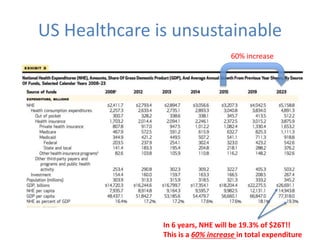
US Healthcare is unsustainable
In 6 years, NHE will be 19.3% of $26T!!
This is a 60% increase in total expenditure
60% increase
What is Medicare?
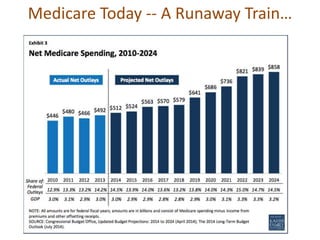
Medicare Today -- A Runaway Train…
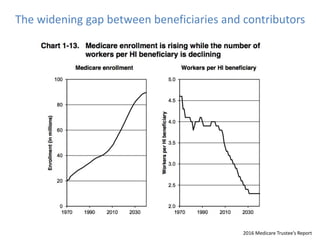
The widening gap between beneficiaries and contributors
2016 Medicare Trustee’s Report
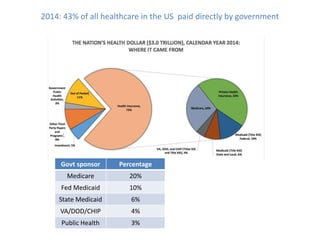
2014: 43% of all healthcare in the US paid directly by government
Govt sponsor Percentage
Medicare 20%
Fed Medicaid 10%
State Medicaid 6%
VA/DOD/CHIP 4%
Public Health 3%
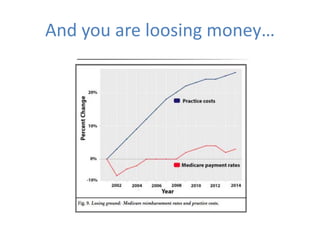
And you are loosing money…
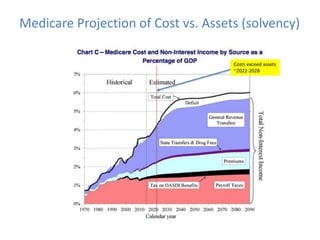
Medicare Projection of Cost vs. Assets (solvency)
Costs exceed assets
~2022-2028
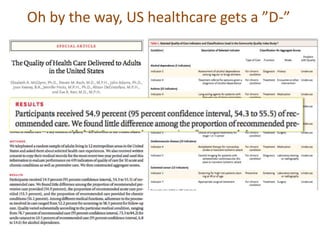
Oh by the way, US healthcare gets a ”D-”
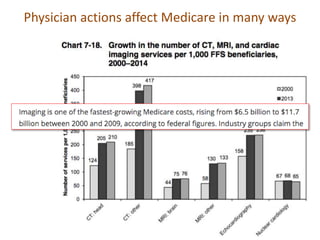
Physician actions affect Medicare in many ways
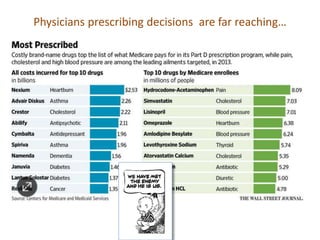
Physicians prescribing decisions are far reaching…
Question 2
Why is MACRA here and
what is it exactly?
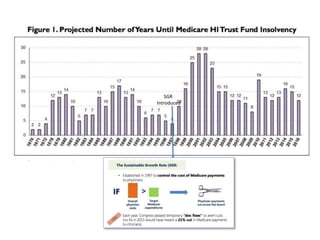
SGR
Introduced
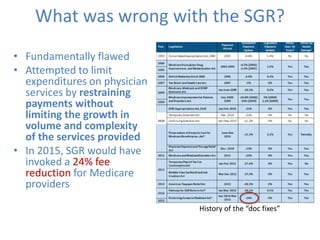
What was wrong with the SGR?
• Fundamentally flawed
• Attempted to limit
expenditures on physician
services by restraining
payments without
limiting the growth in
volume and complexity
of the services provided
• In 2015, SGR would have
invoked a 24% fee
reduction for Medicare
providers
History of the “doc fixes”
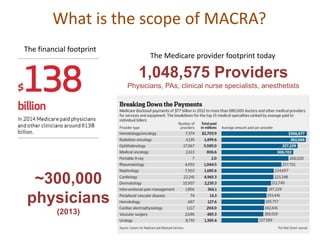
What is the scope of MACRA?
The financial footprint
1,048,575 Providers
Physicians, PAs, clinical nurse specialists, anesthetists
The Medicare provider footprint today
~300,000
physicians
(2013)
The Importance of MACRA and beyond
 MACRA is the ‘start’ of an evolution towards value
based purchasing
 Value-based reimbursement requires managing
patients across multiple providers -- requires data
exchange between EHR systems
 Value-based reimbursement increases the need for
your organization to know where it stands
 High quality clinical care data
 Health analytics
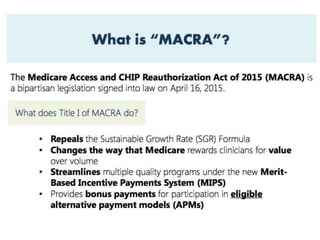
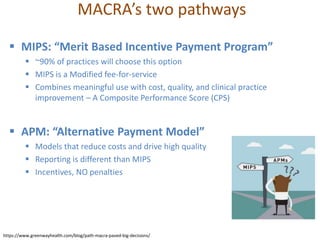
MACRA’s two pathways
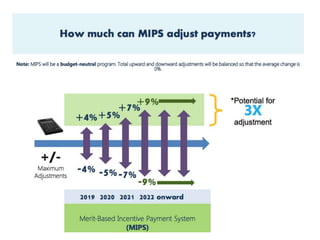
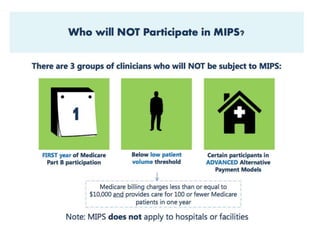
 MIPS: “Merit Based Incentive Payment Program”
 ~90% of practices will choose this option
 MIPS is a Modified fee-for-service
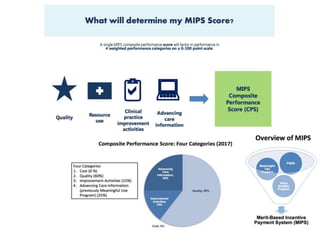
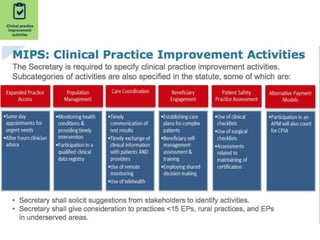
 Combines meaningful use with cost, quality, and clinical practice
improvement – A Composite Performance Score (CPS)
 APM: “Alternative Payment Model”
 Models that reduce costs and drive high quality
 Reporting is different than MIPS
 Incentives, NO penalties
https://www.greenwayhealth.com/blog/path-macra-paved-big-decisions/
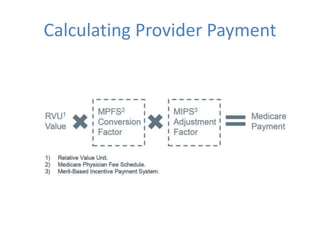
Calculating Provider Payment
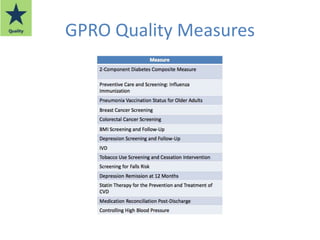
GPRO Quality Measures
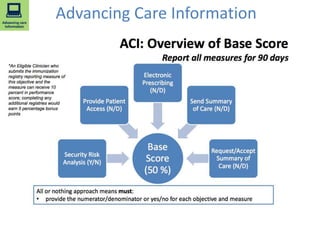
Advancing Care Information
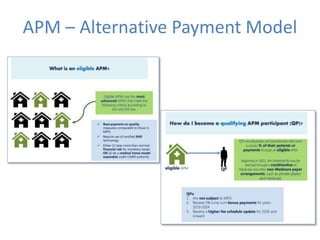
APM – Alternative Payment Model
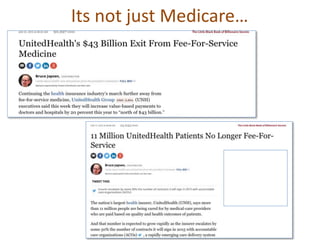
Its not just Medicare…
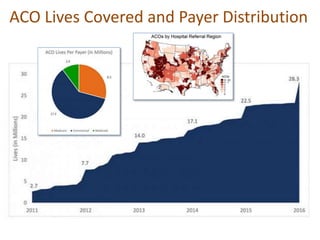
ACO Lives Covered and Payer Distribution
Question 3
Why does data quality
matter?
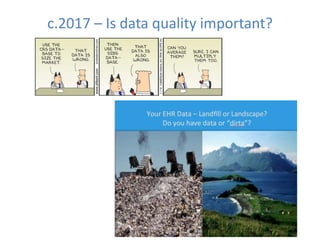
c.2017 – Is data quality important?
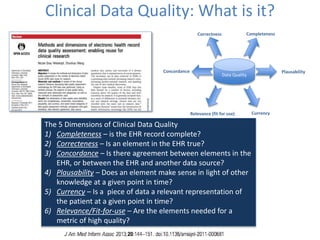
Clinical Data Quality: What is it?
The 5 Dimensions of Clinical Data Quality
1) Completeness – is the EHR record complete?
2) Correcteness – Is an element in the EHR true?
3) Concordance – Is there agreement between elements in the
EHR, or between the EHR and another data source?
4) Plausability – Does an element make sense in light of other
knowledge at a given point in time?
5) Currency – Is a piece of data a relevant representation of
the patient at a given point in time?
6) Relevance/Fit-for-use – Are the elements needed for a
metric of high quality?
Data Quality
CompletenessCorrectness
Concordance Plausability
Relevance (fit for use) Currency
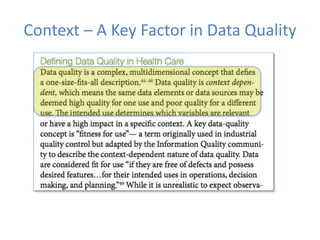
Context – A Key Factor in Data Quality
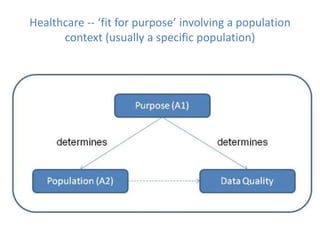
Healthcare -- ‘fit for purpose’ involving a population
context (usually a specific population)
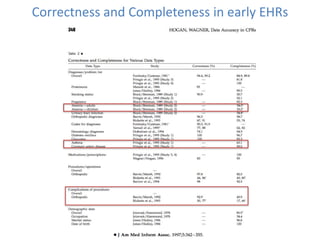
Correctness and Completeness in early EHRs
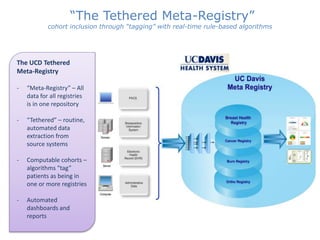
“The Tethered Meta-Registry”
cohort inclusion through “tagging” with real-time rule-based algorithms
The UCD Tethered
Meta-Registry
- “Meta-Registry” – All
data for all registries
is in one repository
- “Tethered” – routine,
automated data
extraction from
source systems
- Computable cohorts –
algorithms “tag”
patients as being in
one or more registries
- Automated
dashboards and
reports
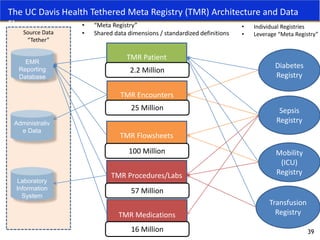
• “Meta Registry”
• Shared data dimensions / standardized definitions
Sepsis
Registry
Mobility
(ICU)
Registry
Diabetes
Registry
Transfusion
Registry
Source Data
“Tether”
EMR
Reporting
Database
Administrativ
e Data
Laboratory
Information
System
TMR Patient
TMR Encounters
TMR Flowsheets
TMR Procedures/Labs
TMR Medications
• Individual Registries
• Leverage “Meta Registry”
39
The UC Davis Health Tethered Meta Registry (TMR) Architecture and Data
Flow
2.2 Million
25 Million
100 Million
57 Million
16 Million
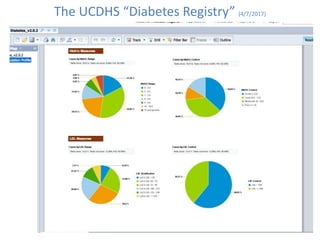
The UCDHS “Diabetes Registry” (4/7/2017)
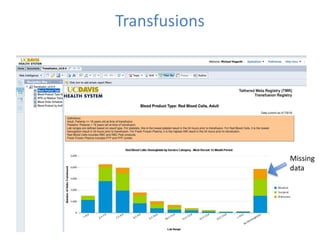
Transfusions
Missing
data
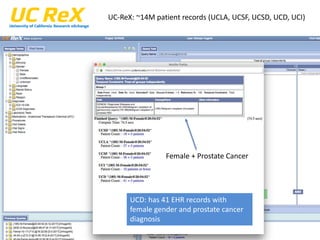
Female + Prostate Cancer
UC-ReX: ~14M patient records (UCLA, UCSF, UCSD, UCD, UCI)
UCD: has 41 EHR records with
female gender and prostate cancer
diagnosis
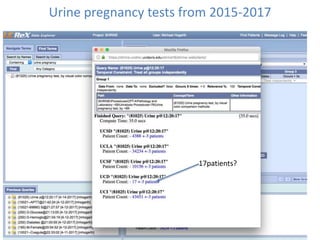
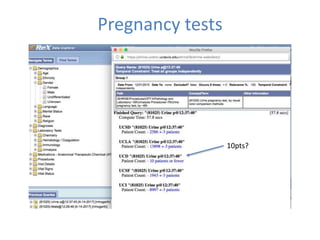
Urine pregnancy tests from 2015-2017
17patients?
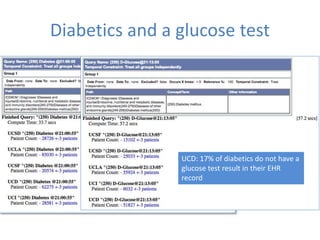
Diabetics and a glucose test
UCD: 17% of diabetics do not have a
glucose test result in their EHR
record
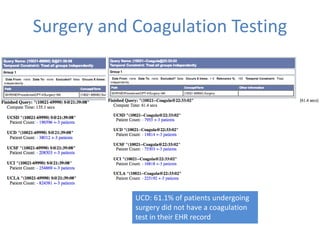
Surgery and Coagulation Testing
UCD: 61.1% of patients undergoing
surgery did not have a coagulation
test in their EHR record
Pregnancy tests
10pts?
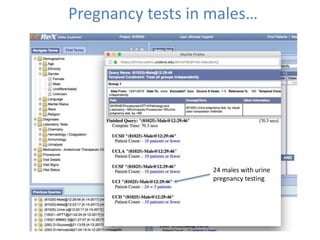
Pregnancy tests in males…
24 males with urine
pregnancy testing
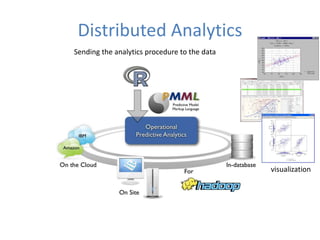
Distributed Analytics
Sending the analytics procedure to the data
visualization
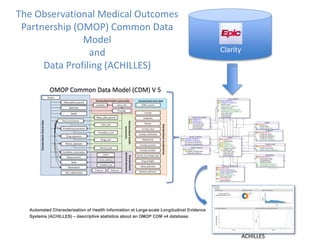
Clarity
The Observational Medical Outcomes
Partnership (OMOP) Common Data
Model
and
Data Profiling (ACHILLES)
ACHILLES
What is Data Profiling?
• Systematic and generalizable method of
data quality assessment
• Can you answer the following questions
– Does your organization have a clinical data
repository?
– Does the group that manages this
repository implement data profiling in any
way?
– What kind of skill sets are required for a
group to optimally perform good data
profiling?
Aim of Research
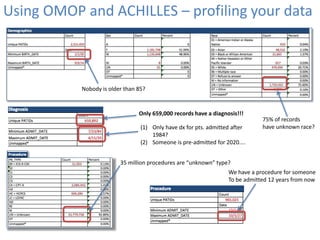
Using OMOP and ACHILLES – profiling your data
75% of records
have unknown race?
Nobody is older than 85?
(1) Only have dx for pts. admitted after
1984?
(2) Someone is pre-admitted for 2020....
35 million procedures are “unknown” type?
We have a procedure for someone
To be admitted 12 years from now
Only 659,000 records have a diagnosis!!!
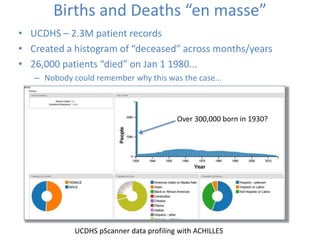
Births and Deaths “en masse”
• UCDHS – 2.3M patient records
• Created a histogram of “deceased” across months/years
• 26,000 patients “died” on Jan 1 1980...
– Nobody could remember why this was the case...
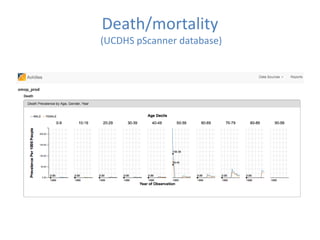
UCDHS pScanner data profiling with ACHILLES
Over 300,000 born in 1930?
Death/mortality
(UCDHS pScanner database)
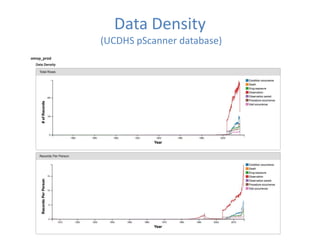
Data Density
(UCDHS pScanner database)
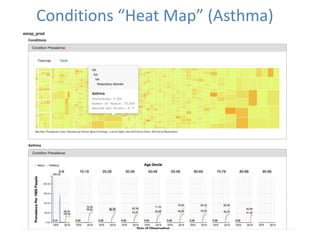
Conditions “Heat Map” (Asthma)
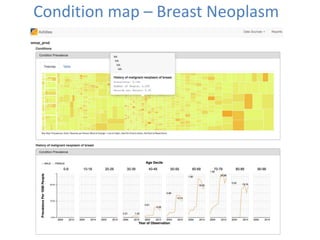
Condition map – Breast Neoplasm
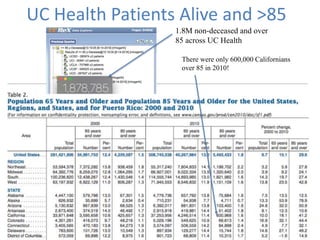
UC Health Patients Alive and >85
There were only 600,000 Californians
over 85 in 2010!
1.8M non-deceased and over
85 across UC Health
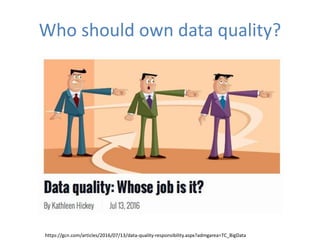
Who should own data quality?
https://gcn.com/articles/2016/07/13/data-quality-responsibility.aspx?admgarea=TC_BigData
Eastern Sierras
“The Range of Light”

Data Quality Matters: EHR Data Quality, MACRA, and Improving Healthcare

  • 1.
    DATA QUALITY MATTERS:EHR DATA QUALITY, MACRA, AND IMPROVING HEALTHCARE 2017 Michael Hogarth, MD, FACP, FACMI Professor, Internal Medicine Professor and Vice Chair, Dept. of Pathology and Laboratory Medicine http://hogarth.ucdavis.edu mahogarth@ucdavis.edu
  • 2.
    Summary Three Fundamental Questions: How is Medicare doing today?  Why is MACRA here (and what is it exactly)?  Why does clinical data quality matter?
  • 3.
    Question 1 How isMedicare doing today?
  • 4.
    US Healthcare isunsustainable In 6 years, NHE will be 19.3% of $26T!! This is a 60% increase in total expenditure 60% increase
  • 5.
  • 6.
    Medicare Today --A Runaway Train…
  • 7.
    The widening gapbetween beneficiaries and contributors 2016 Medicare Trustee’s Report
  • 8.
    2014: 43% ofall healthcare in the US paid directly by government Govt sponsor Percentage Medicare 20% Fed Medicaid 10% State Medicaid 6% VA/DOD/CHIP 4% Public Health 3%
  • 9.
    And you areloosing money…
  • 10.
    Medicare Projection ofCost vs. Assets (solvency) Costs exceed assets ~2022-2028
  • 11.
    Oh by theway, US healthcare gets a ”D-”
  • 13.
    Physician actions affectMedicare in many ways
  • 14.
  • 15.
    Question 2 Why isMACRA here and what is it exactly?
  • 16.
  • 17.
    What was wrongwith the SGR? • Fundamentally flawed • Attempted to limit expenditures on physician services by restraining payments without limiting the growth in volume and complexity of the services provided • In 2015, SGR would have invoked a 24% fee reduction for Medicare providers History of the “doc fixes”
  • 19.
    What is thescope of MACRA? The financial footprint 1,048,575 Providers Physicians, PAs, clinical nurse specialists, anesthetists The Medicare provider footprint today ~300,000 physicians (2013)
  • 20.
    The Importance ofMACRA and beyond  MACRA is the ‘start’ of an evolution towards value based purchasing  Value-based reimbursement requires managing patients across multiple providers -- requires data exchange between EHR systems  Value-based reimbursement increases the need for your organization to know where it stands  High quality clinical care data  Health analytics
  • 21.
    MACRA’s two pathways MIPS: “Merit Based Incentive Payment Program”  ~90% of practices will choose this option  MIPS is a Modified fee-for-service  Combines meaningful use with cost, quality, and clinical practice improvement – A Composite Performance Score (CPS)  APM: “Alternative Payment Model”  Models that reduce costs and drive high quality  Reporting is different than MIPS  Incentives, NO penalties https://www.greenwayhealth.com/blog/path-macra-paved-big-decisions/
  • 25.
  • 26.
  • 28.
  • 29.
    APM – AlternativePayment Model
  • 30.
    Its not justMedicare…
  • 31.
    ACO Lives Coveredand Payer Distribution
  • 32.
    Question 3 Why doesdata quality matter?
  • 33.
    c.2017 – Isdata quality important?
  • 34.
    Clinical Data Quality:What is it? The 5 Dimensions of Clinical Data Quality 1) Completeness – is the EHR record complete? 2) Correcteness – Is an element in the EHR true? 3) Concordance – Is there agreement between elements in the EHR, or between the EHR and another data source? 4) Plausability – Does an element make sense in light of other knowledge at a given point in time? 5) Currency – Is a piece of data a relevant representation of the patient at a given point in time? 6) Relevance/Fit-for-use – Are the elements needed for a metric of high quality? Data Quality CompletenessCorrectness Concordance Plausability Relevance (fit for use) Currency
  • 35.
    Context – AKey Factor in Data Quality
  • 36.
    Healthcare -- ‘fitfor purpose’ involving a population context (usually a specific population)
  • 37.
  • 38.
    “The Tethered Meta-Registry” cohortinclusion through “tagging” with real-time rule-based algorithms The UCD Tethered Meta-Registry - “Meta-Registry” – All data for all registries is in one repository - “Tethered” – routine, automated data extraction from source systems - Computable cohorts – algorithms “tag” patients as being in one or more registries - Automated dashboards and reports
  • 39.
    • “Meta Registry” •Shared data dimensions / standardized definitions Sepsis Registry Mobility (ICU) Registry Diabetes Registry Transfusion Registry Source Data “Tether” EMR Reporting Database Administrativ e Data Laboratory Information System TMR Patient TMR Encounters TMR Flowsheets TMR Procedures/Labs TMR Medications • Individual Registries • Leverage “Meta Registry” 39 The UC Davis Health Tethered Meta Registry (TMR) Architecture and Data Flow 2.2 Million 25 Million 100 Million 57 Million 16 Million
  • 40.
    The UCDHS “DiabetesRegistry” (4/7/2017)
  • 41.
  • 42.
    Female + ProstateCancer UC-ReX: ~14M patient records (UCLA, UCSF, UCSD, UCD, UCI) UCD: has 41 EHR records with female gender and prostate cancer diagnosis
  • 43.
    Urine pregnancy testsfrom 2015-2017 17patients?
  • 44.
    Diabetics and aglucose test UCD: 17% of diabetics do not have a glucose test result in their EHR record
  • 45.
    Surgery and CoagulationTesting UCD: 61.1% of patients undergoing surgery did not have a coagulation test in their EHR record
  • 46.
  • 47.
    Pregnancy tests inmales… 24 males with urine pregnancy testing
  • 49.
    Distributed Analytics Sending theanalytics procedure to the data visualization
  • 50.
    Clarity The Observational MedicalOutcomes Partnership (OMOP) Common Data Model and Data Profiling (ACHILLES) ACHILLES
  • 51.
    What is DataProfiling? • Systematic and generalizable method of data quality assessment • Can you answer the following questions – Does your organization have a clinical data repository? – Does the group that manages this repository implement data profiling in any way? – What kind of skill sets are required for a group to optimally perform good data profiling? Aim of Research
  • 52.
    Using OMOP andACHILLES – profiling your data 75% of records have unknown race? Nobody is older than 85? (1) Only have dx for pts. admitted after 1984? (2) Someone is pre-admitted for 2020.... 35 million procedures are “unknown” type? We have a procedure for someone To be admitted 12 years from now Only 659,000 records have a diagnosis!!!
  • 53.
    Births and Deaths“en masse” • UCDHS – 2.3M patient records • Created a histogram of “deceased” across months/years • 26,000 patients “died” on Jan 1 1980... – Nobody could remember why this was the case... UCDHS pScanner data profiling with ACHILLES Over 300,000 born in 1930?
  • 54.
  • 55.
  • 56.
  • 57.
    Condition map –Breast Neoplasm
  • 58.
    UC Health PatientsAlive and >85 There were only 600,000 Californians over 85 in 2010! 1.8M non-deceased and over 85 across UC Health
  • 59.
    Who should owndata quality? https://gcn.com/articles/2016/07/13/data-quality-responsibility.aspx?admgarea=TC_BigData
  • 60.

Editor's Notes

  • #40 The TMR layer represents both raw and derived data. The derived data is the big value add. For example, each encounter is classified as a result of several raw data points. After this derivation, each patient record can be summarized with the number of classified events per time window.